

Just yesterday, a fabulously thoughtful young man, who has done more solid theological study than most, and keeps up with his role in a Reformed, evangelical congregation by offering leadership among youthful friends, sharing their pain and pointing them to the deeper things of God, came in the store with a very heavy heart. I, too, was not in the best frame of mind and the two of us just felt the weight of the world. We pondered how books might help kids catch a bigger glimpse of the Story of God, how a Christian worldview might impact the lives of his young friends, how the postmodern times of the new century might shape the development of his youth as they eventually mature into long term disciples of Christ. Being a faithful Christian–engaged in the real world, but not of it–is never easy. It certainly isn’t easy now.
And so, this good, good guy needs help. We all need help, of course, but those who work with younger folk—from the goofy tweeners to the hipster collegiates–need all the faithful assistance we can find. And, to be honest, some of our churchy literature is just a bit too shallow, can’t stand up to the needs of my friend and his youth group.
There has been a recent renaissance of thoughtful youth ministry stuff. You may have read in my monthly book review column a few years back my claim that The God Bearing Life was a paradigm-shifting book, and that youth ministry studies will never be the same. My little prediction has come true, as newer authors have called for a spirituality of youth ministry; books like Tony Jones’ Soul-Shaping offer exercises in prayerfulness and serious studies like Christian Smith’s Oxford University Press book, Soul Searching, lament that teens have a sadly thin vocabulary about God. Everyone knows we have to help kids experience Christ in classic ways, to not just have zany programs and light-weight lessons, but to help them dig deep into spirituality and inner character.
ONE OF THE MOST IMPORTANT BOOKS among this recent great batch of books for youth workers, parents or pastors affirms the need for serious-minded and mature Christian disciple-making but doesn’t slide into trendy teen monasticism. It insists that we must take the world and ethos of the high school sub-culture(s) seriously. Engaging the Soul of Youth Culture: Bridging Teen Worldviews and Christian Truth by Walt Mueller (IVP) suggests that before we reach today’s youth with the truth of the gospel, we need to see what they see and hear what they hear. We need to catch the messages encrypted in their culture and understand what’s really being communicated.
The best names of evangelical youth writers have uniformly affirmed Walt’s work with the central Pennsylvania Center for Parent and Youth Understanding. It is a ministry you should know, with great resources, articles, web stuff, media literacy tools, etc. Walt has been a great friend of Hearts & Minds and is an excellent promoter of worldviewish Christian reading. He knows the importance of books and he loves relating serious truth to real teens, and those who work with them—parents, youth workers, school teachers and counselors. He is as a reliable writer as anyone in this field. His new book may be his most important work and is certainly the most significant book of its kind. We are proud to have been privileged to get an early copy of this vital work, and are excited to announce its brand new release. I will tell you more about it soon.
Engaging the Soul of Youth Culture: Bridging Teen Worldviews and Christian Truth Walt Mueller (IVP) $17.00
Category Archives: BookNotes
The Hidden Power of Electronic Culture

After my little ad deconstruction contest, inspired by my juxtaposition of Sam Van Eman’s book, On Earth As It Is In Advertising and the super-bowl ads, I felt like it was an excellent time to do a bitter of commercial hype (if you don’t get the allusion, you’re not paying attention) for a very important new book. Just the description of this book should set you a-quakin’ and we should be very glad for books such as this.
The Hidden Power of Electronic Culture: How Media Shapes Faith, The Gospel and the Church is by Shane Hipps (Zondervan) $18.99. Hipps is the pastor of a Mennonite Church (which describes itself as missional, urban, and Anabaptist.) He has worked in advertising so he knows that world from the inside; his Anabaptist vision gives him the principled scruples to say no to some stuff. My hunch is he takes Romans 12:1-2 more seriously than most and, if this makes sense to you, this book ought to have been published by Brazos.
Still, with a forward by Brian McLaren, and blurbs from Len Sweet and Doug Pagitt, all insisting that traditionalists and emergent folk need to hear this warning about the dangers of a faith that is overly shaped by the forms and values of media, it seems that this book is aimed firstly at the emergent community. The emergent conferences, I’ve been told, went from hyped mediated to less so, and the visual circus atmosphere proved so surreal that even the hipsters complained. So, perhaps this book is a natural evolution of the kinds of cultural discernment that is happening amongst the emerging generation.
I wonder if the less postmodern and more typical “contemporary” services–ordinary folks who are just now getting around to using PowerPoint— might need it more. I think this book is going to help many sorts of congregations.
Two themes seem to animate this book: Marshal McLuhan’s theories (“the medium is the message” you know) and the notion that the local church must embody real, daily practices that show and give flesh to the realities of the reign of God. It is not against media although it invites us to think seriously about it’s role and the implications of it all (read the wonderful section about media in Marva Dawn’s powerful and important Is It a Lost Cause: Having the Heart of God for the Church’s Children for one good prophetic word against the electronic culture.)
I think this new study of the broader impact of technology and the call for communities of faith to be reflective, informed by McLuhan, could be very, very helpful for any kinds of congregations. Just as Quentin Schultze’s Habits of the High-Tech Heart ask individuals to attend to the spiritual virtues needed in our hot-wired, e-culture, and his High-Tech Worship? invites worship teams to be discerning and balanced in using presentational technologies in worship, The Hidden Power of Electronic Culture invites us all, as individuals, families, parachurch groups and congregations, to be wise in discerning how the media shapes us all, and may erode the very truth of the gospel we profess.
As Sweet says on the back, “In the ancient tradition of the ‘jeremiad’, this book issues a wake-up call to the traditional church and a warning to the emerging church—remember the rock from whence you were hew, or else be invisibly mutilated by media.”
The Hidden Power of Electronic Culture: How Media Shapes Faith, The Gospel, and The Church Shane Hipps (Zondervan) $18.99
Super Bowl Free Book contest

I wanted to post this days ago, but my youngest daughter—Marissa, age 13—was in the hospital. She has had chronic pain issues for a couple of years now, and this latest episode was a hard one. So I got behind in the blogging plans.
Still, here’s our offer. It’s gonna be fun, and it gives us an excuse to give away a free book or two. My good bud Sam Van Eman has written (as I hope you know by now since I have cited it here, and named it in my December Best Books of the Year column at our website) the great little guide to cultural discernment, On Earth As It Is In Advertising: Moving From Commercial Hype to Gospel Hope (Brazos Press; $14.99.) In it he not only affirms God’s good gift of stuff, and the artistic and human qualities of good and wholesome advertising of said stuff (this is a good world, after all), but he also goes after the ubiquitous commercialization of everything and how advertising can be deforming. He explores the dangers of consumerism and helps us “see through” the assumptions and values in typical advertising. Crass materialism, though, is just the tip of the iceberg—Sam helps us discern other values and worldviews that are implicit in the stories advertising tells. He gives spiritually-shaped insight into how to critique the messages found in ads and invites communal discussion about how to have a Christian worldview solid enough to not only understand the deeper views that come through the ads but how to resist them. It is a book that we all—unless you live in a cave–really need. And we really need it this month.
Over the next week, offices, dorms and dinner tables will be full of talk about which Super Bowl ads were most enjoyable, clever, fun. Last year we even went to websites and reviewed some of them as we talked about them as a family. I must say, though, that as much as we are committed to an “in the world but not of it” sense of righteous cultural engagement, we didn’t get very far in discerning the deepest and most implicit ideologies of the best ads. We complimented the talent of the best, and moaned through those with explicit tackiness, sexism or crass vibes of hedonism. But the deep and discerning wisdom that Sam invites would have come in handy last year. Even if we are aware of this stuff, it is amazing how seductive these great ads can be in shaping our view of life, and our view of ourselves, our needs, our identity.
AND SO: we announce the first (and maybe last) Hearts & Minds Super Bowl Ad Discernment Contest. Write and post a brief (please!) paragraph or two offering some sort of ideological critique and cultural discernment as you “read” the ads offered during the Super Bowl today. The one or two (if more than two participate) that seem to show the kind of insight and evaluation that Sam commends will get a free copy of his book. We will send it out next week, no strings attached. If you’ve got it already, you can (obviously) give it away to someone who needs it. All of us live in this media-drenched, commercialized and global economy. How can we live up to our high calling in Christ to be people who are prophetic and resistant to the ways of the world? How can we move “from comercial hype to gospel hope”? Maybe On Earth As It Is In Advertising can help. Get your free one by offering your take— not necessarily on your favorite ad, but the one you are best able to evaluate and offer some faith-based cultural criticism about. Have fun. We’re eager to see if anybody posts anything. The free book awaits.
an excerpt from The Rest of God
Today I started the new book by Mark Buchanan, author of the well-written Your God Is Too Safe and a few others that we stock and that look quite good. The new one is called, delightfully, The Rest of God: Restoring Your Soul By Restoring Sabbath (Word) $17.99. I don’t know what more can be said about sabbath—I’ve read several, and they are all really inspiring—but the remarkable endorsements on this one, and his past good work made me want to glory in this one for a while. A rainy Sunday, kids off to church youth group, me nursing an awful cold.
The preface has a very nicely written telling of his memory growing up with cats; fun, and very evocative. He describes watching them in their catnaps, and continues:
I learned to join them, the cats in their cradles of sunlight. I curled up or sprawled out beside them and catnapped too. It had a unique power to replenish. Fifteen, twenty minutes later, a shadow like a cool, dry hand edged up my flesh and nudged me awake. I stirred, set up, and went about the rest of my day fresly aware.
That image comes to mind when I think of Sabbath; a patch of sunlight falling through a window on a winter’s day. It’s a small yet ample chunk of space, a narrow yet full segment of time. In it, you can lie down and rest. From it, you can rise up and go—stronger, lighter, ready to work again with vigor and a clear mind. It is room enough, time enough, in which to relinquish all encumbrances, to act as though their existence has nothing whatsoever to do with your won. It is an invitation, at one and the same time, to empty yourself and fill yourself.
I am not a catnapper. I wake up dazed and ineffectual, embarassed by the drool on my shirt. But the image works as a pointer to part of what Sabbath is about. It helps me believe that a day apart is enough, that trusting God is safe and good, that we need not always be productive. I love his take on a classic Bible text in his next story, which begins,
In the book of Acts, Philip the evangelist meets a nobleman from Ethiopia. He’s the treasurer for Ethiopia’s queen, an important man on important business. He’s a man in such a hurry that he does his reading while racing along on his chariot, like someone checking his Palm Pilot for e-mails between phone calls and strategy meetings.
The Spirit prompts Philip to come alongside him. It is one of God’s strange works of choreography: the Ethiopian at that very moment is reading something from Isaiah, something that stirs in him wonder and hunger. It gives him a taste for something more…
In the beautiful Mary Oliver poem (The Swan) which opens the book there is a line about being “idle and blessed.” I hope your Sabbath was such.
Free of Charge

Miroslav Volf is a Yugoslavian born and raised theologian who now teaches at
His new one is now out, called Free of Charge and I have been itching to tell you about it. I’ve not gotten very far, yet, but it is beautiful. You may want to know it has been chosen by the always intersting Archbishop of Canterbury (Rowan Williams) as the 2006 official Lent book. I hope Episopalians this side of the pond buy it by the cases (not just because it is good, which it is, but because I love the thought of a liberal denomination supporting our more evangelical publishing friends at Zondervan, who have the US rights to this important work. I love a book that has a forward by Williams and a cover endorsement by John Ortberg!)
Volf here is breaking new ground, it seems, by rooting his reflections on social grace—the subtitle is “Giving and Forgiving in a Culture Stripped of Grace”—in the core of the Reformation teachings about the cross. (He is a Luther scholar, after all.) He interweaves stories, powerful stories, and takes us into the vivid times when forgiveness was given (and times when it was not.) It is gently written, but yet is at time intense. It is about big ideas and inner formation.
How can we be people who can be giving, truly giving, and how can we build a culture of grace? As it says on the back cover, “Volf draws from popular culture as well as from a wealth of literary and theological sources, weaving his rich reflections around the sturdy frame of Paul’s vision of God’s grace and Martin Luther’s interpretation of that vision. Blending the best of theology and spirituality, he encourages us to echo in our lives God’s generous giving and forgiving.” Not bad for Lent, or anytime, eh?
Free of Charge: Giving and Forgiving in a Culture Stipped of Grace Miroslav Volf (Zondervan) $12.99
BookNotes Blog
Special Discount
ORDER
saying you saw this here
and get this book for
$10.00
Why James Frey Doesn’t Get It Right
When my good friend Scott got me doing this blogging thing, I was, to say the least, suspicious. Alas, I’ve grown to love telling about new books, and really appreciate the feedback we’ve gotten. I was very clear, though, that my blogging experiment would need to be focused upon what I sense to be my calling: bookselling. Of course, for us, our effort to have good livelihood by being small business operators has an educational aspect. We have to tell folks, yep, even try to convince folks, that reading the titles we recommend would be a good thing. Obviuosly, we opened our shop to sell books— books we believe in, books that carry ideas, insights, enjoyment and challenge. Whether artful or prosaic, fiction or nonfiction, children’s or adult’s, we want to make our living telling people about books. And so, we do our annotations and reviews, tell of our Dallastown shop, invite you into our circle of supporters and try to cheerlead for our work without sounding too self-indulgent.
To wit: I promised myself that I would not opine about other stuff here, as much as I may want to. Of course, in the shop we talk about all sorts of current issues and I write occasionally to the local papers. I regularly have hefty discussion on email with friends, folks I don’t know, even authors and the occasional enemy. Here, though, I want to be about the books.
Because of this desire for focus, I also do not use this as a forum to tell you about other good blogs (although I’ve got some great friends who write), websites or op-ed pieces that I’ve seen.. I would guess you have plenty to read and that you visit blogs and sites more thorough than this one. So forgive me if I haven’t mentioned your favorite blogster or haven’t linked you to the many sites that revolve around the books and topics I’ve reviewed.
I would guess you know where this is going, though: I’m going to break my rule and send you a link, a link to an essay that I found exceptionally well-written, very moving, and important to the genre of literature I so admire, that of memoir. As you may know, there has been a firestorm of controversy and media appearances in recent weeks around the alleged dishonesty of the now-famous and hugely popular Oprah book of last year, A Million Little Pieces. We stock this book and have been moved by James Frey’s creative prose, intense descriptions of his horrible journey into and out of brutal drug and alcohol abuse. It is not a book for the faint of heart, and although we find his humanistic self-dependency to be unsustainable (intellectually or experientially) it is a window into the dark side of the human experience.
Below is a link to a brilliant piece written by a woman who never trusted Frey’s book, dislikes his style, and shares how she–who sweated blood to tell her story honestly—resents his cavalier attitude about the facts of his life. It is the best thing I’ve seen on this particular debate and a moving tribute to all those who do memoir well. King’s essay (orginally in Publishers Weekly) has made me want to read her book, Parched, which is her own memoir of recovery from alcoholism. Anybody else know of it? We have it for those who are, as I was, moved by her brief essay.
Please click here to read Why James Frey Doesn’t Get It Right by Heather King. I hope you appreciate her clarity and care and integrity, even if you may not agree fully with her critique of Frey.
Eat This Book
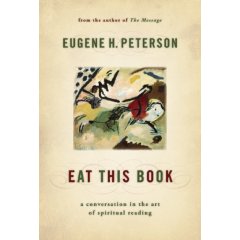
You may recall that in our December year end awards list we proclaimed that Eugene Peterson’s Christ Plays In Ten Thousand Places was the book of the year. You may also recall that when I did a full review of it a few months back, we explained that it was the major volume in a series of spiritual theology books he intends to do.
I don’t want to overstate my hype by calling it the publishing event of the year, but the slim second volume (with very cool matching cover, except a different painting on the front) is now out.
Eat This Book: A Conversation in the Art of Spiritual Reading is the provocative title, which comes from two texts where two characters(Ezekial and John the Revelator) who are told to eat the scroll they were reading/writing. As you may guess, this book is about spiritual reading, lectio divina and how to allow the printed page to become living Word in our lives. I have heard Peterson’s lectures on this (we stock many of the lectures from Regent bookstore in British Columbia, where he used to teach.) Having heard him carefully invite us to this kind of deep and attentive reading, I cannot tell you how badly I want to sit and read this book. And, like most of you, I need not tell you how busy I am, and how hard it will be to find time to steal away anytime soon.
So, look for further discussion about this important new book later. For now, rejoice that it is out, offer glad praise for Eerdmans publishing, and pray for Peterson. (He has others to write in this series, and a forthcoming title on NavPress coming next month.) And pray for all of us, that we may be those who understand the role of reading as a spiritual discipline. May this book help us to that end.
Eat This Book: A Conversation in the Art of Spiritual Reading Eugene Peterson (Erdmans) $20.00
BookNotes BLOG SPECIAL
Order here (or phone in and tell us you saw my mention of it) and get
10% OFF
and
FREE SHIPPING.
God Between the Covers

I’ve been a bit less bloggish lately, what with the Penn State bowl game—Beth made fondue and we ate around the TV!—and then the next evening’s Rose Bowl game. I was exhausted for days! And this from a fellow who rarely watches sports. My beloved is a Penn State fan, though, and JoePa is quite the icon around here. So it was a good couple of evenings, with no muse for book reviewing showing up anywhere.
But now, I’ve been struck. I have been ignoring a book for months because I knew once I picked it up, I would read it in nearly one sitting. The feared paperback is by an author who I want to know, and, truly, I’ve oddly avoided this little book. And it is true: once I opened this thing, I was hooked. Marcia Ford, who wrote with such charm in Memoirs of a Misfit: Finding My Place in the Family of God about her journey into and out of various streams of evangelical faith and charismatic renewal, is the author, and the book is a basically her spiritual memoir by way of the books she loves. It is called God Between the Covers: Finding Faith Through Reading (Crossroad; $19.95.) I suspect I may blog a bit about this again, because there is much to appreciate here and she may be my new patron saint. She tells of various stages in her faith journey, how thrilled (or rescued or enlightened or glad) she was upon discovering certain authors. Her reviews are not substantial but—rather like my style here–she tries to get at the heart of the book, why it is important, what it means to her, and why you should consider it. These are not New York Review of Books essays or Books & Culture pieces or critiques of the sort one would find at the New Pantagruel. They are brief, whimsical, autobiographical. But–with a few minor exceptions (hey grant the girl her taste)– she is dead on.
Where else do you find reviews of authors such as Thomas a Kempis and Anne Lamot (in an essay about why so many popular authors she likes have names like Anne, Ann, Annie), Francis & Edith Schaeffer and Basic Pennington; Oswald Chambers and Fyodor Dostoyevsky; Wendell Berry and Sheldon Vanauken? And a piece on Bruce Cockburn?? Ms Ford co-wrote a pretty nice book on Dylan, too, by the way (Restless Pilgrim released by relevant) so Zimmy is the other musician whose work is granted an entry here.
Her introductory chapter is a wonderful autobiographical reflection on her love of books, her addiction to book buying, her experience with bad schools and good authors, her book-cluttered house with stacks of books everywhere. I love it! Her later reflections include very brief reviews of serious theologians (Rowan Williams, say) social criticism (the black lit of the ’60’s like Malcolm X, James Baldwin and King, or the emergent church movement seen in Len Sweet or Brian McLaren) plenty of wonderful novels, provocative kids books, spiritual formation stuff (from the obvious like Brennen Manning, Richard Foster, Henri Nouwan to important lights such as Merton or Keating.) Each make this just the kind of book I would love to have our customers have.
There are some important things missing that are important to us (she does list my old housemate Bill Romanowski and his must-read book Eyes Wide Open: Finding God in Popular Culture so there is at least a nod to the neo-Calvinist world and life view approach of distinctive cultural engagement) and despite her often-mentioned disillusionment with simple answers of the Christian right, she doesn’t describe books by authors like Sider, Wallis, Perkins and the ESA orbit, let alone Berrigan, Stringfellow, Ellul or Yoder. Other key books that I would hope she knows by Os Guinness, certainly, or James Sire, even haven’t apparantly helped her along the way they did me.
Her mini-reviews of novels—Peace Like a River, A Separate Peace, Life of Pi, Poisonwood Bible, just for instance—are splendid, but how could she leave out…or…well, you get the picture.
Her love of books is contagious. Her descriptions are delightful. Her odd little observations—the poor print job of Merton’s No Man Is An Island or how she confuses a Robert Frost poem and a particular James Taylor song, or how Oswald Chambers could have single-handedly put an end to the “marlarkey” of recent tele-evangelists—is a hoot and a half. The way in which she tells of her own life as she tells of these books helps me recall not only why I love books, but why we sell ’em. Get this book for every church library or ministry resource-center you know. Use it as a guide if you feel a bit uninformed, or pass it on to those who would be blessed by it.
If I can add my own not-so-quirky observation: as a thin paperback, it seems a bit overpriced.* And the cover with the slightly open lap top tenting over a book is too symbolic for its own good. Still: this is a book I wish I could have described in my book of the year listings last month. It is that good. Consider it awarded.
*TO OVERCOME THIS MATTER, BookNotes here offers a blogsite discount. Email us at read@heartsandmindsbooks.com or use our order form here, and we will give you a 25% off discount. The regular price is $19.95 is—for you, dear booklover—$15.00. Happy Reading.
Years-End Best Books Awards from Hearts & Minds: Break Out the Spinny Tin Things
It was just a few posts ago that we referred you to the recent Hearts & Minds website that listed, in our November monthly column, our description of the best of the landslide of Narnia-related books. I have no cynicism about this recent publishing trend and many of these Lewis bios and Narnia studies are really quite good. We hope that we helped renew your interest in Kilny stuff and trust it was worth reading. Maybe your gang should host some post-movie LWW discussion groups or book clubs, using one or two of these as a resource.
NOW, we are very pleased to announce the Hearts & Minds End of the Year Best Book Awards. Check it out to see our website’s December column and see my picks for everything from the Best Really Big Fat Book I Read This Year (and it wasn’t 1776 which was almost fat enough to count, but I haven’t read yet anyway) to a celebration of the year’s best re-issues; I awarded some odd little picks about good books with bad covers, and named some of our favorite novels. Of course, there is “the” best book of the year; couldn’t name just one, natch, so there are a couple of runners up (or should that be runner-ups?) There’s even an Half-hearted Award for a popular topic about which I had huge ambivalence.
It is almost time to break out the spinny tin things you swing around and shake on New Year’s eve, or those little horns that uncurl those annoying paper tongues. You can warm ’em up here by tooting along for these H & M award winners. It may not be the New York Times or Christianity Today, but we are confident we have honored some truly important books. Anybody find any glaring misses? Want to add your favs? Come on, readers! What would you list?
O Holy Night
I am amazed at how often people note that they didn’t know about the third verse of the powerful song, O Holy Night. Sentimentality and the wonderful romance of the holiday has nearly gutted the radical edge of the coming Kingdom of God.
Written in the years as the abolitionist movement was heating up, it is solid gospel. Let us pray that those of us who sing this tonight will be graced to hear it well, and allow it to work God’s ways in us.
Truly He taught us to love one another
His law is love and His gospel is peace
Chains shall He break, for the slave is our brother,
And in His name all oppression shall cease.
Sweet hymns of joy in grateful chorus raise we,
Let all within us praise His holy name.
Chorus
Christ is the Lord, O praise His name forever!
His pow’r and glory evermore proclaim!
His pow’r and glory evermore proclaim!