
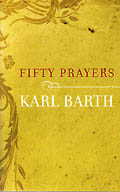
 I wanted to type this on Sunday, as I was using this new book in some sabbath reading, but just didn’t get to it. Even though it is a day late, now, I’d like to share that we now have this book of prayers written by Karl Barth, prayers never before translated into English. It is a very sweet and thoughtful little paperback simply called Fifty Prayers (Westminster/John Knox; $12.95.)
After noting that a colleague gave him an A in preaching and a D in liturgy, the famous theologian wrote this in the preface in 1962:
For a long time I never felt good when before and after my sermons I thought I should, or was allowed, to keep to the order of the usual liturgical books…I was disturbed by the lack of functional relationship, but also by the inorganic relationship between the archaic or even the modern language of these prayers and the language of my sermons. For a while, I sought help by replacing the petitions of the order of liturgy not with extemporaneous prayers ( I have never dared to risk such a thing), but with freely bringing together biblical passages from the Psalms. Only in more recent years did I begin to set forth such texts, first for the end and later for the beginning of the main part of the worship service, within the context of preparing for the sermons themselves.
Isn’t it interesting that in just a few generations we have even one of the century’s foremost preachers and theologians uncomfortable with conversational prayer in worship, to a time when liturgy in many Protestant churches has been so thoroughly contextualized to the commonplace and extemp, where nearly anyone can utter nearly anything? I am not overly fastidious about liturgical purity (even though some of my friends in our church’s contemporary service think I’m fussy) but it is evident that Barth has a certain gravity and thoughtfulness that is striking.
He continues, naming the considerations that guided him in writing these prayers.
The worship service, the center of the entire life of the community, must be presented as a whole, a whole of calling on the gracious God. Following the greeting of the community as the people of this God, the worship begins with the common singing, which I think is not seen as being as important as it truly is. It continues with the pronouncement of the community’s thanks, its penance, and its special petition for God’s presence and support in the special act of gathering for worship, by the member of the community who service as the leader of the action. It ascends to the sermon, in which the call to explanation and application of the Scripture passage (better short than long!) is spoken and proclaimed. From here, it descends to the final prayer, in which the proclamation of the sermon is briefly summarized (with a direct call to God), but in which the worship service is possibly opened, above all, as an outstretched petition to the outside, to all other people, to the rest of the church and the world (is this too often neglected?)
It doesn’t matter much to me whether you or I agree with his description or vocabulary here. I quote it because it shows his deep awareness of the flow, of the wholeness, of worship, and his description of the sermon being the highpoint reminds us of his regard for the Bible. He explains a few more elements of the service, including more singing and a final dismissal (apparently by a layperson) of blessing—again, this is for us as we serve the world. (His parenthetical question hangs still, over the decades, does it not?) This brief description calls us to that which constitutes meaningful worship. (He mentioned communion only in passing, but gives attention to the liturgical year.)
Anyway, these prayers were first written in the context of a whole worship service, and are tied to the sermons that the great man preached. (By the way, Regent College Press recently published two previously untranslated sermons of Barth’s, one on the 1912 sinking of the Titanic, under the title The Word in the World. ) At the conclusion of the forward to Fifty Prayers, Barth says he hopes that the prayers (each about a page long) may be useful for personal and private devotion, but also to inspire “consideration” among other worship leaders. It is an understated recommendation, fitting from a humble saint who understood God’s redemptive work in Christ in exceptional and awesome tones.
These stunning pastoral prayers mostly follow the liturgical calendar, but the rest are arranged thematically. They give us a glimpse of how the Swiss theologian practiced this huge Christian discipline and his rich words and cadences and theological depth can only help us, these days. Kudos to the publisher for making them freshly available to us.
These look wonderful, from my worship leader perspective. So often I struggle when praying with the congregation, that I find myself praying Psalms, other brief passages, even just breathing.
One day, I’ll have to read these.
Thanks, Byron.
Author-teacher-pastor Maxie Dunnam, in The Workbook of Intercessory Prayer, has this to say about Karl Barth on prayer:
“This great theologian insisted that prayer, or praying, is simply asking. Prayer is permitted and commanded to us as petition. The Lord’s Prayer is basically six petitions plus an address and doxology. Without question, Barth affirmed that our prayers are always answered, but he left room for discrepancy between the answer we receive and what we actually have asked. Barth was saying that God cleanses our prayers, using his wisdom in the answer we receive.”
– Maxie Dunnam, “Getting Intercession into Perspective” in The Workbook of Intercessory Prayer (Nashville, TN: The Upper Room, 1979) page 21.
Rex S. Wignall, United Methodist Clergy, Sun City, CA.
Thanks so much for offering this quote. We love Maxie Dunnam, and we think Barth is, obviously, very important. I recall a quote from Barth in a Richard Foster book something along the lines of praying is taking hold of the hand that hold history, or something Big and history-making. Thanks again.