Soul and the City, To Live in Peace, A Heart for Community and other books on urban life & ministry

On Sunday I will be visiting an exciting church plant in Baltimore, helping lead some conversations on being a church in the city.  I’ve been doing some reading on this (for decades, actually.) I’m helping plan an adult education series at my own downtown Presbyterian (USA) church that we will offer this fall.  There is such great literature on this, from mainline denominations and evangelical urban ministries, from historic black and Latino churches to new stuff reflecting on the broader questions of culture, cityscapes and a theology of place.  Call us if you want to talk further… 
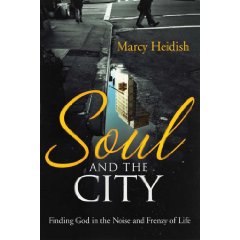
soul and the city.jpgOf the many I could write about, I have to tell you about one that I have finally gotten around to reading—oh, how I wished I had studied it when we received it earlier this year as I would have been promoting it with more vigor.  Soul and the City: Finding God in the Noise and Frenzy of Life by Marcy Heidish (Waterbrook; $13.99) is a small-ish paperback, wonderfully written, beautifully done, and is truly a book of spiritual formation.  Heidish is a great writer, cites fascinating sources to very good effect, weaving quotes and passages and illustrations seamlessly.  What is so delightful and helpful (praise be to God) is that she is so utterly ecumenical;  she will be citing Eastern Orthodox or Catholic classics like Anthony Bloom or Julian of Norwich and then tell us about A. W. Tozer;  she cites reformational scholar Richard Mouw and draws on Tilden Edwards and Evelyn Underhill.  She uses Richard Foster and Dallas Willard and Eugene Peterson, but, as a novelist herself, she knows how to use a great literary passages. I loved a passage she cited of Frederick Buechner that I had forgotten.  Her use of Spoon River Anthology when talking about the last days of her atheist father was poignant and powerful.  I want to watch Grand Canyon again, after her making note of one scene about the longing for community.

This sweet book celebrates the God of the mundane, the spirituality of the ordinary, the way incity street 2.jpg which classic spiritual disciplines can help us engage life, embrace culture, dig into our places and make a difference, especially in compassionate service to others.  Although some of her stories comes from her extensive work with homeless women, serving in shelters and community groups, much of this is just how to walk more faithfully with God when we are really, really busy, pressed and stressed.
Urban dwellers, she reminds us, have a constant sense of being pushed and shoved, of hurrying, of multi-tasking, of living in a swirl of noise and smells and possibilities, good and ill.  Her writing rings true as she talks about praying while waiting for a table at a crowded cafe, while being jammed into a too-full elevator, while breathing the fumes of diesel buses, while seeing the juxtaposition of the very well heeled and the poor. She uses screaming sirens as cues to silent intercession and she has allowed God to help her make contact with others, even on busy sidewalks. (Yes, she cites the most famous passage of mystic Thomas Merton, his epiphany of being one with everyone in that busy Louisville crosswalk.) 

downtown church.jpgShe describes her small prayerful escapes into the sanctuary of downtown churches, and she is (again) delightfully ecumenical.  I suppose she is Episcopalian or Catholic as she is so familiar with their liturgical architecture and sacred seasons.  Yet, she readily describes involvement in store-front missions and evangelical community churches;  she reads Jewish prayers and attends charismatic praise services.  Heidish gets around, has tons of urban and urbane experiences and tells her story with a light touch—there is no pride or over-wrought, larger-than-life stories.  Anyone who feels the fast pace of our high-tech world, who works in offices or commutes in exurbs, or who wonders how to be more sane within our secularized culture of power and politics, concrete and ether, noise and speed, will love her invitation to spiritual growth and inner peace, set precisely in the urban heart of our crazy times.  It isn’t about urban ministry, as such, but about contemplative practice while on the run, in the real world.

Happily, Heidish celebrates the city, too.  It is not all corruption, tension, and waste, grim and crime.  She savors the delights of the availability of various foods—she is attentive to the goodness of ethnic diversity—and art and expanding cultural horizons and diverse religious communities.  Yes, she writes tenderly about volunteering at a hospice or homeless shelter, but she also has friends in the financial industry, writes about wonderful penthouse vistas, and works, herself, as successful writer, in journalism, film and media.  (She won awards for doing the novel from which the Cicely Tyson movie A Woman Called Moses, was adapted.)  Her way with words is a blessing, making this book not only a blessed bit of wisdom, but a joy to read.

***
When I speak in Baltimore, I will surely have to highlight a few others.  Here are some.
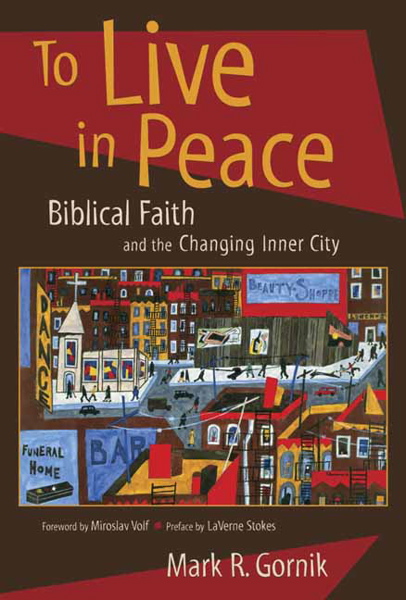
to live in peace.jpgTo Live in Peace: Biblical Faith and the Changing Inner City  Mark Gornick  (Eerdmans) $22.00  This is the best book on the subject, bar none.  Gornik tells of his years of work in Sandtown, the West Baltimore neighborhood where he moved, and the church that emerged.  This has the most profound theological orientation, the best and most energizing Bible study, and the best sociological insights of any urban ministry book on the market. Thoughtful and a bit demanding, it is the best.  Forward by Miroslav Volf.  Simply a must.

A Heart for the Community: New Models for Urban and Suburban Ministry  edited by John Fuder & Noel Castellanos (Moody Press) $34.99  The brand new collection of essays is an official publication of the esteemed CCDA (Christian Community Development Association) and it includes nearly 30 authors.  As Bob Lupton of Atlanta writes, “With cities gentrifying and poverty suburbanizing, the definitions and practices of urban ministry are changing.  A Heart for the Community is right on time.”  This includes some of the best evangelical practitioners in the nation, sharing fresh insights—very up to date!  There are other excellent anthologies of this sort;  we really recommend the one edited by the late Harvie Conn & Manuel Ortiz called Urban Ministry: The Kingdom, The City, and the People of God (IVP; $35.00.)  It is most likely the best one volume collection.  Highly recommended.

The Urban Christian: Effective Ministry in Today’s Urban World  Ray Bakke (IVP) $16.00   For a solid read, this book written in the 80s by a rural boy gone city,
is a fabulous little classic, a great place to start  I cannot tell you how I respect this guy and the reverberations of his decades in urban work.

Theirs is the Kingdom: Celebrating the Gospel in Urban America  Robert Lupton (Harper) $13.95  Tony Campolo writes, “The story of Lupton’s ministry is one of the most inspiring in America. Those of us who are trying to accomplish something of value in urban settings look to him and his co-workers as models.”  Passionate and stimulating, this is a great little classic, another that is excellent to start with;  the chapters are short, there are tons of stories, it is powerfully written. 

Sidewalks in the Kingdom: New Urbanism and the Christian Faith  Eric O. Jacobsen 
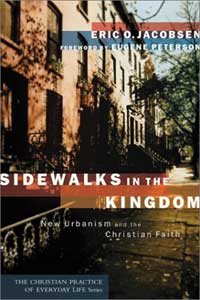
Sidewalks in the Kingdom.jpg (Brazos) $20.00  You may know of my love for James Howard Kunstler, the fiesty and brilliant writer who has popularized “new urbanism” in books like Home From Nowhere; his scathing critiques of the ugliness of our man-man landscapes are legendary.  Here, Jacobsen offers a very helpful, beginners contribution to how church folks can care about their towns–large or small–and how thinking about stuff as mundane as zoning and sidewalks, really matter in God’s good world.  My, my, if only folks paid attention to half of this, we’d have a more charming and sustainable and just built culture.  One need not be a city planner or architect to read this. Highly recommended.

Churches That Make a Difference: Reacing Your Community With Good News and Good Works  Ronald J. Sider, Philip N. Olson, Heidi Rolland Unruh (Baker) $21.99   Remarkable research was done among churches (in the Philadelphia area) that were doing truly wholisitic, faith-based, multi-dimensional urban ministry.  Some are historic minority churches, some are mainline denominational parishes, some are independent evangelical works.  From these truly effective congregations and their wholistic outreach, they drew principles and came up with best practices.  This really is a fabulous handbook for how to get more deeply involved, making a difference.

Linking Arms, Linking Lives: How Urban-Suburban Partnerships Can Transform Communities  Ronald Sider, John Perkins, Wayne Gordon, Albert Tizon  (Baker) $14.99  I’ve raved about this before and want to commend it again. Especially for those who are not in urban church settings, this is a missional vision that is inspiring, with lots of great stories and concrete examples of great partnerships and mutual sharing.   Biblical insight, practical wisdom, a field guide like none other, this is how to move closer to what surely God intends.  You won’t regret spending some time in these stories, being inspired to dream up new initiatives.

 New Neighbor: An Invitation to Join Beloved Community  Leroy Barber  (Mission Year)new neighbor.jpg $14.99. We have mentioned this before—it seems we are one of the few stores that are promoting this lovely collection of short pieces illustrated by stunning, full-color photography of Brian T.Murphy.  A graphically well-designed, pocket-sized paperback, these are stories–almost call and response, highlighting urban need and injustice, and neighborly care and advocacy–that hold up ordinary folks building the beloved community. This is a project of Mission Year and tells their stories, although any of us could be new neighbors.  This will show you why and how. Beautiful, in so many ways.
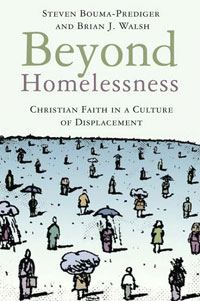
beyond homelessness.jpgBeyond Homelessness: Christian Faith in a Culture of Displacement  Brian Walsh & Steven Bouma-Prediger  (Eerdmans) $24.00  I have raved about this before, and I am convinced it is one of the most insightful and innovative books of my lifetime.  (Ha—my comments were even cited in a footnote in an article about the book in The Christian Scholars Review.)  Not for beginners in Christian studies, I suppose, Beyond Homelessness is nonetheless an unparalleled, Biblical-rooted view of what it means to be at place, why we are or are not at home in this world, how the ecological crisis might provide a lens for healing and transforming faith, and how a vision of God’s redemptive homecoming/restoration could allow us to better engage not only inner city homelessness, but the more general postmodern agnst of our assaulted, beloved world.  There are great Biblical interludes, remarkable stories of urban networks among the displaced and homeless, good environmental theology and a worldview that dares to believe God wants to us to care so deeply that we truly find shalom—home—here, now, granted as gift from our Divine Homemaker.

BLOG SPECIAL
15% off any title mentioned
request the blog special

order here
or call
717.246.3333

Hearts & Minds 234 East Main Street  Dallastown, PA  17313 

Books on Multi-cultural reconciliation, Racial Justice, and Multi-Ethnic Ministry

multicultural.jpg

A good friend was doing some workshops on the topic of racial reconciliation and although she has a lot of good resources, she wondered what was new and important.  I think one of the groups that she was working with was reading through the evangelical classic More Than Equals by Chris Rice and Spencer Perkins;  they knew the ground-breaking work of John Perkins, and maybe had some good stuff by Manuel Ortiz and had studied the classic multi-ethnic history of America, A DIfferent Mirror by Ron Takaki.  Many know the near classic Oxford University Press study Divided By Faith by Christian Smith and Michael Emerson.  They may or may not have seen Eyes on the Prize on DVD but I hope so…I was eager to describe some of our own favorites, a small portion of the large inventory we have on this topic.  I hope you enjoy the list, and hope you are inspired to study this topic a bit.  Read through to the end and you’ll be rewarded with a special blog discount on any of these titles. 

All God’s Children: A Biblical Critique of Racism  Steven McKenzie (Abingdon) $14.95  A powerful study, mostly Biblical, showing how the Bible dealt with race and nationalistic pride and how Christ’s church began as a racially inclusive community.  Very helpful for building  Biblical foundations.

Peppermint-filled Piñatas: Breaking Through Tolerance and Embracing Love  Eric Michael Bryant (Zondervan) $12.99  These short chapters with poignant stories illustrate various ways we can get beyond our stereotypes, and even beyond “toleration” towards authentic relationships and true Christian care.  A bridge-building message about grace, love, inclusive care, and  Godly outreach written by a young evangelical youth pastor.  Very fun, engaging and inviting.

Living in Color: Embracing God’s Passion for Diversity  Randy Woodley (IVP) $16.00  I have often said this is the best book to celebrate ethnic and racial diversity, inviting us to a multi-cultural concern, beyond issues of “black and white.” An excellent primer on the subject, a must-have resource.  Written by a passionate Native Christian, this is a very readable and solid approach.  Highly recommended.

crazy enough to care.jpgCrazy Enough to Care: Changing Your World Through Compassion, Justice & Racial Reconciliation  Alvin C. Bibbs (IVP) $16.00  This Willow Creek leader for multicultural relations has given us a remarkable collection of studies, discussion guides and lesson plans, perfect for preparing programs or for any small group to work through.  This is an expert resource, guiding us through practical issues, rooted in solid perspectives.  I cannot say enough about this fabulous and very useful guidebook.

Cultural Intelligence: Improving Your CQ to Engage Our Multicultural World  David A. Livermore (Baker) $17.99  Although this is  designed for serious youth workers, helping youth and family ministries grapple with important issues, it is helpful for anyone…I can hardly think of a more up to date and urgent book that helps us understand various world cultures, the ethnic and racial diversity common these days, and the need to have some insight about how to be more effective in relating to others. Comprehensive and accessible, proactive and helpful.  I wish I could read you the fascinating chapter titles—you’d really see how thorough it is…great!

Learning From the Stranger: Christian Faith and Cultural Diversity  David Smith
learning from the stranger.jpg (Eerdmans) $20.00  Smith wrote the important book about teaching foreign languages rooted in a Christian worldview (The Gift of the Stranger) and here he offers a broader more foundational approach to what “culture” is, discussing how cultural differences affects our perceptions and behaviors, and why Christians need a robust theology of hospitality.  He shows how Christ’s call to love our neighbor involved learning from others, including “cultural strangers.”  This is a remarkably thoughtful bit of Biblical and theological study, peppered with David’s own stories, insights, and experiences.  It is a beautiful book, a great example of extraordinary, deeply integrated thinking, a wonderful example of distinctively Christian scholarship.  Smith teaches German at Calvin College and is renowned for his perspectives on uniquely Christian theories and habits of education.  Highly recommended for the biggest picture.

Understanding and Dismantling Racism: The Challenge of 21st Century White America  Joseph Brandt (Augsburg-Fortress) $17.00  Recently expanded and re-issued, this is a demanding and serious call to rethink racial assumptions, white privilege and work towards diversity and justice.  Very impressive, highly regarded among trainers and activists.  The author has served as a pastor in an urban Lutheran church although some evangelicals might suggest the book isn’t terribly overt about spirituality or gospel proclamation.  This is not a criticism, I do not think, but a realization that he presumes much that is discussed in other books about reconciliation and justice.  This is the manual for serious work, self-evaluation, and a re-orientation of values and systems, exposing and undoing racism and its structural injustices.  Very important.  Glad for this new, updated edition, too.

The Church Enslaved: A Spirituality of Racial Reconciliation  Tony Campolo & Michael Battle (Fortress) $17.00  Tony–the passionate and humorous Baptist preacher and sociologist–combines here with an African-American Episcopalian scholar and churchman, to offer a fabulous, introductory, but very wise study.  This is hard-hitting, prophetic, and yet kind and pastoral, lifting up contemplative practices and (un)common friendship as a key to new ways of faithful discipleship.  Has a chapter on the vision and work of Desmond Tutu that is very nice.  Includes a very, very good study guide, making it excellent as a study book for congregations.

Beyond Rhetoric: Reconciliation as a Way of Life Samuel George Hines & Curtis Paul DeYoung  (Judson) $14.00  Two exceptionally important African American leaders offer us here a warm, friendly, yet hard-hitting study of not just racism, but of brokenness and alienation, inviting us to the gospel of reconciliation as a key to faithful living.  My, my, this is vital and robust stuff, solid and insightful, insisting on action, not just talk.  Very impressive.

Gracism: The Art of Inclusion  David A. Anderson  (IVP) $17.00  This is a lovely book based on grace (the play on words in the title is crucial!)  Anderson has started as vibrant multi-cultural congregation and here shows the positive way to show God’s favor to others, reaching ou
t in care and grace.  The author is rather young, quite energetic, has a Ph.D. from Oxford, and is leading his exciting Bridgeway congregation as an agent of hope.  Sweet!

heart of racial justice.jpgThe Heart of Racial Justice: How Soul Change Leads to Social Change Brenda Salter McNeil & Rick Richardson  (expanded edition) $15.00  Just a few months ago this new edition, with expanded content and a new cover, was released and many have noted how great it.  With a forward by John Perkins, this is an excellent resource not to be missed. (It has a very useful study guide in the back, too.)  It exposes important material about the racial divides that plague us, yet it firmly places these struggles within the context of spiritual warfare and spiritual transformation.  Can we allow Christ to remake us?  Can we do evangelism in a way that is truly about reconciliation?  Can we resist social and structural evil with the power of the gospel?  Can social change emerge from serious soul change?  Is there a relationship between, say, healing prayer, and working against racial injustice?

Free to Be Bound: Church Beyond the Color Line
  Jonathan Wilson-Hartgrove (NavPress) $12.99  Jon has become known as a co-author and partner-in-crime with Shane Claiborne and the other radically Christian servants in the “new monastics” movement.  He here tells his story of moving to a largely black, rural, Southern church and taking up his place among his brothers and sisters there.  Chris Rice says that this is “one of the most fresh and most important new voices in the American church.”  Shane writes that it “sings truth like old spirituals and lets you sip justice like sweet tea.”  Gotta love a book like that.  Good discussion questions, too.

Race Matters
  Cornel West  (Vintage) $12.95  Although brother West is a follower of Christ and an active churchman, this book isn’t overtly religious, published by a mainstream general market publishing house.  Yet, it resonates with the things of God, has profoundly spiritual insights about the nature of the Western culture, and is, as the Washington Post review said, “as moving as any of the sermons of Martin Luther King, as profound as W.E.B. Du Bois…as exhilarating in their offering of liberation as James Baldwin’s early essays.”  I think it would be hard to be articulate about the conversations about race in our time without knowing this significant work.  A must.

Hope on a Tightrope: Words & Wisdom  Cornel West (Smiley Books) $19.95  I note this for a number of reasons, not the least of which is the way it shows–I pithy and short excerpts with cool graphics–how West is so fluent in not only historic black literature, but in soul music, funk, raggae, hip-hop; his brilliant faith-based insights about culture and oppression is liberally enhanced by drawing on pop culture, especially the sounds of soul.  And, there is a spectacular CD of West speaking, reading, prophesying, proclaiming…pretty hip for an academic from Harvard and Princeton!  (The Smiley imprint, by the way, is the publishing efforts of PBS talk show guy Tavis Smiley.)

Reconciliation Blues: A Black Evangelical’s Inside View of White Christianity  Edward Gilbreath (IVP) $20.00 This author is an esteemed scholar, a traditional evangelical who is Black; this is a journalistic report on his experiences, beautifully written and truly illuminating.  It is bold, it is needed, and it is really interesting as he shares his story, offers his vantage point, and leads us–especially evangelicals, but it is good for anyone–towards practices of new hope.  Significant for para-church groups, or any church or organization which is mostly white who wants to be more inclusive, but wonders why it is so often hard.

consuming image.jpgConsuming Jesus: Beyond Race & Class Divisions in a Consumer Church Paul Louis Metzgar  (Eerdmans) $16.00  This is a heavy book, serious and a bit demanding, laden with mature theology and serious social criticism.  It is important the way the author places racial concerns in the broader context of class differences, and the radical call of the gospel to resist consumerism and embrace grace-even grace found in meals shared together, as we become one at Christ’s table.  Forwards by Donald Miller and John Perkins.

I Have a Dream: Writings and Speeches That Changed the World  Martin Luther King, Jr.  edited by James Washington (Harper) $14.95  This may be the best introduction to various works of King.  These passionate words can still inspire and leave us more aware, and more stimulated, to act in bold ways.  King’s name is so ubiquitous, it is a shame we don’t study his work more carefully.  Highly recommended.  Do you know his Strength to Love?  Wonderful!

Enter the River: Healing Steps from White Privilege Towards Racial Reconciliation  Jody Miller Shearer (Herald) $14.99  Jody was a young man from Lancaster (who had worked in urban New Orleans)  when he wrote this a decade ago, and it has only become more authentic, powerful, and needed.  This is a personal call to be more faithful, and an amazingly insightful essay on ways to proceed.  Very challenging and powerful.

Subverting the Power of Prejudice: Resources for Individual and Social Change
  Sandra Barnes (IVP) $16.00  Barnes is an outspoken African American scholar (professor of sociology at Purdue) who has made the scholarly work on prejudice accessible and useful for ordinary Christian folks wanting to work on this issue.  Looking at gender, status, age, race, wealth, and such, she shows how we damage others and ourselves when we presume and live out inappropriate biases.  This is an essential, intelligent and helpful contribution in the journey to being set free in Christ, agents of social change, learning to understand and disarm our prejudices and bigotry.  If you think the problem is simple, or if you think you’re well on your way, this could be a wake-up call to renewed commitment and work.

Beyond Racial Gridlock: Embracing Mutual Responsibility  George Yancey  (IVP) $15.00  Yancey has written other good books on nurturing multi-cultural congregations (which would be good to read even if one isn’t particularly passionate about starting more intentionally diverse churches or fellowships since they are so interesting and visionary.)  This one, though, is an essential read for anyone serious about solving American racial problems without simplistic answers or one-sided blame.  He shows that various racial groups have born unique pains, and have most likely lived out sinful responses in their own unique ways.  Without crass generalizations, he offers a blueprint for mutual responsibility, in ways that are at once sensible and revolutionary.  Firmly Christian, yet widely applicable, this is a brilliant and innovative contribution that is balanced and respectful.  Yancey is a young, black scholar (University of North Texas) who has earned the right to be taken very seriously.  A long-overdue, constructive proposal, fresh and provocative.

White Guilt: How Blacks and Wh
ites Together Destroyed the Promise of the Civil Rights Era
  Shelby Steele (Harper) $13.95  Steele was catapulted to fame with is elegant and controversial The Content of Our Character where, as a black man, he insists on not talking so much about race.  He makes a plea to the black community to stop what he termed “race holding” which he describes with great care.  Many felt it was wrong-headed (and it may be that it is what stirred West to insist that “race matters.”)  This newer one is classic conservative thinking, calling for an end to blaming others, insisting on self-reliance, and yet predicts that this is impossible in our time, because so many whites want to assuage their perceived guilt, by being eager to appear against racism.  He has been on the talk-show circuit describing Obama’s win in these exact terms: whites voted for him not so much because they agreed with his ill-defined policies, but simply because he was black.  Whether there is truth or insight here remains to be seen, but it is a very, very important part of the conversation.  Steele is very highly regarded among conservative pundits and his arguments make provocative, interesting, and troubling reading.

Hope & History: Why We Have to Keep Telling the Story of the Movement  Vincent Harding (Orbis) $17.00  This is perhaps my favorite one-volume study of the civil rights movement, by an esteemed activist, historian, theologian and storyteller who helps us recall why this is all so very important.  Amazingly moving!  His There Is A River: The Black Struggle for Freedom in America is a classic, too, and should be known among us.  His book on King (King: The Inconvenient Hero is brief and excellent.)

The Next Evangelicalism: Freeing the Church From Western Cultural Captivity  Soong-Chan Rah (IVP) $15.00  This brand new book is getting a lot of buzz as folks are exclaiming how important it is.  Soong-Chan is a popular professor at North Park Theological, and shows that as the global face of Christianity is shifting away from the West (as Philip Jenkins and others have shown) American Christianity must be transformed as well.  Perhaps this is ahead of its time, as we struggle for integration and reconciliation among the most obvious racial groupings of our culture, and remain confused by “America’s original sin” of slavery and mistreatment of native peoples.  Yet, his insight is true: the future is now!  Harvey Cox of Harvard says, “This book is the best and most balanced treatment of the subject now available.”  John Perkins says it is “powerful, prophetic…Rah’s message is one we need to hear and to share with others.”

This Side of Heaven: Race, Ethnicity and Christian Faith  edited by Robert J. Priest & Alvaro L. Nieves (Oxford University Press) $55.00  I mention this only for those who feel seriously drawn to important Christian scholarship; this collection of essays is fabulous, diverse, significant.  The editors are from Trinity Evangelical Divinity School and Wheaton College and they’ve included noted scholars such as Vincent Bacote, Janell Williams Paris, Peter Chao, Paul Heibert…there are many from many nationalities, offering insights from the Bible, from anthropology, from social policy, etc.  This is a major contribution for libraries (at least) and those serious about studying this professionally. 

Here are just a few that are about and for specific races, from overtly Christian perspectives.  Very nicely done.  Of course there are history books opening our awareness of how these ethnic groups came to America.  Do you know Yellow?  Or Harvest of Empire?
Or Bury My Heart At Wounded Knee?

More Than Serving Tea: Asian American Women on Expectations, Relationships, Leadership and Faith  edited by Nikki Toyama and Tracey Gee  (IVP) $15.00  This is a passionate anthology, lovely, interesting, and quite obviously helpful for Asian women of various ethnic and national backgrounds.  Eye-opening for anyone who wants to respectfully listen in…wow.

Being Latino in Christ: Finding Wholeness in Your Ethnic Identity  Orlando Crespo (IVP) $12.00  Perhaps like the one listed above, this is a must for Latino/a Christians—the only book of its kind, really–and is also a good guide to anyone who wants to be a respectful ally and friend.  Exceptional.

One Church, Many Tribes: Following Christ Just the Way God Made You  Richard Twiss (Regal) $14.99  There are perhaps more academic books, some with a more militant First People’s perspective (for instance, the work of James Treat or George Tinker), but this is the best to start with, a charismatic and engaging Native leader, reminding Indians of Christ’s call to unity and grace, following the Waymaker.   Brother Twiss is a dear man, of the Rosebud Lakota/Sioux.

Being White: Finding Our Place in a Multi-ethnic World  Paula Harris & Doug Schaupp  (IVP) $15.00  I am not sure why some white folks are reluctant to buy this, but it is a hard book to sell.  Yet, with all the talk about race, about the need to reflect meaningful on others, on reconciliation and hospitality and such, this is an invitation for white folks to do that well.  A very admirable little book, highly recommended.  I wonder if those of other ethnic groups might value its candor and insight?  Could create some good discussions!  Evangelist George Verwer says it is “a book after God’s own heart.”  Ron Sider and John Perkins similarly endorse it. 

Check All That Apply: Finding Wholeness as a Multiracial Person Sundee Tucker Frazier (IVP) $13.00  Oddly, this is a natural concern for many, but there is nothing else in print from a Christian perspective about being a multi-racial person and the unique opportunities and struggles such folk have.  Could be very useful for some, and a beautiful example of innovative Christian thinking about culture, race, ethnicity and such.

Some of My Best Friends: Writings on Interracial Friendships  Emily Bernard (Harper)  I reviewed this extensively about five years ago, when it blew me away as I read, in well-crafted, robust, stimulating narratives, the joys, struggles, pains, and perplexities of inter-racial friends.  This is not a Christian book; it includes some peculiar takes (esp the vulgar first chapter, about thugs in Chinatown, playing “the race card” during a failed hold-up.)  I found this to be exceptionally touching, honest, painful, funny, and tender.  There is something very rewarding and enriching that happens between most inter-racial friends; it is often, though, harder than imagined, and sometimes, one friend is less than candid than the other.  What a collection!  This  is now out of print, but we have just a few left…
reaching the world in our own backyard.jpg
Reaching The World in Our Own Backyard: A Guide to Building Relationships With People of Other Faiths
& Cultures  Rajendra Pillai (Waterbrook) $14.99  Okay, this isn’t precisely on racial justice or multi-cultural reconciliation, but about building inter-faith relationships, and doing meaningful evangelism with those of other ethnic and cultural backgrounds.  Still, it is a lovely resource, helpful, and insightful…It notes cultural idiosyncrasies, gestures, and sayings and such,
which will help reminds us to be caring and a bit informed.

BLOG
SPECIAL

BUY ANY ONE LISTED
GET ANOTHER FOR HALF PRICE
(less expensive selection is half price.)

please request the blog special when you order

Order here
or call
717.246.3333
Hearts & Minds 234 East Main Street Dallastown, PA  17313

IAM does an interview with Byron about Hearts & Minds…and a recent reading list published in Comment

IAM conversations.jpgYes, the lively and friendly interviewer Christy Tennant, who works in New York for the International Arts Movement (IAM), did a set of free-ranging interviews with me on the vision behind our store, why we carry so many books on culture-making (and other stuff that typical Christian bookstores may not stock), our take on our bookselling calling and more.  There are two parts, done last April, posted alongside other really great podcast interviews**, at the IAM Conversations part of their fabulous website.  I thought some BookNote readers might like to actually hear me talk a bit…

**I’m not kidding: scroll back and check these out;  Christy chats with former U.S. Poet Laurate Billy Collins, philosopher Nic Woltersdorff, Steve Garber (author of Fabric of Faithfulness, recorded live at the CCOs Jubilee conference), jazz muscians such as Helen Sung and Deanna Witkowski,contemporary artist and IAM founder Mako Fujimura, critic and scholar Don Siedell (God in the Gallery), Andy Crouch (Culture-Making), Susan Isaacs (Angry Conversations with God)…wow!  What a resource!  I’m so honored to be interviewed alongside these stellar folks. 

This may be presumptuous but if anybody is doing any promo work for us, trying to convince their church or college or bookgroup or agency to use our services, why not cast this pod over their way?  It’s just me rambling on, sharing our love for books and explaining our work, but, well, it’s what I do. Help us if you can by spreading the word to others who love indie stores. 

Speaking of finding Hearts & Minds other places than our own blog, I just had some book
stack of books.jpg reviews published at one of our favorite on-line journals, Comment (published by the profound Canadian think-tank cardus.)

One column is actually a reprint of a clever article they published about a year ago, inviting readers to a feast of books, using the food metaphor as I list various sorts of titles–appetizers, main course, dessert, etc.  I’m glad they reprinted it.  Bon Appetit!

Here is a brand new article where I describe some recently released gems, very thoughtful books, from the extraordinary Shopcraft as Soulcraft to the newest Alain de Botton (on work)  to N.D. Wilson’s spectacularly weird and demanding Notes from a Tilt-A-Whirl.  Do check it out.

Thanks to Comment for allowing me the privilege of writing for them. They publish serious Christian reflections on issues of public concern, and usually include odd little suggestions on music, food, or ” small comforts.”  Love it!  You should subscribe, getting their good stuff weekly.

Books about learning to care, service, missions & justice

Sometimes we develop a large bibliography, describing books for a certain customer.  Even those we select things specifically for those needs in that setting, we sometimes feel like others might like to see our suggestions.  In this case, a person who helps college student who are doing short term mission stuff wanted resources that could help shape the habits of heart that would help these students care for justice, have empathy for and insights into the lives of the poor, and become more Christ-like servants of their needy neighbors.  It is a wide ranging list, and I hope somebody out there finds it useful.  It would be fabulous if this list were circulated around amongst those who care–or ought to care–about such concerns. And, to be honest, we desire to make a living selling these kinds of books.  Just yesterday we got a very earnest call from a sales rep selling Christian toothbrushes.  Some days we don’t know whether to laugh or cry, knowing what religion has become for so in this religious goods business.  Sadly, I suspect he has sold more of his peculiar wares than we will of ours.  So, check this out, pass it on, order from us if you can.  Together, we can learn and grow into people who care, and learn to serve.  Thanks. 

The Little Book of Biblical Justice  Chris Marshall (Good Books) $4.95  There is so much great stuff on the Biblical themes of justice (and Ron Sider’s Rich Christians in an Age of Hunger still ranks amongst my all time favorites, and surely one of the most important books of our time.)  Still, this is simple, clear, short, and inexpensive, written by a renowned Biblical scholar.  Excellent Scriptural foundation.

Reading the Bible With the Damned Bob Eckblad  (Eerdmans) $19.95  This is a spectacularly interesting account of reading the Bible (literally) with the poor, the homeless, and those on death row.  This encounter with “the damned” helps us see the central message of the Bible, God’s love for us in our brokenness, and how Christ’s Kingdom is bringing a new vision of inclusion, outreach and care.  I’m not sure you could assign the whole thing, but parts might be really useful…  The sequel that he wrote spells out more of the values of God’s reign and, again, could be very helpful.  It is called A New Christian Manifesto: Pledging Allegiance to the Kingdom of God (Eerdmans; $19.95.)  Some of this could be very, very useful in helping students understand the broadest themes of God’s concern for those who are marginalized or hurting.

Deep Justice in a Broken World: Helping Your Kids Serve Others and Right the Wrongs Around Them  Chap Clark & Kara Powell (Zondervan/youth specialties) $18.99  An absolutely fabulous collection of articles and pieces designed for those who are serious about teaching youth about service, missions, justice, the wholistic nature of God’s work, and the call to be agents of social change.  A must-have resource with contributions from Tony Campolo, Jim Wallis, Shane Claiborne, John Perkins, and many more!

Deep Justice Journeys: Moving From Mission Trips to Missional Living  Kara Powell & Brad Griffin (Zondervan/youth specialties) $9.99  This student journal is designed for those who want to make a difference, for those doing service projects of some sort, and who want to harness their compassion and idealism into a long-term commitment to missional lifestyles.  Creative, fun, provocative exercises, reflection questions and guides to further thinking.  Arranged in a “before, during, and after” format, with short readings and great discussion pieces for each experience.  Very, very good.

The Justice Project
edited by Brian McLaren, Elisa Padilla & Ashley Bunting Seeber (Baker) $21.99  This soon-to-be-released book looks to be an absolutely stunning collection (I know some of the contributors, and count a few as dear friends.)  This will become “the” go-to book for those who need serious studies of the call to think faithfully about justice ministries.  Sections include essays on God and justice, justice in the Bible, in the US, in the greater world, and in the church.  Over 30 brief articles.  Due in Fall 2009.

Reconciling All Things: A Christian Vision for Justice, Peace & Healing
  Emmanuel Katongole & Chris Rice (IVP) $15.00  Again, there are many great books on the need for a vision of shalom, reconciliation and peace with justice, but this collection of short pieces from the new Center for Reconciliation at Duke Divinity School is excellent.   Katongole is an African bishop (who has written about Rhwanda and Rice is known for books he has written about race.)

Hope Lives: A Journey of Restoration  Amber Van Schooneveld  (Group) $12.99  This is a great, great resource, handsome, insightful, full of teaching about poverty and compassion, some journalling pages, discussion stuff and moving graphics and pictures.  A five-week journey, with 25 daily readings and reflection opportunities; a few of the lessons are exactly what you’ve asked about.  Done in cooperation with Compassion International.

Crazy Enough to Care: Changing Your World Through Compassion, Justice, and Racial Reconciliation  Alvin C. Bibbs (IVP) $16.00  Nothing confronts a person’s faith quite like injustice, pain, suffering.  Where do we begin to live out our faith in service?  This collection of brief essays and discussion questions and Bible studies is one of the best handbooks and resource guides for discussions on compassion and justice.  Very practical and really useful for small groups.

Mission Trips That Matter: Embodied Faith for the Sake of the World
  Don C. Richter (Upper Room) $15.00  I believe we stock nearly every book on short term missions that we know of, but this may be most useful for you as it is less about planning, getting shots, and learning to serve appropriately, but more on the inner journey of those who reach out, Biblical stuff for those on trips, activities and reflections and other stuff which offers ways to best understand the spirituality of these kinds of opportunities to serve.

Missio Dei: Students Talk About Service  James R. Krabill & Stuart Showalter (Mennonite Mission Network) $3.95  This small booklet is a collection of great stories of college students who have done short term missions, service projects, work camps and the like.  Brief stories and testimonials and reflections on how these experiences have shaped them.  Nothing like it in print!

Simple Spirituality: Learning to See God in a Broken World Chris Heuertz  (IVP) $15.00  Do you know the wholistic mission movement, Word Made Flesh?  Chris is their founder, and this is a spiritual journey into the heart of service, the stuff that is learned–humility, service, and such.  Excellent overview of the call to justice, tons of moving stories, and great insights about how these encounters with others effects our discipleship.

Hearing the Call Across Traditions: Readings on Faith & Service
  edited by Adam Davis  (Skylight Paths) $29.99  This is a wonderful hardback published by a well-known inter-faith publisher;  with a forward by the progressive Islamic activist Eboo Patel, it is a very up-to-date, new voice.  A collection of voices, actually, old and new; from Cesar Chavez and Dorothy Day to Thich Nhat Hanh and the Dali Lami;  from Abraham Lincoln to Flannery O’Conner, Abraham Heschel to Gandhi.  Many religious leaders are excerpted making it a lovely resource

Learning from the Stranger: Christian Faith and Cultural Diversity  D
avid I. Smith (Eerdmans) $20.00  David is well known in Christian college circles for his helpful workshops on helping teachers integrate faith and learning, and for his philosophizing on how to create Biblically-shaped educational efforts.  His own scholarly work is on Christian views of foreign language learning (he teaches German at Calvin College) and is the director of a thinking that helps Christian teachers.  Here, he offers a calm discussion of what culture is, why it is pertinent for today’s college students, and why we need humility and hospitality in our personal interactions with those who are different than ourselves.  And excellent, foundational guide to thinking about our culturally interconnected world.  Very, very thoughtful, rooted in a mature Christian worldview.

Cultural Intelligence: Improving your CQ to Engage Our Multicultural World
  David Livermore (Baker) $17.99  Many have heard about “emotional intelligence” but here is a guide (esp for older youth or young adults) on being culturally aware.  Whether one is learning to be hospitable in the culturally diverse settings of our modern colleges, or preparing for a mission trip, this is a very insightful guidebook to cultural, ethnic, and religious diversity.  Excellent.

Sin Boldly: A Field Guide for Grace  Cathleen Falsani (Zondervan) $19.99  This is a beautifully written collection of essays and articles where the other finds God showing up in the strangest of places.  From rock songs to mission trips, from finding grace in relationships to see God’s hand amongst refugees, she tells wondrous truths in memoir style.  Some chapters would be quite inspiring to your students, I’m sure.

Peppermint-filled Piñatas: Breaking Through Tolerance and Embracing Love
  Eric Michael Bryant (Zondervan) $12.99  This is an exciting and youthful study of why evangelical Christians should be more embracing of others, how to reach out beyond mere “tolerance” and towards loving our neighbors, different though they may be.  Great, great stories, touching insights, great applications, on engaging others beyond boundaries.  Fun!

Untamed Hospitality: Welcoming God and Other Strangers  Elizabeth Newman (Brazos) $22.99  This is a serious, demanding book—quoting the likes of John Milbank, Alister MacIntyre,  and Gerhard Lohfink— and may not be as easily used with students, but I needed to mention it because of it’s brilliant exploration of the themes of hospitality and service within the setting of higher education.  Theologically astute, culturally profound, this is a serious and important study about resisting the modern world’s ways which erode Christian virtue of hospitality..

Making Room: Recovering Hospitality as A Christian Tradition  Christine Pohl (Eerdmans) $20.00 This book is one of the most important books of the last several decades, and has gotten the gracious practice of hospitality renewed attention.  Very, very good, and so important!  We’ve got other great books on this theme, some perhaps even more practical, but I think this is the very best.  A must-read.

Befriending the Stranger  Jean Vanier (Eerdmans) $15.00 Vanier started the L’Arche community movement where folks share lives with the mentally challenged; famous spiritual writer Henri Nouwen joined such a community before he died.  Here, the lovely and gentle Vanier reflects on building community and how to be compassionate to others and ourselves.  See also his brand new book, part of the Duke Reconciliation project, Living Gently in a Violent World (IVP; $15.00) co-written with Stanley Hauerwas. 

The Selfless Way of Christ: Downward Mobility and the Spiritual Life  Henri Nouwen (Orbis) $18.00  This small hardback is a collection of magazine articles first done in the 80s in Sojourners.  What gentle and prophetic wisdom, reminding us of the virtues of saying no to fame and power and success, and embracing servanthood, humility and compassion.  The world lures us to “upward mobility” and the call of Christ is to “a self-emptied heart.”

Compassion: Thoughts on Cultivating a Good Hea
rt  compiled by Amy Lyles Wilson (Fresh Air Books) $12.00  This is a small hand-sized, square book, produced with a modern and hip feel.  Yet, it is to be read slowly and deeply as these short essays are all about the various ways a more compassionate life honors God and our truest selves.  Very thoughtful, appealing, useful as we enhance our capacity to care.

Compassion: A Reflection on the Christian Life  Henri Nouwen, Donald McNeill, and Douglas Morrison (Image) $10.95  A true classic of grace and care, this deeply spiritual reflection could be used with anyone going to mission projects, doing service work, or just wanting to experience the power of God’s care as we care for others.  Rich, wise, thoughtful…

Improving Your Serve: The Art of Unselfish Living
  Charles Swindoll (Word) $13.99  This isn’t on missions or engagement with the poor but a wonderful, basic book on being a servant to others.  The most thorough book on the topic I’ve seen!

Be Last: Descending to Greatness  Jeremy Kingsley (Tyndale) $12.99  Pretty standard fare evangelical inspiration, noting that humility + service = greatness.  Energetic and exciting, he shows how to more faithfully follow Jesus by having a servant’s attitude.

Radical Compassion: Finding Christ in the Heart of the Poor  Gary Smith (Loyola Press) $17.95  This radical Jesuit priest has followed his calling to serve the poor in inner city Portland, and his journal is insightful and powerful.  Showing love amidst despair, this honest study is extraordinary…

The Twenty Piece Shuffle: Why the Poor and Rich Need Each Other  Greg Paul (Cook) $13.99  A seasoned and poetic urban activist (from Toronto), Paul writes passionately, creatively, and frankly.  One of the most urgent books about urban service I’ve yet seen, it is very moving.  Highly recommended!  His earlier book God in the Alley (Multnomah; $12.99) is a bit safer, less edgy, but shows how we can be Christ to others, and how others can be Christ to us.  Again, highly recommended.

Touch: Pressing Against the Wounds of a Broken World
  Rudy Rasmus (Nelson) $14.99  This is a powerful collection of stories from the renowned African American church in Houston, Rudy’s life, his response to God’s grace and his passion to touch others with God’s love. 

New Neighbor: An Invitation to Join Beloved Community  Leroy Barber (Mission Year) $14.99 We are one of the few bookstores stocking this marvelous collection of very short pieces alongside stunning full-color photography of folks reaching out to be good neighbors.  What insight, some of it so poetic, artfully presented as the story moves from needs observed to gifts offered, injustices observed and restoration seen.  Where is community?  Here!  What a marvelous, marvelous hand-sized book, and spectacular resource about service, care, friendship, justice and the formation of what King called “the beloved community.”

When Helping Hurts: How to Alleviate Poverty Without Hurting the Poor…and Yoursel
f   Steve Corbett & Brian Fikkert (Moody) $14.99  There are many great books offering strategies for urban ministry and many also on public policy, the pros and cons of welfare, etc, etc.  Respected scholar and activist Amy Sherman writes, “I can honestly report that this is the single best book I’ve seen on this topic.”  The chapter called “short term missions (without
doing long term harm)” is very good for those who design such experiences and could be helpful as you think through guiding students into service projects.  Done in cooperation with the Chalmers Center for Economic Development at Covenant College, Chattanooga, TN. Outstanding.

The Spirit of Service: Exploring Faith, Service, and Social Justice in Higher Education 
Brian Johnson & Carolyn O’Grady  (Anker Publishing) $40.00  Not sure if you need anything like this, but while I’m listing great titles, I thought I should note this important scholarly text on service learning and such.  Pretty interesting.

Commitment and Connection: Service-Learning and Christian Higher Education
  Claudia Beversluis & Gail Gunst Heffner (University Press of America) $58.00  It is rare I get to say that there is absolutely nothing like this in print;  what a great need this extraordinary work has filled.  This is the work of one of the most important voices in the country for academically-based service learning, a resource that goes discipline by discipline, showing how an experiential and service-oriented vision can enhance learning in that arena, and focus the Christian scholarship in that field for greater human flourishing and social justice. I cannot recommend this more highly for anyone serious about service, learning, the integration of faith and higher education, or anyone seeking a more creative vision for service projects and thoughtful missional living.  Kudos to Calvin College in Michigan for making such a major contribution to the field.  A must for every church-related or faith-based institution of higher learning.

WEBSITE SPECIAL PRICE
10% off
any title mentioned
order on line
www.heartsandmindsbooks.com
or call
717.246.3333
It would be our pleasure to serve you.
Hearts & Minds 234 East Main Street  Dallastown PA 17313 USA  717.246.3333

Reading through the crackle of 4th of July fireworks:Thomas Jefferson (Christopher Hitchens) and Luther Martin (Bill Kauffman)

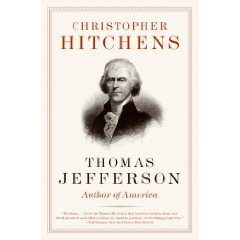
The neighborhood kid’s firecrackers and bottle rockets have finally calmed down—so annoying to a man like me, flat on his bed, from another painful back injury.  Even as the stupid little pop-pop-pops where driving me nuts, I took some patriotic inspiration and roared through two serious books pertinent to the rocket’s red glare.  Or, more precisely, to the debates and characters and ideologies that raged in the late half of the 18th century and into the first decades of the 19th, giving shape to this great nation.  (I believe I first heard from Os Guinness the notion that the U.S. was the first nation ever to be created by intent, by an idea.)  So between the jabs of pain I read a spectacular little biography of Thomas Jefferson, one I’d been meaning to study as it seemed one of those perfect matchings of author and subject.  I refer to the contemporary Enlightenment modernist and religious skeptic Christopher Hitchens and his compact volume Thomas Jefferson: Author of America (HarperCollins; $15.95.) This controversial, world-renowned scholar has done a book on Thomas Paine, too, which I am sure I will read soon. 

jefferson hitchens.jpgIt is hard to underestimate the robust scholarship, wide reading and great learning that are presented in Mr. Hitchens’ book.  Just under 200 smallish pages, it is in the lovely and respected Eminent Lives series. (Other fabulous match-ups in this series include historian Paul Johnson on George Washington and world religion scholar Karen Armstrong on Muhammad.)

I am simply unable to (I can blame it on the back pain and Vicodin, but I am sure even at my best I cannot) do justice to how much ground Hitchens covers, how insightful he is about Jefferson’s worldview—his involvement in the French Revolution, of course, his scientific ways, his scoffing at orthodox Christian faith.  And he shows the excitement of the years leading up to the Revolution, and the serious debates that followed. (More on that, below.)  I had little idea of the large international intrigue during the Jefferson’s presidency, as he shrewdly played off the interests of Great Britain, Spain, and France (think, Napoleon Bonaparte!) Mr. Hitchens knows the best Jefferson scholarship (and roundly mocks the worst) even tossing great accolades to Gore Vidal’s great novel Burr.  The questions of Jefferson’s relationship with Sally Hemings are well described without breathy moralism, briefly cutting through some of the controversy in that area.  (Of the massive amounts of letters Jefferson wrote, the ones that would most likely cover this have gone missing.)

Jefferson’s years serving in DC are well covered as is his evolving views, and his desire to do agrarian work at Monticello, his founding of University of VA, and the start of the Library of Congress after the first batch were burned in the War of 1812. (Some congressmen were not sure they wanted his books, laden as they were with atheism and French Revolution works.) Hitchens makes a case that besides writing the first draft of the Declaration, his greatest legacy was perhaps the Louisiana purchase and the spectacular achievement of planning and funding of the extraordinary Lewis & Clark expedition.

Hitchens is deeply interested in revolution, and is well schooled in and influenced by the Marxian critique of power.  He is a (British) atheist on the left living in Washington who supported the U.S. war in Iraq. Hitch is renowned for his sharp tongue and he despises any who might subvert liberty; his awareness of and work against Islamo-fascism drew him to become a strange bedfellow of the American right.  Oppression of non-Muslims inspired by the Koran plagued Jefferson’s foreign policy and led to the Barbary wars, and the first time the flag of the American empire was planted on foreign soil, in Tripoli, Northern Africa.  Of course, the most serious on the serious right in America are in many ways Jeffersonian. (It was Jefferson’s nemesis, the New York Federalist, Alexander Hamilton, who stood for markets and wealth and a consolidation of centralized power.) As I said, it seemed a nearly perfect task for the redoubtable, anti-imperial, Mr. H. to write about all this.

Of course there is the awful topic of slavery—the only slaves Jefferson ever freed where his own children to Hemings.  That such an awful inconsistency would plague such a great scholar and activist for liberty needs even deeper exploration, even though Hitchens brings it up often.   For what it is worth, this is no hagiography!  (By the way, I have a friend who I respect completely, a scholar and Christian leader himself, who is working on a manuscript that is very, very good, comparing the respective views and actions regarding abolition of William Wilberforce and Thomas Jefferson and what leadership lessons can be learned.  If any prominent editors are looking in, do give me a call, as this is a manuscript that I pray gets picked up soon.)  

I know there are other major books on Jefferson. Hitchens proclaims that Merrill Peterson’s is the finest and best written of the condensed biographies, only surpassed by th great work of R. B. Berstein.  Other books are given helpful summaries in the moving acknowledgments, moving, mostly, for his description of the Jefferson room at the Library of Congress.

***

The next book I devoured (skipping a few pages here and there when I couldn’t adequately concentrate) included a very moving library tribute also.  Bill Kauffman, one of my favorite writers, dedicated kind words to a few smaller libraries, the Maryland Historical Society and such. It isn’t surprising as Kauffman is the consummate homeboy.  (You remember, I sure hope, my rave review a few years ago of his “sense of place” story of returning to his small town to take up a buying local campaign and coach a little league team, endearingly entitled Dispatches From the Muckdog Gazette, or his more politically-minded collection of essays on weird and wonderful front-porch revolutionaries, Look Homeward America, or the almost equally weird and wonderful study of anti-war conservatives, Ain’t My America.)  So, Kauffman’s a small town wise-ass, and he may be the only author alive able to make the detailed blow-by-blow speeches of the Constitutional Convention interesting, and even funny.  Man, can this guy write. 

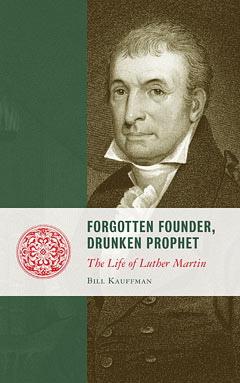
forgotten 2.jpgThis, too, seems a nearly perfect combo of biographer and bioed.  I do not mean anything demeaning to the down-home Mr. Kauffman, but this book is called Forgotten Founder, Drunken Prophet: The Life of Luther Martin (ISI; $24.95) It is in the  “Lives of the Founders” series published by the Intercollegiate Studies Institute, a thoughtful, paleo-conservative think-tank who publishes the likes of Richard Weaver, Russell Kirk and, yes, Edmund Burke.  Kauffman is an anti-Empire, anti-war, “front-porch revolutionary” and we can only guess why he is drawn to write about good-hearted and eccentrics; perhaps it is his counter-cultural wont, or maybe a bit of the gospel.  He likes Dorothy Day and Wendell Berry, after all, and has a healthy blue-collar suspicion of the big-wigs and abstract talkers, which may be why ISI publishes him, although it seems to surprise me a bit;  he is anything but stuffy, unlike, uh, well, most
of their other prestigious authors.  So, anyway, quite naturally, Bill loves the anti-Federalists who worked hard to defeat the writing of the Constitution in that summer of 1787 (the secret writing of the Constitution was done under strict rules which Kauffman summarizes as “What happens in Philadelphia, stays in Philadelphia.”) When these protesters lost, they worked hard to defeat its ratification in the states, a story told well here. These guys were for localism, decentralized government, anti-military and a Bill of Rights.  Antis included the likes of Patrick Henry and Samuel Adams and George Mason (did you know these great revolutionaries resisted the Constitution?!)  Luther Martin was esteemed in their midst, but never achieved their fame; he was a character—a radical who was ruffled, uncouth, a rough-speaking sot who was as known for being long-winded as un-sober.  He nearly drove people crazy with his sprawling 15-hour speeches (sometimes given over two days) and yet was highly regarded as one of the most compelling jurists of his times.  He could lecture about things his hearers didn’t think mattered, only to show—sometimes, at least—that obscure details did matter.  Similarly, Kauffman is not terrible well-known but knows US history as well as anyone.  And he does go on and on.  About some really, really arcane stuff.

And, like our Esquire & Judge, the pontificating Martin, just when the sledding gets tough, and the eyes start to drop over the page, the most outlandish thing is said, the most controversial notion documented, dots connected in new and stunning ways, and I once again can’t put the darn thing down. A detailed book on one of the Founding Fathers we never heard of?   Life is short, why bother? My back hurts and these darn bottle-rockets are killing me.  Luther Martin? Really?  Well, I literally don’t want to skip the boring parts of this tedious book because I know if I did, I just might miss something illuminating, important, inspiring or downright outrageous.  Kauffman is vital and impressive and his passion for the man—he calls him the “Confounding Father”—comes through on every page, even the complex or saddest ones. 

Like Hitchens’ Jefferson, Kauffman’s Forgotten Founder is no hagiography.  How could it be; Luther Martin was a mess of a man, a troubled genius, a beloved character, broke, drunk, but always kindly, except for those he came to cross swords with, most notably, Thomas Jefferson. (When, early on, we learn that Martin came to detest Jefferson, who was close to his republican, localistic, Anti-Federalist persuasion, Kauffman wryly writes, “Patience, dear reader.  No shortcuts via the index, please.”)  Which, just to prove my independence, I promptly checked, only to find a list of every person from this era you’ve ever heard of in history class, and then some; L. Martin was connected and nearly legendary (even if often scorned.)  Martin’s wife was the daughter of the great Jonathan Edwards, and his lack of Calvinist piety most likely broke his in-law’s hearts.  Yet, he was known as a Biblically-literate man, and more than one roommate on a patriot’s trip noted him using the Book of Common Prayer before sleep. 

I say again that Kauffman is a feisty and clever writer, tossing out asides like one about the famous 1700s George Clinton not being the funky parliamentarian (if that isn’t the best quip you’ve heard all day, you might not get it, so google, quick.) He is usually pithy in his all too true observations.  When quoting a Fed framer during the convention who talks highly about being above local concerns, not bound by particular places, but having a grand vision of the global vision, Kauffman quips, “Behold: the Founder as IBM recruiter!”

Kauffman shows how Luther Martin was a complicated thinker and a confusing man.  He spoke and ruled as a judge (he became the Attorney General for the State of Maryland) in favor of abolition and had heart-felt concern about the plight of Africans.  Yet, he owned slaves at one point, even as he worked as a pro bono lawyer for a very committed Christian abolition society.  Confounding, indeed.

I am not sure I can agree with Mr. Kauffman, who ends the book admitting (as he does throughout) that Martin had faults and wrong views and, well, issues.

As we survey the minatory contours of the U.S. government and see a powerful central state involved in perpetual warfare around the globe, a tax-gathering apparatus with its grip on every paycheck, states and localities reduced to mere administrative units of the central state, this anti-Federalist suspects that for all his vices, for all his inability to shut the hell up, for all the gallons upon gallons of rotgut he imbibed, Luther Martin was not a reprobate, but a prophet.

Go here for a nice overview of the book, some blurbs and endorsements, and a good interview with Kauffman about it. 

It seems to me that many of us don’t know as much about this time period and these thinkers and these debates as we should.  They still reverberate, of course.   As the usually contrarian Hitchens writes near the end of his wonderful study, “Jefferson is one of the few figures in our history whose absence simply cannot be imagined: his role in the expansion and definition of the United States is too considerable, even at this distance to be reduced by the passage of time.”  Few would disagree.

Yet, Hitchens continues, writing about the sinister ways Jefferson’s phrase (in his last letter) of the American “experiment” has been also alluded to or used by despotic socialists, Nazis, Ho Chi Minh and other communist dictators.  He concludes, though, “The French Revolution destroyed itself in Jefferson’s own lifetime.  More modern revolutions have destroyed themselves and others.  If the American Revolution…has often betrayed itself at home and abroad, it nevertheless remains the only revolution that still retains any power to inspire.
 
Beyond these two books there are other classic and well-known works on the subject.  Well loved recently is David McCullough’s award-winning John Adams and the Pulitzer winner, Founding Brothers by Joseph Ellis.  Do you know The Great Upheaval: America and the Birth of the Modern World 1788-1800 by Jay Wink (HarperPerennial; $17.95)?  One reviewer wrote of it “Riveting…Spectacular…Dazzling…One of those books you want to buy for friends and family.  And our country’s leaders.”  The serious Gordon Wood wrote in the New York Review of Books that it is “unusally engaging…Winik is not a political scientist but a storyteller, and a superb one.”   

While not a specific history of our land, Os Guinness has written wisely and urgently aboutcase for civility.jpg the “first freedom” found in the Bill of Rights, and the need for a vision of the public square that can allow robust debate about the deepest things.  I’ve often recommended his Case for Civility, And Why Our Future Depends on It (HarperOne; $23.95), but kept thinking of it as I read these other two biographies this weekend.  How does freedom of and from religion work out in a pluralisistic culture?  And can we keep the bonds of our union together?  A must, must read!

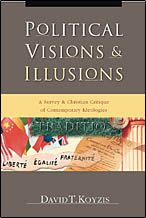
political visions.jpgI have also I have I have also suggested this one before but, again, I dare not leave this topic without the invitation for us who are Christians to do serious study and discernment of the spirit of the age, the shaping ideas then, and now.  No better serious resource can be found that the brilliant Political Visions and Illusions: A Survey & Christian Critique of Contemporary Ideologies (IVP; $20.00) by David T. Koyzis, whose book traces the ideologies of the Enlightenment that so influenced Federalists and Anti-Federalists alike, supporters of McCain & Obama, progressives and traditionalists. It is slow going, but would be very rewarding as a summer read and we highly commend it. 

***
  

The U.S. holiday weekend is over.  My meds are making me sleepy.  The folks in the neighborhood apparently still have some blasting fireworks, noise but no show.  These books are not like that: these are noise and show, sound and fury, fun writing and very, very serious content.   Regardless of your political persuasion, I would think that dipping into these printed fireworks will be an education, and perhaps will light up the contours of our times for you.

Oh: I mentioned that both authors, Hitchens and Kauffman, thanked librarians and that Hitch wrote a bit about the Library of Congress, both his own use of it, and the creation of it under Jefferson.  Libraries make another brief appearance in Forgotten Founder, Drunken Prophet; Kauffman quotes childrens writer Jean Fitz, in her Shhhh!  We’re Writing the Constitution, who noted that Luther Martin talked too long and bored people.  And that he stole books from the Philly library.  Obviously that is in poor taste, but it does remind me: if you don’t want to buy these from us, you can get ’em at the local library.   But in the amount some of you might stack up in library over-due fees, you might as well buy ’em…  

June monthly column up under “reviews” Books on Prayer

I had reason to develop a big ol list of my favorite books on prayer for a friend, so thought I’d post it as the June column here at the website.  I describe each book, and there are some wildly different sorts there, some more theological, some more practical, some quite oriented around Biblical prayers, others a bit more contemplative, from Walter Brueggemann to J. Oswald Sanders; C.S. Lewis to Scot McKnight.  Want to grow in intercession?  Have a favorite book on praery that you have used?  Click here to see my large listing.  May you find resources that nourish your soul, that equip you to greater faithfulness in this urgent aspect of Christian formation.

Just for fun, here are justin constant prayer.jpg a few covers of some of the titles I describe.

ORDER any on the list and get a special 20% OFF prayerful blog-readers discoun
t
.  And, we promise to pray for you.  Seriously. 

Order here.   Or call us at 717.246.3333.  Thanks.

prayer.JPG
folly of prayer.jpg

together in prayer.jpg

Lord, Have Mercy.jpg
life of prayer.jpg
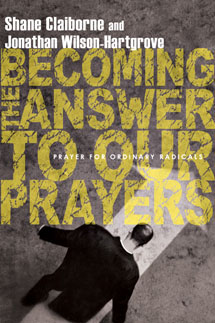
becoming the answer.jpgpraying for dear life.jpg
life of prayer.jpg

The Girl in the Orange Dress: Searching for a Father Who Does Not Fail A memoir by Margot Starbuck (Likewise. books)

girl in the orange dress.jpgI really, really wanted to write this earlier in the week, but I was busy proving to be a less than perfect dad.  Consider this a Father’s Day confession, or a clever way to introduce a book about the search for a father who is truly there for his child.  The Girl in the Orange Dress: Searching for a Father Who Does Not Fail (Likewise. $16.00) by Margot Starbuck is a great book to tell you about on Father’s Day weekend, although it is not about fathering.  It is about being a child of a father.  Or fathers, as the case may be.

Margot Starbuck is one heckuva great writer, a breezy, witty gal who will be (or ought to be) compared to Donald Miller (Blue Like Jazz) and Lauren Winner (Girl Meets God), perhaps even the queen of all memoirs, Mary Karr.  She is less bohemian than Miller, not as elegant as Winner, but (sorry Lauren) funnier by far.  (And while making comparisons, her life was not as hardscrabble as Karr chronicles in The Liars Club and Cherry but for some reason it made me think of those amazing works.  Starbuck is raised in a seemingly safe suburb of Chicago.)  Her quick wit and self-consciousness—how do good memoirists recall such details about their days lived out in previous decades?—serves us well, as The Girl in the Orange Dress is a rollicking story, moving quickly with some laugh out loud lines and some very clever tales, and yet has this wonderful novelistic arch.  It is a powerful read.

It gets heavier as it goes as Margot struggles to reconcile a loving God who calls Himself Father with the lack of faithful fathers in her own life.  I don’t want to spoil the story, but she is searching for her birth parents after her adoptive parents divorce, re-marry, divorce again.  Early on, she easily sees what she considers the good gift in having many caring adults in her life, and doesn’t quite see the anguish to come as she becomes more aware of issues of abandonment and family dysfunction. 

Margot tells of her high school years, her church life and coming to more robust faith, even choosing to go to an evangelical Christian college (although, admittedly, not for the most pious of reasons.)  The stories set in this portion of the book ring so very true; anyone now in college, longing for intentional community, learning to serve the poor and work for justice, trying to discern vocation, to make a difference and make ends meet, and (yes, of course) falling in and out of love–with all the requisite embarrassments and tomfoolery—will surely relate to these chapters.  She gets this part really right and I recommend it to college students and parents of college students.

Ms Starbuck is quite a pistol in those years, the kind of 80s punk chic grrrl who wears maybe different color converses and dies her hair weird colors, showing off multiple piercings.  Her mom (I can just hear it) is concerned about her wardrobe, even as she tries to be supportive, more or less.  Here she describes her look:

    …I looked like the strange offspring of Pippi Longstocking and G.I. Joe. Blond spiky hair, candy-cane striped tights, mismatched socks, rhinestone jewelry, and daisy-painted combat boots did not a mothers dream make.  When I look at the short stack of pictures I have from the period, I am forced to admit that I cannot distinguish from my clothing a typical school day from our high school’s annual Wacky Tacky Day.  Could we really have celebrated it five days a week?

She continues writing about her decision to go to Westmont College, a short ride from the Southern California beaches.  She and her mom, while visiting, noted the tastefully dressed girls in cute sandals.  By this time, Margot had a half-shaved head, visiting campus in cut off overalls.  She reflects, “Mine had to have been the only family in the Midwest to hope that the child they were sending off to college in southern California might actually be domesticated by the experience.  My family would, of course, be sorely disappointed.”

“I would be changed there”, she continues, “but not in a way I ever expected.”

Navigating a conservative religious ethos while being an artsy firebrand is not an uncommon journey for many younger friends, and her journey through these good years is well told.  Finally, there is the sojourn to Portland.  An epic road trip, talking about justice and romance and Providence and beauty?  In a blue Chevy Nova, no less?  Move over, Donald Miller, that open road stuff ain’t just for the edgy Christian boys any more…

Yet, these lighthearted escapades and heart-wrenching experiences (she does inner city work in Camden for a summer, has some relationship and spiritual crises, a friend becomes a single mom) are backdrop for what is clearly more than a postmodern evangelical coming of age narrative.  Girl in the Orange Dress tells of this desire to find a God who can be the parent who does not reject her, who can heal her deep woundedness, who can bring her Home.

Our grrrl ends up donning some somewhat more reliable cloths and ends up at Princeton Seminary.  And how I appreciated the story of a moderately evangelical, slightly charismatic, intuitively feminist student at a liberal seminary where one may not use masculine pronounces about God.  She had served in reconciliation work in South Africa as apartheid fell; yet here, abstract post-colonial theology ruled, oddly without much traction for the real poor that she so obviously served herself.  Ideologically strict males yell at women who have more traditional faith for not being pro-woman.  Hmmm.  Unless one is experienced in this arcane theological academic climate, her observations in the chapter “Welcome to Oz” may seem surprising.  For many, mainline Protestant seminaries nearly ruin one’s vibrant faith and she tells it fairly.

She moves on, through very painful physical disabilities and the trajectory towards reunion (ormargot.jpg not?) with her long lost birth mom and dad. She works at a church while seriously depressed. She sleuths and prays and yells at God.  Suffice it to say that I stayed up way too late reading this thing, as I had to know what comes next.  I even read while on a Greyhound bus, a dizzying feat for those of us who are easily made queasy.  I had tears in my eyes at one point, savoring the pathos and joy and goodness of insights gained the hard way.  And the poignant story of the Pink Post-It note is worth the price of the book, right there (especially if you have any tenderness for aging grandparents.) 

This is a fun book, and, I think, it is an important one.  Whether you have, who know someone who has had, experience with adoption, or know adopted kids or foster parents or have divorced parents in your extended circle of family and friends, or a clay-footed father, this matter—knowing we are beloved and accepted by a God who is there for us—is of extraordinary significance. 

Near the end, Margot tells of seeing an unusual church sign–not that unusual, oddly, since our churches are so often theologically murky and grossly sentimental—that said something dumb about good parents, implying that it would be “unthinkable” for a parent to fail a child.  Ahh yes, s
he is driven to knock on the door, to ask the pastor what in the heck he meant by this.  Didn’t he know?  It is all too thinkable for parents to do hurtful things.  Ask her.  Ask me.

The Girl in an Orange Dress: Searching for a Father Who Does Not Fail is a beautiful gift for anyone, a perfect kind of book because it is easy to read, a bit lighthearted (no, it is downright funny) and yet packs a notable punch, in the story-line, the sheer emotions in conjures, and in the theological truths it conveys.  It is published by an edgy recent imprint by one of our most respected publishers, IVP. (They did the truly stunning memoir Stone Crossings by L.L. Barkat a year or so ago.)  Shauna Niequist (Cold Tangerines) calls it “lovely and challenging” and novelist Lisa Samson says it is for “anyone who needs to know, really needs to know, how much God loves his children.”  Happy Father’s Day, indeed.

Check out the publisher’s webpage that has samples of her writing, endorsements of the book and such, but please come back and order it here.  Thanks.

ORANGE DRESS
BLOG SPECIAL
$4 off
regularly $16
mention the “orange” special and pay only

 $12.00
plus shipping

order here

Hearts & Minds 234 East Main Street Dallastown PA  17313     717.246.3333

***

I mentioned the memoirist Donald Miller.  I presume you know his books published by Nelson, which have sold over a million copies.  Blue Like Jazz is his most popular. His second (and more substantive) is Searching for God Knows What, and his epic road trip saga is Through Painted Deserts (first discovered by Terry Glaspy at Harvest House, originally titled Prayer and the Art of Volkswagen Maintenance, although now considerably expanded.)  Mr. Miller has co-authored a book about the absence of fathers, not as witty or precocious as his others, but a deeply moving story of a man who stepped up and mentored him, since Miller’s father had left the family.  It is called To Own A Dragon: Reflections on Growing Up Without a Father and it is very highly recommended for fathers, young men, or anybody who cares about them.

And, for the record, I truly recommend Starbuck’s The Girl in the Orange Dress for men and women readers, and, likewise, Miller’s To Own A Dragon is not just for men, although I suppose it may be most helpful to hurting guys.  Or dads who need reminded of the value of their love.

Donald Miller’s very long-awaited fifth book, A Million Miles in a Thousand Years: What Imillion miles.jpg Learned While Edited My Own Life is due out in hardcover at the end of the summer. It will detail one man’s opportunity to edit his life as if he were a character in a movie, which he sort of is. You can order it now if you’d like, and be among the first to receive it in September.

Check out his blog, and tell me if he isn’t trying to look like Tom Waits.  Great stuff.  We stock the DVD projects he talks about, too, btw (The Open Table and Free Market Jesus.)  

Religious Knowing? Stages of Spirituality? A Hidden Wholeness and more

You may know that our shop is renowned for having a large and diverse selection of books onlonging for god 2.JPG spirituality, contemplative practices and classic spiritual disciplines.  We ponder these books often, and have our favorites, but occasionally some arrive that deserve special celebration.  For instance, a month ago we showed the brand new Richard Foster book, his best in years.  This title, Longing for God: Seven Paths of Christian Devotion (IVP; $25.00 )has been getting very good customer reviews and we are learning so much through these little spiritual biographies.   As John Ortberg says of it, “This is the best and richest of Christian thinking and soul-making made accessible to everybody.  It would be very hard to read this without having your heart grow.”

Two new books came in recently that are not just how to deepen one’s relationship with God or how to practice the spiritual life.  These two are about how to know, really, whether what we think or feel about God is true, and whether one is making proper headway in one’s journey “deeper in and farther along” (as Lewis put it.)  These are fairly serious books, so  may not be for everyone, but are for anyone who is fluent in this literature, experienced in these habits, or involved in spiritual director or pastoring or teaching others, they are very, very important.

Knowing Christ Today.jpgFirst is the most serious work Dallas Willard has done to date (well, excepting his professional scholarly work as a philosopher.)  Knowing Christ Today Why We Can Trust Spiritual Knowledge (HarperOne; $24.99.)  It is a thorny debate, actually, about the nature of truth—can we really know spiritual things?  (What are spiritual things, really?  If religious truths are real—as Christians insist—than why do we have this sort of dichtomy in our language?  Is there a split between “facts” and “values”?  Others have addressed this helpufully (Leslie Newbegin, for instance, in his brief but potent Foolishness to the Greeks, or Nancy Pearcy in her worldview opus Total Truth.)  To see Willard “focusing like a laser beam” (as Foster puts it) “on the issue of moral knowledge as a legitimate source for understanding reality” is extraordinary.  How many books on Christ-likeness and formation carry endorsements by eminent sociologists, as this one does, with the rave blurb from Boston University’s Peter Berger?  Do you recall the Bible verse “My people are destroyed for lack of knowledge”?  This lucid account of the issues of what true knowledge is, and how that helps us gauge our growth into Christ-likeness, give an excellent lay of the land to how we can regain faith-based knowing, authentic insight, and confident spirituality. This one is worth working through slowly, pondering and underlining as you go.  

seasons of the soul.jpgSeasons of the Soul: Stages of Spiritual Development Bruce Demarest (IVP) $16.00  This is another book that is less about how to grow as a Christian, but how to measure or discern the maturity and adequacy of this growth.  And how to learn to appreciate the new levels and stages and ages of the trek.  Some of us have read and appreciated the developmental research done by James Fowler et al.  A bit too influenced by Piaget’s rationalism, perhaps, and a bit too academic, that school of thought has influenced Christian educators, but hasn’t caught on for ordinary folks as a helpful tool for self examination or aiding formation.  Stages and ages are useful, but haven’t necessarily helped us be more aware of understandable ups and downs on the journey with God, or more comfortable in our spiritual stages.  This new book fills a real need and looks to be just spectacular.  It uses the structure of Walter Brueggemann’s seminal assessment of the Psalms, namely, that there is orientation, disorientation and re-orientation.  Demarest calls it “initial orientation” (the first stage of putting our faith in Christ), “painful disorientation” (which is the season of experiencing struggles, doubts, and the dark night sort of loss of God’s presence), and the phase of coming to subsequent deeper faith, which he calls “joyful reorientation.”  Are they three simple chronological stages?  Cycles or phases?  How can our deepest relationship with God and our devotional life help us as we suffer?  

Demarest, of Denver Seminary, has a very helpful appendix summarizing other authors who have used the journey as a metaphor for spiritual maturity, from the desert fathers, the medieval mystics, to contemporaries such as Evelyn Underhill to M. Scott Peck.  Throughout the book, Dr. Demarest proves himself fluent in the widest readings;  what a delight to see the Syrian fourth century Pseudo-Macarius quoted next to 20th century CM&A preacher A.W. Tozer; to see Elizabeth O’Connor cited next to John Owen.    Like I said, it may not be for everyone, but there are many Hearts & Minds readers who would benefit from this slower, deeper sort of reading, which actually is delightfully written and really quite amazing.  Seasons of the Soul will help you, and equip you to help others. Highly recommended.

A Hidden Wholeness: The Journey Toward an Undivided Life: Welcoming the Soul and
hidden wholeness.JPG Weaving Community in a Wounded World Parker J. Palmer (Jossey-Bass)  $19.95; DVD included  This is not particularly academic or dense, but for those who are used to primarily evangelical piety, this blend of spirituality and psychology, community and pain, may be bracing.  Parker, of course, is a beloved writer, a clear and kind thinker, old friend of Henri Nouwen, and contemporary philosopher of education.  We stock all of his stuff (and his very first, Promise of Paradox, was re-issued this year in a lovely hand-sized hardcover.)  This new paperback edition of Hidden Wholeness includes two new features. Circles of Trust is a DVD containing interviews with Parker Palmer and footage from retreats he facilitated for the Center for Courage & Renewal.  Bringing the Book to Life is a reader’s and leader’s guide to exploring the book’s themes.  (The discussion guide particularly connects the DVD and the book, drawing on the insights and practices of “circles of trust.”)  As it says on the back, “Together, these features gives readers new ways to internalize the themes of A Hidden Wholeness and share with others this approach to sustaining identity and integrity in all the venues of our lives.”

brazos introduction to spirituality.JPGIf one wants to delve into these thoughtful areas, deep spirituality and classic convictions, habits and practices, and learn the broad teachings of the church universal, you may want to pick up as a life-long reference what may be the best collection of essays and articles in a large textbook format, The Brazos Introduction to Christian Spirituality  edited by Evan B. Howard (Brazos) $39.99. At 500 large pages, this is a treasure trove, interdisciplinary and ecumenical.  There are chapter outlines and objectives, sidebars, focus boxes, charts, pictures (and even cartoons) a useful glossary, chapter summaries, questions for consideration and very helpful “looking further” resource lists.  If one wants to know what a relationship with God looks like for Christians, and is willing to hear the perspectives of the breadth of Christian spirituality, this comprehensive volume is a must.


BookNotes
BLOG SPECIAL
ORDER ANY TWO OF THESE
25% off both
order here
credit card or by check


Hearts & Minds 234 East Main Street Dallastown, PA  17313     717.246.3333 

Finding Beauty in a Broken World by Terry Tempest Williams

In the last post I linked to the May Review column where I annotated a whole bunch of great books about nature, wilderness, and finding God in the great outdoors.  Some were overtly Christian, although some were not.  I don’t know how many other so-called Christian bookstores stock this kind of stuff, but we hope you like our distinctiveness in bringing together these genres and perspectives, books and authors not commonly found together. Do check it out if you haven’t; it’s a fun early summer list!

Finding Beauty.jpgI’ve just recently finished Terry Tempest Williams brave and unusual and deeply moving book Finding Beauty in a Broken World (Pantheon; $26.00.) It deserves more than I can give but I thought I’d offer a few remarks and reflections. We commended her in the previous post, so this is a natural follow-up, as she is known as an eminent nature writer, a memoirist of place, a passionate critic of the foolish policies of progress that have eroded sustainability and sanity.  We like her a lot.

Finding Beauty in a Broken World
is a sprawling, big book, divided into three distinct portions.  This is a bit unusual, and although she weaves the themes of each portion together a bit, I would have wished for more connection, making explicit what I presume is understated purposefully.  Still, at the end my jaw was dropped in one of those experiences of epiphany and connectivity.  It really did come full circle.

The book opens with a beautiful, mysterious account of her learning the fine art of mosaic
tiles.jpg work; the frontispiece line These fragments I have shored against my ruins from T.S. Eliot’s The Wasteland** becomes clearly relevant. Ms Tempest Williams is in Ravenna, Italy, waxing on about the history and power of mosaic.  “Eloquence is spoken through the labor of hands, anonymous hands of forgotten centuries.  With eyes looking up, artisans rolled gold tessarae between their fingers in thought, as they searched for the precise placement in domes and aspes where light could converse with glass.  Jeweled ceilings become lavish tales.  I want to understand these stories told through fragments.”

Even as I type that quote it dawns on me—” stories told through fragments,” how did I miss it?—that the fragmentary nature of this book (some pages only have one sentence, some appear to be journal entries or quotes from other books) is itself mirroring these fragmented tales, made luminous as they are brought together.  Hmm;  a stroke of brilliance perhaps, some hint at form and content?

This first part is brief but beautiful.  She tells about the “city of mosaics” and tells of her learning the craft, in this mosaic workshop, so that she could “learn a new language with my hands.”  It is interesting that this art form uses broken pieces.  It is an imperfect beauty.

The second more lengthy portion is more typical terrain for Ms Williams as she has volunteered to serve as an assistant with the world’s leading scholar of several species of prairie dogs.  She is at Bryce Canyon National Park, assisting the study of this fascinating critter, a controversial animal beloved and hated in the developing West.  She makes a very strong case for the preservation of prairie dog towns and it is helpful to learn of how the eco-spheres of the prairie lands are dependent and inter-dependent on these rodents maintaining their traditional habitat.  It is also interesting how government mandates of protecting habitats of such creatures are and are not followed, are contested and ignored.  As a small side-note, she is banned from some National Parks because she was a signature of a class-action type lawsuit against the feds in their disregard for environmental law protecting the dogs.  Who knew citizens could be banned for such things?  Outrageous.  It is not a large portion of the book, but the expose of the corruption in the Fish and Wildlife Service, the Bush appointee Julie MacDonald who so undermined the mandates of law, is important as we assess the current state of environmental law after recent years of disregard.

In this well-written portion she laments the gross mismanagement of Western lands, and portrays the gross hostility of those who love to squish to death these small creatures (not to mention the companies that burn them alive in their burrows which she describes in a harrowing paragraph.)  This battle about exterminating the dogs is symbolic of much of the public debate around ecological living, and her personalizing it—working in this one spot, marking and observing these mammals’ behaviors, following their habits for 8 hours a day sitting in a little tree stand—was helpful and informative.  (Her method, offering fragments of repeated numbers and letters from her daily log was tedious, and I admit to skipping pages at at time, having “gotten” the painstaking monotony of natural science research in action.)  Still, learning about these “prayer dogs” was very interesting and oddly compelling reading. You may want to read “Report from the Burrow” or glance around the website of WildEarth Guardians which she recommends.

This section becomes truly riveting, though, as she narrates the story of her blue-collar family, whose family work is in large excavation.  Her father and brothers are honorable men, hard-working and dedicated, and Tempest Williams’ sincere appreciation for their diligence and skill give her a local working-man’s view of the eco-conflicts.  That her brother was dying of cancer during this portion of the book adds an extra poignancy.  Without drawing it out into overstatement, the battle over protecting endangered species, the cancer that is prominent in Nevada and Utah due to the testing of nuclear weapons, and the inter-relationship with family, land, local history and prairie dog towns, becomes profound. One chapter reprints some of her famous piece in the New York Times, written on Groundhog Day, 2003.   Given the world’s large and looming problems (this was just weeks before the U.S. invasion of Iraq) why should we care about rodents?  “Quite simply, she wrote, because the story of the Utah prairie dog is the story of the range of our compassion.  If we can extend our idea of community to include the lowliest of creatures, then we will indeed be closer to a path of peace and tolerance.  If we cannot accommodate “the other,” the shadow we will see on our own home ground will be the forecast of our own species extended winter of the soul.”

She raises important questions for all of us, even those of us who hold to a Christian worldview, which insists on distinguishing between God and creation, and humans and non-humans.  Yet, even the conservative theologian and cultural critic Francis Schaeffer went to great lengths to show that evangelicals should agree with St. Francis as he talked about our unity with fellow-creatures.  Terry Tempest Williams writes,

Most people are not comfortable making a connection between racism and specism or the ill treatment of human beings and the mistreatment of animals.  We want to keep our boundaries clean and separate. But isn’t that the point, to separate, isolate, and discriminate?  We create hierarchies, viewing life from the top down, top
being, of course, God, then a ranking of human races, and so our judgements move down “the Great Chain of Being” until we touch rocks.  This is the attitude of power, and it hinges on who is in control.  Who has the power over whom?  How does this kind of behavior infiltrate the psyche of a culture?  And what are the consequences of scala natura?

The third portion of this book was even more captivating, and I was riveted by the tale she weaves of her journey to Rwanda with a Philadelphia artist, Lily Yeh, whose movement of “Barefoot Artists” work to create spots of beauty to memorialize the inhuman brutality of the genocide there.  Her time in this crowded African country is told powerfully and engagingly and the relationships that develop in this part of the book moved me as deeply as any great novel. Whether you know much about this place (think of Hotel Rwanda) or very little, this is an amazing bit of writing and very, very worthwhile reading.  Some of it is horrific as she tells of listening to the stories of the genocide victims; some is healing in a manner made known to the world by the South African Truth & Reconciliation Commission.  That is, it is hard, hard stuff, but told in the service of healing, justice, and even forgiveness.  There is great grace reported here, and their desire to offer an artistically rich spot, a regional memorial, as a symbol and place of remembrance, is truly one of the most amazing things about which I’ve ever read.

Much could be said about this moving last third of the book, but I cannot do it justice.  The plotTerry Tempest Williams 3.jpg develops and unfolds as we read of Terry’s month-long stay and friendship with rural Rwandan folk (and of a subsequent visit later with some fabulous episodes which I won’t spoil by telling.)  She studies the local soil erosion, visits the Congo and hears of the killing of guerrillas (this is the area where Diane Fossey did her famous research), the rise of evangelical religion, the creation of small local businesses, like a sunflower oil press. The arts are celebrated, schools are started, art classes begun, villages beautified and the architectural plans and creation of this mosaic-laden memorial completed.  Through rain and illness, hard stories and great laughter, multi-cultural teams find beauty as hopeful as they empower and work with those at the Genocide Survival Village in Rugerero.

A Catholic mystic writer once said that beauty can save the world and my esteemed friend an editor of Image, Greg Wolfe, will have a book out soon with that title.  I do not think it is so.  But it sure can help, and my simple formulation is woefully inadequate. It does more than “help.”  Such gifts of true beauty are, as Calvin Seerveld says in his book of this title, a “rainbow for the fallen world.”  People of Biblical faith can give away their artistic gifts, he says, as signs of redemptive hope, like the dove returning to the ark (Seerveld’s other famous book about the arts is entitled Bearing Fresh Olive Leaves.) Terry Tempest Williams and her gang of barefoot artists do just that, offer hope in color and texture, fragments of light, forming truth and goodness.  Thank God for this brave and important book and the work it so passionately documents.  What connections there are that linger, nearly unspoken, between art, justice, ecology, life.  “Grace” sings Bono of U2, “makes beauty out of ugly things.”  Finding Beauty in a Broken World by Terry Tempest Williams is an example of just that.  As they proclaim in Rwanda, Ukurikurakiz!  Truth heals!  Read it and take hope.

You can see pictures of the memorial, and other great global arts projects of the Barefoot Artists project at their glorious website. There is even a 24-minute film you can watch.

**in a footnote, TTW writes, “…the poet William Caros Williams described the effect of The Waste Land as that of an atom bomb.  This 433-line poem is Eliot’s monument of words to a fragmented and disparaging world, his own poetic mosaic of collage that celebrates the failure of civilization, the distractive and destructive impulses of the modern era.”

By the way, kudos to Zondervan for recently publishing two books on Rwanda (rather a risky move for a publisher, doing not only one, but two.)  Both are excellent. 

mirror to the church.jpgMirror to the Church: Resurrecting Faith after Genocide in Rwanda  Emmanuel Katongole (Zondervan) $15.99  Katongole is a prof at Duke and co-director (with Chris Rice) of their Center for Reconciliation.  He is a Catholic priest of the Kampala Archdiocese in Uganda. Fr. K had some help in the writing by Jonathan Wilson-Hartgrove. Not only does this serve as an excellent and brief introduction to the horror of the Hutu’s and Tutsi’s barbarism, it explores what we can learn, and how the gospel must transcend national and ethnic differences.  Very important stuff, indeed.


as we forgive.jpgAs We Forgive: Stories of Reconciliation from Rwanda  Catherine Claire Larson (Zondervan) $15.99  This well written collection is inspired by the award-winning film of the same name.  As We Forgive was the Gold Winner for Best Documentary in the 2008 Student Academy Awards (yes, sponsored by the Academy Awards!)  An evangelical Episcopalian living in the DC area, this film-maker is a talented, sharp young woman and her film would be a good compliment to anyone reading Larson’s powerful book.  You can get info at the As We Forgive website.

Brand New May Review Column–books about wilderness, memoirs of place, meditations on creation

I’m hoping that many Hearts & Minds customers will click on over to the larger May 09 Review Column to see my annotated bibliography of books of nature writing, devotions for the outdoors, backpack inspirations and memoirs of gardening, hiking and such.  It is a great list, if I do say so myself, with a mix of titles and authors I suspect you may not find in any other bookshop anywhere.

Here is how I introduced the list.  We hope it invites you to check it out, maybe order some.  Enjoy the Springtime.  Thanks for reading—-we couldn’t be booksellers if there weren’t good readers.

A few years ago I did a book review
column that really meant a lot to me.  (Then, in the pre-blog era, I
did them every month and they are still archived in the “reviews”
section here at the “reviews” section of the website.)  I told about a new nature writer that I
holdfast.jpg discovered, a woman who occasionally writes for Orion, and whose work I really, really loved.  Her name is Kathleen Dean Moore and one of her wonderful, wonderful books is called Pine Island Paradox: Making Connections in a Disconnected World. (Mildweed Editioins; $14.95)  Another is called Holdfast: At Home in the Natural World (Lyons; $20.00) another yet is Riverwalking: Reflections on Moving Water (Harvest; $13.00)
and they are truly among some of the best essays I’ve ever read, drawing out
themes of philosophy and religion, marriage and family and commitment,
caring for home and caring for nature, being at home in this world.  And, lots of good ol’
adventure, outdoorsy stuff.  You can read that old review here, and I would be pleased if you did, as I still hold her work in utmost respect. 

I’ve
rarely found anyone who can write like she does, but the nature writing
genre is an old one with many classics, and it continues to grow and there are authors who take my breath away. 
My wife Beth and I have both recently finished the stunning and
haunting book
trespass.jpgTrespass: Living on the Edge of the Promised Land
(North Point Press; $15.00) by Amy Irvine, and we continue to talk
about it as it haunts us so.  Set in the Redland canyons and deserts of
Utah, it evokes a very strong sense of the place making for a memorable
reading journey;  I was  holding those last few chapters, reading
slowly, so I could savor them, when I heard that it had been chosen as
the Orion magazine Book of the Year.  Orion is a
remarkably literate environmentalist journal, with contributors like
and Bill McKibben, Wendell Berry and Terry Tempest Williams.  I have to
say I’m a little proud for choosing Trespass before they
did.   I may write more about it eventually, as it is a serious study
of belonging amidst hostility (the redneck locals hate “tree huggers
and the upright, Mormon locals hate anybody who isn’t like them, it
seems) of competing visions of progress, a story, finally, of loss and
hope.  Irvine and her husband work to protect wilderness land, even as
in the Bush years, land was being sold off for drilling and
desecration.  She tells of her time in the desert, recovering from a
dysfunctional family of origin, coping with her own inner turmoil as
she bonds with her passionate new husband, recalling ancient Pueblo
culture and not-so-ancient Mormon history.  It is a heavy and
beautifully written book, insightful and lovely and troubling and
unforgettable.  And so keenly aware of place: colors, smells,
experience of light and soil, temperature, sensations of God’s
extraordinary creation near the famous four corners region of South
Eastern Utah.  Like Terry Tempest Williams’ famous Refuge: An Unnatural History of Family and Place,
this is quintessential nature writing woven together with a woman’s own
memoir full of politics and faith and weirdness and  love.  It is a wonderful sort of
literature that I truly love.

Other similiar “nature” books are
also memoiristic, but with less inner turmoil, less back-story.  These
kind of books narrate a journey into the woods, into the wilderness,
tell about adventure or hi-jinx, hard living or joyous contemplation of
beauty, farming or gardening, but they are, well, just that.  Shorter
on biography or politics, they tell the tale of what happened when, and
show you around the place.  Think of the great Bill Bryson’s A Walk in the Woods which
is his beloved tale of hiking the Appalachian trail.  Often the ones I
like may not even be about a canoe trip or wilderness climb, but are
just reflections on a ordinary life with a particularly clear sense of
place; that is, they are a memoir of what Russell Scott Saunder’s
called, in a lovely book by this name, “staying put.”  For those who
love the great out of doors, or enjoy the slower life, these make nice
reminders of the beauty of nature, and are perfect for a day off,
Sabbath reading, or a book to take along on a day hike or vacation.

If you skip on over to the monthly review column, filed under May 2009,  you will see I start off with One Square Inch of Silence: One Man’s Search for Naturalone square inch of silence.jpg Silence in a Noisy World, an earnest and interesting story of a road trip by the world’s leading recorder of natural sounds, Gordon Hempton. I only describe it a bit, but could say much more—it is fascinating!  I list a book by the Adventure Rabbi, (yes, there is an Adventure Rabbi, and she rocks), classics like Desert Solitaire, and philosophical studies on the nature of landscape and place.  Mostly, though, fun stories of those who love the great outdoors.  One title is called Heaven is a Leaky Tent.   Another brings luscious reflections on the beauty in creation, and gardening, by an Orthodox theologian. 

I hope you enjoy the May list.  We could have listed more…what are you favorites in this genre?  Annie Dillard? McKibben on silence?  Into Thin Air? Feel free to post suggestions…