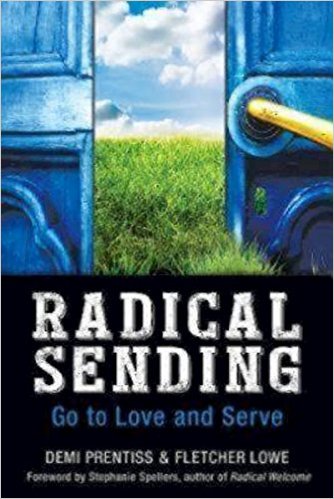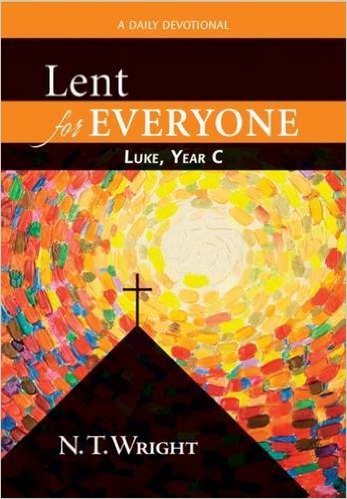
TEN NEW BOOKS YOU HAVE TO CHECK OUT on sale at Hearts & Minds / BookNotes

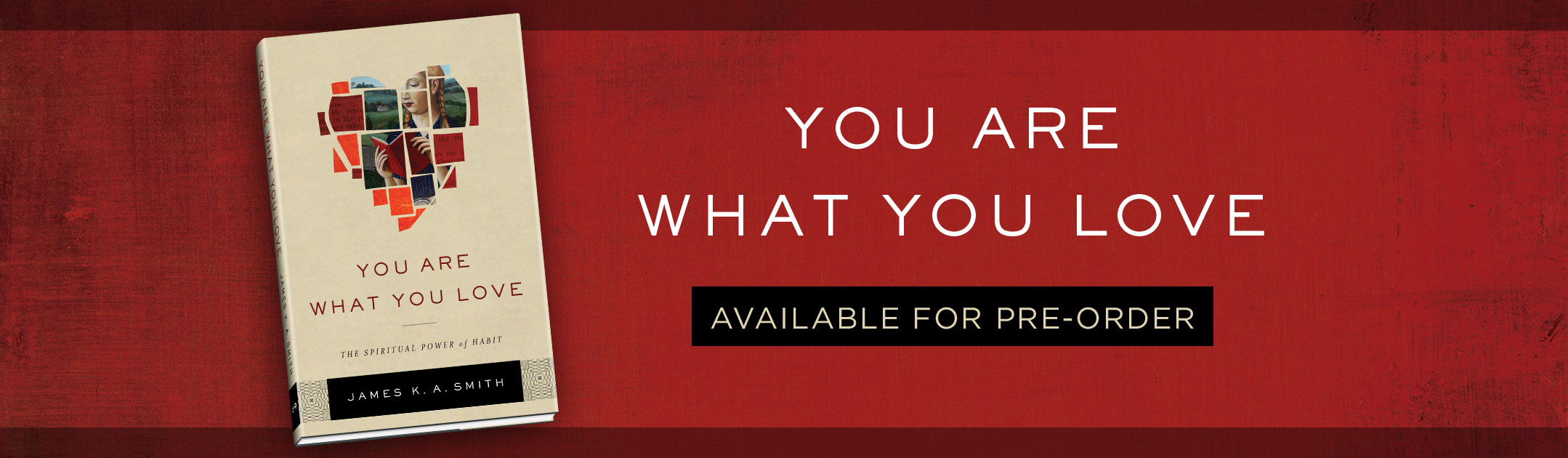
jkas-features3-bkr.jpgI hope you saw my long essay the other day about the importance of the forthcoming Jamie Smith book, You Are What You Love: The Spiritual Power of Habit (Brazos Press; $19.99) at the previous BookNotes post. (All of my past blog posts are archived at our Hearts & Minds website.) A couple of folks said it was quite an education, and I enjoyed sharing, again, some of my own significant influences and some of my own favorite books and authors.  Trying to offer a bit of a backstory (my own or Smith’s I can’t quite say) that frames the new book was fun and meaningful for me, at least.  I do hope you considered it.  

Alas, I haven’t gotten the real review of the book itself done yet, and I’ve learned You Are What You Love (can we call it YAWYL?) won’t arrive for another week, so I’m going to sneak in a random, but no less important, shorter BookNotes list now.  Stay tuned for my eventual review of YAWYL and do check out that “part one” rumination about it if you haven’t yet.  

In the mean time, it’s usually quite invigorating being around here any given day at the Dallastown shop, realizing just how many great books keep coming and coming. There’s lots of dumb stuff out there and plenty that is mediocre.  But, truly, there are wonderful reads and fine authors and helpful publishers; the book world and publishing industry really is a blessing to us all. I know I speak for all our staff here when I say that Beth and I are glad there are readers who care. I don’t mean that only because your shopping with us keeps us afloat, tenuous as that project seems. It means that people care about words, about ideas, about being moved by the art of writing and the habit of reading.  That’s good — essential! — for the health of our world, you know.

Some new and very good books that I shall list below just might scratch where you itch these days or they might make a good gift to somebody who you may know who needs some pleasurable and helpful resources this very week. Spread the word.

TEN NEW BOOKS THAT YOU SHOULD KNOW

Love Kindness- Discover the Power of a Forgotten Christian Virtue .jpgLove Kindness: Discover the Power of a Forgotten Christian Virtue Barry H. Corey (Tyndale) $15.99  When reading an advanced copy of Good Faith which I reviewed a week ago I noticed a footnote to this book that had not yet been released. Kinnaman and Lyons said very good things about it in that footnote and I made a mental note to be sure we had it on order.  It came not long ago and, as I expected, it is remarkable. And it has Micah 6:8 printed on the back — the first verse I learned as a kid, my dad’s favorite.  There are surprising blurbs on the back from David Wells, a serious-minded, no-nonsense and very careful thinker I great admire, a Distinguished Research Professor at Gordon Conwell, and a long, passionate endorsement by Miroslav Volf.  These are impressive signs. Alistair Begg calls Love Kindness “a thought-provoking, heart-stirring challenge to consider kindness as a barometer of a grace-shaped life.”  I know some very kind people and admire them. You do too.  Maybe we need this book so we can be more like them.  The author, by the way, has a PhD in education from Boston College, was a Fulbright scholar and worked with the landless poor in Bangladesh. This looks really, really rich.

Letters to Jacob- Mostly About Prayer.jpgLetters to Jacob: Mostly About Prayer Fr. John-Julian (Paraclete Press) $7.99  This is a very, very small book and I intend to read it devotional here in the second half of Lent. Any title that alludes to Letters to Malcolm by C.S. Lewis, and says “ordinary mysticism” on the cover has to be good!  And I hear it really is.  Desmond Tutu has a rave on the front saying “Wise counsel for all on how to grow in that life of prayer and what pitfalls to avoid.”

Fr. John-Julian is an Episcopal priest who is what they call “semi-enclosed” and has had a wide, wide array of jobs from camp director to TV actor to the dean of an experimental seminary and a social worker — even a bookseller!  (If only he’d have logged some time in the circus.) His wide worldly experience, his service as a pastor, and now as an Oblate (Order of Julian of Norwich) gives him a rare place in which to describe contemplative prayer to those of us who are not quite so oriented to stillness and solitude and deeper prayerfulness.  It looks like an argument for the contemplative life, but also an invitation to it, written to a young, 21st century seeker.  Might even be a slightly deeper version of the lovely Nouwen book called Letters to Marc, which I also loved.  Nice.
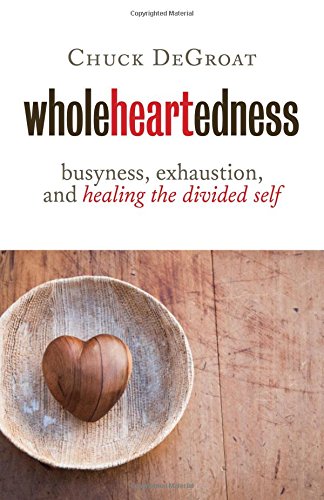
Wholeheartedness- Busyness, Exhaustion, and Healing the Divided Self .jpgWholeheartedness: Busyness, Exhaustion, and Healing the Divided Self Chuck DeGroat (Eerdmans) $15.00 We discovered DeGroat a while back, appreciated by many for his helping to found the Newbigin House of Studies in San Francisco, but who is now a prof of pastoral care at the RCA’s Western Theological Seminary in Holland Michigan and who also has a counseling practice. He wrote the wonderfully interesting and beautiful book called Leaving Egypt: Finding God in WIlderness Places and then a most helpful and very thoughtfulToughest People to Love: How to Understand, Lead, and Love the Difficult People in Your Life Including Yourself.  This new one looks remarkable — just the footnotes alone show how wide of a reader DeGroat is, citing everybody from evangelical neuroscientist Curt Thompson to poet Mary Oliver, from David Letterman to Thomas Merton.


Wholeheartedness has a beautiful style about it, covers very impressive ground, helping us diagnose our unwholeness, awaken to wholeness, and then experience real wholeness.  It seems to me that this is a perfect example of a book that is designed for self-improvement, personal growth, but is mature, sophisticated, beautifully-crafted and nuanced.  Steve Brown raves on the back saying how “this came just in time to salvage this old cynical preacher from almost giving up on every finding healing in this busy world” and Ms Mica Boyett (herself a fabulously gifted writer and a bit of a mystic) says the book will “provoke and encourage and push you past the scarcity of anxiety and performance and into a fuller, more beautiful life of faith.”  Not bad, eh?

Night Comes- Death, Imagination, and the Last Things.jpgNight Comes: Death, Imagination, and the Last Things Dale C. Allison, Jr. (Eerdmans) $18.00  A very, very smart friend of mine, a world-travelled, small-church Presbyterian pastor who is remarkably well read, has confided in me that Dale Allison is one of the smartest and most amazing people he’s ever met. Those of us that have heard him or worked with him know this is true: he is an eloquent and interesting writer, luminous at times, even. He has written major scholarly works, and a few probing, moving meditations, too (such as The Luminous Dusk: Finding God in the Deep Still Places.) Blurbs on the back of this new book include extravagant endorsements by John Burgess (Pittsburgh Theological Seminary), the deeply thoughtful Orthodox scholar and writer David Bentley Hart, and Thomas Long, the well known preacher and prof from Candler.  Allison definitely is respected among evangelicals, Orthodox, and more mainline denominational colleagues.


When Dale was 23 years old he almost died in a car accident and we are told that that terrifying experience dramatically changed his ideas about death and the hereafter. As it says on the back, “In Night Comes Allison wrestles with a number of difficult questions concerning last things — such questions as what happens to us after we die? and why does death so often frighten us?  He is a first-rate Bible scholar and mystic, and here he engages not only biblical texts but the church fathers and mothers, rabbinic scholars, poets and scientists and philosophers.  This is the spiritual and theological guidebook of big questions for the well educated and curious. As Burgess puts it, “Extraordinarily thoughtful and deeply personal, Night Comes makes a profound witness to the ultimate mysteries — and certainties — of religious faith.”

Colors of Goodbye- A Memoir of Holding On, Letting Go.jpgColors of Goodbye: A Memoir of Holding On, Letting Go, and Reclaiming Joy in the Wake of Loss September Vaudrey (Momentum) $15.99  Oh geesh, I got choked up just reading the inside cover.  This very handsome book is a beautifully written story of a Christian mom whose young adult daughter, Katie, an artist, died in a car accident at age 19. There are a number of very moving, even profound, memoirs of this sort and I sense that this is one of them. (That the evangelical publisher compared it to Joan Didion’s The Year of Magical Thinking is itself notable.) I read the excellently-drawn several pages of a foreword by Shauna Niequist (a writer who just keeps getting better and better herself) who has known September Vaudrey and her husband, and has admired her her mothering for years.  Now, we see how her life changed with this grievous loss.  “It’s a story of love and tragedy in tandem; a deeply personal memoir from a life forever changed by one empty place” the promo stuff tells us. I don’t usually like it when there are photos and artwork in books of this sort, but this is very handsomely designed. Kudos to Tyndale for releasing such a rich, meaningful, valuable story.  

Making All Things New- Inaugurated Eschatology for the Life of the Church.jpgMaking All Things New: Inaugurated Eschatology for the Life of the Church Benjamin L. Gladd & Matthew S. Harmon (with a hefty introductory chapter by G.K. Beale) (Baker Academic) $19.99  Wow –this just came and it is asking a very, very important question. If we believe — as we’ve written about often, here, even in the last column which introduced the forthcoming James K.A. Smith book — that God’s Kingdom is in some ways now inaugurated, and that the “end times” of “all things new” and “creation restored” is breaking into history now in newness, well, how then shall we pastor? What should the shepherds to do prepare people for “now but not yet” sorts of lifestyles? 

As the respected Biblical scholar Michael Bird (of Ridley College in Australia) writes,

We stand in the middle of an old world dying and a new creation already born in our midst through Jesus Christ. How does this sense of living between the ages shape our conception of the church, pastoring, and ministry? In this book two young scholars, with the assistance of Greg Beale, show what it means to be end-times people. They offer some great theological reflections and practical advice on how to lead people who are waiting with patience and purpose for the day when God is all in all.

This book which surely deserves to be called remarkable just arrived today and I’m eager to see how (healthy) eschatology can permeate their views of ministry and what suggestions they might make at the intersection of (forgive the fancy-pants words) “ecclesiology and eschatology. Here is one odd-ball thing, though, that distresses me: they don’t seem to cite Richard Middleton.  What?
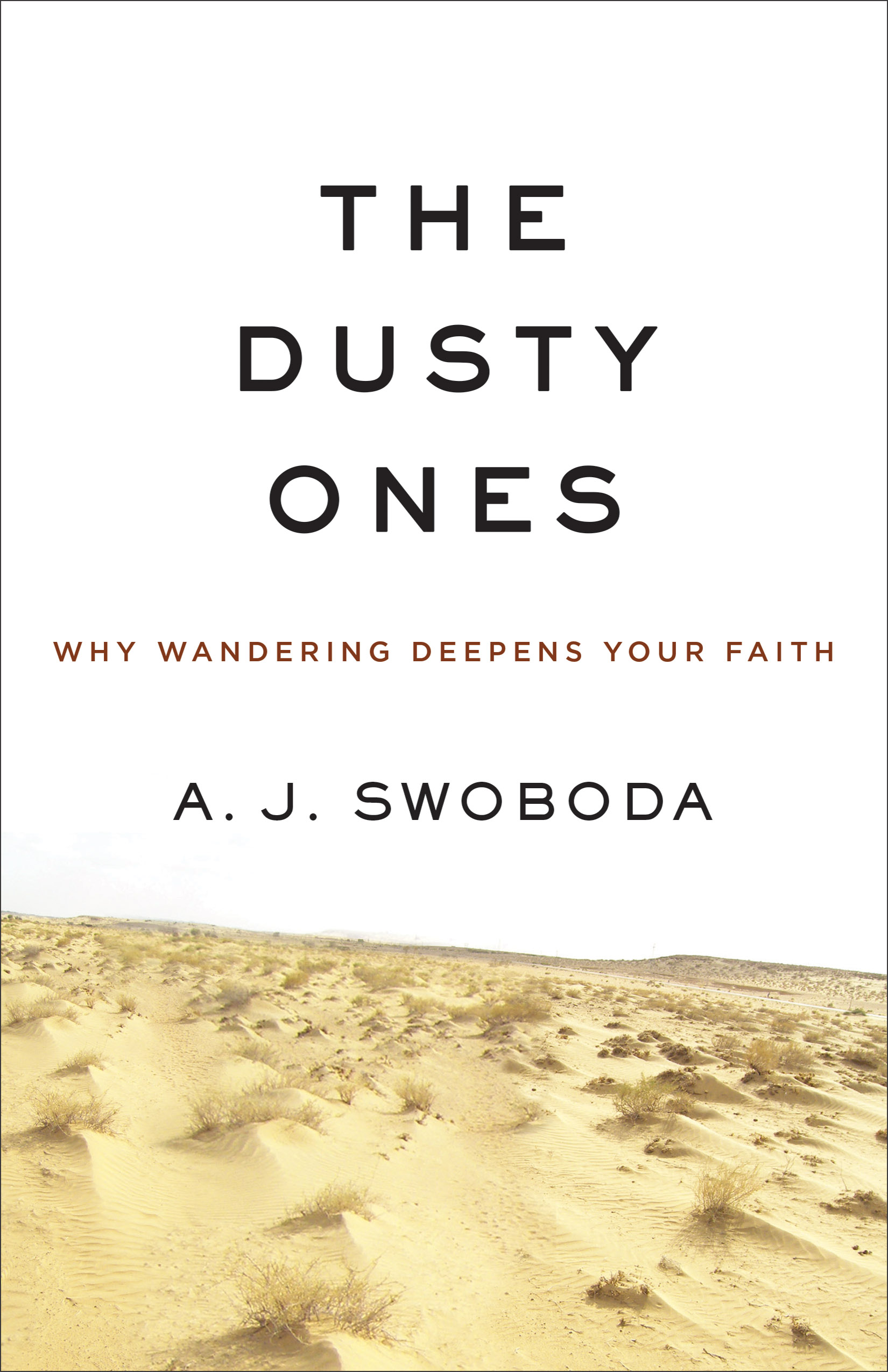
The Dusty Ones bigger.jpgThe Dusty Ones: Why Wandering Deepens Your Faith A.J. Swoboda (Baker) $15.99  Last year about this time I read A.J.s A Glorious Dark which reflects profoundly on the triduum — Good Friday, Holy Saturday, and Easter Sunday. Through his own study and sharing of pain and doubt and darkness and trust, that book moved me deeply and I will re-read it this Holy Week I am sure.  (By the way, not only was Glorious Dark one of my favorite books of last year, he also co wrote the significant and commendable Evangelical Ecotheology.)

Now, in this brand new one with this great, allusive title — The Dusty Ones — Swoboda explores wandering, what it means to be a wandering people, why wilderness matters and how hardships of time in the desert might be formative for us. And what it means to “wander well.”  On the back it says “If you’re restless, doubtful, or questioning, you will emerge from this journey with the assurance that not all who wander are lost. There’s hope and peace for all those who travel the winding path seeking to experience God in all his glory.”  As the upbeat and feisty Jo Saxton puts it, “May we all have the courage to live as one of the dusty ones.” 

One Dress. One Year. One Girl's Stand Against Human jpgOne Dress. One Year. One Girl’s Stand Against Human Trafficking Bethany Winz with Susanna Foth Aughtmon (Baker) $12.99  Just earlier today I read of the awful slave  ships from Thailand that do much of the commercial fishing that sells shrimp to Kroger, Wal-Mart, Whole Foods and Red Lobster. President Obama last month signed a bill to ban all seafood caught with slave labor, which rocked the Thai fishing industry — David Batstone at Not For Sale calls is a “major win against human trafficking.”  But the slaves (many of whom are children according to an AP report) are sill on those ships. It is heartbreaking, evil, and solving global injustices is complex.  Just recall Gary Haugen’s vital Oxford University Press book called Locust Effective: Why the End of Poverty Requires the End of Violence.  We need big, structural reforms and, obviously, a healthy establishment of the rule of law.

Enter Bethany Winz, who, as a sixteen year old (who is Bethany Winz.jpgnow in college at Trevecca Nazarene University), learned about some of this sort of stuff and just decided she had to do something. She tells us that she processes the world and what she learns by blogging and writing, and this fantastic new book emerged from her one-year experience of writing about a social experiment.  Bethany determined to wear the same black dress (that she made, by the way) every day for a year to focus attention on the lack of choices people in modern-day slavery face and to raise money to help end human trafficking.  It is fascinating to see what all happened to and through her in that year — her blog really was popular and she’s a fine young writer, so it makes great sense to know this is now out as a book.

Big, global issues must be faced with sophisticated policy and international advocacy. But they also have to be cared about deeply, and each of us can play some small part.  This is a beautiful, great example of one person doing what she can, where she is.


Jim Martin (Vice President for spiritual formation at IJM and author of The Just Church) writes,

Raw, witty, and unafraid, One Dress. One Year. is a primer on moving from passion to action that is courageously honest about the inevitable stops at disillusioned and disheartened along the way. This book is a must-read for any young person passionate about justice but unsure where to begin.

How to Be Here- A Guide to Creating a Life Worth Living .jpgHow to Be Here: A Guide to Creating a Life Worth Living Rob Bell (HarperOne) 25.99  Again, this is brand new and I haven’t spent more than a few minutes browsing through it. I can tell you two things, at least: even though the advanced buzz on this has been that Rob is seeing his own calling these days (at least in this book project and round of public speaking) as oriented to those outside of the church, doing what some dumbly used to call a “crossover” book, he is still clearly writing as a pastor, a person of faith, a media figure who is drawing people into the story of Jesus as revealed in the Bible.  Agree or not with all that he does or says in this good goal getting folks to consider the Bible — how is that working for you in your own life, I’d ask before getting ugly in condemning Bell for sounding less evangelical than he once did, by the way — he does cite the Bible and Christian theologians in this volume. He has not lost his faith or gone “secular” (certainly, not: this is a guy who did a bar and rock venue tour doing a lecture called “Everything is Religious.”) He cites St. Ephraim the Syrian and  Dorothy Sayers and Cornelius Plantinga  (yes, Engaging God’s World!) and Charles Foster, all right next to Rumi the poet and Abraham Heschel the prophet, Elizabeth Gilbert  — he loves, as he should, her recent book on creativity called Big Magic — and the podcast comedian Pete Holmes, not to mention the fun band Jimmy Eats World, who I think he’s quoted before. Who I know he’s quoted before, but I remember stuff like that.

This is a book for ordinary folks about finding a life of meaning and perhaps destiny, about honing one’s craft and getting good at stuff and being more open to being more connected to people God brings into your life. It’s about being present, attentive, aware in a too busy life.  Like others in this hip, recent genre (designers and artists and cultural creatives as motivational speakers) he is known as a person who can help readers wake up to live “more inspired, vibrant, and complete lives.”  As Green Bay Packers quarterback Aaron Rogers writes, Rob Bell is “a great storyteller, easily making the most complex theories understandable and ideas more fascinating… ”  I agree.

By the way, I recently re-read most of Jesus Wants to Save Christians and his little book on grief, Drops Like Stars and found them to be once again very, very powerful and well worth considering.  And, come on — who doesn’t like Velvet Elvis?  Okay, maybe not everybody, but it’s under-rated, I think, not only fun, but an important little book.  I’m looking forward to this new one.
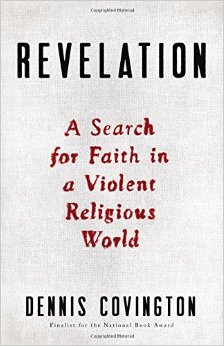
Revelation- A Search for Faith in a Violent Religious World .jpgRevelation: A Search for Faith in a Violent Religious World Dennis Covington (Little Brown) $26.00  Okay, I announced this a week ago in a listing, not unlike this one, of brand new titles I wanted to tell you about but had not yet read.  I stayed glued to a chair or a bed or another chair for hours on end over the weekend and finished this in one huge gulp or two.  As I expected it blew me away and I now really want to tell you about it.

As I noted the other day, Covington is renowned for his American Book Award winner Salvation on Sand Mountain which included quite a bit about his own faith journey, a story of his reporting on, and then being befriended by, Appalachian snake handlers. He has a penchant for the hard and weird and violent, and this has apparently again drawn him to ask what could possible be among the hardest questions: how does religion help people hold on in times of war and genocide, violence and gross injustice? And, perhaps even harder, how does religion sometimes fuel such awfulness.  This is a not an astute, profound study such as Os Guinness’s essential Unspeakable: Facing Up to the Challenge of Evil or Tom Wright’s excellent, even inspiring, Evil and the Justice of God or a tirade like the eloquent War is A Force That Gives Us Meaning by the righteous former war correspondent Chris Hedges, let alone a testimony of good medical mission worker organized by peace-maker Jeremy Courtney (Preemptive Love) although I wish I could send all four to brother Dennis.

This book, though, with the allusive title Revelation — or should he have used a similar word Apocalypse —  is more of a travelogue, a mystery, a memoir of a guy who is driven, haunted (and at times, nearly hunted) as he tries to unravel personal questions about contacts he has along the Syrian -Turkish border.  If you want to know what it is like doing journalistic investigation among refugees and revolutionaries, bribing border guards, hanging out with possible terrorists, fearing for one’s safety — in cabs driven by crazy Middle Eastern drivers or because of the proximity to bombs falling or because one is trying to understand members of what we now call ISIS — this book is for you. 

I was hooked by the first amazing pages, by his foray into the violence of the drug cartels (and the grace of those who minister among them) in an intense chapter set in Juarez, Mexico., one of the deadliest places on Earth. (He had spent time among the death squads in El Salvador decades ago so this kind of danger and this kind of evil felt somewhat familiar to him.  

The book takes a turn to the Middle East, though, and he’s off to Turkey, wondering around places (such as Antioch, that town where Christians were first called Christians, he notes) that I had to get out an atlas to look up.  What a story of intrigue, of passion, of great interest.  Did I say I couldn’t put it down?

Through it all — perhaps not unlike his foray into Pentecostal snake handling so well told in Sand Mountain — Covington is searching to determine, to find, or re-find his own (lapsed? unconvinced?) faith.  He narrates other portions of his life (including his sad divorce from Vickie Covington, already hinted at in the beautifully done, dazzlingly raw co-written memoir, Cleaving: A Story of a Marriage) and their stint as church leaders doing well-drilling mission trips.

One episode doesn’t leave me. In his excursions exploring religious violence he necessarily writes about his growing up in the racist south, in Birmingham, where a otherwise proper Methodist Sunday School teacher was a Klansman.  He tells of being on a bus in 1963 with other kids in the school band, and how a white classmate had her arm hanging out the window.  A black youth passing by cut her with a razor or knife, the news of which inspired the awful bombing of the 16th Street Baptist Church. Wow.

As the book’s emotional momentum seems to grow, Covington’s travels and his research pushes him towards his final goal — meeting with the parents of a US hostage being held  by ISIS terrorists (without it being made public) — he makes his way to the parents home in Arizona, doubting if they would even trust him to speak with him. Other journalists have been kidnapped and then brutally beheaded; no one takes this stuff the least bit lightly. The US doesn’t negotiate with terrorists.  He isn’t even supposed to know about this situation and doesn’t trust the guy he met who gave him a message. You know, you can hardly make this stuff up. It is grim and beautiful, what one reviewer called “a harrowing pleasure” by “one of the most honest and interesting human beings writing today.”


BookNotes

SPECIAL
DISCOUNT
ANY ITEM MENTIONED

10% off
order here
takes you to the secure Hearts & Minds order form page
just tell us what you want

inquire here
if you have questions or need more information
just ask us what you want to know

                                      Hearts & Minds 234 East Main Street  Dallastown, PA  17313     717-246-3333

You Are What You Love: The Spiritual Power of Habit by James K.A. Smith (Brazos Press) review: PART ONE — ON SALE at BookNotes

smith small head shot.jpgYou Are What You Love- The Spiritual Power of Habit.jpgI want to ease into a review of James K.A. Smith’s important new book, a book that I am very, very impressed with, and found to be a joy and of great value, the much-anticipated You Are What You Love: The Spiritual Power of Habit just about to be published by Brazos Press ($19.99.)  It will be shipping shortly and we will have it on sale at $17.99 very soon.

(We are still taking pre-orders of it, at the 20% OFF extra discount as when we first announced it late last year. or again early in 2016. Those early birds got the pre-order extra discount. See below to get that extra discount, even now, and get to join in an exclusive on-line chat with Mr. Smith, compliments Brazos Press. Extra discount good until the book releases mid-March..)

This new book is truly wonderful and so very important, and it is for me significantly connected to my own journey, my own years of reading and being formed by conversations with others about related themes, and somewhat related authors, so I want to place the release of this James K.A. Smith book within a certain context.  There are other contexts and other stories that could be told about this stellar new work (it is dedicated to worship scholars Robert Webber and John Witvliet, about which I will comment when I review it in earnest) but for those who read BookNotes and care about our bookstore work here, I wanted to offer this particular rumination about one or two pieces, so to speak, of the book’s backstory, tributaries, if you will, that have flowed into it and brought Smith to this important point in his career.

I will review the book itself in the next BookNotes, but wanted to share this essay as a preamble to my review. I hope it is stimulating and a bit provocative, helping you come to appreciate the book’s importance.  Maybe this is even consistent with the theme of the book – I might convince you to buy it by inviting you to feel warmly about it because it has a story we might care about and a trajectory that captures your imagination. We are what we love, after all, and I love this stuff. I am not saying this with a wink or in irony; not at all. I hope you love good books and big ideas, even ones that, well…

Take a deep breath, and let’s begin.

In a remarkable book just out in paperback called How I Shed my Skin: Unlearning the Racist Lessons of a Southern Childhood Jim Grisley notes how he quietly absorbed racism in the 1960s in his small North Carolina town, without really being explicitly taught about white supremacy, and, in his words, how he “inhabited a universe where certain things simply weren’t imaginable.” 

Like a black girl kissing a white boy in 7th grade in 1967 in North Carolina, or a white boy liking other boys; few talked about it, and but almost everybody got the message.  Some things just aren’t done.  They couldn’t even imagine it.

subversive 2nd.jpgWhen reading that line I immediately thought of the powerful collection of essays by Brian Walsh called Subversive Christianity: Imaging God in a Dangerous Time (Wipf & Stock; $15.00) which invites us to see deeply into our culture and its ideologies, its idols and dysfunctions, its pains and sorrows. Walsh makes the case persuasively that our very imaginations are held captive by the world and, given discipleship imperatives like those found in Romans 12:1-2, we must find out how to become “non-conformed” to these ways of seeing and being in the world that so profoundly hold us captive.

I have told the story before, but it bears repeating here. I thank you for indulging me a bit of reminiscence that I think will set the stage for my review of what I think is probably the most important book of 2016.

Let me explain.

TORONTO

When in the mid-1970s Beth and I were hanging around the campus ministry organization the CCO (the Coalition for Christian Outreach) we studied mimeographed notes from what we ICS_(Toronto)_logo,_RGB_150x100.gifcalled a “Perspectives Class” that we got from Toronto’s Institute for Christian Studies which we sensed would be transformational for our lives and our organization. A Dutch philosopher and campus worker who I mention in my chapter in Serious Dreams: Big Ideas for the Rest of Your Life (Square Halo; $13.99), the late Dr. Peter J. Steen, had given them to us. More or less, these notes eventually became the core of the book The Transforming Vision: Shaping a Christian Worldview (IVP; $18.00) which you may know is one of the books on my list of those that most influenced me.

The-Transforming-Vision-9780877849735.jpgcreationregained.jpgWhen I announced The Transforming Vision (along with the more succinct and less audacious Creation Regained: The Biblical Basis for a Reformational Worldview by Steen’s good friend Albert Wolters) at the 40th anniversary of Jubilee a few weeks ago in front of 3500 eager college students, naming it a true Jubilee Classic, I was not kidding. The Transforming Vision was the first major book that systematically explored the full-orbed Biblical perspective that could be called a Christian worldview, and how the false division of life into hermetically sealed off compartments (sacred/secular) that was presumed, breathed in the air of our churches and culture, holding captive our imagination, arose from an unfaithful accommodation to pagan Greek dualism by the early church. In succinct chapters painted with a broad brush, Walsh and his co-author Richard Middleton showed how medieval and even reformation-era theologians continued to accept–sometimes explicitly, sometimes tacitly – this assumption: God really only cared about some things (prayer, church, theology, evangelism, the soul) and other more worldly concerns (politics, art, science, sports, urban planning, economics and such) were of lesser concerns, or at least could be considered as “secular” and disconnected from the heart of discipleship. (As one prof at a Christian college railed to his class in those years after hearing Walsh lecture, “There is no such thing as a Christian view of economics!”

(Regarding my claim that this was the first book of its kind, you can study for yourself the fascinating genealogy of the word weltanschauung — world and life view/philosophy of seeing — and learn how it was first used by Christian writers in the magisterial history of the subject by David Naugle, Worldview: The History of a Concept (Eerdmans; $34.00) and consider the later struggle to use it wisely in After Worldview edited by J. Matthew Bonzo and Michael Stevens (Dordt College Press; $13.00.) Both books are important, foundational resources.)

SECULARIZATION RESULTS FROM DUALISM: NATURE EATS UP GRACE

In The Transforming Vision, Walsh & Middleton quoted Francis Schaeffer, who was still alive, drawing on Dutch philosopher Herman Dooyeweerd, observing that if theologians presume a dichotomy between nature and grace, sooner or later, “nature eats up grace.” Or, in other words, if God doesn’t really care about, and the Biblical worldview doesn’t really given an account for or offer normative principles for the stuff of culture such as economics or science or civic life, then faith is increasingly made small, marginalized, rendered toothless, and the idols of the age – unmoored from the Bible and Christian conviction – grow and become the dominant force of society. We turn away from culture saying it is “the world” or “the devil’s territory” or, seemingly more benign, “it is what it is” and don’t allow the gospel to truly have its way in transforming the world.  The Kingdom isn’t seen as “creation regained” but as escape to heaven and some inner comfort, and, subsequently, the world develops as it does and we wring our hands.

(As John Stott used to say, though, we shouldn’t blame meat for rotting; we should blame the preserving salt for not doing its job! Let those who have ears, hear!)

AND A PITHY  DORTHY SAYERS QUOTE

heaven is not my home Paul Marshall.jpgAnd, anyway, as Dorothy Sayers is said to have said, who wants to commit to a religion that is disinterested in most of real life? That’s a good question!  Or as Paul Marshall, also at ICS in those years, wrote in his wonderful collection of pieces about Christian living in various sides of life and culture, Heaven Is Not My Home: Living in the Now of God’s Creation (Thomas Nelson; $15.99) such a constricted, narrow view of religious life ends up just being boring. How can we conjure much enthusiasm for a faith that disregards so much about life in God’s world?

We experience the deformed textures of the world as we now know it in part because of our capitulation to this dualism – God doesn’t really care about the stuff of life, it was commonly assumed in the middle of the 20th century evangelical churches.  We can’t even imagine serious hope for the real world.  The secularizing spirit of the increasingly influential and brazen admen coupled with the often outright disdain for the world in our churches created a toxic faith orientation that was more gnostic than Biblical and allowed distortion and dysfunction to run amuck in society without much substantive challenge.  Such compromised faith and cultural apathy lead to an ethos in most churches about which Episcopal poet Malcolm Boyd could write that we may study the Hebrew prophets but wouldn’t have the imagination to recognize one if he stepped in front of us.

The Transforming Vision not only offered very helpful study on the Biblical narrative (creation-fall-redemption-restoration – in a way that caught the attention of a young Bible scholar named Tom Wright, btw) but critiqued the rise of scientism, technicism, economism, the chief idols that reduced the multi-dimensional goodness of God’s creation to stuff that can be managed. And it made a case for students to be a bit more attentive to the philosophies that informed (deformed?) their majors and invited them to be a bit more rigorous in their reflections about their callings. 

In a way the book was channeling into the late 20th century the insights of Dutch theologian and political leader Abraham Kuyper from a century previous who insisted that Christ’s Lordship over all areas of life should lead to a public faith lived out with grace and holiness amidst a pluralistic society. Kuyper famously balanced “common grace” (realizing the goodness of the creation and the ways even those hostile to Biblical religion do many good things) and the antithesis between God’s Kingdom of light and all other agendas and religious-like forces. (Can anyone say “resident aliens”?)  A transforming vision of God’s missional project of redeeming creation which rejects as unbiblical the false dualism of sacred vs secular will free us to “think Christianly” about all of life and create social initiatives of distinctively Christian witness alongside more secularized projects of those in the world.

KUYPER AND BEYOND: REFORMING THE SOCIAL ARCHITECTURE

Such Kuyperian “world formative” believers will work for alternative labor unions based on reconciliation, media outlets that are fair and profound, Christian universities, faith-based businesses, Biblically-influenced counseling centers, art galleries guided by Christian insights into aesthetics, science think-tanks rejecting the religion vs science model, journals that invite conversations about Christians in philosophy, firms seeking normative, responsible views of technology and engineering, will work vigorously for environmental concerns and the like. Maybe even there could be a “third way” Christian political party like what Kuyper started in Holland. Churches will enable their members to take up vocations in the world as thoughtful, informed, change agents, seeking their own spheres of influence for the sake of pointing to God’s Kingdom, not merely church growth.

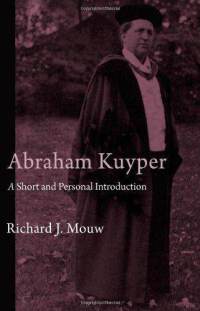
abraham-kuyper-short-personal-introduction-richard-j-mouw-paperback-cover-art.jpgIf you are so inclined, you might benefit from pondering Prime Minister Kuyper’s famous lectures given at Princeton Theological Seminary in 1898 which are still in print under the title that doesn’t do it justice, Lectures on Calvinism (Eerdmans; $18.00) or the very lovely little recent book called Abraham Kuyper: A Short and Personal Introduction by Richard Mouw (Eerdmans; $15.00) to connect those dots.  Smith himself has written about these things and their significance. I love his fabulous collection of essays, reviews, and articles found in Discipleship in the Present Age: Reflections on Faith and Culture (Calvin College Press; $14.99) discipleship in the present age.jpga book we are happy to letters to a young calvinist.jpgstock, or his more specific introduction to gracious, broad Kuyperian themes — and Augustinian as well — in his set of lovely pastoral letters to young Reformed Christians called Letters to a Young Calvinist: An Invitation to the Reformed Tradition (Brazos Press; $14.99.)   I once (okay more than once) quipped that that particular little book might be subtitled “moving from Piper to Kuyper.”

JUBILEE — NO DUALISMS to TRANFORM EVERYTHING

The CCOs Pittsburgh Jubilee conference developed in the late 70s out of this heady mix of reading philosophy, doing cultural criticism, seeking the “integration of faith and scholarship” and exploring what it meant to be faithful Christians at least somewhat in the line of Kuyper – not pietistic dualists who rejected culture nor heterodox liberals whose churches tended to accommodate to secularization and the spirit of the age. (See this extraordinary short booklet celebrating the impact of 40 years of this yearly gathering and you’ll see in an instance what I mean. Do you know anybody doing quite this kind of work with young adults??)

Although Jubilee offers lots of basic, fairly conventional Christian content for young collegiate believers and is known for its commitments to social justice, racial reconciliation and promoting short term mission projects of all sorts, at its heart is this rejection of dualism.  “Everything Matters” it shouted a few years ago. “Transform Everything” was the slogan this year. A year ago when Richard Middleton preached Sunday morning drawing on his stunning, Biblical book A New Heaven and a New Earth: Reclaiming Biblical Eschatology (Baker Academic; $26.99) he came away from the event and wrote a blog post showing an old “no dualisms” button he found somewhere, having heard that was once a slogan among CCO staff. 

truth is stanger than.jpgAnd here is why I remind you of this: after The Transforming Vision found its way into the world Walsh and Middleton followed it up with a major work called Truth Is Stranger Than It Used to Be: Biblical Faith in a Postmodern Age (IVP Academic; $22.00) which explored how insights from postmodernity might deconstruct standard-fare evangelical instincts and how a raw immersion in a more knowingly Biblical story (including big themes of injustice and exile and lament) could offer to the broken pomo culture not easy answers of heaven after death, but costly discipleship that points to God’s amazing grace that would bring social renewal and cultural restoration and hope-in-history.

But, as they helpfully showed, the Bible’s own story isn’t one of God bringing instant healing and spiritual revolution, let alone one of breaking promises with the creation and destroying it so we can live in a disembodied, ethereal heaven for eternity, but is a story in which we are called to take up vocations of prophetic denunciation of the idols of our age, serving as salt and light in but not of the world and thereby being a counter culture which bears witness to new creation. (I don’t know exactly where Gabe Lyons and David Kinnaman got the great phrase “counter culture for the common good” that they have used for years, as I noted in my review in our last post about their new book Good Faith, but it may have resonance with these themes from Walsh & Middleton and ICS and Kuyper and James K.A. Smith.)  Our being somehow in solidarity with the pains of the world is what allows us to be Christ-like and a true counter-culture.

In other words, as Truth Is Stranger… explored, we are called to enter in to the suffering of God’s world and follow the upside down Kingdom of a King whose seemingly not-so-royal coronation is on a cross and whose crown is one of bloody thorns.

And that, my friends, is hard to imagine.

CAPTURED IMAGINATIONS? CAPTURED HEARTS?

subversive 2nd.jpgWhich is why I was glad when Brian published that small collection of lectures, papers, sermons — one given at Jubilee in the mid-80s — that I mentioned earlier, called Subversive Christianity: Imaging God in a Dangerous Time (Wipf & Stock; $15.00.) These powerful, astute, demanding essays explored Biblical texts and contrasted the spirit of the age,  drew on the lyrics of Bruce Cockburn, mourned the agonies of creation, decried the plight of the poor often abused by the neo-colonialism of the US empire, and once again exposed as unbiblical the still too-often otherworldliness of most churches. A more recent new edition adds a prophetic, inspiring chapter exploring our current situation among God’s people and within the world at large.  I was thrilled to hear just the other week that N.T. Wright (who wrote the forward to it) is using it in an on-line course he is teaching on Christian and biblical worldviews.

The heart of that potent book, though – that our tears of lament and protest against the idols of the age will prove subversive, eroding trust in the untenable promises of those false gods of modernity – is explored in light of one major truth, a truth hinted at in Transforming, made a bit more explicit in Truth Is Stranger and explored directly in Subversive, and it is this: changing our ideas alone will not generate the sorts of reforming Christian vision for life that Biblical faith demands. Getting a theology (or worldview) right simply isn’t enough. (It is also why Brian wrote an amazingly insightful, learned, passionate and entertaining book exploring the lyrics of rock singer Bruce Cockburn called Kicking at the Darkness: Bruce Cockburn and the Christian Imagination (Brazos Press; $22.00.) Poetry, music, and the arts can help us “see” things, allow us to be touched by them, using the right side of our brains, helping us mature our imaginations. As Cockburn sings of poets in Maybe the Poet “you need him and you know it.”  Merely assenting to the ideas of a so-called Christian worldview, even one that unmasks dualisms and is grounded in a healthy reading of the Bible using the themes of creation, fall, redemption, restoration, will not truly bring the revival and renewal and Biblical grit that we need to make a difference in the world.

Because, you see, our imaginations are held captive.  Adopting better, bigger ideas in place of bad, constricted ones may help a bit, but — as Walsh said bluntly in Subversive, after having written books himself about the need for a Christian worldview, which now Smith echoes and significantly develops — this just isn’t radical or effective enough.

We have muted the subversive, idol-challenging, big-picture, transforming vision of the gospel not only because we have thought bought bad ideas, but because we just can’t see it.

We might even say that our hearts just aren’t in it.

WAIT FOR IT….

Which is to say this: (wait for it, wait for it…) we really, really need this powerful, important new book by James K.A. Smith, You Are What You Love: The Spiritual Power of Habit.

You Are What You Love- The Spiritual Power of Habit.jpgYou Are What You Love makes the case that we come to embrace new ways of living out the faith not only by being lectured to, by reading books, by thinking well – not even by thinking well about the stuff I’m writing about – but by coming to care deeply for these things with our affections, which are shaped, Smith wants to say, mostly and most decisively, by ritual and liturgy and embodied habits. To live out a transforming Christian vision, we need to somehow learn to “learn by heart” and be transformed by the stuff we do, that in turn effects our desires and imaginations. In that sense, true change happens not, as the spiritual formationists put it, simply from the inside out, but from the outside in.  Rituals and habits shapes our tastes, our affections, we love what we do, and we are, then, what we come to love.  We aren’t primarily thinkers but we are lovers.  That is how God made us.

THINKING IN TONGUES

Smith studied with Walsh & Middleton in those years that Transforming Vision and Truth Is Stranger Then It Used to Be and Subversive Christianity were being debated and written.  As a Pentecostal kid from a small town in Canada, Jamie Smith came alive when realizing he could honor God – he could worship God–as he studied philosophy.  He describes this in an exceptionally interesting reflection in the first great chapter of his serious, philosophical book Thinking in Tongues: Pentecostal Contributions to Christian Philosophy (Eerdmans; $19.00.) Yes, Smith the neo-Calvnist Kuyperian postmodern philosopher whose new book is about liturgy is also Pentecostal. 

WHO’S AFRAID OF POSTMODERNISM?

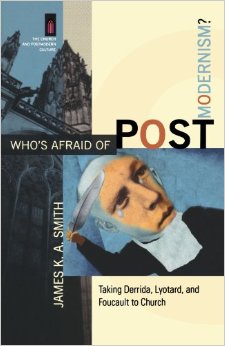
One might surmise that Smith’s interest in postmodern philosophy was stimulated at ICS on 220 College Street in Toronto, as he observed there the deep discussions between their brand of “all of life redeemed” neo-Calvinist philosophy and the more rationalistic theological dogma promoted at places like Westminster Seminary or Ligonier, and was around Walsh and scholars who's afraid of postmodernism.jpglike James Olthius as they began to dig deep into postmodern philosophy. Think of Smith’s own important little book, based on lectures given at L’Abri, called Who’s Afraid of Postmodernism: Taking Derrida, Lyotard and Foucault to Church (Baker Academic; $19.99.) These and his other books on postmodernism do not drift off into weird radical theology or the slippery trendiness of some in the emerging church conversations, yet give a rousing call for historically orthodox believers to engage and in some ways embrace insights from continental philosophy.  Which surely includes rejecting the straight-jacket of faith in autonomous reason that seems so prevalent in many theological circles and, he might say, distorted some of our best theological traditions.

I am not a philosopher (by any stretch) and I don’t really know the details of Smith’s journey, but I think I can can suggest this much: he is, in some important ways, working out the fundamental concern of Walsh & Middleton in their early books that have meant so much to me, a concern that insists that to be Biblically wise we should reject favoring the rational and systematic and modernist methods by honoring the God-given role of the imagination, the heart, the desires. 

THE BIG SPRAWLING STORY OF MODERNITY

Modernity – that big, sprawling worldview and societal movement linked to the intellectual principles demanding faith in Reason promoted by the secularizing and violent French Revolution at the time of the Enlightenment – left little room for the role of the imagination: everything that mattered (and, for the more extreme thinkers, everything that truly existed) could be measured, counted, named, reduced to some objective Fact.

Theologians – especially those of the late scholastic Catholic era and the seminal Protestant reformation – were so influenced by this modernist worldview, this unbiblically narrow view of knowing and truth, that theology became increasingly abstract, systematic, detailed, debated, becoming something so technical and considered so important that it was worth killing for. People could be burned at the stake for having some nuanced detail wrong about an obscure bit of theological arcana. Later, one could be arrested for reading the wrong novels. It is not the only story, but for some, novels and art was suspect. I know of a otherwise thoughtful Christian woman who disapproved of us selling fantasy novels because, well, this wasn’t logical or true. Showing her Madeline L’Engle’s The Rock That is Higher: Story As Truth or Calvin Seerveld on Biblically-inspired aesthetic theory didn’t help. She was, in her fundamentalism, a child of the Enlightenment and only facts mattered.

In many ways, churches and their theology became as much a curse as a blessing and while church leaders fought (think, especially of the nearly one hundred years of war in Europe related to religion in the late 1500s into the middle of the 1600s) some of the culture went to hell in a hand-basket – and, the glories and good that were developed were disassociated with the grandeur of God. This itself is a shame and a scandal, but there you have it.  You know what the makers of parts for atomic bombs, GE, used to say: “We bring good things to life.” Yikes!

DESCARTES STILL IN THE BACKGROUND

You probably know how eventually theologically liberalism ran this into the ground and how American fundamentalism responded; in the US in the 20th century churches were more or less divided into liberal vs conservative camps with all manner of troubles ensuing.  Some of these conflicts and debates were very important, but behind them all seemed to be this larger, usually unquestioned story of the modernity of the Western world. By the end of the last century some had discovered inner spirituality, some had become progressive agents of social justice, some continued to argue theology, sometimes helpfully, sometimes brutally. Church and worship styles came and went, but everybody seemed to still live in the background of a story that said, in Descartes’s famous phrase: “I think therefore I am.”

NOT A BRAIN ON A STICK, BUT LOVERS;  NOT DATA BUT YADA

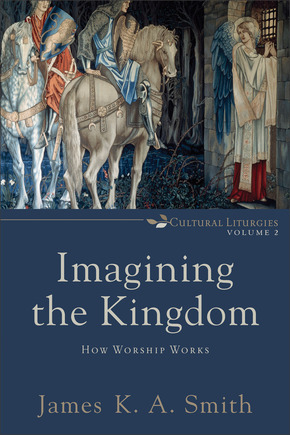
Smith deconstructs this problematic view of what kind of creatures humans are. Descartes worldview and the subsequent rationalism of modernity said we are primarily thinkers, “brains on a stick” in Smith’s colorful summary. And he also critiques what it means to truly know something (again, the modern view is that knowing is merely assenting to raw data absorbed into the mind as facts.) In a set of much discussed books (Desiring the Kingdom and Imagining the Kingdom — see below, or search our BookNotes for times I’ve reviewed them) Smith shows – drawing on the insights he learned from Walsh and Middleton and Al Wolters and Calvin Seerveld and James Olthius at ICS, who were all influenced in those years by Kuyper and Dooyeweerd – that in the Bible the human heart is the center of the human person, not the mind, and that the Biblical word for knowing is yada – the same Hebrew word used to describe sexual intercourse.

Ahh – I helped the CCO a decade or more ago do a series of conferences about wholistic engagement with “heart and mind” that we called Yada, Yada, Yada. And if you don’t believe me that this stuff is interesting and vital and consequential, see Esther Meek’s small book called A Little Manuel for Knowing (Cascade; $14.00) which invites us to covenantal views of true, wise, deep, knowledge or the chapter called “Knowing is Doing” in Steve Garber’s beloved Visions of Vocation (IVP; $16.00.).

With this view of the human person (rejecting Descartes and the modernist illusion of Man the Thinker) and this view of authentic knowing (rejecting the modernist illusion that there are neutral facts one can conquer and thereby truly know in one’s mind alone) Smith is working way outside of the box of conventional assumptions, pressing us to think hard about very basic stuff — what really is the human person, what do we most desire, what is the nature of the heart, what does it mean to really say we know something, how do we change as people and as a society — from what he considers to be a more Biblical, theologically sound perspective.

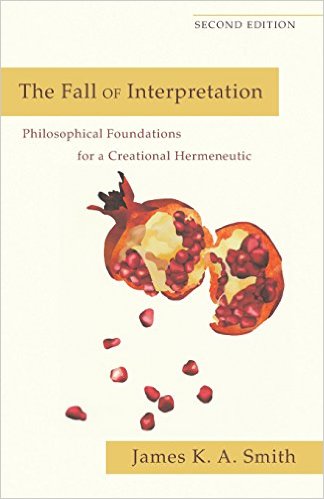
the fall of interpretation.jpgSmith has for a long time in his many books explained that a Biblical vision of of the person is more than a “brain on a stick” and our knowing is something more wholistic/spiritual than mere objective assent to raw data. His first major work was on Augustine and hermeneutics  and was called The Fall of Interpretation: Philosophical Foundations for a Creational Hermeneutic. (Baker; $22.00.) It is an important book, and it should be better known among us.

Especially in his last two recent books, though, and this brand, brand new one Smith helps us see – importantly – that knowing something is not merely intellectual, that we are people who imagine our way into new ways of living, and our imagination is held captive by our loves, that which we most care about. The defining question — as Augustine said in the earliest centuries of the church — is less about what we believe, but what we love.

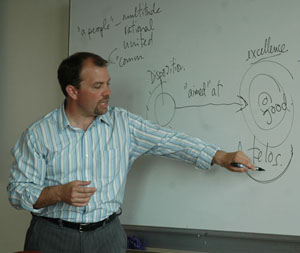
jamie-teaching-seminar.jpgLook: Dr. Smith is a philosopher and writer of books and journalist and college professor – one of the most intellectually robust people I know! – so he surely isn’t promoting anti – intellectualism or doing an end-run around the life of the mind. Of course he is writing a book about all this so just get over that seeming irony.

Still, as a scholar, he is adamant: most Christian theologians – and, in the late 20th century, even many of us who promoted the need for a Christian worldview! — have too closely tied our invitation to “think Christianly” and have a Christian orientation and Kingdom vision to a view that assumed that if we just got our facts right, if we thought differently, if we learned the right stuff, read the right books, critiqued the false ideas, rejected dualism, attended conferences of the missional sort, and paid attention, learned the “Biblical meta-narrative” and understood “creation regained” and the like,  well, we’d start thinking God’s thoughts and living in God’s ways. The Kingdom might come if only we got rid of the bad ideas and adopted the right ideas about a Christian worldview and learned to articulate them in an orderly, clear-headed fashion.

As I might say in my review of You Are What You Love when I get to it in the next BookNotes, I think Smith maybe overstates this tendency, and that only some who talked about worldview talked about it in that reductionistic, modernist, rationalist manner.  But his point is well taken, nonetheless.  Many of us – liberals and conservatives, activists and pietists, progressives and orthodox, worldview thinkers and dualists, scholars and more practical folk — somehow really believe (deep down) that if we just learn the right stuff and assent to the right assertions, then we can apply the right Bible principles and change our lives and maybe change the world.  

But, as we might ask nowadays, “how is that working out for you?”

As we will see, in You Are What You Love James K.A. Smith offers a very different approach to spiritual formation and cultural engagement and he greatly, greatly values the role of the local church and its educational and worship ministries to form us into the kinds of people that are able to be “a counter culture for the common good.”

As you may know, Smith has developed very complex – some might say at times nearly tedious – arguments for how we know with the heart, and are truly most deeply shaped and formed by rituals (for better or worse, rituals from the world or from the church, thin, unsubstantial ones or thicker, lasting ones) in his last two books, part of what is being called the “Cultural Liturgies” series.

DESIRING THE KINGDOM, IMAGINING THE KINGDOM, AND…

imagining the kingdom cover.jpgdesiring-the-kingdom.jpgProfessor Smith’s first major work on all this was Desiring the Kingdom: Worship, Worldview, and Cultural Formation (Baker Academic; $22.99) and the second was Imagining the Kingdom: How Worship Works (Baker Academic; $22.99.) Within a year or so we are told there will be a third one in the “Cultural Liturgies” series, most likely called Embodying the Kingdom. These two are major works, and many have found it valuable to wade through them, both, perhaps with others.  I know some who say they are the most important books they have ever read in their lives.

Into this effort of much writing and speaking about “secular liturgies” and inviting us into a more imaginative view of worldview – he adopts Charles Taylor’s “social imaginaries” – and promoting a storied view of how what he most love shapes how we live, Smith has realized the need to offer a book that has a less philosophical tone, fewer academic footnotes, and is more accessible and practical in its appeal. Much of his concern comes back to how we do church, so we wanted to write a book for pastors and church leaders, with more advise given to generate conversations in the local parish.  You Are What You Love: The Spiritual Power of Habit is that book although I am very glad to tell you that it isn’t merely a “dumbed down” short version of the first two.

You Are What You Love- The Spiritual Power of Habit.jpgIn the last few months I tended to describe it that way, in brief, that that is what it would be, just a simpler version of his two others in the “cultural liturgies” project. Now that I have read it, though, I think You Are What You Love deserves to be known as its own unique and stand-alone book – again, not just a simplified edition of previous works. It is marvelous, interesting, thought-provoking, moving, inspiring. Yes, he is re-visiting some portions of Desiring… and Embodying… but even for those that read and understood those volumes, this book is going to be fresh, good, helpful material.  I can’t wait to tell you about it.

As I said, I love this stuff.  I hope you care.  This is really, truly, life-changing — good for the heart and the mind, and the hands and feet as well.  I’ll tell you more about it soon.

FREE VIDEO CHAT WITH JAMIE SMITH ABOUT THE BOOK IF YOU ORDER NOW

jkas-features3-bkr.jpg

Click here to see a bunch of quotes about the book, a wonderful, short video clip of Smith talking about the book, and an opportunity to pre-order it through us at an extra discount, 20% OFF and to thereby get access to a special on-line conversation with Jamie next month. This is a special way of saying thank-you to you, with thanks to Brazos for their generous partnership.

BookNotes

SPECIAL
DISCOUNT
ANY ITEM MENTIONED

10% off
order here
takes you to the secure Hearts & Minds order form page
just tell us what you want

inquire here
if you have questions or need more information
just ask us what you want to know

                                      Hearts & Minds 234 East Main Street  Dallastown, PA  17313     717-246-3333
 

Good Faith by David Kinnaman & Gabe Lyons — and 10 more helpful reads for cultural engagement ON SALE

See our links shown below if you want to order from our certified secure order form page at the Hearts & Minds website, or the “inquiry” button if you have any questions about any of these items or any concerns about your order.  Thanks for being in touch.

What a whirlwind month it’s been here: my aging mom has moved to an assisted living place, we’ve battled repeatedly with a despised insurance company, we’ve not made a dent in transform everything.jpgunpacking book boxes from the huge Jubilee conference in Pittsburgh, and I just returned from a fabulous trip to speak (about faith and books and reading) at the National Student Leadership Conference at Taylor University in the alluringly flat state of Indiana.  I have shed more than a few tears these past weeks, but the glory of Jubilee and the NSLC have been gifts to me.  I am glad about things, even as many of us ponder what it the world is happening in our civic life with the awful state of political discourse. 

gather.pngAt Taylor U. I met some very sharp students, some very admirable faculty, a few author acquaintances who it was nice to see again, and several authors I can now call new friends. It is so encouraging to know that there are strong, careful, Christian voices and young followers of Christ who want to express good faith in the public square.  How good it was that Taylor brought in such fine authors and speakers. Maybe you saw my twitter pictures of Daniel White Hodge (The Soul of Hip Hop: Rims, Timbs and a Cultural Theology), Mandy Smith (The Vulnerable Pastor: How Human Limitations Empower Our Ministry), Lisa McMinn (To the Table: A Spirituality of Food, Farming and Community), Marilyn Chandler McEntyre (Caring for Words in a Culture of Lies), J.R. Briggs (Fail: Finding Hope and Grace in the Midst of Ministry Failure), Helen Lee (The Missional Mom: Living with Purpose at Home & in the World), Chris Smith (Slow Church: Cultivating Community in the Patient Way of Jesus), and others. This small evangelical college in middle Indiana is nurturing students to think deeply about life and culture, how to take up their callings in the world with faithfulness and courage, and to serve church and society in the name of Jesus.  Like the CCO’s Jubilee, Taylor’s NSLC has been going on for decades and has hosted some of the most renowned religious leaders of our time. What an honor to get to play a small part in these things God is doing among rising generations. 

It strikes me over and over, but especially at these big events, that books connect us, that we have some mutually shared vocabulary as we read together, as we listen well to each other’s influences, and to the way nonfiction authors as well as poets and novelists, some of them nearly prophetic in their wise analysis of faith and life, have left their fingerprints upon us, coloring in big or small ways how we think about life and how we talk about things that matter. 

jubilee bookstore 2016.jpgThank you for joining this far-flung reading community, being a part of the on-going conversations, even of breaking down old walls (oh, between, just for instance) mainline denominational church folks and para-church ministries, between liturgical traditions and more free-spirited charismatics, between progressives and missionals and evangelicals. Jubilee and the Taylor University events both bore witness to ethnic, racial diversity, with women and men from a variety of faith traditions pointing us towards a generous orthodoxy and inviting lived practices that are informed by Biblical and theological reflection and not civil religion or old school dogma.     (Above picture taken at Jubilee 2016 by Andrew Rush.)
These folks are embodying the adage “readers become leaders” and are leading the way towards helpful, fruitful ways to live our faith and create signposts of God’s coming Kingdom.  It’s a great story and project to be a part of and we think our bookstore is maybe playing a little role in it all.  And that means you are too, whenever you order books from us or pass on our reviews and BookNotes columns.

We hope you keep in mind this big, good story of God’s redemptive work in the world as you order and read and enjoy books, allowing them to work their magic, seeing them as tools for transformation, facilitating growth in wise and faithful living.

GOOD FAITH LIVING

First I will describe Good Faith: Being a Christian When Society Thinks You’re Irrelevant and Extreme, a fine new book by David Kinnaman and Gabe Lyons, two friends that help us continue this journey towards a public faith that is Biblically faithful and lived out with healthy relevance.  Then, I’ll name some other books that strike me as very important these days, illustrating how robust faith can inform significant conversations about embodying faith in our current social situation. Perhaps these (a few brand new, a few older) would help you follow up the broad framework and practical ideas offered in Good Faith and the Q Ideas events where it was recently launched.

Good Faith- Being a Christian When Society Thinks You're Irrelevant and Extreme.jpgGood Faith: Being a Christian When Society Thinks You’re Irrelevant and Extreme David Kinnaman & Gabe Lyons (Baker Books) $19.99

Perhaps you know of the very popular, excellent, classy events called Q (a national gathering) and the localized Q Commons events, each masterminded by the good folks at Q Ideas. (Their tag line is Stay Curious. Think Well. Advance Good.) We have stocked DVD presentations of older national Q gatherings (I described them here and here) and have promoted books by their founder Gabe Lyons.  Q Ideas is a remarkable example of a contextualized, thoughtful, generous, evangelical, movement that invites dialogue about public theology and living well in our times. Exploring their website is always time well spent and their TED talk-like presentations they share there are fantastic.  You can see Gabe’s short talk from Friday night at Jubilee here, too, where he introduced this brand new book to the world. His co-author, the Barna Group President David Kinnaman, also presented at Jubilee and the CCO will post his good talk at the Jubilee website soon. David quipped that “spread sheets are my love language.”  He knows his stuff and his passion to share research and data and trends in up-to-date info-graphics inspired him to curate the popular  Frames booklets. We’ve promoted them often and commend them as useful little tools about topics people are known to care about. 

We were so pleased to promote this new Good Faith book early on that we invited Hearts & Minds customers to pre-order it from us; my earlier brief review was based on the advanced manuscript we were honored to get. Now that it is officially out – it’s so nice to hold the real hardback book with that strong black and gold cover — we wanted to remind readers of its importance.

David and Gabe (who had collaborated several years ago responding to research about what unChristian.gifyoung adults tended to think about the Christian faith and American church life, a useful book called unChristian: What a New Generation Really Thinks about Christianity… and Why It Matters) told me that they poured several years of their lives into this, doing formal research through Barna and reading widely, conversing with many, and developing a specific response to the specific data they’ve discerned.  In a way, this is a manifesto for responding to the anxieties (in the church and the world) of our post-Christian culture.

I am sure many of us are more than tired of being lumped in with the worst sort of extremists and practitioners of bad religion.  From elite intellectuals saying that all religion is poisonous to the local media misunderstanding the nuances of differences between various strains of Christian faith, from hostile court rulings about religious liberty to pop culture jokes about toxic spirituality, it is clear that many in our world are suspicious at best and sometimes even hostile to even benign expressions of religious faith. (And, there are those who are properly multi-cultural and eager to make room for most world religions, excepting Christianity.) One only needs to read the letters to the editor column of any local newspaper or look at the bulletin board postings in any public university student union and one will see high-octane denunciations of religion.  How we can graciously and faithfully and effectively navigate these trying times is the project taken up in Good Faith.

And take it up they do.  

First, they have four chapters under the heading “Understanding Our Times” in which they show that many find Christian faith irrelevant and/or extreme and how we experience this tension, a tension many of us feel deeply in our bones.  They observe that even when many of us who regret the bad witness of the more extreme and uncivil voices and try to disassociate ourselves from them, living out a good faith, the watching world misunderstands. Nearly any faith is seen as bad faith.

Part II of Good Faith includes twelve chapters on “Living Good Faith.”  This is must-read stuff, very important, and helpful, especially for those who haven’t kept up on recent conversations about how the world sees Christian faith or how those committed to Biblical values have tried to winsomely explain those views to a skeptical culture.  Some of their analysis and some of their proposed responses, again, comes from social research done by Kinnaman and the Barna Group, and some comes from Gabe’s growing experience hosting even interfaith dialogues through Q.  Each chapter asserts that “Good Faith Christians will…” and they offer a principle or strategy or practice. It makes for a helpful organizing format and feels right, giving us actionable practices based on appropriate postures or virtues.  And they tell lots of stories, giving lively and often moving examples of folks doing the stuff they describe or their own efforts, blunders and successes. 

Chapter 5 is called “Love, Believe, Live” and they spell out what it means to be “a counterculture for the common good.” It is followed by a chapter nicely inviting us to ask “The Right Questions.”  Many of us will find this fairly pedestrian – there’s a very nice chapter called “assimilate or accommodate” and we could recite this message in our sleep – but for others, it will be novel, a life-giving, near-brilliant, faith-saving framework. I’m grateful that they invite us to live faithfully and well, in but not of the surrounding culture and give us examples of what that might look like. Political philosophers or public theologians such as Nicholas Wolterstorff or Miroslov Volf or Oliver O’Donovan or Stanley Hauerwas have explored these themes in the academy, but David and Gabe bring in home for ordinary folks.

Chapter 7 offers a very helpful, brief, principled study of pluralism and tolerance. “Good faith Christians,” they say, “make space for people who disagree.”  Gabe’s opening story about a meeting on religious liberty in the White House is humorous and brings to the fore just how important this is.  (They offer a chart with some data about how different sorts of folks perceive public policy pertaining to religious freedom and that itself is fascinating. As with unChristian, Good Faith offers ways to respond well to the perceptions of our neighbors, fellow-citizens, and, often, family members and loved ones.) Again, this summarizes much serious thought about these kinds of matters, and suggests nicely, but with some urgency, just how we might fruitfully proceed.

good-faith-collage-3.jpg 

Also in this section they tackle major issues of our time and give us chapters on disability rights, race and prejudice, what some call bioethics and “the life issues.” These are each powerful, clear, and generally helpful chapters.

Some may wish they’d speak out with more zeal, others may think they should have offered more gentle nuance. That many will find fault is not necessarily a bad thing – I myself found some portions wanting – but it also is to their credit that they are not trying to tow some culture wars line, and are trying at least a little to bring fresh insights to polarizing topics. Nor are they advocating a boring, slushy middle ground, but they do try to (as one reviewer put it) “turn down the temperature and offer leaders a box of cultural engagement tools.”  This is a strength of the book; it doesn’t necessarily bring new ideas to the table, but it does bring new, calm, faithful, generous, strategies and tools for evangelical public engagement.

Of course, many of the most thorny and controversial issues facing Biblically-informed faith groups these days have to do with the GLTBQ community, and how Christian faith does or doesn’t relate well to persons who are gay or lesbian or trans, both in our own churches and in our advocacy in the public square.  I appreciate that Gabe and David frame their intrepid efforts to speak into these painful and complex matters by framing some of our situation by studying the overall cultural trends about sexuality in a chapter called “After the Revolution.”  They cite very interesting books like Jenell Williams’ The End of Sexual Identity and the eloquent and thoughtful Wesley Hill, including his wonderful book Spiritual Friendship. They offer a chapter on “Marriage, Family and Friendship” with the principle assertion that “Good faith Christians allow their marriages, families, and hospitality to benefit others.” Some of the stories they share about families who take in hurting kids or offer gracious hospitality to others are truly inspiring.  

Some strident culture warriors might find them a bit “soft” on speaking about what they see as a non-negotiable Biblical teaching favoring only heterosexual marriage; they seem confident that this conventional view is correct, but they are eager to live it out with grace and care in a pluralistic society. They describe nice episodes such as when Gabe shared a stage with Bishop Gene Robinson (who is gay) and enjoyed his company, or the beautiful story of Gabe apologizing to someone to whom he came across as insensitive on this issue.  On the other hand, many will find their approach of kindness and civility “too little, too late” and wonder why they don’t seem to grapple with contemporary, inclusive, Biblical interpretations or the implications of a framework of public justice that might honor all citizens desire to be wed.  While we should all admire their good faith efforts, these chapters are going to leave many unsatisfied.  I assume they know this, and I admire their efforts to bear witness to traditional sexual ethics in our complex social setting in a way that makes sense and is seen as healthy and good, not repressive or bigoted.  I suspect this well-intended chapter – written in a manner which writer Ann Voskamp says is “compelling in its humility” – will still not help many get beyond the culture wars divisions on this question.  In fact, there are moments in the book that I wonder if they themselves have adequately broken out of the alarmist, culture wars approach that they are trying so hard to avoid.

The last chapter in this middle section is really helpful, and perhaps nearly worth the price of the whole book.  They describe five ways to be faithful, or, better put, five stages or levels of public faith. Yes, “good faith Christians thoughtfully engage the most divisive issues of our time” but there is a wise and appropriate way to do this. (For what it is worth, Ron Sider’s Just Politics: A Guide for Christian Engagement has several detailed chapters offering a vigorous methodology for moving from a broad Biblical worldview to a Christian social philosophy to specific Scriptural texts, adding in sophisticated modern analysis, right on through to humble and provisional policy advocacy.) Kinnaman and Lyons are pitching this in a less detailed manner, so their five kinds or sorts of assertions or appeals are basic but very, very helpful.  Think of them as “five lenses to help Christians more clearly see opportunities to live in good faith.”

In this section (which they even summarize in a fantastic little chart) they explore how to think well and make determinations and speak in ways that are influenced by our commitments to the five lenses:  theology, ministry, relationships, politics, and action in the public square.  As they say, “while this framework won’t ease the burden of believing something vastly different than the dominant culture, we believe it clarifies the issues and gives good faith Christians a way forward.”

The final Part III of Good Faith is called “The Church and Our Future” and it offers three very good chapters. Listen well to the titles of these three pieces:

  • “Firm Center, Soft Edges” (where “good faith Christian are grounded in Scripture and practice the art of seeing people.”)
  • “Church in a New World” (where “good faith churches make disciples who bless the world.”)
  • “Faithful in Exile” (where “good faith Christians love their neighbors, believe in God’s power at work in his people, and live into God’s call to be agents of reconciliation.”)

Much more could be said about these three provocative, insightful, vital chapters, but each one will keep you and your book club or action group busy thinking and praying and talking together — this is useful, good, stuff.  There is work to do.  As they say in the last line of the book: “Led by love, grounded in biblical belief, and ready to live as a counterculture for the common good, we trust that our good faith will be used by God to renew the world.”

I appreciate what the serious Orthodox writer and social critic Rod Dreher writes of Kinnaman and Lyons when he calls them “trustworthy guides through the emerging post-Christian order.”  Dreher writes,

What stands out about Good Faith is its unflinching realism, a quality that challenges the false but emotionally satisfying narratives of happy-clappy optimists and sky-is-falling pessimists. This prophetic book inspired me to rethink my own assumptions about how to live faithfully in our American exile.

TEN MORE TO FOLLOW UP GOOD FAITH

the next christians.gifThe Next Christians: Seven Ways You Can Live the Gospel and Restore the World Gabe Lyons (Multnomah Books) $15.99  The first third of this explores the demise of the end of American civil religion and Christendom, and offers a four-chapter-Biblical story that is more helpful then the typical dualistic fare, and the last two thirds offers seven key areas where the rising generations of Christians are leading the way to fresh practices across various spheres of life.  I really, really like it and recommend it often.


A Public Faith.gifPublic Faith: How Followers of Christ Should Serve the Common Good Miroslav Volf (Baker) $18.99  I am honored to have a blurb on the back of this, exclaiming how much I appreciated it.  It is about more than politics as such, and argues for a robust commitment to the common good.  Very thoughtful, very impressive.  But don’t take just my word for it. Listen to what Nicholas Wolterstorff says about it:
Why should Christians use the resources of their faith to speak to and
to serve the common good rather than reducing the faith to a message
that soothes individuals or energizes them to pursue success? And how
can they do that without coercing those who are not Christians? Miroslav
Volf sets for himself the daunting task of addressing these two deep
and urgent questions in a way that is both widely accessible and that
takes account of the scholarly literature. He succeeds on all counts.

uncommon decency.jpgUncommon Decency: Christian Civility in an Uncivil World Richard Mouw (IVP) $16.00 I am not alone in suggesting this is one of my all-time favorite books. It is nicely written, very thoughtful, and helps us be honest about any number of quandaries and challenges in showing “convicted civility.” I know you know it is one of the most needed topics these days.  Please, please, please, help us get this book into the hands of those who most need it, which, these days, is just about all of us.  That last thing we need now is a loud-mouthed and rude critique of the loud-mouthed and rude.  Mouw can help.


The Political Disciple- A Theology of Public Life.gifThe Political Disciple: A Theology of Public Life Vincent Bacote (Zondervan) $11.99 You may recall that we hosted Dr. Bacote at a lectureship we sponsor in Pittsburgh each summer, and we promoted this little book with great joy.  It is part of a four-book series of “ordinary theology” and is maybe the best, most balanced, short book on public theology.  Bacote has served on the Board of the sophisticated Center for Public Justice in their efforts to offer a non-partisan framework for political life (drawing, among other things, the serious social philosophy of Abraham Kuyper.) Bacote gives us very accessible intro to public theology and Christian views of civic life.

Flourishing- Why We Need Religion in a Globalized World.gifFlourishing: Why We Need Religion in a Globalized World Miroslav Volf (Yale University Press) $28.00 This is a major, new, academic volume, making a case that religion is important, even in the modern, global world. Volf is an important author; as he wrote with such acute insight in Exclusion and Embrace, his own experiences in the violent context of the Serbo-Croatian war has given him great sensitivity to God’s call to be a peacemaker amidst inter-faith conflict. This is going to be a very important contribution, especially in a globalized culture where many are increasingly wary that religion can do much good, and often brings much harm. In a way, this project is taking up with scholarly rigor a similar challenge as Kinnaman and Lyons as they worry about living out faith when others think it extreme or irrelevant.


Reconciling All Things- A Christian Vision for Justice, Peace and Healing.gifReconciling All Things: A Christian Vision for Justice, Peace and Healing Emmanuel Katongole and Chris Rice (IVP) $17.00 This is the first book in a wonderful multi-volume series from the Duke Divinity School’s Center for Reconciliation, published in partnership with InterVarsity Press. It is a fabulous, refreshing, inspiring book co-written by a  global scholar and a US activist.  Oh my, if only we would embrace this big vision of God’s reconciling work in all creation and see ourselves as agents of that restoration mission.  Their tone and insight and passion would have been a nice addition to the good faith project of Gabe & David.  This book (and the others in the set) are remarkable and important. This one, at least, should be on your shelf and in your conversations.
The Way of Love- Recovering the Heart of Christianity .gifThe Way of Love: Recovering the Heart of Christianity Norman Wirzba (HarperOne) $25.99 This is brand new and I am very pleased to announce it.  I’m eager to see how Wirzba writes about this chief Christian virtue and how he applies it to our strained cultural situation.  I trust you know his name – we awarded his most previous Baker Academic Press book, From Nature to Creation: A Christian Vision for Understanding and Loving Our World, as one of our Best Books of 2015. He is a a scholar of Christian environmentalism, has written widely  about agrarian themes (even with and about his friend Wendell Berry) and did a lovely, lovely book in the  aforementioned Duke Reconciliation series called Making Peace with the Land: God’s Call to Reconcile with Creation which is about food, farming, and eating. He has written other good stuff on food and faith, most rather scholarly.
This brand new book asks if Christianity is failing and if so, what we might do about it. Blurbs on the back are from Diana Butler Bass (who calls it “a gift”) and David Gushee (who says it is “winsome and accessible”) and Eugene Peterson who offers a very lovely paragraph about it, noting that “Wirzba wants to rescue this essential word [love] from the dustbin of everyday and restore it to usefulness. Connecting love and the hope of heaven, he provides a most satisfying and convincing conclusion.”

I like what Tony Jones says about it, 

Wirzba reminds us that the Christian faith should be training us to love. But he also inspires, cajoles, and provokes us to live this out. If you want to love better – and who doesn’t? – this book is for you.

Scars Across Humanity- Understanding Violence Against Women.gifScars Across Humanity: Understanding Violence Against Women Elaine Storkey (Cascade) $16.00  When I think of good faith Christian leaders who have done some of what Kinnaman and Lyons call us to — living radically and yet winsomely in the public square — I think of the UK scholar, activist, writer, Elaine Storkey (and, while we are at it, her thoughtful husband, Alan, author of Jesus and Politics.) I admire the broad and sophisticated work of many British evangelicals who seem to have avoided the polarizing rhetoric of the US Christian right and seem to be taken seriously even by secular authorities and agencies. (Elaine directed the Tear Fund for more than a decade and garnered international respect.) In this book, Elaine offers a very detailed, sophisticated and rather rare study of the crisis of how women are mistreated  — as it is manifested throughout the world. From domestic violence in the so-called developed world to global concerns such as female genital mutilation or honor killings in the sub-continent or enforced under-age marriage, she brings a Biblically-informed Christian social theory and faith-based feminism to bear, exposing and offering proposals to reform complex patterns of injustice and abuse.  

As it says on the back cover, “combining rigorous research and compelling personal testimonies, Elaine Storkey investigates the different forms of violence experience by women across the globe today…  She considers the role that religion can play – for good or ill – in the struggle against this universal evil.”  Elaine and Alan have both spoken at our Pittsburgh Jubilee conference in years gone by, raising big questions about structural injustice and God’s passion for thinking Christianly about public action. It’s the sort of good faith efforts we really need, and this latest project is powerful and important. I can hardly think of a scholar or activist who is more poised to do this urgent work.

Black and White Bible, Black and Blue Wife- My Story of Finding Hope After Domestic Violence.gifBlack and White Bible, Black and Blue Wife: My Story of Finding Hope After Domestic Violence Ruth A. Tucker (Zondervan) $16.99 We have
just received this new release, what looks to be a very disturbing narrative of missionary scholar and former
seminary professor, Dr. Ruth A. Tucker, telling of her own abuse at the hands of
her pastor husband in her allegedly Christian home.  This is going to be hard to read, but a story that needs to be known. 
This will expose the lack of goodness lurking behind the scenes in too many Christian missions and churches and homes and offer a way to think about gender justice, and how to bring hope to those who are going through very, very painful times.  

Strong and Weak- Embracing a Life of Love, Risk, and True Flourishing.jpgStrong and Weak: Embracing a Life of Love, Risk, and True Flourishing Andy Crouch (IVP) $20.00  I know I have promoted this before and told our readers how much we value it.  Andy spoke at this year’s Q this past week, and his new book is simply one of the most insightful, interesting, rewarding and I think important volumes you will read all year. It certainly is a good example of the kind of thinking that will fund our good faith efforts in the public spheres.  Kudos to Andy for doing this good work, and kudos to Gabe Lyons and his team at Q for hosting him speaking about this aspect of faithful culture-making and servant leadership in a world of power gone amuck (or, sometimes, ignored by those not wanting to take the necessary risks of vulnerability to exercise appropriate influence.)  His more lengthy rumination on power, Playing God, is a must-read (I hope you have not tired of us saying this) although you can read Strong and Weak without having read it. It’s one of the best books of the year. 

BookNotes

SPECIAL
DISCOUNT
ANY ITEM MENTIONED

10% off
order here
takes you to the secure Hearts & Minds order form page
just tell us what you want

inquire here
if you have questions or need more information
just ask us what you want to know

                                      Hearts & Minds 234 East Main Street  Dallastown, PA  17313     717-246-3333

It’s Not Too Late: The Essential Part You Play in Shaping Your Teen’s Faith by Dan Dupee ON SALE NOW

It's not too late.jpgIt’s Not Too Late: The Essential Part You Play in Shaping Your Teen’s Faith Dan Dupee (Baker Books) $15.99

BookNotes sale price 10% off = $14.39

Right! It is not too late for parents of older teens.

Or, as Dan Dupee says in his funny and lovely opening foreword, “There’s hope for your great, scary, expectations.”

(To order this right away you can click on the link below which will take you to our secure website, where you may safely enter credit card info, or you can take us up on our offer to just send you the order with an invoice enclosed so you can pay the bill by check, later. Or, you can call the shop, old-school style. We’re eager to share the very good news of this very good book and are grateful for your support. We usually ship through US mail, which is cheaper and just as quick as UPS, but we can ship it any way you select, or send it to someone else as a gift, if you’d like. We even gift wrap for free — just ask.)

It’s Not Too Late: The Essential Part You Play in Shaping Your Teen’s Faith is a useful parenting book giving wise and winsome guidance to parents of teens. The stresses and challenges of parenting teenagers and young adults are legendary, and there are many good books that we often recommend. We carry a lot of parenting books and many are excellent. Dan Dupee’s new book is unique among them and for a number of reasons we are particularly glad to make it available. Dan is a good friend, and we’ve chatted with him about his dream of writing this book — we even sold him some books as he’s did his research for it! We  like and trust him and his wife and respect his work a lot.

Yes, it is a handy and helpful parenting book, fresh and thoughtful and sensible. It will answer some of your questions and assist you in this season of parenting. (Or it will prepare you well for it if your kids are younger.) It will encourage parents of teens and reassure parents of college age young adults. But it is more than a standard parenting book; it is unique, and significant, even for church leaders who aren’t parents, but care about young adult ministry within their congregations.

There are some things about It’s Not Too Late that make it truly exceptional. There is nothing quite like it in print.

It's not too late.jpgFirst, this is a book that is bucking the trends and assumptions we have, expressed in the media, in popular culture, and even in some Christian books, that parents of college-age students don’t really have much influence anymore. Too often we hear people say that once kids reach that stage in their lives, the parenting work is mostly done, and the adults who care, parents and aunts and uncles and church friends, well, we just have to hope for the best. We pick up this idea — the kids pick it up, too — that in matters of faith, young adults will just naturally tend to drift from their spiritual roots. It is nearly assumed: after high school kids will leave the church, and, at best, will come back to visit their faith communities when they come home from college at Christmas and Easter. We hope that once they sow their oats, find a job, settle down, they might come back to active faith in their 30s, perhaps when they have kids of their own.

Dan Dupee (and the staff of CCO, the campus ministry organization he has led for a decade and a half) proves this narrative wrong.

Dan knows this from his keen observation of the fruitfulness of those doing campus ministry with church partnerships like the CCO, but he has done good research, too, drawing on the best work like David Kinnamen who wrote You Lost Me: Why Young Christians Are Leaving Church… and Rethinking Faith which documents some of the reasons young adults leave church.

Dupee shows that it doesn’t have to be this way.

Dupee knows better, and can tell you why the data suggests something very different: his research shows that parents and the local churches of college age students do still have a huge role to play, and that wise parenting of teenagers, even older teens, can pay off in vibrant faith and healthy transitioning after high school into Christian discipleship in the young adult years. (And, yes, helping students heading off to college or vocational schools find healthy Christian fellowship groups or campus ministry organizations and a congenial nearby church, is vital.) It’s Not Too Late explains all this in fun and sparkling prose, drawing specific principles and practices that he has learned along the way. Dupee is a down to earth guy, a dad himself (of two sets of twins, I might add) and knows well the struggles of parenting adolescents who are growing into young adulthood. He tells lots of great stories, making this a top-notch and fascinating parenting book.

daniel-dupee-web.jpgAs I’ve said, Dan Dupee is a good friend and a person I admire greatly. I’ll happily admit that I’m biased: Beth and I know Dan and his wife, Carol, and some of his kids, too, themselves now college students or graduates. Dan is the past President of our beloved campus ministry organization, the CCO (Coalition for Christian Outreach) for which we used to work and still serve as Associate Staff and bookseller for the organization.


In his prep for the book, Dan convened numerous focus groups. As a leader of the CCO, he knows churches that have effective outreach to students, and knows many, many collegiates. He had ready access to lots of folks in diverse settings who were willing to participant in his gatherings to share stories. This gave him access to a wealth of input.

Some of what parents and young adults said in these many face-to-face conversation groups is reported in It’s Not Too Late and you will be excited to learn what works (and what doesn’t) in effective parenting of teens and young adults transitioning out of the house and into college or adult life. From small town mid-West community colleges to urban and sophisticated East Coast universities, Dan convened groups and listened well. The book is theologically informed and Biblically-wise, but these stories make it sing, and help readers realize they are not alone in this parenting journey.

There are clear and practical principles that he deduced from these conversations. Many are refreshingly helpful, and a few matters that surfaced are surprising; this make It’s Not Too Late an exceptional book that offers insights that aren’t always named in otherwise fine parenting books.

For instance, discussions arose in these focus groups about young adults discerning their vocation and how parents, churches and youth group leaders can help students develop a robust sense of call, visions of vocation. What might happen if we as God’s people helped surround young people with caring and wise folks intent on helping them discern their gifts and passions and God’s call upon their lives? What if they learned to view their choosing a major as part of their walk with God and were taught that their classroom studies were to be part of their discipleship?

It’s Not Too Late: The Essential Part You Play… is the only book about parenting teens of which I know that gives considerable attention to this critical matter.  And the stories – oh, the stories about this key issue are tender and inspiring and urgent.

It has big picture stuff and covers the routine issues like how college students, after living on their own for a season or two, move home for Spring break or the summer, and don’t expect to be treated like a high-schooler, with curfews and rules they didn’t have in their resident hall at Big Time U. So there’s that kind of matieral, and it’s good. It’s a treasure of a book, and we couldn’t be more happy to commend it to you.

We think that It’s Not Too Late is obviously a must-read for parents of teens or college-age young adults. But it is also vital for church leaders, youth pastors, summer camp staff, high school or college teachers, campus workers, student affairs professionals and anyone who cares about young adults.

And there is a short appendix written specifically for dads and men. Some things came up about that as he reflected on all he heard from students and parents, and it’s a nice contribution to the larger book.

Why not order a few copies now? We have higher discounts for larger orders of multiple copies, by the way, if you want to organize a book club or class.  Let us know how we can help.

It’s Not Too Late: The Essential Part You Play in Shaping Your Teen’s Faith

It's not too late.jpg


BookNotes

Hearts & Minds logo

Special discount

Any item mentioned

10% off

order here

takes you to the secure Hearts & Minds order form page
just tell us what you want

inquire here

if you have questions or need more information
just ask us what you want to know

Hearts & Minds 234 East Main Street  Dallastown, PA  17313
read@heartsandmindsbooks.com
717-246-3333

Save

A BOOKNOTES BIT OF POST JUBILEE REFLECTION, AN INVITATION TO READ TOGETHER, AND A LIST OF BRAND NEW BOOKS (AND ONE GREAT NEW STUDY BIBLE) on sale

big list of categories jubilee.jpgThe big Jubilee conference in Pittsburgh is over (except for putting away all the unsold books – thousands and thousands. Yikes!)  We thank you for your prayers and encouragement; we were stressed and aching from all the mental work of curating the selections and from the physical labor of lugging the boxes and in the middle of the chaos of setting up last Thursday and Friday we almost wanted to walk away and give up.  Our staff back at the store worked really hard getting us there and our CCO friends out in Pittsburgh are so supportive, and a number of good folks volunteered yet again this year.  (Chris Carson and his Jubby team are always so good directing this big gig geared  to college students.                                                                                 some of our boxes and a list of categories
What an incredible event they create! Here is a short, energetic “highlights” video which will give you a little glimpse.)  By Friday late afternoon the students and others started to show and it was glorious. That I got to preach on Sunday morning besides my more customary book announcements (10 books in 7 minutes!) made this 40th anniversary Jubilee really meaningful for us.

To think of all those books that we sold being read by students and their friends (the conference attracts young professionals, college profs, church leaders and older fans) should bring you great hope. 

I do plenty of hand-wringing about the decline of reading in American culture, and even at Jubilee, standing in front of some of the very best titles I’ve ever seen, on topics where Christian books are hard to find, still some people still don’t take us up on the offer to buy.  Tolle Legge? Not so much, I’m afraid.  And there’s lots of picture-taking of titles, probably so they can buy them from the faceless porno dealers over at Amazon. Sigh; it is so discouraging and feels unfair. Even now, in the triumph of a great event, and with lots of great books now in the hands of eager readers and rising leaders — just think of the ripple effect of that, the maturity and blessing and impact of the righteous ideas found in those books being circulated and promoted and discussed and incarnated – -we realize that it is possible that our bookstore work may have peaked, so to speak. Fewer people buy books these days, fewer people have learned the habit of browsing bookstores (and there are fewer quality Christian bookstores, at least, in which to seriously browse.) But as Jubilee wonderfully illustrates, there are a lot of great speakers and teachers, and lot of folks interested in good stuff, and plenty of quality books being published. Reading and talking about books together as a component of Christian learning and growth is not what it once was, it seems to me, but we’re proud of what CCO does and honored to be a part of their good efforts.

So, at least in Pittsburgh again this year, we’ve seen God work, the Spirit wooing folks to a richer, deeper, more thoughtfully engaged faith, with books seen as helpful tools for on-going discipleship. We are encouraged, even if aware of the daunting task of deepening the worldview and sense of vocation of a rising generation of serious Christians.  Will you join me in saying a prayer for those who bought books, that those books would be read, that each author’s insights would hit its mark, that the act of reading would stimulate and inspire and provoke so that Christ’s Kingdom would be advanced, that young readers would become fruitful leaders even in these hard times, for God’s glory and the common good.  Pray for the CCO staff and other campus workers who brought students to Jubilee to learn about this “all of life redeemed” hopeful vision of a good, fallen, but restored creation, this worldview that believes God is “transforming everything.”  May that event, and the books they cart home, stimulate big hope.

And I invite you to re-double your efforts here in the fast-paced digital age to deepen your book buying and book reading habits.  Start a book club if you don’t already have one.  Even a pair of serious readers can help one another grapple with significant work, and learn more about faith, about discipleship, about our culture, and about God’s mission in the world.  From novels to theology, media studies to spirituality, Bible commentaries to ruminations on work and vocation, there are so many resources that call out to be studied together, whose benefits are gleaned best when not read solo. Get a friend, grab a beverage, turn some pages.  Jubilee kids are going to be doing it this next month, we trust.  Why don’t you?  

Below I list a few brand new ones that we could recommend for some healthy book club reading. Or maybe after hearing about the high-energy, all-of-life-redeemed Jubilee vision you might want to take creation regained.gifHow-God-Became-King-202x300.jpgup conference classics like Al Wolter’s Creation Regained: The Biblical Basis for a Reformational Worldview or The Call: Finding and Fulfilling Your Life’s Purpose by Os Guinness, Truth Is Stranger Than It Used to Be: Biblical Faith in a Postmodern Age (the provocative sequel to an older Jubilee classic, Transforming Vision by Brian Walsh & Richard Middleton) or our Book of the Year a year or so ago, Visions of Vocation: Common Grace for the Common Good by former Jubilee conference director Steve Garber. Or try something by N.T. Wright, such as his accessible Simply Good News or visions of vocation.jpgtruth is stanger than.jpgthe very important How God Became King or one of his most popular, if a bit tedious at times, Surprised by Hope: Rethinking Heaven, the Resurrection, and the Mission of the Church. (Each of these were mentioned at Jubilee, by the way, by me or by a workshop leader or two.)
Or, if you want a very brief booklet that will knock your socks off, why not order A New Heavens and a New Earth: BIblical Picture of Hope by N.T. Wright? It’s an inexpensive booklet we order from England because it makes the case for God’s renewal of all things and the new creation vision that we are new heavens grove.gifwhen the kings mouw.jpgconvinced is transformational once folks grasp it.
Or, try this, one of my all time favorite Biblical studies books — it used to be used among CCO staff in their own training years ago to help them get this radical, Biblical vision of God’s promise and deliverance, Christ’s Kingdom coming on Earth into their bones. Richard Mouw’s little When the Kings Come Marching In: Isaiah and the New Jerusalem is a short volume published by Eerdmans that unpacks this notion that the new creation will be physical, and therefore cultural, and therefore our own efforts for social and cultural restoration and healing are valuable and honored by God. Some of our work now may make it into eternity!  He draws on a significant chapter in Isaiah and shows how this points us to creation regained in the new City.  What a book!  We’ve had folks buy it from us and come back all hopped up, wondering (a) why they’ve never been taught this before in their otherwise Bible believing churches and (b) what next?

Garden City- Work, Rest, and the Art of Being Human.jpgFor someone wanting to enjoy a delightful, upbeat and utterly engaging read on some of these themes, join the many Jubilee-attendees who bought Garden City: Work, Rest, and the Art of Being Human by John Mark Comer.  It’s a fun one, conversational and, yet, for those wanting a light intro to this wholistic Kingdom vision, it could be truly life-changing. I featured it at the adult pre-conference called Jubilee Professional and up front the first night of the main conference.  Garden City – yes!

I can’t tell you how exciting it is when we hear of book groups or Sunday school classes or campus fellowship groups or church leadership teams who read one of these books together and realize that the implications are significant and nearly endless, that there is some re-thinking to do, that we live in a time which calls for repentance and refreshing for authentic, fruitful, missional living.  It happens, you know – church leaders catch a fresh vision around these very things and realize that church-as-usual will no longer do.

To explore this very matter in the local church I sometimes suggest Work Matters: Connecting Sunday Worship to Monday Work by Rev. Tom Nelson for telling the story of his own church and congregants (he doesn’t call them “laypeople” as he rejects the clergy/laity dualism) took up visions of vocation, and increasingly focused on the work world and careers of the people as the primary locus of God’s work work matters - tom nelson.jpgRadical Sending- Go To Love and Serve the Lord.jpgand their ministry.  Tom and some of his congregants have been to Jubilee in past years, by the way.  Or, recall my review a month or so ago of Radical Sending: Go To Love and Serve by Demi Prentiss & J. Fletcher Lowe, two Episcopalian authors who invite mainline parishes to think about work, calling, vocation, the missio dei, and how congregations can facilitate ordinary folks serving God in their work-a-day lives.  As the conference slogan declared a few years ago, “this changes everything!”

From the most progressive mainline churches or advocacy groups to the most orthodox Gospel Coalition folk, from the most edgy emergent communities to the most conventional traditional congregations, from large and spiffy neo-mega-churches to small, old fashioned, rural “wee kirks” we are convinced that these kinds of books are foundational, vital, urgent, offering a framework and vocabulary to help folks live out their faith in our time with integrity and purpose.

Okay, I’m jazzed up about all those books we sold to the CCO folks and what might happen if even half of these eager young Christians take them seriously.  And I’m nervous about what happens if they don’t.  I know church renewal and cultural restoration is God’s final work and that we on our own simply cannot improve our world very much, and we certainly don’t “redeem” anything.  Order Os Guinness’ recent Renaissance: The Power of the Gospel However Dark the Times if you struggle with this – it is a rich reminder of first things, of trusting God, of being faithful in little things even as we hope big hopes.  And, also, perhaps in tension with that wonderful resource, I’d highly recommend reading with another a book to which I alluded in my Sunday morning talk at Jubilee: Prophetic Lament: A Call for Justice in Troubled Times by Sun-Chung Ra.  It is both an astute and anguished cry of the heart about the injustices in our land, and a fairly serious study of the book of Lamentations.  I don’t know if you can sell that one on your people -” Hey, wanna get together and study a book of the Bible you maybe have never heard of, let alone read?”–but it’s worth a try.  It’s a great book, the first of a series where the books will be an interesting blend of Bible commentary and cultural engagement. 

So, yes, both the hopeful, astute Renaissance and the sad, gripping Prophetic Lament remind us that even with our efforts to help others learn, even with all the books we sell and learn form, even with all the great events like Jubilee, we need God. We. Need. God. 

But books can help push us in the right direction, right? Yes!

So — to the new list.

Create vs. Copy- Embrace Change, Ignite Creativity, Break Through with pngCreate vs. Copy: Embrace Change, Ignite Creativity, Break Through with Imagination Ken Wytsma (Moody Collective) $14.99  Jubilee has, some years, and certainly this year, a strong message of inviting folks to be innovators, cultural entrepreneurs.  Friday night opened with a Biblical reflection on the goodness of creation, of all the potential God has packed in to this abundant world, and how, made in the Holy Triune One’s image, humans can make stuff.  (Do you remember how I reviewed last summer a groovy book called Jesus, Bread, Chocolate by John J. Thompson?  It is about what some call “maker” culture, the DIY trend fighting mass marketing and mass consumption and offering instead creative, authentic, artful and often local, sustainable lifestyle choices.  I think of this now as it is a nice, practical, fun way into conversations about what it means to be creative, imaging God in an age stuck with the idols of economism and technicism, to use the language of Transforming Vision.)  Anyway, Ken Wytsma is an amazing writer, a leader who seemed to come out of nowhere (I know that isn’t so; he’s obviously paid big dues) when he founded exceptional, huge, nationally-known The Justice Conference a few years back and followed it up with his flagship book Pursuing Justice.  His second book was called The Paradox of Faith and it had a rave, rave endorsement by philosopher Nicholas Wolterstorff which immediately caught my attention.  What a thinker, what a writer, blending smart, good stuff in an accessible, interesting style.
This brand new one – oh how I wished it had come a week earlier so we could have featured it at Jubilee! – is small, fun, a really fine reflection equipping us to be more creative, more innovative, learning the ability to “adapt and innovate and to inspire the same in others.”

It seems to me that Create vs Copy might appeal to those who like the high-energy, punchy, passionate brevity of writers like Seth Godin or start-up gurus like Guy Kawasaki or  life coaches like Martha Beck or Pamela Slim.  Wytsma cites educators such as Sir Ken Robinson and explores the science of creativity by drawing on the likes of Daniel Pink and Robert Epstein. (And, though-out, he comes back to C.S. Lewis and G.K. Chesterton, over and over.)  This is a rich, interesting, energetic little book and I’m excited about it.  Bob Goff writes that it is “a terrific book on the power of imagination to shape our lives, world, and faith – by one of the most creative guys I know.”  And if Goff says Wytsma is creative, well, Wystsma must be creative.  And this book will help you, in your personal comings-and-goings, I’m sure, but also if you are in conflict at work, in the doldrums at church, or needing to rediscover why you do what you do and just do it better.

If you read this, and I hope many do, here is a thing to wonder about: what if we were to back up and ask what cultural and philosophical baggage the very notion of creativity brings with it, and ask if those a priori assumptions are themselves consistent with a Biblical worldview?  Calvin Seerveld, the premier scholar of a Christian perspective on aesthetics, might have something to say on this topic (see my lengthy piece about him and his work here) and I wished Wytsma dug a little deeper on this seminal matter. Still, it’s surely a great little book, designed wonderfully, with good discussion questions at the end of each chapter.  It really looks fun, and others like Claire Diaz-Ortiz, a Silicon Valley innovator herself, says Create vs Copy is the gold standard for inspiring leaders to make their mark.”

My friend C. Christopher Smith (author of Slow Church and a person I trust much) says “Create vs. Copy will electrify our imaginations as it challenges us to new, redemptive ways of seeing and steers us toward the flourishing God intends for the world.”  The ever-brilliant Aussie cultural critic Mark Sayers declares that “Create vs Copy is an essential resource for anyone engaged in partnering with God as He re-creates the world.”

Revelation- A Search for Faith in a Violent Religious World .jpgRevelation: A Search for Faith in a Violent Religious World Dennis Covington (Little Brown) $26.00  It is a good day around here when we get books by authors we admire and whose writing we are just mad about.  It is a great year when Dennis Covington releases a new book.  You may know his stunning memoir called Salvation on Sand Mountain which explored his reporting on and then involvement with a snake-handling church in Appalachia, or his eloquent, profound book co-written by his wife at the time, the extraordinary essayist Vickie Covington, called Cleaving, about their good but troubled marriage. I loved his wild ride of a nutty book about trying to re-claim Florida land his dad had been bilked out of called Red-neck Rivera which below the surface (not unlike the more intense and beautiful Sand Mountain) seemed to indicate his nearly pathological draw to dangerous stuff. To say his book writing is “high octane” puts it mildly.  And, once again, in this new one, it seems that he is drawn to danger.

I got home from Jubilee bleary-eyed, exhausted, with a belly full of bad road-trip coffee and ears still buzzing from the sound system, and just wanting to go to bed. We unloaded some stuff back into the store, my eyes fell on this book on our new release table, and I felt like it was one of those moments: the new Dennis Covington book!  If I start this now I will be up all night – should I even touch it? Read the first pages?  Covington is an “astonishing” writer and here he is apparently raising huge questions of doubt and faith and of the role of toxic, even violent, religion.  Another high-octane, truly astonishing writer, Mark Richard, author of the unforgettable House of Prayer No. 2I, says, “Dennis Covington empathically inhabits the victims of the violence he meets, and in a fleeting instance find the grace that sustains them and the despair that transcends them beyond our reckoning. Touched by his epistles, we are somehow encouraged, even when all we have is God.”  

Kim Barnes (another of my favorite writers, another of the most unforgettable memoirists I’ve ever read) says “From the first sentence on, you understand what Dennis Covington brings to the page is something raw, terrifying, brilliant, and necessary. Vivid, tense, and compelling, Covington’s story bears brave and unflinching witness to one of the most threatening conflicts of our time.”  

I’m telling you, the blurbs on the back of this book themselves might keep you up at night. Listen to Alan Weisman, who writes,

Once again, Dennis Covington, author of the astonishing Salvation on Sand Mountain, rushes headlong into abysses that the rest of us flee, from the most brutal spots on earth to the rawest truths in the mirror. His obsessed, haunted question scours the depths of madness — his, ours, this century’s — yet somehow salvages faith from the most fearful despair. This brave book is a Revelation, indeed.

Justice Calling Where Passion Meets P.jpgThe Justice Calling: Where Passion Meets Perseverance Bethany Hanke Hoang & Kristen Deede Johnson (Brazos) $19.99  What a thrill to help launch this brand new, very handsome hardback book at #Jubilee2016.  Bethany has been to Jubilee before and her role this year as a workshop leader was exceedingly important – she basically did a serious-minded Bible study, explaining the Biblical and theological foundation for working for social change.  Her MDiv is from Princeton and she continues to work with the premier anti-trafficking organization, IJM (International Justice Mission) where she directs the Institute for Biblical Justice. Her vibrant co-author is associate professor of theology and Christian formation at Western Theological Seminary in Holland Michigan. While a prof at the nearby Hope College (a Reformed Church in America college) she helped create a program dedicated to upholding the significance of theological formation, spiritual growth, cultural engagement, and vocational discernment.  Which is to say both women are exceptionally well-schooled and committed to educating for lasting, formational transformation in learners so that they might be the kind of people who are empowered to be healthy activists in church and world.  They understand the big flow of the Scriptures, the story, as we say, and place God’s relentless call to do justice in that context.  Andy Crouch has called it “a deep, wide, wise contribution to a truly comprehensive Christian understanding of Justice”  and says, “I can’t imagine a better biblical and theological introduction to the topic of justice.”
The chapter titles of this new book illustrate the artful way it is written and the profound way it develops.   The footnotes are extraordinarily interesting; there are nice pull quotes throughout making this quite useful.  (If only there were discussion questions at the end of each chapter – I assure you, though, that there is so much stimulating information in these pages that your group would have plenty to talk about!)  This really is a fabulous new book and we can’t recommend it more heartily. 

Contents

Introduction: Justice and God

1. Engage the Whole Story

Justice and Righteousness

2. Receive God’s Vision of Flourishing

Justice and Creation

3. Move toward Darkness

Justice and the Fall

4. Lament

Justice and Israel

5. Live as Saints (Not Heroes)

Justice and Jesus

6. Be Sanctified and Sent

Justice and the Church

7. Persevere in Hope

Justice and All Things Becoming New

Conclusion: Abide in Jesus

Justice and Perseverance

s & w Andy Crouch better.jpgStrong and Weak: Embracing a Life Full of Love, Risk, and True Flourishing (Andy Crouch) $20.00  We have announced this previously, inviting people to pre-order it from us, and we are thrilled to report that the book has shipped out to stores and that we had it at Jubilee – right from the printing press to the convention center in Pittsburgh.  Andy has been very supportive of Jubilee over the years and although he wasn’t there this year, Strong and Weak was almost the top seller there.  (We sold more of Good Faith by Gabe Lyon and David Kinnamon we we had a supply of for the event; they were both there so that was expected.  And we are taking orders for it, since we cannot sell it here in the shop until the national release date, March 1st.)  That Andy’s new book was of such interest illustrated not only that he’s an important writer whose name people know, but that the topic – power, vulnerability, leadership, authentic human and cultural flourishing – resonates.  In a way it is a sequel to the very, very important Playing God: Redeeming the Gift of Power (which, in turn, follow-ed up quite nicely his classic and exceedingly significant Culture Making: Recovering Our Creative Calling.)
If you do not know Mr. Crouch’s elegant and very interesting style and remarkable message, watch his Friday night talk from Jubilee a few years back — then order all three books, asap. It’s 30 minutes, starts a little weirdly, and you will love it!  You might even get choked up a bit when he plays and explains Bach at the end.  Yes!

Or, watch this short less than 2 minute clip of him explaining the heart of Strong and Weak or this lovely  2 minute one called “Making Space” that hints at much from the book, much that I myself need to learn  You?.

John Ortberg writes of Strong and Weak

This book is going to have a profound impact on our world. It’s built on a clear, deep, life-changing insight that opens up vast possibilities for human flourishing. Classic, elegant, and utterly illuminating.

Beth and I think it is one of the most enlightening and enjoyable and generative books we’ve read in quite a while and we are hoping you will order it soon.  You will be taken in by its good, good prose and you will be impressed by its warm, thoughtful tone, and you will never forget the premise. He not only writes plainly about each point, but he tells great stories, and exhibits a splendid familiarity with folks around the world – one story will be from India or Bolivia, another from an urban, historically black church, another from a mature, slow, orthodox educational ministry at Cornell called Chesterton House. And there’s a rock climbing story.

Crouch’s quadrant diagrams, his expose of false dilemmas and unhelpful tensions (between warmth and firmness, for instance) are incredibly helpful. (The first chapter is called “Beyond the False Choice.”) His chapter on suffering is great, his piece on “hidden vulnerability” is beautiful, and the chapter on “descending to the dead”–what he calls “the greatest paradox of flourishing” — is brilliant.  By the end of the book you will know exactly what he means by “up and to the right” and you will pray for friends to help you, for God to guide you, and for personal courage to make that shift.  Up and to the right.  It’s the way of love and risk.  Praise be to Christ who modeled this, and for inspiring Andy to give us this wise, good book.

The Future of Our Faith- An Intergenerational Conversation on Critical Issues Facing the Church.jpgThe Future of Our Faith: An Intergenerational Conversation on Critical Issues Facing the Church Ronald J. Sider & Ben Lowe (Brazos) $18.99  What a book!  On the heels of #Jubilee2016 this is perfect for me, since the conversations within circle around a huge question for many of us: what is the future of the evangelical movement, in what ways do the rising Christian leaders see things similarly or differently than older church leaders, and what are the burning issues pressing on us now, and looming on the horizon.  Sider, as I hope you know, is one of our favorite gentleman and authors; he is impeccable theologically and holds to fairly conventional historic, orthodox doctrine, even if he has a reputation for being a progressive advocate of peace and justice causes. (And even in his robust calls for simple living and creation care and nonviolence and racial justice and such, he is deeply Biblical and theologically sound.)  Ron has been a mentor to me from afar and has been a long-standing friend of Hearts & Minds. He is the founder and president emeritus of Evangelicals for Social Action.
Ben Lowe is another friend, a younger guy, a Wheaton grad who has published books such as the lively Green Revolution and the very wise Doing Good without Giving Up.  He now is the founding spokesperson of Young Evangelicals for Climate Action (and he ran for office a few years back.) Ben was recently orained in the CMA denomination.

So here’s the simple version of the book: the first half is mostly Ron writing about his hopes and concerns for the next generation of Christian leaders.  He is candid about his own passion for Biblical principles (he is traditional, by the way, on matters of same-sex marriage and is pro-life; indeed, being consistently pro-life has been a major emphasis of his. He is interested in apologetics and values mature, Biblically-shaped theological study. And pushes us all to live what we believe, not just “talk a good game” as we they say.

At the end of each chapter, Ben replies, offering his own sense of his own generation’s response to Ron’s old ways.  Granted, Dr. Sider is no Jerry Falwell or Martin Marty or Marva Dawn or Eugene Peterson, which is to say he isn’t perhaps the most quintessential retirement age church leader,  but his concerns certainly represent the concerns of many standard, moderate, thoughtful evangelicals.  And Ben isn’t Shane Claiborne or Katelyn Beaty of CT or Gabe Lyon of Q so he doesn’t quite represent all of his generation, either (although he is friends with each of those aforementioned younger evangelicals.)  So this conversation seems tilted towards those interested in public faith, in cultural issues, in embodied, whole-life discipleship committed to social change.

So if the first half is Sider offering gray-haired warnings, and young Ben replying, the second half is equally interesting: Ben writes his manifesto and, chapter by chapter, Ron replies.

And, through it all, other voices contribute, too. Christena Cleveland on race and reconciliation, Jenny Yang on immigration, Jim Daly on focusing on the family, Chris Hall (now President of Renovare, the spirituality ministry started by Richard Foster),  Nicholas Wolterstorff and others grace these pages, being held up as examples of ways to think well about the many vexing matters picked up and explored together – intergenerationally! – in this fine, fine, and very honest book.

I believe The Future of Our Faith is a spectacularly useful book even if all the voices and views represented were not more or less configured around older/younger demographics.  That is the operating vision (Ron and Ben are forty years apart) which brings an extra urgency to it, but I think it is a fabulous and insightful and stimulating book just for creating space to converse well and think together apart from the generational differences. (Of course, I’m an old guy saying that. Ha.)  Karen Swallow Prior, herself a young scholar of literature, says it will be “a blessing to the church today and a model for the church to come.”  May it be so.  Get a bunch and find some older and/or younger friends and read it together. There are great discussion questions included and a lovely reminder at the end about Jesus the Center.  

Katelyn Beaty, managing editor of Christianity Today writes,

A wealth of wisdom, conviction, and hope from two leaders who refreshingly defy tired religious and political categories. If you care about the future of Christian witness in a post-Christian American, you’ll read The Future of Our Faith.

God's Justice BIBLE.jpgNIV God’s Justice Bible: The Flourishing of Creation & the Destruction of Evil  (Zondervan) $39.99  There have been a handful of niche market Bibles that have come out in recent years — The Green Bible in the NRSV has, rather than certain verses in red letters, texts in green, all the passages about creation and creation-care. There is the Poverty and Justice Bible which is designed with craft paper and has sidebars about poverty, naturally.  There are men’s and women’s and leadership and Holy Spirit Bibles. We don’t really like most of them very much (although the “green letter” is a pretty neat idea.)  We are not so sure that shoe-horning texts into a pre-determined theme or offering sidebars and devotionals that may be fine content, but linked to texts with dubious interpretation, well, it’s just not the best way to read the Bible.

This God’s Justice Bible, though, looks just tremendous. It is made by an international team of 56 global Biblical scholars, which gives it a true study Bible quality — not just super-imposing devotional content here and there. That the “flourishing of creation and the destruction of evil” is a major and appropriate interpretive lens is doubtless, so, again, this could be a major assist in helping people really understand God’s Word.  

Even the back cover copy is good. It says,

God’s justice — his plan for ‘setting things right’ — is a foundational principle in the Bible. His plan for justice to triumph is traced from Genesis to Revelation, and as a theme, it forms the backbone of Scripture. God[‘s plan is to restore the flourishing of creation and to see the end of evil, and every book of the Bible is infused with hints of this powerful and redemptive process.

The book introductions are quite good, the study notes look excellent and speak to many contemporary problems (from sexual trafficking to governmental oppression to financial inequality and more.) There are prayers (a nice touch), there are questions for reflection, and there is a full color interior design that has wood-carving images of trees from around the world. (That’s very, very cool.)

We know some of the scholars who offered input in this, and know of others.  Our good friend, and former co-director of ESA, Al Tizon (of Filipino descent) did the book of Revelation!  Christopher Wright from the UK did Deuteronomy, and many women and men who are scholars who I do not know – from Kenya, Mexico, Taiwan, Argentina, Singapore, India — are represented. Andy Crouch did the notes for Philemon, Ron Sider did Amos, and C. Rene Padilla did 2 Corinthians.  Bethany Hanke Hoang, who we just saw at Jubilee? She did the notes for Zechariah.  (I wonder if she saw the display we had of this at the Jubilee book display?)  What a joy to peruse the insights and Biblical wisdom of these international sisters and brothers!

This weighty, well-made study edition is a good bargain, packed full of helpful study aids. It’s release last week by Biblical and Zondervan is a publishing event.  Hooray.

BookNotes

SPECIAL
DISCOUNT
ANY ITEM MENTIONED

10% off
order here
takes you to the secure Hearts & Minds order form page
just tell us what you want

inquire here
if you have questions or need more information
just ask us what you want to know

                                      Hearts & Minds 234 East Main Street  Dallastown, PA  17313     717-246-3333


Reflections on the 2016 40th Anniversary Jubilee Conference

We have been choosing, ordering, pulling and packing, stacking and lugging boxes and boxestransform everything.jpg of books for what seems like weeks, getting ready for our beloved Jubilee conference in Pittsburgh. You know how hard our staff work in February getting ready for this huge event with more than 3000 college students. It’s no tragedy, I know, but my fingers are bleeding from the cardboard cuts and my weak back is hurting — well, that is a bit serious. Beth’s weird symptoms from what we suspect is the lingering Lyme Disease stuff from years ago are acting up a bit, too, but she’s been working 18 hour days, anyway. And loading a big rented truck even now as I type. Two days ago she made 130-some category signs (like I said, it’s a big display) and has been spending hours prepping our set-up gear, cash registers, paperwork, gift cards, and supplies. Yep, Jubilee is a big deal for us, and, we believe, a big deal for the Kingdom of God.

It has been stressful getting all these books in and getting them organized and packed. And when I’ve gotten discouraged this week I’ve cranked up Wrecking Ball by the Boss Bruce Springsteen, which brings me great courage. And, this year, The Last Waltz and Switchfoot.)

I WAS 22 AND HEARD THAT EVERY SQUARE INCH COULD BE REDEEMED

cco-logocolorpurpose.pngForty years ago — I was just 22 years old — I worked for the Coalition for Christian Outreach (now branded the CCO) and I witnessed the evolution (or perhaps I should call it a reformation) of a exciting and flexible evangelical para-church campus evangelistic organization growing into a wholistic ministry that took some of its cues from that famous cry of Abraham Kuyper, the 19th century Dutch Reformed theologian, statesman, and civic leader about Christ’s redemption encompassing “every square inch of creation.”
To be honest, I heard this from my CCO staff leaders in my undergrad years.  Beth and I knew about pietistic fundamentalism and we knew fairly boring mainline denominational churchianity. But this, this was something other.

Like saying the gospel is best understood as “creation/fall/redemption/restoration” and a story of cosmic redemption, God (re)claiming and restoring every square inch of Christ’s beloved creation preaches well —  I usually couple it with Colossians 1:15-20 or Haggai 2:1-9 — and the CCO increasingly took these things to heart, growing passionate about not only personal evangelism but social and cultural engagement, the doctrines of vocation and calling, and the necessity of helping college students think and imagine faithfully how to honor the Lordship of Christ in their college classrooms and future careers.
With my help, even, from time to time (more decades ago then now, although I am still associated with the CCO) they trained their staff to reject the sacred/secular dualisms that come more from pagan Plato than the Bible and embrace a fully incarnational, multi-dimensional, creation-regained, whole-life discipleship based on a Biblical theology, and an understanding of the life-changing impact of the full Biblical drama, the sort of Biblical worldview that Leslie Newbigin famously called, citing a Hindu friend who read the Bible and declared it to be unlike other religions, but “the true story of the whole world.”

TWO INFLUENTIAL BOOKS
The-Transforming-Vision-9780877849735.jpgcreation regained.gifI cannot and dare not speak for the CCO, but from my vantage point it I think it is fair to say the among the most significant books that influenced the decades of their staff training, and their vision for developing the Jubilee conference, would be Al Wolter’s Creation Regained: The Biblical Basis for a Reformational Worldview and The Transforming Vision: Nurturing a Christian Worldview by Brian Walsh & J. Richard Middleton. (Richard, by the way, spoke at Jubilee last year about his recent Baker Academic book A New Heaven and A New Earth: Recovering Biblical Eschatology.)
Both Al and Brian taught the material from their books at CCO staff training events before those books ever came out in the late 70s and early 80s. Brian’s little collection of essays and talks given in the wake of The Transforming Vision called Subversive Christianity: Imaging God in a Dangerous Time was last year updated and re-released. It includes a chapter that was given at Jubilee. See?

LEVITICUS 25 – ISAIAH 61 – LUKE 4
shofar-i-dawnstarstudios-.jpgArtwork from the blog of Chris Melanie Thompson.
The Jubilee conference was named, of course, from the beautiful blend of personal salvation on the day of atonement and all kinds of societal policy stuff — debts forgiven, prisoners released, land reform, animals given rest — described in the super-Sabbath Year of Jubilee texts of Leviticus 25.  When the ancient Jews never pulled off this blessed social arrangement, years later a prophet named Isaiah showed up and in Isaiah 61 declared that the Spirit of the Lord would fall and cause this holy liberation theology to really happen.  Good news would be announced to the poor and oppressed, slaves would be freed, and those whose eyes ached from being locked in a debtors dungeon would have to squint at the sun when they got out.  It was going to be the ‘favorable year of the Lord” and the prophetic imagination nurtured by the prophets believed it would be so.
Well it wasn’t so. The Jews went back to the destroyed temple in the destroyed Jerusalem but it never returned to the glory Haggai promised.  As N.T. Wright (influenced considerably by Brian Walsh, I might add) often says, the first century Jews knew they were still in exile, spiritually at least.  They longed for a redeemer to come, a Messianic King to put things to rights.
And soon enough, it happened.
I suppose you know that this Jubilee longing from Isaiah 61 was the very first text of Jesus’ very first sermon, back in his own hometown. His inaugural address was short. He read from Isaiah 61, alluding to the healing and wholeness and justice and shalom of the Leviticus year of Jubilee, and his short sermon said that in Him it had just come to pass. In one of the shortest sermons ever, Jesus said it was now the Year of Jubilee — forgive us our debts, indeed! —  and apparently, those who are in His Kingdom get in on it.  As the Nazarene explained nearer the end of the story in Luke 4, Jesus noted that, just like with the covenantal promises of Genesis 12, this was always to include outsiders. The whole world of people groups and ethnicities and outsiders and enemies were going to be invited into this Jubilee Kingdom and the whole earth itself — every good Jew would have known this — was to b
e restored.  The whole creation was going to be set free (see Romans 8, just for instance.)  
Well, that Biblical material was generative for us in the mid to late 70s and naming the CCO’s college student conference Jubilee — a Dutch philosopher schooled in the line of Kuyper named Peter J. Steen suggested it — pointed to an evangelical faith that was lively and robust and spiritually alive but that had as its trajectory an all-of-life-redeemed worldview that dared to imagine what it would look like if followers of Jesus took seriously his claim that this new era of shalom was breaking in to human history.  Like leaven in a loaf, just imagine what might happen if we took historic, orthodox theology and spiritually vibrant evangelical piety and linked it to Kuyperian social insights and a great passion for social renewal? This was missional before the word was ever coined.

HEARTS & MINDS INFLUENCED BY ALL THIS
I suppose you can see the connections between that 40 year old Jubilee vision, the way in which Beth and I were formed by the early years of the CCO conference in Pittsburgh, and why we opened our bookstore as we did here in central PA.  We realized that if all-of-life is redeemed in Christ, if God wants us to serve in “every square inch” and we need to be “non-conformed” to the ways of the world (Romans 12:1-20, that means we’ve got some thinking to do. Books were understood by the founders of Jubilee to be tools to help us engage in this project of learning about being a Kingdom people in a often perplexing world.
That Kuyper quote — “there is not one square inch of creation over which Christ does not declare “mine!'” — is preceded by a reminder that, “…no single piece of our mental world is to be hermetically sealed off from the rest…”
Kuyper gave that call to submit to Christ’s claim over “every square inch of creation” at his inauguration address of the founding of a Christian university (the Frije University of Amsterdam where, eventually, the philosopher Herman Dooyeweerd taught, a scholar whose work influenced Francis Schaeffer and some of the early CCO founders.)
You Are What You Love- The Spiritual Power of Habit.jpgYou see, our deepest heart orientation influences our thoughts about things give which give rise to our cares and loves (and our cares and desires and loves likewise influence our thoughts and theories) all of which influences the distinctives of our practices; how we live.  As a person “thinks in their heart” is how Proverbs 23:7 puts it — so he or she shall be!  So our loves and desires (cue the ad to pre-order Jamie Smith’s You Are What You Love: The Spiritual Power of Habit ) and our theories and believes about things all matter.  We called our store Hearts & Minds for a reason, after all. Kuyper was right — God’s presence and claim on our hearts and minds means that we need to honor God by being in synch with the principles of the Bible and the realities structured into creation itself, and developing uniquely Christian ways of being in the world, engaging our vocations and callings, thinking Christianly, so to speak, so we might offer at least a faithful presence in our workplaces, sphere’s of influence, and neighborhoods.

(Here is a very interesting youtube overview of Smith’s forthcoming book. I don’t want to distract you from my Jubilee essay, but Smith has been a keynote speaker there, has served CCO staff in training sessions, so although he’s not speaking there this year, it is utterly germane. You can pre-order it from us, of course, and we would be pleased to off a a discount for you.)

WE NEED BOOKS: TOOLS FOR THE KINGDOM
reading books makes you better poster.jpgWe need books to give us insight about what it might mean to be faithful followers of Jesus, to live out the implications of the Kingship of Christ, in a pluralistic, secularized, post-Christian culture, across every zone of life. 
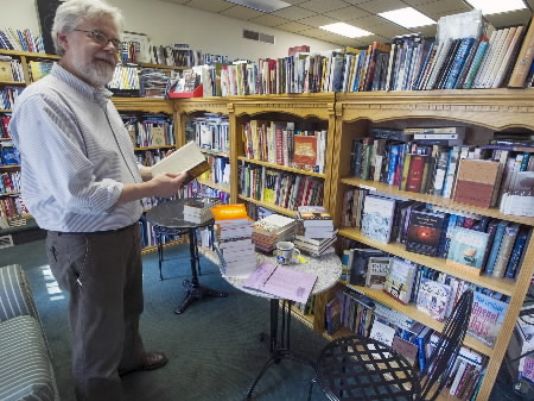
wp-PPYR-BookBuzz-11688-1723fc8d.jpgI hope you indulge me to remind you that we here at Hearts & Minds have books — unlike most Christian bookstores, or so we have been told — on art, science, business, politics, urban design, architecture, gender studies, counseling, education, engineering, environmental science, philosophy, sociology, sports, dance, media, film, business, video gaming,economics, legal theories, and on and on. 
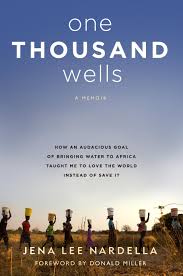
Sadly, most American church folks don’t share our enthusiasm for Kuyper’s worldview and vision for social renewal, and seem baffled when we say that we are neither conservative nor progressive, that we are seeking a Biblical third way beyond the customary assumptions in North American culture, and that the books we stock — diverse as they are — can help ordinary Christian folks live out a truly redemptive faith in the gospel in every area of life.
We believe churches can (must!) help in this, and we are forever grateful that unlike some campus ministry organizations, the CCO partners with local congregations, helping local churches serve their local student populations.  We believe that at the heart of the wide-as-life Kingdom of God, coming on Earth to restore the creation in the risen Christ, is the local body we call the institutional church.  Yes, yes, spiritual renewal is happening all over, and God cares about it all — it’s why I so appreciated Diana Butler Bass’s last book, Grounded: Finding God in the World, just for instance.  But the ordinary local church is, as one of my favorite books by Howard Snyder puts it, “the community of the King.”  Churches that are worth their salt help congregants see themselves as sent, as Kingdom people, as servants of the Lord in all they do.  Every. Square. Inch.

JUBILEE REVISITED
We learned most of this from Jubilee, or speakers at Jubilee.  For 40 years the CCO has been challenging us and inspiring us to be bold for God’s Kingdom, thinking and reading and learning and serving and taking up the high calling of making a difference wherever we find ourselves.
(There have been musicians and artists, too, by the way: it was at Jubilee years ago that I got to hang out with the late Mark Heard, met Bill Mallonee, was blown away (but not for the last time) by Pierce Pettis, introduced CCO to my friend Brooks Williams, heard Justin McRoberts live, and in recent years have come to admire the wonderful singer song-writers Joy and Peace Ike, and was lead in song for many a year by the legendary James Ward who served the conference for decades.)
I will never forget in the mid 70s hearing a lovely but incisive evangelistic speaker, an African American gentleman named Bill Pannell, talk about urban poverty and white privilege. I was transformed by the powerfully passionate preaching of Tom Skinner, another leading black evangelist who died too soon, and later hearing his wife, Barbara. I think it was there that I first met Calvin Seerveld, whose books on aesthetics we often mention. A life long hero of mine
is former Dutch Parliament member Bob Goudzewaard who I met at Jubilee. In the early days of Jubilee we heard R.C. Sproul and C. Evert Koop and Carl Henry and other world class women and men. Wow.
William Diehl was a Lutheran who was an executive at Bethlehem Steel and he chided us to quit saying “thank God’s it’s Friday” because it betrayed an unbiblical, low view of work. His book was called Thank God It’s Monday and it was very, very influential. He was a pioneer, and we may not today have Tim Keller’s remarkable Every Good Endeavor: Connecting Your Work to God’s Work if it weren’t for the influences of Jubilee and William Diehl rippling out from Pittsburgh to places where Keller was paying attention. 
I will never forget hearing Senator Mark Hatfield, an anti-war Republican of considerable renown, talk about “stewardship” and I was on the same page when he explained that for many religious folks that word implies just giving money or time to the local church. Biblically, though, it means — think of what it says in Leviticus 25, again — the land is not for sale. We are merely managers, stewards, not owners. Hatfield offered a faith-based, non-partisan stewardly energy policy from the stage in Pittsburgh and it was written up in the Washington Post.  College students grappling with innovative visions of fresh policy proposals out of their evangelical faith? A national news story!
So many great speakers have crossed our paths in Pittsburgh, and when we even now sell their books I think fondly of them — authors such as John Stott, John Perkins, Al Wolters, Becky Pippert, Bryan Stevenson, Soong-Chan Rah, Os Guiness, Brenda Psalter McNeil, Chuck Colson, Lauren Winner, Harvie Conn, Shane Claiborne, Richard Mouw, J. I. Packer, Lisa Sharon Harper, Jim Skillen, Luci Shaw, Gary Haugen, Bob Goff, Mako Fujimura.  
I will never forget hearing Dr. Harold Dean Trulear whose charge to students I’ve used over and over: “Our scholarship and our worship ought not be ships merely passing in the night.”  He called for an integrated vision, relating academics and faith. Amen?
And who who has heard Tony Campolo preach that “It’s Friday, but Sunday’s comin'” can ever forget how rousing it was to hear a socially engaged, intellectually aware, Baptist preacher that made us laugh and invited us to live our faith in thought, word, and deed?
YOU’VE GOT TO SEE THIS
The CCO has developed a lovely brochure that I’d love for you to open up — it’s very, very cool, and easy to open — that shows some of the impact Jubilee has had over these last 40 years.  
This is an organization with whom we work about whom we are proud, and whose influence on us and our work has been considerable.  I’m sorry I’m not highlighting particular books right now, but as we pack the truck tonight and tomorrow, and get ready for the demanding two day set up, I invite you to check this out. And pray for us, please.  


THIS YEAR’S PROGRAM BOOK
If you want to see what they are doing this year, here is an amazing, artful, program booklet that opens nicely and you can click through like a real magazine.  Notice the four articles written by young friends within the CCO — creation, fall, redemption, restoration.  Somebody saw it and wrote to me saying “your fingerprints are all over this.”  Well, I don’t know about that, but the good writers who did those essays all bought books from us.  So we’re glad for that!  The program booklet itself is a work of art, and the essays are good.
Check out all the workshops in this booklet — engineering, sports, pop music, science, politics, film-making, sexuality, global development, calling and vocation, working in the industrial trades, food, social work, medicine, business, leadership, education, urban ministry, creativity, gospel-centered discipleship, emotional life, lawyering, and more.  When we first cooked up the idea for this conference, we determined to invite students to relate faith to higher education, to help them imagine God’s will for their future careers, and wanted to offer time to interact with real folks living in the rough and tumble of the real world.  You’ll see why some adults come back to Jubilee year after year, to be around such winsome servants of the Lord who are relating faith to work, callings, public life.  It’s the kind of stuff you, if I may be frank, don’t hear much about in many churches, I’m afraid…
Good Faith- Being a Christian When Society Thinks You're Irrelevant and Extreme.jpgone thousand wells cover.jpgYou’ll enjoy and be inspired to see the speakers — from student leaders (an international undergrad who, inspired by her evangelical faith, started what has become the largest organization for Mongolian students in North America!) to some famous authors. Gabe Lyon and David Kinnaman will be talking about their soon to be released book Good Faith, which we will have there.
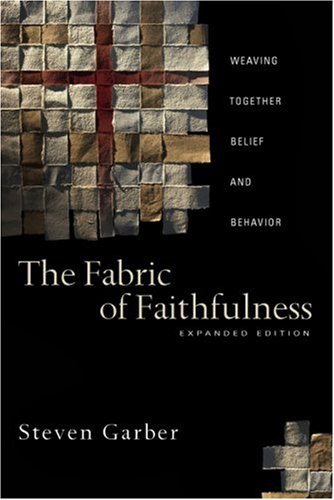
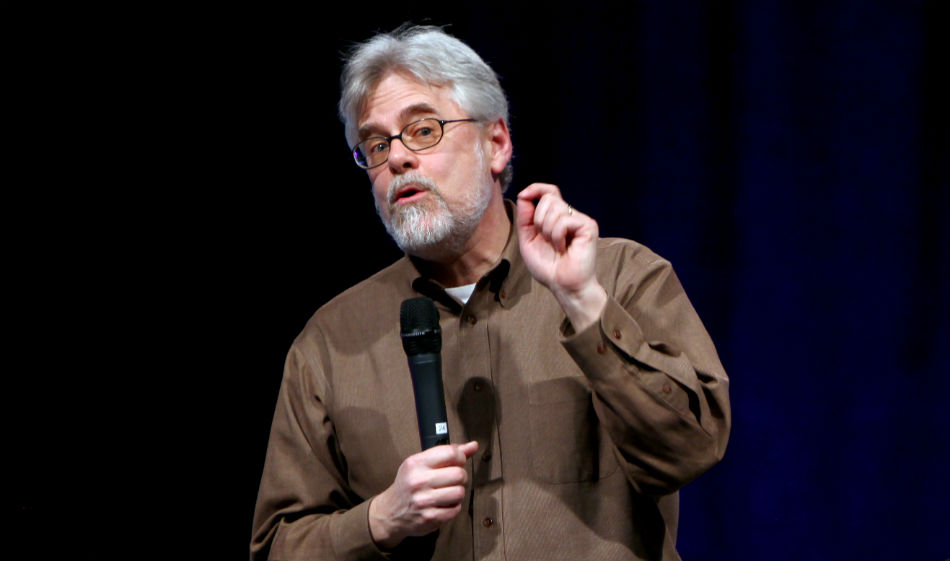
Jena Lee Nardella will be describing her work as chronicled in her great book A Thousand Wells. (It was a BookNotes “Best of 2015, by the way.)
fabric of f.jpgvisions of vocation.jpgSteve Garber — who used to direct the Jubilee conference years ago and cares for Jubilee as much as anybody — will bring his wisdom to a large group of students as seen in his eloquent, wise, and profound works Fabric of Faithfulness and Visions of Vocation. Of course, Derek Melleby will be explaining what led him to write (with Don Optiz) what is essentially a Jubby must-read, Learning for the Love of God: A Student’s Guide to Academic Faithfulness.  
Four final things:
  • On pages 69 – 70 you will see the speakers at Jubilee 2016 who have written books.  We’ll have big stacks there for the crowds that easily surpass 3000. Let us know if you want to order any and we’ll give you the Jubilee discount.
  • See on pages 71 – 72  a short list of key books that I’ve curated for these students. You can see the basic categories and my descriptions.  Hope it gives you a nice reminder about some very nice books. Again, we have plenty of most of these and it would be a delight
    to send some out for your reading pleasure.
  • Strong and Weak- Embracing a Life of Love, Risk, and True Flourishing.jpgYou might notice Andy Crouch in that first link offering his endorsement for the conference. He has spoken there before (indeed, his talks on the impact of creation and culture-making embedded in the Genesis narrative is seminal.) We will have, at Jubilee, the very first boxes of his forthcoming book Strong and Weak: Embracing a Life of Love, Risk, and True Flourishing (IVP; $20.00.) and will be releasing it to the conferees there.  When we return on Tuesday, February 23rd we will start sending out the pre-orders we received back when we announced it at BookNotes last month. If you want to be among the first to get it, let us know asap.  Here is a several minute interview with him that explains the insight of this new, very, very good book. 
  • It's not too late.jpgOur dear friend Dan Dupee is the President of the Board of Directors of the CCO, but for years has their El Presidente. Besides offering good leadership to this fabulous organization, he spent some time doing some research — namely, pulling together punches of focus groups to talk with parents of college age students.  And, talking to the many college age students he came to know through the CCO staff that serve on campuses all over.  His book — which we invited you to pre-order — is called It’s Not Too Late : The Essential Part You Play in Shaping Your Teen’s Faith (Baker; $15.99.)
So, there you have it. 
Except this, if you are still with us: please pray for us not only that we would set up our book display without too much stress (we most likely have too many books for the remarkably generous space… we always over do it, it seems) and that we’d have good conversations with our customers, but also for my sermon Sunday morning.
Borger-Byron-brownshirt speaking.jpgYes, I have the great, great privilege of speaking Sunday morning at Jubilee 2016. I’m not sure if a conference speaker should be called a preacher, but, with God’s help, I’m going to bring it. I’ll be inviting folks to big hope, to understand a bit about the restoration of creation that is the ultimate hope of those of us who believe Christ’s Kingship is truly coming “on earth as it is in heaven.”  End times details aside, I’ll be inviting folks to live into this dream of a better world, taking up visions of vocation that last, bearing witness to what we most deeply believe.  All things (re)newed.  Every. Square. Inch.  Maranatha.
Thank God for the CCO, get excited about the 40th anniversary of Jubilee, and pray that we sell some books that help people respond well to God’s gift of transformation. And that I am able to be a useful vessel for God’s truth to be proclaimed on Sunday morning.
We are grateful for your support, glad for your interest in our work, and truly blessed by your prayers.
In the meantime, pray also for our good staff here at the shop who make all this possible. Beth and I would not be able to do half of what we do without our colleagues in book-selling, Amy, Patti, Katy, our mail-out specialist Diana, and our book-keeper, Robin.  And whisper a prayer for the sales reps and publishers without whose help we wouldn’t get to set up these big off-site pop-up bookstores. And those UPS and FedEx and USPS folks. Thank them for doing some of the heavy lifting.

BookNotes

SPECIAL
DISCOUNT
ANY ITEM MENTIONED

10% off
order here
takes you to the secure Hearts & Minds order form page
just tell us what you want

inquire here
if you have questions or need more information
just ask us what you want to know

                                      Hearts & Minds 234 East Main Street  Dallastown, PA  17313     717-246-3333

ORDER “After College: Navigating Transitions, Relationships and Faith” by Erica Young Reitz ON SALE

NEW EDITION of After College JUST OUT – FEBRUARY 2025. Hooray.

Our dear friend and esteemed leader in campus ministry, Erica Young Reitz, has been working hard these past years mentoring adults moving out of college and into their post-college young adult years. As she honed her insights for this newer generation of rising adults, equipping them to make the transition well, she needed to revise and expand her classic, one-of-a-kind After College book. This bright new edition came out not long ago and we have a big stack here — on sale! — for your ordering pleasure. Her newly revised edition of After College goes usually for $18.00 but we have it at 20% off. Scroll down to the bottom of this column and click on the order tab which will take you to our secure order form at our Hearts & Minds website. Thanks.
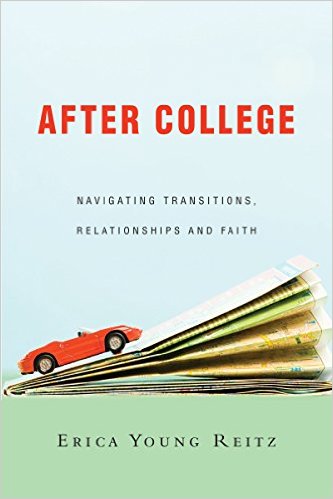
After College: Navigating Transitions, Relationships, and Faith (revised edition) Erica Young Reitz (IVP) $18.00 OUR SALE PRICE = $14.40

By the way, for those that might want to know more about Erica and her work, she will be a special guest on an upcoming “Three Books from Hearts & Minds” podcast, airing, I’m hoping, mid-to late April. As always, that can be viewed at YouTube or listened to at Apple podcasts or on Spotify.  We’ll share those links at the Hearts & Minds facebook page as well.

HERE IS OUR OLD REVIEW FROM WHEN THE FIRST EDITION CAME OUT. AFTER OUR INTERVIEW WITH HER ON THE UPCOMING PODCAST (in April 2025) I HOPE TO DO ANOTHER FRESH BOOKNOTES REVIEW HIGHLIGHTING THIS BRAND NEW 2025 EDITION. For now, re-read this older announcement and know you can easily order the new, updated edition from us now. 

This is a little review we did prior to this book coming out, inviting folks to pre-order it. After College: Navigating Transitions, Relations, and Faith is now available and we are so glad.  We had a little “launch party” for the book out near Pittsburgh with some of Erica’s colleagues in the CCO in late July. Now, we are sending it all over the country as folks are giving it to college seniors or those who have recently graduated. I can’t tell you how glad I am to promote this, how good it is, how very well done.  It is a “must read” for those leaving college and a fine read for college seniors.  Give it now this semester or wait til Spring semester nearer graduation but do give it away to any college students you know who are soon leaving college and who want to honor God in healthy and sound ways.

after college - erica young reitz.jpgAfter College: Navigating Transitions, Relationships and Faith by Erica Young Reitz (IVP) $16.00
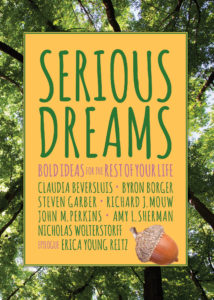
Hearts & Minds SALE PRICE  $14.40

Erica is a dear friend, and has done campus ministry for years.  We have had the joy of watching her enter into sincere friendships with her college-age friends, and we have watched as they’ve often grown into remarkable young adults with a coherent vision for their lives, relating their faith to all of life, and serving Christ’s Kingdom in work, relationships, church and world.  What good fruit her ministry has born. I cannot understate how much Beth and I admire, respect and appreciate her.

And we know she is not only a good campus worker, a friend to many and an exceptionally thoughtful young woman, she is a great writer, too. She reads widely, quotes fine authors and important books and yet writes from her heart, out of her experiencing mentoring young adults and teaching this material.

Over the last several years Erica has worked out of Calvary Church, a fabulously energetic church in State College, Pennsylvania (yes, the home of the Penn State Nittany Lions) focusing her energies on mentoring college seniors, walking with them through their senior year of college as they prepare to make the transition out of college life.  She has identified key areas of concern, has listened well to college seniors, men and women at Penn State and other schools, too, and has been doing workshops and classes about her vision for churches serving young adults well in this particular time of their lives. Her program, called EXIT, draws on best practices and research on senior preparedness, she
offers practical tools for a life of faithfulness and flourishing during
a critical, transitional time. Erica has become a bit of an expert on the transition from college into the so-called “real world.”  She has spoken about this topic at other churches and at the big Jubilee conference in Pittsburgh, sponsored by the CCO, for whom she works.

And, yes, you may recall, we drew upon her good storytelling, sensible vision, and practical experience to offer a down-to-Earth epilogue for my own book, Serious Dreams: Bold Ideas for the Rest of Your Life. A number of folks said they enjoyed her brief piece there as much as the larger and perhaps more serious contributions by famous speakers, authors, and Christian thought-leaders. I was honored that she was willing to craft that afterword for my book, and now I’m delighted — thrilled, really — to tell you about her own book.  It came out the first week of August 2016 and, along with Serious Dreams (naturally) it will be one of the essential books for college graduates.

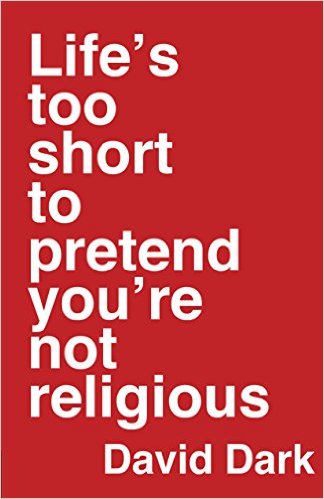
Here is something I subsequently wrote about After College.

Erica is one of the most gifted and insightful and caring campus workers
we know, and we’ve watched her over the years as she developed a
program at Penn State University to help college seniors prepare to exit
well, to transition out of their academic experience and into the
so-called “real world.”  Her program has been immensely valuable for
many, and in this new book she offers insight learned in those years
with seniors preparing for the post-college years. She offers stories,
insight, guidance and the clear voice of a stable, trusted friend as
from a wise older sister, inviting young adults to take their faith
seriously in their 20-something years.

I can’t say enough good things about Erica’s book… it is very well written, very interesting, a just jam-packed loaded with all kinds of really good information and advice. It
will help those who are confused or hurting or those who are well on their way to exciting new prospects.  It is designed really for anyone who is seeking a lasting faith, meaningful vocations, and a renewed passion for honoring God in the way their young adult years unfold.

Congratulations, Erica, and thank you for sharing your wisdom and good, good writing.

Order After College: Navigating Transitions, Relationships and Faith by Erica Young Reitz from us now at a BookNotes 10% off savings.  It is regularly $16.00 and our BookNotes price is $14.40.  PLEASE SEE NEW PRICE ABOVE FOR THE NEW EXPANDED EDITION at 20% OFF.

after college - erica young reitz.jpg

BookNotes

20% off
order here
takes you to the secure Hearts & Minds order form page
just tell us what you want

inquire here
if you have questions or need more information
just ask us what you want to know


                                      Hearts & Minds 234 East Main Street  Dallastown, PA  17313     717-246-3333

Life’s Too Short To Pretend You’re Not Religious by David Dark ON SALE at Hearts & Minds

We announced this a month ago and took a few pre-orders, glad to be able to give an earlyLife's Too Short to Pretend You're Not Religious  .jpg shout out about David’s forthcoming book. Now it is here, and I’ve been itching to write about it. More, I’ve been itching to read it. Some circles of the internets have been been happily ablaze with discussions of it.  Our friends over at Englewood Review of Books have offered a free chapter.  Pathos has pushed it.  I’ve seen the cool-looking, hot red cover on twitter every day for two weeks.
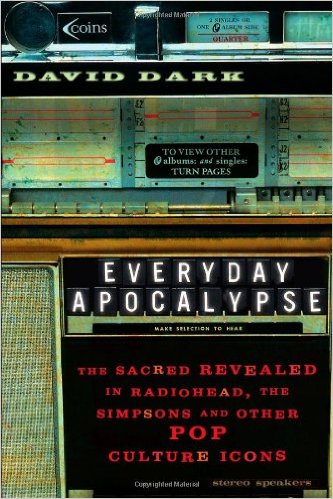
And this is as it should be. I’m glad that reviewers and critics and marketers have determined that this is an important book. David Dark is a national treasure, a witty and wise Christian voice — a humane human voice — and it’s good to know this brand new one has been so eagerly anticipated. As Jessica Hopper (of the very important indie music magazine Pitchfork and author of The First Collection of Criticism by a Living Female Rock Critic) says, “David Dark is one of our most astute and necessary cultural critics. His work gracefully opens new doors of understanding and breaks down barriers between secular and non-…”
This book is so rich and interesting and fun and important and wonderfully written — its been called a “bracing manifesto” and an “optimism-infused love song” and an “irresistible triumph” — that it deserves more of a serious review than I can render here, now. It’s been a hard month, a hard week, and I’m nearly flabbergasted (I’d say gobsmacked but I’m not sure what it means) by how great this book is and how it has brought joy to me these last few days. I’ve read paragraphs and whole pages out loud to Beth (and anybody else in earshot.) There are great lines, great stories, great revelations. Apocalypse now, indeed.
Everyday Apocalypse.jpgHe likes that word, from the Greek apolalypsi, which means revelation. He won considerable fandom when he struck a chord decades ago with his first book Everyday Apocalypse which makes his conviction and experience clear, in an artful, creatively written style in which he offers ruminations on pop culture’s ability to reveal truth.  Indeed, the subtitle is The Sacred Revealed in Radiohead, the Simpsons and Other Pop Culture Icons. It helped kick off a cottage industry of publishing nifty books about gospel insights found within all manner of popular films, TV shows and such; if they don’t cite Dark, I suspect they aren’t as insightful as they should be.

In Life’s Too Short to Pretend David reflects on a central thesis of his, namely, that religion, complicated as it is, is essentially the stories we tell about ourselves and in which we find ourselves — he doesn’t exactly use the word worldview — and these come from what he calls (in an extraordinary, delightfully honest chapter) “attention collection.” (Do we see what we’ve seen, he asks, inspired by conversations with song-writers and poets and art critics.) If this is true — we are all up to something, making meaning and finding happiness and perhaps forging goodness in the world — and that happens as we accumulate influences, then our story is not just our big creeds or claims, but the things that matter to us and how our daily life is directed by them. For David, as for many of his most zealous readers, this includes TV shows and billboards, movies and novels and lots of rock and roll, righteous cultural critics low and mid and high-brow. And, yes, church, too. Dark was raised in a pretty fundamentalist family, and his negotiating with that tradition passed on, those stories, those values, those ways of life, are part of what he tells us about.
David D.jpgAnd, man, it’s beautiful stuff.  His own religious journey has been fascinating. David generously describes a hilarious episode of wolfing down Saltines and Welch-aid in a Kroeger’s parking lot (you can imagine why) and being scolded by a pious grandmother for making promises like “see you later” without qualifying it with “Lord willing” and some incredibly dear tellings of his love for the Bible (“as long as everybody gets to talk, I’ve never been to a Bible study I didn’t like.”) Whether this is your weird story or not — he’s convinced most of us have some weird stories — you will enjoy, perhaps be deeply blessed as I have been, by reading about an evolving faith development without shame or bitterness or anxiety. This stuff is splendid, and it is Dark more joyous and (dare I say it) upbeat than ever before.
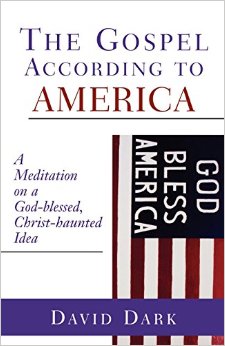
He admits to being zealously earnest in concerns about public justice and restored, right relations, the common good, the beloved community, etc. He uses the word righteous in, well, a righteous way. He says once that he can be sanctimonious — I loved this; perhaps it takes one to know one.

Gospel According to America.jpgThe second book that he wrote was called The Gospel According to America: A Meditation on a God-blessed, Christ-haunted Idea and was laden with heavy, righteous insight, and I still commend it, even if it was a bit more Flannery O’Connor and Daniel Berrigan than Steven Colbert. I was honored to offer a blurb upon his last book (right next to Eugene Peterson!) which was called The Sacredness of Questioning Everything. Again, I heartily recommend it, although it is intense. Weighty, even. Dark has always written in an energetic style, creative, flowing, fascinating, blending generative ideas with colorful, at times even poetic writing. But as pleasant of a fellow that many of us know Sacredness of Questioning.jpgDavid to be, these books were serious business; dense. I was delighted to realize how much I enjoyed — truly, truly enjoyed — Life’s Too Short. His whimsy and wit and generosity is clear as he bears witness to a life of practicing wonder, kindness, curiosity. The content is exceptionally smart, but not tedious. Brian McLaren notes that the writing is “muscular and graceful.”  Yep.
If we were seriously invited to “question everything” in his earlier work, here we are invited to take it all in, to appreciate much, to care enough to share who we are and what we hold most dearly.  From a remarkably generous appreciation for those who shared mix tapes to his fondness for certain comic book characters, he invites us to wonder why we love this stuff.
Or, as he puts it often, “what we are up to.”
What are you up to?  What, as some of the cool kids used to say, are you “into”?  Are there stories you’ve collected, episodes from life that make you who you are? What do you most deeply love?  Want to talk about it?  Life is too short, after all, not to be real, to be alive.  Wake up.
And so, this love letter to the hip and sophisticated who may be postmodern versions of what 19th century Schleiermacher called
“cultured despisers” of religion.  You know in this age of toxic fundamentalisms — radical Islamicists, religiously-motivated abortion clinic bombers, evangelical parents that disown their own gay teenage children, faith-based science deniers — there is much to worry about religion gone awry. But Dark invites us to get beyond the corrupt and caustic and cynical and discover life-giving and healthy ways to talk about the deepest things that matter most to us all. 
The book started out, I’ve learned, as a caring letter to a beloved relative, to whom the book is dedicated.  I suppose it could be a missive to any who these days call themselves “spiritual but not religious” or the now-ubiquitous “nones.” He’s not buying it: nobody believes nothing. But how to talk about religion among those who hate the word?
Well, charming and pleasant and witty as Life’s Too Short to Pretend You’re Not Religious is, it is also a serious critique of alleged religious neutrality. Everybody lives in light of ultimate concerns, shaped by stories and myths and what some might call presuppositions (although Dark does not.) Our hearts are touched by those who love us, by those who repel us, by fragments from SNL or great novels or favorite rock albums or sociology classes or wonderment experienced in the great outdoors or in loving friendships — you know. Our beloved influences are everywhere — it’s an everyday apocalypse out there, remember — and humans are wont to make meaning, to have enthusiasms, to love stuff.  “Ya gotta serve somebody” Dylan growled, and although David isn’t spitting out the words the way Slow Train Coming did, he’s adamant.
Nathan Schneider, author of Thank You Anarchy, offers a perfect one-line endorsement (and warning):
Prepare to have idols smashed. David Dark renders futile the cherished modern ambition to opt out of human religiosity.
   
But, again, even as Dark methodically, gently, disarms our allergies to religion, even the increasingly popular disapproval of the word itself, he isn’t doing apologetics in any conventional sense — defeating bad ideas or defending the truth. He’s telling his story — and as a memoirist, he’s shining — and inviting us to think about what matters to us. He invites us into relationship.
Let me be clear: Dark is an open-minded Presbyterian who draws a bit on theology but just as much about his intuitions and passions and wisdom gleaned from here and there. He’s a serious reader, and his footnotes are spectacularly interesting; I applaud IVP for offering such a literary and learned book, drawing on sources not often found in books released by evangelical publishers, from David Byrne to Daniel Berrigan, from Kierkegaard to Vincent Harding, from Marilynne Robinson to Philip K. Dick, from Ursula LeGuin to Wendell Berry, from Neil Gaiman to Kurt Vonnegut.

(And, hooray, there’s a footnote naming our friends Rob and Kirstin Vander Giessen-Reitsma — their new journal is called Topography, by the way — whose ministry name, “culture is not optional”, is actually a line from Calvin Seerveld’s Rainbows for the Fallen World.)

What a wide and diverse and interesting set of accumulated affections Mr. David Dark has on display here. Signs for all of us, bearing witness to his interesting, good life.

This winsome and fascinating book isn’t all just “let’s tell our stories” and agree we are all secretly interested in God. Can’t we just all get along? He’s too astute and aware for that. Sure he’d “like to teach the world to sing” I suppose, but I suspect it might be more like that last scene from Mad Men, appropriating and deconstructing and re-appropriating goodness here and there, aligned with some agenda. He’s not a cynic, but he’s not a pushover either. One of his kids is named after Dorothy Day, for God’s sake. There is bite and seriousness here; this is a call to wake up to the fact that we’ve been informed (“catechized”) for better or worse. In talking with students, trying to get them in touch with their deepest ways of ordering the world, their below-the-skin worldview, he talks about weird religions. “I bet many of you were raised capitalist.”
In one chapter he reflects wisely on the role of anxiety in our quest for meaning.  Another chapter is called  “Policy is liturgy writ large” and although he doesn’t quote Jamie Smith or Walter Brueggemann, he might have.

He invites us to “genuine consciousness vs trivializing shallowness.”  (“How might we access wisdom, compassion, hospitality and other forms of life for which there is no app?”)  How?  Here’s one clue: he says “poets are the most specific people on earth.”  He takes us to Kurt Vonnegut’s curious understanding of anti-war Jesuit Daniel Berrigan as “Jesus as a Poet.”

This is all pretty darn interesting, let me tell you. Radical stuff. Stimulating and and at times stunningly eloquent.
And then he ends, almost, with a tender story of his son saying he didn’t want to receive communion one Sunday. It goes from funny to complicated to heartbreaking in a matter of a paragraph and I once again realize how amazing this book it, what a gift it is.  David has opened his heart and his life and his very wide mind to help us all put our bodies on the line. 
What are you into?
What do you really desire?
What story do you tell to yourself about yourself when you’re asked to tell others who you are?
What might the artists or writers or poets or Bible characters you most esteem think of you?
Might you want to live  — do you have a deep craving for? — life lived in hope of some order, some sense of coherence?

Could it be that religion matters, after all?

Give Life’s Too Short to Pretend You’re Not Religious to anybody who might be open to talking about the deepest matters of a good life, especially if they enjoy pop culture or important literature. And read it yourself, for your own sake — you will be blessed by David’s invitation to be intentional about what stories inform and shape us; this is a book from which you will find it enriching and valuable. And, also, read it so that you might be more caring and present with and to others — that you might emulate his own deepening practices of caring, connecting, sharing. I cannot imagine any educated reader who wouldn’t benefit from spending time with Dark — any of his good books, certainly, but especially this, his best yet.
D Dark _ red.jpgYes, this a love letter to those who don’t like religion, but it also is a witness to how to approach what Charles Taylor calls “the secular age.” If you recall the last section of James K.A. Smith’s overview of Taylor’s heady and hefty tome, How (Not) To Be Secular, Smith calls (as does Taylor) for a new way to do apologetics, a culturally-engaged, more artful way to think about faith conversations, pre-evangelism and evangelization, about bearing witness to God’s redemptive work here within God’s good but torn creation. Without saying so, Life’s Too Short to Pretend You’re Not Religious is just this kind of project. It is one of the very important new books of this new era. It doesn’t do everything, but for what it is, it is nearly pitch-perfect, delightful, challenging, edifying, inviting.

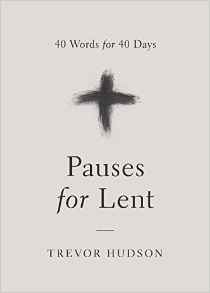
We owe a huge debt of gratitude to David and his publisher. This is sheer gift. Pay attention.

Life's Too Short to Pretend You're Not Religious  .jpg

BookNotes

SPECIAL
DISCOUNT
ANY ITEM MENTIONED

10% off
order here
takes you to the secure Hearts & Minds order form page
just tell us what you want

inquire here
if you have questions or need more information
just ask us what you want to know

                                      Hearts & Minds 234 East Main Street  Dallastown, PA  17313     717-246-3333