Commentary on the New Testament Use of the Old Testament

Commentary on the NT Use of OT.jpgThere has, fortunately, been much attention in recent years, to an integrated perspective on the unfolding narrative of Scriptures, and many have written about the unity of the Testaments.  The Unfolding Drama of Scripture: Finding Your Place in the Biblical Story by Craig Bartholomew and Michael Goheen does this as well as any Bible introduction we’ve seen, and it has become our biggest seller in the Biblical studies category.

One aspect of this emphasis is seen in the interest of reading Hebrew Scripture stories in a Christo-centric way; while this can be overdone, the historical-redemptive hermeneutic has been a God-send, freeing Bible readers from moralism and what Mary Stewart Van Leeuwen calls “proof-text poker” by placing any ancient episode within the broader canonical context and the ultimate Messianic trajectory.  Samples of this for ordinary Bible readers include, for instance, the marvelous books by Iain M. Duguid, and the series offered by P&R called “The Gospel in the Old Testament.”  Great stuff, inspiring, useful, provocative, and laden with mature insight.  There are even books on how to preach in this way, owing much to the innovative work of the late Edmund Clowney.

A related theme is the fascinating work being done on how the New Testament writers used the Old, helping contemporary readers pick up echoes of Older Testament teachings as they appear in the first-century texts.  An extraordinary, serious collection of essays on this is called Hearing the Old Testament in the New, edited by Stanley Porter (Eerdmans; $29.00) which we highly recommend it for deeper thinkers.  (The chapter by Sylvia Keesmat, co-author of Hearts & Minds favorite, Colossians Remixed, itself a major, creative contribution to this project, is worthy of being read and re-read!) 

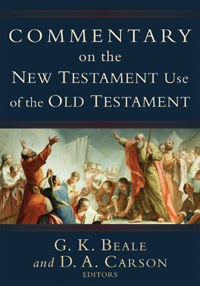
And now comes, from the amazingly impressive folks at Baker Academic, a defining moment in recent Biblical scholarship, the release of a volume so unique and innovative that one can only thank God that such thinking is being done.  We are proud to announce and promote the Commentary on the New Testament Use of the Old Testament edited by G.K. Beale & D.A. Carson.  ($54.99.) 

With rave endorsements from scholars as diverse as Richard Bauckham (University of St. Andrews), Karen Jobes  (Wheaton College), Scott Hahn (Franciscan University of Steubenville), and Thomas R. Schreiner (Southern Baptist Theological Seminary) you can see that this has a conservative tone, and yet is notably ecumenical.  It is written by more than a dozen internationally known, top-tier scholars.  We couldn’t be more thrilled with the judicious and intelligent efforts that obviously went into this 1200+ page volume.  It is a landmark, the most important reference work of the year, and an indication of wholistic and wise thinking in recent New Testament studies.  We think many of you will want to have it for reference use, and it would make a fabulous, perhaps unexpected, gift for anyone you know who loves the Bible.  

BLOG SPECIAL
nearly 30% off
Commentary on the New Testament Use of the Old Testament
Regularly $54.99
sale price
$39.99
order here at our secure website order page
or
read@heartsandmindsbooks.com
or
717-246-3333

Brand New Books

What a whirl-wind few weeks, taking our book van from the Christian Legal Society Florida event, selling books at a student gathering at Penn State, setting up for the Pennsylvania Council of Church’s annual State Pastor’s Conference and heading back to Florida to the bi-annual campus ministry national networking conference, Ivy Jungle.  Sorry I’ve been unable to post much about new books here at BookNotes.

It is always frustrating to me—amusingly so—that great new books arrive right after we do these gigs.  To wit, I will do a brief list of books I wished had been released a few days earlier so I could have shown them at these events.

Just a few days after the State Pastor’s conference some books arrived that I would have loved to have promoted there.  Here’s two:

The Living Church: Convictions of a Lifelong Pastor John Stott (IVP) $17  One could hardly name an elder statesmen of broadly-defined evangelical faith than Father John Stott, rector of All Souls Church in London, who has more stature or influence in our lifetime.  His many books nurtured a generation of young, thoughtful evangelicals—like Tim Keller, say, who offers a glowing tribute on the back cover—to preach the gospel with clarity, obedience, grace, and relevance.  This may be his swan song, a generous and sweeping book, offering his vision for ministry in the 21st century.  Inspiring, historic, lovely. If you know any pastors, this would be a great gift.

Resounding Truth: Christian Wisdom in the World of Music
  Jeremy S. Begbie  (Baker Academic) $22.99  If this book were twice the price it would be worth it, I’m sure.  Weighing in at over 400 pages, this is the call of the famous classical musician to thoughtful engagement in the world of music.  He judiciously develops a theology of sound,  a rigorous and deep aesthetic theory that funds Christian thinking about the world of music.  How many books sport lengthy endorsements from N.T. Wright, Nicholas Wolterstorff, John Witvliet, and Rowan Williams?  No one is better suited to explore a theology of music, and anyone interested in contemporary culture,  music, artistic engagement, or worship will want to become familiar with Begbie’s masterpiece.  I think if I had had this at the Pastor’s event I not only would have mentioned it, but would have suggested it as a gift for choir directors and music ministers and church libraries.  It is a book that ought to be known.

And, so,  off I went, directly from the Pastor’s conference, to the Ivy Jungle event in Orlando.  Thanks to Guster for driving the van, and Bogey-man and Beck for helping sell books.  What an event, with wonderfully committed campus pastors learning from the likes of Os Guinness, Lauren Winner, York Moore, and Gabe Lyons of UnChristian.  We enjoyed seeing Mark Pinsky (Gospel According to the Simpsons) again, and hanging out with several other good folks, singer-song-writer Justin McRoberts, authors and higher education leaders.  Sure enough, as I returned home, I saw new books that came while I was gone.  Had they arrived here earlier, I would have taken them to Ivy Jungle, for sure.  For instance, these two:

The Message in the Music: Studying Contemporary Praise and Worship edited by Robert Woods & Brian Walrath (Abingdon) $18  Here, a handful of  evangelical scholars reflect seriously on various aspects of contemporary praise and worship songs.  This may be the most serious study yet done on recent songs of this nature, and while the authors are not uniformly opposed they are serious-minded critics, bringing theological substance to bear on the actual words, and the theological ethos, and the unintended consequences of the current generation of praise songs.  A brief forward by Richard Mouw–who says he’s a “switch hitter when it comes to worship music”—sets the stage for this fascinating ad important critique. message in the music.jpgwideopenspaces.jpgresounding.jpgliving church.jpgMany in our mainline churches (like the State Pastor’s gang) need this as much as collegiate ministers, and may be more likely to appreciate it.  Which is why I really, really wish I could have taken it to Ivy Jungle.

Wide Open Spaces: Beyond Paint-By-Number Christianity Jim Palmer (Nelson) $13.99  Many readers of BookNotes will recall us raving about Palmer’s moving memoir Divine Nobodies which told stories of unlikely folks–unchuched folks–who showed him truths about God.  We loved that book and it’s Blue Like Jazz writing style and edgy, authentic honesty made it very popular among young adults.  This sophomore release is less memoiristic, more of a sustained argument.  I’ve had an advanced copy for a while, and have been telling folks about it.  Here’s what Shane Claiborne wrote of it: “Jim knows the mess of the world.  Jim knows the mess of the church.  And he still has the audacity to believe that love wins. Here he has created a book that cannot help but leave you feeling closer to God, with a smile that isn’t just for Sunday mornings, and filled with the hope that another world is possible.”  

Slower, Longer, Smarter

open book pic.jpgI rarely use this blog to link people to other places, unless it is to inform you further about an author I’m citing, or an organization that needs promotion, within the context of my mini-reviews.  There is so much good stuff out there, one could easily spend hours and hours each day reading it all.  And this is pretty great, even if it distracts serious books buyers, at times. But I try to stick to my main task of alerting you to books we’re selling here at the shop.

This article, though, which came to my attention while snooping around the website of Mars Hill Audio, written by Hearts & Minds friend Ken Myers, is so well written, so rich, so provocative, that I really thought our friends would enjoy it.  Sorry I’m not touting a book this time. And Ken’s voice, of course, is different than my own (I hear the collective sighs of relief all over cyberspace—a guest columnist at BookNotes!)  I think I will cite this piece in a talk I’m doing in a few days at the Pennsylvania State Pastor’s conference, where we are selling books.  Along with some other good folk, I’ll get to be Calvin College prof, media guru, and important writer himself, author Dr. Quentin Schultze. 

The article about reading, Slower, Longer, Smarter, starts like this:

Many years ago, when working at National Public Radio, I talked with a friend who had left NPR to work in the news department at ABC. During the conversation, he remarked that the biggest difference between his old colleagues and his new ones was that reporters and producers at NPR regularly read books, while the people at ABC generally didn’t. He said this somewhat wistfully, suggesting that he missed the conversations and arguments that are nourished by a shared experience of the focused and sustained attentiveness that books make possible. Books, like music, are ways of ordering our experience of time and intellect. They encourage habits of mind that are quite different from those typical among people whose reading is enabled most often by a device appropriately called a “browser.”

Read the rest of it (it isn’t long) here.  If you are a book lover, are concerned about the state of reading in our times,  you will be glad you did.  If you don’t subscribe to this well-produced, exceptionally thoughtful “audio magazine”, you should consider it.

Redeeming Law

redeeming law.jpg
It has been a while since I’ve posted because Beth and I have been on the first of what is the most brisk whirlwind bookselling tour we’ve seen in years.  Last week, among some other good stuff, we had the great privilege of setting up a large book room for the renowned professional group for Christian lawyers, judges and law students, the Christian Legal Society.  CLS has made it possible to be their “bookstore in residence” during their annual conferences and this year—in a swanky place with beachy weather in Western Florida—we had the opportunity to recommend books to all kinds of CLS members.  Their speakers included the famous (for the filibuster against him when appointed to a federal judgeship by President Bush) and wonderful Christian gentleman, Judge Charles Pickering (read the 60 Minutes interview with him here), blogger extraordinaire and author Hugh Hewett, (he plugged his book Blog, which we highly recommend, and gave a remarkable speech against theological inquisition in the public square) and the dynamic (and I mean dynamic) John Lynch, who co-wrote TrueFaced which NavPress ($11.99) put our a few years back.  It is a marvelous book on God’s grace, and the interpersonal implications of living out of the confidence of God’s mercy, and not out of our own need to please God or prove anything. It makes a great small group study, and now that we’ve met him, we are all the more convinced it is important stuff.  His mentor and colleague, Bill Thrall, joined us as well. Mr. Thrall, as you may know, co-wrote TrueFaced and one of our favorite leadership books ever, The Ascent of a Leader (Jossey-Bass $25) 

With these kind of keynote speeches, the jurists, legal scholars, judges, lawyers, mediators, first amendment activists and law students—-hey to that gang from Pepperdine we shared a hot tub with at 2 am—had plenty to inspire them, but much of their time was spent in serious workshops and seminars.  And book-buying.  It isn’t every day we get to schmooze over thoughtful Christian books with culture-formers and justice-seekers and peace-makers like these very sharp Christian leaders. It was a bit intimidating, and very exciting for us. We wanted our larger circle of BookNotes readers and Hearts & Minds friends to know our whereabouts, and to rejoice that serious Christian books are made available in the most remarkable places. (The load-out and drive back was exhausting, and we’ve got several other large gigs in the next weeks, include a drive back to FL for the big Ivy Jungle event). Pray for our stamina, and the van’s endurance, please.)

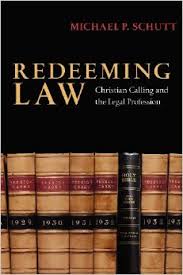
And we must say this:  every field, academic discipline or job area should be so fortunate as to have a single must-read, absolutely foundational, solid and interesting book as do these CLS folks.  Our friend (he’s posted here once or twice) Michael P. Schutt, has recently had published his major work, Redeeming Law: Christian Calling and the Legal Profession (IVP; $24)  a readable, insightful, introduction to the field of law, trying to develop, out of a coherent Christian worldview, a Godly perspsective on jurisprudence, a Christian philosophy of law that could fund and equip the practices of being a uniquely Christian attorney.  I found the book fascinating (I’m not quite done, for the record)—and nobody in my life has ever suggested I was smart enough to go to law school—so I would like to commend it far and near.  At least anyone interested in current affairs, government, public life or politics could enjoy it, and benefit quite a bit.  Mike is a winsome and fine writer (and a heck of a funny guy) who has done for the field of law what every field needs: write the classic, basic, must-have, go-to book on developing a Christian perspective on the calling of that career.  I can’t say enough about this (without doing a true review, which I’m hardly qualified to do, and which I needn’t do here.)  CLS is behind this book big-time, and Mike will be out and about (like at Jubilee 2008.)  His creds are impressive, his spirit right, his scholarship impressive.  What more can I say?  Know anybody you can buy this book for?  Know any church or community libraries that might benefit from having this around?  I know it is a bit of a stretch, being rather specific, as it is.  But come on, folks.  This is the kind of book you won’t find many places, the exact kind of a book we are thrilled to tell you about.  Check it out. Forward this on to somebody you know. 

BLOG SPECIAL
REDEEMING LAW
2O+% off
regularly $24
now
$19
order here
or
717.246.3333

A Short List of Great New Books

What Would Jesus De.gifBeautiful Fight.jpgSome of our BookNotes family of friends expressed gratitude that I offered some criticism of the light-weight zeitgist of the Christian Booksellers Association, the less than faithful nature of some Christian best-sellers, and the way in which the Bible’s clear call to cultural reformation, public justice and social righteousness is often ignored in the popular view of mainstream, middle-class, evangelical faith.  I’m glad folks got a kick out of my little diatribe, and also glad a few folks ordered Mark Bertrand’s new (Re)Thinking Worldview that I promoted a few days ago.  It really does illustrate some of the best sorts of thinking and writing that has graced the Christian book world these days”¦

Just to (re)make (tee hee) the point I often share here, though—there are plenty of great authors and more than enough really good books out these days and most CBA publishers are doing great work.  It isn’t just the academic publishers or the heavy theological ones that grapple with important stuff, and not all the serious books are overly deep.  Every day we are thankful to God for the good kinds of books that go beyond the trite or predictable, but are nonetheless fruitful, good and accessable for ordinary, educated readers.

For instance (hold on tight, we are going to go fast!)

The Beautiful Fight Gary Thomas (Zondervan) $14.99  This introductory price (the hardcover will be later priced at $18.99) is a great asset to what looks to be a fabulous book of orindary holiness and contemplative spirituality, by a writer we greatly admire.  Thomas is one of our favorites, and his writing is mature, wise, and yet very, very readable.  The subtitle is “Surrendering to the Transforming Presence of God Every Day of Your Life” and if it helps us explore that, it is well worth the couple of bucks it costs.  This pleasant writer draws on deep wells—how many evangelicals know Kallistos Ware, let alone Austin Farrar and place them beside John Piper or John Wesley?

Intelligent Design: William A. Dembski & Michael Ruse in Dialogue Edited by Robert B. Stewart (Fortress) $22.00  Well, maybe this isn’t as easy to read as some on this list, but it is a wonderful collection from a wide variety of folks, each weighing in pro and con and other, on the ID debate.  Dembski, of course, is a senior fellow with the Discovery Institute’s Center for Science and Culture, and Ruse is an internationally known philosopher of science and skeptic.  From Sir John Polkinghorne to Nancey Murphy, from Francis Beckwith to Alister McGrath, Wolfhart Pannenberg to several scholars from the National Center for Science Education, this is a fastinating discussion to follow.

The Late Great Evangelical Church C. Vaughn Doner (Oakdown) $27.99  Okay, this is a pricey hardcover, but it makes a powerful, powerful case against the contemporary manifestations of the age-old heresy of Gnosticism in modern, evangelical guise. Mad about dualism?  Frustrated with corny church growth stuff and sentimental piety? With blurbs from newly Orthodox thinker Frank Schaeffer and older Reformed guys like Thomas Schirrmacher and John H. Armstrong, or emergent leaders like Sweet and McLaren, this book has been widely endorsed by all kinds of folks who long for a renewing movement that would recover ancient orthodoxy and discover fresh embodiments of wholistic discipleship, rooted in mature, liturgically-rich church life.  What a book!

The Year I Got Everything I Wanted: A Spiritual Crisis Cameron Conant (NavPress) $12.99  I have mentioned before this new “Deliberate” imprint, an edgy, thoughtful and authentic line of books from this traditionally conservative, evangelical press.  I was very moved by Conant’s previous memoir, published by Relevant, about the break-up of his marriage.  This raises age-old themes from Ecclesiastes, and, while it may seem like a cliché to say that about a young writer who shares his story in ways that are both poigant and provocative, well, it is only a cliché if it is merely a marketing scam to say so.  Read this and see for yourself.  This guy is a straight-shooter, honest and a fine, young writer. 

Monk Habits for Everyday People: Benedictine Spirituality for Protestants Dennis Okholm (Brazos) $12.99  Monk-habits.  Monk habits. Get it?  Of course you do.  With a remarkable forward by Kathleen Norris (author of The Cloister Walk they say on the front, as if they need to tell you) this is one fabulous little book.  Not every day you see a blurb from Tony Jones, Mark Noll and Ms Norris on the same back cover.  Okholm is a Presbyterian, by the way, making this a truly ecumenical goldmine.  Way to go, Braz-os.

What Would Jesus Deconstruct? The Good News of Post-Modernism for the Church John Caputo (Baker Academic) $19.99  Okay, this ain’t the easiest sledding, but it is fun and funny and very, very provocative, written by an provocative, controversial Roman Catholic philospher.  It means a lot to me, and should to BookNotes friends, that this is the second in the series that our friend Jamie K.A. Smith edits (the first in the series was Smith’s brief and brilliant Whose Afraid of Post-Modernism: Taking Derrida, Lyotard and Foucalt To Church.) This new one just came today and although I’ve talked with those who’ve read the manuscript, I am not prepared to say I agree with it, despite Brian McLaren’s exceptionally nice, complimentary and generous foreward.  Perhaps he is, as one pundit quipped, “a sheep in wolf’s clothing.”  And maybe deconstruction can be the hermeneutics of the Kingdom of God, as Christ reconstructs our lives.  You will be hearing more of this, I’m sure. 

BLOG SPECIAL
buy any two
25% off both
order here
or
717.246.3333

(Re)Thinking Worldview

As you know, I’ve taken a bit of a risk in writing critically about the shallowness and bad Biblical theology of tworethinking worldview.jpg quintessential evangelical writers, each writing on two exceptionally profound Old and New Testament texts. (Scroll back two entries if you didn’t seem em.)  Because some of this CBA silliness comes from the lack of an integrated and broad Christian worldview, it seems a perfect time to promote a book that may be in our the top handful of books of the year.  It is a fascinating and fun read, an important and weighty set of teacherly essays on what we mean by worldview, what it means to think Christianly, how the much-noted narrative flow of creaiton-fall-redemption fits into one’s life picture, and why a comprehensive vision for the Christian life is so important to reflect upon.  And reflect upon it he does.

J. Mark Bertrand may be known to hip bloggers for his great website (if you’re a big coffee fan, or lover of fine pens, or swanky book bindings, say, you’ll love his bourgeois push for the best.)  Better, if you’re a book lover of any kind, but especially a fan of serious fiction, you simply have to read his Comment piece from this summer, about the huge question of what to read while traveling.  What a great, great essay, fun and interesting and, surely, a good encouragement to be intentional about your reading habits. 

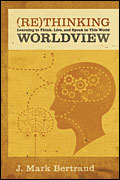
Besides being a blogger, coffee snob and bookman par excellance, Mr. Bertrand works teaching young folks about the importance of serious worldview thinking.  I so badly wanted to put his new book, (Re)Thinking Worldview: Learning to Think, Live, and Speak in This World (Crossway; $16.99) on that list which I compiled in August, but it wasn’t out yet, and I hadn’t laid eyes on it.  I was sure it would be great but, you know, that little integrity piece of the Christian worldview really kept me from pushing it sight unseen, on intuition alone. Now, I am happy to report, advance claims and good suggestions from those in the know, are spot on.  This is a great, great book.

Here’s is what our friend and worldview guru David Naugle writes of it:

For those of you suffering from “worldview fatigue.” or who think it’s a theologically unhelpful concept, or who are new to the notion altogether, read this book.  It’s like a satisfying draught of ice-cold, refreshing water on a hot summer day!  Bertrand’s book is a rich gift to serious citizens of the Kingdom of God.

There is so much here I could comment on (and just a few things to quibble about, but no upside-down cover for him!)  One section is especially useful, where he explains how to move from being a consumer of culture, to a critic, to a contributor.   That he is contributing to culture is doubtless;  that he is a fine writer is evident.  In case you wondered, though, listen to lit guy Leland Ryken: “Bertrand maintains our interest througout with an incipient narrative thread…The book actually has the quality of a suspense story in which the reader is led to wonder what Bertrand discovered next in regard to worldview.”   If a feisty guy like Marvine Olasky says it “throws off sparks” you should take notice.

We think that in the growing set of resources to counter dualism, personalized sentimental faith and a thoughtful approach to cultural engagement, this is an important one.  We are glad to promote it, encourage you to join us in moving your faith community towards wholistic dischipleship, non-partisan cultural reformation, and learning, as he shows in this book, how to move from worldview to wisdom to witness (and, in a brief epilogue, the role of worship.). He is a savvy young writer, aware of the role of story (and of stories—gotta love his quotes from movies and novels) who is honest about many, many things.  Including, his own foibles, the frustrations of the evangelical sub-culture, and, of course, about another key to worldviewish faith: mystery.   Thanks, Mark.  If only, now, we could talk over some of that great java you show on your classy website. 

BLOG SPECIAL
(Re)Thinking Worldview
25% off
regularly $16.99 now $12.75
Order here
or
717.246.3333 

Justice and the World Restored

We received some good emails in response to the previous BookNotes post sharing my frustrations with two mega-selling authors in the CBA (Christian Bookseller’s Association) market, and their most recent books.  I noted that they were popular but lite, although my biggest frustration was the way guys who should know better—Charles Swindoll and Max Lucado–mishandled the Biblical texts that their respective new books are based upon.  As I wrote in that blog entry, we have two nearly iconic evangelical authors doing what I take to be a less than honorable job in exegeting two quintessential Biblical texts, Micah 6:8 and John 3:16.  Chuck’s refusal to talk about justice in his study of Micah 6:8 is the most egregious, although Max’s utterly personalistic take on the word “world” (kosmos), while less clearly wrong, is more interesting.  I said I’d offer some positive books that might help clarify these bad boys botching of the Bible.  Here goes.

I don’t think that most readers of Chuck’s book will need a serious commentary of Micah, so nearly any one would do.  The best, doubtlessly, is A Commentary on Micah by the extraordinary Bruce K. Waltke  (Eerdmans; $32.00.)  If you are the kind of person who has a academic, Biblical studies library, you should own this one.  Scholars, pastors, laypeople—anyone who cares to read carefully will cherish this mature commentary.

If one is interested, as I am, in the classic and beloved text of 6:8** you will appreciate the brief collection of three essays entitled To Act Justly, Love Tenderly, Walk Humbly: An Agenda for Ministers by, respectively, Walter Brueggemann, Sharon Parks and Thomas Groome (Wipf & Stock; $8.95.)  This rare book, only 65 pages, is a gem comprising three moving chapters, obviously given, initially, at some pastor’s event.  Don’t let the sub-title worry you, as this is a splendidly moving set of sermons for anyone.  The Brueggemann one alone is worth the price and you will read it more than once, I’m sure.

The rub in my critique of the Swindoll book was how it was fine, with one exception: it didn’t deal with the word justice in the text, and didn’t even admit it wasn’t dealing with the text.  How a conservative like Swindoll, on an evangelical publishing house, can, in good conscience, fail to stand honestly before the Word like that is just beyond me.  Really, it is, and my essay was not a playful poke to the cheesy CBA subculture.  It was a heart cry that our fellow believers, especially those of influence and status like Swindoll, be more faithful before the living Word of God.  I am not a Bible scholar, and I do not pretend to be.  I am confident, though, that to talk about any of the Minor Prophets without a comment on the call to do justice, is a travesty.

And so, here is one of the best little fair-minded book on what the Bible says about justice, a gem of a resource that you most likely never heard of: A Covenant to Keep: Meditations on the Biblical Theme of Justice by James W. Skillen (Center for Public Justice & CRC Publications.)  $10.00  This is a bargain of a price for a well-written set of nearly devotional essays showing various usages of the word justice in the Bible.  It has some practical application ideas, a few contemporary testimonials, and some helpful suggestions for helping this shape our convictions and practices about public life.  Mostly, though, it is just darn good Bible study.  It is highly recommended by a friend and mentor I’ve admired for most of my adult life.

Bring Forth Justice: Basics for Just Christians  Archbishop Daniel Pilarczyk (St. Anthony Messenger Press) $5.95  Are you kidding me?  Five-ninty-five?  Yep, this inexpensive and very brief book is a fabulous overview of how Catholic social teaching, has described various sorts of justice.  It explains what is meant by commutative justice, distributive justice, social justice, and such.  It distinguishes, in clear but sophisticated way, what we mean by different sorts of social obligations, how to determine who owes whom what, and so forth.  For anyone who wants to thoughtful explore social ethics beyond the rhetoric of justice, this is a helpful little guide.  Of course there are more thorough resources, but this could be read by the most basic believer, even those drawn most typically to the likes of Mr. Swindoll. 

***

As to the truncated reading of kosmos that inflicts Lucado’s mega-seller 3:16: The Numbers of Hope, I will continue to write again and again.  Creation Regained by Al Wolters (Eerdmans; $13) remains the best book which draws the links between creation-fall-redemption, showing how a Christian worldview will “see” life in terms of this cosmic scope of redemption.  Michael Wittmer’s fine Heaven Is A Place On Earth (Zondervan; $16.95) is a truly lovely and very helpful guide, too, into this Kingdom vision that Christ is bringing restoration to every zone of his good, but fallen, creation.  There is a great study guide, making it a very useful resource for small groups.

 Simply Christian
by N.T. Wright (Harper; $22.95) is a splendid antidote to the false piety that afflicts Max’s syrupy best-seller.  It starts with this intuition we all have that things are not the way they are supposed to be, this yearning for the world to be made right.  He not only looks at our deepest foibles and anxieties, but also names the injustices against the planet, from terrorism to global warming.  We really do need things to be straightened out, don’t we?  Is not the restoration, the victory over evil, the creational healing, the grand hope of a planet renewed provided in the gospel of the Kingdom?  Is this not—to use just one example—what Tolkien said often to C.S. Lewis, that we are sub-creators, making stories where good wins in the end, even if in a eucatastrophy, because we deeply know that that is, indeed, the way of the truest truth?  Isn’t that the message of Narnia, that the death and resurrection of Aslan brings glorious Spring, at last, to the frozen creation?  Ahhh, if only Mr. Lucado had remembered that ancient truth: wrong turns to right when Aslan is in sight!  That would have moved him from his sweetly safe individualistic pietism.  Sure Jesus loves “whosoever will” and the Bible is clear that God draws His elect into eternal life.  But the point is not just God’s gracious mercy for sinners, but, more, the way in which those sinners are then transformed and given gifts, like Father Christmas gives to the children in Narnia–weapons!—for the part we get to play in the full-orbed Missio Dei, the renewal of all things, to the glory and pleasure of God 

What’s wrong with evangelical publishing? Two bad best sellers

I mentioned in a blog last week that I was irked about two new popular titles, and that I wanted to share my frustrations. Sorry I have posted lately–we’ve been on the road a bit—selling books with pastors of small churches at a Presbyterians for Renewal gig, for instance, and setting up a UCC retreat on the theme of hope in the writings of Desmond Tutu. We were at a glorious wedding in Western Pennsylvania and I am speaking at the chapel of Eastern University in, well, Eastern Pennsylvania. We’re preparing for an important conference on sexual trafficking and human rights at the John Newton Center in Carlisle, PA (October 27th) which will end with a free showing of Amazing Grace at the lovely downtown theatre. (The DVD of that important film, by the way, will be out soon, so do contact us to order it.) We are happy that our new van (with only 69 thousand miles) can journey the miles dispatching our books hither and yon.

And, these books are—we are happy to say–really diverse. We are told that we have a mix in our inventory that is really wide-ranging, and we hope you like the thought. Unlike some so-called “Christian bookstores”, we stock books on a really wide variety of topics, and from a really wide range of theological perspectives. We like the clarity of John Piper, the broad thinking of N.T. Wright, and the neo-Calvinist worldview of Abraham Kuyper. We appreciate the deeper spirituality of Richard Foster and Henri Nouwan, and have enjoyed selling books with Catholic sisters like Joyce Rupp, or contemplatives like good friends Russell Hart, Kent Groft or Graham Standish. You know that we’ve often named Os Guinness and Ron Sider as friends and mentors, and we often write about social concerns, cultural engagement, and the reformation of higher education. Cal Seerveld on the arts and Steve Garber on how to relate learning to a lifetime of moral seriousness are among our favorite books. We stock books for all kinds of church groups, and love telling people about novels and memoirs. Nurturing the Christian mind ought to be a high priority for a bookstore, and our work on worldviews and the integration of faith and learning can be easily seen by looking back to the “top ten” lists on these topics we did here and here, in August.

Why do we do all this? Well, because the Bible tells us to, I suppose. Christ is the King of all creation, and as renewed agents of His reconciliation, we are trying to advance a view of faith that relates discipleship to each and every zone of life, fostering conversations about social innovations and culturally relevant ministry. We hope this is why you sign up for the blog subscription, so we can tell you every time we announce new books or post new reviews.

What we tend to sell a lot of here in the Dallastown shop, though, and what has been common in Protestant bookselling over the last several decades, has been what only can be called faith lite. Simplistic and cheesy stuff is easy to spot, and the popularity of the repetitive and shallow Joel Osteen notwithstanding, it is our delight to get folks who have never read a religious book, or have only read the most crass and silly ones, to move a step towards thoughtful discipleship, and books that are beautifully written and practical in their application, even though they are clear and easy to follow and down-to-earth. I do not expect everyone to tackle Brian Walsh and Sylvia Keesmaat and their provocative postmodern reading of Colossians (Colossians Remixed)– even though I raved about it here repeatedly. I am aware not everyone wants to read my friend Ned Bustard’s good anthology on beauty and the arts (It Was Good: Making Art to the Glory of God.) Heck, I know that some might even be flustered by the deeply warm and graceful prose of Ruth Haley Barton in her important call to solitude and silence. (Invitation to Silence and Solitude.) I was pleased that we’ve gotten a few orders from UnChristian which I reviewed last week—but more came from mail order than from folks here. These are all books that Hearts & Minds fans will know about, as I’ve noted them here often. But we don’t sell many of these. But I am happy, most days, to sell Max Lucado and Chuck Swindoll, two of the most popular and balanced and clear and accessible inspirational writers of our time. Considering what other less reliable authors are sometimes popular, I am grateful and happy that folks want to read whatever they write.

And therein lies my beef. I could write more thoroughly about this, but I will just protest now, and send something off to Nelson, their publisher. As the two premier popular-level Bible teachers, esteemed by many as balanced and useful, they both have dropped the ball big time.

These two men are perhaps the two quintessential evangelical authors. (And they both have sold millions of books!) Two months ago they both released brand new titles. Chuck has tackled perhaps the quintessential Old Testament summary verse, one of the most popular texts in the entire Bible, Micah 6:8. And he gets it way, way wrong. Max has tackled what is undeniably the most popular New Testament verse, John 3:16, and, guess what? He botches it.

What in the world is going on here, when two level-headed and esteemed evangelical pastors write on two of the most popular passages in the most popular book in the world, and neither can exegete their way to even using the correct words? This, dear readers, is what is wrong with evangelicalism. Despite their history of being Bible believing, and their passion for making Bible truth come alive in vibrant ways for ordinary folks, the desire to make it accessible and real and middle class has caused them to scrub down the passages, truncating their meaning, missing the point and, too often, superimposing a personalistic and middle-class message of self-improvement (with God’s help, of course) onto a misreading of the text.

Micah 6:8, as I trust you know, answers the rhetorical question of what God requires of us, and it is the subject of Swindoll’s newest book, A Life Well Lived. And the first phrase in the tripart answer is to “do justice.” Believe it or not—for reasons that I cannot even speculate upon—Chuck Swindoll doesn’t use the word. His chapter tells of personal integrity and honesty. There is not an iota of a demand for social righteousness, public justice, concern for making things right, mercy for the poor, covanantal goodness, none of the good stuff that is conjured by the Hebrew word in the text, the word typically translated justice. Is Swindoll the only evangelical left who separates faith from politics, who fails the wholistic call to an integrated faith that is both personal and public, concerned about personal kindness and public justice? Some authors may overstate the trajectory in the text towards public justice and utterly politicize the text. But for an evangelical publisher to allow a leading celebrity author, mega-church pastor, radio preacher and former Seminary professor to stand so ineptly before the Word of God is a travesty.
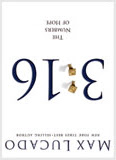
Lucado is increasingly the main evangelical star, writing children’s books, stories and parables, inspiring gift lines, very cool greeting cards, even contemporary praise CDs. If Swindoll has been typically down to Earth and a moving, clever wordsmith, Max is a master; his books have wonderfully tapped in to the real hurts and anxieties of ordinary folks and have reminded us of God’s love in Christ, our acceptance through God’s merciful grace, told with a wonderful knack for the turn of a phrase. Given all the truly odd Christian writers, and all the poor wordsmiths, Max has been a huge blessing to the publishing world, bringing simple faith into common language, yet in a way that soars with sentiment and care. A bit purple, at times, perhaps, as he nearly overdoes the tender sentences, but we have been fans. His new book is called 3:16 The Numbers of Hope.

It does not surprise me, though, that Max misses, as most of evangelicalism misses, the cosmic scope of the theater (Calvin’s word) of God’s redemption when the passage famously says that God loves the world: the cosmos (also sometimes spelled kosmos in some translations from the Greek.) John 3:16 is a key verse in my spiritual journey, as I realized that the text clearly does not say that God died for our souls, or our religious lives, or our churches. Christ died, the passage says, for the whole created order. Romans 8 reminds us, similarly, that the whole creation is groaning, awaiting for people to get right with God (a la the whosoever will of John 3:16b) so that it might be released from the bondage of brokenness, and be set free. The Biblical theme of (re)new(ed) creation is very, very important, and, along with the theme of the Kingdom of God, is perhaps the most important Biblical insight of our time. From the Orthodox (who have always be strong on this) to the Reformed worldview folks, from mainline writers like Pannenberg or Volf to recent Catholic writing, to the emergent conversation, everyone is writing about how God’s healing reign is a reintroduction of the ordered shalom of creation back to his fallen world. Creation-fall-redemption-consumation. For God so loved the world.

Does Mr. Lucado say any of this? Does he even tell what the word world means in its original Greek? He gets it flat wrong, ignoring the plain meaning of the word, and implying that God loves all the people of the nations. This is true enough, but not what the text says.

This truncated view of the gospel, this pietistic and sentimental virtue stuff about honesty and personalized salvation is such a half-truth to be hardly a truth at all. I want to hear the real truth: that God in Christ is buying back his whole fallen world, and that the Kingdom is coming (“on Earth”) and that Christ is Lord of every aspect of life, and that this demands stuff like standing for social justice and creation-care, like Micah 6:8 says and as John 3;16 affirms. In these two books, Chuck Swindoll and Max Lucado are a hindrance to faithful discipleship—but how do we tell nice customers who don’t know any better??

We sell Chuck and Max, and will continue to be glad that fine Christian leaders like them can handle words so well, and inspire us with books of basic Christian growth. But I have recommitted myself to be discerning of the wrong-headed and misguided stuff that the big evangelical publishers push. I want to glorify God by selling books that talk about His sovereign grace over all things. I want books that honor the complexity and nuance of this rowdy and demanding book called the Bible. And I want to hear about social justice and I want to hear about the ways in which God’s atoning death brings wholeness and restoration to all of creation.
Chuck Swindoll slaughters Micah 6:8 and I will be sending the books back, with a firm letter of protest to Nelson. (And if there is any justice, they will pay for the shipping costs.) How dare they mishandle the Word of God like this? What were they thinking? What’s next, Swindoll watering down Amos, with personal integrity flowing down like a mighty water? What, Isaiah 58, saying we should be nice, and then God will hear us? This justice for the poor, this demand for structural change, this call to redemptive economics and righteous policy, that is all so un-pious and un-American! And, apparantly, so easily ignored. Aaaaggh.

Max Lucado misses the full import of the meaning of the word world and thereby diminishes the glory of grace, God’s inclination to incarnation, the death and resurrection of Jesus. It robs us of the vast implications for those who have faith, the daily relevance of their believe, the proper scope of redemption, and the very nature of the everlasting life the text so gloriously proclaims. That the book has this market-driven feel to it—the cover has this nifty logo of the numerals 3-16, and it was released on 9-11–which I must admit leaves me with mixed feelings. (I’m a sucker for the genius behind such marketing campaigns and clever graphics. Yet, sometimes, it seems like somebody came up with an ad first, and then built a slight book around the big idea of the advertising. Did the book follow the tee-shirt, or the CD? Yes, indeed, this is what makes working in the business so darn complicated: shallow books that disregard the very Words of God, presented in a very, very cool package.

Two great contemporary authors on perhaps the two most beloved passages in the Bible. Soon, I will recommend some that get these passage right. And celebrate some of the very solid and useful books that are coming out from evangelical presses. Things are not all bleak. But the mainstream marketing power, making these hugely popular authors immediate bestsellers will misguide many. Let’s redouble our efforts to talk about the best books, the most honest Bible study, the most relevant application. After all, as Swindoll has told us, it is important to be honest.

UnChristian & The Tribal Church and brand new home to the BookNotes blog

I hope you saw the last post–nothing about any books, but very important. It was an announcement that we are happily moving the blog over to the newly redesigned Hearts & Minds bookstore website. We are still transferring the tons of lists, biblios, essays and book review articles that we’ve archived for years. It will be a while ’til that is all there, but the great news is that we will now be able to edit and add to the website easily. The regular blog posts will continue, but will be more integrated into the bigger website. It’s pretty nifty even now, so browse on over.
As we said, though, you have to re-subscribe in the little address box if you want notifications whenever I do a new post. I’ve got the list of those who do—friends and neighbors, relatives and loved ones–so sign up soon, or you’ll throw me into more self-doubt and endless anxiety. Being a small-mart indie bookseller up against the Goliaths of A-zon & Company is hard enough. Don’t let a guy hangin’…

Which makes me think, perhaps circuitously, of the big splash made online by UnChristian: What A New Generation Really Thinks About Christianity…And Why It Matters (Baker; $17.99.) This groundbreaking bit of research and commentary (and you will be hearing more of it this fall, I’d bet) was done under the prestigious auspices of the Barna Research Group. David Kinnaman is the very young new Prez of the pollster group, and has turned their research work on young adults and what they think about Christianity, church, and evangelical faith. The study is powerful, clear, and nearly devastating: classic Christianity has an image problem.
As my old protest buddy, Charlie, still at an urban church in Pittsburgh, would shout, with feigned alarm: Call the Doctor! No, nobody with half an eye open, will be really surprised by this sad news. If you hang around with anyone under 30, with or without body piercings, or you go to any kind of ordinary church, you know where this is heading.
Ahh, but, here are three reasons this book is so very, very important.
1. This provides the hard data, so we don’t have to speculate what young adults think about the church. We have surmised and intuited this before, but here are the goods. UnChristian gives us the facts which we need to work on. Read it and weep.
2. The book is laden with sidebars, counter-stories, examples of testimonies of those who are, in fact, doing the sort of stuff (or, as the case may be, not doing the kind of stuff) that younger folks talk about in this book. That is, the truth of the matter is that there are cultural creatives, edgy folks with compassionate hearts, who are passionate about loving God and following Jesus, who bear little resemblance to the picture held by most non-churched folks. They simply don’t match the assumptions that are carrying the day in the imaginations of the young adult population. These interviews and testimonial are in many cases folks we know, readers of BookNotes, even or people we admire, so we are thrilled to commend the book for this portion, too. The research piece of the book is supplemented and contrasted with stuff from Andy Crouch and Louie Giglio, Brian McLaren and Chuck Colson, Sarah Cunningham and Mark Rodgers, Jim Wallis and Margaret Feinberg, Jonalyn Fincher and Gary Haugen. If you don’t know at least a couple of these names, you haven’t been paying attention. And, sadly, that is exactly the problem: the brave and good witness of faithful, interesting Christian folks like this is evidently not changing the perception of the watching world.
3. This book is co-authored by Gabe Lyons, a friend of a friend who I can’t wait to meet at Ivy Jungle later this fall. He is the genius behind the Fermi Project, who do the snazzy Q events. This is, if I can sound like the baby boomer I am, where it’s at.


Tribal Church: Ministering to the Missing Generation by Carol Howard Merritt was just published by the Alban Institute ($17.) A bit pricey for a paperback, but the Alban I. folks are the best mainline denominational publisher for getting solid studies done with no-nonsense evaluations and clear-headed guidance. Much of what they do is based on a solid lay of the land, written by researchers and practitioners in the parishes sharing what they know. I haven’t spent enough time with this new release to know how brilliant it may be, but I am very confident it is worth reading, if you are concerned about the lack of 20-somethings in your congregation.
Carol Howard Merritt is a very fine writer, and has been influenced by the popular books a few years ago that documented what some have called “urban tribes” of 20/30-somethings. Seen Friends? Here is a short piece drawn from the book, called “Ministering to the Missing Generation” which will tell you of her title, and draw you in to her journey of thinking about this.
I wish Merritt was more interested in the work of folks like the Fermi Project, and had the movement of transforming, evangelical cultural engagement in view. She is a Presbyterian pastor, so her book is informed by her day-to-day efforts in a fairly traditional church. This is, of course, her strength, and (not to sound too contradictory) that may be the vital contribution she makes. Q will attract some and connect their God-given yearnings for relevance and cultural engagement, purpose and vocation, with a vibrant and clear Christian faith. Wooly, emerging conversations will surely spark the hearts and minds of some, drawing skeptics and seekers, post-evangelicals and others. And, surely, Merritt’s ordinary, multi-generational, mainline congregation that isn’t chasing after hipster trends or zippy worship fashions, but is just doing what must be done, surely that is a very significant call. She helps us understand her own age demographic, and draws insights for congregational leaders. Her thoughtful (left of center) views and lovely meandering reflections can be found in her blog, here.
Of course, oodles of questions remain. I could offer concerns about either of these titles. It is my job, though, to commend them with great gusto, to hope and pray our announcements here get them purchased and discussed, and that—please, Lord!—churches of all sorts re-double their efforts to think about the unfortunate images we’ve presented to the young adult generation, the ways in which we’ve failed to present a compelling reason for young adults to be involved in the community of faith and serious discipleship, and to think hard about what to do. Either or both of these books could help. What do you say?

Watch Bono preach. Get a Free Book.


The last few posts have been about books that we care about, and wish were better known within the circle of those who follow religious publishing. Those that know us hopefully know that we invite our friends to buy and discuss these books because we believe deeply that the Bible teaches that we must care about the world and it’s problems. Whether these particular books get it all perfectly—they may not—they are current and inspiring and thoughtful. We commend them sincerely and hope they help you live more faithfully in these times.
So, while on this roll, a good friend forwarded me a link to Think Christian, a fine website that shares our concerns about evangelical cultural engagement. Here, they offer the nine minute youtube clip of rock star Bono getting an award from the NAACP. It includes a great tribute, but then he comes to the podium. He tells of how the vision that poured forth from black pulpits about racial unity during the civil rights struggles inspired him as a teen-ager in the violent and religiously-segregated Ireland. Anyone that knows anything about the Irish troubles, or the rise of u2, can see how that very white Irish punk was changed by an understanding of the black experience in America, and the music and preaching that gripped his soul and shaped his politics.
Let this clip load well because you won’t want it to stall on ya. By the end, you will be on your feet, or maybe on your knees. And maybe— I say this with all seriousness and righteous hope—you will buy more books on the great issues of our time, pass them around, review them, form book clubs, give them to preachers and teachers. That is, you know, how McLaren starts his Everything Must Change, wondering what the world’s biggest problems are, and what Jesus might say about them. Bono gives us a way into that question, and calls us to action, finding God among the poor and abused, and learning to love in a global way. His stirring speech reminds us of some very important things…

Blog Special
Buy any book I’ve mentioned in the last several posts,
and we will offer a
free copy
of the little book of pictures Bono took in Africa
On the Move

which has the text of his famous National Prayer Breakfast Speech.
Buy a book, get a free one. Thanks for your involvement in our work.