Ain’t My America by Bill Kauffman

I’ve been wanting to write more about this guy since I’ve discovered him—hat tip to Calebain't my america.jpg Stegall—a year or so ago.  Bill Kauffman’s new one is called Ain’t My America: The Long, Noble History of Antiwar Conservatism and Middle-American Anti-Imperialism (Metropolitian Books; $25.)  As the title implies, it tells the tale of the a movement and tradition, a longstanding tradition, that most of us simply haven’t heard of.  In what few American history classes we’ve had and in the typical civics lessons we’ve learned, and even in the somewhat sophisticated PBS current affairs shows we watch, we are lead to believe that conservatives are hawks and liberals are doves. The cultural picture, nearly iconic, of the free-lovin’ 60s counter-cultural peaceniks opposing the gray-suited businessmen of the military-minded technocracy only reinforces this simplistic and often wrong-headed perspective.  From the earliest days of our country, there were true patriots—some of the Founding Fathers, for crying out loud, who warned against foreign entanglements; today  there is serious debate and voices against the Bush administrations Iraqi war have been raging on the political right.  Conservatives have a notable history, if one can take note of it, of being against foreign wars.  Bill Kauffman, one who finds his joyful stand on his own small town front porch as he supports his local soft ball team and cares conservatively for the historic preservation of his upstate New York region, helps us take very detailed note.  Who knew?

Two other books of his that I’ve read, and thoroughly enjoyed, were full of historical arcana, interesting detail, and little known facts about middle American protesters against greed, big business and the ideologies of “bigger is better” progress;  the stories Kauffman tells are not about Wobblies, red diaper babies or 60s love children, let alone modern day lefties sympathetic to Chomsky or Obama.  No, these are rural folks, often, populists and isolationists who care about their traditional values in ways that neo-con “family values” advocates seem not to have a clue.  (His powerful and sad chapter about how the military damages families is important and yet would probably earn him scowls from Dr. Dobson for not being pro-Pentagon.)  He takes us on a ride across the decades, from Herbert Hoover to Wendell Berry, from James Madison to Mark Hatfield, and on to dozens of  (almost all unheard of) governors, pundits, poets, congressmen, and preachers who throughout our history have spoken up loudly against war and an expanding American empire.  Occasionally, he tells of liberal, if politically Democrat, leaders such as George McGovern, who had great sympathies for his upper mid-Western folk traditions, who at heart held the most agrarian of visions, and seemed a wholesome blend of liberal pacifistic politics rooted in old-school Americana values.  His admiration for these leaders and their “outside the beltway” integrity, is sincere and very well informed.

As Kauffman colorfully writes about this colorful array of peacenik farmers and social justice cranks who wrote poetry and stood against Bigness of all sorts, I’m struck by how different classical old-school conservative attitudes and values and principles are from what passes  as “conservative” nowadays on the political right.  It would be very helpful for our political discourse these days to remind ourselves that neo-conservatism with it’s idolatry of the free market as the answer to all social concerns, is a far cry from the profound writers of the classical “paleo” cons or the older Whigs.  (Think, say, of the difference between George Bush and, say, Russell Kirk;  the difference between The Weekly Standard’s “war-fighting Republican” Bill Kristol and anti-imperialists like Senator Robert Taft.)

These older brand of conservatives, unlike the subsidized bigwig neo-con think tanks, stand in the feisty patriotic linage of Daniel Webster and Benjamin Rush, of the Anti-Federalists of 1787, the critics of the War of 1812, the Mexican war, the Spanish-American War, the Louisiana Purchase, even, and worried about expanding our military reaches (opposing our violent involvements in places like the Philippines or Puerto Rico.)  Many of them, out of budgetary conservatism, opposed increased monies for wars like in Viet Nam (did you know there were conservatives who opposed the hawks who, in the early escalation of that war, recall, were Democrats!)  They opposed the Hawkish motivation for going to the moon, in part, because of the increased centralization of power, the bureaucratic mess, the militarization of technology and the reduction of human scale economies that occur in such modern schemes.  Was Lewis Mumford and his ilk a conservative or a liberal? (It was conservatives, Kauffman reminds us, that opposed the horrible social dislocation caused by the grand Inter-State Highway system, first promoted as a roadway for the Defense of the nation, and the equally bad social dislocation caused by urban renewal, all Big bad schemes of the utopian  left.)  Kauffman draws on deep sources, sorrowful of the loss of place, the derision of smallness, and highlights writers as interesting as G.K. Chesteron and the closing speech of President George Washington.

Ain’t My America is detailed American history, sort of the flip side of Howard Zinn’s colorful revisionist approach from the lefty side, which gives account of the poor and marginalized (the must-read A People’s History of America. Wow, it would be great to have Zinn & Kauffman on a panel together, since they both are presenting a dissenting historiography.) I had little idea that there were such men and poets as these in our grand American past.  One can be sorry for the brutality of Kit Carson;  we can lament the carnage of Gettysburg and Bull Run;  we can hang our head in shame at the bombings orchestrated by McNamara and Bush I.  But we can be proud of true patriots and good Americans and caring voices who dared to insist that wars of aggression and the politics of expansion and the ideology of growth are not healthy for families and our towns and our country.  Voices like Henry Blake Fuller and William Vaughn Moody and Moorfield Storey, names I had never heard, present a richer, fuller, and, it seems to me on this day, more truly American vision.  Kauffman  presents these writers and poets and pundits and politicos in all their quirky glory.

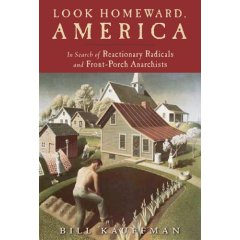
Look Homeward America.jpgKaufmann’s other books I’ve mentioned in these pages before, and are less systematic history.  Look Homeward America: In Search of Reactionary Radicals and Front-Porch Anarchists is a collection of vignettes, great stories of various small town folk who resist the secular left and religious right, who seem to live their lives in ways that call forth alternative, “third way” dreams and values. (In that volume he tells of Dorothy Day and contemporary novelist Carolyn Chute; of “American Gothic” painter Grant Wood and President Millard Fillmore.)  I loved those stories, each historically rich and well written.  For sheer enjoyment, I loved his tremendous, inspiring  memoir,  Dispatches from the Muckdog Gazette: A Mostly Affectionate Account of a Small Town’s Fight to Survive, an example of somebody who “wen
t far” to make something of himself, as the odd metaphors go, and eventually came home to his small town to root for the minor league ball team, the Muckdogs.  That one was truly wonderful, a tremendous memoir which is a must-read for those who appreciate James Howard Kunstler, say, or the rural novels of Wendell Berry.  He’s long-winded, which, in this setting, for those with ears to hear, is a good ‘ol compliment.  Sit back with some sweet tea or a cold beer and let this storyteller teach you some important civic lessons.  Let him tell you the long, noble history of antiwar conservatism and middle-American Anti-Imperialism.

Anti War Radio has a fascinating interview with him here.  Enjoy. 

Who Gets to Narrate the World? by Robert Webber

I want to wax rhapsodic in giving a big old salt-water shout-out to my new friends at this year’s Ocean City Beach Project, an intentional living/learning community across the street from the Ocean City NJ Presbyterian Church, sponsored as a leadership development and discipleship summer experience for college students sponsored by the Coalition for Christian Outreach (CCO.)  OCBP brings together a gang of collegians who read books together, attend several three hour lectures a week, learn Bible study skills and prayerfully consider how to offer their gifts and abilities for God’s work on campus, in churches, and of course in the world.  I and my daughter, Marissa and her friend Natalie, had the great privilege to hang out with the ’08 OCBP crew, and had the chance to deliver some lectures, lead some discussions, show a film, talk about Christ’s reign and explain why book-buying is a good habit for serious Christians who care about such stuff. And I didn’t get a sunburn in the hot south Jersey seashore.

My main presentations were on the development of a Christian worldview prepping them on their reading, especially, Derek Melleby and Donald Opitz’s excellent The Outrageous Idea of Academic Faithfulness (Brazos; $13.99), a book that is ideal for that setting, mature and yet light, serious and joyful. (Please, if you know any college students, make sure they know about this one-of-a-kind resource!)  To invite students to meet God as clearly in their academic work as they might in a church service, to explore the relationship between faith and cultural engagement, to invite radical commitment to Christ’s ways, even in science, sports or sexualtiy, to think through a Biblically-grounded view of citizenship and politics, well, it is all very exciting.   (Why is it that middle age folk like most of my peers are nearly dull to the radical implications for this large vision of making a difference in God’s hurting world?)  Derek and Don’s book helps students explore their sense of calling, their studies, their future work, and I gave a broad a hopefully exiting foundation and framework for thinking about this perspective of whole-life discipleship, this Kingdom vision, this reformational worldview out of which the CCO approaches their work with students and college staff.  We spent considerable time diagnosing the problems of a half-baked and legalistic or rationalistic faith, as we hoped to learn to discern ways to avoid, even as we keep ourselves well rooted in the historic Christian orthodoxies applied in fresh and formative ways.  I even got to tell them a bit about Abraham Kuyper!

As a very small part of one of my talks, I showed this provocative youtube clip of Brian McLaren, called “Domesticated Jesus.” (Time didn’t permit a showing of “Rethink Everything” or “The Societal Machine” two other good clips in this series of brief DeepShift presentations.)  This first great clip laments the increasingly troubled view of faith, the disconnect, the way Christ is domesticated and distracts us from the purposes of God.  This is a view where we do not submit to the grand story of the gospel, but rather, have Jesus as a “hood ornament” on the car we are already driving to our own destination.  Seeing Jesus as a mere accessory to our own autonomy seemed to be a helpful image for these students, and I invite you to ponder this short clip, too, and wonder about how we might rethink the faith in meaningful ways that can equip us to live in the ways of Christ in the contemporary world.  Notice Brian suggests we’ve lost the plot of the gospel message, we’ve somehow gotten confused about the Story.

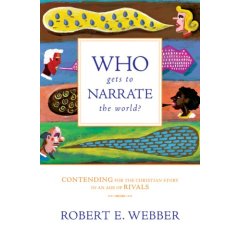
To counter this kind of loss of story, and to offer a reliably Biblical foundation for this “everything must change” rethink,  I cited one of the most amazing books I’ve read in a while, a really fast-paced book packed with amazing information and really fantastic inspiration.  In a season of tremendous books that help us recapture the whole vision of God’s work—these students watched N.T. Wright on the Colbert Report the week before talking about Surprised by Hope and were quite taken with his insistence on the notion that the final end of the Story is re-creation of creation, a healing of the planet and a reunion of heaven & earth—the new book, the last, by the late Robert Webber, is a must read.  It is called Who Narrates the
who gets to narrate the world.jpg World? Contending for the Christian Story in an Age of Rivals (IVP; $15) and it argues that if Christians do not recapture the full story of a creation restored, other faiths or ideologies (think of radical Islam) will win the hearts and minds of the world’s peoples, capturing their institutions and cultures.  Insofar as Islam presents an all encompassing vision, a coherent way of life and vision of history, they do, indeed, intend to narrate the meaning of life for the 21st century.  And, insofar as Christianity is presented as merely private, personalized and sentimental, spiritual and churchy, we will fail at the Kingdom call to disciple the nations.  If we do not narrate the meaning of life as purposeful and the nature of history as a response to God’s sovereign unfolding of His rule, if we do not hold out a hope for the restoration of all things and the reality of the Kingdom, we will see other worldviews and ideological rivals to the God of the Bible win the day.  (For more about the excellent AEF statement that gave rise to this book, visit their website here.)

We unpacked Colossians 1 a bit, one of my favorite passages for decades, now, and of course, Romans 12:1-2. I showed a portion of the edgy and hard-hitting critique of hyper-reality and consumerism, The Trouble With Paris (a book and DVD curriculum I raved about in a post a few weeks back.)  We explored the implications of being “in but not of the world” and how other Christian traditions—liberal Protestantism’s accommodation to culture and radical fundamentalism’s world-flight avoidance of culture—fail at that mandated approach of Jesus.  Ahh, and then there is the cultural resistance of the new monastics and Shane Claiborne, who suggest it isn’t proper to truly engage the institutions of power, and want to only elect Jesus for President.  Weeeee, what a great conversation that was: what does Shane and friends think of Christian citizenship action for the poor, like, say, the lobbying efforts of Bread for the World, or the Kuyperian vision of redemptive engagement within institutions as expressed by the Center for Public Justice?  Does the Colossians insistence that Christ made the powers and that they “hold together” in him, and that they are for him, mean that somehow we can be “in but not of” a traditional political party?  Can Walsh & Keesmaat’s Colossians Remixed: Subverting the Empire help us here?

The very ecumenical and balanced Robert Webber has seen it all, and tells in great prose and astute lectures just how the church has and hasn’t walked that faithful balanced of “in not of” the culture over the long years of church history.  His explana
tion of how we have sold out due to our unhelpful synthesis with pagan dualism, how we’ve yet maintain some efforts to be redemptive within non-Christian contexts, how the Enlightenment befuddled us so, how the modern era present new opportunities, all of this is really insightful.  I wish Who Gets to Narrate the World? would have been an assigned reading, too, for OCBP, as it frames their passionate desire for relevant and faithful Kingdom discipleship with a good historical perspective, and offers hope for serious, global renewal as we relearn the proper Biblical narrative.  That is, as in the McLaren clip, we learn to regain the plot and story.  For Mr. Webber, rather than the “creation-fall-redemption-consummation” flow I taught, it is simply “creation-incarnation-recreation.”  God is honored in all things, through creation and incarnation, the cosmos is reckoned redeemable, and Christ is seen as Savior of the whole world, the one who restores the Kingdom “on Earth as it is in Heaven” thereby giving hope within history.

I cannot recommend Who Gets to Narrate the World? enough. I wish I would have cited it more in my talks at OCBP because it really does offer a fabulous foundation for the development of a viable Christian worldview, and offers a helpful bit of insight about how we have gone wrong, and how we might, in God’s grace, regain a fuller appreciation for the whole counsel of God, and present a view of faith that is compelling, coherent, and consistent.  Such a narration of the story of our lives is just what we need if Christ is going to be more than a bobble head doll hood ornament.

Hearts & Minds 234 East Main Street  Dallastown, PA  17313     717.246.3333

Francis Schaeffer: An Authentic Life by Colin Duriez

Schaeffer.jpgSince the much-discussed and controversial memoir Crazy for God by Frank Schaeffer, son of Francis and Edith, there has been a bit of renewed interest in the evangelical cultural critic, theologian, philosopher and founder of L’Abri, a drop in study center Christian community in Switzerland that ministered to questioning, often disaffected youth in the late 60s early 70s–and exits in several cities throughout the world yet today.  In what seemed to be light years ahead of his time, he talked about worldviews, about presuppositions, the consequences of ideas, the zeitgeist of the times and the flow of history–all as important matters for Christian witness and mission and daily discipleship.  He organized their Swiss hostel (and inspired other intentional communities) as folks bonded together to live out the implications of a Christian view of life in the teeth of a modernistic and secularized cultural ethos.  He assured us that there were “no little people” and that God wanted to use us for Christ’s cosmic purposes, to share grace and thoughtfulness and beauty in such a fallen world that God surely loves.

As evangelicals, especially, discover the grand flow of the Bible as a worldview-shaping Story there is a new passion to explore God’s interest in social and cultural engagement, and seek to honor Christ in all of life—from the arts to the sciences, from local business practices to global justice, from pop culture to environmental studies, from race relations to the contours of our workplaces.  Thank goodness.  Reading folks from Jim Wallis to Leslie Newbegin, from Marva Dawn to N.T. Wright, we search for profound resources to “fund” such a broad vision of Kingdom reformation and many are now using the language of worldview, and this wholistic, imaginative move to embody a new, integrated, way of life. We have studied from those who have popularized and explored the vast implications of that phrase and that move.  (Both James Sire and Nancy Pearcey, who are vital voices in worldview studies, have L’Abri connections. So does Fabric of Faithfulness author Steve Garber. The annual Jubilee conference in Pittsburgh is one huge example of fruit born from conversations around L’Abri themes;  Charles Colson’s exemplary involvement in prison reform is another fruit of Schaeffer’s evangelical yet worldviewish thinking about societal transformation.  And on and on, some of my favorite contemporary authors and very best friends…) 

 We’ve learned that to be “radical” means not to be far left or way out, but to get to the “root” of things, to look at the deepest questions in the most profound ways.  It may be that  “neo-Calvinists” took up that banner most vocally in the past 25 years, influenced by their “radical” hero, Dutch statesman and public theologian Abraham Kuyper, who called for such deep rethinking of everything and it is clear that Kuyper and his rejection of dualism and personalism rubbed off in some ways on Schaeffer and his L’Abri movement.  Nowadays, although neo-Calvinism is on the lips (and keyboards) of places like Comment and Catapult and Richard Mouw’s blog, many others are just glad for reforming possibilities and intellectually serious faith traditions other than old-school liberal Protestantism and right-wing conservative fundamentalism. (I have written elsewhere that even the postmodern emergent movement has some connections to radical worldview thinkers like Brian Walsh and Jamie Smith and the late Robert Webber—who themselves have been nurtured in the Dutch neo-Cal and Kuyper tradition and L’Abri, too.)

 I would say that the person who stands for so much of all of this for me, is, in fact, Francis Schaeffer.  As I’ve written about often, I was introduced to Schaeffer’s books (his early 70s work on Christian responsibilities for creation care, his cultural studies, his critiques of Protestant liberalism, his little book on the arts…) and it showed me immense new possibilities.  To see someone with historic orthodox theology (I was also reading stuff like Malcolm Boyd and Dan Berrigan at the time) who also cared about the burning issues of the day, and even the cries of the counterculture, just blew me away.

I am glad that there is now a new biography of Schaeffer, Francis Schaeffer: An Authentic Life by Colin Duriez (Crossway; $24.95.) It is done by a very reputable biographer, and is a work which many have suggested will be the best bio yet.  It just came, and I’ve not seen any advanced reviews, but as I browse through it, I can tell that it will be helpful and inspiring, informative and fulfilling. Colin Duriez has done impressive biographies of C.S. Lewis and also of J.R.R. Tolkien, so he clearly is in the right orbit.  Before studying English and philosophy at University of Ulster, he spent time at L’Abri.  He is quite aware of his subject, has had the cooperation of the extended Schaeffer circle, and knows details that have been important in Fran’s life (for instance, his meeting in 1950 with the famed neo-Orthodox theologian Karl Barth, and a scathing letter he got from Dr. Barth.)  Fascinating stuff.

A small matter of interest for at least a handful of BookNotes readers (yeah, you know who you are) might be the question Mr. Duriez raises about the role in Schaeffer’s work, of the thought of Kuyperian philosopher Herman Dooyeweerd.  Duriez, who knew Schaeffer well, and stayed in touch for decades, corresponded with Schaeffer specifically about the influence of Dooyeweerd;  Schaeffer’s intimate friend, Dooyeweerdian art critic Hans Rookmaaker, many know, insisted that he introduced Schaeffer to Dooyeweerd’s philosophy which then shaped Schaeffer’s famous trilogy of philosophical works.  Schaeffer  knew Van Til, another Dutch Calvinist (from Westminster Seminary) and there is a family resemblance to a number of these Reformed thinkers who called for the development of the distinctives of the Christian mind, for the sake of God-glorifying cultural witness and social change.  Of course, while this was going on, L’Abri was growing in popularity,  Eric Clapton and folk like Joan Baez were reading Escape from Reason;  Os Guinness was working on his first book The Dust of Death, and Schaeffer was chastising evangelicals in North America for not caring enough to learn about the issues being raised by the counterculture or taking seriously new art forms like film. For those whose faith was shaped in the middle or ending of the 20th century, whether you knew about this stuff then or not OR for those who are too young to have recalled these tumultuous times, and who may not think much of Schaeffer’s influence,  Francis Schaeffer: An Authentic Life by Colin Duriez is going to be great and is highly recommended!

With endorsements from the likes of  Alister McGrath and James Sire (who says “Schaeffer, the Jeremiah of the twentieth century, walks and talks again in these pages”) this surely is a very reputable and thoughtful work.  I am confident that it is.  We are very, very happy to present it to you.< br />

BLOG SPECIAL
Francis Schaeffer: An Authentic Life
$5.00 off
regularly $24.99
$19.99
ORDER HERE
Hearts & Minds 234 East Main Street  Dallastown, PA 17313   717.246.3333 

Three rare CDs for sale: reviewed at the May Hearts & Minds monthly review column

I have been working on this article reporting about and reviewing three remarkable and nearly unknown CDs that we have for sale and I really, really hope you will read my reflections on them.  Even if you aren’t interested in the music, the writing about them, I trust, will be inspiring and informative; they each have a very special story and some good folks behind them.  Please click on over to the monthly website column.  Pass it on to anybody else that is interested in music, any contemporary worship leaders,  folkies, activists or jazz connaisseurs.  These three releases are under the radar recordings and as an indie store, we are able to support these sorts of projects, but yet don’t know how to get the word out… 

life is more.jpgLife Is More 5n2  The spiritual-missional journey of our mail order pal, youth worker, social reformer, worship leader, guitarman Ethan Bryan from Missouri is described in my review, his journey of reading good books (like Irresistible Revolution and Colossians Remixed) and how he wrote an album full of songs, each somewhat inspired by a different cause, project or wholistic faith-based social justice ministry.  Hear songs inspired by groups such as Not for Sale, NoSweat, She Wrote Love On Her Arm, Blood:WaterMission, IJM, etc.  Low-budget, big hearted. I tell the whole story, and more…and what a story it is!  Check out the full column, please.

Songs for a Revolution of Hope  Brian McLaren, Tracey Howe, the Restoration Project
songs for a revolution of hope.jpg Tracey has collaborated with some pretty groovy worship leaders and acoustic new folksters, and has been outspoken about international concerns, justice and peace for some time now.  She took Brian up on his call for innovative and thoughtful new music for emerging, justice-seeking congregations, and they did this album together, with friends.  These tunes were a good part of the worship piece of the Everything Must Change tour.  Consider it a soundtrack to the book, whole-life worship stuff, with beat-poet spoken word a la Cockburn, medieval poets like Julian of Norwich or St. Francis put to country-folk, and some aggressive political awareness, placing orthodox theology next to a postmodern, socially engaged worldview.  Gentle tunes about kindness and mercy, too.  Read the whole review and order a batch of ’em.

heaven in a nightclup.jpgHeaven in a Nightclub  Bill Edgar, Ruth Naomi Floyd, John Patitucci, John Salzano  Our good friends at the thoughtful Christian hang-out and collegiate study center at Cornell, the wonderfully named Chesterton House, put together a full evening of conversation, art, and jazz music one glorious summer evening a year ago in a classy club in New York City.  Edgar is a mean jazz pianist, and knows a whole, whole, lot about the relationship of jazz to older African-American spirituals. Floyd, who often sings with him, is truly one of the great jazz vocalists of our time;  Patitucci is a Grammy Award recipient for his work on the bass; Salzano is a stellar, highly-regarded session sax player.  This live double disc is a treasure, a rare live show that captured a truly extraordinary night.  Supports the thoughtful work of Karl Johnson and other sharp Chesterton House folks in Ithaca, too.  Please see my full review, and order soon.

Hearts & Minds 234 East Main Street Dallastown, PA  17313  717.246.3333

Just Courage: God’s Great Expedition for the Restless

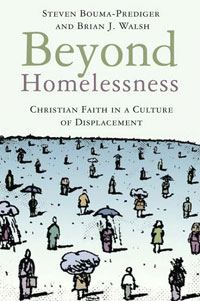
As I continue to celebrate the book I commended to you in the last post, the long-awaited and exceptionally important, yes, brilliant study by Steven Bouma-Prediger and Brian J. Walsh, Beyond Homelessness: Christian Faith in a Culture of Displacement, I am struck by how their themes of homelessness—as metaphor for postmodern dis-ease and a symptom of an economy that fails to appreciate the Biblical vision of home-making and creation-care—show up everywhere.  From the recent, delightful books about buying local, going organic and the joys of daily eating to the broader concerns about climate change and the price of gas, to the heart-breaking realities of refugees from political or natural disasters, the themes of exile and place and the longing for shalom are prominent.  I am convinced that Beyond Homelessness (as I will say in a large review later this month at the website column) is a book that will help us in very many ways; it is groundbreaking.  Like their very important and influential earlier works––The Transforming Vision, Colossians Remixed, For the Beauty of the Earth—this will make a major contribution to our thinking and, hopefully our living in these restless days.

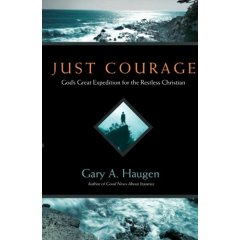
justice courage 2.jpgHomelessness, oppression, displacement, injustice?  God’s hope, real hope? Deep joy amidst great sorrow?  Few have illustrated this more than the remarkable career of Gary A. Haugen, founder of International Justice Mission.  I recall a conversation on the phone with Gary years ago;  he had returned from overseeing for the Department of State the horrors of the genocide in Rwanda and felt compelled to start a Christian ministry, in those days described as something like a faith-based Amnesty International, a spiritually-powered agency that could tap into the wisdom and on-the-ground resources of God’s global people and resist the sorts of structural evils that the UN just couldn’t touch.  IJM has developed in to the premier NGO fighting international slavery, particularly child sex slavery and Haugen has become one of the most influential Christian leaders worldwide.  Evangelical students, especially, flock to hear him and are blogging, starting local chapters, and donating to groups fighting international abuse. (He was just awesome at Jubilee 2007, one of the best presentations in the history of that famous Pittsburgh gathering.) His first paperback book, Good News About Injustice  and subsequent video curriculum is a balanced and thoughtful study of international injustice issues and a mature invitation for Christians to care about public policy and see what God is doing through those who work for reconciliation, justice and public goodness.  Like a modern-day Wilberforce, he’s campaigned against modern day slavery (worse now than it was in the 18th and 19th centuries) and his powerful story Terrify No More documents in page-turning, heart-pounding detail the undercover rescue efforts to free child slaves from a brothel in Southeast Asia.  Maybe you saw the special on 20/20 or recall our recommendations of the book when it came out.  It is one that you can’t put down!

Now, Mr. Haugen brings us his most general book, not nearly as policy oriented and serious as his first, not as specific and detailed as his second, rather, an inspirational overview of the call to stand for justice, to be faithful and courageous, to move beyond comfort and safety and rise to the call to make a difference, in small and daily ways.  Just Courage: God’s Great Expedition for the Restless Christian (IVP; $18) could be his best yet, and we are thrilled that it has released a bit early.  Please don’t skip over the important Eerdmans Bouma-Prediger/ Walsh book as it is a truly profound and theologically mature bit of cultural analysis.  Just Courage, though, could be a great companion book, a brief but stirring call to trusting faith, to daily discipleship, to a global vision, the hope of what Christ’s followers are doing, and how we can take further steps to be agents of healing, hope and social transformation, especially for the hurting or oppressed. The chapters are very short, the readings inspiring, the discussion questions provocative, practical, usable.

Thanks to IJM, to Gary Haugen, and for publishers like IVP for doing such a fine primer on how to live out this concern that is so close to God’s own heart.  This is a great little book!

Just today I was ruminating on the spectacularly thrilling bit of dramatized monologue from the point of view of an 750 BC Jerusalem priest that meets up with the “farmer from Tekoa” the prophet Amos, as envisioned in one of the many Biblical interludes in Beyond Homelessness.  Amos was one of the first Old Testament prophetic books that I studied in depth in the mid-70s and it still ripples down the decades; I’m thrilled to learn something new, to consider the implications for my feeble life.  Quite simply, Just Courage by Gary Haugen will help us hear Amos and live Amos, will help “let justice roll down.”   Will it take you a bit of courage to even order such a book?   To recommend it to a friend or loved on, to suggest it as a study at your church or fellowship? 

Early Prediction for 2008 Book of the Year: Beyond Homelessness: Christian Faith in a Culture of Displacement by Brian J. Walsh & Steven Bouma-Prediger

beyond homelessness.jpgBeyond Homelessness: Christian Faith in a Culture of Displacement by Steven Bouma- Prediger and Brian J. Walsh (Eerdmans; $24.00)  is a book that I can safely say will be one of the most important works of the year, a major contribution to Christian social analysis and cultural reformation.  I’ve followed these friends a bit as they’ve worked out this material. I’ve had an early draft and have been awaiting this published copy for a year; I couldn’t be more excited that it has arrived.  Thanks be to God, the ever-faithful home-making and Earth-restoring God who comes to us in Jesus not, as they ably show, to take us away to heaven only to leave behind a burning planet, but to help us image the God of creation here, now, in creation-caring stewardship, until that great day when Christ returns to consummate his covenantal ways in a new Earth.

Walsh has written widely as co-author about the shape of a Christian way of living, based on a Biblical worldview informed by the grand story of creation-fall-redemption (Transforming Vision, Truth Is Stranger Than It Used to Be, Subversive Christianity , The Advent of Justice, and, with his wife Sylvia Keesmaat, Colossians Remixed.)  How this has transfigured—through, among other things, forming a friendship and working relationship with environmental studies scholar (and author of the brilliant For the Beauty of the Earth) Steven Bouma-Prediger, reading a lot of Walter Brueggemann and Wendell Berry and the new urbanists like James Howard Kunstler, and moving into a sustainable agricultural community farm)—to the metaphor and images of home-making/exile/home-coming, is itself quite an amazing part of the story of this book.  The grand drama of Scripture is still the heart of this book, but the new insights about land and place and the hope (in Revelation 21 and 22) of a “gardened city” are fresh and generative.  I do not say this lightly, I really don’t: this is brilliant.

The Biblical studies are profound (and there are creative Bible interludes between each longer chapter that will bring the insightful and provocative reflections of Colossians Remixed to mind.) The scholarly breadth is prodigious, the cultural awareness just amazing. From the stories to the science, the cultural criticism to the theological proposals, from the song quotes to the incredible footnotes, this is one really interesting read.

It has deep integrity, too, remarkably so.  From their work in classrooms and homeless shelters, to their work in homesteading and sustainable agriculture, they have lived out faithful and creative ways of being agents of God’s great homecoming.  They’ve studied the meanings of home and homelessness, both among the very rich (who may have houses, but not homes in any meaningful sense) and the literally homeless (who may have homes in the sense of a community of belonging, even without houses.)  They explored how the high modern culture displaces us, metaphorically and sometimes literally, from our “sense of place.” They’ve related the cultural angst and upward mobility culture with our disregard for the creation itself, related (as has their friend Bob Goudzwaard) the relationships between some of the key social problems of our time, from climate change to global poverty.

The insight of this important work is urgently needed, and I will be exploring Beyond Homelessness in greater detail in a longer book review over at our monthly column at the website.  For now, please know of our very sincere gratitude for this remarkable work, our commitment to try to explain it well to folks so our readers purchase it, read it, discuss it, and deepen their ties to communities and places, living out the transforming vision that underlies this profound gift of insight, courage and hope.

BLOG SPECIAL
$5.00 off
regularly $24
now $19.00
ORDER HERE
Hearts & Minds 234 East Main Street Dallastown, PA 17313     717.246.3333

5 books announced at Penn SE Conference conference

Here’s a posting to give a public thanks to the Penn Southeast Conference of the UCC for having us to their annual conference again; that hall in the Host is so gigantic! It was great (if exhausting) to set it up with such a huge display.  We are grateful for your interest in books, and glad for the freedom to stock such diverse topics and varied perspectives. From worship resources to the various theological texts, from faith-based perspectives in politics and global concerns to books on spiritual formation, from Christian ed resources and kids books to the massive amount of stuff on congregational life and parish development, like the Alban Institute books that we stock, we loved to show off so much of our wares.  Thanks for caring.

Somebody asked that I post the books I announced from the main podium, so here is the gist of my announcement from Thursday afternoon. Order any on line, or call us, and we’ll offer the conference discount price of 10% off of the regular retail price shown. 

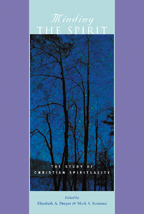
minding the spirit.gifMinding the Spirit: The Study of Christian Spirituality Mark S. Burrows & Elizabeth Dreyer (Johns Hopkins University Press) $20.95  Keynote speaker Mark Borrows (formerly of Andover Newton and apparently a very well-loved seminary prof) did a fabulous job by all accounts in inviting us to think seriously about communicating our faith, growing deep spaces in our churches for meaningful reflection and mature, grounded discipleship.  Of course, we loved his stuff on the role of the imagination, was glad for his call to use poetry (he gets extra points for citing Mary Oliver), and found it marvelous that he called upon church leaders to read widely, to read also for themselves, including novels.  I’d add, also, creative nonfiction, memoirs and autobiographies.  (His suggestion of the Annie Dillard novel The Maytrees was very interesting; it recently came out in paperback.) Rev. Burrow’s helped edit this volume, a spectacularly interesting and deep scholarly book which makes a case for studying spirituality (some of the insights from his talk had some overlap with at least one of his chapters in this collection.)  It is a rare bit of scholarship and not an common book to find.  Glad we have it!

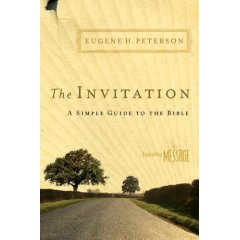
The Invitation: A Simple Guide to the Bible  Eugene Peterson  (NavPress) $16.99  I’veThe Invitation.jpg promoted this at several conferences this spring and folks have consistently shown great interest.  This is simply a handsome hardback casebound copy of the introductions to each book of the Bible that are found in Peterson’s best-selling Bible paraphrase, The Message.  His eloquent and interesting and historically helpful overview of each Biblical book, and some other introductions (like, say, a chapter in the beginning about the big picture of the whole Scriptures, or his intro to the prophets, or to the gospels) are simply spectacular.  When a writer this good explains the Bible so well, with such gusto, insight and brevity, it is a winner. I was glad that some of our UCC friends were as excited about using it in their personal devotions or in church settings as we are.

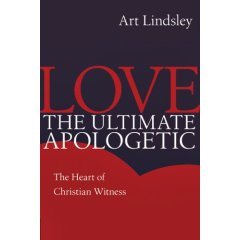
Love, Ultimate Apologetic.jpgLove The Ultimate Apologetic: The Heart of Christian Witness Art Lindsley (IVP) $15  Art is a good friend and has written other books on apologetics, rejecting the relativistic ethos of our culture, drawing on C.S. Lewis and others to offer up a solid argument for truth, for Christian orthodoxy, for a mature witness of balanced Biblical perspective in the public square.  Here, though, he reminds us how this must be accomplished: through love.  Few good books exist about this topic, and his explorations and ruminations are thoughtful and provocative, nothing mushy, always balanced and solidly Biblical. “They’ll know we are Christians by our love, by our love…” the old song goes.  This helps unpack that with depth.

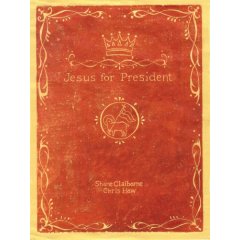
Jesus for President  Shane Claiborne & Chris Haw (Zondervan) $16.99  You may know that we’ve been big promoters of his first book, The Irresistible Revolution, and we pushed it at the conference last year.  This one is a bit deeper, but with a stunning full-color, youthful look.  I’ve noted before that theJesus for President.jpg conservative evangelical publisher releasing this pacifist manifesto with its edgy pomo graphics and hard hitting critique of imperialism—especially of the proud US sort, government or corporations—indicates a new wind blowing through Christian publishing.  Shane exposes the bankruptcy of civil religion and calls us back to the radical implications of the Bible.  He and his co-author draw on John Howard Yoder and William Stringfellow, the Berrigan brothers, Walter Wink, Dorothy Day and other scoundrels of radical faith to call us, joyfully, to a vision of political life that is rooted in the unfolding Scriptural story about peace, justice, a sane lifestyle and a Kingdom that is supplanting all other contending reigns.  Whew. This may be our biggest selling book of the year as we recommend it everywhere we go, even if it sometimes takes some explaining.

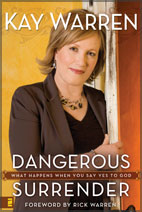
Dangerous Surrender.jpgDangerous Surrender: What Happens When You Say Yes To God  Kay Warren (Zondervan) $21.99  Okay, I’ll admit you may be scratching your head, since some have this view that mainline denominational folks, let alone more radical Christians like the new monasticism and resistance movement of Shane are opposed to mega-churches, and see Warren’s popularity as somehow a sign of serious sell-out.

All I can say is that this book moved me to tears, that her struggle with breast cancer, her friendship with gay folks with AIDS, her risky and dynamic work in Africa are simply told and inspiring.  They are fabulous examples of following Christ into areas of great suffering, of wholistic service, of obedience to the call of God.  Kudos to the Warren’s for parlaying their great fame and wealth into something like their work against AIDS and poverty in Africa.  And kudos to friends in the UCC who, knowing their different theologically perspectives, were willing to purchase some of this easy-to-read story of not just a mega-church star, but a serious follower of Jesus, who is willing to “say Yes to God.”.  I hope it bears fruit in helping mainline folks and evangelicals respect one another and maybe, maybe, help readers to take steps towards such brave and effective service themselves.

feasting on the w
ord.jpgFeasting on the Word Year B volume 1 Preaching the Revised Common Lectionary  edited by David L. Bartlett and Barbara Brown Taylor (WJK) $39.95  I believe it was years ago at a Penn SE event where Beth and I first met Barbara Brown Taylor.  We went on to promote all of her books, every where we go.  If you read her in the Christian Century or other sources, you know she is thoughtfully engaged and deeply interested in the actual words, rhetoric, sentences, stories of Scripture.  She works hard as a preacher, thinking, praying, preparing each week.  As an elegant writer, she, along with respected New Testament professor (Columbia Theological Seminary) Dr. David Bartlett, are well positioned to offer up this extraordinary first volume of what will become a historic, extraordinary resource for lectionary preachers. 

Each week offers four perspectives on the four lectionary selections; that is, there is a brief essay which they call a pastoral, a theological, an exegetical, and an homiletical perspective.  Four columns, each running for a page or more, on each of the four weekly lections. (They are in facing columns, a very nice design option.) The writers drawn in to this project are a diverse and ecumenical bunch, delightfully interesting, it seems, and all actively involved in Christian formation, teaching, preaching or writing.  A quick glance over the contributors shows a number of folks I know, a number more I know of and trust. This is a goldmine and treasure-trove.

BLOG SPECIAL
10% off
ORDER HERE
Hearts & Minds 234 East Main Street Dallastown, PA  17313     717.246.3333

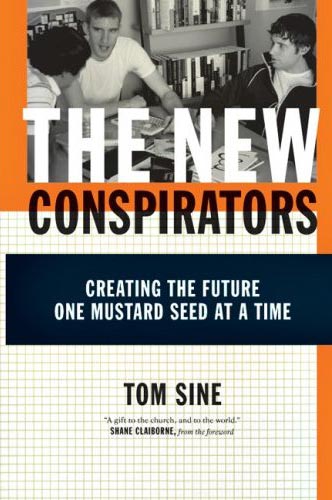
The New Conspirators: Creating the Future One Mustard Seed at a Time

In our over 25 years of bookselling, a few authors stand out for their passion, their large interest in their work and their enthusiastic support for our feeble efforts to sell a few of their titles; titles they usually believed—without pride or presumption—might make a difference in the world.  We’ve looked to them as models of a thoughtful and serious presence within the publishing world and promoting their work helped define our calling here.  Some have sheer enthusiasm, a sharp mind, or a colorful personality and we are energized by listening to them (think Tony Campolo, or, differently, Marva Dawn or Lauren Winner.)  Others are weighty and understated, but the substance and caliber of their work attracts serious listeners and readers (think, for instance, Eugene Peterson, Os Guinness, or Ron Sider.)  In their own ways, these sorts of authors are most memorable for their ongoing pubic witness through their excellent books, their important and gifted writing and the vital content of their ministries.  We have been grateful for their friendship to us here at Hearts & Minds.

And there is Tom Sine.  Sine speaks faster and with as much gusto as Campolo, yet 
tom sine.jpg shares the earthy spirituality of Eugene Peterson; he is fluent and thoughtful about global trends and international affairs and also in the daily, local details of what he calls     “whole-life discipleship.”  And he phones us some days just to encourage us out here in small town central PA.  You see, he believes in the extravagant sowing of seeds and the world-changing power of mustard seeds.

In the mid to late 1970s, as a young evangelical with very public interests, I was hungry for good books and like-minded allies.  In 1980, I believe, I realized (with great delight) that Tom Sine’s groundbreaking The Mustard Seed Conspiracy was, well, groundbreaking.  While some friends and I were studying the history of ideas and the deformation of culture from the impact of idolatrous ideologies and worldviews (reading the likes of Francis Schaeffer, Herman Dooyeweerd, Nicholas Woltersdorf, or Bob Goudzeward) others joined together as we signed up to protest the not so cold war militarism of the arms race.  Influenced by Sojourners and The Other Side and Jim Wallis’ early books, which drew on leaders such as John Howard Yoder, William Stringfellow, Dorothy Day, James Cone,  and Dan Berrigan, we forged communities of action and creative resistance.  Most evangelicals, nor many mainline folks, in those years didn’t care much about the world at all, though, and both the cultural worldview reformers and the political/social activists impressed me with their desire to live out the faith in relevant, transformational ways.  The Mustard Seed Conspiracy seemed in ways to combine various diverse streams, and Sine’s watershed book seemed to have a serious understanding of the broadest social and ideological trends yet invited radical action.  I am only one of many who found that book extraordinary.   Beth heard him at the Jubilee conference in Pittsburgh in those years, and was very impressed, quoting Calvin and Ellul. 

Among the many authors Sine cited (and he always cites a lot) were leaders who became my own heroes and mentors, James Skillen, Ron Sider, John Perkins.  MSC raised a prophetic cry from the evangelical center.  Sine believed that ordinary church folk could make a difference, not just the heavy cultural critics or the exceptionally dedicated resistance protestors.  And he was right.

Years later, as movements and traditions solidified and authors became better known, Tom kept at it, mixing the groups, networking younger voices, doing a string of inspiring, upbeat, invigorating books, drawing always on this wide array of sources, pushing this unique blend of social critique, deep spirituality, radical social action.  From the excellent, brief, introductory study Taking Discipleship Seriously: A Radical Approach (still a must-read and highly recommended) to the critique of the American Dream in Live It Up, from the fairly academic Cease-fire: Searching for Sanity in America’s Culture Wars to the fabulous Finding Your Purpose (better than Purpose Driven Life, as I said in these pages years ago) his books have been consistently interesting and helpful.  Ravi Zacharias famously named Mustard Seed vs McWorld as one of the most important books he’d ever read.  Tom Sine has been an important conference speaker, organizer, consultant and workshop facilitator over the last 25 years, even as he has been based in intentional community, and—importantly, given his calling—in serious relationship with folk from all over the world, especially, it seems, in the U.K. and Down Under.  I think it is fair to say that he stays put and is widely traveled, knows the ordinariness of a real place and yet sees the biggest of pictures.

Sine has been palpably hopeful (his book Wild Hope is sadly out of print) and exceedingly creative, alongside his wife Christine, herself a former Mercy Ship doctor, and author (most recently of Godspace which is a lovely and helpful book on rest, and life’s rhythms.)  When they offer lectures or seminars they might tell stories from Africa, or insist on a closing celebratory feast.  They might have you up and dancing or sitting in prayerful silence or reciting a Celtic blessing.  (They might even have you doing all of those things, just in the first half a day!)  They believe in the sanctified imagination, in a pedagogy that is communal, joyful, and active, and they believe that learning can be transformational.  As I said, there are certain authors who deeply believe in the power of their books, not due to pride or presumption, but because they believe that God uses ordinary folk like themselves to make an impact.  Why else would an author work hard to write a book if they didn’t significantly hope that it will find an audience who will be transformed by it? Sadly, though, many of the Sines’ books have been under-the-radar, I’m afraid, not selling as well as they should;  yet they’ve changed lives.  They are considered by important thinkers to be pivotal.  I’m not sure if Sine coined the phrasing “missional” but he has been a part of that conversation, that movement, inviting folks to joyous lives of simple living and radical service for the Kingdom of God, the shalom of the planet.  Almost all of his books have been critically acclaimed, and we have several of them still on our shelves here.  We are grateful for the chance to have these kinds of resources to recommend and are honored to call him a friend and H&M supporter.

Tom Sine’s persona, his presentations, and his books are infectious; as much as any author I know, Tom backs up his writing with a wild life of faith-filled hope, experimenting (to borrow Ghandi’s phrase) with truth.  He and his comrades in the mustard seed conspiracy breath together (that is the meaning of the word) to cook up (sometimes literally) a new world.  From multi-ethnic meals to multi-denominational worship experiences, he nurtures community, facilitates networks, evokes Godly imagination and insists with every fiber of his being that God’s intentions for His planet is seen in the redemptive restoration of Jesus the Servant King.

So, Tom the statistician and futurist, Tom the Celtic mystic and worship poet, Tom the world missions guru and global storyteller, has left a mark.  The Mustard Seed Conspiracy< /b> (now oddly out of print) has been considered one of the most influential Christian books of the 20th century.  Ask the best leaders and they all will cite him as influential in their journey. 

And so it has come to pas that InterVarsity Press realized that that classic book might be re-issued in some anniversary, updated manner.  Could the ever-energetic, overly optimistic, exceptionally visionary Tom Sine settle for an update of that old chestnut?  He’s a futurist, recall, and is convinced that peopled are called to “read the signs of the times.”  He is, somewhat like Leonard Sweet, a semiotician.  He knows how the times have changed!  Of course, nothing but a whole new book would do.  Viola: The New Conspirators: Creating the Future One Mustard Seed at a Time is the new result, and it is not a spiffed up version of MSC2 but a whole new book!  Can you hear the echo of the original mustard seed conspiracy?  This is the new conspiracy, or at least new forms of the old one.

New Conspirators.jpgThe New Conspirators: Creating the Future One Mustard Seed at a Time (IVP: $15) is an obvious hat tip to the vision and hopes and style of MSC.  As did the original, this includes stories of ordinary folk, it includes incisive political and demographic analysis, cultural criticism, missional theology.  And did I mention there are stories?  Energetic stories, well told illustrations, plenty of examples and case studies?  I know a few preachers who have gotten this just for the sermon illustrations (true sermon illustrations) about those who heard the call to live out wholistic faith, to be a fool for Christ, who responded to grace in creative initiatives of servanthood and mission.  The New Conspirators is packed full of glad news, of those who find life in giving their lives away for God’s sake and their neighbors good.

As the sociologist and “big picture” scholar that he is, Mr. Sine is not content to just call us to service, to tell the tales of God’s new faithful.  (That would be plenty, frankly, but NC is much more than a radical version of Chicken Soup for the Soul.)  He has his finger on the pulse of the latest trends, even those that tend to be under the radar, and explores plenty of fascinating aspects of the 21st century mood, values and concerns.  As one reviewer puts it, he is “a master of connecting the dots.”  Here, he is particularly passionate about exploring groups who are thinking in fresh ways, understanding faith and discipleship in peculiar ways, movements that are fast becoming trends themselves–and connecting those dots.  He explores four of what could become, especially in the aggregate, the most significant movements from the margins to impact the church and consequently the church in our time.  Although we are “traveling in turbulent times” he remains inspired.  He also insightfully tells us of several important conversations that are happening the world over, among these four movements, conversations that run throughout the book.  He introduces plenty of new content, and reminds us of plenty of stuff we thought we knew, gaining perhaps a new angle of vision.  He underscores certain concerns and explains complicated matters in clear prose.  It is a marvelously rich book, potent and packed.  As one customer quipped, “you sure get your money’s worth when you buy this one!” 

Not only do you get your “money’s worth” with the vast and informative content and fun stories, but I believe Sine speaks with authority here, authority earned from the decades of traveling, listening, thinking and working on this stuff.  Listen as Shane Claiborne nicely comments in the foreword, words that are very nice, but, more importantly, are very insightful and important:
 

Tom has not just tried to understand this generation like many of his peers, but Tom has tried to stand under it.  He has been a learner and listener to a generation set on making its own mistakes and dreaming its own dreams for the church.  He is a humble sower of mustard seeds, not the one who scrambles to devour the bountiful harvest.

This book runs the risk of making a few of us young tykes look too good, but that in itself is evidence of Tom’s humility.  His motivation for writing is to see a church that is one as God is one, a people that mirror the peculiar and countercultural politics of God’s kingdom, a body that looks more like Jesus than the ole time religion of the past.  It is that old, stale Christianity that threatens to inoculate us from the real thing. And it is books like this one that revive our imaginations to the things that are turning God on in the world. 

Tom jokes in the book about getting lost easily when he travels, claiming “the gift of disorientation.”  So he goes out of his way to make the myriad of voices and themes in The New Conspirators understandable and clearly presented.  He lists five conversations that are occurring, and need to be occurring, in our home settings.  And he describes, in what is the heart of the book, four groups of “new conspirators” who are, in their unique way, bringing a fresh and vital contribution to the work of advancing God’s reign.

The conversations–“stops along our journey together” as he puts it—explore the following topics as we are invited to join God’s quiet conspiracy.  (Yes, Sine is delightfully and quite intentionally relentless in his writing style, inviting us, the readers, to be a part of this conversation.)  He calls this overview a “global positioning tour” and it is the structure of the book:

1.  Taking the new conspirators seriously.
2.  Taking the culture seriously.
3.  Taking the future of God seriously.
4.  Taking the turbulent times seriously.
5.  Taking our imaginations seriously.

“This book,” he writes, “is an invitation to be much more a part of something really, really small that is quietly changing our world.  But it is also an invitation to revisit our images and understandings of the story to which we have given our lives.” 

Sine says that he finds that “many older evangelical Christians assume that all the important questions were answered decades ago and that we got all the answers right; now all we need to do is simply improve our tactics and strategies.  But as I look at the contemporary expressions of Christian life, church and mission, I am not convinced that we have gotten all the answers right.  I am going to echo some of the tough questions I hear being raised by younger leaders on the conspiratorial edge.  I am going to invite us to the challenging task of revisiting five important questions.”  He lists them like this:

1.  Did we get our eschatology wrong?
2.  Did we get what it means to be a disciple wrong?
3.  Did we get what it means to be a steward wrong?
4.  Did we get what it means to be the church wrong?
5.  Did we get what it means to do mission wrong?

And, to be honest, he is just getting warmed up… Of course, many younger Christian readers may not even quite realize how significant these conversations, and these questions are.  They seem so right to be asked; Sine is correct, though—many are reluctant to even have these kinds of conversations, to ask these kinds of questions.  We are glad to have a book like this to use and strongly commend it to you and your group; it is urgent to be attentive t
o God’s Spirit as we discern together the most faithful ways to live into this stuff.  He is tentative and humble when he needs to be, and provoking and energetic almost always. His middle section about God’s intentions to heal the planet, consistent with, say, N.T. Wright’s well known work on new creation, is fabulous and could generate great conversations and greater Biblical faithfulness. 

 And, he really does look for global conversation and mutual edification.  Their Mustard Seed Associates has created a study guide for the book (beyond the already plentiful conversation starters and discussion resources in the text itself.)  Visit www.thenewconspirators.com or email the author at mail@msainfo.org. They even give you their phone number in the book if you want to call them!  They’ve created a free e-zine, too, sharing stories from around the world.  Sign up for The Seed Sample for a regular story in your inbox..  Conspiratorial, eh?

But, how about the four movements?  What or who are they?

Throughout his travels, Tom has networked and researched and fellowshipped with (at least) four distinct (if overlapping) movements.  These trends, streams that are impacting how church and ministry is being considered, influencing major publishing houses, setting the agenda at conferences and confabs the world over, shaping our vocabularies and imaginative horizons, are described with particular clarity in the first conversation (“taking the new conspirators seriously.”) 

1.  The Emergents.  Obviously, these are (in my words) those lead by the emergent village, but including many more, the postmodern hipsters who are hosting their own global conversations and local cohorts rethinking everything in light of their rejection of modernist agendas and evangelical platitudes.  I’ve written about these folk before and trust you agree that this is a major movement, for better or worse.  Recent reviews have suggest that Sine is one of the best reporters of the emergent-type movements, and The New Conspirators is taking its place beside such standard overviews as Ryan Bolger’s classic The Emergent Churches or the recent Tony Jones, The New Christians.

2.  The Missionals.   It may have been Princeton’s Darrel Gruder who coined the phrase, but this catchphrase implies more than being interested in world missionary work.  This is a “new” mindset where churches are communities, even countercultural ones, that exist for others.  They are not about themselves, but are about the purposes of God in the world.  Influenced by the likes of Leslie Newbegin and popular in the mainline churches, especially, being missional may be the most significant buzzword of the new century.  Sine names the “Gospel and our Culture Network” as an important standard-bearer in this post-Christendom move, and we couldn’t agree more.  Missio Dei is “Thy Kingdom Come.”  And that always takes embodied shape within real cultures, but must not be absorbed by them.  Complicated?  Stay with Sine a bit and it will be your burning passion.

3.  The Mosaics.   Tom uses this nice M word perhaps inspired by the creative efforts by Irwin Raphael McManus and his Mosaic congregation in LA to be truly multi-ethnic and cross cultural.  Resisting racial injustice and celebrating multi-ethnic reconciliation is part of this, but a true celebration of the normative nature of ethnic diversity for the church is the positive goal.  There are wonderful strides being made here, perhaps less in mainline denominational churches, despite their well-intentioned rhetoric.  Many of the most vibrant church plants in most major cities are ethnic congregations and multi-racial ministries are much more prevalent in the US than ever before. Good for Tom for sensing the importance of this stream; there is little use denying this (read Jenkins for the global picture) and every good reason, Biblically and theologically, for working hard to overcome the church’s tendencies towards unfaithful homogeneity.

4.  The Monastics.   While truly cloistered folk may not be the model, here, the monastic movement has taught us much, and the likes of Richard Foster, Henri Nouwan, Thomas Merton and such have swept the broader church, helping many grow more intentionally about spiritual practices, contemplative disciplines, and spirituality that is forms character and sustains a life of Christlikeness and fidelity.  Interestingly, Sine sees the “new monasticism” as being especially involved in the classic monastic outreach to the poor.  Citing the likes of legendary third world urban worker Viv Grigg and Camden NJ activist Shane Claiborne, Scott Bessenecker, who wrote The New Friars: The Emerging Movement Serving the World’s Poor, and John Hayes (of the urban SubMerge movement) Sine documents this amazing move of younger evangelicals embracing God” demand for social justice and solidarity with the poorest of the poor.   Again, although mainline churches seem socially progressive and ecumenical seminaries teach liberation theology, it is clearly younger evangelicals that are flooding the two-thirds world with creative initiatives, wholistic ministries, and writing the most compelling books about God’s deep passion for the relief of oppression and our compassion for the poor.

Not unrelated, too, is Tom’s amazing fluency in the global scene, his very helpful suggestions for taking the needs of the poor seriously (as well  the needs of the middle classes, and the wealthy in the global economy.)  Can we “make poverty history?”  Can ordinary Christian folk get involved in the debates about globalization?  Further, he dips just a bit into the work of Lamin Sanneh and Philip Jenkins and others who report on the increasingly global and non-Western make-up of the worldwide body of Christ.  I know Tom knows these guys, and his heart pounds for a global vision.  This is really, really great stuff, fascinating, urgent, and very accessible for those who tend not to read such sophisticated work or current affairs.  Oh, the seeds he is sowing, and the good work that can come out of those who read this material.  What might happen if a group here or there, your group, perhaps, takes something of this to heart, and makes room in their lives for more intentional faithfulness as culturally awake, global citizens?

I hope that–and I dream what could happen as—many read this book, and that churches, Bible study groups, small faith communities, and adult ed classes use it.  It is well worth reading, a great overview of the issues of our time, and offers a very nice balance between detail and new information and illustrative stories and inspiring rhetoric.  The flow and cadence is right—I know he worked very hard to make this jam-packed and user-friendly.

There are criticisms that can be made as there are with any book.  My own personal peeve is that he doesn’t describe the perhaps even lesser known movement, but very important, uprising of younger neo-Calvinists, those citing Kuyper and inviting conversations about “thinking Christianly” about every area of life.  Friends doing great work on culture, local economies, sustainable and faithful daily lifestyle stuff over at catapult and their *cino network, working at work-world reformation and new urbanism at comment and the important Jubilee conference inviting college students to think about their vocations all come to mind; broader events like the Q (sponsored by the extraordinary cultural creatives at The Fermi Project or New York’s stunning International Arts Movement (IAM).  The Christian Vision project of Christianity Today’s Christian Vision Project (counter-cultural practices for the common good) have been a fresh way for evangelicals and others to engage culture, and Andy Crouch’s DVD “Where Faith & Culture Meet” is a great collection of mustard-seed type innovations.  Andy Crouch’s own culture making site is generating conversations that help folks reflect on getting beyond cultural consumption or critique towards contribution.  All of these in one way or another informed by the neo-Calvinistic Kuyperian worldview and are sowing true mustard seeds that may blossom into sweet gifts for the common good. 

Tom is well acquainted with the increasingly progressive stream within the (post?) evangelical world and his sympathies are clearly with our emergent friends.  A few of the chapters in his book are actually a tremendous intro to that movement.  Still, I wonder how much more helpful it may be to offer some critique or concern about the foibles of that movement?  Certainly there are those who don’t think that movement will offer much of substance for the long haul…  And does the shift from “post-modern to post-colonial” that Brian McLaren so powerfully discusses in The Emerging Manifesto of Hope indicate a trend?  It is one that Tom is perfectly positioned to not only document but to guide.

Lastly, I might have wished for more direct discussion of the fate of the mainline churches.  Are they sidelined?  Are they still viable?  Can our historic liberal denominations live into the new practices that they are themselves writing about, being shaped by deeper worship, teaching contemplative, going missional, and more faithfully guided by their best doctrinal traditions?  The New Conspirators is not at all irrelevant to mainline churches, even if many of the stories are not of your typical Lutheran or Presbyterian or Methodist parishes.  Many of his illustrations are, in fact, from mainline settings (including his good knowledge of Anglican ministry in the U. K.) if admittedly from some of the more innovative and experimental congregations.  Again, this is a part of his own heart, and he and Christine speak often for traditional mainline denominations, so I would have wished for just a small bit more about that as a context for forming new conspirators and how that might be encouraged.

These are just minor quibbles though, and I invite you to consider getting this, for all of the good reasons named above.  The New Conspirators: Creating the Future One Mustard Seed at a Time is perhaps Tom Sine’s crowning work, or, as Alan Hirsch puts it, “vintage Tom Sine.”  He does his social analysis, does social visionary thing, he tells tons of inspiring stories, he documents new trends and invites us to be aware of the (perhaps) strategic influences of several new streams within the broader Body of Christ, even as we live out the implications of these in fresh ways contextualized to the contemporary world and its ways and needs.   He has tons of interesting foonotes and a great sample of on-line resources.  Sine invites you and me, readers, to become friends, well-aware and awake, networked and involved, in spiritual renewal of the sort that is, indeed, “whole life discipleship”—living it up, finding our purpose, taking discipleship seriously, living in a world “between Mustard Seed and McWorld.”  Yes, through his whole body of work, and now in this new masterpiece, he invites us to “imagine the future that is already here.”

Hearts & Minds 234 East Main Street Dallastown, PA  17313      717.246.3333

The Trouble With Paris

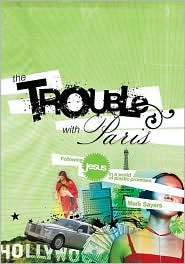
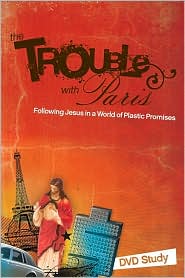
twp.JPGI raced through a book recently which I could hardly put down—it would make an ideal study for a young adult group, a culturally interested adult ed class, or a book to work through with a young person interested in popular culture.  Anyone who knows that it is important to study our social context—or, perhaps, those that don’t–should be aware of this fun and interesting, alarming yet hopeful new book, The Trouble With Paris: Following Jesus in a World of Plastic Promises by Mark Sayers (Nelson; $14.99.)  It is fabulous, and that’s no hype.

It might not be fully fair or adequate to describe the book as obliquely asking about the relationship between the high culture of Paris, France, and the high living of Paris Hilton; it is more generally about ultra-hip postmodern culture and the downward spiral of a life that buys into the superficial pleasures of Hollywood endings and media-promoted consumerism but ends with very little authenticity or joy. So forget Paris, it is about Yourtown, USA, Mytown, PA; it is about you and me and nearly every single young person you know.  From our obsessions with reality TV to internet addictions, from media-drenched teenage materialists to aging boomers thinking of church leadership in terms of celebrity, from the glamour of magazine ads to the impact of photo-shopping and computer-enhanced images, we are all stuck in a world that is, if I may use the old fashioned Christian word laden with negative connotations, worldly.  And, ironically, increasingly surreal, what Sayers called hyper-real. 

Mark Sayers isn’t a curmudgeon or naysayer, though, nor is he an overly pious prude.  He’s taken with the joys and blessings of pop culture, aware of ways modern technologies and contemporary trends have enhanced our lives.  Still, he’s a cultural critic of the first order, well-read in everything from Postman to Baudrillard, citing Vincent Miller and John Kavanaugh against consumerism and David Myers and Barney Schwartz on the paradoxes of choice.  How many evangelical authors cite Jurgen Moltmann and John Piper, Jeremy Rifkin and Julian of Norwich, Ravi Zacharias and Leslie Newbigin ?  How many postmodern scholars cite Zygmunt Bauman and Abraham Heschel? 

Which is to say not only is this a culturally aware work, a well-written, interesting and fresh look at the “plastic promises” of this Paris propensity (sorry) but it is theologically rich, Biblically grounded, evangelically spirited.  It isn’t just a jeremiad against 21st century forms of hot-wired worldliness, but is a sophisticated and insightful exploration of how such hyper-reality erodes real life, distorts our views of ourselves, even distorts faith itself. Sayers is Australian, friends with Alan Hirsch (The Forgotten Ways) and the Red Network.  He is missional, creative, energetic, wholisitic—the big ending to this, the last few chapters, are about living redemptively in the real world in ways that I believe are really right on, down to Earth, thank God!  It is to the books credit that its solid call for embodied whole-life discipleship is the sort that has garnered rave reviews from Gregory Laughery, a thoughtful teacher at the Swiss L’Abri (and author of the fabulous Living Spirituality), from social activist Shane Claiborne and Presbyterian pastor/writer John Ortberg.

The Trouble With Paris
by Mark Sayers is a very approachable and interesting study of the false realities of our age;  indeed, it exposes how we’ve been ripped off by our culture’s version of reality.  The reign of God, living faithfully in a human and humane way in God’s good creation, under Christ’s Lordship, finding spiritual presence in the midst of the ordinary real, is the Biblical antidote to the trap of the sexualized, slick version of a hyper-reality offered by Paris et al.

trouble with paris DVD.JPGIt wouldn’t be a hip and user-friendly text, though, if it didn’t have a multi-media component, so, happily, there is a 4-week DVD curriculum that we also stock, making it (I’m smiling a bit as I write this) a subversive use of the electronic media for saner, wiser purposes.  Check out the very active Paris website, and grab a few clips to see if it might be useful for you or your group.   It sells for $39.99 and there are extra participants guides available as well which will walk you into the trouble, and serve as a guide to a way through to the really really.  A few groups that have used it and have written on line have suggested it is a great conversation starter, stimulating reflection and well worth the cost.
 

BLOG SPECIAL
Trouble With Paris
Regularly $14.95
$10.00
ORDER HERE

Hearts & Minds 234 East Main Street  Dallastown, PA  17313   


Three rare, exceptional, recordings: Life is More, Songs for a Revolution of Hope and Heaven in a Nightclub

Ethan B.jpgLife Is More
5n2

I don’t know exactly when it happened for us, but a creative, thoughtful and very friendly youth leader in Missouri became a friend of Hearts & Minds.  Ethan Bryan calls to check up on us, chats with our staff, prays for our family.  Significantly, it seems, he asks us what books he should be reading, and pays close attention to my BookNotes blog reviews.

I don’t know exactly when it happened for him, but this creative, thoughtful, and very curious follower of Christ, who also happens to be a church staff member doing youth work and leading worship, became more intentional about relating his seminary training, youth min experience and Hearts & Minds reading regimen to his deepened discipleship, his work and ministry, especially around issues of social concern and public justice.  He seems to have ramped up his faith and fidelity, taking risks in joy and hope and contagiously getting others to join in.

You might imagine—if you’ve walked this road at all—that Ethan’s zealous (if gentle and kindly) proclamations of the holistic Lordship of Christ and the creation-wide politics of Jesus brought him renewed energy for sermons, Bible studies, prayerfulness, mission trips and service projects within the context of his own discipleship and his work in disciple-making.  He redoubled his work to make clear Christ’s call to resist the idols of the culture of materialism and invited others to be involved in social service and public protest.  He was starting to form the character and concerns of his youth and those with whom he worshipped into agents of social transformation.  Reading Shane Claiborne (The Irresistible Revolution, Jesus for President) and Walsh & Keesmat (Colossians Remixed) Ron Sider and Gary Haugen, he increasingly found his ministry moving in new directions.  He mentored teens in their efforts to aid the homeless, raised money for a local shelter.  He worked with a very, very sharp young gal who started her own organization to work against sexual slavery a la Loose Change to Loosen Chains (watch out Zach Hunter!  Sally Rymer’s Clapham Sect: Phase II for student abolitionists is pretty great.)  Ethan was kept up at night with tears for the outcast, struggled with matters of personal integrity—how to move downwardly mobile when one has huge higher education debt?  What does it look like to be a suburbanite if God’s intentions for the outcasts are your dream? How do we balance the pastoral and prophetic, in our own lives, and in youth work?  How can we be outspoken leaders and yet remain truly humble?

And, as you might also imagine, there have been some criticisms.  Why does he teach the youth this stuff?  Is this safe?  Why be so critical of the American way of life?  Is being anti-war really part of the gospel of Christ?  And, of course, these concerns are taken to heart, weighed and pondered; as any of us who have heard such remarks know, it is draining thinking it all through.  I don’t know if I sent it to him, but others taking similar halting steps towards the poor, from evangelical backgrounds that may not have opened up the Biblical teaching of social justice and political advocacy, are described in Justice in the ‘Burbs by Will and Lisa Sampson.  It helps tell the story, would be a great ally for your journey.  Our new mail-order pal could have been a character in that book.

With steadfast gentleness he and his wife are raising their daughters to be kids who care about their world.  He and his wife and youth group aren’t described in Tom Sine’s The New Conspirators: Creating the Future One Mustard Seed at a Time, Tom’s recent collection of fabulous examples of all kinds of new ministries, new communities and new visions, but they could be. Again, Ethan isn’t alone–there is a movement among the younger generations, a global story of church renewal linked to cultural awareness and social change;  it is a story Sine tells well.  As I write, I’m looking at a lovely drawing Ethan’s very young child did for us, a crayon drawing of what she imagines our bookstore is like (she knows her daddy orders books from us, books like the one by Tom Sine that her family could well be in!).  Other pictures she sold at a showing at their local coffeeshop to raise funds for the needy.  What a fun family to know—new conspirators, indeed!

* * *

I tell you all this so you might pray for us as we try to nurture and influence customers who become friends, readers who become leaders.  And that you, too, might be inspired to continue to ponder in real terms how to creatively live out the ideas and challenges in the books you read.  Knowledge can puff up, the Bible says, and as booksellers we worry, on occasion, if we are just adding to the “words, words, words” problem of a culture weighed down with information overload.  My friend Steve Garber’s fine book The Fabric of Faithfulness: Weaving Together Belief and Behavior comes to mind as the best book on this very matter; how does one learn in such a way as to live what one believes, to nurture a worldview as a way of life, for life?  Or, Dennis Hollinger’s fabulous Head, Heart, Hands: Bringing Together Christian Thought, Passion and Action, which asks how discipleship in the ways of Christlikeness is actually formed.  It is, of course, multi-faceted: a matter at least of content and knowledge, affections and feelings, and actual living and doing.  That is surely one of the most holistic views of faithful learning we’ve seen, and it reminds us to pray for our customers, that they might feel deeply and live faithfully the ideas that they learn in the books we sell.  Watching our friend Ethan from a distance and his leadership in the areas of social concern has been a real privilege as a bookseller.

* * *
life is more.jpgI tell you this, though, for another big reason (finally, the big point): Ethan has released an album of folk-pop songs that have emerged from his journey.  We are pleased to tell you about it, ask that you consider buying it (we’ve got to help him recoup the dough spent in this risky step of audacious faithfulness.)  He really felt God calling to do this, his first recording ever, and it seems to be a Spirit-led event.  He has released this new CD with some of his musician friends, under the mysterious name 5n2.  The album is called Life Is More.  You can visit their website, here.

Life is More is, for starters, one of the most interesting contemporary Christian music concepts in quite a while.  Each song on the CD is inspired by (if not exactly about) a certain ministry/cause/project which Ethan and his youth support.  Any monies raised by selling this disc will support these agencies and the CD liner notes point listeners to the issues and groups behind each song.  What a great idea!

If one is attentive to books like, say, Colossians Remixed: Subverting the Empire you can see the ideas in the songs of Life is More.  The idea that we are to bear the image of God, resto
red to us in Christ, is a theologically underpinning of Ethan’s critique of the ubiquity of corporate branding and the sweatshop economy that supports many multi-national products and their ads.  One doesn’t have to read the anti-globalization handbook No Logo or Sam Van Eman’s Christian critique of advertising, On Earth as it Is In Advertising: Moving from Commercial Hype to Gospel Hope to understand the first line of the first song:

I will not your billboard be
Carbon-based commodity
Spinning myths, consuming greed
Oh, I will not your billboard be
Walking ads for all to see

That song alone is worth the price of the recording, if you want to discuss this kind of stuff with a small group, especially a youth group.

Okay, though, let’s say it: I think the line “I will not your billboard be” is clumsy, cheesy even, although my very literate 25 year old disagrees.  The poetic quality of some of these lyrics is a touch sophomoric. Perhaps that is perfect for, uh, sophomores.  (He’s a youth worship leader, recall.)

Life Is More is not great, amazing art; the poetry will not endure like Dylan, Bob or Jacob.  He’s no Bruce Cockburn, he doesn’t turn a phrase like Rich Mullins or Derek Webb, even.

Still.  Life is More is full of heart, big, big heart.  Recorded on a very low budget, raised from friends, it exudes the real indie spirit—not the ultra cool, hipster vibe that corporate media now calls indie.  This is indie, as in no label, truly independent, nearly homemade, indie as in indigenous.  These are songs that emerge from the socio-political and spiritual journey of a local church slowly joining the irresistible revolution.  Cut him a big ‘ol break if it ain’t Bono or Bruce Springsteen.  Nonetheless, this, dear readers, is the real thing, a young musician pouring his heart out doing songs that matter.

Here’s what also marks Life Is More as a real gift to any of us wanting to explore holistic servant faith: there is a free book that comes with the CD which includes a meditation study that explores the themes of each song, a really good Bible study (using The Message and inviting a missional interpretation) and fabulous discussion questions.  This booklet turns a heart felt, social justice-oriented, low-fi, and oh-so-sincere record into a great ministry resource.  Play any song on this disc, do the study, and then pray and think and talk your way into new levels of awareness, care, conviction, and action.  “Head, Heart and Hands” indeed.  Ethan Bryan is a very gifted writer; his powerful stories in the booklet and the specific missional options for involvement are truly top-notch.  (YS, Group, are you listening?)

I’ve suggested that not every song is as artistically rich as many singer-songwriters working these days; it isn’t Iron & Wine or Bill Mallonee.  Yet, there are many wonderful lines, well-developed images, allusive ideas.  It feels very earnest, but not like propaganda.  Lines like “another world is whispering still” linger.  He sings that we are “putting on shoes before God” and it didn’t hit me at first what a reversal of images this is of Moses and the burning bush.  Wow.  Let that one cause you to ponder…

The CD is never mean-spirited or harsh, but it does have a bit of a bite (although not as much as you might think, given how it has been described and its raison d’etre.)  “Jesus of America” mocks the shallow and self-absorbed subculture of American evangelicalism, complete with jabs at praying for parking places, Christ as buddy, and dumb Christian T-shirts (and the commercialization in Christian bookstores!)  And then, this:

Heard he was homeless so we built him a home
Now we can keep him there, everyone knows
He’s got his time and place, when we choose to go
Come follow Jesus of America

Not all of the songs are about social justice or political themes, although several are.  Perhaps the strongest song on the album, with gorgeous, masterful, violin and a haunting female vocalist, is the third track.  One of the agencies/movements he promotes is To Write Love On Her Arm.  You may know the story–just hearing it again often brings tears.  A teen gal who had been cutting herself had a friend write the word “love” on her arm to remind her that she was cared for by others when she was tempted to hurt herself.  The movement—writing love on the skin of a friend who is hurting —has caught on as one small, tender response to cutting, and the movement’s website is powerful.  5n2’s song “Falling” has double meaning: as a song about depression that is a lament, this is a crying out about falling deeper into sadness—“worn out from weeping.”  Yet, the song is finally a witness to hope, “falling in mercy.”  Few CCM hits or worship songs offer contemporary laments.  When 20% of teens will suffer from depression before adulthood and untreated anguish is increasingly manifest in cutting and self-injury, we desperately need songs like this.  If you work with youth, play this song for them, visit www.twloha.com.  It will be an important experience and generate healing conversations, I am sure. 

From Jars of Clay’s spectacular Blood: Water Mission to the very useful www.NoSweatShop.com to the Not for Sale campaign, (based on David Batstone’s excellent and powerfully readable book, Not for Sale) to their support of a local transitional housing ministry (Hillcrest, in Independence MO, has won a “best practices” award from the National Alliance to End Homelessness) Ethan and his gang have chosen to highlight some very great organizations.  Life is More points people in fun, musical ways, to ministries that matter, causes which need our advocacy, and a zealous faith that is honest, true, active and alive. 

The music includes some strong, if basic, guitar strumming, a bit of finger-picking, lots of lovely violin, very strong female voices on several tunes, various male singers, usually Ethan.  There is a nice mix of slower ballads and a few feisty upbeat songs with loud drums.  A few could be learned and sung in your youth group, college fellowship or contemporary church settings.  Life is More is not a spectacularly sophisticated release and therein lies its greatest strength: it is authentic, real, indigenous.  God is alive in the community that is served by this fine “fool”, as he likes calling himself.  It comes from a real place, reflects the struggles of a real community, invites us to imagine a better world, shaped by the yearning heart of an innovative and prophetic youth worker and worship leader.  A youth leader and worship leader that reads good books, writes good songs, offers good gifts to the movement of those who are trying to live out the fullness of a subversive, informed, socially-active Kingdom vision. 

I hope you buy Life Is More now, the CD with the free comb-binding study booklet.  Some day, you may hear it again, perhaps recorded with God’s limitless budget, or sung live, with an angel band, in the New Earth, when the tears from these injustices are wiped away.  We may look back in the Kingdom Hall of Fame and remember this little gang from the US mid-West who once gave us this great gift when it was so needed.  This is surely the wind of heaven, the stuff of Earth.  Only $10; study guide included.
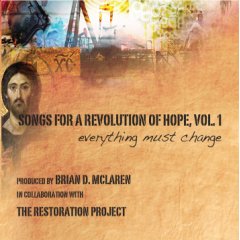

songs for a revolution of hope.jpgSongs for a Revolution of Hope: Everything Must Change
Brian McLaren, The Restoration Project & friends

A few years ago, emergent leader and thoughtful theologian and writer Brian McLaren pondered the state of much of contemporary Christian music, especially the praise and worship stuff.  Much is okay, perhaps more than some realize, but it is well known that much is overly sentimental, terribly individualistic, nurturing a passion for some glorious experience of God, without the Biblically-required response of sacrificial service, missional engagement, commitment to culturally reformation.  Brian wrote an open letter to contemporary Christian artists, inviting conversation around themes of new music, good hymnody, seeker songs and songs for an open-ended journey.  The letter, originally published in Worship Leader magazine, encouraged singer-songwriters and worship leaders to create stuff for our listening pleasure and liturgical use, especially as the emergent conversation was increasingly calling for communities who cared about social justice, peacemaking, global concerns.

Many of us, including we here, have been saying this for years.  You may know of my own deep appreciation for the old hymns done anew by Indelible Grace and it is hard to beat the folkie Americana groove of these old Puritan lyrics.  We love stocking and selling ’em, as well as the solo ones by Matthew Smith, their frontman.  As solid and heartfelt as these recordings are, though, rooting listeners (and congregations who use them in public worship) in solid theology, include a space for grief and expression for lament, even these marvelous CDs fail to lead us much into the public ministries of human rights, creation-care, the contemporary struggles for peace and social justice.  There is no doubt that we need worship songs that are Biblically faithful, robust, artful.  And that help us sing together about the concerns of the 21st century.  Brian was right on in his gentle rebuke and his generous invitation to work on this.  He reports that he started hearing from worship song leaders from all over the world.

As you may know, McLaren wrote an book called  Everything Must Change which carried the thrilling subtitle of Jesus, Global Crisis, and a Revolution of Hope which is now happily out in paperback!   Informed by his work in Africa, his long standing concerns about creation care, his reading of thoughtful social ethics and analysis of ideology such as that done by neo-Calvinist economist Bob Goudzwaard, and his friendship with Sojourners leader Jim Wallis, and Red Letter Christian Tony Campolo,  McLaren asks, in EMC,  the biggest questions about our time and ponders a faithfully Biblical, Christian response.  We liked the book quite a lot and have been eagerly promoting it as best we can.  Not everyone who has followed the postmodern turn and the emergent movement’s call to reach out to younger, disaffected post-evangelicals have followed Brian in this shift to post-colonial, Kingdom thinking.  Still, it is clear that this conversation about global concerns is central to our time.  His book captured much about the issues of the day and how a Biblically faithful view of the Risen Christ can help free us from the principalities and powers (he calls it a “suicide machine”) and empower us to frame a new story as we work to bring God’s shalom in the face it all.

Thank God for Tracy Howe (of The Restoration Project) and others who took Brian’s call to new music seriously, who partnered with him, then, to create essentially a soundtrack for the book Everything Must Change.  Sung together in his DeepShift EMC tour, the recent album Songs for a Revolution of Hope was written and preformed collaboratively, although is seems that Brian wrote most of the lyrics.  (Did you know he cut an album or two of early CCM back in the 70’s?  No wonder he quotes such good music, like Bruce Cockburn, in most of his books—he is a guitar player and singer-songwriter himself!)

Songs for a Revolution of Hope is a recording that I love.  I have found a few friends that don’t “get it” but I wonder if it is because they don’t quite feel the urgency of the need for new songs, deeper lyrics, songs that address the politics, economics, struggles (personal and social) of our day.  That is, their disinterest in the songs may be connected to their disinterest in the topics, which, of course, is rooted in their mis-reading of the Bible.  Like Ethan Bryan discovered, who I describe in the earlier review, and his Life Is More album, when one reads McLaren and Jim Wallis, Bob Goudzwaard and Brian Walsh and Sylvia Keesmaat, Desmond Tutu or Wendell Berry, when one “gets” the implications of N.T. Wright’s (and others) understanding of the new creation being birthed in the here and now as Christ’s people serve as salt and light, as we think through the big issues of the day and realize the ways in which Christ’s Kingdom subverts the empires and ideologies of our modern era, we will rediscover in the Bible quite a new worldview. As Brian Mc puts it, we will see a new framing narrative.  If we are living within, and out of, that new narrative, that Biblical story, we will need new songs to inspire and give poetic voice to our new yearnings and new visions of transformational ministry.

And so, Songs for a Revolution of Hope is an album full of confessions, laments, songs of political concern, structural change, poems about creation, about joy and pain and hope.  There are a few tunes to words written in the middle ages (lyrics by Julian of Norwich, for instance, and a great rendering of a classic Saint Francis prayer about creation, with feisty nylon string guitar-work.)  A few are nearly spoken word pieces (think middle-era Bruce Cockburn) and a few are rip-roaring country-folk with rowdy harmonica.  Songs of praise include absolutely orthodox Christology, Trinitarian understandings of God, but are set in the context of our human joys, a good creation tarnished by greed, the call to be new kinds of people.  It is hard to describe this blend of chants and choruses and worshipful ballads, shaped, as they are, by the full-orbed Kingdom dreams of Brian and his musical gang, plotting goodness, as they say.  Check out the chord charts, licensing, and other information at www.songsforarevolutionofhope.com.  Learn the songs that cry out the themes of Micah 6:8 or the one that has the powerful ending of multiple voices crying “let your Kingdom come!”   Have fun with “Today” or use “Let’s Confess It” as a creative liturgical confession of sin.

There are criticisms I could make—the Gregorian-like chant used on one song (“Chant”) sounds ethereal and otherworldly and while I suppose I appreciate this nod to tradition, to use that styling for an anti-Gnostic hymn like Colossians 1 seems to distract from the this-worldly power of that wonderful ancient Scripture.  One song verges on agit-prop when it talks about greedy businessmen and politicians who lie to stay in power, as if they all do.  Such cheesy lefty stuff is well intentioned but pate
ntly unhelpful.  (And pu-lease, what is that line in an otherwise gorgeous song, about us being agents of progress?  Progress?  Why not substitute healing, or shalom, or goodness, but anyone who studies the framing narrative of the “suicide machine” knows that from the Enlightenment on, and perhaps before, “progress” was code for humanistic mastery over creation, materialistic, anti-Christian autonomy.  Nowadays, it is the mantra of the neo-cons and the cheerleaders for urban sprawl.)

Still, we can take a few sour notes in an experimental, vital, musically interesting, (and lengthy) recording full of relevant (postmodern?) praise and holistic spiritual yearnings. Half of the CCM-produced corporate worship albums have ridiculous lines, stuff that when we sing it in church I say to myself, “well, I just don’t even believe that.”  Or I hold my nose thinking it means well, but still smells funny.   I do like some of the best of some of the new worship leaders; I love Delirious, for instance, and of course David Crowder; Charlie Hall has some pretty holistic stuff;  I know some folks who really like the new Tommy Walker.  The mellow me likes the new Michael Card collection of old hymns.  But none of those artists are thinking much about social justice, few confess the sins of complicity with a broken social scene.  Songs for a Revolution of Hope with its jazzy moments, its flaming mandolin and occasional fiddle, its spoken word edginess, is the kind of album that, if you let it grow on you, can become a soundtrack to living into the new world Christ is birthing in our midst.

 Like it all or not, this is a must-have for anybody thinking about the role of music in the emergent churches, or how awareness of embodied justice-seeking spirituality can be integrated into contemporary worship music.  Tracy Howe is a true collaborator with Brian on this; she has traveled in the hipster tribal scene like the Enter the Worship Circle folks, knows the rowdy, political band The Psalters and sometimes works with her pals at The Cobalt Season.  Her own records can be found at The Restoration Project.  She, Latino musicians April and Nuc Vega, Harp 46 and a handful of other friends of McLaren are to be thanked and supported for making this experimental project available.  We happily endorse it, highly recommend it.  Please let us know if you want to order some—we have a bunch.  $15
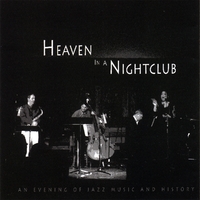
heaven in a nightclup.jpgHeaven in a Nightclub 
William Edgar, Ruth Naomi Floyd, John Patitucci & friends

I have been wanting to tell about this amazing recording for months now, and have simply not felt capable. The live recording Heaven in a NightClub was the brainchild of Hearts & Minds friend Karl Johnson, director of Ithaca’s Chesterton House, a collegiate study center on the campus of Cornell.  It was Karl’s dream to put together an evening of serious jazz performance in a classy New York city club, complete with some conversations about the meaning of it all, set in the (largely unspoken, but hinted at) context of a reformed Biblical worldview, the show illustrating the call to be culture-makers and culture-redeemers.  The vision was amazing, really;  solid and something with which we, here, of course, would resonate.  That we were asked to sell books at the concert made it, well, heaven in a nightclub.  What a gig.

The evening went off flawlessly; the hall was splendid, the acoustics rich, folks of all kinds showed up, music was played, God was honored.  What some don’t know, though, was that the whole evening was recorded, and a flawless double disc has been released by the Chesteron House.  It is a fund-raiser for their Christian study center there at Cornell, and is a great example of the kind of thoughtful elan that Karl represents.  Thanks be to God.

Here’s what I can tell you.  The host for the evening (who does not appear on the album) was Andy Crouch, whose wonderful, important, if a bit controversial, hardcover book, Culture-Making: Recovering Our Creative Calling will come out in the summer of ’08 on InterVarsity Press.  (As a classical pianist himself, Andy was a great emcee, even a bit of a symbol for those with eyes to see, of the evening’s overall hopes and perspective.  Doing this kind of stuff—hosting an informative jazz show in Christ’s name–is part of what we the people of God should be about!)

The main jazzman pianist for the show was Westminster Seminary professor, writer, theologian, and cultural critic, Dr. William Edgar.  Anyone who has heard Bill lecture–say, at the annual Jonathan Edwards Institute conferences—-know that he plays a very mean piano, all styles, but mostly jazz, ragtime, blues, stride, and such.  Man, can that guy play; he insists it is most a hobby, an avocation for a stuffy Calvinist seminary prof.  Well, he sure tickles the ivories like a master, and his knowledge of the music, its heart and soul, gives him an extra bit of insight: I am confident that Bill knows and feels what this music is about.  He is talented with the chops, and he is solidly immersed in the story the music tells, the story of which it is a part.  That came out just remarkably as he explains the songs, tells anecdotes to introduce them, reminds the listeners of the point of jazz, gospel, blues.  A-men.  As the amazing book by Dr. Jeremy Begbie puts it, this is Resounding Truth: Christian Wisdom in the World of Music.  The weighty and beautiful book, by the way, cites Bill Edgar.

The bass player for the evening was the world-renowned, Grammy-award winning John Patitucci.  Anybody who follows instrumental music or the contemporary jazz scene knows Patitucci.  (That he is a PCA deacon may not be as well known…his pastor is a Hearts & Minds friend so we feel somehow distantly connected ourselves, happy to know this famous artist is a brother in Christ.)  I clearly am not a jazz connoisseur, and am even less aware of the intricacies of the electric or upright bass; I might even admit I’m not fond of any overstatement of the instrument.  But holy moly, when Edgar sets him up for his requisite solo, he just blazes, just plays the most amazing dark and smooth and deep notes.  The audience was stunned, and broke into spontaneous applause that honored this amazing virtuoso.  When Bill jams around the Westminster café, I bet he doesn’t have that kind of award-winning bassist with him.  It makes for a very cool album, with some really, really deep grooves.

Edgar’s jazz improvisations do, though, often have an absolutely stunning female vocalist with him, and the renowned Ruth Naomi Floyd traveled with him to perform in the Heaven in a Nightclub show.  They play together often in the Philly area, and Ms Floyd is very highly regarded as one of the best jazz singers of our time.  In NYC, when she sang, they mostly did jazzed-up versions of old black spirituals.  As Edgar explained the context and importance of these songs, briefly, he sounded like some brilliant Reformed griot, talking of common grace and black theology, drawing on insights as deep as James Wendell Johnson or his contemporary friend Carl Ellis, author of Free at Last?.  Edgar explained the hidden anti-slavery and deeply spiritual meanings of many of the old  tunes, and showed how, in reworking them into a jazz setting, th
ey kept the freedom story alive.  With Ruth belting, breathy and low at times, full-throated obbligato in high register, yet again, scat singing all over the charts, she stole the show.  To hear this African American treasure singing with Dr. Edgar, Christian author and theologian, jamming the keys to keep up, my, oh my, oh my.

Of course there was a sax player—-and what a jazz player he is! Joe Salzano is apparently highly regarded, hails from the old school jazz scene in Rochester, and has played with tons of famous headliners (like Joe Sample!) Man, the cat did some serious blowing. (I’m trying to sound like I know what I’m talkin’ about here…it’s a stretch, I admit, but I’m tellin’ ya the dude testified on that thing.)  I cannot presume to tell you what was good about his horn work, only that it was powerful and an excellent edition to the combo (it was not in the foreground, usually, though, and a bit understated, I think.)  Salzano has quite a testimony, himself, and was a vital part of the event.

Heaven in a Nightclub is a rare recording of a rare summer evening, educational, inspiring, and tons of fun—it moved some tears and was called “beyond spectacular” by one participant.  If you don’t like jazz much, or don’t own much traditional African American music (older spirituals, say) this is a must-have addition for a well-balanced CD collection.  If you just want to be blown away by God’s presence in a jazzy show, if you like the idea of relating faith and the arts, if you want to support even the idea of this great project, please order one.  I am confident it will be a blessing to somebody you know, and a good and faithful witness, a great piece of collaboration and improvisation.  Not a bad theme for a project that implies that one can find God’s sacred presence, yes, even in a New York nightclub, eh?  $24.99 (double CD)

A final, sad note (not an inappropriate closing remark for a recording that traces the sad history of African Americans and the role of blues and jazz.  The album is dedicated to a dear friend of ours, a good colleague of Chesterton House, Christian Anible, who died last year of cancer.  Christian worked in ministry with grad students and faculty at Cornell, was a guitarist himself, a rare PCA peace activist.  Many miss him, and the last time he and I spoke, we talked about this upcoming project.  I am glad that his name is mentioned in the liner notes.)  The proceeds carry on the work of the Chesterton House, their new collaboration with the CCO, and, in this way, carries on the spirit of Christian’s work.  Thanks.