Everything Must Change tour and We The Purple

Greetings to new readers of BookNotes visiting from the recent Everything Must Change/DeepShift event with BrianEverything Must Change (smaller cover).jpg McLaren in DC.  We have been grateful to be the EMC tour official bookstore as we’ve shipped stuff all of the land, offering Brian’s books and other resources for those who are exploring the most urgent issues of our time at the series of DeepShift conferences.  As I’ve said here before, Everything Must Change: Jesus, Global Crisis and a Revolution of Hope (published by Nelson; $21.99) is a notable and important shift for Brian as he spends less time making a case for being a “new kind of Christian” or finding ourselves seeking a “church on the other side” —the whole postmodern, emergent conversation—but rather, inviting imagination and hope and action in light of the pressing global concerns of sustainability, climate change, poverty and war. From mountain-top removal in Appalachia to the ways in which South Africa found new vision while overthrowing the old apartheid era, from churches that reach out to the homeless poor to the crisis of international security, war and nationalism, we grappled with big, big concerns in a spirit of collegiality and, more importantly, spirituality. 

Those that know us here at the bookstore know that we have long carried the best Christian (and some Jewish and secular) resources on global issues, as wholistic mission and faith-based social action has always been a feature of our shop.  It is no accident that alongside our fairly traditional (some say conservative) historic Biblical theology and classic spiritual formation books we have long carried books by William Stringfellow and Ron Sider, by Phil Berrigan and Rachael Carson, John Stott and Rene Padilla, John Perkins and Dorothy Soelle, Martin Luther King and Marva Dawn, Jonathan Kozol and Tom Sine, John Howard Yoder and Dorothy Day, Richard Mouw and Thomas Merton, just to name a few.  Brian is not the first to say that the framing stories that shape our worldviews, and consequently our ways of living in the world—-caring or not caring about the burning issues of the day—are the most important thing to get right. (I still say that Brian Walsh & Richard Middleton’s worldview masterpiece, Transforming Vision is one of the most important books in our shop; McLaren, happily, draws upon Walsh & Keesmaat’s Colossians Remixed to show the kinds of transformational Biblical study that can guide us into this kind of radically Biblical change.) Indeed, we often call ourselves radical Christians, not to suggest revolutionary fever or lefty politics; not at all, really.  Radix is the Latin root word from which “radical” derives and it means “root.”  We need to get at the root causes, the deepest ideologies which shape the current ways of understanding and being in the world. (The emergent gang is mostly right about this, that the Christian faith ought not be uncritically wedded to a modernist worldview, and that radical rethinking is needed to disentangle centuries of cultural capitulation to the spirits of the Enlightenment et al. I suspect it was Francis Schaeffer that first taught me that.)  As McLaren suggests in Everything Must Change, we must “wake up” to new dreams of what God is doing in the world, and think considerably differently, “singing a new song” into the new world God is ushering into history.  We call that—as he explicates nicely in The Secret Message of Jesus–the Kingdom of God.  And so, we just came back from a nice witness to the Kingdom, an experience of the Kingdom, a gathering of various ages, diverse denominations, conflicting theologies and different preferences for worship and liturgical styles, even, I’d imagine, different impulses around politics and public policy proposals.  Praise be to God, Nazarenes and Episcopalians, Methodists and PCA Presbyterians, Baptists and Lutherans (though not many historic black churches represented, or Catholics, it seemed) joined together to reflect on the deepest issues of our cultural crisis and what King Jesus might want us to do.  It was a precious time, a joyful time, if a difficult time of selling books (yes, amidst illness, again.)  Many, many thanks to our stalwart volunteers from Vienna Pres and the CCO, especially.

The tour moves on to other cities over the next month or so. Check out the DeepShift schedule and make plans to be a part of a very exciting, well planned, and multi-faceted experience of song, art, lecture, conversation, silence, worship, meals and book-buying.  Yes, indeedie:  buying books is part of the way to wake up to a new world.  We’ve got a lot of ideas to consider, plans to make, lives to change (starting, of course, with our own.)  Books are allies in the journey, food for the day,  insight for new living.  Thanks for your support of our store, for you interest in good books. Buying books from us, here, enables us to stay afloat long enough to continue serving these kinds of conferences and folks on deep in the trenches of important work.  We are glad to be able to serve them, and you help make it possible.  We are grateful for your ongoing support.

The biggest selling books (other than McLaren’s) at the EMC DeepShift event? Clearly Claiborne’s Jesus for President (the amazing graphic designers of the book, Ryan and Holly Sharp, were there, doing music as the Cobalt Season and it was terrific to meet them.) Many took up my recommendation of the serious-minded and richly provocative Hope in Troubled Times by Mark Vander Vennen, Bob Goudzwaard & David Van Heemst.  I promoted Os Guinness’ The Case for Civility, and it seemed useful to many.  A handful of people bought Scot McKnight’s Community of  Atonement, a balanced and wise bit of refreshing theological thinking, which made me glad.  A few people got John Caputo’s What Would Jesus Deconstruct?, which I found a bit troubling, although I loved Jamie Smith’s earlier book in the series, Whose Afraid of Postmodernism: Taking Derrida, Lyotard & Foucoult to Church, so sold that to ’em too.

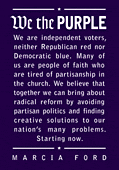
we the purple.gifA book that arrived today that I really wished I could have taken there: We the Purple by Marcia Ford (Tyndale; $17.99.)  I am not sure I am purple, exactly–a blend of red and blue, obviously, and I sometimes think I’m a completely different color—but it does capture something, doesn’t it?   The cover itself looks like a manifesto.  It makes the case, obviously, for independent voters, stating on the cover that it is about people of faith “who are tired of partisanship in the church.  We believe that together we can bring about radical reform by avoiding partisan politics and finding creative solutions to our nation’s many problems.”   There are tons of stories, lots of interviews, profiles and testimonials of grassroots, truly  third way folk.  Looks good.

With similar concerns, although not quite the same strategy, my dear, dear friend, Steve Garber did a very important piece last summer for Comment, on not being cynical about “proximate justice.“  Alas, a good handful of folk, mostly younger, responded to his article in the latest issue, a symposium of responses.  I commend that to you.  If we are going to rock the worldviews, and rock the vote (or, as Shane puts it, vote the Rock) we will have to continue to think about all of this stuff.  Get McLaren’s book if you haven’t yet, start a small group around some of the political ones I reviewed last month at the website column, or check out this new independent voice—Ford is a fun writer, we know that from her lovely, poignant, Memoir of a Misfit.  It isn’t exactly the feisty brilliance of the smalltown anarchist Bill Kauffman (Look Homeward America) or the “crunchy con” of hippy conservatives like Ron Dreher, but it is a new voice, outside the bi-polar predictabilities of the religious right or the faith-based left.  As Becky Garrison (of The Wittenburg Door) puts it, “Marcia Ford employs sass, spirituality, and statistics to expose the failings of our current two-party system”¦”   Key Life preacher Steve Brown even says, “”¦Ford almost convinced me to give up my partisan political positions and join her.”  Maybe it is not quite radix enough, but it sure does make us think.  And laugh, which, as Brian reminded us at EMC, is a deep Christian virtue.

Hearts & Minds 234 East Main Street  Dallastown, PA  17313  717.246.3333   www.heartsandmindsbooks.com

New books on Christian faith and politics AND a free book offer

I hope you had the chance to visit our monthly column last month over at that part of the website.  I explore four  recent books on Christian politics, and how a balanced, Biblical agenda might shape the common good.  As you might guess, we described the new Jim Wallis, The Great Awakening (which is very much a sequel to his best-selling God’s Politics) and we celebrated the very thorough, and quite excellent new book by Ronald Sider, The Scandal of Evangelical Politics (the scandal being, that most evangelical political work hasn’t been adequately Biblical or all that evangelical.) I told about the excellent new book by Steve Monsma, Healing for a Broken World: Christian Perspectives on Public Policy.  And, perhaps most importantly, I review the very, very insightful work by Os Guinness, The Case for Civility: And Why Our Future Depends on It.

case for civility.jpgThis new Os Guinness book offers something that these other three do not, but without which none of them will leave much of a legacy, and that is the serious (if eloquent) reminder to respect our American first amendment, recapture the genius of the Founder’s balanced approach to religion and law, and to ever and always remain peaceable people, civil and fair, even in the most robust of public debate.  The first books are exciting explications of various aspects of Christian views on contemporary public life and how our citizenship can be shaped by the values and practices, principles and positions, of a Scripturally-based worldview.  Guinness, though, insists that we back up and shape and share these views in a manner that is in keeping with the best impulses of the American experiment (freedom for and from religion, for instance, pluralism without capitulation to relativism and such.)  More importantly, he calls us who are people of faith to work in ways that are in keeping with the graciousness of Christ Himself.  Please read my mini-reviews of these stellar books;  we are very, very impressed with them all.

justice rights and wrongs.jpgNone of these are really academic, but here is one that is.  Here is a quick announcement that a major Christian philosopher has released his major, long-awaited work on the theories of justice.  I refer to the Princeton University Press release, Justice: Rights and Wrongs by the impeccable and impressive Nicholas Wolterstorff. At $39.50 you may want to check it out of your local library—I know I will—but some of you should own it.  We are happy to stock it here, of course, and ask you to tell anyone you know who happens to be interested in deep and deeply Christian political philosophy (maybe they can order it from us, a just thing to do, I’d say, rather than going through the faceless carts at you-know-where.)  Aquinas/natural law scholar Jean Porter of University of Notre Dame writes, Justice is “the work of a first-rate philosopher at the top of his game” which “sets forth a distinctive and challenging theory of justice formulated in explicitly scriptural and Christian terms.”  She continues, “Not only does this book reflect the clarity and acuity of thought that characterize Wolterstorff’s work, it also reflects the humane sensibilities of someone who has thought and felt deeply about these matters for a long time.”

Here’s a blog special:  You may recall that our friends at *cino/catapult, Rob & Kirstin VanderDo Justice cover.jpg Giessen-Reitsma, have published what they call a “road journal,” a lovely small paperback with stories and testimonies, book lists and film reviews, which serves as a guided tour into the journey of justice.  (*cino publishes these from time to time; the next one forthcoming will be on food issues.)  Here’s the deal: buy any of the books just mentioned and we will give you a free copy of *cino’s Do Justice: A Social Justice Road Map (a $7.50 value.) 

New insight.  Free book.  Sounds like more than justice to me.

Order here.

or call 717.246.3333.

Hearts & Minds
234 East Main Street
Dallastown, PA  17313

Leonard Sweet, sailing inspired into The Perfect Storm, and uninspired macaroni salad

church of perfect storm.jpgThe other day, after days of pulling and packing (yet again) we lugged too many boxes over to a good and growing local church who was hosting a conference for Sunday school teachers, child-care workers and children’s ministry folks.  Setting up rows and rows of craft books, pre-school lesson plans, brightly colored children’s picture books, and, yes, some theology and worldviewish stuff (the foundations of thinking faithfully about children, education and church) took about 7 hours.  Exhausted from the stress of that, we hustled off to pull and pack the next gig, getting to another church late at night for the next day’s seminar with white-haired, silver-tongued pneuma-naut (his word), Leonard Sweet.  After the exhilarating day with Len at which I sold books, and the terrific and busy Christian ed conference over at Living Word Community Church, which Beth and her sister worked, I scooted back, helping them tear down, bringing everything from both shows back to the H&M garage.  We are, as is often the case, thrilled that folks buy our books, happy for the positive feedback, and always just a little sad that more people don’t take in learning events such as these, that the very best books don’t always sell as much as we would wish, and wonder how best to get the word out that there are amazing resources to be found, good books that can enhance one’s life, deepen one’s discipleship, and move us towards more faithful living in God’s good world.  Jesus called disciples, which, you know, means learners.  Life-long learners grow and mature in many ways, but surely reading widely and deeply, is part of that. Some churches become communities of bookish discourse, and some, sadly, do not.  Some people have a curiosity and eagerness to want to learn and grow, but some do not.   Thanks to those who help us get set up at these gigs, and thanks to those who pray and care, and thanks, especially, to those who purchased books from us.  We really hope it helps.

A custodian winked at us slyly late at night as we were slowly pushing the heavy carts full of boxes of unsold stuff back to our van.  He, too, was working the night shift and happy to be there, after the crowds left.  He said, “Beats cleaning up after macaroni salad.”  My blank stare tipped him off that I had no idea what he was talking about.

“Macaroni salad in the church basement,” he said (as if that cleared it up.)  He explained that in previous churches where he worked as janitor he had to clean up after events that, well, just didn’t seem to him to be that urgent. Just light little lunches.  “What war are they going to fight,” he asked, “after sitting around eating macaroni salad?”

I am a pacifist and rarely use such militaristic language, but he’s right that spiritual warfare is a theme of the Bible.  Or, we could say, using Blues Brother’s phrasing, that “We are on a mission from God!”  What battle, what race, what mission, what endeavors, emerge from low-expectation, boring church meetings, from gathering with little passion or point?  Of course, eating together is a hugely important Christian practice, and Jesus’ himself ate, if not macaroni salad, something like it, often with others, and the on-lookers complained.  But my late-night janitor buddy had seen what I am sure you have seen: a whole lot of church activity that doesn’t seem to motivate anyone to do much of anything.  He was right to observe that he and Beth and Debi and I were cleaning up after a day which mattered, equipping caring Sunday school leaders with passion and excellence, to care for babies and kids, children and youth.  All the work, before and after, is, we pray, a contribution to greater faithfulness, serious learning, equipping saints for making a difference. 

Len Sweet said that as a theologically-interested bookseller, I am like a dinosaur, like the last living turtle on Galapacos Island.  I don’t know about that, but I do know that we were the very first store in the world to get his brand spanking new book—shipped to us directly from the book bindery thanks to some magic worked by my friends at Abingdon Press.  The Church of the Perfect Storm is a Sweetly edited anthology of chapters on the rough waters of our times, the ways in which the church should and can ride into the storm, how to not only ride out the waves, but do effective ministry in these raging waters.  Sweet has played with this analogy often before (although it is out of print, we have some of his fascinating Aqua Church left) and his first chapter is wonderful introduction to his take on the times.)  The last chapter, by the way, is a great sermon on ways to react to wild waters of postmodernity and post-Christendom, chart notes for stormy seas.  As he often reminds us, the most dangerous place for boats during a storm is in the harbor.  We are called to launch out into the deep, knowing Christ is with us helping us enjoy the ride.

What battles are you equipped to fight, what races to run, what vocations to take up,  what storms to chase, after you gather with others? What conversations of what consequence occur?  What books will help you move towards your goals?  How do you trust the Spirit more fully as you are called forth to deep and raging waters, and what resources may help you through it all?  The busy crowds buying kids books this weekend at Living Word, and the exciting time with Len at Grace United Methodist, wore us out, but, as the late-night custodian reminded us, such events are as important as any war.

The Church of the Perfect Storm is edited by Leonard Sweet (Abingdon; $16.)  This includes essays from around the world—from the likes of Alan Jamieson (New Zealand), Greg Glatz (Canada) a South African, a South Korean, Bill Easum, Peter Walker and Mark Matterson, from the U.S., and Tom Bandy is Canadian.  This international view gives this collection a very broad weather report, although they all share Sweet’s penchant for the storm metaphor, for the urgency of taking up the 21st century hot-wired culture, and they each offer insight about how to do ministry in the world of complex and converging social trends.    Want to reorient your thinking into the new social context?  Want to leave “terra nova” behind and move out into stormy seas?  This new title could help.  He ends his acknowledgments with these lines from William Cowper (1731-1800.)

Ye fearful saints fresh courage take,
 the clouds ye so much dread
Are big with mercy and will break
In blessings on your head

Judge not the Lord by feeble sense,
But trust him for his grace;
Behind a frowning providence

He hides a smiling face.

Os Guinness reviews Crazy for God

I have said before that I try not to use this platform to just link you to other reviews on the web…there is so very much good stuff out there, that I could do that all the time.  I assume most BookNotes readers pay attention to reviews, thoughtful religious essays and cultural news, so I don’t need to alert you to every good thing that arrives each day.

Still, this week brought a book review and essay so urgent, so insightful, and so personally moving (for reasons that I trust will become clear) that I urge you to read it.  Our esteemed friend Os Guinness wrote a passionate and wise review of Frank Schaeffer’s anguished and anguishing memoir Crazy for God that appeared in Books & Culture.  He takes his old friend Franky to task for dishonoring Francis & Edith Schaeffer, (or here) for writing a book that is deeply dishonest and chastises reviewers who have applauded the books style without questioning its substance.
If you don’t subscribe to B&C read Guinness’ review here.

I hope I am not one of the reviewers that Dr. Guinness reprimands;  I wrote in my remarks that I found the book very disturbing and insisted that we must not presume that we know that he is telling the truth.  I wrote a “letter to the editor” in The Nation on-line that chastised that reviewer, a contemporary novelist,  for taking all of Frank’s claims as gospel (about L’Abri and about modern evangelicalism)  without using the reporter’s fair eye for ferreting out the truth.  Other reviews and readers have lamented the anger and weirdness of Frank talking about utterly personal things about his parents, but few questioned his veracity.

 I found Frank’s reflections on his early years often beautifully rendered (but not nearly as well written as the first reviewer in Books & Culture exclaimed, and, as I said in my review, the writing often devolved into shock tactics and the bluntly stated mediocre cliche.  More so, I wrote both publicly and privately that I had reasons to mistrust him (and that I written to his journal and his publishers nearly two decades ago in protest to what I then considered to be needlessly incendiary rhetoric and unfair criticism of anyone that disagreed with his far-right views.)  I have long lamented—and I know I am not alone—the shift in Francis Schaeffer’s tone and writing in the last years of his life; how he was co-opted by those who clearly did not understand his worldviewish take on cultural reformation.  Crazy for God shows how Franky–filled with what Guinness calls self-loathing—pushed and promoted his famous dad in that particular direction, arranging meetings with Falwell, Robertson, et al.  I found the book thrilling and fascinating at times, but shared considerable ambivalence about it.  Thanks for those who have written heart-felt notes (mostly off line) about their anguish, and their appreciation for the warning I give as we’ve sold the few we have.

I must say again, though, that I could hardly but the book down, although I had to catch my breath sometimes, reading portions aloud to my wife as we shook our heads, and, on more than one occasion, had to catch myself from weeping over the sadness of the whole affair.  We have read the Schaeffer’s own memoirs, letters, and other testimonials by those whose lives were impacted (as Os says, “without regret.”)  This was to be the “insiders” report and in many ways it was.  If only it was not so ugly, mean, and as Guinness explains, fundamentally wrong in attacking the truthfulness, faith and integrity of his famous parents.

Guinness gets it as right as I imagine we will.  It is the most important, perhaps the only really important, review that has yet been done. He was there, living with the Schaeffer’s and serving as one of Franky’s best older friends, even serving as best man at his wedding.  It has the ring of truth, and the passion of a great man of God, vindicating not the saintliness–not at all—but the truthfulness, of the famous leaders of L’Abri.  Beth and I commend it to you.

Heather King Redeemed At Last

Okay, I admit, it is a dumb joke.  Heather King’s new book, entitled Redeemed, is one I’ve waited for a long, longredeemed.jpg time.  It is here at last.  It is called Redeemed.  It is here at last. I guess you get it. Duh.

Which puts me into this quandary, one I face often here as the sole writer at BookNotes. We get a new book in, a book I am convinced is important and good and righteous.  Or interesting and provocative and fun.  Or (truth be told) one I’ve ordered a lot of and my business partner/dear wife wonders how in the world we are ever going to sell all those.  And so, I become, as I rather proudly said in a last week’s posting, one who “Hawks for the Kingdom.” 

I am aware—as one writer seriously poked at me this week—that I do not usually do what could be considered serious literary or theological review.  I am, in the technical sense, not a critic or a theologian.  (I do get pretty long-winded over at the monthly review column, though, and that almost counts, does it not?)  And so here, I announce.  I celebrate.  I promote.

I have not read Heather King’s Redeemed book yet.  I have worked 15 hours almost straight and have only indulged myself, while I was on hold on the phone, in peeking at the acknowledgments,  looking for someone I might know (the beginning of serious review, by the way, placing the thing—read Mortimer Adler if you don’t believe me.)  I did review (well, I commented upon briefly as I promoted) her wonderfully written and deeply moving book about her alcoholism, Parched, a year or so ago, and I know she is an honest, high-quality writer.  And–get this, if I might namedrop a bit—my pal Lauren Winner told me a bit ago that it was one of the best memoirs she ever read.  (Ahem: why she got an advanced reader’s copy but I didn’t is another matter, but I suspect the fine folks at Viking don’t know me much.)

Anyway, the quandary: wait until I have read much of it, perhaps weeks from now, so I can tell you the real truth, my own take, complete with astute observations, or rush to press and celebrate what I am confident will be worth any dollar you spend, even if I haven’t read it yet?  I’ve read advance comments, know the vibe, trust the woman, and have that to-die-for comment from Lauren.  So, I rush to press.  The faceless internet sites have it, and they squeeze off the Publisher’s Weekly reviews, so I don’t want to miss out.  This one will be so good that I want to be among the first to honor it with some kind of announcement.  Ladies and gentleman, friends of Hearts & Minds, please know that this may be the memoir of the year.   This is a beautiful book you’ll enjoy and which may edify.

The subtitle is A Spiritual Misfit Stumbles Toward God, Marginal Sanity, and the Peace That Passes All Understanding.   See yourself in there somewhere?

Still unsure? Listen to the extraordinary spirituality writer, Ronald Rolheiser, author of the truly great book about deep Christian formation, The Holy Longing, who says,

A story with depth, rare balance, humor, and with a near-perfect eye for what is important, true to the perception that ‘sin, degradation, and scandal aren’t that interesting,’ but ‘conversion is.’  A conversion story along the lines of St. Augustine’s classic.  You’ll learn how grace works.

You may know Ms King from her pieces on NPRs All Things Considered.  You may recall Parched.  Either way, you will not forgot this book.  Thanks for trusting us, for being a part of this circle of BookNote friends, who allow me the freedom to promote stuff I sometimes haven’t read yet.

By the way, an obscure little note for those paying close attention. I briefly raved in the last post about the incredible new Shane Claiborne book, Jesus for President, and promised a more thorough review soon.  My-oh -my, I can’t wait to explore the complexities and insights of that stunning new book—it’s amazing.  Here’s a little connection: Ms. King thanks in that one page I said I read, the Los Angeles Catholic Worker.  The LACW is perhaps the most interesting of all the Catholic Worker houses, with a graphically breath-taking, counter-cultural version of the Catholic Worker paper (called The Agitator) which I was quite taken with for a season or so of my journey. I would suggest that Shane & his co-author Chris Haw are the only authors on a CBA publishing house to cite friends at the LA Worker.  As does King.  See, even in my hawking new books, I’m trying to help make connections, make sense of stuff, place things, spread some mustard seeds, uniting readers of different sorts.  In moments like these, I love this job.

BLOG SPECIAL
Redeemed
regularly $24.95
now $19.95
ORDER HERE

Buy it from us here, now, with this promise.
 If you don’t find it
spectacular I will refund your money, and you can keep the book
anyway.
 How’s that for going out on a limb?

Hearts & Minds 234 East Main Street Dallastown, PA 17313   717.246.3333

SIX BOOKS I WISH HAD COME LAST WEEK IN TIME FOR JUBILEE

jubilee browsers.JPG

If you’ve read the last few posts you surely have picked up our (exhausted) elation for the opportunity to partner with the CCO, our rockin’ reformational friends who organize this wild and woolly Jubilee conference on the Lordship of Christ over every area of life.  Designed for college students, it has a particular emphasis on helping students relate a thick Biblical worldview to their callings as students.  From the nurturing of prayerful practices that form inner character to inviting folks into community and loyal friendships, the CCO helps students mature in historic, orthodox faith so that they might see live from within God’s redemptive story, think about their own sense of calling, discern the spirits of pop culture, engage in social activism and, mostly, learn to “think Christianly” in faithful ways in their collegiate academic work, and preparation for taking up “salt & light” ministries in their eventual professions and vocations.  God cares about it all, amen?  The CCO and the Jubilee event understands this, and over decades has shaped a movement of people who are serving in big and little ways, making a distinctive impact for God’s Kingdom, now.  I hope you looked over the books and authors I cited in my last post: they are all worth knowing  as they help frame this kind of culturally relevant, Biblically faithful alternative to the goofy and often unproductive efforts of both the liberal mainline churches and the conservative fundamentalists.  I loved meeting these authors and thought you’d like to read about them, even if only in passing.

Hearts & Minds exists, you know, to share books and ideas and promote authors— and to invite you into the experience, supporting you in your effort to live out this kind of broad commission, the kind of view that is as equally shaped by Genesis 1:26-28 (the cultural commission one of our speakers called it) as Matthew 28: 16-20 (the great commission); the view that ponders the implications of Leviticus 25 (The Year of Jubilee) and why Jesus started his public ministry with a reference to it in his Luke 4 manifesto.  What does it mean that that year of liberation and public righteousness and rest and atonement and ecological balance and justice and healing and is now a reality, in Christ?  Could it really be true?   

Anyway, this is much of what we are about, helping readers, ministries, churches and anybody else that cares to talk about books, using literature and ideas and resources to explore the implications of a Christian worldview for daily life, work, career, calling, citizenship, culture.  Thanks for being a part of it!

***

It drives me crazy, though, that we come back from this big event, with conversations with students and authors and leaders literally (literally) ringing in our ears, and there are stacks of new arrivals, great books that we would have loved to unveil in Pittsburgh.  And so, my annual “wish they would have released a few days earlier” list.  If you browsed the Jubilee book display—or wished you could have—here are some last minute offerings, brand spankin’ new.

1.  Jesus for President  Shane Claiborne & Chris Haw  (Zondervan) $16.95   Special price: 30% off.
Shane was at Jubilee last year and his neo-hippie call to a faith that is as radical as Jesus was, mediated by his friendships with Tony Campolo and Mother Theresa and his admiration for Dorothy Day, makes this feisty fella a perfect fit to at least get the Jubilee vision conversation going.  Here he calls us to a prophetic critique of nationalism, a suspicion of any militaristic moves and a counter-cultural commitment to be the “peculiar people” that Hauerwas says we should be.  Uh, I mean that Jesus says we should be, at least if Jesus is read through the anti-Empire eyes of Jacque Ellul and Bill Stringfellow.  Get it?  You should!  This has full color on every page, truly amazing stores, great Bible study. I will do a major review  soon over at the monthly review column and will have plenty to say.  I can’t believe we didn’t have this for students who were obviously eager to know about such new/old ways to read the Scriptures and new/ancient ways (like the early church, say, or the Jews in exile) to witness against the injustices of kings gone wild.  Agree fully or not, this is one of the most urgent books of the year, and surely one of the most interesting, creatively designed and zany, despite it’s dead serious perspective.  Very highly recommended.

2.  Free To Be Bound: Church Beyond the Color Line Jonathan Wilson-Hartgrove (NavPress) $12.99  If Zondervan publishing Shanster’s Jesus-centered anarchism is remarkable, it is jaw-droppingly amazing that NavPress has done this stunning book by his compatriot and fellow new monastic, who had previously written about his pacifist journey in Wipf & Stock’s To Baghdad and Beyond: How I Got Born Again in Babylon.  This story takes a high ecclesiology and a commitment to the marginalized and poor, and insists that a racially reconciled Body of Christ is an essential feature for authentic Kingdom witness.  With a forward by John Perkins and a blurb by Chris Rice, you can see that this is right on; as Shane says, “This is a book that sings truth like old spirituals and lets you sip justice like sweet tea.”  Can you tell it is set in the South?  Very, very good, with a great study guide included.

3.  Spiritual Formation as if the Church Mattered: Growing in Christ Through Community  James C. Wilhoit (Baker) $17.99  While this may be a bit meaty for most young students, it has CCO “written all over it” so I would have featured it at Jubilee if I could have.  As a campus ministry, despite the cultural and social reformation focus of Jubilee, they are very, very committed to the local church; unlike most campus para-church groups, they are intentional about partnering with congregations.  Here, this thoughtful educator and scholar of Christian Formation at Wheaton shows how inner transformation, spiritual formation and deep discipleship happens in the context of community in the local congregation.  The forward by Dallas Willard notes that Wilhoit, “with a warm heart and a gentle and intelligent manner” helps us see, in great detail, “what we can do to relocate spiritual transformation at the center of what we do in gathering as disciples of Jesus.”  Very thoughtful and passionate, filling a huge need for how to really arrange our church life for Christlikeness.
 
4.  Johnny Cash and the Great American Contradiction: Christianity and the Battle for the Soul of a Nation   Rodney Clapp (Westminster/John Knox) $16.95  How I wish this had been at our Jub display. I read and recommend anything this very smart, very interesting, very radical writer does.  He helped form Brazos Press a few years back and has given us some fabulous books that walk a line beyond left & right, liberal & conservative;  he knows country music, social ethics, deep philosophy and has a high regard for the liturgical traditions of the wider church.  Clapp is in his element here, drawing huge lessons from Cash’s tumultuous and complex life, suggesting that we must learn to think and live more intentionally in our particular time and place
as Americans.  With chapter titles like “Lonesomeness and Community” and “Holiness and Hedonism” and “Guilt and Innocence” he frames his study of Johnny Cash with deep theological categories, informed by the likes of Will Campbell and Flannery O’Connor.  It may have some similarities to David Dark’s fabulous meditation on being a Christian in our land, The Gospel According to America (a past Jubilee hero) which is nothing but a great compliment. Walk that line and buy this book!

5.  Vintage Jesus: Timeless Answers to Timely Questions  Mark Driscoll & Gerry Breshears (Crossway) $19.99  Some students asked about this and while I appreciate any book that present Jesus to seekers, and which desires lasting commitments to Biblical truth, I must tell ya that I don’t much like young Mr. Driscoll.  He’s been arrogant and rude in his debates about the emergent conversations, and his last two books bored me.(He overstated how cool the emerging movement was in his first, and overstated how bad they were in the next, all the while presenting himself as a wild man, which I suppose he is.  Preaches with his shirt untucked, ya know.)  This new one may or may not break with his reputation for having this mean anti-emergent ‘tude, and it is written with a co-author, but since theological leaders like Packer, Grudem, Ware, and Colson commend it, it should be solid.  He is an edgy guy, a very successful church planter in a very unchurched city, the cover is amazing, and I suspect it will be interesting and informative.  I really could have sold some of these at the big J event.

6.  Lord Save Us From Your Followers: Why is the Gospel of Love Dividing America Dan Merchant (Nelson) $19.99  The title is catchy, the graphics retro, the pictures funny and this wacky author seems to have a lot of common sense and a good eye for the punchy interview.  He tells stories throughout—including the amazing confessional booth story from Blue Like Jazz— and introduces readers to those who live out faith in ways that are deeper than bumper-sticker slogans.  The back jacket says that his road trip documented here explored “intellectually daring search for meaningful dialogue.”  Merchant is a film-maker and he conducts street interviews discussing the culture wars with major players, and common folk, who long for a Christian faith that is positive, service-oriented and closer to Jesus’ own style

BLOG SPECIAL
10% off*
*30% off Jesus for President
ORDER HERE
request blog special

Hearts & Minds 234 East Main Street Dallastown, PA  17313   717.246.3333

Jubilee 2008

jubilee auditorium.JPG

Donald Miller wandered around the stage, his shirt-tail sticking out—I still don’t quite get the generational thing about un-tucked shirt-tails— below his scruffy fleece sweater. His coupla days beard growth gave him the bohemian look I had come to expect and spoke to his style, his vibe from the edgy end of the Gen X cohort.  As he stuck the four fingers of each hand in the pockets of his cord jeans, I sensed not only his writerly persona, but something about who he was, and his perspective on authentic faith.   Thousands of us at Jubilee were captivated as he spoke about story, what makes a good story, why we seem wired to resonant with the very structure of story.  He spoke of novels and films, poetry and life; if our lives are guided by the American dream story, it will be boring and bad, pimping for money and succes.  He was very, very funny and in casual tones called us to live for something that makes sense, something important, something that we might care about, that others might notice, that God would care about.  His books (he smartly called them “narrative essays”) Blue Like Jazz (including the very cool audio CD version, which Miller reads), Searching for God Knows What, the mini-bus travelogue Through Painted Deserts and the one about growing up without a father, To Own A Dragon all sold well as he finished his hipster Jubilee mainstage talk.

Charles Colson, born again Watergate crook, the night before, stood firmly behind the podium, his black suit and silk tie speaking of his generation as he preached with his leather-bound Bible drooping over his aging hands.  A classic orator and apologist, Colson passionately called students to understand their faith, to serious-minded and enduring commitment to the ways of Christ, and to tangible ministry that shows God’s love to those who need it most.  With humble but strong voice he shared stories of his work in some of the roughest prisons on the planet, of embracing AIDS victims, of starting training programs for ex-cons and gang members, seeing God’s good news rehabilitate and renew.  I was glad to hear his call to solid doctrine and the encouragement for young Christians to know how to articulate the truth of the gospel in their often hostile settings in higher education.  His new book, The Faith: What Christians Believe, Why They Believe It and Why It Matters, last year’s tremendous paperback collection of stories and case studies of lives lived well with coherence and meaning, A Life Worth Living, and his worldview text How Now Shall We Live sold well after he finished his powerful Jubilee keynote address.

And so it went, hipster poet to old-school preacher, academic mentor to social activist, workshops on the integration of faith and learning to panels on Christianity and politics to impromptu conversations around the booths of various agencies, such as Restoring Eden, Bread for the World, Arab World Mission, Blood:Water Mission, Fuller Seminary, the Higher Education Degree program at Geneva College or *cino and countless service organizations, camps and urban outreach ministries.  Over 2000 Jubilee students “ravaged the booktable” (as they were told to do by Bible study leader Don Opitz in his reminder that reading, learning, asking big questions and thinking well were part of “academic discipleship” for faithful collegiates.) We worked the book tables like gonzo late night info-mercial miesters, doing what we do (as my friend Mark puts it): Hawk for the Kingdom.

jubilee  booktable.JPGIt is a delight to hawk books in such a setting as Jubilee.  Kudos to the planners and the staff of the CCO who work hard at creating a learning/growing environment where book buying is encouraged, thinking (outside of the proverbial boxes) is celebrated and hospitality is offered to all who dare to dream and imagine how best to live out our faith in times such as these. It isn’t every event we do where the book table is as promoted, where are work is as honored.

What a joy it was to hang out with speakers, to meet authors, to promote books as the writers are standing around.  We so enjoyed seeing Kelly Monroe Kullberg again, whose books, and edited volume of the spiritual journeys of thinking Christians, Finding God at Harvard and Finding God Beyond Harvard which tells of her journey raising up a Christian witness in often hostile university settings.  (Her vulnerablility and grace as she read a chapter from “¦Beyond Harvard about being shouted down by campus leftists during one gig, and eventually winning over her protesters was simply stunning.)  We were glad to get re-aquainted with Chad Thompson, whose book, Loving Homosexuals as Jesus Would opened conversations about grace and care, sexual ethics and such.  (We stock his DVD, by the way, which is the best thing we know of on this complicated topic.)  It is always good to be around Michael Shutt (whose book Redeeming Law is the best.) What a great thing to chat often with David Kinnaman, the new, young President of the Barna Group;  his provocative book UnChristian: What a New Generation Thinks About Christianity, and Why It Matters was one of the most talked about books of last year, and when Colson said it was a must-read, the many guests that arrived just for his talk snapped it up.  We’ve blogged about it before, and David reminded me of how important his research is, and  how exciting the story of the book really is.  Dorothy Chappell (whose edited book about various sub-disciplines within the sciences I mentioned in last week’s post) greeted us and we got caught up a bit with John Seel (who paid us immense compliments, and bought more books than most speakers!)  His Parenting Without Perfection remains one of our top books on parenting, and I recommended it to high school education majors at Jubilee.

Writers and artists who took in Greg Wolf’s workshops learned why his Image journal is so respected, and we sold some of the Square Halo collection of short pieces, Intruding upon the Timeless: Meditations on Art, Faith, and Mystery.  I hope some of the entertainers that were there–Derek Webb, Sandra McCraken, CrossMovement—got to take in some of this good stuff about Christian humanism, aesthetics, art and faith.

The panel discussion after the excellent presentation by former White House advisor and Bush speech-writer Michael Gerson (Heroic Conservatism) included authors and friends Jim Skillen and Ron Sider.  Not only did we have Ron’s newest, significant work on politics (see my monthly column in February for a larger review) but we had his brand, brand new collection of old Prism essays, published by Herald Press, called I Am Not A Social Activist: Making Jesus the Agenda.  For some who are serious about thinking through citizenship, this was immensely useful.

We sold plenty of books written by folks who weren’t at Jubilee—topics such as pop culture, the integration of faith and various majors, relationship stuff, racial reconciliation and anti-poverty resources were popular.  (We referred a number of people to our website bibliography for various careers and callings, Books By Vocation, which annotates books on a Christian perspective for various work arenas, college majors or career fields.)

Not a few customers asked for the brand new book by Timothy Keller, A Reason for God: Belief in an Age of Skepticism and the brand new N.T. Wright, Surprised By Hope. We were thrilled that the day we were leaving, the brand eager awaited book by Brehm Center scholar Barry Taylor arrived, Entertainment Theology: New-Edge Spirituality in a Digital Democracy.  We had it near the very serious new Jeremy Begbie book on music, which we foisted on anyone who would listen, ReSounding Truth.  I promoted Brian McLaren’s Everything Must Change from up front, since it seems like his call for deep change and seeing the inter-relationships of global issues is very aproppos for Jubilee.  We were happy that Tony Jones’ brand new The New Christians: Dispatches from the Emergent Frontier had just come out that week, so we had some eager to check that out.  (It is amazingly interesting, and I’ll blog about it soon.) 

There is a shot of me, shown below, as I was doing one of my book promos on stage;  being a bit less manic, I was reading from Shane Claiborne’s good forward to the brand new book by Tom Sine, The New Conspirators: Creating the Future One Mustard Seed at a Time.  Shane says that one of Tom’s strengths is that he pays attention to the younger generation of believers, helping tell their stories.  In a way, I suggested, his new book is about you–the Jubilee gang.  We first heard Sine at Jubilee in the late 70s, when his first Mustard Seed book was new.  It felt very right premiering this new book at Jubilee 2008.

You won’t be surprised to know (and I hope you are as happy as we are to see young lives framed this way) that we pushed books on worldview, the formation of the Christian mind, and resources on calling, vocation, career.  You know we featured The Call by Os Guinness, and other similar books.  I said from the stage that A Journey Worth Taking by Charles Drew was much better than Purpose Driven Life and sold nearly a case.  My up-front blurb on Restoring Broken Things (Scotty Smith and Stephen Curtis Chapman) seemed to resonate as I pointed out how this broad view of the cosmic work of Christ who “makes all things new” includes restoration of cultures and the rebuilding of lives;  there is new hope for hurting relationships and broken hearts as there is for dysfunctional policies and broken social scenes.

jubilee Byron on stage.JPG

What a privilege for us to wear ourselves out talking books to the students of the CCO, to help young folks (and some older ones too) get new vision for meaningful faith, for distinctive thinking that leads to transforming visions of Christ-honoring social change. The speakers and workshop leaders, music and discussions and worship set the stage for us to offer our contribution, and we are grateful for those who purchased stuff.  Pray with us that these resources are used and lives are changed.  How exciting!  This Jubilee stuff is enough to make even Don Miller take his hands out of his pockets, enough to get Colson to loosen his tie.  I think everyone agreed, it was superlative!

PS: Thanks so very much for those who prayed for us last week, for Beth, especially, as she was relieved in the nick of time from her pretty ugly skirmish with Lyme disease baddies and heavy-hitting meds.  She was grossly sick, but miraculously  made well by God’s strong hand of rescue.
   

BLOG SPECIAL
Jubilee conference special
10% off
any book mentioned
ORDER HERE

Hearts & Minds  234 East Main Street  Dallastown, PA 17313  717.246.3333

New books on Christians and politics

Those that know us here at Hearts & Minds know of our firm conviction that Christ is King, and that, therefore, His reign, truth, grace, and ways apply–in one way or another–to everything in life, both personal and social. I noted in my February 8th blog post about the new N.T. Wright book, Surprised By Hope, that there are cultural and social implications of the doctrine of the bodily resurrection of Christ. These are, in many ways, the upshot of Wright’s book on the creational restoration promised in Christ’s resurrection plan–and why he links our view of heaven, the notion of a restored physicality in resurrection, and the mission of the church. Of course, we could make such claims based on the very doctrine of creation (this is, all of it, God’s world, so art and arcihtecture, sex and soldiering, business and baking, play and politics–okay, you get the point, I’m sure–can be done to God’s glory and in Christ’s Spirit.) Also, we can make the argument for social engagement from the doctrine of incarnation–God did invade and bless this world when He came to Earth in the person of Christ. And certainly, many, many obligations and implications flow from our doctrine of mission: Christ calls us to disciple the nations in His ways, not just save souls; wholistic mission, really, leads to Godly service in every area of life.
And so, selling books about and helping people of faith consider the cultural implications of faith for the fields of work and science and family and entertainment and such has been our passion, in many ways that which makes our store most distinctive. We are very ecumenical, to be sure. We stock a blend of religious publishers and general market books, which I hear is rather rare. We have authors that are serious and light-hearted, we promote academic and popular level titles. Yes, we’d like to think we have an interesting mix, but this notion that God’s Kingdom is wide-as-life and our vocation is to serve Christ across the totality of life, in thoughtful engagement with the issues of the day, that is what brings coherence to our sometimes maddening inventory selection. Call it a Christian worldview, or an “all of life redeemed”  perspective, call it “reformational”  or culturally-engaged or wholistic. People tell us it sets our selection apart, and causes us to stock books that you don’t see in most Christian or theological bookstores.
***
As I write this, we are in the throes of heated and interesting political primary races, campaigns in which Christian faith–and, more generally, the relationship of any faith and the public square–is being talked about more (and in more interesting ways) than ever before in my memory. And so, the social context of this month’s column includes the breakdown of the religious right, the clear testimony of Christian faith among both democrats and republicans (indeed, the way candidate Obama, especially, has made clear his own faith, and the way some Republicans have not) and the debate about the justification of theological tests for candidates (did Romney’s Mormonism matter? Does Huckebee’s fundamentalism?) These are interesting times. 
Into this setting comes a whole batch of brand-new books about faith and politics. Thank goodness for some very, very good ones–the best I’ve seen in years, to be honest, for the casual Christian reader. (I’ve mentioned three great new ones already in my blog post of January 10, 2008.) We have often noted in this column enduring, serious books in political science before. (Paul Marshall’s God and the Constitution is still, despite it’s hardback price, and slightly mis-named title, the best introductory book on the subject, and David K’s serious rejection of the ideologies that undergird and shape both liberals and conservatives is found in the mature, and very important, Political Visions & Illusions: A Survey and Christian Critique of Contemporary Ideologies.) Still, for those who want new, thoughtful, accessible and important resources on conscientious citizenship, this is fabulous season for Christian political books.
If you, like me, have ever worried that there would not develop a consensus on the need for a balanced, non-partisan, radically Biblical view of citizenship, we can begin to set those fears aside. I pray–I really do–that these books will help shape the worldview and cultural attitudes, the politics and citizenship habits of the people of God this year. I am sure that most rank and file church members, mainline or evangelical, haven’t given adequate thought to this, and I am sure that they will resonate with these kinds of books if they ever discover them. Given that ordinary folks don’t frequent seminary bookstores and that ordinary mom and pop “Christian bookstores”  may not promote these titles, it will be imperative that those of us who care about this agenda of a uniquely Christian political viewpoint promote these books any way we can. Using them in book clubs, Bible study groups, adult education classes, writing blogs and op-ed pieces in your local newspapers may be ways to tell others about these treasures of the new year. I’d even invite you to copy this column and pass it on. We’ve got to get the word out about these sorts of books.
The Scandal of Evangelical Politics Ronald J. Sider (Baker) $15.99 You should know, if you’ve read this column for long, that I esteem Ron Sider immensely, that I appreciate his commitments to the Bible, and his humble spirit. I’ve read every book he’s written, almost, and am continually amazed at his hopefulness, evangelical zeal, and tireless efforts to get Bible-believing Christians to think faithfully about global realities, societal reformation, and public justice. His Rich Christians in an Age of Hunger has been cited often as one of the most important books of the 20th century, and it has been my privilege to host him here in York, and to be with him at numerous events over the year and I view him as a cherished Christian brother. Sider is not nearly as “single-issue”  or extreme as some presume he is. (One of my favorite essays of his was about his joy of fishing and feasting on vacations, despite his reputation for living a “simple lifestyle.”  I read and re-read his essay in Prism about the aging of his pious father, after his elderly mother had died.) That he has been called a Marxist is one of the dumber things that critics have written. He grew up a Brethren farm boy and surely doesn’t want the government running everything! He does attend, though, to clear Bible teaching about the authority of the state to pass laws regarding social welfare, an exegetical debate that he wins “hands down”  (even if there are legitimate quibbles about how to best enact such normative directives into contemporary policies.) 
This new book, then, as we have come to expect, passionate and balanced, significantly informed by a variety of Christian perspectives and views. Sider’s fluency in, for instance, the Anabaptist peace witness, the evangelical mainstream, progressive two-thirds world evangelicals, the Reformed/Kuyperian worldview thinkers, and the mainline/ecumenical contribution, makes him positioned to offer a bird-eye view of the topic. (A
year or so ago he co-edited a very important book, with a rather conservative colleague and friend, the late Diane Knippers, about the NAE public policy statement, which he helped draft, “For the Health of the Nation”  which epitomized a wise, multi-denominational view.) When he calls for a faithful methodology he has a keen sense of what that may mean, and shows us clearly. 
While this book begins by looking at the ways in which evangelicals have, in previous decades, ignored the Biblical commands about justice, the poor, peacemaking, the environment, and the like, his goal is to help all Christians develop a solid, Biblical framework and agenda. As one with conservative theological views, he takes seriously pro-family matters, is clearly pro-life, and has deep concerns about the erosion of traditional sexual ethics, of course, so he does not abandon that in favor of other concerns; he is not a partisan “leftist Christian”  instead of a Republican Christian. No, this is more of a call for a “third way”  beyond or other than the typical sides of a bi-polar continuum. This is his call to develop a comprehensive and coherent public philosophy, a comprehensive and coherent view of the state rooted in the Christian mind and a distinctive political philosophy, and, finally, a grace-filled, yet urgent, prophetic witness and action plan for working in favor of God’s ways for public life. It may appear to liberal for some, it may appear to conservative for others, but that may be because our political imaginations are constrained by these worldly categories and partisan positions, neither of which do full justice to a truly Christina view and have foundational loyalties to views and values that are not necessarily Biblical. My, my, this is without a doubt the most thorough study I’ve yet seen of a Biblical view of the state and a Christian view of politics for the average reader. 
The scandal of The Scandal of Evangelical Politics is, then, that the politics of at least the spokespersons for the evangelical movement have not been evangelical enough; that is, conservative Protestants have largely not in their political lives been guided by the first things of the gospel, and their positions have not been truly Biblical. Even if you aren’t interested in the specific matter of how and why evangelicals focused so exclusively on abortion and homosexuality, say, and why the far Christian right is not adequately guided by the whole counsel of God, this book is a must-read. It is, actually, less a critique of the Christian right or recent evangelical failures than a vibrant and urgent and persuasive call to get our politics from a coherent and sane and honorable reading of the Bible. It may be one of the most important books of the year, if it can convince a new generation of evangelical folk to “think Christianly”  and commit to a truly Biblical civic agenda. It is surely the best book to do that, one of the best books for Christians of any stripe. 
By the way, Ron has another brand new books out, released by Herald Press, entitled I Am Not A Social Activist, ($16.99) which is a fantastic collection of his short pieces that have been in the ESA journal Prism over the years. I have read and re-read some of these and we are so glad that these inspiring essays are now in one volume.
***
The Great Awakening: Reviving Faith & Politics in a Post-Religious Right America Jim Wallis (HarperOne) $25.95 Well, what to say about this amazing, inspiring release, which is soon-to-be a best seller? I have to say that if you know much about Wallis, you will understand that he has been saying the same thing, in one way or another, for decades. He was once–along with Sider—what the media termed a “young evangelical” ; he and a few comrades got booted out of Trinity Evangelical Divinity School for protesting the war in Viet Nam, and networked with others who were conservative Protestants, a new kind of evangelical, reading Bonhoeffer and King and Ellul and Merton. Such socially engaged and counter-cultural evangelicals created Sojourners and The Other Side and Evangelical for Social Action’s Prism and supported civil rights (think of John Perkins, say) and evangelical feminism (see, now, the group Christians for Biblical Equality) and a host of anti-poverty, peace and social justice ministries, even as they formed communities and called their fellow evangelicals away from civil religion and a middle-class personalized piety. They stayed true to the evangelical call to honor Christ, to do evangelism, to be guided in personal practices of prayer, holiness, worship and spirituality, but with an eye to social action and with less hostility towards other faith traditions (like mainline Protestants and Roman Catholics and the ever-inspiring Mennonite/Anabaptists like John Howard Yoder..) Although Wallis never quite appreciated it when he was called a leader of “the Christian left”  it was clear he was the most important spokesperson for those who were not the Christian right. He ended up debating Falwell on Nightline and standing with Desmond Tutu in South Africa, and was deeply involved in the base communities of Central America. He convinced his elders Campolo and Sider and Perkins to do civil disobedience in the U.S. Capitol to protest budget cuts that hurt the poor. Wallis drew ecumenical associates–Catholic nuns and liberal mainliners and African American church folk—in a way Sider did not, but he still called himself an evangelical and a preacher. He has written a string of books saying that God’s concern for the poor is the number one Biblical value by which the public order can be evaluated; his community time and again insisted that no matter what party was in power, they would stand against an increase in arms, any support for dictators of the right or left, and, consistently, stood for aid to the poor and American’s urban centers. These books have nourished me over the years, even though they have all been very similar. I still recommend his second book, Call to Conversion, as one of his very best.
God’s Politics, however, really did seem to come at the right time. Wallis was no longer quipping against Falwell on talk shows, he was leading justice rallies and street marches and teaching classes at the Kennedy school in Harvard and doing op-ed pieces for the Washington Post insisting that “the right gets it wrong and the left doesn’t get it.”  He showed how this consistent ethic of life, a moral vision for “higher ground”  and a passion for the disenfranchised and military restraint could shape the public discourse, as more and more citizens became disillusioned with the shallowness and stridency of the Christian right. (And, with Robertson saying increasingly loony stuff, and guys like James Dobson relentlessly polarizing, his call to “God’s politics”  defined more broadly then that, really took off.) God’s Politics and a subsequent study guide, Living God’s Politics became New York Times best-sellers and international hits. Wallis was as popular as he has ever been, going on exhausting book tours, movement rallies and building momentum for a new kind of discussion about the relationship of faith and politics.
Now, we have the book I think I’ve been waiting for from Jim: The Great Awakening is in many ways a sequel to his last several in that it tells the stories of those who are living out this vision, and makes the case for the kinds of religious commitments and spiritual renewal that will be necessary to sustain a new kind of politics. As E. J. Dionne (who himself has a very thoughtful new book out, by the way) has said, “No one has done more than Wallis to transform, advance, and enrich our country’s conversation about faith and politics, and no voice has been as powerful or prophetic as Wallis’ in advancing the cause of justice” ”  Even Joel Hunter (whose excellent book A New Kind of Conservative I posted about in a blog review last month) calls him “one of the great moral voices of our time.”  He continues, ” This book is a path to our spiritual maturity and our country’s moral progress.”  Robert Franklin, president of the historic black college, Morehouse, says, “Wallis is the most influential and visionary religious leader of our time. His broad appeal and impact are reminiscent of Reinhold Niebuhr and Martin Luther King, Jr. Not only has he provided clear intellectual direction for our political, cultural, and spiritual renaissance, he has launched a movement to renew the church and our democracy.” 
Well, all of this may be a bit overstated, the hype of the back-jacket blurb. But I have met Jim on numerous occasions, have read his many Sojourners columns over the years, and while I may sometimes wish he would say something a bit differently, or re-emphasize something in slightly other ways, I have few qualms about recommending this book to anyone. It is chock-full of great stories, introducing us to a movement that is brewing across our land. It is inspiring and fascinating reading, upbeat and positive, serious and urgent. It’s view of “awakening”  isn’t exactly what those of us who study Edwards–the Great Awakening theologian, Jonathan, not the recently-withdrawn candidate, —would hope for, but his passion so see deep religious faith shape our public life is clear, plain-spoken, and bridge-building for many in our culture. Who wouldn’t affirm the need for a moral center for the common good? (Calvinist Edwards wouldn’t deny the need for some common language for our civic concerns and even Methodist Stanley Hauerwas has a very intense and scholarly book just out which is a conversation with a non-Christian political philosopher about how faith can fund radical democracy.) Wallis’ book will take us a good way in the right direction.
I love this Bono quote:
I had always been a skeptic of the church of personal peace and prosperity” of righteous people standing in a holy huddle while the world rages outside the stained glass. But I’ve learned that there are many people of the cloth who are also in the world—from dept cancellation to the fight against AIDS to human rights, they are on the march. Jim Wallis isn’t just part of this movement—he’s out front carrying a bullhorn.
The Great Awakening isn’t exactly a bullhorn— it is less noisy than that. It even has moments of good humor (and a few stories from his time coaching his little son’s baseball team.) Come one, folks, let’s get in on this. Buy and talk about this book in your neighborhood, library, school, civic group, or workplace. 
***
Healing for a Broken World: Christian Perspectives on Public Policy Steve Monsma (Crossway) $16.99 Monsma was himself an elected official (in Michigan) and he has impeccable theological and political chops–he taught political science at Pepperdine University. This guy knows his stuff, is balanced, thoughtful, Biblical, and fair-minded. Here, he weighs in on a handful of specific issues, offering up a Christian framework, and a Biblically-shaped perspective, that would help make sense of various views and topics. It is ideal for an adult Sunday school class, with great discussion questions at the end of each chapter.
The first part is foundational, and I appreciate his Reformed worldview, that suggests the need for a balanced view, the Christian mind, a faithful set of assumptions about God’s world and the nature of political life. Here, he teaches us about justice, solidarity, the civil society and other key notions that can inform our vocabulary and thinking. With endorsements from folks as diverse as Ron Sider (Evangelicals for Social Action) and Joel Belz (World magazine), Chuck Colson and David Gushee, many distinguished evangelical scholars have raved about Monsma’s wise guidance. That he starts with this great foundational section is very, very helpful.
In the next several chapters, Dr. Monsma applies this balanced framework to a handful of complex and controversial issues—from national defense to human rights, the “life”  issues to domestic poverty, from matters about taxation to principles for creation-care. Here, he is very helpful, insightful, and altogether humble. He knows all about jurisprudence and church/state legislation, but I find his views to be modest and clear. It offers more substance than the previously mentioned books, even as he admits to not having the only true view; he is not partisan and he is not strident. And, frankly, I think he is mostly right.
A DVD featuring a 10-minute introduction to each chapter of this book is available from the publisher (www.crossway.org) or from the think-tank at which he now works, the Carl Henry Institute for the Study of Christianity and Politics (www.calvin.edu/henry .) Why not start a small group or class at your church using this fine resource? 
*** 
The Case for Civility (And Why Our Future Depends On It) Os Guinness (HarperOne) $23.95 Okay, let me say this as clearly as I can. I have raved about the above books–Christian thinking about political life, getting involved in a campaign of social justice-minded activism for the common good, developing a faith-based perspective on various issues of the day. These three books are all very, very useful, and I couldn’t be more excited than to use our little spot here to promote them, and help launch a new level and sort of discourse about civic life in our time. Yeah for Sider, Wallis, Monsma.
However. Please understand that even with my vigor for this kind of social action, I am equally concerned that we not take this more balanced and justice-oriented perspective, and rail about it in the public square in the way the Christian right has. One of the dist
inctives of a Christian worldview–even if we need to take a prophetic stand sometimes—is humility and decency. Our methods of persuasion need to be as Christ-like as our agenda. Os Guinness has long been a reminder of this, one of the most eloquent reminders, and he has given us a great, great gift in this thoughtful, careful, well-crafted work. Alongside any of the new crop of Christian books on faithful citizenship, The Case for Civility is doubtlessly a must-read.
Guinness brings his British insight to one of the glories of the American experiment, and this is, of course, the way our Founders crafted the Bill of Rights. Our first Amendment, you surely recall, allows for freedom for and freedom from religion. In one genius stroke, the Fathers strike down the extremists of the secular left and the religious right (no matter how they both claim to be the most faithful patriots.)
Guinness, being an evangelical, is, perhaps, harder on the Christian right here than he is on the ACLU-type secularists. Still, his balanced critique cuts many ways, and all are called to a more civil approach in our public discourse.
Guinness, as those of us who have heard him know, is a masterful communicator, an elegant and eloquent leader. He is on that short list of authors that I would buy any book he releases. And he is on that list of authors I read more than once. His wit and storytelling and deep historical insight shows up here, of course, but so does his own civil approach; although he is often perplexed by wrong-headed tendencies and foolish, he rarely names names, he is polite and courteous. He wants a culture of civility, and his critique of culture wars approaches is done in a manner worthy of his principles.
I find it fascinating that Guinness, here, and in most of his work, is rarely identified with the political left or right; he has endorsements from first amendment specialists, mainline denominational folk, Islamic scholars and secular journalists. (How nice to see an endorsement on the book by a prominent professor at the Jewish Theological Seminary in New York beside pastor Rick Warren, who calls it a “prescriptive masterpiece.” 
If you are not swayed by a mega-church dude saying it is great, how about this, from one of the most prominent sociologists of our time, Dr. Peter L. Berger, of Boston University, “Guinness makes an eloquently argued case for overcoming the culture wars and creating a culture of civility. The Case for Civility is a brilliant analysis of our situation and a possible remedy.”  
This is work that Guinness has been doing for years and years. You may recall that he spearheaded a major project in the 80s, drawing together Supreme Court judges, most living Presidents, politicos and pundits and scholars across the ideological spectrum called “The Williamsburg Charter”  which was a celebration of the First Amendment. Out of that statement—considered controversial by a few on the Christian right who didn’t want a respectful call to a pluralistic culture—came a remarkable book that Guinness co-edited, Articles of Faith, Articles of Peace: The Religious Liberty Clauses and the American Public Philosophy (which we still stock, by the way.) That fairly academic contribution is an extraordinary contribution and vital resource, but Case for Civility has the potential of being widely read, and widely discussed. It takes the fruit of his decades-long commitment to thinking about public matters, and shares it with clarity and passion.
Two chapters will give you a hint of his balanced and helpful approach.  The Case for Civility goes beyond being a scolding for being belligerent, to offer a (modest) proposal, a compact, for ways to live with our deepest differences. Chapter Four is entitled “Say No to the Sacred Public Square”  and it is particularly hard on the agenda of the Christian right (or any other religious group that may want to impose it’s views on the commonweal.) Chapter Five, though, is called “Say No to the Naked Public Square”  which (using language coined by Richard John Neuhaus’s famous book) chides those who would want to forbid faith perspective from fair treatment in the public debate. If he advises a rejection of both a faith-ruled public square and a secularized one as well, what approach does he favor? This is the burden of the book, and it is well worth studying, and studying well. It is spelled out with greatest clarity in a chapter that is called “A Cosmopolitan and Civil Public Square.”  It is, as he says, a “true remedy”  as we relish our diversity, invite fair treatment for all perspectives, and honor the best ideals of American democracy. 
The hard-core secularists will not like this proposal, but neither will the Christian fundamentalists, I’m afraid, although anyone can benefit from reading this suggestive work. Still, it isn’t just extremists who need reminded of the ways of civility, but all of us. I suspect that Hearts & Minds readers are neither secularist nor fundamentalist, and most of us don’t get too cranky in our public discourse, but we will all be pricked and challenged, our most basic attitudes reformed and our deepest convictions clarified, as we read through this new Guinness manifesto. Can we call a book about civility a manifesto? Can we be passionate about values as moderate as toleration? Ahhh, that is another of the brilliant strokes of this book. Without being melodramatic or exceedingly rhetorical, The Case for Civility allows the reader to come away with fabulous history, enlightening insights, innovative political philosophy, and renewed hope for the fabric of our society. And, importantly, we come away ourselves renewed and restored to an urgent task. It is, as the subtitle reminds us, something upon which our very future as a civilization may depend. Read this book with care, and allow it to shape our attitudes and actions. It is the way of dignity and of honor and of authentic social progress.

Pray for Jubilee

Jubilee skyline.jpg

I’ve been wanting to post this piece for months, really, and, more urgently, for weeks.  I have wanted our extended family of friends, customers and allies to be reminded that it is that time in the Hearts & Minds liturgical calendar for making pilgrimage back to Pittsburgh for the annual Jubilee conference.  As you may know, it is an event that has for 31 years attracted 2000 college students, mostly to learn about and be empowered to envision themselves as actors in God’s Story of cosmic redemption;  that is, to play their part as agents of Christ’s reconciling work in the world, especially in the arena of higher education, with an eye to the professional sectors into which college students soon enough take up their places. This perspective, this hope, this passion to get others to think more intentionally in integrated ways about relating faith and culture has become so much a part of us that it is not uncommon for me to talk about “the Jubilee vision” or “that whole Jubilee worldview-transform the world” thing.  I hope our bookstore somehow helps makes contribute to that…

If you’ve read my most recent post on the new N.T. Wright book Surprised By Hope (on the implications of the orthodox Christian doctrine of bodily resurrection) you know that one of our animating passions here at the bookstore to is help folks relate faith and life—the Jubilee vision thing—to sell books that are intellectually stimulating and culturally relevant, that are deeply Christian without being, well, weird.  The campus ministry organization that we work with in doing Jubilee, the CCO, seems to get it just right. They together this event to help students think Christianly about their vocations and callings, to be challenged to make steps towards what Derek Melleby & Don Optiz have called “the outrageous idea of academic faithfulness.” (Indeed, the website organization that supplements their book, www.academicfaithfulness.com, has sponsored an college paper contest, and is giving out Hearts & Minds gift certificates as prizes to students who show insight in crafting a uniquely Christian paper, developing a keen sort of insight in their particular major.) 

 As students (or the adults who watch it all happen) learn to think about their studies in new (Holy Spirited) ways, they can be shaped towards new perspectives and practices in their various occupations that will set them apart as servant leaders, folks who will make an impact.  Jubilee has workshops and conversation experiences and films and concerts and speakers on worldview formation, Biblical studies, philosophy, education, literature and the arts, on politics and business and sports and racial justice, or resisting contemporary slavery and on resisting consumeristic shopping style;  on contributing to the redemption of culture and being “salt & light” in wherever sphere or arena it is God’s good pleasure to use you.  It is on prayer and evangelism and doing brave social action for human rights and creation-care and…and…and….

blue like jazz.jpgJubilee keynote speakers this year include Charles Colson and Donald Miller, both heroes of mine in many ways.  Colson, you’ll recall, went from early 70s Nixon hatchet-man to evangelical spokesperson, to tireless prison reformer to worldviewish cultural critic.  Miller, author of Blue Like Jazz and other bohemian memoirs, has galvanized a generation for good writing about good faith, sharing his honest thoughts about God and integrity and wonder. (It is remarkable how his books have become so popular;  they are even on display at airport terminals, and there is a one-person play out doing Blue Like Jazz live. If you don’t know his books, you should.  The audio CD, by the way, is fabulous! Go here to read his brief sense of indebtedness to Anne Lamott, even though his experience is significantly different than hers.)  I’ve met Kelly Monroe Kullberg  of Veritas Forum before and I’m thrilled that she, too, will be doing a mainstage presentation; her story of witnessing to Christian truth in the world of university life—Searching for God Beyond Harvard tells the riveting story of that peculiar mission field—will be ideal for these young collegiates.  Here is the Veritas Forum website;  check out the video clip!

We, of course, will have miles of isles of books.  It is the largest book display we do all year, and we’ve been ordering and pulling and packing for days and days.  I’ve worn gloves some this year, since our furnace died, and today we’ve met with guys with boiler-room workman coveralls and intricate knowledge about bleeding radiators and re-routing pipes and efficiency rates and financing.  Several of our staff have loved ones who are ill, and you know we routinely ask for prayers for our own families strength and stamina.  Beth’s Lyme disease continues to keep her pained, but she is measuring stuff for the furnace guys and making signs to illuminate the display of the books of the author’s who will be at Jubilee.

Check here to see the list of speakers—click through ’em all, although many are not famous;  they are just solid Christain leaders who have worked hard to have integrity in their job or calling or mission.  Some, though, are important authors—see Michael Gerson (formerly of the White House) and Ronald Sider;  Chad Thompson and Dorothy Chappell (whose edited book Not Just Science, has integrated Christian views of everything from engineering to math, pharmacy to physics, astronomy to computer science.);  Gregory Wolfe of Image journal (and a Square Halo author!) and Matthew Sleeth (his book Serve the Lord, Save the Planet is a gem; his teenage daughter will be there, too, and her book for younger teens is coming soon—It’s Easy Being Green.) Abbie Smith is back this year (Can You Keep Your Faith in College?) as is Lowrie McCown (who has the best book on sports and Christian coaching that there is.)  Authors Jim Skillen and David Batstone, Professor John Cooper of Calvin Seminary and John Seel of Walden Media, are all writers whose stuff we truly admire. Mike Schutt (whose book Redeeming Law is the top book of its kind and a must-read for attorneys) will do a workshop for law and pre-law students;  Dr. James Judge, author of Closest of Strangers, will speak about medicine (and tell of his recent trip to Africa, doing AIDS work there.)  Jena Lee of Blood:Water Mission will be there, and leaders from IJM and BFW will present. I will do a brief interview on stage with David Kinnaman, the new director at the Barna Group, about his book UnChristian (that we blogged about here when it came out last year.)

 There will be surprises, too–a forum of some thoughtful  students who have started newspapers at Ivy League schools (and where is Rory Gilmor
e, you might ask?)  Derek Webb and his wife Sandra McCraken will be singing, and the amazing Philly hip-hop band CrossMovement will preform.  There is a custom-made video interview with former Pittsburgh (and now, best-selling author) Colt’s coach, Tony Dungy;  he loves Pittsburgh, and is very articulate about his own faith journey.  The football fans in the crowd are going to go bonkers to see this!

 And did I say that we will be selling books?  My, my, my.   Do check out the website, and pray for the speakers, and our work, our bookselling, and, mostly for the glory of God, that Christ might be known and honored in significant ways amidst this new generation of Christian thinkers, cultural reformers, and social activists.  May the shalom of God’s Kingdom take root in their lives, and in our world.  And may God bless the CCO staff  when it is all done, with the promise of Leviticus 25, that Jesus preached from in his very first sermon (Luke 4): Jubilee freedom, rest, justice and shalom.  Aaaaaahhhhhh.  It’s that Jubilee vision thing.

new N.T. Wright: Surprised by Hope

surprised by hope.jpgWe have been to two funerals in as many weeks, sloshing around the graveside in a wintry rain with relatives, at one, and grieving with old friends from the store, today, at the loss of a young mother who we knew as a high school student.  Older or younger, death is hard, an enemy as the Bible says.  In both of the funerals we attended, the good news of the gospel and the testimonies of those who believe the Biblical witness to be true, rang out with glory amidst the sadnesses.  What do people do who don’t believe in God’s grace, eternal life, or the confidence of forgiveness? 

Still, even with the most general conviction that God’s grace gives those who are in Christ a glorious future in a wonderful place, there are woefully weird views and assumptions about life, death, heaven, and such.  So much of contemporary view—within and outside of the church, among theological conservatives and liberals alike—is colored by pagan dualism, superstition, and an unbiblical set of assumptions about the body, and what happens when we die. And this, I truly believe, hinders our Christian work here, and distorts our enjoyment of daily life.

I am thrilled to announce that the eagerly anticipated new N.T. Wright book has come out (all 300+ pages!) about these very things.  Catch and ponder the title and subtitle:  Surprised by Hope: Rethinking Heaven, the Resurrection, and the Mission of the Church  (HarperOne; $24.95.)   A year from now, I am confident many of us will be listing it as one of the most significant books of 2008.  I have had an advanced copy for several months, and I’ve been savoring bits and pieces—-I really am so confident that this stuff is very, very important.  It should be understood that here are certain urgent social and cultural implications of the notion that God is redeeming this creation, that (as Paul Marshall so provocatively and properly puts it in his book by this title) “heaven is not my home.”  If our bodies are good, and the Easter resurrection of Jesus is a foretaste of the physicality of eternity, then there is perhaps considerably more continuity between this world and the next than is commonly assumed. 

With deft historical and Biblical study, Wright here makes the case for the Kingdom of God being that which restores (not destroys) creation.  As other important authors in our day have argued (think, of course, of the Hearts & Minds fondness for Al Wolters’ Creation Regained or Michael Wittmer’s Heaven Is A Place on Earth or Randy Alcorn’s Heaven) we are not destined for an ethereal existence in some heavenly place beyond creation and history.  Jesus promises that where He is, there we will be.  And, of course, He is coming back to Earth (read the final climax of the grand Biblical story in Revelation 21 and 22!) The good but fallen garden has been transformed into a city of God, a place where the very leaves of the trees are for the healing of the nations. 

If we are, with Tom Wright’s very expert help, to rethink our assumptions and attitudes about life and death, and life after death, then we will be forced to face a new framework for thinking about what matters most in this life, and the very mission of God.  And, a hopeful mission it is!  As William Willimon says on the back jacket blurb “This is, quite simply, the best book we have on the substance of Christian hope.”    Richard Foster “heartily commends” it.  Rob Bell says it dismantles “the tired old theologies of escapism and evacuation to help a whole generation of us more clearly grasp the Jesus revolution, for here, now, today.”  Dallas Willard says it recovers “the original, radical understanding of resurrection, salvation, and the Good News of life now in the Kingdom of God.” 

This is mostly Biblical study, and it is well worth an investment of the few dollars and several weeks or months it will take to be conversant in the material which is presented here with what Brueggemann calls “enormous erudition.”  From the big questions of what we think and say and hope for at Christian burials, to what we think and say and hope for in the most mundane and ordinary of days, to what we think and say and hope for in the midst of the quandaries and issues of 21st century culture and conflict, Surprised By Hope will give us insight, wisdom, ways and means to life faithfully.  And, by the way, as his clever and somewhat tongue-in-cheek bet in the appendix shows, this will remind us how to do Easter.  Let’s pray it gets into the hands of some preachers this month, to help them help us get it right. 

BLOG SPECIAL
Surprised By Hope
$5 off
regularly $24.95  now $19.95
ORDER HERE

Hearts & Minds 234 East Main Street  Dallastown PA  17313    717.246.3333