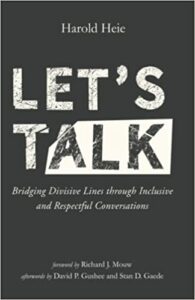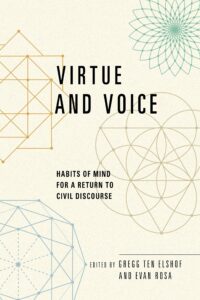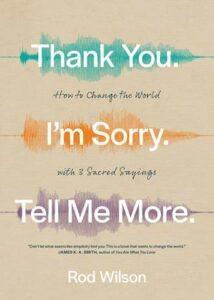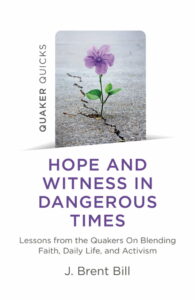
Hearts & Minds Bookstore BEST and FAVORITE BOOKS of 2021 — PART TWO

THE HEARTS & MINDS VERY BEST AND PERSONAL FAVORITES of 2021 – PART TWO

Well, here we go again, more lists of some of our favorite reads of last year. Hope you saw my little meditation on our state of the art here in D-town. And that first great list.

Again: much of what we share here as “the very best” is subjective and colored by my own memory of what I read a half a year ago, conversations that helped us realize how certain books struck people, and, I suppose, what people we respect thought about certain titles. And, of course, there is the question of for whom a book may be “best.” One size doesn’t fit all. I’ve got some unique tastes and interests, I suppose. We’re glad you want to consider these and we’d be very pleased to send some soon.

Please order by using the secure order form page at our bookstore website by clicking on the “ORDER HERE” tab at the very end of this column. Thanks!

THE ARTS & LITERATURE
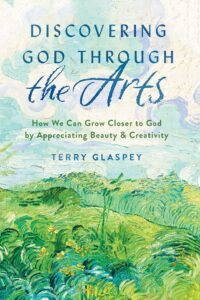
Discovering God Through the Arts: How We Can Grow Closer to God by Appreciating Beauty & Creativity Terry Glaspey (Moody Press) $16.99  OUR SALE PRICE = $13.59

We have carried all of Terry’s many books and have been proud of his good, good work. We rejoiced when his 50 Masterpieces Every Christian Should Know was picked up and re-issued in paperback by Moody Press ($24.99.) Good call!

And thanks to Moody Press for doing this one early this past year, and doing it so nicely (at a great price, too!) There’s lots of full color art, lots of examples of the sorts of stuff he writes about, chapter by chapter. We reviewed this at BookNotes and I’m proud to have my name on the inside as an early rave endorser. What a joy.

And, yep, others have awarded this as a Best Book of 2021, so the word is getting out. Discovering God Through the Arts is useful as a tool for ordinary folks wanting to deepen their discipleship, it is good for those who need sort of a “spiritual” excuse to appreciate classic and contemporary art, it is a blessing for those who intuit the implications of art appreciation but just have never studied all the ways in which artfulness can help us. From learning to contemplate to understanding the Bible better, from nourishing our imaginations to cultivating empathy, art can help us become more of what God wants people made in his image to be. More urgently, attentiveness to creativity and the arts can help followers of Jesus take up their cross and follow Him. I think this is one of the best books of spiritual formation and radical discipleship, even though it gets there gently and with great grace. Surely CT and others are right: Discovering God Through the Arts: How We Can Grow Closer to God by Appreciating Beauty & Creativity is surely one of the Best Christian Books of 2021.
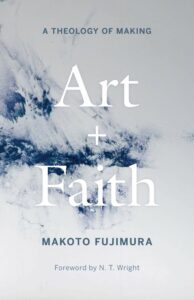
Art and Faith: A Theology of Making Makoto Fujimura (Yale University Press) $26.00 OUR SALE PRICE = $20.80

I announced this when it first came out, and named it again in a long BookNotes list of books about aesthetics and the arts that we did after the fall CIVA conference. Naturally, this is one of the key books in this whole movement of Christians in the visual arts and we, along with many others from across the social and theological spectrum, esteem Mr. Fujimura for this egregiously good abstract art and for his fine, thoughtful prose. That N.T. Wright wrote a good forward to this Yale University Press hardback might illustrate not only its solid theological orientation but its world class prominence.

This “theology of making” is one of the important books in this genre and we are very happy to honor it here again at Hearts & Minds.
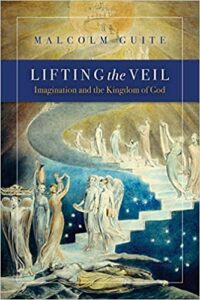
Lifting the Veil: Imagination and the Kingdom of God Malcom Guite (Square Halo Books) $18.99   OUR SALE PRICE= $15.19

Did you see our explanation of this (in the aforementioned long BookNotes art book list?) Square Halo is a boutique publishing house run by our dear pals Ned & Lesley Bustard and Allan & Diana Bauer. We stock everything they do — including several good new books this season. This, though, is a coup; Malcolm Guite is an internationally esteemed poet, priest, liturgist, writer, and theologian (see his brand new little book in the “My Theology” series from Fortress called The Word Within the Words.) Guite speaks on several continents and is well loved among many from various theological spaces.

Lifting the Veil includes lectures given at Regent College in Vancouver and is enhanced with artwork and etchings, graphics and nice design. Square Halo does this sort of thing quite well and it makes this little book even that much better — an artful book inviting us into the redeemed imagination. What a book! Congratulations to Square Halo for all their good books released in 2021; Lifting is my favorite of ‘em all.
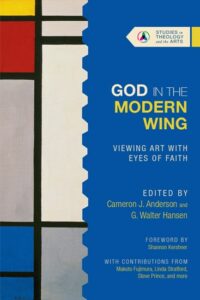
God in the Modern Wing: Viewing Art with Eyes of Faith edited by Cameron Anderson & Walter Hansen (IVP Academic) $30.00  OUR SALE PRICE = $24.00

I do not read many books about the arts, although we are interested in curating a good selection here about faith and the arts. We stock books on art and music and literature and aesthetics (and the process of developing a creative process) andwe appreciate the divergent perspectives of authors from various angles of vision. That is, we have Orthodox scholars pondering medieval art and evangelicals looking at modern art and Catholic thinkers ruminating on all manner of aesthetic theory, spiritual directors writing about pondering paintings as prayer, etc. etc.

We are partial to the wondrous writing of Calvin Seerveld (Rainbows for the Fallen World, just for starters) and so value those in his wake as many contemporary writers from across the world are. IVP has a set of books called “Studies in Theology and the Arts” and they are all excellent and I suspect each cites Seerveld at some point.

God in the Modern Wing is the latest in this ongoing “Studies in Theology and the Arts” series and it captures a bunch of lectures given a few years ago about artists whose work is displayed in the “Modern Wing” of the Art Institute of Chicago. First Presbyterian Church there, with the help of CIVA (Christians in the Visual Arts), hosted a lecture series with each lecture exploring the religious theme of an artist in the nearby museum, followed by a walk through the museum. What a rich, wonderful, faithful program, which happily became this superlative book.

I was won over by the introduction to this book explaining why the Chicago church did this program and how they pulled these nationally known scholars and artists together for the course. That they eventually put it into a book and published it through IVP Academic is a great grace and we are thrilled to celebrate it here, now.

Perhaps not everyone is generous about all this. However, even Hans Rookmaaker, the Dutch art historian who influenced Francis Schaeffer and was famously worried about the nihilistic worldview expressed in some modern art, would have loved this project; I am sure of it. God in the Modern Wing, with the blocky cover from Mondrian is the fruit of a major collaboration of several Christian groups and this good church near the Modern Wing and we are eager to honor it as one of the great books of 2021. Thanks be to God.
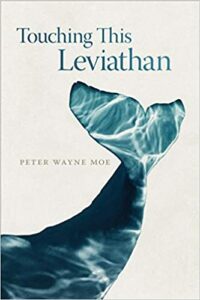
Touching This Leviathan Peter Wayne Moe (Oregon State University Press) $19.95  OUR SALE PRICE = $15.96

Some books just show up somehow and I am drawn to them, perhaps from an allusive title or a lovely cover. In this case, it was both — what is this even about? The description in the University Press catalogue seemed itself allusive, but I was curious enough to order it in for the shop. Was it natural history, about whales? I like whales. But I didn’t expect this:

Touching This Leviathan asks how we might come to know the unknowable — in this case, whales, animals so large yet so elusive, revealing just a sliver of back, a glimpse of a fluke, or a split-second breach before diving away.

How might we know the unknowable? I didn’t see that coming.

Here is more of how they described it:

Drawing on biology, theology, natural history, literature, and writing studies, Peter Wayne Moe offers a deep dive into the alluring and impalpable mysteries of Earth’s largest mammal.

Entertaining, thought-provoking, and swimming with intelligence and wit, Touching This Leviathan is creative nonfiction that gestures toward science and literary criticism as it invites readers into the belly of the whale.

Did he say theology? And, “the belly of the whale”? Yes; it ends up this author is biblically literate, to say the least, and has written for Image journal. He is a Christian who teaches English at Seattle Pacific University and oversees the writing program there.When I saw the good comments about it from Image editor Jamie Smith, I realized I had stumbled upon something extraordinary.
Breaking Bread with the Dead:  A Reader’s Guide to a More Tranquil Mind Alan Jacobs (Penguin Books) $16.00  OUR SALE PRICE = $12.80

This, too, is an honorable mention for 2021 because it came out in paperback this past year. Had I done a Best of 2020, it surely would have been listed. I have more than one friend who are exquisite readers, who read seriously, widely, and a lot. They both insist it is one of the best books they’ve ever read, a magnificent and provocative experience inviting them to ponder the wisdom of ancient writers.  As we said at BookNotes a while ago, I couldn’t put it down.

Reading ancient writers, Jacob’s says, allows us some freedom from the anxieties of our own age. Mature and yet clearly written, as you’d expect from professor Jacobs, one of our favorite public intellectuals and an engaging, artful writer.
Reading Evangelicals: How Christian Fiction Shaped a Culture and a Faith Daniel SIlliman (Eerdmans) $27.99  OUR SALE PRICE = $22.39

We announced this at BookNotes and I might have said in that early review that we are unsure where to put this volume in the shop. Is it mostly history? (Historian Mark Noll has a blurb on the back as does Kristin Kobes Du Mez.) Is it literary criticism? (Karen Swallow Prior raves.) Popular culture studies? Should we just put it with the novels it discusses?

Reading Evangelicals is a play on words, right? We can “read” evangelicals and understand their worldview and place in the culture, we can understand them, by reading and interpreting them. And, we can look at those we might call “reading evangelicals.” What Silliman is brilliantly doing here is looking at the readings habits of certain sorts of mainstream evangelicals. So he “reads” evangelicals by exploring “reading evangelicals.” Or at least certain reading evangelicals and books popularized by evangelicals, mostly. It is thrilling to anyone who follows these things and informative for those who do not.

As one who has sold — often not terribly enthusiastically — these very books, we can attest to their importance. They are often very valued by the readers (God bless them) and important for how they shaped attitudes, especially about key things in what has become known as the culture wars. For better, but mostly for worse, a handful of representative books and authors shaped and influenced a whole segment of conservative Protestants in the last half of the 20th century and how they think about the world.

In a world where I had more time, I’d convene a panel or two about this provocative book. Is he astute in selecting these particular titles? What might other cultural critics say about the impact of these authors on evangelicalism’s late 20th century ethos? Have these influences reverberated across Y2K and into the current century? Why or why not?

And what about ordinary readers of, say, Christian romance or Amish fiction or the supernatural thrillers of Frank Peretti? Did The Shack cause the current rage for faith deconstruction? Do hundreds of thousands of Left Behind fans really think that since we are going to be raptured away from this evil world we really don’t have to care about the threat of nuclear weapons or the damages of climate change? As many of these very sorts of customers we know and love, I cannot say if Silliman’s thesis is fully water-tight. But he is on to something, something big, electric, even. These books have millions of readers.

Reading Evangelicals is a very interesting book about a very interesting topic but is more than just of a passing interest; this is a matter of great consequence. It may help us understand the very tenor of our times, from evangelical support of former President Trump to the religiosity behind some anti-mask/anti-vaccination fury. I’d like to think that Eric Metaxas is self-aware enough to know that he might be subconsciously living out a Frank Peretti novel, but I have my hunches. Silliman’s book might be a key to unlocking a whole lot of mystery these days. In any case, it’s one of our favorite books about books, one that captures some of our forty years here serving dear customers in Dallastown.

Reading Evangelicals is a winsome, yet incisive study of evangelical culture and life through Christian best-selling fiction. It is a Pilgrim’s Progress for twentieth- and twenty-first-century evangelicals, decoding their fears, hopes, and dreams through Christian fiction. A worthy and essential read for anyone who wants an in-depth, compassionate look at the evangelical culture of reading. — Anthea Butler, author of White Evangelical Racism: The Politics of Morality in America

The clever double entendre of Daniel Silliman’s title is more than matched by the insights and sheer readability of the book itself. Its patient account of million-selling evangelical novels is full of unusual wisdom about the authors of these books, but also their publishers, the bookstores that sold them, and (not least) the multitudes who have read them. Silliman’s depiction of American evangelicalism as an ‘imagined community’ defined in large part by these best sellers is thought-provoking in the best way possible. — Mark Noll, author of The Scandal of the Evangelical Mind
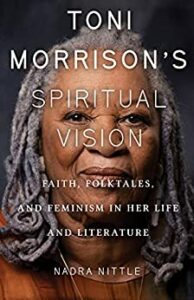
Toni Morrison’s Spiritual Vision: Faith, Folktales, and Feminism in Her Life and Literature Nadra Little (Fortress Press) $24.00  OUR SALE PRICE = $19.20

This is not the first book on the moral imagination and broader social vision of this significant black woman writer. It is, surely, the one that explores her Catholicism more adeptly and appreciatively than any other. For this, alone, we want to honor this important contribution to understanding how Christian faith influences culture, and, in this case, a world-class novelist and essayist. Nadra Nittle is herself a black Catholic writer and journalist who has written for Vox Media, Atlantic, Salon, the Guardian and the Jesuit journal, America.

Toni Morrison’s Spiritual Vision is the seminal text for anyone who wants to gain a deeper understanding of an under-appreciated yet central part of Morrison’s life and literature: her Catholic faith. — Ekemini Uwan, public theologian and cohost of Truth’s Table podcast and co-author of the forthcoming Truth’s Table: Black Women’s Musings on Life, Love, and Liberation 

Nittle has written just the book we need: an engaging and thorough consideration of Toni Morrison’s religious vision. For too long Morrison’s significant spiritual influence has been unspoken or, at best, misunderstood. No more. — Nick Ripatrazone, author of Longing for an Absent God: Faith and Doubt in Great American Fiction and Wild Belief: Poets and Prophets in the Wilderness
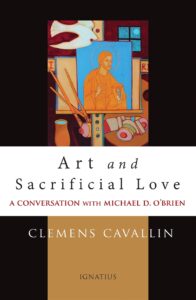
Art and Sacrificial Love: A Conversation with Michael D. O’Brien Clemens Cavallin (Ignatius Press) $14.95  OUR SALE PRICE = $11.96

Oh my, I wanted to read this from the moment I saw it — an incredibly classy cover in a small but handsomely constructed paperback, and that title! Art combined with sacrificial love. Wow. Skimming it quickly I was drawn in to several pages here and there each convincing me I’d read it carefully. Not every book, not even every good book, that ends up here at the shop is one I take home. This, I think, is one I will be recommending to others, anyone drawn to love in a hurting world, and certainly to those involved in the creative process. The book is an interview with the beloved, deep, Roman Catholic novelist and painter Michael D. O’Brien.

Perhaps you know his massive Ignatius Press novel Father Elijah: An Apocalypse or his earliest Sophia House. I have a friend who reads good literature deeply and he recommends most of his stories.

This little book is a rumination, a conversation, a correspondence about things that matter to every thoughtful person, and certainly to artists trying to be faithful to God in their work.

As Joseph Pearce, literary critic and historian (and author of books on J.R.R. Tolkien) notes, “Michael O’Brien’s art is quintessentially personal, in the sense that it incarnates the extraordinary vision of this marvelous man.” Elizabeth Lev, an art historian (and author of How Catholic Art Saved the Faith) notes that, as was said of Fra Angelico, O’Brien is “living truth while waiting truth.”

O’Brien’s conversation partner and author of the book is Clemens Cavallin, a professor in History of Religions at the University of Gothenburg, Sweden and professor of Religion, Philosophies of Life, and Ethics at Nord University in Norway. He has written a bigger book on O’Brien called On the Edge of Infinity.
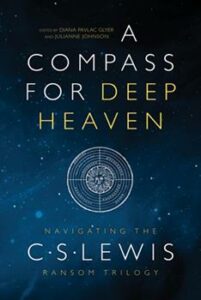
A Compass for Deep Heaven:   Navigating the C. S. Lewis Ransom Trilogy edited by Diana Pavlac Glyer & Julianne Johnson (Square Halo Books) $24.99  OUR SALE PRICE = $19.99

How could we not list this as a notable book of the past year? It is almost one of a kind; I can name on less than the fingers of one hand the books about the great trilogy popularly known as “The Space Trilogy.” There are nearly too many books on Narnia, but, my, my, why not more analysis and inspiring explication of Our of the Silence Plant, Perelandra and That Hideous Strength? Square Halo deserves a halo themselves for working to get this book out to the reading public. (And if your local bookstore doesn’t stock it, why not invite them to look at your copy and see what they think?)

Two quick things about A Compass for Deep Heaven. Firstly, there are some renowned Lewis scholars involved (you should know the name Diana Glyer, not least for her amazing Bandersnatch.)However, most are by younger scholars, some of them published here for the first time. I’m impressed.

Secondly, this book does what many attempt and few pull off: it is basic enough to intrigue the beginners, interesting enough to entertain the fans, and, yes, there is some remarkable insight that will reward even the studious scholar of the works of Saint Clive.

As the Square Halo team puts it, “these books allude to everything from H. G. Wells and the World Wars to Medieval cosmology and Arthurian Legend; there is much to be gained from an introduction to Lewis’s broad and eclectic interests. It provides the background information, historical context, and literary insight readers need to navigate the cosmos of Lewis’s science fiction.

I’m not the only one saying cheerio about this:

A Compass for Deep Heaven is a carefully-crafted and beautifully-edited
volume of ten fine essays that explore a common theme: the mythological,
philosophical, scientific, theological, ethical, and literary influences behind Lewis’s science fiction. Each chapter references and builds on the others,
offering multiple layers of critical and popular analysis. Detailed references and a good glossary provide added value. — Michael J. Christensen, author of C. S. Lewis on Scripture

FAVORITE ESSAY COLLECTIONS
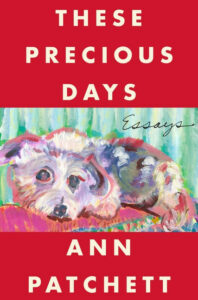
These Precious Days: Essays Ann Patchett (Harper) $26.99  OUR SALE PRICE = $21.59

I suppose a collection of essays and articles by a highly regarded, highly awarded novelist and bookstore owner could be housed under, or at least near, literary criticism. This one isn’t mostly about books and writing, bookselling or poetry, but there are ample references to her writing life and how she crafts her stories. Most, though, are about her home life, her family and friendships. And dogs, There’s dogs.

I cannot tell you how much I loved these pieces — her cadence and way with sentences is remarkable. Patchett is very, very smart, and very, very accomplished, but the book never felt highbrow or pretentious or tedious — just really, really fine writing and funny, sad, interesting, inspiring tales. I was shocked by a few, blown away by a few, delighted by most. There are a lot of good pieces here about all sorts of wild stuff from her curious life, about her friend an elderly nun who serves the poor, her airplane flying, doctor husband, her rumination on book covers, her discovery of the books of Kate DiCamillo. Her dogs. Her own books. The title essay about her friendship with Tom Hanks’ assistant, Sookie, a great dresser and wonderful painter, is one I will never forget. Which is all just to say when you see this described as “essays” do not think it is like Marilyn Robinson, say, or Wendell Berry. Extraordinary talented wordsmiths that they are, I can’t imagine them doing most of the stuff Ann gets herself into. Even her sitting at table and a very serious luncheon with John Updike is told with a fan-girl goofiness that just made me grin.

Through them all, Ann is kind-hearted, down-to-earth (if more capable than most, able to do so very much) and earnestly good. I am in awe of her.

In a way this collection is maybe even more personal than the extraordinary, wonderfully written, 2013 This is the Story of a Happy Marriage, another great essay collection that we truly treasure. (There is in that one a long chapter (“The Getaway Car” which is both autobiographical about her early love for writing, but also no-nonsense (well, with a bit of wry silliness) advice about college classes, MFA programs, writing Fellowships, and doing the hard work of imagining a story and writing it down.) Both are exceedingly good, entertaining, moving. We very highly recommend both. And we certainly name These Precious Days as a favorite book of 2021.

To read this collection is to be invited into that sacred space where a writer steps out from behind the page to say Hello; let’s really get to know each other. Stoic, kindhearted, fierce, funny, brainy, Patchett’s essays honor what matters most ‘in this precarious and precious life.’ — Oprah Daily
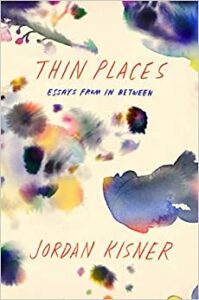
Thin Places: Essays From In Between Jordan Kisner (Picador) $18.00  OUR SALE PRICE = $14.40

If I were giving awards last year (2020) which I sadly missed due to Covid-related business junk, I would have said (and I have said, perhaps not enough) that this was one of my favorite books of that year. I had a very nice, trim sized hardback, published by the prestigious Farrar, Straus, and Giroux. I am not as fond of the new paperback cover (blue and white) but the essays here are still luminous, profound, so very interesting, well done, heart-felt, and etcetera. The paperback came out in 2021, so it’s a Best of this year, too.

I do not know exactly why I was first drawn to this, perhaps because she was acclaimed as a good writer and a clever wordsmith and an honor storyteller. And that she was a born again Christian who had given up her faith, or at least most of it. I am always interested in how people contour their lives and find meaning in these days we are given and I am drawn to those sad stories of those who have drifted from vibrant faith. What can we learn as we listen well, as we honor, even, sadly, these people who find themselves needing to move on? What might have been different? In any case, her piece called “Jesus Raves” was captivating.

Ms Kisner, who has written for all manner of good journals (The Atlantic, The New York Times Magazine, Harper’s, the Paris Review, the Guardian) and has won a Pushcart Prize and teaches creative writing at Columbia. She is a heck of a writer in my estimation, artful, luminous at times, terrifically fun and very compelling. That a person of sincere faith ends up getting published with rave reviews from the likes of Leslie Jamison (The Empathy Exams) who says her essays are “like intricate tattoos: etched with a sharp and exacting blade of intellect, but made of flesh.”

The details are there, her ability to notice and attend to things is admirable. I think she said she is offering “encounters with the ineffable” and, as Phillip Lopate (author of Portrait Inside My Head) puts it, she is full of “risk and daring, urgency and contact.” This really is a fresh voice and her topics are intriguing and matter. Read the opening essays here to see what I mean.
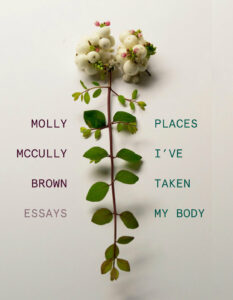
Places I’ve Taken My Body: Essays Molly McCully Brown (Persea) $24.95  OUR SALE PRICE = $19.96

I was attracted to this, I’ll admit it, by the warmly appealing, clean cover, the slightly small sized, nicely made hardback. I love this book for its very design. Which is sort of introducing as this is, in fact, a collection of essays — most autobiographical, appealing to those who appreciate literary memoir — about a woman and her body. Her disabled body. It is a book that conjures places, physicality, stuff. And it is very artfully done.

Molly McCully Brown is a nationally recognized, award-winning poet of great literary substance who teaches at Kenyon College in Ohio. (She is the poetry Fellow for the prestigious Kenyon Review.) In these seventeen intimate essays, she “explores living within and beyond the limits of a body.” In her case, she has cerebral palsy (which she describes as an “often painful movement disorder.”) As she notes, in spite of her limitations, she has led a peripatetic life.(Go ahead, l look it up.)

This book is, quite often, about her travels. These are eloquent and elegant essays and exceptionally profound. She is pondering deeply (even with religious faith) the nature of her body and things that have defined her (inside and out.) She is, again, a serious scholar and literary figure so these essays — crisp and engaging — are mature and sophisticated and yet full of much tender humanity.

Perhaps you may recall a few years ago I raved about a memoir of a woman often confined to a wheelchair, a sassy and snarky and brilliant rant of a book that I adored; it was called Sitting Pretty: The View from My Ordinary Resilient Disabled Body by the very hip Rebekah Taussig. I mention this favorite and often recommended book because Places I’ve Taken is not that. It just isn’t. I would love to get these two women in a room and listen to their witty conversations, but Professor Brown is less an agitator and her beautifully crafted pieces are careful, lush, and what one reviewer called “wrenching” and another called “searing.” I don’t really mean to say she is a better writer, just a different kind of writer. There is no doubt, though, that Ms Brown is bringing a very special voice to the literature of disability.

I want to press this book into the hands of everyone I know. Writing from the locus of her own constantly changing, often intractable body, Molly McCully Brown captures the fullness of the human experience — desire, loss, flesh, faith, poetry, place, memory — with lyric compression and expansive grace. Reading these exquisite essays made me want to get out and do something with my own body — kneel at an altar and recite the Hail Mary, stub out a cigarette in Bologna, stand on a hilltop and shout expletives at the Trump administration. Which is to say, these are urgent, compelling essays that remind us how to be fully alive inside our own bodies, wherever we take them.–Jamie Quatro, author of Fire Sermon and I Want to Show You More

These remarkable essays invite us to look long and hard at our own interior landscapes, and to negotiate exterior ones with as much grace and gratitude as we can muster.— Eliza Griswold, author of Amity & Prosperity, winner of the Pulitzer Prize

DEVOTIONS & SPIRITUALITY
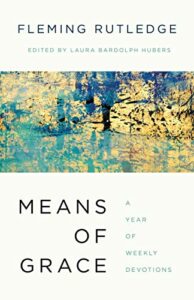
Means of Grace: A Year of Weekly Devotions Fleming Rutledge (Eerdmans) $24.99  OUR SALE PRICE = $19.99

A wonderful collection of Rev. Rutledge’s sermons, edited to be of similar length, useful for a once-a-week devotional. Her work is very highly regarded for very good reason and we were elated when we heard they were doing a “reader” of sorts, a devotional with more than a year’s worth of her substantive, interesting, often moving sermons. Kudos to Laura Bardolph Hubers, the wonderfully thoughtful and enterprising Eerdmans employee — in marketing, actually — who did the editing, culling and trimming of the sermons from their hefty backlist of Rutledge material.

Fleming is very happy with the result of this hard work and we applaud not only Ms. Huber but the whole team at Eerdmans who produced a book that is so worth owning, a volume in a solid, handsome hardback with a striking Mako Fujimura painting on the cover. One of the best books of this sort in 2021, but, as an anthology of one of our best preachers and thinkers and writers, this may be one of the finest books of the decade!
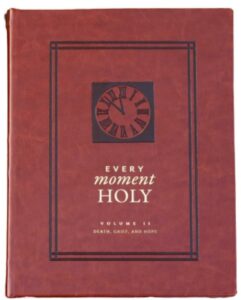
Every Moment Holy Volume 2: Death, Grief, and Hope Douglas McKelvey & Ned Bustard (Rabbit Room Press) $35.00  OUR SALE PRICE = $28.00 [and, now, as of February 2021, there is the new, compact-sized, flexible, leather edition; $25.00  OUR SALE PRICE = $20.00.] When ordering, please stipulate which edition you want.

I suppose you know the extraordinary, handsome, and wildly popular Every Moment Holy Volume 1, a prayer book full of short liturgies and blessings and intercessions for all sorts of things throughout the day. This is a very special second volume, which, as the subtitle suggests, offers liturgies of lament, prayer for grief and loss. We enthusiastically award this handsome, tan, leather-bound hardback as one of the great books published in 2021 but you should know that just last week (in February 2021) we got the smaller, compact sized, softer leather edition. So both EMH Volume 1 and Volume 2 come in two sizes, bigger and smaller, all in leather. There are the $35 leather-covered hardbacks and the $25 pocket sized, flexible leather ones. And we have them all at 20% off. There should be a liturgy for ordering it, since it is (I am not kidding) a holy moment when you do.
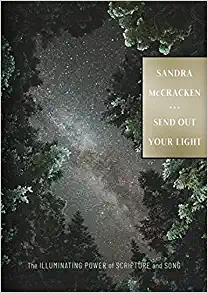
Send Out Your Light: The Illuminating Power of Scripture and Song Sandra McCracken (B+H) $22.99  OUR SALE PRICE = $18.39

Sandra McCracken is a very cool and very talented songwriter, a true artist and storyteller. She is known by many for country-tinged, singer-songwriter songs of faith — psalms, laments, hymns, and pop influenced by deep truth. She is a beloved presence in the Indelible Grace projects and we adore her voice, her contemporary folkie style, her spiritual depth.

(She has, just for the record, worked with all sorts of folks we like —Porter’s Gate, All Sons and Daughters, Ellie Holcomb, and she is one of the moms in the terrific Rain for Roots. Significantly, she has worked with the good folks at Art House Nashville. Her brand new release (February 2022) is Carry Each Other which is a collection of cover songs, from Neil Young to Irving Berlin, Dylan to REM, Leonard Cohen, Nico, and more.)

Sandra has, perhaps more than some of us, experienced sadness in her life; her album Songs from the Valley on lament is extraordinary. She clings to the cross, to sovereign grace, to God’s goodness and grace, and continues to imagine the Kingdom coming. Those who know her music, religious and otherwise, know this about her.

This is, as far as we know, her very first book and it is a fabulous, smallish sized, handsome hardback. It is, I suppose, a daily devotional, but it is more than the typical short reflection on a Bible text. Send Out Your Light is nearly a memoir, a collection of short, personal essays, good words about her life, living in the light about God’s common graces in this world, in these times. As a performing artist and songwriter, she knows well the power of story and song, so Send Out Your Light does often come back to the power of music, including the songs in Scripture. It’s very good. Congrats, Sandra!

(Here is a one minute video about the book that is almost too pretty, but she says a good line or two, and there is a very cool bass line… She says, “Darkness does not have the final word.”)
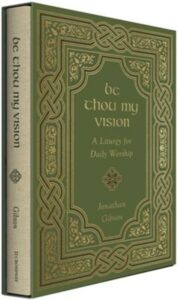
Be Thou My Vision: A Liturgy for Daily Worship Jonathan Gibson (Crossway) $29.99  OUR PRICE = $23.99

I hope you saw our announcement of this in December, describing it as a lush and classy hardback in a slip case, a liturgical prayer book with a Reformed theological perspective. It is designed with a Celtic aesthetic but it is not new age or pantheistic as some recent Celtic theologians tend to be. In fact, the daily offices are quite conventional, the Biblical ruminations historically classic Protestant orthodox, and the readings assigned for reflection are from the Reformed documents, the Heidelberg and Westminster Catechism. Whether this is fully your tradition of not, this daily prayer book is nearly one of a kind and we are glad for it. More than glad, we celebrate it and applaud those doing this kind of resource for those who want this kind of guided help for liturgical daily prayer. Excellent.
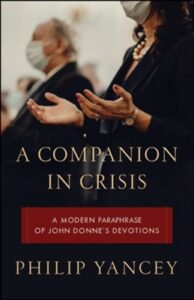
A Companion in Crisis: A Modern Paraphrase of John Donne’s Devotions Philip Yancey (Illumify) $14.99  OUR SALE PRICE = $11.99

Slim as it may be, this is a book we simply have to name as an exceptional read this Year of our Lord, 2021. I described it at BookNotes, so here will just share the information the publisher (or perhaps Philip himself) wrote to describe it:

As the world entered a long dark night, Philip Yancey returned to a nearly 400-year-old manuscript for guidance. In it, he found a trustworthy companion for living through a global pandemic – or any other crisis. As Yancey says, “Nothing had prepared me for John Donne’s raw account of confrontations with God.”

Preacher and poet John Donne wrote Devotions in 1623, during a pandemic in his city of London. For a month he lay sick, hearing the church bell toll for others while wondering if his death would be next. From what he believed to be his deathbed, the great poet wrote a triumph of literature that has given us such familiar phrases as “No man is an island…” and “Never send to know for whom the bell tolls…”

This new version of a classic work is arranged as a 30-day reader based on Donne’s meditations, with startling relevance as we face similar questions.
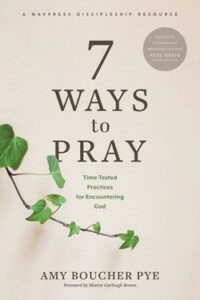
7 Ways to Pray: Time Tested Practices for Encountering God Amy Boucher Bye (NavPress) $14.99  OUR SALE PRICE = $11.99

We have known of Amy Boucher Bye for years (we crossed paths decades ago when she worked with author and public speaker Os Guinness.) Over those decades she has moved to the UK, has studied Christian spirituality, earned a serious degree from the University of London, has published books and articles and devotionals, and has worked in evangelical ministry while raising a family.She is beloved and respected around the world. As we honor this book as a favorite this year, I’ll repeat just some of what I wrote in a longer BookNotes review last September.

This book is one that fills a certain kind of niche and we are very, very pleased to tell you about it; for us, this is the kind of book that we are always on the look-out for but (to be honest) is harder to come by than you might think. It is almost counter-intuitive that such a basic, clear, earnest, spiritually-minded book written with chatty storytelling and nice testimony would be such a stand out. Isn’t there a whole industry of evangelical self-help books, of pious and Biblically-based inspiration? Yes, but few that are as rooted in the broad and wide Christian communion and the ancient teachings of church history. And that, dear readers, makes 7 Ways to Pray nearly an anomaly. It is about the most clear-headed and basic (and I mean that as a compliment) guide to ancient prayer practices you are going to find.

Those that follow BookNotes or browse here at Hearts & Minds know that we love this whole genre of the literature of spiritual formation. Richard Foster’s Celebration of Discipline remains an essential read, one of the best books of our lifetime; I appreciate his Prayer: Finding the Heart’s True Home even better.We stock a lot of books like this, from heavyweights like the desert fathers and Orthodox mystics to Thomas Merton to the lovely and wise Henri Nouwen, from ancient classics like Theresa of Avila (and Theresa of Lisieux) to the more modern evangelical channels of this stuff such as Dallas Willard, Richard Foster, and Ruth Haley Barton.)

But yet, as Godly and deeply spiritual as most of these authors are, they are often just too deep for many of us. (One friend joked that he gets lost in the hallways of the Interior Castle.) And for those raised with the passionate and intimate language of evangelical revivalism and devotional piety of that sort, hearing about even the Examen (let alone prayer beads or icons) just doesn’t work, at least not at first. Sure, some make the effort and have a trusting heart so they forge into deeper waters with guides that sound a little odd to them. What we need is a translator, a clear writer who can simply tell of her own walk with the Lord and how these older, deeper saints can help us in our own discipleship.

And, as I suppose you can guess, Amy Boucher Pye is just that woman. Did I mention she writes for Our Daily Bread? She has this knack for telling a nice story to serve as a nice illustration, dropping into these accessible messages, rich, thoughtful quotes from Bernard of Clairvaux or Dietrich Bonhoeffer or Madame Guyon or Teresa of Avila or John Wesley. What a combo, lovely storytelling prose, Bible teaching, and intellectually solid spiritual guides to give it gravity.This really is a very fine, little book
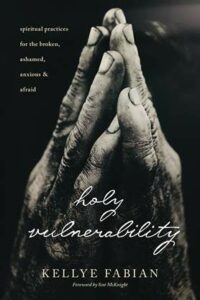
Holy Vulnerability: Spiritual Practices for the Broken, Ashamed, Anxious & Afraid Kelley Fabian (NavPress) $16.99  OUR SALE PRICE = $13.59

As I think of the many great books about spiritual formation, prayer, devotions, and cultivating our interior lives, I think also of those that can touch those of us who are weary, hurting, burned out, cynical. Yes, these laments are ancient — that is why there is so much of it in Holy Scripture — but there is a particular need in these stressful days.I am convinced this is one of the best books of the year because there is a need and this rings true. So true.

We’re grateful for this thoughtful woman who cares deeply about good questions and good, Biblical answers (she wrote the fabulous and fairly in-depth daily devotional called Sacred Questions: A Transformative Journey Through the Bible that we have touted.) But she knows (as she says in that earlier year-long devotional) that seeking solid doctrine and intellectual answers only gets us so far — we have to bring our whole (hurting) selves to God, we have to be, as she puts it here, vulnerable. If that previous book was a honest search for real answers and a Biblical imagination, this is about meeting God even if we’re not okay

“Our brokenness,” she says, “is an invitation to a deeper kind of wholeness.”

The forward to Holy Vulnerability is by Scot McKnight, a very successful New Testament scholar and ecumenically minded pastor. He has named this his favorite book this year about spirituality. He’s right, this is remarkable stuff as we offer our wounds to God, who will love us at those places.
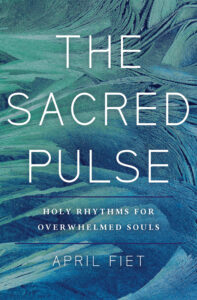
The Sacred Pulse: Holy Rhythms for Overwhelmed Souls April Fiet (Broadleaf) $17.99  OUR SALE PRICE = $14.39

When this book came out, released this fall by the Broadleaf imprint, I wrote a bit about why we were eager to carry it, and why I hoped to dip into it soon. After a quick skim, and drawing on what the publisher told us, and the good reviews by people I trusted, I wrote about it. And then I got a few personal notes thanking me. Ms Fiet has a following, apparently, and she is a good colleague of folks I respect. It’s good when we get to connect like that and in time, she and I have exchanged a few quick emails. I have since come to value the book even more and we are pleased to honor it here in our overview of our favorite reads from last year.

As it says on the back cover of The Sacred Pulse, Fiet is offering insight into how “in a world of hustle and bravado, silencing the noise takes practice.” For those feeling “frazzled, overwhelmed, and out of sorts” from our contemporary life, this book might help us “examine the frantic pattern of perfection and production” so we might “reclaim deeper, sacred pulses.” Actually, she lays out twelve practices to help us do that. She says they are “sustainable and sustaining.” Who doesn’t want a more joyful and holy sense of things, a rhythm, even?

April Fiet is a pastor, writer, and blogger, She co-pastors First Presbyterian Church in Scottsbluff, Nebraska, and is on the editorial board of In All Things. She is a graduate of Western Seminary and has written in places like The Reformed Journal. And she has chickens, so what’s not to love?

Here are others suggesting this book to you. Wow, if these folks celebrate her work, we should too. It is surely one of the best of the year. Why not order one today?

April Fiet welcomes readers into a space that is both contemplative and practical. The book draws on a wealth of spiritual insight to help readers retreat from the busyness of life and recenter their lives around rhythms that heal, restore, and sustain.                   — Kristin Kobes DuMez, New York Times bestselling author of Jesus and John Wayne

I felt seen by this book, in a way that was uncomfortable at first. The unsettling insight into my frenetic performance for God was the opening I needed to hear April Fiet’s invitation: to learn to dance with God again, finding rhythms that are, paradoxically, like rest in motion. — James K. A. Smith, author of You Are What You Love and On the Road with Saint Augustine
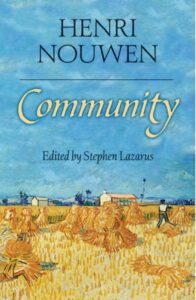
Community Henri Nouwen (Orbis Press) $25.00   OUR SALE PRICE = $20.00

Wow, you read that right — a new book by Henri Nouwen. That deserves an award right there, doesn’t it? We rejoice.

It is compiled and lovingly edited by our friend Stephen Lazarus. (Stephen used to work for the Center for Public Justice (CPJ) in Washington DC and now lives in Toronto, serving as Director for Research and Special Projects act the Henri Nouwen Society.) This book draws together transcripts of talks and messages that have never been published before, together with excerpts of books and articles (again, some that have not been widely seen.) Together, with this new material and nicely woven together previously published content, we have what surely can her called a new book. Even if all of it was previously widely known, pulling his stuff on community together would be a service and make a lovely book. That some of this is from notes from retreats and transcripts of public addresses that have never been published makes this truly an extraordinary publication. What a gift to the world and how very needed it is now. 

The good forward is by the senior editor at Orbis, Robert Ellsberg (who knew Henri, not to mention many colorful characters of the last half a century such as Dorothy Day.) He tells of first trying to get Henri to submit articles for the Catholic Worker, the famous paper founded by Dorothy that he was editing at the time. It’s a good story, and one of those early pieces is now chapter four of this new book. The longer introduction is by Stephen and it soars. What a lovely introduction to this longing for community in our lonely age and what a great introduction to this core theme of so much of Nouwen’s body of work, written and lived. 

For many of us, it is hard to believe that this past year marked the 25th anniversary of Henri Nouwen’s journey to daybreak, his final return to the loving Father. How sad we were upon hearing about his death in Holland in 1996, on the way to film a talk in front of the famous Rembrandt painting (“Return of the Prodigal Son”) that graced the cover of one of his most popular books. 

But his life and ministry live on, especially in L’Arche communities that continue with wounded healers of all kinds sharing life with the mentally and physically disabled. (One of Nouwen’s last full books was Adam, which told the story of a person he came to know at the Daybreak L’Arche.) Deep community, in other words, is one of the great legacies of the spirituality of Henri Nouwen.

Community, edited by Stephen Lazarus, has 10 solid chapters, in about 140 pages. Very, very nicely done, and a great grace for us all. I don’t want to seem pushy or crass, but you know, this really would make a lovely gift to somebody you know who loves Nouwen. Lots of people have many of his books and would be thrilled to hear about a new collection like this. It is an urgent topic, compiled with great love and care. We honor it as one of our favorite books of the year

THEOLOGY
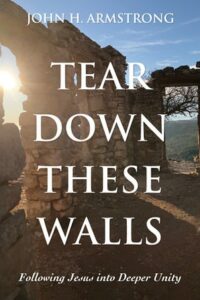
Tear Down These Walls: Following Jesus into Deeper Unity  John Armstrong (Cascade) $23.00 OUR SALE PRICE = $18.40

My friend John Armstrong has devoted three decades or more to the work of Christian unity. His story and ministry have encouraged many around the world and now they are reflected in this study, which includes some of his own story, almost like a theological memoir of a life devoted to unity.

“I am praying not only for these disciples but also for all who will ever believe in me through their message. I pray that they will all be one, just as you and I are one-as you are in me, Father, and I am in you. And may they be in us so that the world will believe you sent me” (John 17:20-21, NLT).

As John notes, “For most Christians these words of Jesus seem like an unreachable ideal. Or they promise spiritual unity without a visible demonstration between real people. Some even read these words with a sense of fear seeing this text used for a compromise agenda. How should we understand this prayer offered for all who follow Jesus?”

The publisher explains:

What if Jesus really intended for the world to “believe” the gospel on the basis of looking at Christians who live in deep unity in a shared relationship with him? What if there is a way of understanding what Jesus desired so that we can begin anew to tear down the many walls of division that keep the world from seeing God’s love in us? Is our oneness much bigger and deeper than we could imagine?

I adore this important work, growing out of John’s important work as an evangelical commitment to inter-denominational unity — shaped by a vision to reach the watching world (which he calls “missional ecumenism.”) He is the founder of The Initiative, which is described as a community of Christians from many backgrounds who walk together in a covenant with Jesus and his followers so that the love of Jesus might exceed all divisions. He is the author/editor of fifteen books and a minister of Word and sacrament in the Reformed Church in America.

A few who follow BookNotes know that we used to promote his early book on this topic, Your Church is Too Small, which meant, of course, that your idea and experience of the church is often too small. We think of the church as our congregation, our denomination, our tribe. That book formed the basis for this greatly changed and significantly reworked new volume, written with the same heart for the gospel and loyalty to the people of God, where Christ’s church is found. This is inspiring, good stuff, helping us live out in church life the sort of love he wrote about in his excellent 2107 book Costly Love: Costly Love: The Way to True Unity for All the Followers of Jesus. 
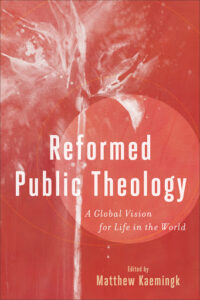
Reformed Public Theology: A Global Vision for Life in the World edited by Matthew Kaemingk (Baker Academic) $29.99  OUR SALE PRICE = $23.99

It is hard to convince readers how rewarding it is to own a collection of dozens of great pieces, on so many different topics (from Christian views of fashion to refugee ministry, from a theology of work to a Christian perspective on citizenship) written by smart scholars/practitioners from around the world. It is still sometimes hard to suggest that theology is not just doctrine for church life but can be opened up and generative for public thinking as well. I am positive that for many of our customers, if you had a volume of “public theology” like this readily available, you’d dip into it as a reference the next time somebody makes a comment or asks you a question about the arts or colonialism or worship or economics or other topics of public interest. It is a treasure chest of Godly insight, written by folks (using case studies) from all over the world.

I award this a Best Book of 2021 award not only because of the breadth of scholarship and the wisdom embodied by the authors of the fascinating individual chapters — a collective testimony to the vanguard of the Kingdom of God, showing renewal in many areas of life, from many corners of the globe — but because of how the book holds together. You see, it is a book that honors the leadership, public thinking, and mentorship of Richard Mouw. This was a surprise volume, compiled and released to honor his retirement from Fuller Theological Seminary and the authors almost uniformly offer some hat tip to the neo-Calvinist worldview that shapes the public philosophy and social theology and sweet piety of Dr. Mouw.

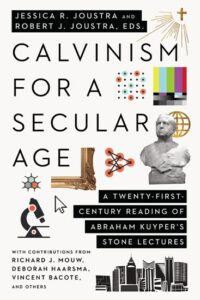
Remember that BookNotes we did a few weeks ago celebrating a book exploring the strengths and weaknesses of Abraham Kuyper and his famous “Stone Lectures” about the Lordship of Christ across every sphere of society? In some ways, some of that renewal of Dutch Reformed thinking influenced Mouw, who himself mentored dozens of young, global scholars. Indeed, one of the editors of Calvinism for a Secular Age, Jessica Joustra, has a good chapter in here. She, too, here, celebrates Rich Mouw as a friend, mentor, and distinctive public intellectual. This book is a treasure and it deserves to be honored among us, even as it honors the work of Richard Mouw. 
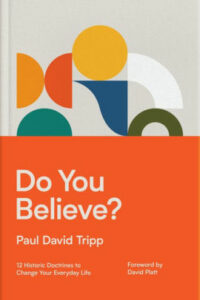
Do You Believe? 12 Historic Doctrines to Change Your Everyday Life Paul David Tripp (Crossway) $32.99  OUR SALE PRICE = 26.39

I am eager to honor this book as a favorite book we’ve carried this year, even though I’m not fully sure I agree with all of it —again, that may make it a good book, pressing us to think for ourselves, to ponder both the ideas it offers and the fruit it generates. I am excited about Do You Believe? as it offers a lively, systematic, thoughtful but not arcane overview of the major classic doctrines that most Christians should know about and cherish. Whether we end up articulating them in the way Tripp does is not essential, but knowing something about the historic and classic perspective he offers here is helpful. This is one of the better books of basic introductory theology for ordinary readers that I have seen in years. 
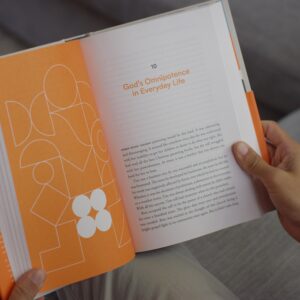
Here is a reason this handsome book (complete with some graphic design touches and symbols for each of 15 key doctrines) is better than many. Following each chapter there is another chapter on how this theological truth could positively effect your life and impact your life with God, your sense of your very self, your relationships with others, your understanding of your church, your responsibilities in the world. If all this studious theological orientation doesn’t form us as better followers of Jesus for the sake of His glory and our neighbor good, if it doesn’t better our faith and our service in the world, then, really, why bother.

A big thumbs up for this major effort to write a theology book with practical application, to root our hope and healing of our troubled lives in the historic doctrines of faith as understood, at least, by Tripps’ fairly conservative, Reformed theological tradition.

He has written other books about applying the Bible to life — with books about awe and wonder, with books about sin and brokenness, with books about our personal fears and foibles, and with books about relationships and personal integrity. He has written about sex, money, addictions, parenting, and more. One of his most beloved books is an intense daily devotional called New Morning Mercies. 

Whenever a fresh article or book by Paul David Tripp is released, I take note. I am an avid follower of his counsel, for no matter how many others might cut me slack–I am, after all, a lifelong quadriplegic–I know Paul David Tripp will insist that I interpret my difficult circumstances, as well as my response to them, solely through the lens of Scripture. Although we rarely cross paths, my friend knows my heart, and how prone I am to wander. It’s why I am especially excited about his new work, Do You Believe? Our life in Christ thrives only when we are rooted in the great doctrines of the faith, and Paul David Tripp does a stellar job of presenting the fundamentals. Whether you already have a grasp on Christian doctrine or are just getting started, this should be your next read!  — Joni Eareckson Tada, founder, Joni and Friends International Disability Center
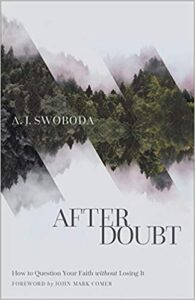
After Doubt: How to Question Your Faith Without Losing It A. J. Swoboda (Brazos Press) $18.99     OUR SALE PRICE = $15.19

This is another great book that we highly recommended at BookNotes when it came out last March. We were early fans and very glad for it. It is the best book on this perennial subject in quite a while.

(I must say I had hoped, but did  not have time, to compare and contrast it with the book on doubt that Brian McLaren had released a few months earlier called Faith After Doubt: Why Your Beliefs Stopped Working and What to Do about It ($26.99; OUR SALE PRICE = $21.59. Brian is following up that book, by the way, with Should I Stay Christian:A Guide for the Doubters, the Disappointed, and the Disillusioned, coming in May 2022 and we are sure to suggest it here later this Spring.)

Swoboda is a very sharp thinker and we have stocked all his books and often recommend his must-read Subversive Sabbath and the excellent one he helped with, Introducing Evangelical Ecotheology: Foundations in Scripture, Theology, History, and Praxis. Almost always in any Lent lists we make we recommend his very helpful, raw, even really like called A Glorious Dark: Finding Hope in the Tension Between Belief and Experience which is perfect for that dark time from Good Friday to Easter Sunday. And before that, he wrote The Dusty Ones: Why Wandering Deepens Your Faith. Do you see a theme here? The brother – who has also written about the joy of the Holy Spirit experience in his exuberant Pentecostal past — has experienced some hard stuff, has wandered and wondered and doubted. Most of these excellent books have led up to this, his magisterial work, After Doubt.

I did not list this book in our PART ONE of our “Best Books of 2021” although I surely could have, there among basic Christian living sorts of titles. This is not an academic book on systematic theology as such. And yet, it is so astute about theological arguments, about doctrinal questions, and about how our own consonance with all of that does or doesn’t ring true, that it seems that this is what we might call applied theology at its best. 

Swoboda could do academic theology with the best of them, straight down the line. But here, he works as a fellow pilgrim, a doubter who isn’t afraid to wonder. As we said in our first BookNotes review, it is ideal for those who are deconstructing their faith, for those afraid of their journey, who wonder about how to question faith in a fruitful way.  It is meaty, but not super scholarly, thoughtful without being dense. Perfect.
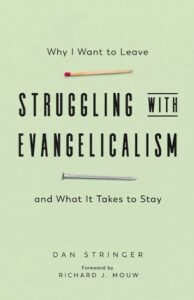
Struggling with Evangelicalism: Why I Want to Leave and What It Takes to Stay Dan Stringer (IVP) $17.00  OUR SALE PRICE = $13.60

Again, I suppose this is not theology proper, but it is very much about theology, or a theological tradition. Or at least a movement with certain sorts of theological dispositions and tones. What is evangelicalism, anyway? And why would a justice-seeking, seriously academic, third culture kid with amazing cross-cultural and global sensibility care about this rather specific, in-house debate about the movement and tradition we call evangelicalism? Well, you’ve got to read this remarkable book to learn more, but I am confident it will help man. Those with big, understandable beefs with the tradition and those who, like Dan, still see beauty and goodness in the simple, gospel-centered focus of evangelical faith and discipleship. 

There have been other such books and this now stands alongside another excellent collection of essays on this topic, Still Evangelical? Insiders Reconsider Political, Social, and Theological Meaning (including authors who say, more or less, yes, no, or maybe.) As a more sustained narrative, Struggling with Evangelicalism is, perhaps now, the best book I’ve seen on this.

I love the small detail on the cover— the matchstick and the nail. That is, do we burn down this dysfunctional house, this wooden structure around the good news, or do we get to work and rebuild it as needed? As the generous forward by Rich Mouw notes, there are very legitimate matters at stake here, and some of it seems to be generational. Mouw says that Stringer was once his student but now he is his teacher.  Mouw notes that this good book helps him understand “both the brokenness and the beauty of this tradition I love.” It can help you, too. It is a great gift, one of the best of the year.
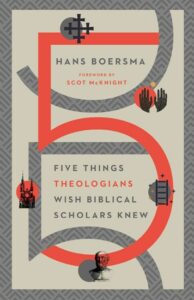
Five Things Theologians Wish Biblical Scholars Knew Hans Boersma (with a foreword Scot McKnight) (IVP Academic) $20.00  OUR SALE PRICE = $16.00

Five Things Biblical Scholars Wish Theologians Knew Scott McKnight (with a foreword by Hans Boersma) (IVP Academic) $20.00  OUR SALE PRICE = $16.00

We award IinterVarsity Press Academic a very cool award here for this combo set of two books, one by a theologian wishing Bible scholars would pay attention to their deep concerns, and the other by a Bible guy, explaining why he wishes theologians would pay a bit more attention to their Biblical studies. Both make really good points. I liked them both, mostly (alhtough Boersma’s apologetic for a Christian sort of Platonism is more than a bit odd, if you ask me.) Their respective forwards, each to the other guy’s book are friendly and collaborative — nice!
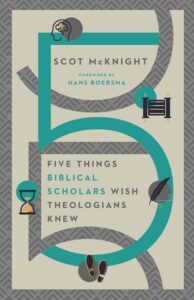
This is really a great project and you’ll learn a bit about theology (and, too, how Biblical studies work goes) by reading them. These are thoughtful, but not arcane, very helpful for all educated readers, each bringing good insight and balance to the other. Kudos.
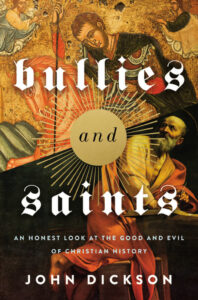


Bullies and Saints: An Honest Look at the Good and Evil of Christian History John Dickson (Zondervan Academic) $28.99 OUR SALE PRICE = $23.19

I suppose a book of honest church history may not be theology proper. But we wanted to honor this, so I’m sneaking it in here, naming it as a treasure published this year, good for any number of readers.  I don’t know this, I suppose, but this very good work could have been done at least in part, I might surmise, to convince the skeptic and seeker that even with the awful stuff that has been done in God’s name through the church, the gospel still might be worth considering. If so, it is a winner in the apologetics category as well, because it is very useful, if an honest skeptic will work through it. Perhaps you need to read it and be prepared to summarize it’s candid approach.

As Dr. Teresa Morgan (Professor of Graeco-Roman History at the University of Oxford) says, it is “one of the most honest, challenging, and compelling cases for Christianity you will ever read!” 

Bullies and Saints is compelling, then, because it shares the “good, the bad, and the ugly” and this is one of its great values. But, aside from that strategy, offering an unvarnished approach, it really is well written, full of fascinating information, a college class between two covers. Some church history books are just too tedious, detailed with frankly more than most of us care to know. Others are too brief; some are sectarian and woefully biased, and many explore mostly the doctrines and heresies (fair enough, it’s all very important) and miss the social/cultural/political goings-on. For a lay reader, Dickson seems to get it just about perfect in a good style and delightfully balanced and paced. Others who also say so include Tom Holland and Philip Jenkins and Michael Spence who calls it “erudite and immensely readable.” That’s an achievement right there, no?

Listen to this great encouragement from Dr. Rebecca McLaughlin, author of Confronting Christianity:

This is a measured and masterful retelling… Read it and weep, smile, question, cogitate and sing.

RACE & RACISM
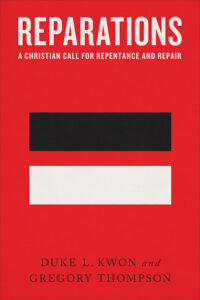
Reparations: A Christian Call for Repentance and Repair Duke Kwon & Gregory Thompson (Brazos Press) $24.99  OUR SALE PRICE = $19.99

I reviewed this in early April of last year and there I said it would be considered one of the best books of 2021. I still think so. It is worthy of honoring, celebrating, buying, reading, discussing. You may not think their Biblical and theological study is adequate, but it is very good; you must admit that. You may not agree with their very tentative conclusions; even they may not be sure what comes next. But it will make you think, and, possibly, think in new ways, animated by Biblical teachings and guided by a passion for public justice. Golly, if that isn’t the mark of a good book — helping you think well in light of Biblical teaching and applied to modern perplexities — then I don’t know what is. Read my remarks about it here:

Here’s a paragraph or two from that review:

Perhaps one of the reasons I think this is surely one of the best books of 2021 is because it is tackling a question that has been raised in several places, talked about in almost quiet hushes as a dreaded topic. Who doesn’t want to work against racism? Who doesn’t even realize there are some structural or institutional obstacles that have to be addressed (not least prejudicial policing and judicial practices that cause what has come to be called racist mass incarceration. Most people of good faith know that racism remains an issue and cause for lament and anyone who knows their Bible knows that breaking down cultural and ethic barriers is a constant theme of the gospel itself.

But reparations? Really?

This is controversial stuff and seemingly endlessly complicated, impossible, perhaps, to wisely adjudicate even if one concedes that the wealth of most established white Americans has been derived from systems set up years ago that were exploitive, unjust, and caused a unarguable housing, education and material asset gap between races. Most of us know now about the inequities even after World War II, how white people of my parents generation got what we all called the G.I. Bill, even though black soldiers did not. Most of us now know that loans were widely available for baby booming young white families to populate the growing suburbs in the middle of the 20th century but red-lining and other fundamentally unfair banking and real estate practices continued even after they were denounced and, in some cases, prohibited. But, still, that was years ago and who should pay whom to make things right? It’s almost too much to ask, and so we do not think about it much. Are we all really implicated in our place in history? There is no overtly Christian book like this that I know of that is doing this sort of serious, thoughtful, and important work, adding to this necessary conversation.

Again, I think Reparations: A Christian Call for Repentance and Repair, is very important and although I guess I cannot promise this to all readers, I found it hard to put down. It is gripping, compelling, interesting, inspiring, wise. Our friend Tish Harrison Warren calls it “a rare book” that is “blessedly troubling.” The Biblical scholarship is impressive, the footnotes are fabulous, the stories moving, and careful suggestions really stimulating.

I am glad for the long introductory chapter that highlights three sorts of understandings of, or levels of, racism, to which they add a fourth. This is very good stuff and worth the price of the book just to have these clear descriptions and insights at your fingertips. A valuable book for any year, and a Very Best of 2021.
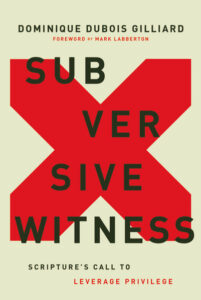
Subversive Witness: Scripture’s Call to Leverage Privilege Dominique Dubois Gilliard (Zondervan) $24.99  OUR SALE PRICE = $19.99

I have been planning on doing a long list of recent books about race and racism that we appreciated having here in 2021. There are a few great ones that fit the needs of our audience and this is certainly one of them. I have not reviewed it extensively but hope to — allow me just to say that this author is a leader you should know. Latasha Morrison (who I’m sure you know from her bestselling Be the Bridge) says he is “a gift to the church” Authors like Soong-Chan Rah and Jenny Yang and Jemar Tisby all rave.

Dominique DuBois Gilliard is a very fine writer — his first one was Rethinking Incarceration: Advocating for Justice that Restores and it was brilliant and vital. He is an ordained minister and serves as the director of racial righteousness and reconciliation for the Evangelical Covenant Church. (He is also on the Board of the Christian Community Development Association.) I simply thank God for him and his gracious commitment to Biblical righteousness in all its fullness and his kind (if frank) exploration of the privilege many of us carry and benefit from. 

The forward by Mark Labberton, now President of Fuller Theological Seminary, is itself very good and sets the stage well for hearing from this black brother as he helpfully explores what we mean by privilege, how to steward it well, what it might look like to “leverage it.” 

As Soon-Chan Rah puts it,
Gilliard calls us into a deeper discipleship that takes us further into God’s Word so that we might find the healing balm of truth.

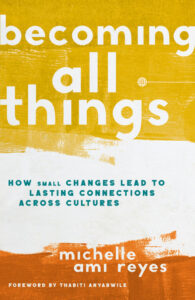
to Lasting Connections Across Cultures Michelle Ami Reyes (Zondervan Reflective) $22.99  OUR SALE PRICE = $18.39

I highlight this as one of the best books of the year in part because it is so very practical. It is rooted in a solid understanding of race and racism in the Bible and it understands much about the questions of equitable inclusion and multi-ethnic diversity.As a leader of the Asian American Christian Collaborate, as co-executive of Pax, and as a scholar in residence at Hope Community Church, a great multicultural church in Austin, she knows how to carefully navigate meaningful change. She would not deny that large policy questions are important, that we need a truly Christ-like view of questions of immigration and voting rights and funding of poverty-stricken schools. But, also — and this is the burden of this fine book — we have to learn to adopt the Apostle Paul’s adage (of being “all things to all people”) in plausible and helpful ways.

Can small changes really “lead to lasting connections across cultures”? He watches it happen in her work in Austin and she knows how to equip us to follow suit. As oneDorena Williamson (author of Colorfull) writes, “This book stirs in me, after decades of multiethnic leadership, an even greater desire to experience God’s diverse kingdom on earth as it is in heaven.”

Do you need a book to “stir you” to desire God’s (multiethnic) kingdom? We simply cannot ignore discussions about cultural identity and cross-cultural engagement. This is a helpful guide to help you walk through this work.

If you are ready to lean in and grow in your understanding of your “neighbor,” then Becoming All Things is the book for you.— Terence Lester, author of When We Stand and I See You

As a mixed-race Christian professor of ethnic studies, I wish that I had read this book twenty years ago. Reyes offers a road map for cultural understanding that is vital for the rebuilding of the church in America.—Dr. Robert Chao Romero, author of Brown Church
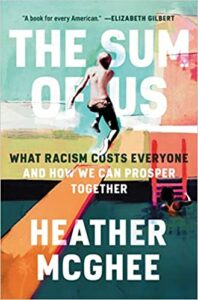
The Sum of Us: What Racism Costs Everyone and How We Can Prosper Together Heather McGhee (One World) $18.00  OUR SALE PRICE = $14.40

I should hardly have to explain why this is so very good. Ibram X. Kendi says, boldly, “This is the book I’ve been waiting for.” Wes Moore (of the unforgettable The Other Wes Moore and Five Days says, “The beauty and power of this book is blinding.” The extraordinary George Saunders (Lincoln in the Bardo) writes that it is “vital, urgent, stirring, beautifully written.” Chris Hays assures us that “Heather McGee is one of the wisest, most penetrating, most brilliant minds to set herself to the Big Problem of American democracy.”  I has been reviewed widely and discussed on the good chat shows on NPR.

Sum of Us was long listed for any number of prestigious awards (including the National Book Award) and the Andrew Carnegie Medal. It was on the Best of 2021 lists in many major book review journals and it is our delight to add our voice, small and late as it may be.

This study, The Sum of Us, is an exploration of the nexus of race, class, and politics. It is written with care, with kindness, with insight, and without turning away from the complex matters of economics, racism, religion, and more. It shows in significant ways not only how we got into the mess we are in but ways to proceed.And some of it — the “solidarity dividend” — can happen, she shows, in houses of worship.

McGhee does not say all that needs to be said and she may or may not be right in all her analysis although with expertise in economics and policy (and a law degree) I wouldn’t want to argue with her. The Sum of Us is a very important contribution, for its insight, her authority, and the power to change that could come if we heed even some of what she proposes.

Here is how the publisher describes her project:

Heather C. McGhee’s specialty is the American economy–and the mystery of why it so often fails the American public. As she dug into subject after subject, from the financial crisis to declining wages to collapsing public infrastructure, she found a common problem at the bottom of them all: racism–but not just in the obvious ways that hurt people of color. Racism has costs for white people, too. It’s the common denominator in our most vexing public problems, even beyond our economy. It is at the core of the dysfunction of our democracy and even the spiritual and moral crises that grip us. Racism is a toxin in the American body and it weakens us all. But how did this happen? And is there a way out? To find the way, McGhee embarks on a deeply personal journey across the country from Mississippi to Maine, tallying up what we lose when we buy into the zero-sum paradigm–the idea that progress for some of us must come at the expense of others. Along the way, she collects the stories of white people who confide in her about losing their homes, their dreams and their shot at a better job to the toxic mix of American racism and greed. This is the story of how public goods in this country–from parks and pools to functioning schools–have become private luxuries…

Bad Faith: Race and the Rise of the Religious Right Randall Balmer (Eerdmans) $16.99  OUR SALE PRICE = $13.59
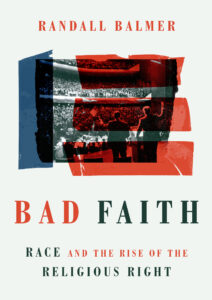
This is a thin, compact-sized hardback and, as they say, worth its weight in gold. He is not the first to document this sinfully tragic mingling of fundamentalism and politics and how it was driven by racism, but it is concise, clear, exceedingly compelling with undeniable documentation. We have in recent years told folks that Jemar Tisby’s The Color of Compromise is the essential must-read book to introduce people of faith to the way Christianity in the US has been compromised (since our founding) by crass, unbiblical, ugly, cruel racism. We must add this, now, to that “must read” list, specifically for those wanting a powerful study of recent history.

In fact, Jemar Tisby himself writes:

Fantastic… Before you read another headline or write another social media post about religion, race, or politics, read this book.

Lisa Sharon Harper, author of the recently released historical study, Fortune: How Race Broke My Family and the World–And How to Repair It All, puts it colorfully:

Bad Faith is the essential reader for all who want to know how America was pushed to the brink and how the evangelical church was led off a cliff.
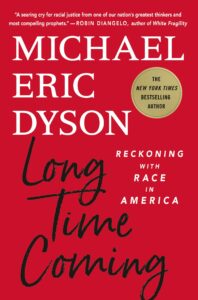
Long Time Coming: Reckoning with Race in America Michael Eric Dyson (St. Martin’s Press) $25.99  OUR SALE PRICE = $20.79

This is another in the compact sized hardbacks Dyson has graced us with. He is one of the most important and interesting public intellectuals in our time and is a great writer, a distinguished professor, a pastor, and a vivid public speaker (Obama once said, probably referring to himself, “Anyone who speaks after Michael Dyson pales in comparison.”)

I so value his remarkable book about RFK and Baldwin; his Tears We Cannot Stop could break you open. This is a third in that compact sized series and is fierce and eloquent, tracing the roots of racism in clear, fresh ways. Bryan Stevenson says it is “formidable” and “has much to offer on our nation’s crucial need for racial reckoning and the way forward.”
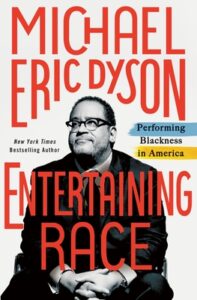
Entertaining Race: Performing Blackness in America Michael Eric Dyson (St. Martin’s Press) $32.50  OUR SALE PRICE = $26.00

I raved about this in a previous BookNotes but I’m not sure people believed me when I told them how exceptional it is, how learned, informed, thoughtful, funny, fascinating and important it is. It is a feast, so informative and interesting. I linked, I think, to a hilarious bit he did on Late Night with Stephen Colbert where he kept extolling Beyoncé. It was a hoot. I love this book, a veritable greatest hits of his many, many pieces about black artists, entertainers, public figures, activists, preachers and, did I mention Beyoncé?

Here is just a little of that BookNotes review I did:

Entertaining Race is a book to spend years with, perhaps, laughing and crying and maybe scratching your head a bit. He is hard-hitting about racism and injustice, but is not only in the key of lament. Dyson truly enjoys pop culture, film, music, theatre.Some of these chapters are about sports, which he obviously enjoys.Some about politics and some are pretty weighty. He knows the West’s intellectual history well and is schooled in philosophy and intellectual history and can also bring in hip hop and Hollywood references in his discussions of Descartes or Abraham Lincoln or in discussion with, say, Jean Bethke Elshtain. And did I mention he adores Beyonce?

But that doesn’t mean he’s always seen as cool, let alone beloved — he got death threats and called out by his chancellor, with demands that he be fired from the University of North Carolina in 1996 when he defended pop culture, citing Kurt Cobain to Snoop Dogg in a notorious, big commencement speech. He includes it here, saying, “you can read for yourself whether the criticism was warranted.”

POPULAR CULTURE
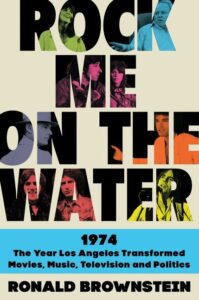
Rock Me On the Water: 1974 – The Year Los Angeles Transformed Movies, Music, Television, and Politics Ronald Brownstein (Harper) $29.99  OUR SALE PRICE = $23.99

If you are a fan of the early to mid-70s, if you remember the early Eagles and the rise of Joni Mitchell and the huge shift in movies and TV about that time, not to mention the rise of certain sorts of soul, the ongoing anti-Viet Nam war movement (and the documentary “Hearts & Minds — ahem!), the controversies with Jane Fonda, the rise of celebrities engaged in radical politics, etc. etc. this book is the best thing I’ve read in years. I couldn’t put it down.

I graduated from high school in 1972 and was working part time in a record store at the time and these were my coming-of-age years. I have never quite considered all that happened in this one seminal year and I never quite placed it all in LA.New York became important later, with disco and punk and SNL. But CSN? The Godfather II? The rise of Archie Bunker and MASH and the major shift in TV? Month by month, Brownstein walks us through the drama and tragedy and idealism of the city of Angels. Rock Me on the Water book blew me away, pointing out on almost every page fascinating stuff about popular culture that I never quite pieced together. It is amazing how older and conventional the most popular films and TV were even in, say, 1968. Cultural critics who say the 60’s didn’t end until almost the mid-70s are right on!

I really, really loved this book, and not just because of the Jackson Browne title on the cover. The film parts, the TV, the politics? All fabulously interesting.

Rock Me On The Water documents the high-octane storybook world of Los Angeles in 1974 with masterful intimacy and fearless cultural analysis. His well-rendered portraits of Jackson Browne, Linda Rondstadt, Joni Mitchell, David Geffen and other luminaries of the time are sublime. This is an extremely kinetic historical document, and a testament to Brownstein’s lasting importance as both a fact-driven journalist and elegant prose-stylist. A must read! — Douglas Brinkley, author of American Moonshot

Brownstein’s kaleidoscopic account of a historic generational transformation that took place in American culture, American politics, and American life in the crucible of modern Los Angeles during the magical year of 1974. It encapsulates in compelling detail the moment when young people and young ideas were moving in on an older generation, based on the strength of new-found creativity and idealism. It documents the triumphs and failures of that new generation with vividness, humor, and, most of all, deep understanding. Running through every page is the author’s deep love for his adopted home. A beautiful ride through an unforgettable time.— Jon Landau
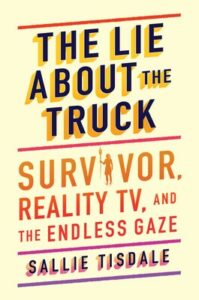
The Lie About the Truck: Survivor, Really TV, and the Endless Gaze Sallie Tisdale (Gallery Books) $27.00  OUR SALE PRICE = $21.60

Every once in a while we want to salute a book just because we know somebody out there cares. You know who you are.

Do you know the reputation of this inquisitive and glorious writer? Some say she is a genius. The Boston Globe says that although she is an easy, chatty writer, she “never says anything the way you’re expecting which makes reading her a pleasure.” The Seattle Times says her prose is “music for the mind’s ear.” Colorfully creative as a wordsmith, her research is considered meticulous.

Meghan Duam, author of The Problem with Everything, says that “Sallie Tisdale is the real thing, a writer who thinks like a philosopher, observes like a journalist, and sings on the page like a poet.”  You just have to like an author described like that!

Do you know the truck? More specifically, the lie about the truck? I did not. I did not care, for that matter. I still, don’t, really. And yet, here we are, listing this as a book to be honored this year.

I read a great review in maybe Publisher’s Weekly and was hooked. Here is how the publisher themselves describe this:

What is the truth?

In a world of fake news and rampant conspiracy theories, the nature of truth has increasingly blurry borders. In this clever and timely cultural commentary, award-winning author Sallie Tisdale tackles this issue by framing it in a familiar way — reality TV, particularly the long-running CBS show Survivor.

With humor and in-depth superfan analysis, Tisdale explores the distinction between suspended disbelief and true authenticity both in how we watch shows like Survivor, and in how we perceive the world around us.

Well, if that is even somewhat true, it deserves to be held up as a significant title for this year.

Music Is History Questlove (Abrams Image) $29.99  OUR SALE PRICE = $23.99

Time is running out for me here, and I’m not finished with this yet. It is more substantial than I expected. It is about music. It is about history. I should have realized that.

We love Questlove and we respect his work as an artist, as a spokesperson, as activist. In Music Is History the five-time Grammy musician, producer, and bandleader, the musical director for The Tonight Show with Jimmy Fallon, shows his chops as writer. We picked this up in the wake of the breathtaking, spectacular Summer of Soul that he produced, one of the cultural highlights of this hard year of 2021. I figured the book might be mostly about those well known black singers.

If Rock Me on the Water was a book I thoroughly enjoyed, understood, related to — I’ll admit I briefly met a few of the people mentioned — some of Music Is History is new stuff for me. Questlove starts in 1971 and goes year by year up until the present, explaining music that was popular and music that was popular in circles I didn’t travel in. He is curious about history and combines his deep expertise in pop music to explore what America has been about in the past 50 years.

It is an intimate conversation with an influential musician of today and it is a black musician’s take on recent American history. What a book! What a blast!
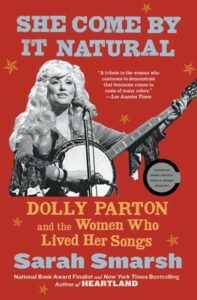
She Come By It Natural: Dolly Parton and the Women Who Lived Her Songs Sarah Smarsh (Scribner) $16.00  OUR SALE PRICE = $12.80

I so thoroughly enjoyed this book that I wanted to tell folks about it all fall of 2021, when I discovered the paperback that had just released. (Yes, the hardback came out in 2020, but, like Dolly, I’m making the most of things the best I can.) I have to admit that the main thing that drew me to this at first was that it was written by Sarah Smarsh, author of Heartland: A Memoir of Working Hard and Being Broke in the Richest Country on Earth. It is a mid-West / heartland memoir about her rural family with working class roots (who, among other things, listened to Dolly Parton music.) Smarsh and her mom are fiesty, smart women who were not well off and, well, her own life story seems to converge, or at least cross over, the Appalachian story of Dolly and her roots music. Dolly and her struggles, her darn hard work, her faith, her loyalty to her Appalachian life.

She Come By It Naturally was, in fact, mostly published in the fabulous Americana music journal No Depression and Smarsh’s weaving it into a great little book earned her a finalist position in the National Book Critics Circle Award (and was on several end of the year “must read books of 2020.”)

I had no idea Dolly was so extraordinary, such a character, so accomplished at so much. I didn’t realize how her wholesome feminism was controversial — there was a bit about it in the great Ken Burns’ documents on country music, I recall — and Smarsh colorfully dishes on all of it. Her intersectional study of the relationship of class and gender and race and geography is insightful without being pedantic. As the back cover says, “Infused with Smarsh’s trademark intelligence and humanity, this insightful examination is a tribute to Dolly part and the organic feminism she embodies.”

I like the line from the Time review:

Stirring, insightful… Smarsh anoints Parton a badly needed beacon: in a divided country, she remains that rare someone who everyone can love.

I enjoyed this so much, I think I’m going to read it again real soon.
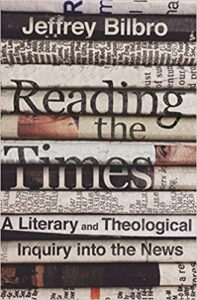
Reading the Times: A Literary and Theological Inquiry Into the News Jeffrey Bilbro (IVP Academic) $24.00  OUR SALE PRICE = $19.20

If my other awards for favorite reads and best books in this category are upbeat and bold, pop culture as typically understood, this is gentle, quiet, thoughtful in a restrained and sober manner. Bilbro is a serious student of Wendell Berry and is a weighty voice in the conversations at Front Porch Republic. He is a solid person of Christian conviction and wonders how we all might be wiser about how we take in the news. If our media-driven, fast-paced, information-overload — as explained by Neil Postman, say, in Amusing Ourselves to Death or mentioned by Steve Garber in his wise works — is part of our formation, shaping how we think and feel about the world, then attending to how we follow the news is essential.

And this is a book that is unlike any in print today, I’m sure. It is careful and judicious, yet interesting and inspiring. It is not entertaining in a way that name drops pop singers or fun TV shows the way the other books I’ve mentioned here, but it is fascinating. I name it as one of the memorable and important books of the year without a doubt.

There may not be any greater need in this moment —for both the church and the larger culture — than a practical theology of the news. Reading the Times is a book that addresses a discipleship crisis of our day. It may be a generation too late, but it’s not a moment too soon. — Karen Swallow Prior, author of On Reading Well: Finding the Good Life through Great Books

I really can’t do better than this long endorsement, which explains it well: I am so grateful for a book that steps back from the flash and distraction of headlines to think deeply about the purpose of the news and how Christians are called to engage. In Reading the Times, Jeffrey Bilbro provides readers with a theological framework for our contemporary discourse. He offers examples from the tradition, from the Old Testament to modern heroes of the faith, such as Frederick Douglass and Dorothy Day, that we might apprentice ourselves, as Bilbro puts it, before these models. Like a teacher, Bilbro questions readers about our ways of responding to media, and he leads us to consider how our participation with contemporary news forms us and our community. By contextualizing our reading of the news within kairos, Bilbro shows Christians how, as T. S. Eliot writes, ‘to apprehend the point of intersection of the timeless with time.’ A relevant and timeless book about how Christians should belong in but not of this world. — Jessica Hooten Wilson, Louise Cowan Scholar in Residence at the University of Dallas, author of Giving the Devil His Due: Flannery O’Connor and The Brothers Karamazov
Steeped in Stories: Timeless Children’s Novels to Refresh Our Tired Souls Matali Perkins (Broadleaf Books) $24.99  OUR SALE PRICE = $19.99

We love books about books and we love books about kids books. There are several (and we are glad we saw this year the re-printing of the fabulously interesting, if a bit weird, Pipers at the Gates of Dawn: The Wisdom of Children’s Literature by Jonathan Cott from the University of Minnesota Press.) More inspiring and fully wonderful, though, is what is, for now, at least, the best book I’ve read about children’s literature. Steeped in Stories is fabulous!

We admire the fictional work of award winning Metali Perkins very much and we are delighted that she here shares some of her own understandings of the role of stories in children’s moral and faith formation and what is going on is so many of the best youth books these days. (And she offers some warnings, too, which are helpful and wise.) We are glad for Broadleaf doing this in the nice, compact hardback format — what a great book it is. We hope this shout-out inspires many to buy it, as it is simply a must-read for parents, school educators, Sunday school teachers, curriculum writers, fiction fans, maybe even sharp teens. Steeped in Stories is a timeless winner!

Mitali Perkins’s winsome way with words seeps through every page of this useful guide that’s so much more than a guide. Her love of classic writing, even with all its flaws, serves as a compass for us to navigate the ins and outs of timeless stories so that they do more than entertain our modern craving for amusement. — Tsh Oxenreider, author of At Home in the World and Shadow and Light

Steeped in Stories is a timely exploration of timeless classics, clear-eyed about cultural blind spots, yet still enchanted by the wisdom, beauty, and wonder of these marvelous stories. This is one of the most brilliant guides to children’s literature I’ve read. — Karen Swallow Prior, professor and author of On Reading Well: Finding the Good Life through Great Books
It Is What You Make of It: Creating Something Great from What You’ve Been Given Justin McRoberts (Thomas Nelson) $18.99  OUR SALE PRICE = $15.19

As I thought back over last year, I immediately thought of how much I enjoyed this easy to read, entertaining and inspiring book. I devoured it. The author is a friend and I admire him a lot so, of course, wanted to read it right away. And while I try to use a few colorful Ines here in my writing (and some might say our whole entrepreneurial thing, here, indicates some sort of maker inclinations) I don’t view myself as a creative type. A “creative” (in the noun, form, as the kids do today.) And — hey, hey —It is What You MakeIt was a book I very much needed to read.

I was going to list this as a Best of 2012 in the “personal growth” category, and I suppose I should have. The others there were characterized, mostly, by coping with pain, about thriving amidst difficulties; that is, they were rather psychological in nature. This is more about being creative and “making something” of whatever you are given (I now cringe every time I hear myself saying, “it is what it is” since he teaches us why that is not so.) But, still, I didn’t want to list this with more directly artistic books, either. Justin is a singer-songwriter and record producer (he just did a kids’ album!) but this book about taking risks to exercise our God-given capacities to make a good life and make a difference, so it is not just for aspiring artists.

So here it is, listed, for better or worse, under popular culture. He did have an air-guitar KISS band as a kid, and he did play and sing — it’s a great story — with the loud punky ska band Five Iron Frenzy on tour for a while.There’s a story about a failure of a gig (or was it) in far-away Edmonton, Canada. And he talks about the band Primas, for crying out loud. Where else would I list this book?

This is a book about recognizing our gifts, using our resources, accepting the collaboration with others who God brings into our lives and sharing our time and taken with others. There are, as the back cover says, “hilariously relatable anecdotes and antics.” Indeed. There’s Bible study, thoughtful exercises, and a upbeat call to get serious with our lives and make something of our communities, our faith.

And, as a bonus, It Is What You Make of It gets an award for the worst cover of 2021 until you read the book to explain what the goofy cactus is all about. And then — bingo — it’s one of the best covers of 2021 once you know what it’s all about. It’s worth the couple of bucks for the book just for that story that explains, well, just about everything.

PUBLIC AFFAIRS / CIVIC CULTURE

What Were We Thinking: A Brief Intellectual History of the Trump Era Carlos Lozada (Simon & Schuster) $17.00  OUR SALE PRICE = $13.60

Since I have a lot of favorite books in this area, I have to be brief. I will say this: I have read a lot and there are excellent reports of our political life these past years. I was glued to several unbelievable books about the former Presidents last crazy months, from Peril by the famous Woodward to Michael Wolff’s third volume on the Trump years, Landslide. Yes, things were weird.

What Were We Thinking, though, is not a behind the scenes accounting; it is not investigative journalism or grandstanding. It is a very sober-minded, nicely written, wise, even, survey of the books about Trump and Trumpism. The author tells us in the beginning how many books about the former President and his administration and the 2016 elections he has read and reviewed (he is a Pulitzer Prize winning book critic for the Washington Post.) Lozado knows the lay of the land, the pro and con arguments, the sassy ones, the fair-minded ones, the ones that focus on race or economics or the carnage of the rust-belt or the evangelicals or whatever. There are books documenting the famously (and simply non deniable) over-the-top dishonesty of the President and his spokespeople and the incredibly sloppy know-nothing zeal he revealed in. There are books that wonder why — who voted for him and what motivated them. He has studied them all. Which is to say, he knows the books, has seen the coverage, has explored the political, cultural, and philosophical thinking behind it all and give us here a wonderful survey of the gist of so much conversation. As the New York Times review put it, “There is a simple, piercing clarity to many of Lozada’s observations.”

I do not want to overstate this, but I have read some and are familiar with many of the 150 books referenced here and I am glad for some that he picked (including, for instance Alienated America: Why Some Places Thrive While Others Collapse by Timothy Carney) and I appreciate his weaving their various points of view and insights into some key principles and takeaways.

Granted, as one person noted, it is “an irony of our age that a man who rarely reads has unleashed an onslaught of books about his tenure and his time.”

I appreciate that Mr. Lozada is less impressed with polemics and those that sound more “righteous than right.” So here is his provocative argument, that I found award-winning:

Whether written by liberals or conservatives, activists or academics, true believers or harsh critics, the books of Trump’s America are vulnerable to the same failures of the imagination that gave us this presidency in the first place.

I loved this real-time intellectual history of our time. As the LA Times put it, “the meta Trump book you didn’t know you needed (and wanted) to read.” Ha!  So meta, so 2021.
The Politics of the Cross: A Christian Alternative to Partisanship Daniel K. Williams (Eerdmans) $27.00  OUR SALE PRICE = $21.60

I have written much about a distinctive, Biblically-wise, multi-faceted view of politics and government and have often suggested that Christian people who want to honor the Lordship of Christ over all of life, including our citizenship, would be well to not primarily seem overly loyal to one ideological camp or political party. It may be idealist to talk about a “third way but surely Tony Evans was write when he preached that when Jesus returns he will not be riding a donkey or an elephant. We should be more interested as one group I admire puts it, in principles before parties. You can see some of those lists HERE or HERE

And so, I’ve offered book lists and review that help us nurture our uniquely Christian mind about law and politics and that offer non-partisan guidance on citizenship. This book, out in 2021, could have fit in any number of those previous lists. It is exactly about that very thing by a wonderfully serious Bible guy, helping us all get beyond the inane partisanship (as Thomas Kidd called it) that characterizes American political life. As he said, if you aren’t interested in getting to a better place, then The Politics of the Cross is not for you.

You can read my longer review at the BookNotes archives, but why not just order it now? You can rejoice that authors as diverse as John Fea Kelly Kapic and Collin Hansen all raved about this. In any case, this was a favorite book of mine this year for its sheer audacious hope that we might take Jesus seriously in our relationship to what seems to be mostly a two-party system, without falling to far off the gospel rails, one side or the other. You will learn much, you will be inspired, and maybe you, too, will be encouraged. I sure was.
Uprooted: Recovering the Legacy of the Places We’ve Left Behind Grace Olmstead (Sentinel) $27.00. OUR SALE PRICE = $21.60

Grace Olmstead’s very good book was one of my favorite favorites all year because it was so gorgeously written, it evoked such a sense of place, it was honest about the implications of caring about “the places we’ve left behind.”I introduced it and raved a bit and invited folks to buy it. It is published by a conservative publishing house and promoted mostly by a network of sharp folks that years ago were called “crunchy cons” — conservatives who care about traditional values, localism, caring for the land (but conservation into the conservative lexicon) — not mostly economic growth or giving big business a pass when they egregiously pollute or disrupt. These folks who talk about a “front porch republic” know as much about Wendell Berry as de Tocqueville and are more interested in a life well lived than winning hot-button issues of the culture wars. I might not have realized that this is the ethos surrounding much of this book, and it doesn’t matter, really: it’s a darn good read and will be engaging for anyone who cares about our civic life, our social fabric, our roots, our parents and children, if we have children.

Read my review at our BookNotes archives but, to be honest, read this review of Uprooted by Valeri Weaver-Zercher that was published in the Christian Century. Valerie is one of my favorite book reviewers and I’d like to award this review of hers as my favorite book review of the year. But, of course, it is based on an amazing book, one of the best of 2021.
Naming Neoliberalism: Exposing the Spirit of Our Age Rodney Clapp (Fortress Press) $24.00  OUR SALE PRICE = $19.20

I am a sucker for big picture social critiques, authors naming the spirit of the age like some Hebrew prophet. From audacious, large scale analysis of genius like McGilchrist’s The Master and His Emissary: The Divided Brain and the Making of the Western World to Brian McLaren’s Everything Must Change: When the World’s Biggest Problems and Jesus’ Good News Collide to the amazing (must-read!) Beyond Homelessness: Christian Faith in a Culture of Displacement by Steven Bouma-Prediger & Brain Walsh to Bob Goudzwaard & Craig Bartholomew’s Beyond the Modern Age: An Archaeology of Contemporary Culture. I suppose it is why we awarded as a Best Book of 2021 (in Part One of this BookNotes list) The 1619 Project, which is nothing if not sweeping. I think it was Francis Schaeffer who once said we sometimes need to turn from the microscope and pick up the telescope for a wider-lens view.

And so, in that spirit, and to that end, we are eager to award Rodney Clapp’s Naming Neoliberalism: Exposing the Spirit of Our Age a Best Book of the Year, honoring him for this careful, studious, detailed study of what is mean by Neo-liberalism and how that phrase captures so much of our contemporary ideologies and so much of what is bringing turmoil to our world. And it is well deserving of our celebrations for the contributions Clapp makes not only to our big-picture and behind the scenes understanding, but in his lively invitation to do something about it; to live by a different story, catechized into an alternative world by the church of Jesus Christ. Thanks be to God.

In my feeble efforts to review this at BookNotes last summer, I was buoyed by the great endorsements that others wise than I have offered:

Rarely are critiques of neoliberalism followed by beautiful, constructive proposals for alternative ways to live. By giving us both, Clapp offers this book as a gift to the church. The converse is also true: it is important not only to identify the life-affirming work churches are called to do but also to help congregations name and understand the dominating power of our age. Only when we are clear about what the gospel frees us from and frees us for, Clapp well argues, may the church be a relevant witness against the power and principality of neoliberalism that opposes God’s reign. — Jennifer M. McBride, author Radical Discipleship: A Liturgical Politics of the Gospel, professor of theology and ethics, McCormick Theological Seminary

This concise and accessible analysis takes us beneath the fear, inequality, war, hunger, and environmental devastation of the present age and shows us how they operate. Rodney Clapp unpacks the ideologies that try to convince us that the world must be so, and then offers resources from the Christian tradition to enact a more livable world. No one is more skilled at bridging the scholarly and pastoral contexts than Rodney Clapp. –William T. Cavanaugh,DePaul University

 Lillian Daniel, senior pastor of First Congregational Church of Dubuque, Iowa and author of Tired of Apologizing for a Church I Don’t Belong To wrote honestly when she said: “Let’s be honest. As pastor of a politically split church, I am not looking for ways to introduce more politics into congregational life. In an age of tweets and squawking, I thirst for the Peace of Christ. But after reading Rodney Clapp’s Neoliberalism, I also see how hungry and lonely I have been, while wandering in this desert of culture wars, for some weight and wisdom from a spiritual tradition that is older, larger and deeper than I am. Somehow, Clapp uses a hot button topic to model how to have a cool Christian conversation, across the aisles of politics or pews. I would gladly introduce this book to my church members, for its sense of perspective but most of all for its contagious hope for a church where God is still speaking louder and more lovingly than the pundits.”

It may be a bit academic to give to everybody at your church, but I like Rev. Daniel’s optimism. Let’s do try to get this read and discussed. We need the big picture sometimes, the serious critique, and the viable vocabulary of faith as an alternative
The Magna Carta of Humanity: Sinai’s Revolutionary Faith and the Future of Freedom Os Guinness (IVP) $25.00  OUR SALE PRICE = $20.00

I have often said that as one of my personal heros and favorite authors I would read anything written by Dr. Os Guinness. Of course I say that about the breezy Anne Lamott and funny, blue-collar, farmer-pundit Michael Perry, too, although with them, the promise isn’t as daunting. Os, however, writes deeper, serious, and often challenging works, and, in this case, on a topic I am not naturally drawn to — the glories of the ideas behind the American Revolution. I’ve read Os on this before (such as his 2019 Last Call for Liberty) and heard him lecture about the ordered freedoms that the founders (despite their flaws) brought into the world in 1776.

I know Guinness’s work fairly well, having read most of his books more than once. I was not quite prepared for a few things in this magisterial, important work, The Magna Carta of Humanity. It wasn’t odd or alarming, but I’ve never recalled Os being so very passionate about Judaism, about Hebrew scholars, and about the extraordinary genius of one of the most significant public intellectuals of our times, the late Rabbi Lord Jonathan Sacks. I got tears in my eyes when Guinness (somewhat uncharacteristically, perhaps) shared how Sacks read the manuscript of Magna Carta and Guinness’s explication of the significance of the very idea of the Old Testament law, and how appreciative Os was that Sacks wrote back, even as he was ill. The revolutionary faith of “Sinai” in the subtitle is very significant and Guinness, always the teacher of important history, shows how the Hebrew worldview in many ways launched (and in some places critiqued) Greece and Rome, the medieval West, the British empire and, supremely, the American founders and framers and their revolution for a republic.

And, importantly, all of this is in contrast to the stream that moves from the French Revolution to Hitler and, more so, Stalin and Mao. How different were the bloodless English revolution and the American war against King George, offering the world a set of ideas that, if applied and nurtured, could offer the ordered freedom under law unlike anything the world had ever known.

Note the two pictures on the top and lower portion of the dust jack and realize they go with two dates — 1776 and 1789; those, in turn,  go to the choice Sinai or Paris.

The Magna Carta of Humanity is worth reading just for Guinness’s reflections on the Old Testament and the legacy of Exodus. He shows the significant consequences of the notion of the covenant, about which his writing is outstanding. He knows the work of Tremper Longman, say, or John Goldingay, Chris Wright, Walter Brueggemann, John Walton, or other eminent Christian Old Testament scholars, but he is drawn to Abraham Heschel, Michael Walzer and Rabbi Sacks, to whom the book is dedicated. It makes for illuminating reading.

A second theme of the book you will have to discover and evaluate yourself; I am firstly celebrating it here, not offering my own critique which must come at another time. I will just say this: I do not fully agree with Dr. Guinness (and I shudder to find myself typing these words) about his assessment of the greater threat from the cultural left these days than from the revolutionary far right. I wished for more balance in his exposing the inconsistencies and dangers of progressive left. He, his wife, and son, have worked tirelessly for a better world and have consistently renounced racism and social injustices, as he does in this powerful book, and I do not in the least suggest otherwise. (Just read chapter 8 for a compelling, solid Biblical theology of justice, hospitality, mercy and homecoming.) His quick-fire points (10!) though, against critical race theory, say, or his rebuke of the secular and postmodern progressive left, left me with more questions than reassurance that he was fully on target. Why suggest that the left are “twitter Jacobins” and not fret about the threats of rape and murder some Christian feminists face there from “brothers” on the right? Talk about cancel culture? The right has been at it for decades, as he well knows, having been the target of cruel rebuke himself for his public affirmation of political pluralism. Referring to a “mob” on one (leftist) side while not using such language against those on the right, some of whom, well, read his books — indicates, I think, a shift in Os’s own thinking and analysis. (He says as much, by the way, in his recent foreword to the celebratory 2019 re-issue of The Dust of Death.)

One need not agree with every word of every book to honor it, to celebrate it, to say that it was a favorite read and to highly recommend it. I do not hesitate to honor and celebrate and recommend The Magna Carta of Humanity: Sinai’s Revolutionary Faith and the Future of Freedom by the exceedingly informative and regularly inspiring Os Guinness. Like I said — I’d read anything he writes. Even if it pokes at my worldview a bit.
And next up, Dr. Guinness has a brand new release that arrived here early. I am thrilled! It is called The Great Quest: Invitation to an Examined Life and a Sure Path to Meaning (IVP; $16.00 – OUR SALE PRICE = $12.80.) I can assure you that it will be one of the great little books of 2022.  Very impressive.


BIBLICAL STUDIES
Cruciform Scripture: Cross, Participation and Mission  edited by Christopher Skinner, Nijay Gupta, Andy Johnson, and Drew Strait. (Eerdmans) $35.00  OUR SALE PRICE = $28.00

This is a book we are so glad to honor, happy to shout out about, naming it as a most significant book of 2021 for a few reasons. I think the major reason is because it is — without announcing it on the cover — a book in honor of the work fo our friend Michael Gorman. Mike was a Dean and know is a professor at Saint Mary’s Ecumenical Institute in Baltimore, and we admire the whole program there very, very much. Mike is well liked by all and really respected by those in the know, professional Bible scholars and ecumenical church leaders. He has written many books but a few he did on Paul’s view of what he calls “cruciformity” has been nearly revolutionary for some. This book is a collection of essays drawing on or interacting with his work. As such, it honors him — hooray! — and it serves the church by refining, more and more, what faithful theology and spiritually and discipleship looks like, inspiring by the cross of Christ. These essays are theological, cultural, a tad philosophical, even, but mostly Biblical. The editors, are all New Testament scholars and most of the chapters are either about the gospels or the epistles.

We celebrated this when it first came out earlier in the year and we are glad to add our little voice here in Dallastown to the chorus of others who have congratulated Dr. Gorman, and, especially, these scholars who put together this book in his honor, for the sake of God’s people who are called to serve the world. It is scholarship that matters and is a resource you should have on hand, read slowly, spend years, with, even. It’s that kind of volume.

Some of the important authors with fascinating insights include Dennis Edwards, Rebekah Eklund, Stephen Fowl, Richard Hays, Sylvia Keesmaat, Brent Laytham (who now serves as Dean at St. Mary’s), N.T. Wright, Patricia Fosarelli, and more.

Kind reviews on the back, encouraging folks to pick up and read these many pieces, are from Richard Bauckham (of the University of Cambridge), Douglas Campbell (of Duke Divinity School) and Scot McKnight, of Northern.
Cruciformity: Paul’s Narrative Spirituality of the Cross Michael J. Gorman (Eerdmans) $40.00  OUR SALE PRICE =  $32.00

By the way, speaking of Best Books and celebrations and Dr. Michael Gorman: it was twenty years ago his profound and game-changing work Cruciformity: Paul’s Narrative Spirituality of the Cross came out. This past year, Eerdmans released an expanded edition, called the 20th Anniversary edition, with a new foreword by Nijay Gupta (which is fascinating) and a very lengthy new chapter by Gorman, giving a bit of the backstory to his work, how Cruciformity came about and how it was received, and some new updated of things he has considered since 2001 when the first edition came out. Certainly this new edition deserves a special place on any list of important books done in Biblical research this year.
Head up, too: Gorman has a new commentary on Romans coming hopefully before the end of March 2022. Yes!! You could PRE ORDER that, here, too, at 20% off. It will be about 350 pages and will called Romans: A Theological & Pastoral Commentary Michael J.Gorman (Eerdmans) $39.00  OUR SALE PRE-ORDER PRICE = $31.20
Abraham’s Silence: The Binding of Isaac, the Suffering of Job, and How to Talk Back to God J.Richard Middleton (Baker Academic) $26.99  OUR SALE PRICE = $21.59

I reviewed this a bit at BookNotes and wish I had time to say more. This is certainly one of the most thought-provoking, stimulating, provocative books in many a year. Richard has been a friend of ours since his co-authoring (with Brian Walsh) The Transforming Vision and Truth is Stranger Than It Used To Be. He has spoken at the CCOs Jubilee conference, having shared there a keynote message from his brilliant book about Biblical eschatology (A New Heavens and a New Earth.) I have raved about his seminal work on the nature of what it means to be made in God’s image (The Liberated Image.) We here at Hearts & Minds are happy to recommend anything he writes.

This new one is serious and complex, but we can describe it simply: Middleton thinks that Abraham should have said no to God when God asked him to sacrifice his son. Drawing on the law and the prophets, wisdom literature and the lament Psalms, he makes a cogent case that God expected him to protest, not acquiesce. This is a deeply coherent argument rooted in the Bible itself, written by a respected Bible scholar and passionate Kingdom leader. Wow. It really could help you rethink a lot, being more faithful to the Scriptures, not less.
First Nations Version: An Indigenous Translation of the New Testament  Terry Wildman and others (IVP) $20.00 paperback OUR SALE PRICE = $16.00

We were delighted that some of our customers bought this when it released in early September, and the publisher was glad to hear lots of good feedback, almost immediately. It was, apparently, more popular than anyone anticipated and appreciated greatly. As we’ve said, this is the fruit of a big project of several tribal leaders who are Bible scholars. It is thoughtful and intentional, rendering the ancient Greek into words, phrases, metaphors and images that ring true to the Candace and linguistic structure of indigenous people’s language. This is nothing odd — missionaries translate ancient Scripture into contextualized idiom all the time. Thanks be to God. I kept thinking I wondered what Eugene Peterson would have thought. Surely a publishing event of the year!(The hardback seems to be seriously confounded by international printing and supply chain issues. We can put you on a waiting list for that one if you want to wait; it goes for $35.00.)
The 30-Minute Bible: God’s Story for Everyone Craig Bartholomew & Paige Vanosky with illustrations by Martin Erspamer (IVP) $17.00  OUR SALE PRICE = $13.60

I have a handful of short, readable, wise, insightful introductions to the Bible. This is a real winner, one of the very best, by a author who has done worldview-ish, insightful Biblical overviews and a woman who has taught big picture Bible classes for years. Together they have given us a short reading about every key moment in the Bible, a fabulous, handsome, small, spot-on way to dip in briefly and get the whole story in 30 readings. They say 30-minutes a day, but you could do this in considerable less time than that. A gem. Buy a bunch!
Following the Call: Living the Sermon on the Mount Together edited by Charles Moore (Plough Publishing) $18.00  OUR SALE PRICE = $14.40

I hope you know that we did a Facebook live event with Dr. Charles Moore and it was a bit intimidating — he is one of the most widely read people I have ever met — and a wonderful time of chatting with hundreds of people from around the world tuning in. This is very much like the equally potent Called to Community: The Life Jesus Wants for His People, also done by Plough, or, say, his exquisite anthologies Waiting for the Light and Bread and Wine. Yep, these are collections of the best reflections on the Sermon on the Mount from all sorts of writers from all sorts of social locations and theological traditions from throughout church history. Only Charles Moore could have pulled this off — entries from Bonhoeffer and Merton, Dorothy Day and Mother Teresa, Saint Benedict and Philip Yancey, Richard Foster, Dostoyevsky, Tolstoy, N.T. Wright, C.S. Lewis, Madeline L’Engle and one of his heros, Eberhard Arnold. What a book! Radical discipleship in community with other followers of Jesus never was unpacked with such depth and joy, clarity and provocation.
The Theology of Jeremiah: The Book, the Man, the Message John Goldingay (IVP Academic) $22.00 OUR SALE PRICE = $17.60                                        The New International Commentary on the Old Testament: The Book of Jeremiah John Goldingay (Eerdmans) $75.00  OUR SALE PRICE = $60.00

Yes, the good professor and prolific Bible scholar gets a double award here, a twice underlined accolade for two books on the same topic. One was released in January 2021 and the other in December, so, well, that just deserves to be noted as a charming bit of good fortune for a geeky bookseller like me or book buyer like you. Right? Golly, this guy is faster than his friend Tom Wright!
Seriously, for anyone who cares deeply about this extraordinary prophet who wept and dreamed and acted out his way into the Holy Scriptures as Jerusalem was crumbling around him before and during the awful deportation and destruction of 586, these two books are exceedingly valuable and a cause for rejoicing, even in our own sort of exile.

I heard a sermon or two as a young person on Jeremiah that influenced me for the course of my life, I think. I read a book about Jeremiah by James Sire maybe 40 years ago and that got me hooked. I’ve perused and borrowed from countless commentaries over the years — this shorter overview from IVP (The Theology of Jeremiah) is the one I was waiting for. The Eerdmans NICOT one (that is the one that is over 1000 pages), as many of our customers who use them know, is a bit over my pay grade. But it may be the definitive scholarly work at this point. (And, interestingly, since we’re honoring Goldingay’s notable output of late, he also just released in the first month of 2022 another serious NICOT volume, this one on Lamentations. Wow.) Two books, both very  impressive.
The Bible With and Without Jesus: How Jews and Christians Read the Same Stories Differently Amy-Jill Levine & Marc Zvi Brettler (HaperOne) $34.99 OUR SALE PRICE = $27.99

This who follow us here at BookNOtes know that we often announce the new books by Amy-Jill Levine. Having met her and sat under her mesmerizing, witty, righteous passion for the early church and the gospels they produced, I have ever since been eager to learn from a Jewish woman what she might say about our New Testament and our Savior. Often she is really, really good — and funny.

She is a good scholar, though, and she has done some hefty work that is important for Christians, especially. This 2021 one, co-written by her colleague Marc Zvi Brettler (who worked with her on the Oxford Jewish Annotated New Testament) is a book that deserves to be awarded as a major release this year. It is just that unique, that rare, a book that, upon hearing of it, I thought to myself “Why hasn’t anyone done that before.” Levine teaches at Vanderbilt and Brettler teaches at Duke; they are both beloved profs and exceptionally qualified to write about, at least, how Jews view their own texts. I have on occasion wondered why they didn’t bring a Christian Old Testament scholar on board with this, but I suppose that is part of the genius.

The book does exactly what it sets out to do. At almost 500 pages it is a major study. It is easy to follow, not arcane, and very informative. That it unlocks for us the reality of varying interpretive traditions, different communities of reading, is itself a great gift.

In an age where polemics and talking past one another is common, the appeal to respectful interpretation and dialogue is refreshing and helpful. Perhaps it is not too much to expect that we see ourselves as others see us or see our sacred texts as others see them.  Highly recommended. — Dr. Ben Witherington, III, Asbury Theological Seminary
Stony the Road We Trod: African American Biblical Interpretation: Thirtieth Anniversary Expanded Edition edited by Cain Hope Felder (Fortress Press) $32.00  OUR SALE PRICE = $25.60

Just two years ago we raved about a new voice in the world of Biblical studies, a strong African American New Testament scholar at Wheaton who got his PhD in Scotland under N.T. Wright. Esau McCauley has become a major voice for serious conversations about race and racism in American evangelicalism, especially and his book Reading While Black seemed to open many readers to the ways in which social location — in this case, being black in America in the era of mass incarceration and BLM— might color how the Bible is read, understood, interpreted, preached, applied. Dr. McCauley, a historic black church guy who is now an Anglican, certainly (certainly) is not the first to develop a uniquely black hermeneutic but his wonderful book has been accesible and contemporary and mostly well received.

Stony the Road We Trod is one of the urtexts in this field, one of the remarkably formative scholarly, classics that we have carried since it came out 30 years ago. The back cover of this new, anniversary edition says it is the first volume to explore distinctly Black readings, and I’m not so sure of that. But it is the first major work, widely received in the broader Bible guild, and used in mainline Protestant seminaries, that not only gave voice to black hermeneutics and scholarship, but united rising Black scholars in the field in a seminal text. It represented a major window, what Jacquelyn Grant of the Interdenominational Theological Center called “a paradigm shift.” Gail Yea called is, rightly, “a landmark volume.”Others have called it “groundbreaking.”

And so we are glad to honor its significance, its heritage, and celebrate this new, re-issued, expanded hardcover edition. The long introduction to this30th Anniversary edition is by Brian K. Blount (now President of Union Theological Seminary in Richmond VA and Charlotte NC.) and is nearly worth the price of the book as he explores why there were not many black and brown PhD Biblical studies scholars even into the 1980s; he shows the background, importance, and the trajectory of Stony the Road. Other new chapters are included and some of the other original texts have been updated. This new volume is a major release of 2021 and we are pleased to name it here.

Just so you know (I’m sure most do, but figure this is a chance to note it) the title of this volume is a line from the poem “Lift Every Voice and Sing” by James Weldon Johnson, written in, I think, about 1900, then put to music and widely known as “The Black National Anthem.” Rev. Felder’s evocative use of this line says much. He died in 2019.

CHURCH LIFE
The Flourishing Pastor: Recovering the Lost Art of Shepherd Leadership Tom Nelson (IVP) $18.00  OUR SALE PRICE = $14.40

We have a lot of books about the vocation of being a pastor, the meaning of the role of the clergy, being a minister or priest. I read a good number of them, thinking of the men and women who I know who serve often under difficult conditions in the local church. I suppose you know the data showing how unhappy many, many clergy are, and I know you know the reports that in the last years, more and more have walked away from the calling and their churches. In many cases, it was a healthy thing to do. I do wish more read more books about the qualities of a good pastor and the characteristics of those that flourish. There’s a lot of good ones from many different angles.

I need not explain all the reasons, but it is my judgement that this is one of the very books books of this kind in many a year. I admire Tom, and I so respect his big picture of the Kingdom of God, networking church leaders for making a difference in the community. His “Made to Flourish” organization emerged out of his passion for thinking about work, Christianly, and realizing that much good that happens happens outside of the church doors as congregants are encouraged to relate Sunday worship to Monday work, so to speak.

If that is his expertise and good, Kingdom passion, helping people reflect on calling and career, vocation and work, what, then, might this have to say to those whose job is to be a minister, a preacher, a leader of the local Body? The Flourishing Pastor really is wise and emerges not only from Tom’s acute insight into the Bible and the theology of the shepherd leader, but also from his passion for thinking about sustainable and meaningful work stewarding our callings well.

Here is how the publisher pitches it; I think this is award-winning stuff:

With the risk of burnout at an all-time high, pastors need a new framework for ministry that will help them move from survival to flourishing. Drawing on the image of the shepherd leader, Tom Nelson offers pastors wisdom and timely vision for leadership that integrates in-depth biblical teaching and whole-life discipleship, providing a roadmap for ministry resilience and longevity.
Preachers Dare: Speaking for God Will Willimon (Abingdon Press) $19.99  OUR SALE PRICE = $15.99

Some of the books on preaching that I have enjoyed the most — I know, it’s a weird hobby, reading books like this — have been those that are from many who give the annual Lyman Beecher Lectures on Preaching at Yale. I will never forget reading several in a row, thinking they were some of the most interesting books on preaching I had read.

Preachers Dare is adapted from Will Willimon’s Beecher Lectures and is inspired by a quote from the great theologian Karl Barth.

Here is how the publisher tells it:

In a world in which sermons too often become hackneyed conventional wisdom or tame common sense, preachers dare to speak about the God who speaks to us as Jesus Christ. Willimon draws upon his decades of preaching, as well as his many books on the practice of homiletics, to present a bold theology of preaching. This work emphasizes preaching as a distinctively theological endeavor that begins with and is enabled by God. God speaks, preachers dare to speak the speech of God, and the church dares to listen. By moving from the biblical text to the contemporary context, preachers dare to speak up for God so that God might speak today. With fresh biblical insights, creativity and pointed humor, Willimon gives today’s preachers and congregations encouragement to speak with the God who has so graciously and effusively spoken to us.

Willimon is world renowned, of course, and has written many other books on preaching (and more than one on Barth.) I’ve crossed paths with him at a workship here in Dallastown, believe it or not, and as a keynote speaker years ago at our Jubilee conference in Pittsburgh. I’ve admired him, disagreed with him, thought he was too understated, at times, and yet, he is one of our finest theological voices for church life today. And this great book says why.

I think, for the record, the cover is beyond cheesy and such a fine work from a prestigious lectureship deserves better. Don’t let it fool you — this is one of the best books of the year.
Becoming a Hybrid Church Dave Daubert & Richard Jorgensen (Day 8 Strategies) $11.99. OUR SALE PRICE = $9.59

There have been a flurry of books about doing church amidst the pandemic, offering insight and guidance about virtual church during a time of quarantining and social distancing. Some are fine, offering common sense and helpful reminds.Others are more meeting, like the excellent and provocative Managing Congregations in a Virtual Age by John Wimberly, Jr. (Fortress Press; $20.00.) This one, though, Becoming a Hybrid Church, written, admittedly, by two friends of ours (one a neighbor and favorite regular here at the shop) is the best of ‘em all. It is short, necessarily concise, clear-headed and yet, oddly visionary. And it reminds us of very important things that some of us still need to hear. (We don’t “watch” worship on line, we participate, even if not person-to-person.) Our descriptions and word choices matter, our policy discussion must be discerned in light of not only congregational needs but the common good, and, sorry, but this thing isn’t going away. Being hybrid is now, for better or worse, a thing.

These two ecumenical leaders — one a wise and earthy church consultant from the Midwest, the other a central PA ELCA staff member for the Synod — know how to help us all get serious and remain faithful, even energized, about the new possibilities God is doing among us. Get a few of these and share them with your congregational leaders.

Here is how they describe it, which says it well:

As we adjust to a new reality, every congregation will need to find ways to continue on-the-ground ministry while also finding ways to use the online world in new and creative ways. Using an adaptive framework to start reflecting on these changes, the book’s concise chapters cover a variety of congregational ministries (worship, servanthood, congregational care, stewardship, spiritual formation and more) that are enhanced when congregations include online ministry in addition to working in more traditional ways. Each chapter includes a closing section with scripture, questions for reflection and a prayer that make it the perfect book for small groups, leadership teams and anyone who wants to think about what the next chapter looks like in the congregation where they are.
Letters to a Young Congregation: Nurturing the Growth of a Faithful Church Eric E. Peterson (NavPress) $19.99  OUR SALE PRICE = $15.99

I have reviewed this before and wondered if my highlighting did it justice. It is a very wise book, a delight to read, just so well done — interesting, faithful, and full of wisdom from a seasoned (perhaps beyond his years) Presbyterian pastor. This is a set of letters to his church and you can read it as inspiration for your own church, learning a bit of “looking over his shoulder” wisdom, almost like a memoir unfolding, of his own pastoral work. (Think of Winn Collier’s fabulous novel in letters, Love Big, Be Well: Letters to a Small Town Church; this is sort of a real life version of that, minus most of the fictional drama.) In a way, this is a very good way to learn, not shaddowing, exactly, but a honest-to-goodness glimpse. I liked it just because it was so interesting to me, so nicely penned, but I commend it because you really could learn a lot from Pastor Eric.

Eric Peterson (I might as well say it) is the ordained Presbyterian son of Eugene and Jan Peterson, brother of a brother who is a novelist and poet and of a sister who is an artist. No wonder this pastor can turn letter-writing to his congregation into an art form.

For some reason, even in this season of pandemic and sadness, and maybe, soon, fresh starts, Letters to a Young Congregation seems spot on. Congrats to Eric for such a fine, edifying, even entertaining book that strikes me as at once reasonable and radical. Read it to find out what I mean.
The Deepest Belonging: A Story About Discovering Where God Meets Us Kara K. Root (Fortress Press) $21.00OUR SALE PRICE = $16.80

This is another book about congregational life, about the story of a church, written by a Presbyterian pastor, but it is not a “how to” book about being a clergy, or even guidelines for being a more effective or faithful church. It is more like a memoir, a narrative, a story. Actually it tells three interlocking stories.On the back cover, in larger print, is asks, “What is church for? What is a pastor? What does it mean to be truly human?”

Kara Root’s vision of faith, we learn right away, is rooted in “joy, freedom, and trust.” And, as they say, The Deepest Belonging “invites readers to walk through surprising doorways — weakness, vulnerability, smallness, rest, and honesty — into a new perspective of the Christian life and the role of the pastor.”

I highlighted this at BookNotes more than a year ago and I want to honor it here, now, as one of the most engaging, warm, provocative, and even luminous books of this kind I have read in ages. I am sure, before, I quoted some of those who rave about its on the back. It seems a good way to celebrate the importance of this book and honor its growing reputation as a very important volume.

This is simply the best book of Christian faith I’ve read in over a decade.                     — Mark Yaconelli, executive director of The Hearth, author of The Gift of Hard Things

Kara Root has an exquisite gift for paying attention and then speaking what she sees, showing us along the way that there is sacrament in the telling of our stories.              — Jan Richardson, author of Sparrow: A Book of Life and Death and Life

Quicksilver smart, deeply honest, and blessed with a gift for language, Root invites us all into a deeper exploration of our faith. — Thomas G. Long, Candler School of Theology, Emory University
The Congregation in a Secular Age: Keeping Sacred Time Against the Speed of Modern Life Andrew Root (Baker Academic) $26.99  OUR SALE PRICE = $21.59

These days I am almost tired of people writing about the magisterial (if notoriously dense) philosophy of Charles Taylor and his seminal The Secular Age. I value those who have drawn on him — Jamie Smith’s must-read How (Not) To Be Secular: Reading Charles Taylor, the easy-to-understand chapter on Taylor in Tim Keller’s small Preaching, even Alan Noble (Disruptive Witness) and Jake Meador (In Search of the Common Good.) And, my favorite — the heady but captivating, How to Survive the Apocalypse: Zombies, Cylons, Faith, and Politics at the End of the World by Rob Joustra and Alissa Wilkinson.

Of all of these, there are three more that are, in my view, essential for modern church leaders and these are the ones that make up the trio by the always insightful (who just keeps getting better and better) Andrew Root. Although one does not necessarily have to read them all or in order (there, I gave you permission), the first (released in the fall of 2017) was Faith Formation in a Secular Age: Responding to the Church’s Obsession with Youthfulness; the second volume was released in 2019, The Pastor in a Secular Age: Ministry to People Who No Longer Need a God. (What a title, eh?) The final volume in the trilogy released early in 2021 and is very, very important. The Congregation in a Secular Age: Keeping Sacred Time Against the Speed of Modern Life 

Yes, he cites Taylor and talks about the cross-pressures of late modernity. (And, he notes, with some concern, that the calls for change in the church often collude with the constantly accelerated lives demanded by our era.) This book, which shows how to move “from relevance to resonance” starts not only with a solid bit of cultural analysis, but examines “congregational despondency.” One of the great realities of our times, he notes, is “depressed congregations.” (Even, I might add, those that are quite zippy and exceedingly busy with the Lord’s work.)
Kudos to the hard working prof (at Luther Seminary in St. Paul) and to Baker Academic for doing this sort of amazing, fruitful work.

By the way, we just got yet another book by Andrew Root that is said to be a fourth in this series, although it can read as a stand-alone title, Churches and the Crisis of Decline: A Hopeful, Practical Ecclesiology for a Secular Age (Baker Academic; $27.99OUR SALE PRICE = $22.39.) We might as well just say right now that this will be on next year’s list — it looks remarkable.
Embodied Liturgy: Virtual Reality and Liturgical Theology in Conversation C. Andrew Doyle (Church Publishing) $24.95  OUR SALE PRICE = $19.96

In just under 150 pages, and with a bunch of really fascinating footnotes, C. Andrew Doyle (an Episcopal bishop in Texas) has given us what seems to me to be the best (and, to be honest just about the only) substantive study of virtual reality and liturgy, which (of course) for Episcopalians and Anglicans — not to mention others of us — includes Eucharist. Doyle argues that the Eucharist is not a formulaic rehearsal of words and rituals but an “embodied and lived experience that requires a shared place and presence.” Of course, “the context of the ritual — with people, objects, words, and all sorts of nuance — creates intimacy with God and each other.”

I want to be clear that this is not primarily about the necessary practices of the hybrid church because of the still-spreading pandemic virus. It is not, nor is my recommending it, weighing in on the firestorm from Tish Warren’s unfortunately worded New York Times piece. (I wonder if she drew on this very book in her own ruminations?) I am not sure I agree with all of this (and, to be honest, I’m not sure I understand all of it, given my limits of understanding of semiotics and Anglican sacramental spirituality and eucharistic theology.

Agree or not, realizing it is about the digital age and the meaning-making going on in virtual reality, and not about pandemic protocols or public health concerns, Embodied Liturgy is nothing short of brilliant. As Ian Markham says, “The scope of the argument is breathtaking.” The Rev. Dr. Kate Sonderegger notes that Doyle “has brought the full compass of contemporary thought to bear on the controverted question of virtual Eucharist.”

Another review notes that, “Andy Doyle approaches the question with the same dignity and care to which he calls any who would dare to engage in deeper conversation about this complex and at times emotionally charged topic.” I liked the phrase that one supporter used saying the book offers a “generous intellectual landscape.”

This may be a serious, landmark Anglican text, but those of us from other Christian denominations and faith traditions should listen in; indeed, we are all “language making” creatures and we all form liturgy of some sort. Embodied Liturgy is important and a good example of how to ponder theologically the ideas and the practices that makes up much of our lives: worship and communion.
A History of Contemporary Praise and Worship: Understanding the Ideas That Reshaped the Protestant Church Lester Ruth & Lim Swee Hong (Baker Academic) $44.99  OUR SALE PRICE = $35.99

I have had a few intellectual mentors even if I suspect they’d say that wasn’t so, as I didn’t offer them the rapt attention they deserved. One was a Dutch neo-Calvinist that studied philosophy under Herman Dooyeweerd in Amsterdam; R.C. Sproul was a youngish “old Princeton” Calvinist who was, to my ears, just about the smartest person I ever met. I had a college prof who was important to me — he taught geography —and I eventually read authors like James Sire and his books on the mind of Christ. All said, emphatically, that whenever one is seriously approaching a topic it is important to study the history and development of that topic. To have true insight and a solid analysis of something going on, one must know the context, which includes the rise and influence of the ideas and forces that shaped it. We don’t sell many books on the history of this or that here at the store, but when I notice an astute one, my heart pounds a little.

My heart pounded lot when I heard about this, even more when I first saw it earlier this year — a solid, serious hardback. And then I sighed, worried that those who need this most, to understand the background and history of contemporary praise and worship as it is often understood (by those who approve and those who do not) and practice it, will be unlikely to shell out this much for a complex, if exciting, account of this topic as it developed in the past 50 some years or so.

It is simply astonishing that a book like this, rich and wise and detailed and interesting, has not yet been done. (And there are some that attempt this, or that do it in bits and pieces. These two authors, in fact, have a rough guide from about five years ago called Lovin’ on Jesus: A Concise History of Contemporary Worship that was published by Abingdon Press.)

A History of Contemporary Praise and Worship, in all 345 pages, does what no book has done and we commend it heartily. As my old influencers said, knowing the history of things that have reshaped our world, for better or for worse, is the first major step of being wise. The book is, by all accounts, the most comprehensive account yet given of the history of the development of “the liturgical forms that reshaped the landscape of Christian worship.”

The story is fascinating, starting in 1946 and quickly moving into the era 1965 – 1985. The two largest units are on “praise and worship” and “contemporary worship” and the final section explored the late 1990’s “new normal” and the confluence of the two.

Lester Ruth got his PhD from the University of Notre Dame and is now a research professor of Christian Worship at Duke Divinity School. Lim See Hong, who is native to Singapore is a Professor of Sacred Music at Emmanuel College of Victoria University at the University of Toronto.They are both astute, Godly, lively scholars and practitioners who care about the health of God’s diverse people in Christ’s diverse church.

Listen to Melanie Ross, who grew up in an evangelical church doing music ministry and now teaches liturgics at Yale Divinity School; she has written books comparing and contrasting the liturgy, music, and worship in several nondenominational/free churches and higher-liturgical congregations. She knows much about all of this and she extols the book, saying:

The story of Contemporary Praise & Worship is fascinating and complex, and Ruth and Lim follow its twists and turns with historical precision, theological sophistication, and wondrous clarity. This book is a remarkable achievement. It will remain the standard work of reference on evangelical and Pentecostal worship for years to come.

And listen carefully to John Witvliet of the beloved Calvin Institute on Christian Worship in Grand Rapids, who is always worth listening to:

What a remarkably rich and thought-provoking account of the people and the convictions that have directly or indirectly shaped the worship practices of millions of Christians in several quite different traditions. Those who remember the people or events described here may well be astonished to see the contours of the larger story in which they played a part. This is a book that will help us slow down and listen attentively, a crucial task for anyone who is called to discern the nature of vital, faithful worship practices in the years to come, including Christians from traditions that seem at first not to be influenced by the worlds described here.
Heavy Burdens: Seven Ways LGBTQ Christians Experience Harm in the Church Bridget Eileen Rivera (Brazos Press) $19.99  OUR SALE PRICE = $15.99

I hope you saw this in a previous BookNotes when I noted how very, very important I think it is. I think back to what I recall is the third gay person that I ever met (that I knew, of course), an upperclassman at my college and a devout, seemingly admirable Christian. He took his own life shortly after speaking with me, before “coming out” was a phrase I knew — why did he tell me, I wondered? And why would someone feel so badly about any troubles in their life to be driven to such a tragic outcome.

I have in one stumbling step after another tried to understand question that for almost 50 years; I have talked with many LGBTQ persons, read tons of books, and continue to worry that religion would ever be damaging thing to anyone. The “heavy burdens” in the title of this book comes from Jesus’s own warnings, of course, so, obviously, this book is urgent for anyone who is serious about not doing what Jesus warned about. We dare not weigh people down the way the Pharisees of old did. This author, by the way, is not fully prepared to fully embrace the open and affirming motto, and stands by fairly conventional sexual ethics. But she knows the heavy burdens, the way LGBTQ Christians have been hurt, have been harmed.

I think this is a very, very important book and while it is surely not the only thing that needs saying these days, it is one of the most urgent. Perhaps it will save a life of an excluded and shamed young person, and, if those who are habitually hurtful learn to repent, it might save their very souls.This is a study we need and advice we need to heed.
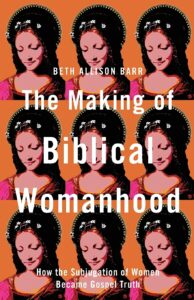
The Making of Biblical Womanhood: How the Subjugation of Woman Became Gospel Truth Beth Allison Barr (Brazos Press) $19.99  OUR SALE PRICE = $15.99

I suppose this could be listed under “Biblical studies” as well — the author offers lots of reflections on how Biblical texts are understood in different kinds of faith traditions (and in different eras of church history, which is her main expertise.) I’ll honor it here under congregational life given the story of the authors church life and the discussion of various camps and movements within the religious landscape.

I think it was a few days before our shipment of these first arrive. I was reading an advanced copy the publisher had sent and Beth (Hearts & Minds Beth, that is) was listening to an interview with Beth Barr on NPR. She came to me to say how impressive it was and that she really wanted to see the book. I had the book in my hands and was about ready to tell her that I was very, very impressed, that she’d want to see it. We both became fans that day, and dug in, realizing she had quite a story to tell and the unique academic chops to tell it in a compelling way.

Dr. Barr was a Southern Baptist evangelical historical with a speciality in medieval studies. She knows how nuns and ordinary women — Catholic and Protestant — read the Bible and lived their lives down through church history. She knows that the recent lingo about “Biblical womanhood” is a fairly recent movement, and the Council of Biblical Manhood and Womanhood are not as simply Biblical as their supporters seem to suggest. Ends up, in great heartbreak, her husband lost his job as a church youth pastor because of his support of her resistance to the mistreatment of women. And so we begin again.

Here are some excepts of my much longer reviewed (paired with three other important words) from an early June BookNotes column.

No lesser a light than historian Kristin Kobes Du Mez of Calvin University thinks that with this  book, The Making of Biblical Womanhood there could be a groundswell shift of views, a tipping point.

One can hope. And, taken alongside Du Mez’s own devastating historical critique (and the careful, irenic, and exceptionally sound Recovering from Biblical Manhood & Womanhood by Aimee Byrd) and a handful of other such texts, we might see an erosion of the unbiblical and hurtful hegemony of Christian patriarchal views and the other unfortunate social consequences that follow from them.

Professor Du Mez is right about Barr’s The Making of Biblical Womanhood. It is fervent and bold and, for those with ears to hear, very compelling. Dr. Barr is a clear and passionate writer whether she is telling her own story as a longstanding Southern Baptist Convention (SBC) wife of a youth pastor, driven from her beloved local congregation over her (and her husbands) honesty about their egalitarian convictions or her work in the academy as a respected medievalist. She can tell a convincing tale about the machinations of a local evangelical/fundamentalist church as well as she can inspire us with stories of empowered 12th century nuns who taught Scripture or late Middle Ages pastors whose wedding sermons (in Latin, of course) say little about gender roles (as do those pushing for so-called “Biblical” womanhood) but invite men and women to mutual submission as they both honor Christ alone.

The thesis of this passionate book is simple: a certain movement of mostly Reformed, often Baptist, theologians and popular writers who wrote the “Danvers Statement” and formed the “Council of Biblical Manhood and Womanhood” (John Piper, Wayne Grudem, Denny Burke, Kevin DeYoung, etc.) insist that they are right in teaching what Biblical womanhood and manhood is and it has created within evangelicalism a strict and harsh movement that has demeaned and hurt many. (And, for some, this male-centric worldview has propped up even a heretical view of the Trinity called “the eternal subjugation of the Son to the Father” showing how their social agenda about power and hierarchy has influenced even their view of God.) They say that this simply what the Bible really teaches and they run with it (with guys like John Piper instructing women who are at home when a mailman visits how to speak in a way that doesn’t deflate his masculine identity; I’m not making this up.)

As a historian, Barr shows that this late 20th century and early 21st century push-back against more egalitarian soundings within evangelicalism, is not in keeping with the beautiful orthodoxy of the best of church thinking down through the ages. She – perhaps inspired by Du Mez, but perhaps not – explains how this pitching of Christian patriarchy as “complementarianism” arose (as the back cover puts it) “from a series of clearly definable historical moments.”

As Scot McKnight (who says, “I could not put this book down!”) writes of it:

Barr’s careful historical examples drawn especially from medieval history hold together a brilliant, thunderous narrative that untells the complementarian narrative.

Beth Barr begins her story with her own inner anguish. It is her story to tell but she and her husband are increasingly out of synch with their strictly anti-feminist church body. It is painful. In these sorts of churches, a woman like her – with a PhD in theological history and a professor at a Christian university – dare not teach teen boys Sunday school. This obsession with one or two verses (misunderstood, many would say) of Saint Paul (while missing other clear texts) silencing women in church creates a fetish so odd that one of her late teen college kids sincerely asked if she had her lecture notes given in the university approved by her husband. She assured him her husband – who did not have a PhD in medieval history – had no desire or authority to do such a thing. The young man was appalled.

Also, there is very good (and lively) scholarship here. Professor Barr explores the Biblical texts and the history of their translation and interpretation. She shows how some women are “written out of” the English Bible – for instance, see her exploration of the infamous Junia vs Junias rendering of Romans 16:7 (and the question of what it means to consider her as one with the apostles.) Barr looks at specific Biblical texts, writes well as a historian about the early church, the pre-Reformation times, and Reformation era understandings of key texts. She shows that the road to what many now call “Biblical womanhood” is rooted in whole lot of very unique debates about specific Biblical subjects. It was fabulously interesting and added new levels of conviction and passion in me.

…for instance, Barr describes the backstory of those traditionalists who alleged that the use of gender inclusive language (that is, “humankind” instead of “mankind,” etc) of an updated NIV was driven by some compromising spirit of the age and which eventually lead to the formation of the ESV translation, done quite openly as an anti-feminist translation.

With chapters like “Sanctifying Subordination” and “Making Biblical Womanhood Gospel Truth” there is some overlap with the Du Mez history from Jesus and John Wayne. There is more Biblical exegesis and as a medievalist she is able to describe pre-and-post Reformation documents and practices regarding women, the home, the family, the church.

The last chapter of The Making of Biblical Womanhood is especially moving, entitled “Isn’t It Time to Set Women Free?” Barr writes about women of the past who fought for recognition of their gifts and authority. She nicely tells of C.S. Lewis’s friend Dorothy Sayers (a 1915 graduate of Oxford who, to Jack’s dismay, affirmed women’s ordination in the Church of England in 1948) and a thirteenth-century female author of Christian fiction (yes, she says, thirteenth century readers loved “trashy romance novels”) named Christine de Pizan who fought against crude and misogynistic views in then-contemporary fiction. Dr. Barr tells about women church historians who are discovering long suppressed stories of women missionaries, preachers, teachers, translators, evangelists.

Barr reveals one of her darkest experiences, involving a guy shaped by the exceptionally authoritarian Bill Gothard Seminar movement. If you’ve read Du Mez (or any number of mainstream exposes of the ugly side of the evangelical movement at the end of the 20th century) or paid attention to sexual abuse scandals among the “pro family” religious right you know the name. God bless Beth Allison Barr for channeling the trauma from her own story and for stewarding well her own professional scholarly gifts in a way to serve us all. It will help heal the pain that some readers experience and it will introduce others to the harmful impact some accepted teaching has.

The Making of Biblical Womanhood: How the Subjugation of Women Became Gospel Truth is a great read, an important expose, exciting, and a helpful foundation for formulating your own view of gospel truth. One of the best books of 2021.
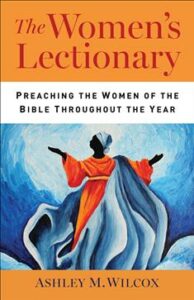
The Women’s Lectionary: Preaching the Women of the Bible Throughout the Year Ashely M. Wilcox (WJK) $40.00  OUR SALE PRICE = $32.00

I’m not sure this Quaker (and graduate of Candler School of Theology and Willamette University School of Law) gets every story or pericope quite right. And she plays with the lectionary calendar a bit (it ain’t set in stone by God, ya know!)But, wow, to have an entire lectionary-based commentary on passages about women in the Bible (and feminine imagery of God) is a long-needed resource. Fairly mainstream Bible scholars (like the respected Luke Timothy Johnson) and teachers of preachers, (like Thomas Long) rave. As Emmy Kegler put it, it offers a “delicate balance of academic and wonder.”

She draws on solid, predictable, respected, sources such as Elizabeth Achtemeir, Katharine Door Sakenfeld, Gail O’Day, Wilda Gafney, Ray Vander Leeuwen, Gail Yee, Carol Meyers, Terence Fretheim, Pheme Perkins, Joel Green, Beverly Gavanta, N.T. Wright, Amy-Jill Levine, Juliana Claasens, Walt Brueggemann, and Renita Weems, just to name a few.

For those who might catch the reference, as a child she attended a Reformed Christian school and was a bone fide Calvinette.

ACADEMIC
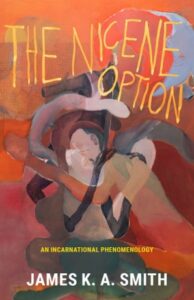
The Nicene Option: An Incarnational Phenomenology James K.A. Smith (Baylor University Press) $39.99  OUR SALE PRICE = $31.99

In recent years the brilliant Calvin University philosophy prof has become known for more popular level books such as Hearts & Minds favorites You Are What You Love and On the Road with Saint Augustine. We have crossed paths with Jamie in various locations and hosted him for a Hearts & Minds public lecture; his many books remain important to thoughtful Christian folks all over the world and to me personally.

This work, which I was proud to struggle through, is a collection of his very deep philosophical essays. Some were chapters previously published in major philosophy texts and some were in academic, peer-reviewed scholarly journals. Finally combined into one major text, this is Christian philosophy at its finest, looking, especially, at contemporary phenomenology and continental philosophy. I even did a bit of a review at BookNotes and thought that deserved some kind of year end award, maybe for audacity. I know enough to know I enjoyed this, mostly, and it is a must for philosophy majors, for those who want to dig deep into contemporary philosophy, and for fans who know the importance of reading Smith, on almost anything.
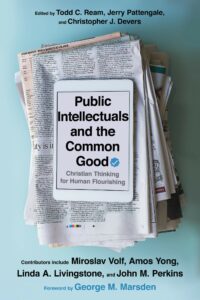
Public Intellectuals and the Common Good: Christian Thinking for Human Flourishing Todd Ream, Jerry Pattengale, Christopher Devers, with a foreword by George Marsden (IVP Academic) $25.00OUR SALE PRICE = $20.00

This is not a book that is overly academic, actually, but it is about the role of Christian scholars and how their work might “go public” and serve the culture at large. This emerged from an extraordinarily good edition of the usually rather studious and restrained scholarly journal, The Christian Scholars Review (Summer 2020) and has been released by the good folks at IVP Academic. I do not know who reads a book like this but I am deeply, deeply moved by this sort of work, calling for the very thing we idealistically imagined ourself somehow facilitating 40 years ago when we followed God’s call to open our shop and try to nurture a community of life-long learners wanting to make a difference in this hurting world. I nearly cry thinking of the possibilities of Christian scholars using their considerable gifts in this way, and the joy of a whole book about it. I applaud these curators, these collegiate dreamers, these nerdy scholars who know enough to know that their work really matters. Thanks be to God.
The Unbroken Threat: Discovering the Wisdom of Tradition in an Age of Chaos Sohrab Ahmari (Convergent) $27.00  OUR SALE PRICE = $21.60

Again, this is not a full-on academic title nor is it on a scholarly/academic press. It is big and thick and erudite and about the history of ideas. And what a good bit of serious thinking it is.

I’ve recommended this in our BookNotes newsletter before, knowing it is a bit more rigorous than some of what we review. Here is how I briefly described it recently over at the new Jubilee Conference on-line bookstore site that we put together:

Sohrab Ahmari is a brilliant public intellectual, a stunning convert to Christian faith and a lively Roman Catholic apologist. (His own conversion narrative is told in his previous book, From Fire, by Water: My Journey to the Catholic Faith.) He writes columns for The Wall Street Journal and the New York Post but here he offers a compelling, scholarly discussion of the role of tradition, of what the role of conservation of older ways and values might be. The militant secularizing French Revolution, based on the secularizing rationalism of the Enlightenment, shaped modernity in a way that it is nearly in the air we breath, always considering “progress” a good thing, that we necessarily should move away from the old (or, better, mock it.) This book is a tour de force inviting us to resist such “newer is always better” assumptions and a critique of liberalism’s individualism — being a “self made” person. He charts a way to return to a wiser, deeper approach because, as Rabbi Meir Soloveichik puts it on the back cover, “we abandon the wisdom of the past at great peril to our future.” Learned, fascinating, provocative.
Playing As Others: Theology and Ethical Responsibility in Video Games Benjamin J. Chicka (Baylor University Press) $44.99  OUR SALE PRICE = $35.99

I have snuck in a few accolades here in our “Best Books of 2021” list, I’ll confess, not because I myself loved the book so very much but because, as a seasoned book-list watcher, reviewer, and intuitive second guesser, I discern that a certain book really is good, important, even. Even if I’ve only skimmed it. This is one of those times. So sue me.

Look: I know next to nothing about this topic so I’m on the lookout always for books that seem to bring bold and profound insights, ethics, at least, and a fresh way of thinking about the whole big thing. I  am not alone in thinking that this exceptionally academic Christian university press is on to something here. Playing As Others is — I’m out on a limb here — a very good book. I dare you to read it and disagree.

Okay, maybe it is worth debating. Here is what we know: it “draws on the theology and ethics of Tillich and Levinas to explore how nontraditional video games can foster empathy and moral formation.” So there’s that.

Theology is capable of uncovering the depth dimension of culture — every aspect of culture, in principle. But video games? Yes indeed. Benjamin Chicka takes theology of culture a lot more seriously than most, and he shows how deep the culture of video games goes. Read this book to find out where ultimate concerns and ethical principles are explored in video games. Read to find out what Paul Tillich and Emmanuel Levinas have in common. This book will forcefully remind you that theology is profoundly connected to every aspect of our lives. Game on!  — Wesley J. Wildman, Professor of Philosophy, Theology, and Ethics, Boston University School of Theology
United in Love: Essays on Justice, Art, and Liturgy Nicholas Wolterstorff (Cascade Books) $34.00  OUR SALE PRICE = $27.20

Deftly pulled together byJoshua Cockayne & Jonathan C. Rutledge and with a heady foreword by Alan Torrance, this volume is a fabulously rich introduction to three of the largest concerns — looming large for many of us, I’d say — of Christian philosopher Nic Wolterstorff. While this is a part of an ongoing “Analyzing Theology” series, and while Wolterstorff can do arcane, scholarly theology with the best of them, most of these essays are not in the field of theology, proper. He is working as a political philosopher and aesthetician and lover of worship. For what it’s worth, the excellent pieces in United in Love were gleaned from stand alone chapters Wolterstorff has offered for other anthologies — some of them from overseas publishers, or expensive volumes from Cambridge University Press or Yale University Press or, in some cases, rather obscure publishers. Having these solid works in one good volume is a major gift to the serious reading public and we rejoice.
The Aesthetics of Discipleship: Everyday Aesthetic Existence and the Christian Life Adrian Coates (Pickwick) $31.00  OUR SALE PRICE = $24.80

This is a very readable dissertation and it assumes that discipleship is embodied. “Formation in the Christian life is not an otherworldly exercise but one that plays in in this world, interwoven with everyday sensory experience in ordinary life.” You can see why I like it!

The Aesthetics of Discipleship is a bit philosophical, and it interacts with Kierkegaard’s framing of “aesthetic existence” and compares this with others who have written about the aesthetic dimension of life, from Bonhoeffer to Iain McGilchrist, Graham Ward to Nicholas Wolterstorff. (And, yes, he cites Calvin Seerveld’s Rainbows for the Fallen World. I would not honor it so if it did not.)

Does mature aesthetic awareness, anchored in love for God and an attentiveness to God’s creation, matter for a life of virtue, a life of discipleship? Does faith formation happen better when shaped by imagination? One heady academic who writes about this sort of thing says that Coates’s study is “engaging and ambitious.”The foreword by South African ethicist (and artist) John de Gruchy is fabulous; Coates, who has studied at Regent College in Vancouver, is himself South African.  Naturally, Craig Bartholomew, a South African who studied with Calvin Seerveld loves it.

Listen to these rave reviews, although, remember — these are themselves academics, so their robust encouragement to read it might be leavened by a reminder that this is drawn from the authors PhD thesis and is quite scholarly.

We have, thankfully, an increasing number of books on embodiment from Christian thinkers. We now also have, finally, a book that recovers the importance of lived sensory experience for Christ’s call to discipleship. Coates brilliantly connects our shared human aesthetic existence to Christ-centered, incarnational living. I highly recommend this book for all readers interested in how to follow Christ, and therefore in the pursuit of true humanity. — Jens Zimmermann, Regent College, University of British Columbia
Nurturing Faith A Practical Theology for Educating Christians Fred P. Edie & Mark Lamport (Eerdmans) $44.99  OUR SALE PRICE = $35.99

This is one of these major tomes that I have not read but just have to celebrate here – surely one of the most significant looking releases of this year in this category. Edie is a United Methodist pastor and veteran youth worker and an associate prof at Duke Divinity School. Lamport is a professor of practical theology who has written and published widelyon themes of formation and Christian education.

After this exceptionally current and quite comprehensive guide to CE ministries in the twenty-first century there are responses from Martin Percy, Almeda Wright, Craig Dykstra, Kiresetn Sonkyo Oh, Elizabeth DeGaynor and Thomas Groome. Wow. I’ve read these responses, first, because, well, that’s how I roll. Its pricey, but with endorsements from the likes of Will WIlimon, Justin Welby, Peter Phan, you know it is substantive.

Honest, inquisitive, theological, practical, comprehensive, and collaborative, Nurturing Faith is an essential primer for “all God’s fellow workers who tend God’s garden where he gifts and grows faith.— Ahmi Lee, Fuller Theological Seminary
The Invitation: A Theology of Evangelism Richard Osmer (Eerdmans) $24.99   OUR SALE PRICE = $19.99

Jason Byassee says this is the “definitive book on evangelism today and likely for years to come.” I don’t know about that, but it at least deserves a good shout out here as one of the most important books this year. There is no doubt that it is rigorous — theologically and Biblically. As a long-time Presbyterian educator at Princeton Theological Seminary, Dick Osmer naturally has some issues with what we might call the “conversationist” approach and offers a “beautiful reimagining” of what we typically think evangelism is and is about. We are going to have to talk about this one, folks…

I kept thinking our friends at the Mercersburg Society would very likely appreciate this. If you get that reference, then you just might need this, too.

Osmer’s Bible study of evangelism in most of the New Testaments writers (and then a chapter putting them in conversation with Karl Barth) is so stimulating.

Throughout, we learn, that he holds to “the essential truth that it is Christ and the Holy Spirit who calls converts and makes disciples—not Christians. Thus, we can invite our neighbors to the wedding feast while remaining reassured that the table is already set.”
Models of Evangelism Priscilla Pope-Levison (Baker Academic) $21.99  OUR SALE PRICE = $17.59

This is another book that I believe is well worthy of being listed, and should be studied and discussed. Some have called it a “landmark contribution to the literature on evangelism.”It basically looks at what she has developed as eight different models of doing evangelism. Wow. Of course, some in mainline churches (this author’s theological context) don’t do evangelism much, or have come to believe it is always pushy and odd. Not this woman! For others, I suppose, evangelism is just a simple thing and this may help bring needed nuanced, if not a righteous complexity. Many have raved about it, from Adam Hamilton to William Willimon who said it is “one of the decades best books on evangelism.”

Just consider:

The familiar faces of evangelism are hot, coercive mantras and cool, manipulative marketeering. Priscilla Pope-Levison will have none of that! Instead, she provides a rich, comprehensive taxonomy of the various spheres of evangelism, each of which reaches out in hospitable ways to different populations. This book will be for a long while the state-of-the-art articulation on this urgent subject. It is a welcome articulation!  — Walter Brueggemann, Columbia Theological Seminary

This is a landmark contribution to the literature on evangelism. Steeped in detailed historical study, written with grace and wit, and informed by years of reflection, Pope-Levison’s book gives us a splendid overview of our options for evangelism. It is a total pleasure to recommend it without hesitation or qualification.  — William J. Abraham, Southern Methodist University

After writing this little announcement, I learned that Outreach magazine name Models of Evangelism a 2021 Resource of the Year. Congrats.
Restless Devices: Recovering Personhood, Presence, and Place in the Digital Age Felicia Wu Song (IVP Academic) $24.00  OUR SALE PRICE = $19.20

I have described elsewhere how this amazing, astute, scholarly work emerged from lectures given among the network of Christian Study Centers at universities around the country.

There are lots of good books that explore the social and cultural impact of digital media. There are lots about habits and practices in our own life as we navigate being disciples in this digital age. However, there are few books that bring together such serious socio-cultural analysis, important philosophical considerations about technology, vibrant faith and a hopeful Christian imagination as does Restless Devices. I really want to honor it as one of the more significant titles of this sort this year.

As one reviewer noted, “In our current digital ecologies, small behavior shifts are not enough to give us freedom. We need a sober and motivating vision of our prospects to help us imagine what kind of life we hope to live — and how we can get there.”

And isn’t that a huge, elephant in the room whenever we are setting ground rules about our use of technology — what kind of people are we becoming and what kind of people do we want to be?

Listen to these excellent recommendations. No wonder I celebrate it here, now, as a Best Book of 2021.

I have been looking for this book for years. Dr. Song brings the top scholarship and the deepest Christian reflection to bear on the important spiritual topic of how we faithfully engage our devices. In this digital age, which requires new forms of moral and spiritual reflection, there are few topics that could be more relevant or more needed. This is a book I will read again and again.— Elaine Ecklund, professor of sociology at Rice University and author of Why Science and Faith Need Each Other: Eight Shared Values That Move Us Beyond Fear

I have longed for a book like Restless Devices to be written. Felicia Wu Song compellingly examines the addictive qualities of digital media – its ubiquity and totalizing power. But her depth of expertise and profound Christian imagination allow her to go further than mere critique. She offers us practical hope in the ‘counter-liturgies’ of the Christian faith. I highly recommend this powerful work of spiritual formation to all who seek to live humanely and faithfully in our digital age — Tish Harrison Warren, Anglican priest and author of Liturgy of the Ordinary and Prayer in the Night

Christ-Enlivened Student Affairs: A Guide to Christian Thinking and Practice in the Field Perry L. Ganzer, Theodore F. Cockle, Elijah G. Jeong, Britney N. Graber (Abilene Christian University Press) $22.99  OUR SALE PRICE = $18.39

There are not many distinctively Christian, well-researched, principled, seriously professional books for those with the vocation of working in collegiate student affairs; indeed, friends of ours published what may have been the first evangelical contribution to the field (edited by David Guthrie, Students Affairs Reconsidered, and cited nicely here.) These authors bring that groundbreaking volume up to date, exploring theories and practices, faith and the calling into higher education, offering “a robust theological perspective for Christian student affairs.”

The book is animated by a love for God, a profound care for students and a passionate engagement with the best thinkers in the field. It includes a lively discussion of research from a national mixed-methods study.

MEMOIRS

No Cure for Being Human (And Other Truths I Need to Hear) Kate Bowler (Random House) $27.00  OUR SALE PRICE = $21.60

We have been big fans of this incredibly talented writer, her two well-known memoirs ofher life with her cancer, and her two works based on her fascinating academic research topic (one on Oxford University Press about prosperity preachers and another about the lives of women leaders in evangelical and charismatic megachurches.)

Not only was No Cure for Being Human one of my favorite memoirs this past year, it was one of my favorite books! Bowler’s great wit, heart-wrenching pathos, love for family and friends, her considerable sass, intelligence, faith — deep, but not cliched or fundamentalist — made for great reading; many times I’d just set the book down, sigh, exclaiming how darn good the line or phrase was. The joy of reading her word-smithing line by line aside, it is a page-turning story of her ongoing coping with cancer. I loved the earlier Everything Happens for a Reason (And Other Lies I Needed to Believe) and this is even better. Surely a book of the year

We’re excited, by the way, that her brand new daily devotional (Good Enough) is just now out. Good Enough: 40ish Devotionals for a Life of Imperfection Kate Bowler with Jessica Richie (Convergent) $21.00  OUR SALE PRICE = $16.80

I was thrilled, by the way, to see the name of our friend Cole Arthur Riley, whose amazing new book This Here Flesh just released a few days ago, in an endorsing blurb, right there on the back cover, right by Barbara Brown Taylor. I know that is happening in real time, this week, in 2022, but this is worth a shout out now:

“With humor and wit, Good Enough guides us into a spirituality that is at once rich and humble, challenging us to search for beauty and meaning in deep waters, yet never asking more of us than a tender and compassionate God would. This devotional is medicine for all those thirsting for mercy in the mundane.”—Cole Arthur Riley, author of This Here Flesh and creator of Black Liturgies

Where the Light Fell: A Memoir Philip Yancey (Convergent) $28.00  OUR SALE PRICE = $22.40

I have read many books by Phil Yancey, watched videos, did author events watching him sign books, and done classes on his work. I’m a fan, and highly recommend his thoughtful, eloquent, but clear and accesible prose to all. This is his long-awaited memoir about his toxic, racist, home church, his tough childhood, his faith journey, his troubled brother, and more. I rejoice that he is still a gentle Christian, a sharp evangelical, a reliable Christian witness. Now we know a bit about why he is over and over drawn to themes of suffering and themes of grace.

Raw, honest, beautifully written, and at times searing . . . We live in a world that is always clouded by ungrace, by strife and anger and division, according to Yancey, and Christians should be on the other side . . . The pain of [Yancey’s] early life gives his words and his witness an authority and authenticity that he would otherwise not have. He has become, over time, a person to whom the wounded and the brokenhearted are drawn, compelled by his message of grace. — The Atlantic

Where the Light Fell is in many ways a classic spiritual autobiography tracing one man’s conversion from cynic to believer. But it’s more. It’s a searing family story as revelatory as gothic Southern fiction. It’s an exposé. It’s a social critique. It’s a tragedy. It’s a tale of redemption. . . . The memoir itself is an answer to the question that looms throughout: What do we do with the burdens, sins, and pain of our past?” — Christianity Today

Philip Yancey is not just one of my favorite Christian writers, but one of my favorite writers, period. He is fearless in addressing the toughest questions and hardest times, the crucifixions we will all know during this life, the hope and shapes and colors of resurrection.  — Anne Lamott, bestselling author of Dusk Night Dawn

The Deep Places: A Memoir of Illness and Discovery Ross Douthat (Convergent Books) $26.00  OUR SALE PRICE = $20.80

I think that my longer review at BookNotes is worth reading —I couldn’t put this vulnerable book down and couldn’t stop talking about it — but the short version might go like this:

For the many who have been made seriously ill by Lyme or other tick-born diseases, we know well the painful disorientation, the desperation, even, for a cure, or at least for a doctor who believes us, who understands. This eloquent and sophisticated writer — a fairly conservative columnist for The New York Times and a devout Roman Catholic — was laid low by a mysterious illness which ended up being chronic Lyme. He was not prepared for how this lead him to underground networks and odd associations, searching for healing insight, for help. He writes that a year earlier he wouldn’t possibly have imagined himself being with people who were also conspiracy theorists, even weird and troubling, but there he was. They shared a common passion to get better, no matter what.

The Deep Places is truly an exceptional memoir, fascinating and informative, about illness, but much more than that. It tells about being a young man at the top of his career with a wife and kids, buying a home, and coping with unbearable chronic pain. Finally, though, it is a question of who to believe, how we know what is best (how do we really know anything?) what is true, especially regarding medical mysteries. I find myself wanting to shout about this from the rooftop as it is so very important, even in these Covid days… and so moving. The Deep Places is wise and caring and intersting and very important for any and all of us. Anybody who has had Lyme will understand! Very highly recommended.

Read these comments about the wonder and value of this book, please:

Douthat artfully weaves two stories together. The first is the story of his own illness, the increasingly outlandish treatments he is willing to try, and the havoc the affliction wreaks in his life. As he looks for a cure, he uncovers a second story: the strange tale of Lyme disease itself . . . No two chronic illnesses are exactly alike, but even so this book will likely resonate with anyone who has suffered from a chronic condition or has cared for someone who has. — Paul W. Gleason, LA Review of Books

To call it a memoir about illness is to seriously underestimate this beautiful new book. Douthat brings a believer’s heart, a journalist’s curiosity, and a writer’s talent to tell an achingly human story that is, ultimately, about life. — James Martin, SJ, bestselling author of Learning to Pray

I read the book in one sitting. It is so profound and truthful about the human condition. I wanted it to go on and on. I had no idea that Douthat was such a poet of pain and hope. — Rod Dreher, bestselling author of Live Not by Lies and The Benedict Option

No Place: A Spiritual Memoir Margie Haack (Square Halo Books) $24.99  OUR SALE PRICE = $19.99

Happily, this has been one of our big sellers this year — we so appreciate the Ransom Fellowship support that Margie and her husband Denis have given us over the years, and they’ve sent many of their devout fans our way. As we’ve said in two fairly long BookNotes reviews, this is a remarkable memoir of the early marriage of Margie and Denis, their slow move away from a legalistic and toxic sort of fundamentalism even as they deepened in their honest desire to serve Christ and his Kingdom, finding their way to a more honest and culturally engaged faith style. And what did cultural relevance look like in the very early 70s? They were part of a counter-cultural Jesus-people community in New Mexico offering hospitality and gospel care to hippies of all sorts, from druggies to revolutionaries to occultists. That they were on the cutting edge of contextual mission in those days is putting it mildly. (And, how did this idealist sort of work effect their marriage? Their ability to find work in a more conventional church, later? Did it put them on a path towards their later life ministry? My, my, what a story this is. What a life they’ve lived.)

No Place is a splendid memoir of a new marriage, the high octane cocktail of religion and counter-cultural life of the late 60s and beyond; it stands on its own merits as a fine sequel to Margie’s excellent girlhood memoir The Exact Place. Yet, we have suggested that this great book is more than just an entertaining story, a literary memoir that tells of some interesting times that you will enjoy. It is, in many ways, a parable of life and times, of faith and life, of radical discipleship, of a search for meaning and purpose and, yes, home. I think you will be a God who is faithful as you read it.

By the way, as we have noted, her earlier The Exact Place has just been reissued in a newly edited version from Square Halo Books with some new content and a brand new (matching) cover. Volume Three of the set, which was once called God in the Sink: Notes from Toad Hall has new material, too, and has just been reissued as This Place.

No Place (the middle one) is the one that released in 2021; the new Square Halo editions of the older first and third ones are just now out in February 2022. Buy all three in their new matching editions — The Exact Place, No Place, and ThIs Place. In cany case, don’t miss going on their early 70s journey to no place, where they find a real place. No Place is one of my favorite reads of 2021.  All three are 20% off.

Sparrow: A Book of Life and Death and Life Jan Richardson (Wanton Gospeller Press) $24.00   OUR SALE PRICE = $19.20

Oh my, I can hardly say in plain words why this elegant book deserves to be on any list of best books of recent years. It is a memoir of loss, the artistic, spiritually-deep author writing well about her husband’s death, and more. This is a beautifully made hardback book and poetically written, as you would expect from poet, writer of prayers and blessings and liturgies and devotions. Sparrow is a book that feels holy to hold, about enduring love and grace. It is the memoir that perhaps could be seen as the backstory of the moving prayer-poems in A Cure for Sorry which we also stock.

Here is how it is describes by her publishing venture:

“Who am I, when the person who saw and knew me best in all the world is gone from this world?” Jan Richardson’s question lies at the heart of Sparrow, a book that began as notes written to her husband, the singer/songwriter Garrison Doles, while keeping vigil for him in the hospital after a disastrous surgery just a few years into their marriage.

Six months after Garrison’s death, Jan returned to those notes and began to write again. The pages grew into an unexpected conversation as she worked to make a new life. Here, Jan invites us into that conversation. She resists simple answers for deepest sorrow, entering instead into the raw complexities of grief, which she calls “the least linear thing I know.”

In Jan’s distinctive spare and elegant style, Sparrow traces a path through the first few years after her loss, articulating not only the ache of grief but also the strange graces and stubborn hope that live within its landscape.

On the Spectrum: Autism, Faith, and the Gifts of Neurodiversity Daniel Bowman (Brazos Press) $19.99  OUR SALE PRICE = $15.99

I hope you recall my rave review of this at BookNotes last summer. Daniel Bowman is a beloved professor at Taylor University and a thoughtful Christian scholar of literature, a writer and poet. In this exceptionally moving story he tells of his own experience of neurodiversity and what it is like to be an adult Christian leader who is on the autism spectrum.

Interestingly, there are many books about being autistic and many are not written by persons with autism. Here he remedies that by telling of his own struggles, his theological considerations about the gifts of neurodiversity, and how we might all learn from one another. This is a great read, good for all of us, and one of my favorite books of last year.

Outlove: A Queer Christian Survival Story Julie Rodgers (Broadleaf Books) $24.99  OUR SALE PRICE = $19.99

I have written about only a few of the many books I’ve read about the experience of LGBTQ Christians, learning from their stories, their anguish, their joys and sorrows. In talks about reading widely I often mention the gifts of empathy and care we can develop as readers when we “walk a mile” in another’s shoes. I have been criticized for this scope of reading and yet resolve to hold up stories of people many of our customers may not be inclined to consider.

This memoir of Bible believing, evangelical Julie Rodgers is illuminating for a variety of reasons. The short version would say how she was a poster child for one of the ministries that tries to “pray the gay away” and that she often went on the road with a male leader of such a ministry, learning to give her testimony and share with others about God’s eagerness to change their same-sex attractions. It is a poignant glimpse into conservative, evangelical para-church ministries, her caring home life, her home church and her own coming of age as a young evangelical leader. The problem was — most of this simply wasn’t true, and the story became one of her coming out her leaders, slowly realizing that she was not who they wanted her to be. In a remarkable part of the story, they wanted her to just keep on telling the tale, essentially asking her to deceive others about her own life and about the promises she was making. When she finally couldn’t keep up the charade, this mentor who had professed spiritual care for her dropped her. It is a terrible part of the story.

Those who have studied the demise of Exodus and other such ministries know well that hardly no one had the sort of transforming change they alleged to have had and few were fully honest about their desires and interior lives since they didn’t fit the narrative.

The next part of Rodger’s journey was as an out gay Christian but one committed to celibacy; there are others who have written powerfully about this faithful option — I think of Wes Hill and his Washed and Waiting, say, or the nicely written books by Greg Cole — and in this new sort role as a new sort of spokesperson, Julie was hired by a well known evangelical college, perhaps the first such out gay follower of Christ to take up a position in any such college. She started doing Bible studies and providing safe fellowship spaces for LGTBQ students, many who were holding on to their faith by a thread, some who were deeply distrustful of evangelical faith. She thought was being supported by the college but as she tells it that was not the case. I won’t offer a “spoiler” but it is a dramatic story, full of anguish and betrayal and institutional politics that should embarrass the college leadership. The book tells of loss and change and renewed sorts of faith.

I found this to be another memoir that I was very deeply moved by, a story that needs to be heard, learning how some of our brothers and sisters, sons and daughters, experience their faith as those with same sex attractions. Memoirs are a real gift, a window into how others constue their lives and tell their stories. Agree or not it, it is their own story to tell, and therein lies the great gift.

Shoutin’ in the Fire: An American Epistle Dante Stewart (Convergent) $25.00  OUR SALE PRICE = $20.00

After reading some of this a second time I am even more sure I want to honor it as one of the best books of 2021. Here is some of what I wrote about it last fall:

When people we know and respect so highly promote a new author, we notice. For instance, Calvin University scholar and popular historian Kristin Kobes Du Mez says:

“A magnificent debut. . . If you read one book this year, make it this one.”

Robert Jones, Jr., himself a New York Times bestselling novelist (author of The Prophets), says:

Only once in a lifetime do we come across a writer like Danté Stewart, so young and yet so masterful with the pen. This work is a thing to make dungeons shake and hearts thunder.

The advanced recommendations and rave endorsements kept coming in, from Krista Tippett, Rev. Jacqui Lewis, Imani Perry, Kiese Laymon, Bishop William Barber, Jonathan Wilson-Hartgrove, even the Pittsburgh-based fiction writer Deesha Philyaw. The praise has been shoutin’.

In a way, this book stands among many memoirs naming the complexity of the black experience in white America. Tisby is right — the prose is arresting, the meditations emotional, the insights revealing. One reviewer said Shoutin’ in the Fire is written with “unparalleled candor” which, while perhaps not technically accurate, does illustrate that his is one of the voices in the movement of black authors being real; really real, telling it like it is as we used to say. (This candid truth-telling by black writers is not new, of course, but it does feel particularly frank and fresh, given Stewart’s role within the church and how that is part of his story of “groan and ache.” If you have appreciated the highly-regarded memoir I’m Still Here: Black Dignity in a World Made for Whiteness by Austin Channing Brown (the same publisher, the same shape of trim-sized hardback) Shoutin’ in the Fire should be on your list. It is a book you will find it hard to put down.

I needn’t say much more other than to say that we feel privileged to get to recommend and to sell such important books by black authors of this calibre. Young Mr. Stewart is a very good writer — you can tell from the very first pages — and he is rooted well in a black family in the black community in the black church.

He knows whose shoulders he stands on, too — he cites before each biographical chapter a good epigram, authors like James Baldwin (there’s that fire language, eh?) And bell hooks, Gwendolyn Brooks, Toni Morrison, Audre Lorde, Nikki Giovanni, Ta-Nehisi Coates. And Maya Angelou, of course. And, happily, near the end, rapper Kendrick Lamar. So Danté is a lover of language, nearly a rural poet himself, coming up in Calhoun County, South Carolina. His BA degree was in sociology from Clemson (where he also played football) and he’s currently studying theology at Candler School of Theology in Atlanta. As a writer and speaker, he is one young leader to watch. We all need, as Stewart puts, it in a closing note to Baldwin, “praise breaks and prophetic lines: We shoutin’ in the fire.”

Kin: A Memoir Shawna Kay Rodenberg (Bloomsbury) $28.00  OUR SALE PRICE = $22.40

We are told that “This startling memoir of a wild soul will electrify you. The unbreakable Shawna Kay rises again and again to forgive, despite every institution that failed her.”

And, yep, that was true.

Or, this, from Rosanne Cash: “Kin moved me, disturbed me, and hypnotized me in a way very few memoirs have.”

I know Ms Cash is especially literate and has endorsed another memoir or two that were remarkable. She, like many of the other reviewers, have noted that this story is written as “an intimate portrait of hardscrabble life in a much-derided, little understood place.” Michael Patrick Smith (author himself of The Good Hand) continues:

With the grit of the damaged yet hopeful, Rodenberg crafts the raw notes of faith, addiction, and generational trauma into a hymn to survival. By focusing on the deeply personal lived experience of a family, Kin contains worlds.

Indeed, it “contains worlds.” Like other memoirs of abuse and complications of family and place, you may not exactly imagine yourself there, and yet, yet, you relate. There are universal themes here, including a love of place, shame about poverty, relationships that are toxic, religion, faith, spirituality, education, culture, and adult children loving their parents despite the often horrible mistakes. And — oh, my — forgiveness.Who wouldn’t benefit, or at least be stimulated if not inspired, by looking over the shoulder at one truly memorably family coping with so much grit and grace?”

Here’s the deal with this complicated, well-written story. First, you should know that Shawn had a very hard upbringing with hard-scrapple extended family in small towns among the mountains of Appalachia. She is now a somewhat sophisticated, college literature professor in another State and the book opens as she is serving as a liaison to the local folk in the holler with a big city TV crew doing some kind of documentary. The New Yorkers disdain for the local people (and their crass stereotypes, asking her to help them find shots that simulated the hillbilly optics they wanted) is exceedingly annoying and Shawna Kay’s keen capacity to relate to two different worlds is obvious. I do not make comparisons of the people or even the books, but because many readers will get the reference, I suggest that she is, in some ways, like Tara Westover of Educated and J.D. Vance of Hillbilly Elegy and, more recently — in some surprising ways — perhaps even Philip Yancey of Where the Light Fell.

Yancey describing growing up with a faith that was harsher than most, “much worse.”

Kin narrates a story that was “much worse.” And not only worse, but much more weird.

You see, Shawna Kay Roderberg (who tells her story with “near heroic self-awareness and insight,” as one reviewer put it) was raised on-again, off-again, in a very strict fundamentalist cult in Minnesota. Maybe not a cult, but at least an expression of exceptional Pentecostalism and hyper-fundamentalism that drew her parents to live in a sectarian community, off the grid, prepping for the end times. She was raised — at least during her time in the fellowship — on a rural compound, eating meals in what sounds like a church camp setting, living in cottages that are meagerly appointed and hardly heated. This in the late 1970s and 80s, with parents who renounced the world and forbade their children most toys and books and most contact with the outside world. How her parents got into this heavy Bible teaching of Reverend Sam Fife is another part of the story and the ways she both appreciated and hated the rules of the place are fascinating. (To say Shawna is precocious is quite the understatement!)

I award this as one of the best books of 2021, without a doubt. It is playful and funny at times, horrible and horrific at others. The fellowship believed in corporal punishment, of course, and there are some scenes of harsh abuse (and other bizarre stuff that seems almost expected in these kind of highly authoritarian religious sects.) Even when they move away (backsliding, as they might call it) they connect yearly with others in this network at larger gatherings.

I hope I’m not saying too much when I hint that her parents themselves have an epiphany or two about the heavy-handed and anti-worldly fellowship. They get a job serving the movement away from the intentional community and, on some days, allow a more normal lifestyle. Their faith wavers, they fall away, they move back to Appalachia.

And we thought the people in the Minnesota sect were toxic and odd. Well, man, this story is just heating up.

Shawna, knowing little about 1980s junior and senior high fashion, let alone popular culture, enters her school in Eastern Kentucky.

Shawna was permitted and has nearly memorized from repeated re-readings the Little House on the Prairie books and the way those stories keep coming up is a fun device. It is a part of her childhood that she clings to even as she gets older. The narration of her years in school back in small town Kentucky — learning how more ordinary rural kids live in public schools, enjoying time at DQ and Pizza Hut and going to the Dollar Store and school events and attending more ordinary country churches — is striking. How little she knows about school life, popular culture, attire, even. Not to mention, shall we say, sex, drugs and rock and roll. But she is a fast learner. So there’s that.

To make matters worse, although it is not explored in detail, there are hints of PTSD from her father’s Viet Nam war service. Which perhaps explains some things…

This family is troubled, and various branches of their relatives have their strengths and weaknesses. It will keep you turning the pages, I promise. Rodenberg both makes Appalachian life and near poverty vivid and compelling but her story dispels many stereotypes (even as it might reinforce others.) Her angle of vision and the tone of the book is decidedly not Hillbilly Elegy. I love the blurb on the back of Kin, that says, “Whatever you believe about Appalachia, prepare to have those beliefs upended, or at least beautifully complicated.”

Beautifully complicated. That’s it! Kin and my feelings about why I loved it so are beautifully complicated.

This recent book, a personal favorite this year, is a high-octane memoir full of vivid descriptions, colorful stories (and colorful language) telling of the struggles of deep faith, distorted as it may be, family love and dysfunction, violence and harm and goodness and redemption. Can telling a story like this itself be an act of hope, what too many reviewers too casually call redemption? I think so. In that sense the above-quoted writer who said this is “secular Scripture” is wrong. It is not Scripture, of course, but it is not utterly secular either. This is a story of some sort of amazing grace and through the ups and downs, extravagant weirdness, family mental illness and unreliable choices, the story shines. 

Hollywood Park: A Memoir  Mikel Jollett (Celadon Books) $27.99  OUR SALE PRICE = $22.39

Okay, I will admit I am on a roll here, recalling the most vivid prose, the most creative writing, the most breath-taking stories of 2021. (See my November 2021 list of memoirs for some others that I read last year, but did not come out in 2021, like the stunner by Carolyn Forche or the investigative story Soul Full of Coal Dust.) This one, though, this one, was a book I will never forget. Beth says that, too, as we both turned pages and pages late into the night, first me and then her. We both were heartbroken and perplexed, entertained and moved.

I want very much to talk about this, but I know I have written more than many can hardly endure. I am sorry — these are some of my favorite books and I want to describe them in a way that is enticing but honest. Some may not find them suitable, and I understand. And this is one, too, with some pretty harsh language and some pretty rough stuff.

I have liked Mikel Jollett as a free lance writer, a guest on NPR, a rock music critic, but mostly as front man for the alt-rock band Airborne Toxic Event. (Anybody who names their band after a line from a Don DeLillo novel is pretty cool if you ask me. This is not gospel music, mind you, so don’t misunderstand. If you are interested, I especially appreciate their second studio album, 2011s All At Once.)

This very complicated and incredibly well-written memoir tells of Jollett’s life growing up (as a very young child) after his mother and father snuck him out of the drug-treatment center turned oppressive cult, Synanon. The place was corrupt, evil, even, and the book explores — after years of family weirdness and break up and a very dysfunctional mother and an addicted turned good guy dad and horrific treatment on many fronts — Jollett’s attachment disorder and damage done having grown up in a communal setting without connections to parents or siblings. The story unfolds with increasing awareness of the horror of the cult, and Jollett finds solace, finally, in song writing and going on the road as a performer. His passionate writing about being on stage is some of the best rock and roll writing I’ve ever read.

The new millennium post punk scene was fascinating; the drug stuff (among teens!) was shocking to me; the narcism of the mother was among the most tragic bad parenting I’ve ever read about… and yet, Mikel loved her, cared for her, as he had too, really. Eventally, Jollett grows as a writer, grows as a musician, and, well, he tells an amazing story about struggles and longing and loss and some sort of redemption. The Hollywood Park in the title of the book alludes to an old LA-area horse race track and figures in as a place he and his dad would. There is a scene near the end that, well… get the Kleenex out is all I’m saying. This is one of the most fascinating memoirs I have ever read, a book I think I will never forget.

BEST BIOGRAPHY (of C.S. Lewis)

The Making of C.S. Lewis: From Atheist to Apologist (1918- 1945) Harry Lee Poe (Crossway) $32.99  OUR SALE PRICE = $26.39

Okay, I didn’t want to be overly pompous declaring this the best biography of the year. I have not read that many biographies (and even though we named the Robert E. Lee bio by Guelzo last week in Part One of this list of favs, I had the good sense to list that under “history.”) Best biography? That’s above my pay grade.

But I am quite confident that this second volume in what I gather will be a trilogy is, without a doubt, the best biography of Lewis in many a year. Alan Jacob’s wonderful The Narnian and Alister McGrath’s C.S. Lewis: A Life – Eccentric Genius, Reluctant Prophet are contemporary standouts, but this, being a multi-volume set, certainly is able to explore deeply. It’s begin touted as one of the best.

The first volume, on Lewis’s boyhood (Becoming C.S. Lewis) is said to be the best work on the subject to date. This one proceeds, without sentimentality or breathy prose, where the first one left off, in 1918 as Jack is convalescing from the famous and painful shoulder wound because of which he was evacuated from France. Poe plainly reminds us that the shrapnel remained in him, troubling him for years, as did the headaches and night terrors. “His wound,” Poe notes, “may have inspired the shoulder wound of Frodo Baggins when J.R.R. Tolkien wrote Lord of the Rings.”

This, then, follows his coming of age during the great war, as he returns to Oxford, his love of literature, his poetry. Of course his friendships with Tolkien and the other Inklings and his slow conversion to Christ. Most know that what became Mere Christianity were firstly aired on the BBC as radio talks. Many know about his friendship with Tolkien, Dorothy Sayers, and other Inklings. Some may know about brother Warnie and Mrs. Moore, Addison’s Walk and the Kilns. But there is so much detail, clearly told. It is, as Lewis scholar Colin Duriez puts it, “refreshingly accessible as well as deeply knowledgeable.”

Kudos to Crossway for a lovely design, the black and white photos so sticking as endpapers and the textured dust jacket. In every respect, this deserves to be considered one of the best books of 2021

FAVORITE NOVEL

Crossroads: A Novel  Jonathan Franzen (Farrar Straus & Giroux)  $30.00  OUR SALE PRICE = $24.00

I have held up this whole newsletter, this award sheet, this ramble of a year’s worth of some of my favorite books, or books I think are important, or need to be honored here, just because I wasn’t sure I wanted to write about this. To pick a novel is hard; really hard. Beth couldn’t even begin — she served this year on a judges panel for an ECPA award for fiction, and she has really enjoyed so many this year. (And they sent her the books for free! Yay!)

IfI had to pick a work of fiction that has stood out for me, that I lost myself in, that was worth every penny of entertainment dollar spent, it is clear which I would say. Without a doubt, my favorite novel this year was this much-discussed, very surprising, very contemporary bit of serious fiction, Crossroad by the famously talented Jonathan Franzen.

Some do not like Franzen; he is too hip, too cool, maybe, too much of a symbol of new millennium novelists, so full of artful detail and yet social commentary. I don’t know about that, I just know some love him and some hate him. I really, really liked The Corrections and Freedom. And I was captivated by Crossroads, every one of the 580 pages. (Well, except that last page; I’ve got issues with that.)

I really hate to spoil the fun — I didn’t know a thing going in to it — but I suppose you could know this much. It is about (get this!) a liberal, mainline church (maybe UCC, although it is called “First Reformed”) and their youth ministry, a hang-out place full of psycho-babble and group authenticity, set (before the considerable flashbacks) in 1971. There are urban ministry trips (maybe well intended, although sometimes not, suburban white folks going to the ghetto) and there is an epic youth mission trip to a Native reservation. There are prayer services and church staff meetings and some college-age folk singers who are maybe going to make it big, (but they have their principles, man, you know?) They debate the war, in more ways than one. There is professional jealousy, all sorts of theological stuff (including a smart teen of a mainline pastor who finds herself born again at a neighborhood Baptist church and critiques her father’s vapid sermons and boringly goofy theology.) So, so much of this rang true (yes, the youth ministry place was called Crossroads) and much of it just astonished me.

This is a very contemporary novel, haunted by God, but not at all what some might call a “Christian novel.” Again, I am astonished at how very much faith and theology and heart there is in this story set in the troubled family of a mainline clergy-person. How did Franzen learn about this stuff? How does he get so much right (and some things that seemed not quite right for early 70s church life.)

I will also say this: I am not sure what it means to say a book is postmodern but it is very knowingly self-aware about the interior lives of the characters, all of them, and there is more fear and doubt and guilt and shame and sex and drugs that you can imagine in book about religious people. So, as with some of the memoirs named above, this is not for those unwilling to engage the mores of modern fiction and the ethos of, of, of, whatever is going on here. Does it offer glimpses of gospel? Does it revel in showing the crummy humanity of even the religious? Does it understand grace, despite all the talk of it? Is it all ironic? Is he a Christian?  I can ‘t say. But it was a heckuva a story, a sprawling epic of unhappiness and church and justice and love. Even the Kirkus Review says it had moments that were “uplifting” and declared that it was, “in a word, exquisite.”

It is said that Mr. Franzen has two more in the saga of these 1970s Hildebrandt’s. I can’t wait.

TO PLACE AN ORDER

PLEASE READ THESE SIMPLE REMINDERS AND THEN CLICK ON THE “ORDER” LINK BELOW.

It is helpful if you would tell us how you prefer us to ship your orders. The weight and destination of your package varies but you can use this as a thumbnail, general guide.

There are generally two kinds of US Mail options, and, of course, UPS. If necessary, we can do overnight and other expedited methods, too. Just ask.

  • United States Postal Service has the option called “Media Mail” which is cheapest but slow and may be delayed. For one book, usually, it’s about $3.50 – $4.00
  • United States Postal Service has another option called “Priority Mail” which is about $8.35 if it fits in a flat rate envelope. Many children’s books are oversized so that will take the next size up with is $8.95. That gets much more attention than does “Media Mail.”
  • UPS Ground is reliable but varies by weight and distance and may take longer than USPS. We’re happy to figure out your options for you once we know what you want.

– DON’T FORGET TO LET US KNOW WHAT SHIPPING METHOD YOU PREFER –

HELPFUL HINT: If you want US Mail, please say which sort — Media Mail or Priority Mail — so we know how to serve you best. If you say USPS or “regular” we’re left scratching our noggins.

BookNotes

Hearts & Minds logo

SPECIAL
DISCOUNT

20% OFF

ALL BOOKS MENTIONED

+++

order here

this takes you to the secure Hearts & Minds order form page
just tell us what you want to order

inquire here

if you have questions or need more information
just ask us what you want to know

Hearts & Minds 234 East Main Street  Dallastown  PA  17313
read@heartsandmindsbooks.com
717-246-3333

We are still closed for in-store browsing due to our commitment to public health and the common good (not to mention the safety of our staff and customers.) The vaccination rate here in York County is sadly lower than average and the hospitals are overcrowded. Our store is a bit cramped without top-notch ventilation so we are trying to be wise and faithful. Please, wherever you are, do your best to stop this awful sickness going around.

We are doing our famous curb-side customer service and can show any number of items to you if you call us from our back parking lot. We are eager to serve and grateful for your patience as we all work to mitigate the pandemic.

Of course, we’re happy to ship books anywhere. Just tell us how you want them sent.

We are here 10:00 – 6:00 EST /  Monday – Saturday, closed on Sunday.


Hearts & Minds BEST BOOKS OF 2021 — PART ONE

It’s been quite a year. Despite Covid hardships, supply chain hassles, and anguishes of many sorts, good books have been an inspiration and solace, entertaining and empowering. We thank God for the publishers (some who make me crazy with their terrible packing and unclear paperwork and frustrating customer service) who are, mostly, doing extraordinary work keeping the printed page alive and well in these perilous times. I mean that: we wouldn’t be here if it weren’t for publishers, sale reps, publicity teams, and book reviewers who help us in this industry daily; we are grateful.

Of course, none of us in this glorious network of bookies promoting the reading life would have much to do if it were not for the writers. Thank the Lord for those who use their God-given gifts of crafting good sentences to help us imagine a new world. From fiction to nonfiction, poetry chapbooks to formal prayer books, those doing this often grueling, creative work are to be honored. It has been our joy to champion a few good writers and their good books.

I am sure that you, too, dear readers, have favorite books you’ve treasured this year. Why not send a note to a writer you’ve appreciated? Better yet, why not buy an extra copy of a book you adore and give it away? That’s how you best thank an author. From an independent bookstore, of course.

Some authors have become long-distance friends this year; a few this year have even become Hearts & Minds customers. What a privilege to serve folks in this way. It is not lost on us how cool it is that we get to do this kind of work.

Naturally, we’ve helped local folks with lots of backyard customer service. We are taking the pandemic seriously, still, so we remain closed for in-store browsing and we’re grateful for those who allow us to serve them curbside. We’re glad for those who asked us to ship books to their events, who have partnered with us in creative ways to get books into people’s hands.

Our staff remain cheerfully eager to serve one and all, and we’re grateful for their commitments to books and reading and helping our customers and friends. They do a lot in tough circumstances, believe me.

This year we’ve found items to help with weddings and funerals, baptisms and confirmations. We’ve helped children who are reluctant readers find just the right book.   We’ve helped those who are struggling with tragedy find resources that have served them well.  We’ve helped countless Bible study groups and Christian training classes and Sunday school groups find ideas to pursue. We’ve gotten books to those who were taking up new projects or ministries and needed resources. We helped college and seminary students find needed textbooks; in fact, we’ve helped professors pick their textbooks. We’ve found odd, out-of-print items for desperate readers and saved a few book groups or classes at the last minute when a certain well-known online place let them down without warning. We’ve driven to urgently deliver books out of town and each of our staff have made personal home visits. We’ve served churches of all sorts, of course — what a privilege! — but also colleges, hospitals, prisons, nursing homes, schools and a couple of think tanks. We’ve sent books overseas and we’ve sent books across town. We’ve special ordered books that are so bad it makes us gag and books that are so wonderful they make us weep. 

We are touched by the wonderful little notes people send along with their checks in the mail or the email replies we occasionally get when folks read the books we’ve suggested. We’ve taken our fair share of criticism — some of it rude, by people who ought to know better —but some of it frank but fair. Just last week an author we admire wrote to us (having just, we heard, sent a letter moments before to his friend Wendell Berry) and today I was reminded by an established author that since some publishers are doing less and less in terms of marketing, he valued our reviews and announcements at BookNotes. What an honor to know our work is appreciated, even by a few authors.

Some days, though, like at your job, it is stressful and at times anguishing. I cannot pretend that this bookstore biz is a charmed life; many days I want to give up. We are not well off enough to quit, so, there it is. This is not a simple job but it is the work God has given us to do.

It has been especially hard this past year since we say through tears that we have lost customers to Covid, that we have customers who have lost spouses, that some friends may be incapacitated with ill-health for life. There are those who are sick or immunocompromised who feel unsafe and disregarded. I admit that there’s anger that I sometimes feel against those who are cavalier about the pandemic, who have spread the disease, who put their own personal freedom or desires above the common good.  And there are all those other losses and grieves we all bear, almost always, it seems.

And yet there are glimpses of glory.

On one song on his Inner City Front album, Bruce Cockburn sings,

Today was a dog licking crap in a gutter in the street/Tonight is a dancer oscillating on weightless feet

Not exactly Dickens’s “best of times/worst of times” but you get the picture.

A favorite quote this year came from the wonderful collection of essays by novelist and bookstore owner Ann Patchett, These Precious Days: Essays. In one wonderful piece she says that Amazon was opening one of their weird, bricks-and-mortar stores near her Parnassus book shop in Nashville. She writes, bluntly,

People ask how we’re doing. I’ll tell you how we’re doing. They are coming for us. They want to kill us. But we will survive.

She’s right. We will survive this.

I love a song Jackson Browne sings where he reassures his lover that he’s not going anywhere. 

You think I’m wishing I was some other place

But, in fact, I’m right here

With my shoulder to the wheel, baby,

And my heart in the deal.

Yeah, yeah.

Our hearts, too, are in this deal, this bookselling thing, this reading life, this passion for changing the world by spreading good words. We think you are, too, despite the odds. Our shoulders are to the wheel. And our nose in a book, baby.

Welcome to our shout-outs for 2021, honoring some of our favorite books, read and sold. Hats off to these fabulous authors for offering their great pages in this year of our Lord. And to many others I don’t have time or wits enough to tell about here. And hats off to you, our friends and customers. Thanks for being around and thanks for caring. Your orders keep us afloat and your support keeps us going.

I’ve described most of these in previous BookNotes and have reviewed many, some even extensively. Hit our archived BookNotes at the website to see my previous explorations. Months or even more than a year later, these have continued to be fresh in my memory, great reads of 2021. Please order by clicking on the link at the end of the column.

THE HEARTS & MINDS VERY BEST AND THE BEST-SELLING of 2021

PART ONE

Much of what we share here as “the very best” is subjective, of course, and colored by my own memory of what I read a half a year ago, subsequent conversations that helped us realize how certain books struck people, and, I suppose, what people we respect thought about certain titles. And, of course, there is the important question of for whom a book may be “best.” One size doesn’t fit all, and not all books I loved are best for you. And, for the record, as a small shop, when we say best selling, you may want to take that with a grain of salt.

Very soon we will send out another big list, annotating our favorite titles in the arts & literature, devotions & spirituality, Biblical studies, theology, church life, history, cultural analysis & civic affairs, the best books about race & racism, a few academic, scholarly volumes and, of course, our favorite memoirs of 2021. Stay tuned for PART TWO coming soon.

A Burning in My Bones: The Authorized Biography of Eugene H. Peterson Winn Collier (Waterbrook Press) $ 28.00  OUR SALE PRICE = $22.40

Our review of this one garnered lots of interest and then the ever-gracious author of this great, great story, talked about us at great length at his on-line book laugh party. We listened in as Liz Vice sang, Eric Peterson — himself an author — and Winn talked about the book, and us. Peterson was fiercely loyal to us as his booksellers, and when said people really ought to buy the book from us. And they did, making it our biggest seller of the year. We are deeply, deeply grateful, making this one of the most moving and delicious book selling events of our career.

Beth and I both thoroughly loved the book and we cannot say enough about it. It is amazing because Peterson was a very interesting and inspiring person and his story is well worth telling and well worth reading. But there is something about Collier’s faithfulness to the man, the ethos of Peterson’s gritty, no-nonsense, down to Earth spirituality, that rings so very true. I’ve read a fair number of biographies, and this is truly a masterpiece. What a blessing to have played a small part in getting a few sold. We very highly recommend it.

I don’t usually say this, but I think a precious book like this is worth owning in hardback. It’s at 20% off, so pick it up now. It is being released in a paperback edition which releases March 22, 2022 and will sell for $20.00. Let us know if you want to pre-order any of those.

The Soul of Desire: Discovering the Neuroscience of Longing, Beauty, and Community Curt Thompson (IVP) $27.00  OUR SALE PRICE = $21.60

There is no doubt in my mind that this deserves to be considered one of the very best books of 2021. We congratulate our friend Dr. Thompson, a practicing psychiatrist, a curator and thought leader, and great writer, for this, his third major book about neuroscience and faith. If his must-read Soul of Shame, in a sense, explored one of the great problems of the human condition, the new Soul of Desire explores a fresh and profound solution. Yes, re-ordering, deepening, claiming, our profound yearnings for belonging, for beauty, can help us re-work our broken brains, if you will.

Oh, of course, it isn’t that simple, and Thompson offers no simple answers. But in the exercises he explains, here, and the case studies he offers, and the almost audacious proposals he makes — sit in silence before a painting (and he has some full color reproductions in the book!) just for instance — The Soul of Desire becomes one of the most wonderful books I’ve read in years.

Somehow, folks liked our early review in BookNotes and word got out that we were a place that had it, believed in it, wanted to promote it (and had it, as we still do, at our 20% off discounted price) and it became one of our best sellers for 2021. We still have plenty here and we are grateful for those who ask about it. What a joy to have this exceptionally thoughtful Christian leader sharing the serious work he does, the art and science, of being a Christian healer of hurting souls. Kudos to IVP for doing just a quality job of it.And kudos to Jubilee 2022 for having Curt Thompson as one of their main stage, keynote speakers later this month.

Religious Liberty in Crisis: Exercising Your Faith in an Age of Uncertainty Ken Starr (Encounter Books) $26.99  OUR SALE PRICE = $21.59

Think what you will about Mr. Starr’s investigation into the Clinton’s corrupt Whitewater stuff or the infamous Starr report exposing the former President’s dishonesty under oath, Starr has been a fair and kind man and has earned the respect and even friendship of those on various sides of various aisles. (He was friends with RBG, for instance.) We respect Ken and he has encouraged many of his listeners at social media workshops and his virtual book tour to support us, making this another 2001 best seller for Hearts & Minds and our little store here in the Keystone state.

(That line was an homage to Ken, by the way, who seems to know the nicknames and mascots for every one of the fifty states. He’s a clever and colorful writer as his work in Religious Liberty shows.)

Some knuckleheads use free speech and even freedom of religion for purposes that are not guided by charity or justice; the common good and public health seem not to be the driving motivation of some who insist on their freedom of speech and their freedom of religious practice. For the record, we disapprove of many who make unjust public stances in the name of Jesus. And, given how worldviews work, shaping our deepest held convictions, all sorts of wacky stuff can be considered religiously-based. And guess what? The genius of the First Amendment includes this freedom for all, not just for those who we like or who are guided by the best lights. I appreciate conscientious objection and I am glad that there are court rulings that support freedom of conscience for those who may be religious minorities.  And in this book, Ken Star offers a introductory class on the history of these court rulings on these very matters, from the freedom of those who are pacifists and oppose conscription, to the Amish and their school practices, to rulings about certain Bible study groups on college campuses that were forbidden to use classrooms that other student groups were allowed to us.

Starr knows the U.S. Constitution, of course, but he also knows the history of rulings (the circuit courts and the appeals) on these matters and, as I explained in a previous review, he explains well the uniquely American quandaries and struggles, laws and court rulings, that have shaped our social fabric, especially regarding religious freedom issues. It’s a terrific read and covers so much of American legal history and we are glad to name it as one of the more interesting books out this past year.

Prayer in the Night: For Those Who Work or Watch or Weep Tish Harrison Warren (IVP) $22.00  OUR SALE PRICE = $17.60

This is certainly one of the most moving books Beth and I have read this year, a clearly written, eloquent at times, very thoughtful guide to praying during hard times. Tish, of course, is an Anglican priest and very good wordsmith and here she is doing two or three things, nicely mixed together amidst memoir-like storytelling and vulnerable candor about her own life and faith.

Firstly (as we described in greater detail at a BookNotes review last winter) she is literally inviting us to the Book of Common Prayer’s language of prayer during the evening prayer time (known to those who follow the daily offices, as Compline.) Those who work, watch, and weep are mentioned in this nearly timeless prayer book and she shares it helpfully with those of us who aren’t schooled in that liturgical tradition. It is rich and solid stuff.

Secondly, she is exploring “night” not only literally (as in evening-time prayer) but, obviously, as a metaphor for all of us in the various dark times of our lives. She not only explores how to pray in the complexities and sadnesses of our times, but explores a bit of basic theodicy theology; that is, “where is God when it hurts?” as Yancey put it in his famous book. Prayer in the Night is a cherished modern classic and it is rewarding to get to send it out from time to time.Thanks be to the God who works, watches, and weeps with us, and for His servant Tish Harrison Warren who with vulnerability and charm shares from her own life how prayer in the night works.

Jesus and John Wayne: How White Evangelicals Corrupted a Faith and Fractured a Nation Kristen Du Mez (Liveright) $18.95  OUR SALE PRICE = $15.16

Howdy pardner! Yee-hah! This book, which has very little to do with John Wayne, actually, does use the strong, cowboy, and, then, film star Army man, as an iconic symbol of American rugged individualism, macho-man / tough guy stuff, gun-totin’, flag-waving, commie-fightin’, civil religion and how that ethos shaped an evangelical industry which came to be nearly a stand-in for American evangelical faith.  This toxic masculinity and the right wing politics that went with it became a social phenomenon and a sub-culture as much as a faith experience; or, conversely, the faith experience of many who grew up in this wild West, macho-manly subculture was significantly compromised as they took their cues more from that worldly posture that became an ideology, more than from Jesus.

She traces this with John Wayne nearby, of course, but it isn’t about him. Her vivid early description of the vigor and handsomeness of the early Billy Graham (and how much was made of his manliness in those years) and Graham’s desire to reach those in political power was brilliant. Long before he was embarrassed by his unfortunate approval of the dirty dealings of foul-mouthed Richard Nixon, he wore his up-to-date suits and colored socks into the White House with Ike.

Her opening, though, with candidate Donald Trump at her own alma mater and hometown, at Dordt College in Iowa, was breathtaking.

As a historian at Calvin University, Du Mez is a fascinating scholar and has given us here the best overview of the evangelical subculture of the last 50 years that I think I’ve ever seen. This is the story of the subculture we have drifted in and out of, never quite a part of it, but clearly in the air of the Christian Bookstore marketplace we’ve been in for the last 40 years. It influenced our faith to some extent, our customers, our parenting, for better or for worse. So I loved this book, read it feverishly, with gladness that she named the dysfunction and unbiblical screwiness of it all — books by the law breaking liar Ollie North who raised money for death squads in Nicaragua, published by a Southern Baptist mission publisher, for crying out loud; Focus on the Family ending up becoming known more for being anti-gay than pro-family; Wild at Heart guy John Eldridge mocking Mother Teresa and evangelical leaders honoring him for it, the unhealthy fetish about sexual purity, the odd embrace of evangelicals of a President who famously described with glee his gross machismo and vile strategy for sexual assault.

Du Mez is a careful and thorough historian and explores this macho side of militaristic white evangelicalism in such a way that it puts pieces of a puzzle together, helping us see the back story of much that has occurred in the last few years. It’s a great read and important: I do not think one can understand August 12, 2017 in Charlottesville or January 6, 2020, without this book.

By the way, we first reviewed this at BookNotes when it was out in hardback. We list it here because it came out in paperback in 2021 and continues to be a Hearts & Minds top seller and personal favorite.

The Making of Biblical Womanhood: How the Subjugation of Women Became Gospel Truth Beth Allison Barr (Brazos Press) $19.99  OUR SALE PRICE = $15.99

Again, this was a good seller for us, largely because of the review we did at BookNotes and the impressive social media presence the author had. Many, many, have joined our early review and discussed The Making of Biblical Womanhood in greater detail than we did, and she has become a bit of a controversy online. The short version is that she is a PhD scholar who knows medieval church history and shows that the fairly recent lingo about “Biblical womanhood” is not faithful to the Biblical interpretation of most Christians down through the ages. Her look back as a historian (and her ecumenical study as a Baptist) is exceptionally interesting and, I believe, very helpful. It’s a very unique book and very, very good.

Her husband lost a job as youth worker at a Southern Baptist church in part due to his, and, curiously, Beth’s moderate, evangelical views on gender equality;  for anyone who has experienced anguish at their own local church, this book will be a much-needed companion. Her story became emblematic of much that is wrong with conservative views of gender; the horribly mean push-back she has gotten almost proves the point. In any case, we are glad that people can read the book and learn for themselves what the fuss is about. We are glad for each and every person who ordered it from us.

We here have read a lot of books on evangelical feminism, egalitarian perspectives, gender justice and the like, so, to be honest, I wasn’t expected to be so blown away by this very interesting book. Highly recommended.

Whole Hearted Faith Rachel Held Evans with Jeff Chu (HarperOne) $26.99  OUR SALE PRICE = $21.59

That the late Rachel Held Evans’s last book would be a big seller this year and that many had pre-ordered it should come as no surprise. We met Rachel a time or two and she was a dynamo. Her books were interesting and well written, her social media and conference ministry catapulted her into a major voice in the religious landscape. People loved her, and said that her progressive and open-minded post-evangelical faith saved their own faith (and in some cases, their very lives.) Her Searching for Sunday, a memoir about finding a church and way of worship and being community that is rooted and solid, gracious and kind, open and inclusive to those with doubts, remains a powerful example of many young adults who emerged out of legalistic and sometimes toxic fundamentalism. She was a rock star, and died very suddenly in the Spring of 2019 after a fluke illness that turned deadly. She left two young children and an adoring husband in grief.

Whole Hearted Faith is the book that was created, at her husband’s request, out of a manuscript she was working on. Her friend Jeff Chu — a good writer and collaborator with Rachel — was a good choice to cull through some drafts, add some previously unpublished articles and pieces, and weave together a coherent volume that is her last, posthumous, book. It is bittersweet reading it for those of us who had met her or for those who feel connected to her work. It is good knowing that even after her death her writing ministry endures, and we’re glad that Chu picked up the challenge. This book is well worth having, even if it is with a heavy heart that we celebrate its importance.

Freeing Jesus: Rediscovering Jesus as Friend, Teacher, Savior, Lord, Way, and Presence Diana Butler Bass (HarperOne) $26.99  OUR SALE PRICE = $21.59

This, too, was a favorite read — a real personal favorite for me for a bunch of reasons — and one that sold well for us this past year. I think it appealed to two or three sorts of folks. I suppose it is mostly those in mainline denominational people who know Diana, who is Epsiopalian, from her previous work on congregational health, the practices of smaller, ordinary churches, and her recent wonderfully written book about gratitude and, Grounded, her book about down-to-Earth faith. DBB is a historian and cultural critic and a good friend of those who want solid research and astute historical insight shaping our conversations about the tone and texture of contemporary faith life.

A second sort of audience, I think, for Freeing Jesus, might be those who have been on a faith journey for decades now, and may have somewhat of a similar tale to tell as Diana does so well in this book, about the shifts and developments in that faith journey. It is somewhat of a memoir of her own faith journey, the iterations of discipleship for her and what that looked like, using the lens of how she viewed Jesus in various seasons of her life. The subtitle is wonderful, isn’t it? And unless you are some ecumenical genius with a superpower of transcending your own time and place and church and your own mind, you, too, have fallen prey to this very understandable foible — you have seen God, and the whole Christian experience, in light of who you most consider Jesus to be and what that evokes from us. That big question — “Who do you say that I am?” — remains one of the important questions any human can seek to answer.

As she explains in Freeing Jesus, earliest religious memories was of Jesus as a friend and as a simple moral teacher. Ahh, that brought memories back from my early Sunday school lessons. In one later season of her life — she’s almost old enough to know the Jesus People movement first hand — she viewed Jesus as the savior of souls and, of course, that meant doing evangelism, even pushy evangelism. (Now that’s an image, isn’t it. Diana on the street passing out gospel tracts.) At another point in another season she passed out Sojourners, maybe, instead of Four Spiritual Laws booklets as she proclaimed the reign of God, knowing Christ as Lord of a broken world, bringing a transforming Kingdom of justice. Yet again, later, she came to know Christ as “the way” which calls forth spiritual practices. You get the picture.

I simply do not know any book that is as candid, as insightful, as interesting, and as near to my own various sorts of understandings of Jesus, as Butler Bass enumerates in this 2021 book. That Jesus might want to be set free from these boxes we put him in — nothing surprising there, either. That is, by the way, the starting point not only for her vivid story in the prelude,. (It is also, by the way, the starting point for the beloved book and DVD curriculum by Philip Yancey, The Jesus I Never Knew, who shows old movie clips to help us realize just how we’ve developed versions of Jesus in our mind’s eye that may need to be reconsidered.)We do have this Nazarene in a box, quite often, and Freeing Jesus will help us see Him afresh. One needn’t have gone through all the stages of faith Diana has to appreciate her project and your various conceptions of who Jesus is may differ. One doesn’t have to agree with her assessment of the strengths and weaknesses of each, either (although she makes often compelling observations Biblically and theologically of her picture of Jesus during each era of her life that are surely worth pondering.) I reviewed this at great length before and we’re glad for those who found the idea intriguing. I am happy to share that it was one of my very favorite books of 2021.

The Power of Place: Chasing Stability in a Rootless Age Daniel Grothe (Nelson Books) $25.99  OUR SALE PRICE = $20.79

We love the topic of this book and Grothe’s Power of Place may be one of the very best overtly Christian books yet on a sense of place, a commitment to staying put, and what the Benedictines call “stability.”  Naturally, he draws on Wendell Berry, and the monastics, a bit, but also so much more; in a way, this book is not just resisting rootlessness, but about finding contentment. As Rich Villodas says, “As a pastor in a busy city, I desperately need this book to help me remain fully present to the gifts already before me.” Enjoy!

As Sharon Hodde Miller, the fine writer of Free of Me, writes:

It is difficult to overstate the importance of this message for our culture right now. The nearly ubiquitous, frayed edges of our souls reveal that we are a profoundly uprooted people… My sincere hope is that Christians will read this with the urgency it warrants.

And, on top of that, it is fun, uplifting, a good, good read, as we say. Enjoy! It is absolutely one of our favorites of the year.

In the Shelter: Finding a Home in the World Padraig O’ Tuama (Broadleaf Books) $19.99  OUR SALE PRICE = $15.99

We were proud to carry this book in an older, imported edition; we loved his poetry and admired his peacemaking work in Northern Ireland through the ministry of Corrymeela. In early 2020 Padraig became widely known by many in North American as he hosted “Poetry Unbound”, an NPR poetry podcast and this eloquent rumination about finding “home” instantly sold out everywhere. How glad we were when we heard that Broadleaf was going to do a very elegant, compact paperback, fully realized with some new content.

This recent US edition of In the Shelter not only evokes a gospel sense of shelter from the storms, but is one of the most handsome paperbacks released this year. Kudos.

Hear this remarkable claim from the foreword by Krista Tippett, creator and host of On Being:

To say that it is one of the most beautiful and quietly necessary books of our young century is a sweeping assertion, but I will make it. . . .An exquisite work of spiritual autobiography.

When Everything’s on Fire: Faith Forged from the Ashes Brian Zahnd (IVP) $22.00                             OUR SALE PRICE = $17.60

I could not put this down and although it released late in the year, Zahnd’s good words on keeping faith even amidst what some call “deconstruction” have catapulted to the top of my “must read” suggestion list for those who want a artful, honest invitation to consider faith anew. I suppose it is about doubt and grief, an apologetics book, as they say. But he spends a lot of time with Dostoevsky and Kierkegaard (and Derrida.) He reminds us that sometimes we do need a renovation of the language and understanding of our faith, but even if we have to remove a wing or two, we surely don’t have to demolish the whole building. There is very much I could say about this moving, edgy, clear, wise book and we are sure it’s one of the best of the year.

Live No Lies: Recognize and Resist the Three Enemies That Sabotage Your Peace John Mark Comer (Waterbrook) $25.00                   OUR SALE PRICE = $20.00

I like John Mark Comer a lot. His Garden City is a gem — easy to read, upbeat and conversational, a more theologically reliable and evangelically-rooted Rob Bell. His insights about this cultural moment are spot on and he reads more widely than most. I liked God Has a Name. Two years ago I named his The Ruthless Elimination of Hurry as one of the best books of the year, good for any younger adult, for sure, and for those needing to understand what it means to be a disciple of Jesus, being transformed by Him, from the inside-out. There he channeled John Ortberg and Dallas Willard for a new generation.

When this new one, Live No Lies, came out late this fall I was sure I’d want to read it — again, I love this dude — but figured I understood his cool teaching style and predicated what he might say about “the world, the flesh, and the devil.” And I was wrong. Or at least underestimated it. It is not only reliably good and lots of fun to read and a helpful overview of Christian growth, but it is very, very good. Amazingly so.  It is even more thoughtful than I expected, intriguing, stimulating, convicting, reassuring, helpful. Some have said it is his most important book yet.

I clearly want to promote this and we’re excited to name it one of my favorite books of 2021. And, I’m sure, of 2022.

Pointing to the Pasturelands: Reflections on Evangelicalism, Doctrine, & Culture J.I. Packer (Lexham Press) $24.99  OUR SALE PRICE = $19.99

J.I. Packer has been a major influence on a certain sort of mostly Reformed evangelicals, shaping several generations of thoughtful and good leaders. Agree or not with every nuance of his Puritan-influenced Anglican theology, most who know him, listen to him, read him, agree that he is not only important but wise, influential and gospel-centered. Some of his books are meaty, but for ordinary readers and a few are fairly serious theological works. We usually carry them all.

Pointing to the Pasturelands is easy to describe: this is a nice hardback collection of a series of columns he wrote in CT (back when it was more formally known as Christianity Today) about Christian life, thinking and doing, prayer and politics, Godliness and holiness and cultural renewal. These are short, well written, and many pack a real wallop. He’s a fine writer — clever and gracious, usually — and this book is a wonderful way to dip into his wisdom, over and over.

You Are Not Your Own: Belonging to God in an Inhuman World Alan Noble (IVP) $22.00                OUR SALE PRICE = $17.60

Our friend Alan Noble is a fascinating character and we are so grateful for his voice in the publishing world. He is all over social media, edits a journal called Christ and Pop Culture and speaks at events (such as the CCOs annual Jubilee conference in Pittsburgh.) He became nationally known with his highly regarded and much discussed 2018 book Disruptive Witness: Speaking Truth in a Distracted Age which the publisher described thusly:

What should Christian witness look like in our contemporary society? Alan Noble looks at our cultural moment, laying out individual, ecclesial, and cultural practices that disrupt our society’s deep-rooted assumptions and point beyond them to the transcendent grace and beauty of Jesus.

You Are Not Your Own is not a sequel to Disruptive… but it is happily more of the same— readable but very well informed cultural criticism and solid, but flexible, evangelical theology, applied to daily Christian discipleship for thoughtful followers of Christ. He both warns us about the ethos of the culture and reminds us how we may have unwittingly carried worldly baggage into the Kingdom of God and helps us rethink and discard what isn’t appropriate.

In YANYO (am I the first to call it that?) he refutes the idols of individualism, self sufficiency, that silly bit about being the captain of our fate. He very nicely replaces that tired and dysfunctional ideology with the warm insights from the Heidelberg Catechism — we are not our own but belong, body and soul, to our Lord and Savior. Many have said before; nobody has said it so profoundly with such interesting and accessible prose. Surely a “best book” of 2021.

Mere Evangelism: 10 Insights from C.S. Lewis to Help You Share Your Faith Randy Newman (The Good Book Company) $16.99                                 OUR SALE PRICE = $13.59

I suppose I could nearly do a category of the recent books about C.S. Lewis and his Inklings. So much continues to be done — sharp, thoughtful, fun studies. (I do hope you know the second installment in the extraordinary biography of Lewis written by Harry Poe.) I wanted to list this, though, not only as a fresh way to dip into Lewis, again, but as a very helpful guide to contemporary evangelism. Of course there are many well-intended folks who give evangelism and bad name, but it is my sense that, on the other hand, many just don’t take sharing the gospel in an intentional, effective, and faithful way all that seriously. We need all the help we can get, and our shelves on this topic here at the shop are overflowing. This is one of the best news ones and we want to honor it here.

Those who follow BookNotes may recall that we have celebrated Randy’s other good books on the topic, especially his 2020 research-based book Unlikely Converts where he tells the stories of those who came to faith and how that happened for them. His Questioning Evangelism (and its great play on words with that double-entendre) explained his own shift to a more nuanced, perhaps nearly postmodern view of engaging in spiritual conversations with seekers.

Here, Newman offers one of his very best books, which starts out in the first chapter telling of his own journey (raised in New York as a secular Jew) to Christian faith by way of reading C.S. Lewis. Lewis, of couse, has his own conversation narrative as one of the 20th century’s most famous converts from atheism to agnosticism to “mere Christianity.” Could Lewis’s own story provide insights for now conversions happen and generous, gracious strategies for helping people alone the way as they consider the case for Christ?

Newman is a close reader of Lewis and draws on all genres of Lewis’s body of work and scours his letters and journals, poems and prose, fiction and nonfiction, for clues to how best to engage the modern heart, mind, and imagination. His principles gleaned from the great thinker who used his imagination, the “romantic rationalist” (as one biographer called him), are put together cogently for anyone wanting a clear-headed guide.

There are bunches of books — some fairly basic, some profoundly deep — about Lewis’s vision of things, his epistemology, his imagination, his redeemed view of reason, his artful collaborations, and more. All are worthy as Lewis remains a key public intellectual of the last 100 years. But no books that we know of does what this does, drawing on his life and work, and offering 10 succint, beautiful, practical principles for sharing your faith with others. This is a great little book, helping you “draw those around you into the great story of the gospel, in which every chapter is better than the one before.”

We offer this a dual award as it is one of the best introductory books about C.S. Lewis published this year and it is one of the very best evangelism books released this year. Here, here.

Randy Newman is the Senior Fellow for Evangelism and Apologetics at the C.S. Lewis Institute, serving out of their offices in the Washington DC area.

Hope in Times of Fear: The Resurrection and the Meaning of Easter Timothy Keller (Viking) $27.00  OUR SALE PRICE = $21.60

I think this book snuck out without much ado, and the reference to Easter in the subtitle caused some to think it was too seasonal to be of lasting interest. Forgive me if I pull in the Apostle Paul to remind us all that if the Easter resurrection did not happen, then we are to be pitied. Which is to say, this book is perennial and you should overlook the publisher’s strategic error of pitching it as a holiday title.

Look: Keller is coping with a life-threatening form of serious cancer. He has struggled to be a person of integrity and care, perhaps too conservatives for our progressive activist friends and, curiously, has been criticized for decades by some in his PCA denomination and beyond. My respect for him has always been high and as he has navigated his illness, his politics, and his shift from pastoring to a broader role in resourcing churches (through Redeemer’s City-to-City movement) our appreciation endures. And this book is one we need, that is helpful and inspiring. It is intelligently written and well informed by excellent scholarship, but Keller is a preacher and writes with a pastor’s care for real people and their real, daily concerns.

There are several things going on here in Hope in Times of Fear and to say it explores the vast implications of the “great reversal” of things inaugurated by Christ’s death and resurrection is really to say too little. But in this short space allow me to just assure you it is a vital, solid, reasonable and faithful book, good for skeptics, for those unsure of the gospel-centered goodness of the Christian faith, and for anyone who needs to plumb the multi-faceted implications of the hope we have in the resurrection. Even for those going through painful times.

I grinned when I read the first line of the preface:

When I had thyroid cancer in 2002 I read an eight-hundred page masterwork, The Resurrection of the Son of God  by N.T. Wright.

I suppose we know his love language: books! He gets a cancer diagnosis and dives into a huge, dense, theological tome. Ha!

Keller continues:

It was not only an enormous help to my theological understanding but, under the circumstances, also a bracing encouragement in my face of my own heightened sense of mortality. I was reminded and assured that death had been defeated in Jesus, and that death would also be defeated for me.

Now, nearly twenty years later, I am writing my own book on the resurrection of Jesus, and I find myself again facing a diagnosis of cancer. This time I have pancreatic cancer, and by all accounts, this condition is much more serious and the treatment a much bigger challenge. 

He also notes, of course, that he is writing in the midst of the worst world pandemic in a century, in New York, no less. This, friends, is how it is done, preaching good, good news with realism and clarity.  You may not even have heard of it, but Hope in Times of Fear is surely one of the best books of 2021.

NATURAL HISTORY and CREATION CARE

Finding the Mother Tree: Discovering the Wisdom of the Forest Suzanne Simard (Knopf)  $28.95  OUR SALE PRICE = $23.16

This is one of those books that I feel like I just have to list even though I have not read it cover to cover (yet.) It was a much-in-demand title a few months ago, on all the major best-seller lists. It received rave reviews from sources as unique as The Wall Street Journal and Kirkus Review, from Michael Pollan to Kristin Ohlson. You may know Dr. Simard’s name as she had a small piece in the amazingly beautiful Secret life of Trees that revolutionized forever how we consider the social ecology of trees and forests.

Professor Simar is a biologist and professor of forest ecology in the renowned British Columbia’s Faculty of Forestry. She may be a science scholar but writes gorgeously and loves her subject; the book has been called “intimate” and “absorbing” and “galvanizing.” The sturdy, wonderfully hefty book (with deckled pages) is an indication of how special this good volume is. It may be a sensation for its provocative and glorious thesis, but it is just lovely and wondrous, too.

For anyone who simply enjoys a walk in the woods and wonders what makes the forest work. — Thomas Horton, professor of mycology at SUNY College of Environmental Science and Forestry

Chasing Dragonflies: A Natural, Cultural and Personal History Cindy Crosby, illustrated by Peggy Macnamara (Northwestern University Press) $24.95                           OUR SALE PRICE = $19.96

I loved this book and, as I explained at BookNotes last summer, I first wonder, as I sometimes do, if I liked the book so much because I sort of know the author. I’ve admired her other work, so maybe I was just eager to appreciate this one. It is about dragonflies, a topic I knew little about and perhaps cared even less. But is that not the sign of a great book, when it can mesmerize you surprisingly. I was only going to skim this. It has become one I tell others about, hoping they will love it as much as I did. It’s one of my favorite reads of 2021. Here is a bit of what I wrote about it:

This lovely book was one of my absolute, favorite reads last summer as I sat outside reading day by day, late into the dusk. If it were not for the demands of our mail order business in the worst of the pandemic I would have dedicated a long review just to this, so taken was I with it. It is interesting, informative, funny, and at times so moving I had to wipe reluctant tears. I recommend it to anyone who cares about the outdoors and obviously to those who love the lovely little insect-like creatures.

Dragonflies are considered beautiful – and, in some places, considered fearsome – the world over. We all know that there are birdwatchers and most know there are those who are dedicated to tracking butterflies. Honeybees are now so endangered that folks follow them. Who knew that there are clubs and groups and scholarly researchers – including what Crosby calls “citizen scientists” – who painstakingly track these beautiful little creatures called odes?

Crosby is a good and honest writer and she says, without sentimentality, that “dragonflies changed by life.” The story is one she unfolds as she speaks about her depression, her faith, the solace found in nature. (Indeed, she wrote a stunning book decades ago about prayer practices as she worked to replant prairie grasses.) She writes well about her sense of self and her sense of place. As a workshop leader and teacher on natural history in the Chicago area she has honed her communication craft and as a coordinator of dragonfly monitoring programs at the Morton Arboretum and the Nachusa Grasslands, she has deepened her uncanny ability to see, to really see, and to invite others into wonder.

Chasing Dragonflies does wonderfully what many books like this do less well; she weaves mythology from around the world with science bits; she tells of her own journey into the study of natural history with glorious details of her work and advocacy. She offers lots of fascinating facts about the little critters and draws us into her gentle but adventurous storytelling of her kayaking and canoeing journeys into streams and swamplands. The rhythm of the book is excellent, the pacing and balance between passionate eco-writing and heart-felt personal revelations and hard science and great life lessons – it all just works so delightfully well. Chasing Dragonflies is a book I want to tell others about and yet fear it will seem to obscure, too dainty. Trust me. This is a great read. Get it, give it, talk about it, and – who knows – maybe you’ll be inspired to, as one reviewer put it, “get up and get out there.”

Our Angry Eden: Faith and Hope on a Hotter, Harsher Planet David Williams (Broadleaf Books) $26.99  OUR SALE PRICE = $21.59

I hope you saw our quick review of this last summer. I have read maybe too many books about climate change and plenty of books about creation care, stewarding well our fellow creatures, being wise as we trek on God’s good but hurting world. Call it Christian earth-keeping or eco-theology or creational stewardship, there are vital and seemingly never-ending layers of Scripture and theology to unpack to help us care for our groaning planet.

And so, I wasn’t much in the mood to read yet another book, but the title was so intriguing. Is creation mad at us? Is that a biblically faithful way to think? And, if so, where is the hope in that? I started Our Angry Eden one Sunday afternoon sitting by our big back tree and long after dark was sitting by lamplight, unable to stop turning the amazing, well-written, even funny pages. I loved this author and found out that he is a fairly ordinary small town pastor of a fairly ordinary Presbyterian church. And, he’s a novelist of an amazing speculative fiction book we carry; why I hadn’t connected that David Williams (author of When the English Fell on the prestigious Algonquin Books) with this David William, is beyond me. Once I pieced that together, I loved the book even more.

Yes, this explains a bit about our “hotter, harsher” planet. And yes, he offers good, Christian common sense, rooted in faith, hope, and love. Yes, it is serious business, and, counterintuitively, perhaps, the book is a real pleasure to read. One of our favs, for sure!

Saving Us: A Climate Scientists Case for Hope and Healing in a Divided World Katharine Hayhoe (One Signal/Atria) $27.00  OUR SALE PRICE = $21.60

It isn’t every day a respected world-class scientist who is an outspoken evangelical Christian gets to do a major release on a large, secular publishing house. She shares her faith, her Christian philosophy of science, her passion for the virtues that allow us to steward well God’s good creation and work for the common good. Saving Us is a grand and good book and we want to recognize it.

We actually heard Dr. Hayhoe, years ago, and carried her earlier book about “global warming facts and faith-based decisions” that even in 2009 seemed groundbreaking. That it went quickly out of print was tragic and spoke volumes about what that evangelical publisher was able to do to get her good work out.

Now she shares her hope and her call to be agents of healing and care in this broader venue (the publisher is owned by the bigger Simon & Schuster) and carries endorsements on the back from Academy Award-nominated actor and UN Environment Program Goodwill Ambassador Don Cheadle and Alan Alda, Abby Maxman (CEO of Oxfam) and young but significant global health advocate Chelsea Clinton.And so many more. For instance, read this:

I’ve seen Katharine speak in person and it was electrifying and probably the most powerful moment I’ve ever experienced in the climate movement. This book will be worth every second you spend reading it. — Kawai Strong Washburn, author, Sharks in the Time of Saviors

Saving Us is a uniquely hopeful approach to the conversation on climate change. Katharine Hayhoe’s expertise is on full display both in the way she talks about the science, and in the wealth of ideas she offers for how we can overcome divisions, but her core argument is simple: we need to talk more with each other.—Thomas Shirrmacher, Secretary General of the World Evangelical Alliance

Everyone Must Eat: Food, Sustainability and Ministry Mark L. Yackel-Juleen (Fortress Press) $19.99  OUR SALE PRICE = $15.99

As we have often said, we have a good number of books offering a theology of land use, farming and faith, sustainable and regenerative agriculture. We have books about the spirituality of food, eating, cooking. Sometimes they overlap, and we wonder if they are more about growing food or eating food, about farming or feasting. And, always, about those who do not have enough of either. Is that not a central subtext of all we do, that some are dying of starvation?

Well, add to this matrix yet another aspect of the topic — Everyone Must Eat is about food and farming, working and eating, sharing and caring, but get this: much of this happens in rural areas. So this book is actually also about small churches, often in rural areas or small towns. The author’s passion for rural ministry is palpable, his practical tips for such ministry (as Ryan Cumming, director of hunger education for the ELCA, puts it) “brings readers into the lives and histories of rural communities that are too often overlooked.” He says, “Everyone Must Eat should be required reading for anyone passionate about food, hunger, the environment, and the future of the church.”

So there ya go: a multi-dimensional book connecting the Scriptures and classic theology to life among those who work the land, showing God’s presence and abiding faithfulness to the creation, and to the churches who ministry among those in small places who are often overshadow (and sometimes harmed) by the big corporations running the food production biz in North America. We stock this book in three places in our store— food/eating; farming and sustainable land use; congregational life. Yackel-Juleen is the director for Small Town and Rural Ministry at the Center for Theology and Land at Wartburg Seminary, Dubuque, Iowa. As ordained Lutheran pastor, he is also the founder of Shalom Hill Farm.

Where the Deer and the Antelope Play: The Pastoral Observations of One Ignorant American Who Loves to Walk Outside             Nick Offerman (Dutton) $28.00

AUTOGRAPHED – while supplies last             OUR SALE PRICE = $22.40

Not going to lie. This made me laugh more than any book this year, but it also has some serious insights. Offerman is maybe our leading public figure who promotes the work of Wendell Berry and his profound insight about conservation — not to mention fooling around in the great outdoors — is enchanting. Did we mention we have some autographed ones? At least for now … while supplies last, as they say.

PERSONAL GROWTH

Redeeming Heartache: How Past Suffering Reveals Our True CallingDan Allender & Cathy Loerzel (Zondervan) $28.99  OUR SALE PRICE = $23.19

We reviewed this at BookNotes and it is clear that the topic touches a nerve and, also, that Allender rightfully has a huge following. We are grateful — we respect him so much. This is powerful stuff, informed by trauma studies and profound, cutting edge counseling studies, and a deeply Biblical sensibility. Thanks be to God.

Here is how the publisher describes it:

Tragedy and pain inevitably touch our lives in some way. We long to feel whole, but more often than not, the way we’ve learned to deal with our wounds pushes us away from the very restoration we need most. Renowned psychologist Dr. Dan Allender and counselor and teacher Cathy Loerzel present a life-changing process of true connection and healing with ourselves, God, and others.

With a clear, biblically trustworthy method, Allender and Loerzel walk you through a journey of profound inner transformation–from the shame and hurt of old emotional wounds to true freedom and healing. Drawn from modern research and their pioneering work at The Allender Center, they will help you identify your core trauma in one of the three outcast archetypes —t he widow, orphan, or stranger — and chart your path of growth into the God-given roles of priest, prophet, or leader.

Faith, and Showing Up for One Another Carrie Hill Byron (Herald Press) $16.99  OUR SALE PRICE = $13.59

This is a smaller paperback but incredibly rich, informed by a great grasp of the current literature on trauma and other hard times, and a first-hand awareness of the experience of chronic mental illness. The author is active in her New England Lutheran parish, volunteers in various health care organizations, and is a respected speaker and teacher in NAMI and other such mental health support organizations. Drawing on her own history of mental health problems and her experience as a teacher and lay counselor, Byron “offers words of hope for those who struggle as well as practical insights to equip congregations to better support those who are suffering in their midst”. Not Quit Fine is helpful, well informed, earnestly written — a practical guide for people who care.

Carlene Hill Byron wants the church to know there are a whole lot of us sitting in the pews dealing with mental health challenges. Her warmth, insight, and call to mature faithfulness will encourage every one of us to be more fully present in community, just as we are, even when we’re not quite fine. — Michelle Van Loon, author of Translating Your Past: Finding Meaning in Family Ancestry, Genetic Clues, and Generational Trauma 

When I was asked to write an endorsement for a book about mental health for Christians, I admit I was a little nervous. But within a few pages, author Carlene Hill Byron put my fears to rest. With humor, empathy, and determination, Byron presents her own struggles and experiences, along with those of others, and gives practical guidance on how to not only support those with mental illness but also recognize the unique gifts that they bring to Christian community. Not Quite Fine should be required reading for pastors and all churchgoers. — Jessica Kantrowitz, author of The Long Night: Readings and Stories to Help You through Depression

Dear Doctor: What Doctors Don’t Ask, What Patients Need to Say Marilyn McEntyre (Broadleaf Books) $16.99  OUR SALE PRICE = $13.59

Even before reading this I was sure I’d love it; I knew it would be one of our “Best Books of 2021.” McEntyre is one of our favorite writers and she works teaching the humanities to med students. She understands the interface of good words and big truths and transformed dispositions so she teaches fiction and memoir and poems to those who are soon to be doctors.

And, as it turns out, she is a patient, like any of us. Her health care providers may not know that she trains doctors for a living; they may not know what sort of a person they are interacting with, but, wow. She is fiesty and fair, honest and understanding, funny and unrelenting. All the things most of us wish we could be when we’re wishing those who are attending to us would attend just a bit more.

This book is simple and eloquent and wise and very interesting. It is nearly an open letter to doctors so they might understand how to best live up to their high callings and to all us, sore patients that we are, wanting to be clear about who we are and what we need. This book is a surprising little gem, very highly recommended.

This Beautiful Truth: How God’s Goodness Breaks into Our Darkness Sarah Clarkson (Baker Books) $16.99  OUR SALE PRICE = $13.59

I have found myself quoting this more than most books this past season, even reading from it out loud in an adult ed class we did at our church this fall. It finally dawned on me, given how much I was talking about it, that I was deeply touched, myself, by this study of depression and struggle and the longing for goodness, for beauty, for wonder and joy. Can quotidian joys — reading a novel, enjoying a colorful tablecloth, watching children play — be agents of common grace for our healing and the world’s good?

Yes, yes. Sarah Clarkson knows, she writes about it beautifully, and we are sure this is one of the great books of this last year. Thank you to those who told us how much it meant to us, and thank you to Sarah for her vulnerable, eloquent prose.

The Voices We Carry: Finding Your One True Voice in a World of Clamor and Noise J.S. Park (Northfield Publishing) $14.99                                 OUR SALE PRICE = $11.99

As we explained in some detail in a previous BookNOtes review, J.S. Park is a hospital chaplain and teaching pastor. He has served as a counselor and caregiver at one of the largest nonprofit agencies on the East Coast, a homeless ministry in Tampa. In this book he explores the many voices that shape us, the different memories and aspects of our lives that guide us, and what to do about that. He is well informed in evangelical theology and pushes here behind the traditional limits of “Biblical counseling” and shows us how to discern God’s voice amidst the noise of the culture and the noise of our own voices. It is an fabulous project.

J.S. Park has experienced a lot in his ministry and even more in his chaplaincy and counseling work, and to be honest, from his experience growing up as second-generation Asian American. As it says on the back cover, “ In The Voices We Carry, J.S. invites you on his own journey and presents the Voices Model to help you recognize, wrestle, and even befriend the voices you carry so that you can find among them your own authentic voice.” Fantastic.

Why Do I Feel Like This? Understand Your Difficult Emotions and Find Grace to Move Through Peace Amadi (IVP) $18.00                        OUR SALE PRICE = $14.40

Perhaps you are not like many of us and you know well the inner goings-on in your own heart? Maybe you are clear about your emotions, about your reactions to things? I am not, always, and just the other day, I said to Beth, while involved in a fairly important Hearts & Minds project, I really, really feel something right now, but I just don’t know what. I was both glad and yet ill-at-ease, excited and fraught, bittersweet about new beginnings and significant losses. Okay, maybe I do know what I felt, but it wasn’t simply. It made me recall how much I liked this book earlier this year. Oh yes, it’s a good one.

Here is some of what I wrote when we were inviting folks to pre-order.

Almost all of the books on creativity and many books on personal growth talk about getting over the hard stuff, the blocks, the dip, the hurdles. Hard feelings and difficult emotions are obviously part of that; it comes with the territory of being human, but is especially urgent for leaders, it seems. There are too many books that are too dismissive of serious pain (even trauma) and I suppose there are some that are too tediously detailed in examining every psychological nodule of one’s interior life; most of us don’t want or need that. As we sometimes warn, too, some books are almost too religious, using faith as some kind of blessed token to protect us and free us from the hurts of our fallen world. Dr. Amandi Peace  avoids all of these pitfalls and here gives us an interesting, positive, realistic study. (Okay, it’s what one reviewer called “bracing.”) She shows exactly how to move through complicated feelings. It’s something I know I need. Maybe you do, too. Why Do I Feel Like This? is written as a book for women, addressing women’s particular anxieties and stresses.

Here is how the publisher describes some of her project:

It’s easy to get overwhelmed by all sorts of conflicting, difficult emotions. But psychology professor and personal development coach Dr. Peace Amadi can help you navigate the complexity of your emotions and live through them in healthy ways. With insights from both psychology and Scripture, this book offers you a clear plan to get your peace back and find your joy again.

Better, here are some high raves from reliable women, raves that drew us in, and now make us want to honor it as a significant and favorite book to promote in 2021 and beyond.

Few bridges have been built to connect scientific psychological research and practice with spiritual faith communities. Dr. Peace Amadi’s book builds this necessary bridge. It offers tangible tools, helping those struggling with mental health difficulties to better understand how to improve their mental health. This is a gift to the Christian community.”–Jenny Wang, clinical psychologist and founder of the @asiansformentalhealth community

It comes naturally to avoid what we don’t want to feel–especially if we believe we can’t heal, that we can’t survive the journey into our own pain. Yet I’ve learned that difficult emotions don’t go away–they just go underground. And there they undermine our foundations until finally we must turn our attention their way. In this book you’ll find tools for acknowledging complex emotions, bringing them into the light, and welcoming God’s healing work. — Amy Simpson, author of Troubled Minds and Anxious

For Shame: Rediscovering the Virtues of a Maligned Emotion Gregg Ten Elshof (Zondervan Reflective) $16.99   OUR SALE PRICE = $13.59

I wasn’t sure what I’d think of this, even though I thoroughly respect and appreciate the concise writing of this clear-headed author. (You may recall us talking about his fabulous book on self deception, I Told Me So.)

This reflective book has been called “brilliant” and “engaging” and “cogent” and even though it is less than 150 pages it is thorough and breaks some new ground, or so it seems to me. I cannot do it justice with this brief summary, but it strikes me that what the good professor — he’s a philosopher, mind you — is doing here is taking up a project counseled by, for instance, Al Wolters, in Creation Regained, when he invites us to see the difference between a good and healthy (God given) aspect of creation, and the dysfunctions and distortions our sin and bad thinking about it can bring. Some call this the difference between “structure and direction” and others just use the common-sense phrase of “not throwing out the baby with the bathwater.” That is, yes, Ten Elshof, suggests that shame is not, necessarily, a bad thing. Brene Brown: call your office — this is a news flash of the first order.

“Have you no shame?” The book asks on the back cover. “Then you might have a problem.” Yes, as Dr. Ten Elshof explains, shame can serve a good function and, yes, some things are shameful. In our cultural moment, it seems, we have perhaps overstated the harm of shame and in our righteous concern against inappropriate shaming, we have embraced an amoral shamelessness.Could this be so? Might we need to re-think all this, distinguishing shame from embarrassment and guilt. He asks about all this for our human well-being and personal flourishing, but he is quick to also note how a proper understanding of these matters can be useful for a well-ordered society.

Ten Elshof teaches philosophy at Biola, a fairly conservative Christian college, and is the founding director there of their Center for Christian Thought, so he is overtly Biblically oriented. Interestingly, though, he has also published books on Asian Confucianism, showing an interfaith and cross-cultural sensitivity. This is a great little book, bringing something fresh and helpful to the conversation and for that we are happy to highlight it as a favorite of 2021.

Four Thousand Weeks: Time Management for Mortals Oliver Burkeman (FSG) $27.00                        OUR SALE PRICE = $21.60

Oh my, I wouldn’t have known of this if several customers hadn’t ordered it.Soon enough, we realized there was a buzz on this, and that people we like loved it. Hmm. I hate time management books, and really don’t like those that make extraordinary promises. One big “faith leader” has a system saying you can work less if you just follow his simple system and buy his notebook to write down goals or whatever. I don’t know: it never rings true to me, and most such sexy programs are a bit light on the facts of the human condition. One doesn’t have to be a Calvinist theologian to know things are not as they are meant to be and that we all have foibles and failures.

And so, along comes Oliver Burkeman, who starts with the Big Truth: we are all mortal. We’ve got, maybe, about four thousand weeks, and we are going to squander a lot of it. Okay, this guy had me hooked from the first paragraph.

After a page or two on the central reality of our limited amount of time with this mortal coil, he notes that time management, in a way, is all life is. Fair enough.

Yet the modern discipline known as time management — like its hipper cousin, productivity — is a depressingly narrow-minded affair, focused on how to crank through as many work tasks as possible, or devising the perfect morning routine…The world is bursting with wonder, and yet it’s the rare productivity guru who seems to have considered the possibility that the ultimate point of all our genetic doing might be to experience more of that wonder.

Burkeman continues:

The world seems to be heading to hell in a handcart — our civic life has gone insane, a pandemic has paralyzed society, and the planet is getting hotter and hotter — but good luck finding a time management system that makes room for engaging productively with your fellow citizens, with current events, or with the fate of the environment. At the very least, you might have assumed there’d be a handful of productivity books that take seriously the stark facts about the shortness of life, instead of pretending that we can just ignore the subject. But you’d be wrong.

And for that, we wanted to give a shout-out right here, naming Four Thousand Weeks as a deserving book for a Heart & Minds favorites list.

HISTORY

Robert E. Lee: A Life Allen C. Guelzo (Knopf) $35.00  OUR SALE PRICE = $28.00

Dr. Allen Guelzo is a remarkable Christian man, a keen scholar, an excellent teacher, and, heretofore was known mostly as a Lincoln man. He has done several award- winning books on Abraham Lincoln and a major work on the battle of Gettysburg. (He also did a very good one on the reconstruction years.) So this recent release on Lee came as somewhat of a surprise, although it makes sense.

There are a number of reasons the best scholars honor Professor Guelzo’s work; words being used about Lee include magisterial, compelling, definitive, and expert, judicious, splendid. Other Robert E. Lee scholars insist it is one that will last. It is doubtlessly important to anyone interested in Civil War era American history.

One of the reasons I want to honor his work as one of the important books published this year is because this is not an obvious tirade, a politically or even morally motivated expose of the man who led the fight for slavery. As a full biography, it is not primarily about that (the way, say, the excellent Robert E. Lee and Me by West Point historian Ty Seidule is.) Yet, as a careful historian, he tells of the man (in over 600 pages!) and convinces any reader with an open mind, that his role in the Confederacy was disloyal to the United States, tragic, and morally bankrupt. As one reviewer put it in the Wall Street Journal:

In Robert E. Lee, Allen C. Guelzo punctures the Lost Cause mythology without indulging in culture-war polemics, and he examines Lee’s life and moral culpability with a judicious eye.

Listen to the always snappy and sometimes wise George Will, writing in the Washington Post. Don’t miss his second to last sentence:

Allen C. Guelzo, an eminent Civil War historian, has now published exactly what the nation needs as it reappraises important historical figures who lived in challenging times with assumptions radically unlike today’s. Robert E. Lee: A Life, Guelzo’s scrupulously measured assessment, is mercifully free of the grandstanding by which many moralists nowadays celebrate themselves by indignantly deploring the shortcomings of those whose behavior offends current sensibilities. But by casting a cool eye on Lee, Guelzo allows facts to validate today’s removals of Lee’s name and statues from public buildings and places… Guelzo’s biography is necessary.

With these sorts of superlative endorsements, about a book written by a scholar whose work we follow closely, we, naturally, have to offer our exclamations about the importance of this major release. Consider this:

Allen Guelzo confirms his place in the top rank of Civil War historians with his masterly biography of Robert E. Lee. Well-researched, well-written and captivating, it will stand as the definitive single-volume life for decades to come. Guelzo’s judicious comments on Lee’s ‘crime and glory’ might be a good place for America to start healing her present-day wounds  — Andrew Roberts, author of Churchill: Walking with Destiny

The  1619 Project: A New Origin Story created by Nikole Hannah-Jones & The New York Times Magazine (One World) $38.00 OUR SALE PRICE = $30.40

I do not need to say too much about this. It has been aggressively maligned by some who know nothing about it and some who have willfully misconstrued what it does and does not say. We honor it as an important and long-awaited historical reflection on what is just common sense: 1619 was a critical, essential date and enslaved people have a specialized history when thinking about the early days of democracy and how that, the legal facts about race, determined so much of black history in the U.S. This thick book tells us why. You should know it; I think you should honor and celebrate it, but at least you should know it.

Importantly, I will explain this: The 1619 Project book that we here honor is, in fact, a major contribution in one big volume towards black history. That is, it is more than the historical research around Jamestown and slavery and material already well-documented and well-known for those paying attention in important books like Before the Mayflower by Lerone Bennett, Jr. (We’ve carried that book since our early days in the 1980s.) No, this is an artfully designed, very handsome book of poetry, essay, history, personal reflection, scholarship, and testimony, complete with nice graphics and black and white photographs. It traces black history in light of that “White Lion” ship of enslaved Africans that landed in 1619 and moves forward, piece by piece, topic by topic, up until the final poem, “Progress Report” by Sonia Sanchez, earmarked for May of 2020. Following that there are 100 pages of footnotes and documentation, making this a valuable, weighty resource.

Here are just a few of the topics and contributing scholars in this big volume:

Nikole Hannah-Jones on origins, democracy and justice; Dorothy Roberts on race; Leslie Alexander and Michelle Alexander on fear, Matthew Desmond on capitalism, Martha Jones on citizenship, Bryan Stevenson on punishment, Anthea butler on church, Wesley Morris on music, Kevin Kruse on traffic, Ibram Kendi on progress. There is more, much more, with fiction and poetry by many authors, some of whom you may know, from Robert Jones to Tracy Smith, Rita Dover to Jesmyn Ward, Yaa Gyasi to Terry McMillan. Much of the archival work for photographs was curated by Kimberly Annece Henderson. 

The Words That Made Us: America’s Constitutional Conversation, 1760-1840 Akhil Reed Amar (Basic Books) $40.00  OUR SALE PRICE = $32.00

Is it fair to award a book I have not read? Is it fair to honor a book I am not sure I fully have the capacity to understand or debate? I have dipped into this, I have skimmed the footnotes, I have googled the author, I have researched his work, his fans, his detractors. There is no doubt that this constitutional scholar (and potential Supreme Court nominee, some day) is one of the leading public intellectuals of our day, and certainly one of a handful of top their constitutional scholars. There is every reason to respect this magisterial achievement, to honor this important scholarly study, to promote as a major work this 832 page tome. We joked when we were sending one out to a learned customer that it may be the fattest non-Biblical book we’ve shipped all year. So there’s an award for Akhil!

More seriously, Akhil Reed Amar, PhD., who teaches political science and law at Yale University, has here given us a major work showing how the early Republic was shaped by the conversations and debates, the framing of and by the framers. Here he shows the history of the development of those dialogs and debates.

Here is the publisher’s marketing information that seems to say it more succinctly than I am able:

Constitutional scholar Akhil Reed Amar tells the story of America’s constitutional conversation during its first eighty years —f rom the Constitution’s birth in 1760 through the 1830s, when the last of America’s early leaders died. Amar traces the threads of Constitutional discourse, uniting history and law in a narrative that seeks both to reveal this history anew and to make clear who was right and who was wrong on the biggest legal issues confronting early America. Amar provides an essential history of the Constitution’s formative decades and an indispensable guide for anyone seeking to understand America’s Constitution and its relevance today.

Here it is explained again:

When the US Constitution won popular approval in 1788, it was the culmination of thirty years of passionate argument over the nature of government. But ratification hardly ended the conversation. For the next half century, ordinary Americans and statesmen alike continued to wrestle with weighty questions in the halls of government and in the pages of newspapers. Should the nation’s borders be expanded? Should America allow slavery to spread westward? What rights should Indian nations hold? What was the proper role of the judicial branch?

In The Words that Made Us, Akhil Reed Amar unites history and law in a vivid narrative of the biggest constitutional questions early Americans confronted, and he expertly assesses the answers they offered. His account of the document’s origins and consolidation is a guide for anyone seeking to properly understand America’s Constitution today.

I will admit that heretofore my favorite book on the whole ratifying the constitution thing was by the ever feisty Bill Kauffman (of Poetry Night at the Ballpark) who wrote the fabulous little biography of the anti-federalist Forgotten Founder, Drunken Prophet: The Life of Luther Martin. Professor Amar mentions him only twice.

Law & Liberty is a blog I try to read some weeks but it is serious, conservative cultural criticism and usually in-over-my-head jurisprudence. They, curiously, I thought, raved about this, saying:

The best book on the subject in many years…. A fresh look at the ideas that shaped the Revolution, constitutional framing, and early republic… A book both popular and learned… a book not only of a scholar but a patriot. If widely read, it may make the difficulty of finding appropriate professional historians to teach our children less of a threat to our common future.

Bonhoeffer’s America: A Land Without Reformation Joel Looper (Baylor University Press) $49.99  OUR SALE PRICE = $39.99

Ever since Eric Metaxas’s engaging biography of Bonhoeffer drew much heat from Bonhoeffer scholars for making such a big deal about Bonhoeffer’s disapproval of much of the religious sentiment at Union when he studied there in the 1930s (and his religious renewal while worshipping among blacks at Abyssinian Baptists in Harlem) I have waited for a serious Bonhoeffer specialist to give another account to Bonhoeffer’s New York years. I apparently was not alone — another historian wrote that, “This is a book that has long needed to be written.” Lori Brandt Hale, Chair of the Department of Religion and Philosophy at Augsburg University notes that “this fills an important gap in Bonhoeffer studies.”

As an outsider to America, Bonhoeffer saw things that many missed. As a German Lutheran, he came to value some things that other US mainline denominational Protestants did not. Is this so? What to make of Bonhoeffer’s reflections of America?

One reviewer (Jack Miles) said, “Bonhoeffer’s America has some of the deep, engrossing appeal of Alexis de Tocqueville’s classic Democracy in America, written almost exactly a century earlier.” Fascinating, eh?

Let’s let Mark Noll explain why Baylor’s Joel Looper has made such a valuable contribution:

Historians and theologians have known about the two trips that Dietrich Bonhoeffer made to the United States in the 1930s, but no one has examined what he said about American Christianity and American church life as insightfully as Joel Looper in this book. Bonhoeffer’s America is particularly compelling on why Bonhoeffer differed so fundamentally with Reinhold Niebuhr and how his worship with African American Baptists in New York City may have affected his impression of America. The book is excellent theological history that includes a sobering word for our own times.

The Land Is Not Empty: Following Jesus in Dismantling the Doctrine of Discovery Sarah Augustine (Herald Press) $16.99  OUR SALE PRICE = $13.59

It seems that for many books that are mostly about history, except for exceptionally specialized studies on scholarly presses, most people know something about what the topic is about. The fall or Rome, the Middle Ages, the French Revolution, the Civil War, the depression, the ’60s, post-9-11 — most folks at least what those words or phrases or eras mean.

Not so with the “doctrine of discovery”, an important historical doctrine that catapulted an era, a tragic movement of conquering, genocide, exploitation, and abuse, the implications of which remain with us in North America to this day. It is a historical document that is increasingly being written about and a vital key and interpretative framework for understand the American experience.

This “doctrine of discovery” that is named in the subtitle of this stunning recent book is described on the back cover. As they say, it “comes from a set of laws rooted in the fifteenth century that gave Christian governments the legal right” (and moral, so they said) “to seize lands they “discovered” despite those lands already being populated by Indigenous Peoples.” The laws (depending on who you read) emerged from or were at least legitimized by the church (justified, often, by a crass misreading of Scripture.)

These Papal Bulls from the 1400s were used favorably in a US Supreme Court ruling in 1823 and continues to be consider in the United States and international law today; it has been cited as recently as 2005 in the decision City Of Sherrill V. Oneida Indian Nation Of N.Y.

One of the great Christian scholars who has written about this is Mark Charles, co-author of Unsettling Truths: The Ongoing, Dehumanizing Legacy of the Doctrine of Discovery and Charles, who himself is Navajo, wrote the very moving foreword to The Land Is Not Empty. 

He warns that the journey Sarah Augustine is taking us on in this book may be uncomfortable. It is a warning worth noting. But he also notes that it is beautiful. I agree.

We honor this book and confidently name it as one of the most important books of 2021. We applaud the author and the Mennonite publisher for doing this hard, beautiful work. I could explain my own interest in this, which I suppose for a white guy of my age on the East coast, isn’t uncommon. But I know I was deeply, deeply haunted by the sorrows of the Native People groups in the American SouthWest the only time I visited there. I know how I felt hiking in Appalachia as a youth and learning about the Trail of Tears. I know I can even be choked up reading, for instance, the names of the original landholders when they are mentioned in passing by well-intended speakers or writers. (See, for instance, the incredibly moving preface to Lisa Sharon Harper’s Fortune.) White settlers saw land for the taking and they sinfully hurt the people who lived there. Most of us concede that. Most of us don’t know what to do about it, now, today.

Sarah Augustine is cofounder and cochair of the Dismantling the Doctrine of Discovery Coalition and executive director of the Dispute Resolution Center of Yakima and Kittitas Counties in Washington. She is a Pueblo (Tewa) descendant and knows more about colonization and the devasting impact of such a legacy has had on indigenous cultures than can fit in one book. You can just tell she is passionate, prophetic, but a patient teacher, helping us all learn about what a right relationship with God through Christ would mean as we live on stolen land. As she assures us, “the good news of Jesus means there is still hope for the righting of wrongs.”

As Nathan Cartagena, a race scholar and professor at Wheaton College says of The Land Is Not Empty, “A tremendous, liberating work full of love for God and neighbor.” Now that’s the point of a good history book, isn’t it? To learn from the past in a way that deepens our love for God and our service to our neighbors. As the final chapter of this amazing, stimulating, informative, and creatively written book puts it, “People of faith, rise up!”

+++

TO PLACE AN ORDER

PLEASE READ THESE SIMPLE REMINDERS AND THEN CLICK ON THE “ORDER” LINK BELOW.

It is helpful if you would tell us how you prefer us to ship your orders. The weight and destination of your package varies but you can use this as a thumbnail, general guide.

There are generally two kinds of US Mail options, and, of course, UPS. If necessary, we can do overnight and other expedited methods, too. Just ask.

  • United States Postal Service has the option called “Media Mail” which is cheapest but slow and may be delayed. For one book, usually, it’s about $3.50 – $4.00
  • United States Postal Service has another option called “Priority Mail” which is about $8.35 if it fits in a flat rate envelope. Many children’s books are oversized so that will take the next size up with is $8.95. That gets much more attention than does “Media Mail.”
  • UPS Ground is reliable but varies by weight and distance and may take longer than USPS Priority Mail. We’re happy to figure out your options for you once we know what you want.

– DON’T FORGET TO LET US KNOW WHAT SHIPPING METHOD YOU PREFER –

HELPFUL HINT:  If you want US Mail, please say which sort — Media Mail or Priority Mail — so we know how to serve you best. If you say USPS or “regular” we’re left scratching our noggins.

BookNotes

Hearts & Minds logo

SPECIAL
DISCOUNT

20% OFF

ALL BOOKS MENTIONED

+++

order here

this takes you to the secure Hearts & Minds order form page
just tell us what you want to order

inquire here

if you have questions or need more information
just ask us what you want to know


Hearts & Minds 234 East Main Street  Dallastown  PA  17313
read@heartsandmindsbooks.com
717-246-3333

We are still closed for in-store browsing due to our commitment to public health and the common good (not to mention the safety of our staff and customers.) The vaccination rate here in York County is sadly lower than average and the hospitals are overcrowded. Our store is a bit cramped without top-notch ventilation so we are trying to be wise and faithful. Please, wherever you are, do your best to stop this awful sickness going around.

We are doing our famous curb-side customer service and can show any number of items to you if you call us from our back parking lot. We are eager to serve and grateful for your patience as we all work to mitigate the pandemic.

Of course, we’re happy to ship books anywhere. Just tell us how you want them sent.

We are here 10:00 – 6:00 EST /  Monday – Saturday, closed on Sunday.


BOOKS ON PEACEMAKING – civility, Biblical nonviolence, anti-war peacemaking & parenting — 20% OFF at Hearts & Minds

PEACE ON EARTH?

I started this BookNotes during the 12 Days of Christmas. We had heard the Christmas carols, studied at our Wednesday night Bible study the texts about the birth of Christ but also the prayerful songs of Mary and Simeon. We pondered the fascinating part of the story that has international astronomers honoring Christ and the horror of the way some kings will even slaughter innocents when their power seems to be threatened. Each year we are struck by how much more is going on in this classic Bible story, much that is missed in the popular imagination, which is sometimes shaped as much by the holiday cheer of Norman Rockwell and Hallmark than the actual Biblical text. I was struck, as many of us are most years, by how the theme of peace is unavoidably present in Scripture, including the Christmas narratives. Maybe we all need, as the Brethren put it a few decades ago, a “new call to peacemaking.” 

I have written before about Biblical themes of shalom, about the idols of military might (as it is often shown to be in Biblical stories), about the tragedies of war, and about Biblical nonviolence. It’s been a while, though, and — now, with Martin Luther King’s Biblically-shaped messages of the mandate for nonviolence and the redemptive power of love ringing in our years from the recent MKL tributes — I thought I’d offer a handful of books, mostly recently released, about Biblical peacemaking and related themes. We have many more than these but since these are relatively recent, we wanted to highlight them here, hoping that book clubs and study groups and Bible studies and think-tanks will take them up for conversation and edification. Agree or not, these are all very much worth knowing about. Please, check this out and spread the word.

I will first highlight a few recent ones about coping with conflicted relationships in our polarized culture (that is, robust books about civility and the like, which is the least we can ask for), a few mostly new ones about Biblical nonviolence, and a few more directly about anti-war ministry. And a couple about parenting for peace and justice.

As the US government continues to pour lethal aid all over the world and tensions rise from Eastern Europe to the Middle East, from Africa to the far East, we need to deepen our consideration of what the body of Christ might pray, think, and do. It is complicated, I admit. We hope these good books will help.

A FEW RECENT BOOKS ABOUT ROBUST CIVILITY & GRACIOUS PUBLIC VIRTUE

Breaking Ground: Charing Our Future in a Pandemic Year edited by Anne Snyder & Susannah Black (Plough Publishing) $35.00  OUR SALE PRICE = $28.00

Every season or so a book comes out that is just so very special, brilliantly conceived, handsomely made, beautifully written, wisely argued, offer solace and joy, guidance and provocation, that as booksellers, we just want to celebrate its presence in the publishing world and the literary landscape, want to press it into the hands of nearly every thoughtful reader, and certainly want to write more about it than I should here at BookNotes. Breaking Ground is just such a book. I will refrain from saying too much, but want to alert you to its significance and invite you to consider it. It is an extraordinary volume, one you will keep and cherish for a lifetime.

Breaking Ground can be explained in several ways, from several angles, but I’ll just say this much: Anne Snyder and Susannah Black are two very different Christian women who individually edit our two favorite journals, magazines of class and intelligence, faith and vision, publications that we admire and support. Snyder is the editor of Comment (our friends Jamie Smith and Gideon Strauss were her predecessors, and I’ll admit I was honored that they allowed me to contribute to their magazine that was, in certain profound ways, in the lineage of Abraham Kuyper’s neo-Calvinist movement which we wrote out in the last BookNotes.) She has worked at think-tanks and in journalism, is a graduate of Wheaton College and is married to the well known pundit and public intellectual David Brooks. Comment is an artful, remarkable journal about reweaving our crumbling social architecture and provides some of the best writers about public life from within what we might call a broad and generous orthodoxy. They have published Smith, Seerveld, Mouw, of course, but also David Brooks and Mark Noll and N. T. Wright and Marilynne Robinson. 

Susannah Black is also a remarkably gifted editor for another magazine, perhaps our favorite these days, Plough. From a different (more ecumenical and even interfaith) literary tradition and somewhat more unique perspective —  it emerges from the Jesus-following, Anabaptist folks who live in intentional, shared community in places called The Bruderhof — Plough, like Comment, offers exceptionally high quality nonfiction writing about society, culture, faith, and values, enhanced by great photography and artwork. While Comment has roots in the Dutch Reformed community and Plough is grounded in the simple way of the Bruderhof, both have a knack for offering profoundly Christian insight into the issues of the day without seeming to be preachy. They are not churchy or overly theological. They include classic poetry and fine essays and astute social commentary (with Comment sometimes tending a bit socially conservative and Plough titling a bit leftward.) 

When the pandemic got serious nearly two years ago, Snyder and her team at Comment (and their sister-in-arms Canadian think tank, Cardus) seeped their work which was already in progress about strengthening civic bonds, healing the fraying social fabric, explore the way the spirit of the age has deformed mediating structures and institutions. I do not recall if they ran pieces by Yuval Levin, but they might have. This project and the resulting book grew to become an online collaboration between Comment and Plough and enlisted all sorts of supportive organizations, such as the Center for Public Justice, the (&) Campaign, The Institute for Human Ecology at the Catholic University of America. It isn’t every day we see The Davenant Institute collaborating with The Awakening Project, and it is lovely to see The Trinity Forum listed next to Mosaic and Bitter Sweet. Kudos to educational organizations like the CCCU and Regent College and Fuller Theological Seminary and to policy think tanks like Initiative on Faith and Public Life for their role. 

This kind of collaboration, they tell us, is “an expression of unity amidst plurality and respectful engagement in the context of diverse perspectives.” A lot of good stuff came out of that “web commons” and this book is the result of that “real time” writing offering insight about what we might do as we move forward past the worst years of the pandemic. Those who care about the common good and who long for fresh insights and daring but doable proposals, will find this book a major resource.

Here is what is on the back of the book to explain the genesis of the Breaking Ground project and eventual book:

A public health and economic crisis provoked by Covid-19. A social crisis cracked open by the filmed murder of George Floyd. A leadership crisis laid bare as the gravity of a global pandemic met a country suffocating in political polarization and idolatry. In the spring of 2020, Comment magazine created a publishing project to tap the resources of a Christian humanist tradition to respond collaboratively and imaginatively to these crises. Plough soon joined in the venture. So did seventeen other institutions. The web commons that resulted – Breaking Ground – became a one-of-a-kind space to probe society’s assumptions, interrogate our own hearts, and imagine what a better future might require. This volume, written in real time during a year that revealed the depths of our society’s fissures, provides a wealth of reflections and proposals on what should come after. It is an anthology of different lenses of faith seeking to understand how best we can serve the broader society and renew our civilization.

Wow. Authors contributing serious content to this nicely crafted thick hardback (of just over 450 pages) include Mark Noll, N.T. Wright, Grace Olmstead, Jennifer Frey, Michael Wear, Dante Stewart, Marilynne Robinson, Christine Emba, Tara Isabella Burton, Phil Christman, Jeffrey Bilbro, L. M. Sacasa, Oliver O’Donovan, Jake Meador, Cheri Harder, Amy Julia Becker, Jonathan Haidt, Gregory Thompson, Duke Kwon, Luke Bretherton,Doug Sikkema, Shadi Hamid, and more. They are a remarkable and astute group and this volume— arranged in four seasons — is a gift to behold.

Breaking Ground is surely one of the most important and beautiful books of 2022, a book to cherish. Thank you to all involved.

Let’s Talk: Bridging Divisive Lines Through Inclusive and Respectful Conversation Harold Heie (Cascade) $20.00  OUR SALE PRICE – $16.00

Speaking of collaboration and the broad Reformed tradition of Comment, and how Anne Snyder so wisely brought in a generous group of others unlike herself, inviting good faith conversation partners to find common ground and fresh expressions of our mutual concerns for public justice and the like, Harold Heie has been doing that his entire career. It is not an overstatement to say he has been an on-the-ground peacemaker and provocateur of communication across party lines for decades. He knows that the state of public discourse in America is dismal, “reflecting an extreme us-versus-them tribalism” but he knows that we can find what he calls “a better way.” And he has worked out avenues and structures to do that (before, and, now, during, Covid.)

Three quick things about this amazing little book.

First, Dr. Heie is not the sort of person who thinks that differences must be covered over or swept under the proverbial rug. He is about addressing in honorable ways the deepest differences among us and, informed by his own charitable Christian faith, learning to listen well. He says that learning to talk respectfully about the real differences among us is a deep expression of love for others so he is fairly aggressive in getting to the deeper sort of public civility and honest talk among parties with differences. Hold on.

Secondly (and this is related to the first point), Heie does not view the Godly call to be respectful and civil as mere examples of a bourgeois sort of etiquette. “Briding Divisive Lines” is hard work and while the stories in Let’s Talk are colorful, they are also sometimes painful. Further, let’s be clear: civility ought not be an excuse to fail to name serious injustices or harm. But we can work together to find certain areas of agreement and move forward in mutual initiatives for redemptive action. Although he is gentle and kind and a wise mediator/peacemaker, such virtues of “respectful conversation” does not stop him from speaking out against society’s evils or working hard to bring folks to some common ground. 

Thirdly, Here has done this for years, quite practically, with face-to-face meetings, having organized small group forums and orchestrated convivial conversation sessions and convened working groups. I know that he has done this quite intentionally with some on-line sessions lately; I would not be surprised if some Hearts & Minds customers took him up on those invitations to participate. He’s been doing this for years; and he has learned some things (from, he is quick to say, his serious failures as well as the moderate successes.) This book is more than a technical manual or workbook, but it isn’t abstract theorizing either. He knows what he’s talking about, because he knows what he’s been doing, and, in a sense, Let’s Talk is nearly a memoir, a report from the field. It is very interesting and very inspiring. 

To illustrate his long-standing work in this topic, just consider some of the titles he has written (and that we stock.) For instance, Learning to Listen, Ready to Talk: A Pilgrimage Toward Peacemaking (set mostly within Christian higher education inviting conversations among colleagues and stakeholders in some very contentious situations, by the way), Reforming American Politics: A Christian Perspective on Moving Past Conflict to Conversation (a thick volume, full of conversations, with a forward by his old friend Richard Mouw), Respectful LGBT Conversations: Seeking Truth, Giving Love, and Modeling Christian Unity (with a foreword by George Marsden) and, with Michael A. King, Mutual Treasure: Seeking Better Ways for Christians and Culture to Converse.

Let’s Talk is quite new and we are happy to commend it to you. We are not alone in expressing our admiration. 

In a time of deep ideological and political polarization, churches have an opportunity and responsibility to model a different way, . . . not by forcing agreement but by inviting conversations that lead to deeper understanding and appreciation of our differences. Harold Heie seeks to give disciples of Jesus a path to reconciliation and renewal that is deeply needed by presenting concrete, practical advice for churches wishing to embark on this journey.  —  Elizabeth Brown Hardeman, pastor, American Reformed Church, Orange City, Iowa

In this revealing and compelling memoir, Heie demonstrates the many qualities that set him apart as a mature and exemplary follower of Jesus. For years, Heie has been calling us to what he calls ‘respectful conversations,’ marked by the biblical characteristics of ‘gentleness and respect.’ Those qualities, together with the author’s characteristic humility, make this a book worthy of serious consideration. —  Randall Balmer, Dartmouth College, author of Bad Faith: Race and the Rise of the Religious Right

So many of us today are imprisoned by tribal politics . . . . That polarization has infected the church, sharply damaging our internal fellowship and our external witness. Heie offers us a liberating way out of our political and religious imprisonment. . . . Learning how to be both honestly rooted in our commitments and deeply open to listening and learning from the other is required for the church’s faithful future. —  Wes Granberg-Michaelson, author of Future Faith: Ten Challenges Reshaping Christianity in the 21st Century 

Speaking Peace in a Culture of Conflict Marilyn McEntyre (Eerdmans) $21.99   OUR SALE PRICE = $17.59

I reviewed this at BookNotes when it first came out last summer, but I love it so much, I’ll just reprise this review here. It certainly is a good one for our topic this week. Enjoy.

It is hard for me to do a talk on the power of books and the spirituality of the reading life without citing Marilyn’s nearly classic 2009 release, Caring for Words in a Culture of Lies (Eerdmans; $19.99) where she offers what she calls “stewardship strategies” to help us steward words well. It is a gem of a book, a little masterpiece and it reminds us that being careful about words can help us resist hype and spin and propaganda. More literary and offering more elegant joy than the rigorous (but also must-read) How to Think: A Survival Guide for a World at Odds by Alan Jacobs, say, Caring for Words is a book I highly recommend, often, to nurture the Christian mind.

And then, this summer, Eerdmans released what seems nearly to be a sequel to Caring for Words, namely, Speaking Peace in a Climate of Conflict and it is wondrous. This is not your typical book about civility — I will name a few of those momentarily — as it really isn’t only about peacemaking or reconciliation efforts. Some of the chapters are fairly directly about that (“Quit Trying to Win” for instance) but there are other themes developed in chapters with captivating titles such as “Unmask Euphemisms”, “Embrace Your Allusive Impulse”, “Complicate Matters”, “Remind People of What they Know.” In a way, it is about “speaking the truth in love” as the Bible says, nearly a handbook for speaking up well.

Indeed, there is a chapter called “Articulate Your Outrage” and another called “Find Facts and Check Them” and, then, one called “Laugh When You Can.” It almost sounds like it is for those of us who do get in heated conversations a lot, or who feel they should. (At moments, it made me think of the very helpful Raise Your Voice: Why We Stay Silent and How to Speak Up by Kathy Khang.) Still, it is artful and literary and so enjoyable for anyone who loves good writing. Poets among us will love her reflection on “telling it slant” and will cheer for the chapter, “Promote Poetry.” Speaking Peace… is a bit more feisty than some books about resisting conflict with civility and even a bit more passionate about public life than what was already heavy Caring for Words… Speaking Peace is a book we need, now, now more than ever. Marilyn McIntyre is a model and wise guide, an ally.

And here is one thing that is fabulous: McEntyre does all this by drawing on exemplary authors, writers she likes, lines she loves, books and essays and poems that have given her endurance and voice, that serve as models for what we are talking about here.

Who wouldn’t want to know which great writers are considered commendable by somebody as expert as lit prof Ms McEntyre? Who couldn’t benefit by having her tell you who to read and why? For lovers of words, book lovers, those who care about reading wisely, this book is a gem. But more, it is equipping us all to the vocation of using words well for the common good.

We have quoted this wonderful back cover blurb by Leslie Leyland Fields before, and I’ll share it here, again, hoping it inspires you to want to sit under the tutelage of this wonderful little book. I need it. Do you?

It’s commonplace to lament the loss of civil discourse, but few do anything about it. For years, Marilyn McEntyre has been quietly shepherding us toward God’s intention of language as a gift rather than a weapon. She’s done it again. We need her brilliantly crafted words more than ever to show us again how to speak, live, and act in accord with the beautiful gospel. — Leslie Leyland Fields author of Your Story Matters: Finding, Writing, and Living the Truth of Your Life

Virtue and Voice: Habits of Mind for a Return to Civil Discourse edited by Gregg Ten Elshof & Evan Rosa (Abilene Christian University Press) $24.99    OUR SALE PRICE = $19.99

Here is another that I reviewed in that post of November 2021, a set of suggestions about the post-election tensions. (I had no idea what would be unfolding, of course, but I still stand by the recommendations.) This book is extraordinary, so wanted to list it here.

Oh my, just when I thought there were enough books on civility there is this. Wow.  I’ve often said one hardly needs more than Richard Mouw’s splendid Uncommon Decency: Christian Civility in an Uncivil World (IVP; $20.00; our sale price at 20% off makes it $16.00.) I still think that Mouw is indispensable for anyone wanting to grow in convicted civility. It makes a great reading group study.

Virtue and Voice, though, is simply amazing, a major contribution, one of the most important books in this genre that has come out in years. It is a collected anthology of rather academic work by authors with a variety of angles of vision — they are ethicists, philosophers, historians, theologians and thought leaders of various sorts. Many of these (including the aforementioned Rich Mouw) have spent long years working on this topic and speak from both personal and professional experience and expertise.

The editors themselves are remarkable and remarkably astute in curating this volume for us. Gregg Ten Elshof wrote the fabulous, little I Told Me So: Self Deception and the Christian Life (not to mention a good book on Confucius for Christians.) Mr. Rosa is the assistant director of public engagement at the Yale Center for Faith and Culture where he works with Miroslov Volf. Very impressive, huh?

The pieces here acknowledge that the current climate of contentious and ineffective civil discourse is troublesome but they also show how “the cultivation of intellectual virtues can renew our voices and heal the broken state of our public discourse.”

I am not sure that academics in a rare volume like this — vital and beautiful as it is — can heal the culture at large. But this is what philosophers and thought leaders do at their best; they become public intellectuals and use their scholarly chops to help us dig deeper and learn some important stuff. It is a gift, a tool, a resource to help us think and cultivate some deeper approaches.

The important stuff on offer here is a deeper way to think about civility by linking it to virtue and, then, to this notion of intellectual virtue, drawing on Augustine’s notion of “rightly ordered affections.” Some who have heard me lecture on the formation of the Christian mind may recall (okay, it’s a long shot, but you might) that I love a book called Virtuous Minds: Intellectual Character Development written by Philip Dow (IVP; $20.00.) This new recent one, Virtue and Voice moves that notion further along in a very generative way. Our intellectualism has to be virtuous (shaped by traits such as honesty, curiosity, humility) and, here, these virtues must shape our public voices. Can we be public intellectuals that invite humility? Can intellectuals who speak out to influence the day also be marked by respect? Can we use our strong ideas in a way that invites people to a hospitable conversation?

The authors here range from Robert Audi to Christena Cleveland, from George Marsden (who here writes on C.S. Lewis) to Robert Roberts. There are people of various specialities, men and women, from evangelical Christian colleges and universities (Biola, Grove City College) and Roman Catholic institutions (Notre Dame, Loyola at Marymount) and from secular state university settings. You’ve got to see Linda Zagzebski’s (of the University of Oklahoma) reflecting on “intellectual virtue terms” and linguistics and semantics.

I think I liked Christina Cleveland’s piece the best, but these hefty, intellectual essays are all astute and often inspiring. How we cultivate intellectual virtues both in the academy and the wider culture is an urgent question which should capture some of our BookNotes readers. We recommend Virtues and Voices: Habits of Mind for a Return to Civil Discourse and celebrate its contribution to the ongoing maturity of our witness.

Listen to the ever-wise, virtuous Lutheran leader and church historian and public journalist Martin Marty, who wrote a lengthy review. He notes,

Every day, hour, and minute, our personal experiences and the media demonstrate the incivility of public discourse in moral, political, and religious life. Not content merely to report on the public scene, these essays demonstrate the value of curiosity, attentiveness, open-mindedness, intellectual carefulness, and intellectual thoroughness… Civil discourse can make a refreshing difference. Virtue and Voice creatively dedicates itself to such discourse, and readers of this book who put any of its contributions to work in the larger society will find fresh ways to be intellectually virtuous.

Thank You. I’m Sorry. Tell Me More. How to Change the World with 3 Sacred Sayings Rod Wilson (NavPress) $12.99  OUR SALE PRICE  $10.39

This is a compact sized paperback that is not that long. It is upbeat, looks nice. Yet, it is wise beyond its simple-sounding appeal. As Jamie Smith says, “Don’t let what seems like simplicity fool you. This is a book that wants to change the world.” 

Yes, the chapters are short, but they are luminous, beautifully written, clear yet profound. The author takes these three often misunderstood phrases and unpacks them, helps us grasp them, invites us to new habits and new hopes. The stories Wilson (who is a psychologist, has served as a pastor and as former President of Regent College in Vancouver) tells are moving and model for us what it means to be prepared to offer goodness in our relationships. 

As the book reminds us, when we say, “Thank you,” we acknowledge the way others impact us. When we say, “I’m sorry,” we acknowledge the way we impact others. When we say, “Tell me more,” we acknowledge the way we impact each other.

This gracious book is really something. Great writers of empathy and depth rave — Dan Allender, Luci Shaw, Alia Eyres, Patricia Towler and more. Listen to this:

Sometimes we have to talk ourselves into becoming different people. We believe what we repeat. We live into what we rehearse. In this wise and inviting book Rod Wilson offers us three simple but potent litanies that could talk us into becoming a society that is attentive, caring, vulnerable, and grateful. Don’t let what seems like simplicity fool you. This is a book that wants to change the world. It starts with me. And you.  — James K.A. Smith, author of You Are What You Love and On the Road with Saint Augustine

From a neat note about the cover design that they nicely offer: “The cover design for Thank You. I’m Sorry. Tell Me More. is meant to demonstrate the important distinction for the book. The graphics behind the text of the cover are the sonic patterns made when we speak these words. The pattern behind the phrase is what the phrase sounds like. They are sacred sounds because they have such transformational quality, because they reflect the character of God.” 

Hope and Witness in Dangerous Times: Lessons from the Quakers on Blending Faith, Daily Life, and Activism J. Brent Bill (Christian Alternative) $10.95  OUR SALE PRICE = $8.76

This book is short, slim, fun, interesting, and, for somebody like me who is not a Quaker, very informative and helpful. For someone who has read a bit about the blending of a contemplative sort of spirituality and a journey outward towards public engagement and a bit of social activism, this, truly, is a delight. Quakers were sometimes called “angelic troublemakers” and this is a great invitation to learn about their serenity and hope. Even if they are pretty quiet about it.

I love this author — we’ve carried more substantive books of his over the years (most recently, a lovely Paraclete title Beauty, Truth, Life, and Love: Four Essentials for the Abundant Life.) He has written about spiritual discernment (Sacred Compass) about the spirituality of wonder in everyday life (Awaken Your Senses) and one called Holy Silence. And who can forget his hilarious Life Lessons from a Bad Quaker? 

This little book, which is only 70 pages if you count the footnotes, is not exactly about peacemaking or even about conflict and civility in our polarized culture. But, yet. Yes, it sort of is. He tells us a bit about the Friends movement and he invites us to humble faith practices that just might help us provide some sort of fresh relationship with the world around us. He calls us to an activism that is rooted in a deep spirituality and a prophetic witness that is bold, but always respectful. As one chapter puts it, we can be involved in “Doing Good While Being Good.”  He says, bluntly at one point, that genuinely spiritual activism “must go beyond partisanship.” Right on.

He quotes his friend singer/songwriter (and Quaker) Carrie Newcomer from time to time. I hope you know the song that goes like this:

The shadows of this world will say / There’s no hope, why try anyway?

But every kindness large or slight / Shifts the balance toward the light.

What Were You Arguing About Along the Way? Gospel Reflections for Advent, Christmas, Lent, Holy Week, and Easter edited by Pat Bennett, introduced by Padraig O’Tuama (Canterbury Press) $27.99  OUR SALE PRICE = $22.39

This is an excellent resource for preaching, pastoral care and personal formation, I think, emerging as it does from the Spirituality of Conflict Project created by Padraig O’Tuama (who has written many of the reflections.) This is a lectionary resource with an introduction for the gospel of the day, a commentary and reflection, some suggestions of ways to respond to the text and teaching, and a closing prayer. Nice.

What is so very unique about this collection of dozens of entries is that they are Bible based but the authors all draw on the work in reconciliation in places like Corrymeela, Iona, Place for Hope, Coventry Cathedral, Holy Island and other local church and community contexts. They are both Catholic and Protestant. The royalties from the sales of the book will support Corrymeela’s Public Theology Project.

Pat Bennett, by the way, is a writer and liturgist with a background in science and theology and is a member of the Iona Community. Padraig O’Tuama, as I hope you know, is a poet, writer, speaker and broadcaster (who curates and presents “Poetry Unbound” podcast from the On Being studios. He has been a leader in the peacemaking community, Corrymeela in Northern Ireland. 

The Space Between Us: How Jesus Teaches Us to Live Together When Politics and Religion Pulls Us Apart Sarah Bauer Anderson (Sarah Bauer Anderson) $15.99  OUR SALE PRICE = $12.79

I could name a handful of other good books along these lines —most obviously the classic Uncommon Decency by Richard Mouw, but also, say, Them: Why We Hate Each Other – And How to Heal by Ben Sasse or Reforming American Politics: A Christian Perspective on Moving Past Conflict to Conversation by the aforementioned Harold Heie I wrote about a few others at a BookNotes two years ago. But this very recent one, self published so not terribly well known, is a little gem, a quiet treasure, an amazing piece of work.

Bauer Anderson, we learn, was raised as part of the severe Christian Right; her dad is an immediately recognizable name in those circles having worked for the Reagan administration and founded the Family Research Council. She is a native of the greater DC area (although, as she puts it now, she is a resident of the Bible Belt and has great disagreements with own family.) She has “spent my entire life learning to navigate the complicated and emotional conversations around politics and religion.” She wrote this recent book out of her own experience so folks can become part of the solution to our polarized and conflicted times, knowing a bit about how tension and heat in personal relationships can be, as she puts it, “discouraging, disheartening, disappointing.” 

I really, really respected the fiesty Danielle Strickland, an activist and justice advocate and author, who says of Ms Bauer Anderson,

Sarah is a fresh and passionate voice for holy disruption and faith. Both challenging and engaging!

Andy Stanley writes,

This is a timely and necessary book. Sarah shows us that, once again, following Jesus is our best hope for navigating the most complex issues in culture.

The Space Between Us is a handy trim sized paperback, 250 pages, with 14 creative and interesting chapters. It ought to be better known and we’re happy to recommend it.

Reconciling Places: How to Bridge the Chasms in Our Communities Paul A. Hoffman (Cascade Books) $20.00  OUR SALE PRICE = $18.00

This is a rare and unique book and for those seriously studying local peacemaking in these polarizing times, it is very, very useful. Hoffman (who has a PhD form the University of Manchester) has been a pastor of a large Evangelical Friends Church in Newport, CA and has served as an oversight leader in the Evangelical Friends movement. It seems he is a truly tested, bridge-building person himself and has years of experience of bringing together alienated (and even hostile) communities. This book is the fruit of years of conflict mediation, bridge-building, peace-forming efforts and offers big picture theory and down-and-dirty, very practical guidance in our efforts to work Christianly towards reconciliation in real places.

Missional thinker and author J.R. Woodward wrote a very good foreword about not only how much he admires Hoffman’s integrity and passion for reconciliation, but for his deeply theological and spiritual insights about our polarization and what it might take to find some common ground among distanced parties. Hoffman has worked in urban, cross-cultural settings, to be sure, but these principles gleaned from this reconciling work, can be applied in various territories and spaces. 

Reconciling Places allows us to cultivate a “sense of place” and a theology of geography, so to speak, but also allows us to know why and how to build bridges. This is a remarkable handbook, thoughtful and inspiring. There are good discussion questions and “next steps” suggestions.

RECENT BOOKS ABOUT BIBLICAL PEACEMAKING & CHRISTIAN NONVIOLENCE

Shalom: The Bible’s Word for Salvation, Justice, & Peace Perry Yoder (Wipf & Stock) $20.00  OUR SALE PRICE = $18.00

This is not new but is a fairly recent reprint of an older classic, once published by the Evangel Publishing House. He is an Old Testament professor at Associated Biblical Mennonite Seminary in Elkhart, Indiana, and has written widely on Biblical interpretation, hermeneutics, having done years ago a little book on how to lead small group Bible studies. He knows the Word and he knows the words of the Word. And, here, it pays off as he explores the meaning of that rich, rich, world shalom. 

I don’t think I know another book like this — ten solid, meaty, but quite readable chapters on shalom in the Old and New Testaments.  Just 146 pages. Indispensable.

Speak Your Peace: What the Bible Says About Loving Our Enemies Ronald J. Sider (Herald Press)  $16.99  OUR SALE PRICE = $13.59

You may have heard me say that one of the very important books in my journey to understand Biblical peacemaking was Sider’s 1975 book Christ and Violence. It was the first book I ever got paid to review, a couple of dollars for a couple of paragraphs in Sojourners.) It remains a little work that I revisit from time to time. As an impeccable evangelical with utter regard for the authority of Scripture, Ron — in the nonviolent Anabaptist tradition — has written several other books about peacemaking. One of his magnum opus works was the 2019 If Jesus Is Lord: Loving Enemies in an Age of Violence and this recent shorter one is an abridged version of that. That was a major and somewhat scholarly work with lots of footnotes about ancient sources and detailed exegetical studies. This one has eliminated some of the scholarly apparatus, cut down on the footnotes, slimmed down the argument. It isn’t a bare-bones study, but it is brief and full of stories and inspiring messages and calls us to Biblical obedience on the call to nonviolence. He tackles questions not only about whether the Bible in its fullness teaches peacemaking, but if nonviolence is naive or perhaps even irresponsible. 

(Ron did his own PhD work at Yale on Luther and knows a bit about mainline and of course evangelical theology and he shared an office for a few years with a intellectually strong and firmly Calvinist in the just war tradition — who was a Marine, no less! So he isn’t unaware of the conversations about these things and criticisms Biblical pacifists sometimes endure.)

Blurbs on the back of this small but potent volume are by Stanley Hauerwas and Walter  Brueggemann, Kathy Khang, Bruxy Cavey, Sami Awad, Jer Swigart; although it is not in this edition, Richard Mouw (who is not a pacifist so disagrees with some of Ron’s views and conclusions) wrote a fabulous forward to If Jesus Is Lord commending it as a major work with which we should be familiar. 

The cover is a bit cute and linked to the goofy peace sign some of us old hippies still flash. I wish the design carried a bit more weight and gravitas — perhaps they were trying to note that it is readable and not dry. Fair enough; there are good discussion questions, too, making this ideal for a small group book club, an adult Sunday school class, or any Christian ed forum willing to grapple with the Bible and its serious implications. I’ve raved about this before, as I do all of Ron’s inspiring books. I really hope you consider it.

God’s Invitation to Peace and Justice: Sermons and Essays on Shalom Ronald J. Sider (Judson Press) $19.99  OUR SALE PRICE = $15.99

Well, Sider has not only published books about peace, justice, world hunger, local poverty, the early church, evangelism, discipleship, being consistently pro-life, and how to think consistently in a Biblical way about political policy, he has been tireless in speaking, teaching, leading workshops, doing seminars, even helping Richard Foster with prayer retreats and Sojourners with on-the-streets protests. He didn’t have the flamboyance of his friend Tony Campolo and yet spoke endlessly and ecumenically, almost as often as Tony has. (And both men — praise to the Lord! — are recovering well from serious health problems and major hospitalizations a year ago.)

Here we have an excellent collection of some of Ron’s singular essays, talks, and sermons.  At 238 pages you get a lot of content, good words about important topics. 

One of the things I am enjoying about this anthology is to read Ron’s own summary of the presentation — when he delivered it and why, and, in some cases, some of what he thinks now about it all. Man, he got around, and, wow, did he bring strong truth in a variety of ways.

Last week I mentioned the book about applying the big vision of Abraham Kuyper’s Princeton “Stone Lectures” to all of life. God’s world is a good creation, now in sin and rebellion, being straightened out, healed, transformed, as Christ’s Kingdom comes to every square inch under the Kingship of Christ. Sider believes all that and while growing up as a Mennonite and Brethren farm boy he brings a somewhat different tact to the application of whole-life discipleship, he gets the contours of that Kuyperian vision as well as anyone, I’d say. Here he is rooted in Scripture, alive in faith, empowered by the Spirit, and hopeful about the possibilities of God’s people finding the grace to deepen both  personal holiness and public faithfulness. The 18 chapters in God’s Invitation to Peace and Justice are great bread for the journey, inspiring words and keen insight about moving into a wholistic and multi-faceted Kingdom vision. Highly recommended.

Preaching the Gospel: Collected Sermons on Discipleship, Mission, Peace, Justice, and the Sacraments Ronald J. Sider (Cascade Books) $20.00  OUR SALE PRICE = $18.00

This was a surprise a few months ago when this indie publisher released this great collection of various Sider sermons on various topics. I’ve always been a fan (as you can tell from my above comments) of Ron’s balanced faith, his evangelical credentials, his broad understanding of church history, theology, and contemporary political and economic social concerns. Mostly, though, he wants to be known as a Bible-based preacher and honest follower of his Lord and Savor, Jesus Christ. In these sermons, talks, messages, and speeches, it comes through, over and over. He has spoken all over the world and his devotion to Jesus and his well-grounded roots in the Scriptures has shaped his message without compromise. 

And how touching some of these are! The first chapter is one I have read elsewhere, a beautiful and inspiring sermon preached at his father’s funeral in 2004 in Ontario. His famous “Words and Deeds” message (about the importance of both social justice and evangelism — themes of which he spoke with equal vigor at the World Council of Churches and at the National Association of Evangelicals) that he delivered in South Africa in 1979 is here, and as timely as ever. His often preached “If Christ Be Lord” sermon was first delivered at a Presbyterian Church in Bethlehem, PA, in 1978 — I have a friend who was there to hear it. I moved me as I read it again last week.

I am obviously not alone in my admiration for Ron’s passion and faith. Read these two endorsements carefully, and pray if God might inspire you to read these messages and take up his call and challenge.

For nearly five decades I’ve been privileged to witness Ron Sider’s groundbreaking work as a leading evangelical voice for the imperatives of social justice. His earned reputation is as a compelling Christian author and energetic social activist. But I welcome the publication of Preaching the Gospel because we see the whole of Ron’s ministry and commitment. These sermons and lectures reflect on marriage and holiness, as well as apartheid and violence. He ponders baptism and communion, as well as justice and peacemaking. This book is a treasure of Ron Sider’s pastoral and prophetic wisdom, held together holistically, just as he has lived. It’s a gift to all who have been inspired by his faithful witness.  — Wesley Granberg-Michaelson, author of Without Oars: Casting Off into a Life of Pilgrimage and General Secretary Emeritus, Reformed Church in America

I have heard Ron Sider preach over the past forty-five years. His sermons and prophetic speeches were a fountain of ‘understanding the times,’ anointed by the Holy Spirit, wrapped in a biblical and historical foundation that flowed like a river to one’s soul. What an incredible gift to now have these sermons and prophetic speeches available for these days and new generations to come. They are ageless.  — Jo Anne Lyon, General Superintendent Emerita of the Wesleyan Church

Who Will Be a Witness? Igniting Activism for God’s Justice, Love, and Deliverance Drew G.I. Hart (Herald Press) $18.99  OUR SALE PRICE = $15.19

Many of us who embrace Biblical nonviolence and robust Christian resistance to the violent hurts of our culture have learned much (or have tried to learn) from Martin Luther King, Jr. (His nonviolent training done in Birmingham outlined in his first book Stride Toward Freedom — and explored for contemporary relevance in so many books such as Healing Resistance: A Radically Different Response to Harm by Kazu Haga — remains foundational. His Riverside anti-war speech one year before his assassination, again, remains foundation.) There are many black leaders of recent years, including some who are fairly young, to whom we should now look for insight about nonviolent peacemaking in the context of systemic social injustice. They understand in their bones better than many of us. One such leader to whom we now look is central Pennsylvania’s own Dr. Drew Hart. He is a public intellectual, an activist theologian, a popular professor at Messiah College (with a PhD from the Lutheran Seminary in Philadelphia.) He knows his stuff, and we’ve highlighted this book (and his first, The Trouble I’ve Seen) over and over. I name this most recent one here, gladly, in part because he situates Biblical reconciliation within the bigger context of social injustice and he places Jesus’s own rather revolutionary nonviolence in contrast with Barabbas. Indeed, I’ve read and re-read the chapter “Liberating Barabbas: And the Things That Make for Peace” several times and for our purposes here in this BookNotes, it is, truly, worth the price of the book.

Listen to Rich Villados, pastor of New Life Fellowship in Queens and author of The Deeply Formed Life:

Drew Hart offers us a powerful vision to be a people on the liberating journey. I’m inspired by his depth of insight, social and spiritual analysis, and the demanding — yet accessible — ways he names for living faithfully to God. I highly recommend this book!

Fight Like Jesus: How Jesus Waged Peace Throughout Holy Week Jason Porterfield (Herald Press) $17.99  OUR SALE PRICE = $14.39

This is one of the books that I’ve most looked forward to — we hadn’t gotten an advanced manuscript or anything, but we had heard it was to be released in February and it just arrived. I’m so glad we can tell you about it and I think it is going to be very highly regarded and quite useful for many folks, especially in this upcoming Lenten season.

Porterfield has lived all over the world (having worked in Asia with the respected Servants, an international development group that serves the poorest of the poor) and has often found himself on the margins of society, living among the neglected and hurting. This gives him huge credibility as he has nurtured not only a deep and compassionate faith but has seen how the powers of the world work, No one can accuse him of being naive.

One of the great features of Fight Like Jesus is that it uses as its starting point and foundation the tragic passage in the gospels when Jesus weeps over Jerusalem, (Jeri-shalom, of course, means “the city of peace”) because it does not know the ways of peace. Jesus’s own lament and heartbreak and declaration should mean much to us, I’ve always thought — what a stinging rebuke, but offered through tears. If Jesus wants His people to know the ways of peace, we certainly should listen up, read up, study up, do what we can to become the sorts of people over whom Christ does not shed similar tears. Right?

So. Porterfield starts us off with a teaching that many of us have used, most of us have heard, but that has rarely been explored with such helpful detail, and that is with Jesus’s entry into Jerusalem on Palm Sunday. Oh my, this is good and helpful stuff.

Naturally, we all know, a real king (or at least the sort they’d always expected) wouldn’t coming riding a lowly donkey but a war-horse, a mighty steed. Oh my, this itself if rich and provocative and Porterfield unpacks the implicit theology of this, linking the non-violent kingly manner of Jesus with many Older Testament prophecies. For those with eyes to see, this should have been a confirmation, not a confusion. But yet, today, year after year, we seem to be confused, missing the point of this dramatic enactment of nonviolent resistance.

As it says on the back, “Throughout holy week, two competing approaches to peacemaking collide.” And, it asks, provocatively, “what if we’ve embraced the wrong one?”

Scott Bessenecker, national director of global engagement and justice for InterVarsity Christian Fellowship writes, “We need now, more than ever, Porterfield’s call for Christians to embrace our heritage as forgers of peace in a world of division.” 

Fight Like Jesus is a deep dive into this one week in the life of Jesus — and what a story it is. I suspect you’ve never before reflected on some of these implications Porterfield draws from Holy Week — I’ve tried to be attentive to this very thing before, and am eager to learn so much new by reading this new volume. I hope you are as excited as I am. As the author notes, “we need to be trained in Jesus’s way of making peace. The good news is, if you want to learn how Jesus makes peace, there is no better place to look than Holy Week.”

Here are a couple of great endorsements from folks we admire and trust:

Porterfield’s life and his book converge in these pages as a witness to the kind of peace we all need. I know I do, and I pray you will put this book in your book bag or back pocket or on your reading stand and read it each day of Holy Week. —  Scott McKnight, author of A Church Called Tov: Forming a Goodness Culture That Resists Abuses of Power and Promotes Healing and The King Jesus Gospel

For those who think ‘peace’ might be mild or meek, flimsy or weak, Jason Porterfield unpacks Jesus’ embrace of a radical peace. Built on a faithful biblical exposition, this book inspires and equips today’s courageous peacemakers to fight like Jesus. Will you put down your hammer and join Him?  —  Margot Starbuck, author of Small Things with Great Love: Adventures in Loving Your Neighbor

Nonviolence: The Revolutionary Way of Jesus Preston Sprinkle (David C. Cook) $17.99  OUR SALE PRICE = $14.39

This book just came out although it is mostly a title change and slightly new cover of a previous book called Fight: A Christian Case for Nonviolence. That one (2013) had a forward by Shane Claiborne; the new edition as a forward by Greg Boyd. Still, with some help for co-author Andrew Roller, Sprinkle here brings his evangelical piety and fervor to this question of Biblical nonviolence.

It is fascinating to me — Sprinkle is a standard evangelical on most matters. He has a lively and helpful book on grace in the Old Testament; he has one defending conventional views of hell; while he wants to be generous and gracious and inclusive he holds to the older school view of traditional opposition to full acceptance of LGTBQ people in the church. He is upbeat and energetic and thoughtful and a pretty typical example of a moderate, well-spoken, non-denominational evangelical leader.  And then he announced he had become convinced of Biblical pacifism, based on his study of the Old and New Testament (and early church history.) And then was published by an iconic, evangelical publishing house with a blurb by Francis Chan. I didn’t see that coming.

I enjoyed this book immensely and it gave me good hope that when people are honest about the Scriptures and eager to live into the trajectory of the good news of Christ, they can change their minds about things and come up with surprising and fresh new insights. Sprinkle is not a Mennonite or Quaker or otherwise part of an official pacifist denomination, so his take is a bit different and his interaction with Scripture is robust and interesting. I was very glad for the older edition (we still have some of the one called Fight at $14.99) and even more glad for this new one with a better, clearer title. Agree or not, this is a fine book to consider, especially if you are part of the mainstream, evangelical world.

Jesus the Pacifist: A Concise Guide to His Radical Nonviolence Matthew Curtis Fleischer (Epic Octavius the Triumphant) $12.99  OUR SALE PRICE = $10.39

Want a basic, slim, solid, Biblical basis for how Jesus taught a consistent turn-the-other-cheek sort of active nonviolence? Want one of the best short summaries of Christ-like peacemaking? This is it. It’s fairly new, and new to me. 

Greg Boyd says in his preface that it is “Easy-to-read and compellingly argued… masterfully demonstrated … a treasure trove of insights.”

List to these other reviews:

Fleischer makes a compelling case: Nonviolent peacemaking is the indisputable way of Jesus. The core of the gospel. The very heart of God. Jesus the Pacifist dispels any doubt about these truths. — Donald B. Kraybill, author of The Upside-Down Kingdom

Walter Wink once said that non-violence is at “the essence of the gospel” such that Jesus followers “should not be called pacifists, but simply Christians.” Matthew Curtis Fleischer knows this, and herein he systematically, cogently, and pointedly makes just such a case. It is a welcome and well-researched volume, and I hope many people grapple with, argue about, and are convinced by Fleischer’s contentions.  — Lee C. Camp, author of Scandalous Witness: A Little Political Manifesto for Christians

I’ve only skimmed but am now eager to read an earlier book Fleisher did, which we have: The Old Testament Case for Nonviolence (Epic Octavius the Triumphant) $12.99;  OUR SALE PRICE = $10.39.)

Who Are Our Enemies and How Do We Love Them? Hyung Jim Kim Sun (Herald Press) $12.99  OUR SALE PRICE = $10.39

This is the shortest little book on our list and it is very good. I like this whole series of  “The Jesus Way” books which are described as “Small Books of Radical Faith.” There are about a dozen of these, including Who Was Jesus and What Does It Mean to Follow Him?, What Is the Kingdom and What Does Citizenship Look Like?, What Is the Church and Why Does It Exit?, What Is God’s Mission in the World and How Do We Join It?, What Does Justice Look Like and Why Does God Care About It? and more. Each is about 80 pages and has good discussion questions. Kudos to Herald Press, a publishing house of the Mennonite church for doing such fabulous little resources.

How to Have An Enemy: Righteous Anger & the Work of Peace  Melissa Florer-Bixler (Herald Press) $16.99  OUR SALE PRICE = $13.59

When I was describing this during a Zoom call a while back for a small group wanting some ideas for their next book club, I heard a gasp when I mentioned this. These are folks who were, I think, mostly quite aware of the gospel call to action, to service, and to peacemaking.They differed politically, I suspect, but they shared common values about wanting to make the world better and to bring God’s light into hard places. And so, regardless of their venue for doing that, no matter the area of need they most cared about, indeed, no matter where they stood on a political spectrum, they all cared deeply, they all knew things were messed out there, and, I gather, they all carried their hurts just below the surface. Maybe you, too, are often on the verge of having concern give way to anger, of frustration giving way to rage. What do we do about this? Can people who extol the loving way of Jesus actually do what the Bible says, “be angry, but sin not”? Floer-Bixler says yes.

Obviously, Jesus’ call to love our enemies does not mean that we should remain silent in the face of harsh injustice. (Even in less dramatic conflict, being civil with our disagreements surely doesn’t mean papering over our deepest differences.) So, obviously, we have to be real about all this.

As this great and important book explains, “to befriend our enemies we first have to acknowledge their existence, understand who they are, and recognize the ways they are acting in option to God’s good news.”  Yes, we can name injustice and yes, until God’s Spirit allows us to market as enemies are perhaps turned into friends, we must admit that there are enemies. As Florer-Bixler says, “the result is a theology that allows us to name our enemies as a form of truth-telling about ourselves, our communities, and the histories in which outlives are embedded.’

The back cover invites us to read this book so that we can enter this process. It says, “we can grapple with the power of the acts of destruction carried out by our enemies and invite them today down their enmity, opening a path for healing, reconciliation, and unity.” 

Florer-Bixler, by the way, has as Mennonite background, studied at Princeton Theological Seminary and at Duke. She is the pastor of a mixed race congregation in Raleigh, NC (and has been featured in The Atlantic and Sojourners and has written for Geez.) I loved her book Fire BY Night: Finding God in the Pages of the Old Testament. In this new one, you can see that she has been involved in on-the-street, BLM type activism and knows well about how communities can be oppressed and harmed and that standing up in grace and goodness might also mean coping with issues of being honest and forthright about enemies and our anguish with and about them. It sure seems to me she has earned the right to talk about this stuff and is a wise guide that we should trust.  That the famous Otis Moss III has a great forward is further indication that Rev. Florer-Bixler has a great gift for us that is well worth reading.

As Kristin Kobes Du Mez puts it, this is “a powerfully disruptive book.”

As Emmy Kegler (author of One Coin Found) warns, “Do not read this book unless you are prepared to have your soul shaken and your heart convicted.” 

Whom Shall I Fear: Urgent Questions for Christians in an Age of Violence Rosalind C. Hughes (Upper Room Books) $13.99  OUR SALE PRICE = $11.19

Wow, this looks like a great little book to reflect on in one’s devotional time of spiritual reading or to use as a guide for small group discussions. It is short (108 pages before the closing litany and an extensive group leader’s guide.) And it is written with a certain sort of reflective gentleness, it seems. Yet it is potent and provocative, creative, even.

Hughes is an Episcopal priest and rector of Church of the Epiphany in Euclid, Ohio. Her theology degree is from Oxford but she lives and works in a small town. Yet, even there, maybe especially there, folks are scared. This book and the fears it explores are not removed from the global economy and the threat of climate change or nuclear war, but, to be honest, it isn’t mostly about global peacemaking. It is more, it seems, inspired by our concerns about active shooters and the drills we have to have in many public places as we reasonably prepare to cope with attackers, ransom situations, SWAT teams and the like.

Even our houses of worship are not immune to violence so one of the questions we must have, a challenge for faith communities of all sorts, is how do we respond to the threat of potential violence within our neighborhoods and even our sacred spaces.

Reverend Hugh invites us to reflect on Biblical stories — the first about closed and locked doors — and ask hard questions about hospitality. She encourages us to “step back from fear” and examine our security politics in light of Scripture.

Okay, that’s putting our money where our mouth is, isn’t it? Living into that claim of Christ claiming “every square inch” of life. What do we do that is distinctively or uniquely Christian in our consideration of locked doors and armed security and gun violence, especially regarding our congregational settings? 

In an age of school lockdowns, police brutality, and rising violent white supremacy, I want to know: Where is the church? Who is the church? How do we be the church in these challenging circumstances? Through story, scripture, and prayer, Rosalind Hughes invites us into personal and communal reflection on what it means to follow the nonviolent way of Jesus. — Lydia Wylie-Kellermann, author of The Sandbox Revolution: Raising Kids for a Just World

In a society that continues to arm itself at a fearful rate, the Rev. Rosalind Hughes helps us explore what it might mean to put on the armor of light. With exceptional scholarly and pastoral ability, she both challenges and emboldens us to a deeper self-examination through the lens of scripture and a pedagogy of humility and vulnerability. Whom Shall I Fear? is a timely gift to an uncertain church in an unstable world. — The Right Reverend Mark Hollingsworth,  Bishop of the Episcopal Diocese of Ohio

BIBLICAL PEACEMAKING AND ANTI-WAR MINISTRY

Waging Peace: One Soldier’s Story of Putting Love First Diana Oestreich (Broadleaf Books) $24.99  OUR SALE PRICE = $19.99

For those who like well written but clear and inspirational memoirs, Waging Peace is one of those books that you won’t be able to put down. I loved Diana’s description of patriotic enlistment in the US Army and her deployment to Iraq as a combat medic. Her faith sustains her through the hardships (including sexual harassment from her own fellow soldiers and officers) and while the story is dramatic, it isn’t sensationalized or horrific. I’ve read battle stories that are deeper and certainly more gruesome. But yet, this book kept me on the edge of my seat; it was harrowing as she told, in gripping storytelling, what is was like for her realizing she may have to kill children. I do not know why she didn’t think of that earlier — well, I sort of do, as I’ve counseled young men planning to enlist and it is amazing how slick military recruiting ads and video games distort the reality of what warriors may have to do. In any case, when Oestreich got there, proud of her country and loyal to her troops, committed to her battle buddies,  she faced a crisis of conscience. As a Christian, could she do that?

As a medic Oestreich had some significant work to do, including helping Iraqi citizens, and the early chapters are exciting about her making her way into dangerous villages while not speaking the language, gaining the apparent blessing of one older matriarch whom she had to decide if she could trust or not. In these forays into the village, she gave the US presence there a somewhat better reputation among villagers. She helped the sick. She treated wounds, she saved lives of those who were battle wounded but more, the impoverished women and children in dusty Iraq villages. The woman who provided her safety and guided her, we learn, was Om Hassan. Oestreich credits Hassan for breaking something open in her; that this Iraqi woman would trust her, and that Oestreich had to make a decision to trust her — following her deep into the village of possible enemies, suicide bombers, even, who were trained to hate her (as she was trained to fear them, trained to kill them)  — became a huge step towards a lived compassion that grew in her during these dangerous months in country. 

As I re-read that portion and the credit she gives to this woman that showed a stranger hospitality so they could give and receive care, I, again, was dissolved to tears. This is a war story unlike any you have ever read.

The story unfolds and as she bears witness to danger and horror, as the stress continues and her companions bear the strain of war, she continues to wonder about the Sunday school lessons of her youth, the grace of the gospel, the love of God. She comes back to the episode with Om, her being befriended by an enemy, the tentative steps towards trust, a discovery of humanity that cried out to her soul. She had to come to grips with the huge question of whether God would want her to kill others who He so loved. She is faced with IEDs, fires, death and destruction. She sees kindness and goodness (on both sides) in that harsh landscape. She realizes she does not want to carry her weapon. As a medic she saw herself offering mercy to all, and made a huge move. You’ve got to read how she came to that move which she saw as a brave act of principle, of conscience, of freedom. She was heading down a path that would soon call into question not only the ethics of her deployment and that war, but of the very idea of killing for political reasons. She was becoming a war-time, battlefield conscientious objector. As the subtitle put it, she was going to “put love first.” It’s a complex and riveting story, morally complicated and theologically freighted. But she realizes it is her time to walk in the way of Jesus. She needs to wage peace.

After coming home she continued the story as she went to work with the extraordinary organization Preemptive Love that started doing pediatric health care in cross cultural ways in Middle Eastern war zones. Her bio reads that she is an activist, a veteran, a sexual assault nurse and the key relationship officer at Preemptive Love. She has her work cut out for her still as a peacemaker and justice advocate. 

I wish I knew how to persuade you to use this book in your next book club, to read it and discuss it and share it. You may not agree with her choices; you may not find her simple faith and Biblical obedience sensible. No matter — this is a great story of a great faith journey, one you may never forget. If Jesus says peacemakers like her are “blessed” and “children of God” (Matthew 5:9) then it might be wise to read her testimony. Yes!

Please (please) read these endorsements who capture some of why this book is one we recommend:

Once in a while, we encounter a story so vivid, so personal, it drags us from complacency and propels us toward possibility. This is one of those rare books. Told through combat boots and teacups, mothers and neighbors, enemies and their absence, Waging Peace promises something more valuable than security and taking sides. Bold, tender, and courageous to the core, this book has changed my life forever. —- Shannan Martin, author of The Ministry of Ordinary Places and Falling Free

Love never fails. Oestreich’s Waging Peace invites us to believe those words as never before. The world is barricaded behind walls of shame and ‘otherizing,’ and only tender love can scale those walls. On the other side, we find our shared humanity, a reverence for complexity, and a longing to be practitioners of this dangerous hope that only chooses love. This book helps you scale the walls.    —- Gregory J. Boyle, S.J., author ofTattoos on the Heart: The Power of Boundless Compassion and The Whole Language: The Power of Extravagant Tenderness

Diana Oestreich’s personal transformation is laid out like bread crumbs for readers to follow without having to participate in military conflict. Diana shows us that the ultimate act of peace is to love. This book is a confession, an atonement, and an act of penance. If one soldier can emerge from such trials, then there is hope for us all to conquer fear. At the same time, it is an instructional manual on how humans can be more humane regardless of circumstance.                         —- Garett Reppenhagen, US Army Iraq veteran, and Executive Director of Veterans for Peace

In faith pursuits, the simplest commitments always get closer to the heart of things. That’s what I found in Diana’s Waging Peace. Summed up with clarity rising from living into truth, not just talking about it, she offers this message: “Love first. Love always. Neighbors and enemies. It’s possible, even in life’s most challenging moments.” Diana’s story could not be more relevant and needed, here and now, where fear and division find constant justification to see even our neighbors as enemies. This book inspires. I feel a resonant sense of gratitude for this voice at this time. —- John Paul Lederach, professor emeritus, University of Notre Dame, author of The Moral Imagination: The Art and Soul of Building Peace and Reconcile: Conflict Transformation for Ordinary Christians

Resurrection Peacemaking: Plowsharing the Tools of War: Thirty Years with the Christian Peacemaker Teams Clifford Kindy (Resource Publications) $19.00  OUR SALE PRICE = $15.20

Decades ago some bold leaders speaking out against war pushed some who were writing and speaking and protesting against war to do more, to do what some not-so-well-intended critics said we should: if we love our enemies so much, why don’t we go there? Indeed, if we were dreaming up idealistic alternatives to war (and learning what brave others have done down through the ages) why not try to publicly protest and bear witness in a real war zone?  Brethren and Mennonite and Quaker pacifists were in the leadership of these sorts of plans; in our circles, this included Ron Sider and friends at Sojourners magazine (who had just published a book published by Harper that featured a small chapter about a Pittsburgh peace group I was involved with.)

Would any of us put our money where our mouth was, so to speak? More properly understood, would any of us take Christ’s mandate to be a peacemaker seriously enough to enter this controversial and dangerous work, pay up with our lives if necessary. A few folks we knew and one we loved very much headed off after some intense training in nonviolence to the Middle East and to Central America where, as the mid-80s Bruce Cockburn sung, down “Where the Death Squads Live.” In those years this iteration of this movement to put US prayer warriors in between the US backed death-squad contras and the innocent villagers they targeted was known as Witness for Peace which soon enough became (or merged with) Christian Peacemaker Teams (CPT.) Kathy Kern’s 600-page work In Harm’s Way: A History of Christian Peacemaker Teams is the definite history and study of this, linking the formation to a speech Ron Sider gave in 1984 to the Mennonite World Conference in Strasbourg, France.

For those who follow this work, the name Clifford Kindy is legendary. He was an early leader, went on many Christian Peacemaker Teams, offered encouraging assistance to many more. The hard work of this kind of peace-building is obviously strengthened by working in community and forming collaborative teams and here he tells us the stories of how some of these peace-witnessing mission-type trips developed, what happened, the impact they did or didn’t have. Kindy draws the reader through the danger, drama, and spirituality of these trips but he also (as he puts it) shares the “mediocrity” of his personal experience, including his life at his farm in Indiana. Well, there’s nothing mediocre about any of this, really, although some may be what we might call mundane. There’s a lot of day by day practical work to prepare to head to, oh, say, The Congo or Palestine or Baghdad. There’s some spiritual preparation to be done when one knows one might be detained, arrested, tortured, and might die. Yeah, there’s that.

Some of the chapter titles are so fascinating they make you want to skip ahead just to see what he’s writing about. It’s fairly plain-spoken, but, good golly, you’ve got to read “In Boko Haram’s Wake”, “Fear and I in Nigeria”, and “Baghdad – Living in the Bullseye.” The one about the suicide bomber that visits a CPT is stunning. “Wild Columbian Bulls” is certainly interesting. There’s a chapter about how they trained a nonviolent team of devout Muslims, showing the interfaith possibilities of this project. One of the chapters is about their ongoing public witness against the depleted uranium (from nuclear weapons) campaign in Tennessee. 

As Clifford explains in the preface, Resurrection Peacemaking begins with the drama of Israeli occupation in Gaza and chapter two flies us back to Joyfield Farm in Indiana, showing what life is like at home for this CPTer.

I know that some BookNotes readers will recognize the name Chad Meyers. He is most known for his amazingly fresh, thorough, political reading of the gospel of Mark called Binding the Strong Man. We stock his other books, including the recent Healing Haunted Histories: A Settler Discipleship of Decolonization.

 Here is what he and his wife wrote about meeting Cliff Kindy:

When we met Cliff Kindy and family at their Joyfield Farm during a Christian Peacemaker Team Congress in 1998, they already embodied an exemplary personal and political discipleship of nonviolence. This now revered elder peacemaker chronicles how CPT experiments around the world are opening paths that can liberate us from our captivity to militarism. Both harrowing and inspiring, Kindy’s stories and analysis invite us into, and instruct us in, that crucial work.  –Ched Myers and Elaine Enns, co-authors of Healing Haunted Histories: A Settler Discipleship of Decolonization

Rose Marie Berger is a seasoned and well-traveled peacemaker and top notch reporter. She has sen it all, and puts well just what we think of this:

Kindy is a Midwestern farmer who eschews swords and is familiar with plowshares. In that Isaiah tradition, he offers gripping stories of courage, sacrifice, and faithful Christian witness in situations of intractable and deadly violence. Nonviolence is most effective, writes Kindy, when it intentionally retakes the initiative from the actors of violence. From Gaza to Iraq, Nigeria to Colombia, and back to the United States, Kindy reveals a hidden truth behind the Christian Peacemaker Team, a civilian “nonviolent special ops,” who for more than thirty years have been infiltrating war zones to de-escalate violence, accompany peacemakers, and serve the victims of war — all for the sake of Jesus. These are the stories of our unsung peace heroes. Remember them. Honor them. Emulate them.  — Rose Marie Berger, senior editor at Sojourners magazine

Pursuing The Spiritual Roots of Protest: Merton, Berrigan, Yoder, and Muste at the Gethsemani Abbey Peacemakers Retreat Gordon Oyer (Cascade Books) $33.00  OUR SALE PRICE = $26.40

What a book! This is fascinating, detailed, a detective story and investigative report, history told about an event many have heard of and yet no one has heretofore seriously explored. For serious fans and students of Thomas Merton, they know of his pulling together a gathering of a handful of Protestant and Catholic thinkers and activists to talk about the spiritual roots of protesting war. One or two mentions may be made of this momentous retreat that was held in fall of 1964 — Martin Luther King had intended to quietly attend but had to go to Norway to give his acceptance speech for the 1964 Nobel Peace Prize. In his place his friend and nonviolent teacher Bayard Rustin was going to be there, but decided at the last minute to go with King to Oslo.

This unfolds slowly, but for those interested in the inter-relationships and networks that shaped the religious left and Christian peacemaking in the 1960s, it is thrilling. Dorothy Day was considered, of course, but women were not allowed at the Cistercian monastery in those years. The Catholic Peace Fellowship was struggling and a young Mennonite scholar John Howard Yoder was becoming one of the first Mennonite peace teachers to become known in the wider ecumenical world. That both Berrigan brothers were there is no surprise (Dan had already become friends with Merton) but the politics of superiors and church officials made some of this tricky, to say the least.

A.J. Muste was a legendary Quaker pacifist, by then getting up in years. Merton really wanted to meet him, but, as a rather older sectarian, he wasn’t quite aware of who the famous monk was, let alone how influential he was becoming. (When his order silenced him from writing, he sent articles under a nom de plume to Dorothy at The Catholic Work that caught the attention of the Vatican. Merton continued to be outspoken about the abolition of war and the dangers of nuclear weapons.  As Merton friend and biography Jim Forest writes in the fabulous preface of Pursuing the Spiritual Roots of Protest, “many essays about peacemaking followed as a book, Peace in the Post-Christian Era, but its publication had been stopped by the head of the Trappist order in Rome, Dom Gabriel Sorais, who felt that it was inappropriate for a monk to write on such controversial topics.”)

Who pulled this event together and why? How did the Pittsburgh meeting of Presbyterian clergy studying peacemaking related? The late Jim Forest (who died just a few weeks ago) was obviously central. It was postponed several times over a year — schedules didn’t mesh, Merton was depressed and overworked, Berrigan was in jail, etcetera.  What a time it was as the Viet Nam war was rumbling, the historic civil rights nonviolent protests were being debated, Merton was nearly a celebrity, and, well, the Berrigans. It was years before they would be on the cover of Time for burning draft files in Catonsville, years before Nixon had them arrested where the Harrisburg trials were a fiasco, and Paul Simon sang about the”radical priests” in “Me and Julio Down by the Schoolyard.” But for those who want a glimpse into what deep spiritual lessons were presented and vigorously discussed in this invitation-only, off-the-books retreat, Gordon Oyer has done us a great service.

Pursuing the Spiritual Roots of Protest was a labor of love with detailed study of archives, letters, interviews, with Oyer tracking down over years of research the slimmest possibility of somebody who had heard something first had. Most of the participants had long died, but he did interview some who were there (Jim Forest, for instance) and had fairly extended notes from the Yoder archives at Notre Dame. There are a couple of pictures. This event, I am convinced, is a major historical occurrence in the second half of the 20th century. Serious historians of the 60s peace movement have long wished for more information about it. Merton aficionados have always wondered. That Oyer has given us this detailed, definitive account, drawn from copious notes and letters and conversations and journals, is extraordinary and a great, great, gift.

A very curious thing that I did not know: Merton had advanced manuscripts of a book called The Technological Society by a Frenchman named Jacque Ellul that was being translated by W.H. Ferry, who pirated apparently unedited copy to Merton the week before the November retreat. Merton was very impressed by this Ellul manuscript and held forth about it in his sessions at the Gethsemani retreat. Who knew?

Disarmed: The Radical Life and Legacy of Michael “MJ” Sharp Marshall V. King (Herald Press) $17.99  OUR SALE PRICE = $14.39

This is a moving story of a peace hero many have not heard of. MJ traveled the world unarmed urging soldiers to choose peace. He was kidnapped and killed on a UN mission in the Democratic Republic of Congo. Famous peace-building scholar John Paul Lederach has a moving foreword; award winning historical and great writer Adam Hochschild (who wrote King’s Leopold’s Ghost about colonial Africa) says Disarmed “reminds us of a kind of courage that is all too rare in this world.” 

Here is how the publisher describes it Michael and his life and death:

Michael “MJ” Sharp was a modern Mennonite armed with wit and intellect, but not a gun. The son of a Mennonite pastor, he demonstrated a gift for listening and persuading early in life. His efforts to approach others with acknowledgement rather than judgement gave him the ability to connect on a level very few managed. He also honed a deep commitment to peace, and after college he joined the Mennonite Mission Network and moved to Germany, where he persuaded soldiers to choose peace and free them of their violent systems.

At 34 years old, MJ was working for the United Nations Group of Experts in the Democratic Republic of the Congo—urging rebels to lay down their weapons—when he was murdered, likely assassinated alongside his colleague Zaida Catalán by those with government ties. This compelling account of MJ’s life, death, and legacy from longtime journalist Marshall V. King explores what compelled Sharp to travel the world working for peace and the ongoing impact of his life and death in the ongoing story of Christian peacemaking in a war-torn world.

I Am Not Your Enemy: Stories to Transform a Divided World Michael T. McRay (Herald Press) $16.99  OUR SALE PRICE = $13.59

If Disarmed is a moving story of a quixotic Christian lead to serve as peacemaker in war zones, I Am Not Your Enemy is packed full of such stories. The foreword by award winning writer Ishmael Beah (who wrote A Long Way Gone about child soldiers) indicates that this is cutting edge stuff, vivid and real. Yes, there are violent stories that surround us, but don’t we need better stories, showing that, yes, sometimes good does triumph over evil? In this time of heightened alienation and fear, the back cover assures us, “McRay offers true, sacred stories of reconciliation and justice, asking what they can teach us about our own divided states.” Born out of the conviction that such stories can cultivate empathy (and perhaps even transform our fear) McRay— a professional storyteller, facilitator and practitioner of this kind of deep sharing —here reports back from the raw edges of real reconciliation.

In You Are Not My Enemy you will read about his interviews with peace builders, former combatants, pastors, even, who took up the causes of making the world a better place. He hears from “grieving parents who comfort each other across enemy lines, a woman who meets her father’s killer, and a man who uses theatre to counter the oppression of his people.”  No wonder Becca Stevens, founder of Thistle Farms (and author of the brand new Practically Divine says it is “stunning.” 

Poet, contemplative and Northern Ireland peace worker Padraig O’Tuama writes,

This book is a muscle, an ache, a practice of asking the troubling questions at the heart of peace.

Keep Watch With Me: An Advent Reader for Peacemakers Claire Brown & Michael T. McRay (Abingdon Press) $16.99  OUR SALE PRICE = $13.59

I wanted to list this now, even though it is a seasonal Advent book. It seems to me it is nearly always Advent, living in the dark as we do, waiting for the light of Christ’s Kingdom to come. This great little reader has a month’s worth of devotional readings, each by and about a particular peacemaker, social change activist, an inspiring person working with individuals who are incarcerated, victims of crime, refugees, trafficked. It shows how the radical call to join God’s movement and find Christ’s peace can be transforming for those who have been hurt, and those who are hurtful. This is a great little devotional for peacemakers of all sorts.

Humane: How the United States Abandoned Peace and Reinvented War Samuel Moyn (FSG) $30.00  OUR SALE PRICE = $24.00

This is a thick and demanding book of groundbreaking investigative reporting and analysis, a thrilling survey of the implications and consequences of new ways we have come to think about warfare. I am not finished with this and I am not sure what to think — it is cunning and insightful and surprising, a truly new take on a vexing old problem.

Here is the gist: we have heretofore generally thought — at least those with moral scruples and ethical principles — that war is bad and that the tragic collateral damage of death and destruction of civilians and social infrastructure should be avoided, almost at all costs. We did not actually fight this way (in fact, quite the opposition) but we had some sort of sense that we, the USA, was not as barbaric as some in our strategies and policies. Prophetic voices against the empires often had to (at least in free democracies like our own where we could) speak up to hold the war-making State to account, insisting that, at least, they not target civilians, hospitals, dams, water treatment plants, schools. We have not always fought according to the just war theory but as ethical pundits and morally responsible Pentagon leaders pushed for constraints on the horror of war, it does seem that there has been some improvement, if we can call it that. Lefty cynics may not agree, but it does seem we have a more just and principled sort of modus operandi in our approach to war-fighting these days.

Our best moral guides, it seems, have shifted seeing war as a bad thing that should be abolished to a legitimate form of foreign policy to be moderated and reformed; not a necessary evil, but a necessary, if unpleasant, good, and thereby, perhaps a virtue.

And this, our intrepid author Samuel Moyn suggests, is why we have — in my words, not his — let our guard down, came to be less outraged by warfare, have grown complacent and complicit as citizens in what remains a death-dealing, horrible, cruel reality on the ground.  As we have reinvented a way to do war in less gruesome ways, or at least have marketed it as such, we have come to think it maybe is not so bad. 

Among many other plots and subplots, Humane includes a history of how an international effort to outlaw war gave way to an effort to regulate it, thereby giving the illusion that it was controlled, softer, humane, even. And law abiding; legitimate.

Here is how Andrew Bacevich, a former Marine  and now President of the Quincy Institute for Responsible Statecraft, put it:

In this profound and deeply disturbing book, Samuel Moyn shows how efforts to curb war’s brutality — to make it more humane — finds the United States today caught in a bind where war has become perpetual. As technology further dehumanizes war’s conduct, this bind will become increasingly difficult to escape.  —  Andrew Bacevich, author of After the Apocalypse: America’s Role in a World Transformed 

In gripping prose, one of our boldest intellectuals and most trenchant critics upends the conventional stories that are told about law, progress, and war. Humane exposes the deceptive promise of humanization and its role in supporting the clinically legalized wars of our future. This book is a call for moral and political engagement that should be very widely read. — Naz Khatoon Modirzadeh, founding director of the Harvard Law School Program on International Law and Armed Conflict

The World’s Most Prestigious Prize: The Inside Story of the Nobel Peace Prize Geir Lundestad (Oxford University Press) $24.95  OUR SALE PRICE = $19.96

Happy to list this one, too, for those interested in the fascinating (and, admittedly, controversial) story of how the inventor of dynamite attempted to atone for the violence he helped bring into the world and, more, how the ongoing prize committee did or did not live up to the founder’s vision. 

Geir Lundestad is a distinguished historian, himself, but, more importantly, he served for twenty-five ears as the executive director of the Norwegian Nobel Institute. 

As University of Virginia professor of history Melvyn Leffler tells us, this unique volume, a history of the prize, adds “fascinating vignettes of his interactions with the winners — Mikhail Gorbachev and Barrack Obama, among others — with incisive reflections of a mature scholar of international relations.” How fascinating to review these laureates and see why they were named a winner of “the world’s most prestigious prize”and a bit of the backstory. 

BRINGING IT HOME

Raising Kids Who Care: Practical Conversations for Exploring Stuff that Matters, Together Susy Lee (598 Press) $19.99  OUR SALE PRICE = $15.99

This recent book is said to be an encouragement and resource for parents who want to help their kids build relationships, counter outside influences, grow strong character, and contribute with purpose to world issues. That’s putting it mildly! This is a vibrant and thoughtful book inviting us to help our kids care about the world as God does. The author delights in saying that this is her passion for the Kingdom of God even if the book isn’t necessarily written for an exclusively religious audience. Nice! Besides plenty of stories and good insight, it actually contains forty guided conversations for families to help teach good communication. Which is, of course, a key tool for effective flourishing for any child, but, especially, for those who want to be purposeful about peacemaking.

Ms Lee says this warm but thoughtful parenting book actually “comes out of my Master’s Degree in Peace and Conflict Studies. I really believe prevention is better than cure, so if we can raise kids who know how to listen and converse, who value empathy and relationship, and who want to contribute to the world with purpose, then we will be peacemakers!!

As she told me:  “I can summarize my whole degree like this: communication is the best tool we have for conflict resolution. It’s a skill though that we too often assume rather than teach. The conversations in my book are designed to teach these skills!

Listen to this good endorsement by missional thinker, Micael Frost:

Not content to let Instagram and Netflix raise our children, Susy Lee has written a brilliant guidebook that helps kids to put down their screens and dive into deep family conversations about critical social issues. If you want your family to care more about others, social justice, the planet, and culture in general, use this book! It’s fun, practical, inspiring, and it might just change the world! — Michael Frost, Morling College, Sydney and author of Surprise the World: The Five Habits of Highly Missional People

This is a brilliant book. I just wish it had been around when my own children were younger!  It is a treasure trove of insight, information and inspiration; with excellent questions and ideas for deepening the conversations in families, helping them to become rich places for the exploration of deep values and character formation. Every parent needs it in hand. — Tim Costello former CEO and Chief Advocate, World Vision Australia

This remarkable book is about hope that change is possible. As a caring parent, an inspiring practitioner with a deep sense of social justice, and a brilliant peace scholar, the author invites us on the journey of nurturing hope in the world, one family at a time. I cannot wait to delve into each of the 40 family conversations in this book with my family. — Dr Dong Jin Kim, Senior Research Fellow in Peace and Reconciliation Studies, Trinity College, Dublin

Justice, Mercy, and Kindness  Cindy Wang Brandt (Eerdmans) $17.99  OUR SALE PRICE = $14.39

I pitched this at our BookNote blog when it first came out in 2019. I said, of course, that it is  rare sort of book, solidly Christian but not beholden to the religious right. Not like you’d read from most evangelical publishers, something different from Focus on the Family. I am sure I noted that Rachel Held Evans wrote the forward, a good forward. Little did we know then in the winter of that year that she would die unexpectedly that Spring at age 37, leaving her husband with two young children. I have re-read her good preface and just wanted to give this book another shout out, fitting in to this theme as it does, even though it isn’t brand new.

Here is what the publisher invites us to realize about this book:

How do we build a better world? One key way, says Cindy Wang Brandt, is by learning to raise our children with justice, mercy, and kindness.

In Parenting Forward Brandt equips Christian parents to model a way of following Jesus that has an outward focus, putting priority on loving others, avoiding judgment, and helping those in need. She shows how parents must work on dismantling their own racial, cultural, gender, economic, and religious biases in order to avoid passing them on to their children.

“By becoming aware of the complex ways we participate in systems of inequal­ity or hierarchy,” she says, “we begin to resist systemic injustice ourselves, empower our children, and change our communities.”

As Carol Howard Merritt, author of Healing Spiritual Wounds, observes:

Cindy Wang Brandt shows us how to respect children, nurture creativity, and encourage their flourishing. Wisdom shines through on every page.

The Sandbox Revolution: Raising Kids for a Just World edited by Lydia Wylie-Kellermann (Broadleaf) $17.99  OUR SALE PRICE = $14.39

I wrote about this back in December, and that was long overdue — it’s a fascinating book, potent and probably unlike any you’ve seen. I’d like to reprise those comments in slightly  edited form here

The Sandbox Revolution is a report from seriously radical, faith-based social activist and peacemaker about how they’ve raised their kids consistent with their lifestyles and visions and convictions that often put them at odds with the mainstream values of their friends, families, and neighbors, and, often, their church families. I suppose some of our good customers aren’t going to see themselves as part of this energetic movement of public theology and social resistance. But for those who want some important conversations that you might not get in your own family or church, this could be stretching and helpful.

Endorsements on the back are weighty, from Liz Theoharis (co-chair of the Poor People’s Campaign), Cindy Wang Brandt (who wrote the very nice Parenting Forword: How to Raise Children with Justice, Mercy, and Kindness) and the wise Quaker, Parker Palmer.

Lydia Wylie-Kellerman was raised in a family of deeply Christian, radical discipleship. Her parents wrote for Sojourners at what might be considered the height of their agitating, doing civil disobedience, and leading local campaigns of fighting the principalities and powers in nonviolent and transformative ways. I am glad that Lydia emerged from that with faith and new creation visions intact; some kids of parents of those movements have scars and resentments that their parents conscripted them to such activism.

Wylie-Kellermann is a good writer like her parents, and she is the editor of Geez magazine. She has curated the Radical Discipleship blog and writes for various Catholic Worker papers. 

The Sandbox Revolution is a collection of inviting stories for parents who want to raise children to work for justice and who see their parenting as part of their whole-life spiritually based activism. You will find here pieces by folks of various Christian faith traditions, interviews and conversations with people in different places within the broader networks of social change projects. Some are scholars (Laurel Dykstra) and some are long-standing faith leaders (Dee Dee Risher) and some are themselves from legendary anti-war families (Frida Berrigan.) Some of the contributors you may know from recent books such as Jennifer Harvey (on anti-racism work among white parents) and Randy Woodley bringing his Native insights.

Lydia is a good writer, an imaginative organizer, and here she has brought together a remarkable collection for those wanting to ponder and learn about parenting for peace and justice. This is a book to inspire you to think well about raising children as peacemakers and more. We are very glad to suggest it here.

Walking Toward Peace: The True Story of a Brave Woman Called Peace Pilgrim Kathleen Krull, illustrated by Annie Bowler (Flyaway Books) $18.00  OUR SALE PRICE = $14.40

This is the story of a woman who gave up everything she owned, even her given name, and, in a quirky call worthy of an Old Testament prophet, set off to walk across the country in the wake of World War II, raising a kind and gentle anti-war message. We met Peace Pilgrim before her untimely death in 1981 at the age of 74. This is a fascinating children’s picture book by an award winning author and a creative rising artist.

See a sample here.

Three Lines in a Circle: The Exciting Life of the Peace Symbol Michael G. Long, illustrated by Carlos Velez (Flyaway Books) $18.00  OUR SALE PRICE = $14.40

Wow, who would imagine that the history of the peace symbol could be so energetically told and vividly presented? And that it could be so interesting and, yes, inspiring, if you want your children to conspire for what black leaders sometimes call “good trouble.” This really is a fabulous, colorful book.

You may find it interesting who first thought up the famous sign — it was in 1958 and has something to do with semaphor the letters n and d.

Mike Long, by the way, is an ordained minister friend, a historian and professor (near us in Central Pennsylvania at Elizabethtown College.) He has written very well-respected biographies of people who have made a difference, from Bayard Rustin to Jackie Robinson, to an excellent, serious volume on Mister Rogers.  He has done thorough research on nonviolent peace actions and now he’s done a biography of a symbol.  What fun.  Carlos Velez has illustrated more than twenty books for children and is widely recognized with illustration awards. He lives in Mexico City.

Take a sneak preview here.

Sensing Peace Suzana E. Yoder, illustrated by Rachel Hoffman-Bayle (Herald Press) $13.99  OUR SALE PRICE = $11.19

We’ve promoted this book at events and conferences for years, and thought it would be fun to include it here. It isn’t as Christ-centered as I might wish, it is a lovely work that could be used in public schools or in various settings. It does invite children to be peace. It shows scenes of people doing service and showing understanding among differences. It is sweet without being simplistic, and I think it is a wise step toward taking up that peace sign, above.

Sensing Peace, though, has another feature that makes it particularly interesting: it invites children to sense peace by using their senses. It asks them to see and taste to be attentive to their embodiedness (although it doesn’t use that big word.) It is delightful book that encourages an awareness of listening and looking, touching and feeling. They can experience peace!

Susan Yoder grew up in a fairly small town, Mennonite setting and now teachers in an urban school and has a heart for children in her city. Hoffman-Bayle was raised in Utah and now lives in New York.

+++

TO PLACE AN ORDER

PLEASE READ THESE SIMPLE REMINDERS AND THEN CLICK ON THE “ORDER” LINK BELOW.

It is helpful if you would tell us how you prefer us to ship your orders. The weight and destination of your package varies but you can use this as a thumbnail, general guide.

There are generally two kinds of US Mail options, and, of course, UPS. If necessary, we can do overnight and other expedited methods, too. Just ask.

  • United States Postal Service has the option called “Media Mail” which is cheapest but slow and may be delayed. For one book, usually, it’s about $3.50 – $4.00
  • United States Postal Service has another option called “Priority Mail” which is about $8.35 if it fits in a flat rate envelope. Many children’s books are oversized so that will take the next size up with is $8.95. That gets much more attention than does “Media Mail.”
  • UPS Ground is reliable but varies by weight and distance and may take longer than USPS. We’re happy to figure out your options for you once we know what you want.

– DON’T FORGET TO LET US KNOW WHAT SHIPPING METHOD YOU PREFER –

HELPFUL HINT: If you want US Mail, please say which sort — Media Mail or Priority Mail — so we know how to serve you best. If you say USPS or “regular” we’re left scratching our noggins.


BookNotes

Hearts & Minds logo

SPECIAL
DISCOUNT

20% OFF

ALL BOOKS MENTIONED

+++

order here

this takes you to the secure Hearts & Minds order form page
just tell us what you want to order

inquire here

if you have questions or need more information
just ask us what you want to know

Hearts & Minds 234 East Main Street  Dallastown  PA  17313
read@heartsandmindsbooks.com
717-246-3333

We are still closed for in-store browsing due to our commitment to public health and the common good (not to mention the safety of our staff and customers.) The vaccination rate here in York County is sadly lower than average and the hospitals are overcrowded. Our store is a bit cramped without top-notch ventilation so we are trying to be wise and faithful. Please, wherever you are, do your best to stop this awful sickness going around.

We are doing our famous curb-side customer service and can show any number of items to you if you call us from our back parking lot. We are eager to serve and grateful for your patience as we all work to mitigate the pandemic.

Of course, we’re happy to ship books anywhere. Just tell us how you want them sent.

We are here 10:00 – 6:00 EST /  Monday – Saturday, closed on Sunday.

GREAT NEW BOOKS ON SALE FROM HEARTS & MINDS – 20 % OFF. ORDER FROM US TODAY

I’ve been working on and off for weeks on a topical post that we’ll do soon. I’ve compiled lots of recent titles around civility, conflict, peacemaking, nonviolence, and the like. It’s been on my heart for ages and there are some books that will have you on the edge of your seat. And a few that are brand spanking new. That list, now, seems more urgent that ever.

However, first, we are so glad about new titles that keep coming — hooray for USPS and UPS and FedEx for getting our cartons to us here at the shop! We want our friends to know about some of them. Here are reviews of some of our recent favs. We think there is something here for your reading pleasure during what for at least some of us is a pretty chilly January.

All are 20% off and, as usual, you can click on the link at the very end which takes you to our secure order form page at the website. That is always safe to enter credit card info and we promise to write back to you personally to confirm everything. Happy book buying!

What Are Christians For? Life Together at the End of the World Jake Meador (IVP) $22.00          OUR SALE PRICE = $17.60

This just arrived a few days ago and I can say without a doubt that a year from now it will be on many of our best reviewer’s “Best of 2022″ lists. We were very enthusiastic about the great wisdom and insight and beauty of his excellent In Search of the Common Good, and this new one is going to be as acclaimed and as enduring, slim as it is.  In a way, What Are Christians For? is more of the same, a combo of small town storytelling, church history, theological explanation, and  an astute critique of the assumptions and practices of modernity, showing how we found ourselves distanced from each other and the creation itself in this fractured seemingly disenchanted world. In this book, Jake pleasantly explores non-ideological politics, race (in conversation with Willie Jennings), ecology and our mechanized society (inspired, as always, by his love for his place and his appreciation of the good words of Wendell Berry) and what Malcolm Foley (director of Black church studies at Truett Seminary) calls “a robust historic Reformed orthodoxy guided by Herman Bavinck.” Oh yeah — this is delightfully ecumenical and surprising, even, breaking stereotypes of what a conservative Reformed evangelical thinks and how young scholars live.

This serious reflection on what a Christian public witness should look like in our day and Meador’s proposal for a politics of givenness (that’s a Wendell Berry phrase) is what some have called “thick” and “trenchant” and “penetration” and “unsettling.” The quite dramatic first story took my breath away and the less dramatic one — involving the debt he owes his dad for helping get him out of a snow bank in the middle of one Nebraska night — had me hooked in the first few pages. This is a wonderful, important book. It is intellectually stimulating, enjoyable, wise and we highly recommend it.

As Tim Keller says, “Our polarized and fragmenting contemporary church needs this book!”

Do You Believe? 12 Historic Doctrines to Change Your Everyday Life Paul David Tripp (Crossway) $32.99  OUR SALE PRICE = $26.39

This is a pretty remarkable, relatively accesible, frankly evangelical, gospel-based and gracious study of historic theology, offered in the clear, non-nonsense and often poignant manner of Christian thinker, counselor, writer, Paul Tripp. You may know his very popular, beloved (if intense) devotional called New Morning Mercies. Here he offers a standard sort of chapter explaining a Biblical doctrine — creation, the nature of God, the person of Christ, what sin is, how redemption works, the role of the Spirit, the theology of the church, our future hope, etc. — and after each chapter there is an application sort of essay, a strong piece about why this doctrine matters, how this theological truth is lived out, the transformation we can experience when we understand and live out of this aspect of Christian teaching. There is even an artistic symbol for each chapter, which is fun and helpful. I appreciate their effort to make this weighty stuff interesting and useful.  

Tripp is not quite a neo-Calvinist Kuyperian of the sort I described in last week’s post, but he indeed does help us see that classic formulations of Biblical doctrines do have practical implications and Do You Believe helps us (as Dane Ortlund puts it) “funnel them into our actual, real-time lives.”  Ortlund continues:

This book makes wonderfully unavoidable what theology is for — buoyancy and hope and energy in my life today.

How Beautiful the World Could Be: Christian Reflections on the Everyday Frederick Christian Bauerschmidt (Eerdmans) $22.99                               OUR SALE PRICE = $18.39

Again, perhaps on this theme of the power of doctrine and the ways in which we can inhabit the world with a “spirituality of the ordinary” and how knowing a bit of theology can help us do that, this remarkable book is a stunner. Frederick Christian Bauerschmidt is a Roman Catholic professor of theology and scholar and good preacher, too (even if Catholics call them homilists.) His last book was a fabulous, beautiful, little Eerdmans paperback called The Love That is God: An Invitation to Christian Faith ($18.99; OUR SALE PRICE = $15.19) that we have commended several times here at BookNotes. This brand new one is written in a lively tone and style (these were homilies, after all and are transcribed as poetic verse) and from a broader faith tradition than, say, the CCEF background of Paul Tripp (above.) Yet, these movingly written pieces are pushing in somewhat similar territory insofar as he is a trained theologian offering practical reflections on living out faith in our day to day lives and helping us see that our personal life story is part of a larger Story begun and unfolding in sacred Scripture’s telling of redemptive history. These are sermons informed by good thinking and poetically offered for us ordinary saints.

You must listen to just one of the many rave reviews from our friend Winn Collier:

In an age where our theology often either wilts or bludgeons, we’re desperate for faithful, artful voices that speak into the grit of our world without adding to the clamor. We need words that pierce while carrying the lilt of love. We need true poets in the pulpit. Thankfully, we have Bauerschmidt’s haunting, holy sentences beckoning us toward the God of beauty and thunder.  —  Winn Collier, director of the Eugene Peterson Center for Christian Imagination and author of Love Big, Be Well and A Burning in My Bones.)

Beautiful and enticing, eh? That very well may be the best book blurb I’ve seen in years and I hope it shows you just how wonderful this new collection is.  

Garden Maker: Growing a Life of Beauty & Wonder with Flowers Christie Purifoy (Harvest House) $26.99  OUR SALE PRICE = $21.59

Well, speaking of applied theology, Christie Purifoy is theologically astute herself, an excellent writer, (with a PhD in English lit), and an exceptionally thoughtful woman who has lived into a deep and human sort of spirituality of stewarding her own home. She offered lovely prose in her debut memoir Roots & Sky: A Journey Home in Four Seasons and then wrote the amazing Placemaker: Cultivating Places of Comfort, Beauty, and Peace which we cannot say enough about. As Covid began to spread, she had just signed a contract to write this book, taking pictures of the many flowers she plants and offering a remarkable blend of gift book, instruction manual, and spiritual meditation on the joy of gardening. And what a book it turned out to be!

Purifoy had time alone to ponder these things in her heart, and the exceptional photos (enhanced by wonderful design touches, from end papers to handsome pull quotes) are accompanied by her own selection of good quotes, Scripture reflections, and rumination on getting one’s hands dirty in the soil of God’s good, fallen, and being redeemed world of wonder.

Enjoy this very short video about Garden Maker.

Garden Maker is a book we’ve been eagerly awaiting and we are sure many will take great delight in this glorious hardback full of vivid photographs and equally vivid writing. Hooray.

Refugia Faith: Seeking Hidden Shelters, Ordinary Wonders, and the Healing of the Earth Debra Rienstra (Fortress Press) $23.99                  OUR SALE PRICE = $19.19

This arrived yesterday and what first struck me is that with such a lovely and appropriate design, with slightly upraised type, it might be the most handsome hardback book that we’ve seen so far this year. Even the pencil sketches before each chapter bring to mind classic old scientific drawings from natural history (or, maybe the lush novel The Signature of All Things by Elizabeth Gilbert.) I mention the aesthetics of this because it seems to assure us that this is done with great care, that it will be a classy volume about the wonders of this good but broken world and truly a worthy read.

Professor Rienstra is a great writer — she is an English prof at Calvin University. The first book I read of hers was a memoir of pregnancy that was beautifully captivating and then another on what sort of liturgical words for worship we might use and their consequence. As good English teachers and writers do, Rienstra cares about words and she writes conscientiously and very well and her work is is itself a gift of solace.  Refugia Faith is reflecting upon “how we can become healers on a damaged Earth and inspire others to do the same.” It is not lost on me that she thanks Kathleen Dean Moore, one of my very favorite nature writers. Nor that she is a writer for the fabulously interesting online Reformed Journal and their blog “The Twelve.”

The key word of the title — refugia (re-FU-jee-ah) — is, in fact, as the back cover tells us, “a biological term describing places of shelter where life endures in times of crisis, such as a volcanic eruption, fire, or stressed climate.”

As the publisher tells us, “Rienstra recounts her own process of education — beginning not as a scientist or an outdoors enthusiast but by examining the wisdom of theologians and philosophers, farmers and nature writers, scientists and activists, and especially people on the margins.”

By weaving nature writing, personal narrative, and theological reflection, Rienstra grapples honestly with her own fears and longings and points toward a way forward — a way to transform Christian spirituality.

Rave reviews grace the back cover from Bill McKibben (who calls is a “solace” and a “small classic”), Kristin Kobes Du Mez (who says it is “filled with beauty” and is “gorgeously written”), Randy Woodley (who says it will help readers “rediscover your sense of wonderment!”) and Karyn Bigelow of Creation Justice Ministries.

Listen to Kyle Meyaard-Schapp, vice president of the Evangelical Environmental Network, who writes,

For most of us, a crises like climate change is cause for panic and withdrawal. Rienstra beautifully, winsomely invites us to flip this script. Rather than viewing it as an insurmountable challenge, she argues that the climate crisis is an opportunity for transformation — if only we have the courage, imagination, and resiliency to seize it.

Say Yes: Discovering the Surprising Life Beyond the Death of a Dream Scott Erickson (Zondervan) $25.99  OUR SALE PRICE = $20.79

This released — dropped, as the kids say –just yesterday and I was too busy reading other brand new ones to spend much time with it last night, even though I was as eager as most to see what Scott is up to now. He’s an acquaintance from his speaking (and painting!) many years at our annual Jubilee conference in Pittsburgh and is the way cool graphic designer and modern artist whose visuals served as a basis for the amazingly thoughtful prayers and meditations of Justin McRoberts. I sure hope you know their collaborations Prayer: Forty Days of Practice and May It Be So: Forty Days with the Lord’s Prayer. Maybe you know his Honest Advent that had more writing content than visual art (than, say, the two with McRoberts, which were very visual in nature.) The brand new Say Yes, I can tell you, has plenty of content. And plenty of art, even if some are small, cartoony illuminations along the page’s edges, odd highlighted words, funny sketches. The goofiness is there; the profundity, too. Erickson is a character.

Two things we can assure you about Say Yes. It is an invitation to a journey. The “surprising life” that emerges from that coffin on the cover is serious business. Erickson sees himself as a partner on the journey, a guide, actually, and he tells stories and points readers how to get in touch with their own deepest stories. He’s influenced by, or at less simpatico with his pal Justin (I do recommend his It Is What You Make of It: Creating Something Great from What You’ve Been Given) and he’s shaped by his quirky awareness of art history and pop culture. With a bit of Jung and Joseph Campbell myth insights, too, I suspect. He loves that meta stuff — he once did amazing icon-like pieces of each of the characters of Lost for a great book reflecting on the theological implications of that big TV hit.

He calls himself a “touring painter, performance storyteller, and creative curate.” He wants to speak to our deepest experiences, including lament, as he did so well in Honest Advent.

If one is going to talk about vision and hope and living your story like some counter-cultural, hipster Bob Goff, your going to need to make it real and grapple with serious loss. And that is what Erickson calls The Voice of Giving Up. As he has explained in his workshops and artsy programs over the years, he has apparently had some midnight conversations with this voice. If you have too, he knows what you’re going through and can help you begin again. As one reviewer put it, it can give your life’s purpose “a metaphorical kick in the pants.”

Playing Favorites: Overcoming Our Prejudices to Bridge the Cultural Divide Rodger Woodworth   (Wipf & Stock) $16.00  OUR SALE PRICE = $12.80

We have gotten so many good books on race, racism, and multi-ethnic ministry that I am soon to release yet another full BookNotes dedicated to the latest on this topic. We have stacks of new ones and they are excellent. For now, though, we just have to tell you about this small one. It is very good, well worth being used as a small group study or to give to your leadership team. But our fondness of it is deepened by our friendship with the author, a respected pastor from Pittsburgh.

Rodger has quite a story and it is his to tell, but we know and love his grown children, know a bit about his own dramatic conversion as an adult, and his eventual work in an interracial church as a co-pastor with an African American colleague. For a while, white guy that he is, he served the CCO in their own cross cultural and multi-ethnic ministry department. He is respected many in Pittsburgh where he has mentored street people and community leaders. We’ve touted a collection of sermons that he did at his downtown church, Kingdom Holiness: Holy Living in a Challenging Culture. He is a good pastor who cares for his people but also about what we might call public theology and social witness. He invites people to think about calling and vocation, work and citizenship. And, yes, race and racism.

In Playing Favorites Rev. Woodworth does a serious but somewhat basic study, excellent for those perhaps just starting this journey in their group or church. It is exceptionally Biblical and although he is not unaware of anti-racist calls to fight systemic injustices, it focuses, firstly, on basic Bible truths about naming and overcoming prejudices, about unity within the Body of Christ and what he calls “becoming third culture people.”

There are seven readable chapters unlocking enriching Bible stories and offering insights which I suspect many readers have missed. He is a good exegete and good teacher, and his stories ring true. It is about 80 pages and then there is a very useful study guide. Using the metaphor of a bridge is going to be very helpful for many. Being rooted in such a robust vision of the gospel is a great asset. Thanks be to God.

Playing Favorites is a helpful reminder of the call to see others not through human eyes of division but as beings made in the image of God reflecting the beauty of diversity. Woodworth recounts for us that prejudice is not what bad people have but is a condition that all people have. . . . May we have the courage, humility, and intentionality to take the lessons in this timely text to heart.  — Todd Allen, Vice President of Diversity, Messiah University

Filled with stories — many of them personal — and undergirded by Scripture, Woodworth carefully, biblically, systematically, and pastorally detangles believers from the sin of partiality to fully and unabashedly embrace other persons made in God’s image. And leaving nothing to chance, Woodworth provides discussion questions for each chapter to further help with liberating us from this partiality entanglement to freely, warmly, and impartially embrace all neighbors. — Luke B. Bobo, Director of Strategic Partnerships, Made to Flourish; editor of Whatever You Do: Six Foundations for an Integrated Life and Living Salty and Light-filled Lives in the Workplace

Born of his lifelong reading of the word and the world, Woodworth enters into the perennial problem of prejudice, a challenge for the church in every century and every culture. We stumble over ourselves, more often than not living with wounds of class and race that keep us from a deeper, truer unity. Playing Favorites offers another way to live, both a critique of what is, and a vision for what should be. A book for all who long to see and hear the world as it someday will be.  — Steven Garber, author of Visions of Vocation: Common Grace for the Common Good and A Seamless Life: A Tapestry of Love and Learning, Worship and Work

Fearing Bravely: Risking Love for Our Neighbors, Strangers, and Enemies Catherine McNiel (NavPress) $16.99                                     OUR SALE PRICE = $13.59

Just a few days ago an author we respect jotted us a quick note saying how good this book is and that we should be sure to order some for our store. We already had, and they just arrived, complete with a great forward by Karen Gonzalez and endorsements by all sorts of engaging and culturally-engaged contemporary authors we admire — Marlena Graves, Dennis Edwards, Matthew Soerens, Michelle Ami Reyes, Aubrey Sampson, Liuan Huska, all authors we have mentioned here and that you should know. And they all rave. Yes!

We have reviewed (and also raved) about McNeil’s previous books — her one about being a mother of a young child (Long Days of Small Things) and, more recently, the breathtaking All Shall Be Well: Awakening to God’s Presence in His Messy, Abundant World. (That one, by the way, has a foreword by the poet Luci Shaw for good measure.) Its reminder that God is alive and well, active and redemptive in the very world in which we live is beautiful and true encouraging.

Now, McNiel takes up a somewhat different approach — but, really not. God is alive and working and we can encounter Christ (as He himself plainly taught) not just in the creation but in the face of others, or, as they say these days, “the other.” The person we don’t like, the neighbor that annoys, the stranger, the immigrant, the enemy. Yes, as she notes, we have many reasons to be afraid. (“Everywhere we go we are bombarded by fear,” it says on the back. This world we love can be unpredictable and chaotic. Sometimes it fells like everything we hold dear is fragile.” But Christ said “Do not fear.” 

And that is what this book is about, really, caring about others more than our fears might allow.

In Fearing Bravely — don’t ya love the play off of the Brene Brown title and the double whammy of the oxymoronic phrase? — McNiel invites you on a journey through very real fears and into love. Love is the answer, the antidote, the offer. What does it mean to love others?  To help us get there, she not only offers solid Biblical reflection, tells great stories, but has some suggested practices, reflection questions, and even recommended artwork to ponder. My, oh my, this looks so good, a theologically solid, spiritually alive, gospel vision of love. Maybe my writer friend was correct — we really need this and it is perfect for Hearts & Minds customers.

The Monastic Heart: 50 Simple Practices for a Contemplative and Fulfilling Life Joan Chittister (Convergent) $26.00  OUR SALE PRICE = $20.80

We are glad for the many, many books that have come out in the last decade or so about contemplative spirituality, monastic practices, the inner life, and the formative aspects of what Dallas Willard called the “renovation of the heart.” (That book, The Renovation of the Heart, by the way, was recently re-issued in a commemorative anniversary hardback which we announced here at BookNotes a few weeks ago at our 20% off discount.) We are thankful for authors like Ruth Haley Barton whose Sacred Rhythms: Arranging Our Lives for Spiritual Transformation  just came out in paperback! (The new paperback sells for $17.00, but since we are mentioning it here, it’s 20% off. OUR SALE PRICE = $13.60.) Yes, there have been so many remarkable books along these lines; it is one of the most notable trends in our 40 years of bookselling. For instance, I just re-read Robert Benson’s 1999 book Living Prayer for the third time and know that many resonant with his lovely articulation of his journey towards a more liturgical and monastic sort of prayerfulness.

Many evangelicals and more main mainline Protestants have been trained in spiritual direction and this renewal of older sorts of spirituality is now not only “a thing” on the religious landscape, it is mostly a very good thing. We are a long way away from the days in the 1980s when there was a petition circulating against our bookstore because we carried books on meditation and “new age” titles like Celebration of Discipline by Richard Foster. We even had a whole section of books by Thomas Merton!

One of the enduring conversation partners, guides, leaders, mentors and models for many of us over these decades of contemplative renewal, Protestant and Catholic, has been Sister Joan Chittister from the Benedictine community in Erie PA. For long years she has been tireless as both an advocate for what some call the “best kept secret” of the Catholic church, their consistent pro-life, pro-peace, pro-ecology, vision of public justice. That those who regularly walk with the poor and marginalized (like the must-read writer Gregory Boyle) call her “essential” and admire her blending of the inner and outer lives is significant. She is one who has earned the right to be heard.

This new one is very inviting and it pretty much just what it says: it is her lovely set of meditative reflections offering ideas of how to cultivate our inner lives (as James Martin puts it) “and so encounter the One who desires to encounter us.” She does this my distilling for us key aspects of monastic life, the practices that shape a certain sort of meaningful life together.

Listen to these poignant words by another beautifully seasoned woman in this movement, Norvene Vest:

To engage these pages is to hear a grateful hymn to the monastic life Sister Joan has known and loved. I notice particularly how often in this book that Joan uses the word you. She seems to be handing over the baton, asking all of us who listen to pick up our own share of the will of God for the the world.

Much more could be said, but if you are drawn to nurturing your deepest longings and yearn for a balance of prayer and work, stability and care, silence and singing, this really is a charming, illuminating read. We thank God for Sister Joan and her community that empowers her to write so very much. This could be one of her best.

Four Views of Heaven (Counterpoints) edited by Michael Wittmer (Zondervan Academic) $20.99       OUR SALE PRICE = $16.79

Many of our customers appreciate these Counterpoint books where the format is simple (even if it sounds a little complicated in explaining it.) There are four authors, each representing four major positions in a given topic. After an author presents his or her arguments, the other three give their unique and particular response, usually noting agreements and offering some critique. (In some cases, like the one on church and state, the responses, especially James K.A. Smith, are exceptionally helpful illuminating common ground and significant disagreements.) This is one of those, too, where the give and take shows some commonality and some significantly different interpretations of the key Bible texts and the complex tradition of church teaching. What an education — four views and each others replies to each other. You can’t take a seminary class so diverse as this (let alone for less than twenty bucks, folks.)  I’m a fan of these “Four Views” Counterpoint books, and this one is one I have been waiting for.

One of my favorite writers who represents well one of my favorite doctrines — the hope of a new creation, which is a restoration and healing of this fallen world. Richard Middleton (whose new book Abraham’s Silence: The Binding of Issac, The Suffering of Job, and How to Talk Back to God is breathtakingly brilliant, and which I described briefly in a previous BookNotes) wrote what I take to be the definitive book about what some call “the end times” and what fancy pants scholars call eschatology. It came out in 2014 and is entitled A New Heavens and a New Earth: Reclaiming Biblical Eschatology (Baker Academic; $29.99 – OUR BOOKNOTES SALE PRICE = $23.99) and has not been bettered since. I am sure it is his expertise and reputation for this book that got him to be one of the four spokespersons and conversations partners in this stimulating volume. Thanks much to Michael Wittmer (who has himself written a bit about this) for pulling it all together.

The four views that go back and forth are:

  • Traditional Heaven – our destiny is to leave earth and live forever in heaven where we will rest, worship, and serve God (John S. Feinberg)
  • Restored Earth – emphasizes that the saved will live forever with Jesus on this restored planet, enjoying ordinary human activities in our redeemed state. (J. Richard Middleton)
  • Heavenly Earth – a balanced view that seeks to highlight both the strengths and weaknesses of the heavenly and earthly views (Michael Allen).
  • Roman Catholic Beatific Vision – stresses the intellectual component of salvation, though it encompasses the whole of human experience of joy, happiness coming from seeing God finally face-to-face (Peter Kreeft).

Two quickie comments: Firstly, this is not about timelines or the processes leading towards any finalizing of human history. There are Counterpoint books on various views of all that happens about millenialisms and views of the rapture and whatnot. Granted, I often say I’m a pan-millenialist (“it all pans out in the end.”) or cite the adage, “I’m not on the planning committee, I’m on the welcoming committee.”  But those debates can be interesting and fruitful. This one, Four Views of Heaven however, is not about eschatology, really, but about heaven. What is it and where is it and what will we do there?  If you’ve read Surprised by Hope by N.T. Wright, you know some of the discussions and why they matter.

And that’s my second question: why it matters. Look — if we are mostly looking forward to being with Jesus in some spiritual sense, worshipping, mostly, in the clouds, maybe, then why bother recycling, say? Why care about anything this world has to offer, really, if our final destination is some ethereal place called heaven. If the Earth is going to be destroyed, really, then what’s the point of earthly existence?  If our bodies are not raised in full as Jesus’ was, then why care for them now, really? I hope you hear my point: what we think about our final destination informs us here and now. We live the Christian life in many ways shaped by our vision of the end. The future pulls us and getting that in focus can be a huge, huge help. Especially if Middleton is mostly right.

But of course,,even apart from the logic of some continuity between this world and the next, the big question is what do the Scriptures teach? What view of heaven do we get from a careful and consistent exploration of the topic. All four authors want us to think Christianly, be faithfully theologically, all inspired by the Biblical texts. Their give and take is a fascinating and informative Bible class you’ll never forget.

Tradition and Apocalypse: An Essay on the Future of Christian Belief David Bentley Hart (Baker Academic) $24.99  OUR SALE PRICE = $19.99

I cannot say much about this since it just arrived hours ago. It happily arrived a bit early and we’ll send out copies tomorrow to those who pre-ordered it. We are truly grateful for those who pay attention to such rigorous thinkers. This is a hardback on the trim size (190 pages, but not hefty) but what it may not have in physical bulk, I have no doubt makes up in intellectual heft with more demanding prose per page than anything on this list. We’ve got our fair share of academic and scholarly tomes here at the store even if we don’t often promote them here since, well, most of us don’t read that technical sort of stuff, fascinating (and sometimes obscure) as it may be. Hart is a rare bird, a serious thinker and scholarly writer who is fairly well known, demanding as he may be. Even his recent books, the weird one about philosophy as seen through the eyes of his pet dog Roland in Moonlight and the recent playful novel, Kenogaia (A Gnostic Tale), will be beyond many of us. I figure this one will be, too…

Ahh, but it looks really important, offering a critique of the concept of “tradition” that dominates Christian thought. Or, at least the Christian thought that he interacts with as a demanding Orthodox philosopher who has taught at several upper tier universities. One could almost call him a public intellectual and I salute him for his ability to do this provocative work. I have it from good sources that this is really imporant.

Read this endorsing blurb carefully and if it makes sense to you, you’ll most likely appreciate Hart and his new book:

Tradition and Apocalypse invites readers to abandon every anxious traditionalism in order to inhabit the only kind of tradition Christianity can actually be: that strange discursive tradition — patient and radical, generous and revolutionary — demanded by the permanent ferment of its apocalyptic origin and its final telos in the coming of the Kingdom of God. We have dogma and history only as we find them suspended between the advent and the final apotheosis of the Gospel apocalypse. That faith must own both dogma and history in this way is the summons of this extraordinary book.
— Philip G. Ziegler, author of Militant Grace

This one maybe explains it just a bit more plainly:

Tradition is not the preservation or development of a body of knowledge or cultic practices but the continuity of faith in and hope of the final apocalypse when all that remains is love — so argues David Hart in this brilliant book, which bristles with insights that are sure to both provoke and encourage.
— John Behr, University of Aberdeen

This Sacred Life: Humanity’s Place in a Wounded World Norman Wirzba (Cambridge University Press) $28.99  OUR SALE PRICE = $23.19

Speaking of public intellectuals that can run a bit on the scholarly side of the street, whose work is widely appreciated but sometimes dense, here is a book that we are honored to promote and happy to say that it will be well worth working through carefully. Wirzba is a bit of a farmer as well as distinguished Professor of Theology at Duke University Divinity School (and a Senior Fellow at Duke’s Kenan institute for Ethics.) He is one of Wendell Berry’s good friends, perhaps a more philosophically-minded thinker ploughing some of the same ground as ecologist and activist Bill McKibben, and a writer who is often cited by Brian Walsh & Sylvia Keesmaat (see Romans Disarmed, just for instance.) He has a few popular level books (he co-authored a book on food, mostly, called Making Peace with the Land with Fred Bahnson and a striking one called Living the Sabbath) and a few expensive academic ones. This may be his most major work yet.

Here is Willie James Jennings (of Yale University) explaining the importance of This Sacred Life:

There is no more important interpreter of how to envision thriving life with the living planet than Norman Wirzba. He writes in ways that bring the religious and the nonreligious, the Christian and non-Christian into a shared perception of the problems and possibilities of healthy creaturely life. This beautifully rendered account of the sacrality of life offers what so many writing today on ecology, ecotheology, or environmental ethics struggle to achieve – a coherent and compelling vision of the human creature. This is a book that sings!

In this corker of a book Norman Wirzba, one of the foremost contributors to environmental philosophy and theology, addresses the modern western problem of rootlessness — not just from soil and land, but from self and a sense of purpose. Grounding his constructive vision in a theology of creation, he finds that this creaturely life (which encompasses the stars and the microorganism as well as ourselves) ‘is not simply the object of God’s love but its material manifestation.’ Wirzba writes with an ease that welcomes every reader, and an erudition that will benefit all.’                          — Janet Soskice, William K. Warren Distinguished Research Professor of Catholic Theology, Duke University Divinity School

A Companion in Crisis: A Modern Paraphrase of John Donne’s Devotions Philip Yancey (Illumify Media) $14.99  OUR SALE PRICE = $11.99

What a find! It isn’t every day that an author as esteemed and popular as best-seller Philip Yancey self publishes his own little book, but here it is. There is a renewed interest in Mr. Yancey, it seems, since his much-discussed Fall 2021 release Where the Light Fell: A Memoir (which you really must read!) This little volume is a side-project Yancey did, a 30-day reader based on John Donne’s poetic meditations. As the back cover promises, “This new version of a beloved classic has starling relevance as we face similar questions…” Questions about life and death, pandemics and suffering, God’s goodness and how to make sense of it all.

Those questions are perennial (and Yancey himself has written wisely about them, in classics such as Where Is God When it Hurts and Disappointment with God and, after a school shooting years ago, the brief but potent The Question That Never Goes Away.) Still, as Phil puts it, “Nothing had prepared me for John Donne’s raw account of confrontation with God.” The back cover describe is well:

As the world entered a long dark night and Yancey (ever the lover of great literature) he turned to this nearly 400-year-old manuscript for guidance. You see, as the preacher and poet wrote his Devotions in 1663, during a pandemic in his city of London. For a month Donne lay sick, hearing the church bell toll each death and wondering if his would be next.

Does God use illness as punishment? Is there some message in the pandemic or our personal struggles? How might you find peace and comfort? With Donne’s poems and prayers and Yancey’s helpful commentary, this small book is rich and rewarding. We are very glad to recommend it.

The Apostles’ Creed For All God’s Children Ben Myers, illustrated by Natasha Kennedy (Lexham Press) $17.99           OUR SALE PRICE = $14.39

I hope you know the short, “Christian Essentials” series of outstanding, pocket-sized hardbacks done so handsomely and wisely by Lexham Press. They include one by Wesley Hill on the Lord’s prayer, one on baptism and another on the ten commandments, both by Peter Leithart.  The one on the Apostles Creed is by Ben Myers and it is exceptional.

And now Myers, a theologian and author from Brisbane, Australia, has done a children’s book based on his Christian Essentials The Apostles Creed: A Guide to the Ancient Catechism. A picture book for young readers with fabulous art by Natasha Kennedy (of Seattle), this one should have wide appeal. After a line from the creed there is a simple reflection on the facing page. It is not sentimental or silly or vapid (how could it be, I think, but leave it to some well intended publishers to misstep.) The art is vivid, the content mature, and without condescending, there is this friendly feline, FatCat, who helps learn the traditional text of the Creed. This is the first venture into children’s picture books from this thoughtful and classy conservative publisher and it will good to see if there is more FatCat coming. I hope so.

We have an inexpensive coloring book, too, also called The Apostle’s Creed for All God’s Children, a FatCat coloring book. It goes for $3.99. OUR SALE PRICE = $3.19.

+++

TO PLACE AN ORDER

PLEASE READ THESE SIMPLE REMINDERS AND THEN CLICK ON THE “ORDER” LINK BELOW.

It is helpful if you would tell us how you prefer us to ship your orders. The weight and destination of your package varies but you can use this as a thumbnail, general guide.

There are generally two kinds of US Mail options, and, of course, UPS. If necessary, we can do overnight and other expedited methods, too. Just ask.

  • United States Postal Service has the option called “Media Mail” which is cheapest but slow and may be delayed. For one book, usually, it’s about $3.50 – $4.00
  • United States Postal Service has another option called “Priority Mail” which is about $8.35 if it fits in a flat rate envelope. Many children’s books are oversized so that will take the next size up with is $8.95. That gets much more attention than does “Media Mail.”
  • UPS Ground is reliable but varies by weight and distance and may take longer than USPS. We’re happy to figure out your options for you once we know what you want.

– DON’T FORGET TO LET US KNOW WHAT SHIPPING METHOD YOU PREFER –

HELPFUL HINT: If you want US Mail, please say which sort — Media Mail or Priority Mail — so we know how to serve you best. If you say USPS or “regular” we’re left scratching our noggins.

BookNotes

Hearts & Minds logo

SPECIAL
DISCOUNT

20% OFF

ALL BOOKS MENTIONED

+++

order here

this takes you to the secure Hearts & Minds order form page
just tell us what you want to order

inquire here

if you have questions or need more information
just ask us what you want to know

Hearts & Minds 234 East Main Street  Dallastown  PA  17313
read@heartsandmindsbooks.com
717-246-3333

We are still closed for in-store browsing due to our commitment to public health and the common good (not to mention the safety of our staff and customers.) The vaccination rate here in York County is sadly lower than average and the hospitals are overcrowded. Our store is a bit cramped without top-notch ventilation so we are trying to be wise and faithful. Please, wherever you are, do your best to stop this awful sickness going around.

We are doing our famous curb-side customer service and can show any number of items to you if you call us from our back parking lot. We are eager to serve and grateful for your patience as we all work to mitigate the pandemic.

Of course, we’re happy to ship books anywhere. Just tell us how you want them sent.

Some brand new books mentioned and a review of “Calvinism for a Secular Age: A Twenty-First-Century Reading of Abraham Kuyper’s Stone Lectures” edited by Jessica & Robert Joustra – ALL 20% OFF NOW at Hearts & Minds

Well, here we are in January. Due to lots of orders coming in (thank you!) and a bit of feeling ill-at-ease (about, among other things, learning writing 2022 instead of ’21) I just haven’t gotten out a new BookNotes.

There sure are some good titles coming in day by day. We just got a lovely little Malcolm Guite book, the first in a series of small volumes called “My Theology” from Fortress. His is entitled The Word in the Words (Fortress; $12.75.) (Another new release in this new “My Theology” series is Return from a Distant Country by Alister McGrath also for just $12.75.) We are very excited about a new daily devotional called Becoming Rooted: One Hundred Days of Reconnecting with Sacred Earth by Cherokee writer Rev. Dr. Randy Woodley (Broadleaf; $19.99.) I’m eager to read The Facts on the Ground: A Wisdom Theology of Culture by the remarkable William A. Dyrness (Cascade; $27.00) and the eagerly anticipated (thanks for those who pre-ordered it) You’re Only Human: How Your Limits Reflect God’s Design and Why That’s Good News by Kelly Kapic (Brazos; $24.99.) We’ve got ‘em at 20% off, too.

Of course, we’ve got the brand new book that just came out by Donald Miller, the Blue Like Jazzman turned marketing guru — his first non-business book in quite a while — called Hero on a Mission: A Path to a Meaningful Life (HarperCollins Leadership; $24.99.) For those who like spiritually-aware, self-improvement type resources, there is a brand new enneagram book that is a must: The Story of You: An Enneagram Journey to Becoming Your True Self by an excellent writer, Ian Morgan Cron (HarperOne; $26.99.) I like Cron a lot and his co-authored enneagram book, The Road Back to You is a standard in the field.


There is a brand new Walter Brueggemann called A Wilderness Zone (Cascade; $21.00) which you know I’ll recommend and there is a new David Gushee volume called Introducing Christian Ethics: Core Convictions for Christians Today (Front Edge; $24.99.) Agree or not with the details, it is a magisterial book and looks to be exceptionally useful about core principles of moral theology but deliberately Christian thinking about some 35 hot vital topics. One impeccable evangelical leader called it “a masterpiece!” I highly recommend it.

In the last week we’ve gotten the new book by Hunter Farrell and Baladjiedlang Kyyllep (of the Pittsburgh Theological Seminary’s World Mission Institute) called Freeing Congregational Mission: A Practical Vision for Companionship, Cultural Humility, and Co-Development (IVP Academic; $26.00) which, I predict, is going to be considered one of the very most important books in missiology and congregational life in 2022 and beyond.) Hunter is a remarkable scholar — having studied at the Sorbonne and earned another degree in South America; he has lived all over the world, promoted the cause of world missions throughout the global church, and is a major leader in with the Presbyterian church. (He’s even speaking via Zoom at our own central PA/Donegal Presbytery meeting this February.) We are real boosters of this important new book.

Speaking of Presbyterians, just yesterday we got the memoir by Douglas Brouwer, Chasing After Wind: A Pastor’s Life (Eerdmans; $22.00.) Although he has served churches in several states, as well as in Zurich, Switzerland, he pastored in Harrisburg, PA, for a spell, in the nearby Carlisle Presbytery. With blurbs on the back from the likes of Will Willimon and Winn Collier (and a great preface by Richard Mouw) it is sure to be a winner.

There are so many more; in the next BookNotes I’ll describe the extraordinary volume edited by Comment magazine editor Anne Snyder, published handsomely by Plough ($35.00) — Breaking Ground: Charting Our Future in a Pandemic Year, which includes pieces by authors as vital as N.T. Wright and Marilyn Robinson and Dante Stewart and Jeffrey Bilbro.

Just an hour or so ago we unpacked The Samaritan Woman’s Story: Reconsidering John 4 After #ChurchToo by Caryn A. Reeder (IVP Academic; $24.00) which came a bit early. We are grateful for so many good books.

There are amazing titles coming in February that we are looking forward to and we invite you to pre-order them asap.

Perhaps few are as anticipated as the stunning memoir and analysis by Lisa Sharon Harper to be called Fortune: How Race Broke My Family and the World — And How to Repair It All (Brazos Press) $24.99. OUR SALE PRICE = $19.99.)

As Jemar Tisby puts it, Fortune is, “Nothing less than an epic and true story of race, religion, history, and identity.” I loved the description by Willie James Jennings who says, “Harper has the rare gift of speaking honestly in ways that remind you of Tom Skinner, and of speaking intimately in ways that remind you of Maya Angelou.”


Coming early next month is the debut memoir This Here Flesh: Spirituality, Liberation, and the Stories That Make Us by our very dear friend Nicole Arthur Riley (Convergent; $26.00; OUR SALE PRICE = $20.80.) You may know her Black Liturgies instagram account; some of our CCO friends know she serves college students through Cornell University (and her husband serves there through Chesterton House.) The book will have endorsing blurbs from Kate Bowler, Krista Tippett, Dante Stewart, Amena Brown, even the New York Times bestselling novelist, Ashley C. Ford. In any case, this book is going to be big! I hope you recall us writing about it before.

We are taking pre-orders for both at our BookNotes 20% off and can’t tell you how glad we are to have these two women contributing their well-crafted prose, amplifying the voices of black women, good books for us all.

A HIGHLY RECOMMENDED BOOK – NEARLY A HEARTS & MINDS CLASSIC:

CALVINISM FOR A SECULAR AGE: A TWENTY-FIRST CENTURY READING OF ABRAHAM KUYPER’S STONE LECTURES edited by Jessica & Robert Joustra (IVP Academic) $28.00                       OUR SALE PRICE = $22.40

On a snowy day last week we got a brand new book that I’ve been waiting for almost a year to see — it means a whole lot to me and its vision and perspective figures a bit into the backstory of why Beth and I founded Hearts & Minds nearly 40 years ago

It is about one of the most important books you most likely never read. We really hope you’ll read my comments below and if you are persuaded, you can send us an order by using the order form at the end of the column at our sale price of 20% off.  As always, that links to our secure order form at the Hearts & Minds website.

Some of the authors in this book are people we have met, a few we count as friends, and all are scholars whose work we very much respect. Besides the Joustra’s who so capably guided this whole project, readers will enjoy hearing from the former President of Fuller Theological Seminary and Kuperianista, Dr. Richard Mouw, the fabulous science professor, author, and astronomer Deborah Haarsma (who also is the President of the faith/science organization, BioLogos), the always fabulous Wheaton prof Vincent Bacote, Jonathan Chaplin (now a professor at Cambridge and fellow at Cardus and the UK think tank Theos) and his wife, Adrienne Dengerink Chaplin (who co-wrote the very excellent Art & Soul.) Jim Bratt, who produced the highly regarded, definitive biography of Kuyper, wrote a lengthy preface that is amazing.

I believe this study and contemporary “reading” and application of Kuyper’s Stone Lectures, which became the book Lectures on Calvinism, is a must-read for anyone in the Presbyterian or Reformed tradition, naturally, but, also, for anyone interested in the (hotly debated) question about the relationship of Christ and culture.

That is, what does it mean to think faithfully and live honorably as a follower of Jesus within our 21st-century, post-Christian culture? Quite specifically, how does the notion of a uniquely Christian world-and-life-perspective shape the way we envision things, how we think about and imagine and engage in the areas of the arts, economics, politics, science, race, (and also the church)? How does the Biblical story of God’s good but fallen world being transformed into Christ’s Kingdom actually influence how we think about poverty, justice, beauty, goodness, science and health? What, really, is religion? What should Christians who sincerely pray “Thy will be done, on Earth” think about the future? How shall we live, then, knowing what we know about the goodness of this wonderful world, and the awful fallenness of its sinful condition and of God’s covenantal promises? How does the message of God’s own rule over history and God’s grace in Christ shape us as we live “in but not of” the world around us? Are these not among the most burning questions for people of faith, living out their discipleship hopefully with some intentional spirituality, even of public life? As Steve Garber puts it, how do we have a “seamless life”?  Or, as Ashely Hales put it poetically in a wonderful new book, can we have a “spacious life”?

Can some old Dutch theologian who became a public figure — a journalist and politico and eventually prime minister over a hundred years ago — be some kind of guidepost for our own very contemporary considerations? Can some set of lectures given at the end of the 1800s in New Jersey — known as the Stone Lectures — be all that important? Really?

Really?

If you follow what we do here at Hearts & Minds at all, my hunch is that you know what I’m going to say: yes, yes, yes.

Allow me to tell you what the book is about, how the book is arranged, and what it is like. I’ll name a few different kinds of people who might find this book to be a helpful study. It is an amazing volume for a whole bunch of reasons and would be beneficial to all kinds of folks. Here we go.

To understand Calvinism for a Secular Age: A Twenty-First-Century Reading of Abraham Kuyper’s Stone Lectures, edited by Jessica and Robert Joustra, you have to know just a bit about the original Stone Lectures, a prestigious lecture series still given each year at Princeton Seminary; many of the yearly lectures become books, some of which you may know. The first chapter in Calvinism for a Secular Age, a long preface, really, is by historian James Bratt and is worth the price of the book — it is so interesting, informative, and helpful. Bratt explains the theological traditions, movements, factions, and controversies in the late 1800s (that ended up shaping much of the 20th century, actually) when Kuyper arrived by cruiser from Holland to do these significant lectures at one of the world’s leading theological schools; he crisply shows how his lectures might have been received. (A fascinating appendix explores the various manuscripts, in Dutch and in English, done by Rev. Kuyper, first in Holland, and then, perhaps, translated or edited in the US in that fall of 1898. There is a bit of a mystery still unsolved about some conflicting narratives.) The big point is that this stalwart of Christian orthodoxy was going to break some new ground there at Princeton.

Even though the titanic Kuyper’s movement of faith-shaped cultural engagement (having founded a major university, started a daily newspaper, formed a uniquely Christian political party through which he was eventually elected Prime Minister) was gaining popularity (and some controversy) in Europe, it may be that be the more churchy theological types in Jersey didn’t quite realize what sort of a broadly worldviewish, culturally engaging, public theologian they were celebrating with their honorary doctorate that October. With magisterial Reformed theologians like B.B. Warfield and Geerhardus Vos as his hosts, many thought, or so I imagine, that they understood what sort of sacred theology the good Kuyper would present. Bratt seems to imply that Kuyper shocked his guests, or at least provoked them a bit. Ends up that Kuyper’s Calvinism was more than they bargained for.

The first full chapter in Calvinism for a Secular Age is by Rob Joustra and it, too, is just such a good overview of the history of Kuyper’s impact in North America and the impetus for this project re-visiting the Princeton lectures. Those ten pages are wise and good.

Dr. Jessica Joustra, an associate professor at Redeemer University in Ontario and a researcher for a neo-Calvinist think tank in the Netherlands, also worked to put this book together. Her concluding comments — if I may jump to the end of the volume — are, as you’d expect, a stellar voice reminding us of what she calls “worldviewing.” I have already read her dozen pages twice.  This whole project reminds us of the unique gifts of this Kuyper tradition and why it matters.

There were not that many people in the room those nights of those handful of lectures in Nassau Hall in 1898, even though it was an august group of thinkers (including a former President of the United States)! There were only 10 or so of the pre-printed, leather bound manuscripts; it would be decades until Eerdmans released the full edition, first in hardback and then in paperback as it is available yet today. The importance of the book, Lectures on Calvinism, has been explored in other volumes and its expression of what has come to be called neo-Calvinism (not to be confused with a rise of hip, young, “New Calvinists” often reported on a decade or so ago) cannot be understated.

In many ways, its visions and challenge — relating the tenets of an evangelical, ecumenical, feisty Protestantism to every sphere of culture — is the backstory and foundations of why Beth and I started Hearts & Minds. A Christian bookstore with sections on architecture and mathematics? A Christian view of farming and engineering, a part of the store dedicated to the arts and popular culture, media studies and science and sexuality? When we opened there were rumors that we were not really a Christian bookstore — who features books on environmental science and racism in a mom and pop Bible bookstore, after all? As one book by a disciple of Kuyper put it in those days, we wanted to “prod the slumbering giant” of the Church, encourage a habit of reading and thinking with “the Christian mind” about all areas of life.

You see, that October at the turn of the 19th century into the 20th, Kuyper explained why, in another context, he wrote about Christ claiming “every square inch” of creation and how no area of life can be “hermeneutically sealed off” from the redeeming power of Christian faith. (That famous line from his inauguration of the Free University of Amsterdam, calling for a coherent Christian worldview that shaped higher learning, was not uttered at Princeton as far as we know.)

The Stone Lectures gave a big (and Biblical) basis for a full-orbed vision of the worldviewish power of religion and how classic Protestant themes (from the likes of Augustine, Johannes Althusius, Luther, Calvin and more) could shape how we think about science and art and politics. If God is sovereign and gracious, as Calvinists insist, what does it mean and what might it “look like” (as we say nowadays) to see God’s ordinances fleshed out in the real world? What might it mean if the reformation was not only about a few church matters and key Biblical doctrines, but unleashed a dynamism that we might even call reformational?

JUBILEE…. and HEARTS & MINDS in DALLASTOWN PA

Is there such a thing as a distinctively Christian approach — and maybe even theories about — science and art and politics, about business and education and history? Kuyper, I want to suggest, authorized us at Hearts & Minds to find books to resource readers for this very notion, helping Christians think well and serve faithfully in law and nursing and schooling and urban affairs, in counseling and media and finances. We have books on relating a Christian framework to the ideas that inform business and technology and government, helping Christians worship as they work by thinking Biblically about their careers and calling. Sound familiar? It was, chiefly, Kuyper who helped American evangelicals — a century later, almost — talk and think and live like this.

JUBILEE – February 27, 2022.

If you have heard us talk about the annual Jubilee conference in Pittsburgh (which, due to the ongoing danger of the Covid spread, is going to be virtual again next month in February 2022) you know that the conference’s “all of life redeemed” vision, this claim that God wants us to serve redemptively in all spheres of life, that God wants to use us to “transform everything” has this Kuyperian tone. Indeed, the CCO (Coalition for Christian Outreach) who founded the conference in the late 1970s learned it from — get this! — sons and daughters of Dutch immigrants who grew up hearing about Kuyper in their homes and schools and churches and moved to Western Pennsylvania to spread this very good gospel.

(Although the previously announced discounts from the old sale is over, you might get a kick out of my long-winded description fo why we remain so eager to tell people about Jubilee, the premier event for Christian college students in the entire nation by looking at some of these old BookNotes columns of us reflecting on how powerful this gathering is and we we’ve been involved in it for so many years. Be sure to come back here, but sometime check out this, this, or this. (That one features a keynote talk I did a few years back.)

We young Jesus movement evangelicals of the 1970s who were struggling with how to relate Sunday to Monday, so to speak, to read “the Bible with the newspaper in the other hand” and to live — as Campolo put it, in his own head nod to Kuyper, it seems to me — as though it is Friday, but knowing Sunday’s coming, needed a comprehensive vision for making all that real, and, in Pittsburgh, we learned about Dutch neo-Calvinism and Abraham Kuyper. We who had heard about Francis Schaeffer saying we should weep for the city and yet rejoice in the arts and care for the earth even as we grapple with the nihilism of late 60s new cinema and existentialist philosophy, we who had heard Tom Skinner and John Perkins condemn institutional racism, we who knew that the Lordship of Christ meant that we must care about social concerns (even if we hadn’t yet read Merton or even MLK much, we at least had heard of John Stott and Ron Sider) — saw in these old Stone Lectures a sort of robust theology, complex philosophy, a curious take on history, and a hopeful future based on nothing less than Jesus Christ, dead, buried, raised, and reigning over His restored creation.

Years before the word “worldview” got co-opted by the religious right and weaponized against others of other faiths, a buddy of mine swore he was getting a Kuyper tattoo as this kind of visionary, comprehensive, orthodox but highly engaged worldview and allowed for pluralism and public justice had just rocked his world.

And I’ve heard there are a few Jubilee tats out there, too. Kuyper’s vision of Reformed public theology lives out in every detail in every sphere of life has been a driving passion for us. It is fascinating to think of where it all came to North America.

Calvinism for a Secular Age tells us a bit about that set of presentations at Princeton that, a century later, had become so generative for so many, providing a plausible foundation for Christian living that somehow was other than the theologically liberal social gospel movement and the overly dogmatic and personalistic neo-fundamentalism of evangelicalism. With the help of some great authors, the Joustra’s compiled this fabulous book exploring the Stone Lectures and updating them for today.

BRILLIANTLY ARRANGED

How it does this is at once brilliant and fairly simple. It is really, really instructive and a great way to get “up to speed” on understanding this seminal work and on learning how those who still stand in this tradition of reformational neo-Calvinism, have worked out the notions Kuyper proposed. 

There are a few extra chapters in Calvinism for a Secular Age besides those explores the chapters of Kuyper’s original, offering good contemporary stuff, but the core chapters are arranged like this: an expert in Kuyper’s thought tell us what he said in each chapter of Lectures on Calvinism (again, that is, the book that is based not he Stone Lectures). I’m not going to lie: this was so much more interesting and helpful for me (who doesn’t have tons of time or patience for some of the primary source real heavy stuff) than only reading the real chapters in the Kuyper original. Maybe I shouldn’t say that, but having authors guide us into and summarize his thoughts is not cheating; it is using the gifts of good teachers to help us understand the importance (and limits) of this older content. Where the older book is a bit dry and complex, the parallel chapters explaining things in this new volume are vivid and clear.

The summarizing of each chapter of Lectures is just the first part of the major chapters of Calvinism for a Secular Age. After this introductory explanation of what Kuyper actually said about religion or the arts, or science, or politics, we then have those authors telling us what Kuyperians, those inspired to work out Kuyper’s compelling challenge, have actually done in the 20th century. Just for instance, the arts chapter explores the aesthetic theory of Nicholas Wolterstorff and even more-so, the colorful writing of Calvin Seerveld. The serious chapter about political theory shows how James Skillen (among others) created the Center for Public Justice (CPJ) with their (Kuyperian) commitments to social diversity and both principled and structural pluralism. To see the work of Skillen and his successor, Stephanie Summers, described in this context almost brought tears to my eyes. 

And that’s not all. After this explanation of what Kuyper said, and what his tribe has done to work out his general vision in distinctive and reformational ways, the given author in each chapter then tells us what is yet to be done. What should we be thinking and doing within each area to work out Kuyper’s legacy — or reform it, if he was wrong about things, as he surely was in some instances?

So there you have it. Each chapter follows this flow, explaining what was said, how it has been enacted, and what more we might do.

Here is a very candid endorsement by Justin Ariel Bailey,  professor of theology at (the Dutch Reformed and intentionally Kuyperian) Dordt University and author of Reimagining Apologetics: The Beauty of Faith in a Secular World. Dr. Bailey says exactly what I want to say:

I have felt ambivalent about Kuyper’s Stone Lectures since I first encountered them. The world and life vision set forth in the lectures are vital to my theological outlook. But Kuyper’s racist asides trouble me deeply, especially when set against tragic appropriations by later interpreters. Calvinism for a Secular Age thus offers a welcome tonic, amplifying my gratitude and acknowledging my grief, making it an essential companion to Kuyper’s lectures. It clarifies his aims, complicates his legacy, and challenges his flaws. When necessary, it moves forward by reading Kuyper against himself. Most importantly, it continues Kuyper’s project, offering a generative and generous vision for all of life, one sorely needed in our secular age.

There are more chapters, too, in the Calvinism for a Secular Age —  Kuyper did not tackle the question of race, for instance, and some of his mid-20th century followers used some of his ideas about pluralism (giving social space and freedom for those with different cultures and worldviews) to enact a brutal invention called apartheid in Dutch-colonized South Africa. (That is what Bailey was alluding to, above, I’m sure.) So Jessica and Rob Joustra realized that there needs to be a new chapter as if Kuyper was addressing race today. None other than Kuyper scholar (a black theologian, himself) Vincent Bacote was given the task to create a chapter on what Kuyper thought about race, what Kuyperians (for better or worse) have done in this area, and what we might do to redeem Abraham’s notions to help us think well about race and racism in 21st century. That chapter, too, is one I might say is worth the price of the book. Kudos.

Here are the other chapter titles and authors:

Preface, James D. Bratt
Introduction, Robert J. Joustra
1. Kuyper and Life-Systems, Richard J. Mouw
2. Kuyper and Religion, James Eglinton
3. Kuyper and Politics, Jonathan Chaplin
4. Kuyper and Science, Deborah B. Haarsma
5. Kuyper and Art, Adrienne Dengerink Chaplin
6. Kuyper and the Future, Bruce Ashford
7. Kuyper and Race, Vincent Bacote
8. Lost in Translation: The First Text of the Stone Lectures, George Harinck
Conclusion, Jessica R. Joustra

WHO SHOULD BUY THIS BOOK?

I was going to be a whippersnapper and say “You should” or “Everybody who likes Hearts & Minds,” but I won’t. 

I think I can safely say this, though. Here are four sorts of readers who should pick this up.

1. Obviously anyone in the Presbyterian and Reformed traditions. Mainline PC(USA) folks — mostly my tribe — may not know of the Dutch leader’s reception at Princeton or his ongoing impact within our heritage. There is a stained glass window in the chapel of Covenant Seminary in St. Louis (which is aligned with the PCA and ECP) of Kuyper and Warfield at Princeton, but many of the more mainline PC(USA) folks, again, may know not this part of their own history.

That there is such a cool, cultural vibe among many city churches in the PCA tradition (or the young, Reformed, Anglican parishes that are springing up) that highlights a sense of place and offers forums on civic culture and wants to bless their multi-ethnic communities comes not only from their convictions based on Jeremiah 29, say, or the Newbigin/missional church planting ethos, but from a Kuyperian strain that has had remarkable impact in some of our best, missional churches. Tim Keller’s Center for Faith and Work in Manhattan — and its many permutations all over North America — may be idiomatic of the Kuyperian influences in conservative Reformed theology these days. The wisdom about vocation and calling and service in the world bears this influence and you rarely see anything like it within PC(USA) circles.

Some Reformed folks are still stuck in seeing Calvinism less as a story to live out of but a set of five key doctrinal points, and they insist on those five points as being nearly the be-all and end-all of the Christian live. Kuyper thought the Reformed tradition was deeper and better than that, and if you are reading somewhat exclusively in that particular tributary, you really need to see this sort of broader application of God’s promise and deliverance, God’s grit and grace.

Obviously if this is your gig, you get it. But even if this seems aloof from your understanding of what it means to be Reformed, I cannot say enough of how vital this is for those of us in this Reformed tradition to be reacquainted with Kuyper’s impact. All of us Presby and Reformed types should read Calvinism for a Secular Age. (For me, I’ll read it alongside the “Confession of 1967” and Barman and Belhar in our PC(USA) Book of Confessions.)

2. Anyone interested in history or, certainly, in historical theology should snatch this right up. My, my, we are glad that in recent decades we are seeing all sorts of folks — including mainline Protestants and evangelicals — reading Aquinas and Augustine; there is a good rediscovery of Wesley and although I have my issues, I smile when I see those Jonathan Edwards is my Homeboy tee shirts. I love the way folk from various quarters are quoting Luther. From the movement interested in Mercersburg theology to the huge renaissance in the Patristics (not to mention new energy coming out of Barth and Bonhoeffer studies) there is much to be learned from older (granted, mostly white) dead guys. Yet, even many who know church history well are unaware of this chapter of North American protestantism. 

(Here might be a place to insert a plug for Devotional Classics: Selected Readings for Individuals and Groups so wonderfully edited by Richard Foster, published by HarperOne; [$14.99) which offers excerpts of primary source historical spiritual writers across several broad traditions, men and women whose old works are so very useful today. There’s no Kuyper in here, even though he was famously pious and prayerful, but this remains a fantastic, ecumenical resource.)

A friend of mine studying at an Episcopalian seminary under the extraordinary Dr. Katherine Sonderegger, sent me a picture she snapped, of Dr. S writing on the class blackboard “Abraham Kuyper” and “common grace.” I don’t know if my friend read Richard Mouw’s book about common grace, All That God Cares About (that mentions Beth and me as I tell about how Dutch Kuyperians influenced our early days of Hearts & Minds) but she knew enough to know I’d be tickled and sent the serendipitous shot as a text. Kudos to Dr. Sonderegger suggesting even future Episcopal priests should know this stuff. Enough said.

3. This book is important for those interested in faithful engagement in contemporary issues of race, peace, justice, political discipleship, and public theology. In other words, almost everybody who reads BookNotes and who at least cares a little about some of the “square inches” of God’s good creation or who longs for a renewed public life. Kuyper and Kuyperians are a curious lot, who (whether they lived it out well or not) claim to believe that we are neither right nor left,  neither conservative nor liberal, but quite foundationally, something like a third way

There is way too much destructive and heretical complicity among the religious right with violent populism and white nationalism and the like. All the talk about personal freedom and such strikes me as an idolatrous ideology from the secular Enlightenment and not Biblical or Christ-like. It concerns me a bit less at the moment, but there is often a knee-jerk predictability among even our well-intentioned Christian social justice warriors, too, some of whom oddly seem to appreciate the secular ideologies of Karl Marx.(Of course not all Christian conservatives are part of the Trumpian alt-right and not all Christian progressives are secular Marxists; in fact, most are not, making their alliance with distressing ideologies more covert and thereby maybe more dangerous.) All of us tend to suppose that God thinks like we do and we’ve all sometimes imagined the Kingdom of God in ways that just happen to suit our own dispositions. Kuyper tries to get us beyond that. We all need him to help keep us honest, especially if we are engaged in ministries in the public square.

Just the other day I was reflecting with a friend who noticed that some Kuyperians are really pretty right wing but the ones I most often quote are not. Fair enough. It’s weird to know that nuts like Josh Hawley and Reformed thinkers who nearly gave their lives for liberation for tortured South Africans like Alan Boesak both have quoted Kuyper. How can Edith Schaeffer and Kristen Du Mez both be influenced by the same intellectual movement? There it is, though: like the Wesleyans or the Jesuits or those who take up the BCP, Kuyperianism is a wild and diverse movement. Maybe that is part of why I recommend it at this cultural moment. Left, right, or center, we need some reconsideration and some fresh ideas. Give this a try, please.

4. Those who don’t care. I suppose you are not still reading if this is you, but if so, thanks for hanging in there with me. I’m glad you honor me enough to at least keep reading my reviews.  If talking about a distinctively Christian approach to faith and culture, if drawing on the past to better understand today, if thinking about old stuff to energize us anew in non-ideological ways just doesn’t work for you, I get it. But, come on — lots of people say we should read old books, and this is a painless way into that older, ongoing conversation.

I hope you know one of the very best books of last year, now in paperback, the stunning Breaking Bread with the Dead: A Reader’s Guide to a More Tranquil Mind. Alan Jacobs reminds us there of the value of hearing those from other times and places and while the Joustra’s good work of bringing together contemporary Kuyperian aficionados means that Calvinism for a Secular Age isn’t an old book, it at least explores and works with and talks back to and invites living out of an old book. I don’t know if this counts for C.S. Lewis’s admonition to read plenty of old books, but I think it is “breaking bread with the dead.” Come on! You can do this!

+++

I’m not alone in hoping a lot of folks with take us up on our offer to join this conversation. Here are a few others trying to convince you to buy this book.

How might an ancient faith connect with modern questions of science, politics, the arts, race, religion, and more? This outstanding collection of essays explores the intersection between faith and public life with a rich and profound theological imagination. This book represents a long-awaited gift for readers of Reformed theology and Abraham Kuyper. Some of the best Kuyper scholars in the world are gathered herein to bring new life and new perspective to Kuyper’s groundbreaking Lectures on Calvinism.

–Matthew Kaemingk, chair and director of the Richard John Mouw Institute of Faith and Public Life at Fuller Theological Seminary, author of Work and Worship: Reconnecting our Labor and Liturgy.

Looking to Abraham Kuyper as a guide who can help us navigate the complexities of this cultural and political moment, this timely volume provides an accessible introduction to Kuyper’s thought as it probes ways that we can continue to learn from Kuyper’s contributions. Each essay, from one among an exceptional lineup of contributors, invites us to consider what faithful Christian engagement looks like in such important areas as politics, science, and the arts. These essays not only mine the wisdom of Kuyper’s thought from the past, but they urge us to imagine what it means that God is renewing and redeeming all things today. This volume will be of interest to all who believe that the gospel involves both personal devotion and public engagement.

–Kristen Deede Johnson, dean and vice president for academic affairs, professor of theology and Christian formation, Western Theological Seminary, author of The Justice Calling

In an age when doubt as to the public usefulness of Christianity is precisely the point at which its private obeisance is bleeding out, this primer on an imperfect but magisterial social thinker will grant a compass once more for all those Christians who desire to serve the whole of their society with integrative courage, creativity, and smarts.

–Anne Snyder, editor in chief of Comment magazine and editor of Breaking Ground: Charting Our Future in a Pandemic Year

What does Abraham Kuyper have to offer to our fractured, twenty-first-century world? With one eye on Kuyper’s own context and another on the challenges facing Christians attempting to bring their faith to bear on public life today, this volume of essays offers an essential guide to the relevance — and limitations— of Kuyperian thought in our contemporary moment.

–Kristin Kobes Du Mez, professor of history, Calvin University,  author of Jesus and John Wayne: How White Evangelicals Corrupted a Faith and Fractured a Nation

I have felt ambivalent about Kuyper’s Stone Lectures since I first encountered them. The world and life vision set forth in the lectures are vital to my theological outlook. But Kuyper’s racist asides trouble me deeply, especially when set against tragic appropriations by later interpreters. Calvinism for a Secular Age thus offers a welcome tonic, amplifying my gratitude and acknowledging my grief, making it an essential companion to Kuyper’s lectures. It clarifies his aims, complicates his legacy, and challenges his flaws. When necessary, it moves forward by reading Kuyper against himself. Most importantly, it continues Kuyper’s project, offering a generative and generous vision for all of life, one sorely needed in our secular age.

–Justin Ariel Bailey, associate professor of theology at Dordt University and author of Reimagining Apologetics: The Beauty of Faith in a Secular World

In recent months, Kuyper has been misquoted and co-opted by some to justify nefarious political agendas and misinterpreted by others who have argued he should be ‘canceled.’ The Joustras provide a timely resource for those seeking to be honest heirs of Kuyperian thought while being committed to refining, at times renouncing, and finally innovating out of this tradition. It is a creative engagement with the complex man whose blatant sins stand alongside the many gifts he offers to those who seek to live all of their lives in light of the gospel of Christ.

–Cory Willson, associate professor of Missiology and Missional Ministry, director of the Institute for Global Church Planting and Renewal, Calvin Theological Seminary, co-author of Work and Worship: Reconnecting Our Labor and Liturgy

SIX MORE BOOKS THAT MIGHT SERVE AS AN INTRODUCTION (OR FOLLOW UP) TO KUYPER AND HIS THOUGHT

Abraham Kuyper: A Short and Personal Introduction Richard J. Mouw (Eerdmans) $15.00  OUR SALE PRICE = $12.00

This is our favorite introduction to the remarkable Father Abraham. Mouw is one of his very best interpreters (and his chapter in the Joustra’s Calvinism for a Secular Age is my favorite.) This is a great little book.

Many of our customers have come to appreciate Jamie Smith and have read many of his books. He was shaped by this Kuyperian tradition and he knows this stuff well. Listen to this:

This marvelous little book pulls off an astounding feat: though it is both compact and accessible, it also gives us the whole Kuyper. Too often we get Kuyper in slices: folks gravitate to a ‘side’ of Kuyper, adopting his theology of culture but neglecting his emphasis on the church, or picking up common grace but neglecting antithesis. But Mouw, with typical wit and warmth, introduces us to Kuyper in all his multifaceted richness. A gift for the next generation.  

—James K.A. Smith, author of You Are What You Love and On the Road with Saint Augustine

Engaging the World with Abraham Kuyper Michael Wagenman (Lexham Press) $12.99  OUR SALE PRICE = $10.39

This is short and sweet, one particular take on who Kuyper was, his spirituality, his public theology, his ambition and (what Nic Wolterstorff called his “volcanic energy.”) All of this solid bibliography content with some guidelines or how to engage our world today in light of this Reformed all-of-life-being-redeemed worldview. This is part of a recent series of “Engaging our World with…” by Lexham, done in handsome, small paperbacks. Nicely done.

I like how Mike Goheen describes itL

Abraham Kuyper still speaks powerfully to our day. The battle he was fighting to confess the Lordship of Jesus over all of life and the public truth of the gospel in the face of the powerful currents of modern humanism that sought to privatize the Christian faith is as important to the church today as then, if not more important! Michael Wagenman has given us a great popular introduction to Kuyper’s thought on the mission of the church in the public square set in his original context but with helpful reflection on its contemporary significance. Michael W. Goheen, Director of Theological Education, Missional Training Center, author of The Symphony of Mission: Playing Your Part in God’s Work in the World

Abraham Kuyper: Modern Calvinist, Christian Democrat James Bratt (Eerdmans) $43.50 OUR SALE PRICE = $34.80

This is without a doubt the definitive, serious biography of the magisterial Dutch leader who lived from 1837-1920) Professor Bratt (recently retired from Calvin University) is a very fine historian and excellent writer and knows this material as well as anyone alive. The book is in the prestigious “Library of Religious Biographies” and has garnered nothing but rave reviews. This really is an astounding work.

The reviews are fun to read, too. Check these out:

Abraham Kuyper was such a titanic figure in the Netherlands during the late nineteenth and early twentieth century, such a volcano of prodigious energy and imagination in so many areas of life, that I have long assumed that his genius would elude capture by any biographer. James Bratt’s biography, Abraham Kuyper: Modern Calvinist, Christian Democrat, proves that I was mistaken. This is Kuyper — not always likable, but always astounding. And it’s a page-turner besides. — Nicholas Wolterstorff, Yale University, author of United in Love: Essays on Justice, Art, and Liturgy

At last! This is what many of us have been waiting for — a careful, detailed, and highly readable (!) biography of Kuyper in all of his human complexity. Jim Bratt has given us the comprehensive study of ‘Father Abraham’ that will serve English speakers for years to come. — Richard Mouw, former President, Fuller Theological Seminary, author All That God Cares About and Abraham Kuyper: A Short and Personal Introduction.

James Bratt has written what can only be called the definitive biography of Abraham Kuyper. With engrossing scholarship and style, Bratt provides indispensable reading for anyone interested in postindustrial Christian social thought. . . . Will undoubtedly become a classic. —Anthony Bradley, The Kings College, New York City, author of Why Black Lives Matter: African American Thriving for the Twenty-First Century

Bratt has done a marvelous job of setting Kuyper’s multifaceted interests, activities, and ideas in their historical contexts. With wit and insight Bratt depicts Kuyper not only as a great man but also as a real person of his times, complete with faults and blind spots that Calvinists recognize as inevitable even among their saints. — George Marsden, University of Notre Dame, author of Fundamentalism and American Culture and The Outrageous Idea of Christian Scholarship 

All That God Cares About: Common Grace and Divine Delight Richard J. Mouw (Brazos Press) $21.99  OUR SALE PRICE = $17.59

I have reviewed this at BookNotes and mention it often; it is one of my favorite theological books of the last several years and while it is more than just about Dutch Reformed neo-Calvinism and Kuyper’s call to engage the culture, to celebrate the goodness of art and science, work and education, play and politics, is does, indeed, help us understand the importance of this lively tradition for all of us. Mouw judiciously explores the controversies (even church splits) about this stuff and nicely suggests ways that non-Dutch and non-Calvinists can appropriate some of the best of this reformational tradition.

In this winsome book, Mouw takes readers on an enlightening tour of the theologies of creation, redemption, and eschatology undergirding his hopeful theology of common grace. Irenic but never shy to respond to critique, Mouw gives us a book that will engage and inform readers from a wide range of theological standpoints. A delight to read!  — J. Todd Billings, Western Theological Seminary

God takes delight! Mouw has given many of us the gift of that truth through his writing and speaking and very being! In this clearly written book he engages many thinkers to help us know that redemption is cosmic in scope and to help us appreciate the work of the Holy Spirit beyond the boundaries of the Christian community.  — Katherine Leary Alsdorf, senior advisor, Global Faith & Work Initiatives, Redeemer City to City

While this book is a thoughtfully crafted exploration of the doctrine of common grace, it is also a fascinating piece of theological autobiography. In it, one of our era’s great irenic Christian thinkers shares his exploration of his Calvinist tradition, centered on his richly textured view of the distinctly Calvinistic idea of common grace. Although this book has an autobiographical quality, its point is not that we look at its author; rather, All That God Cares About invites us to look through Mouw’s eyes as he shows us Calvinism, which, like Mouw himself, proves to be both firm and generous, systematic but never dull, clear yet mysterious. And because Mouw shows us his Calvinism through the lens of common grace, he lets us see how he views God and God’s world. What a thing to share. — James Eglinton, New College, University of Edinburgh

Contours of the Kuyperian Tradition: A Systematic Introduction Craig G. Bartholomew (IVP Academic) $40.00  OUR SALE PRICE = $32.00

This is, without a doubt, the premier, scholarly survey of what we mean by the Kuyperian tradition, written in a way that is significantly ecumenical — that is, it isn’t just for those already loyal to this redemptive neo-Calvimism. There is nothing like it in print, a serious, vibrant, study. It is a bit above my own pay grade, so listen to these scholars and public intellectuals who recommend it:

This book provides a welcome introduction to a memorable Christian statesman who also happened to be a formidable theologian, a pious devotional writer, an ever-active journalist, and an important theoretician concerning Christian life in the world. Those who do not yet know Abraham Kuyper will find Craig Bartholomew a reliable guide, while those who have already encountered this ‘flying Dutchman’ will be pleased with the range and depth of Bartholomew’s insights. — Mark Noll, author of The Scandal of the Evangelical Mind

Abraham Kuyper began the neo-Calvinist movement in the Netherlands in the late 1800s as a way to make classic Christianity speak with fresh relevance to the modern world. Now, over a century later, Craig Bartholomew has given us this clear, thorough overview of Kuyper’s original insights, their further development, and their relevance in the postmodern world. Both veterans of the movement and those new to it will find here a concise presentation of the distinctive Kuyperian themes–creation, worldview, and sphere sovereignty–as they characteristically unfolded in Christian education, philosophy, and political and cultural engagement. Best of all, Bartholomew lays out where Kuyperians can learn from others–and how they might (and must) recover the spirituality and saturation in Scripture that animated Kuyper in the first place. Agree with Kuyper or not, this is the place to go to learn, in brief, what he said, did, and wrought.   — James D. Bratt, author of Abraham Kuyper: Modern Calvinist, Christian Democrat

Craig Bartholomew numbers among the consummate insiders of the Kuyperian tradition, but he has written an accessible guide for the new and curious. Bartholomew presents the distinctive features of neo-Calvinism, such as its emphasis on worldview, sphere sovereignty, and structural pluralism, while also highlighting neglected dimensions such as its spirituality, concern for the poor, and focus on mission. Writing from a South African perspective, Bartholomew also does not shy away from criticizing the tradition when necessary. We’ve needed a contemporary theological introduction to neo-Calvinism for a long time, and Contours of the Kuyperian Tradition will undoubtedly become a standard textbook in this burgeoning field.                                                   — Clifford B. Anderson, associate university librarian for research and learning, Vanderbilt University, Nashville, TN

What do you get when one of the world’s most masterful contemporary theologians engages in constructive and critical dialogue with one of history’s most powerful and relevant theological traditions? You get Craig Bartholomew’s Contours of the Kuyperian Tradition. Bartholomew’s interaction with Kuyper, Bavinck, Prinsterer, Plantinga, and others is smart, accessible, and relevant to a broad range of interests, including public theology, systematic theology, philosophy, political science, education, and biblical theology. Highly recommended.                                                                                  — Bruce Riley Ashford, provost and professor of theology culture, Southeastern Baptist Theological Seminary

Craig Bartholomew’s study offers one of the best English-language interactions with Abraham Kuyper and neo-Calvinism that I know of. He transcends the often repeated and stereotyped key slogans and concepts. As he often relies on his personal fresh and independent observations, he addresses the reader with the persuasiveness of the established theologian. He succeeds in really connecting this tradition, which already existed in the nineteenth century, with today’s world and problems, proving neo-Calvinism to be still very much alive. Everywhere the reader tastes Bartholomew’s lively and appealing enthusiasm for the Kuyperian tradition, which he discovered already some time ago. At the same time, however, his book offers much more than just an overview or summary of that tradition. On the contrary, we receive an independent contemporary engagement with it that does not hesitate to generously use related accents from other traditions. Bartholomew’s book illustrates the importance of Kuyper and neo-Calvinism but also offers an important and creative continuation of that tradition.  — A. L. Th. de Bruijne, professor of ethics and spirituality, Theological University Kampen

Reformed Public Theology: A Global Vision for Life in the World edited by Matthew Kaemingk (Baker Academic) $29.99  OUR SALE PRICE = $23.99

Don’t believe me that this neo-Calvinist tradition of thinking Christianly about contemporary public issue can yield amazing fruit, that some of the most cutting edge, reliable, thoughtful, public intellectuals are, indeed, in the line of Kuyper and his vision of Calvinism as a robust life-system? Don’t believe my opening comment way up at the start of this colomn that those old lectures at Princeton changed how faith and life are understood among many?  Check this out.

In a way, this book is a continuation of the program that the Joustra’s call for in Calvinism for a Secular Age (and what Kuyper himself hoped for in his pious heart of hearts — a public theology that honors the reigning Christ and hopes for charity and justice for every topic of modern life.) This.; yes, this!

This amazing book (that I celebrated more thoroughly in BookNotes last summer) is actually a tribute to the mentoring and vision-casting (worldviewing?) of Dr. Richard Mouw. Many of these writers from around the globe had connections with Mouw and many were PhD candidates that he supervised. Kudos to Matt Kaemingk who is the next best thing to Mouw himself, these days, deeply committed to his generous Reformed worldview, compassionate towards others, ecumenical and gracious, and very committed to thinking well about ways to solve perplexing international problems. If this is the sort of scholarly (and practical) fruit contemporary Kuyperians are offering, and these are the stories they are telling about their vocations in the world, then I think the tradition is well worth honoring, learning about, and carrying forward.

Join these global visionaries in honoring Mouw, and, in a way, standing in the heritage of the best of Kuyper and those world-changing lectures given in 1898 about religion in the modern world.

Here is just an excerpt of my BookNotes review from last July:

…maybe Kuyper’s strictest followers would cry foul —  conscientious Reformed scholars writing about the aesthetics of fashion (as Robert Covolo does) or work (as Katherine Leary Alsdorf does) or about political activism (as Stephanie Summers does) or how to think about what poetry is and does (as James K.A. Smith does) are not, in fact, theologians or, technically, doing theology, as such. But yet, these scholars are informed by great theology and (my hunch is that they most likely know more bone fide theology than your typical church pastor.) These extraordinary global scholars apply theological ideas and insights to their given field, be it the study of “modern political ideologies” (by Bruce Riley Ashford & Dennis Green channeling David Koyzis) or critical race theory (which Jeff Liou handles adroitly) or the great chapter by Presbyterian Eric O. Jacobsen urbanist called “Streets of Shalom: Reformed Reflections on Urban Design.”

Yes, this is theological, but it is “public theology” and in most cases, very public in scope as the chapters examine (and offer Christian insights about) workers rights in China (Agnes Chin) and Japanese aesthetics (Makoto Fujimura) or questions about navigating political pluralism (by way of a great case study in Indonesia by N. Gray Sutanto) and a great piece about engaging pluralism on modern (postmodern?) college campuses by Veritas Forum spokeswoman, the fabulous Bethany Jenkins.

From the study of populism to the ethics of euthanasia to a chapter about the sorts of prayerful piety needed for those in public life (a truly fantastic piece by Jessica Joustra) this work in Reformed Public Theology is vivid, if scholarly, and very much about the issues of the day, concerns and topics about which we should know a bit, at least.

Naturally, there is also rigorous wisdom about the church itself. Editor Matt Kaemingk, you know, did that stunning book called Work and Worship so he is deeply interested in how the local church can shape and motivate congregants for taking up this project of shaping  and living out a coherent, healthy public theology. There are chapters such as a great one by Kyle Bennett on  confession as a practice for civil public discourse; there is a must-read chapter called “A Migrant at the Lord’s Table: A Reformed Theology of Home” by Alberto La Rosa Rojas; the great John Witvliet (of the Calvin Institute of Christian Worship) has a much-needed piece called “Public Trauma and Public Prayer: Reformed Reflections on Intercession.” Nico Koopman has one that is equally vital called “Sexism, Racism, and the Practice of Baptism in South Africa: A Reformed and Transformative Perspective.”

You see? This is a breathtaking collection of very thoughtful and faithful chapters inspiring us to get busy in our own particular fields of the Lord. This book is amazing. Thanks be to God.

+++

TO PLACE AN ORDER

PLEASE READ THESE SIMPLE REMINDERS AND THEN CLICK ON THE “ORDER” LINK BELOW.

It is helpful if you would tell us how you prefer us to ship your orders. The weight and destination of your package varies but you can use this as a thumbnail, general guide.

There are generally two kinds of US Mail options, and, of course, UPS. If necessary, we can do overnight and other expedited methods, too.

  • United States Postal Service has the option called “Media Mail” which is cheapest but slow and may be delayed. For one book, usually, it’s about $3.50 – $4.00
  • United States Postal Service has another option called “Priority Mail” which is about $8.35 if it fits in a flat rate envelope. Many children’s books are oversized so that will take the next size up with is $8.95. That gets much more attention than does “Media Mail.”
  • UPS Ground is reliable but varies by weight and distance and may take longer than USPS. We’re happy to figure out your options for you once we know what you want.

– DON’T FORGET TO LET US KNOW WHAT SHIPPING METHOD YOU PREFER –

HELPFUL HINT: If you want US Mail, please say which sort — Media Mail or Priority Mail — so we know how to serve you best. If you say “regular” we left scratching our noggins.

BookNotes

Hearts & Minds logo

SPECIAL
DISCOUNT

20% OFF

ALL BOOKS MENTIONED

+++

order here

this takes you to the secure Hearts & Minds order form page
just tell us what you want to order

inquire here

if you have questions or need more information
just ask us what you want to know

Hearts & Minds 234 East Main Street  Dallastown  PA  17313
read@heartsandmindsbooks.com
717-246-3333

We are still closed for in-store browsing due to our commitment to public health and the common good (not to mention the safety of our staff and customers.) The vaccination rate here in York County is sadly lower than average and the positivity rate is going up. Our store is a bit cramped without top-notch ventilation so we are trying to be wise and faithful. Please, wherever you are, do your best to stop this awful sickness going around.

We are doing fun, outdoor, backyard customer service, our famous curb-side delivery, and can show any number of items to you if you call us from our back parking lot. We are eager to serve and grateful for your patience as we all work to mitigate the pandemic.

Of course, we’re happy to ship books anywhere. Just tell us how you want them sent.

We are here 10:00 – 6:00 EST /  Monday – Saturday; closed on Sunday.


CHILDREN’S BOOKS TO GIVE FOR EPIPHANY OR DURING THE 12 DAYS OF CHRISTMAS (including some novels for older kids) ALL ON SALE 20% OFF

CHILDREN’S BOOKS TO GIVE FOR EPIPHANY OR DURING THE 12 DAYS OF CHRISTMAS

I could say this is “back by popular demand” but that wouldn’t be exactly true. A few people have commented that they’ve enjoyed lessening the stress and indulgence of lavishing so many wrapped presents on Christmas Day by lengthening the gift-giving season through celebrating the 12 Days of Christmas. Epiphany, of course, it could be argued, is the Biblical basis for gift-giving this time of year, since the wise men brought their presents to the baby Jesus.

And giving books seems so right — not quite the glitzy, big-item toy, but more delightful than the functional gifts of socks or gloves.

If Epiphany is a time of Light breaking in, then surely books as gifts are apropos, things that help us live into the light, that can bring joy to our lives. Thank God for such graces.

In our Advent Bible study last week we studied the middle of Romans 13, that bit about waking up since the Day is near, pondering what it means to put on the armor of light, to live well into the new world God has begun in Christ Jesus. Doing fun and formative overtly religious education is the calling of every church and home; here, though, we offer some books that invite young ones to care about the good and the true and the beautiful, to “do justice, love kindness, and walk humbly with God.” Not necessarily all overtly gospel-centered or Christian, even, perhaps evoking the values of living in the light. 

Here are some fun and beautiful and inspiring book ideas to help continue your effort to help your kids learn about God’s world in its wonder and brokenness and, the need and the glory. Happy gift giving in this upcoming season of Christmas. Epiphany this year of our Lord, by the way, is Thursday, January 6th. We’ve got plenty of time to mail packages. 

The first twenty are picture books for younger children, and the last few are novels for older kids, up through middle school or so.

When God Made Light Matthew Paul Turner, illustrated by David Carton (Waterbrook) $11.99  OUR SALE PRICE = $9.59

We love the first in this series for pre-school children, or up to maybe age 6 or 7 (there are a few big words) done by Turner & Carton, When God Made You. This, too, is a Genesis-derived creation story, but with a twist: it explains the creation of light. As it says, “in the beginning space became bright, ‘cause God filled it with twinkles of yellowy white. Brilliant stars gleamed. Swirls of light streamed. In that once empty space, a galaxy beamed.”

Nice, eh?

It continues on looking at the first brilliant rays of sunrise to the bright orb of the moon, showing how light defines our days. It helps living things grow and flourish. Kids can catch fireflies in jars and play flashlight tag.  Yet — and here is where it is useful for Epiphany conversations — it becomes a metaphor for for God’s own love, for someting inside us, perhaps. 

So beam like the sun; glimmer like a star. And wherever you go, dark will stop being dark. Shimmer and shine, be a beacon so bright, ‘cause when God made you, child, God made light.

The pictures are wild, almost bizarre at times. It’s beyond playful, it is weirdly exciting.

Read Island Nichol Magistro, illustrated by Alice Feagan (Read Island) $18.99 OUR SALE PRICE = $15.19

What a wonderful story about the joy of reading, written by a former bookstore owner and creatively illustrated by a woman who “grew up in a small town but has traveled the world many times over through the pages of her favorite books.”

When book lovers collaborate to do a book about an island where the animals learn to read and enjoy who they meet in the pages of their books, you know it’s going to be great. And a great way for even reluctant readers to get a vision of how good the reading life can be. What a blast this is — and we have autographed copies!  As they say near the end of the colorful pages:

For make-believe though it may look, there is an island made of books. This world of stories, safe and true, is always here to welcome you.  

Be still. Breath out, then in again, and listen for your island friends.

Celebrate Wonder Bible Storybook Brittany Sky (Abingdon) $21.99  OUR SALE PRICE = $17.59

Here at the near top of our list we suggest a children’s Bible storybook. Every home should have a few of these and we can list our favorites — from the brilliant Jesus Storybook Bible and the wonderful Desmond Tutu Bible Storybook Bible illustrated by artists from around the world to excellent Shine On! A Story Bible published by a Mennonite publisher) to the Lion Press Children’s Storybook Bible (for older readers.)

You may know not this recent Celebrate Wonder one, though, and it is exceptional. It isn’t huge, so the nice, compact size is perfect. It is very colorful and inviting, without being too busy or wacky. (Some authors of some children’s Bibles just try too hard to make it seem Disney-esque, kid-friendly.) This one is bright but simple and clear with some good degree of historical accuracy, along with a bit of whimsy I suppose. And, here’s the thing: Celebrate Wonder invites kids to ask simple questions of the text. Perhaps inspired by the language of “I wonder” from the Godly Play movement, these 150 stories each have a “I wonder” question highlighted. Often it is wondering what the characters in the story felt like or how they did what they did or how they saw God in the events that unfold. Or, it is an application sort of question, inviting kids to reflect on stuff about their own life experiences or questions or concerns.

As it says on the back, some children have big questions. This Bible invites them to get involved in the reading, the story, the truth of it all. 

There is a great letter to parents in the back that advises how to best use these stories and there is a glossary of faith words that is a wonderful tool to help kids follow along and develop a vocabulary about these things. Celebrate Wonder is a great addition to every family’s library.

God’s Coming to Visit! Franz Huber, illustrated by Angela Glokler & Rea Grit Zielinski (Flyaway Books) $18.00  OUR SALE PRICE = $14.40

 A clever and funny, almost goofy, sorry about how all the animals prepare for this news that God is going to visit. They all, obviously, want to be well prepared, doing something special to impress God, even worried that they have to do so. But, as they say on the inside cover: “With sensitivity and humor, this story explores the nature of God’s presence and love, affirming that although God may not appear in the ways we expect, we can always be certain that God is with us.”

At a website from the publisher, they give this summary of the big ending:  “They primp and practice amazing tricks until they become impatient. It’s dark and God has not come! A voice in the darkness explains. “God is already here.” Then owl explains God’s constant presence and unconditional love. There’s no need to do anything to impress God. What’s to be done? Be still. Feel God’s love. Share your worries. Ask for help. Love God and each another. They do just that. God is with them to stay.

Nice, eh? And not bad for this Christmas season.

(By the way, we stock all the books from flyaway books, a children’s imprint of the PC(USA) Westminster/John Knox publishing house. Here is a nice summary and some ministry ideas about some of their books. See Picture Book Theology from flyaway books.)

The O in Hope Luci Shaw, illustrated by Ned Bustard (IVP Kids) $18.00 OUR SALE PRICE = $14.40

Ned Bustard’s recent IVP Kids release, Saint Nicholas the Giftgiver was one of our biggest selling books in December and it is still a great gift to give for kids who have been wondering about Santa Claus this past week or so. Ned is known for the brightly illustrated Bible History ABC and Church History ABC books done with Steve Nichols and also for his greatly appreciated design and illustration work in both volumes of everyday liturgies, Every Moment Holy.

Further, we are hoping you know Luci Shaw, one of our favorite poets and writers, a woman whose mark on religious publishing in the US is notable. (She and her late husband founded Harold Shaw Press years ago and is a founding member of the Chrysostom Society writer’s group with colleagues like Walter Wangerin, Eugene Peterson, Marilyn McIntyre, Scott Cairns, and the like.) One of her best friends was Madeline’s L’Engle with whom she has written a book on grief and also a book of prayers. Her Breath for the Bones: Art, Imagination, and Spirit: Reflections on Creativity and Faith remains a standard in our arts section. Her thoughtful Adventure of Ascent: Field Notes from a Lifelong Journey is a staple in our aging section.

We stock much of her published poetry, including the recent What the Light Was Like: Poems, and The Generosity (published in the esteemed Paraclete Press series of poetry volumes, from which The O in Hope is adapted) and her great anthology Sea Glass: New & Selected Poems.

All of which is to say that when one of our most beloved illustrators teams up with one of our generation’s great poets, and offers it as a children’s book, you have a winner on your hands. The O in Hope is a simple poem, but, like any good poem, reveals new insights and treasures as it is read and read again. Ned’s unique artwork — not the linocut block prints for which he is most well known — is colorful and fun and, well, creative. In a bright sort of way, it is itself hopeful.

As is Ned’s style there are a lot of fun things to look for in his design work; Easter eggs they might be called in another medium. He even mentions some O things to look for — orangutan, oar, oranges, okapi, otter, oak, ox, ocean, owl, ostrich, and octopus. 

The opening line is “Hope holds one lovely vowel like a promise.” Ned shows an octopus, giving the hint that this is a book full of O words, but underwater with the octopus is an anchor. These aren’t mysterious or obtuse symbols, so it isn’t deeply eccentric. It’s a perfect coupling of art and words for anyone, and certainly for young readers. 

And in this creatively enhanced book, each “o” letter is highlighted in a different color text. You’ve got to see it; it will, I’m sure, make you smile, and provide lots of opportunities for reading together with a child on your lap. 

“Oh!” say our open eyes at surprising beauty, and then, “Wow!”

By the way, here is a short review in The Banner in which Luci mentions her hopes for this new edition of her poem

When God Made You Jane Miller, illustrated by Megan Elizabeth Gilbert (Ancient Faith) $18.95  OUR SALE PRICE = $15.16

We enjoy stocking books by Ancient Faith, an Orthodox publishing house that does very nice books. This book, in a sense, is about vocation and calling, asking “What beautiful things was God thinking about when He made You?” It explores the possibilities of being a leader or dancer or accountant or midwife or dentist or poet or zoologist or firefighter or baseball player or philosopher, and so forth. It is a very creatively done book, with nice artwork as you’d see in a great kid’s book, telling of different children from around the world, as the author’s imagine God calling them and bleeding them and telling them to “paint” or “run” or “plant” or “build” or “pray.” 

It has some beautiful and sophisticated language so it could be read by children in early elementary school years.

I’m a real fan of this book and highly recommend it. Someone on our staff was concerned that it might be a tad stereotypical — the boy of Kenyan is a runner, the child in Latin America is a farmer. Fair enough. Still, it’s a very good affirmation of God’s various vocations, honorably shown and beautifully envisioned.

God Made Me in His Image: Helping Children Appreciate Their Bodies Justin & Lindsey Holcomb, illustrated by Trish Mahoney (New Growth Press) $15.99  OUR SALE PRICE = $12.79

Here is how the good folks at the gospel-centered and grace filed publisher put this:

When a group of students and their teacher travel to a zoo safari park to learn about different animals and what makes them special, they reflect on God’s design for their own bodies. This beautifully illustrated, powerful children’s book addresses the topic of body image from a Christian perspective, helping children understand their feelings by, interestingly, exploring the doctrine of creation.

Justin Holcomb is an Episcopal priest and professor of theology and apologetics at Reformed Theological Seminary. He and his wife have been active in resisting sexual trafficking and domestic abuse. (Lindsey works at Samaritan Village, a safe home and therapeutic program for adult survivors.) 

This book is packed with content, good stuff about creation, even animals, but also about human embodiment and our feelings — and our worth. And clarity about Christ as Savior who redeems it all. I think maybe ages 4 or 5 to 8.

Child of Wonder Marty Haugen, illustrated by Stephen Nesser (GIA Publications) $16.95  OUR SALE PRICE = $13.56

We have announced this gorgeous book before and folks who appreciate a lovely and broad ecumenical vision, perhaps even an interfaith spirituality, have raved about it. It started as a song composed by UCC singer-songwriter and worship leader Marty Haugen who wrote the song for the baptism of his godson. The lyrics celebrate the sacredness of human life and delight in the lives of children.

Nesser is an artist we enjoy and this book “illuminates the lyrics with scenes of childhood rituals from faith traditions and cultures around the world” and then “shows these growing children as they play together to form community.”

There is included a free link to a download of the “Child of Wonder” song as well as a full notation of it for families that wish to sing as they page through the beautiful pictures. Very nicely done.

Children will enjoy this, but it seems best for adults wanting to commemorate a special occasion like a birth, baptism, adoption. It has a dedication page, making it a special gift.

What Is Beautiful? Abbie Sprunger, illustrated by Ashely Lauren Snyder (Parent Cue) $24.99  OUR SALE PRICE = $19.99

We featured this when it first came out in 2020 noting how much we like the author (who with her husband runs a retreat center in Savannah, GA) and how we respect her previous books (like Stretch Marks I Wasn’t Expecting: A Memoir on Early Marriage and Motherhood.) Abbie is a graduate of Emory University and Talbot Seminary’s Institute for Spiritual Formation

As a mom of three daughters she is very personally interested in how we imagine beauty, how the world’s attitudes can be toxic, and how we need to affirm our young ones to know they are beautiful in their own unique ways, made and loved by God and others. (She has struggled with these pressures herself and knows how urgent this task is.) What a simple, artful, poetic book, happy and vibrant — creatively illustrated by Ashley Snyder who “walks through life with her palms up and her heart open.” This is a great, wonderfully designed, simple book for a very little girl, or for anyone, actually. Some of the proceeds go to the ONE Campaign, by the way, the global movement against extreme poverty and preventable diseases. That’s Abbie for you!  Nice.

This is a lovely gift for anyone that has an appreciation for children’s books — it is a delight for the person reading, I’m sure — but it is for younger children.

All Because You Matter Tami Charles, illustrated by Bryan Collier (Orchard Books) $17.99 OUR SALE PRICE = $14.39

In part in response to the increased awareness of the injustices of mass incarceration and what has come to be called “the new Jim Crow” and the gross killings of black civilians by police, there have been more books about black self esteem in children, for boys and girls, than ever before. We’ve always stocked books along these lines and there are now many more coming out. This one is particularly notable because of the vivid and beautiful artwork of award winning illustrator Bryan Collier. (He has won four Caldecott Honors, including for Rosa by Nikki Giovanni and the best-selling Martin’s Big Words, and others, and eight Coretta Scott King Awards and honors.) So this is big. Tami Charles is a former teacher and has written several great kids books, including Freedom Soup. 

All Because You Matter is truly stunning, visually— creative but not odd or overdone. It is raw, at times — it mentions “Pop Pop’s whispered prayers” for Trayvon, Tamir, Philando. It offers a grand vision of and for black people, appropriately so. The author, in an endnote, says, after telling us about The Talk she had to have with her son, “I will not raise Christopher to walk in fear.” And so, this book. By the way, Collier also tells us about how his grandmother’s quilting informed his aesthetic, which you can really notice. What a good book for all families, offered with these very good touches, about a heavy but vital topic.

By the way, we are taking orders for Bryan Collier’s brand new release We Shall Overcome (Orchard/Scholastic; $18.99.)

Little Faithfuls: You’re So Brave and Little Faithfuls: You’re So Kind Carrie Marrs, illustrated by Christians Engel (Tommy Nelson) $14.99 each  OUR SALE PRICE = $11.99 each

We enjoy these great books highlighted Bible characters for little ones. While we’ve often said that we ought not reduce the drama of redemption in the unfolding Bible story to mere human virtues — be brave, be kind — there is a way to amplify the virtues of the characters, giving the credit to God, showing the characters as servants of the Lord’s work, not overstating

the moral of the story. I think these are nice like that, and, in fact, of the dozen characters in each volume, Jesus Himself is one of them, the one who most fully shows the nature of the trait.

In each book there is a single narrative that weaves these individuals into the story — it doesn’t have a ‘chapter’ for each one, building an intregal plotline into the simple story.

Nice!

Another great thing that delighted us: given the sexism rampant in many evangelical circles, reinforced by dumb stereotypes in Christian children’s books, one might expect the one about bravery to be out Bible men, for boys and the kindness one about women, for girls. Nope. In You’re So Brave we find Rahab and Esther, Deborah andMary and in You’re So Kind we get any number of guys, from Joseph, Aaron and Jonathan, to the boy with the loaves and fishes, the good Samaritan and (get this) John the Baptist. This is some great stuff. As it says on the back, about young readers, “God wants to include them in His story.”  We’d say maybe ages 4 to  8.

Any Time, Any Place, Any Prayer: A True Story of How You Can Talk With God Laura Wifler, illustrated by Catalina Echeverri (The Good Book Company) $14.99       

OUR SALE PRICE = $11.99

You know we love the work of illustrator Catalina Echeverri, and we love the Biblical storytelling in the “Tales that Tell the Truth” series. We love them all  — visit The Good Book Company’s webpage about the series to learn about them, but come back here to order, please.) By the way, we recently highlighted here at BookNotes The Christmas Promise which we have plenty of, still at 20% off, in the regular size. We had sold out, and ordered more late in the season and they are here! Yay.)

This most recent one starts in the garden of Eden, explains the goodness of creation, Adam and Eve’s good relationship with God, and how sin alienated them from God. It is colorful and honestly explains the human condition, our need of a savior, the work of Jesus, all with this gentle emphasis on our talking with God. It lays an excellent foundation for a simple, robust, even, theology of prayer.

Any Time, Any Place, Any Prayer ends up with Jesus teaching the “Lord’s Prayer” and offers not only a big view of God and His Kingdom but a wonderfully inviting vision of being prayerful. It recently won the CT magazine award for Best Children’s Book of 2021. I can see why. They say it is for ages 4 – 8, but I know some slightly older kids would won’t mind it if they’ve grown up with a few of the others.

The Celebration Place Dorena Williamson, illustrated by Erin Bennett Banks (IVP Kids) $18.00 OUR SALE PRICE = $14.40

Wow, what a great story, a great gift to any family that goes to church or for those for whom church is a bit of a mystery. There are tons of Christian children’s books about God, Jesus, the Bible and living with virtue in the world. There are, oddly, not so many about the local congregation. We have a few about worship, a few for kids in liturgical churches, a couple about baptism. But we need more books like this, that are situated in a house of worship, and there are several spectacular things about this, at least.

The Celebration Place is about the local church. (“Here in God’s house, we all join together. In good times and bad, we need each other.”) Short and sweet, a nice message for kids about church. It also shows (as it says in big letters on the back cover) “No longer is church a divided space — now it’s a Celebration Place.” Yep, this shows that racial reconciliation is key to a healthy local church and that that, then, leads to celebration.  A book about church, about ethnic diversity, and about a life together marked by celebration: now that is a book we’ve been waiting for!

It is true that I do not know of any church like this, where “A young man raps, nodding to the beat. Even old folks stomp their feet” and where “indigenous dance with feathers that fly — arms stretched out to the Creator on high.” But it is beautiful to imagine, eh? I’m glad to read that the black preacher’s voice “booms” but that, “the baby’s coo isn’t too much noise.” (Perhaps the most controversial line in the book — ha!) We are glad it envisions a place where “rolling with wheelchairs or running in, all lift up a hearty ‘Amen!’”

I don’t know of any book that starts telling the story of civil rights activism in the US, shows a colorful spread or two of Martin Luther King, and then shifts to a local church living out the dream of diversity in unity. And ends up reminding us of heaven’s diverse worship showing the multi-ethnic beauty of that future reality.  Three big cheers for the great, colorful art of The Celebration place and offering a one-of-a-kind book about racial and ethnic diversity situated in a local church. 

Ages 3 – 7.

Here is a lovely short video of the author, Dorena Williamson, explaining her vision for the book. Nice.

Isaiah & the Worry Pack Ruth Goring, illustrated by Pamela C. Rice (IVP Kids) $18.00 OUR SALE PRICE = $14.40

We adore this very well illustrated new book, again, from the new IVP Kids line. It combines warm painting and what looks like paper cut and patched illustration (although it may not be.) Ms Rice’s good work is just fabulous, making this a very nice book for boys or girls.


In Goring’s Isaiah & the Worry Pack she tells of a young boy named Isaiah who has worries about school and the complicated lives of his family. (As it says, “In our town there’s a boy named Isaiah. Isaiah is a kind boy who loves his family and often worries about them. His worries sit in his mind like big, heavy blocks and never go away.” It is obvious that Goring (who is also a poet) has keen insight about spiritual formation in children and here has developed an age-appropriate image to help understand God’s care and comfort.

His Mom helps the lad imagine each of his worries as a block stashed in his backpack. As Isaiah imagines hiking through the woods carrying his worry pack, he discovers the joy and relief of trusting Jesus with his worries. We hear people say “give it to God” and this remarkable book helps us see what that might look like. There is even a page in the back sharing some instructions for parents or care-givers about not only how to talk about this book, but to offer guidance to adults trying to help kids with their anxieties these days. Highly recommended for (at least) ages 4 – 8.

The Wonder of Creation: 100 More Devotions About God and Science Louie Giglio with Tara Fortner, illustrated by Nicola Anderson (Passion Publishing /Tommy Nelson ) $17.99                 OUR SALE PRICE = $14.39 

We have had a number of customers thank us for telling them about pastor and writer Louie Giglio’s previous two books of Biblical + science devotions based on photos and facts and activities that help kids enjoy God’s good creation. There’s stuff about animals and space, people and earth, faith-building truths about how science isn’t at odds with Christian discipleship. Point kids to creation and help them experience the wonder and magnificence of God.  For ages 6 – 10 or so.

Saint Francis and the Animals: A Mother’s Bird’s Story Phil Gallery, illustrated by Sibyl Mackenzie (San Damiano Books / Paraclete Press) $17.99  OUR SALE PRICE = $14.39

We’ve long been impressed by this remarkable book with artful, even stunning, illustrations —not cute or pretty, even, but a bit colorful and intense, which seems an authentic way to illustrate the odd saint, Francis. In this simple story, a mother bird tells her son stories of St. Francis — all based on classic Francis stories and legends. As Fr. Pat McCloskey, the Franciscan editor of St. Anthony Messenger, who says it “is sure to spark valuable conversations.” What a book.

189 Canaries Dieter Boge, illustrated by Elsa Clever (Eerdmans) $17.99  OUR SALE PRICE = $14.39

Now this is an amazing, charming, artful book that I bet you haven’t heard about. And what a story! You see, “in a cozy room in the heart of Germany, a yellow canary sings rolling melodies to the miners and carpenters of the Harz Mountains. But today, a bird dealer has arrived, and he will take the canary far, far away…”

Yep, this tells the true story of how canaries first came to North America. What a fun and poetic tale, told so well. In the back, there are a few really interesting pages about the factual details of the history of the canary, how monks bred them in Europe, the styles of their singing, the nature of the boat and perilous journey of the dealer who brought the “Harz Roller” canaries — used to warn miners in our mines, here over the years — from Europe. (In 1882 alone, 120,000 canaries were shipped across the Atlantic to New York.) This is fascinating could captive early elementary children up to third or fourth grade..

The Story of Bodri Hedi Fried, illustrated by Stina Wirsen (Eerdmans) $17.99  OUR SALE PRICE = $14.39

This is another example of Eerdmans picking up and translating stunning, evocative, sophisticated (in art and plot) children’s books from Europe. Hedi Fried is a Swedish-Hungarian author, psychologist, and public lecturer. As a teenager she experienced the horror of the Holocaust in Auschwitz, Bergen-Belsen, and several work camps. Today she speaks internationally on the dangers of racism and the value of democracy.

In The Story of Bodri, Hedi spends her days playing with her dog Bodri in the park. As it says on the back, “but her quiet world starts to crumble the day she hears Adolf Hitler on the radio. Germany’s leader hates her and her family, just because they are Jewish. And Hitler doesn’t even know them — it doesn’t make any sense.” This simple story show how this girl and her dog experienced the Nazi’s invading and how her life changed forever.  The illustrations are simple, making them that more gripping, and simple things like the tree leaves changing color show the passage of time. Yes, this is horrific, but it is also a good, true story — Bodri waits and waits for Hedi to return. What a joy. The last page shows Mrs. Fried as an adult speaker telling her story so this horror doesn’t happen again. The striking art is not childish so older children won’t mind reading it. Ages 6-to10.

The Fierce 44: Black Americans Who Shook Up the World edited by Stephen Reiss et al, illustrated by Robert Ball (HMH) $17.99 hardback; $11.99 paperback  OUR SALE PRICE = $14.39 (hardback); $9.59 (paperback)

When ordering this, please tell us which one you want, the hardback or paperback. 

Perhaps you heard of the vile move made by the nearby Central York school board a few months ago to remove a bunch of kids books from the school libraries and approved lists, more than a hundred, almost every single one by or about people of color. Many on the list were books we stocked.

This is one, a children’s list of forty-four of America’s most remarkable heros compiled by the team at ESPNs The Undefeated website. Some are well known older icons — Booker T, Washington, Harriet Tubman, W.E.B. Dubois, Ida. B. Well, James Baldwin, MLK, and some are more recent popular entertainers or thought leaders — Sidney Poitier, Quincy Jones, Serena Williams, Jay-Z. And there other are lesser known black heroes included — doctors, teachers, political activists, church leaders, many contemporary figures kids may have heard of. We’re happy to recommend this in any season, but especially now, given the foolishness that would fear a book like this. For ages 8 – 12.

A FEW BRIGHTLY ILLUSTRATED INFORMATIVE BOOKS FOR OLDER KIDS

Mightier Than the Sword: Rebels, Reformers & Revolutionaries Who Changed the World Through Writing Rochelle Melander, illustrated by Melina Ontiveros (Broadleaf Books) $22.99 OUR SALE PRICE = $18.39

Although this is a Christian publisher, this book doesn’t have overt religious content and it is decidedly progressive in it’s amplifying people who have “picked up their pens and wielded their words — transforming their lives, their communities, and beyond.” As the author says, “Now it’s your turn!” By offering richly illustrated stories of “inspiring speechmakers, scientists, explorers, authors, poets, and activists” they hope to offer encouragement to young people to learn to write, to speak out, to bring good words to help bring good to the world. There is a bit of instruction here, too, about the writing process, revising, editing, etc.

With each short biography or case study they show how each person used different sorts of writing to make a difference. It explains their most famous article, essay, book or manifesto. 

For instance, here are some of the chapter titles, listing the names of the writer and their “motivation” or goal in doing their particular kind of writing: Langston Hughes: Write to Dream, Rachel Carson: Write to Warn, Malala Yousafzai: Write to Advocate, Anne Frank: Write to Express, Helen Keller: Write to Reveal. We learn that Hans and Sophie Scholl wrote to critique and that Mary McLeod Bethune wrote to inspire and that Martin Luther wrote to debate. There are so many different names of such reformers and each style or aim is succinctly explained. From Wang Zhenyi (a Chinese mathematician and poet) who in the late 1700s wrote to explain the solar eclipse all the way to Louis Braille, the inventory and educator, who wrote his famous method of writing words and music using upraised dots, and George Orwell who wrote Animal Farm to oppose authoritarianism.  

There are sidebars and exercises and all sorts of good inspiration and advise for young writers wanting to make a difference. Hooray.  Good for ages 8 – 14.

Holy Troublemakers & Unconventional Saints Daneen Akers (Watchfire Media) $35.00            OUR SALE PRICE = $28.00

There are not that many religiously-oriented bookstores who stock this big, rich book, we gather, and we are proud to be among those willing to share such a book telling of unconventional saints who brew what we perceive as mostly righteous troublemaking. Not everyone will like holding up radical, inter-faith activists or thinkers or public servants who stand for peace, justice, dignity, and inclusion, but just because this perspective is so rare, and the testimonials told are so interesting, we are happy to offer it; we think the world needs these kinds of stories, and we’re glad this large and informative book amplifies the creative efforts of those whose imaginations and work and witness cannot be captured by the religious right or the secular left. And it is such a feast for the eyes, with some striking drawings and illustrations.

Here we have upbeat illustrations in a sophisticated, often very colorful graphic/cartoon style (done by a handful of different talented artists) that is popular these days, alongside the telling about the brave and faith-inspired work of historic folk such as the medieval Saint Francis of Assisi, Anne Hutchinson from the Puritan era in 17th century New England, Civil War era Harriet Tubman and a powerful entry on Florence Nightingale.

But also, there is Bayard Rustin, the gay Quaker who was a friend and inspiration to MLK and Regina Jonas, the first female rabbi to be ordained whose story is almost lost to history. (She minister to fellow prisoners in a secret synagogue in a Nazi death camp in Czechoslovakia until she was sent to Auschwitz where she was killed.) There is a moving portrait of Maryam Mokaara, an Iranian Muslim transgender rights advocate — one’s heart should break that a person would be so badly treated among her countrymen —and another young, religious woman, a Shia Muslim in Chicago who co-founded (with a Sufi woman) an inclusive Mosque working for peace among those with differences. There is a nice entry on Thich That Hahn, the exiled Vietnamese Buddhist teacher of mindfulness and peacemaking.

I loved the chapter about Mr. Rogers, a Presbyterian minister, doing his TV work, as I suppose you know, as a public ministry based in Pittsburgh. What a joy to see the story about (and the beautiful illustration of) poet Mary Oliver. And I was delighted to read about the Christian joy of Gustavo Gutierrez, a priest among the poor in Peru, known as a Godly man and the father of modern liberation theology.  

There are modern day troublemakers, too, including even a few who we have met. Brian McLaren makes an appearance in a very nice chapter about his faith journey. Rachel Held Evans is properly included; there’s a good piece on Christian Native American writer Kaitlin Curtice. I was moved to read the story of Herb Montgomery, a kid who grew up with parents working for Jim and Tammy Baker, became a Pentecostal preacher, who later had an “aha” moment leading him towards Biblical nonviolence and radical peacemaking as a missionary (fulfilling a prophecy about him given during the heyday of the PTL show.) 

After the portrait of each remarkable person there is a question or two to apply their attribute or virtue of the story. For instance, after the powerful story of Alice Paul (an early 1900s Quaker, a descendant of William Penn, with a degree from Columbia and the University of Pennsylvania) who became a “Silent Sentinel” (the group of suffragettes who picketed the White House for 18 months!) we have the question “what injustice would you fight today?” After the story of CCM singer Jennifer Knapp, it asks, “What does it mean to you to love without exception? Following the piece about Danya Ruttenberg and her journey from being a young atheist to a serious Jew with a ministry of creation care, it asks, simply, “what is one way you can love God’s creation?” There is a similar question following the lovely bio of the Roman Catholic steward of trees in Kenya, Wangari Maathai. This is all so interesting, learning about so many different kinds of people making the world a better place.

You get the picture; there are Jewish folks, Muslims, a Buddhist, Christians of various sorts, all activists who have taken up a calling to love God and others with radical inclusion and social reform. Most are part of the movement for greater justice for LGTBQ persons, and that is a clear theme of Holy Troublemakers.

In each essay about each person certain words are highlighted in red and that leads curious readers to a helpful glossary in the back. Words and phrases from “Christological hermeneutic” to shekinah, Imam, heretical, colonization, fundamentalism, queer, calling, civil disobedience, and dozens more. The glossary is an education in itself, framed by this interfaith and progressive vision of dignity and justice and shalom for all creation. Few readers will find this book theological adequate since it is driven by stories of people, flawed and heroic and human as they are, but it is a one-of-a-kind, beautifully made resource that some of our families and congregations will be grateful to have. 

They say ages 8 and up, but I’d say maybe 10 and up…

Stories of the Saints: Bold and Inspiring Tales of Adventure, Grace, and Courage Carey Wallace, illustrated by Nick Thornborrow (Workman) $24.95    OUR SALE PRICE = $19.96

This, too, is a large sized hardback, lavishly illustrated, telling the stories of people of faith and courage. The individuals featured are more conventional Roman Catholic saints — but, boy, that doesn’t mean overly sacred or dull as these are stunning portrayals of amazing, real people. The artwork is fabulous, although a more traditional sort of illustration, evoking older hagiography and classic portraiture. Yet, it has a contemporary, modern touch, making it really, really interesting.

We have raved about this before and once somebody holds it — a big, solid hardback, so well designed and so very well written — they love it. Carey Wallace is a contemporary novelist, too (having written the highly regarded The Blind Contessa’s New Machine, a fictionalized account of the true story of the woman who invented the typewriter.)

As the publisher puts it:

As exciting as any Greek myth, as inspiring as any story about knights of the round table, these stories of the Christian saints are filled with history, adventure, and inspiration. Here, the lives of 70 Christian saints are organized chronologically (from 2nd century bishop St. Polycarp to Mother Teresa) and richly illustrated for kids ages 8-12.

Many important reviewers have complimented both Wallaces nuanced and enjoyable writing and the vivid graphic design work of Thornborrow. Here is what the prestigious Kirkus Reviews said in 2020:

The saints included span centuries and cultures, including well-known figures… more obscure ones like Mary of Egypt and John Nepomucene, and those from non-Western cultures… Wallace presents them all with quiet confidence that the stories matter, and she convinces us that they do. Thornborrow’s illustrations combine traditional iconography with modern graphic art, effectively dramatizing each tale. Unusual, well-done.”

Written with “a quiet confidence that these stories matter.” I like that. Here’s to giving good books for Epiphany and beyond. Order today at our BookNotes 20% off.

A FEW GOOD STORIES FOR OLDER ELEMENTARY AND YA READERS

Just Like That Gary D. Schmidt (Clarion Books) $16.99  OUR SALE PRICE = $13.59

Schmidt is one of our generation’s great youth writers, still a lit prof at Calvin University in Grand Rapids, and known for Newberry Award books like Lizzie Bright and the Buckminster Boy. I adored The Wednesday Wars and you should know the follow-up to it, Okay for Now. This new one, a nice sized hardback, is set in that same late 60s world and may be connected to those two. It is said to bring his characteristic humor and zany characters combined with serious and important moral questions. Starting in 1968 — the Viet Nam war is raging, of course — the book opens telling us about Meryl Lee who, we learn, arrives at a Maine boarding school, haunted by personal loss. 

As the publisher promises, “this timeless story of grief, growth, and change is full of heart and humor.” Schmidt is rooted in a profound Christian worldview and can pull off this wise and caring storytelling in a way that stands alongside the best YA books out there. What a glory.  This is a “Junior Library Guild” selection. Props.  Ages 10 – 14.

Birdie’s Bargain Katherine Paterson (Candlewick Press) $17.99  OUR SALE PRICE = $14.39

Perhaps even more than Gary Schmidt, Katherine Paterson is a legend in the world of contemporary YA fiction. She has been honored with award after award and her early books remain in the canon of kids fiction. Of her thirty books, just think of Bridge to Terabithia or Jacob Have I Loved or The Great Gilly Hopkins.

Here is a key bit that helps you learn what this “bargain” is about. In a mainstream book published by a “secular” house, by the way:

When Birdie’s daddy is posted overseas for a third time, she’s angry and scared. But maybe, just maybe, if she does everything right, God will bring him home safe, one more time…

I chuckled when I opened it at random and read the description of this ten-year old girl buying a “I Heart Jesus” tee shirt at the church camp gift shop. Yep.

This is a post-9-11 story with Birdie’s father serving in the Iraq war. Here is how the publisher tells it:

To save money, she, Mom, and baby Billy have moved to Gran’s, where shy Birdie must attend a new school, and no one but bossy Alicia Marie Suggs welcomes her. Doesn’t God remember how hard it was for Birdie to make friends at Bible Camp? Counselor Ron taught about judgment there — and the right way to believe. Has Birdie been praying wrong? Why else would God break their bargain?

Readers of all faiths and backgrounds, especially children of military families, will identify with and root for the unforgettable Birdie, given inimitable voice by master storyteller Katherine Paterson.

Ages 9 – 12.

Gone to the Woods: Surviving a Lost Childhood Gary Paulsen (FSG) $17.99  OUR SALE PRICE = $14.39  

I got one of these for myself but haven’t had time to open it yet. The great Gary Paulson (author of Hatchet and Dogsong and dozens of others) died just as this book was growing in popularity this fall. It is Paulsen’s own story, an autobiography that anyone who knows his books will find enlightening.

Here is what it says on the dust jacket flap:

Paulsen portrays a series of life-altering moments from his turbulent childhood. If not for his summer escape from a shockingly neglectful Chicago upbringing to a North Woods homestead at age five, there never would have been a Hatchet. Without the encouragement of the librarian who handed him his first book at age thirteen, he may never have become a reader. And without his desperate teenage enlistment in the Army, he would not have discovered his true calling as a storyteller…

This beautifully told and wise book has ended up on all sorts of year’s end Best Books lists and is destined to be remembered as a classic. Here are a few of the rave reviews:

“It might seem unlikely that such an unflinching account could have an uplifting effect. Yet it does. A child may grow up in privation, and he may grow up in ease, but suffering comes to all. Through his example, Gary Paulsen models how it can be overcome.”      —The Wall Street Journal

“A rich, compelling read that is emotive and expressive without forcing empathy from the reader. Both brightly funny and darkly tragic, it is fresh in its honest portrayal of difficult themes . . . Readers will fall into this narrative of succeeding against overwhelming odds amid deep trauma.” — Kirkus Reviews

“Recalls many tense and dangerous moments. Readers will find themselves turning the pages quickly to see what happens next and whether the boy survives, perhaps forgetting that this is the life story of a popular author now 81 years old.”                       — The Washington Post

“A riveting, hopeful survival story about personal resilience amid trauma.”                     — Publishers Weekly

“Paulsen exposes his early life with raw honesty and heartwarming humor . . . This literary treasure is written for book lovers of any age . . . A spectacular memoir that will engage readers as intensely as his award-winning fiction.” — Shelf Awareness

Great for ages 8 – 12 or so…

The Beatryce Prophecy Kate DiCamillo, with illustrations by Sophie Blackall (Candlewick) $19.99 OUR SALE PRICE =$15.99

When a Christian leader and good author ordered this from us the other day it reminded me how I’ve been wishing to tell our BookNotes readers about it. Kate DiCamillo happily won us over many years ago with her rightly popular Because of Winn Dixie. And after that, The Tale of Despereaux: Being the Story of a Mouse, a Princess, Some Soup, and a Spool of Thread, not to mention the creative The Miraculous Journey of Edward Tulane. As one of America’s most beloved storytellers (and two-time Newbery Medalist) DiCamillo is a former National Ambassador for Young People’s Literature. (And, she was born in Philly, so is, technically, a Pennsylvania writer, even though she was raised in Florida and now lives up North.)

Sophie Blackall, by the way, who offers some expert black and white touches, here, is a two-time Caldecott Medalist — originally from Australia. In The Beatryce Prophecy she portrays the medieval society and the life of the girl Beatryce quite well, with warmth, even. 

This is a story set in medieval Europe, considered “a luminous tale of fate, love, and the power of words to spell the world.”

What does that mean? You’ll have to read it, enter the castles and monasteries and adventure, learning, first, why the monks of the Chronicles of Sorrowing fear Answelica the goat.  Imagine Brother Edik’s terror, though, “when he goes to feed Answelica one morning and finds a child in the pen with the demon goat.”

As the jacket tells us, “The child does not know where she came from. She does not know who her people are. She remembers one thing only: her name. Beatryce.”  The king’s men, however, know who the child is, and they are searching for her. 

Ages 8 – 12.

A Place to Hang the Moon Kate Albus (Holiday House) $17.99  OUR SALE PRICE = $14.39

This incredibly written book has gotten rave reviews and we are sure some of our discerning customers will appreciate it. Albus lives in rural Maryland and we are told we have some mutual friends, I think. This is her first novel and we’re thrilled to announce it here. It is perhaps a classic “orphan” story but one of the heroes who helps these lost kids find a sense of home is a librarian who gives them books. Yea!

The amazing Patricia Reilly Giff (a multiple-award winner of the Newbery Honor) has written about it nicely:

Set in England in the early days of World War II, three siblings search for a family who will keep them forever. I admired those three: their love for each other that kept them going, despite cruelty and neglect. Books they read are particularly appealing and the librarian was warm and comforting. An unforgettable story — beautifully told.

Here are other starred reviews and lovely descriptions:

Both touching and genuine, the historical novel A Place to Hang the Moon speaks to the power of stories and families, both of which can be found in the most unexpected places. — Foreword Reviews

The narrative is fresh, lively, and captivating. The characters are drawn with conviction and a good deal of empathy. Lit by wit and humanity, the novel offers a heartening story in which three resourceful children keep a secret, find what they long for, and treasure it. —Booklist

Heartwarming . . . Albus infuses the closely bonded siblings’ search for found family with dry humor [and] affectionate and authentic-feeling characterization –Publishers Weekly

It’s in the often crisp, often cozy detailing and the ever-so-British turns of phrase . . . that this novel claims a place among the most kid-pleasing orphan stories. The loyal bonds among the Pearce siblings and Mrs. Müller’s bottomless well of patience, ingenuity, and perfectly tailored reading lists will have readers aching to swap their own messier families, however briefly, for the Pearces’ home and hygge. –The Bulletin of the Center for Children’s Books

Ages 9 – 14.

Leo, Inventor Extraordinaire Luke Cunningham (Zonderkidz) $16.99  OUR SALE PRICE = $13.59

It isn’t every day a Christian publisher releases an adventure book for a boy that isn’t fantasy with mythical creatures in a middle-earth type scenario. This is not that sort of fantasy. And this now has garnered incredible reviews from the likes of Super Bowl champion and TV personality Michael Strahen, who says “Leo: Inventor Extraordinaire is a book all kids should read, with a hero we all can root for.” 

The story is set in a school for incredibly gifted orphans. There’s the genius kid inventor, a subterranean maze. (And, as it says on the back) “A mechanical monkey. What could go wrong?”

When you are an inventor like Leo, apparently, the answer is “everything.” Ha.

I’m guessing that Cunningham may have a bit of a nod to The Inventor of Hugo Cabret going on here and they say it will be loved by those who enjoyed The Copernicus Legacy series. For ages 8 -13, I’d say, it is filled with both adventure and humor. Interestingly, Luke Cunningham has been nominated for an Emmy Award for his work as a writer with Late Night with Jimmy Fallon. He developed a passion for the Renaissance while earning a history degree from Brown. Apparently Leo himself may be a bit of kid’s version of a renaissance man. 

As a toy inventor, Leo has to contend with dastardly plots, this puzzling set of tunnels below his school in Florence, and the story ends up with some sort of DaVinci Code religious drama going on. There are almost 60 pieces of original black and white artwork and it encourages the development of STEM skills. Cool, huh?

In Leo, Inventor Extraordinaire, Luke Cunningham has created an utterly engaging and charismatic protagonist and an absorbing mystery filled with spectacular inventions, vivid action, an occasional life lesson, and a hearty dose of humor. — Clinton Kelly, TV personality and host

The Fire Keeper’s Daughter — Keep the Secret, Live the Lie, Earn Your Truth Angeline Boulley (Henry Holt) $18.99  OUR SALE PRICE  $15.19

I think I turned off one of our religious customers the other day when I said that I think Reese Witherspoon has good taste in fiction and that if she has chosen this for her YA Book Club, we wanted to carry it, and recommend it as a good and important read. We have not studied this carefully, but by all accounts it is one of the great books of the year, and a New York Times best seller (which does not, obviously, establish its worth, but does suggest it is being talked about all over the land.) I mentioned to my pious friend that the Spirit-led apostle Paul read (and ordered in his letter to young Timothy) the pagan books of his time. It would seem to me that would compel conservative Christians to feel obliged to read widely (or at least set them free to read what they want.) In any case, The Fire Keeper’s Daughter is a complex and keen story, well-written (even called gorgeous and enthralling) from an author who is a Native American leader.

Angeline Boulley is an enrolled member of the Sault Ste. Marie Tribe of Chippewa Indians, is a storyteller who writes about her Ojibwe community in Michigan’s Upper Peninsula. She is a former Director of the Office of Indian Education at the U.S. Department of Education. Angeline lives in southwest Michigan, but her home, she says, will always be on Sugar Island.

With the indigenous stuff going on — exposing corruption on a res — it obviously raises spiritual concerns. And explores hard-hitting topics of concern such as (in the words of the Publisher’s Weekly review) “citizenship, language revitalization, and the corrosive presence of drugs on Native communities.”

Fire Keeper’s Daughter has been optioned already to be made into a film (from Michelle and Barack Obama’s production company, I believe.) Here is some of the buzz.

“A rare and mesmerizing work that blends the power of a vibrant tradition with the aches and energy of today’s America. This book will leave you breathless!” — Francisco X. Stork, acclaimed author of Marcelo in the Real World and Illegal

“Another YA novel that’s absolutely page-turning required reading for adults…Our heroine is so smart, so thoughtful, and so good.” — Glamour

A gorgeous insight into Anishinaabe culture and a page-turning YA thriller with a healthy dose of romance thrown in, Firekeeper’s Daughter hits all of the right notes. — Hypable

Immersive and enthralling, Firekeeper’s Daughter plunges the reader into a community and a landscape enriched by a profound spiritual tradition. Full of huge characters and spellbinding scenes, it gives a fascinating insight into life on and off the reservation, with Daunis as a tough and resourceful heroine through every vicissitude. — Financial Times

Though Firekeeper’s Daughter contains gripping action sequences and gasp-inducing twists, it’s Daunis’ mission of self-discovery, which begins as a low and steady growl and grows to a fierce, proud roar, that has the most impact… Though it both shocks and thrills, in the end, what leaves you breathless is Firekeeper’s Daughter‘s blazing heart. — BookPage

Boulley, herself an enrolled member of the Sault Ste. Marie Tribe of Chippewa Indians, writes from a place of love for her community and shares some key teachings from her culture, even mixing languages within the context of the story. She doesn’t shy away from or sugar-coat the very real circumstances that plague reservations across the country, and she tackles these through her biracial hero who gets involved in the criminal investigation into the corruption that led to this pain. An incredible thriller, not to be missed. — Booklist

This is a great read for senior high youth, maybe ages 14 – 18.

When Stars Are Scattered Victory Jamieson and Omar Mohamed (Dial/Graphic) $12.99  OUR SALE PRICE = $10.39

We’ve promoted this often and are so glad that it has been honored in so many places, from ALA Notable Book to the School Library Journal’s Best Book of the Year a few years ago. Victoria Jamison is an renowned graphic novel author for middle school age kids (she won a Newbery Honor for Roller Girl.)

When Stars are Scattered, which was a finalist for a National Book Award, tells the story, in many of his own words, of co-author Omar Mohamed, who spent much of his young life in Dadaab, a refugee camp in Kenya. Omar is from Somalia and had the opportunity of going to school, and tells here the life of a refugee (including his journey to the US where he was settled in Arizona; there he got a college degree in international development and became a US citizen. Omar eventually took a position with Church World Service in central Pennsylvania where he now lives.)

When Stars Are Scattered is a Hearts & Minds favorite. It is informative, interesting, and inspiring — a great read for almost any age, maybe 9 and up.

Pembrick’s Creaturepedia: Skreean Edition Ollister B. Pembrick (translated by Andew Peterson) (Waterbrook) $13.99  OUR SALE PRICE = $11.19

This is, you should know, illustrated by O.B. P. (Ollister B. Pembrick, naturally) with some assistance from a “master of sketchery”, Aedan Peterson. It is a small hardback, replete with the valuable drawings and detailed explanations by said O.B. P. who lived, barely, to describe each creature in the Wingfeather Saga in grand detail. It is said to be “the have-to-read guide for all who wish not to get eaten, maimed, or otherwise snacked on by the creatures of Skree.”

Which is to say, again, that the Creaturepedia is a small companion to the four volumes of the Wingfeather Saga by none other than Andrew Peterson himself. If your kids have the Wingfeather books, this handy hardback is a hoot.

The four volumes, by the way, are each fabulous hardbacks for early or middle elementary up to younger middle school readers who like adventure and chivalry and a fair bit of tomfoolery. They include, in order, On the Edge of the Dark Sea of Darkness, North! or Be Eaten, The Monster in the Hollows, and the fourth volume, The Warden and the Wolf King. There is a fifth book, random stories from several of Peterson’s posse (N.D. Wilson, Doulas McKelvey, Jennifer Trafton and Jonathan Rogers) called Wingfeather Tales: Seven Thrilling Stories from the World of Aerwiar. All of these hardbacks go for $13.99, by the way, and qualify for our BookNotes 20% off. We’ve got all five, the four by Peterson in the Saga and the supplemental fifth on, the extra collection of “tales.”

[And, as an aside, if the kids like these books, or the parents are reading them, you can always get the parents Petersons two handsome books about his own vision of creativity and his calling as recording artist, writer, and thinker. We recommend last year’s wonderfully titled Adoring the Dark: Thoughts on Community, Calling, and the Mystery of Making (B+H Books; $16.99) and the more recent The God of the Garden: Thoughts on Creation, Culture, and the Kingdom (B+H Books; $17.99.)]

25% OFF SALE ON THE BOXED SET — only through Epiphany, January 6, 2022 and while supplies last.

The hefty boxed set of all four hardbacks in a sturdy, colorful slipcase typically sells for $55.96 but we have that at 25% for those who see it here — good only until Epiphany. That extra sale price for this limited time = $41.97. After January 6th, 2022, it will go back to our typical 20% off.


+++

TO PLACE AN ORDER

PLEASE READ THESE SIMPLE REMINDERS AND THEN CLICK ON THE “ORDER” LINK BELOW.

It is helpful if you would tell us how you prefer us to ship your orders. The weight and destination of your package varies but you can use this as a thumbnail, general guide.

There are generally two kinds of US Mail options, and, of course, UPS. If necessary, we can do overnight and other expedited methods, too.

  • United States Postal Service has the option called “Media Mail” which is cheapest but slow and may be delayed. For one book, usually, it’s about $3.50 – $4.00
  • United States Postal Service has another option called “Priority Mail” which is about $8.35 if it fits in a flat rate envelope. Many children’s books are oversized so that will take the next size up with is $8.95. That gets much more attention than does “Media Mail.”
  • UPS Ground is reliable but varies by weight and distance and may take longer than USPS. We’re happy to figure out your options for you once we know what you want.

– DON’T FORGET TO LET US KNOW WHAT SHIPPING METHOD YOU PREFER –

HELPFUL HINT: If you want US Mail, please say which sort — Media Mail or Priority Mail — so we know how to serve you best. If you say “regular” we left scratching our noggins.

BookNotes

Hearts & Minds logo

SPECIAL
DISCOUNT

20% OFF

ALL BOOKS MENTIONED

+++

order here

this takes you to the secure Hearts & Minds order form page
just tell us what you want to order

inquire here

if you have questions or need more information
just ask us what you want to know

Hearts & Minds 234 East Main Street  Dallastown  PA  17313
read@heartsandmindsbooks.com
717-246-3333

We are still closed for in-store browsing due to our commitment to public health and the common good (not to mention the safety of our staff and customers.) The vaccination rate here in York County is sadly lower than average and the positivity rate is going up. Our store is a bit cramped without top-notch ventilation so we are trying to be wise and faithful. Please, wherever you are, do your best to stop this awful sickness going around.

We are doing fun, outdoor, backyard customer service, our famous curb-side delivery, and can show any number of items to you if you call us from our back parking lot. We are eager to serve and grateful for your patience as we all work to mitigate the pandemic.

Of course, we’re happy to ship books anywhere. Just tell us how you want them sent.

We are here 10:00 – 6:00 EST /  Monday – Saturday; closed on Sunday.


Saint Nicholas the Giftgiver and other Christmas Books for Children (and a few for older readers.) 20% OFF (while supplies last.)

We’re glad for those who ordered Advent devotional books — a few weeks ago we listed some that could be used in studies with weekly sessions for small groups or classes, some that could be used daily, and some that are congenial for families to use together in home devotions. When our kids were little, we weren’t committed to family devotions year round, but when our three were young, we loved the Advent wreath, lighting candles (read: playing with fire) and cultivating a sense of anticipation. So those books are useful.

I’d like to share a couple of nice children’s books to read closer to the holiday (which is 12 Days, you know, starting after Advent, with the first day of Christmas being December 25th. Only one day of Christmas makes about as much sense as one day of Hanukkah, you know.) So here are some Christmas children’s books you can use for weeks to come, just for fun.

All of these are offered at our typical 20% discount for these items we feature here at BookNotes. Of course we have so much more at the shop so don’t hesitate to ask questions at the “inquiry” tab at our website or call us. We’re here 10 – 6, Monday through Saturday. Of course, you can use the “ORDER” tab at our website which is secure for credit cards. Just click on the “order” link at the end of this column which takes you to our Hearts & Minds website.

We, like everyone, are facing supply chain issues and some of our vendors and suppliers are hampered and delayed. We’ll try to be clear about what you can expect, item by item, when you inquire or order. Thanks for working with us to navigate these complicated issues.

FIRST THIS: TWO MORE FOR ADULTS

First though, here are a two more Advent devotionals that arrived here at the store — one from a friend in the UK — after we did that last adult Advent list, so we wanted to name these here. They can take their place next to Advent in Plain Sight, Christ in the Manger by Bonhoeffer, the Plough collection Wait for the Light, and all the others we listed before, such as the remarkable best-seller, Honest Advent by Scott Erickson, and, of course, Advent: The Once and Future Coming of Jesus Christ by Fleming Rutledge.) They, too, are all 20% off.

Celebrating Christmas: Embracing Joy Through Art and Reflections Amy Boucher Bye with illustrations by Leo Boucher (BRF) $25.99  OUR SALE PRICE = $20.79

We just got this in from the UK and we’re so glad. The publisher, BRF, by the way, is the internationally known Bible Reading Fellowship, a British-based nonprofit, who invited Amy to offer the good reflections inspired by original art by Mr. Leo Boucher, her father.

Amy is a spiritual director and author of the lovely, accessible, inspiring, 7 Ways to Pray (that I reviewed here.) This book is a handsome hardback, small enough to send through the mail or wrap as a small gift, it has full color paintings and glossy, quality paper. It isn’t lavish like a baroque art collection or a big coffee table book; in a way, even though the art is wonderful, it is simple, fine work from a wordsmith and a visual artist. It’s very good. In the words of one broadcaster, the two contributors of Celebrating Christmas: Embracing Joy… “combine seamlessly to create a celebration of the warmth, love, promise and glory of Christ’s birth on earth, and what that means for us today.” There are helpful questions at the back to facilitate your own meditation or conversation around the images and reflections.

The Advent Project: A Challenge to Journal, Reflect, and Celebrate Christ’s Birth (Zondervan) $14.99  OUR SALE PRICE = $11.99

Again, this is a very handsome product, beautiful on the outside the lightly textured hardback cover, and nice on the inside with attractive graphics (including hints of water-colored candles, wreaths and the like) in the classy design on the interior. There are brief devotions and simple thoughts, but the feature of this that you might like most is the daily thoughtful prompts for journaling and reflection. This can be used as a journal — use the lines and spaces to enter your own ruminations about the reason for the season, as they say. The Advent Project offers 31 days of brief writings, reflection prompts, and inviting questions.

BOOKS FOR VERY YOUNG CHILDREN

God With Us: A Manna and Mercy Christmas Board Book Daniel Erlander & Mary Lindberg (Augsburg Fortress Press) $7.99 OUR SALE PRICE = $6.39

Perhaps you know the stunning, hand drawn, hand-written large size overview of the Bible, Manna and Mercy. It’s like a seriously cartoony introduction to the Bible with footnotes from Walter Brueggemann and others with a deeply Biblical prophetic imagination. It’s remarkable.

This is a simplified, colorful, excerpt of the Christmas portion of Manna and Mercy and the wording — the people crying and God crying with them, the trees clapping their hands, the good news of God being with and for us in Christ — is all so very solid. Yet it sounds a bit fresh, simple, allusive, different from the telling of any other Christmas children’s board book we know. Wow.

The Christmas Promise Alison Mitchell with illustrations by Catalina Echeverri (The Good Book Company)                                        board book $9.99  OUR SALE PRICE = $7.99  regular hardback book $14.99  OUR SALE PRICE = $11.99

I have raved about this whole”Tales That Tell the Truth” series of full sized children’s picture books; they hint at the Christ-centered, creation-restoring, Kingdom-coming, gritty Biblical vision that makes these Bible stories more than mere moralism (like “dare to be a Daniel” as if the story is about courage, not God’s redemptive presence — the one in this series on the narrative from Daniel is called Jesus and the Lion’s Den!) One excellent one is about racial reconciliation and social diversity in the redeemed new earth (God’s Very Good Idea); one is about raising Lazarus and how that points to Jesus’s own resurrection, one is called Garden, the Curtain, The Cross. You get the picture. Well, the Christmas one places the coming of Jesus in this broad historically redemptive flow of the Bible story and in simple, sweet ways, shows that this baby is coming to rule (and heal) the world. It’s a brief telling, without being overly wordy or heady, with vivid, almost bizarre, high-quality illustration. And this one is the board book version, smaller, shorter, sweeter. I like it and hope your little ones will too, as it reminds us that Jesus is the fulfillment of a promise and a King. Nice.

I Can Count to Christmas: An Interactive Number Story (B+H Kids) $7.99  OUR SALE PRICE = $6.39

This is a fun little board book, chunky and colorful. It rhymes, and the point is the numbers that are almost die-cut, so little fingers can trace the tracks to learn the shape of the numbers. Is this how kids learn to count and to write their numbers? Maybe so. It is tactile and engaging.

For what it is worth, to keep this agenda going, the story has to be switched around a bit, which could be a little odd for some — for instance, the first page is “1 Baby Sent from Above” and “2 Parents Welcome Him with Love.” But then, it’s “3 Wise Men See the Brightest Star” and “4 Camels Must Travel Far.” That the Wise Men scene occurs later in the Bible may perplex some, but it does say they saw the star, so maybe that fits. And 4 camels? And then there’s “5 Houses in the Sleepy Town.” And so on. The tenth spread is “10 Angels” but why do they look like little children?  I think it may not be worth asking these questions, or maybe it will lead to goo conversations in between the little fingers tracing the lines, but I’m warning you. It is too cute.

The Jesus Storybook Bible: A Christmas Collection: Stories, Songs, and Reflections for the Advent Season inspired by Sally Lloyd-Jones, illustrated by Jago, narrated by David Suchet (Zonderkidz) $24.99  OUR SALE PRICE = $19.99

We announced this last year and the publisher ran out, unable to make more in time for the season. A number of our customers loved it, and we’re happy to share it again. Here is some of what we said last year:

Oh my goodness…we are so excited to tell you about this. It will be the lead title when we do another BookNotes post soon that features nice books to give to children this holiday season…

The Jesus Storybook Bible: A Christmas Collection: Stories, Songs, and Reflections for the Advent Season is one of those great books that is oversized and handsome and has a battery/computer gadget thingie that speaks or plays music when a child presses the button.  There is narration, and there are excerpts of four Christmas carols that fit well into the appropriate pages. Kids love these interactive books and we are so happy about this. That it spreads out widely in the lap is great, too. Kudos, Zonderkidz!

They say this is for ages 4 – 8 but I can imagine a slightly older kid reading it herself. And a slightly younger one could press the buttons and smile at the music, so I’m going to suggest this, being a bit optimistic, for ages 3 – 10.

There are key moments to “press the button” throughout and it will bring hours of pleasure and spiritual formation for children and families using this very cool new product. We’re excited. And the Jago art (as you know from the Jesus Storybook Bible) is cool, whimsical without being silly or sentimental.

You should know that we adore the Jesus Storybook Bible and while there are other children’s story Bibles that we like a lot, we are especially fond of the creative art and excellent writing of this one. And the framework and theological perspective — “Every Story Whispers His Name” — shows the interconnectedness of the Bible stories that unfold and point to the promises fulfilled in Christ. It’s really good. And Advent is the perfect time to plumb those obvious interconnections.

This new edition has new content that is explicitly Advent themed.  Highly recommended.

Jesus Came for Me Jared Kennedy, illustrated by Trish Mahoney (New Growth Press) $11.99  OUR SALE PRICE = $9.59

This one takes some explaining, too, and you might want to know it is simple, contemporary looking, vivid, yet text heavy. As board books go, this is larger than most, allowing for the fairly complex sentences and even more complex notions. That it starts with Zachariah being mute reminds me of how weird the Bible is — thanks be to God!  — and how complicated it is to teach this stuff to toddlers. God bless this team for trying. And, yep, they handle Herod’s “sneaky lie” and plot to kill Jesus in a clear, no-nonsense way. I myself don’t like the overly individualized piety of the title (Jesus came for the whole creation the Bible insists), but this good book really does explain the whole Christmas narrative in simple ways without glossing over some important details. It is part of a series of such books called the “Beginner’s Gospel Story Book.” We will be eager to hear how parents use it in their family holiday times.

Goodnight, Manger Laura Sassi, illustrated by Jane Chapman (Zonderkidz) $9.99  OUR SALE PRICE = $7.99

Beth has declared this one of her favorite Christmas board books and I sure see why — it is whimsical with great art by Jane Chapman, and yet it is heartfelt and tender, sensible to a new mom, I think. How can baby Jesus sleep when the stable was so loud? As it says on the back, “Between the itchy hay, angels singing, and three kings knocking — Mama still finds a way for everyone to work together to shephard Baby into peaceful dreams under the twinkling stars.”

The artwork is well done, cute without being comically goofy or maudlin. That Mary’s hair is dark and a bit stringy is perfect. (And the orange wash of the inside walls with chickens under foot gives it almost a Central American/Mexicali feel.) The whooshing glory of the angels singing is shown as colorfully and creatively as any book we’ve seen — the mostly dark skinned, colorfully robed people are singing and dancing even as one plays violin and another an accordion!  And wait till the sheep and rams go crazy, when they, too, see the star. And when the kings come with their royal pomp, the text says, “Mama’s frantic, in a tizzy. Who knew stables were so busy?”

The color and energy and lovely picture of the little baby Jesus yawning is great. No theological message here, exactly, except the reminder that this was one heck of a night for a newborn. Maybe it does have profundity. Just read Philippians 2.

Song of the Stars: A Christmas Story Sally Lloyd-Jones Paintings by Alison Jay (Zonderkidz) $17.99  OUR SALE PRICE = $14.39

I have reviewed this often these last few years and love its simple, poetic cadence, its solid truth that the whole creation is eager to see what this Messiah Baby is about. You know Sally Lloyd-Jones from the remarkable Jesus Storybook Bible and innovative devotionals Songs to Make Your Heart Sing. Alison Jay is an excellent artist and her renderings are evocative of Americana folk art. I love these artful, moving pictures. This can make me tear up and I highly recommend the full picture book (there was a board board edition that we might be able to get, this year, which somehow doesn’t capture the poignant, simple beauty of these renderings of the long of creation.) I love the last line: “Heaven’s Son, sleeping under the stars that he made.”

The Nativity  Illustrated by Julie Vivas (Voyager Books) $7.99  OUR SALE PRICE = $6.39

I am not alone in declaring this one of the most amazing children’s picture books of the Christmas story we know. First released in the mid-1980s, year after year, folks discover this and are amazed by the vividness, the humor, the humanity.  (And, like clockwork, some complain. Yes, there is a full spread picture of the new, naked, baby Jesus, penis and all. Take it up with God if you don’t like that, since, well, that’s how it is.)

There are other things that are jarring that folks either love or hate. Mary is very pregnant and over the years that has become less bothersome to those who found it a bit too sensual (thank goodness.) The angels have these huge freaking wings, like the dragons on the cover of some graphic fantasy novel or some old Yes album cover. That one of them, a spiky-haired Gabriel, is wearing army boots just seals the deal for those who know the Hebrew meaning of “Lord of Hosts” (which Eugene Peterson in The Message rendered “Lord of the Angel Armies.”) But these army-booted wild angels are wide-eyed and eager to help, even if a bit — as most everybody in the story is — a bit clueless. There is wonder, amazement, and awe among these humble peasants and assorted servants at play in the fields of the Lord.

Apropos of not much, there’s one scene when one of the peasant gang is scolding a sheep for following, shooing it the other way, and it puts its head down like a puppy. It makes me smile every time, that somebody was trying to keep the new baby safe. And then there’s the scene — I missed it at first — of an angel riding a sheep. Ha! The people have a Middle Eastern or South American look, or somehow Semitic, so much so that the New York Times called it “A people’s Nativity.”

Santa’s Favorite Story: Santa Tells the Story of the First Christmas Hisako Aoki, illustrated by Ivan Gantschev (Simon & Schuster) $9.99  OUR SALE PRICE = $7.99

I will never forget when we first discovered this, decades ago, as a European import, before the big US publisher picked it up. The Japanese storyteller, the Bulgarian-born, German artist, the unusual brown-toned art, the clever way Santa tells the story of the nativity. What a great idea, having Santa himself saying, “Christmas is not about me, it’s about this other story.” For most American children raised to believe in Santa Claus, it is helpful, I think, to have him, on his own jolly authority, say it isn’t really about it.

It does get a Biblical detail wrong — it has the shepherds following the star to Bethlehem, which is a frustrating gloss. It doesn’t theologize about the birth of the baby, just announces that he brings God’s love. And then Santa gathers his animal helpers and gets his job done to give a happy ending for all.

I’m sure this will delight some, perplex a few, and create great conversations for those who use books not only for enjoyment, but for nurturing curiosity and probing questions.

BOOKS FOR SOMEWHAT OLDER CHILDREN

Saint Nicholas the Giftgiver Ned Bustard (IVP Kids) $18.00  OUR SALE PRICE = $14.40

I have been waiting for this book for nearly a year, knowing that our dear friend, who we admire so much, was doing this first book in the new IVP Kids line. So it’s notable, historic, even. And, we are always very glad for a new book about Nicolas. You hopefully know that Saint Nick was a real saint, a theologian (who, famously — it’s so funny, it ought to be famous — got into a fistfight about the fully divine nature of Christ at the Council of Nicaea) and a follower of Jesus who served the poor. Our custom of sending valentines, it is said, started with him as he sent kind notes to the incarcerated, reminding them that they are loved. He was one radical Christian.

I generally like Ned’s art, too. He does modern day linocuts that seem like what some call woodcuts. They are often laden with symbols — you may have seen his incredible design work and linocuts in the two Every Moment Holy prayer books. Not to digress too much, but he also has done a number of indie press kids books and illustrated serious classical educational curriculum. He did the very colorful illustrations in the popular Crossway titles, Church History ABCs, Reformation ABCs and Bible History ABCs. Yet another style of art is seen in the amazing book co-done with poet Luci Shaw, another brand new IVP Kids release, The O in Hope. More on that anon.

Saint Nicholas the Giftgiver is amazing on several fronts, and I do not have time or space to describe it in detail. Just know these four reasons why you should consider it for kids as young as 4 or 5 and as old as, maybe 8 or 9. Or, kids of all ages!

Firstly, it is colorful and fun, artfully fresh with his colorized hand carved block prints. This process of creation take a huge amount of effort and skill and each piece is a remarkable work of art itself. (You can see a few moments of him doing this art work in this video describing the book — it’s splendid to watch him work!) This is not just another kid’s book typically illustrated, it is imaginatively created, rich, even if full of whimsy.

Secondly, it is, indeed, full of whimsy. It reads in the cadence of “The Night Before Christmas” and tricky as that may be, making words rhyme and fit the meter, it mostly works. So that’s clever and entertaining. And it uses playful words — yep, as Nicholas got older, he had a belly that shook like jelly. Is upbeat and silly, even. (In some serious endnotes for parents, where he mentions some other legends about Nicholas, how he even helped mice, and, yep, a little picture of a mouse scurries along there by the scholarly footnotes.)

Thirdly, it does cover some of the important facts about Nicholas born in Turkey in March of 270. It isn’t a major treatise and there are a few other children’s books that tell other aspects of this famous early Christian. But it is informative and educational. With the ongoing rhyme he says that he settled in the seaside town of Myra, disagreed with Arius, helped the poor, even performed miracles for others, etcetera, etcetera. Bustard continues the sing-song, saying that “Nick cared for the church, serving as their bishop: he shared with God’s people both the Word and the Cup. And in thanks for grace from God the Almighty, he gave gifts to the weak, the sick and the needy.” Dare I say it is edifying?

Fourthly — and this is a bit controversial, but I hope it doesn’t stop you from buying it — in the last small portion, the story swerves to the modern Santa with his sleigh and reindeer.  He reports that,  “Some people say…” which is a good touch. Yes, the book is about the virtue of service, the grace of giving, the goodness of sacrifice, as embodied in a real Bishop of the early church. In small print in the afterword he notes James 1:17, reminding us that every good gift comes from above. But some (especially Orthodox believers, I might think) will not appreciate the segue into the icon of American consumerism, the subtle shift from teaching the value of giving to conceding the habit of getting. I would have been happy if it did not make that far-fetched connection, but it is the standard telling, that our contemporary Claus — Jolly old Saint Nick, you know — has some circuitous connection to the Bishop who, as Nicholas the GIftgiver puts it, “died in three hundred forty-three, on December the sixth… well loved and godly.”

Consider, also, that Ned recently released (through his own small press, Square Halo Books) a paperback book called The Art of J.R.R. Tolkien. He loves the imaginative, playful, child-like stuff of legends, of lore, of magic. Tolkien, you know, did a book himself called Letters from Father Christmas. So if Ned wants to bring together in a fully festive way the great Saint and the modern myth, we should be glad for the good gift. Enjoy it, folks. Enjoy!

The Night of His Birth Katherine Paterson, illustrated by Lisa Aisato (Flyaway Books) $18.00  OUR SALE PRICE = $14.40

I hope you know the remarkable and highly awarded YA fiction writer Katherine Paterson, one of the most esteemed children’s fiction writers of the last 50 years. She was raised on the mission field in China (her parents were Presbyterian missionaries and her faith continues to shine in many of her best-selling books.) This one is a lovely, eloquent, elegant re-telling of the birth of Jesus, told tenderly through the view of Mary.

Sing out, my soul, the wonder . . .

Mary’s baby has arrived, and she can’t contain her joy! As Joseph sleeps, she examines her newborn’s tiny mouth, his wild hair, his little hands. Yet what’s most wondrous is that this child is not just Mary’s own but a gift that God has shared with everyone.

Poetic text by Newbery Medalist Katherine Paterson and striking images by Lisa Aisato reveal the intimacy of that unforgettable night long ago, when the mother of Jesus was the first to welcome him into a world he would change forever.

Carla and the Christmas Cornbread Carla Hall, illustrations by Cherise Harris (Simon & Schuster) $17.99  OUR SALE PRICE = $14.39

What a fun and touching story, a delight for anyone — but I assume especially for black families wanting to see folks who look like them portrayed in a pretty typical, middle class-looking, home decked out for Christmas. The story tells of little Carla who loves being at her granny’s house on Christmas Eve but who (a bit of a spoiler alert) mistakenly eats the last cookie that was left out for Santa. What do to? Well, it involves some scrumptious cornbread (for which there is a classic recipe in the back. (There’s a nice spread of some soul food, too — the author has grown up to be a chef!) It all ends well, and the last page shows a black Santa, like the Christmas ornament your young readers might notice on the tree, munching on, well, you know.

I do wish they had gone to church Christmas Eve. Maybe they’ll got to a Watch Night service on New Year’s… we need a book about that!

Storyteller Carla Hall, by the way, grew up in Tennessee and is a graduate of Howard University and is now a trained chef and accomplished television personality. Artist Cherise Harris spent her childhood in Barbados.

Christina’s Carol: Featuring the Classic Christmas Carol “In the Bleak Midwinter” by Christina Rossetti Tomie dePaola (Simon & Schuster) $17.99  OUR SALE PRICE = $14.39

It is hard not to get a bit choked up describing this; we have loved selling Tomie DePaola books over our nearly four decades, decades when his popularity was at its height. We have friends that met him, others who have been to retreat centers where he would sometime visit to pray. We have loved his folk tales, this funny sales, his Bible stories. His distinctive style has been much discussed in children’s literature circles and he is as esteemed as only a handful of our finest writers and illustrators. He was awarded  both the coveted Newberry and Caldecott Awards medals (the Caldecott in 1976 for Strega Nona and the Newberry in 2000 for 26 Fairmount Street.) In 2011 he was given what was then called the “Laura Ingalls Wilder Award” bit which is now known as the Children’s Literature Legacy Award. We could say more.

This book was what seems to be his last, incorporating previously used pictures from some of his other seasonal books and drawn from some of his last known paintings. While they say this is good for ages 4 – 8 I would say older children might appreciate the interesting, colorful art and many adults, of course, truly love the moody, somber, wintry song with its declaration of love for Christ.

Here is what Publisher’s Weekly wrote:

Based on the 1872 Christmas carol “In the Bleak Midwinter” by poet Rossetti, this illustrated edition combines previously published artwork and unseen art from the late dePaola’s personal collection. The artist’s trademark style brings charm to the classic poem, with photographed three-dimensional dioramas set alongside traditional illustrations rendered in vibrant washes of color. The book offers multiple depictions of characters and scenes; in one memorable spread, the Virgin Mary and Jesus are shown in four different styles surrounded by the text, “But only His mother/ In her maiden bliss// Worshipped the Beloved/ With a kiss.” DePaola fans will rejoice in having this lush, multilayered illustration of a classic hymn for their collection.

Joy to the World: Christmas Stories and Songs Tomie dePaola (Puffin) $12.99  OUR SALE PRICE = $10.39

What a bargain this nice sized paperback is. As they explain on the back cover, “This collection unifies three of the incomparable Tomie dePaola’s most beloved Christmas stories into one handsome volume. Vividly portrayed and expertly crafted, The Night of Las Posadas, The Story of the Three Wise Kings, and The Legend of the Poinsettia are sure to enchant and mesmerize the whole family during the holiday season.”

As the School Library Journal wrote years ago (in reviewing The Story of the Three Wise Kings) “dePaola’s illustrations are not simply pictures designed to expand the text: his illustrations are the text.”

Yes, some fancy-pants scholars note that he uses the influence of Byzantine and Romanesque art, which is true enough. But whatever his style and influences, he brings color and joy, expands our horizons, deepens our empathy for humans and — in many of his books — helps us delight in the goodness of the God of the Bible.

FOR OLDER READERS

The Lion Classic Christmas Stories Mary Joslin, illustrated by Jane Ray (Lion Press) $16.99  OUR SALE PRICE = $13.59

This is a fabulous hardback, just thick enough to be a real “book” and not a kid’s picture book, but not to weighty. There are mature and artful illustrations by the always intriguing Jane Ray. There are twelve captivating stories that “reflect the spirit of Christmas – a gift to bring joy and to treasure.”

There are standard Bible stories here (the nativity according to Saint Luke and Saint Matthew) and some classics, like a telling of the “Nutcracker” story and and a telling of the classic “The Little Fir Tree.” There’s a nice story about Saint Nicholas. There is one chapter called “The Fourth Wise Man.” We get stories from all over the world, too – -“Little Piccola”, “Grandfather Frost and the Snow Maiden “ and “Babushka.” Others have fun titles that evoke folk intriguing tales such as “The Christmas Cuckoo”, “The Old Violin”, “Papa Panov”  We have a very limited supply of this; Lion Press is from the UK and we may not be able to get more. Order today while supplies last.

A Stubborn Sweetness and Other Stories for the Christmas Season Katherine Paterson (WJK) $20.00  OUR SALE PRICE = $16.00

We have spoken, above, of our admiration for the great youth novelist Katherine Paterson. Over her illustrious career she has done two paperback collections of holiday-themed stories, and this draws from those two, and adds two new stories. (Those previous books, now out of print, were Angels and Other Strangers and A Midnight Clear, which I know many of our customers dearly loved.) Here is some of what the publisher says about this anthology:

A Stubborn Sweetness and Other Stories for the Christmas Season is a collection of modern-day short stories by Katherine Paterson, award-winning author of Bridge to Terabithia and The Great Gilly Hopkins both loved by children and adults for over twenty years. This compilation includes stories of real-life people such as a shopping mall’s night watchman, a lonely widower, a pregnant teenage runaway, a political prisoner in China, a grieving mother, and a privileged American, who have forgotten the true meaning of Christmas because of loss, pain, greed, or circumstances. Through unexpected and uplifting ways, each is reminded of the first Christmas story and the vision of hope and peace it offers the world. They realize that even in the darkness, the light and song of Christmas can be seen and heard.

This heart-warming gift book, filled with stories of realistic people finding hope, courage, and faith amidst life’s circumstances, radiates the spirit of the season and reminds each of us what Christmas truly means. Originally written to be read during her church’s Christmas Eve service, this collection of holiday stories is perfect for individuals, families, and churches to read and share during the season.

DESIGNED FOR ADULTS BUT GOOD FOR SOME FAMILIES

Home for Christmas: Stories for Young and Old compiled and edited by Miriam LeBlanc, illustrated by David Klein (Plough Publishing) $22.00  OUR SALE PRICE = $17.60

This extraordinary anthology of quality Christmas stories was previously available in a nice paperback — if you know Plough Publishing you know they do excellent work, with an eye to good craftsmanship and the aesthetic quality of a book. The exquisite (black and white) woodcut illustrations (done by Amish farmer and writer David Klein) are a sight to behold. This year they took this old chestnut and re-issued it in hardback and a very reasonable price.

Home for Christmas is about 330 pages and includes some shorter and some lengthier pieces for authors you may know and many you may not. For instance, you will see a great piece by Pearl Buck and Elizabeth Goudge and Henry van Dyke (of course.) But, is a lovely entry by Katherine Paterson, but there are many others, including writers from Europe. It is a great read-aloud book, mature and wise and good.

“If you’re giving one book for Christmas, make it this one.” Jim Trelease, author of The Read-Aloud Handbook.


Mr. Nicholas: A Magical Christmas Tale Christopher De Vinck (Paraclete Press) $20.00  OUR SALE PRICE = $16.00

Ahh, how to explain this without giving too much away? Allow me to note that Mr. De Vinck has been a favorite of ours for years and has a devoted following among serious readers everywhere. He was friends with both Henri Nouwen and Fred Rogers if that sort of places him, and he has written heart-warming but important essays, editorials in the world’s leading papers, well-crafted short stories, devotionals, memoir, and a remarkable historical saga (Ashes) telling the tale of his own grandmother’s escape from Holocaust-era Germany. He’s a good man and a good writer.

In this, with the reindeer on the cover, you can expect a lovely holiday story, and it is. But, from the foreword by Joanne Rogers (wife of Fred) you hear words like this: “May the charm of this little book add to the beauty of your neighborhood.”  Indeed, it is said to be “a story for every family in every neighborhood — to help us see the unique goodness in every person.”

As the late Madeleine L’Engle (another fan) put it,

De Vinck’s point of view about life and love and children and teachers is important for the world. I would like as many people as possible to know his work.

Enjoy this inspiring story about Mr. Nicholas, the eccentric owner of the local hardware shote who “is somehow involved with reindeer, toys and children.” Perhaps he is more than a clerk on Main Street.

The Dog Who Came to Christmas And Other True Stories of the Gifts Dogs Bring Us edited by Callie Smith Grant (Revell) $12.99  OUR SALE PRICE = $10.39

A few of our customers have enjoyed other inspiring animal stories by Callie Smith Grant (especially her Second-Chance Dogs and Second Chance Cats and The Horse of My Dreams.) This, too, is sure to please any group of dog lovers — and the little picture of five canines with Santa hats on that appears on the back is a hoot.

This is pitched as a collection of “feel-good holiday stories but it seems that there really is something extra nice about some of these.

Bright Evening Star: The Mystery of the Incarnation Madeleine L’Engle (with a forward by Addie Zierman) (Convergent) $16.00  OUR SALE PRICE = $12.80

I hope your kids know the YA fiction of the late, great Madeleine L’Engle. I hope you know her adult work, her poetry, Bible reflections, memoirs, and more. This is one written in her classic style, part memoir, part instruction, part rumination. This really is a lovely, thoughtful book for serious adults who like some charm and elegance in their contemporary Christian writing.  Some of it would be good to read aloud. There is a good reader’s guide in the back too for facilitating discussions or book club conversations.

+++

TO PLACE AN ORDER

PLEASE READ THESE SIMPLE REMINDERS AND THEN CLICK ON THE “ORDER” LINK BELOW.

It is helpful if you would tell us how you prefer us to ship your orders. The weight and destination of your package varies but you can use this as a thumbnail, general guide.

There are generally two kinds of US Mail options, and, of course, UPS. If necessary, we can do overnight and other expedited methods, too.

  • United States Postal Service has the option called “Media Mail” which is cheapest but slow and may be delayed. For one book, usually, it’s about $3.50 – $4.00
  • United States Postal Service has another option called “Priority Mail” which is about $8.35 if it fits in a flat rate envelope. Many children’s books are oversized so that will take the next size up with is $8.95. That gets much more attention than does “Media Mail.”
  • UPS Ground is reliable but varies by weight and distance and may take longer than USPS. We’re happy to figure out your options for you once we know what you want.

– DON’T FORGET TO LET US KNOW WHAT SHIPPING METHOD YOU PREFER –

HELPFUL HINT: If you want US Mail, please say which sort — Media Mail or Priority Mail — so we know how to serve you best. If you say “regular” we left scratching our noggins.

BookNotes

Hearts & Minds logo

SPECIAL
DISCOUNT

20% OFF

ALL BOOKS MENTIONED

+++

order here

this takes you to the secure Hearts & Minds order form page
just tell us what you want to order

inquire here

if you have questions or need more information
just ask us what you want to know

Hearts & Minds 234 East Main Street  Dallastown  PA  17313
read@heartsandmindsbooks.com
717-246-3333

We are still closed for in-store browsing due to our commitment to public health and the common good (not to mention the safety of our staff and customers.) The vaccination rate here in York County is sadly lower than average and the positivity rate is going up. Our store is a bit cramped without top-notch ventilation so we are trying to be wise and faithful. Please, wherever you are, do your best to stop this awful sickness going around.

We are doing fun, outdoor, backyard customer service, our famous curb-side delivery, and can show any number of items to you if you call us from our back parking lot. We are eager to serve and grateful for your patience as we all work to mitigate the pandemic.

Of course, we’re happy to ship books anywhere. Just tell us how you want them sent.

We are here 10:00 – 6:00,  Monday – Saturday; closed on Sunday.

MORE NEW TITLES — FASCINATING, IMPORTANT, ON SALE – order easily from Hearts & Minds at 20% off.

The increase in Covid rates around here is tragic and presents complications for many, including us. It has become evident we’re not opening the store for in-store browsing this month. We’re very sad about that and are glad for those local customers — and some who made road trips here from farther away — who allow us to serve them in our back yard and parking area. We are making “curb side service” a thing, believe me.

We’re glad our staff enjoy getting outside a bit to show customers items in the safer outdoor setting.

We appreciate those who understand our righteous zeal for public health. We cannot fathom why some, like some of our local elected officials, put an ideology of personal freedom above the Biblically-demanded commitment to the common good; we invite those who are frustrated with our decision about our in-store situation to talk to me. The unsigned notes and letters are demoralizing, but we are always up for friendly conversations about our convictions. In any case, we’re still here, working hard to adapt in helpful ways.

Our hearts go out to those who have experienced grieve and loss this past year or so. We are praying for a few friends and customers who we know are sick. And we are glad for those who support us in these complicated days.

On a glad note, despite polarization and the spread of danger, people continue to buy books. Reading as a pastime is making a comeback. Maybe now more than ever, we need the printed page and the conversation partners we find in good literature.

As we said on Facebook the other day while celebrating our store’s 39th anniversary last week, we are honored to be your bookseller, to get to suggest titles, to have your ear and some of your money. We’re grateful for your support of this retail biz and we hope to stay afloat (with your help) through this crisis. We’re not going anywhere — we love books too much and love saving you energy and time by curating and suggesting good ones. We take great encouragement from those who send us orders and those who share their own favorite reads.

To wit: here are some more new ones — some you’ve heard of, some maybe not. That BookNotes collection of important recent releases we did last week necessarily couldn’t list all I wanted to, so this is Part Two. Here are some we just had to list so you know we have ‘em. Enjoy.

ALL OF THESE LISTED TITLES ARE AT OUR BOOKNOTES 20% OFF. JUST ORDER BY USING THE LINK SHOWN BELOW.  TELL US WHAT YOU WANT AND WE’LL TAKE IT FROM THERE.

The Upper Room Disciplines 2022  (Upper Room Books) $16.99  OUR SALE PRICE = $13.59

I was surprised a few years back when I heard that every Christian bookstore didn’t carry this annual chestnut. We love the gentle and quiet prose so often found in Upper Room books and appreciate their doing this annual volume. Each year it is written by 52 different writers, mostly United Methodist (but not exclusively), mostly not well known, each giving us a week of thoughtful, easy to read, clear-headed, basic devotional writing. It’s handsome, trim size is perfect and it is always a delight to see which writers and which weeks most resonate. Actually, we hear that many of them regularly do. Thanks be to God.

This year it seems that the 2022 Upper Room Disciplines has some new features. Besides the focal Scripture passage for each day and the readings and prayers, there is a weekly Scripture overview section and a “guide to daily prayer.” I do indeed recognize more of the contributors this year and it is perhaps drawing from a wider range of denominations. There’s a week done by Kathy Khang,  Lynn Baab, Steve Harper, Will Willimon, Amy Oden, Brandan Robertson, Daniel Wolpert, Patricia Raybon, Lydia Wylie-Kellerman, Oshetta Moore, and so many more.

Jesus Listens: Daily Devotional Prayers of Peace, Joy, and Hope Sarah Young (Thomas Nelson) $19.99  OUR SALE PRICE = $15.99

It is well known that one of the biggest selling religious books of recent years has been Jesus Calling (and four others) that offers imagined letters from Jesus to us. No, Sarah Young does not say that these are real, channeled voices from God, they are an exercise of sanctified imagination. They offer tender, caring, intimate words from Jesus that are pretty faithful to Biblical themes and conventional evangelical piety and theology. They are out in several editions from journalling versions to very handsome larger ones to the classic, small sized ones with padded covers. They are well loved and very nice.

This is her brand new one and it is a reversal in style: these are her (our?) prayers to Jesus. These are “devotional” prayers, lush and well written and earnest. It invites us to, as the back cover says, “experience a delightful relationship with a Savior who loves to hear your prayers.”
It takes you on a “365-day journey of Scripture-based prayers to draw you closer to ht e One who loves you perfectly.” There are Scripture references at the ned of each prayer.

I am not sure this is the most mature or sophisticated book on prayer you will read, nor the most eloquent, elegant prayerbook. It is really religious-sounding with all kinds of pious lingo. Who knows if she knows what she’s doing, really?  But Jesus invited children and sinners and the broken and other surprising folks to come to Him and in Sarah Young we have at least one nice example of a person giving voice to her deepest longings and fears and hopes. I am sure it will help many. Nice slightly padded cover, heavy paper, a ribbon marker, it’s a handsome hardback.

DVD Gentle and Lowly: The Heart of Christ for Sinners and Sufferers DVD+Study Guide Dane Ortlund (Crossway) $39.99  OUR SALE PRICE = $31.99

Hardly a week goes by that we don’t hear a testimony about this book, 90% of which are wildly passionate, praising how it helped them come to understand Christ and His grace better, a handful who mostly liked it because it explored how Christ’s work (and the Puritan’s classic teaching about that) could be applied today, and another handful who thought that is fine, but a bit abstract and tedious and deeper than it needed to be. I get it. It is marvelous and draws on the Puritans and that leads to what some might call a Reformed Protestant mysticism. It’s deep stuff, about one aspect of our faith and discipleship.

Happily, the content of this deeper life stuff based on knowing intimately the kindness of Christ has been made into a well-produced, clear-headed, 10-session teaching video.

I’ll let the publisher describe it:

In his best-selling book Gentle and Lowly, Dane Ortlund takes readers into the depths of Christ’s very heart for sinners. Focusing on Jesus’s words that he is “gentle and lowly in heart,” Ortlund dives deep into Bible passages that speak of who he is, encouraging readers with the affections of Christ for his people.

This supplemental video series features ten videos, including ten teaching sessions as well as an introduction and conclusion from author Dane Ortlund. Each session covers 2-3 chapters from the book and can be used with the book, the Gentle and Lowly Study Guide, or both. It is ideal for serious small groups to work through together or for reflective, personal study.

The Making of C.S. Lewis: From Atheist to Apologist (1918-1945) Harry Lee Poe (Crossway) $22.99  OUR SALE PRICE = $18.39

This is the second very handsome volume of a major projected three volume biography. A number of significant reviewers last year said that the first volume was the absolute best work on Lewis’s young life. This may be the best on his key years before and during his conversion.

There are rave reviews on the back: for instance, Joseph Pearce says, “There are few more-erudite scholars of Lewis alive today than Harry Lee Poe.” Malcolm Guite, Colin Duriez and others recommend it. This really is a major work and wonderfully made. I bet you know somebody who would love it for Christmas — get ’em volume 1, too, if they are really serious…

Make Work Matter: Your Guide to Meaningful Work in a Changing World Michaela O’Donnell (Baker Books) $19.99  OUR SALE PRICE = $15.99

Many know that we’ve featured many books on vocation and calling, work and labor, finding the connection (as Tom Nelson puts it in the subtitle of Work Matters) between Sunday worship and Monday work. We all want a “seamless life” (as Steve Garber puts in the book by that title, with the subtitle “a tapestry of love & learning, worship and work.”) Well, there are a lot of books these days on a faithfully Biblical vision for marketplace ministry and meaningful work and the need is there — not enough churches talk about this major aspect of our lives and a lot of the book are starting to sound a bit redundant. We’re glad for that, but this one, you should know, is fresh and timely and takes into consideration the ways in which the work world has changed in recent years.

Give the extreme shifts in work in this last year or so, a book like this is very urgent. Make Work Matter invites us to discover how God might want us to contribute, to define “where you are in this season of work” and embrace what God says (and doesn’t say) about calling, which will enable us to develop a  “mindset and habits suited for the new world of work.” Michaela O’Donnell helps us “reflect on and work out ways that sustain you on the journey.”  That’s a lot of promise in a nicely written paperback, but Dr. O’Donnell knows what she’s doing. She is the executive director of Fuller Seminary’s famous De Pree Center for Leadership.

Dave Evans, who cofounded the Stanford Life Design Lab and co-wrote the amazing Designing Your Work Life volume says:

The pursuit of work takes work — and this book is a powerful tool to focus your labors and easy the challenge of that worthy pursuit. I recommend it heartily.

The Loneliness Epidemic: Why So Many of Us Feel Alone and How Leaders Can Respond Susan Mettes (Brazos Press) $22.99  OUR SALE PRICE = $18.39

Once again, Brazos Press offers us a remarkable, serious, but not overly academic resource to help leaders and others come to understand our culture. In this can, as the title explains, this offers data and insight and proposals to ameliorate the loneness so many folks report these days. This features original research from the Barna Group and David Kinnaman offers for foreword.

(The book is truly excellent but David’s opening is raw and riveting and the next few summarizing pages are worth the price of the book.) Mettes in this book asks what makes people lonely, what it is and isn’t and how we (especially in the faith community) can better minister to those who are lonely. This is more important than some of us may realize. I really recommend you consider this.

As Kinnaman says,

If you are experiencing loneliness or know someone who is… you should know what ideas are circulating about the crush of loneliness and the buffering of healthy relationships. Susan helps us close these gaps.

Habits of the Household: Practicing the Story of God in Everyday Family Rhythms Justin Whitmel Earley (Zondervan) $19.99  OUR SALE PRICE = $15.99

Justin’s 2019 book The Common Rule was a game changer for many and has been a consistent big seller. It is rooted in a solid vision of the good life in God’s world and a profound awareness of the temptations in the high-tech, fast-paced digital culture. Justin understands, as Jamie Smith puts it, “the things we do, do things to us.” So his first book was a guided set of plans and proposals and priorities (with colorful graphs and cool charts) of how to set new habits; he helps us resist the chaos and disorder by affirming things we do daily and weekly and monthly, and things we say no to in similar patterns, It’s the best blend of visionary thinking storytelling and practical self-improvement guidance of any recent book we know. Kudos to IVP for that good one.

And now there is this brand new sequel where Justin offers ways to establish new habits based on healthy values in our homes, with our children. He offers bedtime liturgies and a better framework for discipline as discipleship. He invites us to examine screen time and ways to help children understand the Biblical rhythms of work, play, and rest. He even has a custom age-chart for “your family to plan for shared years under the same roof.”

There are hundreds of great parenting and family books and dozens we love, This is surely one of the best, what Andy Crouch calls “gold.” Ann Voskamp calls “a gem of a book that I want to give to absolutely every family I know.”  She continues,

Earley hands us transformational hope for every family with these practical and gospel-saturated pages. I couldn’t put it down.

Take Back Your Family from the Tyrants of Burnout, Busyness, Individualism, and the Nuclear Ideal Jefferson Bethke (Thomas Nelson) $27.99  OUR SALE PRICE = $22.39

Bethke burst on to the scene a decade ago as a very young dude with a viral video extolling the goodness of the gospel, the passion we can have in dedication to the way of God’s Kingdom, how grace and grace alone is the heart of radical Christian faith. His book Jesus > Religion sold millions, I think. He keeps maturing and writing — I adore This Thing Called Christianity: A Dance of Mystery, Grace, and Beauty. He has one coming out in January called Love is: How Messy Stores Can Meet in the Heart of God. He seems to really be in touch with what folks a yearning for — his To Hell with the Hustle captured a lot about a truly Christian view of “reclaiming your life in an overworked, overspent, and overcorrected world” and paired nicely with John Mark Comer’s popular The Ruthless Elimination of Hurry. Jefferson Bethke gets a lot abouto our culture, about true spirituality, and about being church folks together living out God’s redemptive story. He is a great voice of a certain sort of youthful, serious, but very accesible gocple-centered discipleship.

Which is just to say that this new one is ideal, needed, powerful and fun. Just look at that cover. It isn’t funny, but it sort of is. Many really are needing to “take back your family” from these cultural tyrants.

Isn’t it interesting that this punchy gospel preacher names as one of the tyrants “the nuclear ideal”? That is, our families are not our own and we need broader networks of communities to thrive. He has a chapter about how we learned to think about our families the way we do from the Sears department store and their wish books. He says it leads to toxic hyper-individualism (and widespread brokennes.) America’s family model isn’t working. Maybe we need a more radically Christian framework for what he calls “family teams” which help us do life multi-generationally with other families on mission together. Wow. 

John Mark Comer says: “This book is a road map for the weary family soul.”

 You just might no somebody who would appreciate it.

The Intentional Father: A Practical Guide to Raise Sons of Courage and Character Jon Tyson (Baker) $16.99  OUR SALE PRICE = $13.59

Speaking of John Mark Comer (who most recently wrote the amazing Live No Lies: Recognize and Resist the Three Enemies That Sabotage Your Peace which is a hip and contemporary study of the old formulation of “the world, the flesh, and the devil”) this author, Jon Tyson, has a tone somewhat like Comer’s. Jon Tyson is an Australian church planter who came to New York City and founded a remarkable church in Manhattan. He’s culturally aware, relevant but deeply Biblical, perhaps somewhat like a young, hip, Tim Keller; his latest book is Beautiful Resistance. It is this reputation and my respect for him and his work that makes me want to read whatever he writes. And, my goodness, we need this new compact and punchy guide to fathering boys. I would read anything Comer writes, and that this draws on recent research from Barna — and bears a moving forward by David Kinnaman — makes it all the more appealing. It’s smart, casual, insightful, solid stuff. 

As Tyson says, “It’s not good enough to hope our sons will become good men. We need them to be good at being men.” This book shows fathers, grandfathers, and other male mentors how to lead the way.

Rewilding Motherhood: Your Path to an Empowered Feminine Spirituality Shannon K. Evans (Brazos) $16.99  OUR SALE PRICE = $13.59

If you’ve read Calvin University history professor Kirstin Du Mez’s much-discussed Jesus and John Wayne or the much-loved (and unfairly maligned) The Making of Biblical Womanhood by Beth Allison Barr, you know there is afoot a move to reconfigure the nature of being a Godly man or woman, and that there is a fresh diversity of recent books that are not just the sorts on the evangelical best-seller list or “Focus on the Family.” In that context, it makes sense to learn of amazing new books such as Rewilding Motherhood by a justice-seeking, Catholic-contemplative mom with five kids who offers a new understanding of faithful feminine spirituality — for motherhood, no less. Kudos to Brazos and their healthy ecumenical publishing agenda to bring to the world this expansive spirituality which necessarily leads to a proper understanding of God and self and life lived with virtue and compassion.

Arranged with some profound structure and insight, but with friendly and upbeat writing, Rewilding Motherhood offers chapters under the unit “Growing Inward” and then several on “Flowing Outward” which look spectacular, deeply intertwined in a wholistic vision of spirituality and real life.

If you are a mother who longs to feel at home in motherhood–or a seeker who wrestles with finding a home in faith–Shannon Evans offers a new way to encounter the divine within the ordinary.  — Laura Kelly Fanucci, author of Everyday Sacrament: The Messy Grace of Parenting

Evans takes us on a journey to explore the fullness of our identities as women. This book surprised me, taught me, and held me, reminding me not only of the gift of being a mother but also the gift of coming home to myself in every way possible. — Kaitlin B. Curtice, author of Native: Identity, Belonging, and Rediscovering God

In a culture that has long minimized the full humanity of women, Evans invites us to a more expansive view of motherhood and ultimately femininity. Rewilding Motherhood is both a fierce encouragement and a deep exhale. I’m grateful for this book. — Aundi Kolber, therapist; author of Try Softer and The Try Softer Guided Journey

The Sandbox Revolution: Raising Kids for a Just World edited by Lydia Wylie-Kellermann (Broadleaf) $17.99  OUR SALE PRICE = $14.39

Perhaps the above-mentioned Justin Earley and his Habits of the Household is a bit too practical for you. (Don’t fear it — believe me, it’s good, interesting, life-giving stuff.) And perhaps cool Jefferson Bethke is a bit too evangelical (don’t fear it — believe me, it’s good stuff from that faith tradition.) Okay, though; they aren’t for everybody. Here, then, is a parenting book unlike any you’ve seen. I can count on one hand parenting books like this, as challenging as and as important as this. The Sandbox Revolution is a report from seriously radical, faith-based social activist about how they’ve raised their kids consistent with their lifestyles and visions and convictions that often put them at odds with the mainstream values of their friends, families, and neighbors, and, often, their church families. I suppose some of our good customers aren’t going to see themselves as part of this energetic movement of public theology and social resistance. But for those who want some important conversations that you might not get in your own family or church, this could be stretching and helpful.

Endorsements on the back are weighty, from Liz Theoharis (co-chair of the Poor People’s Campaign), Cindy Wang Brandt (who wrote the very nice Parenting Foreword: How to Raise Children with Justice, Mercy, and Kindness) and the wise Quaker, Parker Palmer.

Lydia Wylie-Kellerman was raised in a family of deeply Christian, radical discipleship. Her parents wrote for Sojourners at what might be considered the height of their agitating, doing civil disobedience, and leading local campaigns of fighting the principalities and powers in nonviolent and transformative ways. I am glad that Lydia emerged from that with faith and new creation visions intact; some kids of parents of those movements have scars and resentments that their parents conscripted them to such activism.

Wylie-Kellermann is a good writer like her parents, and she is the editor of Geez magazine. She has curated the Radical Discipleship blog and writes for various Catholic Worker papers. 

I’m dating myself but the main book for parents like this in the 1980s about this sort of thing was Parenting for Peace and Justice by Jim and Kathy McGinnis published by Orbis. The Sandbox Revolution is a larger collection of inviting stories for parents who want to raise children to work for justice and who see their parenting as part of their whole-life spiritually-based activism. You will find here pieces by folks of various Christian faith traditions, interviews and conversations with people in different places within the broader networks of social change projects. Some are scholars (Laurel Dykstra) and some are long-standing faith leaders (Dee Dee Risher) and some are themselves from legendary activist families (Frida Berrigan.)  Some of the contributors you may know from recent books such as Jennifer Harvey (on anti-racism work among white parents) and Randy Woodley bringing his Native insights.

Lydia is a good writer, an imaginative organizer, and here she has brought together a remarkable collection for those wanting to ponder and learn about parenting for peace and justice. The alternative, lefty bibliography is amazing, too… wow.

Aging Faithfully: The Holy Invitation of Growing Older Alice Frying (NavPress) $16.99  OUR SALE PRICE = $13.59

This small sized hardback just arrived and I can’t say much other than to say that Alice Flying has done remarkable work for her entire career as an editor of thoughtful religious books, Bible study guides, and several books of her own on spiritual formation and discipleship. She is a moderate, thoughtful, reliable evangelical woman with a lot of kindness and a lot of awareness of the whole movement towards spirituality and contemplative formation. She was using the enneagram back before only a few of us knew what it was. 

That Richard Foster and Ruth Haley Barton are the two endorsements on the back — both rave recommendations about the author and the book —is an indication that this isn’t a typical self help book or a oddly mystical new plan to find new faith in our last seasons. Nope, I am sure this is just deeply Christian, warmly spiritual, helpfully wise, solid stuff, inviting us to live with hope as we age faithfully. I think this will go in our store right next to the famous Falling Upward by Richard Rohr, On the Brink of Everything: Grace, Gravity, and Getting Old by Parker Palmer, The Gift of Years: Growing Older Gracefully by Joan Chittister, and (for those growing even older) the many wise books by Missy Buchanan. 

The back cover asks “Would you like to grow as you age? Do you have the courage to receive God’s love and life in new ways?” This book is going to help. Nice!

Atlas of the Heart: Mapping Meaningful Connection and The Language of Human Experience Bene Brown (Random House) $30.00  OUR SALE PRCE = $24.00

Most Hearts & Minds customers and BookNotes readers will surely have heard of Brene Brown. Maybe you’ve read one or two of her New York Times bestselling books like Daring Greatly or watched her viewed-by-zillions TED talk. Maybe you’ve noticed the very wise ways the Biblically-rooted psychotherapist and neuroscientist Curt Thompson uses her work in books like The Soul of Shame and The Soul of Desire. Anyway, a new book by Dr. Brown is a big deal in the publishing world.

And this, Atlas of the Heart, is amazing. It is a slightly oversized book with heavy, glossy paper. There is artwork, pull quotes enlarged in cool designs, there is edgy illustration and some sophisticated, graphic-novel type cartooning. It is a very cool book, artful and enticing. For anybody who might think a conventional book is a bit daunting or boring, this is a gift. What a presentation!

And, yes, it continues her large theories and visions about “mapping meaningful connections.” “We are the mapmakers and the travelers” she says. Let that sink in.  Atlas of the Heart is a book worth savoring, enjoying, pondering.  She highlights (get this) eighty-seven of the emotions and experiences that she claims define us as human.

As it says boldly on the back,

“As she maps the necessary skills and an actionable framework for meaningful connection, she give us the language and tools to access a universe of new choices and second chances.” 

Ms Brown invites us to “a universe where we can share and steward our stories of our bravest and most heartbreaking moments with one another in a way that builds connection.”  This is one of the most interesting and, hopefully, helpful books of this year. What a joy.

Speaking Code: Unraveling Past Bonds to Redeem Broken Conversations Diana DiPasquale (Square Halo Books) $33.99  OUR SALE PRICE = $27.19

Any time Square Halo Books does a new volume, we want to kick up our heels and celebrate. I don’t think I know of any boutique-sized, small, indie press within Christian publishing that is a classy or interesting, doing good books, well made, and utterly delightful in so many ways. So, yay!

Speaking Code is a bit of a departure for their oeuvre, as this is a fairly technical book for Christian therapists, pastoral counselors, serious caregivers, and those who want a deep dive into the techniques and practices of careful, biblically-infused communication. We all “speak code” and here, Diana DiPasquale, a seasoned counselor, offers keys to speak the truth in love, to be heard, to hear and understand. She has scripts and case studies offered in a slightly oversized format making this a handsome but workbook sort of resource.

As it says on the back, “This book helps decipher a cryptic conversations, allowing us to see where God’s specific goodness enters our lives.” Yep — she believes God’s goodness is central and Christ’s own grace can shape our own conversations and patterns and impulses.

I’ve read Speaking Code in manuscript form and am delighted to hold the bigger, better, real book. It is very useful, wise, biblically-based, and — I might admit — a bit daunting. This is not a casual read through a few quick techniques about listening skills or being honest and vulnerable. Weighting in at 350 well designed pages, this is a major work, slightly oversized and a notable volume.

And here is my own quick option, a reflection that ought to be teased out more fully in another review: it is a perfect companion to the above-mentioned Atlas of the Heart. If Brene Brown is a bit too inspiration with her humanistic values of connection and joy and meaning and resisting shame, Diana brings a Calvinist’s realism about the human condition and a pastor’s wife’s care for real, ordinary folks in desperate need of concrete help. Granted, not everyone can take in Brene Brown’s elite workshops and spiffy TED talks or even the hip appeal of her beautiful new book. Diana offers Biblical grit and Christian educational counseling services, a nice supplement to the new age idealism of Brown.

I might say that the energetic and zestful Brene Brown is also a nice supplement to the workmanlike handbook of Speaking Code. Both are very useful books, each in their own way, but, truly, I suspect they’d each be a good counterbalance and supplement to the other. In any case Speaking Code is a major contribution to seriously Christian consideration of communication and honest relationships.

The Journey Toward Wholeness: Enneagram Wisdom for Stress, Balance, and Transformation Suzanne Stabile (IVP) $24.00  OUR SALE PRICE = $19.20

Let it be said: I do not know what enneagram number I am, although friends and customers have had betting games trying to figure it out. You know who you are. I don’t know my Meyers-Briggs letters, either, but whichever mysterious batch of numbers or letters it is, it’s the one that loves this stuff (for others, but not for me.) Ha.

We’ve carried E stuff since before it caught on, and we’re happy to stock all the good ones these days. The 40 Days of Being whatever number yours is, the Whitaker House devotionals, the heavy, complex ones, the best of ‘em all (maybe) called The Enneagram of Discernment by Drew Moser and published by Falls City Press. We’ve got Alice Fryling’s and A.J. Sherrill’s and we’re taking pre-orders for the forthcoming Ian Cron one (The Story of You due the end of December.) But off all of those, the most popular and the best for most readers is the Suzanne Stabile one co-authored with Cron called The Road Back to You. And the best one showing how the enneagram insights relate to relationships, her The Path Between U is excellent. I’m not sure I believe in all these numbers and wings but it’s a great, helpful book that we happily recommend. I liked it a lot.

Which brings us to this recent one, The Journey Toward Wholeness.There is no doubt that Stabile is one of the leading lights in this movement and if she can help us towards wholeness, we should give her a listen. The subtitle helps place this one in the enneagram universe: “enneagram wisdom for stress, balance, and transformation.” Oh yeah, we need some deep insights for that, don’t we?

The Journey Toward Wholeness is timely and wise. In these pages, you’ll find language that will guide you through the lifelong process of becoming who you were made to be. You’ll find hope and next steps so you can keep traveling these liminal times at a graceful pace. This book caused me to feel seen and understood, and also challenged me to go deeper, right here where I am. Suzanne Stabile really spoke to me with this book, and I will be returning to it often. — Morgan Harper Nichols, author of Forty Days on Being a Five

During a time when the popularity of the Enneagram is unprecedented and sound bites are plentiful, the depth of this ancient wisdom is often overlooked. Suzanne Stabile, using her uncommon understanding of the Enneagram, coupled with her gift of synchronicity and a deep appreciation for storytelling, offers The Journey Toward Wholeness. It will be a treasured companion for those who seek the kind of spiritual transformation that will add both peace and goodness to their own lives and to the world around them.  — Richard Rohr, Center for Action and Contemplation

Holy Vulnerability: Spiritual Practices for the Broken, Ashamed, Anxious & Afraid Kelley Fabian (NavPress) $16.99  OUR SALE PRICE = $13.59 

Oh man, some of us need this. We’re grateful for this thoughtful woman who cares deeply about good questions and good, Biblical answer (she wrote the fabulous and fairly in-depth daily devotional called Sacred Questions: A Transformative Journey Through the Bible.) But she knows (as she says in that earlier year-long devotional) that seeking solid doctrine and intellectual answers only gets us so far — we have to bring our whole (hurting) selves to God, we have to be, as she puts it here, vulnerable. If that book was a honest search for real answers and a Biblical imagination, this is about meeting God even if we’re not okay “Our brokennes,” she says, “is an invitation to a deeper kind of wholeness.”

The forward to Holy Vulnerability is by Scot McKnight, a very successful New Testament scholar and ecumenically-minded pastor. He has named this is favorite book this year about spirituality. He’s right, this is remarkable stuff as we offer our wounds to God, who will love us at those places. 

I like that she not only cites Cornelius Plantinga’s Not the Way It’s Supposed to Be: A Breviary of Sin but the wonderful Daniel Taylor book The Myth of Certainty. This is good stuff.

All the Things: A 30-Day Guide to Experiencing God’s Presence in the Prayer of the Examen Katie Haseltine (Morgan James) $15.99  OUR SALE PRICE = $12.79

Perhaps you will recall our previous BookNotes rave review as we explained about this very nifty little book serving as a great introduction to the famous “prayer of the examen” that is often used in spiritual direction programs. Katie Haseltine is not one who was raised using the language or practices of Benediction or monastic spirituality, so this book is ideal for those who want to join her on a journey into some lovely and practical and transformational habits to discover faith, hope, and love.

Whether you are seeking spiritual intimacy or needing to deepen the art of discernment, whether you are hoping to practice greater Godly mindfulness or if you just need rest, or generosity, or curiosity even, this book brings all sorts of short readings about the Christ-like virtues of those wanting to inhabit the Kingdom of God. One day at a time, they say. This can help. Fresh with hopeful energy to make a difference in this hurting world, it is based on ancient important wisdom made practical for ordinary folk. 

As excellent author and mentor to many Steve Garber (author of A Seamless Life) writes,

Katie has worked hard to form her heart after the heart of God, and I have watched with affection and respect as she gives herself away to others, for others. I pray that this new book will bring her commitments and love to a wider world.

On Love & Mercy: A Social Justice Devotional Stephen Mattson (Herald Press) $21.99 Our SALE PRICE = $17.59

I’m not a Mennonite but sometimes I sort of wish I was. I know that we stock nearly every new book done by their publishing house, MennoMedia and their long-standing publishing imprint Herald Press. Many of their books have a edgy, young feel, bringing together the yearnings of younger Christians these days, a gospel-centered focus that isn’t right wing, a thoughtfulness about culture that isn’t part of the culture wars, a evangelical spirit without any of the tradition’s baggage. This book is a perfect example, a fiery, Christ=centered daily devotional that is a pious and spiritual as any you may want, but loaded with teaching about the Biblical basis for social justice and peacemaking ministries. On Love and Mercy has 60 substantial reflections complete with Bible, thoughtful reflections, and a closing prayer and a small black and white illustration or contemporary woodcut. Classic.

The first reading is “Removing the Stigma from Social Justice” by which he means the false divide between those who feel drawn to social change ministry and activism and who are sometimes made to feel — heck there is a whole cottage industry of books aimed against them these days —  that this isn’t fully Biblical, isn’t really connected to discipleship, is mere trendy cultural stuff, not Biblical or gospel. This book puts that ridiculous claim to rest and invites devout followers of Christ as Lord to dig into the works of mercy, public justice, social transformation and reconciliation. As Karen Gonzalez — another Herald Press author — put it, Mattson challenges us to do the work of justice and “reminds us o fits divine importance.”

Some of the readings are almost straight Bible teaching and spiritual formation. Others are more thematic with reflections on Christian thinking about topics from the idolatry of nationalism to the need for prison reform to sexual and gender prejudice.

We are glad for these kinds of resources — we have before celebrated Rest for the Justice Seeking Soul by long-standing and respected civil rights activist Susan K. Williams Smith (Whitaker House; $14.99) and the great Bread for the Resistance: 40 Devotions for Justice People Donna Barber (IVP; $16.00) and the brand new, hefty, We Cry Justice: reading the Bible with the Poor People’s Campaign edited by Liz Theoharis (Broadleaf; $19.99) with 53 provocative entries. Stephen Mattson (who graduated from Moody Bible College, by the way) has written one of the best in this genre and we are really glad for On Love and Mercy: A Social Justice Devotional.

Wanderlost: Falling from Grace and Finding Mercy in All the Wrong Places Natalie Toon Patton (Paraclete Press) $18.99  OUR SALE PRICE = $15.19

Speaking of publishers that we enjoy carrying all their new books — this is going to be a great read because Paraclete always does lovely, thoughtful, intentionally well-crafted titles. If they say it is fun or inspiring or profound or artful, we believe them. And this one is said to be beautifully written and the story of a woman hurt by toxic fundamentalism and on the road — literally — to recovery.

As Paraclete tells us, Natalie Toon Patton’s journey is more than pilgrimage: it’s a one-way ticket to the palace of her own resurrection.

Secondly, we love travel books and there is a growing collection of books at the intersection of travel and faith. Some are fun or funny, others heavy and complicated. With this title — Wanderlost — I gather the author is witty and likes to chuckle. But we realize that this isa s one reviewer put it, a “summons to a place many of have long forgotten: the spiritual home within.” That she departs from the American south to the passions of the Middle East and on to Europe is fascinating…

Another reason I am going to read this myself for my own pleasure is that the excellent writer Steve Wiens says her prose is “elegant and easy, like falling into a conversation you don’t want to end. A trusted guide for anyone willing to take the long way home.”  I like that. Maybe you will, too.

I’m grateful to Natalie Toon Patton for showing us how richly God’s mercy dwells in all the corners of this big earth. This memoir is a moving account of a life on the run and a faith on the mend, but it is also much more. Watching Patton find pieces of herself through her travels, we learn an enduring truth: wandering is a deeply formative part of the Christian life, one that can bring us home again.” — Lisa Deam, author of 3,000 Miles to Jesus: Pilgrimage as a Way of Life for Spiritual Seekers

The Unbroken Thread: Discovering the Wisdom of Tradition in an Age of Chaos Sohrab Ahmari (Convergent) $27.00  OUR SALE PRICE = $21.60

Well, if Wonderlost is a fun, moving, travelogue, literally, about a woman taking some detours to find meaning and faith, this major work is a search of a similar kind, written in a different style and format. This is, I might say, a learned defense of the meaning of tradition, the significance of knowing the grand traditions of the past — intellectual and practical — and offers a serious apologetic about some of the deepest questions we need to be asking now. Those on the progressive let (who says “progress” is a good thing, anyway?) and the alt-right with their fake conservatism (remember how Bill Buckley nearly excised the ugly John Bircher’s and their racism from the conservatism movement decades ago?) all need to grapple with this weighty question. Archbishop Cardinal Dolan of New York, calls it a “vivid and learned defense” and assures us that he recovers important truths about the nature of ad the potential for authentic human flourishing. 

Read carefully this summary of the book that, if you are like me, will thrill you with curiosity to know more:

As a young father and a self-proclaimed “radically assimilated immigrant,” opinion editor Sohrab Ahmari realized that when it comes to shaping his young son’s moral fiber, today’s America comes up short. For millennia, the world’s great ethical and religious traditions taught that true happiness lies in pursuing virtue and accepting limits. But now, unbound from these stubborn traditions, we are free to choose whichever way of life we think is most optimal-or, more often than not, merely the easiest. All that remains are the fickle desires that a wealthy, technologically advanced society is equipped to fulfill. The result is a society riven by deep conflict and individual lives that, for all their apparent freedom, are marked by alienation and stark unhappiness. In response to this crisis, Ahmari offers twelve questions for us to grapple with-twelve timeless, fundamental queries that challenge our modern certainties. Among them: Is God reasonable? What is freedom for? What do we owe our parents, our bodies, one another? Exploring each question through the life and ideas of great thinkers, from Saint Augustine to Howard Thurman and from Abraham Joshua Heschel to Andrea Dworkin, Ahmari invites us to examine the hidden assumptions that drive our behavior and, in so doing, recapture a more humane way of living in a world that has lost its way”–

Listen to these weighty recommendations:

Ahmari’s tour de force makes tradition astonishingly vivid and relevant for the here and now. Only a writer with Ahmari’s intellect, his audacious commitment to faith and reason, and a journalistic gift for storytelling could have pulled this off.  —  Rod Dreher, author of How Dante Can Save Your Life: The Life-Changing Wisdom of History’s Greatest Poem

In this fascinating book, Sohrab Ahmari eloquently articulates what many American founders understood and the French Revolutionaries forgot: that faith is essential for freedom to truly flourish, and that we abandon the wisdom of the past as great peril to our future. Traditional Jews, Christians, and all who care about the future of the West are in his debt.  — Rabbi Meir Soloveichi, director, the Zahava and Moshael Straus Center for Truth and Western Thought, Yeshiva University

Where the Deer and the Antelope Play: The Pastoral Observations of One Ignorant American Who Loves to Walk Outside Nick Offerman (Dutton) $28.00  OUR SALE PRICE = $22.40

Okay, this is one of these books that (a) we love stocking in our religious bookstore because it surprises folks to see a seemingly secular comic actor’s book on offer and (b) because it is funny, and, (c) because it is wise and (d) because it reminds me of another of our all-time favorite authors, the essayist and fiction writer (see the hilarious Jesus Cow) Minnesota blue collar philosopher Michael Perry. Oh, and he’s smart: Offerman is, in fact, one of the most astute observers and fans of Saint Wendell Berry. I loved it when Mr. Berry won some big-wig award for literature and Nick gave a about a half hour speech about Berry that was eloquent and funny and insightful while Berry read a pretty boring and perfunctory acceptance speech.

Anyway, Offerman offers his “pastoral observations” here that shows how he “loves to walk outside.” Which is code for thinking well about land use, outdoor adventure, agriculture, ecology, religion, and more. He quotes Wendell Berry, Aldo Leopald and John Muir. Enough said.

I love the back cover quotes, too, those endorsement blurbs that always matter. One is from Henry David Thoreau, which is hilarious. Another is from Aldo Leopald (“Mildly interesing, anyway, but a bit heavy on the Muir? Was he really so great? I mean, who wouldn’t look at Yosemite and think it was amazing. Duh.”) A badger weighs in about George Saunders and Jeff Tweedy, Sara Vowell disapproves, and John Muir says, “Yes, I heard that Mr. Leopald is portrayed favorably by this author, to whom I say, if you like prairie grass so much, why don’t you marry it?”

You’ve got to read what “Mother Nature” says. She mocks Offerman’s choices and his “too-thick treatise (begging the question: Where does he think paper comes from?)” Reader, she says, “You do the math.”  Ha.

Feed the Wolf: Befriending Our fears in the Way of Saint Francis Jon M. Sweeney (Broadleaf) $26.99  OUR SALE PRICE = $21.59

I’m immediately attracted to this book for a bunch of reasons. Sweeney is an important spiritual writer who has earned the respect of all who have followed his work. (By the way, he did the wonderful biography of his friend, the late Phyllis Tickle.) Somewhat like Phyllis, Sweeney has traversed various fields of the Lord, from conservative evangelical Protestant to a sacramental Episcopalian, to his home, now, in the Catholic Church. He has long been attracted to the mystics and saints and has written a number of books about Saint Francis, particularly.

I wish I could say more but I am holding this to savor at just the right time — it is one of those very special books, I think, that deserves special attention. (One review says, “this is not just something you read; it is something you put into practice.”) As the best books about the saints will tell us, in their lives and foibles and courage and virtue we might find healing for our own disoriented and disordered lives. Their truths could heal us and equip us to be agents of transformation in the world. And who better than Saint Francis to lead us to new hope?

Sweeney is a good storyteller, and this book he focuses on these exceptional stories of what Sweeney calls his “ordinary miracles.” Francis’s relationship with creation is part of that and there is at least one chapter which includes the legend of his relationship with the wolf. But this is not a mushy book about being one with nature or mostly about animals. Each “ordinary miracles” discloses something wise and vulnerable and healing from a story from the saint from Assisi and from it he offers fifteen spiritual practices to explore.

Jon Sweeney has written several remarkable books about Saint Francis, but this one seems especially appropriate for these troubling times. Read this book, then read it again, and a few more times, and tell every open-hearted soul you know to buy a copy. It’s that good. — Claudia Love Mair, author of Zora & Nicky and Don’t You Fall Now

Kudos to Broadleaf and artist/designer Sonny Ross for such a striking cover.

You Are the Best Thing: Vulnerability, Shame Resilience, and the Black Experience: An Anthology  edited by Tarana Burke and Brent Brown (Random House) $27.00  OUR SALE PRICE = $21.60

When we heard that Brene Brown had helped curate an anthology of black authors, storytellers, activists, artists, and writers to tell their stories of “shame resilience” I was a bit surprised and grateful for her collaboration with people of color and leaders like ‘me too’ founder Tarana Burke.

Yes, this is huge. What do those historically oppressed and who have been traumatized be ongoing racism have to say to Brown’s upscale TED talks on vulnerability and shame and resilience? Do her teachings even apply? Might folks whose stories are told in powerful books like My Grandmother’s Hands (by Resmaa Menakem) have something to inform Brene Brown and how might this collaboration offer not only insight about the black experience but about shame, resilience, and “shame resilience” for us all?

There are a lot of great writers in this collection (although some you may not know; I didn’t.) But some are important and all are splendid. From Jason Reynolds to Austin Channing, from Keise Laymon to Marc Lamont Hill, from Lavern Cox to Luvvie Ajayi Jones, to Imani Perry to Sonya Renee Taylor, this is a rich and interesting gathering of authors. You Are the Best Thing is an amazing; highly recommended.

Kudos, too, for the powerful cover, with just a bit of texture and remarkable art.

Stony the Road We Trod: African American Biblical Interpretation: Thirtieth Anniversary Expanded Edition Cain Hope Felder, editor (Fortress) $32.00  OUR SALE PRICE = $25.60

I can hardly believe that this book is 30 years old but we rejoice that the publisher has reissued it in this slightly expanded well-made hardback. (There is an important new introduction by Brian Blount and three other new scholarly chapters.)

Dr. Cain Hope Felder is one of the great leaders of our time and this book paved the way for many other resources on reading the Bible from angles of vision that are not the mainstream of conventional white culture. It has been considered a landmark volume, representing “a major shift.” Surely it is as vital today as it was thirty years ago.

Stony the Road We Trod works out of the powerful interfacing of the heritage of African American Christianity and the presence of African American scholars in theological academies of the US. I want to read it as both challenge to and expression of theologies of prophetic pragmatism. — Rebecca S. Chopp, Emory University

God Gets Everything God Wants Katie Hays (Eerdmans) $21.99  OUR SALE PRICE = $17.59

Oh my. Oh my. I’m wishing I had time and energy to describe this is great detail, weigh in on my appreciate and criticisms, offer a mature and gracious evaluation. No time for that, and maybe it isn’t necessary, but those who want their theology upright and precise and conventional and the sort of systematic theology taught in Bible colleges and evangelical seminaries, or practices in most conservative churches, this isn’t going to be appealing to them, anyway.

If you like nuance and edgy sarcasm, a positive move within the movement deconstructing evangelical cliches and hurtful practices, if you like the colorful language and creative theologizing of the likes of Nadia Bolz-Weber and Sara Miles and Lenny Duncan and Heidi Neumark, this book has your name on it.

If you rolled your eyes, or nearly wiped tears of sadness when you saw vicious attacks on twitter last week on thoughtful, balanced, legitimate post-evangelical contributions to theology like David Gushee’s After Evangelicalism or even Jonathan Merritt’s Learning to Speak God from Scratch, than this freshly written, clever, and very interesting new exploration of theology by edgy church planter Katie Hays will be a must for you. It makes them look at bit tame, and it invites us into her church’s practices of thinking stuff through together in conversation with the Bible in all it’s honest weirdness.

If you wonder what deconstruction might look like — the good, the bad, and the ugly (and funny as hell) — then God Gets Everything God Wants is a fine place to start. I like David Gushee’s more professorial and systematic text, myself — I’m an older and whiter guy than he is, for crying out loud — but Katie Hays is a piece of work, and her wild and wide-ranging explorations of “a gospel of hope, inclusions, and defiance.” are a blast. It is, you should know, her creative, colorful telling of how they do theology at Galileo Church and it’s candid.

Even after reading the remarkable We Were Spiritual Refugees: A Story to Help You Believe in Church (which I highly recommend, but put your seat belt on, first, gentle readers) I still don’t know if the church name — Galileo Church — was inspired by the fabulous Indigo Girls song. I suppose not, but I sort of hope so.

Here is what some others are saying about God Gets Everything God Wants and the open-source, communal, theologic project down there among the spiritual refugees in Texas where Katie is doing simply remarkable stuff, that thrills my evangelistic heart:

Katie’s book is for anyone who has felt unheard and unwelcome in church and those who are still shaking off the dusty remnants of a loveless, controlling faith in cahoots with systemic injustices. She invites the reader on a tour through personal and scriptural witness toward a reimagined, loving community where real, no-holds-barred relationship reigns — with God and with others. She writes with humor and insight while baring her own faith struggles and wonderings. To quote the author herself–you are likely to find yourself saying, ‘Thank you for telling me that. Tell me more. — Heidi B. Neumark author of Sanctuary: Being Christian in the Wake of Trump

This book is for Christians who’ve been there and done that but now would like to take a second look at the religion of Jesus. It’s also for people who haven’t been there yet but are waiting for an invitation. Hays covers a lot of ground in theology and the life of faith, always with good cheer, conversational style, and plenty of energy. This is a good read in the church–or just outside the front door. — Richard Lischer, author of Just Tell the Truth: A Call to Faith, Hope, and Courage

Spirituality is best explored in community, and in God Gets Everything God Wants, Katie Hays invites us to bring all of our beautiful, broken, burdened selves to the conversation. Do not be fooled by Katie’s light-hearted language and easy way with words. This book is a serious theological rehabilitation of the core message of the gospel, with the kind of clarity and insight that puts you in mind of Richard Rohr or Brian McLaren. We’ve needed this book.  — Paula Stone Williams author of As a Woman: What I Learned about Power, Sex, and the Patriarchy after I Transitioned

Practically Divine Becca Stevens $27.99  OUR SALE PRICE = $22.39

In our Zoom Bible study at church this week we were digging into the heavy and at times pretty odd (and wonderful) book of 2 Peter. It’s sort of Advent-ish, we were sure of it, as it invites us to live right as we anticipate the future coming of Christ in judgement and healing power. There’s a line about participating in the Divine and, wearing the conservative evangelical hat that often I don, I admired that this is pretty unusual language. Maybe Orthodox monks talks without heresy about “divination” but it’s not something that I quite can wrap my creaturely head around.  And so, I don’t like the title of Becca’s new book.

But, man, it’s a good one. She is, as you should know, a major leader of social justice ministry and restorative business as a key to rehabilitating broken lives. She founded the fabulous Thistle Farms and spin-off businesses offering dignity and jobs to women who have been abused, trafficked, hooked. It is one of the great Christian ministries in North America and her many books about love, faith, hope are all very nice, clear, inspiring. She’s an ordained minister and super smart, but her books are not rocket science. They are about loving others well with the love we get from God. We respect her a lot, as do people who know her well (“she’s the real deal” a good friend told me, as we learned soon enough upon meeting her at a conference a few years ago.) This new book is just out and I can only say it surely includes moving stories, inclusive, caring theology, and a call to both “participate in the Divine” and to live it out with kindness and grace in everyday life. As she puts it, “There is no secret formula to experiencing the sacred in our lives — it just takes practice and practicality.”

As the back cover puts it, “No matter where we are — on a walk in the woods, in a sacred building, or in a dusty refugee camp — signs of love abound. You’re invited to join Becca Stevens as she explores what it means to be “practically divine.”

Here is how one of the great literature figures of our time, activist and best-selling and highly awarded novelist Isabel Allende, puts it in her admiration of Becca and her recommendation of this book:

These are the moving stories of broken women and wounded communities healed by the immense power of practical love. No one knows more about redemption than author, pastor, activist and speaker, Becca Stevens. Having herself experienced the trauma of sexual abuse, poverty and death, Becca has spent decades working for and with women survivors. It’s a life spent in unconditional service, and joyful faith. Practically Divine is a prayer book, a manual for living with an open heart. — Isabel Allende, activist and bestselling author

This extraordinary book just might be Becca Stevens’ best…and that is saying a lot! Like the healing oils from her famous Thistle Farms, Practically Divine is gentle, powerful and, yes, very practical indeed. Open these pages and prepare to experience the practice of love, a balm for your soul. —The Most Rev. Michael B. Curry, Presiding Bishop of The Episcopal Church and author of Love is the Way: Holding on to Hope in Troubling Times

Connections Worship Companion Year C Volume 1 – Advent throughout Pentecost edited by David Gambrell (WJK) $25.00  OUR SALE PRICE = $20.00

We have quite a number of older classic and newer edgy liturgical resources (see, for instance, for the former, see, and for an example of the later, see the recent Liturgies from Below: Praying with People at the End of the World by Claudio Carvalhaes.) The great Connections Worship Companion is the first in a new series to supplement (or at least be in the spirit of) the WJK multi-volume series of lectionary-based preaching and worship planning volumes Connections: A Lectionary Commentary for Preaching and Worship.

As the publisher describes it: “This book offers complete liturgies for all worshiping occasions between Advent and Pentecost of Year C, from the call to worship to the closing charge, with prayers and litanies for every need in between. Part of the Connections commentary series, these worship resources help congregations illuminate the connections between Scripture and liturgical rhythms. A “Making Connections” essay precedes each liturgical season’s resources, providing context for worship within the themes and purpose of the season.”

The Connections Worship Companion is an indispensable aid for worship planners and preachers. With liturgies from a diverse range of voices and attention to both the Revised Common Lectionary and the Narrative Lectionary, these volumes provide creative, faithful, and lyrical words for worship. Editor David Gambrell’s wisdom and eloquence grace the introductions to each liturgical season, offering concise and compelling insights into the Christian year. These volumes are a gift to the church and a guide to worship that is beautifully embodied, spiritually alive, and theologically rich. ―Kimberly Bracken Long, editor, Call to Worship: Liturgy, Music, Preaching, and the Arts

What an inspiring array of weekly liturgical resources and reflections on the theological themes of the seasons of the church year are offered in this new resource! All are beautifully crafted and thoughtfully prepared with the worshiping people of God in mind. A must-have resource for pastors, lay leaders, and worship planning teams. ―Leonora Tubbs Tisdale, Clement-Muehl Professor Emerita of Divinity, Yale Divinity School

Why Can’t Church Be More Like an AA Meeting? And Other Questions Christians Ask about Recovery Stephen Haynes (Eerdmans) $19.99  OUR SALE PRICE = $15.99

This is truly fascinating book that almost defies categorization. It is a  new book about congregational life and what the church could and should be. It is, more obviously, a book about the recovery movement, about AA and addiction ministry and pastoral counseling. It has some history, some inspiration, some theology, and some sociology.

I like the clear questions of the chapter titles and the spunky little answers:

1. Why Can’t Sunday Be More Like Saturday? (it’s not what you think)
2. What Can the Church Learn from AA? (quite a bit)
3. Do Christians Need Recovery? (not until they do)
4. Are AA and the Church Allies or Competitors? (maybe both)
5. What Is Recovery Anyway? (it’s complicated)
6. Is Recovery Anti-Christian? (nope)
7. Is Recovery Biblical? (sort of)
8. Can Christians Embrace Recovery? (apparently)
9. How Are Christians Reclaiming What the Church Gave AA? (let us count the ways)
10. What Does the Church Bring to Recovery? (in a word, theology)
11. Does Twelve-Step Recovery Work? (define work)
12. What about Sex Addiction? (is that even a thing?)
Epilogue: When Is Recovery Finished? (when you are)

Here is how Sonia Waters describes it. She wrote an excellent book called Addiction and Pastoral Care (and is a prof of pastoral theology at Princeton Theological Seminary) she is well-equipped to understand this book and it’s value. Listen to her:

Stephen Haynes’s book is both an introduction to Twelve-Step culture and to the influence that Twelve-Step wisdom has had on Christian communities, including recovery programs, recovery ministries, self-help groups, and even recovery churches. For those Christians who are curious or suspicious about the Twelve-Step model, this book offers a balanced introduction to Twelve-Step recovery, including the Christian influence behind Alcoholics Anonymous and the many ways contemporary Christian groups have critiqued, adapted, or embraced Twelve-Step recovery. Haynes also reviews theologies of addiction, providing a primer for students to develop their own theologies of addiction and recovery. Informed and thoughtful, Haynes views the whole landscape of Twelve-Step and Christian recovery but also challenges Christians to consider how we might reclaim the humility, honesty, and mutual caring that rests at the center of the Twelve-Step culture.

Here is Seth Haines, whose amazing book Coming Clean is a striking memoir about his own alcoholism…

If you’ve attended a Twelve-Step recovery meeting, you’ve likely come to a simple conclusion: If church were more like this, no one would ever leave. In this book, Stephen Haynes highlights the hallmarks of programs like AA–the nonjudgmental curiosity, unmitigated acceptance, and unfailing support of the members–and casts a new vision for the church, one that sees brokenness as the first step in a miraculous healing journey. This book is a must for every pastor, priest, deacon, or lay leader. Do not pick it up lightly. — Seth Haines author of The Book of Waking Up: Experiencing the Divine Love That Reorders a Life

Renegades Born in the USA – Dreams, Myths, Music Barack Obama & Bruce Springsteen (Crown) $50.00  OUR SALE PRICE = $40.00

Alllll riiight!!!! I’m saving this for last, like a big, loud encore. But yet, some of it is gentle and quiet and almost whispered as these two thoughtful guys talk about literature and faith and family, their visions of America, their past, its future. And, yes, about rock and roll and race and justice and fame and glory days. True fans know the backstory of the conversations these aging baby boomers had and the extraordinary podcast and films made as they chat and laugh and ponder some of the things that matter much to them both. And to us all, really.

After the last years, it may be surprising to remember that Mr. Obama was a reader and thinker; he developed a friendships with writers and artists — for instance with writer Marilyn Robinson, with whom, he tells Bruce, he was corresponding when the horrific shooting at Emanuel AME Church in Charleston happened. As she wrote to him about a theology of grace, he was inspired to sing “Amazing Grace” at the funeral. Bruce is very interested in that story and invites him to tell. It’s a very moving episode in the podcast and, of course, is in the book.

Renegades is an incredible, large, lavish text to serve as further proof that these exquisite and utterly remarkable conversations — a rock star and US President! — actually happened. It is incredibly designed with lots of interesting art and vivid photographic history with a cool edge. And it includes the transcripts of the conversations which, on their own, are amazing. It is a souvenir, a keepsake, a testimony. Like either man and his work that much or not, this is simply extraordinary, and if you are a fan of either, or both, it is a must-have keepsake. 

+++

TO PLACE AN ORDER

PLEASE READ THESE SIMPLE REMINDERS AND THEN CLICK ON THE “ORDER” LINK BELOW.

It is helpful if you would tell us how you prefer us to ship your orders. The weight and destination of your package varies but you can use this as a thumbnail, general guide.

There are generally two kinds of US Mail options, and, of course, UPS. If necessary, we can do overnight and other expedited methods, too.

  • United States Postal Service has the option called “Media Mail” which is cheapest but slow and may be delayed. For one book, usually, it’s about $3.49.
  • United States Postal Service has another option called “Priority Mail” which is about $7.60 or so for a few books and that gets much more attention than does “Media Mail.”
  • UPS Ground is more reliable but about $8.00 or more for one or two books to most places.

– DON’T FORGET TO LET US KNOW WHAT SHIPPING METHOD YOU PREFER –

HELPFUL HINT: If you want US Mail, please say which sort — Media Mail or Priority Mail — so we know how to serve you best. If you say “regular” we left scratching our noggins.

BookNotes

Hearts & Minds logo

SPECIAL
DISCOUNT

20% OFF

ALL BOOKS MENTIONED

+++

order here

this takes you to the secure Hearts & Minds order form page
just tell us what you want to order

inquire here

if you have questions or need more information
just ask us what you want to know

Hearts & Minds 234 East Main Street  Dallastown  PA  17313
read@heartsandmindsbooks.com
717-246-3333

We are still closed for in-store browsing due to our commitment to public health and the common good (not to mention the safety of our staff and customers.) The vaccination rate here in York County is sadly lower than average and the positivity rate is going up. Our store is a bit cramped without top-notch ventilation so we are trying to be wise and faithful. Please, wherever you are, do your best to stop this awful sickness going around.

We are doing fun, outdoor, backyard customer service, our famous curb-side delivery, and can show any number of items to you if you call us from our back parking lot. We are eager to serve and grateful for your patience as we all work to mitigate the pandemic.

Of course, we’re happy to ship books anywhere. Just tell us how you want them sent.

We are here 10:00 – 6:00 Monday – Saturday; closed on Sunday. Thanks for your support.


An array of GREAT NEW BOOKS– all on sale at Hearts & Minds. ORDER NOW.

Call it an omnibus column, a miscellany, a grab bag full of goodies. After a couple of good BookNotes columns that were thematic — books on the arts, a list of Advent devotionals, two posts about memoirs — I’ve got to give a good shout out to about two dozen random, recent books that we just have to let you know we have. A few of these are very, very good —all are worth your consideration. Agree with them all or not, these are worth reading, edifying and enjoyable for educated people. A few I hope to review at greater depth later, but we just have to get the word out now. Glad to help you narrow things down a bit by recommending these.

ALL ARE 20% OFF at our BOOKNOTES SPECIAL. YOU CAN ORDER easily by clicking on the order tab at the end of this column. If you have questions, just click “inquire” and ask away, whatever you want to know. We’re not automated or faceless, so it’ll be real humans writing back. We’d like to think we’re humanizing or reforming the practice of on-line shopping. 

Thanks to those who support our business, who buy books, who share the reviews, who help us spread the word about the power of the printed page and our south central Pennsylvanian independent bookstore. Good for you. It’s our joy to serve you. 

The Power of Place: Choosing Stability in a Rootless Age Daniel Grothe (Thomas Nelson) $25.99  OUR SALE PRICE = $20.79

This is, I must say, one of my favorite books of the fall and will be one of the Hearts & Minds Best Books of 2021, if and when we get around to making that list. Daniel is a pastor of a large, evangelical church in Colorado Springs and, perhaps surprisingly, was mentored by Eugene Peterson. (His previous book which we exclaimed about, now in paperback, is Chasing Wisdom and it is dedicated to Peterson. And it showed. It was, dare I say, a wise book, and a fun read.)

The Power of Place stand among a very few books on a sense of place written out of a Biblical vision and which inspires ordinary folks. He may be informed by the likes of the high-end Where Mortals Dwell by Craig Bartholomew, or the spirit of Wendell Berry, or the Benedictine notions of stability, but this is so appealing for ordinary readers. It is a wonderful study of place, caring for your locale, staying put. Yes, he draws on quality writes from mystic Thomas Merton to lively, Duke Bible scholar Ellen Davis, but this shows a pastors heart, and, yep, the hands of a small time farmer, living in community with some other stewards of their homestead.  This exposes our go-go-go mentality and the “grass-is-greener” attitude that drives us to move on, move up, move away. But Grothe applies the ancient vow of stability to our 21st century, typical American lifestyle and church style, inviting us to say no. Peterson might have said it with a deep growl (even with a twinkle in his eye) but Daniel says it with an upbeat confidence that this really is God’s best life now. With so many of us uprooted and displaced, The Power of Place is a balm.

This book is really, really good.

I love this quote by Rich Villodas, who writes:

Daniel Grothe is one of my favorite pastors. He carries in him a spirit of deep wisdom, helping us pay attention to the reality of God’s presence right where we are. In this much-needed book, Daniel offers a vision of stability for world increasingly marked by distraction, transience, and rootless technological omnipresence. We were made to be present — to God, to each other, and to the rest of creation — and Daneil shows us how to do his through is life and a beautiful exploration of the Scriptures.

The Suffering of Job, and How to Talk Back to God J. Richard Middleton (Baker Academic) $26.99  OUR SALE PRICE = $21.59

If we give out an award this year for Best Biblical Studies book focusing on the Old Testament, this will win that award hands down. Richard is truly one of our favorite Biblical scholars, and I would say anyone who deeply loves the Word of God should just read anything Richard writes. It’s that good, that informed, that important. It shakes you up. Thanks be to God.

You may know that he co-wrote (with Brian Walsh) two of most important books in my life, The Transforming Vision and Truth Is Stranger Than It Used to Be (that I still recommend, regularly, and lament that not enough people buy them these days.) He has a chapter in our oft-recommended The Advent of Justice devotional. He also has the distinction of writing the two best books (in my opinion, anyway) in two categories: the very best book on what it means to be made in the image of God (The Liberating Image: The Imago Dei in Genesis 1) and the very best serious book on eschatology, A New Heavens and a New Earth: Reclaiming Biblical Eschatology. In both cases, he brings fresh, important insight that is at once deeply faithful and ancient, and yet fresh and utterly contemporary. Those books are worth their weight in gold, packed full of scholarly insight and practical wisdom. For those who work through them, they could be life-changing.

And now, here is this, a stunning study of Genesis 22, a passage that simply has never sat well with me. God is God and we are not, and God can do what God wants. But God has gone out of His way to show us, in Scripture and in the person and teaching of Jesus, what God is like. And the God of the Bible simply doesn’t ask us to kill our children. God does not. Jesus proves it, and to think that God asks Abraham to do this as some kind of test has always been something I’ve been skeptical of. There just has to be another explanation, another interpretation.  The standard evangelical sermons, the critical liberal scholarly studies, even their gut-wrenching Kierkegaardian approach leaves me ill-at ease. Into this mess of inadequate interpretations Richard Middleton says what few have said. God expected Abraham to say no.

Holy smokes, could this be the answer? Well — hold on a minute, because one cannot dismiss centuries of nearly uniform consensus of interpretation without good, good reason and without some deeply Biblical reasons. This is going to take some doing, and Richard gives us 250 pages in three major parts. Some is fairly academic, but he livens everything up with lines from movies like The Princess Bride, pop music and the like. Maybe even Burning Spears and Bruce Cockburn…

As the subtitle explains, to get at this daring interpretation, we have to first set aside any qualms about “talking back to God.” In Scripture this is called lament, and in Abraham’s Silence Middleton adds very good Biblical teaching and explanation to the growing body of literature (scholarly articles in his footnotes and popular books, right here on the shelf at Hearts & Minds) saying that lament is a central part of the Biblical witness and a vital part of our own faith formation and a habit of Christian discipleship. (There is nearer the end of the book an amazing chapter called “The Gritty Spirituality of Lament.”) We must sing those Psalms in the Bible, we must cry out, we must protest. The God of the Bible not only can take it, but seems to expect it. God does not want our passive acceptance of suffering and injustice.There are deep reasons for this, and Middleton helps us get at it a bit. We need, as he notes, to understand “the suffering of Job.” 

So, after great chapters offering models of Biblical prayer that include “voices from the ragged edge” and invites us to sometimes boldly stand as “God’s loyal opposition” Professor Middleton moves to help us make sense of the equally troubling book of Job. (You know, the one where God plays a deadly, cruel gave with the Satan by killing Job’s loved ones.) Richard’s chapter “The Question of Appropriate Speech” is worth the price of the book. Using the line from Brutus, he asks “Does God Come to Praise Job or Bury Him?” Whoah! 

And so, from the question of lament thru the study of Job, we get to this question of “talking back to God.” I hope you get the gist. These serious parts of the book are evocative and generative and transformational, in and of themselves. But you also get to see where this is going — Abraham’s silence is the problem in this Genesis text, called by older Jews as the Aqedah.  With help from Jewish friends and centuries of Jewish interpretation (which he seems to know well) Middleton asks how to “unbind the Aqedah” from tradition. (Clever use of words, there, eh, unbinding the text.) I can’t over-simplifying this careful, even dense, study, and it is a joy and blessing to follow his argument, but it starts with this question of whether or not we have misread and misapplied the story of the binding of Isaac and explains that “God desires more than silent obedience in difficult times.”

I am not alone in insisting that this is a magisterial, extraordinary and daring volume. 

This is interpretation at its most daring and at its best. Middleton sees the urgency of speaking up to God, a ‘speaking up’ in which God delights (see Job 42:7)! Middleton’s conclusion matters among us now in a time of authoritarian silencing all around us. — Walter Brueggemann, Columbia Theological Seminary, emeritus

This book is an extraordinary commentary on the meaning of the Aqedah (Genesis 22). I consider this to be a masterpiece of once-in-a-generation quality. Abraham’s Silence respectfully reverses millennia of traditions (Jewish and Christian) that praise Abraham’s unquestioning obedience to the instruction to sacrifice Isaac while taking them seriously and honoring them. As a Jew, I deeply appreciate the theological humility with which the whole book is written. The result is a fair-minded, 360-degree scan of all the available wisdom on a theological conundrum that has baffled the wise for centuries. This book deserves to reach the widest possible audience of Bible readers. — Rabbi Irving (Yitz) Greenberg, President, J. J. Greenberg Institute for the Advancement of Jewish Life, Hadar Institute

In this groundbreaking work, Middleton dares to question Abraham’s unquestioning obedience in Genesis 22. His approach is robustly biblical-theological, but his outside-the-box thinking offers an intriguing new solution to two interpretive puzzles: the binding of Isaac and the testing of Job. The pastoral implications of this book make it a must-read for pastors and biblical scholars alike. — Carmen Joy Imes, Biola University

I have been learning from Middleton for over twenty-five years. From him I learned that, in the Bible itself, God invites our questions and doubts. He showed me–through the Psalms and Job–that lament is faithful. This marvelous book exhibits the singular combination that is Richard Middleton: a deep and broad attunement to the Scriptures and a keen philosophical sensibility, both wed to a profoundly pastoral concern. A gift for both church and academy. — James K. A. Smith, Calvin University

Here is an interview with Richard about the book from a special Publisher’s Weekly article released for the AAR-SBL academic meetings this past week. At Richard’s blog he notes one typo — the journalist who interviewed him said he’s been pondering this for six years. It should read thirty-six years!

Delivered into Covenant: Pivotal Moments in the Book of Exodus Part Two Walter Brueggemann (Westminster/John Knox) $15.00  OUR SALE PRICE = $12.00

Careful readers of BookNotes might recall our review earlier this year of Part One of this small set, Delivered Out of Empire. We noted with enthusiasm that the two volumes (the second one just out last week) were part of a new, anticipated commentary series that are designed to be brief and useful for Bible study groups. Called “Pivotal Moments in the Old Testament” and under the editorial leadership of Brent Strawn, this ongoing series will hopefully offer more of what these two by Brueggemann on Exodus do. Literally, the reflections examine hinge points, pivotal moments, stuff that happens in the text that (either notably or maybe subtly) change things. 

In Delivered into Covenant, Brueggemann offers a guide to the second half of Exodus (from Israel’s journey through the wilderness to Mount Sinai to the establishment of the tabernacle) drawing out the pivotal moments in the text. Throughout, he helps us see how Exodus “consistently reveals a God who is in radical solidarity with the powerless and who is dedicated to cultivating a covenant people who act to repudiate the powers of empire.”

Again, there are questions for reflection or discussion at the end of each chapter (there are fourteen, although the previous volume, Delivered Out of Empire, only has ten chapters) making it great for a small home group, a Zoom Bible study, or an adult Sunday school class. 

The Sacred Pulse: Holy Rhythms for Overwhelmed Souls April Fiet (Broadleaf) $17.99  OUR SALE PRICE = $14.39

This is a brand new book from the recent Broadleaf imprint, a publisher releasing very interesting and nicely done titles. As it says on the back cover, Fiet here is offering insight into how “in a world of hustle and bravado, silencing the noise takes practice.” For those feeling “frazzled, overwhelmed, and out of sorts” from our contemporary life,  this book might help us
“examine the frantic pattern of perfection and production” so we might “reclaim deeper, sacred pulses.” Actually, she lays out twelve practices to help us do that. She says they are “sustainable and sustaining.” Who doesn’t want a more joyful and holy sense of things, a rhyme, even?

April Fiet is a pastor, writer, and blogger, She co-pastors First Presbyterian Church in Scottsblurff Nebraska and is on the editorial board of In All Things. She is a graduate of Western Seminary and has written in places like The Reformed Journal. And she has chickens, so what’s not to love?

Here are others suggesting this book to you.

April Fiet welcomes readers into a space that is both contemplative and practical. The book draws on a wealth of spiritual insight to help readers retreat from the busyness of life and recenter their lives around rhythms that heal, restore, and sustain. — Kristin Kobes DuMez, New York Times bestselling author of Jesus and John Wayne

I felt seen by this book, in a way that was uncomfortable at first. The unsettling insight into my frenetic performance for God was the opening I needed to hear April Fiet’s invitation: to learn to dance with God again, finding rhythms that are, paradoxically, like rest in motion. —James K. A. Smith, author of You Are What You Love and On the Road with Saint Augustine

Filled with clever observations and thoughtful ideas both large and small, this book is a wonderful companion for those of us who want to reorient ourselves to healthy Kingdom rhythms, but are unsure of where to start. — Chandra Crane, author of Mixed Blessing and National Mixed Ministry Coordinator for InterVarsity Christian Fellowship

April Fiet shows us how to find our way to wholeness through intention, community, creativity, and a life-giving embrace of sacred time. The rhythm of this book can be heard as a joyous dance to which we are all invited. — Sophfronia Scott, author of The Seeker and the Monk: Everyday Conversations with Thomas Merton

We have plenty of books on methods, but April Fiet shows how to grow in your awareness of the sacred in the simple, unexpected areas of your life. — Ed Cyzewski, author of Reconnect and Flee, Be Silent, Pray

Centering Prayer: Sitting Quietly in God’s Presence Can Change Your Life Brian D. Russell (Paraclete Press) $17.99  OUR SALE PRICE = $14.39

If the above title was an invitation to a whole life spirituality, a “dance” as one reviewer put it, and about including in our lives habitual practices that feel like rhythms, this new one is part of that, a component, if you will, but a vital one. It is about sitting in quiet, about Christian meditation, about silence and the tradition of “centering” prayer.

Much has been written about this mystical form of silent praying, and there are masters in it. Many are Catholic monks or folks with unique gifts and callings to explore this process of centering and mindfulness. This Brian Russell book is, I think, a bit different than most with the “centering prayer” phrase on the cover, in part because it is not overly mystical or esoteric. It is written by an evangelical, a United Methodist pastor who also teaches Biblical studies (and has earned awards as a beloved, respected prof) at Asbury Theological Seminary. His specializes in this deeper sort of spirituality and calls his coaching and direction ministry “Deep Dive Spirituality.” Yes, he stands on the shoulders of the likes of Basil Pennington and Thomas Keating and Cynthia Bourgeault. He cites Richard Rohr. But, like them, he also quotes the patristics and medieval scholars in a way that seems normal. He invites us to pray in ways the older saints understood, drawing on Julian of Norwich and Roberta Bondi’s nice books on the church fathers. And then he applies it nicely for our modern lives. 

Despite the deep roots and mystical colleagues, this really is centering prayer demystified. It would be, I think, I perfect follow up to Ruth Haley Barton’s Invitation to Solitude and SIlence, a routine seller for us here at Hearts & Minds. Centering PrayerL Sitting Quietly… has great endorsements from the likes of Dr. Winfield Bevins, A.J. Swaboda, and the Director of the School of Kingdom Living at Dallas Willard Ministries, John Carroll. Even the always energetic Leonard Sweet suggests that “this book could change your life.” 

When Brian Russell discovered centering prayer, he reports, he became calmer, less reactive, freed of past wounds and became a better listener. This is a helpful book, then, that can bear good, practical fruit. It is clear as can be. But more than helping us calm down and find peace and healing relationships, it helps us “discover the depth’s of God’s love.” If this book can help with that, maybe it can change us for the better, in the very best way. Highly recommended.

Community Henri Nouwen (Orbis Press) $25.00  OUR SALE PRICE = $20.00

Wow, you read that right — a new book by Henri Nouwen. And compiled and lovingly edited by our friend Stephen Lazarus. (Stephen used to work for the Center for Public Justice (CPJ) in Washington DC and now lives in Toronto, serving as Director for Research and Special Projects act the Henri Nouwen Society.) This book draws together transcripts of talks and messages that have never been published before, together with excerpts of books and articles (again, some that have not been widely seen.) Together, with this new material and nicely woven together previously published content, we have what surely can her called a new book. Even if all of it was previously widely known, pulling his stuff on community together would be a service and make a lovely book. That some of this is from notes from retreats and transcripts of public addresses that have never been published makes this truly an extraordinary publication. What a gift to the world and how very needed it is now. 

The good forward is by the senior editor at Orbis, Robert Ellsberg (who knew Henri, not to mention many colorful characters of the last half a century, from Dorothy Day on.) He tells of first trying to get Henri to submit articles for the Catholic Worker, the famous paper founded by Dorothy that he was editing at the time. It’s a good story, and one of those early pieces is chapter four of this new book. The longer introduction is by Stephen and it soars. What a lovely introduction to this longing for community in are lonelier age and what a great introduction to this core theme of so much of Nouwen’s body of work, written and lived.

For many of us, it is hard to believe that this past year marked the 25th anniversary of Henri Nouwen’s journey to Daybreak, his final return to the loving Father. How sad we were upon hearing about his death in Holland, on the way to film a talk in front of the famous Rembrandt painting(“Return of the Prodigal Son”) that graced the cover of one of his most popular books. 

But his life and ministry live on, especially in L’Arche communities that continue with wounded healers of all kinds sharing life with the mentally and physically disabled. (One of Nouwen’s last full books was Adam, which told the story of a person he came to know at the Daybreak L’Arch.) Deep community, in other words, is one of the great legacies of the spirituality of Henri Nouwen.

Community, edited by Stephen Lazarus, has 10 solid chapters, in about 140 pages. Very, very nicely done, and a great grace for us all.  I don’t want to seem pushy or crass, but you know, this really would make a lovely gift to somebody you know who loves Nouwen. Lots of people have many of his books and would be thrilled to hear about a new collection like this. It is an urgent topic, compiled with great love and care.

A More Perfect Union: A New Vision for Building the Beloved Community Adam Russell Taylor (Broadleaf Books) $26.99 OUR SALE PRICE = $21.59

We have been siting on a big stack of these for a while and I’ve been eager to tell you about it. With other themes and topics, I’ve just to found the right time, but we do want it to be known that we are eager to promote this, sharing far and wide about why it is important to read, to discuss, to debate, to apply. It is a bold and “actionable” call to unite our fractured country (on one hand) but to do so by invoking the things we should all care about. By exploring deep and profound matters of public morality that include caring for the hurting, the lost and the least, as they say. It is a deep social vision of empowerment of the poor by evoking old Judeo-Christian values of justice and care. Yep, it is a mighty reiver flowing down from a modern day Amos, so, despite the call to unity, this is a not another gracious call to civility. This is, as the subtitle puts it, a call to build a beloved community.

Who coined that term, so loved by Martin Luther King, Jr? What is behind it? What does it demand of us? Rev. Adam Taylor has worked on this stuff for decades — although he is now the new president of Sojourners, an ecumenical Christian organization that works to advance justice and peace, he previously led the Faith Initiative at the World Bank Group, served as Vice President of Advocacy at World Vision, was cofounder and executive director of Global Justice, and was selected as a White House Fellow under the Obama administration. A graduate of the Harvard University Kennedy School of Government,

He also graduated from  the Samuel DeWitt Proctor School of Theology and is ordained in the American Baptist Church and the Progressive National Baptist Convention and serves at the Alfred Street Baptist Church in Alexandria, Virginia.and the Samuel DeWitt Proctor School of Theology, Taylor is ordained in the American Baptist Church and the Progressive National Baptist Convention and serves at the Alfred Street Baptist Church in Alexandria, Virginia.

So, yes, he’s been studying the interface of faith and social development for years. From the World Bank and World Vision, his passion for and knowledge about the poor and the economic systems that effect them, is commendable. That he, to put it baldly, took Jim Wallis’s place at Sojo is pretty remarkable, so anybody who has followed Jim over the years will want to read this book.

Wallis himself often writes perceptively of “an old and deep vision that needs to be rediscovered to make our union more perfect.” Jim has long been committed to mentoring younger activist and taking cues from newer generations of ecumenical Christian leaders. As Jim puts it, regarding the moral revival needed for a vision of peace and justice,  “Adam Russell Taylor is one of the leaders who will help us restore and rekindle it. This essential book reframes and renews the vision.”

That the late John Lewis wrote the forward to this (perhaps one of the last things he wrote before he passed to glory) is notable, isn’t it? There are other nationally-known leaders who have shining endorsements on the back of A More Perfect Union. Rev. Michael Curry, the Presiding Bishop of the Episcopal Church. Rev. Dr. William Barber of the renewed Poor People’s Campaign. Black history scholar Eddie Glaude. The Rev. Traci Blackman, associate general minister of the United Church of Christ. The great Soong-Chan Rah, now at Fuller. Wes Granberg-Michaelson of the Reformed Church of America (and an early editor at Sojourners.) Dr. Barbara Williams-Skinner (co-convener of the National African American Clergy Network and the President of the Tom Skinner Leadership Institute.) On and on, from black leaders like Otis Moss, interfaith leaders like Eboo Patel, Jews and Muslims and evangelicals, all agreeing that there is something about this book that is going to help us “be together differently” (as Eddie Glaude put it.)

In July 2020 United States Representative John Lewis wrote this passionate foreword to this book, closing his sermon about hope and the beloved community and redeeming the soul of American with the rousing line, “I still believe we shall overcome.”

And then Representative Lewis said:

“With great urgency, clarity, and hope, this book provides a moral road map showing us how.”


Entertaining Race: Performing Blackness in America Michael Eric Dyson (St, Martin’s Press) $32.50  OUR SALE PRICE = $26.00

We have long, long been a fan of the amazing Michael Dyson. He has been an icon in black church and black academic circles (in Philly, especially) for decades. We have stocked most of his books and recommend them all. In the last few years he has been prolific and passionate in small sized manifestos such as Tears We Cannot Stop: A Sermon to White America and Long Time Coming: Reckoning with Race in America, and What Truth Sounds Like: Robert F. Kennedy, James Baldwin, and Our Unfinished Conversation about Race in America.

What is so interesting about this pastor, scholar, public intellectual, is that, like, say, Cornell West, he has drawn much from black popular culture. I think the first book I ever read by Dyson was Holler if You Hear Me which was about Tupac. He has written about Jay Z, he has written about Marvin Gaye. 

And here, he brings much of his scholarly and prophetic and religious and artistic interests together by exploring this double or triple entrees about entreating race.

One public leader has said Dyson is “one of the most remarkable thinkers in America today” and another review says he is “a true gift to our culture.” Indeed.

In a way, Entertaining Race is a greatest hits performance of Mr. Dyson, as most of these pieces (starting as early as 1991) have been published (or were delivered) elsewhere. Some of this showcases him at his prophetic best, preaching and speaking and writing; there are reviews and op-ed piece, stuff about the entertainment business, interviews with black leaders such as Abraham X. Kendi and Ta-Nihisi Coates, as well as public thinkers such as Alicia Garza and Jordan Peterson. Most of it hasn’t been widely circulated so for most, it is a new, deep, expansive collection — over 500 pages of his passion, insight, bombast, rumination. 

And he is confident of much. Here are the first lines of “The King of Pop and the Queen of Everything” in which he explains his well known love for Beyonce.

Beyonce symbolically snatched from Michael Jackson the crown of best entertainer on the globe, ever, when, ironically enough, the curls atop her glorious crown got snatched into the blades of an electric fan. While that event had hardly anything to do with her ascent, it certainly had a lot to do with the performance of a Black and female identity that could meet any challenge on any stage at any time as she maintained her dignity and cool.

If you want a very entertaining summary of the meaning of the title, and then, more, a hilarious schtick about Beyonce being the Best Ever, you’ve got to watch this clip of Michael Eric Dyson from a few weeks ago on Late Night With Stephen Colbert. You bet I stayed up to watch it. Really, it’s good.

I like that in Entertaining Race there is a sidebar introduction in a little gray box that tells you, sometimes at great length and eloquence, the setting for the given chapter — a concert review, a speech, a class, a protest, a scholarly essay, a sermon, an interview, a Divinity School lecture, a debate. It makes this even better than a compilation or anthology, allowing it invite us into his career(s) and work and life. I’m a fan of those introductions, so don’t skip them.

And, wow, there are good lines here! In one speech given as he presented a journalism award to Nikole Hannah-Jones, he writes of “short declarative sentences in service of expansive truth” and thus describes “the epic sweep of her beautiful prose” as “like Hemingway being mugged by Morrison.” In a clever title to a piece about the famous Pittsburgh playwright, he notes “The Blues of August Wilson.” In a section called “God in the Public Square” he has a chapter called “Abraham Isaac, and Us (and Hagar and Ishmael and Trayvon and Michael Brown, too.)” His 2008 Harvard Black Commencement Celebration speech is here, entitled “The Weltanschauung of Lil Wayne, or, What You Can Do With a Harvard Degree.”  His piece, originally published in Newsweek, about reparations, is called “King’s Dream, Rihanna’s Demand.”

You get the picture. It is a book to spend years with, perhaps, laughing and crying and maybe scratching your head a bit. He is hard-hitting about racism and injustice, but is not only in the key of lament. He truly enjoys pop culture, film, music, theatre.  Some of these chapters are about sports, which he obviously enjoys.  Some about politics and some are pretty weighty. He knows the West’s intellectual history well and is schooled in philosophy and intellectual history and can also bring in hip hop and Hollywood references in his discussions of Descartes or Abraham Lincoln or in discussion with, say, Jean Bethke Elshtain. And did I mention he adores Beyonce?

But that doesn’t mean he’s always seen as cool, let alone beloved — he got death threats and called out by his chancellor, with demands that he be fired from the University of North Carolina in 1996 when he defended pop culture, citing Kurt Cobain to Snoop Dogg in a notorious, big commencement speech. He includes it here, saying, “you can read for yourself whether the criticism was warranted.”

Renovation of the Heart:  Putting on the Character of Christ 20th Anniversary Edition Dallas Willard (NavPress) $27.99  OUR SALE PRICE = $22.39

We only met Dallas Willard once and it was fascinating and an honor. Only later, though, did we realize his outsized significance as a philosopher and guide to the deeper spiritual life, rooted in the contemplative disciplines of classic spiritual formation and a disciple-making passion rooted in solid evangelical theology. That he was one of the early voices to mentor Richard Foster (and encourage him to write Celebration of Discipline) itself shows his importance. That he encouraged formational practices that actually yielded inner transformation and in-depth Christ-like character, that itself yielded honest-to-goodness Jesus-following discipleship, makes him simply one of the most important voices in religious publishing in the last 50 years. I do not think that is an overstatement nor is it uncommon to note that he brings together these various features of whole-life discipleship in a way that is nearly rare. Heart. Mind. Body. Soul. He’s all about that kind of Kingdom living from the inside-out, in balanced and wholistic ways. He has influenced authors like Ruth Haley Barton, Jan Johnson, John Ortberg, Mindy Caliguire, J.P. Moreland, Curt Thompson, Esther Meek, Jim Wilder, and Jamie Smith shows his impact.

It isn’t every day that contemplatives like Richard Foster and sociologists and cultural thinkers like Os Guinness and hip young pastor like John Mark Comer all grace the back cover of a classy book like this. 

Spirit of the Disciplines may be his breakout book that was seriously noticed and Hearing God may be the best book on that subject and his Divine Conspiracy (book one and book two) are his most famous. But this, Renovation of the Heart, is my favorite, his most accesible, and the one I tell those new to Willard to start with. And then, when folks read his work — even the lesser known ones like The Great Omission: Reclaiming Jesus’s Essential Teachings on Discipleship and Knowing Christ Today: Why We Can Trust Spiritual Knowledge and The Allure of Gentleness: Defending the Faith in the Manner of Jesus — they circle back and re-read this. Many folks say it was among the most transforming books they’ve read and many say it is their most beloved Dallas Willard book.

That Renovation of the Heart came out 20 years ago is remarkable to me. That it has now come out in a nice hardback with a formal looking cover is special. There is a new Forward by John Mark Comer which is excellent. There is a fascinating new Afterword by Natasha Sistrunk Robinson (you may recall our review of her amazing memoir as a woman of color called A Sojourner’s Truth) and there is a bonus chapter never before in print called “Dallas Willard Discusses Renovation of the Heart.” It is very good.

Making Faith Magnetic: Five Hidden Themes Our Culture Can’t Stop Talking about…And How to Connect Them to Christ Daniel Strange with a Foreword by Timothy Keller  (The Good Book Company) $16.99  OUR SALE PRICE = $13.59

This is a remarkable book and I’m so glad we discovered it. It works on several levels and my quick skim made me want to go back and study it with care. For anyone wanting to understand cultures and “social imaginaries” and worldview and how these frameworks shape our visions of life (and the good life) this is fascinating. For anyone wanting to share the gospel with people in meaningful ways, showing how Christian faith is relevant and significant for their real lives as they see them, again, this is a major tool — a hack, a work-around, maybe — for doing evangelism in what Charles Taylor, now famously, has called our “secular age.” It really is a vital new book — Keller calls it “terrific.” Nola Leach says it will”empower you to engage with people and culture” and William Edgar (a master of cultural apologetics himself) says it is “Superb. This book,” Edgar continues, “is as magnetic as its title.” A UK evangelist, J. John, says it is “profound, perceptive and wonderfully fresh.” The author, after all, is pretty pop-culture savvy (having written a great little book about living well in the world called Plugged In: Connecting Your Faith with What You Watch, Read, and Play.)

But here’s a fun and nearly funny thing. These endorsing blurb by those who wisely recommend Making Faith Magnetic for its fresh and “down to Earth” approach, its insights about culture, its ability to help us “engage” (because it is “wonderfully fresh”) also know that this book has emerged from the author’s curious discovery of a teaching from a Dutch missiologist from a hundred years ago, J.H. Bavinck. (He was a great writer, by the way, an innovative thinker, related to the more famous Herman Bavinck of the era of the renewal in Holland under the leadership of Abraham Kuyper.)  Daneil Stranger tells us that Bavinck, in his interest in comparing and contrasting and making the Christian faith understandable and attractive to other world religions, found five themes that, in one way or another, every world religion tries to answer. These are sort of what Walsh and Middleton in Transforming Vision (or, cribbing from them, what N.T. Wright in The New Testament and the People of God) call “worldview questions.”

If you want to have fruitful conversations with your friends or co-workers or relatives about the things that matter most, about deeper matters of concern to everybody, of how our stories have to answer or give an account for certain human longings and needs, then Making Faith Magnetic will be worth reading. Just like Daniel Strange invited (in Plugged In) to enter other’s worlds, other’s stories, appreciating their “frame of reference” and (in that case) entertainment choices, we can more generally find these “themes” folks think about and build bridges to the gospel

As Keller points out in the good foreword to Making Faith Magnetic, by backing up and recalling the role of stories in Plugged In, he notes that we can both affirm the big questions and expose as inadequate the answers offered by the distorted narratives and false gods of our culture. (Simply, I’d say, we can say, yes, work is good, but, not, it isn’t a key to identify. Yes, money can help in some ways, but it isn’t a key to good life. Etc.)

Keller says this approach is called ‘subversive fulfillment’ and “is the essence of good apologetics in a post-Christian, post-modern society.”

Enter this new book which (again, happily drawing on five topics clarified by Bavinck years ago) shows us “hidden themes our culture can’t stop talking about.” They aren’t just simple talking points or hot topics, so you’ll have to dig in to understand this language (of words like totality and norms and deliverance and destiny and higher power.) It’s extraordinary.

Strange then, after chapters on the five magnetic points, in the second part (called “The Magnetic Person”) he shows how Jesus  fulfills those very longings. He connects the dots and shows us how to do it. What an amazing little book this is, helping us be effective in our conversations, offering a fresh (old?) paradigm for meaningful, contextualized evangelism.

There is, by the way, an appendix called “Magnetic Preaching” by which he means, of course, doing this strategic process inspired by Bavinck’s missiology. Trust me, this is good stuff. Enjoy!

Mere Evangelism: 10 Insights from C.S. Lewis to Help You Share Your Faith Randy Newman (The Good Book Company) $16.99  OUR SALE PRICE = $13.59

I hope you recall a review we did three years ago of a book called Unlikely Converts:  Improbable Stories of Faith and What They Teach Us about Evangelism by Randy Newman. In that book, Randy presents the results of intriguing research he did a couple of years ago. He got in touch with recent converts to Christ and asked them how they came to faith, what drew them to Jesus and His church and how they heard the gospel as good news. Each chapter explores a lesson learned by recent converts, letting us learn from them how best to help the good news sound and become persuasive. Just for instance, nearly every person said they heard the invitation to know God, to find salvation, to accept Christ, to join the community of faith — worded differently, perhaps, each time — several times before it sunk in and took root. That is, like Jesus said, there’s a lot of seed sowing that has to go on and we should realize that there is a bit of a chain of influence among those who see or hear our witness. Interestingly, almost every single person reported some sort of supernatural episode, too; at the very least, and always, they came to know that people were praying for them. And so on — lessons learned as we listen to the stories of those recently adopted into the family of faith.

That book of stories from “unlikely converts” is only one of several good books Mr. Newman has written. (Many love his book Questioning Evangelism, which we also recommend.) He is, as much as anyone I know, an expert on these things. And he’s had his ups and downs, too. He’s shifted and grown, learned much and refined his insights and strategies. Which leads us to this brand new book.

If Unlikely Converts developed principles for sharing one’s faith drawn from the real stories of real seekers and skeptics who came to faith, Mere Evangelism —the very title a play on the famous book Mere Christianity of course — draws principles for sharing one’s faith drawn from the life and the writings and the stories of none other than C.S. Lewis.

Randy works for the C.S. Lewis Institute in Washington DC and is admired for his kindness, humor, sharp mind, and his ability to listen well and speak well to those who may or may not be interested in the Christian faith. He admits to be reluctant, himself, which means he really did have a lot to learn with Lewis. Lewis called himself the least likely convert in all of England, and then, it seems, as much as he corresponding and talked with people and spoke and wrote about an apologetic for reasonable, imaginative faith, he didn’t fancy himself an evangelist. Oh my, heaven forbid. 

Randy came to Christian faith (he was raised in a colorful family of liberal New York Jews) by reading Mere Christianity. It seems he must have been thinking about writing a book like this for most of his adult life. In it he draws on Lewis’s life and work (and the Biblical theology that shaped it) to give us ten key insights “which will both prepare and inspire us to share our faith today.”

We have gotten a number of new books in recent months and years about C.S. Lewis. This one by Newman on learning from Lewis surely deserves to be on the list of anyone who likes reading about Lewis and his world, Lewis and his faith, Lewis and his writing. This belongs in the library of anyone who collects books about the most famous Inkling.

But then, also, this is a must-read book for anyone who wants to be more honorable and faithful (and hopefully effective) in talking about one’s faith journey, about sharing God’s love, about doing evangelism in a wise and interesting way. Mere Evangelism gives you 10 good points, from Newman, cribbing from Lewis, drawing (among other things) on both reason and imagination. What a great idea for a book. And the imaginative and interesting Randy Newman is just the person to write this book. Enjoy!

Reading Evangelicals: How Christian Fiction Shaped a Culture and a Faith Daniel Siliman (Eerdmans) $27.99  OUR SALE PRICE = $22.39

This is another one of those fascinating and tremendous books that deserves a much longer review than I have time for here. I hope to revisit this for a number of reasons but here I can entice you by summarizing it’s simple project and spilling the beans on just a basic point or two. The subtitle tells you the too-great-of-an-idea to be true and the main titles tells you part of the point. It’s a play on words: we are reading evangelicals, studying them, trying to see who and what shaped the last 50 years of this movement of conservative (but not quite fundamentalist)  mostly white American Protestants. And we realize they are a “reading” people. At the popular level they may be reading some unique inspirational fiction, but read it they have. The five books highlighted in this major work not only shows who the authors are and what their books were like but also a bit about how those book both influenced and gave voice to a certain sort of attitude about life, faith and the culture among conservative evangelicals.

We can study the much-discussed evangelical faith movement (not to mention their voting patterns, insofar as there are any) by — yep — talking a look at mega-selling books from This Present Darkness to Amish fiction to the huge-selling “Left Behind” series. 

As historian and evangelical scholar (and keen observers of evangelicals) Mark Noll writes, 

Siliman’s patient account of million-selling evangelical novels is full of unusual wisdom about the authors of these books, but also their publishers, the bookstores that sold them, and (not least) the multitudes who have read them. Silliman’s depiction of American evangelicalism as an ‘imagined community’ defined in large part by these best sellers is thought-provoking in the best way possible.

It has long fascinating us, as a store somewhat in the thick of all this, what sort of currents and beliefs and pressures and teachings create a desire for books like the ones studied in Reading Evangelicals? From Jeanette One to Beverly Lewis (who was fabulous, by the way, when we had here in the store on two occasions) and from Peretti to LaHaye — who reads these kinds of books and why? (The only other book that comes close to this, more focused and a tad academic, is the wonderfully fascinating Johns Hopkins University Press book by Valerie Weaver-Zercher, The Thrill of the Chaste: The Allure of Amish Romance Novels.)

Kristin Kobes Du Mez says that Reading Evangelicals by Silliman is:

Beautifully crafted and deftly argued, Reading Evangelicals offers a deeply perceptive analysis of modern evangelicalism through the lens of popular Christian fiction. Carefully researched and laden with keen insights, the book will stand as an essential contribution to the study of American evangelicalism.

So, yes, there is some literary criticism here, so to speak. Siliman looks directly at the texts like Love Comes Softly and The Shack — the first and last chapter, actually, and we learn about the writing and publishing and marketing and reception of the books. But, as we’ve noted, there is more going on here as Siliman moves from these books to what they stand for, how they shaped generations, and how evangelicalism as a movement and theological force within the country, has been in many ways influenced by the family-owned bookstores and religious publishing chains that push these kinds of stories. By. The. Millions.

(Or, as in the case of The Shack, how many didn’t, with some store’s and chains life LifeWay banning it.)

Love these books or not, this is an amazing thesis, a great project, and a thrilling read. And, by the way, if you are one of the few in American religious circles who don’t know these authors — as I’ve already heard one book loving evangelical reviewer say, and as I can nearly hear dozens of my mainline Protestant clergy friends saying even now — then you just aren’t paying attention. These are novels you should know because they have, in one way or another, influenced the religious landscape of our times and the faith of neighbors, friends, and fellow church folks. 

Reading Evangelicals is a very valuable book which will bring you up to speed on this tributary of the best sellers lists and it will give you a balanced and insightful look at this much-discussed religious movement. It’s worth every penny and, as Althea Butler puts it, is “a winsome yet incisive study” that is “a worthy and essential read for anyone who wants an in-depth, compassionate look at the evangelical culture of reading.”

I love how sociologist Grant Wacker (and recent biographer of Billy Graham) puts it:

Though evangelicals have never produced a Graham Greene or a Flannery O’Connor, their fiction writers have sold millions of copies and influenced millions of readers. Silliman explores this sprawling yet curiously understudied subculture with a golden pen, genuine empathy, and keen insight. He not only carefully summarizes the narrative of a dozen or so key texts but also draws on social scientists such as Max Weber and Jürgen Habermas to show how they addressed the spiritual needs of their time. In Silliman’s hands the topic receives the sophisticated yet accessible treatment it richly deserves.

Struggling With Evangelicalism: Why I Want to Leave and What It Takes to Stay Dan Stringer  with a Foreword by Richard Mouw (IVP) $17.00  OUR SALE PRICE = $13.60

They had me with the Richard Mouw foreword, and then the clever hint on the cover of a barn-burning match and a building nail. Which will it be, burn down the house or fix it up? Isn’t that the question?

And Mr. Stringer, I’m happy to report (I think) finds his way to pick up — as the old Indigo Girls song puts it — a “Hammer and a Nail.” Although he, too, sings with the passions of a revolutionary, at the end of the day he has the wisdom of a reformer.  Not surprising for somebody influenced by the prophetic and irenic Dr. Mouw.

This is not the first of the many books about this, and, as I’ve said before, these sorts of books are good for mainline Protestants, and others, too. (I’d invite you to read read my lengthy review of the excellent Still Evangelical?) Nearly anyone can benefit from the mostly in-house discussions about what makes a religious tradition acceptable or not, worth saving or not, whether renewal is plausible or not or whether emerging expressions and “new things” (Isaiah 43:19 ) are warranted. This should be of interest to anyone that has any interest about religion in our society.

If you are mostly proud and comfortable with evangelicalism, from, say, The Gospel Coalition to CT to the Passion conferences to the CCCU to Acts 29 to ECPA to K-Love radio to your neighbor community church (not to mention the neo-fundamentalism of the religious right) you really need to see what the more thoughtful (if frustrated) children of the movement have to say. If you are not comfortable calling yourself an evangelical any more, it still is quite helpful, I’m positive, to see how this conversation is developing. In other words, I hope Struggling with Evangelicalism is very widely read and seriously considered. In fact, if you’re an ex-Christian or non-Christian or (as I’ve said above) from a mainline Protestant or Catholic tradition, I’d invite you to consider this book just to see how some believers are working through these issues. It might give you insight and maybe admiration for the open-minded and honest among them.

Read these two carefully written and very illuminating endorsements of this important book:

Part memoir, part sociological study, and part theological reflection, this honest and winsome book is for any Christian who uneasily identifies with historical evangelicalism. Reframing it beyond the brand that has become increasingly problematic, Dan Stringer uses his own life experience, which has stretched beyond North American contexts and assumptions, to both call and equip those of us who inhabit evangelicalism to the shared task of attending to — and renewing— our own space. As one who has been uneasy with the evangelical moniker, even while being firmly part of its institutions and community, I am grateful for perspective he brings in this timely book. I believe many others will be too.  — Tod Bolsinger, Fuller Seminary Church Leadership Institute, author of Canoeing the Mountains

The ambivalence of what it means to be evangelical is addressed honestly and courageously through Dan Stringer’s prescient reflections on the present and future of evangelicalism in the world today. Through the background of his own cultural hybridity, Dan weaves his struggle with evangelicalism by reformulating traditional theological approaches with a refreshing model of awareness, appreciation, repentance, and renewal. In this process he offers us his greatest gift — his authenticity. With remarkable and compelling words, this book captured my imagination and inspired within me generative ideas that challenged my own thinking with gutsy realism. It is not just a narrative of his own journey. It is about ours as well. With a firm and gentle invitation, Dan craftily ushers us into the struggles and hopes we all face. In doing so, we will discover who we are and by doing so, begin to embrace the space in which we belong.   — Randy Furushima, president emeritus of Pacific Rim Christian University

Wholehearted Faith Rachel Held Evans with Jeff Chu (HarperOne) $26.99  OUR SALE PRICE = $21.59

We were glad to highlight this a bit before it came out and we took a good number of pre-orders. Now that it has been here a few weeks and we’re starting to hear some feedback and there are reviews and opinions (pro and con) all over social media, I’m not sure what more I can add in this quick space. We want you to know, as we said in our invitation to pre-order it, that we cared for Rachel even though we were only together twice. I even argued a bit with her about something — I don’t know what. We were early fans of her first memoir, and then that wild second one about taking Bible commandments about womanhood literally for a year. Other than the great A.J. Jacobs who does something like that?

Many know that RHE had started a conference (with her good friend Sarah Bessey) for those who were in faith struggles, ex-evangelicals, doubters, skeptics, seekers, maybe those involved in what now some now call deconstruction. (It was and still is called Evolving Faith, which is funny since she lives still in Dayton TN, the town known for the historic anti-evolution Scopes trials.)

We’ve always said that doubt and change and growth is a good thing (some folks actually believe that old Reformed slogan, Ecclesia Reformata, Semper Reformandam don’t ya know) so we appreciated her probing and questions and making a case for fresh interpretations and new expressions of faith. We’ve always had a heart for those on the fringes of the faith community, too — Beth and I used to work in campus ministry in the ’70s, after all, and spent countless hours with young people who had not found church to be meaningful for them. If we had somebody like Rachel writing in those days, I am sure her books would have been useful tools, a blessing, even, to help the bored or skeptical or hurt. In these more vivid, postmodern and polarized days, her critique of customary faith, especially of a Southern fundamentalist sort, and of the idols of rationalism and white privilege are amped up as has been the backlash against her.

She died very suddenly in 2019, leaving behind a husband a little children. Her absence among them and her many friends is what is worst, but she is missed as a public voice, too.  She passed even as she was rising, becoming an increasingly known voice, almost an icon, of young, questioning, ex-evangelicals who maybe still loved the Bible and Jesus and church — so much so that she was being reviewed in The New Yorker and Vox and HuffPost, and was even on The Today Show (ahh, she could be charming and was a very lovely spokesperson for an evolving faith, searching for Sunday, as one book put it.) Who knows what God would have done through and in and for her? It is a sad, sad thing for many of us in religious publishing to feel her loss; I cannot imagine what her family and friends and most loyal fans have been enduring these past few years. We still want to offer condolences for the loss.

Maybe this new book will bring some solace, knowing that more of her work is offered up, out there, available, still. With 15 chapters, the lovely, inviting title, and nice look, Wholehearted Faith is a good book, not weird or hard. She was starting to write about this notion of wholeheartedness, and the book was in the works when she passed. Rachel’s husband, Dan, invited her Evolving Faith colleague, the journalist and author Jeff Chu, to finish it up for her.

Here is how the publisher describes how it came into it’s final shape: “With the help of her close friend and author Jeff Chu, that work-in-progress has been woven together with some of her other unpublished writings into a rich collection of essays that ask candid questions about the stories we’ve been told–and the stories we tell–about our faith, our selves, and our world.”

As the always observant (and excellent writer) Barbara Brown Taylor says, we “owe Jeff Chu a deep bow.”  Right!  As she writes,

A voice like Rachel’s endures in the time machine of her writing. All who love the sound of it owe Jeff Chu a deep bow. A vision like hers outlives a single lifetime. What she discovered, she made available to us; now it’s our turn to carry on. — Barbara Brown Taylor, author of An Altar in the World and Learning to Walk in the Dark

Here are some friends of hers who are recommending it, and they tell you why.

If you feel even a shred of internal division, Wholehearted Faith will help you put the pieces back together. This book is a special gift — I’ve already gone back for a second and third read. Each page invites you toward an honest and humane wholeness. – Brian D. McLaren, author of Faith After Doubt

Gorgeous, heartfelt and bittersweet. Rachel Held Evans spent her beautiful life trying to convince us that, all along, God’s love was for absolutely everyone. At last, we must believe her. — Kate Bowler, author of No Cure for Being Human and Everything Happens for a Reason

Wholehearted Faith speaks equally well to all; book groups will find rich fodder for discussions, parents will find support for raising tender-hearted Christian children and pastors will find that perfect illustration for Sunday’s sermon.– The Presbyterian Outlook
I love everything Rachel Held Evans wrote, and I love her profound, warm-hearted, brilliant storytelling. Her books have always thrown the theological lights on for me, charmed the pants off me, entertained and enlightened me. — Anne Lamott, author of Dusk, Night, Dawn and Help, Thanks, Wow
Long admired (and vilified) for her openness to question the Bible, God, and the practice of white evangelical Christianity, Evans takes issue with assertions that ‘a bulletproof belief system’ is a hallmark of Christianity. . . . Even readers unfamiliar with Evans’ previous work will find much to appreciate. — Library Journal
Like all of her work, Wholehearted Faith is warm, wise, and intimate. . . . Evans doesn’t shame the ignorant. She delights us into knowledge on the way to wisdom. . . . One can see why Evans’s critics pounce. She likes to draw out their poison to bring healing.– The Christian Century

There is also a fabulous afterword/epilogue by Nadia Bolz-Weber at the end. She is such a good storyteller and wordsmith, I read it first and cried. I liked how she noted that she and Rachel were culturally pretty different (“her, a short, pretty, Southern young woman in a cardigan, me a tall, tattooed, city gal in jeans and a black tank top. Rachel always delighted in telling audiences “I’m so lad Nadia and I became friends as adults because if we had known each other in high school she would have scared the bejeezus out of me.” No, they didn’t look like they’d be friend. In her afterward, Nadia says hey they were and shares her own grief.

I don’t know who wrote this (Jeff?) but it seems right to me:

This book is for the doubter and the dreamer, the seeker and the sojourner, those who long for a sense of spiritual wholeness as well as those who have been hurt by the Church but can’t seem to let go of the story of Jesus. Through theological reflection and personal recollection, Rachel wrestles with God’s grace and love, looks unsparingly at what the Church is and does, and explores universal human questions about becoming and belonging. An unforgettable, moving, and intimate book.

When Everything’s On Fire: Faith Formed from the Ashes Brian Zahnd (IVP) $22.00  OUR SALE PRICE = $17.60

Brian Zahnd is one of our most intriguing writers and church leaders that we are always glad to be able to celebrate his curious (if sometimes controversial) books. Let me just say it, whether I agree or not with all of his views, I dig this guy. From one of his early books — on a charismatic publishing house, on aesthetics, called (cribbing from Dostoevsky) Beauty Will Save the World — I knew he was a live wire and well worth reading. A Dylan-quoting Pentecostal? A guy who reads more widely and deeply than many of our best pastors and who writes vibrantly, maybe inspired by his own extraordinary experiences with the Holy Spirit? Wow.

And then he wrote a couple of very powerful books on forgiveness. Which lead to yet another surprise, a stellar book called A Farewell to Mars: An Evangelical Pastor’s Journey Toward the Biblical Gospel of Peace which prophetically challenges the God-and-country nationalism of war and invites us to consider an evangelically-rooted, Biblical vision of nonviolence.

He wrote a few books about being disgruntled with conventional church (see his short memoir, Postcards from Babylon: The Church In American Exile) making overtures towards new understandings of the cross, the atonement, the nature of hell and the like. In conversation with everyone from Rob Bell to Michael Hardin to Bradley Jersak to Sharon Baker he is both innovative as a thinker and committed to Christ and His Kingdom above all. Whether he is precisely right in all this is a matter of some conversation but I will highly recommend his inspiring Sinners in the Hands of a Loving God for a good example of the roots and branches of this gracious and Christ-like approach.  As admired and reliable evangelicals like Rich Villodas has said, “Time and again, Brian Zahnd has demonstrated an uncanny ability to help us navigate this present age…” And as stalwart pastor-preacher-theologian Fleming Rutledge has put it, “Brian Zahnd’s unique voice is neither ‘liberal’ or ‘conservative.”

As Fleming Rutledge continues, regarding his voice and approach,

It is both cheekily irreverent and profoundly faithful. Above all, it is Christ-centered. I just wish the church would listen to him more.

Which brings us to this brand new one that I have not read yet, but that seems to be exceptionally solid intellectually, pastorally gracious, theologically robust, and, I suspect, surprising on many fronts. He cites scholars as diverse as Jacques Derrida and Sergius Bulgakov, Karl Rahner and David Bentley Hart, James Cone and (yes!) Bruce Cockburn. That our friends at IVP released this is a good sign that they do not deem his manifesto to be less than orthodox and that it may be — please God! — a balm for many who are hurting, even devastated by the weird confluence these days of a too-often shallow and corrupted faith community and the cross-pressured weight of secularism. 

As it says on the back cover of this important work:

In an age of secularism, skepticism, and cynicism, our worldviews have been shaken. Various solutions exist — some double down on certainty, while others deconstruct their faith until there is nothing left. But Brian Zahn offers a third way: what is needed is not a demotion but instead a renovation of faith.

I hope to weigh in later, but for now, I trust Rich Villodas who says about When Everything’s on Fire,

Whether you are losing your faith or want to help others hold on to it, we would do well to have Zahnd take our hand and be our guide.

Or, consider the words of the colorful Jonathan Martin, 

But I believe the book you are holding now is one that truly only Brian Zahnd could write, and the precise book we needed him to write in this particular moment. His gift is clarity, and the way he focuses his prophetic vision here is so lucid, singular, and laser focused, it is almost blinding. Zahnd does not offer us certainty in uncertain times, which is always just a bad magic trick, anyway–he offers something much better: beauty. This is a flaming, scorchingly beautiful vision of faith in a world where faith has left many of us in the cold. 

Restless Devices: Recovering Personhood, Presence and Place in the Digital Age Felicia Wu Song (IVP Academic) $24.00  OUR SALE PRICE = $19.20

We have been delighted over the years to receive orders and get to send boxes of books to various Christian study centers that are often located near major colleges and universities. (There is even a network of these Christian think-tanks and discipleship communities situated at our best research universities; our friend Charles Cotherman told the fabulous story of their formation over the years in his impressive To Think Christianly: A History of L’Abri, Regent College, and the Christian Study Center Movement.) Some of our friends in that movement, including the good folks at Chesterton House at Cornell, have told us about Felicia Wu Song (with her PhD from UVA) as a astute cultural sociologist and woman of deep faith who has brought her Christian perspective to bear on her scholarship on media and digital technologies. (She current teaches at Westmont College in California.) She is known in the growing field, having published scholarly pieces in journals such as Gender & Society and the prestigious Information, Communication & Society. Part of her impressive work has be around what it means to create “virtual communities” in this “bowling alone” ear.

There are lots of good books that explore the social and cultural impact of digital media. There are lots about habits and practices in our own life as we navigate being disciples in this digital age. However, there are few books that bring together such serious socio-cultural analysis, important philosophical considerations about technology, vibrant faith and a hopeful Christian imagination as does this new Restless Devices.

As one reviewer noted, “In our current digital ecologies, small behavior shifts are not enough to give us freedom. We need a sober and motivating vision of our prospects to help us imagine what kind of life we hope to live — and how we can get there.”

And isn’t that a huge, elephant in the room whenever we are setting ground rules about our use of technology — what kind of people are we becoming and what kind of people do we want to be?

Listen to these excellent recommendations, suggesting this book for your consideration:

I have been looking for this book for years. Dr. Song brings the top scholarship and the deepest Christian reflection to bear on the important spiritual topic of how we faithfully engage our devices. In this digital age, which requires new forms of moral and spiritual reflection, there are few topics that could be more relevant or more needed. This is a book I will read again and again.  — Elaine Ecklund, professor of sociology at Rice University and author of Why Science and Faith Need Each Other: Eight Shared Values That Move Us Beyond Fear

Digital media has shaped our spiritual lives and churches in profound ways, yet we have few guides to navigate this new terrain. I have longed for a book like Restless Devices to be written. Felicia Wu Song compellingly examines the addictive qualities of digital media–its ubiquity and totalizing power. But her depth of expertise and profound Christian imagination allow her to go further than mere critique. She offers us practical hope in the ‘counter-liturgies’ of the Christian faith. I highly recommend this powerful work of spiritual formation to all who seek to live humanely and faithfully in our digital age — Tish Harrison Warren, Anglican priest and author of Liturgy of the Ordinary and Prayer in the Night
Dr. Song unpacks a modern digital landscape that is cracked and parched–but she doesn’t leave us in our thirst. Instead, she extends her hand and guides us back to the source of living water by way of a well-trodden path she has traveled with her students throughout her professorship. It is a true gift to journey with Dr. Song toward a reimagined relationship with our devices–one where we’re transformed less by them, and more by Christ. — Krista Boan, cofounder of START: Stand Together And Rethink Technology

Good sociology spurs relevant theological inquiry. Sound theology has powerful sociological implications. Restless Devices has both good sociology and sound theology, making it a prophetic book for our times. I am grateful for Dr. Song’s work, which shares how we can move from permanent connectivity with our devices to abiding with Jesus in an attuned, embodied, and collective manner.  — Russell Jeung, professor of Asian American studies and author of At Home in Exile: Finding Jesus Among My Ancestors and Refugee Neighbors

You Are Not Your Own: Belonging to God in an Inhuman World Alan Noble (IVP) $22.00  OUR SALE PRICE = $17.60

This is a substantial book that deserves a careful consideration. I cannot even begin to do it justice in a quick announcement here. I’m a very big fan of the clever and brilliant Dr. Noble and appreciate the light touch in his writing, even though we know he has dug deeply and pondered much. He got his PhD from Baylor and is now a lit prof and editor-in-chief of Christ and Pop Culture. He’s an advisor for The AND Campaign. He’s a good guy and this is all very good work.

His first book was Disruptive Witness: Speaking Truth in a a Distracted Age was spectacular (and is more urgently needed now as it was then.) We named it a Best Book of 2019 — this new one will be awarded widely as well, I’m sure, as many are coming to appreciate Doc Noble’s insight and good, good writing. You Are Not Your Own could also be called You Are Not Alone, but, here, he plumbs our human condition, drawing from that key New Testament text (and that lovely question from Heidelberg Catechism.) Our distracted loneliness is only one symptom of a deeper malaise, caused by a deeper belief. And that is that we think we are our own. We are not.

That we belong to ourselves — ‘you’re not the boss of me’ is how some teen-targeted TV show sang it a few years back –is “the fundamental assumption of modern life.”

As it says on the back cover, hinting at the theme of the book,

“If we are our own, then it’s up to us to forge our own identities and make our lives significant. But while that may sound empowering, it turns out to be a crushing responsibility.”

And so, the Biblical notion that we belong to God, that we are not our own, that we are bought with a price, even, is, finally, very liberating news. Up against the zeitgeist and idols of both modernity and postmodernity, the secular age and fever-pitched religiosity, too, this calm and radical insight is worth exploring.

And explore it, he does. Noble offers this counter-cultural, subversive truth in detail, in wise and helpful ways. He shows that this whole autonomy business is damaging and disordered. How he illustrates all this, looking at the very structures of society, is enlightening. (Two good chapters on how society shapes and fails us, are worth the price of the book.) Again, he is a scholar who is a good teacher, a deep thinker with his feet on the ground. As Karen Swallow Prior puts it, You Are Not Your Own is “astonishing in its breadth and its depth, but even more remarkable for ints compassionate and practical wisdom. ”

Listen to every word written here by Duke Kwon (a Biblical scholar and pastor and co-author of Reparations), who sums up the strengths and value of this great book:

Alan Noble has given us a gift. Using one of the most beautifully articulated truths in creedal history as its guide, You Are Not Your Own examines one of the great sicknesses of our age — the soul-crushing malady of self-belonging. With the learnedness of a professor, the meticulousness of a tutor, and the empathy of a friend, Noble guides the reader through crucial questions around personhood, identity, and meaning. And he does so in a manner that is at once exposing and healing for those exhausted (and seduced) by modern life. Importantly, this book offers more than cultural insight and a Christian anthropology; it offers much needed hope, not by commending religious techniques that only add to the burdens of self-optimization, but by commending Christ — the one to whom alone we must belong. Here is a book that is penetrating, accessible, convicting, and in the end, hopeful.

You know that Anglican priest, Tish Harrison Warren, is one of our very favorite writers these days, from her two must-read books and her recent columns, amazingly, in The New York Times. She is astute, always, and a fine writer, so if she says something is worth reading, it is. Tish says:

In You Are Not Your Own, Alan Noble offers a deep diagnosis of the dysfunction and disease in our contemporary culture. And he shows that the challenging hope offered in the first question of the Heidelberg Catechism — that I belong not to myself but to Jesus Christ — is the only cure to this sickness. This is a rich book, eloquently and perceptively exploring the damage inflicted by the myth of autonomy and offering the healing resources of the Christian faith. Anyone hoping for a deeper understanding of our contemporary malaise or wanting to explore what it might mean to belong to Christ should read this timely, well-written, and wise book.

Another little thing — this is a well made book, with handsome end papers and some heft to it. Kudos IVP. This is a book to enjoy and re-read, I’m sure.

The God of the Garden: Thoughts on Creation, Culture, and the Kingdom Andrew Peterson (B+H) $17.99  OUR SALE PRICE = $14.39

Perhaps you saw this when we offered our big sale on books on the arts that we posted last week. Most of those were very much about a  Christian engagement with the arts, books about aesthetics, beauty, and those several grand IVP books like God In the Modern Wing. This was a sleeper in that list, a quiet little memoir by a singer-songwriter and publishing great (he started Rabbit Room Press and has done the great Wingfeather Saga kids books, now out in a great boxed set, btw.) Because we were so fond of Adorning the Dark: Thoughts on Community, Calling, and the Mystery of Making, we really wanted to celebrate this new companion volume which is part memoir but also “an attempt to wake up the reader to the glory of God shining through his creation.” 

As it says nicely on the back cover:

…being as honest as possible, Andrew Peterson shares a story of childhood, grief, redemption, and peace, by walking through a forest of memories: “I trust that by telling my story, you’ll encounter yours. Hopefully, like me, you’ll see that the God of the Garden is and has always been present, working and keeping what he loves.” Sometimes he plants, sometimes he prunes, but in his goodness he intends to reap a harvest of righteousness.

The Flourishing Pastor: Recovering the Lost Art of Shepherd Leadership Tom Nelson (IVP Praxis/Made to Flourish) $18.00  OUR SALE PRICE = $14.40

This arrived a bit early and we couldn’t be more thrilled to get to announce this brand new title by our friend Tom Nelson. He’s a fine pastor and founder of Made to Flourish, the brilliant networking ministry which helps churches engage culture, specially around a good perspective on developing a Christian view of vocations in the work world. Tom, you may know, wrote Work Matters: Connecting Sunday Worship to Monday Work which told of his own journey as a leader of a local church and what happened as he unlocked for his flock the visions of vocation that lead to a high calling of serving God in the work-a-day world. That book remains a favorite and is a fabulous introduction to thinking faithfully about work. His Made to Flourish organization has offered fabulous resources along these lines (like the little Discipleship with Monday in Mind which is a must-read for church leaders of all sorts) and his book about investing in local economics and community development projects, The Economics of Neighborly Love. I mention this to assure you that he is a reliable, Biblical leader with not only a missional, Kingdom mindset but who has nurtured a growing network of folks dreaming of ways to be salt and light in their local communities. I really, really respect that.

And now, a bit surprisingly, perhaps, Tom has circled back to his own earlier calling, and is considering the vocation of pastoring. Drawn from his own years in the pulpit and pastoral office, inspired, it seems, by what he has learned about work and service, leadership and integrity, vocation and calling, with his focus in recent years on ordinary folks in the work world, he has fresh stuff to say about pastoral leadership, about the job of being a minister in a ordinary congregational setting.

There are those writing about the task of the clergy-person who have perhaps unwittingly (or, wittingly, for that matter) taken their cues from the modern business world and the leadership theories of the professional class and applied them to church life, which, in ends up, is not particularly faithful or, we have found, helpful. A church, of course, is not a business or a corporation. Others, of course, askew all “worldly” knowledge about leadership studies and corporate cultures, and — inspired as we have been by the likes of Eugene Peterson, Winn Collier, Art Boers and the like — we get that. (Perhaps you might see Wisdom from Babylon: Leadership for the Church in a Secular Age by the deeply spiritual Gordon Smith for an excellent and balanced adjudication of all that in these days.)

In any case, it seems that pastoral leadership studies are in flux and in many cases, many pastors are nearly burned out and giving up, hardly able to find time or energy to consider the first principles of their own callings. (We only have to look at the latest Barna research floating around the internet this very week to see the pain and anxiety plaguing pastors these days.)

With a very helpful study guide in the back of The Flourishing Pastor, it would be ideal for a clergy support group, or for any minister to read through him or herself. It is not the only such book, but I trust Nelson a lot, and appreciate his wide research and his passion to rehabilitate the calling of shephard, so that pastors and their flocks might flourish.

When authors and friends I admire offered eloquent endorsements, as they have here, I knew this would be a book I’d love to tell you about. Please read these recommendations. Maybe they will inspire you to buy this for your pastor.

The deepest, truest learning is always over the shoulder and through the heart. In The Flourishing Pastor we are drawn into Tom Nelson’s long labor of love–a vocation born of commitments to biblical theology and missional practice that have formed his work as a pastor among a particular people in a particular place, a vision for his congregation and his city. With surprising candor and humility rooted in an honest spirituality that seriously wrestles with the Word and the world together, this is a window into the mind and heart of someone who longs for the reality of an integral life for himself and for all of us. Every pastor I know would be graced by this apprenticeship in print, a book where words become flesh in the life of a good man who is also a good pastor.                       — Steven Garber, author of The Seamless Life and senior fellow for vocation and the common good with the M. J. Murdock Charitable Trust

The Flourishing Pastor overflows with practical wisdom from the frontlines of a pastoral ministry that has been both faithful and innovative. Tom Nelson understands the contemporary cultural challenges of pastoral ministry as well as its timeless woes, from the discouragement of grumpy parishioners to the heady lure of celebrity and the loneliness of leadership. This book makes clear the irreducible foundation of the ministerial vocation: intimacy with God that roots one for integrity and resilience over time. Simultaneously, it coaches pastors in a vital, practical skill: discipling congregants in connecting their work and worship. While unpacking it all, Nelson writes with a pastor’s heart, and it’s easy to see why he has been a beloved mentor to many a young pastor.  — Amy L. Sherman, author of Kingdom Calling: Vocational Stewardship for the Common Good

In an age of increasing complexity and ambiguity, Tom Nelson invites his readers to consider an ancient model for leadership. Drawing from a deep well of scriptural insight, trusted voices from the past and present, and his own wealth of pastoral experience, Nelson reveals a pathway that leads to flourishing leadership, both personally and organizationally. Pastoral leaders of the present and future would be wise to heed his words. —Terry Timm, lead pastor of Christ Community Church of the South Hills, Pittsburgh, author of A Movable Feast: Worship for the Other Six Days

At the Blue Hole: Elegy for a Church on the Edge Jack R. Reese with a foreword by Wesley Granberg-Michaelson (Eerdmans) $21.99  OUR SALE PRICE = $17.59

Not long ago I was doing a Zoom book announcement about new titles for a clergy gathering. My hawking new titles with vigor was an appreciated part of their pre-Covid conferences, so they tried this on-line approach. I raved about this, which maybe was odd, since it is the story of the decline of a particular (Southern, no-less) denomination. But yet, I thought they’d benefit from it and I maintain my commitment to tell folks about this remarkable volume.

I came first to believe in this book for one simply reason: my friend Wes Granberg-Michaelson has the foreword. Wes has written his own life stories in a couple of big memoirs, and a fabulous recent title about his shift to a deeper, contemplative spirituality, inspired by his hiking the El Camino trail. You’ve got to read Without Oars: Casting Off into a Life of Pilgrimage including its insightful foreword by Diana Butler Bass. But what is significant here about Wes is that he has not only worked with the World Council of Churches and knows various sorts of believers, churches, denominations and para-church ministry the world over, he has served as the President of the Reformed Church in America. The RCA, by the way, is itself a fascinating case study, founded mostly by immigrants, rooted in a conservative sort of Calvinist theology, but willing to be part of the NCC and other associations of mainline Protestantism, they remain viably robust, yet in decline. If you are part of nearly any sort of mainline church, you can relate, right?

Michaelson has been a wise leader through a heck of a lot, and has written books about spiritual leadership and congregational renewal. I say all that only to point out that if he says a book about an obscure denomination that started long before the Civil War in the 19th century is somehow emblematic of where most of us find ourselves here in the secularizing 21st century, then we should take his advise and read whatever he says.

Such was my first intriguing (if I’ll admit, a tad reluctant) dip into this survey of the decline of the Churches of Christ in America. While any of us who have spent any number of decades in the church world will find it poignant to read a pastors elegy of remembrance and will be glad, somehow, for his promise of hope, some will be provoked by his thesis that, to live, we simply must die. (Yes, he is drawing on a key principle taught by the Master; they are, churches of Christ, after all.) As it says on the back, about the calls to claim their own death, “this once-thriving fellowship may yet emerge from the grave into the light of resurrection.”

I simply know of no other book that has a rave review and good blurbs on the back from popular preacher and author Max Lucado and progressive, prophetic, Brian McLaren and Methodist Bible scholar Dr. Elaine Heath. I say that not only because it is a heckuva lot of fun to link Lucado and McLaren, but because it shows that no matter where you find yourself in the denomination landscape, At the Blue Hole has something for you. It is a tale of church life in the 20th century, of changing visions of meaning (and metrics) and renewed expressions of faith. It is a call to missional action and a call to seek a better future. As civility-oriented peacemaker, historian, and scholar Richard Hughes puts it,  “At the Blue Hole is a book as wise and refreshing as it is compelling.”  In fact, he calls it “riveting.”

As Max Lucado puts it, “Equal parts theologian, pastor, and historian, Jack Reese has written a personal and prophetic book…and a description of what must change.”

There is humility here in this memoir and story of a denomination in decline. And there is energetic hope, a call to return to Jesus. I wonder if you and your church leadership needs this study? I wonder if even in Advent we might consider repenting and waiting and longing and hoping? At the Blue Hole might be an odd read this time of year, but I think its paradox — to live we must die — may be just what makes it so apropos.

In this artful and honest story of his own tribe, Churches of Christ, Jack Reese offers wisdom for all congregations and wider fellowships living with present American society. The pathways for us all m ay not hold the certainties we crave, but they are marked by the sustaining grace we need. The stories on these pages are a gift to illumine our journey.  — Wesley Granberg-Michaelson, author of Future Faith: Ten Challenges Reshaping Christianity in the 21st Century

Home: 100 Poems edited by Christian Wiman (Yale University Press) $25.00  OUR SALE PRICE = $20.00

Of the list of books we did a while ago in the genre of memoirs, in the Advent devotional post, in the great list of books about the arts, and even in some of the ones above, here, there is a reoccurring theme: we must be attentive to our lives, slowing down, even, paying attention in ways that perhaps allow us to enter a space of wonder. We must cultivate a habit of attentiveness, even as we are aware of the culture at-large pulling us in other ways, towards speed and efficiency and pragmatism. Could it be that poetry could help us? Ancient writers and the wisest modern pundits say yes. Poetry is an art form, perhaps as much as any, that requires a certain imaginative playfulness the first requires slowing down. 

We needn’t review in great detail here (as we did in the previous post where we mentioned Wiman’s He Held Radical Light, the fame of the poet, his now-legendary bout with brain cancer, his refreshed faith (described in My Bright Abyss) and his working with Miroslav Volf at Yale Divinity School. His last collection of new poems came out earlier this year and is called Survival is a Style. He is a poet we appreciate and esteem.

For what it is worth, a few years ago he edited an anthology of poems with the simple, inviting, title, Joy: 100 Poems. Yep, he pulled together rich and serious poems that inspire joy. (I digress, but it is just fun to note that the Wall Street Journal review of Joy was written by the thoughtful attorney and Christian legal scholar, David Skeel.)

With this new one, Home, he is back at the project, compiling a stunning anthology of 100 poems (or, in some cases, excerpts) about home. Considered poignant and timely, this is a very important occasion, I think. 

The following lines from the publisher may make it seem more heady than it needs to be, but it makes for interesting reading itself, helping us see that Home’s collected poems are:

…exploring home’s deep theological, literary, philosophical, historical, political, and social dimensions. Wiman calls home “a house, a country, a language, a love, a longing, a grief, a god.” It’s “a word that disperses into more definitions than one book can contain.”

The tensions between diffusion and concentration, roaming and rootedness, precarity and security are everywhere in this book, often in the same poem. Ranging from early modernism to the current moment, and from southern Africa to the Arctic Circle, the selections are as diverse as the poets included. Collectively they envision an imaginative home for even the most homeless of modern readers. Completed entirely during quarantine, amid the miseries of separation and isolation, the collection offers a powerful vision of home as both a place and a way.

Heavy Burdens: Seven Ways LGBTQ Christians Experience Harm in the Church Bridget Eileen Rivera (Brazos Press) $19.99  OUR SALE PRICE = $15.99

A few weeks ago I told of two memoirs I had read, one by an evangelical praise and worship leader mom who came to accept that her daughter was gay, and the other by a Churches of Christ gal who had written a book disapproving of her own same-sex attractions, only to change her mind, and tell of that story called Affirming.) In both cases I invited readers to slightly bracket out their own theological impulses or Biblical convictions in order to hear the story of these sisters in Christ. Agree or not, I said, just at least try to understand and feel some empathy about their journey.

I was criticized for that on facebook. I get that — we have been criticized for affirming women’s ordination, for taking Jesus literally when he said we dare not kill, for naming Mammon as an idol as the Bible does, for being pro-life and for writing about books that take climate change seriously. On one hand it comes with the territory (we may have quirky tastes, maybe even quirky convictions) but it also made me sad. Again: a recent batch of memoirs of told the stories that have long been inadequately heard or honored among many churches. Gay and lesbian and trans folks, especially younger folks, have been treated poorly in many churches. They’ve been yelled at, harshly prayed over, sent away, told to kill themselves. I think you all know this and if you do not oppose crass mistreatment of siblings in Christ (or outsiders to the faith community, for that matter) you ought to ask why.

Maybe this book will help explain why this continues to be a pressing concern. Heavy Burdens: Seven Ways LGBTQ Christians Experience Harm in the Church is written by a movement among mostly conservative (mostly Reformed, even) evangelicals who are willing to say that same sex erotic attraction is disordered and acting on it us not Biblically permitted, but who at the same time want to offer care and dignity and kindness and acceptance of members of the queer community.

Endorsements from this remarkable work are from (among others) Eve Tushnet (who has written about being gay and Catholic and celibate) and Wes Hill (who has written about being gay and an evangelical and celibate.) Bridget Rivera is herself of that “Position B” view within the recent church debates, a view that is neither fully affirming nor excluding. She has worked with, for instance, the PCA Revoice conference and Preston Sprinkle’s Center for Faith, Sexuality and Gender. His still negative but at least kind view is captured in the title of his book People to Be Loved: Why Homosexuality Is Not Just an Issue and in his chapter arguing for a gracious application of the conventional view in back-and-forth “Counterpoint” book Two Views on Homosexuality, the Bible, and the Church.)

I say that to note that this book inviting church folks of all sorts to consider the burdens placed on gay brothers and sisters; that Jesus’s rebuke of the Pharisees in Matthew 3-4 is on the back cover is a powerful reminder of how even well-intended legalism falls unto Christ’s seven-fold “woes” in that prophetic chapter. Most of us, I wager, who have strong convictions about Biblical faith need help from time to time discerning if our righteousness is turning harmful, maybe even toxic. We need a straight-shooting report from the field, hearing about this stuff. Heavy Burdens is essential for those wanting some thoughtful assessment.  It is not a book trying to argue for one side or another in the ongoing debates about sexuality and gender. It is surveying harm done and asking us to own up to that, one way or another.

Fair enough?

As Wes Hill puts it:

In spite of–or just as often because of–my position as a ‘conservative’ on marriage and sexuality, I have seen firsthand the ways the evangelical movement has devastated the faith of many of its LGBTQ members. Not everyone will agree with every argument in this account of that devastation (I don’t), but every Christian who reads this book will no longer be able to ignore the real harm that has been done in the name of the gospel — or to avoid grappling with the repentance and justice-seeking that the gospel continues to ask of us all.” — Wesley Hill, associate professor, Western Theological Seminary; author of Spiritual Friendship: Finding Love in the Church as a Celibate Gay Christian

Here are just a few quick things to know about this book. I wish I had time and energy for a longer review; like others listed above I hope to revisit this another time. For now, just know that Heavy Burdens is not, really, a listing of obvious grievances.  Yes, there is horrid testimonial after hurtful story after reports of nothing short of brutality among so-called believing Christians that are poisonous and abusive. But although those stories are real and less than gracious treatment in church is not uncommon, Bridget Eileen Rivera is a keen sociologist and has been studying the broader impact of religion (for good, in some cases) and ill in contemporary churches and — interestingly — in church history. For some, this book may be a bit too historical and philosophical, moving beyond bad testimonies and a plea for being more kind, to places many of our deepest assumptions about selfhood, identity, sexuality, gender, marriage, views of normalcy, changing mores and standards on various issues (like contraception and divorce, say), morality, social ethics within broader contexts of culture wars and politics in this secularizing and fragmented age.

Yes, she shows how Christians have wounded LGBTQ people (including youngsters) in our congregations and para-church ministries, but she is digging a bit deeper. This is a rich and thoughtful book of expose but also of analysis. She offers two chapters for each of 7 “burdens”, with a crisp and punchy summary of each at the end of that section. There are then three closing chapters under the heading “A Better Way.”

Gregory Coles is an honest gay evangelical committed to the idea that the Bible teaches that his same-sex attractions are wrong and that he is thereby committed to sexual celibacy; he has two very well-written books about his own experiences as a gay young adult with lively evangelical faith — Single, Gay, Christian: A Personal Journey of Faith and Sexual Identity and the amazing No Longer Strangers: Finding Belonging in a World of Alienation. Coles writes of this new Heavy Burdens book:

Rivera’s dauntless and nuanced voice fills a signifiant void in the Christian debate over sexual identify. This book challenged me to think more deeply about the logics that underlie my own convictions. I have a hunch that, no matter where you fall along the spectrum of belief, these provocative pages will challenge you, too.

And that is what this book will help with, offering critique, for instance, of the logic of the views held by well-intended traditionalist (like Rosaria Butterfield and Denny Burke, say) about how the LGTBQ community tends to frame questions of identity. Or in the inconsistency of some church leaders giving a pass to some sorts of sin, but refusing that same sort of understanding to those with what they assume to be sexual sin. One of her big projects (and this comes, I am sure, from some of her deeply solid, Reformed, upbringing) is to be clear about being gospel-centered, not substituting moralism or legalism (of a liberal or a conservative sort) for a robust foundation in grace, the rescuing power of Christ’s atonement, His transforming power, and the freedom of conscience that every serious church tradition has honored down through the centuries. We must keep first things first, and that is not the polarizing matters of gender or culture or politics, but Jesus, the gospel, God’s grace, faith in His work, his “Yes” (2 Corinthians 1:20) and all who trust Him being equal heirs to the Kingdom of God.

Kristyn Komarnicki of Christians for Social Action has for years directed their “Oriented to Love” dialogue program and knows as much as just about anyone about how painfully poignant honesty in candid, caring conversations can be transforming and healing, but also about how some hurt is hard to heal. She says that this book is a “game changer” and that means a lot to me. If she recommends it, that’s good.

As she suggestions Heavy Burdens is not designed necessarily to change our theological convictions, exactly, but it could, if read with an open mind, change our hearts.

THREE NEW BOOKS BY EUGENE PETERSON

On Living Well: Brief Reflections on Wisdom for Walking in the Way of Jesus Eugene Peterson (Waterbrook) $20.00  OUR SALE PRICE = $16.00

In a weekly Bible study I help lead I’ve been consulting The Message more than I used to and am again enjoying its helpfulness and clever creativity. Peterson’s love for words comes through, as always, not to mention his passion for getting the clear-headed point of Scripture made plain as day. As we have often said, we loved Eugene and Jan and respected them both immensely. I’ve read nearly all of his many books and often find myself going for them, I’ll admit, rather than The Message. But, man, could he turn a phrase, and I am trying, even now, to determine if I think he is different in his formal writing and his talks and his sermons and his Bible translations. There are a few different voices, I think — this becomes understandable, I suppose, when reading Winn Collier’s extraordinary A Burning in My Bones: The Authorized Biography of Eugene Peterson.(HERE is our early review of it; the 20% off BookNotes discount still stands.) He was a unique person, both country boy and urban scholar, small church pastor and significant professor, poet, jokester, preacher. 

Well, On Living Well is yet another sort of genre, and I’m glad for this, very glad, It is, we might say, his “shorter writings.” Years ago Rich Mouw, when serving as President of Fuller Theological Seminary, published a little book of very short entries, drawn from what he called a rather unique genre— a collection of bits written from when he had been asked to make “brief remarks.” This really is tricky and can be thoroughly enticing when done well. On some days, Peterson was a man of few words, and he seemed to choose them carefully. Maybe the “brief remarks” or “shorter writings” genre is one that suited him well.

And, actually, these 200 entries in On Living Well are excerpted from the Amen! newsletter columns that Pastor Pete wrote when he served Christ Our King Presbyterian Church in Bel Air, MD, mostly in the 1970 and ‘80s. As the editor of this collection says about Peterson’s work in these pieces in the Amen! church newsletter:

It is a remarkable testament to his craft as a writer and his commitment to excellence in even the smallest opportunities.

“The wisdom in this book,” he avers, “represents Eugene at the height of his pastoral work, speaking with candor, warmth, and directness to those under his care.”

There are several major themes and the short pieces are grouped accordingly. It is a virtual handbook of living the Christian life, even if Peterson might not like the notion of a manual or checklist. But it does offer Biblically-shaped wisdom on a lot of topics. Wow.

Considered a “feast for the soul” this new volume contains never-before-published short pieces ranging from two pages to only a few paragraphs. While a couple are half a page in length, most are about one page. They can be read devotionally, they can be pondered and discussed, they could be read out loud as “opening remarks” before a meeting. That these have been compiled into topics and arranged around the theme of “living well” makes the short essays in On Living Well exceptionally useful. As always, it includes such about finding God in the down-to-earth, about living out the message of the Kingdom, of discovering an “extraordinary spirituality of ordinary life.” An ordinary life consecrated by living for and in Jesus. This is the sort of stuff you’d hear if you were in Peterson’s congregation in those years.

Here is the epigram in the front of the book, Peterson’s rendering of Proverbs 1:7 (from The Message) which maybe might invite you to take up this very book, on living well.

Start with God — the first step in learning is blowing down to God; only fools thumb their noses at such wisdom. 

The Invitation: A Simple Guide to the Bible Eugene Peterson (NavPress) $12.99  OUR SALE PRICE = $10.39 

I have occasionally mentioned that I once wrote to Peterson, and maybe to a guy from NavPress — a key player in the adventure that led to the publishing of The Message lived near us here in Red Lion, PA — about how the introductions to each book of The Message (omitted from some editions, btw) are so very, very interesting and captures the key points of each book in their place within salvation history. I thought they’d make a great paperback to hand out, even to youth, as an accessible and even hip handbook. Why not take those well-written introductions and put ’em out in one small volume.

They publisher did just that, but as a boring looking hardback that was in those years a bit more expensive than I would have wished. The book went out of print for a decade or so.

And now, here it is again, in a very cool edition, a smallish paperback, at a great price. Hooray! The Invitation is exactly that: an invitation to study the Bible by giving you an inspiring overview, a book-by-book reflection on the point of it all. 

I hope you, like me, have enjoyed and benefited from those helpful introductions before each book of the Bible. They are so spot on, engaging and informative and inspiring. I hope that you might want to see them in one nice volume, easy to consult, easy to read as a devotional, easy to give away. Why not use this book called The Invitation as an invitation. Buy a few at our sale price and give them out. It’s a gem. You can say your bookseller foisted it upon you. You’re welcome.

Symphony of Salvation: A 60-Day Devotional Journey Through the Books of the Bible Eugene Peterson (NavPress) $19.99 OUR SALE PRICE = $15.99

I don’t know if you’ve seen advertisements about this but if so, I’m sure you’ll agree that this looks just stunning. It has full color artwork, lots of nature photography that seems suited to the rugged stories of Scripture, with a contemporary typography and modern design layout. I like this book a lot, with its memory verses and pull quotes. It is colorful, handsome, sturdy, and would make a fabulous gift for a man or a woman, even a youth or a teenager.

Just know, though, that Symphony of Salvation is The Invitation (see above) arranged in a nicer way, with heavier, matte paper, illuminated with photography. It isn’t clear, I don’t think, that it is really nothing more than the same introductions to each book of the Bible that Peterson crafted so well for The Message and does not include any other new material. Once your expectations are no longer honed by the impression that this is something in addition to The Invitation, I think you’ll love Symphony of Salvation. I just wished they’d have called it The Invitation Deluxe Edition or A Simple Guide to the Bible from The Message: Full Color Version. Because that it is. It’s a feast for the eyes and a fine way to reflect on the gist of every book of the Bible, with a key verse highlighted. We recommend it heartily.

+++

TO PLACE AN ORDER

PLEASE READ THESE SIMPLY REMINDERS AND THEN CLICK ON THE “ORDER” LINK BELOW.

It is very helpful if you would tell us how you prefer us to ship your orders. The weight and destination of your package varies but you can use this as a thumbnail, general guide.

There are generally two kinds of US Mail options, and, of course, UPS. If necessary, we can do overnight and other expedited methods, too.

  • United States Postal Service has the option called “Media Mail” which is cheapest but slow and may be delayed. For one book, usually, it’s about $3.49.
  • United States Postal Service has another option called “Priority Mail” which is about $7.60 or so for a few books and that gets much more attention than does “Media Mail.”
  • UPS Ground is more reliable but about $8.00 or more for one or two books to most places.

– DON’T FORGET TO LET US KNOW WHAT SHIPPING METHOD YOU PREFER –

HELPFUL HINT: If you want US Mail, please say which sort — Media Mail or Priority Mail — so we know how to serve you best. If you say “regular” we left scratching our noggins.

BookNotes

Hearts & Minds logo

SPECIAL
DISCOUNT

20% OFF

ALL BOOKS MENTIONED

+++

order here

this takes you to the secure Hearts & Minds order form page
just tell us what you want to order

inquire here

if you have questions or need more information
just ask us what you want to know

Hearts & Minds 234 East Main Street  Dallastown  PA  17313
read@heartsandmindsbooks.com
717-246-3333

We are still closed for in-store browsing due to our commitment to public health and the common good (not to mention the safety of our staff and customers.) The vaccination rate here in York County is sadly lower than average and the positivity rate is going up. Our store is a bit cramped without top-notch ventilation so we are trying to be wise and faithful. Please, wherever you are, do your best to stop this awful sickness going around.

We are doing fun, outdoor, backyard customer service, our famous curb-side delivery, and can show any number of items to you if you call us from our back parking lot. We are eager to serve and grateful for your patience as we all work to mitigate the pandemic.

Of course, we’re happy to ship books anywhere. Just tell us how you want them sent.

We are here 10:00 – 6:00 Monday – Saturday; closed on Sunday. Thanks for your support.

4 DAY FLASH SALE — 30% OFF BOOKS ON THE ARTS, FAITH and CREATIVITY while supplies last. AND 3 NEW SQUARE HALO BOOKS TITLES, a new Malcolm Guite, a study of Lewis’s “Space Triology” a new book on the art of JRR Tolkien

One of our great joys, we often say, is setting up book displays for organizations who value our curating and service in providing resources as intregal to their educational events at conferences and gatherings. We were treated so well as we shipped stuff to the Christian Legal Society for their national event a few weeks ago and it was an honor to serve them — their conference is one of our yearly highlights and it was sad not to be there with them. CCO, the campus ministry out of Pittsburgh, continues to partner with us to resource their staff and students. What fun it was doing a couple of video workshops about books for a UCC pastor’s event last month. Maintaining these networks of friends and colleagues in so many places has been sustaining for us. Thanks to so many who have prayed and partnered with us in so many encouraging ways.

We have especially enjoyed serving culture creatives and artists over the years at national events like IAM (the International Arts Movement) and CIVA (Christians in the Visual Arts.) CIVA just had their biannual national gathering and by all accounts it was spectacular. Although we were not there, we had a person on site in Austin helping us out by selling books for them — we are not only grateful for the opportunity but glad for all the good feedback from participants. Thanks to those who wrote encouraging notes and inquired about our small role in this big event. We love CIVA.

Due to snafu upon snafu, not all of the books we intended to show and sell at the event made it to the book display in Texas.

Their loss is your gain, though, as we are now having a 4-Day FLASH SALE with EXTRA DISCOUNTS on some wonderful books about faith and the arts. These are not all we have (of course) nor are they dogs we’re trying to get rid of. As you can see below, these are top quality, often quite remarkable volumes that we just have a too many copies of right now due to the book table fiasco.

We’re going to try to get some great books to you (especially if you, like us, didn’t feel safe travelling to Covid-dangerous Texas.) For the next four days (ending November 18, 2021 at midnight EST) we have these books on sale, while supplies last, at 30% off.

After Thursday the 18th they will revert to our more customary BookNotes 20% off, which is still an excellent bargain. But this quickie flash sale is the best price you’re going to find on some of these specialized titles.

You better order right away, though, as the 30% OFF deal is only good on these while supplies last. And in any event, is over soon. Let’s do this!

DON’T MISS MY COMMENTS AT THE END ON THREE NEW BOOKS PUBLISHED BY THE GOOD FOLKS AT SQUARE HALO BOOKS, ONE BY MALCOM GUITE, ONE ABOUT J.R.R. TOLKIEN’S ART. THESE ARE 30% OFF, TOO, UNTIL THURSDAY.

FOUR DAY FLASH SALE – WHILE SUPPLIES LAST.

30% OFF GOOD                                    UNTIL NOVEMBER 18, 2021.

As always, you an order by using the oder link at the bottom of this column that takes you to the Heats & Minds Bookstore secure webpage order form. Or, give us all at the number shown at the end. We are grateful for a chance to serve you. 

Art + Faith: A Theology of Making Makoto Fujimura (Yale University Press) $26.00                                  OUR SPECIAL 30% SALE PRICE = $18.20

We have reviewed this at BookNotes and it is one of the more significant books in this field in recent years. A must-read from Yale University Press, it has endorsements from art critics and important reviewers as well as thoughtful blurbs by Rowan Williams, Miroslav Golf, Christian Wiman and Martin Scorsese.  There’s a nice foreword by N.T. Wright, too.

We have been eager to promote this far and wide.


Refractions: A Journey of Faith, Art, and Culture Makoto Fujimura (NavPress) $24.99                       OUR SPECIAL 30% SALE PRICE = $17.49

This was Mr Fujimura’s first book, expertly designed as a very handsome paperback and nicely illustrated, composed of his reflective essays — refractions, Fujumura calls them — many from his experiences in New York after 9-11. Some of it is exquisitely moving.

If you don’t have this, it is a wonderful collection and makes a very nice gift.


Culture Care: Reconnecting with Beauty for Our Common Life Makoto Fujimura (IVP) $17.00         OUR SPECIAL 30% SALE PRICE = $11.90

This may be the most general and wide-ranging Mako has written, certainly about the arts and why we need a network and movement of culture-shaping, arts appreciating folks who steward well the possibilities of God’s creation — for the sake of our neighbors and the flourishing of our society. Yes, the subtitle says it really well — this invites us to cultivate a culture that cares about beauty for the common good.  I think this is a wonderful, lovely read, inspiring for anyone, necessary, even, for the building of a good society. Can we celebrate, as Steve Garber sometimes put it, “common grace for the common good”?

Listen to this from Cherie Harder, the President of The Trinity Forum:

In his generous and inspiring work Culture Care, artist Mako Fujimura suggests that our common culture is not a territory to be captured, but a garden to be cultivated, needing the nourishment of creativity, community, connection, and the generation of beauty. It is a grace-filled call to beat swords into plowshares and take up the work of tilling our common garden.

For the Beauty of the Church: Casting a Vision for the Arts edited by W. David O. Taylor with a foreword by Luci Shaw (Baker Books) $20.00            OUR SPECIAL 30% SALE PRICE = $14.00

A great introduction to this whole conversation, especially for why church folk should care. Unlike most of the book listed on sale here, this is mostly not by artists as such. There are artful and passionate pieces here by Eugene Peterson, Andy Crouch, Lauren Winner, John Witvliet, Barbara Nicholas and more. A must-have, fun and hopeful book, which Marva Dawn called “urgently needed” and William Dyrness called “explosive.”

It Was Good: Making Art to the Glory of God edited by Ned Bustard (Square Halo Books) $24.99  OUR SPECIAL 30% SALE PRICE = $17.49

This is regularly sold at nearly every conference we attend as we usually take it to show — it is such a rich anthology of all sorts of writers, pastors (for instance,Tim Keller), artists of various sorts (it included Mako Fujimura’s first published piece, by the way and a great piece by Mary McCleary), theologians, critics, collectors, patrons… It Was Good: Making Art looks at artmaking and aesthetics and creativity and offers all sorts of good reflective stuff on tone and color and light and practice and truthfulness and craftsmanship and collaboration and  more. (For the record, I think Adrienne Chaplin’s chapter on “beauty” is one of the more important essays about this vexing topic, and James Romaine of the notion of “creativity” is very important as well.) Not for young beginners, maybe, but it is not heavy or academic, either. Pitch perfect, full of great stuff, an edifying book for nearly anyone. If you are interested in the arts as a non-artist, I’d highly recommend this. If you are just getting into this whole filed, it’s a must. If you want to encourage artists actually doing art making, give them this. 

Rainbows for the Fallen World Calvin Seerveld (Toronto Tuppence Press) $35.00                            OUR SPECIAL 30% SALE PRICE = $24.50

We have gone on record for years now saying that this is one of the most important books in this field and it is routinely cited and footnoted, by scholars in the disciplines of art history or those striving to think Christianly in the heady field of philosophical aesthetics. And it is often nearly venerated by working artists who have found deep inspiration in it’s read and re-read pages. Rainbows… is written with Cal’s deep and prophetic Biblical insight and spiritual verve; he is a tad eccentric (he makes up words, I think) and offers some of the most electrifying prose about this topic — heck, about any topic — I have read in my life. We’ve been proud to know him a bit and glad to regularly promote his many books. This is one of those books that, agree or not — like it or not, even — you simply must have if you are developing a library in this whole field. We’re happy to have this, and would love to talk further about Seerveld’s allusive, imaginative, suggestion-rich insights about aesthetic life and redemptive art in a broken world. 

(I must say, there is a chapter in a book described below, from a CIVA conference a few years ago, Contemporary Art and the Church: A Conversation Between Two Worlds where Cal and his friend, philosopher Nicholas Wolterstorff, are in conversation, and it is a joy to listen in to that important conversation. Seerveld, by the way, has a short “letter to a modern artist” in the back of Michael Card’s lovely IVP book, Scribbling in the Sand: Christ and Creativity.)

Here is an older BookNotes post that describes other significant Seerveld books.

Walking on Water: Reflections on Faith and Art Madeleine L’Engle (Convergent Books) $16.00        OUR SPECIAL 30% SALE PRICE = $11.20

Originally published by Luci and Harold Shaw in 1980, this book has been esteemed and treasured by thousands of artists and art connoisseurs, and many who just love the beautiful and thoughtful prose of the great writer and advocate for a deeply ecumenical but Biblically Christian vision. Unlike many books in this space that are written by systematic theologians or philosophers or visual arts, Madeleine was a poet, writer, librarian, Episcopal lay woman and outspoken advocate for an open-minded and big hearted view of the universe and God’s wonder to be seen all around; it remains a classic, mixing memoir and reflection making a gentle for a very intentional effort, but with a light touch, to allow deep spiritual truths to inform her allusive and creative writing. In telling us how inspiration works for her as a writer, we all can take new courage, rooted well in the past and yet current, without being trendy or faddish. This book is another that is in the top handful of must-have resources for anyone reading in this field of faith and the artful life. This recent edition has a very nice preface by YA novelist Sara Zarr. 

Art & Soul: Signposts for Christians in the Arts Hilary Brand & Adrienne Chaplin (Piquant / IVP Academic) $38.00                                            OUR SPECIAL 30% SALE PRICE = $26.60

For many years I highlighted this as one of the top three or four must-read books for those serious about a uniquely Christian approach to this creative field. More and more have come out in recent years — at CIVA this year, one of the speakers in celebrating the headway we are making in helping church folks appreciate the arts and artist, said, “Did you see that book table in the lobby?”  Still, this is a classic because it not only is delightfully written and so very interesting and substantial, but because it offers a very healthy blend of what we might call theory and practice. Dr. Adrienne Chaplin (who studied in Amsterdam) took over for a while Calvin Seerveld’s legendary chair in aesthetics at the Institute for Christian Studies in Toronto and knows in her bones a deeply Christian theoretical framework. Hilary Brand is a working artist and free lance photographer and writer. Together, they have made this book, first done in the UK, a master class in at least one school of thought about Christian thinking and practice. 

Calvin Seerveld writes in a rare foreword, “Everything about this book by Hilary Brand and Adrienne Chaplin rings true.” He says it is written with verve and “sparkles with inside artistic knowledge and simultaneously breaths a generous love for the reader.”  

Discovering God Through the Arts: How We Can Grow Closer to God by Appreciating Beauty & Creativity Terry Glaspey  (Moody Press) $16.99   OUR SPECIAL 30% SALE PRICE = $11.89

What a great, easy-to-read, well-informed and very inspiring book! It is deal for those who need to be invited into this spiritual practice of gazing at creation, or visual art, or listening to music or reading poems (etc.) as an avenue to transformational spiritual formation and whole-life discipleship. From nurturing wonder to cultivating empathy to learning to pray, good art can be helpful as we attend and receive. This colorful book is a treasure and reasonably priced before our discount. Written by a friend and Hearts & Minds fan, we are so happy to recommend Terry Glaspey’s Discovering God Through the Arts. We will be naming this as one of our favorite books of the year. 

Naming the Animals: An Invitation to Creativity Stephen Roach with Ned Bustard (Square Halo Books) $11.99   OUR SPECIAL 30% SALE PRICE = $8.39

Did you see our earlier review of this fabulous, recent, compact sized book? We raved about how it is so readable and intersting, offering a solid and reliable theological basis for seeing our human calling made in God’s image.  Of being creative. Naturally, this is good for young artists — or older ones for that matter — but I think it is a key idea for anyone’s Christian worldview, knowing the implications of this key human task.  We happily recommend to one and all.


Van Gogh’s Second Gift: A Spiritual Path to Deeper Creativity Cliff Edwards (Broadleaf Books) $19.99  OUR SPECIAL 30% SALE PRICE = $13.99

Again, this is one we’ve highlighted at a previous BookNotes. It is a very handsome compact sized paperback — Broadleaf Books does these compact sized paperbacks as well as anybody in the business — and this wonderfully explores his little-used letters as a key to understanding our own creative processes. This is a treasure, very nicely done and very sweetly interesting.


The Mystery of Art: Becoming an Artist in the Image of God Jonathan Jackson (Ancient Faith) $16.95  OUR SPECIAL 30% SALE PRICE = $11.87

Have you watched the TV series Nashville? Jonathan Jackson plays the charming and ethical Avery and, yes, he is an Orthodox Christian (in Nashville, encouraged there by Charlie Peacock & And Ashworth’s ArtHouse ministry.) This is one of the best short and readable books on faith and the arts I’ve read in a while and highly recommend it. For those not familiar with the riches of the Orthodox theology and spirituality as catalyst for creative, this will be a great and holy initiation.  He is a cultural creative, visual artist and yet is mostly known as an actor. Nice.

Art for God’s Sake: A Call to Recover the Arts Philip Graham Ryken (Crossway) $6.99                    OUR SPECIAL 30% SALE PRICE = $4.89

This is a standard contemporary book from an evangelical and Reformed leader (now the President of Wheaton College) who has long encouraged artists and the calling to be cultural caretakers. This is short, sweet, solid, and inspiring. A prefect starter book for aspiring artists or anyone who needs a Bible-based perspective on why the church should care about the arts.


Art Needs No Justification Hans R, Rookmaaker (Regent College Press) $9.95                                    OUR SPECIAL 30% SALE PRICE = $6.97

Half a century ago, Dutch philosopher, art historian, and jazz music collector Hans Rookmaaker influenced — through long walks and talks— the youth-oriented, missionary-minded lay philosopher and Reformed thinker Francis Schaeffer. Schaffer inspired a generation of aspiring artists and cultural critics to relate evangelical faith to philosophical and cultural trends, watching foreign films and avant-garde music and studying art history before it was acceptable (let alone understood as helpful) in most conservative American church circles. This little volume, Art Needs No Justification was one of Hans Rookmaaker’s famous manifestos, as applicable to day as then. 

The God of the Garden: Thoughts on Creation, Culture, and the Kingdom Andrew Peterson (B+H) $17.99  OUR SPECIAL 30% SALE PRICE = $12.59
I hope you know Andrew Peterson’s important work as founder of Rabbit Room and Rabbit Room Press, his great singer-songwriter music recordings, his fiction, and (lately, beekeeping.) You should know of his very nice Adorning the Dark: Thoughts on Community, Calling, and the Mystery of Making which is a lovely and accesible reflection on discerning ones calling, particularly as an artist. This new one, The God of the Garden continues that conversation with Peterson sharing more of his own story, his sense of calling to point to God’s Kingdom ways by working in the creative arts. Does God’s glory shine through creation and can art help us stand in great wonder? 

The Sound of Life’s Unspeakable Beauty Martin Schleske, translated by Janet Gesme, with photographs by Donata Wenders (Eerdmans) $24.99                      OUR SPECIAL 30% SALE PRICE = $17.49

Had we not had the Covid quarantining and pandemic disasters last year, this would have surely been listed as one of our Best Books of 2020 and even now, in 2021, it feels new and important. Done on heavy stock paper in a solid hardback, its heft somehow feels right in the hand, revealing that this is a very weighty books, beautiful. It is nicely crafted with especially good writing and artful black and white photos enhancing the moving prose, but the substance of the story is what makes this a thoroughly unique book. As I have explained in detail at previous BookNotes, Mr. Schleske is a renowned German luthier and this is about his craft of selecting and working with wood, wood he selects with his eye and ear for beauty. What creative and artful craftsmanship it takes to create a beautiful violin or viola! What insight it takes to write about it so it might inspire believer and nonbeliever alike, showing how his Biblical faith illuminates his work with the wood, his exploration into unspeakable beauty. This book is nothing short of a gift, a treasure, a guide to the goodness of aesthetic life opened up for human service.

Art and Theology in Ecumenical Perspective edited by Timothy Verdon (Mount Tabor Books/Paraclete Press) $34.99                              OUR SPECIAL 30% SALE PRICE = $24.49

We were honored to tell people about this several years ago at BookNotes when we explain that it is scholarly and ecumenical, mostly drawing on European Roman Catholic scholars of art and theological aesthetics. This is a big, hefty volume, a great gift for those who value these kinds of major works. There are serious essays and lavish art. We are grateful for the Mount Tabor imprint of art books that Parcelete Press sells, and we have them all!


A Wounded Innocence: Sketches for a Theology of Art Alejandro Garcia-Rivera (Liturgical Press) $14.99  OUR SPECIAL 30% SALE PRICE = $10.49  

We have long appreciated this Latino Catholic scholar, himself a gracious wounded healer, asking the big questions (as the publisher puts it), “What is the theological significance of art? Why has the Church always encouraged the arts? What is so profoundly human about the arts? The answer to these questions involves a series of “sketches,” a mixed spiritual/theological reflection on various works of art written in a poetic style that should appeal to the professional theologian but is aimed at the informed public. The reflections explore the relationship between the spiritual and the arts in its many dimensions.”

Alejandro García-Rivera is more systematic than most theologians because he includes unifying appreciation of imagery and symbols in the living system of a whole faith as well as analysis of textual parts which preoccupy and divide many theologies. His approach promises insightful reconciliation by viewing art works like the Vietnam Memorial while attending to the aesthetics of doctrines like justification rather than by arguing from previous linguistic misunderstandings which separate Christians. His theology of art invites confessing, forgiving, and living with wounded innocence as creative presence in mystery more than memory.  — Doug Adams, Professor of Christianity and Arts, Pacific School of Religion and Graduate Theological Union 

By the way, get this: Dr. Garcias-Rivera received his doctorate in theology from the Lutheran School of Theology at Chicago and holds degrees in physics from Ohio State University and Miami University. The author of numerous articles and winner of a Catholic Press Association award, he is assistant professor of systematic theology at the Jesuit School of Theology at Berkeley. Bueno chico.

God in the Modern Wing: Viewing Art with Eyes of Faith edited by G. Walter Hansen and Cameron J. Anderson (IVP Academic) $30.00                           OUR SPECIAL 30% SALE PRICE = $21.00

This brand new book is a personal favorite and incredible in its accesible insight about modern art viewed through he lens of Christian faith. This book emerged from a CIVA-inspired lecture series at Fourth Presbyterian Church, Chicago that sits within walking distance of the famous Art Institute of Chicago and its fabled Modern Wing. These lectures are each by Christian experts in various schools of thought and the very artists whose work is shown there in the Art Institute’s Modern Wing. What a great example of interesting and relevant Christian education, and what a fine example of modern artists, historians, and critics serving God’s people in the local church. Some of the chapters here are by Mako Fujimura (on Marc Rothko, by the way) Steve Prince, Joel Sheesley, Linda Stratford, Lean Samuelson, Tim Lowly and Bruce Herman, to whom, with his wife Meg, the book is dedicated.

The cover, by the way, is by the modernist Piet Mondrian, a composition from 1931.

The foreword to this book by pastor Shannon Johnson Kershner and Fourth Presbyterian member Walter Hansen’s preface making a case for all of this is truly inspiring. Cam Anderson’s meaty introductory chapter putting modern art in social, cultural, religious, and philosophical context is truly worth the price of the whole book. Kudos to CIVA, IVP Academic, and First Presbyterian for this superb collaboration. Love to you all!

Placemaking and the Arts: Cultivating the Christian Life Jennifer Allen Craft (IVP Academic) $30.00  OUR SPECIAL 30% SALE PRICE = $21.00

I have appreciated this book and recommended it often — how artists can enhance our sense of place and how a sense of place might inform localist artwork. Serious and highly recommended. One of the best in the “Studies in Theology and the Arts” series.

The endorsements have been fabulous, reminding you, I hope, that this isn’t just a quirky interest of us here at the bookstore. This really is fantastic and important.

Jeremy Begbie, in fact, says,

“Jennifer Allen Craft is one of the most important emerging voices in theology and the arts today… Lucid and lively, Placemaking and the Arts deserves to be very widely read.”
And then there is this from Eric Jacobsen who has written several relating to our embodiment in places, such as a nice faith-based introduction to new urbanism, Sidewalks of the Kingdom, and the glorious The Space Between: A Christian Engagement with the Built Environment. Jacobsen, a Presbyterian pastor, writes:

After a couple of generations of neglect and disinvestment, I’m delighted to see that place is being rediscovered within the Christian community as an important aspect of human flourishing. Placemaking and the Arts makes a significant contribution to this movement. In this book Craft develops a comprehensive theological framework for thinking about how the arts can help place us in time, space, and community. And she makes a convincing case for how art must play a critical role in any recovery of place. Many have expressed concern about the place of art in contemporary life; Craft helpfully extends this conversation to consider the role of art in place (and placemaking). Highly recommended.

Contemporary Art and the Church: A Conversation Between Two Worlds edited by W. David O. Taylor & Taylor Worley (IVP Academic) $30.00  OUR SPECIAL 30% SALE PRICE = $21.00

This was the book that came out of the legendary CIVA 2015 conference and brilliant as was the event at Bethel College that year. For anyone wanting to be fluent in this urgent conversation (or understand CIVA’s recent past) no single book is more important. Kudos to those involved in that rousing CIVA event and the IVP “Studies in Theology and the Arts” series of which this a part.

Just to be fully clear, the “church” in the title means the Christian community at large, not necessarily the local congregation. That is, this is mostly not about the worship arts or liturgical use of art.

I like the sly cleverness of this great endorsement, riffing on images of a “cold war” between modern art and the faith community.

in the art world, it’s always October (October being the name of the Marxist journal that has long dominated the field). This essay collection shows that many are ready to flip the calendar to see what a new season will bring. Contemporary Art and the Church affords further evidence that glasnost (‘openness’) and perestroika (‘restructuring’) are challenging the enduring Cold War between art and religion, which requires rethinking from both sides of the divide. The authors shout in unison, ‘Tear down this wall,’ and it finally feels like 1989.          – —  Matthew J. Milliner, associate professor of art history, Wheaton College

The Faithful Artist: A Vision for Evangelicalism and the Arts Cameron Anderson (IVP Academic) $28.00                                                                  OUR SPECIAL 30% SALE PRICE = $19.60

Mr. Anderson was for a while the beloved director of CIVA and this is his extraordinary manifesto, a very thorough book emerging from his life long ministry of creativity and within the arts community.  A standard foundational read whether one is part of evangelicalism or not, it is a must-read. Thanks the IVP Academic doing this “Studies in Theology and the Art” set of books.


Modern Art and the Life of a Culture: The Religious Impulses of Modernism Jonathan Anderson & William Dyrness (IVP Academic) $35.00   OUR SPECIAL 30% SALE PRICE = $24.50

Another key release which is part of the IVP Studies in Theology of the Arts series, this one offers a fresh alternative to the much-discussed and dour Modern Art and the Death of a Culture.

You should read the classic Rookmaaker book, too, and then, this. What a conversation!


The Art of New Creation: Trajectories in Theology and the Arts edited by Jeremy Begbie, Daniel Train, W. David O. Taylor (IVP Academic) $30.00  OUR SPECIAL 30% SALE PRICE = $21.00  FORTHCOMING – DUE MARCH 2022                    pre-order now

This forthcoming volume is going to offer great chapters from the breathtaking DITA10 Conference held at Duke Divinity School exploring how our understanding of the relationship between creation and new creation is informed by and reflected in the arts. I have not read any of it yet, but can’t wait. I know the great African American Pennsylvania artist Steven Prince has a chapter as does the aforementioned Jennifer Allen Craft, here paired with Norman Wirzba and loads of what look like breath-taking pieces by dancers and poets and visual artists and musicians.

“From music to painting to film, this volume brings theologians and practicing artists together to imagine God’s new creation that, as Begbie highlights, is ‘before us’ but not yet realized. This mind-bending idea begs for embodied expression, and our cultural moment—rife with fear and injustice—needs those who can transform our imaginations for a new world to come. This collection is an enlivening contribution to the theology and arts conversation, which can often be abstract in its conclusions and outcomes. Instead, we are offered perspectives revealing that the integration of theology and the arts can be a vital nexus from which to imagine God’s new creation in our broken world.”  —  Shannon Steed Sigler, executive director of the Brehm Center for Worship, Theology, and the Arts at Fuller Seminary

The Human Work of Art: A Theological Appraisal of Creativity and the Death of the Artist Davor Dealt (St. Vladimir’s Seminary Press) $16.00            OUR SPECIAL 30% SALE PRICE = $11.20

The esteemed Russian Orthodox publishing house, St. Vladimir’s never ceases to surprise us with remarkable books out of their unique tradition, offering robust theology and spirituality applied to various aspects of modern life.  We have stocked this for years, but never promoted it as much as we should — Dzalto is a professor of art history, religious studies, and iconography at the American University of Rome. Aristotle Papanikoulaou of Fordham University says he is “unequivocally one of the most important thinkers today in the Orthodox world.”

The Art of God: Reflections on Music, Diversity, and the Beauty in You Jimi Calhoun with a foreword by Paul Louis Metzger (Cascade Books) $21.00      OUR SPECIAL 30% SALE PRICE = $14.70

Calhoun is an edgy artist, intercultural activist, and pastor from Austin and write vibrant, missional stuff about why art is important at the local level. Lively and even a bit provocative, this is a great read. I loved his earlier book, A Story of Rhythm and Grace about his years as a travelling bluesman, a black rocker who has played alongside music icons from Etta James to Mick Jagger, Elton John to Funkadelic, and how in many ways he experienced more grace in the music scene than in the conventional church.

Calhoun’s Art of God emerges from his years not only as a creative worker but in his leadership in the community. He is co-chair of Community Dreams, an Austin-based nonprofit serving urban youth, and a member of the Austin Interfaith Inclusion Network, which serves people living with disabilities. He is on the boards of the Interfaith Arts Council, Humanitarians for the Arts, and the Exnihilo Art Center in Deadman’s Cay, the Bahamas.

Sanctifying Art: Inviting Conversation Between Artists, Theologians, and the Church Deborah Sokolove with a foreword by Bruce Birch (Cascade Books) $24.00                                                      OUR SPECIAL 30% SALE PRICE = $16.80

Read this wonderful description of this book we’ve stocked routinely and are happy to tell you about:  

As an artist, Deborah Sokolove has often been surprised and dismayed by the unexamined attitudes and assumptions that the church holds about how artists think and how art functions in human life. By investigating these attitudes and tying them to concrete examples, Sokolove hopes to demystify art–to bring art down to earth, where theologians, pastors, and ordinary Christians can wrestle with its meanings, participate in its processes, and understand its uses. In showing the commonalities and distinctions among the various ways that artists themselves approach their work, Sanctifying Art can help the church talk about the arts in ways that artists will recognize.

Fashion Theology Robert Covolo (Baylor University Press) $39.99                                                        OUR SPECIAL 30% SALE PRICE = $27.99

Dr. Covolo’s book is doubtlessly the most consistently Christian, deeply thoughtful, serious scholarship in the field of fashion studies that has ever been done. It is academic and rigorous but a heck of a lot of fun for those inclined to this sort of scholarly aesthetics. We know there are those deep into this field who have been waiting for Christianly conceived insights about aesthetics and adornment that is utterly engaged with contemporary theory.

Blurbs on the back of Covolo’s amazing book include a rave from the legendary Fiona Dieffenbacher of the Parsons School of Design. Wow.

Reluctant Partners: Art and Religion in Dialogue edited by Ena Giurscu Heller (The Gallery at the American Bible Society) $35.00                              OUR SPECIAL 30% SALE PRICE = $24.50

This elegant collection of important essays was curated as part of a show at the short-lived gallery when the American Bible Society was still in New York City. That this isn’t better known is a shame, and we’re glad to have a few left.  


Bezalel’s Body: The Death of God and the Birth of Art Katie Kresser with a foreword by Bruce Herman (Cascade Books) $28.00                                        OUR SPECIAL 30% SALE PRICE = $19.60

As I’ve said before, don’t let the odd title about the death of God (or the cover picture which isn’t the most appealing for my eyes, at least) throw you off This is an amazing read. CIVA elder and esteemed painter Bruce Herman wrote the wonderful forward and there are endorsing blurbs from James K. A.  Smith, Matthew Milliner, Ben Quash. Whew.


A Redemptive Theology of Art: Restoring Godly Aesthetics to Doctrine and Culture David Covington (Zondervan Academic) $24.99                OUR SPECIAL 30% SALE PRICE = $17.49

This book is one that is rooted in the world of conservative Reformed systematic theology — think Westminster Seminary, maybe — but yet has blurbs by the likes of Noel Paul Stookey and the very edgy, indie folkie due Lowland Hum. (Covington is himself a working musician, so that’s quite cool.) Some readers (I’ll admit) find it tedious while others have declared it essential and beautiful. The fabulous Old Testament scholar Tremper Longman says that Covington’s reflections are “revelatory and insightful. I strongly recommend this book not only to artists, for whom this book should be mandatory reading, but to everyone who wants Christian answers to these important questions.”

Creative Practice for Visual Artists: Time, Space, Process Kenneth Steinbach (Routledge) $44.95    OUR SPECIAL 30% SALE PRICE = $31.47

This book on an academic publishing house is the sort that aspiring CIVA-type authors love, written, as it is, by a faith-based art prof who has interviewed bunch of working artist to discern exactly what sort of practice enhance their work. Even if this wasn’t done to God’s glory infused with a Christian imaginary, it would be a great tool for any sort of aspiring author. I know artists at CIVA were looking for it, and we’re sorry it never made it to the event. We’ve got it here at the best price anywhere.

Active Sights: Art as Social Interaction Timothy Van Laar & Leonard Diepeveen (Mayfield Publishing Company) $37.95                       OUR SPECIAL 30% SALE PRICE = $26.55

Originally designed as a thin but slightly oversized paperback supplemental text for a college course, this now out of print volume has taken on a legendary life of its own and is often talked about. Here is how the publisher describes some of what is going on in this multi-faceted study:

It explores the purposes of contemporary art and the complex interactions between art, artist, and viewer. Active Sights looks especially at how artist and viewer belief systems and the social functions of art affect the ways in which contemporary art is seen. The text includes 31 full-page illustrations of contemporary art…

Putting Art (Back) In Its Place John E. Skillen (Hendrickson Publisher) $24.95                             OUR SPECIAL 30% SALE PRICE = $17.47

I did a more extended review of this at BookNotes when it came out and it remains a key title. Notable is that the book came out of years of reflection and teaching in Orvieto Italy, as a Gordon College-related study-abroad professor and mentor.

What was the “place” of Medieval and Renaissance art? What is the relationship of the faith community and the art world, of liturgy and aesthetics? What sort of network of patrons and civic society supported the arts? What does it mean to bring art back to esteemed place within the church but also within the culture at large, from business to government? This is truly a fascinating read.

Redeeming Transcendence in the Arts: Bearing Witness to the Triune God Jeremy Begbie (Eerdmans) $18.00                                                 OUR SPECIAL 30% SALE PRICE = $12.60

The topic of transcendence was part of the CIVA theme this year, and this book is central to that project. Here is what the publisher says. (I reviewed it at greater length at BookNotes when it first came out.)

Many people believe that there is something transcendent about the arts, that they can awaken a profound sense of awe, wonder, and mystery, of something “beyond” this world–even for those who may have no use for conventional forms of Christianity. In this book Jeremy Begbie–a leading voice on theology and the arts–employs a biblical, Trinitarian imagination to show how Christian involvement in the arts can be shaped by the distinctive vision of God’s transcendence opened up in and through Jesus Christ.

A Peculiar Orthodoxy: Reflections on Theology and the Arts Jeremy Begbie (Baker Academic) $28.00  OUR SPECIAL 30% SALE PRICE = $19.60

This is overly simplistic to say, but in a previous review at BookNotes I suggested that Redeeming Transcendence (above) is perhaps about the arts, through the lens of theology, and this one, A Peculiar Orthodoxy, is a bit more about theology, through the lens of the arts. If that’s muddled, as it may be, I’d say just get ‘em both. You can’t go wrong with the exquisite and brilliant Professor JB. As you can see, below, Nic Wolterstorff raves about this saying it is “state of the art.”

“Any work by Jeremy Begbie is bound to bear instruction and delight, and this one is no exception. Thinkers and writers who give equally serious consideration to theology and the arts are rare birds indeed, so it is a pleasure to see Begbie take flight once more.” — Alan Jacobs, Honors College, Baylor University

“Orthodoxy, yes, but not at all peculiar–unless it is peculiar for a person so steeped in orthodox trinitarian theology to be so richly acquainted with the arts, or peculiar for a person so richly acquainted with the arts to be so steeped in orthodox trinitarian theology. Only a person as learned and immersed as Begbie in both of these areas of human endeavor could spy the wide range of connections that he brings to light between theology and the arts, especially music, many of them connections I had never noticed, connections that I will want to think about for quite some time. Extraordinarily perceptive. And the range of reading brought into the discussion, with never-failing generosity of spirit, is amazing. This is state of the art!” — Nicholas Wolterstorff, Yale University; Institute for Advanced Studies in Culture, University of Virginia

“Jeremy Begbie sets a high standard for a theological engagement with the arts. In this book, he gives an eloquent account of that standard and formulates questions that anyone working in this field must confront.” — Judith Wolfe, St. Mary’s College, University of St. Andrews

Global Arts and Christian Witness: Exegeting Culture, Translating the Message and Communicating Christ Roberta R. King (Baker Academic) $26.99                                                  OUR SPECIAL 30% SALE PRICE = $18.89

Part of the Mission in Global Community edited by Scott Sunquist and Amos Young, and with a great foreword by Mark Labberton, this is a fabulous scholarly resource for anyone thinking about aesthetics, indigenous culture, and the role of the arts in global mission.

By the way, if you are looking for more in this field, you should consider The Arts as Witness in Multifaith Societies edited by Roberta R. King and William Dyrness (IVP Academics; $35.00) in their excellent Missiological Engagements series.

The Art of Christian Reflection Heidi J. Hornik (Baylor University Press) $49.99                             OUR SPECIAL 30% SALE PRICE = $34.99

Professor Hornik is an art historian teaching at Baylor University in Texas. She could have easily been speaking at CIVA this year and her book is a testimony to how great art can help shape us, help us reflect, even think about contemporary issues in refreshing, ethical ways. LI truly love this well made, heavy volume. I’m not alone:

In this work, Heidi Hornik shows us how art can transform our sensitivities to contemporary moral issues and attune us to beauty and virtue that brings us closer to God. To walk with her through the visuals assembled here is to embark on what she aptly describes as a ‘pilgrimage’ – without doubt our journey will lead us far beyond the trifling.  — Samuel E. Balentine, Professor of Old Testament and Director of Graduate Studies, Union Presbyterian Seminary

This stunning book by Heidi Hornik is a rich resource for Christian reflection and action. The formal and iconographic analyses of eighty carefully-chosen works of visual art are skillfully integrated with interpretations of biblical texts, important Christian habits and virtues, contemporary moral issues, and formative and liturgical practices of the church. These discussions begin with explorations of what these works of visual art mean, how they are crafted, and how they dialogue with biblical texts and other Christian contexts. But the true focus and most enduring aspects of Hornik’s book are the enlightening insights about what these works of visual art want from us, how they challenge us to respond in our daily lives as Christians.  — David B. Gowler, The Chair of Religion, Oxford College of Emory University

Heidi Hornik’s book is remarkable. Both a respected scholar of Renaissance art history and an avowed Christian, she uses her historical understanding to illuminate great works of art and her religious perspective to bring these works to bear on moral, ethical, and devotional issues facing contemporary people of faith. The book is at once accessible to the layperson–both religious and art historical–and fully grounded in scholarship, and its structure allows for brief-but-focused meditations on the beautiful objects chosen, the questions they raise, and even the answers they may provide.       — James Clifton, Director, Sarah Campbell Blaffer Foundation, and Curator, Renaissance and Baroque Painting, Museum of Fine Arts, Houston

In this innovative volume, art historian Heidi Hornik highlights the rich potential visual art offers Christians as they seek to engage with contemporary ethical issues. Over eighty images are brought into fascinating dialogue with a vast array of contrasting subjects, such as forgiveness, virtual reality, vocation and pornography. Professor Hornik’s thought-provoking approach is to be warmly welcomed, opening up unexplored and fruitful territory.  —  Christine E. Joynes, Director, Centre for Reception History of the Bible at the University of Oxford

He Held Radical Light: The Art of Faith, the Faith of Art Christian Wiman (FSG) $23.00                     OUR SPECIAL 30% SALE PRICE = $18.40

I’m sure you know something of the story of world-renowned poet Christian Wiman — a Texan, by the way, now at Yale —perhaps through his moving, well-written memoir My Beautiful Abyss. He has a recent poetry volume we stock, a great new collection he edited, but this is his rather dense study of art, aesthetics, the power of language and his stab at relating faith and his works as an arts educator and writer. A very impressive, slender hardback. 


Intruding Upon the Timeless: Meditations on Art, Faith, and Mystery Gregory Wolfe (Square Halo Books) $22.99                                                      OUR SPECIAL 30% SALE PRICE = $16.09

The former editor of Image and legendary pioneer of late 20th-century thinking about aesthetics, the arts, literature, criticism, poetry, and more, offers here his best short essays that appeared in Image. Brilliant at times, vital, historic, even, it has a rave on the back from Annie Dillard.

As Dillard puts it, in one of the great endorsing blurbs of all time:

Intruding Upon the Timeless takes its title from a phrase of Flannery O’Connor. That’s apt, because not since O’Conner’s Mystery and Manners has there been such bracing insight on the pile-up where art and faith collide. This book will rev your engines and propel you down the same road.

It is, by the, nicely enhanced by designer Ned Bustard making it a very, very nice second edition.

Christian Art Michelle P. Brown (Lion Scholar) $36.99  OUR SPECIAL 30% SALE PRICE = $25.89

A rich edition of the lavish edition previously released as The Lion Companion to Christian Art (without the visual artwork) makes this compact compendium, featuring articles by invited experts and authorities on various aspects of the traditions of faith-infused Christian art.

Dr. Brown is the Professor Emerita of Medieval Manuscript Studies at the School of Advanced Study at the University of London and previously the Curator of Illuminated Manuscripts at the British Library. She is also a lay Canon of St. Pauls Cathedral in London. 

Face to Face: Portraits of the Divine in Early Christianity Robin Margaret Jensen (Fortress Press) $34.00                                                   OUR SPECIAL 30% SALE PRICE = $23.80

Robin Jensen is a prolific and important Lutheran scholar, an expert on the art of the early church (she even has a book on how early Christian art reflected the tensions with the Roman Empire) and we had hoped this would have made it’s way to the CIVA book table. Have I mentioned the snafus? But here it is, and you can get it now, on sale. Yay.

Here’s the simple description of this lavish and utterly fascinating volume which include over 100 photographs of ancient, Christian (mostly) Roman era art:

Examining how God and eventually Christ are portrayed in early Christian art, Jensen explores questions of the relationship between art and theology, conflicts over idolatry and iconography, and how the Christological controversies affected the portrayals of Christ. Since much of this art comes from ancient Rome, she places her analysis in the context of the history of Roman portraiture.

The Art of Faith: A Guide to Understanding Christian Images Judith Couchman (Paraclete Press) $27.99  OUR SPECIAL 30% SALE PRICE = $19.59

Have you ever stood in front of a painting and thought What does this mean? Of course only certain sorts of visual art have specific symbols or overt metaphors and only some of those are distinctively Christian. Still, for viewing or thinking about or anyone doing this sort of sacred work, The Art of Faith is a remarkable study of interpretation and very, very interesting. Rave reviews on the back are from Jeremy Begbie, Frederica Mathewes-Green, Ed Knippers, and Gary Bradley, a gallery owner and IAM leader which should illustrate it’s great integrity and usefulness.

Visual Faith: Art, Theology, and Worship in Dialogue William Dyrness (Baker Academic) $22.00  OUR SPECIAL 30% SALE PRICE = $15.40

Visual Faith was of the early books in the esteemed and essential “Engaging Culture” series published by Baker Academic. We have pointed to many of the books in this series as examples of how Christian faith can relate to everything from video games to film to TV to hip hop culture to theatre. But this is a stand-out, a must-read chestnut.

Dyrness advocates ‘careful historical and theological reflection’ and puts this into practice in ways that satisfy the academic mind. Most of all, however, he emerges as a theologian of the arts with a message for the churches. He offers a well-founded critique of traditional Protestant prejudice against matters visual and artistic, and he issues an inspiring challenge to follow the Spirit into richer modes of praise and worship. — Graham Birtwistle, Free University, Amsterdam

A refreshing and welcome addition to the growing discourse on a Protestant recovery of visual imagination and the need for Christians of all stripes to engage and exploit the visual arts-both in the secular marketplace and within the worshiping life of the church. —E. John Walford, Wheaton College

God in the Gallery: A Christian Embrace of Modern Art  Daniel A. Siedell (Baker Academic) $26.00                                                                    OUR SPECIAL 30% SALE PRICE = $18.20

Until the two recent books about very modern art in the IVP Studies in Theology and the Arts (see above — Contemporary Art and the Church and the brand new God in the Modern Wing) there has been no other truly essential book which navigated appreciatively and knowingly the worlds of modern art than this classic by Dan Siedell. Dan is an amazing art curator, museum scholar and a heck of a nice guy. Get this book! 

None other than the esteemed and thoughtful scholar James Elkins (Chair of the Department of Art History, Theory, and Criticism at the School of the Art Institute of Chicago) has written about this book, saying:

Dan Siedell is an exceptionally thoughtful and articulate observer of the very difficult intersection of religious belief and contemporary art. The book is full of unexpected and promising confluences. Here a reader will find the principal secular theorists of modernism, but this book is also ‘nourished by Nicene Christianity’ and informed by a wonderful range of authors, from Florensky, Levinas, and Wyschogrod to Seerveld, Wolterstorff, Walford, and Dyrness. This is a tremendous book, a genuine effort at dialogue in an arena marked by the near-complete absence of open exchange.

A HEARTS & MINDS CELEBRATION and TRIBUTE – HEAR YE, HEAR YE: 3 NEW ARTFUL RELEASES BY SQUARE HALO BOOKS 

Lifting the Veil: Imagination and the Kingdom of God Malcolm Guite (Square Halo Books) $18.99          OUR SPECIAL 30% SALE PRICE = $13.29

What a fabulous delight — nearly a publishing event in this space of faith and the arts — to have this lovely little book by the Hobbit-like, genius of a lit lover, poet, hymnist, liturgist, priest, historian, scholar, raconteur, essayist, and lecturer. (And Blake loving, motorcycle-riding, rock and roller, but I digress.) We could wax wild about the lovely reputation and colorful character Mr. Guite is, but we mostly need to say this. Besides a scholar of Coleridge (his book Mariner: A Theological Voyage with Samuel Taylor Coleridge is without parallel), he is a religious poet, perhaps even, at times a liturgical poet. He has championed the role of the arts in the church. We stock most of his volumes of poetry and have for quite some time. We are taking pre-orders for the eagerly awaited formatting book on poetry coming from Fortress this winter in their new “My Theology” series, called he Word Within the Words

But this, this, THIS is remarkable. Kudos (as always) to Ned Bustard and the Square Halo team who did such a job getting this collection of essays which were originally delivered at Regent College in British Columbia into a handsome, affordable paperback. The lectures are nicely enhanced and illustrated with all sorts of black and white art — wood cuts, linocuts, old prints, the sorts of stuff Ned does in his much appreciated illustrations in the two Every Moment Holy prayer books or the gleaning of art that became his curiously gruesome and yet popular Revealed: A Storybook Bible for Grown Ups. Yes, Ned added not only the requisite William Blake reproductions that Guite was alluding to but stunning pieces by contemporary artists like Tanja Butler and Ernst Barlach next to etches by Rembrandt and Durer. He makes very effective use of the heavily inked sketches of Edward Knippers. It is a lovely, visionary book in itself.

But the substance of Guite’s content, marvelously delivered, written only as a poet/scholar preacher can, is so good. In the opinion of one leader who has been thick in this movement of cultivating a faithful involvement in the arts, this really does sort of move the conversation into needed, fresh territory — not “integrating faith and art” but nurturing the imagination. As the back cover of Lifting the Veil promises: Transfigure Your Imagination. 

The lectures delivered in Vancouver were made into chapters with titles like this:

  1. Imagination and the Kingdom of God
  2. Christ and the Artistic Imagination
  3. Christ and the Moral Imagination
  4. Christ and the Prophetic Imagine

The Epilogue starts with a line from Blake, words given to the Christians embedded in his epic poem Jerusalem. 

It may be said that there is more to be said, not only about this stimulating little book but about the topic. Rev. Dr. Guite is a great person, a lively, clever speaker and a scholar of immense capacities. And he’s a poet. He has worked in this field a long time and — as this book shows in its dedication to Jeremy Begbie — he has been intentional in thinking well, informed by good colleagues. But that is no to say that he is fully right or fully righteous in this manifesto of sorts. Let’s buy this book, get it passed around, allow this poet to have this role, too, as teacher and preacher, as we all seek to do the hard thinking which might enable God to redeem our imaginations, including how we imagine the imagination. No, I’m sure Guite wouldn’t mind me inviting us to engage him well, to critique and debate. It’s that kind of books too — Ned making it so aesthetically enjoyable shouldn’t lull us into thinking that this rhyme of a not-too-ancient mariner today offers a final word. But he does offer a very good work. We commend him to you and we honor Square Halo for doing just an amazing book, so needed at just the right time.

I think this book could be a truly major release, except that indie presses from Lancaster PA — let alone a Christian ones that mostly specialize on the arts like Square Halo — aren’t as well known as they should be and simply don’t have the resources for a huge marketing campaign.

So it is us up to us, friends and lovers of the arts, caretakers of the imagination. Guite himself tips his hat to CIVA and Rabbit Room and Square Halo and others who are forming a recent renewing network of folks that he calls an “imaginative resistance who are “lifting the veil.” “The divided worlds of reason and imagination are beginning to be knit back together as C.S. Lewis long that they should be.”  And buying this very book can help in that resistance to the false formulations and impoverished ways of being in God’s world of wonder. Hallelujah!

J.R.R. Tolkien and the Arts: A Theology of Subcreation edited by Ned Bustard (Square Halo Books) $18.99                                                      OUR SPECIAL 30% SALE PRICE = $13.29

Well, after my raving (maybe even to the tune of “Rave on John Donne” by Van Morrison) for UK poet Malcolm Guite, what more can I say to build enthusiasm for this other brand new Square Halo release, about another British storyteller? Yes, Tolkien is more famous that Guite and his Catholicism has shaped his visions of literature, storytelling, and aesthetics — not to mention helped create an amazingly generative bond with fellow Inklings as so vividly described in Diana Pavlac Glyer’s Bandersnatch: C.S. Lewis, J.R.R. Tolkien, and the Creative Collaboration of the Inklings. But in some ways he and Guite are simpatico. To see this book next to Lifting the Veil: Imagination the Kingdom of God just is a blast. 

I’ll tell you this bit of goodness, too — I’m not kidding. It’s a blast to see Ned’s good linocut of JRR gracing this volume right next to his 2013 release with his lovely illustration of C.S. Lewis, C.S. Lewis and the Arts: Creativity in the Shadowlands. What a pair of books, right? 

As with the Lewis volume, Square Halo commissioned a handful of great Christian scholars and lovers of Middle Earth to write pieces about the great Tolkien’s view of the creativity and the arts (and his own work as visual artist!)

Those that know even a bit about this know that Tolkien coined the phrase “sub-creation.” That is, we as humans made in God’s image are divinely inspired and tasked with being creative, but we (unlike God) do not create ex nihilism. So we are “sub” creators, under God, if you will. Little creators, if you will. It is a rich and provocative and allusive phrase, well worth exploring, as many of these contributors in J.R.R. Tolkien and the Arts: A Theology of Subcreation do. These good chapters are themselves acts of sub-creation, it seems, artful and creative and nuanced themselves. They are not oddly allusive or cryptic, and there is a certain charm and imaginative freedom here as they explore — many as theological conservative evangelicals — the nuts and bolts, and the visions and dreams, the robust mind and artistic talents of the greatest Inkling.

The book is arranged with a few chapters in each of three units or sections. As always with SHB books, even the table of contents is a nicely designed visual arrangement.

Part I is called “Art with Tolkien” and includes pieces by Charlie Starr (a well known figure among deep Lewis scholars) Bethany Ross — whose piece is worth the price of the book — the brilliant Matthew Dickerson (who gave the best lecture on Tolkien I’ve ever heard, and who here gives a shout out to Mark Heard, by the way) and the wonderful artist Matthew Clark.

Part II is called “Art By Tolkien” and moves into some directions that might be ground-breaking. “Art By Tolkien” has very impressive chapters by Christine Perrin, Billy Jarvis-Freeman, Ned Bustard, and Jennifer Trafton. How many know of the great writers visual art, his drawing and painting? This is, for many, I think, very new material and it should be celebrated.

Part III, “Art About Tolkien”, offers two pieces by Bryan Mead and John Hendrix.  Mead does a quite admirable job reflection on bringing Tolkien’s stories to the silver screen (and other ruminations on Tolkien-esque aspects of film) and John Hendrix offers what might be the most complex chapter in the book, “The Glyphic Tolkien: An Illustrated Legacy of Middle Earth.” You may. Have heard us cite Hendrix as we often talk about his excellent graphic novel about Bonhoeffer, The Faithful Spy.

We should all spread the word on this new book, too — again, J.R.R. Tolkien and the Arts deserves to be very well known, widely considered, and it could be that the boutique publisher that Square Halo Books is needs some help from us. Look: if you know anybody in any of the many Tolkien clubs and societies (playful or scholarly) they should know this. If you know people that are fans, they should know this.  We have to help get the word out as this is pioneering stuff, without being stuffy or arcane.

The short, ending epilogue explains a bit about how this book came about, and suggests more work that needs to be explored in what we might call Inkling studies. (She recommends digging more into the influence of George Macdonald and the eccentric Owen Barfield.) Just reading that final commission at the end reminds me how important all this is and how on-target Square Halo is to bring this to the world.

“Why did it take so long,” one scholar involved in this anthology is reported to have said, meaning that there simply hasn’t been an adequate accounting of Tolkien’s own art (other than his famous novels) and now, finally, we can see some of it and read about it. Yes, there are reflections on illustrations by JRR and for that alone some fans and aficionados will be thrilled. The chapter on his poetry (some within the LOTR) is wonderful. That thoughtful people of Christian conviction can wisely appreciate and explore and evaluate his work is such a gift. Again, this book is a vital little contribution to Tolkien studies and we have to help spread the word. Kudos and hat tipping and hoorahs to everybody involved.

Here is a line by the much cited little story of Tolkien, Leaf by Niggle:

‘It’s a gift!’ he said. He was referring to his art, and also to the result; but he was using the word quite literally.

A Compass for Deep Heaven: Navigating the C.S. Lewis Ransom Trilogy edited by Diana Pavlac Glyer and Julianne Johnson (Square Halo Books) $24.99 OUR SPECIAL 30% SALE PRICE = $17.49

Once again, like the remarkable book by Guite on the imagination and the study of Tolkien and the arts, Square Halo Books has made a contribution to religious publishing — it is not too audacious just to say publishing, Christian or otherwise — by offering a substantial (but playfully fun, mostly) anthology of pieces about one of the most popular science fiction volumes in the 20th century sci-fi canon, C.S. Lewis’s Ransom Trilogy (or, what is more popularly known as the Space Trilogy but perhaps ought to be called the Cosmic trilogy.)  Perhaps not as well known as Isaac Asimov or Philip Dick or Ursula K. Le Guin and other in the highest ranks of such work, Lewis’s trilogy is beloved and respected. As Louis Markos says in the forward to A Compass for Deep Heaven, it “deserves a place in any pantheon of influential novels in the genre. Lewis understood instinctively that the impulse behind much science fiction is not so different from that of Dante or Spenser, Swift or Coleridge.”

And so, Square Halo picked up the need for a book on this and found these essays that had previously been issued from an in-house source at the Honors College of Azuza Pacific University under the name Warnings from Outer Space: Backdrops and Building Blocks of C.S. Lewis’s Science Fiction Trilogy. With some fresh input and editing, under the expert leadership of Diana Pavlac Glyer (of The Company They Keep and Bandersnatch, two important books on the collaborative creativity of the Inklings) and Julianne Johnson, this excellent collection by top notch readers and writers was released. Yes, some could hold forth on Dante or Coleridge — but most writers here are less academic, but they know the trilogy like the back of their hands. There are not mostly authors who are in the Lewis guild, so to speak, but are accessible writers who have a passion to help guide others into the riches of Out of the Silent Planet, Perelandra, and That Hideous Strength.

A Compass for Deep Heaven is exceptionally rich and there is nothing like it in print. It will be a blast for anyone who likes the Ransom books and it will be a very good guide to anyone taking them up for the first time. (There is even a really useful glossary at the end, not to mention a great bibliography.) A few of the chapters set the stage (such as the excellent piece on myth by Julianne Johnson) but many are quite specific — who knew there was so much in these books? (Well, we all did, I suppose, but just never had anybody help us see what was hidden in plain sight.). And, naturally, there are illustrations for each chapter. Thanks to Will Kelly for enhancing our enjoying of this great and very cool paperback.

We will be telling you more in the new year, but get on your calendar now to plan (if the Covid dangers subside) a trip to Lancaster, PA, to be a part of Square Halo’s amazing INKLINGS CONFERENCE: CREATIVITY, COLLABORATION, AND COMMUNITY, February 11-12, 2022. What a line-up of amazing folks!

+++

TO PLACE AN ORDER

PLEASE READ THESE SIMPLY REMINDERS AND THEN CLICK ON THE “ORDER” LINK BELOW.

It is very helpful if you would tell us how you prefer us to ship your orders. The weight and destination of your package varies but you can use this as a thumbnail, general guide.

There are generally two kinds of US Mail options, and, of course, UPS. If necessary, we can do overnight and other expedited methods, too.

  • United States Postal Service has the option called “Media Mail” which is cheapest but slow and may be delayed. For one book, usually, it’s about $3.49.
  • United States Postal Service has another option called “Priority Mail” which is about $7.60 or so for a few books and that gets much more attention than does “Media Mail.”
  • UPS Ground is more reliable but about $8.00 or more for one or two books to most places.

– DON’T FORGET TO LET US KNOW WHAT SHIPPING METHOD YOU PREFER –

HELPFUL HINT: If you want US Mail, please say which sort — Media Mail or Priority Mail — so we know how to serve you best. If you say “regular” we left scratching our noggins.

BookNotes

Hearts & Minds logo

SPECIAL
DISCOUNT

20% OFF

ALL BOOKS MENTIONED

+++

order here

this takes you to the secure Hearts & Minds order form page
just tell us what you want to order

inquire here

if you have questions or need more information
just ask us what you want to know

Hearts & Minds 234 East Main Street  Dallastown  PA  17313
read@heartsandmindsbooks.com
717-246-3333

We are still closed for in-store browsing due to our commitment to public health and the common good (not to mention the safety of our staff and customers.) The vaccination rate here in York County is sadly lower than average and the positivity rate remains high. Our store is a bit cramped without top-notch ventilation so we are trying to be wise and faithful.

We are doing fun, outdoor, backyard customer service, our famous curb-side delivery, and can show any number of items to you if you call us from our back parking lot. We are eager to serve and grateful for your patience as we all work to mitigate the ongoing pandemic.

Of course, we’re happy to ship books anywhere. Just tell us how you want them sent.

We are here 10:00 – 6:00 Monday – Saturday; closed on Sunday. Thanks for your support.