We’re sorry this edition of BookNotes was a bit delayed. Maybe you saw at the Hearts & Minds Bookstore Facebook page that Beth took a tumble while working at an off site gig (she lugs a lot of book boxes and is the packing queen, organizing the van) and suffered a pretty severe concussion. And then my mom, Betty Borger, rather unexpectedly died; we are almost too sad to think. She was 93 and used to work in the bookstore herself (behind the counter and, for a while, in our mail-out department.) She liked simple, religious novels, so in a way, this one goes out for her. Buy some books and smile!
Thanks to those who expressed appreciation for our last BookNotes on memoirs. I named dropped a bunch of older ones we’ve enjoyed or have sold well in the past and named 10 more recent releases for your own summer reading. If you missed that, we encourage you to scroll back at the BookNotes archives at our Hearts & Minds website and see my apologetic for reading memoirs, especially to widen your horizon and nurture empathy for other fallen people made in God’s image with whom we share the planet. What a great opportunity we have to experience the pleasures of good writing as we look over the shoulder, as it were, of folks narrating their lives, telling their story, showing us how they connected the dots (or don’t) of their life time. I’m a big van of memoir and the ones I mention in passing and the ones I actually reviewed might be helpful for you as you build your library, select books for your book club or reading group. We have heard that a few of these that customers have purchased from us have made their way into vacation suitcases, beach bags, and backpacks, even, for campers wanting a book to read by the trail or lake. How gratifying to get to fill those kinds of orders. Happy reading!
If reading memoirs is a fun way to see how good writers craft sentences as they tell (true) stories, then novelists give us a different kind of related, literary experience. Read mostly for entertainment and at our leisure, we glean so much from fiction. This is not the place to 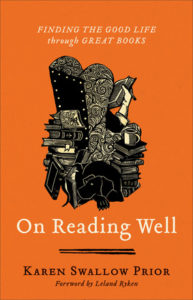 rehearse all that, but we have a whole section in the Dallastown shop which we call “books about books.” Serious literature criticism, memoirs about reading, and Christian arguments for reading widely abound. (I suppose you know we have often mentioned and featured Karen Swallow Prior’s lovely memoir of her own early years by way of the books she read, a great read called Booked: Literature in the Soul of Me and had her in the store last fall to do a presentation on her must-read book on character formation called On Reading Well: Finding the Good Life Through Great Books.
Our selection of novels in the store is large, but limited to what our mostly religious, York County customer base wants. I wish we had more robust sales of fiction and wish we had more room to display even more than we do. Besides lots of inspiring fiction published by Christian publishing house – their releases have changed a lot since my mom fell in love with the inspirational prairie novels of Janette Oke — we carry our share of New York Times fictional mega-best-sellers, like When Crawdads Sing by Delia Owens and the new, layered, Elizabeth Gilbert novel City of Girls, set in the tawdry glamour of 1940s New 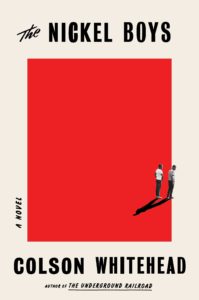 York theatre district (which Beth liked, even though it was fairly graphic in its description of sexuality, a racy feature some will not appreciate.) We feature important ones, especially, such as Barbara Kingsolver’s Unsheltered (which we both loved!) or the latest by award winning Moroccan-born, American novelist, Laila Lalami, The Other Americans, a crime novel revealing much about immigration, and, of course, the brand new (very, very heavy) The Nickel Boys by Colson Whitehead, who wrote last year’s amazingly well done, Pulitzer Prize Winner, The Underground Railroad (which is now out in paperback.) None of us have read it yet, and it may be too gruesome for some tastes, but this NPR interview with Mr. Whitehead and a former resident of the Dozier School for Boys in Florida (where the book is mostly set) and an investigative journalist who has studied the despicable place for decades, will explain it’s importance. Unbelievable.
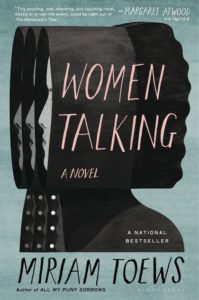 Do you know the work of Miriam Toews, a Canadian with a Mennonite past who writes socially engaged, serious fiction such as her recent Women Talking? It is about sexual abuse within strict Amish-like communities and gained some fame when none other than Margaret Atwood tweeted, “This amazing sad, shocking, but touching novel, based on a real-life event, could be right out of Handmaid’s Tale.” Another writer called it “an astonishment, a volcano of a novel…” and Laura Van Den Berg says it is a “flawless, ferocious work of art.”
The last few years have seen some excellent books to widen our range of books by people of color such as Everything I Never Told You (by Celeste Ng) and Behold the Dreamers (by Imbolo Mbue) and the provocative There, There by Tommy Orange, a raw, creatively written contemporary story about urban Native Americans. I reviewed it here last summer, and it is now out in paperback. I’ll be you’ve never read anything like it!
Whenever I share a new list of new fiction, I feel a need to note that reading older novels is fine, too. Most who have read the most recent Virgil Wander (by Leif Enger) truly enjoyed it, even if it doesn’t surpass his phenomenally beloved Peace Like a River, which came out in 2001 and which you should definitely read.
Among our store’s perennially recommended ones include the novels of Wendell Berry (start with Jayber Crow or Hannah Coulter), Marilyn Robinson (read them in order, Gilead, Home, and Lila, and then jump back to her first, Homecoming, a very different sort of story offered in a few different sort of intense, creative prose.) For sheer joy and amazing writing and spectacularly curious stories, don’t miss The River Why and The Brothers K, by James David Duncan. One is about fishing, the other baseball; the first very funny, the second a lot of fun, but with a more painful plot. And pray that he gets the long-awaited next one done!) And I personally adore the early novels of Barbara Kingsolver, like Pigs in Heaven. You can read a few other favorites I’ve mentioned at BookNotes in the past HERE, HERE, or HERE or HERE.
12 (mostly) NEW NOVELS – ALL ON SALE. 20% OFF.
ORDER NOW. PLEASE.
We show the original, standard price. We’ll be sure to deduct 20% off when you order. Just click on the link at the very end to be sent to our secure order form page at the Hearts & Minds webpage where you can safely enter credit card and shipping info. Or, if you aren’t using a credit card, and want us to just bill ya, hit reply and send us an email. Ordering is easy. Just tell us what you want. We’ll confirm and take it from there. Thanks for sending orders our way and allowing us to help you out with your summer reading. Have fun!
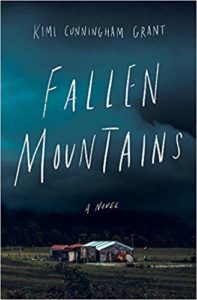 Fallen Mountain Kimi Cunningham Grant (Amberjack Publishing) $14.99 We were alerted to this indie press book by a good friend of ours, a discerning reader and good writer herself who is a friend of the author. (Hey, Erica Young Reitz, we even saw how you are thanked in the acknowledgments for helping the author think through the ending.) Ms Grant is a central Pennsylvania native and attended Messiah College. She has won numerous poetry awards and received a Pennsylvania Council on the Arts Fellowship grant, so is obviously a young writer to pay attention to. And she is, indeed, a good storyteller, has a way with words, and can craft good, good pages that draw out her characters. This slow, building plot set in the mountains of North Central PA.
I am drawn to stories set in small towns that honor the uniqueness’s of rural life, and Fallen Mountain, indeed, does. (There is a small subplot that is very realistic about how the fracking industry destroys woodlands and mountain streams in a way that many conservationists and hunters find dismaying. (Shades of the must-read Pulitzer Prize winning non-fiction work, Amity and Prosperity.) Although Grant’s story isn’t overtly about environmental themes or a diatribe against fast-paced modernity, there is a small touch of Wendell Berry in her approach. The small town sheriff, wanting to retire, and his friendships with those who work a well-described local farm is pleasant and generous and, I suspect, plenty realistic. Anyone who likes the woods (hiking, hunting, or lumbering) will appreciate her good descriptions and the significant plot twist about protecting the land from, well… I don’t want to say too much. If you know the forests of Pennsylvania, you can imagine.
The plot revolves around a character who has disappeared, maybe murdered (or maybe not), so it is a bit of a mystery, with the twists and turns that sometimes accompany such a whodunit. But, more, like the best suspense stories, there is a deeper, more important project unfolding, that of exploring place and relationships, romance and regret, hard times and the search for some kind of meaning; redemption, even.
I can’t give too much away other than to suggest that Fallen Mountain is a fine early book by a rising author, a fascinating setting and plot, with lots to enjoy and lots to smile about and also some hard stuff which causes us to ponder much about this fallen world. Big hot shots from out of town figure as almost bad guys and there are good glimpses into hurts that arise from childhood bullying to opioid addictions, all very real issues in the lives of those in small towns where memories endure as people learn to live together over the longer haul of their lives. This book gives us an entertaining window into these daily dramas, follows the quandaries of a few key characters and brings home a captivating story with an ending that will leave you closing the book with satisfaction.
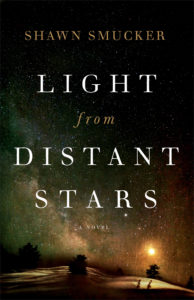 Light from Distant Stars Shawn Smucker (Baker) $14.99 I so badly want to explain what we like about this great new book, and have so much to say. Since the death of my mother, this book that opens in a funeral home and is largely about the relationship of a son and his deceased father, is more poignant for me than I knew when I started this review almost a month ago. I have carefully read this fascinating, entertaining, curious novel, written about it, erased it all, tried to re-write a better review, participated in a book release event party (sponsored by the author’s Lancaster friends The Row House Forum and Square Halo Gallery) and have pondered it over and over again. It means a lot to me this summer and we would be very happy if you ordered it from us so you can join in the buzz.
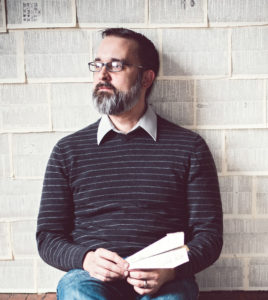 For starters, as we have said before, Shawn Smucker is a fine writer, a friend of Hearts & Minds, and a truly decent guy; he received great acclaim for two very well-written YA fantasy novels (The Day the Angels Fell and The Edge of Over There that we have highly recommended) and an inspiring (dare I say necessary) memoir Once We Were Strangers about his friendship with a Syrian refugee in his hometown of Lancaster, PA. He’s co-written a few biographies too, so has been honing his artful writing chops since his days as a lit major in the good program at Messiah College.
Light from Distant Stars is an apropos title as one of the characters in the story has a fascination with this notion that we see light that left their respective stars a million years ago; stars that perhaps now may be long gone from the galaxy. He doesn’t explore any didactic meaning to this fact, but it lingers, hanging in the air and as I reader I wondered why. It’s a moving metaphor, allusive and suggestion-rich (as Calvin Seerveld might put it) and hints at deeper things going on in this wild story.
Deeper things? How about Stranger Things? (I haven’t even seen that pop-culture TV phenomenon, but the lined worked. Ha.) This new book offers some pretty stranger things. It is set in a town (like Lancaster?) and rural areas nearby. The main character, Cohen Morah, works, unhappily, in his father’s undertaking business. (A fun aside: Shawn has told me he is a good friend with feisty funeral parlor owner and author Caleb Wilde, who he thanks in the acknowledgments. I hope you know his book Confessions of a Funeral Director: How the Business of Death Saved My Life.) On the first page, Cohen’s father is dead on the floor of the embalming room and Cohen wonders if he killed him. So there’s that.
The book is not terribly gruesome, but as somewhat of a kinda murder mystery, there’s a tiny bit of disturbing description. Much of the book is set in flashback — stuff that happened a long time ago, that we’re just seeing now? – and Cohen’s father, an undertaker who used to be a preacher named Calvin, play baseball together. The beautiful description of young Cohen in a hot evening church service is captured wondrously and the domineering, cold, religious mother comes across painfully. Although it isn’t overly intense, there are shades of the likes of Pat Conroy or others who write about dysfunctional families here as Smucker explores the dissolution of a family and hints at the brokenness that ensues.
My family was healthy and safe and good (Beth and I both daily are grateful for the wholesome setting we were given by our decent, middle-class families and as we grieve the loss of my mom this week, we recall that intensely) but I was deeply moved by Smucker’s gentle explorations of a religious family broken in so many ways. Cohen’s good sister, his bitter mother, his father trying at another shot at redemption in his later years, his slow, lingering death in the hospital, all weave in and out of the story which is loaded with interesting plot turns, odd-ball characters (wait til you meet the mysterious street kids Than and Hippy) and includes moments of sheer genius.
That Cohen, during the long hospitable vigil, sneaks out at night, walking to a nearby Episcopal church to find a late-night priest to whom he can confess his sins, illustrates the plausible way faith – by which I guess I mean sin and redemption, fear and hope, trauma and healing, the search for resolution and the forging of meaning in memory and moving forward – is quite naturally woven into this story of darkness and light. And a story of light it is. Light amidst some very real darkness.
There’s a bit of surreal stuff that is a major part of the story as Light from Distant Stars slips into what the fancy-pants critics might call “magical realism.” That is, this isn’t a fantasy novel (there are no Hobbits or wizards or talking, Narnian-like creatures), not a supernatural thriller (although some might describe it that way since there are moments of mysterious spookiness) but there is some inexplicable weirdness (imagined or real?) with a bit of a blur between what is actual and what may not be. There is a force, a cloud, a Beast – think of the “smoke monster” from Lost — that soon enough we realize represents something utterly pernicious, something mentioned in only a passing paragraph but is achingly significant. A burning horror is in the book significantly, and it adds some gonzo oddness that, for me at least, was fun and captivating, making this more than a dour story of family sin and interior struggle. I am not a fan of this device, usually, but that damn thing came to intrigue me and kept me turning the pages, trying to figure out what the heck was going on.
Near the end there is another huge plot turn and a new character shows up – not his grumpy mother, not his healed-up sister, not his new priest friend, not his elementary school baseball playing girlfriend now turned detective, or his flashback dear, now dying, dad. It’s a kid in the hospital and I won’t give away what happens in this crazy episode, but it is a tad over the top. I liked it, and the images of how that whole thing plays out in what I assume is Lancaster General Hospital is the sort of rising action that made me almost stand up and cheer. I won’t spoil it – but, again, Light From… isn’t a ponderous or overly dour study of the human condition, but a great, entertaining read, full of plot and character and light and goodness and a batch of surprises that keeps coming and coming. Who thinks up stuff like this?
At the release party for Light from Distant Stars held at the Square Halo Gallery in downtown Lancaster, the articulate, profound, delightful, non-fiction writer Christie Purifoy (you must read her fabulous Placemaker: Cultivating Places of Comfort, Beauty, and Peace) interviewed Smucker about his new novel. Christine read an excerpt from her book — gorgeous prose poetically delivered, about, well, about decay. (Okay, it was about homemade kombucha and sauerkraut.) Entropy, decay, death. Can we control such forces? Is there hope in the ruins? Her reading set up Shawn to talk soberly about his own book, and his own fascination with these things, about death and history and hope. In those moments, this spiffy thriller about smoke monsters and baseball and sinning pastors and reconciliation with stern mothers and careers and callings and confessions all took an even deeper turn, and I realized more of the genius of this fun, easy to read, (but well-crafted) curiously profound story. The late night confessions and hymn singing and deeply rendered loneliness spires downward and outward and light shows up, light that the Bible tells us reveals all. Light that John 1 tells us the darkness cannot overcome.
Whether you want a fast-paced and very entertaining thriller or an allusive reflection on families and regret, shame and healing, whether you want a murder mystery or a tender tale of death and birth, Light from Distant Stars is a great read, perfectly described by somebody as “eerie and enchanting.” I doubt if Smucker is considering a sequel, but I want to know more about Cohen Marah, his old friend Ava, his sister Kaye out near Philly, and maybe even the sexy Miss Flynne. And what the heck happens with Thatcher after, well, after that?
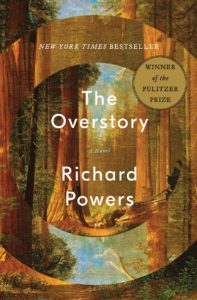 The Overstory Richard Powers (Norton) $18.95 Good friends who read a lot of contemporary fiction kept telling about this and we watched as some smart customers bought it and it was increasingly mentioned on literary blogs and appeared on “best of” lists in newspapers and journals all over the country. This was before it won the 2018 Pulitzer Prize. Beth eagerly picked it up this Spring and found it to be one of the most beautifully crafted works she has read in ages. She has a good eye for good writing and was so taken by some passages she put little Post-it notes on certain pages to read them out loud, later. What writing! What an artful, respected piece of modern fiction.
I cannot say too much about the plot, but it is complex and fascinating. In the shortest of annotations we might say it is about trees. And about how in God’s creation the inter-working aspects of reality cohere. (Do trees really talk to each other as another best-seller has documented? Do they “clap their hands” as the Bible says?) In this novel, they indeed do, and more.
So, yes, what you may have heard, that this is a green, tree-hugger story, is true, but it is so much more. Although (Lord have mercy) we need to care about trees and climate change and environmental stuff, and be brave in protecting the Earth God gave us to care for, and maybe good fiction is the way to motivate us to care more. (It may be that that is increasingly the case, that a good story can be more persuasive and formative than several didactic lectures.)
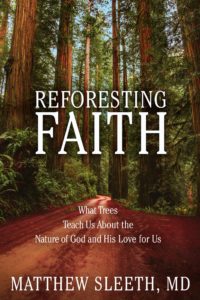 Evangelical MD turned environmentalist Matthew Sleeth recently wrote Reforesting Faith: What Trees Can Teach Us About God and if you’re not up for Mr. Power’s strikingly imaginative story about trees, read Sleeth, first, and then read Overstory. Or, if you find the beauty and power of a fictional story about trees and greed and conflict and life and death to be deeply compelling, then read Power’s novel first, then the non-fiction Reforesting Faith next.) In any event Richard Powers is a gifted writer, an astonishing storyteller, and his drama is thick and engaging. It’s a beauty of a book.
I might add that The Overstory actually isn’t all about trees and saving the bioregion. One major character has a severe disability and finds it exceptionally difficult to navigate the material world, so he enters – vividly, with extraordinary detail – a parallel universe on line. Some of this big story raises questions about the reality of virtual reality, the experience of (and ethics of?) so-called digital culture. What is really real in this story of life we all live? This book is gorgeously done and surely unforgettable. Powers is, as he has been before in his other highly regarded novels, simply dazzling.
“Monumental…A gigantic fable of genuine truths.”
Barbara Kingsolver
“The best novel ever written about trees, and really just one of the best novels, period.”
Ann Patchett
“This book is beyond special… it’s a kind of breakthrough in the ways we think about and understand the world around us, at a moment when that id desperately needed.”
Bill McKibben
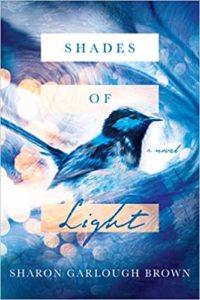 Shades of Light Sharon Garlough Brown IVP) $18.00 I have written about this before and a few interested customers were eager to pre-order it. We just got it into the store last week, a bit ahead of the scheduled mid-August release, and we’ve sent it out to those who have already ordered it. You may recall that I touted it as a realistic spiritual story that moved me, surprisingly so.
The author, Rev. Garlough Brown, is in real life an ordained clergywoman and a certified spiritual director near Grand Rapids who has written a series of easy-to-read Christian novels about the process of spiritual direction, with episodes of the stories unfolding in retreat centers, among folks struggling with spiritual disciplines, lingo drawn from, maybe, the sorts of folk who read Richard Rohr or walk the labyrinth, who are active church congregants, wanting a transformative, engaged spirituality, who maybe are learning about discerning God’s work in their lives day by day, learning the monastic practices of solitude and silence and are trying out the examen. Or they try to. 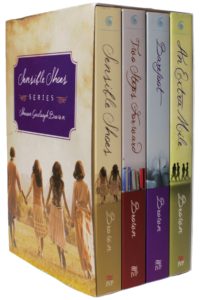 These four “Sensible Shoes” novels (each published by IVP) are a delight because there isn’t much popular storytelling about those sorts of topics or characters who take up intentional spiritual practices.
Well, this new one is about an idealistic, young adult social worker, whose name is Wren, who is burned out and has a break-down, struggling, as we come to learn, with serious, clinical depression. Her Aunt Kit takes her in, offering a room in which to stay while she recovers. The room happens to be in Kit’s apartment in a contemplative retreat center where Kit works, and, slowly, the depressed Wren begins to heal by taking up a project of painting the stations of the cross for an upcoming Lenten retreat that Kit is running.
This plot turn makes perfect sense as much of the story revolves around Wren’s interest in art. Her passion for and knowledge about Vincent Van Gogh is significant; her conversations are peppered with quotes from Van Gogh (often from his beloved Letters to Theo, some of which are about his own religious and artistic struggles and his own deep inner demons.) She comments about this or that famous (or lesser known) painting of the legendary Dutch artist and it was so fun learning a bit about the great master in this tender, poignant story.
I am not sure I’ve read a novel quite like this before and I greatly appreciated the descriptions of Wren’s interior life and psychological condition. I appreciated her hard episodes with her disturbed (bi-polar?) friend, and resonated deeply, as any parent might, with the portions of the plot about the out-of-state parents who so badly wanted to help their hurting daughter, but did so mostly by keeping their distance. Some readers will appreciate that Hannah, a pastor from the earlier “Stepping Stones” stories, makes a brief appearance.
The Shades story unfolds from a variety of views and the redemptive message for those who suffer, or those who care for the suffering, is inspirational (without being overly simplistic.) There is a lot of “spirituality” God-talk that I often don’t appreciate in novels, but, it works well in Shades of Life as this female pastor, rooted in contemporary evangelical spirituality, trained in spiritual direction, naturally does have this gentle, hospitable demeanor and propensity to speak a certain way, even if some of it sounded a bit clichéd. It was, in fact, spot on. Her graciousness and gentle spirit reflects a certain sort of clergy and pastoral caregiver many of us know well, and Wren’s helpful expertise in Van Gogh’s work, rings true. What a pleasure (and help) to read a book about grief and God, about art and psychology, about social work and spirituality. Highly recommended.
By the way, for book groups, IVP has nicely published a little study guide booklet, too, that sells for $10.00.
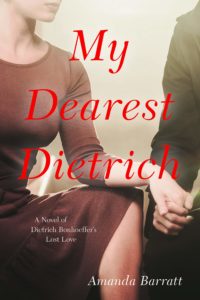 My Dearest Dietrich: A Novel of Dietrich Bonhoeffer’s Lost Love Amanda Barratt (Kregel) $21.99 This is a brand new novel that I just had to mention even though we have not yet read it. There have been a few other authors brave enough to create a novel set in World War II era Germany, using that backdrop to explore, in fictional storytelling, what it might have been like to be romantically involved with Dietrich Bonhoeffer during the years of his underground seminary and resistance to National Socialism and Hitler. We have letters from him during those years of his imprisonment starting on February 7, 1945, the day after he turned 39 when he was transferred from his prison in Berlin to Buchenwald to Regensburg to Flossenburg.
Some of those previous historical fiction works were very well respected although a few were not so well done, not so accurate, and, perhaps, not so artful or interesting. My Dearest Dietrich is said to be very solid and it may stand in league with Becoming Mrs. Lewis: The Improbable Love Story of Joy Davidman and C. S. Lewis, the recent novelization by Patti Callahan about Joy Davidman that became a sensation last winter. Like that one, My Dearest Dietrich, follows the life of a brave and thoughtful woman who stands alongside a legendary Christian leader. Becoming Mrs. Lewis was fraught with the unforgettable story of Lewis marrying the smart, former Jewish atheist from America on her deathbed, and if that was gut-wrenching and made for a great read, My Dearest Dietrich is surely equally fraught. What a story this is — what one reviewer called “as beautiful as it is brave.” This isn’t a spoiler alert, really, since anyone who might be drawn to pick up this new historical fiction story surely knows that Dietrich Bonhoeffer was executed by the Third Reich in 1943.
Some may know that his relationship with Ms Maria Wedemeyer to whom he was engaged but did not marry, was itself complicated.
There is included in the story some of the actual correspondence of Bonhoeffer taken (naturally) from his famous Letters and Papers from Prison but also the lesser known Love Letters from Cell 92 by Bonhoeffer and Maria which was translated into English and released in the States in the early 1990s. I’m eager to see what this good storyteller does with this previously unexplored story, what one Christy Award winning author (Jamie Jo Wright) says is “a haunting love story with beautiful prose and picturesque descriptions” and what Jocelyn Green (of Between Two Shores) calls “a multifaceted story of the highest stakes and the deepest loves.”
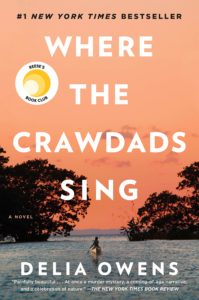 Where the Crawdads Sing Delia Owens (Putnam) $26.00 I mentioned this in passing, above, as it has been riding at the top (or near the top) of all the standard best-seller lists and is hugely popular this summer. It has sold more than 2 million copies (in part due to its choice as a “Reese’s Book Club” selection. (That Reese Witherspoon has very good Southern taste, I must say!)
I will also say that it took me just a bit to “get into it”as they say. Perhaps the writing (the character’s speech, actually) will be appreciated like the famously difficult, if at times playful, black cadence found in the stunning, Their Eyes Were Watching God by Zora Neal Hurston, a beloved, unforgettable work, considered a great classic of American literature, despite (or because of) the demands it places upon the reader. In any event, Where the Crawdads Sing starts with this complicated vocabulary that (foolishly) I tried to read as some ancient, New Orleans/Cajun dialect. Soon enough, we learn that the young character is living in the land of palmettos in North Carolina, in a region having developed and maintained its own unique dialectic, in the American Southeast One reviewer says it is “steeped in the rhythms and shadows of the coastal marshes” and is “fierce and hauntingly beautiful.”
In what is in part a murder mystery and a story of grave injustices, Where the Crawdads Sing is also a gripping coming-of-age story, what Alexandra Fuller calls “a lush debut novel… her mystery wrapped in gorgeous, lyrical prose.” It has been called “astonishing” and “heartbreaking” and “ambitious, credible, and very timely.”
One of the things I liked was the good writing about the natural world – the marsh ecology, the herons, the slow, slow days of this child, Kya, living alone along the wetland shores of the Outer Banks. In that, it was very lovely.
The New York Times Book Review says that, “In her isolation that abandoned child makes us open our own eyes to the secret wonder – and dangers – of her private world.” We don’t know if many other religiously-oriented bookstores carry this kind of work, but we are happy to recommend it.
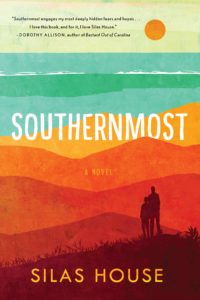 Southernmost Silas House (Algonquin Books) $15.95 This publisher is renowned for good, classy, meaty (Southern) stories, and this one just released in paperback – called “bracing, honest, and luminous” — is no exception. The fictional Asher Sharp is an evangelical preacher who is, as it says on the back cover, “willing to give up everything for what he believes in. Except his son.”
The writing is mature, highly literary, and, like Mr. House’s other important books of fiction, youth fiction, and non-fiction (he edited Something’s Rising, a book we carry about Appalachian folk resisting mountaintop removal) it is set in the South, including more or less a chase/road trip from the mountains of Tennessee through Kentucky and finally to colorful Key West, actually – hence, the title.) We saw a review of this when it first came out in hardback last year in Sojourners and realized it had profound insight about hopes and fears and struggles and faith and family, mostly revolving around the questions of religious allies of persons with same-sex attraction and the consequences of this pastor’s preaching about tolerance and his loyalty to his gay son. Recently, we saw a stellar review in The Englewood Review of Books from which a blurb is drawn and reprinted in the inside of Southernmost.
Many good writing and reading folks have endorsed this, from Southern and rural writers like Dorothy Allison and Charles Frazier and the lovely (and funny) Lee Smith, who ends her amazing review with these words:
“With its themes of acceptance and equality, Southernmost holds a special meaning for America right now, with relevance even beyond its memorable story.”
 All Manner of Things Susie Finkbeiner (Revell) $15.99 I think the simple cover and the curious title (hasn’t that ever been used as a book title before?) first struck me, as did the imagination-capturing blurb from Jocelyn Green, a Christy Award-winning author of Between Two Shores, who wrote, “Some books are meant to be read. All Manner of Things is meant to be lived in.” If the characters are real and the story important, this quote is a huge invitation, eh?
This is the story of a young man who enlists in the Army in 1967 and, from Viet Nam, sends his sister, Annie Jacobson, the address of their long-estranged father. If anything were to happen in Nam, Mike wrote, Annie must reach out to their father.
Unexpectedly, the father returns and there are tragedies in this already tense time. There is grief and struggle, hardships and family stuff. For those of who lived in those hard if exciting times, stories like this could be healing and hopeful. That it is explicitly Christian will appeal to many.
You may recall how we touted The Solace of Water, a story set in central Pennsylvania that told of the friendship of an Amish woman and a black woman, united by grief, written by Elizabeth Byler Younts. Ms Younts writes about All Manner of Things,
“With intimacy, a poetic voice, and an ever-present grip on hope, Finkbeiner writes with breathtaking admiration for the common American family in the throes of unbearable circumstances. Beautiful. Honest. Artfully written. A winning novel.”
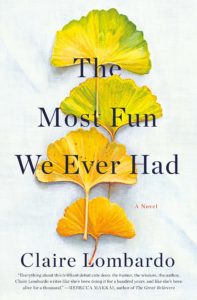 The Most Fun We Ever Had Claire Lombardo (Doubleday) $28.95 Okay, I’ll admit it. I got this into our store mostly because I loved the cover. And I read a fabulous review. (But mostly the cover.) Some people just love holding this kind of a big, thick, novel — I recently ordered for myself another hardcover copy of Elizabeth Gilbert’s splendid The Signature of All Things just because such a sprawling, epic, wondrous novel deserves a material heft in the hand to match the story. The Most Fun We Ever Had, a debut novel with amazing endorsements from the likes of Richard Russo and Affinity Konar, despite the cheery title, just seems to deserve this good, fat, 500 page volume. It’s apparently an ambitious, sprawling, multi-generational novel about the life-long friendship of four sisters and their respective families. The Guardian said it could be the “literary love child of Jonathan Franzen and Anne Tyler.” Ha.
Advance praise has been significant and fun:
“A wonderfully immersive read that packs more heart and heft than most first novels…A deliciously absorbing novel wit–brace yourself-a tender and satisfyingly positive take on family.”
–NPR
“This juicy saga spans more than four decades…You’ll be glad this loopy family isn’t yours, but reading about them is a treat.”
–People Magazine
“A family epic…It resembles other sprawling midwestern family dramas, like Jonathan Franzen’s The Corrections. The result is an affectionate, sharp, and eminently readable exploration of the challenges of love in its many forms.”
— Booklist
“Everything about this brilliant debut cuts deep: the humor, the wisdom, the pathos. Claire Lombardo writes like she’s been doing it for a hundred years, and like she’s been alive for a thousand.”
— Rebecca Makkai, author of The Great Believers
“Lombardo’s impressive debut is a gripping and poignant ode to a messy, loving family in all its glory. She juggles a huge cast of characters with seeming effortlessness, bringing each to life with humor, vividness and acute psychological insight.”
— Madeline Miller, New York Times bestselling author of Circe
“What a splendid, spacious, gripping novel Claire Lombardo has written. These pages sparkle with wit and wisdom. I love the four difficult Sorenson daughters, each in the grip of her own emergencies. The Most Fun We Ever Had is a gorgeous and profound debut.”
— Margot Livesey, author of Mercury
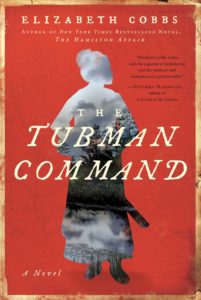 The Tubman Command Elizabeth Cobbs (Arcade) $25.99 If you follow serious historical fiction you may know of Cobbs for her best-selling novel, The Hamilton Affair. Here she offers a fictionalized account of a lesser known event in American history, the time in May 1863 when the demoralized Union Army (having suffered fresh losses at the Battle of Chancellorsville and Fort Sumter stood to taunt the American Navy) recruited a woman with the code-name Moses. You know this is the heroic (and by that time, hunted by the Confederates) Harriet Tubman.
The episode this novel recreates is one of the most daring and dangerous in all of the history of the Civil War. In Beaufort, South Carolina, Tubman plots an dramatic expedition behind enemy lines to liberate hundreds of bondsmen and to recruit them as soldiers. And you thought she just led the chillin’ North to safety.
This novel “tells the story of Tubman at the peak of her powers, when she devises one of the largest plantation raids of the Civil War.” Plantation raids? Who knew? Union General David Hunter places her in charge of a team of black scouts even though he’s skeptical of what one woman can accomplish. If you care about or enjoy learning about the Civil War at all, this is simply a must – it will blow you away!
What an adventure this book tells of: there are alligators, overseers, slave catchers, sharpshooters, and even some hostile Union soldiers, gunships, and men who simply didn’t believe in her abilities. Did you know Tubman was married? Her husband – who she has left to pursue her unbelievable calling in this crisis of American freedom struggles – figures in to the story as well. I’ve only started it, but I’m finding it exceptionally compelling, a real page-turner, human and humane and yet visionary and exciting. The Tubman Commands is extraordinary fiction.
Here are just a few of the colorful, persuasive, endorsing reviews:
“If you think you know all about Harriet Tubman, think again–this novel brings her alive as only fiction can. With a historian’s grasp of detail, Elizabeth Cobbs spins a gripping tale of romance, wartime spies, and daring escapes. The story of Harriet Tubman’s leadership of black troops behind enemy lines, The Tubman Command illuminates the unfathomable bravery of people fighting for liberty and the birth of a better nation. Harriet emerges from these pages as a brilliant strategist, master of psychology, and a fully-rounded woman whose legendary heroism has made her a cherished American icon.” –Kate Manning, author, My Notorious Life
“Cobbs is that rare writer who possesses both the uncanny eye of the historian and the dynamism of a natural storyteller. By the last chapter I was breathless and near tears, captivated by the true tale of one woman who railed against injustice and changed the course of history.” –Fiona Davis, national best-selling author of The Masterpiece
“A phenomenal piece of writing which humanizes one of America’s most beloved icons and shows a different side of a woman whom many think they already know.”– Edda L. Fields-Black, Author of ‘Combee’ Harriet Tubman and the Combahee River Raid (forthcoming)
“Cobbs paints a vivid portrait of Tubman at the heart of one of the most innovative, daring, and dangerous missions of the Civil War. The heroic and brilliant Tubman is brought vividly to life as a flesh-and-blood woman and a strong and cunning leader in this compelling and instructive fictional tribute.” — Booklist
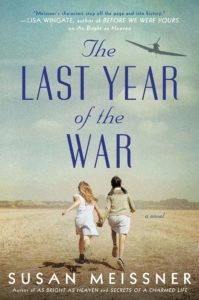 The Last Year of the War Susan Meissner (Berkley) $26.00 I wanted to list this since it is one Beth found very engaging and very entertaining. It is a beautifully poignant novel, with what one reviewer said “explores the complexities of love, friendship, and the fleeting truths of identity.” The prose is truly lovely, even if it highlights a dark aspect of our culture and a sad time in American history.
In this new novel Meissner tells of two older women who realize they are both still alive (in their 80s) and plan a reunion. You see, they met at a Texas interment camp that the USA ran for Japanese citizens and for German citizens during World War II. One, the German woman, whose name is Elise, is starting to get Alzheimer’s – she calls her condition “Agnes” – but she surely recalls her friendship with a Japanese woman who she met in the awful camp. Beth was struck by this story about Agnes (she read some of it out loud to me as we ourselves death with my own mother’s loss of memory) and how Elise (14 years old when her father, a second generation American citizen, was arrested for being a Nazi sympathizer) ended up meeting Mariko in the camp. This elegant story tells of the friendship of these two different women, how their lives evolved, and how they reunited in happy friendship near the end of their days.
Michael Gable, of the historical novel A Paris Agreement, says,
Powerful and at times chillingly contemporary, and it reminds us why we read historical fiction in the first place.
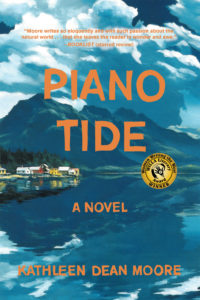 Piano Tide Kathleen Dean Moore (Counterpoint) $16.95 This is not a brand new novel, but we somehow had missed it, even though it was written by a memoirist and nature writer that I adore. I’ve read several of Moore’s beautiful non-fiction works (such as Pine Island Paradox and Holdfast and Wild Comfort: The Solace of Nature.) Her recent polemic is important and passionate, called Great Tide Rising: Towards Clarity and Moral Courage in a Time of Planetary Change. We stock them all, of course. I had completely missed that this philosophy professor and mom and ecologist and climate change activist had tried her hand at a novel. She’s such a good writer that I figured we should carry it.
I think we first learned of it when we heard that Ms Moore spoke at the Calvin College Festival of Faith and Writing and then, again, came to the college to present a spoken word piece on climate change set to a moving classical piano composition (starting with a mournful bit by Rachmaninoff.) What a wonderful idea!
Knowing about this creative work by Kathleen Dean Moore, then, we certainly wanted to stock her novel. We’re happy to recommend it to you. Beth read this one right away, and found it compelling; a rip-roaring read, funny and entertaining, all about the bad guys who are ruining the environment for a quick buck, the complexities of family loyalties, and a bit of a nifty romance. Set in the gorgeous timberlands of a remote Alaskan island with a greedy industrialist named Axel Hagerman as a protagonist, Piano Tide plays out with some very surprising twists. (You’ll see how the piano fits in, as it does.) It includes elegant descriptions of the landscape and social ecology of this distant place and yet has energy and subversive wit. (In this, it brings to mind the legendary Monkey Wrench Gang.) Oh my, what a nearly “Romeo & Juliet” this then becomes as the young adult children of two opposing players in the battle for the land fall in love and move into the very spot where the turmoil and flooding will happen. Whewie!
I suppose this could be considered a well-written morality tale and a spectacular telling of what could become a transformative act of resistance. We hope all of our fiction makes some sort of difference in your life, transformative, enjoyable — a great use of your funds. We wouldn’t say this if we didn’t truly believe it. Books matter, reading stories can be great enjoyable, and, who knows, you might find some new insights, new vistas, new passions. Happy reading, one and all. Thanks for caring.
Order below by clicking on the link, following directions by telling us where to ship, how you want to pay, and however else we can serve you well. Send overseas? Gift wrap? Enclose a note? We’re happy to help, as long as we can tear ourselves away from the stories that keep us turning the pages.
BookNotes

SPECIAL
DISCOUNT
20% OFF
ANY BOOK MENTIONED
+++
order here
this takes you to the secure Hearts & Minds order form page
just tell us what you want
inquire here
if you have questions or need more information
just ask us what you want to know
Hearts & Minds 234 East Main Street Dallastown PA 17313
read@heartsandmindsbooks.com
717-246-3333
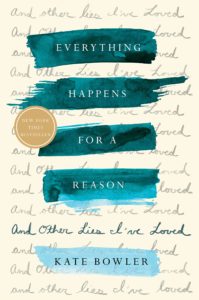 Everything Happens for a Reason And Other Lies I’ve Loved Kate Bowler (Random House) $16.00 paperback/$26.00 hardcover I know this isn’t brand new and I have to admit neither Beth nor I had read it when it was at the height of its buzz a year ago. We knew Bowler’s impressive and charitable ethnographic study of Pentecostal and prosperity preachers (Blessed, published by Oxford University Press) and knew that, in the midst of becoming a scholar of religion and teacher at Duke Divinity School, she was diagnosed with an awful, quickly developing, terminal brain tumor. We put the book under death and dying in our store, recommended it to those experiencing illness and, more, loss. I suppose that works, but now I also want to shelve it in our ordinary memoir section; this really isn’t a systematic critique of cheesy things people say or simplistic theology or even a theodicy, as such. It is her story. It is a memoir. And I Couldn’t. Put. It. Down. I’m not kidding – I laughed and cried and read some of the good parts out loud and told everybody I knew that week that they had to read this right away. My goodness, what a read, what a storyteller, what an experience she has had.
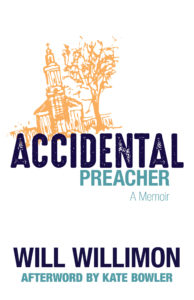 Accidental Preacher: A Memoir Will Willimon (Eerdmans) $24.99 We want to be among the first to announce this – and note that there is a lovely Afterword by Kate Bowler. I suppose Willimon is one of those writers who most everyone who reads BookNotes would have heard of. He’s written dozens of books (which have sold over a million copies) and is often cited as one of the best preachers in America. He has been a rural pastor, an urbane preacher, a scholar, writer (including a novel), a seminary professor, a chaplain (at Duke) and a United Methodist Bishop. He has co-written books with his friend Stanley Hauerwas and is considered, by some, too theologically conservative and, by others, too theologically liberal. Some say he’s cranky, others say he’s a softy. We first heard him here in Dallastown (yes, at a small UCC church, decades ago) and he spoke at our Pittsburgh Jubilee conference. He has been outspoken on the need for the church to be theologically astute, for pastors to be caring but deep, and for the church to bear witness to the ways of Christ in society, standing against injustice, racism and apathy about poverty. He’s our kind of guy.
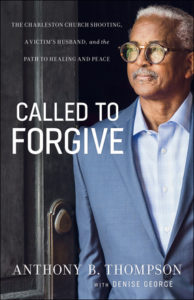 Called to Forgive: The Charleston Church Shooting, A Victim’s Husband, and the Path to Healing and Grace Anthony B. Thompson, with Denise George (Bethany House) $17.99 This past June was the fourth year anniversary of the awful day when Dylann Roof attended the Wednesday evening Bible study at the predominantly black Mother Emanuel AME Church in Charleston, South Carolina. Roof killed nine African-Americans as they prayed and one was Myra Thompson, the wife of Reverend Anthony Thompson.
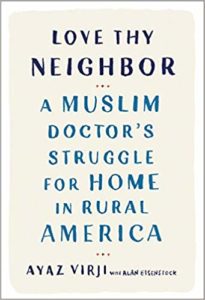 Love Thy Neighbor: A Muslim Doctor’s Struggle for Home in Rural America Ayaz Virji (Convergent) $26.00 This is pretty much just what you’d expect, but I was very, very moved, nicely entertained, a bit troubled, and very glad I picked this up. It had me hooked by the fist dramatic page. It had gotten a coveted starred review from Publisher’s Weekly and is (I think) the first book by an Islamic author published by this progressive, Christian publishing house. Love Thy Neighbor: A Muslim Doctor’s Struggle for Home is a great read — lovely, hard, important.
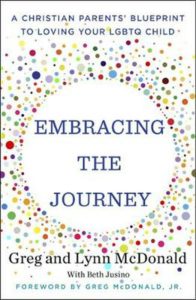 Embracing the Journey: A Christian Parent’s Blueprint to Loving Your LGBTQ Child Greg and Lynn McDonald (Howard Books) $26.00 Not everyone will agree with this journey – reluctant at times – towards acceptance and inclusion that these evangelical parents promote, but I do not list it firstly as a self-help guide for religious parents and their LGBTQ+ adult kids. I list it here as a memoir, a story, a captivating, engaging narrative of a family coping with their own unique situation and the conflict and renewed deepening of discipleship and faith in evoked.
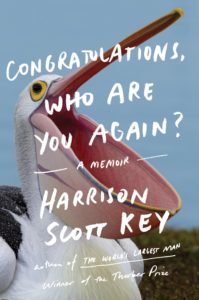 Congratulations, Who Are You Again? A Memoir Harrison Scott Key (Harper Perennial) $15.99 For some of us, taking books on a vacation or sitting under a canopy in the back deck, is a special pleasure this time of year and I wanted to suggest at least one book that was wise and truly funny, engrossing and sure to make you chuckle out loud. A buddy of mine and mail order customer of ours mentioned to me that he is in a little band in his church – a bunch of older guys who get together to rock out about old guy stuff, which itself is kinda of funny – and that memoirist Harrison Scott Key was in this little side hustle of his. Holy smokes, I couldn’t believe it. Key wrote the best-selling and evidently hilarious memoir-ish collection of essays called The World’s Largest Man and thereby won the prestigious Thurber Prize. As in James Thurber. As in fine, literary comedic prose.
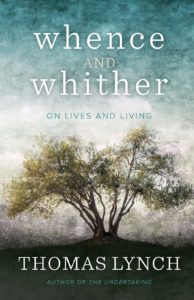 Whence and Whither: On Live and Living Thomas Lynch (WJK) $18.00 With a nice textured cover with French folds and deckled edges, this handsome paperback book bears a certain sort of weight, insinuating that it is serious, mature, heavy, even. And it is. The writer is the nearly legendary author of the late 1990’s book about the funeral business called The Undertaking: Life Notes from the Dismal Trade and it’s wonderful, must-read sequel, Bodies at Motion and at Rest: On Metaphor and Morality. These are among my all-time favorite books, by the way, and we have subsequently carried and promoted Lynch’s poetry, his memoir about going back to Ireland, Booking Passage, and, of course, his co-authored books with theologian and preacher Thomas Long on a theology of and righteous practice of funerals (The Good Funeral.) Lynch is a literate figure, intellectual and writerly, and his prose is stunning; it moves from humorous storytelling to philosophical observations, from artful lines and illuminating insight. And he wrote me a letter, once, so there’s that. I love this guy.
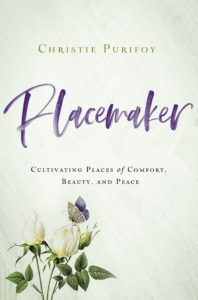 Placemaker: Cultivating Places of Comfort, Beauty, and Peace Christie Purifoy (Zondervan) $18.99 It is one of the great joys of recent months to have gotten the chance to finally meet Pennsylvania author Christie Purifoy, a memoirist and essayist of the finest quality, who can turn a phrase like nobody’s business. A few years ago she wrote a lovely book about her spacious, old farmhouse “in four seasons” (Roots & Sky: A Journey Home in Four Seasons) and it was quite good. But his Placemaker book is extraordinary, delightful, compelling, enjoyable on many levels. The other evening at a book event she read movingly from a section about fermentation (you know, sauerkraut, kombucha, making pickles, even.) The Earth’s processes of death and decay, entropy, chaos and the like became a window for reflecting on our desires for control, for reigning in the chaos. She frets about these things as we do, but she also tends orchards and writes glowingly about trees. Creation and Fall and Redemption swirl together in her gorgeous reflective prose and a book about place becomes a vision for living into God’s healing ways, on Earth as it is in Heaven.
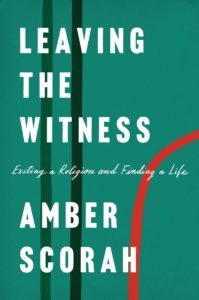 Leaving the Witness: Exiting Religion and Finding a Life Amber Scorah (Viking) $26.00 I don’t usually feel a need to warn folks about a book, although this (and the next I’ll describe) carry a bit of a concern. Bear with me while I describe this too quickly. I couldn’t put it down, staying up to the wee hours, and yet was so very deeply saddened by how this story ends, as the subtitle implies, in atheism. This calm willingness to face an essentially meaningless life devoid of faith or the transcendent is unsettling, and I trust that it will not unduly influence readers in that (tragic) direction. I worry about such things.
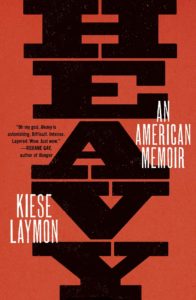 Heavy: An American Memoir Kiese Laymon (Scribner) $26.00 hardback; $16.00 paperback Oh my, this is another that I couldn’t put down, that moved me considerably, that I want to commend, but feel like I have to offer some honest notes so you can determine if this book is for you or not. I picked it up for a variety of reasons; like many Hearts & Minds friends and customers, I am a white guy wanting to be more deeply aware of the stories of people of color; as the subtitle suggests, it is a deeply American story and I do not want to look away. I am also interested in questions of the body, how weight is seen and experienced – I mentioned feminist hero and great, great writer Roxanne Gay, above, and it was her lively endorsement of Heavy that really caught my attention. If she says the topic and the prose is that breathtaking, I knew I wanted to read it.
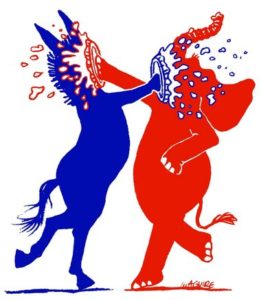 We used to complain about gridlock and the lack of civility. Now we have a left wing guy shooting Republican congress-people while they are playing baseball. And lefty feminista politicians get vile rape threats almost daily. Helping fuel this ugliness we have a President who cannot be civil because he can’t follow the plain Bible command to tame his tongue. Or his twitching, tweeting, fingers. We elected a man who said he was proud about his greed and who exhibits traits of narcissism, a self-professed sexual abuser and then some fundamentalist Christians circled the wagons around him, saying he gets a “mulligan.” In response many others grow more and more angry. Both sides accuse the others of holding to double standards. (Thanks to PennLive for the cartoon.) It seems to me that nobody should be happy with how things are these days.
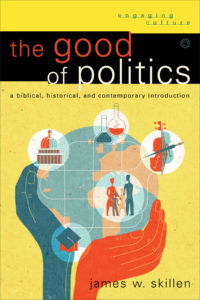 ’ve written much, before, here at BookNotes, about developing a uniquely Christian worldview that funds a distinctively Christian approach to politics. Before we get to the topic of civility and the fraying of our culture and perhaps our Republic, I want to remind us about this. See
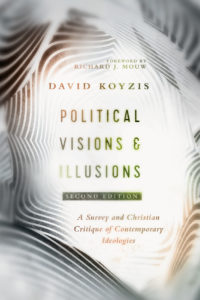
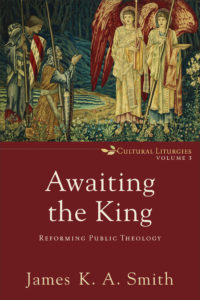 Heady stuff like Political Visions & Illusions: A Survey & Christian Critique of Contemporary Ideologies (now out in an important second edition) by David Koyzis (IVP Academic; $33.00) critiques the ideologies of the left and the right and the roots of their pagan, Enlightenment-era political philosophies. What a powerful, important read — vital for the serious-minded Christian citizen. Similarly, James K.A. Smith’s third volume in his must-read, if demanding, “Cultural Liturgies” trilogy, Awaiting the King: Reforming Public Theology (Baker Academic; $22.99) is, again, intellectually robust but very, very important.

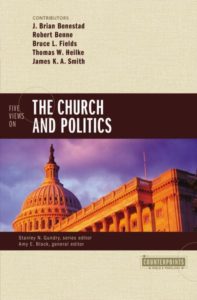 We have recommended the fascinating five-views across the spectrum dialogue expertly edited by P.C. Kemeny called Church, State and Public Justice: Five Views (IVP Academic; $22.00) and the more recent five-fold back and forth in the Counterpoints series dialogue in Five Views on the Church and Politics edited by the wonderful Amy Black (Zondervan; $19.99.) Whenever I mention this I rave about Jamie Smith’s helpful contribution not only offering a Kuyperian type neo-Calvinist pluralistic approach, but in his ecumenically astute feedback after the other chapters a Lutheran, an Anabaptist, a Roman Catholic, and a historic, black church approach.
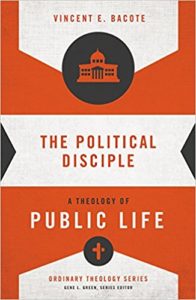 More simple but helpful is Vincent Bacote’s little The Political Disciple: A Theology of Public Life (Zondervan; $11.99) which can persuade the apathetic to care and those accommodated to either party to think a bit more about social holiness and Biblical distinctiveness so that our public witness might be more aligned with Christ’s rule and intent and less partisan. It’s part of a series of nearly pocket-sized called “Ordinary Theology” and is very useful.
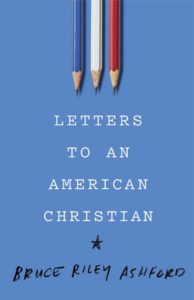 I’m a fan of Bruce Ashford’s small and often delightful Letter to an American Christian (B&H Books; $16.99.) He is a Senior Fellow in Public Theology at the Kirby Laing Institute for Christian Ethics (Cambridge, U.K.) and a Research Fellow at the Ethics and Religious Liberty Commission. He is the co-author of One Nation Under God: A Christian Hope for American Politics, author of Every Square Inch: An Introduction to Cultural Engagement for Christians so he has been bringing his wholistic, if a bit conservative, Christian worldview to bear on public issues for a while, now. This one is especially fun as it is written as a kindly, pastoral letter to a young person who has recently become a Christian but is perplexed about the relationship of faith and public life here in the USA.
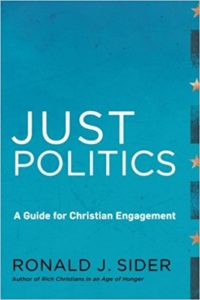 One of the books I think is the very best on all this is Ronald Sider’s meticulous Just Politics: A Guide for Christian Engagement (Brazos Press; $24.00.) It offers a complex template for developing a Biblical worldview, a Christian social theory, a faithful view of political foundations, a batch of policy goals, and then a guide for thinking about detailed issues, policies and advocacy, with due Biblical diligence, theological sophistication, social savvy about realities on the ground. And, always, a good bit of humility since good citizens, even good Christian citizens who have done “all of the above” in getting their ducks in row, can still disagree. Many will disagree with Ron’s conclusions about the Biblical material or the social science data, but no one should criticize his intention to be coherently Christian and informed by good faith, good thinking, and good care for the betterment of society.
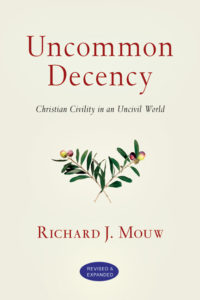 Richard Mouw’s Uncommon Decency: Christian Civility in an Uncivil World (IVP; $18.00) remains the gold standard for me, and I very, very highly recommend his fabulous, small, inspiring book. I know I am not alone in declaring how much I like this book. I’ve written about it in greater detail HERE and would be delighted if you read my review and ordered a bunch. Maybe you could suggest it now as an adult Sunday school class or small group book study for this fall. It’s the best to choose, I think, for a Christian study class or faith formation group or adult ed forum and I explain why in that older BookNotes column.
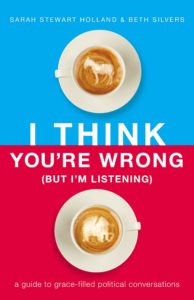 I Think You’re Wrong (But I’m Listening): A Guide to Grace-Filled Political Conversations Sarah Stewart Holland & Beth Silvers (Nelson) $24.99 This is a delightful book, a lovely study that came out of the friendship of these two politically engaged moms with tons of grass-roots civic experience. They know their stuff, have significant disagreements, and have fun talking about them. They famously co-host the
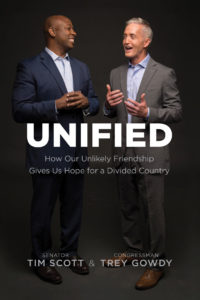 Unified: How Our Unlikely Friendship Gives Us Hope for a Divided Country Senator Tim Scott & Congressman Trey Gowdy (Tyndale) $16.99 What a great little book this is! It is easy to read, co-written by two elected officials – one black, one white, both Republicans — and they are, almost surprisingly in the current climate on Capitol Hill, good friends. This describes how their relationship has allowed them, compelled them, to take each other’s life experiences and views more seriously and with greater good will. For those that long for a story that gives us a glimpse of how to find harmony within diversity, this is a great read.
 There is a nice companion booklet to Unified called The Friendship Challenge: A Six Week Guide to True Reconciliation – One Friendship at a Time (Tyndale; $12.99) which enables you to work for greater unity in your own community. Grab some friends and work through this together.
 Them: Why We Hate Each Other – And How to Heal Ben Sasse (St. Martin’s Press) $28.99 I hope you know the fabulous books by Senator Ben Sasse. Agree or not with his principled, mid-Western conservatism (and his rather incongruous voting history) his books are fantastic to read. He is a thoughtful, well-spoken, multi-faceted civic leader, less concerned, it seems, about politics as such and more about cultural renewal and civil society. His book The Vanishing American Adult: Our Coming-Of-Age Crisis–And How to Rebuild a Culture of Self-Reliance (St. Martin’s Press; now out in paperback for $17.99) was about problems with the rising generation, or, I might say, with how older Americans have raised and perhaps coddled Gen Z. He invites self-sufficiency, wide reading, consideration of things that matter, local loyalties, family ties, and the like. It’s smart and not condescending.
 Love Your Enemies: How Decent People Can Save America From the Culture of Contempt Arthur Brooks (Broadside Books) $27.99 Wow, this subtitle alone should capture your attention and inspire you to want to start a book group, right? I have heard Mr. Brooks (no relation to David, by the way) and know him to be kind and eloquent and thoughtful. The New York Times recently reviewed this in their Book Review section which indicates its seriousness and its importance. With great endorsements by Simon Sinek and Ben Sasse, cofounder of AOL Steve Case, and important and eloquent Roman Catholic author, Bishop Robert Barron, you might realize that this will appeal to readers from across the political and religious and cultural spectrum. When he warns us not to “weaponize” the values of others that we disagree with, but to treat them with understanding and respect, he’s speaking boldly and wisely. When he says we have more in common than we realize, he’s surely correct and, as you might guess, I love hearing that good news about common ground and such. (Alas, he seems to almost under-play our most serious differences, though. In fact, some of really don’t have much in common. I appreciate the line from Os Guinness who years ago spoke of learning to live “with our deepest differences.”) Kindness and grace are hugely and urgently needed, but I wished for a bit about the structures and principles of pluralism and how we can actually honor serious diversity and what may seem like impassable conflict.
 The Death of Politics: How to Heal Our Frayed Republic After Trump Peter Wehner (HarperCollins) $25.99 This book is powerful, unrelenting, nuanced, very well-written, even elegant, and mostly right, I think. Peter Wehner worked in the Reagan White House, served President Bush, and is one of those who, we might say, helped craft the ‘80s itineration of the religious right, at least the more intellectually sound corners of that movement. Almost a decade ago he co-wrote a book with the “compassionate conservative” Michael Gerson, Wheaton grad, Bush speechwriter, now an anti-Trump, Republican Washington Post columnist. That short book which of course we continue to stock was called City of Man: Religion and Politics in a New Era (Moody Press; $19.99) and was wise, balanced, reasonable. Mr. Wehner works at the brainy, principled, conservative, think-tank The Ethics and Public Policy Center, has written for The Atlantic and is a contributing editor to the The New York Times. I say all this to add weight to this incisive study of our current context and our dysfunctional discourse and bad views of government, politics and the use of power, so that you will take seriously his lament and diagnosis, his urgent call for reform and, at least, dignified civility.
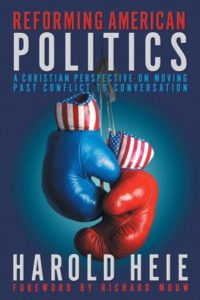 Reforming American Politics: A Christian Perspective on Moving Past Conflict to Conversation Harold Heie (Read the Spirit) $24.99
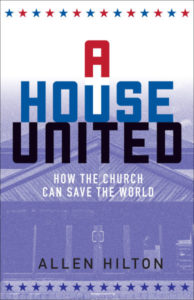 A House United: How the Church Can Save the World Allen Hilton (Fortress) $16.99 I reviewed this at greater length in a BookNotes last fall. I highlighted it in a column I did for the Center for Public Justice, in fact. Even though it isn’t brand new, I have to list it here. I’ll admit that at first I wasn’t so sure about the title and premise — can the church save the world? But what Hilton means is powerful and poignant, and, frankly, exceedingly practical. In a nutshell, his common sense (but explored with helpful theological substance) argument is this: we cannot help heal the culture wars in our civic spaces until we within the Body of Christ (at least!) learn to respect one another. There are huge theological and ethical differences within various denominations (and even within our own congregations.) Sometimes, we allow our worldly dispositions and partisan political loyalties to trump our affection for our brothers and sisters within the one body of Christ. There may be no more practical and urgent starting point for our efforts to heal the fallout from the cultural wars than for people of faith to love one another. (Sounds a bit like John 13, doesn’t it?)
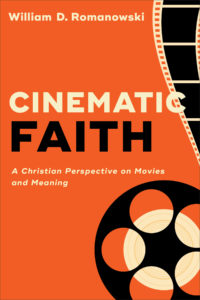 As on on-ramp to a review of William Romanowski’s important, new book Cinematic Faith: A Christian Perspective on Faith and Film
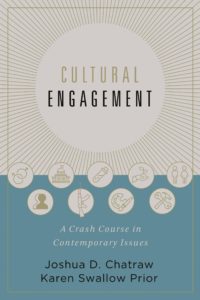 Who knows, maybe the new one coming in early July edited by our lit prof friend Karen Swallow Prior (along with Anglican theologian and director of New City Fellows in Raleigh, Joshua D. Chatraw) will help. It’s called Cultural Engagement: A Crash Course in Contemporary Issues (Zondervan Academic; $29.99) and should at least inspire those with a broad worldview who are willing to have these (mostly, but not exclusively) moderate to conservative scholars stimulate their thinking. I’m glad for the relative diversity of authors and views. With dozens of topics (work, the arts, creation care, immigration and race, reproductive technologies, war, gender, and more) and very thoughtful contributors such as Katelyn Beaty, Vincent Bacote, Robert George, Ellen Painter Dollar, Joel Salatin, W. David O. Taylor, Michael Wear, Tish Harrison Warren, Mako Fujimura, this is going to be a very helpful handbook. Who puts Matthew Vines and Rosaria Butterfield together? Rod Dreher and Andy Crouch? This book is loaded with fascinating ideas, good stuff to struggle with. You can PRE-ORDER this now if you’d like at our BookNotes 20% OFF. Just use the secure order form page at our website by clicking on the link at the bottom of the column.
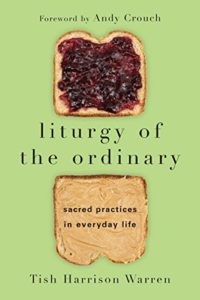 Or maybe we just need to remind folks of some of our recent favorites like Tish Warren’s amazing Liturgy of the Ordinary: Sacred Practices in Everyday Life (IVP; $16.00) that shows how our worship practices in church can equip us to find God in the sacredness of the ordinary, hour by hour throughout the day. This truly has been one of my favorite books in recent years and it wonderfully shows how we can practice the presence of God in the mundane moments of ordinary living. If you haven’t read it yet, you really should — we love it!
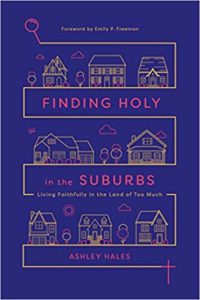 Or, somewhat similarly, we might re-recommend the excellently written and astute little book by Ashley Hales called Finding Holy in the Suburbs: Living Faithfully in the Land of Too Much (IVP; $16.00) that explores the concrete (and sometimes tempting) social realities of suburban living in light of gospel values. That is, how do we embody faith in the day to day, finding God’s presence and living Christ-like lives in those sorts of settings of yards and cul-de-sacs and commutes and status and busy, fast-paced lives? Does God show up in your sub-division? Can we think Christianly and live faithfully in the development by the mall?
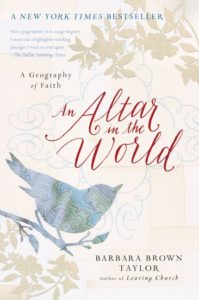 These books push us to incarnate, embody, live out, the gospel in ways that are not abstract or “spiritual” in some lofty sense. They help us do what Barbara Brown Taylor evokes in her beautifully written memoir An Altar in the World: A Geography of Faith (HarperOne; $15.99) about finding holiness in the down to Earth. You know I’ve said often how much I value this good book.
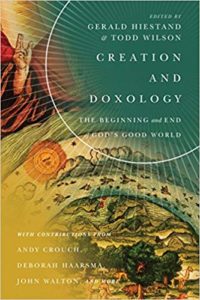 All of which reminds me of a book I recently started, the remarkable, energetic, scholarly papers of a conference called Creation and Doxology: The Beginning and End of God’s Good World edited by Gerald Hiestand & Todd Wilson (IVP Academic; $25.00.) Co-published by the Center for Pastoral Theologians, it includes gloriously stimulating pieces by Andy Crouch and Deborah Haarsma and John Walton and Kristen Johnston and many others on everything from medicine and technology to the insights of Wendell Berry to the role of a robust doctrine of creation in the history of science to the hope for restoration of a renewed cosmos to the significance of beauty in theology. This has much intellectual rigor and has much to do with providing a Biblical resource for scientists, it seems.
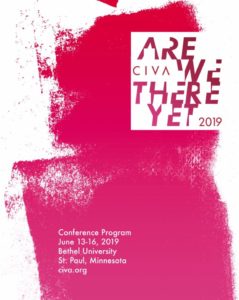 Last week we had the great privilege of sending some books to the remarkable bi-annual conference of
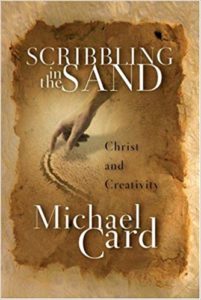 Scribbling in the Sand: Christ and Creativity Michael Card (IVP) $18.00 This is a truly fantastic read, both as a Biblical study and a set of wise musings, a lovely look at creativity and the life of Jesus. Some of Mike Card’s own story as a thoughtful songwriter is included, so those who like his good music will especially enjoy this. There is a great appendix, too, offering several short “Letters to a Young Artist” (by the likes of Mako Fujimura, Calvin Seerveld and others) that are themselves worth the price of the book. Very nicely done. In fact, it is much more than “nice” — Publisher’s Weekly called it “stunning” and writer Larry Crabb says, “This book touched my heart as few others.” Yes!
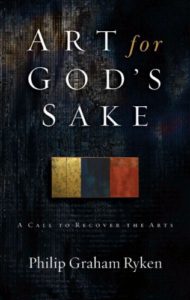 Art for God’s Sake: A Call to Recover the Arts Philip Ryken (Presbyterian & Reformed) $6.99 One of the most brief but potent little arguments for the idea of Christian art rooted in a Christian world-and-life-vision. As Hans Rookmaaker used to say, “art needs no justification” and this makes that clear for anyone with doubts, or how God is pleased by our interested in the arts. We don’t want to fall into an idolatrous and unhelpful “art for art’s sake” approach, but we surely don’t want an “art for the sake of a message” approach, either. This is a nice way to begin and the argument is concise and lovely. Give this to any seriously Christian high school or young college student who loves the arts or anyone wanting a succinct starting point.
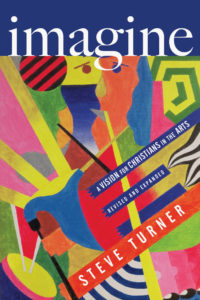 Imagine: A Vision for Christians in the Arts Steve Turner (IVP) $18.00 Turner is one of the best rock critics in the world; he was the authorized biographer of Johnny Cash, and has done other serious rock bios (Marvin Gaye, Van Morrison, and several important works on the Beatles.) His new (and lots of fun) Turn, Turn, Turn: Popular Songs Inspired by the Bible (Worthy; $24.99) shows how the Bible has influenced popular music (from the 50s through nearly contemporary times) and is so very, very interesting. Imagine (now out in a recently updated, 2nd edition) is an accessible, insightful book making a case an “in the world but not of” engagement with culture and the arts, offering a fine foundation for anyone doing creative work out of a Christian orientation. Imagine is especially good for those involved in the world of popular culture, film or the contemporary music scene, since that’s his specialty, but it’s a good book about being faithfully open to common grace in the art world for nearly anyone. Great reading, especially for those who perhaps feel like maybe this isn’t that important or right.
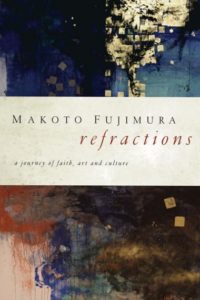 Refractions: A Journey of Faith, Art, and Culture Makoto Fujimura (NavPress) $24.99 Mako Fujimura was just becoming known as an evangelical thought leader, doing impressive abstract art in lower Manhattan when he started writing these ruminations on art and culture. Some of these essays and prayers emerged from his important work post-9-11 when he helped show how the arts can help citizens and neighbors lament and grief and recover from the awful attack. Handsomely designed on good paper, this is a humane, beautiful book to cherish. Makes a great gift and is a great example of a handsome and thoughtful Christian book for those who may not be inclined to read something more directly religious. We often recommend this as one of the first to read in this topic, and you will not be disappointed. Very nicely done.
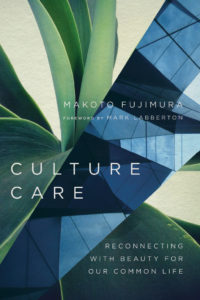 Culture Care: Reconnecting with Beauty for Our Common Life Makoto Fujimura (IVP) $18.00 This potent little volume, a more recent one by Mako, is about the common good, our responsibilities for caring for our culture, and the particular ways in which we can be cultural stewards by feeding our culture’s soul with “beauty, creativity, and generosity.” Good for “creative catalysts” who desire a renewal of culture that yields human flourishing. Why not join with some others in your church or fellowship and read this together and see what comes of it. Excellent. By the way, don’t miss his reflection of beauty and cultural healing as it comes up against sorrow, suffering, and injustice in his splendid, thoughtful study of a transforming book in his life, the famous Silence by Japanese novelist Shusaku Endo. Mako’s study, in a very handsome hardback, is called Silence and Beauty: Hidden Faith Born of Suffering (IVP; $26.00.) There’s an excellent, extensive introduction by Philip Yancey.
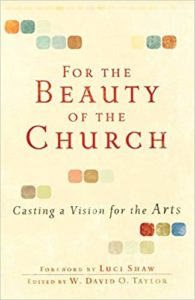 For the Beauty of the Church: Casting a Vision for the Arts edited by W. David O. Taylor (Baker) $18.00 This is another one of those books that nearly anyone should read and from which nearly everyone would benefit. What a great collection, interesting and upbeat with a variety of contemporary scholars, pastors, critics, patrons, and artists, from Luci Shaw, Andy Crouch, Eugene Peterson, Barbara Nicolosi, Lauren Winner, Jeremy Begbie and Joshua Banner. This really is an excellent collection, particularly useful for local church study. These chapters emerged from a conference at a church, so isn’t only for artists, but for anyone who cares about how the church can affirm and appreciate the arts and artists.
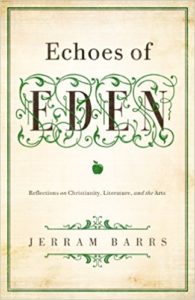 Echoes of Eden: Reflections on Christianity, Literature, and the Arts Jerram Barrs (Crossway) $18.99 We have an extensive selection of books – at various scholarly levels – of books mostly about literature, so wanted to name at least one. That this also is good for any sorts of creative workers or anyone interested in a faithfully Christian insight about the arts makes this one great for nearly anyone. Barrs is a beloved professor at Covenant Theological Seminary and we stock all of his books, from Being Human (which properly frets about Gnostic influences in some contemplative spirituality) to excellent books on prayer and evangelism, Barrs is really solid. Our dear and trusted friend Denis Haack of Ransom Fellowship has a very nice blurb on the back of this, as does the always-discerning William Edgar. Timothy Keller says it is “the most accessible, readably, and yet theologically robust work on Christianity and the arts that you will be able to find.”
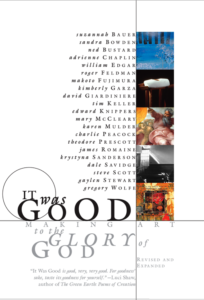 It Was Good: Making Art to the Glory of God edited by Ned Bustard (Square Halo Books) $24.99 I love this book and very, very highly recommend it. When a very handsome revision of this classic was released a decade ago, I wrote this:
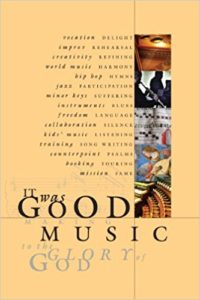 It Was Good: Making Music to the Glory of God edited by Ned Bustard (Square Halo Books) $19.99 Okay, this was the sequel to the wonderful It Was Good: Making Art… and I invite you to
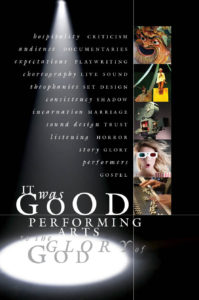 It Was Good: Performing Arts to the Glory of God edited by Ned Bustard (Square Halo Books) $19.99 Ahhh, this is the third in this splendid set of thoughtful books that explore the cutting edge of that line between theory and practice, between significant (but not dense) aesthetics and good ideas and the practical matters that artists face. This one is exceptional in part because it is just about the only book like it that offers good guidance and inspiring reflections about the craft of being a performing artist. For dancers, actors, folks on the road, people managing theaters and doing choreography or filmmaking and the like. What a book!
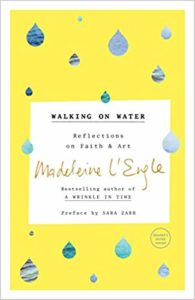 Walking on Water: Reflections on Faith and Art Madeline L’Engle (Convergent) $15.00 Recently released with a new cover design and compelling forward (by YA novelist Sara Zarr), this little classic is one of the most-often mentioned and certainly cherished books among those who care about this topic since its release in 1980. Sublime. Interesting. A must-have book for anyone involved in writing or the arts. It may be surprising to some how deeply knowledgeable she is about the contemplative tradition, about the Orthodox, about others upon whose shoulders we stand in our understanding of faith, life, the arts, and the creative process. Certainly of interest to arts, but a good, provocative read for nearly anyone.
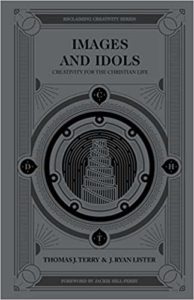 Images and Idols: Creativity for the Christian Life Thomas J. Terry & J. Ryan Lister, with foreword by Jackie Hill Perry (Moody Press) $14.99 Just the look and feel of this hardback volume sets it apart – it is sturdy, black and white, textured, sans dust jacket. The authors are leaders of humble beast, an underground hip hop music label out of Portland that does important, gospel-centered rap and other hip hop records and concerts. They are not only way cool and authentically down with that scene, but they are wanting to forge a community of artists who are rooted in the gospel and thoughtful about aesthetics, the arts, cultural engagement, social renewal, and the like. For those who have followed the deepening worldview of performing artists like Lecrae or Prop or Sho Baraka or others in those circles, Humble Beast is highly, highly regarded. And so, this first volume in what may become a series of studies is insisting, “God is reclaiming creativity for His glory and our good.” Yep, it’s hip hop meets Jonathan Edwards, or so it nearly seems with Terry & Lister dropping names like Dorothy Sayers and Dostoevsky, Abraham Kuyper and Flannery O’Connor, this study is foundational and wonderfully realized. There are some pretty cool touches to the book too, with some light notations and illustrative graphics and reverse printing on full color pages. Kudos!!
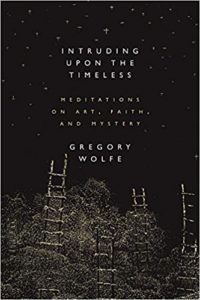 Intruding Upon the Timeless: Meditations on Art, Faith, and Mystery (Revised and Expanded, 2nd edition) Gregory Wolfe (Square Halo Books) $22.99 I adored the first small volume of this that had the minimalist markings of the great Barry Moser illustrating the essays by famous Image Journals editor Greg Wolfe. In this second edition there are many more essays and much more artwork illuminating this wonderful anthology of some of Greg’s best short form essays that appeared in Image from the days it was so masterfully developed under his watchful eye. I love these short pieces on all manner of artful observations, about poetry and paints and movies and rock critics and dance and visual artists. Greg, an evangelical who became Roman Catholic years ago, has this wide vision and learned view and a winsome ability to tell a good story in a short essay. Intruding Upon the Timeless is a great introduction to a major voice in the faith and art movement in the last decades and will appeal to many sorts of readers.
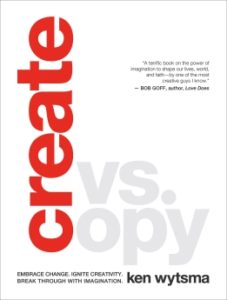 Create vs. Copy: Embrace Change. Ignite Creativity. Break Through with Imagination. Ken Wytsma (Moody Press) $14.99 We have a lot of books like this, about creativity and the process of being inspired. I respect Ken Wytsma so much and this is great on the power of imagination. Bob Goff says he is “one of the most creative guys I know” which surely makes it well worth considering. This is good for leaders, for artists, for anyone wanting to develop their God-giving creativity. Highly recommended.
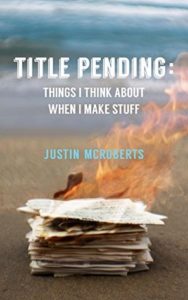 Title Pending: Things I Think About When I Make Stuff Justin McRoberts (Justin McRoberts) $9.99 I love this little book by our good friend Justin, a singer-songwriter, consultant, coach, speaker, and author with lots of social media savvy. He has worked with visual artists and collaborated in all sorts of church and mission project and know much about being a maker. This offers an outline of sorts, with lots of stories, good teaching, and upbeat prose, for exploring your own drive to create. After an opening thought on “who needs another book on creativity?” he invites us to the journey. There are sections called “Get Your Bearings”, “Map Your Territory”, “Pay Attention to the Weather”, “Course Corrections”, and “Enjoy the Journey.” Lots of ideas for good practices and some hard stuff and some fun stuff. We’re glad to stock this rare little guidebook and know it’s going to inspire somebody out there.
 When Poets Pray Marilyn McEntyre (Eerdmans) $19.99 Granted, this is not about the visual arts, but, as a matter of fact, Marilyn McEntyre was at the CIVA event and although she was not doing a plenary session, we sold out of several of her great books – her Caring for Words in a Culture of Lies is a favorite – and this marvelous thin hardback is nearly sublime. It offers deeply spiritual ruminations on poems (many which you may know, others which you may not) and asks if these well-worded lines and phrases could actually be used as prayers. There are two dozen select “prayer-poems” to learn from and live with. As the publisher puts it,
 Learning from Henri Nouwen and Vincent Van Gogh: A Portrait of the Compassionate Life Carol Berry (IVP) $22.00 This brand new book is the long-awaited reflection on the course Nouwen taught (just once) at Yale on compassion, learned by and from Vincent Van Gogh. Ms. Berry audited that class and took copious notes; she was approached by the Nouwen literary estate to write this spiritual formation book that shares what she learned by spending time with Van Gogh under the guidance of Henri Nouwen (who, as we know, loved his Dutch painters, especially Van Gogh.) What a great book, wonderful for nearly anyone who appreciates the arts. Thanks to IVP for doing this fine work and including some nice full color reproductions, too.
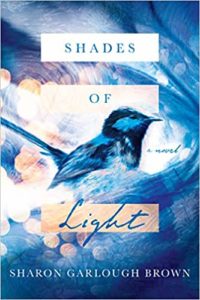 Shades of Light: A Novel Sharon Garlough Brown (VP) $18.00 Speaking of Van Gogh, keep an eye out for a forthcoming novel by Sharon Garlough Brown coming this August called Shades of Light. This nicely told story (by the author of the popular Sensible Shoes novels about spiritual direction) while mostly about a young woman recovering from depression and anxiety (and her anguished loved ones and aunt, Kit, who is a spiritual director) includes a whole lot about Van Gogh, who the main character (named Wren) is inspired by. I was actually very deeply moved by how Wren took comfort in the pain and paintings of Van Gogh and how beautifully she could describe the famous correspondence between Vincent and his brother Theo. I also enjoyed the vivid description of this novice painter setting out to paint… uh, I can’t spoil it. You’ll have to read it yourself! You might enjoy it too, and be moved by the sorrow and regret and beauty and hope found as someone ponders great art. PRE-ORDER it at our 20% off discounted price today.
 Rainbows for the Fallen World Calvin Seerveld (Toronto Tuppence Press) $35.00 Rainbows is certainly one of the most esteemed and often-cited books in the last generation of Christians thinking deeply about faith and art and culture, and certainly a very significant book (from a very significant leader) in the history of CIVA. (Its first edition was published in the 1976, and I treasure my first edition as much as any book I own. For a variety of reasons, it is a personal favorite.) In Seerveld’s many books that we stock, this flamboyant writer colorfully studies Scripture, art history, aesthetics, and cultural renewal, always reveling in the sturdy goodness of God’s creation and the call for an allusive and imaginative human response. Rainbows has a few chapters about what we might call obedient aesthetic life — that is, not stuff just for artists but for all of us. And some wonderfully rich and deeply thoughtful calls to cultural renewal, inspired by his astute reading of various paintings and arts movements. He has a heady chapter about
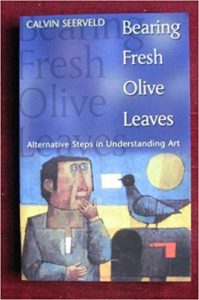 philosophical aesthetics and some inspiring talks about why we need a robustly Biblical framework for imagining the gifts artists bring to our lives. You should know his next book that was released as a follow up to Rainbows was Bearing Fresh Olive Leaves: Alternative Steps in Understanding Art (Piquant Press; $35.00) which I also adore. And then, we are proud to stock his large collection of miscellaneous and sundry works (such as Normative Aesthetics, Redemptive Art in Society or Art History Revised)
 Art & Soul: Signposts for Christians in the Arts Hilary Brand & Adrienne Chaplin (IVP Academic) $34.00 This is also surely one of the best books in recent decades exploring a uniquely Christian involvement in the world of the arts. Lots of interesting side journeys cover all manner of scholarly and practical stuff. Chaplin, by the way, took up Seerveld’s chair in aesthetics at the Institute for Christian Studies in Toronto when he retired. Mature, thoughtful, important. I sometimes tell the story that I once knew a young art student at a state university who was being told by her advisor in the art department that she simply had to give up her faith, that her efforts to integrate her faith into her creative work was inappropriate and doomed. She bought this book from us, gave it to her teacher who later apologized, saying, “I didn’t realize that this is what you mean by developing a Christian perspective on the arts…” It’s that good.
 Placemaking and the Arts: Cultivating the Christian Life Jennifer Allen Craft (IVP Academic) $30.00 This fantastic book is the latest in the excellent “Studies in Theology and the Arts” series and the author was a CIVA 2019 speaker. We are thrilled to suggest it to you. For starters, it breaks new ground, showing how Wendell Berry-esque localism is enhanced by art that attends to local space and, conversely, how local artists can enhance awareness, flourishing, and redemptive justice in their local places. There is nothing like this in print, making it a must-read, even urgent book. We reviewed Placemaking and the Arts a bit more extensively when it first came out and we continue to think it is brilliant. It’s good not only for those interested in the arts but for anyone interested in a sense of place, caring about their local region, those doing missional work for the common good. Very highly recommended.
 The Arts and the Christian Imagination: Essays on Art, Literature and Aesthetics Clyde Kilby, edited by William Dyrness & Keith Call (Paraclete Press) $28.99 What a beautiful book this is, a great volume for your own personal library or to give as a very special gift. Kilby, you may know, is legendary for being an early friend of C.S. Lewis and one of the primary people who influenced American evangelicals to adopt Lewis and his lucid apologetics and his astute literary criticism and, of course, his colorful, creative fiction. He founded the marvelous Marion Wade Center at Wheaton College (where he taught literature for decades.) This collection has been called a “landmark book” with “breathtaking scope” by an author who has been “profoundly influential.” Luci Shaw says that Kilby “set the course of my life.” The significance of this author and this collection is hard to understate.
 There is, in fact, a lovely, handsome, companion volume to this entitled A Well of Wonder: Essays on C.S. Lewis, J.R.R. Tolkien, and the Inklings also by Clyde Kilby, edited by Loren Wilkinson & Keith Call (Paraclete Press; $28.99) which explores the seven key British authors who make up the writer’s group known as the Inklings.) In both volumes, the editors have carefully and thoughtfully selected and compiled the best of Kilby’s many essays, articles, lectures, chapters of other books to create two great readers: one on Kilby’s work on the Inklings and the other, more general in nature, on Kilby’s own writing on the arts. These are extraordinary, important, nearly historic, I’d say. Kudos to Paraclete for these two very nice matching volumes.
 Arts Ministry: Nurturing the Creative Life of God’s People Michael J. Bauer (Eerdmans) $29.00 There may be some chintzy books on this, some guides that are somewhat self-evident, but this is mature, wise, complex, and well worth having around any congregation that cares even a little about this vital (but often not adequately considered) aspect of local church ministry. Published by the Calvin Institute of Christian Worship in their Liturgical Studies series (edited by John Witvliet) this volume is clearly “the best available guidebook to the emerging field of Christian arts ministry.” There are 18 different illustrative case studies that make this an inspiring and energizing read. The pioneering Catherine Kapikian (of the Henry Luce Center for the Arts and Religion at Wesley Theological Seminary” calls it “an unprecedented expose on arts ministry – what it is, how it works, and why it succeeds…” written with “unblinking, erudite analysis.”
 Redeeming Transcendence in the Arts: Bearing Witness to the Triune God Jeremy Begbie (Eerdmans) $18.00 Of the new books in this field that came out this year, this may be the most important, and certainly one which carries the most amazing endorsements. A musician and a classical composer by training, Professor Begbie is one of the best scholarly voices in this movement, and you should read whatever he writes. This recent book explores, as only Begbie can, the questions of awe and wonder and mystery in the arts. Of course, he “employs a biblical, Trinitarian imagination to show how Christian involvement in the arts can be shaped by the distinctive vision of God’s transcendence opened up in and through Jesus Christ.”
 Very highly recommended.
 He Held Radical Light: The Art of Faith, the Faith of Art Christian Wiman (FSG) $23.00 Certainly one of the nation’s most esteemed contemporary poets, Mr. Wiman movingly wrote about his return to Christian faith in his 2013 best-seller My Bright Abyss: Meditation of a Modern Believer (Farrar, Strauss, Giroux; $14.00.) That was reviewed positively in prominent venues, with Kathleen Norris writing the extraordinary review in The New York Times Book Review. Now at the Yale Center for Faith & Culture, this is his recent work exploring theology and art in what Marilynn Robinson calls “scholarship that has a purifying urgency.” It’s a bit dense, has significant interaction with poetry and poems, but for those studying this field, it is one of the most important books published this year. If you are a fan of Wiman’s poetry, or care to read his moving studies of contemporary writers, you will love this.
 The Faithful Artist: A Vision for Evangelicalism and the Arts Cameron J. Anderson (IVP Academic) $28.00 Special kudos to the previous director of CIVA for offering this mature and sophisticated appeal for how contemporary evangelicalism can come to appreciate the arts and how a deeply rooted faith can inspire artists today. This should be on the shelf of any person of faith who is an artist, and anyone who does ministry with and for artists. Many who are in this movement find their editions dog-eared and well used. This is a must-read that is meaty and scholarly enough, without being tedious or obtuse, thoughtfully written with a vast knowledge of the best literature in the conversation, and thoroughly engaging. The Faithful Artist is a great overview, but more than an overview, it is nearly a manifesto. Whether you identify with the evangelical tradition or not, this is a fabulous book. By the way, I’m not fond of the cover and if you are like me, please don’t be dissuaded. This book is beautiful, thoughtful, rigorous, and important.
 Contemporary Art and the Church: A Conversation Between Two Worldsedited W. David O. Taylor & Taylor Worley (IVP Academic) $30.00 An exceptional release in the important “Studies in Theology and the Arts” series sponsored by CIVA, this is perhaps the definitive volume (and will be for quite some time, I suspect) pushing a deeper conversation about exceptionally contemporary art work and its reception within the Christian community. This includes expertly edited versions of talks and panels from the extraordinary 2015 biennial CIVA conference and includes inspiring and provocative transcripts of the wonderful presentations from that gathering. Nearly all the great thinkers and critics and patrons who have forged the foundation of CIVA these last decades are in here. This splendid book is nothing short of spectacular and a great tribute to the profound state of the discussion about this topic. I’m in awe. Order it today!
 God in the Gallery: A Christian Embrace of Modern Art Daniel A. Siedell (Baker Academic) $26.00 Dan Siedell is a deep thinker and curator who has been a pioneer in writing about modern art from a Christian perspective. The concern of this book is to think faithfully in ways that are germane to the real world of contemporary art moving the conversation about faith, culture, and the arts into the 21st century. Not at all limited to a faith-based cul-de-sac or echo chamber, Siedell is embedded in the real modern art world and is a trusted thinker; this was groundbreaking when it came out in 2008 and remains a must-read standard. He is also the author of, among other works, Who’s Afraid of Modern Art? (Cascade Books; $24.00.)
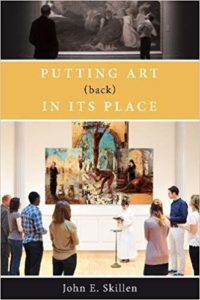 Putting Art (Back) In Its Place John E. Skillen (Hendrickson) $24.95 Many professors and students have admired the wonderful arts-oriented semester abroad program in Orvieto, Italy, founded by Dr. Skillen, a medievalist from Gordon College. This thoughtful book “takes readers on a fascinating journey through the world of Christian art in medieval and Renaissance Italy to rediscover the sacred role artwork can play once again in our churches.” Part historical survey, part manifesto about art commissions and collaboration and a vibrant call for church folks to realize the value of art and insist upon its flourishing. Skillen knows the cultural context of medieval and Renaissance Italian art (and storytelling) and its impact on art history and Western culture. This is a grand and unique book; highly recommended.
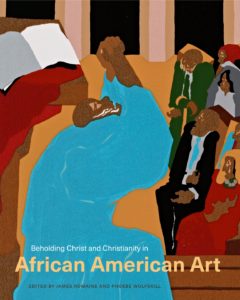 Beholding Christ and Christianity in African American Art edited by James Romaine & Phoebe Wolfskill (Penn State University Press) $34.95 We were particularly glad to hear that at the bi-annual CIVA event in June of 2019 they intended to focus somewhat on the relationships and interfaces of art, social change, cultural transformation, and the unending project of seeking ethnic justice and racial reconciliation. Respected evangelical art historian James Romaine here joined up with Dr. Phoebe Wolfskill, Department of African American and African Diaspora Studies at Indiana University, Bloomington, to offer a collection of essays that explore prominent African American art. Sometimes these artists engage overtly religious themes; often this work is transformatively Christian. As the publisher explains, these essays “examine the ways in which an artists engagement with religious symbols can be an expression of concerns related to racial, political, and socio-economic identity. We were glad to sell a few of this hefty book at CIVA and are happy to tell you about it now.
 Normative Aesthetics: Sundry Writings and Occasional Lectures Calvin Seerveld (Dordt College Press) $21.00 This collection of various pieces – ranging from exceedingly dense scholarly philosophy to delightful sermons and brief essays – is the best place to dig deeply into Seerveld’s famously unique (and Biblically sound) aesthetic theories. No one in the contemporary world has done what he has done, and anyone interested in the topic, if they are intellectually honest and at all curious, owes it to themselves to study this volume.
 Redemptive Art in Society: Sundry Writings and Occasional Lectures Calvin Seerveld (Dordt College Press) $21.00 One of my great joys in my bookselling and book reviewing “career” was being asked to provide a quip on the back of this volume as an endorsing blurb. I mentioned how important it is to see art as a gift that can stimulate and be a part of social change, bring shalom and voice to the oppressed. Better, though, are these sample lines from the good introduction by Adrienne Dengerink Chaplin, who wrote:
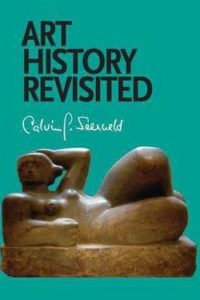 Art History Revised: Sundry Writings and Occasional Lectures Calvin Seerveld (Dordt College Press) $21.00 As the publisher explains: “The essays in Art History Revisited follow a general course from the historiography of philosophy to the historiography of art and aesthetics to analyses of individual artists like Antoine Watteau and Gerald Folkerts and the theory and practice of artist/aestheticians like William Hogarth and Anton Raphael Mengs. As this selection of essays attests, Seerveld is both well-versed in the history of art and has made significant contributions to this field as well.” I know very little of any of this, and enjoyed learning, and was considerably blessed to see Seerveld in action, to imbibed from his integral worldview and his, deep, Godly passion.
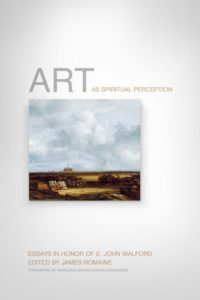 Art as Spiritual Perception: Essays in Honor of John E. Walford edited by James Romaine (Crossway) $40.00 This is a very handsome, hardback festschrift for a legendary art historian, known for his many good years of teaching at Wheaton College. Each chapter has a contemporary art historian exploring the deep insights of a certain work, or body of work, as they were taught by their teacher, or colleague, or friend, John Walford. A few of the pieces are very, very good, examining the process of Christian art historical discernment (including one I truly loved by Calvin Seerveld.) A rare, specialized collection for those interested in the methodologies of art history.
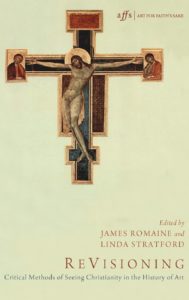 ReVisioning: Critical Methods of Seeing Christianity in the History of Art edited by James Romaine & Linda Stratford (Cascade Books) $43.00 We were delighted to announce this book when it came out in 2014, now noting that it is somewhat like the Art as Spiritual Perception, above but more sprawling, diverse and intense. With over 20 chapters (and 350 pages, complete with color plates) it remains a seminal work in the field of nurturing a uniquely Christian art historical method. The publisher explains it like this: ReVisioning examines the application of art historical methods to the history of Christianity and art. As methods of art history have become more interdisciplinary, there has been a notable emergence of discussions of religion in art history as well as related fields such as visual culture and theology. This book represents the first critical examination of scholarly methodologies applied to the study of Christian subjects, themes, and contexts in art. ReVisioning contains original work from a range of scholars, each of whom has addressed the question, in regard to a well-known work of art or body of work, “How have particular methods of art history been applied, and with what effect?” The study moves from the third century to the present, providing extensive treatment and analysis of art historical methods applied to the history of Christianity and art.
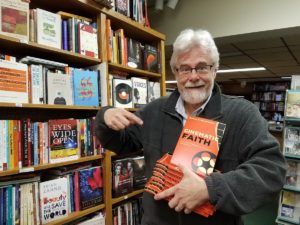 In this week’s BookNotes I will review a new book that we think is very good, a lot of fun, and even, I would say, important. It’s important for ordinary folks as well as for those who study this particular field professionally. Its retro cover matches the topic: Cinematic Faith: A Christian Perspective on Movies and Meaning by Calvin College film studies professor (and excitable film buff) William D. Romanowski (Baker Academic) $22.99. Our 20% OFF ON SALE discount makes it just $18.39.
 major work on Tolkien’s “divine design” is majestic) to a church education conference with PC(USA) Presbyterian congregational educators, to a UCC clergy convocation (with Sarah Griffith Lund leading as a vibrant speaker whose book Blessed Are the Crazy: Breaking the Silence about Mental
 elected their current very good Bishop.
 We are told over and over that our books make a difference, that our presence matters at these denominational events. Historically, mom and pop Christian bookstores have been part often simplistic pietistic and fundamentalist traditions and have sometimes not been very serious-minded about theology; they have often eschewed working with mainline congregations. When large evangelical chains won’t even carry certain Bible translations or the work of certain publishers, there is good reason for animosity towards Christian booksellers among mainline Protestants and Roman Catholics. We have been graced by those in mainline circles who have welcomed us, knowing that we are a mom and pop, small town, Christian bookstore whose most core convictions remain orthodox. And we are grateful for
 those who have trusted us.
 on leadership development, youth ministry, and Christian education. Some rather evangelical books can be wisely used by mainline folks and we have tons of books from more liturgical, mainline traditions. We take books like The Art of Transformation: Three Things Churches Do That Change Everything by Paul Fromberg, one of the priests at St. Gregory of Nyssa (Church Publishing; $18.95) or Becoming a Just Church: Cultivating Communities of God’s Shalom by Adam Gustine (IVP; $17.00.) or the new one by the remarkable Peter Steinke, Uproar:Calm Leadership in Anxious Times (Rowman & Littlefield; $19.95) and dozens and dozens more.
 Abraham Kuyper who used that great phrase about Christ being Lord of “every square inch” of His creation to understand that God cares about more than our churches. (Although it wouldn’t hurt to get it from the proverbial horses mouth – the third Pro Rege: Living Under Christ’s Kingship volume in the massive Kuyper translation project was just released (Lexham Press; $49.99) offering remarkable insight about cultural engagement from the early 20th century Dutch theologian and statesman.)
 (Do please read
 (And then back up and read
 As you can guess, we are passionate about this wholistic vision – learned mostly from the likes of Francis Schaeffer and Abraham Kuyper and in books like Creation Regained: Biblical Basis for a Reformational Worldview by Al Wolters and Heaven Is Not My Home: Living in the Now of God’s Creation by Paul Marshall and Engaging God’s World: A Christian Vision of Faith, Learning, and Living by Cornelius Plantinga – about how we can find God in the ordinary stuff of life and how we are called by God to be faithfully attentive about how to think and live in all spheres of life; no arena of culture or aspect of society or corner of your life is off limits to the saving power of Christ and the renewing power of the Spirit. It hardly needs saying – but yet, in religious circles, it does – life in God’s creation is multi-dimensional. We think and feel, work and play, vote and shop. Theorists of all sorts get at this when they talk about two hemispheres of the brain or when educators talk about multiple intelligences or even when we hear about personality types (like with the recent interest in the Enneagram. As multi-faceted people made in God’s image, we are more than bodies and souls. Which is why the church must proclaim a big gospel of all sides of life and why faith-based booksellers must carry resources for living in every sector of life and culture.
 teaching to lawyering, from math to aesthetics, from farming to journalism, there are Christian authors offering up their workspaces as holy ground, as mission fields. There are people that get what my friend John Van Sloten says in his clever book title (and very excellent book) Every Job a Parable: What Walmart Greet, Nurses and Astronauts Tell us About God. Such folks may not be church leaders but they are trying to be salt and light, leaven in the loaf, blooming right where they are planted in the factory floor or work cubicle or sculpting studio or kindergarten classroom.
 callings to serve God in professions and careers that I compiled, Serious Dreams: Bold Ideas for the Rest of Your Life (Square Halo Books; $13.99) and why I’m sad when people think that even young adults wouldn’t be interesting in such a thing. It is unfortunate, I think, of how few churches honor their college grads. Maybe if we all read Serious Dreams it might help.
 I was dismayed that a book that is getting rave reviews in places like Christianity Today called Seculosity: How Career, Parenting, Technology, Food, Politics, and Romance Became Our New Religion and What to Do about It by Dave Zahl didn’t sell at our recent mainline gigs, even though Fleming Rutledge (an Episcopalian) had a great blurb on the back, and it is published by the ELCA-related Fortress Press. It is an interesting, playful, grace-filled, feisty study of our culture – the sort of things he does at his exceptional website and podcast Mockingbird.
 One book we always take out with us to events is Eyes Wide Open: Looking for God in Popular Culture (Brazos Press; $24.00.) It is a personal favorite written by an old college pal, author of the brand new Cinematic Faith, William D. Romanowski. Decades ago in those critical years, under the influence of older mentors in the
 Culture Wars: Religion & the Role of Entertainment in American Life (Wipf & Stock; $45.00) remains a major work – critiquing, by the way, the very way we assume that there is a difference between high art (that we should study and learn from) and low art, or pop culture (which, well, is just amusement, after all, or so many assume.) That the original cover had a picture of Rocky Balboa and William Shakespeare and Bruce Cockburn made a nice point. Bill was a lit major in college, was a performing artist himself, had worked in campus ministry with emerging adults (through the CCO) and soon became perhaps the leading voice in the early 1990s discussions about evangelical faith and popular culture. He was speaking widely and doing research and meeting important voices in the entertainment industry. (The picture above, by the way, is with the legendary Jack Valenti, the late President of the Motion Picture Association — you know, the institution that runs the Academy Awards and gives out the Oscars.
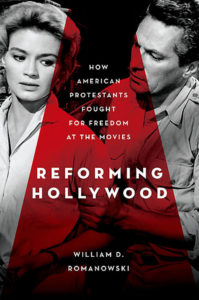 As you may recall from
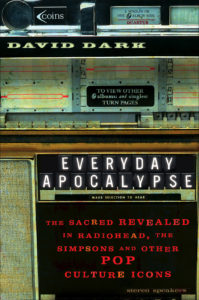 (By the way, another vital favorite, which we also take everywhere we go – with a more allusive writing style, and a bit more punchy evaluation of important popular culture works – is David Dark’s amazing Everyday Apocalypse: The Sacred Revealed in Radiohead, The Simpsons, and Other Pop Culture Icons (Brazos Press; $20.00.) Don’t you love the cool, old-school juke box on the cover design?
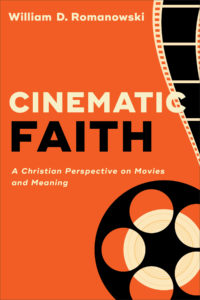 Years in the making, we are very, very glad to get to announce a brand new book by professor Romanowski. As we’ve said, it’s called Cinematic Faith: A Christian Perspective on Movies and Meaning (Baker Academic; $22.99 – OUR SALE PRICE = $18.39) and I’m reading through it happily for the second time. For anyone who likes going to the movies or can’t wait for the next NetFlex DVD to show up (please don’t tell me you watch films on your little phone!) this big book will be an education and a joy. It isn’t preachy and it isn’t simplistic but it isn’t overly academic. If you love movies, you need this book.
 Books help us see and appreciate and develop the creation God has given us. To use the language of Andy Crouch’s essential text, we become Culture Makers who “recovery our creative calling” and can then, as Romanowski puts it, “find God in popular culture.” (By the way, we take Crouch’s Culture Making everywhere we go, too – it’s such a very, very helpful book to help us find meaning and purpose in our day to day lives.)
 Rear Window, and a great piece called “Narrative, Character and Perspective in The Blind Side” – you’ve got to read that if you enjoyed this movie as much as we have. Through all of these excursions, you can tell that his tastes are not overly high-brow. (Remember his central thesis of Pop Culture Wars that all film and pop artifacts are religiously/philosophically laden and artfully serious, and his central thesis of Eyes Wide Open
 that we can find signs of life and Godly insight from even pagan popular culture.) Cinematic Faith is hoping to enhance your viewing experiences and help you get more out of your entertainment dollar, not bore you with academic discourse or shame you for enjoying the movies you enjoy. Please know, this isn’t highbrow scholarly theory for snooty cineastes but a thoughtful tool for all of us, whether you like The Kings Speech or the X-Men series or Marvel’s Captain America: Civil War.
 I will name several good things that make this a very important contribution, not only for anyone serious about developing a uniquely and inherently Christian way of approaching film, but for ordinary folks who enjoy a good movie night from time to time.
 has been informed by the aesthetic theories of Calvin Seerveld (Rainbows for a Fallen World, Bearing Fresh Olive Leaves, Normative Aesthetics, Redemptive Art in Society) and more, including study and conversations with other philosophers of the arts such as philosophers such as Nicholas Wolterstorff and Lambert Zuidervaart as well as pop journalists like the great Steve Turner whose Imagine: A Vision for Christians in the Arts is a great book for anyone wanting to dip into an integrated Christian perspective on art and culture and whose Popcultured I already mentioned.) This means that Bill has worked very hard at a deep level to wonder what it means to take up theories and mindsets that inform dispositions and practices that are not only coherent and consistent from a Christian perspective but that are deeply integral. In this, he doesn’t get all preachy nor does he particularly wear his faith on his sleeve, but he is a reliable, faithful guide. Faith, in his scholarship, is not an afterthought nor is his sense of quality and value in a film based on cheap inspiration. I suppose we don’t have to say it here, but a novel or movie can tell a profoundly immoral story and be brilliantly made and wise; similarly an overtly Christian movie may have a lively religious message but be poorly made. Such films and books can even be dishonest about the way faith works in real life. Some of the most theologically sane movies have be made by deeply troubled filmmakers and some of our worst films are made by otherwise Godly people trying to use the art form for evangelistic purposes.
 And then he goes from he assessment of the conventional American myths to a full-on study of gender in mainstream Hollywood. As a guy with long-standing sensitivity to the critiques of machismo, a critique he has himself been making for decades, this chapter, called “Stop Taking My Hand!” (which is a line from Rey in Star Wars: The Force Awakens), looks at “gendered cultural patterns” about the ideal man or woman. Do these images reflect our values and assumptions or shape them? What might the recent interest in strong female characters bode for film and storytelling? With explorations of Katniss Everdeen (The Hunger Games) to Hilary Swank’s awarded winning Maggie Fitzgerald being trained in boxing by Clint Eastwood’s character in Million Dollar Baby, Romanowski brings fascinating and I think wise insight to questions of gender and sexuality and relationships.
 Deep Focus: Film and Theology in Dialogue Robert Johnston, Craig Detweiler and Kutter Callaway (Baker Academic) $26.99 As I’ve hinted above, I’m not inclined to be particularly interested in seeing what theologians, as such, have to say about film studies. A book about movies that has churchy stained glass on the cover strikes me as awkward. This sort of approach just seems somehow off to me, as if we have to somehow sanctify the ordinary act of watching movies not by thinking Christianly about movies (as Romanowski would argue) but that we need these professional thinkers about theology to make it so.
 screenplays and win awards for costuming and who are actors and actresses on the silver screen. They know their stuff and they’ve offered us important, inspiring stuff. In a back cover blurb, Terry Lindvall calls them “ophthalmologist of the cinema.” I love that!
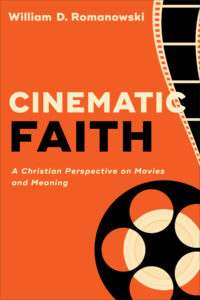
 Last week’s BookNotes review
 As I explained, Romans Disarmed book fits well within the decades of work and witness and writing Brian and Sylvia have done. They are a bit rare — academics who publish in the finest scholarly journals who work an organic farm, stewarding it well with old ways and some innovative permaculture approaches. (And they have animals and heirloom tomatoes and do workshops on all kinds of homesteading skills.) Plus, they have served among the homeless in Toronto, done campus ministry with college students, have mentored young adults in starting social service ministries and justice-seeking businesses. (Check out this video about
 In case you missed it, I noted that Brian and Sylvia did a previous book in this same creative genre – an amazing, potent, radical, application-oriented (conversational) creative commentary called Colossians Remixed: Subverting the Empire (IVP Academic; $28.00; our sale price at 20% off = $22.40.) In that column I named some of their other books as well.
 There have been a lot of books on St. Paul, lately. Those of us who don’t read a lot in this field may not know it, but it is stimulating to find the various scholars who are helping us solve our problems with Paul. Of course, we have raved about the novel-like biography of Paul colorfully written by N.T. Wright called Paul A Biography (HarperOne; $29.99; our 20% off sale price = $23.99) and we highly recommend it.
 Practical books come to mind as helpful resources for more simple living like Nancy Sleeth’s delightful and very inspiring Almost Amish: One Woman’s Quest for a Slower, Simpler, More Sustainable Life (Tyndale; $14.99 – our sale price = $11.99) and wise, profound books like Norma Wirzba’s Living the Sabbath: Discovering the Rhythms of Rest and Delight (Brazos Press; $20.00; our sale price = $16.00) and A.J. Soboba’s Subversive Sabbath: The Surprising Power of Rest in a Nonstop Road (Brazos Press; $19.99; our sale price = $15.99) which are exceptionally helpful to shore up the Christian lifestyle proclaimed as good news in Romans Disarmed.
 It brings us great delight to announce the release this past week of the prestigious Library of America’s simultaneous publication of two handsome, sturdy cloth hardbacks (expertly bound with high quality, acid-free paper, Smyth-sewn binding, even ribbon markers) of some of Wendell Berry’s most significant essays.
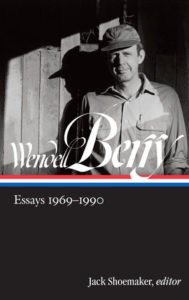
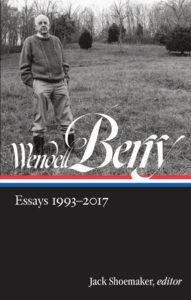
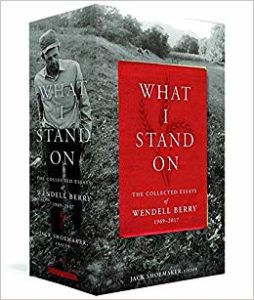 What I Stand On: The Collected Essays of Wendell Berry 1969-2017 Boxed Set edited by Wendell Berry (Library of America)
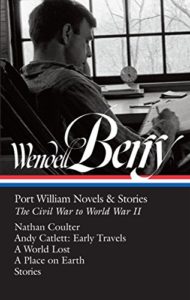 For those wanting to dip into Mr. Berry’s extraordinary fiction world – all of his novels and short stories are set within the membership of the same fictional Kentucky community, haphazardly scattered over more than a century — Library of America has published (and we have announced, previously) the first of a several volume set of his stories and novels, arranged, cleverly, in fictive, Port Williams historical order. That is, they are not chronological based on when Berry wrote or published them, but are ordered within the historical unfolding within Berry’s Port Williams world. We don’t know when the next volume is coming but this LoA is very, very nice.
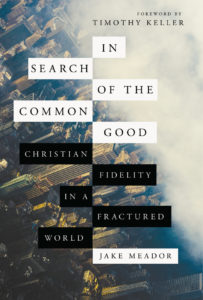
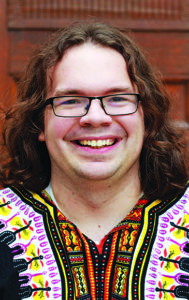 Jake brings brilliant learning and fine writing (he is vice president of the brainy Davenant Institute and the editor-in-chief of Mere Orthodoxy) but he’s a real Wendell Berry buff, so he’s always down to Earth. His sense of place – and his invitation to us to deepen our own loyalties to our own places – is palpable. It may be because he’s a Husker from Nebraska and has seemingly fierce loyalties there. As Collin Hansen of the Gospel Coalition says of Meador’s writing, “You’ll see his characteristic combination of deep learning with an earthy touch.” That’s putting it mildly. There’s real dirt under this guy’s fingernails.
 The first half of In Search of the Common Good is a vital and compelling few chapters – about 30 pages – on “The Breakdown of Community.” He explores what he calls “the passing of the American church” and then explains, brilliantly, “the unwinding of common life in America.” You know this stuff in your bones, but we need words to say it, and we need some sense of why we’re experiencing this unprecedented unwinding. It is very good writing; I was engaged from the beginning. And it offers a view that isn’t alarmist, but is urgent.
 Romans Disarmed: Resisting Empire/Demanding Justice by Sylvia Keesmaat & Brian Walsh (Brazos Press) ON SALE – 20% OFF regular price = $26.99 / our sale price = $21.59
 air, but are drawn from what we know about first century social experience in Rome. In a chapter called “Kitchen Walls and Tenement Halls” we meet a slave, Iris, (who is named after a person who is actually described in a scholarly work by Peter Oakes called Reading Romans in Pompeii: Paul’s Letter at Ground Zero) and we meet Nereus, a Judean who lived among the dock workers and leather makers in the lowlands by the Tiber, but who ventured into the heart of Rome to hear Paul’s letter. Where he meets the pagan slave woman, Iris. What a story, laden with scholarly footnotes and even Bible references (who knew the list of names in Romans 16 could be so informative and yield such an interesting story!)
 I might add there are several fun books that do this sort of thing, but not many. Keesmaat and Walsh site the fabulous The Lost Letters of Pergamum: A Story from the New Testament World by Bruce Longenecker (Baker Academic; $19.99), a book we championed it its early first edition. See also the clever books in a recent series by IVP such as A Week in the Life of Corinth and A Week During the Fall of Jerusalem (both by Ben Witherington) and A Week in the Life of a Roman Centurion by Gary Burge) and several others.
 I might as well just say it. I think Romans Disarmed: Resisting Empire/Demanding Justice is the most important book of Biblical study I have read in years; perhaps ever. I promise you that you have never read anything like it, and it is one of those few books that the often-used (but rarely accurate) phrase “it could change your life” applies. It surely deserves a Best Book of the Year award, but, because it is so politically charged, don’t expect to see it on evangelical “Best of 2019” lists. I suspect most Christian bookstores won’t even carry it. I assume (but one never knows) that the respected New Testament commentators who are active – Douglas Moo, Tom Wright, Fleming Rutledge, Beverly Gavanta, Katherine Grieb, Michael Bird, Frank Matera, Craig Keener, Scot McKnight, Richard Longenecker, Michael Gorman, Stephen Westerholm, Thomas Schreiner, Richard Hays — will be weighing in on its merits. Will they appreciate how much social location matters? Will they know why they draw so much on Elsa Tamez and her book Amnesty of Grace exploring justification by faith through the lens of suffering and repression in Latin America? Romans Disarmed is a very important book and I can’t wait to hear what others think about it.
 As they tell of these painful stories (some of us met their late friend Iggy in Brian’s powerful Habakkuk Before Breakfast; Books Before Breakfast; $14.00 which
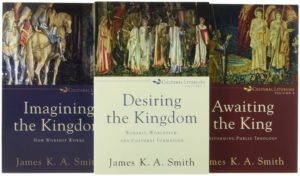 Christian faith is never mostly about holding the right abstract theological truisms, but always about what we embody as we live out the deepest convictions of our hearts, “against the world, but for the world” as some put it. (By the way, as an aside: did you know that James K.A. Smith, who wrote the must-read “cultural formation” trilogy, summarized in his one-volume You Are
 What You Love: The Spiritual Power of Habits (Brazos Press; $19.99), studied with Brian Walsh when he was a grad student at the
 activist poet Wendell Berry and anti-globalization prophet Naomi Klein. If you’ve read the latest from Brueggemann (like Tenacious Solidarity or Truth Speaks to Power or God, Neighbor, Empire) or Wendell Berry’s Sex, Economy, Freedom Community or Citizenship Papers, or any of Ms. Klein’s anti-climate change manifestos (or, for that matter, anything by their friend Norman Wirzba, who writes on faith and food, farming, Sabbath, and the like, and edited the Wendell Berry agrarian collection The Art of the Commonplace) you’ll have a sense of where they are coming from. Or, maybe, you could pick up the book I last spotlighted in BookNotes, The Possibility of America (WJK; $17.00) by David Dark, who, with a poet’s eye and patriot’s heart, gets so much of this.
 That they learned much of this analysis about ideology and idols from Dutch Kuyperian economist and socio-political observer Bob Goudzwaard is no secret, and Brian’s 1980s classic (co-authored with Richard Middleton) The Transforming Vision: Shaping a Christian Worldview (IVP Academic; $25.00) remains a succinct and powerful study of the development of the idols of our time that they named as scientism, technicism, and economism. (Idols, you know, are good things that become ultimate things; things we trust for communal salvation and that we start to serve and even become like.) That their imagination of seeing and saying this stuff has been deepened by Canadian folk-rock-pop singer-songwriter Bruce Cockburn is no surprise, either, and Brian has explored how a Christian social imaginary can be enhanced by a close reading of Cockburn lyrics in his brilliant Kicking at the Darkness: Bruce Cockburn and the Christian Imagination (Brazos Press; $19.00.) Believe me, it’s illuminating about the arts, about music, and about the idols of our time, helping us “see” things anew, whether you happen to like Cockburn’s songs or not.
 We have often promoted Brian’s small but potent collection of essays/sermons (with a foreword by N.T. Wright and a blurb on the back by yours truly) called Subversive Christianity: Imaging God in a Dangerous Time (Wipf & Stock; $17.00.) Even for those old friends who have the first edition, the second edition released in 2014 has a very important, long, new chapter that anticipates the work being done here analyzing the American empire, globalization, economic injustice, the violence of the state, and how the Bible itself can deconstruct – subvert – the harsh ideologies that, in Cockburn’s lyric (in a song about the International Monetary Fund’s dubious work in the developing world) offer “deification of tyranny – idolatry of ideology.”
 Almost a decade ago, Brian teamed up with beloved environmental studies professor and creation-care advocate at Hope College, Stephen Bouma-Prediger to write a book that, again, forms a nearly essential backdrop to the work he and Sylvia have done in Romans Disarmed. It is called Beyond Homelessness: Christian Faith in a Culture of Displacement (Eerdmans; $29.00) in which they play with the classic shorthand for the Biblical narrative, “creation-fall-redemption”, by talking about “homemaking-exile-homecoming.”(For those who get the inside joke, I have called that book Al Wolters meets Wendell Berry meets James Howard Kunstler.)
 (This theme of longing for a safe home was conjured up beautifully in Brian’s book on Cockburn in which he preached the gospel of homecoming in tandem with Bruce’s song “The Candy Man’s Gone” and previously in Truth Is Stranger Than It Used to Be: Biblical Faith in a Postmodern Age (IVP Academic; $26.00) which made the case that a longing for home was behind much of the and ennui and restlessness of postmodernity.It remains the best book on the subject, and the one the engages the Bible the most!)
 A third point to underscore: from very contemporary debates about climate change or sexuality or race and ethnicity or theological doctrine, the letter of Paul has been weaponized (used to bolster a strident view, to exclude others, or, as in Boy Erased, where a Bible was literally used to pummel a teen, making a point that God’s Word can pound out same-sex attraction.) From a Trump official saying last summer that we have to obey them because of Romans 13 (oh, what a misreading!) to insistence on certain views about Jews or predestination, this weaponizing is prevalent. Drs. Keesmaat & Walsh insist we have to read it in a more generous and disarming way so it can function for us today as it surely did in the first century in Rome.
 One of the ways they enact this exact sort of hospitable discourse is by using a device they featured creatively in Colossians Remixed. Just when some of their teaching is getting heavy and their Bible interpretation seems a bit speculative, in comes another voice, in italics, an interlocutor. I was hoping the argumentative kid who gave them a hard time in Colossians Remixed, interrupting with skeptical questions that led to fascinating digressions would be back, but it isn’t that guy. This new conversation partner is skeptical enough, but seems to be on board more with their claims, asking wise and good questions, seeking clarification of their exegesis and theological views and telling stories from his own life about the difficulties of applying this kind of anti-imperial lifestyle. They can debate about what Keesmaat & Walsh mean when they say that Romans 1
 exposes “the idolatry at the root of the depravity of life in the Empire” and how the Jerusalem Council re-imagined the nature of faithful discipleship and what stipulations are essential for fellow believers, but they also must talk about what difference all this makes for us and what we should be about now, in these times. I don’t recall that we ever learned this person’s name, but she (I thought it is a he, but we learn, eventually that it is a woman) is a great part of the story. This dialogue partner, even though pushing back against some of their statements, is sincere and eager to learn and grow into deeper more relevant fidelity to the gospel. She’s a good part of the story.
 It is true, after all, that we all need to grapple with this matter of hearing each other, of hosting better conversations, which is why I’m sure Brian and Sylvia would love – as we do! – the new book (also published by Brazos) by our friend out at Englewood MO, C. Christopher Smith, who just released the must-read How the Body of Christ Talks: Recovering the Practice of Conversation in the Church (Brazos Press; $16.99.) I suspect that as you are reading Romans Disarmed you are going to want to have some conversations about a lot of different things and How the Body of Christ Talks just might be tool that will save you a lot of grief, guiding you towards being communities of missional conversation and prophetic dialogue. Oh yes, this is rich, thoughtful, good stuff and would make a great companion volume to read alongside Romans Disarmed.
 That is, they think Paul’s letter, read carefully and contextually, insists on an open and inclusive fellowship. But they also are clear that (following nearly every other major, well-informed Bible scholar) when Paul uses the word righteousness, he means very much something like what we today might call social justice; as N.T. Wright puts it in his oh-so-British way, a “putting things to rights.” Salvation is not a promise of an ethereal soul floating off to heaven because one got the ticket out of hell, but the breaking in of a new creation order, a regime change here on earth where God in Christ brings His shalom, social health, cultural renewal, a politics of peacemaking, a Jubilee vision of justice. This is not liberal social gospel rhetoric, but the best, most faithful rendering of what the Bible itself really says. We have Christ’s righteousness imputed and imparted to us, and that, properly understood, means we become gospel-infused agents of justice. Which maybe starts with hospitality, being welcoming and listening well, especially to the marginalized and hurting.
 You can decide for yourself if chatting with Sylvia and Brian at church, or hanging around the rough-around-the edges ministry of Greg Paul and his Sanctuary Community that they tell us about, or visiting their farm and joining in the daily chores (yes, it’s a real farm with a lot of daily chores) would feel safe and good for you, if they are truly hospitable and welcoming of a variety of views. I have a hunch that even if
 you find them, as I do, a bit strident at times, you will like them a lot. They know a lot about philosophy, about church history, about contemporary political issues, about rock music, about urban architecture, and contemporary social science, and, yep, they grow food and love to bake bread and do many, essential home-making arts. They know their Bibles and they love Jesus. And you can trust that they’ll shoot straight, telling you what’s on their hearts. What’s not to like?

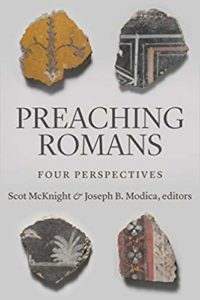 social and even political implications. They flesh it out more robustly and with more verve than any other book we know, but this isn’t altogether pioneering stuff. In fact, just a few months back a great book was released compiled and edited (again) by McKnight & Modica called Preaching Romans: Four Perspectives (Eerdmans; $20.00.) These essays and sample sermons illustrated generously how many different views there are about the heart of Romans, how to read it, and how sermons proclaim its grace and grit to us for our daily discipleship. From Fleming Rutledge to Will Willimon to Carl Trueman to Tara Beth Leach, there is good stuff in here. Friends who are sympathetic to Walsh and Keesmaat are included in voices such as Michael Gorman and Richard Hays.
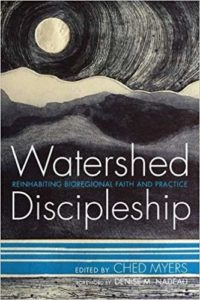 stewardly within their own watershed (they are part of a movement explored, in fact, in a book edited by Ched Meyers called Watershed Discipleship: Reinhabiting Bioregional Faith & Practice [Cascade; $30.00.]) Of course they draw on some of the great, clear writings of Wendell Berry, who they’ve been citing for years. They talk about race and racial injustice (which, for them, include a lot about First Nations people in Canada, among whom they have good friends and with whom they have been working for decades, long before the uprising at Standing Rock brought Native people’s contemporary issues to most of our awareness.) They talk about food and music and politics and violence and home-making and sexuality and worship and lament and joy and grace and worldviews. All in a commentary on a book of the Bible that some people think is metaphysical, theological, and beyond their ken. Again I say, wow. Romans Disarmed is one of the most curiously interesting, life-changing books I have read in a very long time.
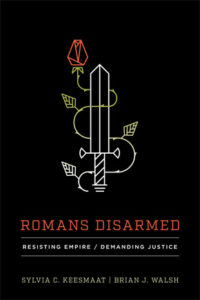
 God’s Sabbath With Creation: Vocations Fulfilled, the Glory Unveiled James W. Skillen (Wipf & Stock) $35.00 Well, if Sylvia Keesmaat & Brain Walsh are feisty farmers and watershed activists, stewarding well their own land even while in conversation with First Nation’s peoples seeking justice, and this sense-of-place informs their study of Romans which they see as an anti-Empire manifesto, this new book – which picks up some (vaguely) similar themes, by political scientist and founder of the moderate Christian think-tank and faith-based, US citizen’s group, the
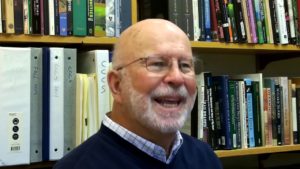 foundational critique of the secular rationalism of much of the Western philosophical tradition (and the pietism and/or secular rationalism of the Western theological tradition, as well) from the famous Dutch philosopher, Herman Dooyeweerd. Dr. Skillen has long been deeply grounded in that particular stream of neo-Calvinist (“reformational”) worldview philosophy and although he has been a political scientist most of his life (his most recent previous book is one
 The Possibility of America: How the Gospel Can Mend our God-Blessed, God-Forsake Land David Dark (Westminster John Knox) $17.00 OUR SALE PRICE = $13.60
 The Possibility of America: How the Gospel Can Mend our God-Blessed, God-Forsake Land is actually a considerable re-working and expanded edition of his 2005 book, The Gospel According to America: A Meditation on a Christ-haunted, God-blessed Idea. It is, for those who are familiar with that stimulating, much-discussed book, different enough that it demanded a new title; it is not just a “revised” edition. There’s so much new content in The Possibility of America that it earned a new title; not only is there considerable re-working and new content, the overall tone is a bit different. Understandably.
 Enter David Dark, who once was a bit less outraged and a bit less consumed by the dark antics of our leaders, and who has deepened his long standing passion for Biblical justice and relating prophetic truth to current realities.
 To wit: see also the great chapter by Mr. Dark on Father Berrigan in the wonderfully grand Eerdmans collection called Can I Get a Witness: Thirteen Peacemakers, Community Builders, and Agitators for Faith & Justice (Eerdmans) $26.99. OUR SALE PRICE = $21.59 I described this very sturdy and nicely bound hardback previously at BookNotes, exclaiming how profound this collection is, how needed. Edited by Charles Marsh, Shea Tuttle, & Daniel Rhodes, there are a baker’s dozen chapters by 13 deeply caring authors. Each good author tells about a certain American saint who lived out faith in robust and often-controversial ways, who took a stand, spoke out, paid up. The research for the book came out of a several year project overseen by Charles Marsh at the
 As I trust I’ve made clear, he has written about a variety of aspects of American culture and politics, if in a tone of “new seriousness.” The stern Berrigan-esque insight is prevalent but America is not just a nay-saying screed. He truly enjoys thinking about this stuff – one can tell, in part by the way his fertile mind jumps from this author to that, this episode of an old TV show to that, from a memory of being frustrated with a scene in Patch Adams to teaching us the importance of Faulkner’s The Sound and the Fury or riffing on the message of folk singer John Prine’s song “Your Flag Decal Won’t Get Your into Heaven Anymore,” or how one of his conversation partners (a student, perhaps?) put Wendell Berry in his pantheon of elders, “right up there with Tupac Shakur and Ursula K. Le Guin.”
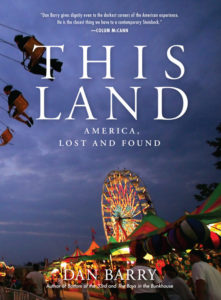 This Land: America, Lost and Found Dan Barry (Black Dog & Leventhal Publishers) $29.99 OUR SALE PRCE = $23.99 I came to respect Dan Barry as a extraordinary writer and dogged investigator and great storyteller when I read one of the most gripping books of creative nonfiction I’ve ever read, Boys in the Bunkhouse: Servitude and Salvation in the Heartland. (Enter it in quotations in our “search” box at the Hearts & Minds bookstore website and you can find my comments about it in December of 2016 or again when I awarded it Best Book award at the end of that year.) That award-winning expose moved me so that I explored his personal memoir, Pull Me Up, and then his great baseball book Bottom of the 33rd.
 This handsome volume is illuminated with full color photographs from award-winning photojournalists, on thicker paper, making it nearly a keepsake volume. I agree with those who have said it is nearly a historic look at American life, from sea to shining sea. (There is even a chapter on Lancaster, PA.) This Land truly is a magnificent book and it would make a fabulous gift for anyone who cares about our place or enjoys reading short form creative nonfiction.
 What I Found in a Thousand Towns: A Traveling Musicians Guide to Rebuilding America’s Communities – One Coffee Shop, Dog Run, and Open-Mike Night at a Time Dar Williams (Basic Books) $27.00 OUR SALE PRICE = $21.60 We’ve carried the great Dar Williams’ music for years – yes, we still stock CDs – and when we heard she had a book coming out, I was excited. She is articulate, has a good eye for that curious detail, and is known as an environmental spokesperson. She cares about things that matter and has sung beautiful about life in our hurting world. (The New York Times review said this book was more a report from the Green party than the green room. Nice!)
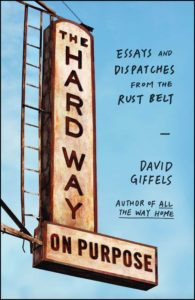 The Hard Way on Purpose: Essays and Dispatches from the Rust Belt David Giffels (Scribner Book Company) $16.00 OUR SALE PRICE = $12.80 Perhaps you recall that we named as one of my favorite books this past year the fabulously interesting, engaging memoir Furnishing Eternity: A Father, a Son, a Coffin, and a Measure of Life, a memoir about a guy in Akron, Ohio, who is a writer, community college teacher, and who is a bit of a wood-worker – he had written a previous memoir about fixing up his old house called All the Way Home: Building a Family in a Falling-Down House – who is making a casket with his engineer/ woodworking father. It is a book about small towns, about rock and roll, about father-son stuff, the lost arts of working with your hands, and a lot about the grief he experiences as he loses his best friend and beloved mother. It was a near prefect book for me – a memoir of a middle-aged guy with rock sensibilities, an irreverent streak, and a colorful, religious family. Building a coffin. What a great book!
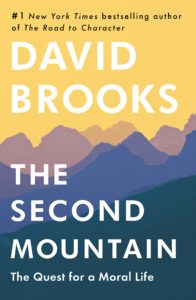 The Second Mountain: The Quest for a Moral Life David Brooks (Random House) $28.00 OUR SALE PRICE = $22.40 We received a somewhat early edition of this and have been working through it bit by bit. I am a huge David Brooks fan, and appreciate his lucid and eloquent speaking and writing. I know those who are serious progressives distrust him since he is often pitched as the conservative voice on NPR or PBS. Conversely, some of my conservative friends roll their eyes when they think of David as a conservative, since they think he is way too liberal. In this regard he seems akin to another favorite pundit, The Washington Post’s Michael Gerson.
 I loved Brooks’ early books like the essential Bobos in Paradise and the fantastic one about suburban fascination with yards, On Paradise Drive. Of course we stock them both, not to mention The Social Animal and The Road to Character. But this new one is truly extraordinary, catapulting Brooks, I would think, into the major ranks of being a thoughtful, accessible, public intellectual rooted in the Christian tradition.
 Political Visions & Illusions: A Survey & Christian Critique of Contemporary Ideologies (2ND Edition) David Koyzis (foreword by Richard Mouw) (IVP Academic) $33.00 OUR SALE PRICE = $26.40 I have maintained since the first edition of this learned and exceptional book came out in 2003 that it is nothing short of essential for those wishing to think deeply and Christianly about faith and political life. In my first BookNotes review of it, I summoned Bible texts about the mind of Christ, about not being “taken captive” by worldy ideologies, about being “non-conformed” to the ways of this world through having a “renewed mind.” I hope you know those texts. The Bible is clear that we are to “take every thought captive” and as Al Wolters first taught me, the Greek word in Colossians 2:8 (similarly to 2 Corinthians 10:5) does not mean merely any bad thoughts – like take captive our propensity to lust or anger or envy, but theories. That is, we shouldn’t be taken captive by theories or ideas that are not themselves consistent with a Biblical view of reality.
 his own immersion in the profoundly Biblical political science of the likes of Groen van Prinsterer, the brilliant and feisty anti-French Revolutionary social theorist who framed much of the Christian political party that eventually came to be led by Prime Minister Abraham Kuyper in early 20th century Holland. That is, van Prinsterer (we have the new edition of his classic Unbelief and Revolution newly translated by Harry Van Dyke and re-issued by Lexham Press; $15.99) was the main intellectual leader behind Kuyper’s movement.
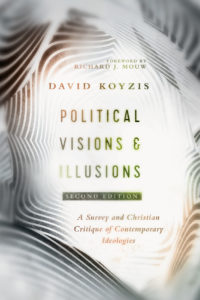 science, Koyzis is a help in this for those interested enough in working through a major book like this. Certainly anyone in public office or working for campaigns or interested in public affairs needs this sort of resource. It is less sprawling than Suicide of the West, the best seller by Jonah Goldberg (who makes no pretenses of trying to nurture a Christian perspective), but if one has interest in this sort of thing, Political Dreams and Illusions is your book.
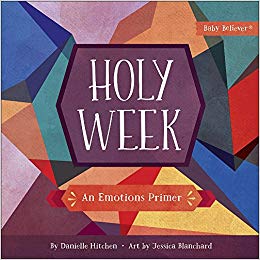 Holy Week: An Emotions Primer Danielle Hitchen art by Jessica Blanchard (Harvest House) $12.99 I have rarely been so glad, and frankly surprised, by a board book; this new one called Holy Week is part of a several book series called “Baby Believer.” Maybe that sounds a little corny to your liturgical ears, but these are wonderful books for infants (and maybe up to 4 or 5 years old or so.) Each one has Bible episode or verse, linked to something that is also being taught. For instance, Let There Be
 Basics is called A Counting Primer; we love the one called From Eden to Bethlehem: An Animals Primer. There is even one called Psalms of Praise: A
 The one we are featuring now, of course, is the one designed to teach the episodes of Holy Week, and it does so brilliantly. Each chunky page tells of something that happened and lists and emotion. You’ve got to see it in it’s full color glory with excellent age-appropriate illustration, but here’s what it shows:
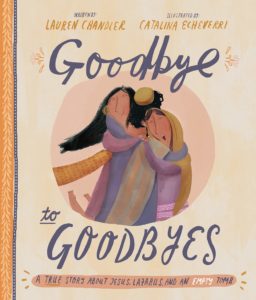 Goodbye to Goodbyes: A True Story About Jesus, Lazarus, and an Empty Tomb Lauren Chandler, illustrated by Catalina Echeverri (The Good Book Company) $14.99 We have highlighted each of the books in this great series, too, and we rejoice that there is a new one, perfect as an Easter gift for young ones ages up to middle elementary ages. Goodbye to Goodbyes is part of a series called “Tales That Tell the Truth” and we love them all. I hope you recall A Christmas Promise or The One O’Clock Miracle or The Storm That Stopped. The recent The Friend Who Forgives is about grace, based on a parable from Jesus. We loved God’s Very Good Idea which shows God’s plan for ethnic and other kinds of diversity in creation, and how God’s plan of redemption includes restoring multi-ethnic reconciliation, never wavering from his “very good” plan. It’s a delight that share the whole gospel — what Lisa Sharon Harper on her adult book calls The Very Good Gospel.
 As it says on the back cover, “This is happy, and sad, and (in the end) very happy story of what happened when Jesus visited his friends Mary, Martha, and Lazarus, and changed everything.” Kudos to the whimsical illustrations, the portrayal of people from many ethnicities, energetic illustration that captures the spicy flavor of Middle Eastern culture, and the glimpse to contemporary times.
 The Chronicles of Narnia C.S. Lewis (Harper) I suppose I don’t have to explain the remarkable stories here, their wonder and joy and sadness and adventure and triumph. Beth and I had the opportunity to sell Lewis books at a Lewis conference in an Episcopal church near Philly a few weeks back and we were enchanted again by being around people who knew so much about Lewis (and the other Inklings) and seeing rekindled enthusiasms for these good stories. It is terribly simplistic, but maybe it would be helpful to be reminded of some of the themes in the Narnia books; here is what Wikipedia says, at least:
 The nicer paperbacks with better paper and colorized Pauline Baynes art sell for $9.99 or $8.99 each (depending which book) or $64.99 for a boxed set.
 The hardbacks sell for $17.99 each (or $120.00 for a boxed set.) The cover art is by 2-time Caldecott medalist David Wiesner and interior illustrations are Pauline Baynes originals.
 Entering the Passion of Jesus: A Beginner’s Guide to Holy Week Amy-Jill Levine (Abingdon Press) $16.99 You may recall my review of this at the start of Lent… it isn’t written as a daily Lenten devotional, so I was surprised how many people ordered it from us a month ago. I wanted to mention it again since its six chapters would make a great reading plan for Holy Week. It’s just 141 pages and a very good read!
 Reliving the Passion: Meditations on the Suffering, Death, and Resurrection of Jesus as Record in Mark Walter Wangerin, Jr. (Zondervan) $14.99 Oh my, this is one of the best Lenten books we know, a careful and moving reflection on Mark’s telling of the passion week story. This offers 41 readings for the season but you could obviously just read the last few weeks as it moves towards Good Friday and Holy Saturday.
 The Undoing of Death Fleming Rutledge (Eerdmans) $24.00 I have described this in better detail other years — almost every year since I was blown away by it in 2003, I believe. If you enjoyed her Advent sermons you will appreciate these as well. These are not Lenten sermons generally, but many year’s worth of Holy Week messages — Palm Sunday sermons, Maundy Thursday reflections, Good Friday words, good, good stuff on Holy Saturday, Easter sermons. This is mature, eloquent, moving, inspiring, collection of real sermons preached by this legendary Episcopal priest. For some chapters there are some art pieces shown on which she helpfully comments. I commend this book to you with all my heart.
 Three Hours: Sermons for Good Friday Fleming Rutledge (Eerdmans) $18.00 Last year, Reverend Rutledge preached seven sermons in a three hour Good Friday sermon. She has published several such sermons in The Undoing of Death and again in the nice little paperback, The Seven
 The Crucifixion: Understanding the Death of Jesus Christ Fleming Rutledge (Eerdmans) $30.00 I don’t need to explain this award winning book that (with indexes) weighs in at 665 pages. It is, doubtlessly, one of the major theological books of our time and, by some accounts, one of a handful of must-read books on the cross. It won the Academy of Parish Clergy Reference Book of the Year when it first came out, and the next year it was awarded the Christianity Today Book of the Year. We named it a Hearts & Minds Best Book the year it came out, adding our little voice to the choir of accolades. Roman Catholics, mainline Protestants and evangelicals alike have raved about it, using words like “extraordinary” and “monumental” and “supremely illuminating.”
 The Day the Revolution Began: Reconsidering the Meaning of Jesus’s Crucifixion N.T. Wright (HarperOne) $18.99 You know we are fans of Tom Wright and we appreciate his careful and lively exegesis framed by a big Kingdom vision. This is Bible exploration for the sake of the churches mission, which itself is for the sake of the world — thanks be to God! As I explained when this came out in hardcover a year or so ago, we might describe this as a study of the cross in light of Wright’s essential book Surprised by Hope. That is, if God’s final agenda is not to whisk us away to some heavenly place beyond the clouds but is, in promissory fashion, restoring the good but fallen world into a (re)new(ed) creation then — with that big restoration/creation-regained project in mind –what is the point of the cross? Wright her looks through the lens of new creation and cosmic restoration at every key passage where the apostle Paul writes about the cross. What is going on in these passages? How might we more fully understand Paul’s insistence that Jesus puts to death, Death? Is it proper to refer to Good Friday as the start of the revolution? I dare you to read this book and not feel your mind stimulated, your heart inspired, and your feet and hands ready to get back to work on Monday morning.
 The Suffering and Victorious Christ: Toward a More Compassionate Christology Richard Mouw and Douglas A. Sweeney, with an afterword by Willie James Jennings (Eerdmans) $19.99 In the last BookNotes blog newsletter I highlighted a fabulous, readable, conversational rumination on evangelical theology called Restless Faith by Richard J. Mouw. I noted how widely read and conversant he is in many faith traditions, how he is generous in taking seriously the proposals and insights of those outside of his own Reformed camp, and is a good conversation partner, learning and growing from others as he seeks theological (and social) common ground. I might have said that he is restless not in an itchy or cynical way, but in a generous sort of open way, always eager to reform, to mature, to give an account for stuff we learn as we live in God’s world.
 The Art of Lent: A Painting a Day from Ash Wednesday to Easter Sister Wendy Beckett (SPCK) $15.00 This little book, wonderfully printed on heavy paper and full color reproduction, at such a nice price, is, I’ve often said, the best bargain of any book published in recent years. What a great resource this is — so nicely done (if, granted, a bit small.) Okay, so you missed the wonderful opportunity to use this for the last 30 days. You can use it this next week or so, and I am sure you’ll draw on it over and over. We sold a lot of this one last year, and some have re-ordered. Some who loved the Advent one got the Lent on (a “no-brainer” somebody said.) We’re happy to remind you of it again. Get it now, on sale.
 Balm in Gilead: A Theological Dialogue with Marilynne Robinson edited by Timothy Larson & Keith Johnson (IVP Academic) $28.00 Oh my, what a marvelous book, another in the extraordinary collections that are published by IVP from the annual Wheaton College theology conference. Last year the event was a discussion about and with novelists and essayist Marilynne Robinson and it brought together some of our finest thinkers about faith and literature and culture and church and included a response by the notable author herself. (There are contributions here by Rowan Williams and Joel Sheesley and Lauren Winner and Timothy George and others.) This book is the next best thing to being there at the event, and we are so, so happy to get to announce it here. I trust you get the allusion in the title to the Pulitzer Prize winning novel, Robinson’s second, Gilead.
 Spiritual Rhythms for the Enneagram: A Handbook for Harmony and Transformation Adele & Doug Calhoun and Clare & Scott Loughrige (IVP/formatio) $24.00 Holy smokes, just when you thought there were enough books on the enneagram and faith formation (well, unless your a 5, and then you can’t get enough) here comes a workbook-sized manual by remarkable folks gifted in creating great resources. (Adele Calhoun did the incredibly useful Spiritual Disciplines Handbook and the powerful, poetic Invitations to God.) Clare and Scott are cofounders of a church where they’ve served for twenty-six years and they are, like the Calhoun’s, are certified Enneagram instructors. In large print on the back it says “You are more than your type.” Hear, hear.
 Whence and Whither: On Lives and Living Thomas Lynch (WJK) $18.00 Those who have followed our work for a long time might recall the times, years ago, when I insisted that Lynch was our favorite new writer. His award-winning book The Undertaking: Notes from the Dismal Trade and it’s follow up Bodies at Motion and at Rest helped me when my dad was killed and I was unable to read about grief. But these literary, passionate, deeply moral reflections on being an undertaker blew me away and remain all time favs. His great reflection on his travels to Ireland — Booking Passage and the book he wrote with theologian Thomas Long (The Good Funeral) are stellar. We stock his poetry, too. Because of his groundbreaking work doing solid studies of the role of the “dismal trade” and his splendid writing style, Lynch remains the gold standard in this genre, but lately I’ve read a number of other such books. I loved the spunky Smoke Gets In Your Eyes: And Other Tales from the Crematorium and, last year, Caleb Wilde’s
 Brave Souls: Experiencing the Audacious Power of Empathy Belinda Bauman (IVP) $23.00 Belinda Bauman is one of our favorite people, even though we’ve only met a few times. You know those rare folks who are confident and honest, who show such interest in you that you realize they have a gift — caring, thoughtful, brave, for real. After a few moments in her presence I was encouraged and blessed and glad. She and her husband, Stephen, have lived all over the world, doing relief and development work and caring for the poor and oppressed in the name of Jesus. As Steven tells it, Belinda was often the energizing force, the one who most readily heard God’s call to risk and serve. They are adventurous people who do excellent work and I’d read anything either of them wrote.
 Becoming Whole: Why the Opposite of Poverty Isn’t the American Dream Brian Fikkert & Kelly Kapic (Moody Publishers) $15.99 Why don’t you order a few of these from us right away — it’s that important, and I’ll be mentioning it often this year. I’m sure I will name it as one of the Best Books of 2019. Let me explain.
 Common Grace: God’s Gifts for a Fallen World Volume 2 Abraham Kuyper (Lexham Press) $54.99 This is the brand new, much-anticipated volume in the ongoing Kuyper publishing project releasing hefty tomes in the “Collected Works in Public Theology.” We stock them gladly as it was in many ways Kuyperians — the fancy word those who stand in the line of the early 20th century Dutch neo-Calvinist cultural leader and public intellectual who reminded us of God’s redemption of “every square inch” of culture and society — who inspired us with a world-and-life vision of faith that led to founding our bookstore the way that it is. That God has given good gifts that can be discerned by artists and scientists and wise ones who are attentive to the glories and structures of creation should be evident; that such wisdom leads to human flourishing by honoring God’s built-in intentions for His creation is a matter of life and death. The best books help us open up and disclose the meaning of history and the point of life in each and every aspect of society. Preacher, theologian, reporter, educator, Prime Minister Kuyper (1837-1920) had much to say about so much of this, positing a set of Christian principles from which might emerge a renewed, just culture (unlike the brutal French Revolution of the previous century) and his old words still speak today. Kudos to those translating his many newspaper essays and lectures and books (sometimes for the first time in English) and for putting them in these handsome, enduring volumes.
 Seasoned Speech: Rhetoric in the Life of the Church James E. Beitler III (IVP Academic) $25.00 Maybe you saw on social media that a week or two ago we sold books at a great C.S. Lewis conference hosted at an Episcopal Church near Philadelphia. With several expert Lewis scholars we had a blast, and a few talked about this seemingly arcane topic that so preoccupied Lewis and his Inklings: rhetoric. In many ways, this is a huge topic — how do we communicate? What makes something compelling? How do we present truth (or what we think is truth) to others? In an age of mass marketing and social media, how do we persuade? Does goodness, beauty and truth go together, and does charm and eloquence and elegance count much in persuading others? What is a Christian view of communication and what might a theologically-aware framework offer as we think about rhetoric? What does that verse (Colossians 4:6) mean about having our speech “seasoned with salt”? Lewis asked these questions, of course.
 The Universal Christ: How a Forgotten Reality Can Change Everything We See, Hope For, and Belief Richard Rohr (Convergent) $26.00 Okay, I’ll say right away that my announcement here does not do this book justice. As I wrote in my somewhat critical review of Rohr’s previous book, The Divine Dance, I have great appreciation for Father Rohr and his Franciscan sensibilities. His peace and justice activism rooted in a vision where “everything belongs” in the “naked now” means a lot to me. When he cites Merton and the other mystics, I’m truly glad and nicely challenged. I want to like his work; I think I’m we’re often seeking similar vistas but using different words and ways into the experience; as we implied above in announcing the new Kuyper volume on “common grace” I am thrilled by the notion that God upholds all things, inviting us to a sacramental worldview, where we see God’s presence in the mundane and God’s redemptive work all over.
 Surprised by Paradox: The Promise of AND in an Either-Or World Jen Pollock Michel (IVP) $16.00 I’m fascinated that there have been four or five (really good) books on paradox in the last year or so, the best coming from evangelical publishing houses like this one. There is afoot a lovely and healthy longing for mystery and a naming of wonder and even for those who want rigorous thinking and generous orthodoxy, they admit that there is a role for ambiguity. Our human categories simply can’t contain all these either/ors. We need the world “and.”
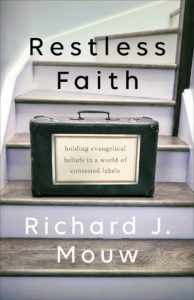 Restless Faith: Holding Evangelical Beliefs in a World of Contested Labels Richard Mouw (Brazos press) $19.99 Okay, I’ll just say it: Mouw is my favorite writer in the genre of theology — he makes complex stuff really clear and explains why it matters — and is one of the very best (balanced, careful, thoughtful, wise, generous) when it comes to applying classic Reformed theology to the world and its cultures and issues. If he calls himself a Kuyperian, I call myself a Mouw-ist.
 Beating Guns: Hope for People Who Are Weary of Violence Shane Claiborne & Michael Martin (Brazos Press) $19.99 This book has been called “timely, relevant, and necessary.” It is a study of gun violence from the point of view of a simple-living, urban activist. Shane — whose Irresistible Revolution is a must-read and whose Jesus for President grows more timely every day — lives in a brutally rough part of Camden NJ and has experience drive bys and gang violence and police shootings (that is, police shooting his black neighbors) more than probably anybody you know. He grew up a Southern Baptist boy and still retains a vibrant and happy style of speaking about Jesus. I suppose he grows restless as Mouw does, but because he shares life with the wounded and hurting and sees the glories and dignities of the poor, his restlessness is more with apathy and carelessness and those who have denied the basic teachings of Jesus.

 As Shane and Michael say on the back cover, “The world doesn’t have to be this way. Beating Guns shows how we can all be part of the solution.”
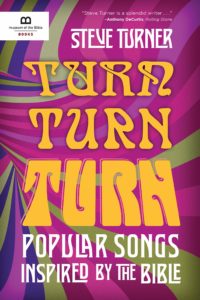 Turn, Turn, Turn: Popular Songs Inspired by the Bible Steve Turner (Worthy Books) $24.99 I have been wanting to tell you about this book for weeks now. Turner is an amazing rock critic and Christian thinker about pop culture. His books should be widely known and shared, especially among younger creative types for whom his work could be a life-line.) Oh how I wish we could sell more of his must-read books Imagine: A
 The Common Rule: Habits of Purpose for an Age of Distraction Justin Whitmel Earley (IVP) $18.00 We have lots of books here at the shop about self help sorts of things, from time management resources to books helping you get your house in order. Many are useful, some are more profound than others. None of us want cheap promises or easy answers.
 In a way, it is fair to say that this is a practical application follow-up to James K.A. Smith’s award-winning, very widely read You Are What You Love: The Spiritual Power of Habits. Listen to Andy Crouch, author most recently of Tech Wise Family and Strong and Weak: