A BONA FIDE PUBLISHING EVENT: A SIX-VOLUME SET OF THE WRITINGS OF CALVIN G. SEERVELD — ALL ON SALE, 20% OFF

seerveld set.jpg

A PUBLISHING EVENT

A publishing event. 

It is a phrase I’ve used a few times but, for obvious reasons it must be employed only sparingly.  Most often it is reserved for the release of, say, a previously unpublished work by a classic author. (Speaking of which, a new edition of Roald Dahl’s classic YA book Charlie and the Chocolate Factory has been released with a recently discovered, long-missing chapter. Now that’s a publishing event for you!)

Sometimes the phrase may indicate the significance of a new volume, perhaps a second novel of a highly acclaimed, exceptionally gifted writer, or maybe a new Bible translation destined to become widely esteemed and used (like, say, the release of the ESV in 2001.)  Occasionally it may refer to a major new scholarly contribution that promises to change paradigms, rocking the worlds of science or medicine.  If the blockbuster sales promise to be large enough – think Harry Potter or The Hunger Games – some refer to the release date as a publishing event.  

The phrase is sometimes used too quickly, I think, cheapening it.

That said, I can’t think of any other way to describe what I felt and how I came to think about the announcement of a 6-volume set of writings by the important Christian philosopher, aesthetician, art historian, Bible scholar, hymn writer, cultural critic, Dr. Calvin Seerveld. I know, I know, Seerveld is only known in a very small circle, a niche sub-culture, within theseerveld.jpg small Christian subculture, and his writing is sometimes exceptionally dense and often eccentric.  Seerveld’s field, the field of the Lord in which he plays, is aesthetics, and his life-long project of developing a coherently, consistently Christian aesthetic theory, embedded in and emerging from a deeply Biblical world and life view, is seen by some to be esoteric. His artfully serious writings may seem obscure, even: digging deep into the philosophical assumptions embedded in and flowing out of a Rococo art piece, waxing eloquent with passionate insights about an off-off Broadway theater performance, detailing the good and bad, wise and deadly, of a scholar’s textbook, detailing the religiously-shaped ethics informed by particular art theories of a century ago.  

On one hand, Seerveld is a specialist in a specific field, and he has paid close attention to details, and it may be that this matters most to those within the scholarly arenas of art criticism, museum curating, or academic discourse.

On the other hand, who among us can’t see the implications of art’s impact on cultural trends, and how “ideas grow legs” and ripple down through the ages with consequences in our day to day days, especially when those ideas are carried into a mass market through electronic mediums like movies,TV and itunes? Dr. Seerveld’s specialized theorizing, as we shall see, even when arcane, ends up being – as they say about Holy Communion – “a gift of God for the people of God.” We should say, in response to Seerveld’s work, “thanks be to God.”
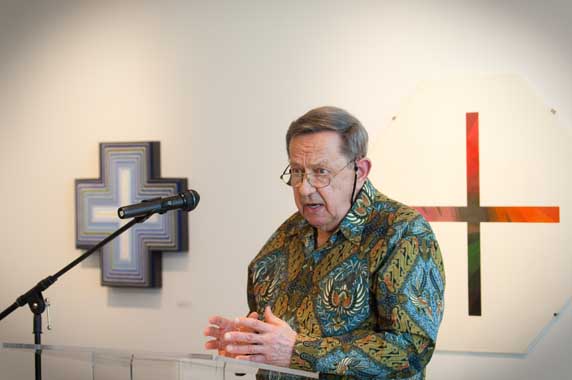
seerveld at gallery in shirt.jpgCalvin Seerveld is a hero to many of us, modeling as he has, a commitment to serious, world-class, inter-disciplinary scholarship, one whose remarkably detailed, arcane professional work usually ends up sounding very, very important. Even if one doesn’t know much about art history, say, or the discussions about public art in Canadian cities, or the perspectives and practices emerging from recent study about play and recreation, reading Seerveld makes one realize how it does matter. Like a truly good teacher, he helps us “get it.”  Without jumping to simplistic or moralistic “practical applications” his perspective comes through his robust, scholarly essays, papers, talks, or sermons, and get into one’s bones in transforming, sometimes Earth-shattering ways. His insights, both the big, broad conclusions and the smaller allusions offered in detailed lines are — to use a phrase I swear I first heard from Cal, probably at a Jubilee conference in the mid 70s — “pregnant with meaning.”

And so, dear readers, friends of Hearts & Minds, join me as I make the case that the release of this extraordinary collection of occasional pieces – major addresses, keynote talks, academic papers (a few published in chapters of hard-to-find books published in Africa or Amsterdam) and many popular-level articles published in magazines, not to mention a few sermons and hymns and Bible studies and lovely meditations – ought to be consider a bona fide publishing event.  From the largest literary stars rocking the best-seller lists to brilliant work coming from cryptic indie-publishers, from important new scholarship in the mainstream academic guilds to the large renaissance of important Christian scholarship available from publishers like Eerdmans, Baker Academic or IVP Academic, I can say that there is simply nothing that has been published in recent years that is as ambitious, as fascinating, and – dare I say it? – as important, as this collected works project of Dr. Calvin G. Seerveld, son of a Long Island fishmonger. 

BEARING FRESH OLIVE LEAVES                                                                                                      (OR: “COMMON GRACE FOR THE COMMON GOOD”)

Steve Garber’s nice phrase from the subtitle of his Visions of Vocation, “common grace for the common good,” captures something of the tone of Seerveld’s work. (Garber esteems Cal Seerveld greatly, by the way, and Seerveld was an early influence on him, along with their mutual friend, the Dutchman Hans Rookmaaker.) Seerveld brings profound insight to the watching world. Which is to say that although he is one of the most overtly Christian scholars I know (Scriptural references pepper his talks, Biblical stories and  theological allusions show up in the most fascinating ways) his work is read by scholars who do not seem otherwise interested in Christian convictions. His work has won prestigious scholarly awards and some of his presentations were first delivered in very public forums. One volume of these six (Cultural Problems in Western Society) includes, in fact, six serious presentations given in Europe at a series of annual conferences paid for by the Dutch government, bringing together policy advocates and civic activists, artists, labor union leaders, and cultural workers, who were tasked to think together deeply about the changing culture in Europe, especially given the rise in immigration and the increase in tensions arising in an increasingly secularized and multi-ethnic society. 

I reviewed that one briefly for the Citizens for Public Justice newsletter, Capitol Commentary, reminding that particular audience that Seerveld is useful for those committed to nurturing principled convictions about  citizenship for the common good. Seerveld is perhaps anBearing-Fresh-Olive-leaves2-188x300.jpg example of what we sometimes call a public intellectual. Common grace for the common good, indeed.

(Seerveld has a previous and quite brilliant book of essays about the arts, including some wonderful talks he gave at the famous Greenbelt Festival in England, entitled, with Noahic overtones, Bearing Fresh Olive Leaves. Yes, that’s it — we bring gifts of promise, pointing others towards God’s gift of shalom a-coming. Again, this is language of the common good; love of neighbor seems to be palpable in even his art theories, educational proposals or civic studies.)

It is fair to say, though, that Seerveld is mostly known in certain Christian circles – he is Dutch Reformed, a neo-Calvinist standing in the Kuyperian legacy who studied with Barth and other heady continental theologians, a son of a New York fish seller who has served as gritty cheerleader and very vocal supporter of the struggles of the rough and tumble Christian Labour Association of Canada, a founding professor of the embattled Institute for Christian Studies in Toronto, the first Christian institution in North America to offer PhD degrees (in subjects other than Bible or theology) in an knowingly, intentionally Christian program. His work at ICS helped them earn their world-wide reputation, even though the hugely significant Creation Regained: The Biblical Basis for a Reformational Worldview by Al Wolters, a good friend and former colleague of Seerveld’s there, is now better known. (It was Seerveld, by the way, who coined that phrase “reformational” to distinguish the neo-Calvinism of Kuyper, Dooyeweerd, Vollenhoven and the movement of scholars from Amsterdam and Toronto’s ICS from the more conventional Reformed theology known in the States.)  

Cal’s friend Nicholas Woltersdorff, who left Calvin College to take up a position at Notre Dame and then Yale, and eventually the equally prestigious UVA, is a similar scholar who is also widely read; his books are on Cambridge University Press, and other renowned scholarly presses, and his Eerdmans Art in Action is considered a watershed book on Christian writing about aesthetics. I mention him for those who may know his serious work in aesthetics and political philosophy, but who oddly may not have read Seerveld; they are good friends and working in somewhat similar terrain. (And both will be on a panel at the upcoming CIVA conference in June of 2015.) Seerveld seems more evangelically passionate, his wildly colorful style allowing his seriously informed academic ruminations to feel on the page like revival fire. Perhaps this is why he did not, like Nick, end up respected in the Ivy League; Seerveld is perhaps too rambunctious and less willing to obscure his own deepest orientation. At any rate, perhaps knowing the long-standing friendship between Nick and Cal will help you place Seerveld in the larger landscape of what we sometimes call integrated Christian scholarship.  Rainbows.gif
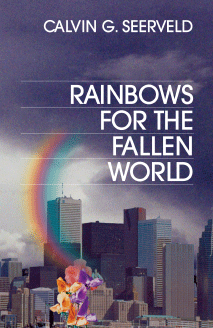
Seerveld’s Rainbows for the Fallen World (published by his own Toronto Tuppence Press) is a study done in evocative, passionate, eccentric prose, part sermon, part philosophy, part chat with older Dutch Uncle, part exhortation from what sounds like a not so minor prophet, and is perhaps his most well-known work. It is cited by many of our smartest evangelical artists and cultural creatives — Mako Fujimura, Andy Crouch, Charlie Peacock, Michael Card, the late Mark Heard, the publisher Ned Bustard of Square Halo Books, guys in Jars of Clay, William D. Romanowski, not to mention leaders at organizations like CIVA, IAM, the XD team of the CCO, and Fuller’s Brehm Center for the Arts. We are proud to sell it, and have sent it around the world.

Justice advocate and former leadership mentor at the Max DePree Center for Leadership Gideon Strauss writes of Seerveld:

I cannot adequately express my own gratitude for Calvin Seerveld’s lifetime of faithful study, writing, and speaking. I first bought a copy of Seerveld’s Rainbows for the Fallen World in the mid-1980s, from a colporteur selling them out of a room in the back of his house in apartheid South Africa, and I have since read three copies of Rainbows threadbare and to the point of falling apart. No other pages outside of the Scriptures themselves have more decisively and thoroughly shaped my understanding of God, the world, and myself than the introduction and first chapters of Rainbows. 

While in graduate school I read an essay included in Part Two of this volume [Cultural Education and History Writing], “Footprints in the Snow,” that shaped my understanding of culture, history and history-writing in a perduing manner. I can say without any doubt that Rainbows and “Footprints in the Snow” are the most important things I have ever read, outside of the Bible itself.

Each of these good volumes, with uniform covers, collects dozens of Seerveld pieces, most never seen in a book before, many published since his retirement from ICS in the 1990s.  A few of the chapters are articles published or sermons delivered as far back as the 1960s and those, too, are almost all as timely as the most recent.  The subtitle of each is “Sundry Writings and Occasional Lectures.”

This remarkable six-volume anthology of his many sundry pieces not only brings these rare works to readers who have long wanted such a collection – some of these pieces have been photo-copied and passed around like Russian samizdat — and some are real surprises (to all but the most devout fans.) To see so many Seerveld writings that we haven’t actually seen before (or haven’t even heard of!) is a gift of the finest order. Yes, I’m sayin’ it, right here, right now: the simultaneous release of this handsome set is a bone fide publishing event!

Nicely, this set collects the writings less by genre (each book contains short articles and longer papers, spoken small informal talks and major keynote presentations, academic pieces and devotional meditations) but by theme.

Here are the names of the six volumes, in no particular order.
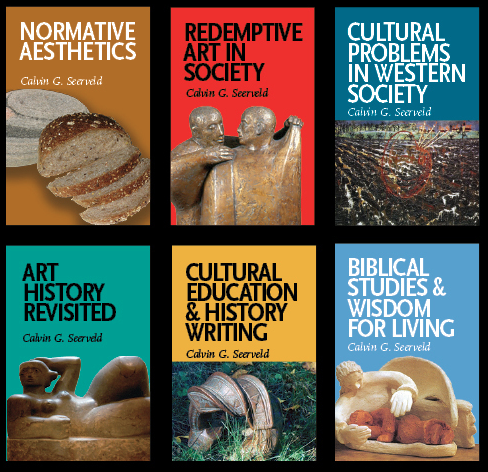
Seerveld books screen Shot 2014-04-11 at 20.42.30.png

CULTURAL HISTORY AND EDUCATION WRITING //                                                    CULTURAL PROBLEMS IN WESTERN SOCIETY

Perhaps some readers who know of Seerveld’s work as art critic and advocate for a reformational aesthetics, or as a Bible scholar who speaks at worship conferences, especially on the use of the Psalms in liturgy,  may wonder what these last two volumes are about. It isn’t easy to ever say what any of Cal’s books are “about” as they are so colorfully written, always so deeply Biblical, informed by his serious study of theology and philosophy, and his concern for the ordinary people of God, that all are always about many things at once. These two collections, though, are a great example of his interdisciplinary interests (and expertise.) 

As I mentioned above, I briefly told about the two of them earlier in the year for a review column that I do called “Politics and Prose” for Capitol Commentary, published by the Christian political think-tank, the Center for Public Justice.

I exclaimed there that those seeking more profound thinking about contemporary socio-political problems would be wise to study with Seerveld as he brings his brilliant, prophetic imagination to bear on some of large issues of the age. As I note there, some of these talks were delivered at an annual conference in Europe, in part funded by the Dutch government, bringing together artists and cultural creative alongside educators, civic leaders, politicos and union leaders.  It is almost unheard of in North America to see this kind of robust conversation among public leaders and faith leaders that is intellectually meaty and multi-dimensional.

Artist or activist, these essays are worth your consideration, and would bring a refreshingly rare vision and tone and direction to your work. 

That review of these two is short, and you could quickly read it here — but do come back here, please! 

A few chapters in Cultural Education & History Writing deserve special mention, as theycultural_problems.jpgcultural education.jpg are important to at least a few of our BookNotes readers. There is reprinted an important speech offered at the founding of a Christian college in Korea. It is amazing —  “Why Should a University Exist?” If you are in higher education, this is well worth pondering.
And, importantly included here is Seerveld’s passionate, important, wise contribution to a complex conference a few years back called “Beyond Worldview” which tried to argue through the usefulness, or harmfulness, of using the word “worldview.” Many of those pieces were published in a vastly under-rated, important book After Worldview edited by Matt Bonzo and Michael Stevens.

Cal’s piece here from that event is called “The Damages of a Christian Worldview” and is lovingly dedicated to one of my own influences, the Western Pennsylvania reformational philosopher and preacher, Peter J. Steen (1936 – 1984.) It is a good piece; it makes me happy that Seerveld loved Pete, and gave him this small honor.

Pete Steen would want you to read “Jubilee on the Job” a prophetic, astute, and powerful keynote offered at the 50th anniversary of the Christian Labour Association of Canada. It isn’t the only piece in here on the dignity and hardships of work. I’m so glad that one is in here. Anyone reading about faith and the marketplace, Christian views of work and vocation must read a few of these good papers.

And it may be a bit “insider baseball” for some, but his short piece from The Banner called “Thinking Deeply About Our Faith” honors some of his own influences. He talks about meeting a famous Dutch pastor who was a survivor of the Dachau concentration camp and a bookseller, and the colorful H. Evan Runner, and their passionate arguments as they discussed Trinity Christian College (where Seerveld first taught) and the founding of ICS in Toronto. There were conversations between folks at Calvin and Regent in BC and Westminster Seminary in Philadelphia (and, even, the CCO in Pittsburgh.) It is a nice, quick summary of some history that I’ve watched develop from afar.

Most of these pieces are brilliant, and substantive. I cannot recommend them enough for the educated Christian thinker who reads widely.

NORMATIVE AESTHETICSnormative aesthetics.jpg

You may think that a book about Normative Aesthetics is a bit arcane, and I suppose it is.  However, if you live in God’s world, you have know you experience the aesthetic dimension of life – God has given us “rainbows for the fallen world” after all.  You attend to color, you listen to music, you choose clothing, you set your table for meals, you trim your trees, make a snowman;  you do or don’t use banners and/or paraments at church, you send greeting cards not just by what they say, or choose fonts in blogs or use irony in your facebook profile. Maybe you like soccer, wax your car, pay somebody to style your hair, use certain affectations in your speech.  Maybe you hang a painting in your home, maybe you have a favorite ceramic mug, maybe you tell a good joke. Perhaps you read novels, watch films, go to rock (or country or jazz or polka) shows, enjoy architecture, binge on TV shows, for better or worse. Maybe you judge a book by its cover.

Knowing a bit about this side of life, knowing a bit about the philosophy that underlies and shapes and informs appropriate thinking about aesthetics is certainly a must for artists, critics, or aficionados of the arts.  (You do think there is good and bad art, don’t you? Also fashion or play or cooking? Of course — there are norms, perhaps what the Bible sometimes calls creational ordinances, which are more than principles, much more than “values” and really not at all what we say when we talk about our subjective tastes.  Wow, come to think of it, we could all use a book or two with the word “normative” in the title — who doesn’t want to live life in sync with what is true and good and right? 

You could give this to anyone who has already read a few books on culture-making or the arts and who needs a deeper underpinning, who wants to go a bit further in to the quest for Christian consideration, Christian thinking, Christian practice in the arts. Or give it to anyone who is smart enough to want to read seriously about this particular field.  

Yes, there are chapter titles here like “Dooyeweeerd’s Legacy for Aesthetics: Modal Law Theory” which expands that nearly mystifying chapter at the heart of Rainbows for the Fallen World. His “A Turnabout in Aesthetics to Understanding” was his much-discussed inaugural lecture from the early 70s when he took up his chair at Toronto’s Institute for Christian Studies; I still have a few copies of it when it was sold as a small booklet!  Lambert Zuidervaart’s wonderful, thick, helpful introduction to this volume is itself worth studying; it is called “(Un) Timely Voyage: Calvin Seerveld’s Normative Aesthetics.”  It is meaty, intelligent, perspicacious, if you will.

But many of these chapters are fun for anyone, not just philosophers of aesthetics. I loved the one called “Joy, Style, and Aesthetic Imperatives, with the Biblical Meaning of Clothes and Games in the Christian Life.” His little piece “Ordinary Aesthetic Life: Humor, Tastes, and “Taking a Break” is wonderful and wise — who else writes stuff like this? I don’t know how many times I have read, over the years, his stunning “Christian Aesthetic Bread for the World.” “Both More and Less a Matter of Taste” is a bit heady, buy must-reading, I think, for anyone who wants to be faithful in our conversation about culture and social renewal in these days. His “Relation of the Arts to the Presentation of Truth” is passionate, serious, and very important. 

What great blurbs grace the back, too. 

James K.A. Smith notes not only how influenced he has been by Seerveld and how he has “drilled wells that Christians will drink from for years to come” but that it this release is perfectly timed: 

Just as Christians in theology and the arts are becoming interested in the imagination, they can discover anew the philosophical wisdom of Seerveld’s normative aesthetics.

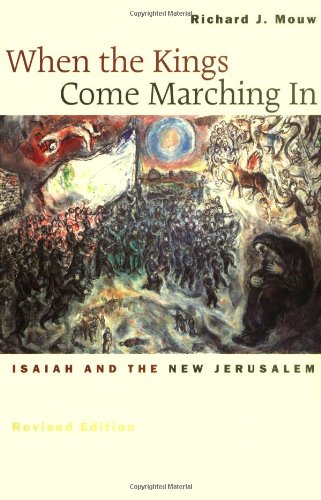
Nicholas Woltersdorf has a very gracious and helpful endorsement. So does Richard Mouw, who calls his work “ground-breaking” and reports that he “practices what he preaches.  These fine essays both stimulate our imagination and offer us a gift of joy.”  

This book is a true, joyous gift, a publishing event in itself, and I’m eager to have Hearts & Minds friends know of it.  Will people buy a book on aesthetics (normative or otherwise?)  We shall see. I suspect it won’t be a big seller at LifeWay or Barnes & Noble, but we do hope to sell a few, for God’s sake.

BIBLICAL LIVING & WISDOM FOR LIVINGbiblical studies & wisdom seerveld.jpg

The volume in the set that may be most appealing to most BookNotes readers is the extraordinary (words fail me) writing and insight in Biblical Studies & Wisdom for Living.  In this 425-page, thick volume – a volume that, again, is stunning in its breadth and erudite contribution – we have a wide array of his Biblical work. 

Eugene Peterson, you might want to know, is a fan.

Of this new volume, he writes,

For those of us who have been led and directed by Calvin Seerveld’s books to develop artistic imagination as we read Scripture, receiving the narrative whole and integrated, this gathering of his occasional writings is sheer bonus. No one in my experience is more prescient in his alertness to the intertexuality of the entire Biblical canon. Under his influence I find myself listening to God’s voice in the Scriptures, not just reading God’s words.


Read that again, my friends. 

Some of you may esteem the well-respected work of the Calvin Institute of Christian Worship, headed up by the remarkably ecumenical, surefire, John Witvliet, who grew up, I gather, with a steady diet of Seerveld.  

Witvliet says of Biblical Studies & Wisdom for Living, 

Vintage Seerveld — gutsy, wise, vivid, provocative, sanctifying… While several pieces directly address audiences and questions of particular significance to Reformed Christians, the patterns of thought reflected here will be inspiring and challenging to serious Christian believers in any tradition.

I sometimes call Cornelius Plantinga, a research fellow at said Calvin Institute, the patron saint of booksellers, not only for his many eloquent, broad-minded books about learning for God’s sake (like the lovely and valuable Engaging God’s World) but for his book about books and reading, Reading for Preaching. Plantinga says of this particular Seerveld volume in the new set,

This collection of Calvin Seerveld’s writings is a sheer gift. Highly intelligent, wide ranging, deeply revealing of the light of God, these lively pieces inform, delight, move the heart. They are at once provocative and reassuring, and they are, above all, wise.

Here are a few of the chapter titles of this one: 

“Hearing God’s Narrative About ‘the way’ of Shalom” 

“Reading and Hearing the Psalms: The Gut of the Bible”

“Pain is a Four Letter Word: A Congregational Lament.”  

One long chapter is called “Five Psalms: For the American Guild of Organists” and in it he explores three Psalms. The bit on Psalm 19 he titled “Celebrating the good news of God’s creational ordinances and creatural glossolalia” and it is excellent; Psalm 30 is “A song written for a consecration service of the house of God” and one that “never gets old” is Psalm 96. The next two “psalms” in this chapter include poetic pieces from Isaiah and Revelation 18 (“Hip Hop millennial culture and Hallelujah!”)

I’m telling you, this is stuff that combines Hebrew scholarship, the history of exegesis, robust Reformed theology, worldviewish hope, brought out in creative, contemporary dunamis. It’s a pocketful of kyrptonite.

Other chapters in this volume bring greater detail: one chapter is on Proverbs 10 which he called “From Poetic Paragraphs to Preaching” and then there is a classic study of Proverbs 31 (which is entitled “Celebrate the Resourceful Woman.”) Excellent, fresh, insightful.  

A few chapters are rather academic. For instance, one of Seerveld’s famous works is his script for a dramatization of Song of Songs called The Greatest Song. (We carry that rare, lovely book as well, by the way, with its  evocative script, its handsome woodcuts, its Biblical heft and eroticism.) In one chapter with rich implications for any of us who read the Bible in fresh ways, he studies a literary critic named Herder who wrote and preached and translated in the mid-1700s, and anticipated contemporary conversations about hermeneutics raised by the likes of Gadamer, centuries later. This heady and fascinating bit of historical theology and aesthetics is called “Herder’s Revolutionary Hermeneutic and Aesthetic Theory: The Import of Herder’s Hermeneutics for Text Performance of The Greatest Song.”  Okay, so it may not be for everybody.

A few of these pieces, though, are sermons, tough and tender and worth repeated readings. Peterson and the others are right, this is prescient and alert and leads us to God’s own voice!  Try on “The Gift and Distraction of Pleasure” or “Longing to Lament: A Conversations Between Michael Card and Calvin Seerveld” (clear, honest, helpful!) or “We are Not Pilgrims: We are called to build tent cities in God’s world.”  Amazing.

He has meditations here on marriage such as “The Tender, Tough Mystery of (Married) Love” and on friendship (“The Rare Gift of a Friend”) and remarkable pieces like “Ways-of-life and becoming elderly wise” and “Bastards or Sons of God?”  I almost think that if some of us immersed ourselves in this kind of radical, integral Biblical reflection until it gets into our bones, we might be more healed and whole, less afraid and anxious, more bold and glad and good.  

Some of the chapters in Biblical Studies and Wisdom were messages given on occasions such as college graduations or at associations of Christians schools or other denominational institutions.  No matter your own denomination, you should read his “Modest Proposal for Reforming the Christian Reformed Church in North America” which will blow you away.  His “Graduating to Glocal Martyrdom” is wondrously heavy – who says this kind of stuff at a commencement talk? He’s pretty tough, too, in another piece about higher education, although its rumination on 2 Corinthians 2: 14 – 3:6 would be powerfully applied to your church or fellowship group as well — it is called “The Smell of Your School: A Letter of Reference?” Wow.

Seerveld shows his cross-cultural humility (and savvy) in his fabulously interesting study of Say Amen, Somebody! the 1983 documentary about black gospel music and Thomas Dorsey. His first line in this great chapter is, “Say Amen, Somebody! should be seen by every sourpuss in the church.” As he narrates his own experiences in black churches, his study of gospel music, we learn so much. There is one great episode of going to black churches with his friend, the Dutch art historian Hans Rookmaaker in the early 60’s; included is a great grainy picture of Rookmaaker and Mahalia Jackson from 1961. Oh my, this is precious stuff, and I hope you realize it.

I could say more about this large volume, as there is so much more.  Allow me to name one more chapter. 

One of Seerveld’s most popular and often-re-printed short pieces is included here. “How to Read the Bible as a Grown Up Child” gives a broad, serious, clever, passionate reminder of how to approach the story of God revealed in the Scriptures. It is wonderful, just wonderful.  

Seerveld has a short, meaty book called How To Read the Bible To Hear God Speak: A Study in Numbers (an earlier version old fans of his know as Balaam’s Apocalyptic Prophecies: A Study in Reading Scripture) which  compares four different hermeneutical methods (from fundamentalist literalism to hyper-Reformed dogmatism to liberal higher criticism to postmodern engagement) naming the strengths and sometimes deadly weaknesses of each camp’s approach.  He mostly shows a better, redemptive way, as he guides us how to read the Bible by preaching it so well, and by using it in such a fruitful, lively way in all his scholarship. 

But this little piece that is in the Biblical Studies & Wisdom volume – about being a “grown up child” — is delightful and good, and captures this vision, explored in his bigger book on reading the Bible, and his devotionals, such as Take Hold of God and Pull. Is it an overstatement to say you should buy this book so you have easy access to this one “How to Read the Bible Like a Grown-Up Child” essay?  Perhaps. But I could say that about half of amazing pieces here: it is well worth owning this book so you can draw on these pieces for the rest of your life.

ART HISTORY REVISITEDart history revisited.jpg

Well. This is where it gets serious, friends, and this is where Seerveld perhaps shines in his own field, beyond what I can adequately express. I know some of you will love this book, and some of you should give it to somebody you know.

Seerveld has been honored for his astute contributions to this field; he has done as much on a uniquely Christian, reformational method, than anyone in our lifetime, perhaps ever. (He has a thrilling, invaluable chapter in a book on the methods of doing art history Christianly, a festschrift in honor of the famed Wheaton College art professor, John Walford, called Art as Spiritual Perception: Essays in Honor of E. John Walford edited by James Romaine.)

And in Art History Revisited we see him in action.  And, it is something — yes, the aforementioned “publishing event.” As Nigel Halliday from the UK writes, 

Seerveld writes with the learned precision of the academic, but also with the passion and wry humour of a man rationally and emotionally convinced that we are God’s creatures living in God’s world…. the result is writing that brings art and artists to life, whether from this age or ages past, and makes us reflect seriously about our own lives. 

James Romaine (President of the Association of Scholars of Christianity in the History of Art) notes,

Cal Seerveld brings fresh insights to the methods and motivations of art… Seerveld’s practice of identifying connections across periods of art history manifests a belief in God’s authority over the entirety of history and culture. His is a pursuit of the divine continuity that binds and gives meaningful significance to the ordinary particulars of historical and cultural moments.

There is some slow sledding here, rich and fruitful. For those that follow these things, Seerveld tends to appreciate the scholarly philosophy of Dirk Vollenhoven, the brother-in-law of cosmonomic Christian philosopher, Herman Dooyeweerd, and has several chapters here such as “Vollehnoven’s Legacy for Art Historiography.” Some of this deep background philosophy about the very nature of God’s real world offers a lens for him, which enables him to write remarkably prophetic pieces such as “Methodological Notes for Assessing What Happened 1764 – 1831 in the History of Aesthetics” and “The Moment of Truth and Evidence of Sterility within Neoclassical Art and Aesthetic Theory of the Later Enlightenment.” There are Biblical insights here, and he explains it, too: see the chapter “Biblical wisdom underneath Vollenhoven’s Categories…” Whew.

Part Two of this heady volume gives some delightful and inspiring examples of his methods by doing some nice case studies, truly revisiting art history, bit by bit. Whether you know much about this stuff or not, it is great, informative reading, a great way to learn a lot. He looks, for instance, at “Telltale Statues in Watteau’s Painting” and studies Hogwarth, Anton Raphael Mengs, and the wonderful contemporary wood engraving of Peter S. Smith.  What great chapters! Know these artists or not, these are informative, inspiring pieces of fruitful Christian reflection. Anyone with interest in Christians working contemporary visual arts will love, and deeply appreciate his wonderful essay called “Redemptive Grit: The Ordinary Artistry of Gerald Folkerts.” 

REDEMPTIVE ART IN SOCIETYredemptive art.jpg

This is another favorite in the set, and it is one to which I had the immeasurable honor of adding an endorsing blurb. That Seerveld or his chief editor (from Dordt College Press) John Kok thought I might have some wisdom to impart here was a blessing for me — foolishness on their part, some might say. Ha! But there I am, next to Hans Rookmaaker’s wondrously artful daughter, editor-in-chief of ArtWay, Marleen Hengelaar-Rookmaaker, on the same page with scholar Jeremy Begbie, now of Duke Divinity School, and Makoto Fujimura.

Here is what Mako wrote,

Dr. Seerveld’s carefully crafted, scintillating, poetic words… are, to me, shalom promises, wisdom given to encourage artists in a broken, dark, and yet glorious (New York.) to only seek the best, to integrate one’s life and one’s art, and to bathe everything in prayer. I am grateful for his words: I am grateful for this book.

I appreciate what Begbie says,

Countless artists and theoreticians have been nourished by Cal Seerveld’s vivid and striking wisdom. These extraordinarily wide-ranging essays will not disappoint those who have followed his work, and those who are new to his unique voice will be greatly enriched.

But, you know, I hate to say it, but I think that the Borger guy captured best the tone and value of this particular volume, this one called Redemptive Art in Society.  Here is what I said:

Can high quality, properly nuanceful, allusive theatre, sculpture, painting or song help heal the world? Can art expose injustices, bring comfort to the hurting, shake the idols of our age? These chapters are amazing pieces, a true gift for those wanting to go further along the journey towards “seeking the peace of the city.” Wise leaders and faithful artists simply must read them.

Yeah, I believe truly that. Art can change the world. (Perhaps you saw my review in Capitol Commentary of Fierce Convictions: The Extraordinary Life of Hannah More: Poet, Reformer, Abolitionist by Karen Swallow Prior, about the Victorian-ear British societal reformer, high-class cultural leader, educator, writer, and friend of the famous politician William Wilberforce.) I think this is very, very important stuff.

As Seerveld predecessor at ICS, Adrienne Dengerink Chaplin, writes in a moving, important introduction to this one, 

“What would art look like that liberates, reconciles, reforms, and edifies?”  That is the driving question throughout this collection of writings and lectures by Calvin Seerveld.” 

She opens her superb introduction by writing about Seerveld’s important lectures given in South Africa during the days after the worst of the apartheid years.  She cites a line he gave there, a line I heard in the mid-70s that impacted me like Richard Wright’s famous “punch to the solar plexus.”  

“In my country on Friday nights youths die by the thousands culturally at the movies, and ten thousands are stunted by their weekend videos.”

The antidote, he says, is normative aesthetics, lived out, real and raw. “The best defense against attractive superficiality in the arts is a tough, home-bred imaginative fiber.”  Or, as he puts it elsewhere, “art is like minerals in one’s food, the fiber to one’s diet, whose nutritives one hardly notices unless you become malnourished and it is determined that iron or ruffage has been missing from your daily bread.”  As Adrienne puts it, “For Seerveld, wholesome bread — artistic, ludic, theatrical — is a recurrent image of the redemptive role of art in society.”

Seerveld cares deeply about public justice, about politics and economics, labor and freedom and shalom, real hurting people in a polluted world.  But let me be clear: although he cares about the “redemptive role” of art in society — thee are chapters here where he talks about inner city murals and shares his passion for the “displaced” and, as we noted, about liberation in places like South Africa — this collection is not about social justice propaganda, about harnessing the arts for some just project.  No — just like we realize that cheesy, evangelical preaching in the guise of, say, contemporary worship choruses or  Christian-radio-friendly simplistic Christian pop, is often less than artistically mature, thin and not adequately nuanceful, so agit-prop, Christian preachments even about peace and justice, are not the calling of the mature artist, either, and not what ordinary folk should hunger for.


Redemptive art is gritty, but not propaganda. We bring “fresh olive leaves” announcing shalom, but we don’t have to sacrifice metaphor, allusion, suggestion — we “tell it slant” — let alone excellence and craft. Seerveld has thought harder and written more significantly than anybody I know about the ways in which art can enhance cities, how imaginativity is important for human dignity, how allusive artistry can enhance our cultural flourishing in ways that screeds and propaganda cannot.

As with the other volumes, Redemptive Art in Society includes some pretty scholarly pieces here, and then there are others that are so brilliant, and so fascinating and hopeful, that I’d wish everyone would read and study and ponder them. “The Challenge to Be Imaginative Salt in God’s World” is a near manifesto for relevant, socially-poignant Christian art. His message “For the Next Generation of Christian Writers of Literature” is a must for creative writers and readers of novels. He has an important little piece on poetry. He offers more than one piece on theater, a must for actors, writers, or anybody who enjoys going off Broadway. 

Seerveld is especially attuned to the life of the city (and he has often shared insights about the murals of Diego Riviera.) This is excellent stuff for urban ministers, city planners, those called to reflect on the “sidewalks of the Kingdom” and  “the spaces between us” as Christian new urbanist Eric O. Jacobsen puts it. But it isn’t just about public art and social renewal.  Again, this is a book about the consequences of good aesthetic theory and the impact of mature Christian art and artful appreciation. I love this book!

A publishing event it is. 

seerveld set.jpg

SIX VOLUMES

These six volumes collect, as we’ve seen, a real variety of styles — sermons, Bible studies, short magazine pieces, letters, even, next to scholarly essays and academic publications.  And they cover a variety of themes explored by Seerveld in his sundry and occasional work.  Some of these pieces are nearly legendary, a few are famous. Most, though, are virtually unknown, and we hope that this new collection will make his sustained, on-going work well known, from sea to shining sea.  This really is great stuff, and we are more than please, we are compelled to tell you about it.

This series from Dr. Calvin Seerveld are among the most important and meaningful books I have been pleased to try to sell in our thirty plus years of selling books coram deo.

I trust you enjoyed reading about them, hearing about this fine scholar and eccentric cheerleader for the arts. I trust you will consider parting with some of your hard earned cash to buy a few, if not all.  These are the sorts of books that last a lifetime, a wish investment, important for God’s glory, in God’s world, for those starved for lack of mature Christian theories about important aspects of our lives in God’s good but broken world.

Who else has written a chapter called “Joy, Style, and Aesthetic Imperatives with the Biblical Meaning of Clothes and Games in the Christian Life”?  

Who else takes a course on popular song-writing so he can learn how his students might counter “formulaic meretricious songs” and does so in light of global starvation and real poverty, with a photo of an African shanty-town, beside a Picasso piece an Rembrandt self portrait?

Seerveld laments those who are

smothered by the clutter of huge, repetitive blinking billboards signs 7/24 for corporate advertising, turning the place into a marketing venue. There is more than one way to be killed: commercialistic anaestheticzed place can have the forlorn mark of a Las Vegas virtual cemetery.

Well, this is amazing writing, colorful, demanding, serious, a bit playful, stunning. There is no other author like him, and we cannot thank Dordt College Press quite enough for bringing these pieces into the publishing world.

We can tell you about them, though, and pray that you help us spread the word about them, curious and winsome and learned and full of prophetic imagination that they are. You’ve not seen anything like them, I am sure. These books are remarkable, and we are happy to tell you — someday in the Kingdom Hall of Fame I will be vindicated, if you don’t believe me — that this batch of books being released this fall is a true publishing event.

Or, as the kids say these days: A. True. Publishing. Event.

The gifts of God for the people of God.

Thanks be to God.

Seerveld books screen Shot 2014-04-11 at 20.42.30.png

YOU CAN BUY ANY ONE AT 20% OFF. 

IF YOU BUY THE WHOLE SET, WE”LL SELL THEM AT 25% OFF AND WE WILL SEND ALONG (WHILE SUPPLIES LAST) A NICE ART BOOK, A COFFEE TABLE GIFT BOOK THAT SEERVELD LIKES. 

NICE, eh?

Here are the mundane details:

We’ll show the regular price, and our BookNotes 20% sale price.

Normative Aesthetics                          $21.00   our sale price  $16.80             

Cultural Education & History Writing   $23.00   our sale price  $18.40

Cultural Problems in the West             $17.00   our sale price  $13.60

Biblical Studies & Wisdom for Living   $25.00   our sale price  $20.00

Art History Revisted                             $20.00   our sale price  $16.00

Redemptive Art in Society                   $21.00   our sale price  $16.80

BookNotes

SPECIAL
DISCOUNT
ANY ITEM MENTIONED

20% off
order here
takes you to the secure Hearts & Minds order form page
just tell us what you want

inquire here
if you have questions or need more information
just ask us what you want to know

                                     Hearts & Minds 234 East Main Street  Dallastown, PA  17313     717-246-3333


THIS JUST IN: DVD on C.S. Lewis, narrated by Os Guinness “C.S. Lewis: Reluctant Disciple: Faith, Reason, and the Power of the Gospel” – ON SALE NOW

Wow, what good news.  We just got into the shop a brand new DVD on C.S. Lewis, narrated by Os Guinness!
 
C.S. Lewis: Reluctant Disciple: Faith, Reason, and the Power of the Gospe
l  (Discovery House) regular price, $19.99. Hearts & Minds BookNotes sale price – $17.99.

We have been waiting for this, and have been eager to tell you about it, and was tickled that it arrivedCS Lewis Reluctant Disciple DVD.jpg just yesterday. We were up quite late last night, watching this lovely set of eight lessons, listening to the charming accents, viewing breath-taking scenes of Donegal, Ulster, the Northern coast of Ireland, and of course, the Kilns and the colleges at Oxford and Cambridge.  I don’t know what was more visually stunning, the bright green scenes of the lawns and gardens, or the glorious architecture of those hallowed academic halls, the churches and even the pubs. 

The production of C.S. Lewis: Reluctant Disciple is top class, not edgy or wild or unusually creative, but gentle, beautiful, very nice, with a lovely and effective orchestral score.  Filmed on location in Ireland and England, there are remarkable archival shots, old black and white photographs, of Lewis’s early years, and up to his death in November 1963.  The production has — for lack of a better way to explain it — a PBS/Ken Burns sort of style. There are lots of interviews with lots of people, and the camera moves from these handsomely set interviews to old black and white pictures, close-up shots of letters and notesDVD.jpg and family documents, to contemporary scenes of the lively locations at Oxford or Cambridge or the countryside Kilns where he and his brother Warnie lived.
Time does not permit me to explain all the wonderful people who are shown here, the scenes shot, or the insider information that is shared, but I’ll make three quick observations.
First, it is just wonderful to hear people who knew Lewis personally, to have these candid andirish landscape.jpgIreland.jpg first hand interviews, some which were quite enlightening, some which were a bit light-hearted, and a few which brought tears. I wasn’t expecting these first-hand accounts, and was a bit surprised at how touched I was by this. Jack’s longing to enter the other country near the end of his life, and hearing testimony of people that were with him in his last days was deeply affecting to Beth and I.

We think you will enjoy this, be moved by it, and be very, very glad for this wondrous opportunity to be in the company of those who knew this great man.

Secondly, you should know that it is not particularly academic; it is not so much a work aboutlewis face.jpg apologetics as the subtitle of the DVD curriculum might lead you to believe. It bears witness to the life of this great man, a thinker, writer, professor of note, and that is enough. There does come with it a very thorough study guide, with discussion resources, reflection questions and Scripture verses, and it is clearly arranged (in eight lessons) for group exploration.  The Leader’s Guide is well made and useful, but the sessions can be viewed almost back to back, like a series from PBS.  
This production really is a delight, so informative, even though I’d say it offers less “teaching” about his views, then about his life.  There are several sessions on his early years, the war years, his early disappointing efforts at poetry and the like.  The bits on Narnia are brief, there is littleoxford-university.jpg dissection of Mere Christianity (although the backstory of the BBC inviting him to lecture live, and his voice becoming the second most famous voice in all of England, only surpassed by Winston Churchill, is great.) They interview a friend who told of how he wrote the whole first Screwtape letter in his head during a communion service (and show the church) and they show the pew in which he sat for morning prayer each day at Oxford. The interviews with a US friend of Joy Davidman was delightful, and a few of Lewis’s old friends who told of how he handled his grief when she died — on the page, in his writing, not in his public life — is all here. (Oh how he loved to write. “Ink,” he declared, “can solve anything.”)

lewis with signature.jpg

CS Lewis Reluctant Disciple DVD.jpgThis DVD curriculum is, again, less a direct teaching tool about faith and reason and the like, or a study of his theories and theology, but truly a documentary glimpse into the life of C.S. Lewis.  It is dignified and classy and warm, and perhaps could be described as dignified, sharp but pleasant in a way that befits this Oxford don, who was known as quite a fine chap and a very decent human being.
Thirdly. I daren’t exploit this, but it is true: Os Guinness is so very articulate and gifted as an orator, that even if he is reading from a script, as seems evident, it is simply marvelous, a perfect narrator for this project. To hear Os narrate this story of his hero from Belfast, a don at Oxford (where Os once studied, after Lewis had died) and to hear his own charming cadences and accents, well, it was just wonderful. os guinness.jpgWhat a great pairing of a contemporary voice and this glorious subject. To hear Dr. Guinness reading lines from The Weight of Glory or A Grief Observed or a great passage from Screwtape Letters —  it is worth the price of admission, just for that. 
Here is what it says on the back of the DVD. 
Escaping to a place of imagination and mythology during his time away in English boarding schools, young C.S. Lewis convinced himself that God did not exist. And despite his Christian upbringing, he moved further and further from the truth, ceasing to be a Christian in every aspect of the word. But from the trenches of World War I to his time at Oxford University, he began to seek the Lord until God’s indescribably joy finally found him.
C.S. Lewis: Reluctant Disciple gives you a deeper look into
the life of one of the twentieth century’s most influential writers as it chronicles his journey from disillusioned atheist to fearless defender of the faith.

We have been waiting for a good video study of Lewis and when we heard of the many friends and former colleagues or students of Lewis and the many Lewis scholars that were involved — on both sides of the Atlantic — we were very enthused.  Having watched it all, we can say that it is very well done, a true delight and more, a testimony of a life well lived, of a good man, of a writer, scholar, teacher, and mere Christian, saved by grace and living in to his own calling as an lucid apologist, good teacher, argumentative but charming conversationalist, and loyal friend.

You will enjoy this DVD, and I suspect you know someone who will be made exceedingly glad to receive it as a gift.  We can, of course, ship it out right away, even gift wrapping for free if you’d like.
There are eight sessions, and most are between 10 – 15 minutes in length. The exceptionally well done Leaders Guide is included in the case. This is to be sold for $19.99 but with our discounted savings for BookNotes readers, we have it for just $17.99.

BookNotes

SPECIAL
SALE PRICE
$17.99

DVD
curriculum

C.S. Lewis: Reluctant Disciple

order here
takes you to the secure Hearts & Minds order form page
just tell us what you want

inquire here
if you have questions or need more information
just ask us what you want to know

                                     Hearts & Minds 234 East Main Street  Dallastown, PA  17313     717-246-3333

God in the Sink: Essays From Toad Hall by Margie L. Haack (Kalos Press) ON SALE – 20% OFF


God in the Sink: Essays From Toad Hall by Margie L. Haack (Kalos Press) regular price $11.99  ON SALE   20% OFF our discounted price $11.56

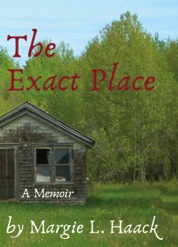
god in sink.jpgTwo years ago our biggest selling book was a lovely,exact place.jpg wonderfully-written, nuanced telling of a tale of girlhood in rural poverty, the memoir The Exact Place (Kalos Press; $13.95 — our sale price, $11.16) by our friend Margie Haack.  It is a great, gentle story, enjoyable and profound, describing how her life was, and how her girlhood story unfolded amidst rural poverty and a less than ideal home life.  We still recommend it often, and hope you know it.

Margie and her husband Denis have been heroes of ours, mostly for just being thoughtful and charming and winsome and honest and for showing such support and care for us.  They are solidly evangelical in the historic faith, but with the rare gift of living it out with beauty and grace and culturally savvy, low-key but caring about things that matter.

For decades they’ve had a ministry which has been at least two-fold: offering hospitality in a big old house in Minnesota (although they had a pad in the 1970s in urban Albuquerque which attracted all kinds of disaffected youth, young adults asking big questions about life and faith, etcetera and etcetera) and speaking, writing, and publishing resources to help Christian folks be more open to what their good friend Steve Garber calls “common grace for the common good.” 

Which is to say, they have a ministry of hospitality and they review movies and rock albums, TV shows and documentaries, and the occasional social or political trend, with incisive commentary, Biblical reflections, good journalism and very helpful discussion questions.  They long to see ordinary church folks and evangelical fellowships and campus ministries and faith leaders learn to appreciate the popular arts and learn to be discerning about the worldviews and visions, the good and the bad, coming to us from cultural creatives.  From small groups Bible studies to discussion salons to Sunday school classes, many people use their web pages and their publications.

I am not the only one to have suggested that their Ransom Fellowship (which publishes Critique journal) and their home that they nicely named Toad Hall are perhaps something like a North American version of the Swiss L’Abri (except for the real North American L’Abri’s, of course, here and here.)

I suppose there are plenty of reasons this isn’t exactly so, but I sometimes describe them as a postmodern or 21st century Edith and Francis Schaeffer. (And now that we have Edith Schaeffer’s 1977 book A Way of Seeing back in stock, after being out of print for so many years, we think it is nice to bring them up.)

Anyway, be that as it may, we like them a lot, and they have been doing good work, serving others, thinking well, sharing ideas, doing life with others, and promoting good books and music and food and frienships.

We have long appreciated Critique and some of our best and most favorite mail-order customers are friends who Denis or Margie sent our way.  They seem to understand that our own vision and inclinations and theological orientation here are somewhat akin to their own.  We respect them for holding to orthodox faith and applying it in sometimes unorthodox ways.  We respect them for the deep legacy of abiding in the Word, and living it out in the complexities of the contemporary context.

Yes they are all about the contemporary context —  in their publications and great website, they’ve done insightful album reviews, have encouraged people to watch serious films, they’ve aided and nurtured visual artists and poets and they have mentored hundreds of people to embody genuine, risky faith, with Biblical discernment, while living in something like a Babylonian exile.  If anybody gets the “in but not of”  and “already but not yet” / creation-fall-redemption vision, it is they.  We have learned much from Denis and Margie, about the details of a coherent, gracious Christian orientation and approach to culture, but also about the real-world, day-to-day expression of real caring for real people in their very real home. The house they called Toad Hall.

And that, my friends, is the bare-minimum background I needed to tell to help you understand the absolutely fabulous, truly exceptional, sometimes hilarious, sometimes tragic, always interesting newly released collection of essays and meditations offered in this anthology of Margie’s monthly Notes from Toad Hall.  God in the Sink: Essays From Toad Hall has been long-awaited and eagerly anticipated by so many of her loyal fans.  If you order it from us, you’ll see why.

Critique was a pioneering journal, offering incisive reviews before the likes of Relevant magazine or the Mockingbird website and remains an wonderful resource for anyone wanting to keep up with cultural trends, even hosting conversations on the latest important films or indie rock albums. Denis and Margie have done this together as a labor of love, and over the years many good writers have chimed in and contributed essays and reviews and discussion guides.
margie in light.jpg
But – perhaps like Edith Schaeffer – it has been Margie’s home-making and hospitality, inventing recipes, teaching others to set tables and do dishes, ruminating on God’s presence in the day by day, that has not only made Toad Hall a home and haven for many, but has allowed Ransom Fellowship to become a down-to-Earth, making-it-real, incarnational experience, grounded in a real place of grace. Want to know what beauty and goodness and holiness look like, beyond the good essays in Critique?  Join them at Toad Hall.

Or, since few of us actually have made the trek to their big old Minnesota home, we can listen in, learning about the day-to-day stuff of life, through the pen of Margie Haack. Her Notes From Toad Hall has been a report and an essay, sharing life and ruminating, and it has been one of my favorite publications.

Each month when the mail carrier brings our packet of extra copies of Critique and Notes from Toad Hall — we love sharing them with folks who would appreciate them — both Beth and I dive into Margie’s Notes… first. Critique is important, informative and well done.  Notes from Toad Hall is powerful, moving, funny, and sometimes real as hell.

We are astonished at Ms Haack’s ability to describe her life, the craziness of hosting events, the anxieties of wondering what others might think when they see the mess of her own daily life, the complex emotions when facing hard family stuff (and the complex emotions when, well, not facing hard family stuff: Margie wears her heart on her sleeve, and names what is going on, like it or not through the small and large issues of her days.)  In her Notes from Toad Hall she has offered, month by month, a brave look into their real lives,
and it is both stunning to see a Christian leader with such raw candor, and wonderful to see a vulnerable, funny story develop as she narrates her life and times running a household as interesting as the Haacks.
Notes From Toad Hall began as a family newsletter, the sort of ministry update written by missionaries and those who raise their own salaries from contributors; but, as she says in the first essay compiled in God in the Sink: Essays...

It was our desire to update the friends on our mailing list in a way that was informative but not so dull you would want your time back after you read it. The challenge was how to write truthfully about the place where we all must dwell — in whatever is our ordinary and everyday — without over-emphasizing what our culture, Christians included, defines as success.

This paragraph captures her honest style and the intent of her Notes, and the pieces that became God in the Sink.  Don’t you want to read something that promises to tell you about this kind of stuff?  Talk about a spirituality of the mundane; listen to this:

The rhythm of ordinary life is rarely that exciting or sensational. I wanted to honestly share what it meant to be a faithful follower of Jesus not so much when a hundred people praised my spinach quiche and artisan bread or a lecture on tattoos – that part was easy – it has always been much harder for me to believe God calls us to the very place where the thistles and thorns of the fallen world creep into our vocations and callings every day. It’s a place where there are painful disagreements with your spouse, where a child’s vomit stains the woodwork, and where the espresso machine explodes. Faithfulness is tested and strained through the mundane, often boring, offices of life where the pantry must be kept stocked and mistakes are made when filing your taxes. These things are so ordinary we hardly consider that this is where God mentors us and gives us grace and rest and meaning and life, but these were the bones that grew into a personal essay I included in every letter. This is a collection of some of those essays gathered together with the hope that others would be encouraged, as I have been, to recognize God’s presence in the ordinary.

I am sure that you will enjoy these finely crafted essays, these good pieces about a life livedgod in sink.jpg with ordinariness. I am sure you’ll find your own faith enhanced, your own sense of the presence of God heightened, your own willingness to laugh at yourself liberated.
These reflections are fun and good; they make for nice reading, and they make for solid spiritual nourishment.  You will enjoy them, and you will be appreciative.

I wish I could cite excerpts from each of these essays but this review would be too, too long if I started.  I want to press this into your hands, invite you to press it into the hands of others.  I suppose women who do behind the scenes family stuff may be the primary audience, but I certainly hope you don’t think that it is exclusively for women or homemakers or those involved in this kind of ministry.  This book is certainly for anyone, reflections about finding God in the ordinary, the hidden art of finding the joy of living; a way of seeing, even.
But it is also about how real caring in real life mediates God’s own grace and holiness, exposing our own deep need to some inner work, re-doubling our trust in God’s goodness and promises, saying no to household gods and inner idols, letting go of self-importance and the attendant anxieties when we live for things other than “the audience of One.”

In many of these gracious essays, the writer shares her own heart, inviting us (without sanctimony or cliché) to repentance and sanctification.
jesus - god in the sink bobblehead.jpg
The first essay, by the way, tells of Margie doing dishes with a three-year old granddaughter.  The child wants to wash the bobble head Jesus figurine, perched ironically on her counter.  Her snarky side is on display a bit more vibrantly in other essays, but you get a glimpse of this here:

I wondered how to explain irony to her. How to say it had an obscure, but special meaning to me. I’ve often thought, I should put it away because people must look at it all the time and wonder if I’m a heretic of some kind, worshiping saints or idols or something equally suspicious. This is my explanation. He was a gift from a friend, Jeremy Huggins. Together we appreciate the humor and irony in Christian paraphernalia that is marketed in certain stores. Things like Frisbees that say “Flying high for Jesus.” Or night-lights with the inscription: “Jesus is the light of the world.”
 
So there Jesus sits bobbling on the edge of my sink as a reminder to laugh at ourselves for the absurd ways in which we represent Christian faith to the world, and to try to push against the trivialization of such great a thing as the gospel. I mean no disrespect to a God I love. I think he knows that.
 
When it took too long to think of a simple answer to this dear child, she moved on to the next question.
 
“Can I give God a bath? He wants a bath.” I gently said no. He will get all rusty inside and not bobble anymore, and I quickly moved to pack him in a box, ready for my next kitchen. Yes, my next kitchen. The words were both exhilarating and terrifying.

And, yes, this is a big reveal: the Haack’s have left Toad Hall and their new location has generated a new name, and her beloved newsletters have a new name.

In another essay she shares about the new phase of their life, and their transition to a new place.  It is moving stuff, relevant for many, I’m sure,

So, this is, perhaps, the winter of our lives. Or at least late fall. There is still lots to be done. I’d like to keep going with Notes From Toad Hall. Denis wants to keep writing Critique. I’d like to keep on letting you know how this aging bit goes. Is it possible to serve God well with failing body parts, Social Security and Medicare? We plan to lean into this and listen and learn new ways of being faithful in the midst of our ordinary. We’d like to be signposts of encouragement to others. We are going to avoid the advertisements of our culture that insist “You can do ANYthing you want no matter how OLD you are.” Bah. Denis jokes that we’re not quite ready for assisted care, but with a play on words, says, “perhaps we will name our next home “The Out House,” referring to the last place we will own somewhere out there on the prairie on our way out of life. And, Bonus! he suggests I write “Sheets from the Outhouse.” Maybe.

margie.jpg
This collection of pieces written over a decade or so hangs together and chronicle their life and ministry in Minnesota.  It is not a memoir, so it is not quite a sequel to her beloved The Exact Place biography.  But in a way, it nearly is: these essays emerge from the exact place she has been these years, literally and metaphorically.

There is much honest wisdom here.  For instance, she occasionally writes about her own lack of energy, spiritual dryness and such.  As she pokes at the typical modern middle-class habit of shopping as an antidote to depression, she writes,

What I’m experienci
ng is spiritual dryness, and my first instinct is to do exactly what Tim Keller describes in a sermon on Psalm 42. He says that when something goes wrong for American Christians, they look for someone or some thing to pin it on. We tend to be very moralistic and think that surely, spiritual dryness is the result of un-confessed sin in our life. We haven’t pushed the right button, we’ve neglected our Christian “to-do list.” What we need to grasp, he says, is that dryness is going to happen no matter where, who, or how old you are as a Christian. It isn’t necessarily because you’ve done something wrong, or haven’t had faith, or neglected to read through the Bible in a year. It’s because you’re human and we live in a fractured, fallen world.
 
Keller examines Psalm 42 which examines the nature of our disorder. The Psalmist asks “Why are you downcast, O my soul? Why are you so disturbed?” The question is not rhetorical; it isn’t at all cynical, or sarcastic. It is actually asking us for self-examination. So the Psalmist searches for hopes.

Her insights about her own life, and how God in mercy deals with us, are always good, and usually refreshing in their honesty.  In an essay entitled “Calm Down” she is reflecting on her own strengths as one who is good at intuition.  And yet, she gets herself involved in a battle with Sudoku.  Can you see it?

After supper on Wednesday I began my third Sudoku with a jaunty confidence. Two and a half hours later Denis begged me to please come to bed. I did, but I took it with me and worked on it for another hour without adding a single number. Only then did I notice five stars at the bottom of the puzzle with three of them shaded. A crack of light entered my darkened mind: Oh. This indicates difficulty factor. The one in my hand was a 3-star. The previous night’s (with solution) was printed at the bottom; it had only been a 2-star. With logic gaining momentum despite intuition, it occurred to me that as the week goes by the puzzles increase in difficulty sort of like the NYT Crosswords so that by the time you get to the weekend they’re so punishing you want to pay your own way to New York, find the editor, and force him to eat iceberg lettuce and Velveeta cheese until he can give you an eight-letter-word for “rugged outdoor clothing.” Carhartts! Idiot! As anyone north of Minneapolis would know. And I don’t want to hear, my friend, how you can do it in 10 minutes while blogging, writing a movie review, and flirting with the barista. By then I was crushed, in addition to feeling slightly crazy. But I rallied and told myself, “You’ve always despised logic, so why in the name of all your precious hormones don’t you just intuit the solution? A few numbers should not defeat you.”
 
Have you ever considered, even for one second, praying that God would help you finish a puzzle? Well. Okay. Maybe you haven’t. But what about scoring a three-pointer from mid-court, or beating a red light? Or shooting a trophy buck? You know it’s the same thing.
 
At 11:30 p.m. Denis raised an eyebrow at me and turned out the light on his side. I held the paper out for us to observe — it was covered with hundreds and hundreds of teeny, tiny numbers written in patterns, grids, and graphs. Suddenly, it was so scary because there it was: A Beautiful Mind! Remember that scene from the movie when the door of John Forbes Nash’s office opens and on every wall, floor to ceiling, are little papers with hand-written numbers, formulas and codes, and you suddenly understood how ill he is, even though he is a genius? This was my mind on paper and it was not well. I shrieked, threw the paper and pen across the room, and turned off the light.

 
She moves from there to some painful needs in her life and in her family. They’ve got financial concerns, health concerns, a leaky roof, ruined books. She feels convicted by the lack of joy in her life.  She takes up some Psalms as she often does, and then recalls Sufjan Stevens’ version of Come Thou Fount.  “He completely redeems, what for me was an – I’m sorry – annoying old hymn.” With banjo and simple vocals, so quiet, so profound, he sings Come Thou Fount.”
 
“I didn’t mean to cry,” she writes, “to be taken by joy with a hymn I knew so well and formerly resented from my childhood. Every verse came back unbidden.”
 
And so it goes in God in the Sink, Essays… From retelling scenes from Julie & Julia to citations from the Book of Common Prayer to honest reporting of arguments with her beloved husband, and plenty about her adult children and her grandchildren, she crafts honest, interesting ruminations.  There is sadness and snark and joy. There are remedies for poison ivy, a recipe or two, and a bit about Stephen Hawking, written in the summer of 2005, right after a beautiful chapter on “Cool Cotton Sheets.” These are great pieces, on all kinds of things, and I loved reading them all.
 
There are books described, song lyrics, natural history and nature writing, and lots of Bible and some stuff about their own sense of calling, their community, their travels.  It is a collection of reflections that work on many levels, writings that should appeal to anyone who enjoys the art of the essay.  And it is a glimpse into the life and times of Margie Haack, formerly of a house called Toad Hall.  God in the Sink: Essays From Toad Hall is a testament of her life in those years, and we all should be very, very grateful that such places exist, and that such books tell the tale.  Thanks be to God.

For what it is worth, we can send these right out, and we do complimentary gift wrapping, too.  We have these at a BookNotes special price, and think they would make a lovely holiday gift.

god in sink.jpg

BookNotes

SPECIAL
DISCOUNT
GOD IN THE SINK: ESSAYS FROM TOAD HALL
by
Margie L. Haack


20% off
our sale price $11.56
order here

takes you to the secure Hearts & Minds order form page
just tell us what you want

inquire here
if you have questions or need more information
just ask us what you want to know

                      
               Hearts & Minds 234 East Main Street  Dallastown, PA  17313     717-246-3333


Fifteen Great Gift Books — Fabulous, Fantastic, Fun, For-Sure. 20% OFF (while supplies last.)

Here are some great gift ideas, some not the sort of thing we typically review, nor titles that we havegold gift wrap.jpg tons of.  If you want ’em, order quickly.  These are awesome, for sure.


We show the regular retail price, but we’ll deduct 20% OFF those prices, at least as long as we have these in stock. We can gift wrap for free, too, if you’d like — just add a note to the bottom of our order form page.  Easy.


Our order form page is certified secure, by the way, so you are safe entering credit card digits.  If you’d rather, we can just send you an invoice, and you can pay later by check, as we explain at the order form page.


Just see below for the links to get to our order form page, or give us a phone call, if you’d like. During the holidays we are here 10 – 8 Monday through Friday, and 10 – 6 on Saturday.


We’re closed on Sunday, of course, but every other day, we reply to inquiries, orders, or  emails pretty promptly.  If you don’t hear back from us within a few hours or so, you might want to give us a ring, or email me at read@heartsandmindsbooks.com  We want to make your shopping with us enjoyable and confident, even if we’re a little clunky and old fashioned.


As old fashioned as anyone who believes books still make really great Christmas presents! 

history of the book.jpgThe History of the Book in 100 Books: The Complete Story, for Egypt to e-book  Roderick Cave & Sara Ayad (Firefly) $35.00  This is a weighty, well-made book, with sturdy binding and glossy paper, over 360 pages, slightly over-sized.  It should be well made, too, because — as you can tell from the title — it literally is a book about books. You may know the “100 items” craze (we have one on the Civil War, a new one on WWI) where 100 items are explored as significant examples of key markers, transitions, or signifiers of important points in history.  Here you have museum-quality photographs of key books, both in how they developed from cave paintings, Egyptian cuneiform tablets, Burmese palm leaves, up to parchment scrolls to actual books.  Here you will see and learn much about, obviously, the Book of Kells, Gutenberg, the controversies about Bible translations, the rise of all manner of printing and publication through the modern era and into the digitization age.  This is a great, great overview of the rise of the book, but it is also a fascinating collection of dozens of book reviews.  Do you know the first modern study of anatomy? Much about Johnson’s Dictionary? A “literary oddity that entranced Europe? Tristam Shandy! One of the very first children’s books published (does the name Newbery ring a bell?) Do you know who the first celebrity chef was? Or much about the publishing history of Diary of a Young Girl?


And what is the future of the book, from manga to e-books to the question “what is a book?”  The History of the Book looks at all this and more. It is a treasure trove and joy to behold, a fabulously detailed book for any book lover and would make a truly awesome gift.  

one hundred portraits moser.jpgOne Hundred Portraits: Engraved by Barry Moser  Barry Moser, with a Foreword by Ann Patchett (David Godine) $35.00  Godine remains one of the most reliably prestigious book publishers around, and this gift book, slightly oversized, brings together the exceptionally artful engravings of one who has been called “probably the most important book illustrator working in America today.” (And, hooray, I recall that Ned Bustard’s Square Halo Books has a paperback collection of essays by Gregory Wolfe, Intruding Upon the Timeless, that is nicely illustrated with Moser’s work.) In this magnificent new book you see Moser’s portrayal of writers, poets, theologians, scholars, leaders (and a number of people I’ve never heard of.) You’ll be thrilled to see full page (or sometimes half page) portraits of important figures such as Milton, Dickens, Twain, Auden, Frederick Douglas, Flannery O’Connor, Eudora Welty, T.S. Eliott, Herman Melville, Alexander Pope, Martin Luther King, and a must-see, wild woodcut of Chaucer — and so many more. In his own afterward he writes about his philosophy of portraiture, a bit about why he selected the visages he did, and grouped them a bit for our own background information. And how many books get an introduction by novelist, book-lover, and book seller, Ann Patchett? Very, very nice, lovely, striking, artful.


terrapin.jpgTerrapin And Other Poems Wendell Berry, illustrated by Tom Pohrt (Counterpoint) $25.00 Tom Pohrt spent years gathering those poems of Wendell Berry that he imagined children might enjoy and appreciate.  These are not written as children’s books, and aren’t new, but they are pleasantly set, one on a page with a large type font, making it look a bit like a very classy kid’s picture book.  As it says on the dust jacket flap, “Over the past several years a dialogue has evolved in which the poet has come to advise the illustrator on the natural history of the animals and plants seen so intimately in the poems.  Then came the august book designer David Bullen, who has been designing the books of Berry for more than thirty years.”

The resulting volume of twenty-one poems includes dozens of watercolors in what amounts to a visual meditation on poems they work to illustrate.  Again, the publishers believe this is “a consummate example of the3 collaborative effort that is fine bookmaking, the perfect gift for children, grandchildren, or any love of the book as a physical object.”  And, of course, for any lover of good poetry, and any fan of the esteemed Kentucky farmer, naturalist, and storyteller. 

written in wood.jpgWritten in Wood: Three Wordless Graphic Narrative  George A. Walker, with an introduction by Tom Smart (Firefly) $29.95  This is an amazing undertaking, and we stock it as an example of what graphic novels can do, how visual art can itself form a story, and how woodcut art is so very, very powerful.  Each of these is moving, and I think if you know anyone who enjoys graphic novels, these wordless ones will really captivate them.


George Walker is a renowned woodcut artists and this contains his telling of three wordless stories.  The Mysterious Death of Tom Thomson explores the death of the iconic Canadian artists who went missing in the summer of 1917. Book of Hours tells the mundane yet meaningful way in which the people int he World Trade Center spent their last hours before the tragic events of the attack on 9/11.  Conrad Black relates a story of a famous and notorious media baron.  All three of these stories are themselves worth “reading” (viewing?) repeatedly, and the artwork shows how versatile the medium is, and how talented Mr Walker truly is.  Cool, huh?

Art & Prayer by Verdon.jpgArt & Prayer: The Beauty of Turning to God Timothy Verdon (Mount Tabor Books/Paraclete Press) $32.50  First, I want to say kudos to Paraclete Press for bringing such wonderful books to the marketplace, and for making them with nearly monastic care, beauty, quality.  Their rich ecumenical context and their own monastic lifestyle makes them one of the most interesting publishers these days, and one of our favorites.  I can hardly think of a book they’ve published in the last decade that we haven’t stocked.

This one is magisterial, and we are glad they offer it here at such a reasonable price.  It is a heavy, well bound book, made with glossy paper, and vibrant, classical artwork. Monsignor Verdon explores the essential interactions between prayer and the imagination, and although this book seems to be a book of art history — and it is; we stock it in our art section — it is mostly a profound rumination on the nature of prayer. The first chapter is entitled “Prayer, life, art” and it then has mature chapters on spaces of prayer, liturgical prayer, the prayer of pleading, lectio divina, contemplative prayer, and a moving chapter on “the hour of death.” This is all lavishly illustrated, and the artwork is not only illustration, but a springboard for deeper reflection and application.   Notice the subtitle: the beauty of turning to God.

Father Verdon is one of the world’s most respected art historians, is Academic Director of the Mount Tabor Centre in Barga Italy.  He earned his PhD at Yale, although for most of the last 50 years he has lived in Florence where he directed the Diocesan Office of Sacred Art and Church Cultural Heritage and the Cathedral Foundation Museum there. 


sacred pause hackenberg.jpgSacred Pause: A Creative Retreat for the Word-weary Christian Rachel G. Hackenberg (Paraclete) $21.00  Leave it to Paraclete to once again give us a splendid, rich, wonderfully made small book of prayerful meditation, illustrated with good graphic design and full color photography and artwork.  Hackenberg is a UCC pastor and the writer of the popular Writing to God, so you can expect a vivid, colorful, aesthetic experience.  Here, she invites us to “reconsider and re-engage” with the words we typically use to describe our faith.  As Bruce Epperly notes, “This book will awaken you to a sensational faith, encompassing all your senses and enabling you to experience the holiness of God in the quotidian adventures of life.” Yes, this is inviting us to leave behind stagnant faith and tired expressions, but it is light-hearted and joyful, too. From grammar lessons to poetry, stuff on letters and helpfully playful definitions, this is upbeat, making you glad to be reading and pondering and doing such good stuff.  She draws on Microstyle by Chris Johnson, Finally Comes the Poet by Walt Brueggemann, and so many more artists, poets, scholars, pray-ers.  Handsome, unusual, nice.


Consider the Birds- A Provocative Guide to Birds of the Bible.jpgConsider the Birds: A Provocative Guide to Birds of the Bible Debbie Blue (Abingdon) $16.99  This has been out a year or two, and we’ve carried it to various events, pressed it in to the hands of anybody that (a) likes birds, (b) likes Bible ruminations, (c) likes good sermons, creative, interesting, compelling, and (d) if they just love really good writing, a great, surprising book to enjoy.  Blue is a great wordsmith, a really honest pastor, a preacher at the edgy House of Mercy, an emergent church in Minnesota. Lauren Winner said it was “the best book I’ve read all year” which speaks volumes. It has fancy french folds, giving the paperback a very handsome feel, it has woodcuts throughout, making it a tremendously nice book, a great gift. You should buy two, one for you to keep, and one to give away.  And be sure to tell whoever you give it to where they got it, since, they, too, will then want to order more to give away.  It’s that nice.


glory of the tree.jpgThe Glory of the Tree Noel Kingsbury, photography by Andrea Jones (Firefly) $39.95  I have long been taken with trees, and love good photography of these glorious creatures. Some books art a bit too artful, some a bit too tedious, some more poetry than science, others just wooden lists.  (Sorry.) This one gets it right —  beautifully written, nicely designed, arranged showing ninety-one of the world’s greatest tree species; it describes their botany and origin, and of course, for each picture it explains the location, size, characteristics, and the potential age (which itself is great fun and mind-boggling!)  I love this large book, glad for the vibrant color and the great photography. 


Dr. Noel Kingsbury, a Welshman, is recognized internationally as a leading innovator in horticulture and has written widely on landscape and plant ecology; Jones is one of the world’s foremost garden photographers.  Her work has appeared in all the obvious popular nature magazines as well as scholarly journals.  She lives in Scotland.


human age ackerman.jpgThe Human Age: The World Shaped by Us Diana Ackerman (Norton) $27.95 This is by, quite frankly, one of the most important living nonfiction writers, a gracious and vital author, one that has achieved the sort of acclaim that only comes to the finest thinkers and wordsmiths. Her work here has blurbs on the back from luminaries such as Siddhartha Hukherjee (who won the Pulitzer for The Emperor of All Maladies), the notableTerry Tempest Williams, the Pulitzer-Prize winner Jonathan Weiner (who says she writes with “brilliance, zest, and high style. We need to hear this voice of affirmation. It is important. It matters.”) Another Pulitzer finalist says “with this stirringly vivid, darkbright manifesto, Ackerman summons us to the wager of sheer possibility: life against death, delight still (if only barely) trouncing despair.”  You may have heard of her luminous book A Natural History of the Senses or her lovely The Moon by Whalelight and that she was highly rewarded a few years ago for the book that has been compared to “Schindler’s List”, about the Warsaw Zoo’s saving people from the Nazis, The Zookeeper’s Wife. 


readers-bible-blog.jpgESV Readers Bible  (Crossway)  hardback, with slipcase:  $29.99;  brown/walnut Portfolio design ingenesis page from Readers Bible ESV.jpg TruTone faux leather: $44.99;  black TrueTone faux leather: $44.99  We have so many BIbles, and so many are made with striking, nice covers, attractive fonts, and many have useful notes, helpful, insightful commentary, making Bible buying these days an art in itself. We could name many, but this new edition is worth crowing about.

This truly is a “readers” version — it offers a single column page (just like any other book, without two columns or notes or distracting cross references) and has the poetic sections off set in verse form, but, most importantly, it has no verse numbers!  It really does look great on the page, like an ordinary book, allowing for an ease and coherence of reading that is perhaps unsurpassed. There are chapter numbers (printed in a beautiful red ink in a nice font) giving at least some customary guidance; the lack of verse numbers, though, makes for an extraordinary experience. This is a great translation, too (based on the old RSV, actually) and is increasingly popular, especially in Reformed churches. It has been made very accurate, nicely readable, and just reverent/classy enough.  This edition of the ESV, though, stands out.  It comes in three cover designs, a hardback, or two kinds of TrueTone imitation leather. Kudos to Crossway for producing yet another very well made Bible, and for the extra effort put into this fine project and the resulting truly exquisite Bible design.

title pending.jpgTitle Pending: Things I Think About When I Make Stuff Justin McRoberts (Justin McRoberts) $8.99  Funny, I thought “title pending” was literal, just what Justin was calling this project as he was working on it. Little did I know it was really the name of the book. Ha.  McRoberts is fun, funny, and also really serious, as a follower of Christ, as a husband, father, pastor, friend, and as an agent of the reign and commonwealth of God; he is dedicated to being a good singer-songwriter, videographer and all around cultural creative. He’s an artist and he don’t look back, if you get my drift.

You may know how we’ve pushed his wonderful, wonderful CMYK, a book of stories, letters, graphic art, pictures of installation art, song lyrics (and a CD to go with it all.) We still love selling that book, and enjoy explaining it to folks — the cool design, the artwork commissioned for it, and the song lyrics and letters that form the core of the book, as each letter and essay offers backstory and context for the song. Justin McRoberts, as you might tell, is a very creative guy.  His vision of faith is robust and broad — and his musical tastes and aesthetic influences are mature and diverse, too: here he quotes artists and thinkers from Dylan and Rage Again the Machine, to Van Gogh and author Scott Belskey and his helpful book Making Ideas Happen.  This brand new little book tells you how he does it.

Yes, this is a wonderful guidebook for anyone wanting to be a bit more creative in their lives, who wants permission and courage to think deeply, blow some fuses, make stuff happen.  It is, most obviously, a commentary on the creative process, offering examples of how an artist and activist like McBob does his creative best.  His master class about reading David Sedaris and ripping off Tom Petty is, well, it is pretty great. I’m not a musician or very creative at all, but I really liked it, I guess. As a bit of a writer, I guess it’s what I, do, too: steal shamelessly. 

But, like other such books (think, maybe of Lewis Hyde’s The Gift or The War of Art  by Steven Pressfield or Ed Catmul’s Creativity Inc) Title Pending is not just a handbook for artists and singer-songwriters, and it is more than a rumination on the creative process.  It is a brief guide to living deeply, daring to do what we should, giving it a good shot, being faithful in little things, and maybe some bigger, cool stuff, too. He uses a mountain climbing and hiking metaphor throughout the book (and has a section on cliches, too — ha) and these insights, although directed to artists or those wanting to be more creative, are useful and applicable for anybody wanting to life a more abundant, purposeful, joy-filled, honest life.  I’m not just saying this because I’m a fan, because Justin shows up at places I respect (Calvin College Festival of Faith and Music, Jubilee, Q and the like) or because he is a fine friend. I say it because it is exactly so: this little book is a must-read for creative types and artists, and it is also really nice for anyone who wants their very life to be a work in progress, perhaps as St. Paul put implied, a living canvas.


small victories.jpgSmall Victories: Spotting Improbable Moments of Grace  Anne Lamott (Riverhead) $22.95  This is a wonderful collection of this fine writer’s best pieces on grief, coping with harder times, finding (spicy) grace amidst the brokenness of our screwy lives and oh-so-hurting hurting world.  Most essays are gathered from other other collections, although one or two had only appeared in magazines, and there is maybe one new one.  We so enjoyed hearing Anne at the Calvin Festival of Faith and Writing last spring, and had even asked to host here at the shop, thinking she might appear at a small indie bookstore. (Improbable, we knew.)  She’s been out promoting this book a bit, and it deserves acclaim. It reveals her big spirit, her kind heart, her eccentric faith and her deep awareness of God and mercy and hope, and the joy of baby steps on the right road towards recovery.  The jacket is especially handsome, the heft of the book is considerable (even though a handy size, like her other recent ones) and even the ink is colored on very nice creamy paper.  This is clearly created to be a keepsake or gift book, and it is a nearly perfect design. 

Miracles.jpgMiracles: What They Are, Why They Happen, And How They Can Change Your Life Eric Metaxas (Dutton) $27.95  I have been waiting for this amazing book, published by this old, prestigious publisher, to fly off our shelves, and although we’ve promoted it at BookNotes already, I wanted to remind you of it again, now. This is a hefty, handsome hardback, a solid, thoughtful gift. You know Mr. Metaxas is a zesty writer, a serious, deft, thinker, a great communicator. He graduated from Yale with honors and he worked for VeggieTales for a while (honing his wit and good humor there, no doubt.) He came to fame by writing a biography of William Wilberforce (which became the wonderful film, Amazing Grace, which has helped catapult the new abolitionist movement against trafficking and modern day slavery.) He hit his stride with the big bio, Bonhoeffer, which is doubtlessly the most popular and widely read (and widely discussed) book on the German theologian and martyr, ever.  Metaxas has edited a great collection of essays (Life, God, and Other Small Topics…), an anthology of shorter biographies (Seven Men) and some clever books on apologetics for skeptics and seekers. He’s even written some lovely children’s books. He is way talented, energetic, productive, and we should be glad somebody with this calibre of smarts and this level of energy is on the side of the angles.

To wit: he has been studying the claims of miracles for a while, and, like C.S. Lewis before him (you know Miracles, by the Oxford don) he wonders if, at the most basic philosophical level, things that don’t match up with ordinary scientifically proven processes really do happen.  And if so, what in the world do we call them? What is the natural? The super-natural? And how do we give an account of the weirdo stuff that happens out there?  Even if we tend to be suspicious of many of the claims of the miraculous, it is hard to deny that, as a famous playwright once had a curious King say, “There are more things in heaven and earth, Horatio, Than are dreamt of in your philosophy.”

Just check out some of these rave reviews of Miracles: 

“Metaxas provides a compass for our intellect and inspires our journeys with profound miracle stories — with his attuned humor shining throughout.”   Makoto Fujimoro, artist and cultural leader                                                             

“In his inimitably entertaining way, Eric Metaxas shows us that it is okay to believe in a world in which God still speaks and shows up in the cosmos and the lives of people just like you.  By opening this book, you’ll embark upon a divine conspiracy.”   Gregory Thornbury, President, The King’s College

“Metaxas’s Miracles mixes storytelling with logic and inspiring beauty with profound mystery. It’s an intoxicating combination.”    Patricia Heaton, Emmy-Awarding Winning actress

“If you are a skeptic, read this book with an open mind and you might just discover that miracles are real. If you’re already a believer, be ready to be inspired.”    Kristen Powers, The Daily Beast


“As a secular reader, I come to such books with a certain resistance. Metaxas won me over instantly by meeting me where I live. His intellectual honesty, coupled with an openhearted wonder at the sheer breadth of human experience, is irresistible.”    Christopher Noel, author, Impossible Visits


when holidays hurt.jpgWhen Holidays Hurt: Finding Hidden Hope Amid Pain and Loss  Bo Stern (Nelson) $12.99  Every year we feature a book or two or three about this topic, and many respond by buying multiple copies; there is a real need for books likes this, and as we move through the longing and anticipating of Advent, it is a good time for all of us to be aware of the deepest “hopes and fears of all the years.” But sometimes, rather then experiencing quiet Advent longing and anticipation of redeeming hope that gives us room to mourn and space to be honest and raw, we end up with false faces, too much cheer, movies about romance, mistletoe, joy, joy, joy, joy.  How in the world are we to cope with this cheeriness when our hearts are heavy from grief or loss? What resources are there for those who hurt?  This book is arranged as a devotional, so the reader can reflect a little bit each day — not a bad idea! — but it also unfolds as the author tells her story of her husband being diagnosed with ALS, the pain of his impending death, and the struggle to connect the joy of the season with the suffering within their own family.  You should be aware of this small, handsome hardback, and perhaps consider sharing it with somebody you know who needs some hope about coping the next few weeks.

my true love gave to me.jpgMy True Love Gave to Me: Twelve Days of Christmas Illustrated by Scot McKowen (Firefly) $19.95 Perhaps you just need a little stocking stuffer, a handsome book without too much serious content, a nice gift, nicely made. Or something to kick off a new tradition of keeping Christmas alive for twelve more days, towards Epiphany!  This is our favorite book with the odd lyrics, lyrics that are in fact full or religious symbolism. This is one of those nice clothbound books, rich, without a dust jacket, and great illustrations, more for adults than kids. Certainly you have a true love, no? This is really sweet.

Here is one of the spreads, showing the type on one page, and the artwork on the facing page. Nice, eh?

seven swans a-swimming pages.jpg 

BookNotes

SPECIAL
DISCOUNT
ANY ITEM MENTIONED

20% off
order here
takes you to the secure Hearts & Minds order form page
just tell us what you want

inquire here
if you have questions or need more information
just ask us what you want to know

                                     Hearts & Minds 234 East Main Street  Dallastown, PA  17313     717-246-3333

Re-run, Encore: Reviews of The Cosmopolitan Canopy, Just Mercy, Forgive Us, Some of My Best Friends Are Black, Bloodlines, Living in Color and more… HEARTS & MINDS recommends BOOKS ON RACE – ON SALE 20% OFF

In BookNotes a few days ago I shared with you about our work serving an Episcopalian clergy retreat;martin-luther-king-pic.jpgfor those that enjoy knowing about our work, and to give a thank-you shout-out to those who hosted us, we talked a bit about books we highlighted there, and some of what sold.


And then I told you about their speaker, urban sociologist and “people watcher” Dr. Elijah Anderson, and his useful book on building safe spaces for true multi-ethnic conversation, exploring how some cities are able to develop “cosmopolitan canopies” and how people of color navigate these different sorts of cultural spaces. The book is called The Cosmopolitan Canopy: Race and Civility in Everyday Life (Norton; $17.95 — sale price, $14.35) and we told you about it.


Then I highlighted what I have been saying is one of the most important, and truly thrilling books I’ve ever read, Just Mercy: A Story of Justice and Redemption (Spiegel & Grau; $28.00 — sale price $22.40) by Eastern University alum and Harvard Law School grad, Bryan Stevenson. What a book!


I rarely do this, but wanted to re-post those two reviews, since some people may not have seen them.  The books are so good, and so timely, I just had to share them again.


I’ve taken the liberty of collating a few other reviews that I’ve done on books about race and sharing links of other lists I’ve made on this topic in the last year or so.  


I hope you have some of these kinds of resources in your personal library, for your own reflection, for sharing with others, for using as tools in your church or fellowship as you continue to have important, hard conversations about these vital matters.  These are “things that matter” and we are grateful for the opportunity to serve you as you read and learn and share.


cosmo canopy.jpgThe Cosmopolitan Canopy: Race and Civility in Everyday Life  Elijah Anderson (Norton)  $17.95 — our sale price, $14.35


…our speaker, Dr. Elijah Anderson, was gracious and kindly. His grandmother was a mid-wife (and knowingly named him after a Biblical prophet) and his parents worked on a plantation in the south, picking cotton in the years of Jim Crow and lynching and horrors big and small, until they moved North in the great migration.  Dr. Anderson himself came of age as cities were burning after the killing of Martin King, and his own interest in people watching and trying to figure out how and why things were happening in the “iconic ghetto” grew into a life calling in urban sociology.  His early books include the scholarly ethnographies, A Place on the Corner, Street Wise, and the remarkable study of inner city Philadelphians, The Code of the Street. His work is considered classic ethnography — serious sociology which is also, in the words of People magazine, “a people watcher’s delight.”

I have been reading his latest book The Cosmopolitan Canopy: Race and Civility in Everyday Life and have been blown away by how very interesting, and useful it is. I so hope people come to study it — it offers really enlightening and even necessary information in these days of complicated conversations about racism, white privilege, police brutalities, and what is or isn’t plausible about racial aggressions in modern North America.  I’ve read a lot of books about how races interact, what minority folks do or don’t tend to do, or say, in “white spaces” and the like.  Maybe you have, too.  But there is data in here that is very important, really enlightening, and interesting to read.  

Many pages could be shared just reproducing the many, many rave reviews this important book has accrued, such as Ellis Cose (who wrote The End of Anger: A New Generations’s Take on Race and Rage) who called it, simply, “An amazing achievement.”

Or, William Julius Wilson, the eminent urban sociologist from Harvard, who said it is “Vintage Elijah Anderson – original, creative, engaging, and thought provoking… a must-read.”

It isn’t every book about racial disunity and the glimmers of hope found in truly cosmopolitan settings that earns rave blurbs from authors as diverse as Cornel West and George Wills.  Have West and Wills ever agreed on anything else?  They both commend this book.

It may even be true, what Randall Collins, president of the American Sociological Association, says: “The Cosmopolitan Canopy is the most important book on race relations in many years.”

Two things you should know about this book.

Firstly, it isn’t a rant against racism – not at all like, say, the new Cornel West title which is called Black Prophetic Fire a book of interviews with Christa Buschendorf and up-to-date criticism of the current status quo in race relations and public theology. Agree with him or not, Brother West is always worth reading, and we commend it to you.

The Cosmopolitan Canopy, however, is nuanced, and at times quite delightful.  One reviewer said that Anderson may be the nation’s leading “people watcher” – and who doesn’t enjoy that?  He is, here, attempting to offer a major reinterpretation of the racial dynamics in America, by introducing terms such as the “cosmopolitan canopy” by which he means islands of civility and cultural convergences existing amid the ghettos, suburbs and ethnic enclaves in which segregation is the norm.  Of course, he identifies “the racial fault lines that on occasion rend the ‘canopy’ and describes the ways in which it recovers.”   His stories of racial injury, discrimination, harm, are painful – in part because they are so commonplace and believable.  (As the Springsteen song [I had mentioned American Skin: 41 Shots in the earlier version of this review] puts it, “It ain’t no secret…”) Yet, white folks too often haven’t talked with their black friends enough about this, or haven’t immersed themselves in the literature.   So reading this sociological account could be very, very useful.

Dr. Anderson – even though he has accumulated his own experiences of demeaning discrimination over his lifetime – seems relaxed, here.  He is a congenial people-watcher and he is telling the stories and making connections;  The Cosmopolitan Canopy  is popular sociology and not terribly polemical.  He loves the city, and he loves trying to understand the social boundaries, constructs, institutions, and social locations that help create a flourishing public space. As a skilled ethnographer, he is exceptionally perceptive.  And he relishes his task as storyteller and interpreter.


Here’s the second thing you should know: not only does Anderson enjoy cities and telling the stories of their inhabitants and their patterns of behavior, he particularly loves Philadelphia. The Cosmopolitan Canopy is a study of race relations in the city of Brotherly love, and a tribute to the unique public spaces in that city of neighborhoods.  Even if, like me, you do not know Philly all that well, you will love these chapters on different places in the metropolitan area that seem to invite greater civility and racial harmony.  Not unlike, say, James Howard Kunstler who (in The Geography of Nowhere or Home from Nowhere) tells of very specific suburban messes, bad city planning and ugly American architecture, you don’t have to really know or care much about the particular place he is describing: you get the picture. But Cosmo Canopy is set in Philadelphia.

Doc Anderson takes readers through a walking tour of Center City, and that first chapter is sheer delight, learning how urban spaces do or don’t facilitate multi-ethnic diversity and civility.  But then the real fun begins, as he then moves to the Reading Terminal (a true “cosmopolitan canopy” he says.) The Gallery Mall is a “ghetto downtown” and his look at Rittenhouse Square offers a study of the practice of civility.

You see, Anderson is not just lamenting the ghettos and the “white spaces” that dominate much American life, he is pointing towards what works, how to create more democratic and safe spaces that are civil and full of what he calls comity.

Anderson’s survey of those he calls “ethnos” and “cosmos” is very, very illuminating. That is, there are those who chose to see themselves largely as part of a particularized racial enclave (this can be whites, blacks, or others, of course) and whose worldview is formed mostly by surrounding themselves mostly by people who are just like them.  And there are those who have a more cosmopolitan vision, who are truly multi-racial in their orientation, comfortable with diversity.  Of course there are those who have to switch sensibilities – urban blacks who live in black neighborhoods, are formed in black churches, and attend mostly black schools but who go to work in mostly white career tracks or white institutions.  Some resent and find this very difficult while others seem to relish this.

Don’t you just wonder about all of this?

Anderson explains for us the emotional toil and drama of being “black middle class in public” and this part was especially interesting for me.  If most BookNotes readers are white, but who have black friends, it may be surprising to you how your black friends may relate in the predominantly white spaces, and how they may act in their own homes and neighborhoods.  All of this was very stimulating, if hard, at times – I thought I knew a lot about this stuff, and I feel, now, as if I’ve got so much more to learn!

Even as Anderson documents features of a healthy civic society, and these places that are “cosmopolitan canopies” — thanks, Philadelphia! — he follows with a powerful chapter called “The Color Line and the Canopy.” (You may know that “the color line” phrase comes from W.E.B. Du Bois.) There is stuff about “provisional status” that you must read, and an excellent bit about how many black employees experience the mostly-white workplace. The Cosmopolitan Canopy ends with some powerful stories that invite all readers to ask if they are committed to civility and willing to resist those who are racist or rude or uncivil. 

He writes,

Under the cosmopolitan canopy, city dwellers learn new ways of interacting with people they do not know who are visibly different from their own group. They become more comfortable with diversity and discover new ways that people comfortable with diversity and discover new ways that people express themselves in public. These experiences may lead people to question and modify their negative presuppositions about others. Even if they do not want to know those others intimately they practice getting along with everyone. The canopy offers a taste of how inclusive and civil social relationships could become. That people find such pleasure in diversity is a positive sign of the possibilities of urban life in the twenty-first century.


JM.jpgJust Mercy: A Story of Justice and Redemption Bryan Stevenson (Spiegel & Grau) $28.00 — our sale price $22.40

In recent days I have had some difficult conversations with friends who do not seem to trust the concerns and perceptions of the uprising against the apparent sense of abuse felt by many people of color, especially when thinking about criminal justice, the police, and so forth. I do not know how you’ve talked about Ferguson or the NYPD/Garner case, and if you are seeking a moderate, fair-minded, just approach – which is to say, not knee-jerk reactionary one way or the other, but seeking evidence, prudence, justice.  But if you have had these conversations, I am sure you have met people (maybe you yourself are one of them) who are suspicious of the claims that race is, without a doubt, a factor in many of the situations of police violence and what seem to be unjust verdicts and mishandling of evidence by the courts.

I myself have often said — despite my passion for racial reconciliation and public justice — that it is unwise to jump too quickly to accusations about motivations, especially when we don’t know all the facts of any given incident.  Although we dare not be naive about the prevalence of racial animus in our land, and must continue to struggle with the legacy of racial injury upon which this nation was built, it is nonetheless wrong to declare that racism is involved if we do not know that.  Fair enough?

But we do need to know about the patterns of institutional racism, the ways in which things tend to go wrong, even in our good land.  To be ill-informed about how (for instance) our courts and criminal justice systems has been tainted by racism is irresponsible, in my view (especially if one is sharing opinions about it.) We simply must know the facts on the ground.

And so, I beg you to purchase (as soon as you can!) and read this amazingly moving book, a book I’ve been saying is one of the most important books I have read in my entire life, the stunningly outrageous, very interesting, page-turning, and finally inspiring work by Bryan Stevenson, Just Mercy: A Story of Justice and Redemption. I will say a bit more about this when we announce our “Best Books of 2014” at the end of the year, as this will be named. 

Here is a video of a 20-minute talk we heard Bryan give at the Q gathering in Washington DC a few years ago, an event at which I spoke, and Beth and I sold books.)

Here is a review of Just Mercy that I had published (in an slightly edited version) in Capitol Commentary, a weekly on-line publication of the Center for Public Justice, for whom I write a monthly book review column. I hope it inspires you to read the remarkable book.

For those who care to learn about the need for greater public justice, and how legal practices, lower court rulings and higher court appeals, and complex cultural attitudes about poverty and race in the United States too often subvert “liberty and justice for all” there is simply no more compelling way to be introduced to the painful realities of our land than to take up the study of racially-charged mass incarceration and the inequities of how poor people are treated by the criminal justice system. We can learn much from the experiences of those courageous lawyers who toil over legal details at low wages as they serve in legal aid clinics to help the under-represented get a fair hearing in court. 

It is in such a world that even stalwart conservatives like the late Charles Colson have spoken out against the death penalty: in our terribly broken legal systems, even what some might see as a legitimate task of the state cannot be adjudicated justly.  And it is into just such a situation that Bryan Stevenson has served in the deep American south, fighting unjust incarceration, and what are often poorly handled legal cases involving poor, usually black, often uneducated citizens who have been degraded and sometimes abused in U.S. prisons. His Equal Justice Initiative is an extraordinary organization, and those that have heard him speak — at gatherings such as Jubilee or Q or The Justice Conference — have long awaited this fuller telling of his heroic tale. Just Mercy: A Story of Justice and Redemption is one of the most powerful, painful, informative and inspiring books that I have ever read. It has been worth the wait for Stevenson to find time (amidst a grueling schedule of life-and-death advocacy) to pen this must-read memoir.

In this volume, we come to learn the excruciating details of several key cases on which Stevenson worked.  We learn about the most egregious miscarriages of justice, the most brutalizing treatment of people in prison, and it is revealed how – in Alabama, particularly – bad laws and ugly practices have continued on with little reform or safeguards that have been instituted in most other states.  In some cases Alabama is one of the few places in the country where certain choices (like putting young teens in with adult prisoners, where rape and abuse is common) are still permitted. This book documents outrage after outrage, and you will be troubled. This is an expose that needs to be read; written in Stevenson’s first-person narrative, it is nothing short of riveting.

Some of the racial inequity regarding mass incarceration and extreme punishment has been documented in Michelle Alexander’s rightly famous The New Jim Crow: Mass Incarceration in an Age of Colorblindness so it will come as no surprise to read her glowing endorsement: “Bryan Stevenson is one my personal heroes, perhaps the most inspiring and influential crusader for justice alive today, and Just Mercy is extraordinary.” 

Desmond Tutu says that Stevenson is “America’s young Nelson Mandela, a brilliant lawyer fighting with courage and conviction.” 

Southern Baptist bestseller, lawyer John Grisham says, “Not since Atticus Finch has a fearless and committed lawyer made such a difference in the American South. Though larger than life, Atticus exists only in fiction. Bryan Stevenson, however, is very much alive and doing God’s work fighting for the poor, the oppressed, the voiceless, the vulnerable, the outcast, and those with no hope.”

Throughout some of these stories, ironically, Stevenson is working — against compromised prosecutors, judges complicit in gross negligence and sometimes overt, disturbing racism — in the very town made popular by the filming of To Kill a Mockingbird. When Time magazine last month asked Mr. Stevenson about the obvious comparison with Atticus Finch, he was quick to note that Finch lost the famous fictional case. He realizes deep in his bones that lives of real people are at stake; he dare not resign himself to lose. He dare not rest in the popularity of his TED talks or NPR interviews.  He simply must win more of these cases, prevent children from prison abuse, staying the gruesome execution of the innocent, offering presence and hope to the families of criminals and victims alike.

You will be hooked on this stunning story within the first few pages, and by the end of the first dozen pages, you will be feeling things you may not have felt in a long while, on the edge of your seat, wanting to know how this young man from a poor village in rural Maryland, who attended a small Christian college in Philadelphia, who was so unsure of himself at Harvard Law School, ended up staring down crass injustice with little assistance and no money in the dangerous South. You will be reminded of the awful last chapter of Dubois’ Soul of Black Folk (“Of the Coming of John”) and you will know that intimidation and even the fear of lynching remains a reality for many of our fellow citizens here in America. Your heart will break when you watch as Bryan visits in very poor homes with family whose loved ones have been abused by the legal system, who say to him, “These people have broken our hearts.”

How can it be that “these people” remain supportive of intransigent, structural injustice, upheld by prosecutors, judges, prison officials (some who appear gruff and abusive, some who appear kind and ashamed of the outcomes of their work)? Why do not more cry out from within the legal system?  What can citizens do?  What might Christian lawyers and legal scholars do? This is the epic stuff of great literature, a grand story that will engage you, inspire you. As Rev. Tutu writes, “It is as gripping to read as any legal thriller, and what hangs in the balance is nothing less than the soul of a great nation.”

forgive us banner.jpg

I have given announcements and brief presentations about Forgive Us: Confessions of a Compromised Faith by Mae Elise Cannon, Lisa Sharon Harper, Troy Jackson, Soong-Chan Rah (Zondervan) at probably half a dozen events this fall, and have tried to be an avid supporter of it. I know three of the four authors (and have met the other) and even helped a tiny bit with some copy editing of this book. I was sent an advanced manuscript so I could offer a blurb, which is included alongside authors, pastors, leaders from across the spectrum of churches and faith traditions. (My little claim to fame — ha!)  We think this book is educational, important, and the prayers and laments are, in fact, useful and healing.  Please consider how you might use this book.  We haven’t sold nearly as many as we would have wished — I’m aware that it looks at some hard stuff but it really is good to read; repentance can lead new joy and sturdy hope.  As I say in my review blurb, it will help you be a “son or daughter of Issachar” (see 2 Chronicles 12:32.) Don’t shy away, please.

Here is a review that I did of this that first appeared in Capitol Commentary from CPJ for whom I’ve been writing a monthly column, mostly on nurturing faithful citizenship.  I had this on facebook, too, so you may have seen it.

forgive us .jpgForgive Us: Confessions of a Compromised Faith Mae Elise Cannon, Lisa Sharon Harper, Troy Jackson, Soong-Chan Rah (Zondervan) regular price $22.99 — our sale price $18.39
Perhaps you have seen that Facebook cartoon showing an indigenous First Nations person musing, “Speaking of bringing deadly diseases to our shores…” The cartoon intends to remind us, in the midst of the fear over the Ebola crisis, that white Europeans have wreaked havoc on local populations in the past, and that the horrific impact was only matched by the gross malfeasance. It is appalling to think about the intentional genocidal decimation of whole populations and the later abuses in North America such as the Trail of Tears, the sins of Kit Carson, the dubious treaties signed and broken, and the injustices of Native American schools and reservation policies.

Forgive Us: Confessions of a Compromised Faith documents such abuses in overwhelming detail that might be disturbing to the tenderhearted. For many readers of Capital Commentary, though, spending time with its four good authors exploring the history of some very heavy stuff will be a significant experience. This is an important book for our organization.

Forgive Us brings together four esteemed evangelical social justice activists and scholars (two who are trained as historians), each telling the sordid tale of a particular group’s abuse and how the Christian church has been complicit in it. The authors in turn teach us about how US churchgoers have hurt native peoples, people of color, women, the GLBTQ communities, immigrants, Jews and Muslims, and in one powerful chapter, the creation itself. These informative chapters bring together important facts about how the church has been harmful.  As a reader, you will most certainly exclaim more than once “Why haven’t we talked about this before? Why did I not know this?” Perhaps it will drive you to your knees.

The authors are convinced of the Biblical truth that confession and repentance precede outbreaks of gospel good news and that understanding and naming past cultural sins is an essential contemporary spiritual practice. From its earliest days, the Center for Public Justice has called for confession of social injustice, rejecting the hubris of civil-religious pride that would resist admitting to national sin. Learning more – for the first time, or as a refresher – about these complex and harmful past policies, whose implications reverberate in the present, will make us better neighbors, better citizens, and more sensitive to language, feelings, and experiences of others in the public square.  It may help us truly become more caring and just people, appropriately transformed by at least some of the burdens of history that have implicated us.

This feisty quartet of scholar-activists has given us a great and difficult gift. They are all loyal church leaders, desiring above all that Christ be glorified and that God’s message be heard afresh. Indeed, one of the motivations for this book has been their profound personal sadness that too often the watching world realizes (better than many in the church) that the history of Christianity in North America has included great shortcomings like these. This move towards confession will hopefully be noticed by those estranged from the dominant expressions of Christianity and could bear fruit among those who carry within them wounds and worries about the church’s integrity. It might help the public know whether Christian social and political movements such as CPJ care enough about them and their concerns. For these practical reasons, reading and discussing and living out the suggestions found in Forgive Us could be a very important activity.

One thing should be made clear: the Bible teaches, and these authors remind us, that although social sin hurts our neighbors, our land, our culture, and even ourselves, it is first an affront against a Holy God. In Christ alone, through faith alone, by God’s grace alone, we can be forgiven and restored. Confession is an essential step, a response to God’s Spirit working among us, bringing to clarity our sin against God and others. This book includes a litany of confession after each chapter, and these liturgical aids could be useful in one’s personal devotions, in small prayer groups or fellowship meetings, or in more formal worship services. These poetic prayers are reminders of the heart of this book: the profoundly religious call to repent. Naming and confessing our sins, seeking absolution and healing from God, and being open to new opportunities to rebuild trust before th
ose whom we have harmed could be, oddly, a great joy and blessing.  Read Forgive Us: Confessions of a Comprised Faith and thank the Holy One for grace and for these authors, scholars and prophets and pastors that they are, who serve us well by inviting us into this spiritual practice so necessary for a public faith worthy of the name Christian.

some of my best friends.jpgSome of My Best Friends Are Black: The Strange Story of Integration in America Tanner Colby (Penguin) regular price, $16.00 — our sale price $12.80 


This is not about the Jim Crow years, the civil rights struggle or the brave movement of those who followed King’s activism.  Rather, it is what race relations were like in more recent years — with institutionalized racism prevalent and de facto segregation common in many place, but all the kids learning about the “I Have a Dream” speech in school.  We a just love the diversity vision, but how many are actually experiencing it?  It promised in the promo literature to be written with “boundless curiousity and a biting sense of humor.”  Since the author had written books on both John Belusi and Chris Farley, I expected it to be interesting and a bit funny.  It wasn’t really funny, but, still — what a book!

This just came out in paperback and it tells an amazing story of a white guy who realized that he had no black friends.  Raised in the white flight world of Alabama in the 70s, he realized he wanted to do something about his insular background. This book not only tells the general story of Colby learning about racial matters in the US, but describes in detail the situation of suburban Birmingham schools, his move to Kansas City and learning of the racist housing policies in that troubled town, the impact of “affirmative action” type protocols in the advertising world of Madison Avenue professionals, and the dramatic story of the efforts of a Catholic Church in a parish in Louisiana. This memoir really explores some unexpected aspects of our culture — both black and white. Many serious reviewers have commended this for being thoughtful and insightful.  

Timothy Nafuali says, 

In weaving together the personal narratives (including his own) of the Children of White Flight and the Children of the Dream, Tanner Colby has crafted a powerful piece of social commentary and contemporary history. Hugely readable, quirky, and incredibly smart, Some of My Best Friends Are Black present four unforgettable smaller stories to tell the big story of race in today’s America.

Here is a link to a list of books I put together after the exciting “Living in Color” conference at Genevaliving in color woodley.jpg College in 2013.  This really does include some of our classic, go-to resources, and a few other fun titles we threw in.  This is a good list, I think. Please, please, copy this, forward it, spread the word. And thanks to those good friends at Geneva and other Christian colleges who are working hard to bring evangelical and Reformed faith to bear on the issues of life, and to give voice to concerns of minority staff and students. 
https://www.heartsandmindsbooks.com/booknotes/sale_great_resources_for_livin/

Here is a link to a BookNotes blog post I was proud of, a listing of some of the many books we havefree ellis.jpg and recommend on Martin Luther King, Jr. and the famous March on Washington and the history of the civil rights struggle. What lessons we can learn from those who were faithful in working for justice so many years ago.  I wrote this the week of the commemoration of the 50th anniversary, thinking it would be timely for our customers who wanted to read up on this extraordinary event in American history.  I was sad we didn’t sell any of these that week.  
https://www.heartsandmindsbooks.com/booknotes/great_books_about_martin_luthe/

Here is a long column I did in the fall of 2011, a major review of Bloodlines: Race,bloodlines.jpg

Cross, and Christian published by Crossway.   This an important book by a conservative, passionate evangelical leader, Rev. John Piper (with a foreword by Timothy Keller.)  I not only ruminate on Piper’s grace-filled, gospel-centered, exceptionally rigorous Biblical orientation, and how that names racism as sin, but list 10  strengths of this intense book.

https://www.heartsandmindsbooks.com/booknotes/bloodlines_race_cross_and_the/

Here is a review I wrote a long time ago, sharing (in light of a few good books ofbeing white.jpg worldview studies) about a title called Being White: Finding Our Place in a Multi-ethnic World by Paula Harris & Doug Schaupp, and a very creatively written, deeply moving, feisty anthology about inter-racial friendships, Some of My Best Friends: Writings on Interracial Friendships edited by Emily Bernard.  The formatting of my piece may be a bit odd, and I apologize — it is worth knowing about these books, though, so thanks for your patience with some errors in the fonts. Gotta figure out how to correct some of our old archived stuff.  We do still have these books, by the way.
https://www.heartsandmindsbooks.com/reviews/worldviews_race_and_interracia/

As is sometimes my approach, I sometimes rattle off a handful of titles that are important, name-dropping for your sake so you know key authors, and books we esteem and stock.  In the middle of the review of the intense Calvinistic Baptist John Piper, I do this little rant:

Do you know the very insightful sociological study Why Are All the Black Kids Sitting Together in themany colors.jpg Cafeteria and Other Conversations on Race (Basic Books) by Beverly Daniel Tatum? Or the heavy anti-racism classic recently updated and reissued by Joseph Barndt, Becoming the Anti-Racist Church: Journey Toward Wholeness (Fortress)?  I really hope you know the excellent recent title Many Colors: Cultural Intelligence for a Changing Church by Soong-Chan Rah (Moody Press.) I really appreciate the neo-Calvinist worldviewish perspective of foreign language scholar David Smith who wrote Learning from the Stranger: Christian Faith and Cultural Diversity (Eerdmans) as it brings a somewhat scholarly, hospitable bit of research tocultural_intelligence_cover.jpg the conversation. Even more scholarly is the extraordinary and highlymore than equals.jpglearning from the stranger b-N.jpg reviewed (if dense) work The Christian Imagination: Theology and the Origins of Race by Willie James Jennings of Duke that came out last year on Yale University Press. (Which just was announced — December 2014 — to have won the prestigious and generous Grawemeyer Award in Religion Prize offered by Louisville Theological Seminary.) More practically, I hope every church leader or youth worker, especially, has practical educational resources like Cultural Intelligence: Improving Your CQ To Engage Our Multicultural Worldleading a healthy multi-ethnic church.jpg by David Livermore (Baker), or the practical books on increasing and navigating congregational diversity such as One New People by Manuelrace matters.jpg Ortiz (IVP.)  Do you know the progressive theologian and Episcopalian church diversity trainer, Eric Law? UCC conference minister Lorene Beth Bowers?  Or the books by Curtis DeYoung? Or Brenda Salter McNeil? Mark DeYmaz? Soong-Chan Rah? Howard Thurman? Shelby Steele? Cornel West? John Perkins, of course?  


There are so many good leaders working on this topic, so many fine books, and we have many.  Why not make a commitment to read something new in this field, find a group, get a partner, form a start a class.  Maybe make a donation of a few to your local church or library. Let’s get the word out about these helpful gifts of shalom. Let’s do the work. 

Read for the Kingdom!


BookNotes

SPECIAL
DISCOUNT
ANY ITEM MENTIONED

20% off
order here
takes you to the secure Hearts & Minds order form page
just tell us what you want

inquire here
if you have questions or need more information
just ask us what you want to know

                                     Hearts & Minds 234 East Main Street  Dallastown, PA  17313     717-246-3333

The Cosmopolitan Canopy: Race and Civility in Everyday Life (Elijah Anderson) AND Just Mercy: A Story of Justice and Redemption (Bryan Stevenson) BOTH 20% OFF


I heard the news a bit late, about the
lack of an indictment of the policeNY_DN.jpg officer who, against NYPD protocols,
used a choke-hold on and killed a non-threatening guy selling loose cigarettes in New York. As you surely know, the incident was caught on video tape and it was
exceptionally baffling to wonder why this officer was not held
accountable.  Was race involved in
how the man was handled? Was race involved in how the case was handled? It is a
large claim to make without evidence that it was due to race that this was so
mishandled, but it isn’t implausible to suggest so. 

On the heels of the decision in Ferguson, it has catapulted once again some very important issues onto the front burner of our national discourse.  


Ironically, I missed the breaking story earlier this week as we were away from the news media while we were
selling books at a gathering which was exploring the nature of subtle (and not
so subtle) racism in America, and how to create what our speaker called a “cosmopolitan
canopy.” 


What a week!

I can’t tell you how my
heart aches — as yours does, too, I’m sure — as I’ve listened to our speaker,
Dr. Elijah
Anderson
, a renowned black sociologist,
and read his most recent book, and heard the news about the Eric Garner trial, and
followed all manner of conversations on line about Ferguson and now NYC and the general state of race relations.  On PBS over the weekend, Beth and I watched a tribute to Bruce Springsteen, and I cried as I listened
to Jackson Browne’s moving rendition of Bruce Springsteen’s song about another
case of ethnically-charged police violence American Skin (41
Shots.)

Lord have mercy.

And just this morning I suggested in a class I’m teaching about incarnation, Advent, and missions, that this season is less a countdown to the Big Day,Advent poster from High Calling.jpg but a season to inhabit, not unlike Lent, to allow God to work on our longings, desires, laments. As I tried to write in my essay at The High Calling blog, Advent allows us to intensify our longings for the restoration of all things as we anticipate not so much a celebration of the first coming of Christ, but of the second coming of Christ.  

Come Lord Jesus. 

***

Our speaker at our event was Dr. Elijah
Anderson, who has taught sociologyelijah anderson.jpg for three decades at the prestigious University
of Pennsylvania and, more recently, at Yale, and he walked us through some of
his academic work and then illuminated racial dynamics in American cities. He
told stories of how even middle class blacks who are often comfortable in
mixed-race or largely white social settings carry great stress because of the
inevitable “nigger moments” that they face.  Because of the history of racial injury in our country, even
slight episodes of disrespect are freighted with great and sometimes
debilitating emotion.  Of course we
talked about Ferguson, and the clergy that had gathered for this event talked
candidly among themselves about their own experiences of racial injustice.  It was sobering, but helpful.

Icosmo canopy.jpg want to tell you about how very
important (and how very, very interesting) Dr. Anderson’s book,
The Cosmopolitan Canopy: Race and Civility in Everyday Life (Norton; $17.95) really is. But first, a bit of a report about our book-selling efforts at the event in New Jersey.

We were selling books as we do each
year at a clergy retreat for priests and church leaders of the Pennsylvania Diocese
(the greater Philadelphia area) of the Episcopal Church.  This is not my own tradition — what
again is a warden or canon or deanery and which Rite are we using, and whose feast day is it
today? — and I guess it shows. (And I thought my evangelical friends had a lot of in-house jargon!  Ha!)  But these exceptionally thoughtful pastors working in the
context of high church, liberal mainline Protestantism are good to Beth and me
and we have a lot of fun. They let
me tell them about books I love, and they often buy some of the ones I describe
in my presentations up front. (Thanks,
friends, for your rousing enthusiasm for my rousing books presentations! Nunc dimittis.)

From our “Book of the Year” (Steve
Garber’s Visions of Vocation: Commonlife together in christ.jpgvisions of vocation.jpggood shepherd bailey.jpg Grace for the Common Good) to the new Biblical studies work by the
eminent New Testament scholar Kenneth Bailey, Good Shepherd: A Thousand Year Journey from Psalm 23 to the New
Testament,
to a lovely new book on spiritual formation by Ruth Haley Barton
(Life Together in Christ: Experiencing
Transformation in Community
) they were receptive and generous in their book
buying.

These priests ask good questions about
serious resources, and tease me just enough to show we’re welcomed. (And I tease them just enough to let
them know I feel at home with them.) I told them about St. John Before Breakfast by my pal Brian Walsh. They loved that he
does a morningSt. John Before jpgwe make the road McL.jpg Eucharistic service at the University of Toronto which he calls “Wine
Before Breakfast” and bought all the copies we had. Not too surprisingly, they
bought a bunch of Cathleen Falsani’s edited collection of “rants and readings
of the odd parts of the Bible” called Disquiet
Time. 
We pushed We Make the Road by Walking: A Year-Long Quest for Spiritual Formation,
Reorientation, and Activation
, the latest Brian McLaren book designed for
small groups to read the Bible through in a year; I am quite fond of it, and
recommended it slow church.jpgto them. Of course I told them about our good time recently with
Chris Smith, with one of the authors of Slow
Church: Cultivating Community in the Patient Way of Jesus
and sold a number
of that.

We just figured you’d like to know what
these folks bought, and the kinds of things we’d promote at an event like
that.  It was a good time, even
though we had to pull an all-nighter to set everything up. It isn’t every group that buys J. I Packer alongside Joan Chittister,
Marcus Borg and Jamie Smith.

We are glad for friends there that
worship well, serve their parishes, and are working to be sure their people
grapple with the Bible, and the implicationsbible challenge cover.jpg of the Bible. One of their
priests, Marek Zabriski, is nationally known for his effort to get parishes to
read the Bible through in a year. His edited guide to reading the Bible
through, accompanied by devotional-like readings, The Bible Challenge: Read the Bible in a Year (which is published
by Forward Movement and which we carry, of course) is a year’s worth of daily devotional
readings, written by authors as prominent as Walter Brueggemann and Barbara
Brown Taylor, which illumine the Biblical reading of the day.  There are guides to what to read (and
why) and reflection questions for personal or small group use. His effort — as documented in another
book called Doing the Bible Better and
the Transformation of the Episcopal Church
— is remarkable, and the book is
a great tool for anyone wanting a moderate, balanced perspective on reading and
inhabiting the Biblical story in a coherent, contemporary way. 

So, yes, we were with mainline
Protestant clergy who were buying books about theology, the Bible, parish revitalization,
spirituality, missional service, liturgy, and more.  It was a great time in the lovely book room.

And our speaker, the aforementioned Dr.
Elijah Anderson, was gracious and kindly. His grandmother was a mid-wife (and
knowingly named him after a Biblical prophet) and his parents worked on a
plantation in the south, picking cotton in the years of Jim Crow and lynching
and horrors big and small, until they moved North in the great migration.  Dr.
Anderson himself came of agecode of the street.jpg as cities were burning after the killing of
Martin King, and his own interest in people watching and trying to figure out
how and why things were happening in the “iconic ghetto” grew into a life
calling in urban sociology.  His
early books include the scholarly ethnographies, A Place on the Corner, Street Wise, and the remarkable study of
inner city Philadelphians, The Code of
the Street.
His work is considered classic ethnography — serious sociology
which is also, in the words of People magazine,
“a people watcher’s delight.”

I have been reading his latest book and
have been blown away by how very interesting, and useful it is. I so hope
people come to study it – it offers really enlightening and nearly necessary
information in these days of complicated conversations about racism, white privilege,
police brutalities, and what is or isn’t plausible about racial aggressions in
modern North America.  It is called
The Cosmopolitan Canopy: Race and
Civility in Everyday Life
 and we highly, highly recommend
it.

Pcosmo canopy.jpgages could be shared just reproducing the many, many rave
reviews this important book has accrued, such as Ellis Cose (who wrote The End of Anger) who called it, simply,
“An amazing achievement” or William Julius Wilson, the eminent urban
sociologist from Harvard, who said it is “Vintage Elijah Anderson – original,
creative, engaging, and thought provoking… a must-read.”

It isn’t every book about racial
disunity and the glimmers of hope found in truly cosmopolitan settings that
earns rave blurbs from authors as diverse as Cornel West and George Wills.  Have West and Wills ever agreed on
anything? 

It may be true, what Randall Collins,
president of the American Sociological Association, says, the Cosmopolitan Canopy is “the most
important book on race relations in many years.”

Two things you should know about this
book.

Firstly, it isn’t a rant against racism
– not at all like, say, the new Cornel West title which is called Black Prophetic Rage, a book of
interviews and up-to-date criticism of the current status quo in race relations
and public theology. Agree with him or not, Brother West is always worth
reading, and we commend it to you.

The Cosmopolitan Canopy is nuanced, and at times delightful.  One reviewer said that Anderson may be the nation’s leading “people
watcher” – and who doesn’t enjoy that? 
He is, here, attempting to offer a major reinterpretation of the racial
dynamics in America, by introducing terms such as the “cosmopolitan canopy” by
which he means islands of civility and cultural convergences existing amid the
ghettos, suburbs and ethnic enclaves in which segregation is the norm.  Of course, he identifies “the racial
fault lines that on occasion rend the ‘canopy’ and describes the ways in which
it recovers.”   His stories of racial injury,
discrimination, harm, are painful – in part because they are so commonplace and
believable.  (As the Springsteen
songs puts it, “It ain’t no secret…”) Yet, white folks too often haven’t talked
with their black friends enough about this, or haven’t immersed themselves in
the literature.  So reading this
sociological account could be very, very useful.

Dr. Anderson – even though he has
accumulated his experiences of demeaning discrimination over his lifetime –
seems relaxed, here.  Again, he is
a people-watcher and he is telling the stories; again, it is urban ethnography
and not very polemical.  He loves
the city, and he loves trying to understand the social boundaries, constructs,
institutions and social locations that help create a flourishing public space.
As a skilled ethnographer, he is exceptionally perceptive.  And he relishes his task as storyteller
and interpreter.

urban ethnography.jpg
Here’s the second thing you should
know: not only does Anderson enjoy cities and telling the stories of their
inhabitants and their patterns of behavior, he particularly loves Philadelphia.
The
Cosmopolitan Canopy
is a
study of race relations in the city of Brotherly love, and a tribute to the
unique public spaces in that city of neighborhoods.  Even if, like me, you do not know Philly all that well, you
will love these chapters on different places in the metropolitan area that seem
to invite greater civility and racial harmony.  Not unlike, say, James Howard Kunstler who tells of very
specific suburban messes, bad city planning and ugly architecture, you don’t
have to really know or care much about the particular place he is describing:
you get the picture. But the book is set in Philadelphia.

Doc Anderson takes readers through a
walking tour of Center City, and that first chapter is sheer delight, learning
how urban spaces do or don’t facilitate multi-ethnic diversity and
civility.  But then the real fun
begins, as he then moves to the Reading Terminal (a true “cosmopolitan canopy”
he says.) The Gallery Mall is a “ghetto downtown” and his look at Rittenhouse
Square offers a study of the practice of civility.

You see, Anderson is not just lamenting
the ghettos and the “white spaces” that dominate much American life, he is
pointing towards what works, how to create more democratic and safe spaces that
are civil and full of what he calls comity.

Anderson’s survey of those he calls “ethnos”
and “cosmos” is very, very illuminating. That is, there are those who chose to see themselves largely as part of
a particularized racial enclave (this can be whites, blacks, or others, of
course) and whose worldview is formed mostly by surrounding themselves mostly
by people who are just like them.  And there are those who have a more cosmopolitan vision, who
are truly multi-racial in their orientation, comfortable with diversity.  Of course there are those who have to
switch sensibilities – urban blacks who live in black neighborhoods, are formed
in black churches, and attend mostly black schools but who go to work in mostly
white career tracks or white institutions.  Some resent and find this very difficult while others seem
to relish this.

Don’t you just wonder about all of this?

Anderson explains for us the emotional
toil and drama of being “black middle class in public” and this part was
especially interesting for me.  If
most BookNotes readers are white, but who have black friends, it may be
surprising to you how your black friends may relate in the predominantly white
spaces, and how they may act in their own homes and neighborhoods.  All of this was very stimulating, if
hard, at times – I thought I knew a lot about this stuff, and I feel, now, as
if I’ve got so much more to learn!cosmo canopy.jpg

Even as Anderson documents features of a healthy civic
society, and these places that are “cosmopolitan canopies” – thanks,
Philadelphia! – he follows with a powerful chapter called “The Color Line and
the Canopy.” (You may know that “the color line” phrase comes from W.E.B. Du Bois.)
 There is stuff about “provisional
status” that you must read, and an excellent bit about how many black employees
experience the mostly-white workplace. The Cosmopolitan
Canopy
ends with some powerful stories that invite all readers to ask
if they are committed to civility and willing to resist those who are racist or
rude or uncivil. 

He writes,

Under the cosmopolitan canopy, city
dwellers learn new ways of interacting with people they do not know who are
visibly different from their own group. They become more comfortable with
diversity and discover new ways that people comfortable with diversity and
discover new ways that people express themselves in public. These experiences
may lead people to question and modify their negative presuppositions about
others. Even if they do not want to know those others intimately they practice
getting along with everyone. The canopy offers a taste of how inclusive and
civil social relationships could become. That people find such pleasure in
diversity is a positive sign of the possibilities of urban life in the twenty-first
century.

I could say more about this fabulous book of social observation, and
why BookNotes readers, especially, may find it useful. I am very eager to promote it, and glad
to have had the chance to listen in to these conversations facilitated by Dr. Elijah
Anderson and his good books.

The Pennsylvania  (Episcopal) Diocese is itself diverse –
there is a white pastor of a church made up of Africans and those from the
Caribbean where there are understandable regional tensions; there are clergy of
every ethnic background who serve various kinds of parishioners from blue
collar whitesmary oliver line - uses of sorrow.jpg to African American professionals (etcetera, etcetera – we live
in such a colorfully diverse world, don’t we?)  Some who serve are GLBT or in other ways seen as minorities. Women priests continue to struggle in some places with ugly discrimination and
some live with great sadness and frustration for ways in which they’ve been
mistreated. These clergy friends are candid with one another about their own
sense of race relations within their collegial associations and in their own
relationships, and within their churches. Was the gathering itself “white space”
or “cosmopolitan”?  Again, you see,
just having people of different hues or backgrounds in the same room doesn’t
make it civil or safe, let alone cosmopolitan.

I admire any organization that desires to embody God’s will,
and which attempts to be attentive to the implications of the gospel; these
last days reminded me of the daunting task ahead if we are to be faithful and
fruitful responding to the call of the gospel to be agents of reconciliation. Dr.
Anderson and his talks about the social/racial dramas played out, day by day, especially among middle
class blacks, college students, professionals, and others living in places like
Philadelphia, helped focus our conversation in fresh ways. I suspect it could
be helpful to you, too, wherever you live and work, no matter what your race or
ethnicity or status.

In our book display we had dozens of
other books on racial reconciliation, ethnic diversity, growing a multi-ethnic
church. We have a lot of these
kinds of resources for nearly any kind of church; give us a call if you’d like
us to suggest some resources.

(By the way, if you write or call, knowing
something of the racial make-up, the history and fruitfulness of previous
conversations about this you may have had, and the theological tradition in
which you stand would be helpful as we help you by suggesting a few good
resources.)

For a very good overview of the changing
face of North American ethnicities,living in color woodley.jpgmany colors.jpg I really recommend, by the way, Many
Colors: Cultural Intelligence for a Changing Church
by Soong-Chan Rah (Moody
Press; $14.99) and it was fun selling it to my Episcopalian friends. If you’ve
followed BookNotes for long, you may know we are fond of Randy Woodley’s lovely
and challenging call to racial diversity in the Body of Christ, Living
in Color: Embracing God’s Passion for Ethnic Diversity
(IVP; $18.00.) More
Than Equals:more than equals.jpg Racial Healing for the Sake of the Gospel
by Spencer
Perkins and Chris Rice (IVP; $20.00) tells the story of one white guy
and one black guy who became friends, partners in ministry, and the struggles
they had at learning to work well together and move people towards “the beloved
community.” It remains a life-changing book for many.


***

Just Mercy: A Story of Justice and Redemption (Spiegel & Grau; $28.00.)

In recent days I have had some difficult conversations with friends who doJM.jpg not
seem to trust the uprising against the apparent sense of
abuse felt by many people of color, especially when thinking about criminal
justice, the police, and so forth. I do not know how you’ve talked about
Ferguson, and if you are seeking a moderate, fair-minded, just approach – which
is to say, not knee-jerk reactionary one way or the other, but seeking
evidence, prudence, justice.  But
if you have had these conversations, I am sure you have met people (maybe you
yourself are one of them) who are suspicious of the claims that race is, without
a doubt, a factor in many of the situations of police violence and what seem to
be unjust verdicts and mishandling of evidence by the courts.

b-stevenson-0410_021_scrs.jpgAnd so, I beg you to purchase (as soon
as you can!) and read this
amazingly moving book, a book I’ve been saying is one of the most important
books I have read in my entire life, the stunningly outrageous, very
interesting, page-turning, and finally inspiring work by Bryan Stevenson, Just Mercy:
A Story of Justice and Redemption.
 I will
say a bit more about this when we announce our “Best Books of 2014” at the end
of the year, as this will be named. (You could check out his powerful TED talk, or his great NPR interview, too, or visit his Equal Justice Initiatives webpage at www.eji.org/.)  

For now, please read (or re-read) this review that I had
published (in an slightly edited version) in Capitol Commentary, a weekly on-line publication of the Center for Public Justice, for whom I write a monthly book
review column. I hope it inspires you to read the remarkable book.

For those who care to learn about the need for greater public
justice, and how legal practices, lower court rulings and higher court
appeals, and complex cultural attitudes about poverty and race in the United
States too often subvert “liberty and justice for all” there is simply no more
compelling way to be introduced to the painful realities of our land than to
take up the study of racially-charged mass incarceration and the inequities of
how poor people are treated by the criminal justice system. We can learn much
from the experiences of those courageous lawyers who toil over legal details at
low wages as they serve in legal aid clinics to help the under-represented get
a fair hearing in court. 

It is in such a world that even stalwart conservatives like the late
Charles Colson have spoken out against the death penalty: in our terribly
broken legal systems, even what some might see as a legitimate task of the
statestevenson.jpg cannot be adjudicated justly.  And it is into just such a situation
that Bryan Stevenson has served in the deep American south, fighting unjust
incarceration, and what are often poorly handled legal cases involving poor,
usually black, often uneducated citizens who have been degraded and sometimes
abused in U.S. prisons. His Equal Justice Initiative is an extraordinary
organization, and those that have heard him speak — at gatherings such as
Jubilee or Q or The Justice Conference — have long awaited this fuller telling
of his heroic tale. Just Mercy: A Story of Justice and Redemption
is one of the most powerful, painful, informative and inspiring books that I
have ever read. It has been worth the wait for Stevenson to find time
(amidst a grueling schedule of life-and-death advocacy) to pen this must-read
memoir.

In this volume, we come to learn the excruciating details of several
key cases on which Stevenson worked.  We learn about the most egregious
miscarriages of justice, the most brutalizing treatment of people in prison,
and it is revealed how – in Alabama, particularly – bad laws and ugly practices
have continued on with little reform or safeguards that have been instituted in
most other states.  In some cases Alabama is one of the few places in the
country where certain choices (like putting young teens in with adult
prisoners, where rape and abuse is common) are still permitted. This book
documents outrage after outrage, and you will be troubled. This is an expose
that needs to be read; written in Stevenson’s first-person narrative, it is
nothing short of riveting.

JM.jpgSome of the racial inequity regarding mass incarceration and extreme
punishment has been documented in Michelle Alexander’s rightly famous The
New Jim Crow
so it will come as no surprise to read her glowing
endorsement: “Bryan Stevenson is one my personal heroes, perhaps the most
inspiring and influential crusader for justice alive today, and Just Mercy is
extraordinary.” Desmond Tutu says that Stevenson is “America’s young
Nelson Mandela, a brilliant lawyer fighting with courage and conviction.” 
Southern Baptist bestseller, lawyer John Grisham says, “Not since Atticus Finch
has a fearless and committed lawyer made such a difference in the American
South. Though larger than life, Atticus exists only in fiction. Bryan
Stevenson, however, is very much alive and doing God’s work fighting for the
poor, the oppressed, the voiceless, the vulnerable, the outcast, and those with
no hope.”

Throughout some of these stories, ironically, Stevenson is working —
against compromised prosecutors, judges complicit in gross negligence and
sometimes overt, disturbing racism — in the very town made popular by the
filming of To Kill a Mockingbird. When Time magazine last month
asked Mr. Stevenson about the obvious comparison with Atticus Finch, he was
quick to note that Finch lost the famous fictional case. He realizes deep
in his bones that lives of real people are at stake; he dare not resign himself
to lose. He dare not rest in the popularity of his TED talks or NPR
interviews.  He simply must win more of these cases, prevent children from
prison abuse, staying the gruesome execution of the innocent, offering presence
and hope to the families of criminals and victims alike.

You will be hooked on this stunning story within the first few
pages, and by the end of the first dozen pages, you will be feeling things you
may not have felt in a long while, on the edge of your seat, wanting to know
how this young man from a poor village in rural Maryland, who attended a small
Christian college in Philadelphia, who was so unsure of himself at Harvard Law
School, ended up staring down crass injustice with little assistance and no
money in the dangerous South. You will be reminded of the awful last
chapter of Dubois’ Soul of Black Folk (“Of the Coming of John”) and you
will know that intimidation and even the fear of lynching remains a reality for
many of our fellow citizens here in America. Your heart will break when you
watch as Bryan visits in very poor homes with family whose loved ones have been
abused by the legal system, who say to him, “These people have broken our
hearts.”

How can it be that “these people” remain supportive of intransigent,
structural injustice, upheld by prosecutors, judges, prison officials (some who
appear gruff and abusive, some who appear kind and ashamed of the outcomes of
their work)? Why do not more cry out from within the legal system?
 What can citizens do?  What might Christian lawyers and legal
scholars do? This is the epic stuff of great literature, a grand story that
will engage you, inspire you. As Rev. Tutu writes, “It is as gripping to
read as any legal thriller, and what hangs in the balance is nothing less than
the soul of a great nation.”

As usual, we’ve listed the regular retail prices, but will deduct 20% off for BookNotes readers — just click on the Hearts & Minds website order form page at the link below (it is secure) to send us an order. Fill out the form, and we’ll take it from there. Thanks for reading our reviews, for caring about good books, for supporting our efforts.  We are grateful.

BookNotes

SPECIAL
DISCOUNT
ANY ITEM MENTIONED

20% off
order here
takes you to the secure Hearts & Minds order form page
just tell us what you want

inquire here
if you have questions or need more information
just ask us what you want to know

                                     Hearts & Minds 234 East Main Street  Dallastown, PA  17313     717-246-3333


God With Us: Rediscovering the Meaning of Christmas by Eugene Peterson, Scott Cairnes, Emilie Griffin, Richard Neuhaus, Kathleen Norris, Luci Shaw, Greg Pennoyer, Gregory Wolfe — 30% OFF (one week only OR while supplies last)


I hope you saw last week’s list of good Advent resources, books to help you, as I put it
advent word.jpg(rather cleverly, if I do say so myself), get ready to get ready.  
Included in that post last week, I offered links
to previous Advent and Christmas lists from older seasonal BookNotes. A few of those titles from other years may be out of print, but most are still available.  I enjoy
telling you about these kinds of helpful little books, and invite you to avoid the
malls and check out those book lists — I think reading book annotations is itself a nice, educational habit.

I want to note one quick point, now (and a book to go with it, of course) and
then revisit a previously published Advent/Christmas book that is one of our all time
favorites, which we have on an
extra special discount deal for a limited time or until we run out.

First, the quick point: it is said among those who study the liturgical
calender and church year that Advent is less a time of counting down to our
celebration of the incarnation at Christmas, but is a time of getting in touch
with our longings and hope for the final consummation of God’s plan for
history, the restoration of all things, at Christ’s glorious return.

Insofar as Advent includes creating space for naming our
waiting for the second comingnew heavens and new earth.jpg (which in a mysterious way has already begun now as we inhabit
“the already and not yet”) it would be very apropos in Advent to study J. Richard Middleton’s new book
A New Heaven and a New Earth: Reclaiming Biblical Eschatology (Baker Academic; $26.99) which I raved about in a BookNotes review a week or so ago. It is one of the most impressive and
important books of Biblical scholarship I’ve seen in years. (Richard himself makes the connection with Advent overt in his week’s worth of Advent devotions in Advent of Justice [Wipf & Stock; $9.99] which was edited by Biblical scholar and farmer Dr. Sylvia Keesmaat, with contributions by Brian Walsh and Mark Vander Vennen.) I reviewed that here.  Reading Middleton this time of year would be great, I’m just saying.

If you want a more traditional, seasonal selection of readings with a warm and reflective tone, written by beautiful writers who have paid much attention to their own interior lives and the nature of seasonal practices in the church and world, allow us to remind you of what, when it was released 5 years ago, we said
was one of the best Advent books
we’ve seen in all our years of
book-selling. We don’t usually run
repeats of our reviews, but we have often done annotations of this one, and
wanted to edit a few of my earlier comments, and share them with you here.  If you know this book, you know how lovely it is.  And that it makes a
great gift as well.
 

THIS ITEM IS NOW OUT OF PRINT — We don’t really want to take down our review, but please note we did say (in Advent 2014) “while supplies last.”  There are no more of the hardcover.  HOWEVER there is a new and quite lovely paperback edition, very richly produced, but with only a few art pieces. It is called GOD WITH US READERS EDITION and sells for $18.99. We will describe that in a future BookNotes blog, offering it there at our usual 20% off.)  Read on!

GGod-with-Us-9781557255419.jpgod With Us: Rediscovering the Meaning of Christmas 
edited by Greg Pennoyer & Gregory Wolfe (Paraclete) regular price $29.95  SALE PRICE 30% OFF = $21.00 

If
some of the previously mentioned ones have the great strength of including a diversity of authors,
theological and literary, and they include enough material to take you through
Epiphany in early January, this one has as its great strength two more wonderful
features: the stunning, gloriously reproduced, serious artwork through-out and
the quality of the five primary authors who offer five great chapters. (Five, of
course, because they wisely include the week after Advent, between Christmas and
Epiphany.) This is printed on high-quality, glossy paper, and includes a
ribbon marker, making it a glorious gift, a fabulous book to hold and
behold. 

The authors
include Scott Cairns, the Orthodox poet and eloquent contemplative, Emilie
Griffin, the wise Episcopalian writer who has done books on spiritual formation
(and serving God in the workplace),the  late Richard John Neuhaus, a Lutheran
scholar and pastor who became Roman Catholic in mid-life and founded the
rigorous public policy journal First Things,
the wonderful Presbyterian memoirist and essayist, Kathleen Norris, and the splendid poet and advocate for the
creative arts, Luci Shaw. There is a nice forward by Eugene Peterson and a nice page about the church calendar and an interesting appendix about Epiphany dates written by Beth Bevis. The page design and graphics nicely accentuates the accompanying art. My, my, this is a great
treasure.god-for-us-rediscovering-the-meaning-of-lent-and-easter-7.jpg

Important, too, is that this work emerged from the mature writing in the pages
of our best literary journal, Image, a sophisticated, faith-based
quarterly of literature and art and criticism; Pennoyer & Wolfe are extraordinary thinkers and writers
themselves, and have put together what is without a doubt one of the most glorious books you could own. (Except, perhaps for the long-awaiting, luxurious sequel, God For Us: Rediscovering the Meaning of Lent and Easter which Paraclete released this past Spring [regularly $29.95.] What a great set of books, so similarly produced.)

Eugene Peterson’s introduction to God With Us: Rediscovering the Meaning of Christmas, is lengthy and
robust, wise and beautiful. Here is how he starts,

Birth: wonder…astonishment…adoration.  There can’t be very many of us for
whomn the sheer fact of existence hasn’t rocked us back on our heels. We take
off our sandals before the burning bush. We cath our breath at the sign of a
plummeting hawk. “Thank you, God.” We find ourselves in a lovish existence in
which we feel a deep sense of kinship – we belong
here; we say thanks with our lives to Life. And not just “Thanks” or “Thank
It” but ThankYou.“ Most of the people who have lived on
this planet earth have identified this You with God or gods. This is not just a
matter of learning our manners, the way children are taught to say thank you as
a social grace. It is the cultivation of adequateness within ourselves to the
nature of reality, developing the capacity to sustain an adequate response to
the overwhelming gift and goodness of life.

And then Pastor Pete continues,

Wonder is the only adequate launching pad for exploring this
fullness, this wholenesseugene peterson hands open.jpg, of human life. Once a year, each Christmas, for a few
days at least, we and millions of our neighbors turn aside from our preoccupations
with life reduced to biology or economics or psychology and join together in a
community of wonder. The wonder keeps us 
open-eyed, expectant, alive to life that is always more than we can
account for, that always exceeds our calculations, that is always beyond
anything we can make.

He goes on from there to reflect on the meaning of this
season, the particularity of Jesus’ birth, and the relationship between
creation and incarnation, between God’s work and our own.  It is really, really rich, a wonderful
opening to this handsome, deep volume and deserves repeated readings.

Peterson eventually offers a few beautiful lines that are truly memorably (and quotable) and then
follows with a very astute observation. Notice: people in the first century were not credulous, even as they were influenced by their culture’s religious and political ways:

Birth, every human birth, is an occasion for local wonder.
In Jesus’ birth the wonder is extrapolated across the screen of all creation
and all history as the God-birth. “The Word became flesh and dwelth among us” –
moved into the neighborhood, so to speak. And for thirty years or so, men and
women saw God in speech and action in the entirely human person of Jesus as he
was subject, along with them, to the common historical conditions of, as
Charles Williams once put it, “Jewish religion, Roman order, and Greek
intellect.” These were not credulous people and it was not easy for them to
believe, but they did. That God was made incarnate as a human baby is still not
easy to believe, but people continue to do so. Many, even those who don’t
“believe,” find themselves happy to participate in the giving and receiving,
singing and celebrating of those who do.

Yes, even those who don’t believe “find themselves happy to participate…with those who do.”

I don’t need to tell most BookNotes readers that we disapprove of those Christian organizations that want to turn this holy season into a battle-ground against the secularists, protesting those who say “happy holidays” and whatnot. Ugh. We think being winsome, respectful, and gracious during this time of year is the better way, and, anyway — as Peterson has suggested — most people are at least vaguely interested in Christian Christmas practices. Rather than pick a fight, why not show some good will?  And be ready to explain the hope that is within us…

book giving, tan paper.jpgI have long thought that Christmas is a wonderful time for
natural, winsome evangelism, for showing that we live with hope and expectation. People really do sing theological truths in the
carols; even the malls blare songs with religiously-rich lyrics. People do ponder “the hopes and fears of all the years” in the quiet moments of December. People are truly open to getting gifts and cards. It is a great time to give books about the Christian faith to those with
whom you otherwise may not feel comfortable taking about
your faith.  It may be one of those
rare opportunities to share a book or CD with your un-churched friends and it
won’t seem intrusive.  Lots of people give books this time of year, and an Advent devotional of this literary and artistic tone would work well as a gift for nearly any educated friend. 

30% off red.jpg

We are happy to sell this throughout the season at the customary 20% BookNotes discount, but for this week only — until December 5, 2014 — we have it at 30% off.

Or, until we run out — it’s “while supplies last” as they say.   You can order by clicking on the “order” link below. Or give us a call, if you’d like to talk.  

god with us open.jpg

god with us on beige cloth.jpg


BookNotes


SPECIAL
DISCOUNT
30% OFF
this week only
– offer expires December 5, 2014 –

God With Us:
  Rediscovering the Meaning of Christmas
edited by
Greg Pennoyer & Gregory Wolfe
(Paraclete Press)

order here
takes you to the secure Hearts & Minds order form page
just tell us what you want

inquire here
if you have questions or need more information
just ask us what you want to know

                                   Hearts & Minds 234 East Main Street  Dallastown, PA  17313     717-246-3333


12 Great New Advent Books for Your Seasonal Spiritual Formation: 20% OFF (and a free book offer, if you order now.)


Okay, friends, here it is, our annual description of new
Advent resources.  Don’t delay —
we are giving away a free Advent book if you order anything in the next 72
hours.

After that, all these fine
resources (and some that we’ve mentioned other years, here, here, or even here, if they are still in
print and still available) still qualify for the BookNotes reader’s 20%
discount. 

And don’t forget my review of the newly re-issued The Advent of Justice devotional by Sylvia Keesmaat, Brian Walsh, J. Richard Middleton, and Mark Vander Vennen, which I described here. 

So, if you order by the
end of day Sunday, we’ll toss in an Advent book or study (of our choice, something nice, with real value, as our gift to you.) After that, we still offer a 20% discount, deducted off the retail price that is shown.   

Spread the word, gather your group, send an email to Santa or do
whatever you have to do.  There is
something for almost anyone. We’re here, helping you get ready to get ready.

Tthe-season-of-the-nativity.gifhe Season of the Nativity: Confessions and Practices of an Advent,
Christmas & Epiphany Extremist
Sybil MacBeth (Paraclete Press)
$17.99  Wow, what’s not to like
about this – written, as it is, by a self-professed season “extremist.”  Ha!  I love that! (And, as a good liturgical aficionado would,
this resource includes ample stuff for Epiphany!) The spiffy ad copy on the
back – with a design that looks warm and contemporary – says “Christmas
sparkles brighter – when you celebrate the season in all of its fullness.”  Okay, there’s an allusion to Advent,
Christmas, and Epiphany – but it
means more, I think.  Ms MacBeth,
you see, is the author of the very, very popular Praying in Color (and the pocket edition, and the kid’s edition)
that invites us to doodle and design and be creative in our playfully serious coloring
our prayers.  From colored pencils
to other creative options, that book, like this one, is fabulous for those who
can’t just sit still and read and meditate.  When this invites us to celebrate in “fullness” it means to
suggest a multi-dimensional, holistic kind of engagement.  And – kudos to the Sisters of Paraclete
Press – the design of this colorful book is as lovely as the idea.  It really is vibrant, colorful, and
winsome.

Listen to what Lauren Winner writes about it.  (She was, by the way, an early booster
of MacBeth’s earlier projects.)

This gorgeous book is going to remain at my reading chair, dog-eared
and bookmarked, all through the Yuletide season. It will also be under the tree
of just about everyone on my gift list. We will all have more interesting
winters, and greater intimacy with Jesus, because of it.

Aall I really want abingdon cover.jpgll I Really Want: Readings for a Modern Christmas Quinn G.
Caldwell (Abingdon) $15.99  Well,
somewhat like the Sybil MacBeth one, this looks cheery and upbeat, like one of
those bright red advertisements for chain department stores that are so
alluring this time of year (until you look carefully at the lower right corner.  Ha.)  But – but! – this is some pretty radical stuff, not
just a pretty package.  As the
author (a pastor of Plymouth Congregational UCC Church in Syracuse NY) writes,

“Let’s get one thing straight: this book is not going to help you ‘simplify the
season.’ It’s not going to help you throw a stress-free Christmas party or
create the Best Christmas Ever in five easy steps. I’m not here to simplify
anything for you.  Neither is God.
If you have too many cookie exchanges or whatever, you’re just going to have to
find a way to deal with that yourself. This book is actually designed to
complicate the season. It’s here to invite you to think and pray a little more
deeply about it.”

So, yeah, there’s that. 

As Lillian Daniel writes of it, “Accept this invitation to a
five-week birthday party for Jesus, populated by aggressive cousins, evil
dragons, and last-minute shoppers. Your Christmas is about to get hilariously
complicated.”  Or, listen to the
punchy, passionate Debbie Blue (you do know her crazy-good, very provocative Birds of the Bible don’t you?) “I love
that the suggestions are surprising (set something on fire, decorate garishly,
believe in a God that can co-opt the culture’s co-option.) It’s playful and
funny and theologically profound.” 
These readings are pretty amazing, sure to make you think, knock you off
balance a bit, maybe even knock some sense into us all.  As Stephanie Paulsell of Harvard says,
he “releases us from forced cheerfulness and invites us to relish the rich,
complex darkness of the season…” 

TThe Christmas Countdown .jpghe Christmas Countdown: Creating 25 Days of New Advent Traditions for
Families
Margie J. Harding (Paraclete Press) $15.99  I’m always a little suspicious when a
book promises “meaningful and fun activities” for families with children.  I’m not sure that most of these sorts
of earnest resources work that well. 
Maybe our family was just spiritually dull or religiously lazy (or, at
times, overwrought?) but we were often a bundle of antsy un-cooperation.  I wish we’d have had this handsome book
when our children were young: it combines moderate, ancient, solid theological
insight and interesting, earnest, maybe even fruitful activities, from word
puzzles and games to recipes and songs. 
There are readings, discussion questions, prayers. There are “action” steps for adults and
“prompts” for kids of varying ages, including an “onward” session for after
Christmas.  I don’t know how “new”
these traditions will be – but if you’ve not tried this sort of thing before,
or if you haven’t found it meaningful, well, this could be a good next step.   Very nicely done.

LLight of Lights- Advent Devotions from The Upper Room.jpgight of Lights: Advent Devotions from The Upper Room Upper
Room (Abingdon) $10.00  This little
guy is a gem for a few reasons. It is brief, inexpensive, pocket-sized
(almost.)  It could be used
personally, as any devotional guide would be; the readings are mature,
contemplative, well-written, as you’d expect from the altogether lovely Upper
Room. But this is the main value and point: it is designed, really, to be a
resource to be used with an Advent wreath.  There are four weeks of devotions with the themes (of the
Advent wreath) of Hope, Love, Joy, Peace. There are some little tips for
including the tradition of the wreath in your home or congregation, and there
is a small group guide in the back, so it could be used in a small group,
Sunday school class, or other faith community setting. We highly recommend this
hands-on customer – especially if you have kids that like fire!  Light of Lights suggests a
flame-retardant artificial wreath, but we say “humbug!” to that.  Go get some fresh-smelling pine or
holly or anything real.  Let
Christ, the very God of very God, be your light of lights!

Nnot-a-silent-night-leader-guide.jpgot a Silent Night: Mary Looks Back to Bethlehem Adam Hamilton
(Abingdon) $16.99  I suppose by now
you know of this Kansas-based, United Methodist pastor, nearly a rock star, one
of the biggest selling religious authors these days, a passionate, powerful
speaker who appeals very widely. 
His previous studies of Advent and Christmas, Lent and Easter, and the
life of Jesus (see, The Journey and The Way) have been very useful, and are
purchased by individuals, families, and, of course, congregations.  Like many of the others he has done, this book (which can
be read as a stand-alone devotional) has a DVD, a leader’s guide, a youth
version, a children’s resource, even a little flash-drive full of
congregational ideas and preaching resources. We gave the different components, for sure!

Anyway, if you’ve read any of his other thoughtful, inspiring
books, you’ll want this. I suppose
the “spend Christmas with Mary” has been done before, but maybe you’ve not explored it — at least not like this, imagining
Jesus from Mary’s point of view. 
Hamilton starts at the end, with Mary at the crucifixion and
resurrection, and then travels back in time as she witnesses Jesus’ life and
ministry, and ends at the beginning, “with the Christ child born in a stable,
Mary’s beautiful baby.” Wow.

UUnwrapping the Greatest Gift.jpgnwrapping the Greatest Gift: A Family Celebration of Christmas Ann Voskamp (Tyndale) $24.99  Last year we raved about a very handsome hardback devotional by Ann Voskamp, the amazingly good writer of the very popular One Thousand Gifts.  It was called The Greatest Gift.  There is a fabulous DVD curriculum to use with it, which explores the great, rich tradition of “The Jesse Tree.”  We were fond of that book and DVD, too, but can hardly express how this material has generated yet another Advent book by Ms Voskamp — a full-color, oversized hardback with good, glossy pages, which beautifully helps families explore moving scenes from the Bible that lead us, step by step, through the history of redemption and towards the birth of Christ and the Advent of His Kingdom. Vivid, contemporary illustrations enhance the Scripture readings and questions and activities; links for downloadable ornaments are included that help communicate the stages of salvation history, starting with the Garden of Eden.  On the back cover of Unwrapping the Greatest Gift they invite us to “Celebrate the best love story of all time with your family!” Indeed, this helps your family retrace the linage of Jesus and fall in love with the story of God, unfolded bit by bit, with very nice artwork and these great downloadable ornaments. 
This is a beautiful book you will want to keep, because, we hope, it is one you will cherish.

Ffeasting on the word Advent Companion.jpgeasting on the Word Advent Companion: A Thematic Resource for Preaching and Worship edited by David L. Bartlett, Barbara Brown Taylor, and Kimberly Bracken Long (Westminster/John Knox) $25.00  You very well may know all four volumes, of all three liturgical cycles, all 12 of the Feasting on the Word preaching commentaries.  And you may have used some of the creative, helpful Feasting on the Word Worship Companion volumes which offer liturgical resources, prayers, litanies, and such, drawn from and inspired by the Feasting… project.  Well, the rumors are true: they’ve created one convenient volume for Advent (and Christmas eve and Christmas day) use, that includes preaching ideas as well as worship aids, with ideas on everything from Advent wreath litanies, suggested hymns and carols to children’s service ideas and ready-to-use options for a mid-week service.

I know we’ve mentioned this earlier in the season, but it is useful for those that need such an all in one pastor’s companion and deserves to be listed with the other best of 2014 Advent resources.

EEvery Valley- Advent with the Scriptures of Handel's Messiah.jpgvery Valley: Advent with the Scriptures of Handel’s Messiah foreword by Albert L. Blackwell (Westminster/John Knox) $15.00  This is an amazing, wonderfully done hardback (at a great price, I might add) that prints the libretto from Messiah (crafted by GFH’s friend Charles Jennens) and the NRSV Biblical texts upon which they are based.  The 40 Biblical meditations are by a variety of pastors, scholars, and mainline denominational writers, adapted or drawn from the exegetical and theological material in — wait for it… — the preaching commentaries, Feasting on the Word Year A, B, and C.  Actually, this is a great idea, with sophisticated, brief theological reflections based on these classic texts, presented in a very nice devotional format. As it reminds us on the back cover, “These memorable words can easily be heard in a kind of sentimental haze, familiar from countless church choir concerts and Christmas eve services. But the Scriptures Handel set to music in his most beloved oratorio also tell as powerful story — of God’s promised one, from prophetic foretelling to birth, death, resurrection, and ultimate victory.  Find inspiration for your holiday season and year-round faith with these forty insightful meditations.”  Hallelujah! 

TThe Messiah- The Texts Behind Handel's Masterpiece (Lifeguide Bible Study).jpghe Messiah: The Texts Behind Handel’s Masterpiece (Lifeguide Bible Study)  Douglas Connelly (IVP) $8.00  You may know that the Lifeguide Bible Studies are the most popular small group Bible study guides out there, basic, clear, thoughtful, inductive without being self-evident.  This doesn’t have too much about Handel or Messiah and so could be done by those who have little interest in classical music.  It examines in 8 sessions the key Bible texts that make up the grand oratorio.  Maybe you could even do a few weeks of it now, and safe the last portions for Lent or Eastertime.  There is a very nice suggestion at the end of each study (which they call “now or later”) which invites a careful listening to the music, attending to this feature or that characteristic of the performance. It would be fantastic to do that as a group – I favor the “now” rather than the “later” – but they realize not every group wants to do that.  This really is a nice part of this inexpensive study, and we highly recommend it.  Maybe this is a bit overstated, but on the back it suggests, “Perfect for Advent or Lent, this guide leads you through Scripture passages used in Handel’s Messiah that highlight who Jesus is and what he came to do. It might change the way you listen to Handel’s oratorio. Even more, it might change the way you live.”

IIn the Manger- 25 Inspirational Selections for Advent Max Lucado.jpgn the Manger: 25 Inspirational Selections for Advent Max
Lucado (Nelson) $9.99  I think of
all the many, many great books and devotionals Max has done over the last 30
years, God Came Near is one of his
best, and remains a enduring, lovely, moving set of ruminations on the
incarnation.  In this handsomely
designed little hardback, we get short excerpts from this and other popular
books by the evocative author. 
Sentimental, challenging, insightful, worshipful, tender – each page is
a delight, nicely done, helpful.   Lucado has written a lot of beloved books over his career, and this little compilation is very nice, not pushy or heavy, but yet compelling.

 In the Manger is the kind of book that you will enjoy
if you are a fan of Max Lucado, and it is very nice book to give away to those
who may not know his rich, inspiring prose.  A perfect stocking stuffer or gift to tuck in with another
gift or greeting.


UUnder Wraps- The Gift We Never Expected .jpgnder Wraps: The Gift We Never Expected Jessica LaGrone, Andy
Nixon, Rob Rendroe, Ed Robb 
(Abingdon) $12.99  Okay, the
“unwrapping” gifts has been done before in too many sermon series, Christmas
tracts, Advent devotionals. I know. 
I don’t even love the cover of this with the silly (retro?) type font.  But you know what? This is a truly
lovely book, handsomely designed with some very nice artful touches inside,
with mature and meaty insights, good reflection questions and eloquent prayers.  I like it a lot.

The writers have been teaching pastors
at The Woodlands United Methodist Church in Texas, and this is solid, accessible,
interesting stuff.  I was almost
bowled over by the simple paragraph that talked about God becoming incarnate in
Jesus “under wraps” and as I opened myself to reflecting on these short sets of
readings, concluded that this is a very faithful, very fine, easy-to-use
resource. The chapters attempt to reveal the attributes of God throughout redemptive
history, in chapters called “God is Expectant”, “God is Dangerous”, “God is
Jealous” and “God Is Faithful.” 
There is a final section for use during Christmas week called “A Season
of Joy.”

Besides this devotional, they’ve produced a DVD, a Leader’s Guide, a
youth study book, a children’s resource, even a worship planning flash drive
with lots of good stuff for sermons, PowerPoint, creative liturgical
resources.  Call us if you want more info, as we have all the various supplemental pieces, including the nice DVD.

Llight-upon-light-a-literary-guide-to-prayer-for-advent-christmas-and-epiphany-31.jpgight Upon Light: A Literary Guide to Prayer
for Advent, Christmas, and Epiphany
compiled by Sarah Arthur (Paraclete
Press) $18.99  Dare I tip my hand
and say that I intend to use this often this season?  It really is an extraordinary book, a literary and spiritual
feast full of fiction, poetry, and excerpts of great literature. The book is
elegantly designed with French folded covers, and an equally beautifully
tone.  Perhaps you know Arthur’s
previous one like this, At the Still
Point
which was for use in Ordinary Time.  This includes a daily prayer which is most often a poem
(including some surprising choices) and then a Psalm, Scripture readings, and
then some daily offerings of poems and short excerpts of fiction.  If you believe in the holy coming to us
in the guise of literature, this is for you. 

As poet Luci Shaw writes of it, “Sarah Arthur illuminates
our whole year with the gift of flaming words. A treasure of
enlightenment.”  Just a thought:
even if you aren’t interested in Oscar Hijuelos or MacDonald’s Gifts of the Christ Child or Elizabeth
Barrett Browning or Gerard Manley Hopkins or Fred Buechner or Christiana
Rossetti, you surely know some lit-lovers, English majors, or aspiring poets
who don’t want a more customary Advent devotional.  This would make a beautiful, appreciated gift.

BookNotes

SPECIAL
DISCOUNT
ANY ITEM MENTIONED

20% off
order here
takes you to the secure Hearts & Minds order form page
just tell us what you want

inquire here
if you have questions or need more information
just ask us what you want to know

                                     Hearts & Minds 234 East Main Street  Dallastown, PA  17313     717-246-3333

Hearts & Minds presents: Eight Great New Books, all 20% OFF at BookNotes


Lots of great books keep coming in to the shop. Sales may be down in indie bookstores,
but the publishing world is strong, writers doing their thing, publishers releasing important work.  What a joy, what a gift, to be a reader
in these times.  Here are a few you
should consider for your own library, or maybe for your small group. At least you could put some on that Christmas list you know you’re making.  Or maybe you can’t wait for that.  Send us an order, today!

Rrebel souls.jpgebel Souls: America’s First Bohemians  Justin Martin (De Capo) $27.99 I love
books that do social history, placing ideas and movements within a broader
context, that unlock the personalities of people (famous or less so) showing
how they reflected (and in some cases caused) features of our society that we
now take for granted. In Rebel
Souls
Justin Martin tells us about Pfaffs, a storied 1850s bar in New
York City that became (quite knowingly) the first place in America to forge an
alt-community of artists and creative thinkers who called themselves bohemians. The word, coined in Paris a decade before, was inspired, in fact, by Puccini’s
classic opera, La Boheme (which, in
turn, inspired the long-running Rent,
set in the East Village.) Walt Whitman
was a nightly feature at Pfaffs, and the coterie of these creative, troubled
souls, had a reach that was stunning: into this story comes Emerson, Mark
Twain, Abraham Lincoln, and some very important, if lesser known folks, including, perhaps America’s first stand-up comic. They had
no word for stand-up comedy in the 1850s so they called the performances of
Artemus Ward “comic lectures.”

You may know Justin Martin from his nicely-written, very informative,
fascinating books such as the highly regarded Genius of Place: The Life of Frederick Law Olmsted; he is a fine
historian and great writer. Pulitzer Prize winner Debby Applegate says about Rebel Souls,  “A terrific book about a magical
time and place in American history – Pfaff’s basement saloon on Broadway on the
eve of the Civil War, where boozers, brawlers, and barflies, journalists,
comics, actors, and poets came together to create a bohemian paradise.  Like the West Bank of Paris of the
1920s or Greenwich Village during the Beat Generation, Pfaff’s scene burned
brightly and then burned out…” 

If
space permitted, I’d tell you about the role of their writings and reviews, and the lasting significance. I’d tell you about the
Naked Lady, the guy who wrote the first book (a big seller, published by Harper
& Brothers!) on hashish, the role of theater in those years, the role of women, the Pffafians relationship with John Wilkes Booth, and –
of course – more about the one who became the Good Grey Poet himself. I learned so much, and enjoyed the story greatly.

Also, I’d be sure to tell you how important it is to
understand the ethos and orientation of bohemia for understanding today’s new
romantics, hipsters, neo-hippies, many artists and indie rockers, and some of
the emergent religious communities. 
As Martin tells us early in the book,

The Pfaff’s Bohemians were part of the transition from art
as a genteel profession to art as a soul-deep calling, centered on risk-taking,
honesty, and provocation. Everyone from Lady Gaga to George Carlin to Dave
Eggers owes a debt to these originals. They were also the forerunners of such
alternative artists groups as the Beats, Andy Warhol’s Factory, and the
abstract expressionist painters who hung out during the 1950s at New York’s
Cedar Tavern. 

The pendulum continues to swing from rationalism to
romanticism, control to freedom, thinking to feeling, from the straight and narrow to the wild and
free (and it is not a stretch to say, red states and blue states.)  For at least one major
manifestation of a zeitgeist that still attracts, hang out a Pfaffs for a bit
with Whitman and his rag-tag crew of cultural creatives. Experience how this
bawdy group of writers and thinkers shaped, in some ways, the very way some
artists increasingly imagined their own vocations and work. Follow Whitman
after the Civil War to DC, and then to Camden NJ, even as he publishes yet
another edition of Leaves of Grass,
this time with “O Captain! My Captain!” included. Think of Robin Williams, even, and say a prayer.

This is a wonderful book about bohemian culture, a fascinating history that reverberates yet today.  Thanks to Mr. Martin for his painstaking research and the obvious care of his subject that come out so nicely in his writing.

Ffather factor.jpgather Factor: American Christian Men on Fatherhood and Faith edited
by R. Anderson Campbell  (White
Cloud Press) $17.95  I do hope I
can write more extensively about this later, because it is truly a fabulous,
fabulous book, interesting, well-written, helpful. There is a small backstory
or two: The “I Speak for Myself” series of which this is a part includes two
books of young Muslim writers telling about their lives. These were helpful testimonials written by young Americans who were Muslims, one by women, one by men — lovely stuff.  The third in the series was Talking Taboo which we reviewed and
touted, a wonderful, important project of young Christina woman talking about
their experiences as women in the church. A host of important writers I admire
and a few friends were in that one, and we carried it around to many places
we’ve done book displays.  The new
fourth one is perhaps the best yet, with really, really good writing, and very,
very moving stories.  I happily
admit that Mr. Campbell is aanderson campbell.jpg friend I admire, and a dad I admire, and that two other former CCO staff
friends — Kurt Ro and Brian Shope — are included among these 30 writers under
30 years old. (I don’t think
my judgment is too clouded here) but their pieces are amongst the strongest in the
book.! Congrats, friends.

To summarize, these moving
pieces are ruminations on the fathers of these guys, or their own role as a
father, on knowing God as a father, and on this whole messy male business.  Sometimes, naturally, the
reflections include both recalling their own dads, and their being a dad; you can imagine.  A young dad wants to be just like his own father; another young dad
does not at all want to be like his own father.  There is joy and sadness and faith and rage and great grace
in these pieces and I truly recommend them.

Matthew Paul Turner notes that “In many ways, Father
Factor
is a work of art, a beautiful collage of humanity and soul, a
thoughtful collection of stories detail the lives, dreams and fears of American
fathers. The essays in this book will make you laugh, bring you to tears, and
at all times, cause you to rethink your approach to parenting. But most of all,
Father
Factor
will give you hope.

I was fortunate enough to get to offer a blurb, alongside
more famous and better writers, from Richard Mouw, Christena Cleveland,
Eboo Patel, to my friend Lisa Sharon Harper.  For what it’s worth,
here’s what I wrote:

I love memoirs — who doesn’t love a good story? — and these short
narratives are a joy to read, a reader’s delight, getting a glimpse into
the lives of others. There is wonder, loss, love, joy, pathos, romance
and laughter, a little cursing and a lot of praise. But there is more:
these are exceptionally brave stories from many different sorts of men
reflecting profoundly about God the father, their own fathers (for
better or for worse) and their own particular journeys into fatherhood.
This is not a self-help manual, but guys from all stages of life will learn much and be better fathers because of it. Highly recommended. -Byron Borger, Hearts & Minds Books, Dallastown, PA

Llife together in christ.jpgife Together in Christ: Experiencing Transformation in Community Ruth
Haley Barton (IVP//formation) $18.00 
Do you long to experience transformation in community?  Ponder that, and ponder it again. You know we’ve admired Ruth Haley Barton for years,
view her as nearly a spiritual mentor, and have read and commended all her many books
over the years. This, though, I must say, really, really touched me. I believe it was just what I needed, and it
may be what you need, too.  She offers a
concise, powerful, but sensible call to combine two things, two things we all long for, and yet are rarely adequately combined: community and spiritual growth, or, in other words, relationships and
transformation. 

Life Together in Christ  provides a model that is specifically created to help you be more intentional about your
journey into spiritual growth by being in the company of others.  I love her reflections (sometimes
fairly obvious and lovely, other times creative and extraordinary) on the
much-loved story of the two walking on the road to Emmaus. The back cover promises that she
“offers substantive teaching and direction for small groups of spiritual
companions who are ready to encounter Christ – right where they are on the road
of real life.”

There are some great conversation starters at the end of
each chapter, some things to ponder solo highlighted in sidebars and boxes, as
well as some resources for small group use, making this not only inspiring but
very practical.  Some of us don’t
value the “processing” stuff in these books, but for this one, it is essential.  As I’ve already pondered some of these
bits, I can am confident that they will be worth your time, valuable for you
and your group.

There are, not surprising, rave reviews here from authors as
diverse as Mark Labberton and Ronald Rolheiser, James Bryan Smith and J.R.
Briggs.  And they are right – this
is an excellent resource, a lovely book, and a sure guide to deepening one’s
life, by allowing God to bring transformation to a group walking together. 

Bbeloved dust.jpgeloved Dust//Drawing Close to God By Discovering the Truth About
Yourself
Jamin Goggin & Kyle Strobel (Nelson) $16.99  I have been pondering how to describe
this book; I had an advanced copy, as I respect these two thinkers
immensely.  Goggin edited one of
the best books of earlier this year, a serious, semi-scholarly work inviting
evangelicals (and others) to be more intentional and thoughtful as they take up
the best mystical and devotional classics; Stobel (who is, among other things,
a Jonathan Edwards scholar) has a real gift to take deep, sanctifying truth and
make it upbeat and helpful for readers who are perhaps not used to wading in
deep spiritual waters.  

At any
rate, Beloved Dust is a very contemporary book, with a self-awareness about life and
times, written in a witty and at times clever narrative way. But, but, believe me, this is remarkable material, including
some excellent Bible study and some guidance into patience, prayer, and
openheartedness. If you want to
truly know God, John Calvin taught, one must know oneself. And knowing ourselves as we are –
beloved dust – is the heart of this book about spiritual formation.  This is one of a great kind of book
I’ve noticed recently, a happy blend of pretty ancient, dare I say profound
stuff, presented as only young, contemporary pastors can. Maybe it’s the double-slashes in the title, maybe it’s the subtitle, artful cover.  But this is a cool book, but one that,
as cool as it is, has a degree of gravitas. Nice!

If you’re not sure if a heavy book of serious spiritual theology could be written in a very contemporary way, and be as solid as it is winsome and inviting, just check this out, and then come back and place an order with us.

Wwhat your body knows about god.jpghat Your Body Knows About God: How We Are Designed to Connect, Serve,
and Thrive 
Rob Moll (IVP)
$16.00  Where to begin to let you know how great this book is?  How about this: Christianity Today gave
this a very rare, exceptional five-star review.  Singer-songwriter Michael Card wrote a truly lovely,
well-written foreword. Scot McKnight and Richard Sterns and Katelyn Beaty and
other good writers have added their rave reviews. You really should know about this.

Or, get this, from the very smart Jamie Smith:

“The theologian Henri de Lubac once said that human beings
were created with a natural desire for the supernatural. This marvelous,
accessible book by Rob Moll picks up on this conviction brilliantly, inviting
us to embrace our bodies as the gifts they are. The incarnate God meets us in
our bodies and brains. An excellent exposition of the bodily basis of
discipleship.”

I loved Rob Moll’s 2010 IVP book The
Art Of Dying
which was beautiful and wise and worthy of repeated reading. This new examination of neuroscience and brain studies and religion
is, without a doubt, the best one of this sort I’ve yet read (and there have been a good handful the last few years.) Moll tells a lot of very tender and
engaging stories, including a brave section about his wife and her mysterious chronic illness. He does mature and solid Bible study, he draw connections between all sorts of things
and invites us to take seriously that God has wired us for God’s own self,
which – get this! –  can release
stuff in the brain that literally can help us become more empathetic and kind. You will learn a bit about amino acids and the role of the brain and the body in our faith (even a chapter on worship.) You will learn that Moll works for World Vision and cares deeply not only about our own molecules and the mystery of our spiritual lives, but of the brokenness of the world, and efforts to bring redemption and hope. The title and subtitle of this important new book is very helpful to explain
what it is like and just what the book is about.  It is a real winner.  Spread the word!

Mme to we.jpge and We: God’s New Social Gospel Leonard Sweet (Abingdon)
$17.99  I hope you know my
appreciation for Len Sweet, as a thinker, a writer, a leader, a public speaker,
preacher, and friend.  I’m a fan, and
that won’t easily change.  His
early books were important for me, his recent ones fantastic.  They are always energetic, playful,
learned, and always worth the price tag in part due to the truly extraordinary
amount of fascinating, unexpected, and important footnotes.  One can enhance one’s plan for being a
life-long learner just by reading carefully Sweet’s own reading recommendations
and sources.

Like most of the books on this little list, this new one
truly deserves a long and more attentive review.  Time and space do not allow, but I can say these few things,
too quickly.  If you like Sweet you
will like this, but you may have to, as with some of his books, overlook a few
jumps in logic, one ADHD leap from topic or illustration to another. Although
the “house and garden” metaphor, drawn from the magazine title, I guess, figures
prominently, I still don’t know what he means by that.  I track with most his stuff pretty
well, but I was left scratching my head on occasion, maybe moreso in this one
than in others.  (Take that as a
dare, friends, not a warning.)

Secondly, you might surmise this, but if you don’t know, you will learn
right away: Sweet may be seen as an edgy postmodern prophet, but in his
heart of hearts he’s an old school Wesleyan revivalist of the holiness tradition.  He has no patience for those who might
drift from a Bible-based, God-exalting, Christ-centered, cross-preaching,
church-going, soul-saving, true gospel. 
He is ruthless in dismissing the liberal social reformers of the early twentieth century, and, seemingly, as hard on the new century post-evangelical, hip, emergent folk
who seem to similarly allow their missional vision to become so attuned to (at
least the rhetoric, if not the work) of social justice that the first things of
the gospel are squeezed out. He
is, on this score, not unlike Scot McKnight or even John Piper.  As deeply as he swims in the waters of cultural studies, he does not sound like Brian McLaren, let alone the politico Jim Wallis. Yet, despite his apparent disapproval
of the so-called Christian left, he is adamant, as he always has been, that our
gospel work must be culturally-relevant, socially-engaged, communal, green.

It isn’t that complicated, but in Sweet’s witty, provocative
hands, this stuff sounds wildly innovative, perhaps a viable alternative
between the right and the left, the conservatives and the progressives.  Sweet cites Ivan Illich and Wendell Berry
a bit (and calls him “the world’s best living poet”) and he affirms some of the
passionate voices who critique consumerism and materialism. He offers some interesting ruminations
on racism, a little tirade against “simple living”, and some blunt observations
about the anti-globalization movement. A good part of the last half is about what
it might take to birth a new (Christ-like) economy.  He works creatively with Genesis — “tend and keep” (the garden) becomes “conserve and conceive.”  Whether you pick up on and draw energy from his endless
plays on words or whether you roll your eyes, his framing of the gospel as
both/and – me and we – is immensely helpful. His hinting at or briefly stopping to give a cursory critique to all kinds of stuff in light of his relational/holiness theology along the way is
evocative, and his weighing in on a few major day issues of the day is
important.  He invites us to see
the world in a very different way. When an author – through profound wisdom
or sheer literary elan, or a bit of
both – can do that, that, my friends, it is worth buying a few, gathering some
people together for a night or so, and chatting it up. 

In this case, it may be a bit of a roller-coaster ride, and you may be a little
dizzy when it is all done.  But
you’ll not only be glad you took the Sweet ride, you’ll be very glad for the
“we” that emerges from that shared experience.  Heaven knows we
need a social gospel.  A new kind
of social gospel. Me
and We: God’s New Social Gospel
will make you think about that in ways you haven’t before. 

Iimagination redeemed.jpgmagination Redeemed: Glorifying God with a Neglected Part of Your Mind
Gene Edward Veith, Jr. & Matthew Ristuccia (Crossway) $16.99  I have been waiting for this book for a
long time, and I think we need a Biblically and philosophically faithful
Christian view of imagination that is written in a way that ordinary people can
appreciate and learn and grow from it. 
This is that book, the best thing I’ve seen at an accessible level, and
no other book that I know of does quite what this does. Redeemer Presbyterian’s Center for
Faith and Work had Matt Ristuccia speak at their annual event a week or so ago,
and everyone raved.  The Executive
Director of CFW, David Kim, wrote about the book “Through their seasoned
pastoral and scholarly gifts, Veith and Ristuccia have done the church an
incredible service in lifting up the critical role of the imagination in the
Christian life.”  When a scholar of aesthetics and musician of the caliber of Jeremy Begbie says it deserves to be
widely read, you know it is important.

I’ll say just a few quick things.  Firstly, Vieth is clear and succinct in his unpacking of the
role of the imagination, which he insists is merely the ability of the mind to
create mental images.  I think he’s
a bit wrong about that, and his latent conservative rationalism colors this
book, as it has his others. Still, it’s an informative, instructional and even colorful read,
and his parts are a valuable contribution.   I’m pondering (among a whole lot of other things, the cover, too, by the way.  What is going on there? And what kind of cover would have been evoked to serve a book with a more robust, wild, less linear view of imagination? Just some kind of inchoate hunch here…)

This is not exactly the place to pick scholarly nits — imagine a mental image for that, if you will — and in any regard, I am not enough of a philosopher, I’m afraid, to do so. (I say this as I’m working on a long review of a new set of Calvin Seerveld books which I’ll publish soon, by the way, DV.  Dr. Seerveld, I would suppose, might not locate the human ability to imagine in the brain as simply as Veith & Ristuccia do.) If you like to think about these things, certainly you should get this book and let your mind run wild, as you consider what the imagination is and what it means for our daily life.

The second part of each chapter is written by Rev. Ristuccia, who does,
basically, a vibrant, evocative Bible study of Ezekiel, and it is quite good. (The few lines where he compares the different visions
of Ezekiel with different Beatles albums is, uh, spectacular!) This bit of prophetic imagination is splendid, solid, helpful, and makes for good reading. Three cheers, right there! 

If you are not drawn to a critical evaluation of the
assumptions about these things — is Veith right about what the imagination is, and how it works, and is Ristuccia right in bringing Ezekiel to the table like this? —  then, by all means, read the book happily, and
be glad that this literary scholar/professor and Bible scholar/pastor have
dreamed up this very interesting book. You will be glad to consider how things like remembering and planning,
learning and listening, dreaming and hoping, are contingent on a robust,
redeemed imagination. You will learn about the goodness of how God made us, be reminded of the vexing ways sin can disrupt and distort our imaginative capacities, and will be invited to open up your efforts to enhance this aspect of your God-given mindfulness. 

There is, finally, a nice concluding appendix which will be of special
appeal to some, a suggestive reflection on how paying more sustained attention
to the imagination (and the arts) can help in our apologetics.  There are full books on this, thank
goodness, and it is nice to have these few extra pages included in Imagination
Redeemed.
This is good stuff, and we should be sharing this book widely
– it will help us embrace this too-often ill-considered gift of our human-ness,
this part of the mind that is a gift of God designed to bolster and deepen our
faith and lives.

VVainglory.jpgainglory: The Forgotten Vice Rebecca Konyndyk DeYoung
(Eerdmans) $14.00  It isn’t every
day that we get to announce a mature, thoughtful, but popular-level book
released from the prestigious philosophy department of Calvin College;  we are happy to note that Dr. DeYoung
is a stellar prof at that productive, legendary department. Her scholarly work
has been on Aquinas and a previous excellent book called Glittering Vices: A New Look at the Deadly Sins and Their Remedies was,
in my view, not as widely read or valued as it should have been. I suppose it is fair to say that this new
one is a bit of a follow-up, related, obviously, to her study of sin and dysfunction
in the human heart and how culture can reflect the sad situation.

The books starts in an eloquent, but nonetheless funny way:
she is to give the heady, respected Stob lectures, and is wondering if it is
prideful, or even vainglorious, to be glad about such a thing.  Should she tell of her own struggle
with vainglory as she explores the topic in the lecture (or is that, in itself,
vainglorious?) Does not talking about her own foibles imply she is above the
fray? Is that reflective of some
distorted desire? She ends up
inviting her students to check her, making lists of instances of pride,
vainglory, or hints of false humility. 
Ha – even those pages were a razor’s edge, and she navigated it
wonderfully.  I was hooked, knowing
she would be a thoughtful, nuanced, and pleasant, an honest guide.  Early on, I realized that she would be
candid, but not gooey, erudite, but easy to read, even as she was rigorous with
herself and her readers. The book
maintains these standards and seems to me to be a quintessentially excellent
Eerdmans release.

First, you should recall this: vainglory was one of the
earliest, deadliest sins in that nasty list, but was dropped somewhere along
the line. Through nuances of
definition and translation, we now more commonly talk about pride.  Or vanity. Vainglory, though, is a particular sin, and although we
don’t use the word, much, we all know the sin. In others, and, I suspect, too often, in ourselves.  Especially (as DeYoung explains in one
very good section) those of us who are public figures, teachers, preachers,
artists, writers, all whose job it is to publicly impress others.  I suspect not a few BookNotes readers may find this important to their own developing virtue.

It is always good – at least for our little corner of the
book world here at Hearts & Minds and our little BookNotes niche – to see philosophers,
spiritual directors and pastors all endorse a new book with equal
enthusiasm.  Robert Roberts (who I
seem to think is a Kierkegaard scholar) has written deeply about the spirituality
of emotions and the psychology of virtue, says “DeYoung’s Vainglory is the best
thing out there on the vices of pride. 
It’s profound, readable, witty, telling, historically informative, and pastorally helpful.”  William
Mattison notes that “DeYoung writes with the wisdom and expertise of a
theologian of psychologist, yet with the accessibility of a college roommate
discussing life over a meal in the dining hall.”

And then there is this from Richard Foster, who is judicious
in his endorsements:

At last a book that takes head-on what is perhaps the capital vice of modern culture.
Rebecca Konyndyk DeYoung draws from the classical tradition of Christian moral
thinking to introduce us to the life-giving virtues, which alone can free us from the plague of narcissism that is the cultural zeitgeist
of our day. I recommend this book highly.

BookNotes

SPECIAL
DISCOUNT
ANY ITEM MENTIONED

20% off
order here
takes you to the secure Hearts & Minds order form page
just tell us what you want

inquire here
if you have questions or need more information
just ask us what you want to know

                   Hearts & Minds 234 East Main Street  Dallastown, PA  17313     717-246-3333

FREE BOOK OFFER: Buy “A New Heaven and a New Earth” by Richard Middleton at 20% OFF and get a free Richard Mouw book


I know, I know, I’ve already declared (months ago) that
Steve Garber’s exquisite, profound, deeply thoughtful book Visions of Vocation: Common Grace for the Common Good (IVP; $16.00) will surely be the Book of the Year, which we will properly announce in our Best of
2014 awards column at the end of the year. 

There have been so many other good
releases this year — there will be a handful of other true very honorable
mentions. 

It may be that the just
released A New Heaven and a New Earth:
Reclaiming Biblical new heavens and new earth.jpgEschatology
by J. Richard Middleton (Baker Academic; $26.99) is the most
important book in its field, a magnificent, innovative, lasting contribution
to the field of Biblical studies.  I can hardly understate just how significant this new book is. 

Walter Brueggemann says, “when his book catches on, it will have an immense
impact…” 

James K.A. Smith notes
that “Richard Middleton has been one of my most important teachers. Every
encounter changes me.  This book is
no different…. if as widely read as I hope, this book would transform North
American Christianity.”

Interestingly for many Hearts & Minds customers, this
book about God’s promises to renew all things, is actually not unrelated to Garber’s
important voice about recovering a sense of vocation in a fallen, complex
world.  It is also somewhat related to what
has become our biggest selling item in years, the colorful, nuanced, delightfully interesting, and very useful DVD curriculum published by the Acton Institute, For the Life of the World. All three have some connections to
Toronto’s Institute for Christian Studies graduate school in the 70s where they
were, in one way or another,
influenced by the legendary Christian philosopher of aesthetics, Calvin
Seerveld, and the philosopher cum Bible scholar Al Wolters who wrote the
often-cited Creation Regained: The Biblical Basis for a Reformational Worldview.  Like Transforming Vision, which Richard Middleton co-authored in 1984,
these innovative reformational thinkers at ICS did their high level scholarship
in light of the inherent connection between different acts of the Biblical
drama: creation-fall-redemption-and restoration/consummation. 

HCFR.jpg bonnie jpgere, on the left, is how my dear friend, Bonnie Liefer, an artist working for the CCO (Coalition for Christian Outreach) has shown the Biblical story, inspired somewhat by these same teachers back in the 1970s. Notice the themes from Genesis 1 and 2, Genesis 3, Matthew 27 and Revelation 22.

Richard’s passion to explain a full-orbed and fully Biblical holistic eschatology, the last square on the lower right, so to speak — God restoring all creation, following the revealed trajectory in the Bible of a good creation, a radical fall into idolatry and distortion, a decisive redemption by Christ, and a creation-wide restoration — was nurtured by that story, taught by scholars in that place in those years.

Understanding the historical-redemptive unfolding of the
Biblical drama in light of this grandbig story (moody).png story has been one of the most popular
developments in popular-levestory of god, story of us.jpgl Biblical literacy in this generation and nearly
antrue story of whole world.jpgy church plant (in this remarkable era of so many fresh church plants)
nowadays, besides cool graphics and nifty names, will invite people to find their story
and meaning in light of the big story of God’s redemptive work in
the world. From emergent to missional, from Acts 29, The Gospel Coalition, the Fresh Expressions movement, to the 1001 new projects the Presbyterians are working on, the language of story, and the appreciation for the vision of the Kingdom of God and this renewed emphasis of the overarching trajectory of the Biblical narrative is central. It seems
that all kinds of folks are surprised by hope these days.

Yes, Surprised By
Hope: Rethinking Heaven, Resurrection, and the Mission of the ChurchSurprised by Hope-b.jpg
(HarperOne; $24.99) by the
former Anglican Bishop, N.T. Wright, may have popularized these themes more than
early books of Wolters, Middleton, et al, but there is no doubt that Wright
himself was influenced by them (and was in conversation with them in the late 70s via his
friendship with Middleton’s co-author, Brian Walsh, whose recent work I
highlighted just a week or so ago, here
.) 

If you do not know the magisterial, much-discussed Surprised by Hope you should know
it. It is surely one of my all time favorite books.  If you aren’t much of a
serious reader, the Surprised by Hope DVD curriculum expertly produced by Zondervan, is an informative, clear-headed, lecture series with N.T. Wright and is very creatively
produced.  I cannot recommend it enough.  Both the book and the DVD remind us,
to put it simply, that many of our most cherished assumptions (and much of our
popular vocabulary) about heaven and the afterlife are not Biblical.  

Of course it is more complicated, and
there are perplexing Biblical texts and notions from church history – for better
or worse – that must be examined, but the short version is sensible, but counter-intuitive for many, still: God’s Kingdom comes “on Earth as it is in
Heaven” and the end of the grand Biblical narrative (Revelation 21-22) is not about us leaving the Earth, but Emmanuel, again, God with us, in a restored, healed cosmos.  That is, Left Behind and
Hal Lindsey and apocalyptic bumper-stickers about the rapture notwithstanding, we don’t go to
heaven to live forever.  Heaven
comes to Earth.  The meek inherit the Earth. As Paul Marshall puts it in his tremendous book about living out the Christian life in various arenas and sides of life, “heaven is not my home.”

This is the carefully argued thesis of A New Heaven and a New Earth: Reclaiming Biblical Eschatology, Richard Middleton’s careful, complex, book of fascinating Biblical study.

SO IMPORTANT

I can hardly tell you (based on my own intentional
observations about these things for nearly 40 years) just how important this all is.  It is not arcane or an eccentric little side matter. In what feels like a lifetime
ago, I considered writing a book about it. 

WHAT GETS YOU UP IN THE MORNING?

You see, it is almost always the case that people live their lives in
light of some sense of what they expect in the future. Garber lapses into Latin and talks beautifully
about our telos.  “Why do you get up in the morning”
is a more playful way of asking it, he notes in the powerful first chapter of his
first book, Fabric of Faithfulness:
Weaving Together Believe and Behavior
(IVP; $17.00.) What gets us up, our
sense of what matters, the goal of our purpose driven lives, our telos, always animates and
guides and informs and shapes how we live.  That is, our view of the end of things matters a lot.

Wbyron speaking at montreat.jpghen speaking on this very theme at Montreat College in
North Carolina last week – at a symposium for students on work and vocation,
arranged around keynote talks exploring themes of
creation/fall/redemption/restoration – I cited, I think, Romans 8, that
mentions that the whole creation is groaning, awaiting the salvation of
humankind so that the creation itself can be healed. John 3:16, I reminded them, uses the Greek word cosmos for world, which is to say that when Jesus
says “God so loved the world” He means just that. (And Leonard Sweet once quipped, if God so loves the world,
why don’t we?)  

Yes, we should care
about God’s good, if fallen world, because God loves it, and intends to rescue
it. The verse does not say that for God so loved our souls, or for God so loved our churches.  Cosmos.

When more than one professor thanked me profusely after that talk at Montreat, I shared
my own little concern: am I just firing people up with my natural talent for
enthusiasm, but not really saying much new? Maybe my big insight that God died
to save the universe, that the new creation is really this world restored, that (as C.S. Lewis put it) “matter matters,”
is really just a lot of stuff we all know, dressed up as some big paradigm
shift. But just not that urgent to keep saying, over and over, as I tend to.

But — and this is the
point, for now — both professors insisted that they hear “all the time”evangelical ecotheology.jpg people
saying that we need not care for this Earth since “it’s all going to burn,
anyway.
”  Yep, we live inspired by our view of the end, and if we think God is whisking us off to some other place — we’re “only visiting this planet” as one famous Christian rocker said — then why care about current events, or much of daily life, really?  I was once scolded (one can’t make this stuff up) for caring about world hunger because, as my critic explained, the worse things get here on Earth, the sooner Jesus will come back to carry us home to heaven.  So, let ’em starve was the take-away of that awful eschatology. And it made a difference in that person’s daily living, including a blatant disregard for the poor and starving.

One professor of environmental studies at Montreat says he oddly gets asked from
evangelical church folks why a Christian college would teach ecology (again, since it is all going to burn.) Interestingly, he has also been asked this by secular colleagues from state universities as well. Why indeed would you (at your Christian college) teach environmental studies, they wondered, if your religion tells you it is all going to burn?  Odd, both the skeptics from the church
and the secular university each assumed that a Christian college wouldn’t care about
caring about the Earth. Because God is going to destroy it all anyway and “take us to heaven to live with him there” as the beloved carol Silent Night puts it.

Which is just one example of why we’ve got work to do to
give a better account, to the church and to the world, of God’s gracious (Triune)
goodness in creating the world, blessing it, sal means.gifsustaining it, and – after our rebellion and tragic fall from
grace, the “vandalization of shalom” as Cornelius Plantinga put it in his
excellent Not The Way It’s Supposed to Be
– Christ’s own redemptive work to reclaim and restore the world He so
loves. That “salvation is creation
healed” (as Howard Snyder and Joel Scandrett put it in their great book of that
title) needs to be proclaimed with Christ-exalting clarity. That God is not scraping the covenant
made with all the critters (see Genesis 9) and nuke the creation, but intends to
remain faithful to the promises, and will remake and restore and heal the world is a
major theological truth that must be understood and explained, taught and
preached, appreciated and lived.

J. RICHARD MIDDLETON: AN AUTHOR YOU SHOULD KNOW

Enter Dr. J. Richard Middleton, (PhD, Free University of
Amsterdam), whose new book will help us more than any other serious study yet
done on this topic. 

Middleton is professor of Biblical worldview and exegesis
at Northeastern Seminary andj-richard-middleton-2012-left-facing.jpg adjunct professor of theology at Roberts Wesleyan
College. (He has also taught at
Colgate Rochester Crozer Divinity School for a season.) I have already mentioned that he co-wrote The Transforming Vision and its sequel, Truth Is Stranger Than It Used to Be with Brian Walsh. His large, scholarly work on what it
means to be human, exploring the nature and consequences of the Biblical
teaching about the imago dei is
called The Liberating Image (Brazos Press;
$27.00) and it has been considered by some to be the definitive book on the
subject. Heavy as it may be, it is
an extraordinary work, with vast implications, and should be on the shelf of
anyone with serious interested in Biblical theology. It is that important.

Anew heavens and new earth.jpg New Heaven and a New Earth is also a bit hefty, over 300 pages, some of it fairly
detailed.  But it is not designed
only for the guild, or Bible professors or even clergy, but is offered as a
serious gift for anyone who wants to read and study and learn. It is, like Liberating Image, so significant in its research and so fresh in its
articulation, that it might be considered definitive. The great wordsmith and thoughtful preacher Cornelius
Plantinga observes that it is “comprehensive, learned, accessible, and
exciting.”  Al Wolters says he is inclined to call it “magnificent.”  Terence Fretheim of Luther Seminary
says it “deserves wide attention.”

We helped “launch” this book at the very first place it was sold, last weekend’s conference on imagination and innovation in the workplace at Redeemer Presbyterian’s NYC Center for Faith and Work. Apparently Keller’s team there thought it was important enough to have him speak at their famous yearly gathering about this brand new book.

The book opens with a poignant story of Richard as a young man, sitting with a friend atop a glorious mountain in his Jamaican homeland. They climbed there to enjoy a beautiful
sunrise, and were deeply taken by the sublime beauty of it all.  As they praised God for this moment,
Richard’s friend said “what a shame it is all going to burn up.”  Even as a young guy, he recoiled. A strong evangelical Christian with early familiarity and love for the Bible, Richard sensed that this was
not so.  He set himself, he tells
us, to explore this theme in the Bible, and it has been a passion of his ever since.

HYMNS WITH BAD LINES AND BAD IDEAS

He pokes at bit at some old hymns that talk about going to
heaven, to live there forever. 
From obvious examples like “I’ll Fly Away” or “When the Roll Is Called Up Yonder” to lines in “Love Divine, All Love Excelling” or “My Jesus, I Love Thee” to “Silent Night” and
many others, he documents our fuzzy thinking about all this. (Wasn’t it the revival preacher A.W.
Tozer who said the church doesn’t have to tell lies, we just get together and
sing them?) I have my own
list of stupid lines that I find detrimental, and these few pages are striking and will cause us to think.  Again, we have our work cut out for us
if we are going to unlearn centuries of poor articulation and outright unbiblical
ideas.

After this opening foray in Part 1, sharing the journey “from creation to
eschaton” and showing the real plot of the Biblical storyline, Middleton walks us
through in Part 2 what he calls “holistic salvation” in the Old Testament.  From “the exodus as a paradigm of
salvation” to “earthly flourishing in law, wisdom, and prophecy,” and even the
nature of the coming of God in both judgment and salvation, he offers
excellent, illuminating, clear Bible study, including some formulations that
may be new to some.  This is rich, fresh, solid stuff.

Whether you
are at a mainline church or an independent, evangelical one, whether you are
highly liturgical or less so, I am convinced some of this material will simply
rock your world. You will be made to reconsider shibboleths and sacred cows and you will have “aha” moments.There are
fascinating and useful footnotes, too (a lot of them — hooray!) and Richard’s passionate insight about the
Biblical text is matched by his fluency in the most important literature, old
and recent, scholarly and popular.

In the next 50 or so pages, Middleton offers in Part 3 two
strong chapters under the headline “The New Testament’s Vision of Cosmic
Renewal” and here he echoes N.T. Wright’s good work about how the resurrection
of the body implies so very much about our future hope.  (Middleton also explores “the
restoration of rule” which is excellent and generative, drawing somewhat on his previous work on our task as image bearers) even as he points us to
what it means to say that God intends “the restoration of all things.”  Again, this is dynamic, fresh, and for some, new, radical material. I have not read a book about the Bible as exciting as this in years!

For what it is worth, I had an advanced copy of the manuscript, which is how I had the good fortune of getting to study this long before it arrived this week.

BUT WHAT ABOUT…

Part 4 of A New Heaven and a New Earth looks helpfully at problem texts for holistic
eschatology.  After my presentation at
Montreat College’s symposium on this topic last week folks
lined up to talk about the rapture, the curious I Peter passage about the
elements being destroyed (or does it say “disclosed” as any good study Bible
will note?) and other contested texts. This part of the book is immensely helpful, and you will need it if you are using the creation-fall-redemption-restoration drama as part of your own spiritual formation work.  If you see salvation not as an escape plan from the world, but as a “homecoming” and restoration to our place in a (re)new(ed) earth, these few problem passage must be addressed.

The Greek word used in the popular “all things new” promise of
Revelation 22 is the word thatall things new graphic.jpg means re-newed (not “brand new.” They had a
word for that, but that isn’t what John saw in his vision; it is a restored earth, not a brand new earth, indicating some continuity, between, as they say, this world and the next.

Why do we continue to think of eternal life as some ethereal place for
disembodied souls (and worse yet, why do we say dumb stuff when a child dies,
like “God needed another angel” as if humans ever become angels?) The Biblical tradition is does not
offer some dream-world, some woo-woo spiritual soup into which we all merge — Christians give a different account for our hope than do Hindus, Buddhists or Platonists.  

We care about the environment because God has pledged his Holy Self to it. 

And Jesus entered it, and died for it.  He — remember Colossians 1 — holds it all together, and is reconciling “all things” through the blood of His cross.from the garden to the city.jpg

The Bible teaches that this
good world will be saved and restored and renewed and transformed as we, in renewed,
resurrection bodies, rule once again in some kind of culturally developed paradise.  As the very good book on technology and digital culture by John Dyer (who did a workshop Montreat) puts it, we move “from the garden to the city.”

SO WHAT?

Does all of this really matter that much?  I will give you my short answer, and tell you about how
Richard answers it, as well.

As I tried to develop in my passionate Montreat College
talk, I am convinced (as I wrote earlier) that how we think of the future does
indeed effect the tone and vision of our contemporary lifestyles. It’s that telos thing mentioned previously: how we think about the future, our end-goal, colors the sort of hope we have now, which shapes the kind of life we live, the things we invest in, the stuff we do, and how we do it, and how we explain it to others.

When a couple finds themselves to be
pregnant, it slowly changes everything: the birth which is to come starts to
effect daily choices, from nutritional decisions to economic ones to even legal matters. The couple grows closer in their love
as they dream together about the good future they will share with their
offspring. They start preparing
the baby’s room, shopping for a crib, picking names. Oh yes, this future blessing has present consequences.  The reality of what is to come rubs off in the here and now,
and nothing is ever the same. The
present itself is pregnant and the future is like a magnet, pulling us toward
its hope.  As we sing at
Christmastime, “the hopes and fears of all the years” are met in Christ. This alludes to our past longings and
anxieties, but perhaps also to those regarding the years yet to come. I truly believe that our daily
discipleship is deepened and enhanced and given direction by a proper
understanding of the new creation God has promised to bring into our
midst. We start to live in the “already” even though we know the Kingdom’s fullness is “not yet.”

N.T. Wright assures us of the confidence we can have, given that Christ Himself has walked into and through death, and come out alive on the other side, in the reality of new creation. It is, he says, like a call we may get in the middle of the night from an earlier time zone.  It may seem like night to us, but — in fact! — the caller is calling us from the future, and it is bright as day there.  Yes, with Christ’s Easter victory and ascension, we know the future is assured.  He is risen, in the body, a first hint of the new creation which is ours.

David Arms offers this artful rendering of the creation/fall/redemption/restoration story:cfrr art.jpg

As Marva Dawn and Tom Wright and Brian Walsh have all
written, our current-day faith communities can be seen as actors doing
improvisation, acting out a missing scene or two in coherent ways, inspired and
informed by the parts of the play we have: the first part and the last
part. We know how the playwright worked in the past.  We know how the story resolves. Here in the middle of time,
we improvise, knowing the plot of which we are a part, and knowing how that
story ends. 

Understanding the
ending correctly is essential for getting our daily work now right. This stuff really does matter, and it matters a lot.  Which is why I think this book is so very right for our times, when there is renewed interest in the fate of the Earth and the full picture of the Story of God.

Here is how our friend Sylvia Keesmaat (co-author of Colossians Remixed and editor of The Advent of Justice) puts it, in her rave review blurb inside the front pages:

Richard Middleton is talking about a revolution! Why should Christians settle for the anemic goal of eternity spent in heaven when the Bible’s robust vision is one of a resurrected humanity on the new earth? Set your imagination free from the chains of other-worldly dualism, and enter into the brilliant and fascinating world of the biblical story, where the vision of all things redeemed breathes new life into our discipleship.

Richard Middleton also wants to show how this has vast consequences; almost like he’s talking about a revolution. He ends A
New Heaven and a New Earth
with a major section exploring how this all
might matter now. 

He calls this
section (perhaps unwisely, in my view) “The Ethics of the Kingdom.”  He does not mean only ethics as some
might think of that word – what we are to believe about euthanasia or lying or genetic engineering or sexuality)
but he means how we live out our daily life, in a full-orbed, multi-faceted,
way that is animated by a Kingdom vision, embodied in society. 
He starts with Luke 4, that famous passage where Jesus reads from an
Isaiah passage which alludes to the Year of Jubilee in Leviticus 25.  This Nazareth manifesto insists that
Jesus is the long-awaited God of Israel who is bringing this new era of shalom and grace
to the culture. Richard’s explication of the implications of this Jubilee
theme is remarkable.

He begins the second chapter in this last section like this:

In the receding chapter I argued that Jesus’s proclamation
of the kingdom of God in his sermon at Nazareth was good news because it
addressed his hearer’s full-bodied, concrete earthly needs. But the episode at
Nazareth did not end on a positive note, with the praise of his audience. It is
the burden of this chapter to explore how Jesus went on to complicate this good
news, so that it would not be understood superficially and self-righteously.
Rather, the good news of the kingdom can be grasped only through a radical
challenge that requires a fundamental reorientation of life.

I wish I could summarize this provocative chapter where he
does close readings of many gospel passages, and draws out important mandates for our Jubilee vision. He is both prophetic and pastoral, here, and I appreciate how he warns us – including
those who are fond of worldview education, and kingdom language – to seek God’s
Spirit to guide us in these perilous days ahead. I have read this chapter twice, now, and commend it to you
as an excellent way to end this extraordinary, vital work.

Ahh, but that isn’t even the end. 

There is an appendix that will appeal to those interested in
Christian scholarship, in other books on this topic, and on recent church history. The appendix is called “Whatever Happened to the New Earth”
and there Middleton annotates a variety of books and schools of thought, explaining in this
literature review the twists and turns of the story where we’ve tended to get
this topic so very wrong.  He does
review Wright, and Randy Alcorn, and others who have in recent years reminded
us that (as Wright put it in our
backyard a few years ago, preaching from his book How God Became King) “Orthodox Christian doctrine affirms the
rescue of the created order itself, rather than the rescue of saved souls from the created order.”

Richard is not alone in making a case for a very robust,
very multi-dimensional, very “this worldly” sense of God’s rescue plan.  He is not alone in insisting that this
is exactly what the Bible teaches, misunderstandings and heresies and bad pop
theology notwithstanding. But with A New
Heaven and a New Earth: Reclaiming Biblical Eschatology
he has become the
preeminent scholar who has given us the preeminent work on this vexing, vital
subject.  It is my hope that every
Bible teacher, every pastor and preacher, and every Christian who longs for a
more coherent, meaningful, faithful daily discipleship struggles long and hard
with the content of this book. It is that important.  Our visions of the future, and our faithfulness to the
Biblical story, matters more than we may know. 

Getting this right is urgent.  This book will help.

new heavens and new earth.jpg

AND A FREE BOOK —  A $15.00 VALUE. OFFER GOOD UNTIL 11-16-14

To sweeten the deal just a bit, if you buy this book now at our sale price we will –  this weekwhen the kings come (Mouw) good.jpg only
– send you also a free copy of one of my all time favorite books, a little book that
is as life-changing as any I know on these topics, Richard Mouw’s lovely When the Kings Come Marching In: Isaiah
and the New Jerusalem
(Eerdmans; $15.00.) 

You know (and you will know better, if you read the Richards — Middleton and Mouw) that humankind was given the grand task to “tend
and keep the garden” which, as Genesis 1 puts it, means we are to “fill the
Earth.” This so-called “cultural mandate” implies God wants us to cultivate or “fill”
creation by developing its glorious potential. From schools to CD players, from games to governments, art to astrophysics, humankind
has filled the Earth. Mouw reminds us that the Psalmist claims that the Earth
is the Lords and the “fullness thereof” which is an allusion to the
“filling” – which is to say, the development of human culture, skyscrapers and all. God must love the Beatles and Monet and chocolate and ipads,
perhaps. In the famous “wealth of
the nations” passage of Isaiah 60, this filling, this stuff, the cultural
artifacts (like lumber from Lebanon) are renewed and purified for the new
creation, another signal that we are not destined to inhabit some disembodied
heaven singing worship songs for eternity. Isaiah and John imagine a new city filled with good
stuff, animals and culture and restored civic life. “What are [the international commercial vessels] the ships of Tarsish doing here?” Mouw asks?

I hope you wonder that, too. Knowing at least a bit about what God is working towards will help us discern norms and patterns for our engagement in culture, now.  We will give you this great book for free if you order
Richard Middleton’s A New Heaven and a
New Earth
right away. While
supplies last, naturally — we’re not in the new Earth yet, so we have some limits. Our offer ends November 16, 2014. 

The BookNotes offer of 20% OFF A New Heaven and a New Earth remains indefinitely, of course,
but we can only give away the Mouw book for the next few days. I hope you agree that these two books, one on sale and one for free, could be very helpful for you and yours.

BookNotes

SPECIAL
DISCOUNT
ANY ITEM MENTIONED

20% off
order here
takes you to the secure Hearts & Minds order form page
just tell us what you want

inquire here
if you have questions or need more information
just ask us what you want to know

                   Hearts & Minds 234 East Main Street  Dallastown, PA  17313     717-246-3333