Christmas gifts: devotionals

We are glad some readers enjoyed our description in the last post of the exceptional A Faith & Culture Devotional, and we’re hoping it will be a surprising and appreciated gift for many.

Maybe you’d like to give a more traditional devotional as a gift, but don’t want just the same old mediocre inspiration.  Here are a few different ones.  Maybe one of these would please that special someone.

Glenstal book of readings.JPGThe Glenstal Book of Readings: For the Seasons  (Liturgical Press; $29.95.)  This is a pocket sized prayer book full of readings from some truly remarkable theologians, writers and philosophers arranged as readings to be used to supplement the Divine Office (or, of course, by itself) during Advent, Christmastide, Lent and Easter.  You may know that a few years ago when the odd publishing phenomenon of the Prayer of Jabez was taking North America by storm, the Irish Benedictine Columba community’s Glenstal Book of Prayer became (a more spiritually substantial) sensation on the best seller lists of Europe.  We stock that interesting little prayer-book, still…This new sleeved book of readings is produced by the same folks with very lovely leather, a strong ribbon marker, two color ink, and quality paper.  Readings include authors such as Hans Urs von Balthasar, Raymond Brown, Hildegard of Bingen,  Martin Buber, Kallistos Ware, Karl Rahner, Romano Guardini, John Henry Newman, Richard Bauckhan, John O’Donohue, Elisabeth Schussler Fiorenza,  even Karl Barth. 

tender words.jpgThe Tender Words of God: A Daily Guide  Ann Spangler (Zondervan; $16.99)  This is a collection of the Bible’s most tender words, designed to remind us of God’s immense love for us.  This is a beautiful glimpse of God, from God’s own words, arranged for morning and evening readings, a text and a prayer.  As Ann tells of her purpose, “I wanted to know God’s love that is lavish…so that I could love more fiercely.”  Wow. A compact hardback with an embossed cover and a beige ribbon marker.  This is very, very nicely done, and could be really a God-send for many, inviting us to prayer consideration of the very words of God.

fresh grounded.jpgFresh Grounded Faith: Devotions to Awaken Your Spirit  Jennifer Rothschild (Harvest House; $13.99)  Rothschild is a popular author on the “Women of Faith” circuit, the author of the very moving memoir of her blindness (Lessons I Learned in the Dark.)  Here, she runs with the coffee schtick, with each daily reading followed by sections cleverly called “What’s Percolating in Me: My Response”,  “Spill the Beans: My Prayer”, and  “Thanks a Latte: My Praise.”  There’s even a website to order a special free blend of her own roast.  May be just right for a coffee lover who wonders what is brewing inside, how to hear from the fresh God of the Bible, and what it means to be grounded in Him, secure, stable, rich.  Might it be said that we then become a pleasing aroma?  Check out this promo video about her.

open the door rupp.jpgOpen the Door: A Journey to the True Self  Joyce Rupp (Sorin Press; $17.95)  This Catholic sister is a master at plumbing rich metaphors (Fresh Bread; May I Have This Dance; Broken Cup, among others) and placing them into workbook journal/devotionals.  This new one is a beautiful exploration of the image of the doorway, and is reflective, allusive, contemplative, suggestive.  We’ve met Joyce, have truly enjoyed her nearly mystical presence and mature teaching, and are happy to celebrate this brand new set of creative meditations.

By the way, we’ve long appreciated her book Praying Our Goodbyes (Ave Maria Press; $12.95) also, which may be a good resource from some this time of year. Regardless of one’s sadness or grief, we can—as the old hymn puts it—“take it to the Lord in prayer.”  In her distinctively Catholic way, Rupp gently helps us do just that.  Highly recommended.

soli del gloria Augsburger.jpgSoli Deo Gloria: A Daily Walk Through Romans  Myron Augsburger (Herald Press; $14.99)  Looking for a mature yet pleasant romp through one of the most content-rich portions of Scripture?  Want a guide who is not only deeply evangelical in his commitments to historic Christian doctrine, but who is socially engaged, aware of the needs of the world, and eager to rediscover how simple living, peacemaking and wholistic witness can emerge from the Scriptures?  Myron is a deeply respected man, a fruitful Mennonite leader and evangelist and one whose experience in higher education has made him a mentor to many.  This is a page-a-day coolection on the very gospel of God, found in the story of this remarkable letter written to the faith community struggling in the heart of the Roman empire so many years ago.

BLOG CHRISTMAS SPECIAL
free freight on any item listed
ORDER
HERE

Hearts & Minds 234 East Main Street  Dallastown, PA 17313  717.246.3333

A Faith & Culture Devotional: Daily Readings on Art, Science & Life

a faith & culture devotional.jpgI’m torn here at BookNotes sometimes between raving and raving, going on and on, telling why a particular new book is so important, so urgent, so helpful, and the more subtle and brief approaches.  This ain’t Twitter, friends, but I do know I sometimes push the limit of your generous reading time and on-line attention span.    So I will try hard not to write too much today, but this book warrants it.  I want to shout it from the rooftops, in great detail.  This is a great, great new book!

Ahh, the quandary: how to be brief when a book is so exciting to me, so urgent for the church, so perfect for our readership?  I want to announce, describe, promote and sell this great new resource, and to avoid sounding like pure schlock, I’d love to take the time to explain it a bit.

The publisher, Zondervan, has broken new ground, offering a devotional reader that is not a typical collection of Bible readings or devotional thoughts.  It is a reader on various aspects of Christian engagement with culture, a primer about the intellectual life well lived.

Edited by our friend Kelly Monroe Kullberg (of Veritas Forum), and Lael Arrington, this is a fabulous idea and is carried out well; A Faith & Culture Devotional is described as “a daily guided tour through many of the paintings, laboratories, rock arenas, great books, mass movements and private lives that have shaped the ways we think and live.”

Each section is arranged for 2 weeks, and each day includes a short piece—call it an essay or article or devotional, around a certain theme, followed by brief reflection/discussion questions.  For instance, they offer readings in categories of history, popular arts, science, philosophy, literature, and so forth.  The only thing that quite comes to mind as similar to this are the Breakpoint radio collections that were compiled from Colson’s radio show. These are a bit more broad, and not necessarily stamped with Colson’s particular perspective, making them appealing to those who enjoy that format and worldviewish framework, but who might appreciate other voices.

The scholars, authors and activists that these pieces are written by include writers who are known to the evangelical press and widely respected—-Phil Yancey,  Os Guinness, James Emory White, John Stott, Nancy Pearcey, Scot McKnight, Gene Vieth, Francs Schaeffer, Dallas Willard and more.  And there are those who are known in the broader church (Frederica Matthewes-Green is a heck of a great writer and a thoughtful Orthodox author; Michael Behe is a devout Roman Catholic biologist…)

Some of these pieces, by their titles, or by the paring of topic and writer, are thrillng to consider:  Eric Metexas writing as Screwtape on The Davinci Code,  Hans Rookmaaker on the Impressionists, contemporary painter Bruce Herman on “Sex, Intimacy & Worship” Phil Yancey on Tolstoy, novelist James Scott Bell on Moby Dick.  The late Lebanese scholar and UN leader, Charles Malik has a piece entitled “The Future and the Wonder of Being” and Betsy Childs’ title made me turn to it right away: “The Virtue of Holiness: A Vivid Thing”  Dick Keyes gives us insight into “Seeing Through Cynicism” and Drew Trotter critiques the sociobiology of E.O Wilson.  One of Ms Arrington’s pieces is a perfect example of the cleverness and usefulness of most of these entries: “Dr. Faustus: The Vanity of the Easy Button.”  Or, how about the subtitle of one on the poetry of Gerard Manley Hopkins, “The Sacrament of Struggle.”

Ahhhh, my quandary.  I just want to keep writing, teasing you with the various good pieces here, the interesting insights, the worldview-forming power of these various essays and quality thinkers.  There’s a year’s worth—stuff on Dylan, on aging, on trafficking, on quantum physics; there are lovely pieces on the Bible and helpful articles on pivotal moments in history (like the French Revolution or the impact of Uncle Tom’s Cabin.)

I hope you pause for a moment and think of the value of such a reader;  this is a Christian university education in a nut-shell, a refresher course (if you’re lucky) or a new batch of material you ought to know, but most likely don’t. Not only will this help you be what you are called to be, but it will be an excellent tool, a resource and reference to use often.  Who knows when you’ll have to say something of worth about Picasso or string theory or archeology, literature or U2, genomes or Hamlet.

You probably don’t read as widely as you should;  few of us do.  You may not see yourself as called to be a son or daughter of Issachar (who “understood the times and knew what God’s people should do”) but I suspect, if you are reading BookNotes, you desire to please God by being faithful, wise, active, engaged.  I am sure dipping into this–in long stretches, as I might, or in the prescribed daily dose—will strengthen your mind and deepen your heart.

BLOG SPECIAL
A Faith & Culture Devotional
regularly $16.99
sale price
$13.00
ORDER
HERE

Hearts & Minds  234 East Main Street  Dallastown, PA  17313     717.246.3333   

Jim Cotter, The Sacramental Life, Psalms for a Pilgrim People and other resources for the journey

Just got back from selling books at a retreat with Episcopal clergy and what a good time it was; meals, fellowship, drinks, conversation, and writing up stacks of books to be purchased from us at Hearts & Minds.  Thanks to the ECAP gang who invites us and allows us to push our wares.

It was a true delight to meet the inestimable poet, priest, and pastor, Jim Cotter, guest lecturer and worship leader, all the way from Wales.  Although deeply rooted in the Anglican tradition and the practice of daily prayer through the prayer book, he is known for his innovative and creative wordsmithing, experimental liturgies, and Biblical re-tellings.

Hispsalms for pilgrim people.jpg famous book Psalms for Pilgrim People (Morehouse; $17.95 but now $5.95 sale-priced) has been popular here for years—it re-works the Psalter in creative and intriguing ways, drawing forth contemporary and theological nuance from the classic Hebrew texts. Some like this volume for it’s ease of use; just 150 prayer/poem/psalms followed by a line or two refrain. And a great introduction to the project in an opening chapter.

The psalms and prayers in that book have now been incorporated into a major release, a remarkable new hardback prayer book, organized as prayer-books are, full of readings, antiphons, collects, sung responses, and such, useful for private or corporate worship.  It is called Out of the Silence…Into the Silence: Prayer’s Daily Round (Cairns Press;  $32.00; sale priced at $25.)

 We are, at this point, one of the very few North American bookstore stocking Out of the Silence… Into the Cotter.jpgSilence and are newly enthused after hearing him at the ECAP retreat.  Regularly $32.00 we have them here, now, on sale, for just $25.  Jim was delightful to listen to as he told of his commitment to good book-making, from the quality of the ribbon marker to the two-color pages (appropriate rubrics in red) and a binding that allows it to lay flat open (essential for a useful prayer-book!)  The gold impression is nice, and the sturdy cloth cover is top quality.  Importantly, the prayers and services are contemporary, classy, yet a bit edgy, poetic and pregnant, energizing and honest.  I trust he wouldn’t mind me saying that he is open-minded and big-hearted, hoping for church renewal in small ways as folk pray with regular honesty and creativity, in small groups or alone.  (He serves a parish on a remote island in the Welsh village of Abadaren.) He isn’t fond of rigid dogma and wouldn’t be considered a theological conservative, so his words are free to move in ways that are unexpected and exciting. (I am, most BookNotes readers know, a fairly conservative evangelical in my own doctrine, but a huge and important step in my spiritual journey came when a camp friend gave me Malcolm Boyd’s Are You Running With Me Jesus? in 1972 or 3.  So I’m appreciative of the iconoclasm of liberal Episcopalian poets…) Why not order one of the new Cotter book, Out of the Silence… to give to someone with an eye and ear for open-minded prayers and who might be inspired by a serious alternative prayer book?

We have the collection of re-worked Psalms by Cotter, too, Psalms for Pilgrim People —while supplies last, at the sale price of $5.95.  They are usually $17.95 but are going out of print, so we got them cheap.  Let us know if you’d like one or two.

There is another fabulous new book I enthusiastically noted at the event which I highly recommend here as it might be useful for more conventional Episcopalians, or anyone who wants either a solid introduction to the Book of Common Prayer or who may just suspect that these ancient prayers, rhythms and cadences could be formative in helpful and faithful ways.  sacramental life.jpgSacramental Life: Spiritual Formation Through the Book of Common Prayer by David A. DeSilva (IVP; $18.00) is a splendid new guidebook to the doctrine of the prayer-book, but, more, an introduction to it’s deep themes of spiritual formation.  No lesser master of the spiritual life than Richard Foster has called it “Expert guidance and wise counsel.” It is commended by respected Biblical scholars like Ben Witherington III and by the retired Bishop of the Episcopal Diocese of Los Angeles, Frederick Borsch.  Even Methodist Bishop Will Willimon has a rave review.  “I hope,” DeSilva writes early on, “that, as you read and pray through this guide, you will discover afresh the ways in which the rites contained in the Book of Common Prayer facilitate a genuine encounter with God, a transforming experience of grace.”  He does this by especially focusing on the four sacramental rites of baptism, Eucharist, marriage, and burial.  That, friends, is a good step towards what we often refer to as a Christian worldview, or, as Lutheran worship scholar Gordon W. Lathrop calls it, a “liturgical cosmology” in his exceptionally interesting and important text, Holy Ground (Fortress; $29.00.)  That is a book I should have highlighted at the clergy retreat— theological, poetical, liturgical insights for a worshipful worldview.  Wow.

Curious about how liturgy and regular rituals are important to us all?  Explore Foundations in Ritual Studies: A Reader for Students of Christian Worship edited by Paul Bradshaw & John Melloh (Baker Academic; $22.99.)  I promoted this last year at the Episcopalian gig, and it sure would have fit this year, too…from Romano Guardini to Mark Searle to John D. Witvliet, with authors as diverse as cultural anthropology to liturgy.

Curious about other trends in the Church of England, progressive theology coming out of Great Britain?  Sharing Jim Cotter’s eagerness for innovation and celebration of creation-based common grace, yet perhaps more intentionally post-evangelical (rather than merely
ReenchantingChristianity.jpg non-evangelical Anglican) the controversial Dave Tomlinson just released Re-Enchanting Christianity: Faith in an Emerging Culture (Canterbury Press; $18.99.)   The blurb by Tony Jones puts it well, “Cuts through the pap and pop that has infected the church for decades.”  Deeply informed by thinkers such as Moltmann and Ricoeur and David Tracey, and citing folks as diverse as Madeline L’Engle and Nick Cave, this is an extraordinary call to new ways.  Hmmmm.  His book The Post Evangelical was considered by many to be the first salvo in the debates about the emergent movement, so he’s an important writer.

Two books showed up the day I got back from the retreat.  I would have highlighted ’em both amongst by Episo-pals, so if any are reading, consider these part of my up-front book announcements.  I’ll plug ’em he
re, now:
.
signs and seasons.jpgSigns and Seasons: A Guide for Your Christian Journey  Graham Kings  (Canterbury Press; $22.99.)  This is a collection of fresh stories, inviting us to use the image of journey, and openness to the arts, to nurture new ways to pray and live out contemporary, engaged faithfulness.  It includes poetry and reflections, helping us be more intentional about the shape of our journey by reminding us of the centrality of the Christian year.  He draws upon examples of art installations, poems, innovative worship experiences and, if I may suggest, it all strikes a healthy balance between creativity and playful allusivity (Seerveld’s word) and orthodox sanity.  I like N.T. Wright’s endorsing blurb, “This book will open the mind to fresh truth while opening the imagination to glimpses of glory.”  Kings is Vicar of St. Mary’s Islington, one of London’s most vibrant churches, and the founder of Fulcrum, a network committed to renewing the evangelical centre of the Church of England and the world wide Anglican communion.  This would be a great refresher for those needing a bit of a blast, although it may be most useful for beginners, those unfamiliar with the church calendar, and how it shapes our unfolding discipleship.  Check out the book’s website here, watch the author video, and come back here to order. 

jewish woman's prayer book.jpgAnother book I wished had arrived in time to share at the retreat may interest some readers here: it is gloriously produced as a simple hardback with a rich paper jacket and glorious Hebrew lettering on each facing page.  A Jewish Woman’s Prayer Book edited by Aliza Lavie (Spiegel & Grau) is stunning, weighty, imported from Israel.  A beautiful, one-of-a-kind collection, it draws from a variety of Jewish traditions, through the ages, to commemorate every occasion and every passage in the cycle of life.  Wondrous.

        BLOG SPECIAL
            ORDER HERE
Prayers for a Pilgrim People $5.95
Out of Silence…   $25.00

Hearts & Minds 234 East Main Street  Dallastown, PA  17313     717.246.3333

Black Friday and A brillant new book about Wendell Berry

In the last post I promised to tell of another book that “gets at” the most fundamental quandaries of modern times, that offers critique and insight about very basic matters in our world.  We can lament the problems of our culture (and some do so wisely with prophetic power and grace and others just wheeze like reactionaries who long for the “good old days.”)  Some, it seems are a bit overly critical of the West, some not critical enough.  Some are so cranky as to fail to witness to any hope;  others don’t need much hope because they seem pretty content with things as they are.  We trust that the books we’ve cited here over these past months are balanced, thoughtful, helping make you wise and faithful in thought, word and deeds as you engage the world as it is, good and bad.  There have been some important ones.  I think back about recommending the profound and serious critique of the idols of our time by Vinoth Ramachandra, Subverting Global Myths: Theology and Public Issues Shaping Our World .  And I think of how we celebrated Surprised by Hope by N.T. Wright’s wonderful call to a robust doctrine of new creation, which funds missional thinking and profound hope, here, now.  What a delight and inspiration to think in new ways about God’s Kingdom “on earth as it is in heaven.”  I will continue to encourage folks to buy and study Beyond Homelessness by Brian Walsh & Stephen Bouma-Prediger for, as I’ve noted in previous posts, it is deep, rich, radical, and very, very insightful about the nature of our alienation from our place in this postmodern world.  Anyone interested in the big picture of the crisis of our times—and Christ calls us all to be, it seems—will be blessed to spend time working on the remarkable books we’ve been promoting.

I would suspect that if there is any one author who is being read by—or at least is on the reading list of—nearly every thoughtful Christian leader who cares about the spirit of the age and who is seeking insights about a more normative, sane life and lifestyle it is Kentucky farmer, poet and novelist, Wendell Berry.  Berry is renowned in literary circles for his short stories, novels and poems.  He is widely read as a cultural critic, one who pens pristine essays for Harpers and Orion and various regional lit or citizenship mags;  he has been interviewed in Sojourners and The Christian Century.  His writings regularly appear in conservation anthologies and he has inspired a young generation of environmentally-aware writers, perhaps most notably Bill McKibben. Of course, his main day job is being a farmer, and he has written essays on all manner of agricultural practices, from sheep shearing to logging with horses, from how to treat animals to how to treat land. He is old pals with homesteaders like Gene Logshead and rural scholar-activist Wes Jackson.  His land ethic, rooted in a Southern agrarian vision, reverberates into topics as diverse as eating well to race relations to sexuality.  He is mostly against abortion and war, has traditional rural values, and knows, as most farm folk do, that families have to stick together, as do other kin and neighbors, even amidst the common hardships of our life in place.  So, in his many books, his stories and essays, his polemics and reviews, his letters and poems, he calls us to consider a wonderously different way of living, a way that values things other than growth, speed, efficiency, mobility, power or worldly success.  In ways that are neither Marxist nor monastic, Berry invites us to live in deep, ordinary fidelity.  That, in fact, is the title of one his collections of short stories, Fidelity.

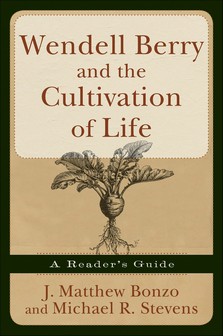
Wendell Berry and the Cultivation.jpgFinally, we now have a most wonderful introduction to the work of Mr. Berry, a fine and thoughtful guide to his fiction and non-fiction, his ways and means, his life and his writing.  Wendell Berry and the Cultivation of Life: A Readers Guide by J. Matthew Bonzo & Michael R. Stevens (Brazos; $21.99) is yet another book that we are so, so happy about this year.  In an age when independent bookselling is increasingly rare, and the sustainability of our little project here is increasingly difficult, we are overjoyed—almost with a bittersweetness—that there are such good writers, such good books, and a movement within religious publishing that is bringing out these kinds of exceptionally important works.  We’ve carried Berry since the day we opened 27 years ago and we are overjoyed to know of evangelical Christians that are living inspired by him, and who are writing about him so thoughtfully.

There are some friends, perhaps informed by some of Berry’s worldview, who have signed up for AdBuster’s Buy Nothing Day, today;  if “Black Friday” is a bit of a symbol of over-consumption and crazed shopping fever, stepping back can be prophetic and wise, I suppose, if a bit gimmicky.  (The Advent Conspiracy is another great movement to pledge to resist the commercialization of our holiday season, a good plan to “replace consumption with compassion.”)  And yet, here in retail-land, we are not ashamed of what we do,most of the time, and would be happy if folks do, indeed, buy stuff from us this weekend. I dare not ridicule others who, like me, make a living selling legitimate products.  Anyway, it isn’t that buying is bad, it is perhaps the kind,  amount, sort of, point and meaning of our commerce that matters—and that is a battle we must fight every day.  I’d say, get over the one day “buy nothing” protest and get thyself to a nearby bookstore that you believe in (and convince a nearby library if you can) to buy this book which will, we trust, guide you through the various writings of WB, and offer an appropriate view of economics and a thick account of our human calling to stewardship that will be more important than a mere protest against the Xmas spirit at the mall. Read and disucss it, and the world will be better for it.  If you are so inclined, we would appreciate it if you helped us stay afloat doing what we do, and by ordering this from us, here.  Order a few, as it will be a lovely gift, introducing people to a writer of considerable charm, depth and prophetic power.  Maybe you could have a little reading group;  buy local foods from a farmer’s market and have a Berry reading party.

Berry is worth reading, and Bonzo & Stevens are excellent interpreters of his importance.  As Phyllis Tickle, herself a southern farm woman, says, they “provide us with the clearest and the most cordially inclined, but still clear-eyed, overview of Berry that I have seen to date.  As the green-theology/neo-agrarian movement grows, this kind of careful reconsideration and assessment of its saints, forerunners, and older protagonists becomes increasingly pertinent, and, indeed, even necessary.”

Which is to say, Wendell Berry is the Man.  Now is the time.  Matt & Michael tell us why.  Here is a brief interview with Matt done by my good friend Derek Melleby for the CPYU Bookshelf.  It will give you a nice taste as to why they wrote the book and why we should care. Enjoy.   

Narnia and the Fields of Arbol and other books for a Culture in Decline

A few days ago we had the privilege of selling books at a prestigious event sponsored by the Washington DC-based C.S. Lewis Institute a ministry that, in the spirit of Lewis, attends to nurturing the heart and mind, for the sake of both personal and cultural renewal. It was a conference with the intriguing title “The Fall of the Nations” and included Ken Boa reflecting on the fall of the Roman Empire, and Os Guinness speaking eloquently about what sorts of habits and attitudes might sustain our democracy.  Faith and freedom were built into the early days of our nation, the first nation created as an experiment in an idea.  Guinness has long been a sane and thoughtful voice honoring the depth of insight of the American Bill of Rights.  We are pleased to have our books represented at this Lewis-sponsored conference.  Thanks to Scott C. and others who volunteered to get our books on the road, set up, and peddled.  (Meanwhile, back at the proverbial ranch, Beth and I had store chores, a sweet 16-birthday party to run, complete with a jungle theme, my mother just out of the hospital, and books to haul elsewhere.)

The Ken Boa books were thrilling to promote as we’ve often recommended some of his fabulous books on spirituality, devotional life, apologetics, and such. His newest is a very useful and lovely hardcover (Regal; $24.99) called The 52 Greatest Stories in the Bible (co-written with John Alan Turner, with whom he wrote a book about parenting kids with the mind of Christ and a Christain moral imagination.) It explores these highlights of the grand story  It seems like a great idea, hanging out for a week in a given story, all to serve getting the big picture of the Bible in a year.)   His cultural analysis stuff was very well received (we sold his DVD on the comparisons between the fall of the Roman Empire and our own contemporary failings and fallings.)  Check out his very nifty website, blog here.  We have almost all of his books, so let us know if you want to order anything.

And Guinness.  Once again, we had the opportunity to promote his many books, especially featuring his brief book on truth and spin and hype, a timely and succinct call to navigate the postmodern landscape with Biblical fidelity.  Time for Truth: Living Free in a World of Lies, Hype and Spin (Baker; $12.99) is a great book to visit and re-visit and is a central portion of any evaluation of our times;  how do we think about truth?  I am not sure he and Ken fully agree on what may be symptoms and what may be causes of cultural decline, but I am sure they would both insist that we think through our very notions of truth, mostly rejecting Enlightenment rationalism on one hand and postmodern relativism on the other.  Knowing that last year the word “truthiness” was entered into our vocabulary, I am sure this little book is as valuable as ever.
case for civility.jpgFor this “Fall of the Nations” gathering, though, we were particularly glad for Guinness’ wonderful book, serious and provocative, about political life, especially in America. I hope you know The Case for Civility: And Why Our Future Depends on It (HarperOne; $23.95) as we have been enthused about it and have tried to encourage folks to order it for months, now.  I wrote a long description of it last February in our review column, and I’ve noted its importance throughout the year.  Not only does Guinness invite us to fair-minded, robust, civil discourse, he offers a more philosophical strategy, a perspective and framework that is more than public politeness. The Case for Civility reminds us why we ought not seek a “religious public square” nor a “naked public square” but a “pluralistic” one, that permits fair treatment and voice of religious perspectives, but seeks to enshrine none.  More than a happy medium between the religious right and the secular left, it is truly a “third way” that builds into our public attitudes and approaches an awareness of the genius of the first amendment, and the need for religious liberty, the legitimacy of persuasion, the legal notions of “positive neutrality” when it comes to government treatment of faith-based institutions, the urgency of creating structures to nurture civic unity despite philosophical diversity.  If only our new President could articulate for our new era a way out of the culture wars, a way beyond the current impasses, by drawing on the insights of the founders and framers.  I have been thinking of key books that I wish the President-elect would read, and this would be one of them.  (Of course, Os’s The Call, one of my all time top few books, would be on that list, too, but I digress…)

Although I was not at the DC lectures, as we packed up the boxes to take, I could only imagine the things that would be alluded to, cited, named, or explained.  As Boa and Guinness together thought about a new reformation to turn back the darkness of these hard days, even in light of certain insights from the past, what books should we feature, what titles should we promote?  Of course we had Gibbon’s Rise & Fall of the Roman Empire there (the three volume Library of America hardbacks are very classy; the one-volume paperback quite nice, too) and the wonderful historical studies by Thomas Cahill, such as How the Irish Saved Civilization which struck me as particularly approppos.  (I suppose it was a bit off theme, but his book on the Greeks, a culture I too often cheaply critique for the legacy of Platonic dualism, is a great read: Sailing the Wine-Dark Sea as is his overview of Jewish civilization, The Gift of the Jews: How a Tribe of Desert Nomads Changed The Way Everyone Thinks and Feels.  His book on the high middle ages is now out in paperback which I’ve been wantingHow should we then live DVD.jpg to read for some time now.)
For this gang, especially, Francis Schaeffer’s How Should We Then Live: The Rise and Decline of Western Thought and Culture.  It is a sweeping survey that I still commend, and enjoy any time I pick it up. We have the DVDs, too, of the original 10-part series.  If you haven’t read it or watched ’em get it on your Christmas list, quick!

C.S. Lewis’ own Abolition of Man is about first things, a profound bit of cultural criticism, going after the reductionistic ways of scientism, the need for a wholistic view (also in education) that honors the full dignity of the human person.  It is not his most well-known book, and it is a serious little work, but it pays off with great rewards, even if it takes more than one quick read-through.  Highly recommended.

 Whenever cultural discernment is needed, we often take copies of Question of God by Dr. Armand Nicholi, Jr. of Harvard Medical School,  which is a spectacularly creative and interesting contrasting of the worldviews of Lewis and Sigmund Freud as they debate God, love, sex, and the meaning of life. (The Lewis Institute hosted him several years back before the book came out, lecturing on these two intellectual giants.) 

Although it is most
ly about bio-ethics, the new release from the intellectual journal The New Atlantis, In the Shadow of Progress: Being Human in an Age of Technology by Eric Cohnin the shadow of progress.jpg seemed like a good compliment to these dire proceedings.
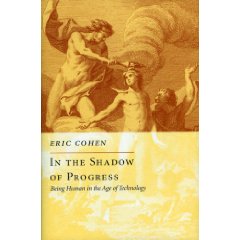
 Of course the award winning tour de force by Canadian philosopher Charles Taylor, A Secular Age, is one that fits helpfully into this batch of insightful faith-based cultural criticism.

I have written in the blog and review column why I think that the most urgent and interesting and important book of cultural analysis and Christian reflection this year is the brilliant Beyond Homelessness by Brian Walsh & Stephen Bouma-Prediger (Eerdmans.)  It suggests that the highlight of modernity is finally a displacement from place, and this is oddly enshrined in the postmodern nomad.  From metaphorical placelessness and homesickness–something Lewis wrote powerfully about—to the economies that produce literal homelessness amongst the poor and refugee, our cultural ethos is one that does not attend to home.  Ecological and environmental thinking, deeply rooted in the God who makes homemaking covenant with this planet, our home, is central to the task of re-imagining the possibilities of restoration, they insist.  And I think they are correct; whatever we can learn from the fall of the Roman Empire, and however important Mr. Guinness’ insights about the religious freedom charter from Williamsburg days, our essential relationship the Earth, and consequently our place on Earth, must be more urgently explored as a foundational matter.  No society can endure, and no faith should, that dismisses the goodness of creation and the duties of real living, here.
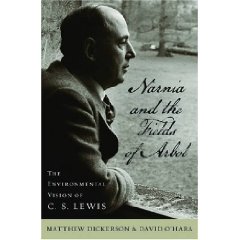
narnia and the fields.jpgAnd so, I was thrilled when a long-awaited academic book showed up the day we were heading to the conference, a solid study of  environmentalism within the writings of C.S. Lewis.  Written by two evangelical scholars, whose other books (such as From Homer to Harry Potter) we have enjoyed selling, this new work was a perfect reminder of this vital piece of any discussion or visioneering about cultural renewal: we must have a viable doctrine of creation.  We happily suggest the brand new Matthew Dickerson & David L. O’Hara, Narnia and the Fields of Arbol: The Environmental Vision of C.S. Lewis (University of Kentucky Press; $35.00) for your consideration.  Dickerson knows his stuff, he co-authored a similar title a few years back, Ents, Elves and Eriador: The Environmental Vision of J.R. R. Tolkien  (also U of K Press; $35)  Both are in a series named “The Culture of the Land.”  I wonder what the Roman Empire (or the Pax Americana one) thinks about that?

Next post, I’ll tell you about another important book, reflecting on a very important author, that will help us further on this very matter.  Stay tuned, it’s going to be good.  Thanks!

Reordered Love, Reordered Lives: Learning the Deep Meaning of Happiness

Last week in a post or two we highlighted the deeply satisfying books by our friend Ruth Haley Barton, who we had here earlier in the week.  We are so happy that she was able to be with us, and share her life, her passions for sabbath, solitude and silence, her understanding of prayerfulness amidst our hectic pace of life, and how best to put ourselves into postures to be transformed by Jesus Christ.  My friend Brian Rice over at Leadership Connextions blogged about it a bit (his blog is always fun and informative.)  Thanks to customers near and far who attended, and to Living Word Community Church who hosted us so well.

One of the books I told Ruth about—what a privilege and joy (and fearsome responsibility) to recommend books to authors and Christian leaders—was the new Reordered Love, Reordered Lives: Learning the Deep Meaning of Happiness by David K. Naugle (Eerdmans; $18.) Rooted as she is in the deepest traditions of the church, she immediately understood the Augustinian allusion in the title and the insights of the best monks and thinkers of the earlier times: what we believe is not all that matters, in fact, doctrinal certitude is usaully trumped by a deeper experience of the God of grace.  That is, what we know–in the Biblical sense—is what matters, not just our intellectual assent to Bible truth.  Ruth explained some of this in her presentations, sharing how as a very Biblically-oriented evangelical teacher she had great “head knowledge” (as we say) but became so desperate for a way of being that was life-giving and normative and appropriate and good, that she was driven to the spiritual formation traditions, the mystics and the monks, who could help her experience God’s Spirit in real and lasting ways.

And yet, there is more to the experience of God, more to a solid way of life, than having spiritual encounters, or living in a way that is attentive to the Divine, and David Naugle is one of the best guides we have to a fuller, sustainable, meaningful, whole, truly Christian life and lifestyle.  He is a worldview scholar, having done the mammouth and extraordinary book Worldview: The History of a Concept, (Eerdmans; $28) so he is well prepared to think at the most foundational and basic levels, knowing well the way our most basic assumptions of life, the story we live in, and the way we see and imagine our selves and the world, are the most influential aspects that shape us.  But what human ideas, experiences and practices will yield a life well lived?  It is, we must say,  more than a renewed experience of spirituality, although Ruth’s wonderful guides are a helpful part of our formation.  And it is more than worldview notions, although James Sire and Nancy Pearcey and Walsh & Middleton and Al Wolters and Mark Bertrand have been vital in Naugle’s own development.  These are all authors we know and love, and their call to a tranforming vision rooted in a consistently Christian vision of things is so important.

Reordered Love.jpgYet, in Reordered Love, Reordered Lives Naugle shows that there is something beyond these important aspects of our discipleship, more than spirituality and worldview.  Yes, the deepest things of heart and mind are informed and shaped by something even more fundamental, something Augustine captured in his famous trope: our loves.  Naugle wisely guides us into the question of what we most love.  If, he reminds us, we love the wrong stuff, or even love the right stuff wrongly, our lives will reflect that disorder.  True happiness comes from getting the first things first, loving all sorts of things properly, and living well-ordered lives that are shaped by these fundamental cares and commitments.  Here is a link to a helpful little column about the book, written by Breakpoint’s Kim Moreland, called Priorities of Affection.  It’s a nice summary of Naugle’s view. 

Oh my, this may sound a bit heady, or, to some, even hopelessly arcane.  I assure you, this book may be one of the most important of your life, if it can point you towards a grace-filled appreciation of caring about what matters most, and loving well.

Charlie Peacock is a H&M friend and a mentor to artists and musicians, such as the band Switchfoot (who David quotes more than once in the book; Jon Foreman’s songs could nearly be a soundtrack to Reordered Love…) A few years back, Charlie wrote a splendid and rare kind of book, an easy to read and yet very thoughtful and truly pleasant book called New Way to Be Human (Shaw; $12.99) which nearly anticipates this more in-depth study.  And that is it: Naugle helps us be truly human, followers of the most Human One, Jesus of Nazareth.  Of Naugle, Charlie writes, “This book is in league with the very best of Christian cultural apologists.  Though it is full of current and relevant cultural illustrations, the real attraction is, simply, Jesus.  Naugle beautifully illustrates that Jesus is the good fulfillment of every human desire.” 

Steve Garber, author of the always-timely, wonderfully rich Fabric of Faithfulness, who also writes wisely about caring for that which matters most under the sun,  writes, knowingly,

 I regard David Naugle as one of the most gifted professors in America. Perennially his students learn to think and care about the most important things—remarkably so, in fact.  Reordered Love, Reordered Lives allows all of us the grace of learning over his shoulder and through his heart, listening in on the unusual pedagogy that is uniquely his.  Amazingly wise, incredibly well-read, he is always attentive to what matters most, and his books should find its way into hearts and minds, courses and colleges, far and wide. 

Fabulous similiar endorsements from Jamie K.A. Smith to Os Guinness, Esther Lightcap Meek to John Seel, Chuck Colson to John Witvliet, deep and thoughtful and vital writers whom we admire and trust, all rave about this book, in ways that are truly eye-catching, even in the exagerrated stylings of book blurbs. When this many smart and good folk commend a book so lavishly, it is worth having! 

Whether it is expounding on a Gerard Manley Hopkins poem or a Johnny Cash song, quoting Stephen Colbert or C.S. Lewis,  wondering about the role of ipods or studying the most deadly sins, this exploration of the African Bishop’s insights about transformed lives lived happily aright for the redemptive purposes of God’s Kingdom, Naugle’s book is one which we cannot recommend more highly.  He even has a little section about the importance of reading to gain insight, an example of his own love for learning, his enthusism for good ideas.  I’d would think some of our readers will say “amen!” to those few pages.  And least I sure hope so.

David Naugle.jpg

Davey is a fun guy, a thoughtful and dear man.  We commend his website, his articles, his earlier book, his taste in music (he has hosted our friend Brooks Williams and is always talking about fellow Texan Kate Campbell) and, now, this most readable and important reflection on the biggest ques
tion of all: who and what do you love?  Want happiness?  Deep happiness?  Do you want to go beyond a purpose-drive life?   Want your life to be ordered in such as way that it is sane and good?  This book, which I hope you learn to love, can help.

BLOG SPECIAL
BUY
Ordered Loves, Ordered Lives
 
GET
New Way to Be Human
for more than half price.
Usually $12.99 now, $6.00
both books for $24

*when you place the order, ask for the blog special, or you may just order either book at regular price. Thank you.

ORDER HERE
or call
717.246.3333
Hearts & Minds 234 East Main Street  Dallastown, PA  17313     717.246.3333

Setting Words on Fire

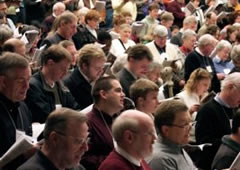
worshipping preachers.jpgEarlier in the week, in what was an exhausting set up and tear down, we had a glorious few days selling books in Harrisburg with pastors who had gathered at the annual State Pastors Conference organized by our friends at the Pennsylvania Council of Churches.  This tends to draw mostly mainline denominational clergy, but that, of course, is a large and diverse tribe, and the Council provides a big tent.  We love working with such an interesting group, talking books with Lutheran and United Methodist clergy, Church of the Brethren and Moravians, lots of UCC pals and local Episcopalians.  There were a few American Baptists and Presbys, a few very thoughtful Roman Catholics—quoting First Things and ecumenism and such— and, lo and behold, a couple of ethnic Pentecostals.  Praise be to God.  And, it seems, most of these leaders mostly liked our display.  As always—after lugging stuff down awkward freight elevator and through a huge hotel kitchen with blazing stovetops and giant hot cauldrons, we look back and can’t believe it is over.

As you might guess, our passions for cultural reformation and the empowerment of laypeople to impact their spheres of influence led us to push books like Andy Crouch’s Culture Making and social concern books like Jim Wallis’ Great Awakening or a brand new book, Wendell Berry and the Cultivation of Life: A Reader’s Guide by J. Matthew Bonzo & Michael R. Stevens (Brazos; $21.99).  You may have seen the Christian Century article a year or so ago which, like the common advice given by Eugene Peterson, suggests that Berry’s views of stewarding the land in a rural place is insightful for those caring for a Christian flock in a church.  Not many of the pastors took me up on the notion (maybe because it seems pricey) but I will review it in earnest, later.  It is a fabulous work, applicable for anyone that loves literature, or, well, a life well lived and I had hoped pastors would be excited about it.

 I gave a heartfelt pitch for a book that is precisely designed to help clergy help laypeople see faith “as a way of life” entitled Faith as a Way of Life: AFaith as a way of life.jpg Vision of Pastoral Leadership by Christian Scharan and a forward by Miroslov Volf (Eerdmans; $15.)  Scharan worked with the Yale Center for Faith as a Way of Life and this three-year study group made up of clergy, artists, theologians, economists and the like, interviewed hundreds of pastors to find the best practices that help them equip lay folks into living faithfully in every sphere of life.  I am so grateful that they are describing one aspect of Pastoral Excellence in terms of how faith flows into life, belief informs behavior.

  So: we try to do our thing, helping these fine pastors find books that they may not find at a big box store, or even at a typical store that serves mainline clergy.  From pomo emergent stuff to contemplative spirituality, racial justice to the books about film and the arts, promoting books about these broader Christian concerns seems to be appreciated.

Yet, we do, of course, stock plenty of the quintessential books for pastors and for parish health and development.  We have all the Alban Institute books—nearly every single one— and other such cutting edge, practical resources.  A personal favorite that just arrived is a great sequel to the great Transforming Congregational Culture by Anthony Robinson.  Entitled Changing the changing the conversation.jpgConversation: A Third Way for Congregations (Eerdmans; $18) it offers ten conversations that renewing congregations need to have.  Robinson invites church leaders and members into these ten crucial topics that can help change their culture (framing them all by the quest to find alternatives to extremes, something other than fundamentalism and liberalism, a welcome approach indeed.)  Martin Copenhaver says of it, “Robinson has done it again.  Building on his previous work, which many of us have found indispensable, he has written a book full of insights and wisdom.  No one writing about church life today writes with more depth and perception.” 

Time did not allow for me to describe a new book by Jeff Lucas, but its opening story, about Itzhak Perlman playing an nearly impossible Bach piece with a missing string, is so moving, it is worth the price of the book for that alone.  Creating a Prodigal Friendly Church (Zondervan; $14.99) uses a clever device, naming each chapter (in Italiano) after a movement in music.  That God’s lilting melody of love would be better heard is the theme of his heart, and he helps churches learn how to best have prodigals engulfed in the song they so long to really hear.  How can he help those who have drifted or left the church, perhaps angry or bored…can a church adopt an open heart, he asks, that will in turn open its doors to everyone?  This is a fast-paced little book, full of stories and ideas and practical notions that would benefit most churches.  We have plenty of books on how churches can make first good impressions, be hospitable, welcoming and friendly.  I hope you know, for instance, the thoughtful and gracious No Perfect People Allowed: Create a Come as You Are Culture at Church by John Burke (Zondervan; $14.99.)  We have an edition with a DVD included making it a great training tool or adult ed class.

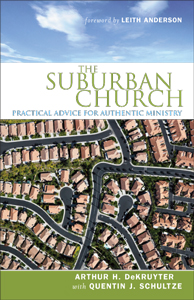
Last year one of the keynote speakers was Quentin J. Schultz, who spoke on technology–very good.  He told me then that he had a forthcoming book in the pipeline, and itsuburban church.jpg was nice to show it off this week.  It is called The Suburban Church: Practical Advice for Authentic Ministry which Q co-wrote with Arthur H. Dekruyter  (Baker; $18.95) and it reflects upon the unique challenges of pastoring those who are suburbanites.  We also, by the way, pushed the new Ron Sider & John Perkins book that I’ve mentioned before on the blog, Linking Arms Linking Lives on urban/suburban church partnerships.  I don’t know what it will take to get this book talked about, but I think it is very, very important, for all kinds of congregations and all kinds of settings.  It is a masterpiece of wholistic theology, multi-faceted Kingdom ministry, and very useful for helping churches in their move towards being more missional. 

We told of some of our favorite books of the year, doing a short reading out loud from The Year of Living Biblically by A.J. Jacobs  (now out in paperback) and the exquisite memoir by Andrew Krivac, Th
e Long Retreat
(an elegant and moving memoir I wrote about a few months ago.)  We promoted serious theology, prayer, small group resources, leadership development, conflict resolution. There are two brand new books by Walter Brueggemann, Great Prayers of the Old Testament (Westminister/John Knox; $16.95) and Abingdon’s brand new first entry in the “Library of Biblical Theology” simply entitled Old Testament Theology: An Introduction ($32.00.)  We had tables and tables of liturgical resources, lectionary preaching guides, and the books of prayers and litanies and worship planning books that pastors from some denominations need.  You wouldn’t believe how much of that sort of stuff we have! 

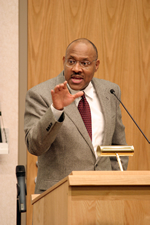
And, we there were tons of books on preaching.  The speakers this year were alllarue.jpg homileticians, and we were happy to have the resources of Gail O’Day and new favorite preacher, Cleophus LaRue, extraordinary wordsmith from Princeton Seminary, author of several books on the power of black preaching. 

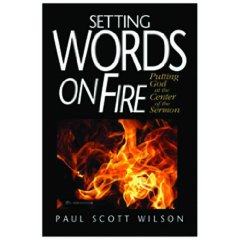
And, we were the first store in the country to have the brand new book by master theorist of preaching, Paul Scott Wilson.

setting words on fire.jpgHis brand new one is called Setting Words on Fire: Putting God at the Center of the Sermon (Abingdon; $27) and includes a DVD, showing excerpts of different sorts of styles, approaches, and forms.  Co-produced at Calvin College, it apparently includes a clip of Scott Hoezee, one of my favorite pastor/writers and I look forward to checking it out myself.  I suspect it will be tremendous.  I owe a special thanks to my sales rep, Linda B. from Abingdon Press, who helped us acquire this before it technically released.  It was pretty cool having it with the ink nearly wet, and even Paul Wilson himself had not seen the finished product yet.

 Moments like these remind us how joyous it is to unite words and readers, writers and publishers, book-seller and book-buyer.  I pray that Mr. Wilson’s vision–God at the center of the sermon–would indeed set many preachers and their words on fire, so that all of our churches would be renewed and revitalized.  You who read theological and other Christian books, supporting booksellers like us, and the authors we promote, spreading the good ideas, helping them gain traction in your churches and fellowships are part of the plan.  Thanks.  Soli deo gloria.

Books by Ruth Haley Barton (Speaking Monday, November 17th)

Thanks to those who posted comments or sent email or Facebook messages wishing us well on the author reception we are having on Monday with Ruth Haley Barton. We appreciate your prayers.  Apparently, a number of folks really have loved her books and can vouch that she is, indeed, a high quality presenter.  We can’t wait for her program which we are sponsoring over at the cool coffee bar at the nearby Living Word Community Church who have graciously agreed to co-host this event.  If you know anyone in Central PA, send them the previous blog post as it might inspire them to take a field trip this Monday night.  Ruth will speak sometime after 7 pm;  there will be light refreshments, a chance to meet, chat a bit, and get books autographed.  We’ll have her titles available.  Extra thanks to InterVarsity Press, her most recent publisher, who is helping make this event possible.  We’ve always said they are our favorite publisher, and we are glad Ruth’s work has found a good home there.

Want us to have her sign a book, and then send it to you (or a special someone?)  Just let us know before Monday, and we can do that for you.

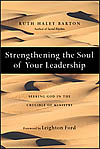
Strengthening the S.jpgStrengthening the Soul of Your Leadership: Seeking God in the Crucible of Ministry  (IVP) $18  This is her new one, a brillant study of Moses, good for anyone who is even half-way serious about being faithful in intentional discipleship and staying rooted in deep awareness of God’s sustaining presence.  It is rare to see a book on spiritual formation, self-awareness and leadership development, so this is a true treasure.  Give it to anyone you know who is a leader, or ought to be…One of the great new books of the year!

Click here for a short, fantastic, video clip of Ruth talking about her book.

Sacred R.jpgSacred Rhythms: Arranging Our Lives for Spiritual Transformation  (IVP) $17  One of our favorites, this is a delightful and passionate call, realistic and pleasant, to develop a personal “rule of life” or set of lifestyle priorities that allow for practicing the spiritual disciplines.  Who doesn’t want a more sane pace of life?  Who doesn’t need to know how to find God in the ordinary stuff of real life?  This is a very, very nice book and a fabulous introduction to contemplative living.

Invitation to S.jpgInvitation to Solitude and Silence: Experiencing God’s Transforming Presence  (IVP) $17  Wow, what a great treasure, a book to ponder, to come back to, to allow it’s calming influence to seep over you.  We are all, surely, aware of the dangers of over-stimulation, the anxieties of our info-glut culture.  Learning to get comfortable with silence is key.  Ruth is amazingly contemporary and yet saying something the wisest writers have said for centuries.  Highly recommended.

Longing for M.jpgLonging for More: A Woman’s Path to Transformation in Christ  (IVP) $16  This is a revised and expanded version of a book that we used to say was the best book of which we knew for Christian women; now it is even better. Originally called Truths That Free Us: A Woman’s Calling to Spiritual Transformation it is written to help women find inner strength, being aware of their needs and desires, inviting readers to reflect on yearnings that can best be met in God and Christ’s ways.  From spirituality to sexuality, this is a fabulous, easy to read, yet very profound book for anyone.  It is especially popular among college age women, it seems, and a great example of thoughtful and well-written basic Christian growth for contemporary women.

Equal to the T.jpgEqual to the Task: Men & Women in Partnership (IVP) $15  It is no surprise, I presume, that we are comfortable with the movement of “evangelical feminism” that is shared by authors such as Mary Stewart Van Leeuwen, Elaine Storkey, Gilbert Belzikian and others who, out of the highest regard for the Bible and historic orthodox faith, invite us to lifestyles of servanthood, mutuality and gender justice.  Ruth is not a strident voice, but she does offer here remarkably insightful stuff on how women and men might compliment one another in the work-world, in friendship, in ministry.  I don’t think there is as much attention paid to this as there should be and as women are increasingly found in positions of church and work leadership, issues of power as well as issues of sexuality and temptation, will need to be addressed.  This is a forward-thinking, useful and really fun look at what can be seen as a great blessing of God, or, as a potential trouble spot. Unless you live in a cave, this would be a useful study and ponder and we highly recommend it.  It has much to offer young and old, men and women.

ruth.gif
women like us.jpgBecoming a W of P.jpg
Ruth: Relationships That Bring Life
(Shaw)
Becoming a Woman of Purpose (Shaw) $5.99
Women Like Us: Wisdom for Today’s Issues (Shaw) $5.99

Hearts & Minds  234 East Main Street  Dallastown, PA 17313     717.246.3333

Hearts & Minds to host author Ruth Haley Barton at LWCC this Monday night

candle flame.jpgI could certainly write lots about the wonderful books of our friend Ruth Haley Barton, her books for women, her book on men & women as friends (Equal to the Task), and her recent batch on spiritual disciplines and how God can transform us as we align ourselves with the Spirit.  We can do that, allowing God to work, by creating space in our lives for solitude and silence, listening prayer and serious Scripture study.  Ruth has trained at the world-renowned Shalem Institute, and brings a broad yet uniquely evangelical perspective to their important ecumenical work in spiritual formation and contemplative living. 

Her 2007 Sacred Rhythms is one of our favorite books in recent years, a natural follow-up to the excellent Invitation to Solitude & Silence.  Her new one, which I will review at length eventually, uses Moses as a case study in leadership development, and the possibility of leaders being less faithful, effective and fruitful then they might because they fail to attend to the ancient and classic disciplines of prayer, meditation, fasting, solitude, journaling and such.  There are not many books that adeptly bring together leadership development and spirituality, and Stengthening the Soul of Your Leadership is marvelous. Her own vocation to help leaders in this prayerful inner journey is described at the website of The Tranforming Center.  Check it out.

We’re very pleased with her as a writer, and appreciate her ability to write about such deep and mysterious stuff and yet remain clear, upbeat, practical and thoroughly rooted in the Biblical story.  We’re biased since we care for her so, and although we are not intimate friends, we’ve connected well whenever we’ve been together, know each others families a bit, enjoy good conversations with her. We, along with our local friends, will have a chance to get caught up this coming Monday, when she has agreed to offer a presentation for us, followed by an autographing party.

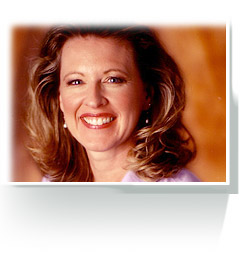
 We are hosting “An Evening with Ruth Haleyruth haly barton.jpg Barton” and she’ll talk and teach a bit, share some stories, inspire us to move more deeply into greater faith maturity, and maybe talk about how she–busy wife and mom that she is—came to be a renowned writer of spirituality.  I suspect she still has to pinch herself sometimes, but God has, I am certain, used her in important and true ways as she serves and encourages and guides many, though her lively speaking and excellent books, to Christ’s transforming grace.

SO:  please spread the word!
 We will start around 7 pm this Monday, November 17th, in a fairly spacious, though intimate, coffee bar and art gallery in the nearby Living Word Community Church (2530 Cape Horn Road) in Red Lion.  This is on Route 24 just a couple of miles from our shop. Many thanks to LWCC for allowing us to use their space, and for their enthusism in helping host this author reception, presentation and autographing party.  Yes, of course, we will be selling her books.

May be suggest that autographed books make very special holiday gifts?  Let us know if you are unable to be with us but want me to pick you up an autographed book which we could mail next week.  I’ll do a blog post in a day or so about that, listing her titles, some prices and such.  For now, though, pray for us, tell anybody in central Pennsylvania that you can, and join us if you are able for this great opportunity to met an author, be blessed by a very special presentation, and join with others in reminding ourselves of how to come to know God more deeply.  We are very, very excited.    Special thanks to Ruth and InterVarsity Press for their genorousity in showing up at our funky little spot.  We are grateful.

Hearts & Minds 234 East Main Street  Dallastown, PA  17313     717.246.3333

Beyond Homeless by Brian Walsh & Steven Bouma-Prediger reviewed at the website

beyond homelessness.jpgIn my effort to get caught up with some long overdo more substantial–or at least more long-winded–reviews, I’ve just put up one of our “monthly” reviews over at the Hearts & Minds website, listed as a July 2008 review.  This one takes a long look at what may be the Book of the Year, Beyond Homelessness: Christian Faith in a Culture of Displacement by Steven Bouma-Prediger and Brian Walsh (Eerdmansl $24.00.) I’ve commented on this several times at the blog, each time hinting why I am so fond of it, and why I think it is important, but am only now able to post my fuller remarks.  I really enjoyed giving an overview of this complex and serious work, noting that these authors are solid guys who live what they write about.  The integrity of this project is evident, and the thoughtfulness soars.  I hope you’ll read my longer remarks; I truly hope you enjoy them.  Thanks.

Naked Vegetarians.jpg
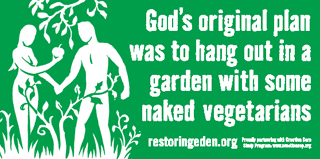
I happen to know that these authors are not vegetarians, and I’ve never seen them naked, thank goodness, but this sentiment taken from a very cool poster by our friends at Restoring Eden seems a fine place to start to think about their “home-making” book.  Can we imagine a safe home, a created order where God and God’s shalom dwells?  Can we seek to create a vision of Biblical faith, and subsequent spiritually-guided practices of creation care and attention to place that allows us to be healing homemakers, intimate and real?  Can we truly care about the vast issues of public life, as well as live daily with sustainable notions of home economics, that make for pleasant homes and strong families?  Can we care about the merciless slaughter of creatures and the extinction of species and also the plight of the urban poor and international refugees, even as we find new find energy for fun relationships, mature friendships, intergenerational extended families, and worshipping communities that teach us the Godly way of hospitality and gracious love?  Can we feel “at home” when we are alone?  Do we have a sense of place? Can we do anything about suburban sprawl?  Can our cares and concerns translate into prophetic action in this new era of rethinking public policy?  What does the Bible, and the cross of Christ which stands central to it’s story, have to do with all this? 

These guys—I’m tellin’ ya—are experienced and able guides to help us, as Marva Dawn puts it in her rave endorsement of Beyond Homelessness, “comprehend and mend” our broken, alienated world.   They can help us come home.  Please check out my review.   Help us spread the word…pass this on to anyone you know who likes to consider big books about important stuff.  Thanks.