God and Politics & Deer Hunting With Jesus

I’ve written before about the adult ed class I’m doing at my church on citizenship and faith, Christians politics and such.  I’ve been re-reading parts of old favorites–Paul Marshal’s God and the Constitution is brilliant, and David T. Koyzis Political Visions and Illusions is (as the subtitle puts it): A Survey & Critique of Contemporary Ideologies and is therefore exceptionally important for those serious about such concerns. We are glad for these thoughtful resources that get beyond the typical news reports or the knee-jerk faith-based partisanship from the left or the right. Jesus for President by Shane Claiborne & Chris Haw, as we’ve said before, is as hip and radical as they come, and I love it, and recommend it, even if I find the anarchy/resistance bit less than adequate.  Ahh, I remember doing Bible studies with Berrigan-esque folks years ago, perplexed at how easily they insisted that Revelation 13 (the state as beast) trumps Romans 13 (the state as servant);  it is never that simple, though, is it?  In God’s good but fallen world, it seems to me, we must live in the tension that insists that institutions are fallen, but can (and shall be) redeemed in Christ, meaning we must protest, sometimes, and be patiently in for the long haul, sometimes. As John Stott puts it, we are called to be “conservative radicals.” (That is, there are a few key core truths which we must conserve and, in light of those—the Lordship of Jesus revealed through an authoritative Bible—everything else can be radically critiqued.)   

And so in our class we’ve dashed through stuff about the civitas, how we are to seek the public good, honoring in civil ways, the pluralism of our culture.  Os Guinness’ Case for Civility, as I’ve said before, is a rich, thoughtful, deep guide to forging an alternative between the “naked public square” and the “sacred public square.”  We cannot abide a Taliban-like theocracy, of course, but the alternative is not an implausible removal of religious convictions from public life.  Dr. Guinness helps us get at this quandary and it is very, very helpful. See a bit about it here.

After a few weeks on the Biblical basis for justice, we’ve been reflecting now on civic life, on everything from Sidewalks in the Kingdom (a book we’ve often promoted, a new urbanism study written by a Presbyterian pastor, Eric Jacobsen who is influenced by the brilliant and fiesty work of James Howard Kunstler;  you can see Jacobsen’s website here. which has some great resources and excerpts of the book.) We’ve mentioned Robert Putnam’s Bowling Alone, which reminds us of the need to think hard about social capitol and the demise of mediating structures and civil society. (See Bowling Alone’s website, here.)  Not all public life and civic engagement is about government per se; a good new “third place” in a town may be just what is most needed to foster a sense of commitment to the community, and to create energy for civic engagement.  (Of course, zoning laws come into play, so there ya go, back to political issues.)  Before we ask what the task of the state is, we should be aware of the broader civic institutions, voluntary associations, clubs, churches and other such groups that we too often don’t take very seriously.  At least that is Putnam’s thesis.
god and politics.jpg In my reading this last week, I remembered a very, very small book that I loved a few years back, realizing that it is now happily reissued in a slightly larger size, but still small and handy.  It is fun, funny, moving and clear-headed as they come.  God and Politics: How Can a Christian Be in Politics (Tyndale; $7.99) is written by the delightful Christian gentleman, Roy Herron (a State Senator from Tennessee.) I read it almost in one sitting, wiping tears from my eyes at one point, and wondering how in the world I can sell a few of these lovely, little, very inspiring, basic-level, but spot-on introductions to balanced and thoughtful Christian statecraft.  This is written by a sharp guy, a former minister, a Democrat from TN.  He draws on his experience as a state senator and promotes a humble, kind, and just sense of the common good.  If you know anyone who needs a nice, evangelically-minded and very interesting quick intro to this whole field, this little book can’t be beat.

I spent a bit of time in my Sunday school lecture explaining why “I’m neither left nor right” and the conundrum of those like, for instance, the consistent life ethic folks of the Catholic social teaching movement that is (to be simplistic) pro poor and pro life;  ahhhh, they just don’t fit the typical bi-polar continuum of the American reds and blues.  To be against the abuse of the earth and to be in favor of traditional sexual ethics, again, is hardly liberal or conservative.  Ron Sider’s Evangelicals for Social Action, and to some extent Sojourners and Campolo’s Red Letter Christians movement (and his new book of that name) are examples of this “third way” thinking that isn’t easily pegged in terms of typical American ideology.  The neo-Calvinists—I’ve mentioned the Stephen Monsma book and DVD in the last post—are similiarly not quite on the typical left-to-right sliding scale.  A peculiar people, indeed.

Yes, I want to be nonpartisan.  Still,  I came home and started reading a “hard to put down” book I’ve been meaning to get to, and it is as partisan as can be.  It is mad as a wet hen and it is such a thrilling read, such a sad and funny expose of how American blue collar redneck Southern working class folk think and live, written by a “class warfare” advocate whose good hearted care for his own fundamentalist/blue-collar roots is palpable.

 I’m talking about Deer Hunting
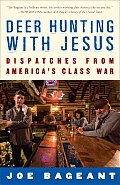
deer hunting 2.jpgWith Jesus: Dispatches From America’s Class War by Joe Bageant (Three River Press; $13.95.)  His explorations from the local bar and grill in his hometown of Winchester VA, remind me a bit of one of my favorite writers, Bill Kauffman (Muckdog Gazette and Look Homeward America) without the detailed history, but sharing his antipathy for big corporations that bamboozle the ordinary folks of small towns.  He knows his town well, and has done some stunning organizing around slumlords and tenets rights, fighting shady cops and Republican commissioners and anti-union Chamber of Commerce leaders, even while he calls them his neighbors, and knows everybody’s business (as they know his. This is a smallish town, remember, one with, apparently  where a lot of folks are related to alot of other folks.)  I was disappointed in the church he visited, but I suppose it was typical; it was poignant because the visit was to his brother’s Baptist church.  You’ve got to read the chapter which told of the Rubbermaid factory (and the ever present threat of plants moving to Mexico.)  This is one down-home, fired up, sociological treatise that is a real as the busted up cars in the yard, the karaoke bar where diabetic women sing Patsy Cline, the gun-lovin’ residents of the local mobile h
ome park get born again, and  everybody’s huge credit card debt doesn’t keep them from kicking back with a few cold ones when times get tough. Despite the lack of health care, poor wages they remain largely a committed Republican voting block. 

Forget the bestseller from a few years back, What’s the Matter with Kansas? and pick up this gonzo journalist gone-working class, a guy whose writing has been said to make Michael Moore seem tame.  Look, you may not be wanting all the feisty liberal talk here (let alone the cussing), and you may not like his anger at the neo-con elitists, and you may not appreciate his unabashed pro-union, anti-business bias.  But this is one heckuva bias, and it colors every bit of his muck-racking journalism with such a passion for the oppressed and such a righteous anger against the injustices foisted upon these good and often very hard-working folk, that it makes for a convicting, exhilarating, raging read.  He’s writing about people I know, and you probably do to. Folks who have never stepped foot in a Starbucks, and wouldn’t know an emergent cohort if it bit ’em on the butt.  Despite all the progressive’s earnest talk about the poor and the little guy, even Obama’s moving speeches about single moms and the working poor, most progressives frankly don’t know, let alone appreciate rural or small town folk.  Bageant does. He has been living as a proud  white Southerner on the lower end of the middle class for a while, and has been blasting away about it at his controversial blog (www.JoeBageant.com) for years.

 I’m glad that I picked up this wild Deer Hunting With Jesus today, and it will remind me that even as I call for a “third way” and have great ambivalence about the simplistic proposals from the Democrats and the Republicans alike, there are tons of folks out there beside the urban underclass, who are really hurting, and we need to make sure they are not left behind.  Not all corporations are corrupt—I have never thought that—but there are corporations, large and small, who rip people off, and there is collusion allowing injustice to go unopposed.  This is one of those books that can light a fire, giving us real names and places and situations, real stories of a rough part of town, like a John Gorka song, reminding us of how a good chunk of our fellow citizens live. And it is wonderfully self-aware, loaded with the irony that Bageant gets, that he is a liberal and his friends and neighbors hate liberals.  They listen to Rush.  They know how they see the world. Yet he is there, laughing and crying and writing it all down, probably listening to Bruce Springsteen and maybe some Johnny Cash–and surely the hometown gal, Patsy Cline— along the way.  What a story.  
Hearts & Minds 234 East Main Street Dallastown, PA  17313     717.246.3333

Small group Resources for Civic Engagement

I hope my reviews and announcements here encourage you in your commitments to reading, and that perhaps they inspire some to organize book groups or a small group study of some sort.  These kind of low-risk, informal social initiatives can only strengthen communities, bond folks together around the struggle for new ideas, and, hopefully, honor God as people of faith grapple with ideas found on the printed page.  The great revival preacher and social reformer  John Wesley, you probably know, gave rise to the movement known as “Methodism” which got its name from his method of disciple-making: reading groups!  Wesley was very widely read and quite the Oxford bookman, but his method for groups was simple: read the Bible and good books and pray.  Not a bad method, if you ask me. 

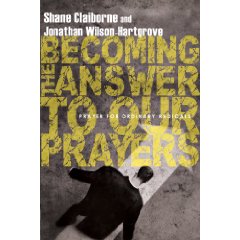
And, as an aside, it is fabulous that Shane Claiborne, author of The Irresistible Revolution  and Jesus for President, the dread-locked poster boy for radical social activism, has a great new book with his old Eastern College pal Jonathan Wilson-Hartgrave, which draws on the early saints and medieval mystics, rooting social action in deep spirituality.  It is called Becoming the Answer to Our Prayers: Prayer for Ordinary Radicals (IVP; $13.)  TheyBecoming Answers.jpg didn’t learn this stuff—and offer these amazing sidebars of quotes and prayers—just by googling ancient prayer, or snooping the local big box bookstore, but by being together, doing small group stuff, exploring books together, and being in relationships with others around these important ideas.  Young Baptist evangelicals like Shane & Jonathan don’t just start citing Dorothy Day and William Stringfellow, let alone Gregory of Nyssa and Saint Benedict out of nowhere; somebody passed those books to them!  They read as they worked, prayed as they protested, learned from traditions other than their own.  Congrats to the IVP Likewise imprint for putting out this kind of stuff, spreading the good news around, helping us read widely.  Would I be too blunt to say you should “go and do likewise”? 

In recent posts I’ve mentioned some important books for the journey towards increasing cultural responsibility, social engagement and Christian views of civic life.  Maybe you don’t want to read a big book on Christian political persepctives or dive deep into foundational studies just now.  Well, how about small group stuff?  How about DVD?

Here are some very, very useful tools that are thoughtful but brief and arranged for small group use.  Maybe they’d be just the resource you could pick up to pull together a group this month. Email or call us today and we can ship ’em right out! 

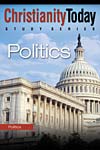
CT politics.jpgChristianity Today Study Series  (Current Issues Bible Studies)  Politics  (Nelson) $9.99  They’ve taken some of the best articles about faith and politics from CT in recent years and added great discussion questions, sidebars and solid Bible study.  The first essay is a thoughtful and important framing one, written by our friend James Skillen (of the Center for Public Justice.)  Other authors include Dave Gushee, Stephen Carter, Timothy George, Andy Crouch, Richard Kauffman (now of The Christian Century), Nancy Pearcey, William Willimon and a large handful of other men and women.    It is arranged in 8 weeks (although you could skip some, if you wanted) and I could imagine spending more than one session on some of the chapters. 

We have their other new studies, too, Faith & Work, Engaging the Culture and one on Islam.  Excellent.

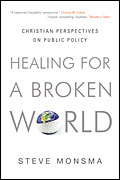
healing for a broken world.jpgDVD Healing for a Broken World: Christian Perspectives on Public Policy  Stephen Monsma  (Henry Institute/Crossway) $24.95  I’ve raved about the book, which explores four Biblical principles and then applies those principles in a balanced manner to an array of contemporary issues. This well-crafted and content-heavy DVD has interviews with fabulous folks—Jennifer Butler, Rich Mouw, Richard Czik, John Dilulio and others—and is ideal for a small group that wants to hear some brief insights, follow along as a small group of young adults discuss the content. Obviously, you then enter in with your own conversations of consequence. 12 Sessions.  Highly, highly recommended, especially in this election season.

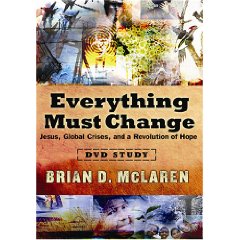
EMC DVD.jpgDVD  Everything Must Change: Jesus, Global Crisis and a Revolution of Hope  Brian McLaren  (Nelson) $39.99  This is a bit edgy in style, creative and interesting, as Brian lectures, ever so briefly but with very compelling insight, about the major themes of his important book and recent tour.  There are clever pull out quotes and drop in interviews and a small bit of footage from the tour.  From our ideological idolatries to our deepest questions and yearnings, this relates the framing narrative of the gospel and how a Christian vision might help respond to the great global challanges of our day.  A great study booklet guides you through 8 strong sessions.

BLOG SPECIAL
10% off
any resource mentioned above
ORDER

Hearts & Minds 234 East Main Street Dallastown, PA 17313  717.246.3333

Speaking about God’s glory in the work-world and university

Scholarship: Seeing and Savoring God in Every Branch of Learning

The task of Christian scholarship is to study reality as a
manifestation of God’s glory, to
god's passion for his glory.jpg speak about it with
accuracy and to savor the beauty of God in it. 

I think Edwards would regard it as a massive abdication of scholarship that so many Christians do academic work with so little reference to God.  If tall the universe and everything in it exists by the design of an infinite, personal God, to make His manifold glory known and loved, then to treat any subject without reference to God’s glory is not scholarship, but insurrection.
                            
John Piper
                             God’s Passion for His Glory

Oh, my, what a privilege to try to remind scholars (and other ordinary folks) of this, to remind myself, too, that the reason we sell books on so many topics—from engineering to political science, from family studies to geology, from liturgical studies and worship to race relations and multi-ethnic ministry—is so that God might be glorified in all these vast and varied arenas of life.

This week I got to tell our story, once again, about our vision of having a bookstore that equips people to think seriously about life, to read widely, finding books that “warm the heart and stimulate the mind” that help us become leaders in social innovations and lives of integrity.  We are serious about the call of the Bible to “take every thought captive” and to have non-conformed minds, “renewed minds” as Romans 12:1-2 puts it.  So, again, I drove a van-load of book, this time to the fabulous CCO Christian fellowship group at the University of Pittsburgh, sharing with 130 some under grads, talking about why buying books and thinking well is the way to a more meaningful college education and a more faithful Christian style of discipleship.  We cited to these students some of our favs (which I hope you don’t grow tired of me naming) like Os Guinness’ The Call and Don Opitz & Derek Melleby’s The Outrageous Idea of Academic Faithfulness and Andy Crouch’s Culture Making and others who invite us to think seriously about the foundational questions of a Christian way of being in the world.

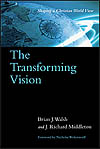
transforming vision.jpgThe Transforming Vision by Brian Walsh & Richard Middleton has a new cover and we still think it to be one of the most important books I’ve ever read. (Brian’s new one, Beyond Homelessness:Christian Faith in a Culture of Displacement, is another we’ve raved about!)  The lovely little hardback The Mind of God by James White is another example of the way habits of reading can help us know God better and serve Christ more faithfully in the real world of daily living. I often cited in these settings Steve Garber’s Fabric of Faithfulness: Weaving Together Believe and Behavior, an elegant and thoughtful book that emerged from Steve’s own work years ago in that same university complex.  Garber identified three things that those with serious faith commitments need if their discipleship will be meaningful and sustained;  we talked about those three things the last few nights. Thanks to Chris and his “Cornerstone” team for a great night.  

The next day, I had the immense privilege to share this same vision with a group of Pitt and CMU grad students, a few Ph.D. candidates, faculty and professors, a few law students and med students.  And a whole batch of very sharp post-college work-world professionals.  We struggled with big questions, how the goodness of God’s world, distorted by cursedness and sin, can be healed and renewed by Christian folk serving as God’s agents of restoration.  What difference does it make, we asked, for people of faith to reject the dualism or secularity of our times, and boldly invite Christ into our marketplace vocations, our office cubicles, research labs, or job sites.  Of course we talked about the secularization of the university, George Marsden’s little Oxford book The Outrageous Idea of Christian Scholarship and, for the post-college crowd, resources such as Your Work Matters to God by Doug Sherman & William Hendricks.

I talked with a guy working with “thinking machines” who is designing “smart wheelchairs” and I talked with an insurance agent. There were chemistry Ph.D. researchers and social workers doing urban ministry and a specialist in international economics.  A pacifist and an Air Force pilot had respectful conversation.  How do our Christian convictions impact these fields?
Can I suggest books that guide them more deeply into the journey of work-world fidelity?
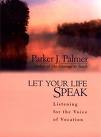
Can Christians even in seemingly arcane fields like mechanical engineering or robotics or mathematics find God’s glory and see their work as an avenue of God-honoring, neighbor-loving, service?  We can, as Parker Palmer reminds us in his beautiful Let Your Life Speak,
let your life speak 2.jpghelp make the world a better place by “listening to the voice of vocation.”  Which should lead to some Curious George-like attributes, as was recently written over at Academicfaithfulness.com.

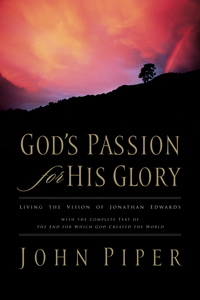
Thanks to Mitch from Bellefield Presbyterian Church for not only hosting our book show, but by introducing me using this splendid quote shown above by John Piper whose book God’s Passion for His Glory (Crossway; $15.99) is a vast and warm and profound reflection on what some consider to be the most important sermon of Jonathan Edwards.

Interestingly, I intended to draw upon John Piper, from his great chapter “Serving God in the 9-to-5” in his Don’t Waste Your Life where he reflects on the difference between human work and the work done by, say, a beaver, who also works studiously.  Piper reminds us that our labor, if it is to glorify God and be laden with meaning and not “wasted”, must be aware of four things: we do our work for God’s glory, using and acknowledging gifts and talents God gives us, studying and being in submission to the creational realities that are there, done in service to our neighbor.  I like that, our work is for God and neighbor, done in and through Him, but, importantly, also studying the creation, and submitting ourselves to the “laws” or “norms” embedded in reality.  Or, as Piper says above, “speaking about it with accuracy.”  

Piper, citing Edwards, in the opening quote above, is correct also about this: to not study all areas of God’s world is an abdication of our cultural mandate.  To fail to see God in each spher
e of life is to steal from Him His glory.  And to fail to see God in the details of life we end up, finally, warping the meaning and potentials of that arena, of that aspect of culture, and thereby keep it from truly helping our world, truly serving our neighbor.  Just was blunt, we are to love God and neighbor.  Hopefully, our bookish work here reminds people of how to make that happen, in the ordinary stuff of daily life, and especially, in our work, callings and careers.  We think our book selection, being a bit different than more typical “Christian bookstores” offers a broader range of resources to help live into this grand Edwardsian vision about ordinary work.  We think we can help you learn more of how to know God and enjoy serving Him in the real world.

Thanks to the young professionals, the campus ministry teams and the good folks at Bellefield Presbyterian and the CCO who allowed us to sell books and preach about all this life changing stuff out at Pitt.  It is our partnership with lively and relevant congregations and ministries that allow us to stay in business, doing this kind of resourcing work.  I didn’t get back home, after driving all night, and sleeping a bit along the road, until 6 am, but was worth every minute.

Want to help keep this conversation going among your church, fellowship, friends or work-world colleagues?  Do you long for more discussion about this stuff?

Choose any of the books I’ve mentioned in passing above and we’ll give you a 20% discount.  Over at the website you can inquire about prices or other details or you can just order a few.  To order, go here. We thank you very much.

The Long Retreat: In Search of a Religious Life

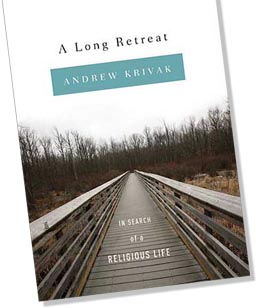
It is my habit to read novels or memoir on Sundays, when I can, and in recent weeks I’ve cherished a book that I could hardly put down. (In fact, I read it throughout the week, when I had long retreat.jpgwork stuff to do, as I was so enthralled with the author’s journey, his writing, his faith and struggle, all so well told.)

 The Long Retreat: In Search of a Religious Life (FSG; $25.00) is the wonderfully rendered memoir of a Northeastern Pennsylvania boy who joins the Jesuit order, working for 8 long years in prayer, discernment, service, travel, study, and huge amounts of (hardly realized) self-doubt and the clarification of vocational discernment, to come to that place of needing to finally decide if he would make his final vows to pursue ordination.  Andrew Krivak is a very good writer, very aware of his own deepest issues and able to tell of his emotional and spiritual journey without sounding overly pious and certainly never sentimental.

It is a fabulous story, filled with romances (yes), weird colleagues, thoughtful spiritual directors, stirring scenes of social service and college teaching and urban ministry. (His harrowing account of a working with a manipulative, distressed student rivals the scenes of almost being mugged on ghetto streets by a drug dealer/pimp.)  He explains much about Catholic monastic life, about orders and vows and praying the Divine Hours which are revealing and demystifing—hearing about brothers arguing about who does the dishes, or being grumpy about another’s annoying habits was refreshing in a way.  Mostly, though, it is a long, long journey to figure out what in the hell to do with one’s longings, with certainity and uncertainity, with one’s sense of self and God. 

I was drawn in right away even though I couldn’t quite imagine a young teen being given, by his working class mother, Thomas Merton’s classic The Seven Story Mountain.  Mr. Krivak is very smart, a bookworm in his youth, eventually attends St. John’s in Annapolis to read Great Books (and spends a semester in their renowned New Mexico campus, allowing for some exploration at a zen center and deeply spiritual Catholic retreat house way out off the grid in the desert.)  He learns to sail, works in a boat-building job, all while reading serious poetry, pondering his own contemplative spirituality and coming of age in the head-spinning 80s.  His being drawn to the serious life, to Merton-esque faith and social action, his intellectual journey and his sense of being called to a specific vocation as a Jesuit was told with such clarity and in the context of his own unfolding young adult life, that I was telling others how great this book was within the first few chapters. 

When he recounts the death of his father, I was hooked, knowing this would be one of those books I count as my own, the author a friend even though we will most likely never meet.  And yet, we do meet him in these 300 plus pages, and I was wiping away tears of joy and sadness, too, for his choices, for the complexities of life’s turns and the joys of pursuing God, and the graces of knowing how to be loved.  Sitting outside in a cheap plastic chair with a light chasting a shadow on my book late last night, I knew I had to tell you about this wonder memoir. I hope he is working on another…

The Long Retreat gets it name from an experience of long silent retreat every Jesuit novitate makes, (among many others) and it becomes an extended metaphor for the whole book.  Even when he’s flashing back to tell of his boyhood–chopping wood with his burly father, or exegeting parts of the detailed Spiritual Excercises of Saint Ignatius, the context is this long retreat, this ongoing intentional plan to see, often in times of silence or counsel with spiritual directors, how our interior lives and our daily living find coherence.  From mission work amidst injustice in a village of Haiti to exploring his father’s Eastern European roots during a study trip to Slovakia, from his teaching at LeMoyne College in Syacuse to the ordinary hassles of living in community with other often colorful men with similiar purposes, this spiritual journey is fascinating, helpful, provacative, beautiful.  If you read it, you too will, I am sure, long for substance and confidence about your life, for a sense of God’s will, and you will hunger for beauty (and understated by essential part of Krivaks search.)  In fact, it may remind you again not only of your own passion for your sense of vocation but of the need to be reflective about your inner life, your fears, doubts, yearnings, choices made or unmade.  Andrew Krivak is an honest man and a heck of a narrator. His story is funny at times, ribald and learned and devout.   Some of our readers—especially those who read stuff like Taste This Bread,(Sarah Miles)  Virgin Time (Patricia Hampl), Here If You Need Me (Kate Braestrup) or the memoirs of Kathleen Norris or the aforementioned Mr. Merton—will want to get their hands on this right away.

Patricia Hample concurs: “This is the best spiritual memoir I’ve read since The Seven Story Mountain––and that was a long time ago.”  Novelist Ron Hansen says that it is “not just a fascinating insider’s look at Jesuit formation, but a beautifully written case study in prayerful discernment of one’s proper vocation.  Few memoirs of religious life are as wise and revelatory as this.” 

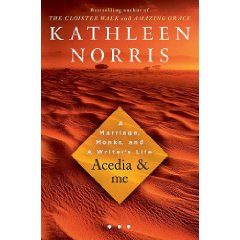
I have also started Kathleen Norris’ long-awaited new book, Acedia & Me: A Marriage, Monks, and A Writer’s Life (Riverhead; $25.95) a book (she writes early on) which isacedia.jpg somewhat a follow-up to her lovely little chapbook The Quoitidian Mysteries: Laundry, Liturgy and “Women’s Work.” (Paulist Press; $6.95.)  Acedia is not exactly depression, not laziness (as in the seven deadly sin, sloth.)  As she notes early on, it is rather a question of living without the energy to hope, an inability to care. Considerably more gentle and subdued than Krivak (and a bit of different generation) Norris narrates her story of “through the geography of her life as a writer; her marriage and the challenges of commitment in the midst of grave illness.”  Her interest in the monastic tradition is evident and her fascination with the the “noonday demon”—and her own youthful melancoly—shapes this book about her recent years, including the tragic death of her husband.  Can a lack of joy undermine commitments to work, marriage, friendship, faith, community?  I am eager to explore this book more, because, as with The Long Journey, we can escape into a novel-like experience of another’s life, but, as with the best novels, we can find resonance and hope and healing.  Thank God for faithful and honest and gifted writers who tell their tales with candor and grace.  As the Minneapolis Star Tribune puts it, “Norris is one of those writers who demands to be handed around.  You want to share this great discovery, giving her work as a gift—or you simply shove a copy into in the face of a friend, saying, ‘Read this.'”

BLOG
SPECIAL

10% off
any book mentioned
ORDER< br />HERE
Hearts & Minds 234 East Main Street  Dallastown, PA  17313   717.246.3333 

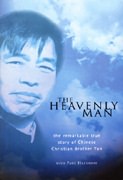
Brother Yun, The Heavenly Man

heavenly man.jpgEvery so often we meet people who lead us outside of our comfort zone, or remind us of older commitments.  Although Hearts & Minds prides itself in a diverse and interesting selection of books on global missions, and cross-cultural relationships, it is easy to lose passion for these large, important concerns.  It has been a while since I read a mission biography or spent time in tears praying for the persecuted church. So it was with great joy that we had the privilege of selling books at a lecture and author appearance by the Chinese underground church leader known as The Heavenly Man, Brother Yun.  He acquired his nick-name when he refused to offer his given name to the communist authorities, knowing that if he told of his home village, others there would be endangered.  Such fidelity earned him persecution, repression and torture, and the claim that he was “from heaven.”

Through a Chinese-loving, cross-cultural Finnish translator—more a brother and ministry partner than a mere translator— we heard and felt the message of God’s faithfulness during persecution, the need for boldness in outreach and obedience, and the possibilities of miracles, as the house church movement so often sees.  When Brother Yun would start to sing (sometimes with hymn tunes Westerners would recognize) with rich and throaty Chinese whisps of sound, it was truly trans-cultural and very moving.  Knowing this brave soul had suffered so, yet could still burst into joyous passion for Jesus, was haunting;  what power as he invited us to serve as “good Samaritans” giving the presentation a serious sort of integrity.

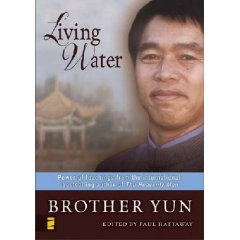
living water yun.jpgAs the books were signed—-in long stripes of beautiful Chinese characters—and Yun said “hallelujah” to each customer, Beth and I commented that this was an author signing unlike any we’ve done.  And it reminded us of our past involvements with Chinese dissidents and asylum seekers, of God’s heart for global missions, and for how the Christian church and world is changing in our lifetime.  As you may know, the millions of believers in China (not to mention other places on other continents) are spilling out into mission, especially in the conflicted areas of the  Central Asia, the subcontinent and into the Middle East (what missiologists called the 10/40 window.)  This mission outreach from China towards the West they call the “Back to Jerusalem” movement.  It was striking to hear Brother Yun call us to care about Muslims, Hindus, Buddhists and communists.  As he shared his meager food in prison with atheistic murderers on death row, so we all must, in Christ-likeness, give our lives away.

Brother Yun has two books.  The first, about his harrowing and remarkable life is called The Heavenly Man (Kregal; $16.99) and the newer one is a collection of his devotional and spiritual insights called Living Water (Zondervan; $15.99.)

We have some of his books left, and are pleased to offer a special deal for those who might enjoy a good mission read, a glimpse into the persecuted church, or a vibrant reminder of what it means to trust God as we know Christ’s suffering and joy.  Here’s the deal: buy both and get ’em for $20.  That is a large savings, and a lovely set of inspirational stories.

For those interested in other ways the gospel is being discussed in China, consider this rare find, a book which reports about (even with wonderful photos) and offers the transcripts of an ongoing debate held in China A Friendly Dialogue Between an Atheist and a Christian by Luis Palau & the renowned diplomat, Zhao Qizheng (Zondervan; $14.99.)

One of the very best overviews of Christianity in China is called Jesus in Beijing by the estimable journalist, former Beijing Bureau Chief for Time magazine, David Aikman (Regnery; $16.95.)  The subtitle is How Christianity is Transforming China and Changing the Global Balance of Power.

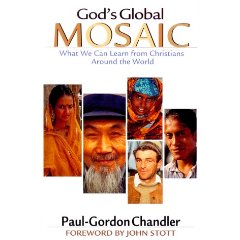
You probably know the important watershed work about the global expansion of faith done by Philip Jenkins, The Next Christendom (Oxford; $14.95).  He is a dear man and an important scholar.  A more slim and very inspiring book ongod's global mosaic.jpg the same topic is one of our favorites, God’s Global Mosaic: What We Can Learn from Christians Around the World by Paul-Gordon Chandler (IVP; $15.)  This tells in moving prose how Christians from each continent have something in their own faith journey that they have particularly learned, hard-won insights that we in the often cozy West should learn.  With a forward by John Stott, this is a generous and upbeat book, even if full of the gravity and pain of Christlikeness that comes from great suffering.  Our experience meeting Brother Yun reminded us of the great ethnic and racial and cultural diversity that we will someday experience in the new creation.  Why not start now, at least by reading up a bit?  You won’t, for eternity, regret it.


BLOG SPECIAL
2 BOOKS 20 BUCKS
ORDER
HERE

Hearts & Minds 234 East Main Street Dallastown, PA  17313  717.246.3333

Civitas: Christian responsibility for Politics, Public Life and the Common Good

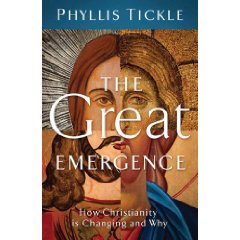
We just got in the much anticipated new book by Phyllis Tickle, a book called The Great great e 2.jpgEmergence: How Christianity is Changing and Why  (Baker; $17.99.)  It is a slim volume, rich and gracious and elegant. It walks us through our “contemporary cultural upheaval and the religious consequences” (as Diana Butler Bass puts it on the back jacket) of these huge sea changes.  Although I’m not sure she is so pedestrian as to name it, one of the obvious changes is that the faith and politics discusion is remarkably different, extraordinarily so as the religious right is not the only faith-based voice in the conversation.  Part of the shift, I think it is obvious, is a new frame for discussing the deepest matters of faith and public life, religion and politics.  Happily, as many of us have been saying for decades, Christianity ought not be exiled from public discourse nor aligned with any one party, and can offer insight for a new way of transending the polarities common in typical public discourse.  Tickle is a wise guide to the biggest cultural picture, and I’m sure the book will be helpful to explain some very big notions, with very real consequences of these new times.

So, into the eye of the storm we go, and last week I started teaching an adult Christian ed class at our church, a class I’m calling Civitas: Christian Responsibilities for Politics, Public Life and the Common Good.  The word “civitas” is from the same root Latin word from which we get civility, and implies that we are part of a commonwealth, belonging to a citizenship.  Christian citizenship, I’m suggesting, is more than about working for what we want, not even just what helps Christianity.  The Bible itself tells us much more and we will explore the themes of public justice, social righteousness, pluralism, violence, and a Biblical view of the state.  Ahhh, the “Christ and culture” stuff come up again and we will wrestle with various ways Christians have engaged the surrounding world.  You know I’m appreciative of the “beyond the religious right and secular left” rhetoric of Jim Wallis’ God’s Politics and The Great Awakening (and his Sojourners movement) as well as the similiar “red letter Christians” movement of Tony Campolo as described in his book of that name. And even Shane Claibornes radical Jesus for President stuff is very helpful for reminding us to be intentional about our sacred texts and our foundational loyality to Christ, even as we serve within the broader civil society.  That there are now resources like this, movements and organizations and books is part of this change.  Thank goodness!

Yet, as Ron Sider’s explores in the wonderful Evangelicals for Social Action website (and in his excellent book The Scandal of Evangelical Politics) and as Jim Skillen at the Center for Public Justice has taught us, we must have a comprehensive and Biblically informed public philosophy out of which can emerge a thoughtful and coherent Christian view of citizenship.  I reviewed a few books about this last winter at the website column, and we have a somewhat more extensive starter biblio at the “books by vocation” pages,  but I now want to add another book which I used the first two weeks of our class.  It is just great!   It was a special delight—a real blessing!—to re-read it and I truly want to commend it to you.

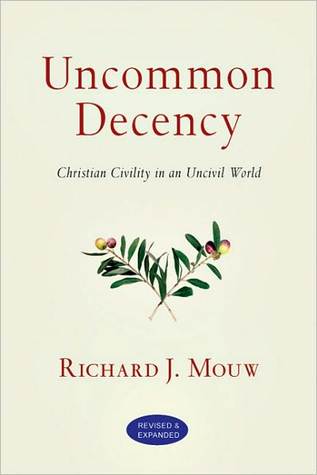
uncommon decency.jpg I am referring to the beautiful and insightful (and I’d say urgently needed if it weren’t so obvious) Uncommon Decency: Christian Civility in an Uncivil World by Richard Mouw (IVP; $15.00.)  This fine book explores heady stuff like pluralism, how Christians (and others) can have deep convictions and yet remain civil, and how civility works out during particular kinds of conversations (like, say about sex.)  His call to this uncommon decency is something I feel very strongly about and his guide is the best I’ve seen.  For those who know us well, you can be sure I’ve read and re-read his brillant chapter called “Abraham Kuyper, Meet Mother Theresa.”  Again, Mouw is so sweetly and admirable able to be clear about his own (Dutch neo-Calvinist) tradition where, with Prime Minister Abraham Kuyper he insists on the Lordship of Christ claiming “every square inch” of his world, and yet is also able to be self-critical of that tradition’s tendencies towards excesses of triumphalism and pride as we work for God’s plan in culture.  So, wisely, he introduces Kuyper to the simple and servant heart of Mother T.  Ahh, that is it, isn’t it: Kuyper and Theresa.  Uncommon Decency indeed.

For what it is worth, here is my description of the first two weeks of our class.  We’ve got a spiffy poster that Ned Bustard at Square Halo Books and World’s End Images designed for us (I couldn’t figure how to copy my adobe attachment here on the blog but I wish you could see it) and a full syllabus if you want to see it.  Just let us know.  We’re even taping the class, I think, if you’re desperate for this kind of fellowship and conversation… 

For now, we relish the insight of Rich Mouw  in Uncommon Decency as the basis from which I can introduce my Presbyterian church friends to “thinking Christianly” about politics with Ron Sider and Jim Skillen and Paul Marshall and David Gushee and so many other moderate, thoughtful, integrated Christian social thinkers who, with civility and insight, call us to be faithful, even in our work as citizens in the civitas.  Pray for us if you think of it.  And maybe in this urgent season, consider telling others about good books on this topic, buying them now and reading together this fall.  Maybe this could be you’re starting point, too.

SEPTEMBER 8th  Introduction and the Big Picture  

Any Christian study of any topic must be put in the broadest context of God’s call to be involved in service in His world, the matter of how the Bible does or doesn’t influence us, and how to formulate a Christian worldview.  That is, we have to develop the mind of Christ and exhibit Christ-likeness, allowing His ways to shape our human activities.  We are called to live our lives—in business, recreation, work, or citizenship–in ways that are different than the typical, and may not be beholden to any ideology or partisan viewpoint.  We are called to be faithful to God’s Word (which is seen most clearly in Jesus.)  Of course there are various ways in which Christians have related the gospel and our life in the world so we will explore several tendencies and highlight a Reformed perspective.

SEPTEMBER 15th  Why politics?  And how?

There are several reasons why we should develop a Christian political perspective and make an effort to be active in public life.  Pragmatically, politics influence
s the lives of our neighbors (not to mention our own) and our call to love others should lead us to care how policies effect them.  We are members of a country, a political community, a civitas.  Of course we confess that Jesus Himself is the true King and every aspect of our lives must reflect our commitments to His ways.  We desire to be faithful in all of life, including public life and citizenship. No aspect of life is removed from our spirituality; political life, like all of life, is an avenue of worship, a way to honor God and witness to Christ’s Kingdom.  It can be said that civic life is largely about the common good, the civitas.  And certainly, Christians should be in the forefront of a call to civility, fairness and integrity in all our discussions and activism, even when we robustly disagree and are compelled to speak prophetic truth to distorted power.

Hearts & Minds 234 East Main Street Dallastown, PA 17313   717.246.3333

Eyes to See Volume Two

Last year I raved about a lovely hardback collection of classic short stories, handsomelyeyes to see.JPG packaged and released by Thomas Nelson publishers, a renowned evangelical publisher, a stalwart in the often cheesy world of the “Christian Booksellers Association.”  So-called Christian fiction is often very nice, but the mainstream classic stuff still is often more mature, richer— aesthetically, and in terms of complexity and nuance.  That short story collection, Eyes To See, was compiled by popular author Bret Lott (himself a follower of Christ and New York Times bestselling fiction writer.)  It was a delight, and wonderful to see the CBA publisher taking that initiative. Many of the stories were brand new to me.  It was fun to send a few out to email customers.  Here is that brief blog post from last December.

It truly pleases us to announce that Mr. Lott has compiled a second collection, simply entitled Eyes to See Volume Two (Nelson; $22.99.) As you can see, although the pixels don’t do it justice, it has a similar dusk jacket making it truly lovely to behold.

eyes to see vol 2.gifAnd behold it you will, if you take a good look.  Eyes to See Volume Two has some classic authors—Charles Williams, Charles Dickens, G.K. Chesterton, Leo Tolstoy, all doing truly short stories from their large body of work.  Some are rather contemporary (John Updike’s “Pigeon Feathers” is the selection from that master and a piece from the newly released Yellow Leaves the contribution from Frederick Buechner.)  Several of the authors are new to me, but apparantly known in finer literary circles.  Gina Ochsner is a very contemporary writer,  Mary Wilkins Freeman wrote at the turn of the 1900s.  (She was, along with Edith Wharton, the first women writer to be inducted into the National Institute of Arts & Letters and has left a mark on American literature, especially exploring the stories of woman of faith.)  Sarah Orne Jewett is included, a name also well-known in the late 1800s as she befriended the likes of Twain, Henry James, Tennyson, Kipling, Willa Cather…

So, with older and newer tales, this is nearly 300 pages (in print that is not too tiny) of important, inspiring, meaningful entertainment.  It can capture your attention and, maybe, your heart.  There are some brief bios of the authors and a discussion guide in the back. We are happy to offer it to you, either with or without the first volume.  See the blog special pricing, below, a discount offered on either or both.

By the way, just a brief mention.  We have followed the life and work of Larry Woiwode, who had a contribution selected for the first Lott collection.  He was a seriously esteemed man of letters, an awarded writer, and, after a Christian conversion, he somewhat fell out of favor amongst the critics.  He wrote a memoir, a commentary on Acts and a couple of serious novels, has become the Poet Laureate of North Dakota, and continues doing pieces in prestigious journals.  Recently, there has been a buzz on his moving telling of his farm accident, a memoir entitled A Step From Death (Counterpoint; $24.00.)  Booklist calls him a “gripping storyteller as well as a ruminative thinker.”  This one, they say, is “darkly beautiful, lanced with portent and gratitude.”   And a lot of high-brow literary citations, references to poems and stories of doing his amazing work as writer, father, husband.  Anybody whose conversion story somehow involved the books of Calvin Seerveld, as I’m told Mr. Woiwode’s does, is my kind of author.  This literary telling of his brush with death on his organic farm in North Dakota and the memories these evoked are written nearly like a collection of short stories.

Lastly: over at the First Things blog a Junior Fellow, a serious young man with political and theological concerns, posts that he and many of his like-minded friends aren’t much into fiction.  A mentor there apparantly got him reading novels again, and he’s taken up Jane Austen. Yet, he wonders if others share his plight.   Another light-hearted post comes in recommending that he drop everything (including Austen) and read Master and Comander and the other 19 in that fine historical series about the British Navy. Hmmm. What would you tell a ambitious young adult, who loves non-fiction and reads widely, but isn’t quite so sure he enjoys novels so much.  Favorite recommendations anyone?

BLOG SPECIAL
usually $22.99
$20
ORDER
HERE
Hearts & Minds 234 East Main Street Dallastown, PA  17313     717.246.3333
 

The new Marilynne Robinson novel, Home

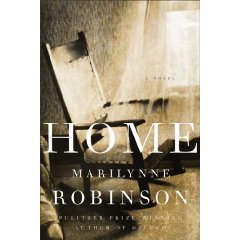
Home.jpgWe are happy to announce that we have gotten our shipment of the new Marilynne Robinson novel, Home (FSG: $25.)  It is, surely, one of the most eagerly anticipated new novels of the year, with Ms Robinson being a great example of the sort of deeply thoughtful, exceptionally talented, fascinating, faith-filled writers we so eagerly want to promote.  There are many talented writers in the “Christian Booksellers Association” (CBA) sold as “Christian fiction” but we are thrilled to find theologically astute authors who can transcend the usual confines of so-called inspirational fiction. Robinson is exactly that kind of writer.  The New York Times Book Review writer James Woods noted in his review of Gilead that “Robinson’s words have a spiritual force that’s very rare in contemporary fiction.”  Here is one great review of her work, and of the new novel.

The last thing I read, I think, of Marilynne Robinson (Gilead won the Pulitzer Prize in 2004 ) was her serious forward to a collection of pieces by John Calvin. HarperOne has this nifty series of smallish paperbacks of classic theologians and mystics with sometimes surprising contemporary authors offering introductions (they are called HarperCollins Spiritual Classics, each $11.95.)   Her intro to Calvin was excellent.

Interestingly, Robinson also contributed a preface to the lovely Vintage paperback John Calvin: Steward of God’s Covenant: Selected Writings ($13.95.)

So, she is obviously quite a thinker, a good writer, and a fine (if deep) essayist, as can be seen in her collection The Death of Adam: Essays on Modern Thought (Picador; $15.)  She writes critical pieces on topics as wide-ranging as the notion of wilderness to growing up Presbyterian to historical topics such as abolition, and, of course, more directly literary essays.

But her gift to us all of the two novels, Housekeeping, published in 1980 (and the favorite of some) and the beautiful Gilead, is why she is so beloved.  Giliead, if you don’t know, is the splendid story told by an old man, a minister, telling his young child about his life.  I hope it isn’t too far afield (or obvious) to say it reminded me, at least in approach and tone, of The Memory of Old Jack by Wendell Berry.  The brand new Home is a parallel story, told in the voice of Reverend Robert Boughton, the best friend of John Ames, the main character in Gilead.  Set in the same Iowa town, this is another luminous and tender tale.  As it says on the dust jacket, Home is about families, family secrets, the passing generations, about love and death and faith.

We are happy to be able to sell such radiant fiction, books to be savored and discussed.

BLOG SPECIAL
Home
regularly $25.00
$5 off
$20.00
ORDER
HERE

Hearts & Minds 234 East Main Street Dallastown, PA  17313     717.246.3333

Surpised by Hope and Seeing Through Cynicism

Regardless of your political persuasions, I hope you watched some of the Democratic convention, and will also watch the upcoming speeches at the Republican convention.  I am not quite a political junkie, although we do have as many books about faith and politics, I’d bet, than any store in the country.  “Something to offend everyone” really is a slogan here, and, if heard with an open-minded ear, means that we have a real variety of books, something to challenge us all. We always encourage reading widely, but that may be a civic duty these days.  I have written a length review piece at the monthly column a few months back suggesting books on this topic, and our Books By Vocation part of the website offers an annotated listing for political science types.   There are wonderful books for those of us seeking to be Biblically faithful, agents of the sorts of change God might desire, and eager to approach our civic life with Christian sensibilities even as though that transcends typical party affiliations.

faith of barack obama.jpgFor those who may be interested, which should be many of us, there is a fair and informative discussion of the role (and what kind of) faith plays in Mr. Obama in a newly released book.  The Faith of Barack Obama is written by best selling historian and  conservative author Stephen Mansfield (Nelson; $19.99.) Mr. Mansfield wrote The Faith of George W. Bush and has penned works on Winston Churchill, Booker T. Washington, and a book called The Faith of the American Soldier.  He can hardly be considered a partisan, yet it seems that this book is fair-minded, thorough, and quite helpful.  Archbishop Desmond Tutu has called it “perceptive and well written” as it explores Obama’s “faith-based liberal politics.”  From Trinity UCC, black liberation theology, to his relationship with Sojourners magazine and Saddleback’s Rick Warren, this interesting study shows Obama’s influences and helps explain what he has said he believes.

Here is an audio interview with Mr. Mansfield about the book, his hopes to be fair (Mansfield himself is conservative and pro-life) and how this book came about. 

It is exciting to many of us that Obama has motivated many younger citizens to be involved in civic affairs, and his rhetoric has inspired many as has his memoir, The Audacity of Hope.  Hope is a theme, of course, of his candidacy, and regardless of the necessary evaluations we must make of the content of his positions, the vision has stirred many.  It has placed change and hope in the center of the national debate.

We have several good books on hope in our store, but the one that I have been touting is–Isurprised by hope.jpg know some of our customers can predict it, since I’ve mentioned it before—the extraordinary Surprised By Hope by our favorite Bible scholar, N.T. Wright.  (HarperOne; $24.95.)  The subtitle is Rethinking Heaven, the Resurrection, and the Mission of the Church and from it you can see that he is asking the largest questions we can ask, questions that have been central in our ministry here: in what way does Christ’s resurrection give us hope?  What is the nature of our hope–is it that our “souls” go to “heaven” for eternity? What is the destiny of history, that God will burn up the world and whisking some to an ethereal location in the clouds?   No!  Jesus is bringing His regime change to the planet, and his wholistic rescue mission–with the principle battle being won at Golgatha and His Kingdom vindicated through resurrection and ascension—allows us to wait and work with all creation even as we groan for redemption (see Romans 8.)  What real hope—the redemption of our bodies, the restoration of creation— this brings into real history!  What joy it is to read N.T. Wright’s reflections on this reality that God rules, that Christ is Victor, that His bodily resurrection is historically true, and God’s Kingdom is breaking in “on Earth as it is in Heaven.”  That our hope is not pie in the sky, as they say, and that God’s ultimate intention for His planet is a restored creation regained, a new urban garden called the New Jerusalem which comes as gift as Christ returns, gives us huge and significant freedom to be new kinds of people.  He explores these implications in the third portion of the book.  (Amongst other things, we can be friendly critics to any and all ideologies and political movements, knowing the likelihood of idolatry and the reality of their limitations.)  We care for our place, our country, even as we are loyal to another regime—God’s Kingdom.  We are citizens of heaven, which means, though, as Wright shows, that we can be truly responsible actors in history.

From a helpful explanation of our wrong-headed and sentimental views of heaven to our un-biblical views of our souls, from the shifting understanding of death and funeral practices, to dumb hymns and otherworldly piety, Wright brings great sanity to the church.  He does battle with unhelpful speculations (from the theological left and right) and is in constant interaction with the most popular theological tendencies across the denominational spectrum.  Surprised By Hope offers a true alternative which is a vision that is at once historically orthodox and 21st century fresh, utterly evangelical and yet quite ecumenical.  With endorsements from leaders as diverse as Rob Bell and Richard Foster, Dallas Willard and Walter Brueggemann, this is widely being described as one of the most important books of our time.

Will Willimon properly calls it a “masterful work of Christian hope” where the Biblical teaching on hope is “defended, explicated, and proclaimed with wit, wisdom, intellect, and grace.” “This is,” he continues, “quite simply the best book we have on the substance of Christian hope.” 

Surprise by Hope will help us get beyond (as Rob Bell puts it) “the tired old theologies of escapism and evacuation” and allows us to understand and grieve death and dysfunction, to understand not only a Christina way to live in the world but to hope well.  In a political season when that word is often used, it would do us all well to plumb its deepest Biblical meaning, and there is no better resource to use.  We eagerly and enthusiastically share our hope in God’s work in our world, seen, for instance, in the publication of such rich and solid works as N.T. Wright’s magnificent Surprised By Hope. 

Lastly, you may be rolling your eyes at Obama, or peeved at the hilarious send-up David Brooks did in his New York Times column to the overblown Democratic speechifying (“in front of Greek columns conscientiously recycled from “Yanni—Live at the Acropolis.”)  Either way, I wonder if some of us need to examine our reluctance to allow ourselves to hope.  Are we too bitten by a bug called cynicism?   Are we overly suspicious of everybody’s views?

seeing through cynicism.jpgSeeing Through Cynicism: A Reconsideration of the Power of Suspicion by Dick Keyes (IVP; $16) is a book which deserves its own lengthy review, as it is wonderfully unlike any book in print.  Written by the co-director of the New England L’Abri, it brings together insightful cultural criticism, thoughtful psychological study, a critique of an unqualified shift to the postmodern, and how all of this allows many of us to wallow in our nearly self-righteous contempt for nearly everything.  We are so suspicious that we deconstruct nearly anything other than the weird, and carry ourselves with disengaged detached irony (even as it may parade as prophetic or hip.) Dick Keyes understands this, and has struggled honestly to examine the deepest causes of our cynical selves.

 This is a book, I say again, that is truly thoughtful and exceedingly rich.  It is very important, and utterly compelling for those willing to work through it.  It is not a cheery little read— and it certainly is not a book about which we can be cynical.  The author is brilliant and in many ways offers us new insights again and again, some based on his honest journey.  Seeing Through Cynicism is a tremendous bit of Christian scholarship, and a wise spiritual anecdote to the spirit of the times.  We commend it to you sincerely, with great hope.  Especially for those who roll their eyes at my unabashed earnestness it thinking it could make a difference.  Please know of this important resource, and pass this on to others if you think, in kindness, that it might help. 

BLOG SPECIAL
20% off
any book mentioned in this review
just ask for the blog special
ORDER
HERE

Hearts & Minds 234 East Main Street  Dallastown, PA 17313   717.246.3333

The Courage to Teach and other gifts for teachers

school arch.jpgThe evening weather has been cool and crisp, making it feel all the more as if autumn is approaching.  Every night this week we’ve heard the nearby Dallastown High School drum-line practicing, a bittersweet sound that assures us that it is back-to-school time.

In my last post I told of giving a presentation for college faculty reflecting upon their job as Christian teachers and mentors.  I mentioned books not only important for collegiate staff and educators, but for students themselves heading back to dorms and student unions. Some readers of BookNotes, though, are going back to public schools, elementary or high schools, to take up their posts anew in the fresh fall air.

One of my life heroes is Jonathan Kozol, whose early books in the 70s reminded us of the politics of schooling, the way curriculum—what is taught and what isn’t—is more than transmitting data, but the shaping of values such as concern for common-good citizenship and social justice.  Kozol, you may recall, was fired from an impoverished Boston ghetto school in 1964 for using a Langston Hughes poem that was, as they said, unauthorized.  He won the prestigious National Book Award for Death at an Early Age in 1968, a book that riveted me and has not quite let go, decades later.  The Night Is Dark and I Am Far From Home, now out of print, remains one of the very most influential books I’ve ever read.

Kozol has gone on to study, describe and protest what he has called the “savage inequalities” of our schools, with some being quite beautifully well-off and others being poor and under-funded.  As an advocate for children, especially those forced to attend bad schools, he has made his mark.  His last large book about these things, just a year or so ago, and now in paperback, was The Shame of A Nation: The Restoration of Apartheid Schooling in America.  (For the record, as much as I esteem Mr. Kozol—and cherish a long car ride I once had with him talking mostly about Jesus and His radical politics—I think he is misguided in his critique of school vouchers, Charitable Choice, and such.)

letters to a young teacher.jpgHis very lovely new collection of thoughtful letters to a first year teacher, Letters to a Young Teacher (Three Rivers Press; $12.95) recently came out in paperback.  It would make a wonderful “back to school” gift for a teacher of any kind, and Kozol’s practical advice (even a recipe for making goo) would be inspiring for a young, new teacher or an older more experienced one.  His advice is almost always spot on, and his tone is not the least bit condescending.  He is a radical thinker and a prophetic voice for justice, but this book is less about his social vision and more about his classroom demeanor (which is, nonetheless, informed by a deep humanistic vision of care for the students and the need to sometimes work to reform educational institutions.)  We commend it to anyone who wants to think a bit about the profession of teaching.

The Courage to Teach: Exploring the Inner Landscape of a Teacher’s Life
by Parker Palmercourage to teach.jpg (Jossey-Bass; $27.95) may be the most talked about book for teachers of the last decade, and for good reason.  Palmer, the profound writer, mystic, Quaker, activist, is another favorite of ours, and this book emerged firstly from his spectacular work on educational theory—exploring a Hebrew view of what it means to know (To Know As We Are Known: Education as a Spiritual Journey which is a very important little book indeed.)  After that meditation on forming educational communities of deep knowing and responsible caring (rather than teachers being the sole transmitter of abstract facts) where education makes a personal, even spiritual, difference, he set off doing workshops for educators.  His masterpiece The Courage to Teach emerged from those workshops (followed by a beloved book on vocation, Let Your Life Speak, which he tells us was written after being so inspired by so many teachers who seemed to truly be called—vocare–into this line of work.)  A new anniversary edition was released recently of CtT and a fabulous follow up has been compiled as a companion study/reflection book, too.  You can follow some of Parker Palmer’s other work, listen to podcasts and such, at the Center for Courage & Renewal. (Fans should know that his very first book, The Promise of Paradox, has also recently been reissued in a great little hardback!)

teaching with fire.jpgMany who have been in the network promoting Parker’s model of teaching with the heart were asked what keeps them going, and particularly, if poetry helps.  Many sent in poems, with a brief description of why this particular work is taped to their classroom desk, or in their lunchroom, or in the cover of their grade-book.  These “teacher-selected” poems have been compiled by Sam M. Intrator in a lovely hardback, Teaching With Fire: Poetry That Sustains the Courage to Teach (Jossey-Bass; $16.95.)  It, too, would make a lovely “welcome back to the classroom” gift for any teacher, old or young.

Letters to Lisa: Conversations With a Christian Teacher (Dordt College Press; $11.95) is aletters to lisa.jpg fabulous book we often tell folks about.  John Van Dyke teaches education from a Christian perspective at his post at Dordt College (a CRC related college in Iowa) and has authored the excellent Craft of Teaching.  As the story goes, his daughter, one of his former college students, ends up teaching fifth grade in a fairly sophisticated alternative Christian school, yet is frustrated with the old “how to apply what we learned in college to the ordinary day-in-day-out classroom of a real school?”  So this book is a set of questions from Lisa, the first year teacher, back to her dad, the esteemed reformational professor of Christian education.  She says, in effect, “Remember how you taught us about x, y or z?  Well, let me tell you how it really is in this crazy classroom.  What do I do?  And Van Dyke, part college mentor, part caring dad, writes back these wonderful epistles translating wholistic pedagogical philosophy rooted in a solid worldview, into very practical advice for a first time teacher, trying to be faithful in her daily job of students, discipline, grades, administration, parents and all the r
est.  In this sense, in style and format, it resembled the aforementioned book of letters from Mr. Kozol.  In its naturally-breathed faith perspective, though, it is a perfect example of the faith-work integration stuff that I lectured about at Geneva last week, the notion of ordinary folks serving God in their ordinary jobs by developing a view of work and set of practices in their workplace that reflect the core truths of the Biblical story and a Christian framework.  Every career should have a book of letters just like this one.  Thank God that there are so many useful resources for teachers.  May they take great courage for their work is so very important.

Hearts & Minds 234 East Main Street  Dallastown, PA  17313  717.246.3333