Local Bookseller laments the closing of Borders, Tells of Local Indie Stores that Remain

This weekend our local Borders closed for good.  A few weeks ago I had this essay published in a shorter form in our local York Sunday News.  It is always nice to get to write for the home town paper and I tried to both lament the loss of the local Borders and celebrate the other locally-owned bookstores that remain in York County.  So that it wasn’t a piece just about Hearts & Minds I sincerely gave a shout out to a few other stores in the region.

When a few local media stories included ill-informed comments like “now there are no bookstores in York” I was understandably irritated, but I toned down my righteous indignation.  Ha.  I thought you might like to see my effort to talk about ourselves in public.

The last line or two are important to me, too: weaning a generation of shoppers away from the glitz and glory (and uniformity) of the big box stores and their unreasonably huge, if predictable, inventories will take some doing.  Many smaller indie stores are fantastic but funky.  We can’t be everything to everybody.  The indie experience may take some getting used to, not unlike experiencing the difference between a casual, eccentric, health food store and the florescently lit big box pharmacy chains, or the difference between a farmer’s market and the giant grocer.  Long live the little guys in their odd little glory as an alternative to the mass markets. Except for the most pragmatic of buyers, shopping with us will certainly be more interesting and, we hope, finally, more enriching.

borders-store-closed1.jpg
What a loaded question!  As a local bookstore owner I have been asked many times this past month what I think about the closing of Borders, the national chain, and the local East York store, by folks who may think I am somehow glad; they were one of our chief competitors, after all.  But I am a bookstore owner because I am a bookstore lover, and each member of our family has good memories of browsing Borders’ many shelves and we are truly sad to see them go.  I recall sometimes feeling a bit sheepish as I studied their selections or as a friendly clerk would ask how our Dallastown business was faring or when a regular customer of ours would greet us with a hearty “What are you doing here?”  And so we all were there, happy for the bookish conversation, the new covers, the hiss of the espresso machine.  Of course we are sad.

Now they are gone and there are thousands of booksellers throughout the country who are unemployed.  Acres of empty parking lots, hundreds of missing venues for authors to get their books into the marketplace, publishers themselves cutting back due to the loss of bookstore space to sell their new releases.  In these hard times of civic contention and a hunger for serious answers to our cultural malaise, the loss of even one decent bookstore is a shame.  The loss of hundreds is a tragedy.  Books and bookstores are unspeakably valuable assets for a free society and the demise of so many is worse than just the inconvenience and loss of an entertaining venue that so many of us feel.  We are now more impoverished.

And so, along with many others, we offer our lament, pained that a land such as ours cannotbook.jpg support those very businesses that invite thought, the investigation of ideas, learning, and that exquisite pleasure of being lost in a story.  No, we who are called to the vocation of book-selling are not glad for the demise of Borders.  We wish our local colleagues in the book business the very best.  Some were true book lovers, themselves poets and writers and I hope they might somehow find a way to stay in the important world of books.  Certainly, we need more cheerleaders these days for those lovely rectangles of paper and print.

Yet, for those who care to drive just a bit, there are bookstores to be found in our region.  Our own shop has served customers from throughout the Mid-Atlantic for 30 years in our small town setting;  we often apologize for our sketchy signage, cluttered feel, and mish-mashed fixtures, but those whose eyes are wide with the thrill of the discovery of new titles, a unique blend of topics, and vital, good authors, seem to not mind much.  Book lovers are like that—indeed, one recent. popular on-line column opened with the AA like mantra: “Hello.  My Name is Wendy and I am a Bookstore Addict.”  I can’t tell you how many serious book buyers have told us that we are a threat to their budget (or their relationship with their spouse.)  Interesting bookstores offer a setting and service that, in some ways, is significantly different than the rather cookie-cutter ethos and selection of the major chains.

Just this week a customer from out of town started to cry when she noticed a particular book and our selection of Bruce Cockburn CDs. (And, oh, was I proud tell her that I was working that very day on a manuscript I was doing a blurb for, a Biblical reflection on the work of the Canadian folk-rocker.)  This sort of synchronicity is more common than you might suppose as we have curated our selection with care and a bit of eccentric passion, offering a curious blend of books on current events, cultural criticism, spirituality and memoir.  When a person alive to the truest things of life sees titles that resonate, when she connects the dots between her deepest convictions and her daily life, well, it is often a very exiting moment.  For instance, we currently have a display of seasonal cookbooks, titles about buying local produce and the relationship of religious faith and food, and it is fascinating how people respond.  Books about real life matter!

 * * *
Throughout York County there are several great used bookstores (including one in Dallastown, making our village a two-bookstore town, not to mention the home of Pennsylvania’s best hot dog and the area’s best burrito!)  There is a large religious chain bookstore in East York with a niche focused exclusively on conservative Protestants.  There is the delightfully funky Readers Café in downtown Hanover.  There is a new age shop in downtown York.  There is even a small Bookland in South York, a hold-out from the local chain that served the region in the 80s and 90s.  For typical beach books and bestsellers, Target and WalMart handle a handful. For what it is worth, our store is the largest and most diverse of any bookshop in the area, but all of these outlets combined offer plenty of opportunity for browsing and purchasing books old and new.
 
It isn’t easy in this era of faceless, on-line ordering, but we believe that locally-owned and passionately bookish independent bookstores can still thrive.  So do shed a tear about the loss of the big-box Borders.   But don’t give up on bookstores, especially indie places that each have their owner’s mark, selected by lights different than bestseller lists or market fads.   For a real find, be prepared to linger, to browse, to dig.  You will find treasures on the shelves of locally-owned indies and you will find staff who sincerely want to help you in your reading life.  Indie booksellers took up this strange literary life for a reason: we love books and we love people and we are convinced that reading matters.  We hope that York Countians agree.

children's books.jpg
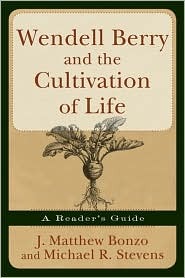
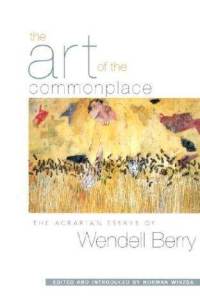
We are as committed to the printed page as anyone around, and read widely.  Our store is stronger on nonfiction than on popular novels and poetry and we long ago realized that we needn’t fill our limited shelf space with standards that are widely available elsewhere.  (Still, the very first book we sold, the day we opened in November 1982, was the extraordinarily rich novel by Victor Hugo, a complex story called Les Miserables.  This was years before the Broadway musical made Les Mis a household word, and we saw this as a good sign, taking comfort that such readers would find themselves driving down Route 74 to our homey spot.)  Still, we are mostly a theological bookstore, probably the most ecumenical one on the East Coast.  We define “theology” in fairly expansive terms, choosing to carry books of all sorts, from kid’s books to resources on grief, books on film and books on finance, from the work of the new poet Laureate to current events studies about the role of religion in globalization; we have books which creatively evaluate the Twilight books and books that engage the work of farmer-writer Wendell Berry.  We recommend books on prayer and books on peace, confident that there is a connection.

If one is not too imaginative or has an allergy to faith-based books, I suppose our shop might seem weird.  But if you love books, thoughtfully selected, creatively juxtaposed, even, displaying titles of all sorts, including those that may be a bit off the beaten path, serious and fun and beautiful, your visit to an indie bookstore will be worth your journey.   For a generation reared on the glossy shelves and high end snacks at the oh-so-uniform big-box chains, it might even see like a step back in time, not unlike the jarring experience of reading a truly great book.

store front pic.jpg
Hearts & Minds 234 East Main Street  Dallastown, PA  17313    

5 new books to help you grower deeper, journey inward, move outward and move forward

I hope you appreciated my top ten suggestions for reading around 9-11, published in the last BookNotes post.  I know everyone is different in these things, based on a lot of factors, but I was glued to the television, drawn to the sadness of the commemorations that day.  I perhaps had not grieved well enough, although I’ve pondered the attacks (and visited Ground Zero and Shanksville) and prayed about all this over the last decade.  But it was an intense and finally good day for me; shedding tears in solidarity with others is sometimes good for the soul.  I do hope you reflect on those books I mentioned; it isn’t the standard list, I guess and I really to recommend all of them. (At facebook I posted a few short clips of interviews with Lee Camp about the book I described about Islam and war.  Very thoughtful; as is often the case, hearing an author describe why he wrote the book and a bit about it is really helpful.)

And, now, these.  A handful of good books that seem right, good ones to mention as we move forward.  What do we do now, if we were inspired somehow to see renewal, if we are drawn to “first things” and, aware of life’s fleeting nature, we want to cry out to God, recommit ourselves to spiritual disciplines, if we want to recommit ourselves to being the sorts of people God calls us to be?

Well, this isn’t a master list of spiritual classics (but such a list is coming soon!)  These are a few new ones that fell into my lap at the right time.  We’re happy to sell these kinds of resources and hope you take advantage of our BookNotes discount.  Click on the order form link below and we’ll ship ’em right out.  Thanks.

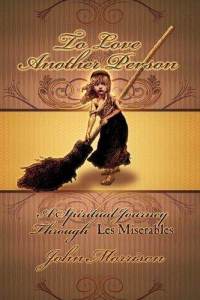
love-another-person-spiritual-journey-through-les-miserables-john-e-morrison-paperback-cover-art.jpgTo Love Another Person: A Spiritual Journey Through Les Miserables John Morrison (Zossima Press) $14.99  When pondering some of the deepest things of life these last days—death, justice, forgiveness, compassion, injustice, politics, revolution, faith—I thought of the splendid novel and moving musical Les Mis.  There are oodles of books (thank goodness) on C.S. Lewis and Christian studies of Tolkien, faith-based ruminations on all sorts of novels, but this is the only recent, distinctively Christian approach to the themes of Hugo of which I am aware. It is written by a retired Episcopal priest with advanced degrees in literature.  What a great idea!  Thomas Howard writes that in picking this up we are “sitting at the feet of an excellent teacher, theologian, and literary and drama critic.”  Canon Denis Brunelle has degrees in the study of liturgy and medieval theater and he writes, “Hugo’s commentary on the social life and ills of 19th century France is timeless and becomes, through Morrison’s work, a reflection on how we ‘miserable ones’ of today are called to plunge deeper into the realities of God’s presence and love for all.”  Yes, a book for our time, and any time.  If you haven’t read the great novel, maybe this season is a good one to embark.  Morrison will walk you through it.

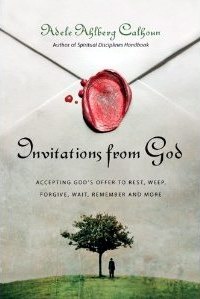
invitations from God.jpgInvitations from God: Accepting God’s Offer to Rest, Weep, Forgive, Wait, Remember, and More  Adele Ahlberg Calhoun (IVP/formatio) $15.00 This isn’t brand new and I wrote about it in a column about spiritual formation when it came out earlier this year.  I said that I so appreciated this invitation to consider God’s invitations to us: yes, God calls and invites and beckons us.  And, as the subtitle suggests, God doesn’t just invite us to happy-clappy lives of faith and victory.  We are called to bring to God our cares, our fears, our anger, our needs; God invites us to lament, to doubt, to remember.  If you long for an experience of spirituality that is both fully human and yet drawn into the Divine, this guide book is a treasure–it is a book to experience. 

Solid thinkers like New York pastor Tim Keller and spiritual formation guides like Ruth Haley Barton have endorsed it.  Calhoun is surely right that life necessarily brings invitations and how we respond ends up shape who we are and what we become.  As she puts it, our yeses and noes “form the terrain of the future.”  There are good reflection questions for your own pondering, journaling and reflection and they are also ideal for use by a small, trusted group.  Nothing quite like it.  It seems especially needed now.

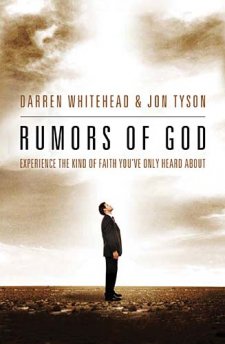
rumors-of-God-cover.jpgRumors of God: Experience the Kind of Faith You’ve Only Heard About  Darren Whitehead & Jon Tyson (Nelson) $15.99  For some reason I have a bit of an allergy to marketing plans (and book subtitles) that suggest we haven’t even come close to experiencing what the authors have.  I don’t like stuff that smacks of formulas or over-promises.  It strikes me as prideful and dumb—unless you are trying to reach some perfectly demographed seeker who has heard of faith but has no clue, why imply the prospective reader has no experience of God but has “only heard” about it?  Having said that (there!) saying why I was put off by the subtitle of this, let me shout that this book is not at all pompous.  It is humble, kind, gentle, insightful, wise, and strikes a perfect tone for seekers, new believers, those who haven’t read a ton of Christian living books or for those who have and want to perhaps move towards a balance and thoughtfulness that was a bit lacking in other such books.  This isn’t arrogant or overblown and it isn’t simplistic.  And there are rumors out there—in the Bible, for starters–that things can be (as Brueggemann likes to say it, “otherwise.”)  Phil Yancey wrote a marvelous book Rumors of Another World and of course my favorite rock star, Bruce Cockburn, wrote a song Rumors of Glory.  So the rumor is afoot, and these guys helps explain it.  People do seek, and they do find.  Their powerful stories attest to this and it is wonderful to read them.  This new book is, I believe, one of the best books of its genre: a clear-headed, multi-faceted, mature and accessible overview of vibrant Christian faith, robust and sturdy and enjoyable.

I’ve seen Rev. Tyson before in some of the great Q Ideas That Matter DVDs that we often recommend and he is very good–a New York City church planter who hails from Down Under.  Very impressive.  Mr. Whitehead is no slouch, either, also an Aussie, who now works at Willow Creek.  Their footnotes and examples are really, really good, and I sometimes wonder how authors like this do it, reading so widely, being such good communicators, coming up with clear and yet exciting ways of saying some very old truths.  Kudos to them and the publisher for pulling it off with class!

There are endorsements by Louie Giglio, Gabe Lyons, Scot McKnight, and Alan Hirsch. (Note that again: a passionate worship leader, an engaged and savvy cultural reformer, a respected New Testament scholar, and an energetic missional activist.)  Each shares how this simple book really could influence your views of discipleship, draw
you away from triviality and move you towards what is more than a rumor: a better way, a Kingdom dream, an “unimagined future.”  Unless we are utterly jaded, most of us hunger for a spiritual life of intimacy with God, and a walk with Christ that is lively and real.  We want our worship to matter and our lives to count.  We know we must engage the culture around us and that a life with God means a life of civic integrity and social concern. I’m telling you, this book is both a clear-headed and a bit of a visionary guide, well-grounded and forward-thinking.  There is a good discussion guide making it ideal for a book club, study class or Bible study. Highly recommended as these two pastors know how to communicate, are helpful guides and, as young leaders, have earned the right to be listened to.

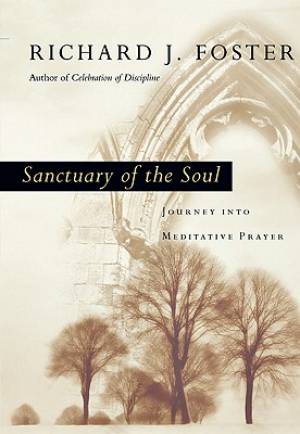
Sanctuary of the Soul.jpgSanctuary of the Soul: Journey Into Meditative Prayer  Richard Foster (IVP/formatio) $16.00  I have had a small hand-sized advanced copy of this for a while and I’ve carried it around, outdoors, to coffee shops and cannot tell you easily how much it has helped.  I don’t naturally find silence appealing and I don’t often hear the voice of God. I don’t take the needed time and when I do it isn’t very fruitful.  This book reminded me of much and taught some new things. 

Watch this lovely video to hear Richard talking about this short book, a lifetime in the making.  You will enjoy the many names he cites at one point, I’m sure, as he reminds us that the resources are many.  He is uniquely situated, I think, to teach us about them and to distill their ancient wisdom for our busy lives today.  The guidance Foster offers is clear as a bell and the material is solidly Biblical, so I commend this to one and all.  Foster is eminently reliable and his wide awareness of the best spiritual classics and devotional literature of the ages make him one of the finest and most important writers in spirituality.  He includes a lot of Bible study, yes, but he tells stories from his life, too.  The stories (including a major chapter at the end of each section where he narrates a particular experience) rang true–I met Foster once and had a remarkable and memorable episode that blessed me profoundly, so I can imagine that his stories and illustrations are quietly so.  He is gentle, not breathy, but also very profound and serious.
                                                                    
Richard Foster has written a bit about meditative and listening prayer before (in Celebration of Discipline, for instance) and many of us have long wanted more good guidance about this discipline. (Foster, by the way, notes that Dallas Willard’s Hearing God is one of his favorite contemporary books on this subject and we agree!)  Of course he draws on older authors like Madame Guyon and even older authors like Theophan the Recluse.  He warns against inappropriate versions of meditation, new age or Eastern, and affirms a keenly Biblical approach.  (There are those who mistrust Foster but we are proud to carry his books, glad to stand with and for him, and eager to commend this book on meditation to you.  I am not a mystic and certainly no master of the sorts of stuff he invites us to.  But I hunger for it.  Don’t you?  I love Ruth Haley Barton’s good Invitation to Solitude and Silence and perhaps that is a more foundational place to start.  But if you want simple guidance about silent, listening prayer, about Christian meditation, entwined with Foster’s telling of his own on-going journey to the “sanctuary of the soul”, this book will be a beloved ally for you.  Certainly in these hard days of political controversy, of national sadness, and of the already hectic new season upon us, we need to be still.  This book will help us, and now is a good time to read it.  Highly recommended.

start_something_that_matters_200.jpgStart Something That Matters Blake Mycoskie (Spiegel & Grau) $22.00  One of the things that was nice about the 9-11 coverage was the cutaways and human interest stories of people doing good work, volunteerism, thousand points of lights and the like. One of those stories, I forget which one, inspired me to tell you about this book by the founder of TOMS shoes.  I suppose you know that books about upstart entrepreneurs are often inspiring, can teach us a lot about getting involved, following our dreams, taking chances, solving problems, making a difference, and they are also, I suppose, nearly a dime a dozen.  As one who enjoys trying to motivate others, equipping folks to be more than they are, who feels called to promote books that educate and inform, I could write about these sorts of books often, but they often seem a bit out of reach.  Sure we can learn much from the founder of IBM or Starbucks, but, really.  Who of us can do that? (The founder of Zappos has a cool book, Delivering Happiness and started a foundation to build a movement.)   Well, when I read how Blake started TOMS shoes with a free intern in his shared apartment, I literally broke out laughing.  I thought we started small.  I thought we were sketchy, trying to get free publicity and keep the bill collectors at bay, pretending to be more professional then we were.  Blake is a go-getter and he is deeply concerned not only about cool fashion but about global justice. (You surely know that TOMS gives a pair of shoes to impoverished children for every single pair he sells!)   He wants us to know how he stepped up to do something so that we, too, might follow our idealistic dreams and make a difference.  Or work with those who are stepping up, supporting and buying from or praying for or volunteering with…yep, we can all make a difference.  As Andy Crouch says at the end of Culture Making, we can all take initiative, maybe with just three friends. 

Blake Mycoskie challenges us, tells his own story, and inspires readers to find a “new model ofbook-4-book.jpg success” (as he puts it) and to make a difference in a hurting world.  Look, I like TOMS, and like this startup vibe and I even like the graphic appeal of this handsome book.  Start Something That Matters is for you, or someone you know.  In the post 9-11 world, one thing is certain: folks are eager to get involved, to do something bigger than they might have before.  The entrepreneurial spirit is alive and well and many people, including people of faith, are allowing God to lead them to good things, missional endeavors, ministries, classes, programs, ways to love and serve and care and give God the glory as the love is spread.  This is a fun book, but more, it could light the fire under you or somebody you know.  (And, with every book you purchase, natur
ally, a new book will be provided to a child in need through Blake’s latest dream, One for One.)  TOMS, by the say, stands for Tomorrow’s Shoes, shortened from his first slogan, dreamed up on a vacation to Argentina: Shoes for a Better Tomorrow.  A better tomorrow, indeed. 

Check out this very cool video of (rural?) street rapper David Bowden who did a piece  of spoken word slam poetry over edgy guitar, inspired by the title of this book.  Start Something That Matters.  Or as some folks said in another context, “Let’s Roll.”

BookNotes
SPECIAL
DISCOUNT
any book mentioned above 
2O% off
order here
takes you to the secure Hearts & Minds order form page

inquire here
if you have questions or need more information

Hearts & Minds 234 East Main Street  Dallastown, PA  17313     717-246-3333    

.

10 books to help you commemorate the sorrows of 9/11

I know that you are reading articles on line, in magazines, and perhaps watching TV specials about the tenth anniversary of the 9-11 attacks and I feel almost awkward adding to the torrent of words and images.  Yet, we need them somehow, don’t we?  In the review from the other day I recommended Skye Jethani’s new book With (thanks to friends who ordered it–we are grateful and hope you like it as much as I did.)  Yet, somehow, although we practice the presence of God, realizing that the Risen Christ is truly with us, we are, some of us, need to know that there are others with us, too.  Being in touch and sharing our stories reminds us that we are not alone. There is little doubt that many of us want to talk about where we were ten years ago, how we heard, who we fretted about and how we grieved.   So, doing our part, we offer some books for your consideration.  We stock some classics—national best sellers, say, like, The Looming Tower: Al-Qaeda and the Road to 9/11 by Lawrence Wright (Vintage; $15.95) which won the Pulitzer Prize.  We would like to offer some less well known resource, book that we think you will enjoy knowing about.  I think they would be useful this month as we reflect and commemorate this important milestone in our collective experiences.

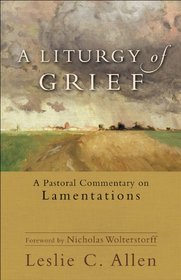
liturgy of grief.jpgA Liturgy of Grief: A Pastoral Commentary on Lamentations  Leslie C. Allen (BakerAcademic) $21.99  Even as he was becoming a senior Old Testament professor at Fuller Theological Seminary, Allen served (and continues to serve) as a hospital chaplain for over 10 years.  This is the first clue that this Biblical scholar is well acquainted with grief.  A scholar who does his exegesis through tears is to be trusted, I’d say. Nicholas Wolterstorff writes of this splendid new book that it “is at one and the same time an important contribution to our understanding of and dealing with grief and an important contribution to our understanding of one of the supreme pieces of literature in the Old Testament.”  Other scholars of the Hebrew Bible concur (M. Daniel Carroll R. of Denver and Tremper Longman, for instance.)  Are you heavy of heart?  Do you do caregiving for the hurting? Do you preach or teach those who need to hear an affirmation of their need for rituals of grief?  I don’t know what those churches who call their contemporary worship services “celebrations” will do this week, but this book could help.

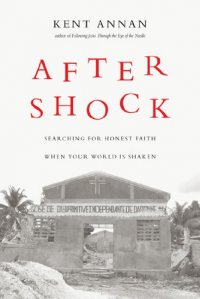
haitiaftershock.jpgAfter Shock: Searching for Honest Faith When Your World Is Shaken  Kent Annan (likewise/IVP) $15.00  I mentioned in my previous post a few books that might serve us well as we talk together about the floods and natural disasters that have hit so many.  There was one book I considered mentioning but wanted to hold off listing it until I could commend it here. It is a very special book.  While After Shock was written in the aftermath of the horrific earthquake in Haiti a year and a half ago, it could also serve as a serious reminder of what it is like to have faith shaken after any sort of rending crisis.  Whether your anguish is over a neighborhood shooting or a family cancer that has rocked your world; whether you are led to doubt God’s goodness after a natural disaster like a tornado or flood or whether this week’s 9-11 recollections uncover deep anguish in your soul,  this book will speak honestly to you.  You see, Kent was himself a passionate missionary serving the poorest of the poor in Haiti (and he had written an excellent book about Christ’s call to serve others, one we often recommended, Following Jesus Through the Eye of the Needle: Living Fully, Loving Dangerously; likewise/IVP; $15.00.)  He worked hard on that one, editing carefully, as authors will, and worked to make it interesting and compelling.)  After the earthquake, Kent told me, this second book just poured out of him. There was little time to ponder, no time for re-writes.  The wonderful, edgy imprint, likewise, wanted a raw and honest appraisal of how to cope when, as the subtitle suggests, the ground below your feet is rocked.  If you are coping with any sort of trauma or you just wonder how in the world to make sense of a world gone awry, this book is a wonderful conversation partner and Kent will be a good companion in your pilgrimage on the way towards new hope.

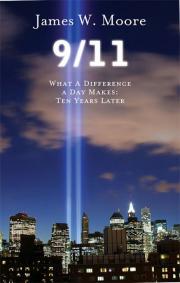
911-what-a-difference-a-day-makes-ten-years-later.jpg9/11: What a Difference a Day Makes: Ten Years Later James W. Moore (Abingdon) $7.50  I wanted to list this one because it is so very clear, simple, concise and inspirational.  James Moore is a best-selling author of oodles of upbeat, clever books, a great storyteller and a fine United Methodist Bible teacher.  This just a bit larger than pocket-sized paperback is useful for anyone who is stressed who needs to be reminded how God is with us (even in the turbulence–you have to read that chapter inspired by a great illustration.) He has a good, common-sense chapter on why religion can be a force for good and not evil, and how we can recall the stories of 9-11 to find comfort and hope. The last chapter is a pleasant reminder–or is it a plea?—that a shared experience like this can bind us together as we have shared sorrow and shared resolved.  United we stand, in shared love.  Nice.  

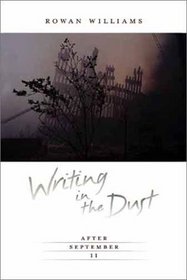
writing in the dust.jpgWriting in the Dust: After September 11 Rowan Williams (Eerdmans; 2002) $12.00  It is well known that a publisher can rush a book to press in nearly miraculous speed.  When it is important, sometimes, this happens, and in the fall of 2001, there was a real need for a reliable and mature voice from within the mainstream Christian tradition addressing the horrible attack and the state of the world.  There had been awful things said about the attack, and even those with well-grounded faith traditions felt confusion, grief, and anger (at the killers, of course, at Al Qaeda and militant Islam, at the politics of those years–each of us for our own reasons—and even at how some in the faith community hijacked the tragedy of the event seemingly for their own ignoble purposes.)  I needn’t tell you that times were pretty awful and many looked to churches to offer words of insight and hope.

One of the early responses came from a deep and thoughtful pastoral letter, a handsome small book rushed to press by Eerdmans, an historic publisher in Grand Rapids, written from across the ocean.  The author was the widely respected British Archbishop of Canterbury, a learned man and profound thinker, The Revered Rowan Williams.  His ruminations came with a dust jacket with a subdued photo of an iconic bit of rubble, with a nearby tree, perhaps struggling for life.  It had a simple quote on the front, naming it as a “fully sensitive theological contemplation” by Lutheran novelist, John Updike.  On the back cover, Nicholas Woltersdorff, an extraordinary scholar and author of books on social justice and shalom, as well as one about personal loss and grief, says that Williams wrote about this particular grief “with hushed tones, as before a mystery.”

Writing in the Dust soon became an international best-seller, beloved by Episcopalians and Anglicans (it was endorsed by the Rector of the Parish of Trinity Church on Wall Street) but by others as well.  Stanley Hauerwas noted that it was written with a “hard gentleness honed by the language of prayer.”  The metaphor of dust, so poignant in the book, continues to haunt.  It was an important, if occasionally uncomfortable, reflection, in the early days after the attack.  I believe it is equally valuable today.

Refractions.jpgRefractions: A Journey of Faith, Art and Culture Makoto Fujimura (NavPress) $24.99  Over the last twenty or so years Mako has worked hard at his abstract painting craft, has written and spoken widely about a Christian view of aesthetics, and has helped organize an extraordinary organization (IAM) which networks and supports artists and cultural creatives of all sorts.  His 2009 break-out book was a collection of ruminations, pieces from his luminous blog, which he calls “refractions.”  It is a book that (if you follow BookNotes) you know we routinely recommend.  It is splendid!  Mr. Fujimura works and worships in lower Manhattan and his children were in school within a few blocks of the WTC the morning of the attack, creating a panic for this gentle Christian family as the fateful day unfolded.  His well-told reportage of that day is well worth reading.  In fact, several chapters of this beautifully illustrated work tell of the way in which he and others organized artists in the neighborhood of Ground Zero to create visual and multi-media art installations that would offer (sacred?) space and give visual voice to grief.   His clear insights about how the arts can be used to restore peace to a broken city are exceptionally profound and while this book isn’t exactly a 9-11 title, there are some chapters here that emerged from Mako’s work near Ground Zero in the years following the attack.

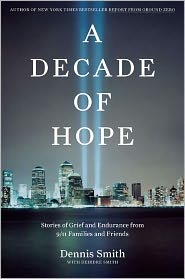
decade of hope.jpgA Decade of Hope: Stories of Grief and Endurance From 9/11 Families and Friends  Dennis Smith (Viking) $26.95  Everyone knows about the heroic bravery and self-sacrifice of so many first responders and fire fighters but few have followed their stories with the care and passion as Dennis Smith, whose Report From Ground Zero was the definitive account of those horrible first hours, certainly the most appreciated, well written, heart-stopping narrative of the rescue efforts. Written a few years after the attack it was a beautiful way to juxtapose those who died trying to save lives and the brutality of mass murder.  Smith was a fire-fighter in New York and has been on the board of Tribute, the interim memorial at the World Trade Center.  These new stories, based on years of diligent interviewing bring us important insight about how these families of rescue workers and victims have fared in the last decade, allowing their stories to put us in their shoes and finally give us a portrait of hope.

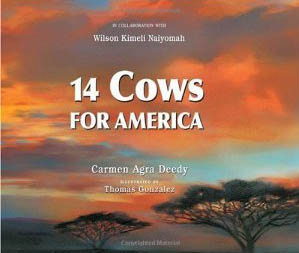
14Cows1.jpgCows for America Carmen Agra Deedy, illustrated by Thomas Gonzalez (Peachtree) $17.95 This may be one of the most stunning picture books in years—both the breath-taking art done by a Cuban illustrator and the sheer power of the story that is both sentimental and incredibly weighty. After the horrible bombings of 9-11, word got back to some Maasai tribesman in rural Kenya about this tragedy in the United States. (One of their young men had been studying in the states and was at United Nations students meeting and saw the towers fall.) They could hardly imagine (literally) what it meant to lose skyscrapers and that many lives, from a fireball that hot, but they understood that it was a large, large loss.  Through a child’s idea, they wanted to help   In their culture a cow is a sign of life, literally and mythically, and an elder tribesman was dispatched to find the American ambassador. The tribe wanted to give the United States people a cow. (This is unprecedented—they would seldom give such a prized possession to strangers.)  A few more were donated by other poor Maasai warriors—again, these are their most prized possessions, and were offered as profound act of friendship to a grieving people.  Can you imagine the ambassador wondering what to do with this beautiful gift of 14 bovine?  When the story became known, Wilson Kimeli Naiyomah (the younger man in the tribe who was studying in the U.S. who first told the tribe the story of what he saw) was featured on Oprah, who helped fund his obtaining a science degree from Stanford, and was awarded a Rotary Club Peace Fellowship; he is soon to take up a degree in international peace studies. This art and text in this book is breath-takingly wonderful, capturing well the mood of this genous tale, and we highly, highly recommend it.  It is an episode and a book that truly deserves to be widely, widely known.

Here is a splendid little video that shows most of the art from the 14 Cows book.  You will enjoy it, I’m sure, and hopefully will think of somebody you can share this with.  Here is a 5 minute clip of the author, the delightful Carman Deedy, describing the story, the book, and what it meant to her to be involved in this poignant drama.  There is a lot of very dramatic backstory here, so don’t miss it.  Then buy the book—please!
 

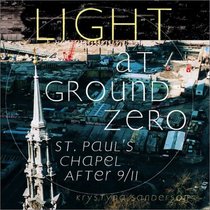
light at ground zero.jpgLight at Ground Zero: St. Paul’s Chapel After 9/11  Krystyna Sanderson (Square Halo Press) $15.99  At the very heart of the hell that was Ground Zero on the day of September 11, 2001, and the hard months following, stands St. Paul’s Episcopal Church, just yards away from the destroyed Building 5 of the World Trade Center. Hurrying from her home in Greenwich Village, photographer Krystyna Sanderson headed to lower Manhattan amidst the smoke and dust to help with rescue efforts.  In the first paragraph of the introduction to this collection of photographs–a piece which still causes me to choke up, even though I’ve read it numerous times–she tells of how amazed she was that her church was not destroyed.  “Except for a layer of ash and soot, the building survived unscathed.  Many proclaimed that ‘St. Paul’s had been spared.’ It seemed clear to me that if this was true, it was not because we were holier than anyone who died across the street; it was because we now had a big job to do.”

Any rescue effort at huge global disasters will always be full of drama and passion, pain and tears and the very best and worst of human endeavor.  St. Paul’s became a center of all this, a weigh-station for the rescue teams, a hang-out for the first responders, a place of rest and recovery from those involved in one of the most intense human ministries in recent memory.  Day by day the brave rescue workers and helpers and chaplains dug through the rubble and day by day Ms Sanderson documented on film with her expert eye and artistry the ministry of the chapel.  This paperback book is har
dly a coffee table book: it is too precious for that, and its relatively small size makes it perfect for prayerful consideration.  

These shots are tragic, of course, but yet triumphant.  To see the church altar covered with the heavy rubber coats of the workers, to see the styrofoam coffee cups by the knave, to see the pews turned into first aid stations, to see the hand-made emergency signage taped over the stained glass, is to glimpse a vision of the church made messy in ministry to the world.  Anyone who cares about the nature of the church’s work will glimpse a parable here; more than a parable, a reality.  The radical hospitality offered as relief workers partnered with folks of good will from around the world is shown visibly in these lavish full-color photographs.  The photos could easily stand alone, and on many pages they do, but there is a brief and tasteful illumination by setting alongside them text from the Episcopal Book of Common Prayer.  Thank goodness this work, too, came to press in the year immediately following 9-11.  Thank goodness it remains not only as a close-up remembrance of this ministry among the horror, but an on-going reminder, a photo essay, of the goodness of human kindness and the resilience of those dedicated to life-giving service.
 

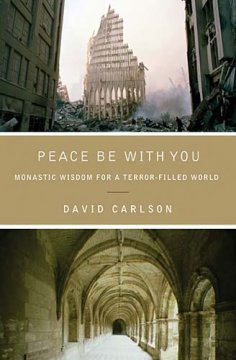
peace be with with you.jpgPeace Be With You: Monastic Wisdom for a Terror-Filled World David Carlson (Nelson) $15.99  Of the several books I’ve pondered this month around this theme this one stands out.  It is based on a fabulous idea, rooted in a fabulous question: do monks and nuns have anything to say to us about how to think about the horror of 9-11 and how to respond in these times?  This  new book was envisioned, it seems, nearly a decade ago when the author, a Baptist college professor who had converted to Orthodoxy, longed for greater clarity about his own unsettled spirit after the attacks of 9-11.  The handsome cover art of this paperback tells us of his journey: there is a stark picture of Ground Zero rubble on the top half of the cover design, while the lower half of the cover is a stunning photo of the walkway of a historic old abbey.  Indeed, the question of Professor Carlson is about the relationship of the two: what insight might monks and nuns, sequestered at their monasteries, have on how we remember–and respond to, even now–the terrors of that day?

The idea of the book is simple and, despite the weighty topic, a bit light-hearted: the author goes on a road trip (sometimes accompanied by his non-believing adult son) to a handful of far-away and secluded monasteries, obtaining interviews with the often reluctant monks.  How did they remember the news? How did they feel about it?  Did their schooling in the ways of prayer equip them to respond more peacefully, with more Godly focus or wisdom?  What insights, since then, have they developed, based on their spiritual disciplines and global brother or sisterhoods, that might be offered to a world such as ours?

 The book is truly interesting, as books that include memoir and travelogue can be; it is even a bit clever at times.  The author is self-aware and realizes a good adventure when he sees one. 

Some of these intentional communities are deep in the canyons of New Mexico or across miles of harsh terrain and he writes about them well.  For instance, after a grueling trip along some treacherously icy canyon-lands–well, these roads are treacherous even without the ice, it seems— he celebrates worship with Russian monks at their skete standing for two hours in the snow (their pipes have frozen so they can’t use the indoor chapel.)  The book is not just travel writing, but it is enjoyable, including the portions where he is visiting more urban monastic communities. He talks about his journey, his relationship with his adult son, the anxiety he has about ever completing this rather off-beat project (some monks, as you can imagine, would rather do almost anything than talk!) And, yet, he finds some real characters,too.  (Do you know the story of Thomas Merton laughing about smelly feet?  Persons committed to a monastic lifestyle are still themselves, he finds, and, yes, he does go to the famous Merton location in Kentucky. How could he not?)

So the idea is easy: find some people who were praying the day of the attack, and find out if their prayer habits made a difference about how they felt about the attack during and afterwards.  

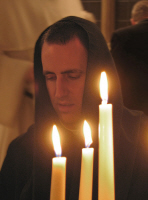
But it is not really so a simple quest as it ends up. Carlson admits to his own inner demons, hebenedictine-Lawrence-OP-CC2-a.jpg struggles with bouts of depression and carries great remorse about the mean-spiritedness of much of our political discourse (especially regarding our relationship with Islam.)  Surely, he thinks, these men and women whose vocation is to pray and who know silence, who worship often and serve humbly, have nurtured habits of heart that will allow them to speak well into our needy times.  He is both grateful for such good insights and happy to report much of the Christ-like character these prayerful saints exhibit. Hearing their take on international affairs, and the soul of our nation, is powerful.  But, as we all should surely know, monks and nuns are not in a holy bubble; they have internet and watch the news, and often live lively lives engaged in local neighborhoods. (I enjoyed one chapter where Carlson was spending time in a monastery whose urban mission included a bread baking business and cafe.  Working with the general public isn’t the most “devotional” space for cultivating deep mystery, often, yet these men used their daily frustrations to guide them to greater Christ-likeness.  Men and women called to these religious vows are human, and struggle with the same quandaries of discipleship we all do when it comes to questions of forgiveness, mercy, peace and justice, caring about our daily issues and wanting to be aware of global concerns.

Peace Be With You takes us into this mix of sinners and saints on a holy road trip, leaving us with very big questions and some very significant answers.  I think this would make a perfect book club book—even if your group isn’t used to reading overtly religious books.  This story is so interesting, the writing so clear, and the question so significant that it deserves to be read and pondered.  What do you think, does having a deep and consistent prayerfulness, nurtured in practices of solitude and silence, make you a better citizen, a more Christ-like peacemaker, a person with something to say about 9-11?  Read this book for yourself; it’s a winner!

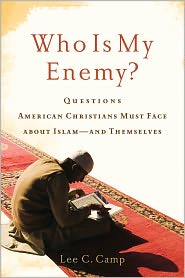
who is my e.jpgWho Is My Enemy? Questions American Christians Must Face About Islam—and Themselves  Lee C. Camp  (Brazos) $17.99  I will be doing a larger more substantive review, Lord willing, of this remarkable brand new book but I simply had to list it now.  It may be one of the most interesting and informative and important books of the whole year (and I mean that!)  Camp is known for at least two things.  First he developed a bit of a following when he released a very powerful and exceptionally well-reviewed overview of serious Christian discipleship called Mere Discipleship: Radical Christianity in a Rebellious World (2nd edition) (Brazos; $21.99)&nbs
p; It is a more serious and mature study for those who like Bonheffer’s Cost of Discipleship, say, or the punchy writings of Hauerwas or Yoder, Walter Wink or William Stringfellow.  Endorsements include rave blurbs from missional dudes Frost and Hersch. If you’ve read, say, Crazy Love or Radical, you need to advance to this.

Secondly, Camp got deluged with vulgar hate mail when a Nashville newspaper misquoted him (inadvertently, he graciously believes) as saying that Christians must “let go” of some of their theological claims in order to get along with Muslims.  Of course this is ridiculous, no evangelical leader involved in serious interfaith dialogue would say such a thing (you can read his clarification, here.) But few gave him the benefit of the doubt and he was severely rebuked by people from all over the world within a day’s time.  Many called for him to be fired from the college at which he taught.  A few were legitimately concerned about a Christian leader suggesting doctrinal compromise but many more were incredulous about any desire to work for conflict resolution with Muslims.  So, Camp was quickly exposed to deep and troubling hostility by people claiming to be Christians. He’s aware of the firmness of many anti-Muslim Christian activists, how some are very quick to hint at violence, and how anger and fear are often just below the surface of any conversations about how we are to perceive Islamic neighbors.  I’ve experienced some of that unreasonable hostility myself and cant imagine how he felt getting such scary emails and phone calls, people writing inaccurately about him.  

Well, in this wide-ranging work, Camp tells some of his story of what he had to do in response to that firestorm. He felt that he had to study more and come to know Muslims personally.  He draws on some significant insights of Miroslov Volf,  reads widely, and takes off.  He attends programs at the local mosque, travels to several important sites—from the Blue Mosque in Istanbul to the Oklahoma City National Memorial to Hebron in Palestine to the Old City of Jerusalem and to a local Arab barbershop. He gets to know some ordinary Muslims and some devout Muslim scholars. 

As you may guess, Camp is mostly interested in the question of violence and war.  Are they out to get us?  How do Muslim leaders understand the limits to war? Is there a restraining sort of just war theory in Islamic thinking as there is in the West? What about Bin Laden?  And—and this is where it speaks truthfully, painfully, and will, sadly, be controversial (get ready for more hate mail, Lee)–how do those who have grossly violated the just war theory in our own history have any moral high ground to critique jihadi violence? What might it mean to take a log out of our own eye even as we rebuke and resist others?  Camp is clear to state that this isn’t a typical argument about “moral equivalency” and he offers much nuance in his teaching, whether it is about Puritan violence against Native Americans or the evil done during the Crusades.  He does serious Bible study and explores that thorny ground of hermeneutics (that is, how do Muslims interpret their Scriptures and how do Christians interpret theirs, especially on the legitimizing of violence?)  Camp invites us all to explore the way that Christ calls us to be peacemakers and wonders how to do that in light of the realities of the Islamic story and the facts of the Christian story.

I will have much more to say about this new angle on “Christian-Muslim” dialogue but wanted you to know we have it in stock now, I’ve read it all, and am very, very confident that regardless of your level of awareness about Islamic teachings or history or where you stand on the ethics of war, in this month after the anniversary of 9-11 we will simply have to have something better to say than the modernist liberal assumption that religion is mostly part of the problem or the right wing ugliness that burns Qu’rans and wants a holy crusade against an axis of evil.  Camp gives us a better way to think about the clash of civilizations and Who is My Enemy? will be of interest to anyone who cares about the state of the world in this era of terrorism.  Glen Stassen has said it is “truly the best book I know for all Christians who want to be faithful to Jesus while figuring out how to relate to Islam.”  Scott McKnight calls the author “courageous.”  Highly recommended.

BookNotes
SPECIAL
DISCOUNT
 – any book mentioned –
  
20% off
order here
takes you to the secure Hearts & Minds order form page
inquire here
if you have questions or need more information

Hearts & Minds 234 East Main Street  Dallastown, PA  17313     717-246-3333

With: Reimagining the Way You Relate to God by Skye Jethani

Talk about uneasiness and disorientation. Last week I experienced the first earthquake I ever felt and within a matter of days was battering down our hatches for what was to be the first hurricane we ever encountered.  I was on the phone calling a few friends in NYC, inviting them to stay here, even as I realized that was probably more symbolic than useful.  Why would somebody want to flee a dangerous hurricane zone to another, only lesser impacted region?  Somehow it just felt good to be connected to others who were waiting it out, anxious, curious, glued to the TV, praying for others on the Eastern seaboard.  

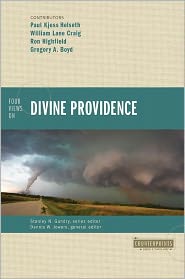
But what to pray?  That God would avert the winds from those we know toward those we don’tDivine Providence.jpg know? From us, to them?  Dare we praise God when our place seemed spared, giving God credit for that, only to find terrible damage done elsewhere?  This stuff is a mystery and we dare not be glib.  If you want to study this question–does God cause all things?  Direct all things? Does God limit His own control?— the best resource came out just recently and shows several perspectives.  It is called Four Views on Divine Providence (in the excellent Counterpoints series) edited by Stanley Gundry (Zondervan; $19.99.) It includes four views, and each author replies to the others, too. What a huge question, what a vexing matter, and what a fine collection of able scholars to argue their respective views.  A lovely last concluding essays looks at the bigger picture, the areas where the authors agree and a bit about the strengths each view carries. 

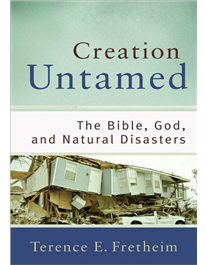
For a serious book that is more specifically about natural disasters and a creational theology, see Creation Untamed: The Bible, God, and Natural Disasters by Lutheran Old Testament scholar Terence E. Fretheim, (Baker Academic; $19.99.)  I appreciate it because it not only is about the theodicy question, but starts with the givens of creation, and the goodness of creation. It may surprise you, challenge you, maybe comfort you.  It is worth reading.

Here are a few blurbs about it.

creation untamed.pngThere is no issue in contemporary faith more vexing than how we are to understand God’s will and action in the event of natural disasters like tsunamis and hurricanes, wildfires and floods. Fortunately for readers, there is no more reliable guide for thinking biblically about these issues than Terence Fretheim. In this thoughtful and compact volume, Fretheim helps us not only to see clearly our own created vulnerability but also to encounter biblical testimony to a God who becomes vulnerable with us.   –Bruce C. Birch, Wesley Theological Seminary

Who better than Fretheim to take up the hard contemporary question concerning the destructive forces on exhibit in creation! The author has spent his life thinking about these issues and reading these old texts forward toward our time and place. He begins with the conviction of the goodness of God’s creation, and from there he launches into the dangers of reality and takes us with him.    –Walter Brueggemann, Columbia Theological Seminary

Terence Fretheim explores the biblical materials to grapple with the devastation of natural disasters. He encourages readers to reconsider their traditional understanding of the relationship between God and suffering. I enthusiastically recommend Creation Untamed to all who want to be honest with the Bible and with life.   –Tremper Longman III, Westmont College

Well, as I sent little notes to friends in the bad weather danger zones—not to mention to a friend whose father died in a plane crash, and another who had a re-occurrence of cancer—I invited them to know God’s presence.  To rest in confidence of the deepest truths we know about the world.  To be attentive to the living and reigning Christ.  I believe in intercession and regular hope for miracles.  Yet, with Irene churning up the coast, all I could muster was to recall that God was with us, nothing more.

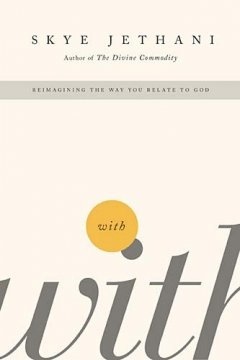
with.jpgI suppose that “with” may have been my operative word in part because it is important to my own heart.  Knowing God’s presence and experiencing God’s daily graces seems most important so we might live wisely and glorify God in all things. Immanuel, God-with-us may be enough.  But it is also because I had just finished a splendid book, a book called With by Skye Jethani (Nelson; $15.99.)  It was an easy read, enjoyable and uplifting.  And it taught me a lot, reminded me of much, and gave a new handle to discuss spirituality and discipleship.  I think many H&M friends will want to get it.  It is very nicely done and, importantly, it really is that helpful.    Let me explain.

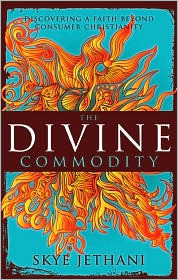
Skye Jethani is a good writer, has been involved in journalism and in public speaking in prestigious venues such as Christianity Today, Catalyst and Q.  He is currently the managing editor of Leadership Journal.  His earlier book was much discussed, critically reviewed, and we pushed it happily a year or so ago, although it wasn’t easy to describe.  It was called The Divine Commodity: Discovering a Faith Beyond Consumer Christianity (Zondervan; $18.99) and it analyzed how late modern consumerism—an ideology of reducing things to commodity, things to be bought, claimed, owned, controlled, used up—influenced the way many of us view religion, God, church life (“church shopping”) and spirituality.  Jethani is nearly brilliant in that meandering book, and many people found it both enjoyable and insightful.  There are even 8divine c.jpg pages of full color plates of Van Gogh paintings that he uses to make his valuable, wise, provocative points.  (Remember what Nouwen did for the story of the Prodigal Son by using Rembrandt?  Jethani isn’t that contemplative and his Van Gogh ruminations are not utterly central to the book, but it is that sort of thing.  Very effective.)  Walter Brueggemann said of it, “This is as good a book on the pervasive power of consumerism as I have read.”  Mark Batterson, pastor of National Community Church, predicted that “this book will challenge your assumptions in a way that will result in deeper-held convictions.”  By using the Bible, church history and his own very contemporary narration (and a lot of well placed and sometimes surprising, wonderful, citations of great books and authors) it invited us to be liberated by surrender; by engaging in spiritual practices with holy imagination we can resist the world’s consumerist/marketing pull which has been distorting faith and church life for at the last few decades, at least. We can be free to know God truly when we stop making God into a commodity.  This is a book that deserves to be known better than it is–it is beautifully written, very creative, expansive and very thoughtful.

I suspect that his new publisher worked hard to get this new book, With, a little less sweeping in its reach and a touch more focused, making it an easier book to describe and a bit easier to read.  This is not to say it is less in
teresting or more shallow.  With carries a subtitle “Reimagining the Way You Relate to God” and one doesn’t get more profound or urgent than that.   In some ways it is a follow up to Divine Commodity, although it isn’t marketed that way.

The new book has two parts and the first part is fabulous—fairly obvious stuff, or at least it becomes so in his writerly hands.  He discusses four traditional ways Christian people have approached their relationship with God.  As you may guess, these four each have some grain of truth, perhaps, but are very fundamentally askew.  Jethani shows why these common styles, styles that are common place and often presumed, need to be rejected and avoided.  Does he step on toes?  You betcha.  Is he nice about it?  Oh my, yes.  This is not a jeremiad or angry book and in no way mocks these sub-Biblical spiritualities.  He is firm.  We need him to be.  But he is pleasant and kind.  As Jim Belcher writes, “Jethani convincingly diagnoses the reigning paradigms of life, with secular or religious, and shows how each one has captured some element of truth but in the end is deficient.”

What are the four failing ways?   You will have to read the four chapters to get the full critique of each but he names them like this: Life Under God; Life Over God; Life From God; Life for God.  Each one sounds good (well, the prosperity gospel of life “over” God seems pretty obviously inappropriate, but he cites well known authors who fall into this posture, and not just the obvious culprits.)  Is it wrong to be “under God”?  Don’t we agree that we should live our lives “from God”?  And certainly I most often talk about serving God, as if we are living “for” God?  You got a problem with that?


Yep, he does.  And it made a lot of sense.  It was, actually, the chapter that most moved me, even if the critique of “doing” for God has been said before.  He tells about mentoring some evangelical college students who live in near despair and how he listens to their pain and it opens up the immense topic of experiencing God’s grace.  That chapter is worth the price of the whole book, especially if you care about young adults.

The chapter describing life “from” God is a further exploration of the themes of consumerism and how capitalism has influenced even how we perceive things of the Spirit.  It isn’t just a reiteration of The Divine Commodity, though, but carries that argument further, with great force and clarity.

And a problem with all of these less than appropriate paradigms is that they tend to inoculate us from the real gospel.  All our God-talk and spiritual energies and our trying and religiosity just backfires, doesn’t work, and creates an ethos in a church or within a person that offers an impression that God is known and life is going well, but it isn’t sustainable.  It is empty.  It isn’t true. 

Well, the alternative to these four distorted models is life “with” God.  And he has four chapters on that, exploring how our “with God” view can help us embody faith, hope, and love.  It is surprising to me that there is precious little about faith, hope and love in contemporary Christian literature (oh, how I love Dan Allander’s book about recovering from hurts of the past, The Healing Path (Waterbrook; $14.99) which, although designed for those who have experienced trauma, abuse or grief, is helpful for any of us who want to recover a deeper sense of faith, hope, love.)  These last sections themselves are, therefore, a very valuable contribution to practices we need, ways of thinking about virtues and character and spirituality that are rooted in these basic Biblical values. 

Skye Jethani gets it right, and helps us along.  His writing is clear, concise, conversational and I believe offersskye.jpg very serious teaching. I hate to say this is a “worldview” book as some don’t find that to be a compelling selling point.  But surely how we think about God, and how God works in the world, and what sort of relationship we have with God is a core aspect of the most basic thing we can know about “life after Eden” (as he describes the human condition in the first chapter.)

With is a fun book, too.  He illustrates a point nicely using The Birdman of Alcatraz, one of the few movies I remember my father taking me to, and he quotes Jerome Berryman’s Christian ed classic, Godly Play.  He quotes letters of J.R. R. Tolkien and commends Robert Letham’s magisterial work on the Trinity.   Any book that uses Surprised By Hope gets my attention, and he throws in an elegant line or two from The Call by Os Guinness.  The last line is from a famous poem of Dietrich Bonhoeffer.  I love a richly written book with great use of good quotes that isn’t difficult but which teaches new content, and reminds us of old truths.  Jethani is a good communicator, and that is important. Missional guru Alan Hirsch is spot on when he says “Skye Jethani writes with a stylish verve, real intelligence, and spiritual depth.”

Here are a few other quotes endorsing the book.  They are all from writers I respect and I’m happy to share this to let you know that this may be worth your time.  I hope you read through them as they capture the strengths of this title.  Why not recommend it for your small group, book club, or adult Sunday school class?  This is a good appendix about discussion With with others, which makes it that much more useful.

with.jpgMade of the stuff of spiritual classics
and presented in simple, contemporary terms, Skye Jethani does each of
us a great service in calling us to reimagine the way we relate to God. 
We so readily fall prey to living out distortions and reductions to
our Christian faith–with disastrous consequences.  You and I are far
more than sinners, consumers, managers, and servants.  We are dearly
loved by God and made for eternal communion with him.  Everything looks
different when we live life in response to God’s love.  Paul
Louis Metzger, Ph.D., Professor of Christian Theology & Theology
of Culture, Multnomah Biblical Seminary and author of
The Gospel of John: When Love Comes to Town

Cleverly
using four prepositions-under, over, from, and for, Skye Jethani
convincingly diagnoses the reigning paradigms of life–whether secular
or religious-and shows how each one has captured some element of truth
but in the end is deficient; Ultimately, they miss the most important
thing-real communion with the living God. Thus utilizing one final
preposition, With, he lays out what it really means to know and
experience communion with God-a life of faith, hope and love–the very
things that we all desperately want and need. This is a helpful,
encouraging, and inspiring book.  Jim Belcher, author of Deep Church

It
doesn’t matter, as old theologians were rumored to argue, how many
angels can dance on a pinhead. But it does matter which preposition
governs your faith – over, after, against, for, from, under, with. Who
knew what huge worlds turn on such tiny words? Who knew what
theological riches were laced into the bones of grammar? Skye has done a
great service to the church. In prose elegant and clear, with insights
keen and deep, he shows how everything changes with just one word:
With. It’s a book I want my whole church to read.  Mark Buchanan, author of Spiritual Rhythm

Who
knew that a preposition had so much influence? Skye’s book will
challenge the way that you think about God and faith digging deep into
our motivations and heart issues. You can’t read this book and not see
yourself and others differently!  Margaret Feinberg, author of Scouting the Divine and Hungry for God

This book will do for our generation what J.B. Phillips, in his classic Your God is Too Small, did for his. With reveals
views of God that can’t satisfy and opens up the possibility for
exploring a life with God that more than satisfies.  Scot McKnight, author of One.Life and The Blue Parakeet, professor of theology and biblical studies at North Park University

Since I dove into With,
I can’t stop thinking about it. Skye Jethani’s insights will change
how you think about God…and you…and how the two of you relate.  Dr. Kara E. Powell, Executive Director of the Fuller Youth Institute 

There’s a good reason why Skye is a senior editor at Leadership Journal…he
writes with a stylish verve, real intelligence, and spiritual depth.
Suggesting that the basic posture that you adopt towards God determines
the quality, meaning, and direction of your life, With is designed to head readers in the right direction  Alan Hirsch, author of Untamed, TheForgottenWays.org

Here is a link to the Q website where Skye gave a great (short) talk “Inoculating a Generation” which we also recommend. It is upbeat and hip, but very profound.  Check that out, watch his keynote talk, and then order the book from us asap.  It will help you reimagine your relationship with God. 

BookNotes
SPECIAL
DISCOUNT
 – any book mentioned –
  
20% off
order here
takes you to the secure Hearts & Minds order form page
inquire here
if you have questions or need more information

Hearts & Minds 234 East Main Street  Dallastown, PA  17313     717-246-3333

 â€¨â€¨

Healing the Heart of Democracy by Parker J. Palmer

I hope you read my long piece last week about the error-filled bombast at The New Yorker et al that linked Francis Schaeffer and Nancy Pearcey to the discredited, fringe, off-shoot of conservative Reformed theology, called Theonomy.  (The writer of said piece, a Mr. Lizza, following others, termed this Dominionism and then in other outlets seemed to implicate any Christian who wants to honor God by serving the public good with Biblically-derived ideas.  Lizza has been lionized by the left and roundly rebuked by the religious.) I offered good links to a few who responded to this woefully ignorant reportage and some of my own ruminations on Schaeffer (Francis and son Frank) and Ms Pearcey, whose books we carry.  We then offered a rather diverse array of books that promote further thinking and talking about all this, resources to have ready as we talk with our neighbors, write letters to the editor, start book clubs and otherwise take steps to put forward a decent, coherent and just understanding of the relationship of faith and culture, religion and the public square, church and state.

I noted that my list is diverse and valuable and a few of the titles are truly brilliant. Is there somebody you might want to forward that list to? I’m confident there are some real winners there.  Maybe somebody should send some to their own local journalists. At the very least, this fine piece on anti-religious prejudices in the newsroom, thoughtful explored by journalist Rod Dreher. It is well worth reading.

THE PROBLEM HAS NOT GONE AWAY

We were a bit ahead of the curve on this most recent chapter of this frustrating story, but it has gone viral–from various quarters—and it hasn’t gone away.  National news outlets and hundreds of prominent blogs, and now an insulting and sophomoric (if cleverly-written) editorial by the–oh my–Executive Editor The New York Times continue to repeat this shoddy coverage of conservative religion. (The prominent Mr. Keller says he is going to ask and then report the answers to “tough questions” about the religion of the candidates and yet he in his inaugural volley repeats like it is some big deal the publicly discredited Schaeffer-Dominionist trope.)  Well, we’ve spoken about that enough for now, which leads me to this remarkable, brand new book.  I’m grateful that a number of BookNotes fans posted my column–it is good to think it maybe helped a bit.

SADDENED

As I indicated in that August “monthly review column” I have been deeply saddened by this angry mocking of conservative religion and the angry push-back by conservatives and nobody, that I know of, admitting they made any errors in judgement.  The ridiculous statements from the secular left are matched by hostility on the religious right.  And many in the middle are muddled—maybe me, too.  So much of it is heartbreaking, and I have used that word knowingly.

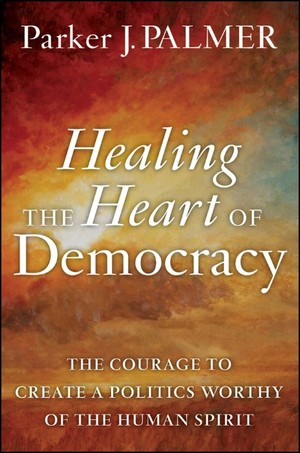
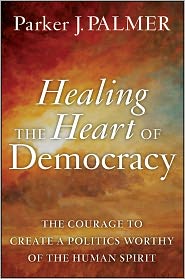
healing the heart of democracy.jpgImagine my surprise, then, when I picked up the brand new book by Parker J. Palmer, Healing the Heart of Democracy: The Courage to Create a Politics Worthy of the Human Spirit (Jossey Bass; $24.95) to find this opening line:

“I began this book in a season of heartbreak—personal and political heartbreak—that soon descended into a dark night of the soul.”

I read twice the wonderfully rich and tender prelude, “The Politics of the Brokenhearted” and it reminded me of an earlier piece he had written in another collection, years ago (which I will mention below) also about heartbreak and citizenship.  Although Palmer started writing this book more than 8 years ago, it felt to me like it was written yesterday.  I’ve had an advanced copy of this for a while, and intended to wait for the right time to pick it up; in fact, I forgot I had it.  In what I assume was an act of gracious providence, I spotted it just a few days ago while looking for something else in my piles, and took it up almost immediately.  It was just what I needed.  And you?  He says it was his hardest book to write.  I think it will speak to many.

I will return to this theme of sadness, but first just a bit of background. You may or may not know about Parker Palmer’s remarkable career, his friendship with the likes of contemporary contemplatives such as Howard Thurman, Gerald May, even Thomas Merton, or his writing about the inner life, especially as it relates to daily living, public life, work, calling, careers.  The Active Life: A Spirituality of Work, Creativity and Caring (Jossey-Bass; $16.95) is a masterpiece, I’d say, and not too long ago a paperback version of A Hidden Wholeness: The Journey Toward an Undivided Life (Jossey-Bass; $19.95) came out in an edition that includes a DVD.  The small, handsome hardback Let Your Life Speak: Listening for the Voice of Vocation (Jossey-Bass; $18.95) is a classic.

The title of his very first book is also a phrase–“in the company of strangers”—which re-appears in this new one, and it is in some ways a revisiting of this early theme, ruminating on the interface of our deepest inner lives and our civic involvement, how we live in public amongst those that may be different than we.  Indeed, this new book is explicitly calling for a “politics of the heart” and invites us to bring our deepest yearnings, emotions, insights, and values to the hard world of data and facts and reason.  This is grounded in some very impressive scholarship about which he has written nicely in the past.

For instance, his famous little book on epistemology and education, To Know as We Are Known: Education as a Spiritual Journey (Harper: $13.99), reminds us that in the Bible (and other great spiritual traditions) authentic knowledge involves head and heart and hands and is always a relational matter; we “know” in ways that are more than just rational.  Yada, the Hebrew word for knowing, is also the word for sexual intercourse and implies so much more than merely an Enlightenment view of mastering facts in our head—relationship, responsibility, and affection.) That wholistic view of knowing deeply–with the heart, as it were—gave rise to a particular view of education and teaching, and he then wrote about that. Palmer became justly famous for The Courage to Teach: Exploring the Inner Landscape of a Teacher’s Life, now in a 10th Anniversary edition (Jossey-Bass; $27.95.) Soon, a book followed it, a collection of serious narratives of people who nurtured learning communities of caring, inspired by the methodology and vision of Courage to Teach simply called Stories of the Courage to Teach, compiled by Sam Intrator (Jossy-Bass; $18.95.)  That anthology showed that all sorts of educators–in colleges, in elementary schools, in seminaries, in prison groups, in senior centers, in doctoral programs, in adult ed study book clubs—could, in fact, teach with the heart.  

CITIZENS OF HEART

Can we, as citizens, like those teachers, embrace this “hidden wholeness” in our public lives?  Can we use our intuitions and feelings and values (and the heaviness of our hearts) as well as are brains to consider political proposals and work with neighbors for the betterment of our polis?  Can we bring our whole hearts to the public square? 

I deeply resonate with this and while it is a different approach and vocabulary than
the historic Calvinism of Schaeffer and Pearcey of which I have written before, it seems to be a healthy next step in that conversation.  With Dutch Statesman Abraham Kuyper (and Schaeffer and Pearcey) some of us want to honor Jesus Christ in every sphere of life and while we resent cheesy accusations of crusading “dominionism” we cannot privatize our faith, marginalize our convictions, give up on our desire to serve the common good by proposing what we think the Good Book has to say about our life together under the sun.  Serious evangelical intellectuals have given us paradigms and methodologies of discerning how best to do this.  We’ve been offered good books that have critiques of ideologies and insights about hermeneutics, ways to imagine the political implications of general Biblical truths, without overstating things and without hubris.

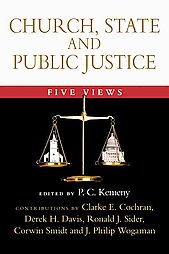
[See, just for instance, the splendid and immensely helpful Church, State and Publicchurch-state-public-justice-five-views-p-c-kemeny-paperback-cover-art.jpg Justice: Five Views edited by P.C. Kemeny ( IVP; $19.00) which shows the general commonality of the discourse despite the very large differences of opinion. Ron Sider’s exceptionally thoughtful and thorough The Scandal of  Evangelical Politics (Baker; $20.00) is another very helpful example that walks one through a set of questions in order to develop some balanced Biblical vision, from which might emerge a political philosophy, from which we might humbly propose some tentative policy points. Or visit the interesting website of the Center For Public Justice, an non-partisan, mostly Reformed think-tank and center for Christian citizenship.]

 
Having done this sort of intellectual work, grappling with a theological worldview and a Biblical perspective on statecraft—yes, it is what Christians do—how then do we embody that, lean into and work for it, walking into the pluralistic culture, alongside our fellow citizens in this flurry of frustration we call democracy?  After the Biblical study and policy discussion, at the end of the day, don’t most people of faith–you and I—just want to serve the common good, make our towns and states and nation a bit better? To be good citizens as the Bible teaches? Love our neighbors, also in our politics?  Here, Palmer’s Healing the Heart of Democracy is wise, kindly, and urgently needed because he is showing us how to reweave the tattered fabric of our communal life and how to “walk on” as part of a commonweal.  He is good at this stuff, how to take next steps amidst tensions.  He is gifted and experienced and truly wants to bring a variety of voices to the conversation.

HOLDING TOGETHER TENSIONS – LIVING IN CONFLICTED TIMES

One of the big points in this book is the need to hold together various tensions, to hear each other out without demonizing one another.  (He tells of people coming to workshops to find common ground on abortion, even,  and although it isn’t easy, such small steps are happening. Some deeply divided communities are working towards some common concerns. His reports from the field of “getting along” and “listening well” are very instructive and should make us glad.)  And, be clear—he shows us not so much how to resolve conflict, but how to learn to live with our deepest differences.  Our religious, cultural and political differences are not going to go away, after all.
 
ph_events-palmer.jpgYou may think that since Palmer is a kind-hearted Quaker, he tends towards sentimental ideals—“Can’t we all just get along?”—and you would be wrong.  Yes, Palmer talks about the centering role of silence and solitude and has a fluency in the mystical traditions, but he is also seriously aware of the ways in which on-the-ground cultural and political differences are real, and can either be voiced in healthy ways or in destructive ways. He was an early student of the civil rights movement and was as anguished as most activists at the upheaval of the last 60s.  He knows much of this in his bones and, I suspect, carries it deeply within him.  Gee whiz, he even tells the story of how Martin Marty apologized for a bad review written in the Christian Century of Thomas Merton’s 1964 Seeds of Destruction when Marty thought that Merton was being needlessly flamboyant in his prediction of the racial wars to come. Who knows this kind of stuff except those who had their ear to the ground and their heart on their sleeve in those hard years?)

To suspect Palmer of romantic, genteel idealism is understandable—let’s face it, this is not The Art of War or a pragmatic guidebook in the spirit of Karl Rove (or Saul Alinksy, for that matter.)  But Palmer is politically savvy and street smart and considerably chastened by the stuff he has seen while pondering, acting and mentoring public figures over most of his lifetime.  A few of the great stories in Healing the Heart… are about political activists, legislators, people in positions of influence, as they struggle to follow their hearts, living out their deepest beliefs in their offices.

As an organizer and advocate for social change Palmer is not unrealistic when he reminds us that good conversation, art and poetry and empowering education can help us. (He is, more than anything, a teacher, after all.)  The right art and practicing attentiveness to it helps us become people who are deeper, who can host differences, live into tensions and conflict, and be decent with others, showing hope and grace and goodness. This “liberal arts” view is not silliness, not at all.  And to bring such art and poetry into our own interior selves, well this is transformative.  This focus on the heart, and being in touch with our sadnesses, is not poppycock.  Palmer argues here that it is essential work not just for personal wholeness and health, but for serious citizenship. 
 
HABITS OF THE HEART — AT THE LOCAL LEVEL

No it is not poppycock or sentimentalism. After all, it was the famous French scholar Alexis de Tocqueville (who Palmer cites often) who coined the phrase “habits of heart” and insisted that Americans need some way to keep these character traits of virtue alive if democracy is to survive.  Palmer’s wide-ranging study shows how our habits of heart might be more intentionally nurtured in order to fund a robust, fair-minded, and truly effective local civic life.
The notion of a “local” “civic” life–civil society, mediating structures, third places and such–is not new but Palmer explores it here as nicely as in anything I’ve read in recent years.  He extols third places, invites us to think about the “pre-political” and promotes the development of trust-building dialogue groups. (My friend Steve Garber of the Washington Institute on Faith, Vocation, Culture, who hosts discussions about living passionately as Christians in various career areas in what he calls Vocare groups, creates space for what he terms “conversations of consequence.”)  Palmer says such meaningful conversations happen best in “circles of trust” and then surprised me with a funny footnote about the Robert DeNiro character in Meet the Parents.)  Interestingly, he even has a section about how trust-building citizenship enhancing communities can form even on line. The dude is ov
er 70 and affirms ways our social medias can help create healthy civic discourse! 

DEEPENING THE AMERICAN DREAM

I noted that Palmer started his career thinking about public life.  Indeed, I have a series of papers he wrote about how higher education might speak to the cultural crisis of the early 70s, published by the National Council of Churches, and an early book of his was about civic life.  He then became known in education, wrote a book on calling (inspired by his sense that the best teachers worked from their heart because they viewed their jobs as a holy vocation.)  He has written several books about spirituality, contemplation in a world of action.  Last year he won the prestigious William Rainey Harper Award (that has previously been awarded to Margaret Mead, Paulo Freire and Elie Wiesel.)  Earlier this year he co-authored a book on how college life might be enhanced through “collegial conversations.”  

As writer and “public intellectual” Palmer has never been far from politics, though, and has recently been behind the scenes networking people to ask big questions about our own dreams for a new politics, finding common ground, talking genuinely about our differences. He has helped organize a couple of conferences on this topic through his work as Senior Partner of the Center for Courage and Renewal.

We had the wonderful opportunity to sell books for him at a very lovely gathering a few years ago (at the prestigious National Press Club in Washington DC) that included a number of excellent speakers, addressing these exact themes. (One of the highlights of that event wasdeepening-american-dream-reflections-on-inner-life-spirit-mark-nepo-hardcover-cover-art.jpg meeting Vincent Harding!)  That conference actually celebrated a book edited by Palmer’s friend, Mark Nepo entitled Deepening the American Dream: Reflections on the Inner Life and Spirit of Democracy (Jossey-Bass; $24.95.)  Some of the distinguished authors in that good volume include Gerald May, Jacob Needleman, Elaine Pagels, Robert Inchausti and Robert Bellah. What Palmer introduced in his important essay in that collection, the one about a politics of the broken heart, comes to full flower here.  That anthology was important but this new book will truly help us reconnect who we are with what we do, and how we do it— yes, even in these heartbreaking times of culture wars, loud accusations, and divergent worldviews clashing in the public square.

I like how Mr. Palmer describes democracy as having an “ecosystem” and he describes it in suggestive ways that made me think. One chapter is called “The Loom of Democracy” and in another chapter he has a sub-heading “The Promise of Neighborhoods” with both images indicating his concrete vision, his down-to-earth hope that we will be busy, doing the work of citizenship, day by day. This truly gets beyond the most obvious partisan distinctions—he celebrates the “little platoons” of Edmund Burke and invites us to resist the “decline in public life” by banding together with friends to be more involved in local happenings.  His citations of Bill Moyers, and Robert Putnam, poets Walt Whitman and Emily Dickinson, or social critics like E.F. Schumacher, may appeal to those who slide towards the political left but his extensive use of Abraham Lincoln may make allow this book to become a considered recommendation for conservatives, as well.

LINCOLN’S MELANCHOLY

It is commonly agreed that in the Second Inaugural address Lincoln invited us to some of the most generous and profound ideals, delivered in some of the grandest eloquence,  in our nation’s history so this isn’t anything to roll one’s eyes about–it is wonderful primary source stuff he is citing, substantive and momentous. (He cites some other, lesser known Lincoln speeches as well to wonderful effect.)  Palmer plumbs this material well and it is more than inspiring, it is a clarion call to renounce our current culture wars and incivility and with great intentionality, to forge a better way.


lincolns-melancholy-how-depression-challenged-president-fueled-his-joshua-wolf-shenk-paperback-cover-art.jpgIt is not just a matter of passing interest (although it is very interesting) that Palmer draws significantly on the award winning study of Lincoln’s depression,  Joshua Shenk’s Lincoln’s Melancholy: How Depression Challenged a President and Fueled His Greatness (Marainer; $14.95.)  Mr. Palmer takes heart that this sad, great man was able to so ably lead our broken nation.  This is a key to the book: it is our broken-heartedness that we must bring to the table. We must do inner work to be in touch with our disappointments and pains, and such self-awareness can drive us to honor the disappointments in others.  As we tend to the heart of the matter, often the broken heart of the matter, we will be more humane, more kindly, more insightful, and more resolved to do the good work of building civic community, long before we enter the contentious field of partisan elections or policy disputes. As in his other books he draws a fairly direct line from “inner liberation to outward transformation.” 

As I write about this here it sounds nearly like shallow psycho-babble, new-agey pablum, but Mr. Palmer is too astute to allow for cheap solutions. If you are inclined to psychological language, I suppose you will love this book.  Few have brought the psychology and interior lives of our selves and our neighbors into the public arena quite so well.  However, please do not let any presumption that this is silly or mystical dissuade you from getting this book. Business writer Peter Block calls it “fiercely realistic.”  Again, he is drawing on Abraham Lincoln. He quotes Reinhold Niebuhr’s The Irony of American History published by University of Chicago Press, for heaven’s sake.
 
The subtitle of this work is important.  Palmer invites us to summon “the courage to create a politics worthy of the human spirit.”  He believes this happens, mostly, as I’ve suggested, at the local, “pre-political” level, and it does, in fact, demand courage.  It is not a small matter to be in touch with our own fears and foibles and to be gracious about them as they appear in our fellows.  Good citizenship, though, demands that we listen to our hearts, and listen to the hearts of our neighbors.  Not only does this take exacting inner disciplines, but it demands a sense of place.  We must listen to our neighbors, our neighborhoods, our land.  We need a multi-faceted, perhaps less dramatic, view of our civic involvement.  Being a good citizen includes so much more than merely showing up to vote every so many years or sending off an electronic petition. We must be invested in the real, human infrastructure, care about the membership of the commonwealth.  Does it surprise you that Mr. Palmer quotes the farmer poet from Kentucky? 

Palmer tells many great stories throughout the book.  It is not mysterious or recondite but when it even verges on sliding into an overly abstract view, he reminds us of our common ground as humans by telling a good story.  And the stories are often fabulously inspiring.  A few are fairly mundane, and they are as good as the ones, say, from the civil rights movement, that are more dramatic. 
(Ahh, the story he tells of why an African American Sunday school class at Koinonia Farms used Roberts Rules of Order is so illuminating!)

default.png

Healing the Heart of Democracy by Parker Palmer is a book about good folk who care to be in touch with what they most surely know, from paying attention to their wounds, their fears, their places, their community (or lack of community.)  And who care to know how to talk about that with others, who, carrying their own hurts and needs and fears, may have very different values and proposals, with both sides fearful and angry with each other. This is not easy work and it doesn’t lead to simple answers. We need to tell our stories, but that is only the beginning; we live in a harsh world of power and money and injustice and duplicity and he knows it.  Such “heart work”  is, nonetheless, the only hope for sustainable steps forward for our civil union.  To help us get there he offers a brief “theology of hospitality.”

Parker P.jpgHealing… is a book for our times, needed always, I suppose, but certainly now. (Yes, certainly, this very week!)   It is a book local groups should read,  study, talk about.  It has at times a tone of spirituality and of course talks about the heart, the core of our being, our deepest sense of our identity and such but it is not sectarian and could be shared with nearly anyone.  His anecdotes and stories tend often to arise from progressive movements for social change (like the Highlander School who taught Rosa Parks and countless others in civil rights organizing) and he tells examples of community organizers, those working with the disenfranchised, or farmers resisting the lures of agribusiness.  These are worthy of great consideration and I hope that no one is turned off by his tendency to hold up such remarkable examples.
 

Yet, clearly, again, this is not about how to work for the Democratic party or some lefty progressive faith movement and he is as even-handed as he can be.  This is about democracy.  It is about America.  It is about the real tensions of our current civic lives and the need for new approaches—literally newly found places (he even mentions malls)—to make democracy work at a local level.  It is about reclaiming safe public space for democratic conversations of consequence.

It is practical, but it is not a handbook; there is no blueprint. It is a reflection, a call, a rumination. And at times it is truly wondrous. the 

For instance, he writes,

America’s founders realized that generation after generation of citizens would need to stay in the action lest the political movement they planted whither and die.  So they built opportunities for continual renewal into democracy’s infrastructure…  As the journalist Jon Meachum observed in his review of Joseph Ellis’s American Creation

How to live in a tragic milieu and yet strive toward triumph….was a consuming concern for the founders, who, led by James Madison, made a virtue of creating competing centers of power within the constitutional structure… To transform disagreement from a natural source of strife into a source of stability was a crucial insight, and is arguably the great achievement of the Constitution. What frustrates the passionate about America—its creaky checks and balances, diffuse sovereignties and general aversion to sudden change—is, Ellis argues, what makes possible the triumphs we do manage to pull off.

BROKEN-OPEN HEART AND SLOW POLITICS

Can we pull it off, some slow, small triumph of democracy working?  Again, Palmer says that he wrote this book in a time of sadness and that our own wounds might be that while will help us get beyond hurt and fear.  I think of the famous text in Jeremiah that says our own shalom might come when we give ourselves to our political enemies; in their blessedness (which we are told to seek) we find our own blessedness.  That comes close to what this book is about: our own hurts might be healed even as we are honest about them, thereby opening the possibility of attending to the foibles of another.

Palmer puts it better than I can, and reminds us that talk of such “politics of the broken-hearted” has been heard before.  He writes,

The broken-open heart is a source of power as well as compassion—the power to bring down whatever diminishes us and raise up whatever serves us well.  We can access and deploy that power by doing what every great social movement has done: put time, skill, and energy into the education and mobilization of the power of the heart.  As history consistently demonstrates, heart talk can yield actions just as practical as those driven by conventional forms of power.


I know this sounds a bit mushy.  For some of our readers, it sounds a lot mushy!  I think it is fascinating how he explains the differences between a heart that is broken with some proper attention and good grief and thereby broken open (ahh, I think of that line in Bruce Cockburn’s Last Night of the World) and a heart that is shattered, which does not allow for greater awareness or compassion or understanding. 

Palmer maintains that “the heart has always been a driver of politics, a source of inner power that gets harnessed for ends that range from good to evil.  That power is amplified and released through the experience of heartbreak. But the kind of power generated depends on how the heart breaks—and the elasticity that allows it to break open instead of apart comes only through the exercise of democratic habits of the heart.”

Again, he is drawing on Tocqueville insisting that this attention to our formation of habits of citizenship create the “inward and invisible infrastructure of democracy.”  In a few specific chapters he shows where and how that can happen in places such as schools colleges, and universities, classrooms and congregations.  (He even happily commends author appearances and book studies are neighborhood bookstores!)  As I’ve noted, he affirms spaces with small face-to-face circles, but he also has come to explore certain forms of virtual communities as well.  These human scale settings can “resist the deformation of the mass media” and allow us to “find the sense of voice and agency that citizenship requires.”


The voice and agency that citizenship requires.  Can we find this, in humility and common grace?  Even in these polarized times, where most of us have some frustrations with others, some of us with huge resentments, many of increasingly falling into the habits of caricaturing our opponents, never giving others the benefit of the doubt, presuming the worst of those with whom we disagree, we must learn to ask ourselves why we are this way.  Can we summon what Lincoln on March 4th 1861 called “our better angels”?

 AsAbe Lincoln.jpeg Palmer reminds us,

At the moment Lincoln spoke, with the nation on the brink of such massive violence, his hopeful words about “angels” must have seemed like a futile gesture, and a p
itiful one at that, a thimbleful of oil tossed onto a raging sea in the vain hope of calming it.  Still, it was exactly the kind of moment—a moment of hopelessness that presaged many more of the same—when only hope deeply rooted in a broken-open heart can see us through.

Parker Palmer then quotes Lincoln himself, in the glorious passage from which the famous phrase comes:


We are not enemies, but friends. We must not be enemies. Through passion may have strained it must not break our bonds of affection. The mystic chords of memory, stretching from every battlefield and patriot grave to every living heart and hearthstone all over this broad land, will yet swell the chorus of the Union, when again touched, as surely they will be, by the better angels of our nature.

BookNotes
SPECIAL
DISCOUNT
 – any book mentioned –
  
20% off
order here
takes you to the secure Hearts & Minds order form page
inquire here
if you have questions or need more information

Hearts & Minds 234 East Main Street  Dallastown, PA  17313     717-246-3333

A new long essay is up at the monthly review column.

A new long piece is up over at the monthly column at the Hearts & Minds website, archived under “August 2011.”  I usually do a longer review there, a big list or a rambling reflection naming lots of authors and books in passing.  This month I shared my involvement in a bunch of facebook and website debates, and finally list a whole batch of books about civic life, books I really like.  They are all offered at a good 20% discount, too.  

Here is how it starts, slowly—I hope you read the whole thing:

I actually wanted to write about two other topics these past few days–we just got the new Richard Foster book on meditation called Sanctuary of the Soul: The Journey Into Meditative Prayer (IVP;
$16.00 hardcover) and there have been some other good spiritual
formation titles lately.  And, although I’ve mentioned Mark Noll’s
amazing Jesus Christian and the Life of the Mind (Eerdmans; $25.00 hardcover) in a Comment review,
I wanted to highlight it here at BookNotes.  I’m pretty eager to run
through a batch of new books and will do that soon.  Now, though, I’m
feeling a bit off-center, confused, needing to write about something
else.
confusion.gif
                                                                                                     Confusion by Jeanne Curin.
I
feel like I should offer a few resources that will help us navigate
through the rough waters of our political and cultural conflicts, waters
that got me a bit sea-sick this week.  The culture wars are hitting
hard these days and while I mostly want to be a conscientious objector
in these battles, my fingertips were kept busy this week posting on
various websites, blogs and threads of facebook conversations.  It has
made my heart heavy for various reasons.  As I wrote to one friend, it
is disheartening to try to entry a discussion as a voice of moderation
and reason and end up making matters worse and getting all irritated.   

Here’s
the backstory and a few books that I think are important, wise,
balanced and helpful to understand this exact sort of conflict about
religion in the media, the ways evangelicals are construed, and the
questions about how to be civil and fair even as we advocate for a
pluralism that values a variety of voices, left, right and center,
religious, secular or neither.

* * *

Well, I have a lot of links there to a number of great articles about how The New Yorker, in anewyorker-logo.jpg story about Republican candidate Michelle Bachmann, wrongfully linked Francis Schaeffer, a hero of mine whose books and ministry influenced me immensely, and Nancy Pearcey, a friend of mine whose books I admire, to a fringe and weird group called the Theonomists; the author of the piece called the “Dominionists” which is another phrase some use, although not what the Theonomists call themselves.)  Yes, that’s the odd ball movement founded by R. Rousas J. Rushdoony, wanting to “reconstruct” American life–well, maybe not now, but someday, maybe–around the principles of the Old Testament civil codes.  Nobody takes them seriously, but a dozen major media outlets passed on this stupid trope that Schaeffer and Pearcey were part of that.  It went viral and hundreds of mostly left-wing bloggers were all exclaiming about these horrid folks advocating violent take-over of the government. NPR then interviews Mr. Lizza, the author of the piece and he dug himself deeper, suggesting that it is unacceptable for people of religious convictions to allow their faith to shape their public lives.  Keep it in the church, folks. (You can read it yourself; I’ve got the link at the column.)   Misquotes and distortions abounded about Schaeffer and Pearcey, again.  I swam into it a bit, offering comments there and there. It wasn’t pretty.  Joe Carter at First Things called ’em out and it is tart and right. You’ve got to read his two piece, so I give ya the links. 

As I say in the column, I’m not interested in Michelle Bachmann much, but, as I also explain in the column, I am interested in Francis Schaeffer and in honest journalism and how evangelical faith is seen in the public square.  I took all this pretty personally this week, and the on-line discussions didn’t go all that well.  It has been wearying, and I thought of books I wanted to mention, from books about the religious tone-deafness of much of the media— a brilliant book, actually, Blind Spot: When Journalists Don’t Get Religion edited by Roberta Green-Ahmanson, Paul Marshall and Lela Gilbert (published by Oxford University Press) to one of the most important books of the year, American Grace: How Religion Divides and Unites Us by Robert Putnam (Simon & Schuster), the famous sociologist who wrote Bowling Alone; from David Koyzis’s brilliant and essential-for-understanding political ideals, Political Visions and Illusions ** (IVP) to Bill Kauffman’s spectacularly interesting road-trip throughout America, telling of movements that want to secede from the Union, or at least break up their states a bit (like in New York.)  That heckuva great read is called, cleverly, Bye Bye Miss American Empire (Chelsea Green Press) and will do two things for you, at least (besides inform you about a whole bunch of history you most likely didn’t know.)  It will introduce you to some of your odder neighbors, which is always a good thing.  And will help you realize that folks who seem a little off the beaten path are not necessarily scary and ought not be demonized, like the Lizza NPR piece on the “exotic” influences of the likes of Francis Schaeffer.  You want exotic?  Kauffman knows exotic.  And he is pretty sane.  He’s about caring for your community, staying put, being local, sort of a wise-cracking Wendell Berry.

**I just saw a blog that wrote as if it was some nuclear disaster and some stunning revelation, that Ms Bachmann, because of Schaeffer and Pearcey,  doesn’t “believe in the Enlightenment.”  Well, how about that?  And those guys aren’t even close to being post-modernists.  That faith in science, brutality of the French Revolution, smashing the church stuff didn’t work out so well after all.  If the writer knew even a little of the roots of Western culture, like the ideas that Koyzis so insightfully explains, they wouldn’t embarrass themselves with such pointless alarm.

I end up mentioning a bunch of books I swear you won’t find on one single page anywhere else on the whole world-wide-web.  Or in any bookstore in America, I’d bet.

Public Faith Volf.jpgSure, I explain plenty about Schaeffer and Pearcey but I also highlight titles that will help us navigate these culture wars waters in the months to come, and I’m not just trying to be clever, pushing Kauffman and the weird new thesis of D. G. Hart on why evangelical conservatives are really not conservatives.  This is urgent, important stuff.   We really need books like the new Miroslov Volf , A Public Faith published by Brazos, and books like A Purple State of Mind by Craig Detweiler (Harvest House.)  I suppose it will come as no surprise that I again recommend Os Guinness’ rumination on the first amendment in his splendid and nicely written Call to Civility: And Why Our Future Depends on It (HarperOne) a book that I think is really helpful as we talk about faith, the separation of church and state and all that.  For the journalists who don’t know what their talking about I list a very helpful survey edited by Hall of how Calvinism influenced Western culture; that’s a great book, too.  And I celebrate a really interesting new memoir about a child raised in the rigors of an activist religious right family.  It’s called Raised Right by Alisa Harris and will be released in a few weeks.  It is amazing and very enjoyable.

Please do visit the monthly column.  Sorry it is a bit long.  Thanks for allowing me to share my discouragement, tell the tale of the internet debates this week, and offer our suggestions for ways to be more aware and more fair.  I hope you enjoy reading it. Send an order or two our way if you can.
 
 Just click here to read. After the essay and the book list, there is the easy to use order form link.

Hearts & Minds 234 East Main Street  Dallastown, PA  17313     717.246.3333

Schaeffer, Pearcey, The New Yorker, and American Grace (and other good books on faith and the public square.)

I wanted to write about two other topics these past few days–we just got the new Richard Foster on meditation called Sanctuary of the Soul: The Journey Into Meditative Prayer (I(VP; $16.00 hardcover) and there have been some other good spiritual formation titles lately.  And, although I’ve mentioned Mark Noll’s amazing Jesus Christian and the Life of the Mind (Eerdmans; $25.00) in a Comment review, I wanted to highlight it here at BookNotes.  I’m pretty eager to run through a batch of new books and will do that soon.  Now, though, I’m feeling a bit off-center, confused, needing to write about something else.

confusion.gif
                                                                                                     Confusion by Jeanne Curin.
I feel like I should offer a few resources that will help us navigate through the rough waters of our political and cultural conflicts, waters that got me a bit sea-sick this week.  The culture wars are hitting hard these days and while I mostly want to be a conscientious objector in these battles, my fingertips were kept busy this week posting on various websites, blogs and threads of facebook conversations.  It has made my heart heavy for various reasons.  As I wrote to one friend, it is disheartening to try to entry a discussion as a voice of moderation and reason and end up making matters worse and getting all irritated.   

Here’s the backstory and a few books that I think are important, wise, balanced and helpful to understand this exact sort of conflict about religion in the media, the ways evangelicals are construed, and the questions about how to be civil and fair even as we advocate for a pluralism that values a variety of voices, left, right and center, religious, secular or neither.
newyorker-logo.jpgLast week the prestigious The New Yorker magazine wrote a long, critical piece on Michelle Bachmann, followed by the author of the piece doing an interview on NPR (“The Books and Believes Shaping Michelle Bachmann” which distorted the nature of Bachmann’s religious influences and oddly expressed dismay that some Christians believe their religion should inform everything they do, rather than be limited to churchy stuff.  What followed felt like a firestorm—well, it seemed like a firestorm, but, to be honest, it was mostly a few voices trying to cry out in the wilderness, my own among them, that were mostly ignored by the The New Yorker editors and the many other places that picked up the story.

The author, Mr. Ryan Lizza, said Michelle Bachmann was influenced by one of my heroes, Francis Schaeffer, and one of my friends, author Nancy Pearcey.  Not bad press, being mentioned in one of the world’s leading literary and news journals and my beloved NPR.  

However, Mr. Lizza went way beyond the obligatory note that this could be construed as having some connection to the Christian right (it is no secret that the congresswoman is a conservative Lutheran evangelical and politically right-wing) raising some alarming specter of some group he (taking a cue from other journalists, making way too much of a weird thing) called the “Dominionists.”  This group, the godfather of which is R. J. Rushdoony, is not new to those of us familiar with conservative Reformed circles, although they actually call themselves Theonomists or Reconstructionists.  (“Dominionist” is a confusing phrase since many Christians of all sorts have developed a theology of culture based on the primordial mandate to “take dominion” found in Genesis 1 but it is used now as a pejorative to apparently de- legitimize proposals from those with faith-based motivations, as if they are the only ones wanting to have influence and their public contributions are, ipso facto, duplicitous.)  So, yes, there are those who want to impose a theonomy or reconstruct the culture along principles gleaned from the Hebraic law.  And, yes, they could be seen as parallel to the very real Afghani Taliban but that would be silly since their influence is virtually nil and even among themselves, they don’t tend to agree on what, if any, steps they should take to bring God’s law into the law of the land.  They tend to (in various ways and in various nuances of application) believe the Old Testament law should be the basis for civil law, or perhaps should be some day.  Importantly, they are widely denounced by nearly everybody who is half-way normal, including nearly anyone who has had any significant influence over serious policy thinkers in recent years.  They are unimportant, routinely renounced (when they aren’t being ignored) and fringe.  To say that Francis Schaeffer or Nancy Pearcey are “Dominionists”, and believe in the violent overthrow of the US government (which even the Theonomists-slash-Dominionists do not) is beyond irresponsible, it is blatant slander.  To add to the insult, it then makes most conservative Christians look bad, as if there is something inherently dysfunctional with orthodox religion, the old “guilt by association” racket.  This is a little of what our decent Muslim friends feel, I’m sure, when anyone Islamic (or even anyone Arab) is seen through the lens of our fear of terrorism, judged unfairly.  And it is somewhat what motivates some of new Protestant liberals like Spong and Borg and Gulley: they create their new versions of faith in reaction to the very worst caricatures of the far right. But that is for another day.)

Let me be clear that I don’t care at all right now about Michelle Bachmann, let alone  Governor Perry from Texas.  I do care about irresponsible journalism and I really care when they misrepresent people I have been influenced by, whose books we sell, and people that I care for.  One need not agree with all of Schaeffer’s history nor all of Nancy Pearcey’s philosophy to want them to be understood properly.  And Lizza botched it big time.

FRANCIS SCHAEFFER’S WORTHWHILE BOOKS
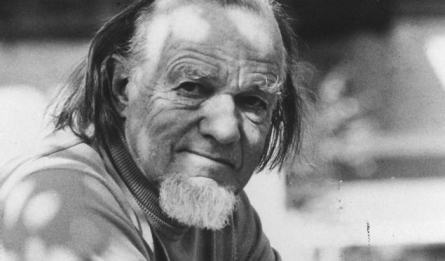
francis_schaeffer.jpgWhen I worked in campus ministry in the 1970s I showed the documentary that Bachmann says  that she saw, the ten-part film series How Should We Then Live?, and I showed it more than once. (We still sell the DVD— here is a sample of part of his lecture on the Middle Ages—and gladly recommend the book.)  It led to remarkably fruitful conversations, about
how history gets written, about how to study the social context of art and architecture, about the strengths and weaknesses of the Middle Ages, whether the Enlightenment project of rationalism was ultimately a helpful shift in Western culture, and how to think wisely as we discern the currents flowing through Western society and whether the American dream of “personal peace and affluence” is a morally sustainable value system.  The DVD and book is still a great overview of Western history, and his earlier works—The God Who Is There, Escape From Reason, Pollution and the Death of Man, or his lament-filled study of Jeremiah, Death in the City–remain some of the most influential books I’ve ever read.  We still sell a few of his wonderful little Art and the Bible from time to time.  True Spirituality is a fine work, one that resists any overly-gnostic tendencies, insisting that the work of the Holy Spirit happens moment-by-moment, in not too dramatic measures, in daily life, not in any super-spiritual, mystical ways.  His little volume The Mark of a Christian reminds us that after we make the best case exploring the presuppositions of Western thinking, reject the idols of reason and romanticism, embrace the absolutes taught about God and shown in God’s creation, we still must, finally, love.  The “final” apologetic, Schaeffer insisted, was love.  The anguishing shot in How Should We Then Live? of Schaeffer holding disgusting shackles that slaves would be forced to wear, and declaring that the church failed to adequately speak out for human rights, is still a powerful memory for me, a good illustration of what he meant.  

For Schaeffer to be so misrepresented was frustrating, to say the least.

NPR
And then, in the Lizza NPR interview which was also being posted and tweeted and passed around, warning the nation about the dangers of Schaeffer and his ilk, Lizza nearly implied that anybody of historic orthodox faith is a fanatic, maybe dangerous for the public order.  As I noted, he seemed dismayed and resentful that any Christian would want to take their faith into their public life. My friend Keith Pavlischek, who wrote a book about important Catholic political theologian John Courtney Murray, noted that Murray used to say that secularists wanted to “keep the church in the sacristy.”  

I’m sure you can see why that just gets my goat. I hope it gets yours.

So, I linked at facebook and tweeted the firm rebuke of the New Yorker misquoting of Schaffer written by Joe Carter over at First Things. It is interesting, well documented, and worth reading. It is called “A Journalism Lesson for the New Yorker.”

And then I posted Carter’s next reply, “Dominionismists – The New Birthers” where he responds to the “regrettable silliness” in the much-forwarded Michelle Goldberg’s Daily Beast piece, of which he says “this dominionism nonsense is about the stupidist trend to come along since Birtherism…. I have to give her credit, though. I thought on this topic it would be difficult to produce an article less informed and more slanderous than Ryan Lizza’s embarrassing New Yorker piece.  But when it comes to lowering the bar, you really can’t beat Tina Brown’s Newsweek/The Daily Beast.  So kudos for your remarkable achievement, Ms Goldberg: You’ve written the dumbest article I’ve read all year.”

Okay, Carter is fairly highbrow and doesn’t get out much, I guess.  I could forward him a lot of dumber articles.  But, still, this is about the legacy of Francis Schaeffer and whether evangelicals should be involved in the public square, so I’m all in.  Dare we as people of faith speak of faith in the public square? Should we be embarrassed if we found Schaeffer’s work appealing?  Could our own unique convictions actually be a balm for the common good?  Must others of other faith commitments compartmentalize their faith, too, leaving it at the door of the workplace, the university, the voting booth?  It seems that this is what Goldberg and Lizza and their many fans–whew, you should read the vitriol on the left-wing blogs– are demanding.  And this is frightening for any pluralistic social order.

NOBODY  EXCLUDED
At some point, we have to back up and insist that no-one’s faith-based motivations or formulations dare be excluded from the public square (not fundamentalists, not liberals, not Muslims, not atheists, not creationists, not Marxists, nor anybody else!)  The pressure of modernity, of course, is to marginalize faith.  Many liberal opinion leaders seem to have a particular antipathy about traditional religion (as do some rank-and-file liberals, too: in a recent informal survey, nearly every liberal polled indicated that they would be willing to censor conservative authors with whom they disapprove.  Yikes!)   As Stephen Carter once said, it seems that liberals often want to treat religion as if it were a hobby akin to collecting stamps or building model airplanes.  Which is to say, keep it to yourself since it is, de facto, idiosyncratic and irrelevant. Those of us who hold to the core Christian creed that Jesus is Lord simply must bear witness to that, in all we do, also in our (humble, bold) politics.  We have not done a good job of this — see the very important UnChristian: What a New Generation Really Thinks about Christianity and Why It Matters by David Kinnaman and Gabe Lyon (Baker; $18.95) for how younger adults are turned off by right wing impressions given off by legalistic religion — but be that as it may, the intellectual gatekeepers have no business distorting the facts about our foibles. (Yes, the truth itself is sometimes bad enough!)  Again, Francis Schaeffer was no Theonomist and nobody cited in the Lizza piece called for violence against anybody.

NANCY PEARCEY ON WORLDVIEWS

Nancy Pearcey Saving Leonardo Google for Blog 1.jpgI was glad to see Nancy Pearcey reply to the accusations about her and I linked at my own facebook to the important explanation of worldviews offered by her at Human Events. Her essay is called  “Dangerous Influences: The New Yorker, Michelle Bachmann, and Me.” To explain what Lizza made murky she mentions the Dutch philosopher Herman Dooyeweerd, for crying out loud (as does the Wikipedia site about Francis Schaeffer) which has no relationship to the far right.  I “liked” her piece and more trouble ensued.

(I was scolded there by folks who were quickly posting, irked that I wanted to change the subject away from their rather mean-spirit and generally random comments, poking snark at those who care about global warming or complaining about Obama.  Indeed, I did want to reorient the thread, wanting to shift from blaming the left (got that), The New Yorker (done), or even other secular humanists for their inconsistencies—they want to stop conservative Christians from allowing their values to shape their political work, but they themselves sure seem to want to work for “dominion” guided by their values, (fair enough), to actually talking about what Pearcey wrote. I wished her readers would respond to her explanation o
f how worldviews must be understood to really “get” where others are coming from—this is an important contribution.  When one guy insisted that if “humanists” had power, “they would kill us all off” I realized I had entered some pretty scary waters.  A young friend who has been paying attention to this stuff in recent months, who I helped spiritually years ago, admitted he had had it with this dreadful sort of talk, he admitted that Voltaire and his animosity to any religion was beginning to make sense.  And I just wanted to cry.

The way in which the “Schaeffer is a Dominionist” trope was picked up all over the internet, repeated by a dozen major outlets within the day, and hundreds of blogs and tweets, was an example of the astonishing speed and power of the internet, an example of this thing we call “going viral.” Ugh.  And, sure enough, within a few more days, more mainstream news columnists began to repeat the dishonest meme: Bachmann hangs out with religious nuts who want to overthrow the government. That advocate violence against abortion providers.  That don’t believe in any separation between church and state. That are linked to this cult-like “dominionism.” Blah, blah, blah.  One misinformed piece slandered Pearcey (who believes in principled pluralism) by saying she taught that only Christians should be in positions of influence.  Nonsense!

I can’t imagine how Nancey must feel, knowing that such widely-read reports have said suchNancy Pearcey.jpg disturbing things about her views.  Heck, I feel badly since we carry her books.  If they said that stuff, we wouldn’t promote them, that’s for sure.   One person, well intended I’m sure, reminded us of Jesus’ own command to rejoice when people say bad things about you, but I somehow couldn’t muster the faith or attitude.  I care about what people think about the vision we share here, the books we carry, the God who we try to represent and glorify.  I hate it when people are accused falsely, whether it is some of the far right saying scandalous things about Obama or whether it is the mainstream media saying unfair things about Schaeffer and Pearcey.
Of course, so much of this indicates the way in which many in the media are simply ill-informed about religion, don’t know who evangelicals are, and don’t seem to want to understand us, either.  (Lizza refers to the “exotic” nature of Bachmann’s religious influences.  Really?) One of the best pieces about this, giving good facts about Schaeffer and Rushdoony, is written by Barry Hankins, here. (Note Hankins’ excellent book on Schaeffer, mentioned below.)

SCHAEFFER CO-OPTED BY THE CHRISTIAN RIGHT
Schaeffer was eventually co-opted by the Christian right, quoted by conservatives who hadn’t read his earlier work and wouldn’t have cared about the things he most cared about.  In the last years of his life he was dying of cancer, too, and that may have altered his typical clarity; I don’t know.  There is no doubt that the current religious-conservative movement includes leaders who have been influenced by Schaffer to one degree or another.  Francis and Edith’s disapproving soncrazy-for-god.png Frank Schaeffer has told that story, embellishing it a bit, I gather, in the controversial memoir Crazy for God: How I Grew Up
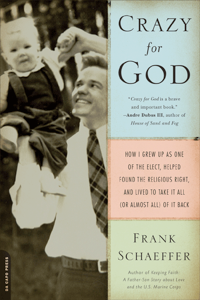
as One of the Elect, Helped Found the Religious Right, and Lived to
Take All (or Almost All) of It Back
and the recent, riveting (and also contested) Sex, Mom and God both of which, characteristically, it seems, to this big-ego angry son, suggest that he nearly single-handedly started the Christian right and the evangelical wing of the anti-abortion movement.  It is obvious that some folks who identify with the Christian right or the Tea Party, have been inspired by Schaeffer’s final book or two; Frank now regrets that profoundly and is speaking out against his father and his own detrimental role in those years.  The elder Schaeffer did shift from art and political and cultural evaluations as he ministered to the counter-culture in the early 70s to more political matters in the early 80s. (You can see it coming in the last few episodes of How Should We….films and book.)  Frank now tells how he took his dad around (with his father less convinced of the wisdom of it) to rile up Falwell and Robertson and others who became the cheerleaders for the Reagan revolution. I know that some of his story is true—I crossed swords, as they say, with him in those very years myself, sad to see him push his father in such an uncharacteristic direction. That a Tea Party favorite such as Ms Bachmann sees in Schaeffer’s understanding of the absolutes of a Christian worldview an intellectual funding of her traditionalism and conservatism is fascinating and not unimportant.  But Dominionism?  Violent revolution?  Come on!

By the way, although I read and enjoyed both of Frank Schaeffer’s flamboyant, controversial tell-alls–the new one about Edith and sex is as much about Frank’s abandonment from evangelicalism as it is an expose of L’Abri—it needs to be underscored that friends who were close to the Schaeffer family have chastised Frank for disrespecting his parents, for making it all sound much more extreme than it was, for overstating Francis’ crankiness and Frank’s own influence in the politics of the Schaeffer family.  I don’t know about that, and trust those like Os Guinness who have expressed great sadness about these books. 
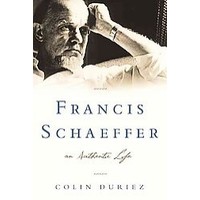
Schaeffer bio.jpgFor those wanting a more traditional biography of Francis Schaeffer, the one by Colin Duriez, Francis Schaeffer: An Authentic Life (Crossway; $24.99) is the best at this point.   It is just fantastic and is applauded by many who were there!  Kudos.

  Francis Schaeffer: A Heart and a Mind for God edited by Bruce Little (P&R; $12.99) just came out this year and is loaded with anecdotes, stories, and appreciative testimonials of Schaffers work and influence—it is very good and a great reminder of why he was so important to so many of us.

For perhaps a broader historical view of Schaeffer’s impact, written by a critical but appreciative scholar, see Francis Schaeffer and the Shaping of Evangelical America by Barry Hankins (Eerdmans; $20.00.)  Hankins does a very good job showing how the youth who were part of the revivals of the late 60s and early 70s created a movement of evangelicals which needed an intellectual basis for faith and how important it was for someone like Schaeffer, who took the bohemian culture seriously, to appear in those very years. He  (and his wife) made a mark not just on persons–like me–but on the very texture of American evangelicalism and certainly shaped the views of many who were rising to parachurch leadership at the end of the twentieth century.  Oh, that authors like Lizza would understand this recent religious history and understand the configurations of various sorts of evangelical Protestants. 

No one can predict who is going to quote what book as an influence, and therefore, for instance, we shouldn’t blame the Quran for suicide bombers any more than we should blame Schaeffer for abortion clinic murderers.   Most in the mainstream media are careful not to insult all Muslims because of the way some act.  Yet it is clear that the media’s take on Bachmann and Perry and the ways they are or are not influenced by Schaeffer does not offer the same care or respect.  (And conversely, there are some responding to this egregious sloppiness on the part of the New Yorker, insisting that it is unfair to blame Schaeffer for the extremist views of the Theonomists, but yet they still seem to want to despise all Muslims for the extremity of the jihadists.)  Can’t either side on the culture wars get this thing right?  Too many people are too quick to connect too many dots, blaming others without warrant, due to the most implausible or incidental connections.  Heck, I once read a book by a Theonomist/Dominionist leader Rushdoony critiquing John Dewey’s role in American educational philosophy;  does that make me a Theonomist?  Geesh.

(There was at least one nice exception in a major outlet to the journalistic Schaeffer-hatefest by the way, a fine short piece from The Indiana Star, which gives a more positive view of Schaeffer, if, indeed, Ms Bachmann has been influenced by him as she says.)

So, I entered these conversations and some of you did too.

Here, for instance, is one brief summary of the discussion by Alan Noble that offers a bit of balance in tone and pushes us to not just demand that Christians not be pushed out of public affairs but that we are equally passionate about the religious rights of others as well.  Thanks to “Christ and Pop Culture” for this short but helpful reminder.

Again, I do not mean to imply that Schaeffer was faultless or that he was not deeply involved in stirring up activism both to help unplanned and troubled pregnancies and to overturn Roe v. Wade.  He maintained that some of America’s founders were influenced by a more-or-less Reformation base coming, as they did, from the North of Europe.  He offers a fairly non-controversial reminder about earlier Christian ideas that shaped some of 18th century framers. He was admired by conservative family values doc James Dobson and was read and understood by Congressional quarterback Jack Kemp (as well as anti-war Republican, the late Senator Mark Hatfield.) In The Christian Manifesto he made a limited and cautious case for nonviolent civil disobedience, a case I had learned long before from Gandhi,  Martin Luther King, Philip Berrigan and Henry David Thoreau.  And that’s news?

NANCY PEARCEY AND THE MANTLE OF SCHAEFFER
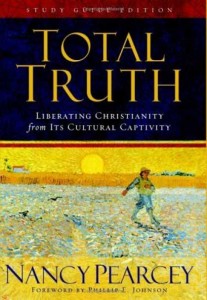
total-truth-207x300.jpgIt is obvious to anyone who has read Ms Pearcey that she is one of today’s most able interpreter of the philosophical views of Mr. Schaeffer, channeling influences from Herman Dooyeweerd to Cornelius Van Til to Michael Polanyi offering a new voice for his old perspective. She hammers the fact-value dichotomy, what Schaeffer called the “upper story and lower story” views of truth, and she shows how this simple commitment to a robust view of truth effects everything.  It is no news that she favors a serious and open-minded deconstruction of the orthodoxies of old school Darwinism, a matter which she explores even in her firs
t book, a co-authored work with Charles Thaxton on the history of naturalism within the philosophy of science, The Soul of Science: Christian Faith and Natural Philosophy (Crossway; $17.99) is a very fine work (there is a section on mathematics which is fantastic), and whether or not she is fully right is nearly beside the point—she is a thoughtful, engaging, widely-read cultural critic whose work is very reasonable and certainly valuable to consider. Total Truth: Liberating Christianity from It’s Cultural Captivity (Crossway; $19.99) is her most foundational book and even if it has struck some as a bit overly confident and insistent, it makes her case consistently and clearly, with tons of illustrations, stories, and serious footnotes as well as a thought-provoking discussion guide to further the conversation.  Her “recommended reading” list is not only wise and wide-ranging, but it is annotated wonderfully, making it very helpful.  (That she did this is interesting, too–many authors don’t add this touch.  I think it indicates firstly that she is a good teacher, and she is serious.  She expects people to “master” this material and to allow it to shape how they engage in cultural reformation.  It is vast and sweeping stuff on the history of ideas and the deformation of culture based on bad assumptions and ideas, but she thinks you must understand, and she is walking you through it.  And she means business.  To know these books is, well, part of the cost of discipleship, I suspect she’d say.  And she would be right.)  I am just so troubled that there are so many hare-brained and truly odd writers claiming to be Christian, that this is what the critics of Bachmann chose to go after?  Have they even read these books?  I bet you’ll have some kind of conversation about this very thing before long.  I hope my confidence in the significance of her work is somehow helpful as you defend as the legitimacy of offering a Christian perspective in the marketplace of ideas.  

If you want to learn a bit more about her, here is a new report done at the “Solid Ground” website by  journalist Jesse Mullins, a fine cowboy reporter (who interviewed me about Pearcey and quotes me in the story. Even though I don’t wear a cool ten gallon hat like he does.)

If candidate Bachmann reads Pearcey, I am glad.  If The New Yorker reports it, all the better.  As long as they get it right.  Which they did not.

SPREAD THE WORD, SUBVERT THE TROPE, IGNORE THE FRINGE
To wit, your ever-ready pals at Hearts & Minds BookNotes will offer a few suggestions for your background reading and wide and unruly list of books to keep our heads about us in these nutty discussions.

Is it tacky to suggest that I wish Mr. Lizza would have read a few of these?   Maybe somebody should buy a few and send ’em out to your local news writer or blogger who covers this beat, especially if she or he keeps spreading these dumb rumors that Schaeffer was significantly influenced by  Rushdoony or other writers of the Theonomist persuasion.  (If Lizza or Goldberg had enough reportorial chops to check, uh, even Wikipedia, they’d see a good footnote documenting that two of the leading lights of the Theonomist movement opposed Schaeffer!  Schaeffer didn’t have to distance himself from them, because they were not in his camp!)

Or, how about those that repeat that mantra that because some of us call upon evangelicals to get out of the comfort of their pews and get active in shaping culture, being involved and trying to have a helpful impact, that makes us somehow like some Taliban?

Look, we all know there are “Christian” fascists out there, holocaust deniers, gun-totin’, Bible-thumpin’ militias, weird right-wing characters of all sorts who are obviously undemocratic and sometimes dangerous.  Still, I’d rather ignore Rushdoony, Fred Phelps and the like.  I’m disinclined to fret much about gold-buying alarmists like Rushdoony disciple Gary North who are so far off the reservoir that they just don’t matter.  And they certainly don’t have anything to do with any discussions about the wisdom of Francis Schaeffer or Nancy Pearcey or any others of us who, with a different tone and perhaps even a different key, talk about worldviews and cultural engagement from a Christian perspective.

There are enough important matters to argue about, good debates to be had, ideas to be thought through, principles to be clarified and causes to care about that we simple ought not be distracted by those who would fixate on these nearly cult-like “Dominionists” or the equally nearly cult-like secularists who insist that anyone who has faith should stay in their church and out of the way. Yes, both exist, the hard religious right and the hard secular left.  Some are in some dingy church basement somewhere, self publishing their “reconstructionist” books about taking dominion.  The others are writing slipshod stories for the Daily Beast, CNN, The Daily Kos and The New Yorker.  It is easy to ignore Rushdoony, but harder to ignore the influence of stars like Lizza.  So it goes.

ONE MORE TIME: RESIST THE ALARMISM
A final little story.  An acquaintance of mine that I respect is a columnist at a nationally known newspaper.  He has been burned a bit by conservative and legalist religion, it seems, and is smart enough to know that true followers of Christ will be known by love, known by grace, and that the far right ought not have the monopoly on describing what Christianity looks like in the public square.  I like his writing.  It tilts to the left on matters of peace and justice and race relations, and I appreciate his good eye and good heart.  And yet, this week, he wrote a column about a guy he somehow met, who said—inspired by these “Theonomists” that some call “Dominionists”—that he would kill his parents for being idol worshipers.  The Bible demands it, he said.  

Wow.  Catch your breath. This is dangerous stuff, the stuff of cults, right?  Maybe like Charles Manson or the Mormon Fundamentalists or from the sort of group from which the phrase “drinking the Kool-aid” arose. I am sad to think that anybody would be taught such a thing, that religion would be so misused.  However, to even whisper any relation of this tragic loss of sanity to a candidate such as Michelle Bachmann, or well known, respected authors, like Schaeffer, is ridiculous.  I have no idea why this award-winning reporter couldn’t wrap his journalistic head around what seems so obvious to me: the guy who says the Bible teaches him to kill his non-Christian parents has nothing to do with Francis Schaeffer or even Jerry Falwell or Glen Beck or any of the other notorious hot-heads on the right.  Nothing at all.  To try to connect those dots is just plain old wrong.  Talk about the metaphor of “drinking the Kool-aid”—this oft-repeated trope that the “Dominionists” are all over trying to take over America and that Bachmann has been influenced by them via Schaeffer, well, it’s just the stuff of urban legend and UFO conspiracies, except it is repeated over and over, from people who ought to know better.

BOOKS AS LIFE PRESERVERS FOR THE COMMON GOOD
So maybe these will help.  Consider them life preservers for the upcoming year.  It’s going to be a wild ride in some rocky waters.  Get ready to throw ’em out to others and help and save the day. 
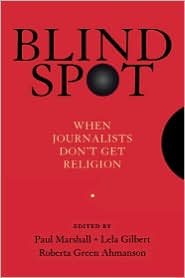
Blind Spot .jpgBlind Spot: When Journal
ists Don’t Get Religion
edited by Roberta Green-Ahmanson, Paul Marshall and Lela Gilbert  (Oxford University Press) $19.95 This is the best collection of pieces about the ways in which typical journalists seem to be tone-deaf to the role of religion.  Marshall’s own piece on how reporting on terrorism misunderstands the role of radical Islam—suggesting that the violence is not religious in nature by inaccurately describing jihadists in ways that mask their self-proclaimed religious motivation–is riveting and worth the price of the book.  There are a variety of  media scholars and observers included making this a thoughtful overview. And it is Oxford University Press, people. This isn’t reactionary pulp, but important scholars evaluating major gaffes, indicating a huge hole in the professional training and insight of most major journalistic outlets.  Very important, judicious and helpful.

American Grace.jpgAmerican Grace: How Religion Divides and Unites Us  Robert Putnam and David Campbell (Simon & Schuster) $30.00  This thick tome of social science by the respected author of Bowling Alone may just be one of the most important books of recent years, a monumental work, elegant, descriptive and exceptionally insightful.  I reviewed it briefly when it came out nearly a year ago, cribbing from the rave reviews from Doris Kearns Goodwin, Jon Meacham, Cornel West, and others.  Rabbi Eric H. Yoffie (The President of Union for Reform Judaism) says that “this is the best overview of American religion in the last half of the twentieth century that I have ever read. If you care about American religion, you must read this book.”  Religion matters, in private and in public. It isn’t coming out in paperback until February 2012 and it may be too important to wait.  Highly recommended.
case-for-civility-why-our-future-depends-on-os-guinness-hardcover-cover-art.jpgThe Case for Civility: And Why Our Future Depends on It Os Guiness (HarperOne) $23.95  I reviewed this when it came out, declaring my huge appreciation for it, and have mentioned it time and again.  One needn’t agree with all the proposals but it is a must-read for anyone interested in conversations about church and state, faith in public life, and the like. This is not just about public manners or civil etiquette—which itself would be helpful, but not quite the full point of this volume— but Guinness here explores how the first amendment offers a framework for freedom for and from religion. We must not move towards any God-based Theonomy or any kind of state church, of course. But a “naked public square” that privileges secularism is equally faulty.  This “case” challenges the religious right and the secular left calling us all to take steps to solve the impasse of of our times through what he wonderfully explains in vigorous and inspiring prose as a “cosmopolitan public square.”  I do hope you consider reading this and living out his important vision and urgent call to decency, civility, and, urgently, a robust commitment to the principles of our First Amendment.

bye bye miss.jpgBye Bye Miss American Empire: Neighborhood Patriots, Backcountry Rebels, and Their Underdog Crusades to Redraw America’s Political Map  Bill Kauffman (Chelsea Green) $17.95  I gladly named this as one of the best books of 2010 and couldn’t stop telling interested folks (and, well, some who weren’t so interested) about this cool and remarkably intricate history of parts of the country that want to secede from the union.  Weird, I know, but bear with me–this is a fabulous read. Look, I don’t know what I think about all this but I do like the quote from the Guinness book, spoken by JFK years ago.  Our democratic witness should “make the world safe for diversity.”  Want diversity?  Really?  Want to hear the people–real people?  Listen to the crazy folk from the Yooper State, the Lakotah Nation, the Second Vermont Republic, The Republic of West Kansas.  Did you know about the State of Jefferson?  Take a stroll with Kauffman through the deep South hearing out those–including blacks!—who just want to hold on to their own unique barbequing culture.  Listen to the longings for liberation of some from places like Hawaii, who wonder why the US colonized them in the first place.  These backyard anarchists, localist yahoos and populists against Empire sometimes heroically want self-rule.  Some just want to be left alone.  Some are sorta nutty.  Is this a great country, or what?  I’d vote for Bill Kauffman for President if he’d run, but I can tell ya now that he ain’t.  He’s too busy in his own home town, coaching Little League and fighting WalMart. Read his story about leaving Washington activism for his own front porch and his own home town in the wonderful memoir Dispatches from the Muckdog Gazette: An Affectionate Account A Small Town’s Fight to Survive (Picador; $14.00.)  Kauffman knows more about American history, I’d bet, than anybody you’ve ever met and probably more than almost anybody you’ve ever read.  And he’s fun: he’s so far to the left he’s right.  Or so far to the right, he’s left.  Anybody who wants to understand America–that is, her people—heck, anybody who likes the History Channel’s How The States Got Their Shapes—ought to read through this amazingly rich ride full of very long sentences through the backcountry of the U S of A.  The Republic of Texas?  Why not?  Seriously.
purple state.jpgA Purple State of Mind: Finding Middle Ground in a Divided Culture  Craig Detweiler Harvest House) $13.99 Not up for the wild ride against Empire and into the localist’s dreams, narrated by history geek Bill Kauffman?  Fair enough, he’s an acquired taste.  This is a more simple book, excellent in many ways, by an astute cultural critic (film scholar, too) and PhD who taught at Fuller Theological Seminary and now is at Pepperdine. This upbeat call to move past the culture wars—purple is a blend of red and blue, of course—was somewhat inspired as an old college friend of the author’s (a guy who helped him cross the line of faith and become a follower of Jesus) who renounced his own faith and wrote a book against the Christian right.  Detweiler sees himself as a purple Christian, conservative on some things, liberal on some things, traditionalist in a good way, but progressive at times, too.  Yet, A Purple State of Mind isn’t even about politics as such, but is interested in an “in but not of” the world wise and discerning Christian cultural engagement.  It explains why followers of Jesus must offer a view of life that is grace-filled and, while Biblically-grounded, anything but judgmental.  Is all about Jesus, less about religion. It celebrates love and joy but also faces disappointments, and is honest about life and life’s struggles.  Such a view wants to hear the story of others, wants to build bridges.  This sort of purple view tries to embody the love of God but avoids evangelical cliches, encourages creativity and the arts but yet isn’t disi
nterested in moral values, advocates for all people, working out a consistent sort of way of being truly pro-life.  Maybe if more religious folks were known for this sort of nonpartisan, courageous middle ground we might make more headway towards less hostile interactions of the sorts I experienced this week.  The issues may be more complex than this, but certainly not less.  Very nice.
Public Faith Volf.jpgA Public Faith: How Followers of Christ Should Serve the Common Good  Miroslav Volf (Brazos) $21.99  I gave this a brief review in my column at Comment, and only scratched the surface of what can be said.  Volf, of Yale Divinity School, has given us one of the best books of the year, perhaps of the decade!  For a time such as this, indeed.  Volf lived through genocide in Eastern Europe and knows about exclusion, marginalized faith, and all manner of confused views of the relationship of faith and public life.  He has written extensively on peacemaking, forgiveness, and just did a book on gracious Christian view of Islam called Allah. This wonderful call to care for the common good within a framework of pluralism is more urgent, I believe, than most of us realize.  Volf is clear about the dangers and problems of a public faith. But he shows its great necessity.  There are rave, rave endorsements on the back from Nicholas Wolterstorff, Richard Mouw, and Randall Balmer.  Many are saying that this is must-read, and we at Hearts & Minds agree: a highly recommended book.

Here is a very short video clip where he explains what the book is about.  Volf is very clear and thorough.  In this clip, you’ll get a sense of how thoughtful and helpful this book is.
political-visions-illusions-david-theodore-koyzis-paperback-cover-art.jpgPolitical Visions and Illusions: A Survey & Christian Critique of Contemporary Ideologies David T. Koyzis (IVP) $20.00  Okay, I trot this out nearly every year when there are elections or political debates or if there are matters on the news that seem to exhibit the “culture wars” debates.  And now is that time, for sure.  It just amazes me how little most people know about the background ideas and philosophical foundations for both right and left wing writers, pundits, movements.   In this complex and important book Koyzis adeptly explains where ideas come from, what liberals and conservatives really believe (or assume) and whether those guiding ideals do or do not comport with a consistently Christian worldview.   How do legitimate ideas end up becoming idols and get hardened into ideologies?  What are the dynamics of ideological conflict in our new century?  Why does the typical “liberal vs conservative” story not really do justice to the more complex realities behind political movements?  This is beyond astute, it is genius, the best and most comprehensive overview of political thinking that I know of.  It uses words appropriately, explaining how political philosophers have used phrases and ideas in the past, and helps us all get a handle on what is going on in our heated civic debates.  Highly recommended.
tochangetheworldbook.jpgTo Change the World: The Irony, Tragedy, and Possibility of Christianity in the Late Modern World  James Davison Hunter (Oxford University Press) $27.95  Forgive my colloquialism but this is one brainy dude and this is one sophisticated book.  Seriously, if you haven’t considered reading this, you haven’t been paying attention to BookNotes.  We’ve cited it often, noted that we may not agree with it all, and assured readers that it may be one of the more important scholarly books on the sociology of social change written in our lifetime.  Hunter, a thought-provoking scholar at UVA, who ends up being the guy who coined the phrase “culture wars”  has garnered, not surprisingly, rave reviews from super-heavy sociological philosophers like Charles Taylor and esteemed writers like Robert Bellah who says it is “extraordinarily important.”  Nicolas Wolterstorff says it is “a feat of great intellectual imagination.”  Tim Keller says he learned much from it.  For what it is worth he is very critical of the Christian right and the Christian Left.  And just about everybody else, too, but that’s another story. 

from Billy Graham to Sarah Palin.jpgFrom Billy Graham to Sarah Palin: Evangelicals and the Betrayal of American Conservativsm  D.G. Hart (Eerdmans) $25.00  I’m usually pretty frustrated when even well-schooled journalists don’t seem to know much about what evangelicalism is, or what creedal faith is about.  As it ends up, that ain’t half of it: as half the blogs yapping about Francis Schaeffer and Michelle Bachmann and Rick Perry have implied, they don’t know what conservatism is, either.  I’m not sure I do, either, after starting this very provocative and serious book which—to make a complicated story very short—says that the dynamism inherent in revivalistic evangelicalism, that wants to make the world a better place, doesn’t really lead, ultimately, to conserving much.  Hart, a Paleo-at-least, finds this troubling.  Authentic conservatism, he shows, is not enhanced by the likes of mega-churches rallying around the likes of Sarah Palin.  I’m rubbing my head from this category-changing, mind-bending study suggesting that those evangelicals that are conservative are insufficently so in ways that really matter.  Mike Cromartie of the Ethics and Public Policy Center says to get this “for your pastor and also give one to your favorite political activist.  By doing so you will raise the level of theological, and political, conversation in the church.” 
calvin and culture.jpgCalvin and Culture: Exploring a Worldview  edited by David Hall and Marvin Padgett (P&R) $19.99  For the 500th anniversary of John Calvin this anthology was created showing how Calvin has influenced various aspects of modern life.  Grounded in historical reformation-era studies, this explores how a Reformed vision has shaped the rise of the arts, business, economics, history, journalism, law, literature, medicine music, philosophy, politics and science.  As reporters and pundits mock Schaeffer for his “wide as life” faith and his strict adherence to a conservative Calvinism, we all ought to know a bit about the truth of the matter.  Calvinist or not (heck, whether you are a Christian or not) this kind of amazingly rich historical record is very, very helpful to know.  Further, Paul Marshall—recall that I started this
list with his edited volume on blind-spots in journalism—is the author of the piece on politics.  He is certainly one of the leading Calvinistic political philosophers in the world, and this short chapter is worth the price of the book.  Buy it, photocopy that chapter, and send it to anybody griping about Schaeffer or the goofball New Yorker thesis that Schaeffer followers want to take over the world by force, and only want Christians to be in elected office.  That simply has nothing to do with Reformed views of statecraft and nothing to do with Reformed understanding of jurisprudence.  There are other books on this exact topic, but this one on various aspects of Calvinistic influence on the rise of culture—from music to science to economics—is the one I think might be most useful here. Calvin and Culture by Hall & Padgett is informative and illuminating.  You will learn something, I guarantee it.
raised right.jpgRaised Right: How I Untangled My Faith from Politics  Alisa Harris (Waterbook) $14.99 I will be writing more about this when it releases in a few weeks (it is still unavailable, shipping early September 2011.)  I’m almost done with my advanced copy and I’m mostly astonished at this young woman’s story, her being raised in a very active Christian right-wing family—she picketed abortion clinics as a child, holding signs that she surely couldn’t have known what they meant—and becoming active (oooh, how she was active!) in Republican politics as a teenager. This narrates how she has come to a different understanding of her faith and no small amount of serious anguish, anguish that I would guess many of us have felt.  Ms Harris is a fantastic writer, making this one of those great memoirs that is easy to read, fun and well-told, and yet very memorable–what a story!  Has she just shifted, as many of her twenty-something young evangelical peers have, from a right wing faith to a left wing one?  Is her organizing demonstrations at the Bank of America and her advocacy for the poor, just the flip side of her still politicized faith?  As she untangles and rethinks things, she lets us look over her shoulder, watch as her rather exciting New York life unfolds, and we get to be a part of the religious coming of age of a very sharp young woman, who is a reporter and very fine writer.  I suggest that the story isn’t over and I predict she will write more.  I hope so.  This is, in many ways, what this whole crazy New Yorker bigotry about Bachmann and the “exotic” nature of the Christian right is all about.  It guess it is rather exotic, as is anyone who takes faith seriously these days, and lives out her principles in public ways.  Harris’ conservative family has done this, and it has left its marks,  in ways that are good and maybe not so good.  One story, one family, one very thoughtful twenty-something.  I could hardly put this book down and trust you find pleasure, empathy and insight, regardless of your thoughts about faith, politics, or social justice.

READ SCHAEFFER & PEARCEY FOR YOURSELF. 
MAKE UP YOUR OWN MIND
.
BUT DO SO WITH OTHERS.

And, of course, since this nasty brouhaha started with the viral trope about the horrible views of Francis Schaeffer and Nancy Pearcey, and then all the push-back from it,  you might start by reading them for yourself.
How Should We.jpgHere you can find a list of Schaffer’s books and if they are in print, we probably have them. I mentioned a few favorites earlier in the column (like the short Art & the Bible and True Spiritualty) but I think I’d start with How Should We Then Live? (Crossway; $19.99.) Unless you prefer philosophy, at which point  you should get his famous The God Who Is There (IVP; $15.00.)  The anniversary edition has a good forward by Jim Sire, too.) 

Here again is the fine article about Nancy Pearcey and we stock all three of her books too (as well as the ones she co-wrote with Charles Colson.)  I’d start with the thick but important Total Truth: Liberating Christianity from It’s Cultural Captivity (Crossway; $19.99.) I reviewed her fascinating survey of the arts and popular culture, Saving Leonardo: The Secular Assault on Mind, Morals and Meaning (B+H; $26.99.) here. Enjoy!

THAT’S WHAT FRIENDS ARE FOR
Nancy Pearcey writes about, and Francis and Edith Schaeffer lived live examples of, intentional, friendly, hospitable, community.  Book clubs, reading groups, and fellowship gatherings are the natural venues for exploring big ideas, deconstructing the unhelpful ideas of our culture and discerning what is true, and what difference it makes.  Our bookstore would love to enhance your community by providing resources and we are grateful for your support.  But it is most important that you are together, in your locale, being part of the lives of others who care about you and will help you to think clearly, wrestling honestly with these heavy ideas about faith in public life.  We may get a little sea-sick by it all, disoriented.  That’s why we need not only good books but good friends.  We learned that, too, from Francis Schaeffer.


BookNotes

SPECIAL
DISCOUNT
 – any book mentioned –
 
20% off
order here
takes you to the secure Hearts & Minds order form page
inquire here
if you have questions or need more information

Hearts & Minds 234 East Main Street  Dallastown, PA  17313     717-246-3333

Six Sensational Summer Stories (sorry) — Truly Wonderful Reads

The evening is cool, the moon bright, and the crickets lovely, not as annoying as the usual screech of the cicadas these mid-summer nights.  It is such a nice night out, I long to get my little lamp and sit outside with a cold beer and a good book.  But yet, I want to be in touch with our cadre of Hearts & Minds readers—would love to do some “book talk.”  I wonder what others are reading? What is enjoyable and what is edifying?  (I learn a lot from facebook and twitter about the habits of our fans) and am always delighted to see the orders that come in from across the land.  We got some good replies about my Larry Woiwode piece—the Words Made Fresh review, but few orders.  It is serious literature, I realize, so maybe isn’t widely appealing, but it is an important book.  As we said, we are thrilled to see this caliber of thoughtful work from within a seriously Christian worldview.  Hats off to Crossway for releasing the collected essays of such a substantive thinker, author and critic.

Here are some books that we have wanted to tell you about but they just haven’t matched any of the previous columns.  So, we offer a miscellany of six wonderfully written, very thoughtful, and fully lovely books.  A surprising mix, all but one by my bed-stand as I work through them all as the mood fits.  These are each exquisite volumes and they seem right for a night like this.

Last-American-Man.jpgThe Last American Man  Elizabeth Gilbert (Penguin) $15.00  I have admitted often that we loved Eat Pray Love, and while we obviously have a different understanding of truth, God, the faith experience, and romance, we adored this wise and often hilarious travelogue.  Even her section about the Ashram was beautifully rendered.  How would you narrate your encounter with the sublime, the Divine?  Well, that fun book led us to Committed, her history and sociology of marriage, written very much as a sequel to EPL, telling of her reluctance to marry the man she met and feel in love with in Bali.  Despite some opinions that seem wrong-headed, it was a nearly brilliant book, and Beth and I both devoured it.  On a roll, then, I took up her first book, The Last American Man and Beth immediately followed suit (since I wouldn’t shut up talking about it every night) and I cannot even tell you how this book rocked our world!  We both zipped through it, laughing and rubbing our foreheads and shaking our heads and staying up late, awestruck.  Beth loaned it to a friend before I could; it is that kind of book. 

A long and very colorfully story short, it is the biography of a lad from the early 70s raised by a6a00d8341c831253ef00e551f4e1828833-640wi.jpg super-strict, nearly abusive father who ends up living in a teepee, knowing the ways of Native customs the world over and thereby living a “back to nature” ideology that stood as a firm rebuke to the materialism and superficiality and alienation of American culture.  This fellow–Eustace Conway from North Carolina–is a natural outdoorsman, woodsman, hunter, self-taught carpenter, a born storyteller, a manic visionary who builds his own homestead, starts a nature center for guests that flock to him in nearly cult-like passion, becomes one of the finest horsemen in America, and longs to be happy with a hippy-chick Earth Mother, pioneer woman wife, a hope that for reasons that become clear, ain’t gonna happen any time soon.  Alas, he’s a troubled soul, gifted, rugged, stubborn, a Dreamer Like No Other, tenacious, hardworking, and not a little bit magnetic.

 As is her style, Gilbert makes us laugh, can swear like a sailor, and tells this amazing tale in clever prose and in ways that offer insight, compassion and more balance than most could conjure up in the face of such a story.  She realizes, it seems, that there is something deeply religious about our human quests, and to better understand them, we must know a bit about history, sociology, culture, zeitgeists past and present.  She is helpful ruminating on the American frontier and how that rugged individualism shaped our identities, from cowboy towns to utopian communities to contemporary wilderness sporting.  This is a wide-ranging book, years in the making, reporting intimately on this whole remarkable (and remarkably dysfunctional) family of Eustace Conway, his genealogy, his famous grandfather, various relatives, former friends and bitter enemies, all as a canvas to draw some interesting conclusions about American history, masculinity, our relationship to the environment and how in the world to be happy in a world gone dumb.  One of the most interesting books I have read in years!

Here is the long GQ article that became Gilbert’s book.  Hold on tight and if you find it as interesting we I did, despite the crass language, order it from us.  Fair enough?

Growing-at-the-Speed-of-Life.jpgGrowing at the Speed of Life: A Year in the Life of My First Kitchen Garden  Graham Kerr (Perigree) $27.00  Speaking of characters, Graham Kerr was in many ways a caricature of much of what Eustace Conway despised. He was tony, un-serious, wasteful, on TV.  Those who grew up when I did knew him as the Galloping Gourmet, the predecessor of all those characters now on the Food Channel, brilliant, British and way too giddy.  Except he drank and drank as he showed his gourmet dishes, turned into an on-air alcoholic.  During those years he was mockingly awarded the “Broken Wooden Spoon” by Weight Watchers International, who called him Public Enemy Number 1 because of his bad culinary choices.

Kerr found himself at the end of his extravagant rope and in other books has described his turn to Christian faith.  He did a low-salt cookbook with the Brethren Press, became a very helpful teacher about good nutrition and healthy living, rethinking how he related to food and how he taught cooking.  He published a string of cookbooks and became involved in philanthropy and soon was even outspoken about world hunger. And now, he’s taken a large new step, timely and important and a natural “next step” on his journey, even though it seems a brave one for his career.  As he says in this lively new book “In my long career as a gourmet/nutrition teacher I have cooked just about everything that grows, but I’ve never grown a thing I’ve cooked.”   

Here, Kerr reflects on the earth-to-table process.  As he puts it “I decided to go back to theindex.jpg starting line and run the whole race from the beginning.”  And what a book it is.  Whether you are an armchair gardener or an active one, whether you are a foodie or a newbie in thinking about whole foods and organic eating, this book is for you.  It includes his story, lots of sidebars and illustrations, and over 100 recipes, all taken directly from Kerr’s family garden.  The illustrations are especially nice, pencil and ink line drawings that conjure up images of the Moosewood
cookbooks or classics like From a Monastery Kitchen.  They show the plant and the root system, with lines like an architect’s drawing showing how many inches everything should ideally be.  Perfectly helpful. Growing at the Speed of Life, is a great title, too, eh?  Gladly the book is as good as the title makes it sound.  Highly recommended.  Here is an small bit where Kerr describes it.
 â€¨â€¨

While it wasn’t immediately clear to me what impact the experience of creating this garden would have on my life, my neighbors, and even–to a small but vital degree—our community, I recognized that I wanted to share the lessons I learned.  It became my intention to write a book that would not only be of value to home cooks and armchair gardeners but also serve as an introduction to gardening for people who had the wherewithal to pick up their own spades and dig in—be it a few square yards in a suburban backyard, a couple of pots on a city balcony, or an acre or so in the country.

Here is a good TV interview with Graham Kerr from a Vancouver station; listen to him mention delight. And how he talks freely about his Christian faith and fellowship, his group’s prayer about the needs of the neighborhood and their idea for this very thing.  Great! Here is a clip of some good gardening tips, too.  Know anybody that you can give this large, handsome book to?  It makes a lovely gift.

OneHundredNames-210.jpgOne Hundred Names for Love: A Stroke, A Marriage, and the Language of Healing  Diane Ackerman (Norton) $26.95  This is one of those books that just feels good to hold, a touch heavy, well bound, a delight that deserves such a solid presentation as it is gloriously written, full of grace and gravity.  By the best-selling author of The Zookeepers Wife, the very important classic of naturalist literature, The Natural History of the Senses, and a dozen others, this is a passionate and intimate study of her husband’s life-changing stroke.  Ironically, she was out on a book tour for her just-published book, The Alchemy of the Mind, which was an work on brain studies, when West had his stroke. Many have said this is Ackerman’s best writing yet, and her best book to date.  She deftly explains in neurological detail the complexities of the human brain, but, more, the complexities of human sorrow and heartrending love.  (It is hard for anyone, of course, to suffer aphasia, but to have such an articulate wordsmith–her husband is an esteemed novelist– lose language in such a way, and to have such an informed writer as a spouse, is especially poignant.)

For those of us who have experienced even a bit of the anguish seeing loved ones suffer, for those of us who know about the ministries (and mistakes) of doctors, nurses, scientists and caregivers, for anyone who longs to speak deeply to and with a lover, this luminous book speaks great truth.   Can faithful love help speed healing—even after serious brain damage? Can two writers (again, her husband, Paul West, is himself a serious aithor) learn to live in the obvious aftermath of a stroke?  I must admit I sat for a few days pondering the cover sheet of “part one” which she calls “The Cartography of Loss” before I could continue.  The last section is called “One Hundred Names for Love” and the appendix includes, yes, her 100 poetic phrases for her husband.  It is a bit deep but will take your breath away.  It is that kind of book. 

Here is a good NPR audio (Bookworm) interview with her  Please view this short, classy YouTube “trailer” for the book to hear Ackerman explain it, reciting some direct portions.  Get out your hankies.  And, as West says, “Thank God for language.”  Indeed.

The Grace of Everyday Saints.jpgThe Grace of Everyday Saints: How a Band of Believers Lost Their Church and Found Their Faith  Julian Guthrie (Houghton, Mifflin, Harcourt) $25.00  I do not know what first drew us to stock this, perhaps it was the advanced blurbs by award-winning reporter Ken Auletta (“a gem of a book”) or activist scholar James Carroll (“moving and eloquent”) or Beth Kephart, herself a brave and good writer we admire who says it is “brave and engrossing.”  Perhaps the story itself piqued our interest as it is not uncommon, even here—a Catholic Diocesan decision calls for the closing of a church and the folk in the parish are left to their sorrow.  In this case, the good people of the exiled congregation of St Brigid do not give up their church, find a renegade lawyer and take their prayers to the streets and the courts.  What a saga, as they enduring in their campaign.  In their holy revolt, as Carroll puts it, “resistance and reverence open to one another.”  In their work they learn more than they want to know–you’ve heard about the coverups of abuse in the Church, so you can imagine—and enter an awful battle pursing truth and finding faith, all the while insisting that their faith can keep them going, pressing on against all set-backs.  As Kephart puts it, “This is the story of a candle that burned on the steps of a fabled, shuttered church and the people who kept that flame—and their own faith—alive. What is sacred? Who can be trusted? Can communities save us when hierarchies cannot? This brave and engrossing book seeks answers.  It sanctifies a truly moving quest.” 

And what a quest it is, told by a fantastic storyteller whose good writing (Ms Guthrie has won awards for her work in San Francisco journalism) will keep you reading, turning page after page, and pondering much, being both outraged, humbled and inspired. Can communities save us when the institutions fail?  Can organic, lay-led worship be as meaningful as officially authorized liturgy? I suspect this is a story most of us have not heard before and I am confident it is a story you will never forget.

This thorough Grace of Everyday Saints Youtube clip is very moving, and the author, Ms Guthrie, is very articulate, kind and compelling.  I hope you check it out.  This book deserves to be widely known and widely read.

home-short-history-idea-witold-rybczynski-paperback-cover-art.jpgHome: A Short History of an Idea  Witold Rybczynski (Penguin) $16.00  I’ve been wanting to pick this up for years—we’ve had it in our homemaking section and in our architecture section—and just never got to it.  I knew I had heard amazing things about it, and of course knew his other greatly esteemed books, mostly about appropriate technology, the one that is a “natural history of the screwdriver”, and several good books about architecture and buildings and city life, not to mention the best-selling A Clearing In The Distance: Frederick Law Olmsted and America in the 19th Century.)  Rybczynski is a learn
ed man, a crisp and very entertaining writer, and the sort of scholar who can write so nicely that you find yourself wanting to re-read passages for the sheer joy of it all.  Do you love to learn? Do you want to know a bit more about the history of houses, interior decorating, fashion, intimacy, and—in a spectacularly informational chapter—the history of houses and rooms and living arrangements in the medieval world (whoa!)?  Well, then, this is a truly wonderful little resource.  If you read even a few chapters and you haven’t learned something good, and are not happier about learning such curious things, (like the fabulous chapter on the sixteenth century Dutch and what we learn about gendered roles of family life from painters like Jan Vermeer) I suspect you might need to check your pulse.  This is fine, fine stuff, enthralling and good.

The point of this book, besides the sweeping history, is that our own notions of home-life, domesticity, intimacy and comfort, are, in point of fact, quite socially constructed.  Our houses and our homes and how we abide in them are the way they are because of the ideas we have, because of what we carry in our consciousness and what we presuppose about the nature of these very human matters.  Worldviews matter, even in how homes and rooms and privacy and comfort are understood—Hearts & Minds readers know this! (Can anybody say weltanschuauung?)  The very idea of a room, for goodness sake, was only invented and entered into the vocabulary in the late sixteenth century!  And the word “comfort” as we know it is very recent—Rybczynski is good at tracing the fascinating roots of various words and how they came to their current usage..  And time does not permit to explain all that this book explains about privies, lavatoriums, bathes, bathrooms, outhouses and loos and how notions and practices of hygiene have shaped the development of our culture.  

Each chapter starts fabulously with a narration (lesson sounds too formal but it is jam-packed with information)  based on a photo or drawing. The first, for instance is a Kate Greenway illustration from 1879, which serves as a segue into a detailed exploration of the world of Ralph Lauren and his home furnishing lines. (It is a brilliant look at nostalgia and work the price of the book for this short piece.)  The justly famous second chapter starts with a close reading of an Albrecht Durer engraving (1514) of St. Jerome in his study.   What a helpful, vibrant reminder of what we can learn about social history from artwork.  (And who knew, later in the book, that we could learn so much from the study of—sit down as I say this—the history of the chair!)  It is a long way from the one room hovels of the peasants of the Dark Ages or the earliest days of furniture, used by the bourgeois of 15th century France (or Norway.  He has a section on Norway!) to the last photo, a reflection on well-being, via a painting by Norman Rockwell, circa 1945.  R means no ironic deconstruction here, he is not winking at us as he shows it.  This scene is illustrative and in the hands of such a fine and eloquent and knowledgeable social critic, the final chapter leads us to more pure gold.  This is as enjoyable as learning gets as he explores notions of style and efficiency and, I would say, almost as important as it gets.  As our notions of family, home-life, marriage, community, and lifestyle change in this new century, knowing a bit about the history of this idea of home just may be a godsend.  Home: A Short History of an Idea is very nicely done, with equal portions of good style and good substance. 

Here is the classy website of Mr. Rybczynski, including this page with descriptions of all his books.

sabbath-world-glimpses-different-order-time-judith-shulevitz-paperback-cover-art.jpgThe Sabbath World: Glimpses of a Different Order of Time  Judith Shulevitz  (Random House) $15.00  Again, I often held the handsome hardback of this well-reviewed book over the last year but never got around to reading more than a few random pages.  I swore I’d take time to care for it, but, of course, a book like this dare not be read in haste, so never got to it.  I was glad when it came out in paperback, a nice trim edition. 

I’ve read several books about sabbath keeping as a specifically Christian discipline—Marva Dawn, Lynn Baab, Dan Allander, Wayne Muller—and carefully studied the dense classic by Rabbi Abraham Heschel.  I don’t know if other bookstores have a “sabbath” section, but there are a lot good books on this topic.  This one, though, is unique: as the subtitle suggests, it is a report, offering glimpses, revealing much.  Bruce Feiler notes that it is “compassionate, revealing, and deeply personal”  This is indeed a personal story, much of it written as memoir, but informed by thorough scholarship on the history of the idea. And, my, how she can take us all over the world, and all over the centuries, so deftly!   Shulevitz has herself struggled to keep this difficult practice, so it is not an abstract study—at times it reminds me a bit of Lauren Winner, this yearning tobe faithful, to live “out of time.”  It is, as I’ve said, grounded in rigorous research–she is an accomplished young writer, publishing in Slate and The New Republic and the New York Times, etc. etc.  It is beautifully written and is finally an invitation, a call to depth.  A Sabbath World was a finalist for the National Jewish Book Award (and there has been added to the back of the book a reading group guide.)  Are you feeling over-scheduled, over-worked, even over-networked?  Slow down this summer and23284_106765472684218_8581_n.jpg take in some lovely words, some sharp thinking–informed by literature, social history and healthy spirituality, brought to you in lines and paragraphs of sheer beauty.

Here is a live 45 minute lecture by Ms Shulevitz on the book, introduced by the mother of one of the book’s fans, novelist Jonathan Safran Foer.  How cool is that? Listen in and you’ll want to read the whole book!  It is learned, thoughtful, exceptionally well-written and in many ways quite exceptional.  A perfect book for late summer nights.


BookNotes

SPECIAL
DISCOUNT
 – any book mentioned –
  

20% off
order here
takes you to the secure Hearts & Minds order form page
inquire here
if you have questions or need more information

Hearts & Minds 234 East Main Street  Dallastown, PA  17313     717-246-3333

 

Words Made Fresh: Essays on Literature and Culture by Larry Woiwode

Several decades ago, Larry Woiwode was a young author, his novels nominated for all the most prestigious literary prizes, his essays anthologized in creative writing readers, his by-line found in both academic journals and popular magazines known for good writing such  as The Atlantic Monthly, Harpers, The Paris Review and the like.  He was invited to replace the inestimable John Gardner in his writing program at Binghamton after Gardner’s death by motorcycle accident in northern Pennsylvania.  Books such as Beyond the Bedroom Wall and What I’m Going to Do, I Think were in vogue and rightly so.  He was asking important questions in his important work and, we come to find out later, he was desperate.  He began reading the Bible and became an Orthodox Presbyterian.  His next novel, Poppa John–which featured a clown and a conversion and which I truly enjoyed–was panned.   Now that he was a person of faith had his craft weakened?  Was he a worse storyteller?  Was it cheesy to put a conversion story in a contemporary work of fiction?  Or was he every bit the same excellent novelist and the New York literary establishment unfairly despised his religious faith and how it shaped his latest work?  Well, that was a long time ago, it seems.  Over a decade ago, in 2000, he did his first memoir, an autobiographical book called What I Think I Did: A Season of Survival in Two Acts (Basic; $15.95.) More recently, in a highly regarded memoir he wrote for his son (upon being sparred from a near-death experience with a hay-baler), he takes readers to his early days as a writer, and into his interior life as farmer, husband, father.  That is called A Step From Death (Counterpoint; $15.95.)


9781433527401-192x300.jpgYears later, Mr. Woiwode remains a Christian, has deepened and widened intellectually, and is respected as a novelist and perhaps more so as essayist and critic.  He has written poetry, a book-length Bible reflection, a memoir which gathered great reviews   Words Made Fresh: Essays on Literature and Culture (Crosway; $24.99) is a brand new and very handsome hardback volume collecting some of his well-crafted essays, spanning his career, mostly about literature. 

A famous Esquire piece, “Guns” from 1975, opens the book with an allusive yet helpful afterword, indicating obliquely that he has found greater peace since those turbulent years.  All of the subsequent pieces, in fact, are considerably re-worked, added to, expanded and updated, giving the very title of the book a bit of a double meaning.  Words Made Fresh is, obviously, an allusion to the beloved and central Christian notion of incarnation–the Word made flesh–but also indicates that these older words of Woiwode have been freshened up a bit.  Not that they needed refreshing (although it is good that some are brought up to date, citing more recent books by the authors under consideration.)  These were excellent and nearly timeless, even though they are now updated. What a treasure trove this is.


It is curious to me that this profound collection of serious literary criticism ended up at Crossway books, who has long published books on evangelical faith, including some about faith in the marketplace of ideas, social engagement; they released books on the arts, film, literature and such, influenced as they were by Francis Schaeffer, who emphasized historic,51ywfOrszLL._SL500_AA300_.jpg orthodox faith applied robustly to the culture at large. They do good work, of course, and, in fact, published a version of the controversial Woiwode novel that was panned by the literati.  Yet, this new book is so beyond the scope of the typical “Christian Booksellers Association” release that it is breathtaking to see it published by Crossway.  Kudos to them, I guess. (And kudos that they will publish early this fall a new hardback Christmas novella by Mr. Woiwode, to be called The Invention of Lefse: A Christmas Story; $12.99. You can pre-order it now, if you’d like, at the BookNotes discount, below.) 

Still, this current work, Words Make Fresh: Essay on Literature and Culture could have been easily published by any number of prominent mainstream publishing houses.  Any serious bookstore that cares about contemporary fiction will have it, if they order from such a singularly Christian publisher.  It should be considered a very prominent collection.
 
As a fan of Wendell Berry, perhaps Larry Woiwode wanted to be published by an independent publisher.  (Most New York publishers are “controlled by a conglomerate, or owned by a television network or oil company or German corporation” Woiwode points out in a piece about the craftsmanship and financial woes of Wendell Berry’s one-time indie publisher, North Point Press, which became for a season Counterpoint, and is now Shoemaker & Hoard.)  Anyway, regardless of the publisher, parochial or not, this is literary criticism at its finest, offering exceptionally thoughtful ruminations, wonderfully-written observations, reviews and argument.

Copy of Woiwode02.jpgThe work’s illuminating Christian influence is most often implicit, covert, as it were.  He does not wear his faith on his sleeve, except when he does.  And even then, it is lucid, poetic, demanding, classic (perhaps bringing to mind the great essays by Calvin scholar and Nobel Prize winning novelist, Marilyn Robinson.) Many, many serious writers have endorsed Woiwode’s work, from Charles Johnson (Middle Passages) to Brett Lott (who says of him “there is perhaps no better writer at work in America today…his books are built to last”) to Sven Birkerts to Jill Pelaez Baumgaertner.  Gregory Wolfe, author of the recent Beauty Will Save the World: Recovering the Human in an Ideological Age (ISI; $29.95) is one of our best critics and he says “Larry Woiwode’s prose is so piercing and precise, so concrete and muscular, that I would read his reflections on the price of potatoes.  In an era when words have become weapons or commodities, Woiwode reminds us that they can still become flesh and blood, full of grace and truth.”

Oftentimes we recommend books, especially in the religious marketplace, that are inspiring, but not particularly deep.  Or they are challenging, but not particularly gracefully written and we wade through it because we know the material is valuable; I sometimes call these “resources.”  Occasionally, though, we find a book that is not a breeze to read, that is sometimes quite demanding, not because it is poorly written or dry but because it is so very profound, with a mature vocabulary and a slightly dense style, and yet we sense that it is worthy, a book we gladly spend the energy to read slowly, from which we enjoy learning. (Earlier in the summer I named the essayist Alan Jacobs somewhat in these terms; smart, eloquent, but serious-minded.  Ditto with Greg Wolfe.)  Larry Woiwode’s essays, in this volume at least, require some basic knowledge of American letters.  In Words Made Fresh he writes about Gardner, of course (two splendid chapters) and has essays on Reynolds Price, John Updike, and a great article that had app
eared in Image on Bob Dylan—actually on Dylan’s view of the news, compared to CNN.  There is a closing chapter called “The Faith of Shakespeare: My Favorite Actor” that Leland Ryken called “a small classic.”  To be honest, if you do not know who these novelists are, you should read this as a mature and helpful way to be introduced.

9781433527401-192x300.jpgThese essays–now updated and expanded–were previously published in places such as the Washington Post Book World, The Chicago Tribune Book World, The World and I.  A provocative essay on education (“Deconstructing God: Teaching the Fourth R”) appeared in Civilization which is the magazine of the Library of Congress.  (Man, for an organic farmer from Western North Dakota–he has been their Poet Laureate since 1995–this dude gets around!)  One of the expanded chapters were first published by Books & Culture.  Another was a rather auto-biographically-shaped lecture on faith and the arts given at a conference sponsored by the Graduate Theological Union at Berkley. I loved “Homeplace: Heaven or Hell? On the Order of Existence” so much I read most of it a second time out loud to Beth (and I understood some of it better then, too.)  He notes that he was reading Wendell Berry in those years and I have heard he was also reading the aesthetic theory of Calvin Seerveld.

There is another great chapter that will be of interest to some BookNotes readers, I’m sure, on the work of Reynolds Price.  It is brief and accomplishes three things, I’d say.  It puts Price on the map for those who may not know him.  It discusses his interesting work in translating, and reviews Price’s translation of the gospels.  And, through-out, he pushes back against those in the literary establishment who seem to have an open mind about nearly everything except Christianity.  There is bigotry afoot and Woiwode names it; those who are frustrated with liberal PC tone-deafness to nuances of faith will appreciate this chapter.   And he gets away with it; the Boston Globe says of him “he continues to be a writer who can not only dazzle, but illuminate…There is something organic, whole, and necessary about his work; it blows fuses.” 

And so, we celebrate this book, and the fuses it blows, and we are grateful that publishers like Crossway occasionally surprise us—they are particularly predictable these days, with fine stuff from the Gospel Coalition and a small bit of typically truly Reformed cultural engagement, and we stock almost all of their books.  We are glad to be among the evangelical wing of the Christian Booksellers and yet have always pushed those envelopes, carrying books when we opened like, well, like Beyond the Bedroom Wall and What I’m Going to Do I Think.  Woiwode published a paperback of Poppa John with Crossway in the mid ’80s and one sales rep said we were one of the very few Christian bookstore book buyers in the country who knew who he was.  I doubt that that was true, but it indicative of an often-discussed problem of the anti-intellectualism and insularity of most religious bookstores, especially the chains.  So we’ve followed this author’s work, read much of it, and are just delighted to have this great collection, now.

HERE you can find a brief little promo video conversation between John Wilson (of Books & Culture) and Mr. Woiwode, and then a longer one. (In the first he speaks of vampires and in the second, John Calvin, so take your pick.)  The two of them collaborated as editors for The Best Christian Writing of 2001 so they have been friends for a while.  Do watch it, but be sure to come back—you’ll want to see what I say is the best chapter in the book.   

So, I must say this, about one chapter that is my favorite one in the book, I think. I believe that Larry Woiwode’s chapter on Wendell Berry (“Views of Wendell Berry: A Life Against Agribusiness”) is perhaps the finest short introduction to Berry’s writing (especially his nonfiction) that I have yet seen.  I know it is a cliche, but it is nearly worth the price of the book, just for this helpful chapter.

We often tell customers that the best paperback book about Berry, written by friends Matt 3248671.jpg Bonzo and Michael Stevens is Wendell Berry and the Cultivation of Life: A Readers Guide (Brazos; $22.00) which is a great, great, book-length introduction.  There are two more spectacular anthologies about Berry that have come out recently, both by University of Kentucky Press, and each are so good I could cry. 

(One is called Wendell Berry and Religion: Heaven’s Earthly Life edited by Joel James Shuman & L. Roger Owens and the other is called The Achievement of Wendell Berry: The Hard History of Love by Fritz Oehlschlaeger. But they aren’t exactly introductory.  They are large books with many specific chapters, and they are expensive–each one is $40.00, a shameful price tag that should be embarrassing to the authors, with a crummy discount to bookstores, at that, so we cannot mark them down or offer discounts.  I can only guess that the editors at the University Press haven’t read Mr. Berry very closely and don’t want mom-and-pop bookstores to sell these books and that the authors somehow didn’t have the wherewithal to protest, so are complicit, in the exact way Berry so passionately warns about. Ironic.)

That said, we are thrilled with Larry Woiwode’s lovely one-chapter study of Berry’s localism, his sense of place, his literary life, his faith in the good nature of creation, his desire that our work and scale of living be ordered and attuned to the realities and givens of land and history— it is just the best!  There are others who are perhaps more breathy and passionate in their joy for the radical critique Berry brings to the ways of North American living and there are many wonderful pieces about him. But I am really glad that this chapter is in this collection; it is helpful, sane, reasonable—nearly calming.  Woiwode is not dispassionate—he himself, as I have noted, is an organic farmer and poet—but it seems that the most flamboyant line about Berry is the title of the chapter.  It is a fantastic overview, with several good excerpts of a few of his early books.  It makes Words Made Fresh, an already great book that much better.

Mr. Woiwode is a natural to tell us about Berry.  Firstly, he has this unique experience of coming of age as a writer and student of literature in the last quarter of our previous century—under the shadow of the likes of Faulkner, maybe, but contemporary to Updike, Cheever and even Pynchon and, yes, the somewhat older Eudora Welty and Wendell Berry, whose first novel, Nathan Coulter, was published in 1960 and whose first bit of cultural criticism, The Long Legged House, came out in 1969, followed up quickly with The Hidden Wound in 1970.)  Not only was Woiwode an up-and-coming writer as Berry was becoming art-commonplace-agrarian-essays-wendell-berry-paperback-cover-art.jpg renowned (I think The Unsettling of America, publ
ished by the Sierra Club in hardback in 1977, the first Berry book I read, may have been the one to launch him to greater popularity) but Woiwode was also one who left the big city, like Berry, to return to his home state to take up a homestead, a rural vocation he took as a calling.  Also, he is unashamed of being a Christian, and–except for the (perhaps) religiously-motivated slighting of Pappa John—seems to get away with describing his faith in the most prestigious venues in the country, as does Mr. Berry.  Woiwode is, like Berry, besides a novelist, a poet and he does short stores and essays of literary and cultural criticism. So it surely seems he is perfect to introduce us to Mr. Berry’s agrarian vision, his fiction and nonfiction.  I pray that the conservative evangelicals who tend to buy Crossway books will take up Berry’s novels, perhaps starting with Jayber Crow or Hannah Coulter. (Here is a splendid little review by a conservative Baptist inviting us to read good fiction, and particularly the likes of Hannah Coulter. It is a very nice review. Send it to your pastor, as he recommends that pastors read good novels!)

It may not interest everyone, but at the end of the essay about Berry in Words Made Fresh there is a coda, a several page bit of brilliance where Woiwode gives a fascinating description of the ups and downs of Berry’s independent publisher’s work to use quality ink and nice woodcuts on the covers, to smythe-sew the bindings of hardback editions (rather than gluingmedia.nl.jpg them in the procedure called perfect binding, which Woiwode slyly calls imperfect binding) and why acid free paper is so important.  He notes their effort to issue his work in uniform editions.  This, he astutely observes, is an “organized and sympathetic overview which in the past was a publisher’s way of indicating confidence in the writer’s future.”  And he laments the plight of the indie publishers, noting those that went belly up or were bought out, now run by the aforementioned television corporations and oil companies.  Anyway, it’s a good couple of pages that are a good tribute to publishers who try to do things well, especially apropos for an author who does things well, like Berry, like Woiwode.  He ends this chapter, and the afterward about book binding, like this,

All of this should remind us, as Berry reminds us, to think small, not big.  And to perhaps hold foremost the truth that we’re all at the mercy of time, that eventual sifter of the elements of history, whether written large or small across the decomposing substance of the present.

And so, for the various good chapters of Words Made Fresh gathered from Image and Books & Culture and a number of prestigious secular publications, we are thankful.  We are glad to be able to feature just such a book—deeply rooted in the very Christian worldview that we ourselves work out of, but not preachy or pushy.  This is top scholarship, mature and good and wise and often very, very moving.  It is surely one of the best books of this sort in a long time and will should be considered as one of the better books of this year.

BookNotes
SPECIAL
DISCOUNT
 – any book mentioned –
except the two from University of Kentucky Press.   

20% off
order here
takes you to the secure Hearts & Minds order form page
inquire here
if you have questions or need more information

Hearts & Minds 234 East Main Street  Dallastown, PA  17313     717-246-3333  


Here’s the short version. A better, more lengthy piece posted at the July monthly BookNotes column and a list of favorite John Stott books

I thought that my ruminations about our trip to Calvin College for Marissa’s orientation there, our (once again, sorry) shout out to the Rich Mouw book about Abraham Kuyper, and a review of Taking Every Thought Captive: Forthy Years of the Christian Scholars Review edited by Don W. King (Abilene Christian University Press; $24.95) was getting a bit long so I allowed it to morph into a reflection piece more suitable for the longer form over at the BookNotes website monthly review column. 

And then we learned of the death of John Stott, which became an opportunity to offer my small bit of tribute, offer a few links about him that I thought you might appreciate and, yes, offer my top ten list of John Stott books.  But that became a top 15 (and one famous one didn’t even make the cut!)  The column grew longer, but I did not want to break it into two discreet pieces.  My testimony about Kuyper and my tribute to Stott are deeply entwined and I hope you read it all.

Here are just a few excepts of the longer essay.  Thanks for being a part of our work, fans of the bookstore and readers of astute Christian literature.  Now more than ever—with this trip to Grand Rapids rattling around my bones, deeply glad for the chance to visit with friends there, and mourning of the end of the John Stott era—I hope our store is known as a place you find faithful, relevant, and helpful.  As Dr. Stott has written, Your Mind Matters to God.  Read on!

Do you know that feeling after a long, long drive, returning home from a
far-away but greathighway-night.jpg event?  We are happy but exhausted from the white
lines (and orange cones) on the Pennsylvania Turnpike, eyes bleary and
body tense from navigating the late-night truck traffic.  On the Indiana
interstate,  right before the Ohio line, a billboard offered a rest
stop with chocolate “for the pain that is Ohio.”  Yep, these long,
tedious hours of flat Buckeye road offers time for thinking and talking.
 

Beth and I had just gone through a two-day parent introduction at Calvin College in Grand Rapids, Michigan, while our youngest daughter experienced her Calvin freshman orientation.  This Passport program
was spectacular, with fabulous fun and food and helpful information. 
We learned about the history of the school, John Calvin’s French accent,
saw brief video clips from scholars likes James K.A. Smith,and were
reminded of the cosmic scope of Christ’s redeeming restoration project
(and hence, the deeply integrated religious vision of teaching the arts
and the sciences for God’s glory and our neighbor’s good.) I leaned over
to Beth and said that I wanted to attend Calvin College!

On the
long ride home I pondered my own faith development, my own college
years decades ago, my frustration as a younger man wondering why those
who seemed most fired up about the gospel seemed so disinterested in the
world and its great hurts. In my mind I revisited our many years of
meeting students, selling books, including books written by people we
had met at the Calvin orientation, and how we still have—thank you,
Jesus!—a glimmer of our old idealistic vision that we can in some ways
change the world for the better as we nurture a Christian mind,
grounded in a Biblical worldview, enabling us to make connections
between our deepest convictions and the way we live….

*** 

….A brand new book—edited by an impressive team of scholars, including a
former CCO978-0-89112-547-1.jpg staffer and Kuyperian from Hope College named Todd Steen
(whose PhD in economics was taken at Harvard)—illustrates well the
ways in which evangelicals have been wrestling with the questions of
faith and learning, Christ and culture, piety and scholarship, for the
last nearly half a century.  Taking Every Thought Captive: Forty Years for the Christian Scholars Review, edited by the current editor of CSR,
the literature professor Don King of the PC(USA) affiliated Montreat
College along with Perry Glanzer, David Hoekema, Jerry Pattengale, Todd
Ream and Todd Steen (Abilene Christian University Press; $25.00.)  This
thick book deserves a more thorough review later, but it is essentially a
fantastic greatest hits collection of four decades of scholarly work
done from within an intentionally Christian framework.  (You know, even
if you don’t have all of a band’s many releases, if you care at all you
pick up the greatest hits album.)  There are pieces here spanning the
journal’s career and they are well selected.  Some of them are really
good to be in a book since the academic journal, CSR isn’t widely
circulated outside of Christian colleges and they deserve to be read. 
What a wonderful opportunity to read through so many important
articles!  There are substantial essays by a wide array of scholars,
from thinkers such as Nicholas Woltersdorff, Jonathan Chaplin, Richard
Mouw, Mary Stewart Van Leuuwen, Roger Lundin, Nancy Ammerman, Dallas
Willard, Stanley Hauerwas, Jenell Paris and many more.  There are pieces
on politics, on art, on the role of the Christian college, on student
learning, on math and science and ethics and philosophy.

One
piece that I have read and photocopied from the journal was a
provocative and beautiful bit of writing by Brian Walsh and Steve
Bouma-Prediger, using ecological insights based on a Scriptural vision
of place and “homecoming” to suggest that students should know the
places where they are studying.  It was published in the review (along
with a strongly-worded critique the following quarter) as they were
writing their Beyond Homelessness, applying its insights
about cultural displacement and Biblical exile to the experience of
learning within the context of modernity.  Brilliant!  Another piece
that I think should be widely discussed was by Ronald Sider who called
in the CSR for more academically rigorous research that
popularizes for the church the work of the academy and helps social
reformers and activists to translate Christian thinking into policy
initiatives.  Again, this was a splendid piece that I highly recommend.  

The Christian Scholars Review
has long been an important organ for good book reviews and serious
academic research done by scholars mostly within the mostly evangelical
Protestant faith community.  The special issues have been splendid (they
did a C.S. Lewis issue a few years back, for instance) and it has
regularly been a good testimony to the way our discipleship can effect
our scholarship and cultural engagement.  I wish there was a way for
more libraries to stock it, certainly university libraries should, since
they typically have journals from every other perspective one could
possibly think of. Certainly any college professors that you know should
hear about it.  Maybe this book would be a way to introduce them to the
important work of the journal.

***

41782_49965968829_3002_n.jpg….Before we started the journey home we made a stop in the small town of
Three Rivers, Michigan, to visit the center of what I jokingly call the *cino
empire.  You may know that *culture is not optional is a loose network
of writers, friends, artists, and social entrepreneurs, mostly younger
folks who have drunk deeply from the Kuyperian social vision and have
been influenced by radical thinkers at places like Dordt, Trinity
Christian (Palos Heights) Calvin, Redeemer (in Ontario), ICS (the
graduate school in Toronto), and the CCO.  Besides running conferences
and camp-outs, film festivals and concerts, they publish catapult,
a bi-weekly e-magazine which offers transformational memoir and poetry
and excellent essays of faith-based cultural criticism. (They have an
e-mailed daily asterisk quote that you can subscribe to as well, which is my daily shot of literature for subverting the Way Things Are)….

***

….And then the sudden, bittersweet news of the death of John Stott.  He
was one of our era’sJohn-Stott.jpg great Christian leaders, himself deeply involved in
all of the sorts of things that have captured our hearts even this very
week in Grand Rapids—caring for students, nurturing the Christian
mind, thinking about the reform of institutions, relating to the global
South and honoring our international relationships, serving the poor and
marginalized out of a non-compromising Christ-centeredness.  Stott was a
British evangelical Anglican, Rector of All Souls in London,
evangelist, author, a principle in the World Evangelical Fellowship, the
Lausanne movement, and founder of the international social ministry, The Langham Partnership International.

As
you most likely know, he wrote widely—mostly for our favorite
publisher, InterVarsity Press, and left a mark on millions influenced by
them….

Please read the rest of the column, here.  And see my favorite Stott titles listed.  Thanks.

Hearst & Minds 234 East Main Street  Dallastown, PA  17313     717.246.3333