More Media: Donald Miller audio, Brueggemann lectures, GLO Bible and more

Last week we did a post about the new Convergence DVDs, describing them as very, very thoughtful and interesting: three DVDs of Donald Miller interviewing Phyllis Tickle, Lauren Winner and the always impressive Dan Allander/Tremper Longman tag-team.  Of course for our exceptional literary types, I sort of apologized, and mentioned that those who care about the printed page might want to also be excited about the new Wendell Berry volume of poetry, Leavings.  So it goes; Hearts & Minds, trying to reach various sorts of customers, different, yet united by their hope of finding faith-based stuff that is a bit better than much of what one finds out there.  We love old-school, rural, literary types like Wendell Berry (and have a brand new book about him, too, which we’ll review soon) and we have the most contemporary releases of DVDs and audios and such.

And so, a few other non-book items for our media mavens:

million miles audio.jpgCD A Million Miles in a Thousand Days: What I Learned While Editing My Life  Donald Miller $24.99 You may have read my review of this great new book in an earlier column. We love it and think it deserves to be read, given out, discussed widely.  It is an excellent book for anybody trying to figure out their life, yearning for some story to live in and out of, some way to see a trajectory that is going in some purposeful direction.  It is a bit self-deprecating, honest, only a little snarky, and very, very funny.  And yes, the CD audio book is being read by Mr. Miller, making it great for one on the go.

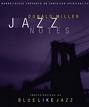
FREE BOOK OFFER: Buy this audio (or the regular hardback book) and we will give you a gift bookjazz notes.jpg version of Blue Like Jazz  absolutely free.  Called Jazz Notes this small full color hardback has not only handsome moody color photos but a CD tipped in the back that has Miller reading excerpts of the book in his best bohemian voice, spoken over and around some fairly average soft jazz.  It’s a pretty cool way to introduce a friend to Donald Miller — to hear him reading.  And we are sending it free with any Million Miles… book or audio purchase.Yay.
 

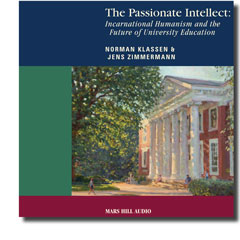
passionate intellect.jpgCD The Passionate Intellect: Incarnational Humanism and the Future of University Education  Norman Klassen & Jens Zimmerman (Mars Hill Audio) $24.99  Anything narrated by Ken Myers is worth listening to.  It is a given that if he selects it to put into an audiobook, it is well worth hearing.  We loved this book about the meaning of education and true humanness, so when we heard Mars Hill Audio was producing an unabridged reading, we were jazzed. Rich, classy, provocative, and solid…we are happy to stock this Mars Hill audio book.  If you don’t know the Mars Hill audio journal subscription, we highly recommend it.  Visit their very thoughtful website home at www.marshillaudio.org.

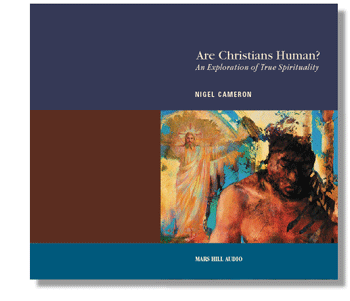
are christians human.gifCD  Are Christians Human? An Exploration of True Spirituality  Nigel Cameron (Mars Hill Audio) $20.00  Although we have a few in stock, the paperback book version of this excellent study is out of print.  When the perceptive Mr. Myers realized this was no longer around, he thought it should be made available again, and selected it to record.  It is a book that can be listened to profitably over and over.  Dr. Cameron is a theologian and medical ethicist, rooting his thoughtful and prophetic insight about the nature of spirituality in a proper understanding of the human person.  He rejects Platonic dualism, and affirms the nature of humans as embodied in a good creation.  It is an exceptionally rich account of mature spirituality which at once provides a Biblical alternative to sloppy gnostic nonsense of the liberal sort, and hyper-pietism of the fundamentalist sort.  Read by Ken Myers.

CD The Church in Joyous Obedience Walter Brueggemann (Regent College ) $30.00  The graceful package artwork by Sandra Bowden is the first gentle hint that this is truly an extraordinary product.  Dr. Brueggemann spent several days in British Columbia at the 2008 Laing Lectures hosted at the renowned evangelical grad school where he gave some of thewalt speaking.jpg most stunning presentations I have heard from him.  He lectured on Torah, on Isaiah, and on Jeremiah–standard fare stuff for those who know his body of work. Yet, the poetic passion and imaginative connections he makes in these three lectures are exceptionally brilliant and stimulating.  After each lecture, two Regent profs (one a Biblical scholar and the other an economist) give responses, raising some questions they had for the good preacher, and he briefly responds.  What a great example of gracious and serious conversation.  We think it is the kind of thing H&M fans would appreciate and we eagerly recommend it.

glo.jpgGlo (Zondervan) $79.99  sale price $59.99  We have more Bible translations and editions than most bookstores, but we’ve never found any Bible software that we were really excited about, that we felt took the possibilities to a new level, that we understood would be really special.  This Glo, though, is spectacular.  It taps the newest technologies and includes all kinds of very cool stuff: more than 2,300 high-resolution photos (zoomable), 7,500 encyclopedia-type articles, 150 maps, more than 650 works of art, integration with the best web content, 450+ virtual tours (360-degree, modern-day and re-created ancient biblical locations.)  There are hours and hours of HD videos, all at a click of the finger, right where you need them, not to mention more traditional features like time-lines, atlas, searchable topical indexes, and all the NIV Study Bible notes (which are, in our opinion, perhaps the best notes available in any study Bible.)  These navigational lenses reveal the world of the Bible in ways that are truly innovative and exciting and helpful.  What a great gift for anybody who spends time online, who uses their computer well, or who just wants a new way to experience the Scriptures in fresh, electronic, ways.  Learn more about it here

Glo Bible and screen.jpg

This does demand a lot of RAM and at least 18GB of free hard disk space, and obviously a good video card, a DVD-ROM drive, etc.  If you are interested in ordering this amazing item from us, check here first for PC System Requirements. 

We have this new Glo Bible at a very special price: $59.99  (The publisher has announced that the price will go up to $89.99 in a month or so, so this may be the best price around.)

Hearts & Minds 234 East Main Street  Dallastown, PA 17313     717.246.3333


Books on Marriage (in honor of our 33rd wedding anniversary)

Yesterday was our 33rd wedding anniversary and we didn’t do anything to celebrate it. It may be that we are tired or too busy, or maybe it is that we are just content in the midst of the middle ages.  Either way, I know I can’t imagine myself without my usually sane business partner, beloved wife and mother of our three kids, dear Beth. My brother nicely wrote recently about not even remembering when he didn’t have such a soul mate as his wife (he’s been married longer than me) and I understood exactly.  We are blessed.

I am going to suggest that some of the health of our relatively happy marriage comes from reading good books on all sorts of topics.  Early on in our young adulthood, fired up about social change and God’s Kingdom and relevant ministry and intimate community with like-minded friends, we read about all sorts of things, curious and veracious about God’s care for all of life, how our deepest convictions about the reign of the Triune God might be lived out in our broken world.  That we chose early on not to fixate on our marriage, but to ponder the meaning of Matthew 6:33—seeking first and only God’s Kingdom—seems to have be a helpful approach.  In the heyday of the “relationship” emphasis of the 80s, with everybody talking about co-dependency and recovery and hurts and issues (some of which was genuine and healthy) we sometimes feared that we were missing something.  Were their deep dark secrets we were suppressing?

Do you know that scene in the old Woody Allen movie where he stops a cheery, obviously in love couple on the street?  He asks them the secret to their joyful unity and one replies something like “Well, I’m just shallow and don’t have very much deep stuff to think about” and the other says something like, “Yeah, me too.”  We kinda felt like that sometimes.  Maybe we were happy because we just weren’t working at our marriage all that much.

Still, thinking and reading widely has been helpful.  We are sometimes asked for our favorite books for couples, and of course our answer varies depending on the faith, lifestyle, age of the couples, and how deep or academic they want things to be.  (And maybe something like Shane Claiborne’s Irresistible Revolution is the jolt they need to take up the cares of others for a season, losing themselves to find themselves, you know.)  Yet, there are a few we come back to over and over, writing to friends and customers who inquire about the best books for either pre-marital reading or for ordinary marriage renewal.  These aren’t for those in deep trouble, and aren’t scholarly.  We have books on the tough stuff,  recovery from infidelity, books about domestic violence, authors who help those with sexual problems or resources for counselors. Call us or hit the inquiry tab up above if you want to talk about other related issues.

Here then, are a few we find ourselves recommending. 

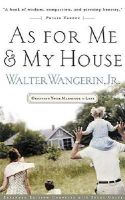
As for Me larger.jpgAs For Me and My House:Crafting Your Marriage To Last Walter Wangerin (Nelson) $14.99  This is written almost as memoir, Wangerin telling stories, by one of our great living authors.
Stuff about forgiveness and communication, mostly.  Many have said it is their all time favorite book on marriage and has had such enduring appeal I think I want to call it a classic.  Good discussion guide in the back.  A wonderful, wonderful book. (Look for his new one soon, by the way; Letters From the Land of Cancer.)


Intimate Mystery
: Creating Strength and Beauty in Your Marriage  Dan
intimate marriage.jpg
Allander & Tremper Longman (IVP) $13.00  I really loved their bigger book based on
Genesis (Intimate Allies) which uses a “case study” approach of
marriage problems, and then referring back to the “original plan” in
Genesis, but it maybe was a bit much for most folks. This newer one is
fabulous, and useful since it is more slim.  It uses the framework of “leaving
and cleaving” and it is wonderful to see an amazing counselor and a top Bible scholar working
together like this.  It is well written and yet very clear.  There are a set of separate
Bible study guides for each chapter, which now, in the paperback, are included
in the back of the book making it really useful to have. (You can still get the study guides separately, though.)  There is a 6-session DVD, too ($30.00) which is very well done–short clips to generate conversation in groups, bits of Dan Allander teaching, interviews with couples. 
Excellent, solid, beautiful stuff.
  (By the way, these are the guys that are interview in the recent Donald Miller Convergence DVD project I wrote about the other day.) Highly recommended.

 
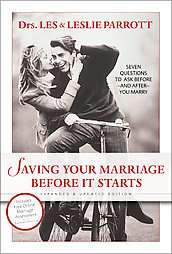
saving your marriage before.jpgSaving Your Marriage Before It
Starts
: Seven Questions to Ask Before (Or After) You Marry  Les & Leslie Parrot (Zondervan) $14.99  Well, this may not seem to be for old-timers, but it is still surprisingly
insightful, as a great refresher.  These two are very sharp (and yes, those are their names so stop snickering!) I’d recommend anything they do—and
they do a lot!  Love Lists [$14.99] is simple: it offers a list of things couples should do every day, stuff they should do once a week or so, a monthly list, and some recommendations for a “yearly check-up.”  Very nice idea, eh?  There is a man’s Bible study guide and a woman’s, too, for Saving Your Marriage which is
helpful.  It is a bit more psychological, self-helpy and practical so I’d recommend it
be coupled with some sort of substantial theology of marriage for a sound
foundational framework. Still, they pick the key topics of handlng money,
sexuality, communication and such and give great advice. There is a newer one entitled Saving Your Second Marriage Before It Starts that, it seems to me, would make essential reading for those considering re-marriage. Another good one from them is called I Love You More: How Everyday Problems Can Strengthen Your Marriage (Zondervan; $12.99) and covers a range of family issues, personal problems, particular struggles, with testimonials and case studies of those who made their way through matters as painful as infertility, handicapped kids, sexual infidelity, money problems, spiritual differences, and so forth. Les and Leslie.  Read ’em and learn.  
 
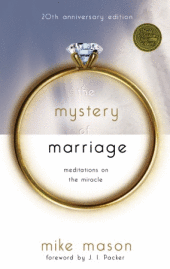
mystery of marriage.gifThe Mystery of Marriage: Meditations on the Miracle 
Mike Mason (Multnomah) $13.99  Contemplative, rich, thoughtful, deeply spiritual, quite
lovely and one of our personal favorites.  Eloquent and elegant, a bit mystical and moving, so therefore not for
everyone who isn’t used to books about the inner life.  A true favorite of many, though;  there is nothing like it!
  Beth and I both have thought it to be our favorite (at one point or another, I think) and we’ve given it as a wedding gift.  I suspect that many of our best customers will find it extraordinary and a real find, for its insight, theology, and well-crafted prose.  You might as well just buy an extra copy or two now as you will want to share it.

Many sorts of folks have said this is the best thing they’ve read on marriage, so we really do commend it. A forward by J.I. Packer is very nicely done. Mason has several other well-written books, too, which are really worth reading, including the recently re-issued set of short fiction stories, The Furniture of Heaven.  Nice.

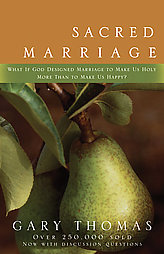
sacred marriage.jpgSacred Marriage Gary
Thomas (Zondervan) $14.99 This, too, attempts to offer more than a self-help approach, pondering instead the “reason for” and
“meaning of” our unions, somewhat like Mike Mason, but not quite as deep or richly mystical.  Still, this is a
wonderful look at the deeper theological and spiritual nature of marriage.  His
tag line is “what if marriage wasn’t to make us happy, but make us holy.” 
Whew.  Still, he’s not a heavy writer, he tells nice stories, even writes with delightful joy and good humor.  There is also a
companion called  Devotions for the Sacred Marriage ($14.99 hardcover) which is a nice addition, or a nice gift.  By the way, Gary, who we have met, and who Publisher’s Weekly once called “the evangelical Henri Nouwen”,  has earned his way on to my list of authors that I will read anything he writes.  His last, Holy Available, on being shaped into the image of Christ, was excellent.  His newest is called Pure Pleasure: Why Do Christians Feel So Bad About Feeling Good, which looks fabulous and I am eager to get to it.)  He has also written the excellent
Sacred Parenting and Devotions for Sacred Parenting which,
like the marriage ones, bring a nice blend of philosophic/spiritual insight and
practical, inspiring, and very helpful stories.    
 
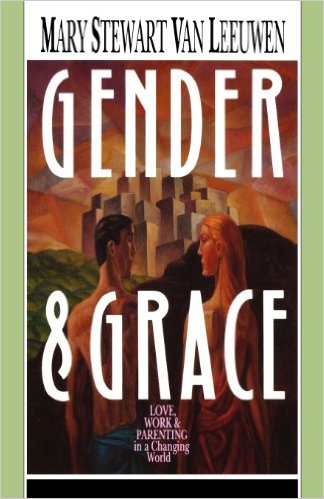
Gender and Grace: Love, Work &
Parenting in a Changing World
  Mary Stewart Van
gender and grace.jpg Leeuwen  (IVP) $23.00. Beth and I heard Mary lecture a time or two in the early 80s, and devoured her book when it first came out. (We ended up being mentioned in her serious sequel to G&G on masculinity, My Brothers Keeper? [$17.99] which is vastly under-read, in my view.  It is amazing!)  If couples
don’t get the gender roles stuff  fundamentally right, there will be troubles…as an evangelical feminist who works in the social sciences, and sees/ thinks through the broad lenses of a Christian worldview (shaped by the very shape of the Biblical narrative itself—good creation, turned ugly from, but being restored in Christ) she is to be trusted.  We think it is
wise and thoughtful, but, admittedly, a bit serious and broad-rnaging for some
folks. I do think it is one of the most important books we’ve ever read!   Skip those handy evangelical books saying simplistic things like “she wants love, he wants respect” or the wildly confused and confusing Wild at Heart
. Start here.  By the way, her much-anticipated book about gender in C.S. Lewis, and how the old chap changed after he married, will be out in the new year.  It is called A Sword Between the Sexes: C.S. Lewis and the Gender Debates.  I’ve read some of it and it is truly a major, significant work.)
 
marriage made in eden.JPGMarriage Made in Eden:
Pre-Modern Perspctive for a Post-Christian World
Alice Mathews
& M. Gay Hubbard (Baker) $18.99  One of the best overviews, theological, rich,
foundational from an egalitarian perspective.  I like the way the title echoes the view that God had something in mind in the beginning, and that we moderns may have need to ancient wisdom applied in fresh ways.  Again, this is not a self-help book,
really, so some couples might balk. Most BookNotes readers long for the more foundational work, though, and this offers a wonderful framework for further, more practical stuff.  Still, what is more practical than getting the foundation right? This is sadly out of print, but we have a few left. 
 

Have you had certain books on marriage that have proven to be especially helpful?  That you find to be richly written, to be recommended for thoughtful readers?  Do you and your faith community talk about this stuff much?  If you are unmarried, do you ever read books about gender and relationships?  (We have lists for singles, too, by the way, and a book list on dating sorts of things…give a shout if we can send any suggestions.)  I haven’t listed a lot of important, useful ones that we carry….what are your top few?  Let us know!  Thanks.


Hearts & Minds 234 East Main Street Dallastown, PA  17313  717.246.3333

Book of the Decade


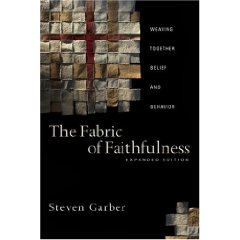
The Fabric of Faithfulness: Weaving Together Belief &
Behavior

Steven Garber
(IVP, 2007) $16.00

fabric larger.jpg

In the mid 1990s I had this long, wonderful, interesting conversation–late,
late into the night—with my friend Steve Garber. He was working on his Ph.D.
in education, trying to learn through research, vast reading, great
conversations with leading mentors and educators, and tons of first hand
interviews with not-so-young-adults—what caused Christian faith to take hold
in meaningful, long-lasting, and integrated ways. I was happy to regale him with
stories of my own college years, and into my journey with the Coalition for
Christian Outreach (CCO) doing campus ministry. Steve and I had many mutual
friends, some common interests, and shared an affinity for professor of
philosophical aesthetics, Calvin Seerveld, and all-of-life-redeemed philosopher
/preacher Dr. Peter J. Steen, and the agrarian essayist and poet, Wendell Berry.
Each gave feisty and academic legs to the vision of God’s Kingdom coming in
every area of life and invited us to live life with an earthy, Christian
lifestyle. Steve told me about his early days as a college student living in
community and running a thoughtful, Christian activist newspaper and his days
learning from Francis and Edith Schaeffer in their Swiss study center, L’Abri. I
told him about my feeble activism on behalf of the United Farm Workers,
advocating for nonviolent social justice in ways inspired by Martin Luther King
and Cesar Chavez. Mostly, we pondered how in God’s great grace He has drawn us
to good authors—I think I was re-reading J.I. Packer’s
Knowing God at
the time—and the good people in our lives who kept us going as we attempted to
live faithfully for Christ’s reign in our callings, careers, and vocations.

I didn’t know, or don’t recall thinking, that this interview would end up
being in a book, let alone a book that great leaders (from Stanley Hauerwas to
James Sire) would insist was one of the best books about the journey of young
adult faith into serious, integrated whole-life discipleship. After having
read Fabric of Faithfulness: Weaving Together Belief & Behavior in the
University Years
,(first released in late 1996) and enjoying the many, many
stories of fellow pilgrims who told their stories to Steve, I realize that my
little late night interview wasn’t all that vital. Some of the stories, however,
are truly amazing, and some of the folks he tells of in the book are stunning in
their insight and eloquence. Still, all of us who were interviewed, nearly every
one, had some testimony of the same three things, three things that Steve has
identified through research, reading, and his excellent knack of listening so
very well, to be the things that most characterize what Eugene Peterson’s book
on the Psalms calls “a long obedience in the same direction.” Three things that
help us keep on keeping on, long after the heady and idealistic years of campus
fellowship groups and young adult commitments.

Sure, Peterson swiped the line from Neitzsche. And Garber swipes lines from
everybody from abolitionist William Wilberforce to novelist Walker Percy, from
Bono to Beavis, from third century Augustine to twentieth century Newbigin, from
Calvin (and Hobbes) to Calvin (of Geneva.) It makes for a fun and engaging read,
a contemporary and urgent book, at once learned and urgent. I mention it often
in my own book reviewing and public speaking; it has become a touchstone of
sorts, a classic.

When pondering the best non-fiction Christian books of this decade, in fact,
a few continue to impress me, haunt me, challenge me, and reassure me. Among
others I could name, I think Brian Walsh & Sylvia Keesmaat’s remarkably
faithful, postmodern Bible study, Colossians Remixed: Subverting the
Empire
(IVP) and the delightful and insightful Culture-Making:
Recovering our Creative Calling
by Andy Crouch (IVP) or all three of the books by Lauren Winner stand out for
me as perhaps the truly most significant of the 2000s.

Yet, in the later half of that first decade of the new century, Steve
Garber’s Fabric of Faithfulness was re-issued by InterVarsity Press,
allowing me to declare here that it is “the book of the decade.” Of
course the great new cover really helps and the shortened subtitle (showing that
its audience is most often those who have graduated from college and, perhaps
approaching mid-life like many of those interviewed in the book, were longing to
more fully understand the relationship of the Biblical themes of vocation and
the Kingdom of God.) Yes, that subtitle makes it clear that this is a book about
integrity, about living with coherence and clarity about “connecting the dots”
between our deepest worship on Sunday and our deepest struggles on Monday. Such
integration is the foundation upon which long-term, hopeful discipleship
emerges.

But, most importantly, there is, quiet significantly, a fabulously
interesting and very important new introduction and afterward.

These two new chapters, which include moving stories about William Wilberforce,
about valiant Chinese dissidents, about Steve’s’ meetings with the likes of
seeking rock star Billy Corgan or Peter Gabriel, are among Garber’s most
eloquent writings, and they set the stage for the re-launch of Fabric as
a truly adult book. It is to some extent about learning, about young people in
their yearnings for a life of coherence, and it was written when Steve was
mostly working with collegiates. Deans and administrators and educators have
used it. He does talk about rock stars and youth trends and pop culture. So,
yes, yes— it is a book even for college students. But more, especially with
the significant new book-ends of powerful forward and afterward—you have to
read them for yourselves to see what I mean—this is now more than ever for
anyone who longs for the deepest joys of discovering a sense of vocation, of
relating faith to their tasks in this sorrowful, broken world, for those who
long to make a difference, in the arts, culture, business, civic life or other
areas where a Christian worldview might most profoundly shape our thinking and
practices, allowing us to engage the societal pressures and resist the cultural
forces so well described and analyzed within these pages.

So. Book of the Decade it is, thanks to the expanded edition that appeared in
2005. I thought to celebrate it here at decade’s end I would reprint a review I
did when the book first appeared in the late ’90s. I’ve changed very little, and
trust this long review will convince you that this is a book worth having, a
book worth reading and re-reading, a book worth working on, discussing, and
sharing.
See more of Steve’s writing at the Washington Institute on Vocation, Vocation, Culture.


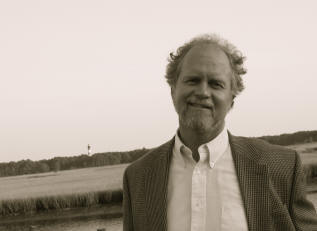
In the middle of the remarkable new book The Fabric of
Faithfulness,
Steve Garber tells the
Steve Garber.JPG

story of a meeting with one of his
students, a student who “asked wonderful questions about important ideas.” As
one experienced in mentoring college students, Garber saw that the student
seemed not to take his intellectual search all that seriously. Our author found
himself doubting that the fellow “really understood the difference of truth and
the difference it makes.” In a move which seems uncharacteristic for the gentle
teacher, Garber issued an ultimatum: he would talk no further with this student
until he watched all of the films of Woody Allen, from Annie Hall on. It
should be a clue as to who might enjoy this book, as well as who ought to.

Laden with quotes from popular cartoons, film and rock music, The
Fabric of Faithfulness
is a book which takes young people–specifically
people in their university years (what developmentalist Sharon Parks calls “the
critical years”) and their culture seriously. In fact, it is a book that takes
everything seriously, including the quest for meaning in Woody Allen movies.
(Indeed, at least one critical reader has suggested that this is a hindrance of
the book: it perhaps takes itself too seriously.) For those who want a light
read, or rather formulaic principles for spiritual success, this is not the book
for you.

At times lyrical, nearly always eloquent, occasionally written with such
wisdom it can only be called profound, The Fabric of Faithfulness
is a passionate plea for those who work in higher education to help young people
develop a coherent and meaningful worldview which issues forth in a life-long
commitment to relevant, radical discipleship. In the face of the obstacles that
latter-day modernity and the dawning postmodern milieu place before us, which
Garber helpfully explores to considerable benefit, his desire to help students
weave together beliefs and behavior is no small thing. That he apparently has
motivated some of his young friends and students to struggle towards a
thoughtful, evangelical faith which is able to stand, even amidst broken lives
and perverse culture, earns him the right to tell his story.

As the author points out in the opening pages, however, the story of this
book is significantly intertwined with the stories–successes and failures,
brave attempts and false starts, foibles and faithfulness–of the scores of
people he interviewed for the book. It is their animating presence throughout
The Fabric of Faithfulness that gives it such a real-life feel and
keeps the philosophical reflections (with visits from Richard Bernstein,
Alastair MacIntyre, George Steiner and Lesslie Newbigin) from becoming
ivory-tower speculation. Its ultimate practical application is seen in rave
advance reviews from the likes of InterVarsity Press’s resident intellectual
guru James Sire (who called it “the best book on moral education I’ve ever
encountered”) and Stanley Hauerwas, Duke University’s resident alien, who wrote,
“If there is any book I would want to give to a son or daughter going off to
college, it would be this one.”

If the playful yet deadly serious question “Why do I get up in the morning?”
is asked by Professor Garber to his college students, he asked similarly
pregnant queries of the 40- and-50-somethings he interviewed for
Fabric. His guiding passion was to determine what happened to
folks who got serious about their faith in their college years that enabled them
to endure and thrive in their desire for a life-long commitment to godly service
in their careers, loves and lifestyles. Were there discernible traits of those
whose faith journey led them through the “valley of the diapers” and across the
threshold into the beginnings of middle age with their Kingdom cares and
commitments intact? Were there certain scenarios of discipleship that provided
the context for such idealistic faith to endure and mature? How and what sorts
of habits of heart (as Garber often puts it) were formed which served to develop
character in the lives of those interviewed? Quite specifically,


Each person responded to a series of questions that asked them to reflect on
their “cares and commitments” at this point in their lives, and what had
happened during their university experience that gave “shape and substance” to
them. In a variety of ways, this question was asked again and again: What is the
relation between how you are living today–particularly your sense of what is
most important, what you most care about–and the tapestry of influences on you
during your university years? (p. 35)

Over and again, Garber discovered three traits which emerged from the
interviews. And in teacherly fashion, he reminds us of them in numerous ways
throughout the book:

As the stories were told, during the critical years between adolescence and
adulthood they [those that thrived and continued to live out their vision of a
coherent life] were people who (1) formed a worldview that could account for
truth amidst the challenge of relativism in a culture increasingly marked by
secularization and pluralization; (2) found a mentor whose life “pictured” the
possibility of living with and in that worldview; and (3) forged friendships
with folk whose common life offered a context for those convictions to be
embodied. (p. 160)

A faith understood as comprehensive and true, a mentor and a community. If
these are the essentials for building a story of healthy fidelity over the long
haul of one’s life, how might ministry plans, Christian ed programs and
discipleship strategies nurture such traits? Garber is only suggestive (since
this is not the book’s focus). But if his own ministry style is any indication,
the typical youth pastor, campus minister or college teacher could learn
volumes: read good books with students, eat lots of meals together, view films
and discuss novels, analyze the lyrics of pop songs and struggle to understand
the cultural visions being promoted through pop culture, listen to the pains and
fears of post-adolescents, talk, write letters, speak honestly, encourage deep
friendships, help folks make connections, model a concern for current events,
always and everywhere ask questions of “knowing and doing” and how to live a
whole, integrated life. (If this sounds like the rigorous whole-life approach
modeled by Francis and Edith Schaeffer and others in the L’Abri movement, it
should come as no surprise. Garber himself dropped out of college in the early
’70s and made his way to the Swiss study center for a season.)

Life-long learning and commitments to long-haul discipleship best happens,
then, in community with other like-minded folk reflecting together on real life,
and Garber’s stories offer adequate proof that there are plenty of
spirituality-hungry young adults seeking lives of moral consistency and
integrity. True to the “Generation X” and “Millennial” research, they long for
genuine and deep relationships and one wonders, at times, if these profoundly
struggling young adults are being patronized or trivialized in many church and
parachurch ministries. Even at our finest Christian colleges, some observers
wonder if students are truly challenged to unite life and learning, telos and
praxis; in a phrase, have we created authentic communities of Christian learning
or just religious shadows of secular institutions of higher education? Those who
lay awake worrying about such things–and some, I’m sure, do, including some of
those who appear in this book–would do well to reflect on Garber’s work,
digging through the footnotes and citations, as soon as possible.

Despite the media blitz about the cynicism of Gen X, Garber and his
colleagues from organizations with which he works, such as InterVarsity
Christian Fellowship, Pittsburgh’s Coalition for Christian Outreach (CCO), and
the American Studies Program of the Coalition for Christian Colleges and
Universities, can offer vibrant testimony that there are those who want more
than a cheap faith or a cheap thrill. There are those who want to deeply connect
what they believe about the world and how they live in that world. There are
young men and women who are thoughtful about their culture and long to make a
difference in their callings, vocations, life and times. Throughout this book,
Garber seems to imply that working with this strategic group is extremely
important (these are, after all, in many ways, tomorrow’s leaders and cultural
gatekeepers) and uniquely rewarding. The stories which are told here certainly
lead readers to agree.

young adults in suits.jpg

If the invitation to engage in this sort of thoughtful mentoring of those in
the “critical years” doesn’t make many potential readers (who may not have any
connection to campus ministry) rush out and buy The Fabric of
Faithfulness
, traditional church leaders ought to know this, too: this
book is an exceptionally useful guide to some of the most important moral
philosophers and social critics writing today. As such, it can serve as a
helpful introductory crash course, a way to get a taste of authors you’ve heard
of but with whom you may not be adequately familiar. Would that church leaders
knew these scholars, understood these issues, cared for ideas and people—I can
attest that Steve’s sensitivities, shaped as they are by engagement with these
deep thinkers, has allowed him to mature into a man of great impact on others.
For those that want to mentor leaders, his approach, as shown here, is simply
essential.

In a fairly brief and quite readable way, Garber interprets for us three
primary “lenses” through which contemporary cultural critics tend to view the
influence of the world on people’s worldviews and lives. With biblically-based
insight, happily, Garber looks at and through all three lenses, showing the
compelling insight of each perspective. He explains, firstly, the “history of
ideas” approach which emphasizes how intellectual presuppositions guide our
worldview formation. (As a representative of this approach, think, for instance,
of Francis Schaeffer, or, as Garber suggests, the work of Thomas Oden.) In this
view, what people believe is influenced most by the philosophies of the books
they’ve read, the movies they’ve seen, the doctrine or ideologies they’ve been
taught. As the old saying goes, “ideas have legs.”

Inevitably, however, this gives way to a deeper question, the matter of the
“ethic of character” and the complexities of the dichotomy between personal and
public lives. Think here of Stanley Hauerwas, whose work such as Vision and
Virtue
and The Community of Character have influenced significantly
the discussion about moral development and character formation. Simplistically
put (and Garber does him much better), this approach asks not so much what we
claim to believe but who we are. This is profound stuff and his discussion here
on the difference between idealistic optimism and becoming people of hope are
pages which are alone worth the price of the book.

Thirdly, Garber walks us through the role of the “sociology of knowledge”
approach, that is, the thesis that “What I believe is deeply affected by my
social experience: my family, community city, society and century” (p. 34).
Peter Berger’s book The Social Construction of Reality is a standard
here–or consider his writings about the impact of “privatization” on the
possibility of developing meaning-systems. Somewhat similarly, consider, too,
the influential work of evangelical scholar Os Guinness and how he reminds us of
the pressures of modernity on the Christian mind. There is no doubt that we all,
as Garber phrases it, “bear the bruises of modern consciousness.” In a stroke of
understated genius–almost too good to be true–Garber suggests a linkage of
these three ways of understanding (and their respective emphases upon the role
of convictions, character and culture) with the three traits uncovered in his
interviews: worldview, mentor, community. A sense of truth undergirding a
worldview seems to be a trait best understood by the history of ideas
perspective. The role of the mentor is helpfully highlighted by Garber’s
ruminations on the ethic of character and the role of culture is mediated and
nuanced by the role of one’s own subculture or supportive community. Three
different lenses help us see the three traits which enable young disciples to
thrive and endure.


The Fabric of Faithfulness is a splendid resource even if one doesn’t
work with young adults or new Christians. It is well worth reading for the sheer
joy of walking through a near barrage of contemporary Christian authors (from
the prophetic social critique of Jacques Ellul to the Christian educational
theory of Craig Dykstra), wise novelists and writers (from Dostoevsky to Milan
Kundera and Walker Percy) and classic theologians (Augustine, Lewis). But the
sources are wider still; one is often surprised with an excerpt from a Mike
Royko column or a Calvin & Hobbes cartoon…

***

Early on in The Fabric of Faithfulness, Garber shares a letter
from one of his anguished young friends who has become disillusioned with the
painful difficulties of remaining Christianly steadfast and redemptively active
in current affairs while pursuing her new career and lifestyle. Her last line to
him was, “Your secrets for dealing with the brokenness are coveted by one who
has been blind-sided by the reality of the world.” Interestingly, though, it
seems that one of the convictions most dearly held by those enduring
40-somethings Garber interviewed was a sense that their faith and Christian
obedience was, in fact, in keeping with the reality of the world. Firmly rooted
in a biblical doctrine of creation (as well as fall and redemption), mentored by
leaders who embodied a principled and realistic Christian lifestyle and
surrounded by a community of caring fellow-travelers, they were
convinced–contrary to the fact/value dichotomy of modernism or the radical
relativism of postmodernism–that Jesus Christ is Lord, Lord of politics, of
history, the economy, careers, romance, culture…this is the fundamental
reality. It is this awareness (along with the community of fellow-believers)
which creates “plausibility structure.”

It is my prayer that this excellent book, rooted in Garber’s own diligent and
creative work with students and careful listening to former students, will
inspire many of us to find for ourselves such a plausibility structure, the
sense that we together can live out the implications of an integrated Christian
life. Perhaps reflecting on this book and its stories will help us not be
“blind-sided by reality” when the going gets tough but, like Sophie Scholl and
the other anti-Nazi students with which Fabric ends, “face the consequences of
their convictions, addressing not only the indifference of the university but of
Germany itself.” These youngsters stood up and paid up, sadly, with their very
lives. That is the sort of faithful Christian this book hopes to help produce.
May we in the established churches be worthy to receive the gifts, insights,
courage and questions of such young disciples. And may we hear them as they call
us who may already be beyond the “university years” to weave together our own
belief and behavior.

10% discount

Fabric of Faithfulness: Weaving Together Belief & Behavior

Steve Garber

regularly $16.00

now $14.40

ORDER HERE

Hearts & Minds  234 East Main Street  Dallastown, PA  17313     717.246.3333



Spectacular new DVDs: Start & Convergence.

We trust you know that we here at Hearts & Minds are bookish.  Some of you subscribe,leavings.jpg even, to this BookNotes blog because you know we won’t assail you with advertisements for cheesy gifts and a thousand new “praise” albums.  Folks that walk in our shop–despite the fact that we do carry a goodly share of gift items and music and random weird stuff—comment on how many books we have packed in to this space.  Just today I pondered a note I got from an author, thanking us for caring about and selling books in “these hard times.”  Indeed.  And, also just today, I spent some time treasuring the brand new collection of poems by Wendell Berry, a handsome, slim volume called Leavings (Counterpoint; $23), a collection described as “elegies, lyrics and letters and the occasional love poem.” And some of his famed Sabbath poems. We love books as they carry words, which carry ideas, often with great charm or beauty and power.

Yet, we do get fired up about non-book items, sometimes, and I have been twitching to tell you about a few great, great, great new DVDs. They are designed for small group use, but I’d suggest them even if you’ve got no one to watch with.  They are that good.

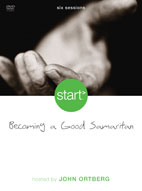
start_logo.gifFirst, I could hardly be more impressed by a new six-week series on the “Good Samaritan” passage, expertly produced by World Vision and published by Zondervan.  It is called Start: Becoming a Good Samaritan and is hosted by John Ortberg, who is a very good communicator.  His “thoughts from the bench” set the overview for each week, as he meditates for a few minutes in precise prose, even as he casually sits on an outside park bench.  (His little piece on why we ought to read the prophets, on week 3, is worth the price itself, and could be shown in many settings!)  Other great speakers, authors and activists show up here, each articulate, balanced, thoughtful, and very compelling.  Speakers such as Eugene Peterson, Philip Yancey, Gary Haugen, Joni Eareckson Tada, Desmond Tutu, Jim Wallis, Shane Claiborne.  Rob Bell does a “nooma-esque” thing with a batch of chairs in each one, and that, too, is very, very compelling.  Brenda Salter-McNeil gives one of the best, brief invitations to work on racial and ethnic diversity I’ve seen; Shane Claiborne is in there, AIDS activists show up, speakers as diverse as Chuck Colson (who is very good on prison reform) and Matthew Sleeth (one aspect of being a good Samaritan in this day and age, they insist, is “Tending to God’s Creation.”)  My, my, these are wise and challenging voices for living out compassionate faith among our often hurting, global neighbors.

I like the way this DVD keeps moving—the days of old “talking heads” or 45 minute sermonsbecoming a good sam.jpg being shown are long gone. There are well-paced interviews, live footage, a bit of music.  Yet, this isn’t like The Trouble With Paris or Everything Must Change (both which I’ve shown in various settings, and regularly rave about, for solid content and cool production) which are hip, edgy, and so fast-paced that they might annoy some traditional viewers. Start is well shot, crafted with a very rich, contemporary cinematography, without the dizzying stylings of some of the more recent postmodern curriculum. It really is artfully done—it is strikingly beautiful in some places!—and I couldn’t recommend it more.  There is a study guide you can buy to go with it.  For more info, please visit www.juststart.org.  We could be thrilled to sell this to you or your church and I am sure it will be fruitfully used and greatly appreciated.  Kudos to Zondervan for releasing this timely and excellent program.  May it be widely used.  DVD $24.95  participants book $9.95. 
converge logo.jpgToday is the official release date of the three Convergence: Where Faith and Life Meet DVDs that Donald Miller has been promoting on his recent tour.  We’ve had ’em for a week now and are so excited about these, I could wax on and on about them, too.  Briefly, they are simply made with a casual aesthetic: Donald Miller interviewing some sharp, provocative, insightful folks. They are promoted as “a new generation of small group resources” and could easily be used to spark your own conversations.  Again, they are well made, insightful, with top-shelf contributors offering authentic input about real faith.  Highly, highly recommended. Visit www.allthingsconverge.com for study guides and more info.

Here’s the skinny on the three of ’em:

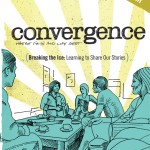
convergence learning to share.jpgConvergence: Breaking the Ice: Learning to Share Our Stories  Phyllis Tickle is truly one of the most well-read, and well-rounded people I’ve ever met.  She is energetic, ecumenical, deep and yet down to Earth.  In this free-ranging and delightful set of three conversations, Donald Miller—quite a storyteller himself—chats with Tickle about the role of stories in our lives, how to reflect on our lives, even how to realize how certain places have shaped us.  Although Phyllis is known as a cultural critic and reporter of the emergent trends, she is also a memoirist and has lovely memories of her rural, southern girlhood, and how her husband and she bought at Tennessee farmstead.  Asking how our lives have unfolded, what stories and values have shaped us, and what we can learn from listening well to another’s story creates a fabulous and enjoyable learning experience.  This is great for any class or group, but ideal for small groups wanting to dig a bit deeper in forming authentic community with one another. DVD $14.99 

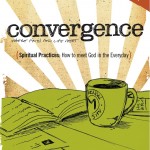
convergence spiritual practices.jpgConvergence: Spiritual Practices: How to meet God in the Everyday  Here, Donald Miller has three 20 minute conversations with Dr. Lauren Winner, author of Girl Meets God, Mudhouse Sabbath and Real Sex, now teaching at Duke Divinity School.  She explains what we mean by spiritual practices, shows how Jesus did, and Christians should, engage in such practices.  She explains how to start doing spiritual practices and how they bring us closer to God, and what else to expect.  This is wise, fun, i
nteresting, and sharp reflections by a good friend and important voice.  Kudos to Miller for getting Lauren in on this.  Listen up!  DVD $14.99

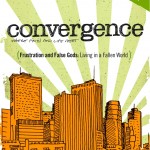
convergence FRUSTRATION-.jpgConvergence: Frustrations and False Gods: Living in a Fallen World  In this one, Donald Miller interviews two of my favorite writers, each with their own unique specialty.  Dr. Tremper Longman is no doubt one of the most significant Old Testament scholars around; his credentials and publishing are extraordinary.  Tremper’s old college roomate, Dan Allender, is now a professor of counseling (and Professor of Counseling at Mars Hill Graduate School in Seattle.  When these two guys team up—as they have in several really, really great books–you have the best of contemporary cultural analysis and deep inner insights informed by fabulously rich Biblical scholarship.  Here, these two reflect with Miller on basic questions: are we to be happy?  Why is life often so unsatisfying? How are we to live in a world filled with God’s goodness yet plagued by sin and brokenness?  Three conversations of about 20 minutes each.  DVD $14.99

BLOG SPECIAL
10% off any DVD mentioned
buy any three and get 20% off

Order Here
(or click on the “inquire” or “order” tab at the website)

Hearts & Minds 234 East Main Street  Dallastown, PA 17313     717.246.3333
Pennsylvania State Pastors’ Conference: Books about Church, Congregational life, and more

Thanks once again to the good work of the Pennsylvania State Council of Churches, the annual gathering for pastors was meaningful, interesting, fun, and, for us, a bit profitable.  (Yay.)  That is, we sold a bunch of books.  We worked late into the night (getting to bed at 5:00 a.m.) to ready the book room with tons of stuff for mainline clergy, books on lectionary preaching, worship aids, congregational revitalization, spirituality, leadership, Advent resources, pastoral care-giving and such.  Nobody buys much theology, but we had it there; social justice, racial reconciliation, creation-care, too… What a fun, fun gig.  Thanks to friends as diverse as Moravians and Episcopalians, Church of the Brethren and United Methodists, UCCers and Lutherans.  Praise God for a few indie evangelicals, AME, and Roman Catholics, too, who show up. 

Gil Rendle, whose books on the Alban Institute are old standards, did an excellent job of offering insights about systems, leadership, vision, and congregational health, guided by leaders who, themselves, are well-grounded in their own spiritual practices, and who “keep one foot out of the system” for perspective and support.  It seems to us that sometimes our bookshop helps be that place “outside of the congregational or denominational system” where clergy friends can unload a bit.  Books and authors certainly can be a life-line for those who don’t have a lot of support, who feel like they are–as Rendle put it—walking through and working in their own particular (messy) wilderness.  We love hearing how books have offered friendship, solidarity and encouragement to folks, and we hear such things at these kinds of event. Thanks to each of the pastors who visited with us and those who said so many nice things.  

As I’ve said, we had thousands of books on display.  Here are just a few that we featured, talked about, and sold.  I will soon offer a more substantial annotated bibliography of recent books about church life over at the monthly review column.  I’ll led off with a few of the very best books for BookNotes readers about congregational life (such as the extraordinary Deep Church by Jim Belcher, one of my favorite books of the year in this category) and list a batch of recent releases that those who care about churches should know about.  For now, here are a few that our friends in Harrisburg seemed to enjoy.

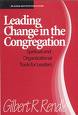
leading change.jpgLeading Change in the Congregation: Spiritual and Organizational Tools for Leaders  Gilbert Rendle (Alban Institute) $17.00  It is rare when we sell out of an author’s book at such an event, and we were delighted that this 1998 classic sold well.  With chapter titles like “Spinning Wheels Gather No Traction” this is a fun read.  He is a master at explaining systems theory, leadership dynamics and the contemporary sense of being in the wilderness. 

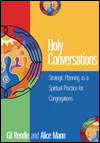
Holy Conversations: Strategic Planning as a Spiritual Practice for
Holy Conversations.jpg Congregations  Gil Rendle & Alice Mann (Alban Institute) $25.00  Alice Mann is very well known as a consultant for mainline parishes and she teamed up with Gil to give us and this very practical resource volume, the very best resource of it’s kind.  Just the title helps you reframe planning away from a business model towards a spiritual process of discerning God’s will amongst the people of God. 

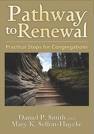
pathways.jpgPathway to Renewal: Practical Steps for Congregations Daniel Smith & Mary Sellon (Alban Institute) $17.00  This is a remarkably clear book guiding pastors and leaders through three phases of the wilderness journey.  (As Alice Mann summarizes in her forward): “…building the readiness of leaders to lead, developing a vision, and aligning the congregation’s life with the vision it has discerned.”  Another reviewer says it is “like a GPS guidance system for congregations…It keeps our eyes on the destination of congregational renewal, shows us ways around very real obstacles, shares the experiences of others who have traveled this way, and reminds us that the journey is always worth it.”  This book seems to capture much of the insight, vision and vibe of Rendle and his talks this year.

this odd and wonrous calling.pngThis Odd and Wondrous Calling: The Public and Private Lives of Two Ministers Lillian Daniel and Martin Copenhaver (Eerdmans) $16.00  I cannot tell you how moving some of this was to me.  I know a number of clergy, and I know them well enough to know about their lives, their dreams, their marriages, their kids, their job insecurities, their joys and sorrows at work and at home.  This book about ministry captures some of that, and more. As Lauren Winner puts it, “My dictionary doesn’t have enough enthusiastic adjectives for this book, which I adore…”  This is one of the best books I’ve read about life in the church, and the pastors who serve.  I hope the pastors who bought it enjoy it, are affirmed in their work, and share it widely with others who want to know what they do day by day.

prepare for exile.jpgPrepare for Exile: A New Spirituality and Mission for the Church  Patrick Whitworth (SPCK) $19.95  A broad and sweeping study, set in the church in England, with a solid foundation in reflecting on church history and then thinking through a deeper spirituality (Benedict, Teresa, Luther, Pascal, Wesley, etc.)  to ground new missional ways of being church in a culture that has sent us into exile.  Although perhaps less evangelical, there are shades of Frost & Hirsh here.

Introducing the Missional Church: What it Is Why It Matters, How to Become One  Alan J.introducing the missional church.jpg Roxburgh & M.Scott Boren (Baker) $17.99  Okay, I didn’t display that at the State Pastors conference, but it came in the day it was over!  I sure would have plugged it from on stage if had arrived in time!  Part of the Allelon Missional Series of the “Mission in Western Culture Project” this looks to be perhaps the clearest explication of missional thinking yet done. Imaginative thinking about being a Kingdom presence in a post-Christian culture, this helps local leaders think like missionaries right here at home.  A
ccessible, basic, useful.  Highly recommended.

churchmorph.jpgChurchMorph: How Megatrends Are Reshaping Christian Communities  Eddie Gibbs (Baker) $17.99  Another book in the Allelon Missional Series, this came out a few months back and has been described as a “master guidebook to the territory we all must travel in order to be church in the new post-Christendom cultures of our day.”  Alan Hirsch says it is “the most thorough interpretive map of church trends to come out in years.”  Fun stuff!

Worship Words: Discipling Language for Faithful Ministry  Debra Rienstra & Ron Rienstra (Baker) $19.99  Ron teaches preaching and worship at Western Theological Seminary and Debra is a wondrous writer and English prof at Calvin College.  (Her great memoir of her pregnancy Great With Child was just re-issued in a stunning new paperback edition!)  Here, they carefully examine the role and use of language for praying, singing, and preaching in the worship practices of the church.  With endorsements from Tom Long (Candler School of Theology) and Marva Dawn (Regent College, BC), and Nancy Beach (Willow Creek) this is a genuinely blessed book hopefully to become a classic. This is beautiful reading, important matters, and we recommend it heartily.

Holy Things: A Liturgical Theology, and Holy People: A Liturgical Ecclesiology, and Holy Ground: A Liturgical Cosmology  Gordon Lathrop (Fortress) $20.00 each  All three are now available in paperback, with handsome matching covers.  I love these, the first two on the ordo, on worship and assembly.  This third one, though, is broader, thicker, and may have been called (Lathrop says in the forward) Only One Is Holy.  Holy God, holy ground?  Read it and see life in new ways.  Heavy, rich, important.

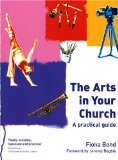
The Arts in Your Church: A Practical Guide  Fiona Bond (with forward by Jeremy Begbie)
the arts in your church.jpg Piquant  This is packed with real-life case studies and photopgraphs and guides to thinking faithlly about the arts in congregational life.  There is nothing like this in print: we import it from overseas because such useful and visionary books are rare.  Published in England, this is a must for any congregation thinking about such things.  Or if you’re not!

Inclusive Yet Discerning: Navigating Worship Artfully  Frank Burch Brown (Eerdmans) $20.00  You may know Brown as the very thoughtful writer of Oxford University Press’ much-discussed Good Taste, Bad Taste, Christian Taste.  Here he gives us several writings on the complex interweaving of theology, art and worship.   Who else brings together Bach and Marcus Borg, Pope Benedict XVI and Rick Warren?  This is another contribution in the vital Calvin Institute of Christian Worship Liturgical Studies Series edited by John Witvliet.  Kudos.

feasting on the word.jpgFeasting on the Word  Year C volume 1 and volume 2  edited by David Bartlett & Barbara Brown Taylor (Westminister/John Knox) $39.95 each   The editors of this ambitious series begun last year have offered the first two volumes for preaching The Revised Common Lectionary for Year C.  These are written by a vast array of mainline scholars and preachers and pastors, offering for angles on each of the weekly texts: an exegetical, theological, homiletical, and pastoral.  Four often eloquent and insightful takes on every passage.  Wow.

sacred meal.jpgThe Sacred Meal Nora Gallagher (Nelson) $17.99  I read a lovely and compelling quote from the back from Barbara Brown Taylor and another from Lauren Winner and this became the immediate best-seller at the gathering.  We truly love this “Ancient Practices Series” edited by Phyllis Tickle, and think you will, too.  The other brand new one in this series is by Sister Joan Chittister, The Liturgical Year, sold quite well, too.  I’m so happy.  We featured the whole Thomas Nelson series—Bob Benson on prayer, Dan Allander on sabbath, Scot McKnight on fasting… Brian McLaren’s introduction to the series, Finding Our Way Again, is very, very nice.  Highly recommended.

Living the Christian Year: Time to Inhabit the Story of God  Bobby Gross (IVP) $17.00  The forward by Lauren Winner is very, very good, and Bobby does a remarkable job offering an introduction for those who need a primer on this liturgical year stuff.   It is a devotional guide inviting us to indwell the church calender by setting our sights by theological time.  We will be hosting Bobby on Ascension Day, by the way, to worship, have him teach a bit, and sign books as we celebrate the good graces that allowed him to write this wonderful devotional.  Poet Luci Shaw calls it a “bountiful resource” and Emilie Griffin calls it “a jewel of a book.

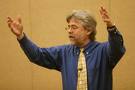
Byron speaking.jpgIn my own workshop, I highlighted some favorite memoirs. I read briefly from really interesting and well-written Woman Overboard: How Passion Saved My Life by Jo Kadlecek, the incredibly moving, and very funny, Girl in the Orange Dress by Margo Starbuck,  and the delightful but vulgar Mennonite in a Little Black Dress by Rhoda Janzen, and of course Donald Miller’s A Million Miles in a Thousand Years which I think everyone should read.

 I read a long excerpt from Frederick Buechner’s Telling the Truth, told of some good books on how to read (and even argue about) the Bible—-I wish I would have had time to read from the flamboyant and bohemian Debbi Blue and her stunning set of Bible reflections called From Stone to Living Word: Letting the Bible Live Again—showed some new editions of NRSV Bibles, talked about the ESV, too, and celebrated books that invite us to see God’s glory in the mundane such as the altogether lovely book An Altar in the World: A Geography of Faith by Barbara Brown Taylor. 

Although it is a bit too philosophical for the taste of some busy pastors, I suggested that they work through the extraordinary book about rituals, secularization, worship and worldview formation called Desiring the Kingdom: Worship, Worldview and Cultural Formation by James K.A. Smith.   Really, I can hardly think of a more fruitful scholarly book to read and careful
ly ponder, raising great questions, and offering profound insights about the point of all this stuff about church, God, and mission. I’ll say it here, now: it is one of the most important books of the year! 

CD.jpgIf you would be interested in hearing me do this hour and a half luncheon book ramble, you can purchase the CD or audio tape, I believe, from the good folks who tape the State Pastors’ Conference, Un’I Tape Duplications. Call ’em at 717-761-5392.

Here’s a deal:
If you get that tape, or either of the ones from previous years when I did similar book talks, we will give you a $10.00 credit for any book you buy that I recommend or mention in the workshop.  That covers more than the price of the audio recording for you.  We are eager to have you hear this (shall we say) animated presentation.  Just let us know if you got it when you place an order.

Hearts & Minds 234 East Main Street  Dallastown, PA  17313     717.246.3333

.

What do you think of these kinds of books, anyway…a mock quiz

In my last post I celebrated last weekend’s Faith4Thought conference at Calvary Baptist in State College, home of the most partying school in America, Penn State University. You can download my keynote talk at their website, by the way if you’d like to hear me yapping about all this worldview stuff, sharing about defining moments for me that lead me to this work I do.)   I suggested that the CCO is an organization from which we can learn about churches reaching college age young adults.  I noted that they are committed to the institutional church and that they help students gain a sense of vocation and calling, integrating faith into every area of life, including their future careers. (One of their slogans is “Transforming College Students to Transform the World.”  Yay!)

Equipping laypeople—as mainline churches call those of us who are not clergy—for the work of ministry is something that nearly all denominations and faith traditions affirm.  Whether this means lay folks are invited to, say, take up the offering on Sunday or are called to heroic short term mission service or to think deeply about how faith relates to their thinking and practice in their callings and careers, all depends. Some churches nurture discernment about God’s call in every aspect of life and others aren’t quite that missional or visionary. Some get people working for the parish, others encourage them to be culture-makers in the world.  How seriously do we take the call of ordinary folks to find God in the ordinary things they do–work, voting, shopping?  Do we really believe Romans 12:1-2 that says that life is worship?  And that we need transformed minds and cultural non-conformity?  It seems to me that CCO and the Faith4Thought event was interesting to young adults because these are some of the issues facing those in these crucible years.  And many students did seem to want to look at books, resources for their journey… 

So, join me in a little thought experiment. I’ll show some of the bookcovers of some of the titles we sold at this CCO sponsored college age gathering. If you can see them, you’ll see stuff on math, nursing, business, advertising, science, food, art, technology, etc.   Then take the following little quiz.

When BookNotes writes about a Christian view of engineering or a faith-based approach to psychology or suggests books about a Biblical perspective on art or science or education or business, I think:

a)   A Christian view of professions like medicine and math and biology?  You’ve got to be kidding!  Get me outta here!  As a strategy for Christian outreach to young adults?  That’s downright looney! 

b)   Reading books about the interface of theology and social life, Christianity and college classes?  Economics and education and ecology in light of Jesus’ reign?  Do you really think anybody wants to do that?  Maybe at F4T they did, but most of us aren’t that geeky.

C)   Hmmm.  I claim to believe that Jesus is Lord, so I kinda guess there is some connection between my faith and thinking about this kind of stuff.  Never thought of it quite like that before, really…I wonder if my friends at church would think this is weird?  We don’t really talk about this that much and I’m not sure if they read books like this.  Interesting…

d)  You know, I know some artists and lawyers and social workers and have friends in business, and, well, yeah, I think they should know about some of these titles.  They just might think that is helpful and pretty neat.  I think I’ll suggest these titles to  them.  Who could I have good conversations with about these kinds of resources?

e)   I’d love to start some kind of outreach with young professionals or students and let them know that God–and our church–care about their world, their work, their passions and ideals. Wow, maybe we could connect students and mentors, older folks with younger ones around career areas and marketplace discipleship.  We’re gonna rock this town!  Where’s my credit card, I gotta buy me some books!

Well, if it these seems a bit out of your comfort zone, or you are not passionate about sharing resources likes these with those who might care, why not listen to that talk I gave?  You can download it here.  I get pretty excited when I get to share our big dreams of making a difference by helping folks find a more wholistic vision of their discipleship so hold on to your hat!  Thanks to Calvary for posting it.  Thanks to BookNotes readers for spreading the word…

Technology and Religion.jpgculture making.jpg 
brothers keeper.gifloving monday.jpg

                                                                                                           
gender and grace.jpg
           
                                   
math.jpgon earth as.jpg    &n
bsp;                                                               
                                  
making art smalll cover.jpg                                         
OIAF - Medium.jpgbiology through the eyes of faith.jpg                                    
fine line.jpg
                            
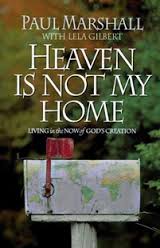
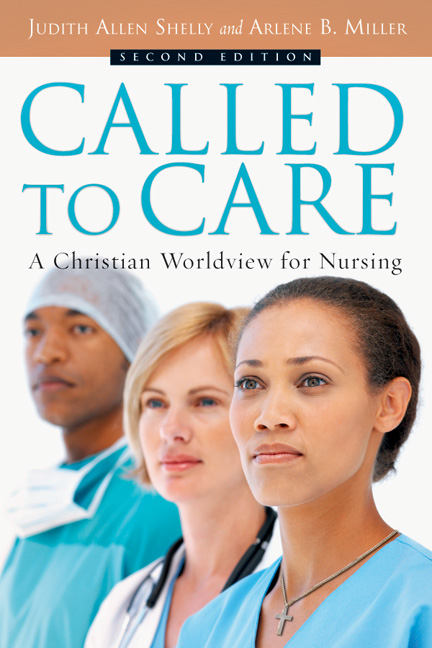
Conversations With American Writers.jpgfabric of faithfulness.jpgheaven is not my home.jpgcalled to care.jpgculturally savvy christian.jpgyour work matters to god.jpggod's economy.jpgbringing it to the table.jpg

Church, Young Adults, and Faith 4 Thought

Souls in Transition.jpgMany church folk fret over the lack of involvement of 20-somethings in their congregations.  It is a difficult thing, and there are a handful of books written in the last year or so about young adults and their frustration with their churches.  Some have had less than meaningful experiences in evangelical churches; others write from the perspective of mainline denominational parishes.  It is something that older church leaders should be talking and praying and thinking and listening about; younger friends, I hope, will refuse to grow jaded or cynical or disengaged.

Congregations that are near college campuses have a unique opportunity to think through ways to welcome college students into their family of faith, and today I was with a church in State College PA that has a history of involvement with the academic community, students, faculty, staff and friends.  It is vibrant and youthful, and it was a delight to see older women helping to organize an event for younger students.  From the excellent food to the art and ambiance, it was obvious that they were thoughtful about what they were doing (in a fairly standard-issue Protestant building.)  Kudos to them for their hospitality and desire to be an outpost of God’s reign among the academic community, and their eager welcome of rowdy young folk.

The event was called Faith4Thought, and I view it as a real privilege to speak and sell books atByron speaking.jpg their conference.  I’ve written before about their themes–and the much larger, February Jubilee conference in Pittsburgh to which it points.  Relating faith and academic studies, helping professionals learn that God cares about their callings, cares and careers, equipping people live out their faith in the marketplace is a theological obligation, and we are thrilled anytime a local churches raises up this vision of cultural engagement and intellectual growth.  When, like Calvary in State College, they do with and for young adults, it is spectacular and illustrates a key to building bridges with many young adults: speaking to these areas that are so important to this generation.  I just had a blast—I talked to many about good books and preached my little heart out.

(I believe the audio of my keynote address, by the way, will be posted at their website, soon.  I’ll try to announce it, at least to the Friends of Hearts & Minds Facebook group.)

Being located in a college town, or near a community college, art school or technical institute, does not guarantee that a church will attract young adults.  It is odd to be, though, that many don’t even try.  Many grumble about the “missing” youth and younger adults, yet don’t seem to have much energy or funds for doing anything about, even when there are hundreds (or, more likely, thousands, near them at these campuses.)  Let us tell you about one organization that can help, an organization that co-sponsored the Faith4Thought gathering today.

The CCO (Coalition for Christian Outreach) partners with local churches near colleges with trained staff to help those churches design plans for reaching, serving, ministering to and perhaps attracting student.  We think that they are on to three big things.

1.  Unlike other para-church groups, they don’t just show up on a campus to build relationships with young adults, starting Bible studies and social justice projects and such; they get stationed at a local congregation which has some kind of heart for student outreach, wants to attract and serve young adults, and wants to be involved in the academic institutions that are their neighbors.  CCO is robustly ecumenical in a sturdy inter-denominational way, and they have staff at Episcopal, United Methodist, Presbyterian (USA) and other mainline churches, as well as at CMA, Evangelical Free, PCA, independent and other evangelical churches throughout the Mid-Atlantic.  We applaud their inter-denominational approach because it is rooted in a solid ecclesiology.  That is, they love the church, they think that ministry should be connected to local congregations, and they think that if we are going to help young adults relate faith and life, one part of that is getting them involved in the ordinary life or real congregations.  Church camp, Cursillo, or Passion conferences only go so far, and young adults, like everybody else, need to be committed to the community of faith expressed in a multi-generational congregation.  CCO gets this.  Hosting an event for students on “academic discipleship” and the vocation of being students in a local church is extraordinary and right.  God cares about college students, but so should the local church.  To do that, the local church has to show intentional interest in the things that collegiates are about. 

2.  CCO also understands that if we are to make a difference for God’s Kingdom, we must commit to the long-term work of being Christ’s people in a particular place.  Standing in and with a local church roots us, often, in a style and context of ministry that goes back hundreds of years in the same building!  That is, by partnering with the local church, CCO is contextualized into a place, and wants to work within traditional institutions.  Partnering with the local church near the local college is a way to make a longer-term commitment to a neighborhood or town or region.  It is what some of us call a theology of place.  The CCO holds out a vision of not just touching the lives of young adults who are college students, through the local church, but realizes that doing ministry like this allows for the nurturing of networks of influence that may lead to social initiatives, cultural reforms, institutional change.  It seems that the theological perspective of the CCO that includes notions of the Lordship of Christ over all of life, themes of vocation and calling, an emphasis on the imagination and a Christianly shaped worldview, and the importance of both evangelism and social action leads naturally to caring about institutions.  Locating a ministry out of a church for the sake of the local college shows a seriousness about culture-making and social change that is important.  It isn’t really surprising that some CCO staff have also started or partnered with other local institutions as a platform for doing college ministry; they have become employed at colleges themselves, at local coffeeshops, or have been hired by Habitat for Humanity.  Very cool.

3.  It may be counter-intuitive to think that young adults care about these things, but I think they do.  Maybe there is a stream of Jack Kerouac in some free-wheelin’ hipster youth, but I think many postmodern young adults desire a greater sense of stability, wanted to be connected to strong families, are interested in local economies (hence the attraction of local coffeeshops and such.)  If a local church can show why we should care about our communities, students will be enthusiastic volunteers in local missions, cultural renewal, and working as God’s servants in creative ways in the local area.  At Calvary/F4T I heard of some college students at one CCO related church who are helping out in local high school ministry through Young Life.  Another few students were doing some local environmental stuff ne
ar their college town.  It was exciting to see young adults and older folk together tearing down tables and scarfing pizza as they moved out my book display and prepared for an ancient-future type meal and communion service they hold every Saturday night, for young and old alike.  It isn’t easy to do the kind of work that will make a church interesting and helpful to serious young adults, but it can be done.

(By the way, on this matter of whether young adults care about institutions and place andbeyond homelessness.jpg permanence, one student at F4T was thrilled to see the extraordinarily profound book called Beyond Homelessness: Christian Faith in a Culture of Displacement by Brian Walsh and Stephen Bouma Prediger (Eerdmans; $24.00.)  She read the rave reviews on the back cover and surmised that this book was not mostly about literal homelessness, but explored displacement as a metaphor for those who are postmodern nomads, who don’t want to settle down, like the character in the novel (soon to be a major movie) Up In The Air.  She understood that this book, which is also about poverty and environmental degradation, makes the audacious claim that God is a home-making God and Christ promises a sort of homecoming.  We must care about our places, land, culture, and institutions, if we are to move forward on these 21st century problems.  Not too shabby to be having these kind of meaty conversations with a younger adult in a local church, eh?  I LOVE selling books to young adults as they are often most idealistic, interested, excited about learning and growing in their faith.  What church wouldn’t benefit from these kinds of conversations?  What church has older folks who are also on the cutting edge of growing faith, who can stimulate, engage, learn from and with twenty-somethings?  Would your church put together a conference entitled “Imagination, Invention and the Imago Dei”?)

So, CCO partners with churches, which illustrates their ecumenical, orthodox ecclesiology.  They have a perspective on faith that believes that institutions are part of God’s created order and part of Christ’s redemptive work, so it is natural they care about local congregations, local people, networks of influence within the local academic community and beyond.  And they intuit that young adults want this kind of stuff: robust, evangelical faith applied in innovative and missional ways, committed to big dreams of Kingdom outreach, including discerning vocation and callings.  My speaking and bookselling at Faith4Thought reminded me not only of the stuff the event was about–the big themes of calling and career and relating faith and learning for the sake of God’s Kingdom–but the broader backstory of local churches and the faith development of young adults.

Doing a one day event like Faith4Thought is not the only way to reach out to young adults, but talking about the relationship of faith and life, work and career, calling and creativity, including  “tactile” experiential workshops, rooted in Biblical spirituality and exuberant praise and worship, is vital.  I highly recommend you study their event webpage to see the workshop topics, observing how this event was designed.  It might be interesting to ponder if your ministry to young adults is this serious.  One young lady, in a breakout session I was leading about reading, noted that many young adults don’t really know much about the Bible, doctrine, or radical discipleship, letting alone do reading on relating faith to learning and work, because, as she put it, in youth group “we just went bowling.”

I suppose not everyone needs to read the serious research on the spirituality of American young adults, but the very prestigious sociological work of Christian Smith & Patricia Snell has finally come out, entitled Souls in Transition: The Religious and Spiritual Lives of Emerging Adults (Oxford University Press; $24.95.)  This is the long awaited result of the five-year study following up the work done in his much-discussed Soul-Searching.  Still, if anyone wonders why the young adults and college age are not so present in their congregations, and wants to really know the data or their religious views, this is will be known as the classic go-to volume.  I commend it to those who care about young adults, who work with young adults, or with those who want a fabulous example of solid sociological work done by deeply Christian scholars who are at the top of their craft. 

Here are just a few more, perhaps less demanding:

tribal church.jpgTribal Church: Ministering to the Missing Generation Carol Howard Merritt (Alban Institute) $17.00  This is the best book on this topic written by a mainline denominational pastor.  It is loaded with astute observations, personal stories, and the latest research.  She opens with a story about a Persian rug, connecting places she’s lived, itself an anecdote that speaks volumes…  Very impressive, even if I may disagree with bits and pieces of her approach, and wish she would have addresses some things that were left out.

Thank You For Asking: Conversing With Young Adults About the
Thank you for asking.jpg Future Church Sara Wenger Shenk (Herald Press) $14.99  Sara Shenk is a fine writer, a Mennonite with her hear and heart open to twenty-something, voices that are themselves well worth reading and hearing.  As Brian McLaren says in the forward “Presbyterians, Catholics, Pentecostals, Episcopalians, and others will feel that these Mennonite stores, with a few small adjustments, could be their own…”  For what it is worth, one can tell that the researchers in this huge project were inspired by the work of Sharon Parks (whose book Big Questions Worthy Dreams is one of the best on this age group.)  It also cites Steve Garber’s Fabric of Faithfulness on the first page.  Yay.

Quitting Church.jpgQuitting Church: Why the Faithful and Fleeing and What to Do About It  Julia Duin (Baker) $12.99  Duin is a religion editor at a major newspaper and has her journalistic chops down pat.  This is well researched, well told, interesting and yet very, very thought provoking.  She admits she is in many ways a part of this story, and it makes a clear point that many folks (including the younger generations) find church boring not because of dry doctrine or dogma, but because of the lack of it.  That is, she has uncovered this massive movement of those who have become bored by congregations that don’t challenge them, don’t teach much, aren’t particularly serious about faith, creeds or culture.  I think it is a must-read for anyone wondering about how to engage younger adults. 

They Like Jesus But Not th
e Church: Insights From Emerging Generations

Dan Kimballthey like jesus but.jpg (Zondervan) $18.99  Kimball is an easy to read and one of the more traditional authors in the emerging conversation, and this is a standard study of the attitudes of those who may be “spiritual but not religious.”  Pretty fun stuff.  There is a DVD, too, for those who want to be more welcoming, inviting younger jaded ones into conversations about faith.  It isn’t rocket science, really, but this is a provocative way to enter the conversation and get others thinking about reaching this population.

why we love the church.jpgWhy We Love the Church: In Praise of Institutions and Organized Religion Kevin DeYoung & Ted Kluck (Moody) $14.99  This is a hoot of a book, a bit snarky, pretty hip, and yet is a conservative, theologically rich account of these young dudes and their passion for Bible-centered, God-centered congregational life.  Woot.  Here is the book’s website where there is a video clip, a sample chapter and free study guide.  Check it out and swing back here to place an order at our special price for blog readers.

BookNotes
BLOG SPECIAL

10% off
any book mentioned

ORDER HERE

Hearts & Minds 234 East Main Street  Dallastown, PA 17313   717.246.3333

.

Bibliography posted on Reading, Worldview, Vocation, Public Life

I mentioned in the last post that one of the great things we did a week or so ago was speak atCarrying Books.jpg the Christian Legal Society annual convention, this year held near San Diego, CA.  What a delight and honor to be doing a workshop among so many other serious scholars, folks like Gail** and Gordon MacDonald, and a whole host of thoughtful public intellectuals, legal scholars, legal aid workers, religious rights activists, and ordinary attorneys working to serve their clients with integrity.  The care that CLS offers for their members was shown to Beth and I, too, as their guests.  Plus, it isn’t every day I get to scarf snacks late at night and do a podcast with smart professors and students about the challenges of being a person of faith in the graduate programs we call Law School.  You can find that podcast (and my one rambling comment–stick with me, it was 1:00 am—at the Cross & Gavel website, hosted by my hero, Michael Schutt, author of Redeeming Law.)

**I was the only man in the room, by the way, for Gail MacDonald’s amazing talk about her best friends and mentors, mostly dead people she came close to in books.  My, my, what a lover of biography, and what a sturdy talk about being a stout-hearted woman.  I literally had tears in my eyes as she read excerpts from the wife of Jonathan Edwards, the humble wife of Oswald Chambers (who was with him only a few years before his untimely death) and the extraordinary work and witness of Ruth Bell Graham, who had become a friend of Gail in her time of need.  Thank goodness for older mentors who can tell us of the lasting power of reading.

And so, I said that I had a handout at the event, a briefly annotated mammoth listing of books about reading, books about worldview formation and calling, books about public life and political responsibility, and a handful about lawyering.  Even if the last few for lawyers aren’t interesting to you, the rest sure should be!  Here is the link to our monthly column, October 2009.  I called it “Making Prominent the Printed Page: Developing a Christian Worldview by Reading Widely.”

I know the sort of readers we have here at BookNotes and you are mostly customers and friends who want resources for yourself and others that help your Christian faith be more than only worship and liturgy, more than private devotions or church involvement.  For Biblical people, faith is a way of life and Trinitarian worship and spirituality centers us for the “journey outward.”

We thank you for the privilege of telling of these titles in the crowded space of your in-box.  I trust that some of these descriptions will pique your interest, some will re-affirm aspects of your theological/intellectual journey, some will challenge you to want to dig deeper into the need to read widely, think deeply, and apply faith in responsible ways into every zone of our broken culture.  I trust you will click on this link over to the monthly review column, and enjoy my colorful description of these great, great books. I am sure a few will sound familiar.  I am equally sure you will be surprised by a few new ones.  Please help us spread the word, copying at least parts of this and sending it on to somebody who might be happy to see such a list of rich titles. Thanks. 

Just click above on the “reviews” tab and see the archive of monthly longer pieces that I do (most) every month.  These random covers are just a few you’ll find…

amusing ourselves.jpg
heaven is not my home.jpgliving at the crossroads.jpgmind for god.jpggutenburg elegies.jpg
forgetting ourselves.jpg
believers guide to legal issues.jpgpolitics of greatest good.jpg


                        BLOG BIBLIOGRAPHY SPECIAL

                                        10% OFF    any one book
                                         20% OFF  any two books
                                         30% OFF   any three books

please ask for the blog special pricing
I just realized I didn’t list the prices in the bibliography. Sorry. Please email or call if we might be more helpful by stating the retail prices, from which we
will deduct the discount.

ORDER HERE

Hearts & Minds 234 East Main Street Dallastown, PA 17313     717.246.3333

Developing a Christian Worldview Through Reading Widely: A Bibliography

As I said on the blog post introducing this, I had this as a handout for a workshop done at the October 2009 Christian Legal Society conference in La Jolla, California.  What a privilege to sit with a small group of lawyers, judges, jurists and law students and talk about reading as an act of worship, obedience, relevant discipleship and dialogue with the culture.  That spells WORD and was the main framework for my remarks about why we need to read seriously.  Here, then, are some of the best suggestions I had for this small but serious group.


On Making Prominent the
Printed Page
: Developing a Christian Worldview Through Reading Widely (for Christian lawyers.)


about reading


Amusing Ourselves to Death: Public Discourse in an Age of Show
Business
Neil Postman (Penguin) A classic study of how American
culture shifted to entertainment, with illuminating case studies from religion
and politics. A must-read.


How the Irish Saved Civilization Thomas Cahill (Anchor) A popular
telling of the significance of Ireland’s discovery (through St. Patrick and
others) of reading and writing and books.


The Gutenberg Elegies: The Fate of Reading in an Electronic Age Sven
Birkerts (Faber & Faber) Part memoir, part lament, part speculation and
social analysis about the fate of reading in the world of computers and the
internet, with a recent new forward and afterward.


A Mind for God James Emory White (IVP) Short and inspiring, this is
a helpful reminder of how reading helps shape a Christian worldview, from which
we can effectively work and witness. Makes a lovely gift, succinct and
inspiring.


Habits of the Mind: Intellectual Life as a Christian Calling James
Sire (IVP) Sire is always worth reading, and here he offers a lifetime of
insight from a humble intellectual. A few of the sections are priceless—his
love of reading shines through and he offers seasoned advice for being a
life-long learner.


on worldview


Living at the Crossroads: An Introduction to Christian Worldview
Michael Goheen & Craig Bartholomew (Baker) One of the best recent
discussion of worldview, and how that is embodied in our era, a crossroad of
modernity and postmodernity. Very, very insightful.


Creation Regained: A Biblical Basis for a Reformational
Worldview
Al Wolters (Eerdmans) One of the most often cited books
on worldview; the “creation-fall-redemption” Bible study is very clear. The
“structure-direction” distinction is essential. One helpful chapter in the
second edition compares Wolter’s Dutch neo-Calvinism with the popular and
important missiological vision of Leslie Newbegin and the Biblical theology of
N.T. Wright. Fascinating.


Fabric of Faithfulness: Weaving Together Belief and Behavior Steve
Garber (IVP) One of my all time favorite books by a friend of CLS; Garber
eloquently explores three necessary features of a coherent and lasting Christian
lifestyle. Worth reading and re-reading for anyone who cares about deep
knowledge, integrated vocations, and our responsibility to learn how we can live
out the mission of God. (The second edition has a brilliant forward and a moving
afterword. Very, very rich.)
A
small disclaimer: I am mentioned in the book, which truly has nothing to do with
my very sincere admiration for this author and the maturity of vision in the
exceptional book. You can skip the few pages about me…


Heaven is Not My Home: Living in the Now of God’s Creation Paul
Marshall (Word) Although he has written important work on international human
rights, this is a little known and delightful handbook for distinctively
Christian perspectives across all of life. There are chapters on business,
citizenship, art, technology, work, play, rest, learning, worship and more.
Nothing like it in print!


He Shines in All That’s Fair: Culture and Common Grace Richard Mouw
(Eerdmans) Although Mouw writes as a Calvinist exploring the Reformed phrase
“common grace” this is of vital interest to anyone who lives in the real world,
wanting to know if God cares about the ordinary stuff of life. Does God enjoy
baseball? Jazz? Popular music? Good laws? Mouw is always worth reading, and he
shines here.


Head Heart Hands: Bringing Together Christian Thought, Passion & Action
Dennis Hollinger (IVP) Now the President of Gordon Conwell Seminary,
Hollinger has several important and insightful books on ethics. Here, he shows
how a balanced and robust Christian live must be thoughtful, passionate and
active, but that many Christians (and many churches) over-emphasize one aspect
of discipleship to the exclusion of the others. With great wisdom and
practicality, he shows how all three are deeply intertwined and authentic growth
must be multi-faceted.


Serious Times: Making Your Life Matter in an Urgent Day James Emery
White (IVP) Inspired by the famous line from John Adams (in a letter to Thomas
Jefferson) “My friend, you and I have lived in serous times” this looks at
others who have similar left their mark on “serious times.” White offers
specific insights and lessons from a variety of heroic leaders, from Wilberforce
to Lewis, Martin Luther to St. Benedict, Bonhoeffer to Mother Theresa, inviting
us to take up our role in seeking God’s work in the world. Lon Allison of the
Billy Graham Center says, “My soul is quaking under the impact of this
book.”


Reordered Loves, Reordered Lives: Learning the Deep Meaning of
Happiness
David Naugle (Eerdmans) Some serious readers have
suggested this is one of the best books they’ve ever read, drawing on
Augustine’s famous quip that to really understand what a person is like it is
less telling to ask what he believes, but what he loves. How can we love the
right stuff, in the right way? What if we do not? Naugle is one of the best
“worldview thinkers” alive today, and this is a rich, warmly written, deep and
rewarding meditation on what to care about.


Simply Christian N.T. Wright (Harper) Wright looks at a few
issues that most people care about (from the most intimate to the most public)
and uses those nearly universal longings for things “to be put to rights” and
asks “what if the Biblical story answered those questions?” The heart of the
book is his introduction to the Christian drama, based on a fine overview of the
unfolding Biblical story, with some final chapters on what it might look like if
that story answered those questions, and the implications for our lives,
churches and work in the world. One of the best contemporary apologetics
available.


Surprised by Hope: Rethinking Heaven, the Resurrection, and the Mission of
the Church
N.T. Wright (Harper) If God is truly intending to restore
the creation, and the physical resurrection is a foretaste of what God is doing
in the world, and if we reject as Platonic a harsh dualism between body and soul
then how do we view death, heaven, everlasting life, and such. How does a
vibrant doctrine of resurrection and new creation effect our daily sense of hope
and mission? Very, very stimulating.


Counterfeit Gods: The Empty Promises of Money, Sex, & Power, and the Only
Hope That Matters
Timothy Keller (Dutton) This may be the most
insightful and profound brief study of idolatry I’ve yet seen, intellectually
sophisticated yet very nicely written; deep yet practical, challenging yet full
of a Christ-centered gospel of transformation. Highly recommended.
Due late October
2010.


vocation & calling


The Call: Finding and Fulfilling the Central Purpose of Your Life Os
Guinness (Nelson) One of my all time favorite books, the chapters are short but
elegant, literary and Biblical, profoundly theological and yet helpful for
anyone who wants a sustainable and faithful basis for a “purpose driven life.” A
must for our times! (By the way, the “prequel”, The Long Journey Home is
an excellent invitation for seekers.)


A Journey Worth Taking: Finding Your Purpose in This World Charles
Drew (Presbyterian & Reformed) Informed by the same vision as Guinness about
the need for a thoughtful doctrine of vocation and calling, this is more
systematically developed following the unfolding Biblical themes of creation,
fall and redemption. Excellent.


Culture Making: Recovering Our Creative Calling Andy
Crouch (IVP) One of the most talked about evangelical books in years, this
reminds us that worldviews are less abstract ideas but embodied ways of living,
and that we are called not just to think or “engage” culture, but to actually
produce cultural goods. From omelets to artifacts, laws to businesses, families
to civic organizations, we humans make culture, and it is a God-given duty to do
it as an act of worship and service. No one has written about this
better.


Your Work Matters to God Douglas Sherman & William Hendricks
(NavPress) The best, most readable and practical overview of a Christian
theology of work. The title says it all…highly recommended.


Fabric of This World: Inquiries into Calling, Career, and the Design of Human
Work
Lee Hardy (Eerdmans) Often cited, a serious and rich study of the
notion of work and calling by an astute Christian philosopher who has written
insightfully about the nature and order and possibilities of work.


The Other Six Days: Vocation, Work & Ministry in Biblical Perspective
Paul Stevens (Eerdmans) Stevens has written widely on the role of the
laity, of the integration of faith and calling, and has worked for years helping
Christians think faithfully about their work. This is his best thinking on the
subject.


Forgetting Ourselves On Purpose: Vocation and the Ethics of Ambition
Brian Mahan (Jossey Bass) Evocative, playful, stimulating, a wise and helpful
reflection on the role of ambition, service and such. Not your typical
“Christian” book, but very well worth pondering…


political life and legal thought


The Good News About Injustice and Just
Courage
Gary Haugen (IVP) The International Justice Mission may be
one of the most exciting and fruitful international Christian legal
organizations of our time. These are foundational, evangelical studies of God’s
heart for justice and how we can be involved as agents of His healing and
reconciliation. Powerful, basic, vital.


God & the Constitution: Christianity and American Politics Paul
Marshall (Rowman & Littlefield) I think this is somewhat mis-titled as it is
not really about the Constitution as such. It is the best overview of a
distinctively Christian view of government yet done. Very helpful for anyone
pondering the role of government and a Biblically-informed view of
politics.


Church, State and Public Justice: Five Views edited by P. C. Kemeny
(IVP) Five scholars offer their take on uniquely Christian politics, and then
the other four respond. Excellently presented views include a Catholic
perspective, a classical “separationist” view, a moderate Anabaptist approach, a
“principled-pluralist” neo-Calvinist view and a mainline Protestant social
justice emphasis. Wow.


Political Visions and Illusions: A Survey & Christian Critique of
Contemporary Ideologies
David Koyzis (IVP) No one volume is a profound
and readable in its study of the roots of Western thought and the history of the
development of political theory. Koyzis astutely exposes the Enlightenment roots
of both liberals and conservatives, and helps us understand the dynamics of
ideological conflict in the modern world. Very significant.


Justice: Rights & Wrongs Nicholas Woltersdorff (Princeton
University Press) Recently reviewed in the CLS Christian Lawyer journal,
this is serious, philosophical stuff, by an eminent Christian philosopher.
Anyone called to legal work in any capacity needs to reflect long and hard on
the nature of justice, and this scholarly work will help. Important and
weighty.


Uncommon Decency: Christian Civility in an Uncivil World Richard
Mouw (IVP) I love this book, its teacherly style, wise ways and gentle
call and humble apologetic. Anyone involved in public life ought to read this
once every year or so. Lovely, honest, and good.


The Case for Civility: And Why Our Future Depends on It Os
Guinness (HarperOne) More than a call to good public manners or civil
politeness, this is a fabulous exploration of the nature of our distinctively
American way of honoring freedom of speech, rooted in First Amendment freedoms
for and from religion. Dr. Guinness is one of our leading evangelical social
thinkers, and here he passionately calls for work not towards a Christian
takeover, but a leavening influence by advocating for pluralism, fairness and a
strong appreciation for the vision of the Framers of the constitution. Highly
recommended.


Toward an Evangelical Public Policy: Political Strategies for the Health of
the Nation
Ronald Sider & Diane Knippers (Baker) The National
Association of Evangelicals worked for years to come up with a non-partisan,
balanced and Biblically-informed social vision, and their “For the Health of the
Nation” document (included herein) was published along with this set of
wide-ranging essays. One of the very best collections of evangelical social
thinking. Important, and a great reference tool.


Politics for the Greatest Good: The Case for Prudence in the Public Square
Clarke D. Forsythe (IVP) The author is a leading policy strategist
in bioethical issues and senior counsel for Americans United for Life, a
national pro-life public policy organization. He has argued before federal and
state courts and testified before Congress; he knows what he’s talking about!
Here, he offers thorough and wise judgements about moral absolutes, political
compromise, and effective Christian involvement. Reasonable and
strategic.


How Free People Move Mountaisn: A Male Christian Conservative and a Female
Jewish Liberal on a Quest for Common Purpose and Meaning
Kathy
Roth-Douquet & Frank Schaeffer (Collins) This is a fun and feisty read where
two very different individuals argue back and forth, wondering how to bring
civic change, greater justice and maturity to our pubic discourse. A great
example of digging deep into philosophical and religious foundations,
disagreeing and debating, with common concern and passion.


Crime and Its Victims Dan Van Ness (IVP) When Chuck Colson moved
from only prison evangelism and ministry to include work for more structural
reforms, he commissioned Van Ness to do a foundational Biblical study of crime
and punishment. This is the best volume on the topic.


Changing Lenses: A New Focus for Crime & Justice Howard Zehr
(Herald Press) With Van Ness’ contribution to evangelical discourse around
“restorative justice” as a basis, other (Mennonite) activist-scholars have
developed the idea into greater clarity around reforms, values and proposals for
more Christ-like approaches in criminology. A very important contribution, which
should be considered.


God’s Joust, God’s Justice: Law and Religion in the Western Tradition
John Witte, Jr (Eerdmans) I would be remiss not to note something of the
prolific, substantive scholar, Dr. Witte. He is one of the leading scholars in
this field, now the director of the Center for the Study of Law and Religion at
Emory University. This “traces the historic struggles that generated the
constitutional separation of church and state…”


lawyering


The Believers Guide to Legal Issues Stephen Bloom (Living Ink) What
a joy to see a simple, clear-headed, spiritually-based introduction to legal
issues. Most Christian attorneys would know all this, but it is an ideal tool to
share with others in your church or practice, framed by simple gospel insight.
Nice.


The Lawyers Calling: Christian Faith and Legal Practice Joseph
Allegretti (Paulist Press) One of the best overviews of the ways in which faith
shapes legal practice, the metaphors that are used to imagine what lawyers are
and do, and how to be a responsible, ethical, attorney. Semi-scholarly,
readable, insightful, from a Roman Catholic lawyer drawing on many Protestant
sources. Very helpful.


Can a Good Lawyer Be a Good Lawyer? edited Thomas Baker (University
of Notre Dame Press) An ecumenical collection of essays, sermons, meditations,
and reflective pieces, including some written by active CLS leaders. You may not
love each and every entry, but most are good, and a few are great.


Redeeming Law: Christian Calling and the Legal Profession Michael
Schutt (IVP) I believe that every career and profession should be so fortunate
as to have such a winsome, readable, and yet profound and scholarly treatment of
nearly every aspect of the foundations of the field. Not necessarily the most
simple or practical, but it is the most essential book for every Christian
lawyer’s library. Highly, highly recommended. Great footnotes lead in many good
directions for further study, and the discussion questions make it ideal for
personal growth or small group conversation. Get several and pass ’em
out!


First Be Reconciled: Challenging Christians in the Courts
Richard Church (Herald Press) Many attorneys struggle with the
Biblical verse about not going to court, and this Mennonite lawyer take is most
seriously. Provocative and important, attempting to be serious about Biblical
obedience in the reformation of legal attitudes and practices.


Wee Kirk, CLS, Holy Capers

A few friends who subscribe to BookNotes, or are part of the “Friends of Hearts & Minds” Facebook group, have noticed I haven’t been around all week.  Our whereabouts have not been a mystery, but for those that care, they have been bookish.  Here’s the story.

At the start of last week, we were lugging books into the lovely Laurelville Mennonite Camp & Retreat Center in Western PA, serving our great friends at the annual Northeast Wee Kirk Conference.  That’s “small church” in Scottish, yee surely know, and it is a gathering of those who pastor or serve small congregations, mostly in Presby churches.  What an inspiring lot, these hard-workin’ (book-buyin’) Wee Kirk folk.  Thanks to Presbyterians for Renewal for helping fund this gathering.

Wee Kirk was especially good this year as we reconnected with old pal and prolific writer Rev. Dr. N. Graham Standish.  If you don’t know his recent books published by the Alban becoming a blessed church.jpgInstitute (Becoming a Blessed Church and Humble Leadership) you really should. They are among Alban’s best-sellers!  (His congregation was highlighted in the work of Diana Butler Bass, and he makes an appearance in her splendid Christianity for the Rest of Us.) An earlier book he wrote that we love is called Discovering the Narrow Path: A Guide to Spiritual Balance which shows his wise, contemplative approach. Graham strikes me as ancient-future, and we talked about Dutch anthropologist and mystic Andrian Van Kaam, celebrated classic stuff like Testament of Devotion, even as he showed me spiffy worship graphics on his Apple Mac laptop. We’ve got his books around, of course, so let us know if you want to order any.

ecstasy and intimacy.jpgDr. Edith Humphrey was another speaker, she of McGill U. fame (where she studied with N.T. Wright and hung out with Brian Walsh years ago) and now is a beloved Prof. at Pittsburgh Theological Seminary.  She has two very, very thoughtful, pretty intense works.  One has this remarkably provocative title, about the rhetoric of visions in the New Testament: I Turned to See The Voice. (Awesome, eh? Think about it.)  Another we  really recommend is the remarkable Intimacy and Ecstasy: When the Holy Spirit Meets the Human Spirit (published by Eerdmans.)  It has a good forward by Eugene Peterson, and he highly recommends it as meaty, spiritual theology. She was an Episcopalian but in recent years has been drawn to Orthodoxy, so she’s writing, as a Biblical scholar, out of a very mature inner life, rooted in a liturgical worldview.  She is an excellent thinker and quite impressive.   She has a chapter in the brand new IVP Academic title Trinitarian Theology for the Church: Scripture, Community, Worship, which looks altogether impressive.  Meeting her makes me glad that we carry her work.

churches that make.jpgWee Kirk wouldn’t be Wee Kirk without Phil Olson, who co-authored the fabulous book most known as a Ron Sider title, Churches That Make a Difference.  Phil worked for ESA for a stint, and he helped Heidi Unrue and Ron do this very helpful study of wholistic congregations whose outreach is truly bearing faithful fruit.  It is a classic of wholistic evangelism and his passionate (and funny) talk about Philip (in Acts) left us eager to study and serve.  We’ve talked about this book often, and it was tremendous to have Phil telling us about it. It really is a favorite.  If you care about missional outreach, especially in an urban setting, this is a must-read.

After these fine days studying God’s Kingdom ways for rural churches and small congregational life we experienced some emotional whiplash hopping on a jet to upscale San Diego, where we were privileged to serve the annual event of the Christian Legal Society.  Each year, this fine professional association gathers to fellowship and equip for distinctive service those who serve in fields of law, legal studies, legal aid, mediation, human rights and ministry with and among attorneys. 

(By the way, in a past issue of Comment there was a symposium on hope; friends of the journal were asked what signs of hope they see.  I wrote about professional associations like this, that gather to reflect seriously on their interface of their field and their Christian faith. Art groups like CIVA or IAM, student gatherings like Jubilee, and CLS were mentioned.  Just saying, we really take courage that God is working in these vocationally-oriented gatherings.  You can read it here if you’d like. It might help you see why we do so much stuff outside the store.)

At CLS San Diego, I had the great joy of doing a workshop on reading, offering suggestions on books about worldview formation, calling and career, civic and political life and how all that frames and informs the art of lawyering well.  I had some nervousness about this–there were authors and scholars and judges walking around all over the place—but once I started my spiel,byron.jpg I got pretty fired up.  I’m not sure if the small group in the seminar got much out of it, but I was once again reminded of my own sense of calling to help talk about books that can change lives, help us think and see and imagine Christianly, living out all of life, in all of life, in a manner that is Biblically-informed, wise and faithful.  Some of these attorney’s and public leaders are pretty visionary themselves, and some are doing remarkable work making a difference in their own corner of the legal world.  (And, in the workshop itself, was inspired by stories of lawyers who counsel their clients, offering free books, or those who have started reading groups amongst their colleagues at the firm.)  Thank God for readers, and especially for Christian lawyers, for those who serve in prestigious practices or small town courts, doing splashy or commonplace tasks, helping their neighbor, working for the common good.  It was great to be with them.

redeeming law.jpgI’m no lawyer, of course, but Mike Schutt’s book, Redeeming Law:Christian Calling and the Legal Profession, was nonetheless a fabulous, inspiring read when I devoured it a few years ago. Being with Mike at CLS is one of my year’s highlights, and I commend this book to you, knowing it is written by a guy I so appreciate a
nd respect.  If you know any thoughtful lawyers, it is a must, so please tell them about it. Mike is doing some very fine pod-casting (look out Mars Hill Audio & Ken Meyers!) and I even helped a bit with a zany late night one with a few law students and a law prof and a practicing attorney.  Good for anybody thinking about the relationship between studies and real life, between the calling of students as they transition into careers.  Anyway, his “Cross & Gavel” website is a treat, especially the podcasts.

Soon, I’ll post the annotated bibliography that I handed out at the CLS workshop.  It may be helpful for anybody interested in reading, nurturing a worldview, the Christian mind, calling, vocation, and public/political life. A few CLS participants insisted that these sorts of resources ought to be more widely available.  So right. 

And, this: we heard one of the best speeches I’ve ever heard, delivered with hilarious zest by an upbeat and contagiously joyful lawyer who is making a difference in so many ways, mostly now in Uganda.  Yes, it is a hilarious and clever story, but he is very close to becoming theBob Goff.JPG first non-Ugandan to serve on their Supreme Court.  And he’ll probably get one of those cool wigs and everything.  Better, he may expedite justice in this war-torn land, with a special passion for adjudicating the trial of children who languish in jails due to involvement in the awful child warfare there.  Pray for him.  His name is Bob Goff.  Here is a website of Restore International a non-profit he’s started, fighting trafficking, among other good things.

Bob Goff, this great speaker and the highlight of the CLS event, by the way, is somebody some of you have heard of.  He is talked about with great gusto in the fine new memoir by Donald Miller, A Million Miles in a Thousand Days.  Miller, as I explained in my Booknotesmillion miles.jpg review here, writes in his new memoir that he has to get a life that is a bit better, especially since they are making a movie about him.  What does one do when one realizes that one’s life is a bit drab and uninspiring, and the character they are telling about you in the film is better than your real life?  Well, Miller wisely studies the process of film-making, learning what makes a good story, and begins to make his life count for something. Bob Goff is his chief ally in this, taking him to Uganda (and a few other crazy places, too.  He calls these holy capers.)  Goff was the real deal, and it was a remarkable pleasure to hear him extol a life “with the fingerprints of Jesus on it” to these CLS leaders.

And it is a real pleasure to remind you that if you want to hear about this remarkable life, check out A Million Miles in a Thousand Days.  If you follow that link given above to my review, or just scroll back a month, we have a pretty sweet deal offered on it. 

By the way, local friends: did you hear that Donald “Blue Like Jazz” Miller, and his hilarious comedian friend, Susan Isaacs (author of Angry Conversations With God: A Snarky But Authentic Spiritual Memoir) is speaking here in York/Red Lion, PA, this Friday, October 23rd? Thought you may appreciate a reminder.  Check out Living Word Community Church if you’re anywhere nearby.  Buy the book from us, though, since the publisher’s marketeers have arranged a dumb out of town chain selling books there.  Consider it a holy caper, a mitzvah. Thanks.
And for anybody that is still reading: just got back from an out of town funeral, a beloved Aunt Trudy. She gave us books and art supplies as kids. She was 91.  RIP.

Want any of the books we’ve mentioned?  Order here.  Say you saw it on the blog and we’ll give you a special 20% off blog special.  Thanks for caring. 

Hearts & Minds 234 East Main Street  Dallastown, PA  17313  717.246.3333