The Outsider Interviews: A New Generation Speaks Out on Christianity

35727_406379022915_736902915_4577582_5490654_s.jpgWe loved the in-store party with Ned Bustard and his family, celebrating the Church History ABCs book.  Ned told us a bit about making some of the pages, and why he put little quirky things in. (Ahh, the button down Oxford shirt on John Owen, from Oxford.  I hadn’t noticed that!) There are some fun photos at facebook; it was fun seeing kids and parents, eager to learn 36214_406379352915_736902915_4577612_2303086_s.jpgsomething about this clever, new ABC book. 

It dawned on me, as it does from time to time, how foreign this stuff must sound to many.  Being excited about Tertuillian? Ignatius? Queens and artists and missionaries of years ago?

Well, indeed we do care.  We are rooted in this tradition called church and while each age lives out the burning issues of their time hopefully in fresh and fruitful ways, we do so rooted in the knowledge of God’s faithfulness to His people over time.  Disciples of Jesus don’t go it alone, so we care about the past, and others who have walked this journey before. 

For a simple but compelling book on church history for adults, why not try ABC author Steve Nichols one for grown ups called Pages From Church History: A Guided Tour of Christian Classics?  (Aside: you will recall how we raved a week or so ago about Diana Butler Bass’ People’s History of Church History, which is more about how ordinary folks lived out faith in various eras of the past.  Steve’s emphasis on important books and ideas that shaped the theology of the practices Diana writes about is very helpful and is a good supplement to her approach.) Steve is a good, clear writer and we are happy to suggest books that are relatively easy to read and yet solid and mature.  Kudos to Dr. Nichols for this good ability and gift to us all. 

And yet, I come back to this question of how the Christian books we sell, the ideas and convictions we talk about, the rhetoric, the practices, the lingo, are often off-putting to those outside of the church or Christian community.  This, naturally, cannot finally change—that is what conversion is, after all, being transformed and transported into a new community—but we should attend to it, thinking about how our ways of doing church may or may not be hospitable and helpful to those wanting to check us out.

You most likely recall me promoting the important book UnChristian: What a New
3d_unchristian_cover.jpg Generation Really Thinks About Christianity…and Why it Matters by Dave Kinnamon and Gabe Lyon (Baker; $18.99) which is research done on what young adults think about religion and Christianity, particularly. The book, and the DVD curriculum that was done later around it is very, very much worth reading.  If anyone cares about what that generation thinks or how evangelical faith is perceived, it is a must.  Happily, it also has tons of great stories that show that the perceptions aren’t fully fair: there are plenty of devout Christian folks that are doing remarkable work in the world—the stereotypes just aren’t accurate!  This book can help us work on how we present the faith to younger outsiders.

After the huge buzz on that vital book, a group of folks who tend to specialize in thinking about outreach, evangelism, reaching out to seekers and forming friendship with those outside of traditional faith communities got to thinking.  What would happen if they set up shop in a given city and invited young non-churched folks to come and share, filming the events? The three who pioneered this project are Jim Henderson, who has written some very good books on evangelism (including the clever Jim and Casper Go To Church where he takes the agnostic Casper to a bunch of churches to get his feedback), Todd Hunter, whose recent Christianity Beyond Belief tells of new ways to live out a Kingdom vision in a postmodern culture, and Craig Spinks, a production geek with a heart for meaty conversations and using new media to spark discussion about the faith journey.

Image.asp.jpgThe narrative of this effort, the road trips to several cities, the report on what happened, is told in lively and helpful chapters in The Outsider Interviews (Baker; $24.99.)  I really, really liked it.  Yet, as the story unfolds, it becomes evident that the enclosed DVD of the actual interviews is equally central to the experience (perhaps more so.)  In fact, they call this a DVB—a blend between a book and DVD—to try to show the integrated nature of this whole project.
Reading and viewing can be done in any order and they invite you to go back and forth.  Both, though, are vital.

 According to statistics, it says on the back cover, young adults are more disenchanted with the church than ever.  But “beyond the statistics are the stories—real people with real opinions, and real experiences.  These people are more than just numbers…what if we took time to listen to the voices behind the statistics?”

As these three leaders traveled and took the time to listen to the candid stories of these young adults, the film and book increasingly became intertwined.  You can read the book.  You can watch the interviews.  Hopefully you’ll do both.  The DVD is slipped into the book, although you can buy it separately for $19.99, skipping the book.  If you care about these folks that are missing from your congregational life, if you want the new generation to embrace Christ and His church, if you wonder how to help those young adults or college age students that are in your church, this could be an excellent resource.  Of, if your congregation isn’t interested, maybe you might start your own study group.

The whole notion of “insiders” and “outsiders” is an important bit of the dialogue.  Kinnaman tells us in a good forward just what he used those words in UnChristian.   That is bit of the first chapter, too, the “backstory” that Jim Henderson tells. His organization, Off the Map, is designed to help Christians see themselves through the eyes of outsiders.   Interesting, eh?

Here is a “trailer” for the book.  Take a look. 

I suspect that some readers of this review are themselves in the age group–the demographic, as they say—found in UnChristian and The Outsider Interviews.  Why not invite your local barista or college room-mates or co-workers to watch this together, or just read the book.  I think unchurched folks will appreciate it a lot (just to see that somebody wants not first to tell them what to believe but to hear them out) and w
ould stimulate remarkable conversations.

Or, if you are somewhat older, traditionally committed to a real church, I am sure you wonder about those you love who haven’t embraced your own faith.  As this book puts it, see the “hearts behind the charts” and learn to truly hear the probing questions offered by those who aren’t convinced that the church is important in their lives. I envision folks of various denominations and church traditions caring
enough to use this. I envision folks of various denominations and church traditions caring
enough to use this.

Teaching strong doctrine and church history and experiencing rich liturgy and deep community will continue to be important; caring about what outsiders think doesn’t mean we are at liberty to change the truths of the gospel.  However, it is unforgivable to not care about our neighbors, including what they think.  We are called to give witness, to serve others, to be God’s ambassadors.  This book is an indespensible guide to doing that in our time.

OUTSIDER
BLOG SPECIAL DISCOUNT
20% off
Order Here
this takes you to our secure order form page of the website
Inquire Here
this is for asking any questions you may have

Hearts & Minds 234 East Main Street Dallastown, PA  17313     717.246.3333

The Church History ABCs. Stephen Nichols & Ned Bustard tell God’s story as our story: church history for kids of all ages

I enjoyed sharing the last post I did, talking about serving student leaders at OCBP and curating the book display at the Civitas gathering, sponsored in DC by our friends at CPJ.  I was just trying to be clever when I mentioned the alphabet soup.

But at 7:00 Wednesday night here in Dallastown we really are diving into Godly alphabet 41422_736902915_5168_n.jpgsoup.  As we’ve said before, our friend Ned Bustard (Square Halo Books) designed and illustrated a fantastic new children’s book on church history, called The Church History ABCs: Augustine and 25 Other Heroes of the Faith (Crossway; $15.99.)  Most of the text was written by uber-smart PhD guy Steve Nichols from nearby Lancaster Bible College, and the spiffy artwork was done by the aforementioned Mr. Bustard, almost shown, to your right.  We will be hosting a book release party, reception, and reading here at the shop.  There will be some alphabet-themed refreshments, too. 

ChurchHist_ABCs-book1.jpgHow does one do a reading from an alphabet book, you ask?  Hey, have you never read Dr. Seuss right out loud?  Of course you have!  This is going to be great!  It will be fun to read this out loud–maybe even get some crazy unison thing going on. (Will the Lutherans out-shout the Calvinists on their respective pages?  Will we all groan at the Knox-Knox joke?)  We’ll hear about Ned’s artistic vision, maybe his collaboration process with author and editors, learn just how a classy kid’s book comes to be.  With the interesting blend of bright color, stylized illustration, computer graphics and real photography, The Church History ABCs really is tremendous-looking.  I think it is one of the more artfully designed kid’s picture books on any Christian publishing house, and certainly stands up with the greats so far this year in the design category.  I suppose I’d want to say this even if it weren’t true since Ned is such a nice fellow, and really deserves acclaim (even from our small corner of the universe) but—yes—it really is true.  This is a very, very wonderfully designed book.

35401_1417483511285_1058522605_1212391_3832648_n.jpg

 And the content?  Whewie, let’s hear it for nerdiness of the first order.  A kid’s book about church history?  Most adults don’t even read church history. Well. Maybe, just maybe, that may be part of these dude’s sneaky plan.  Come to think of it, I’ll bet this will make Screwtape himself squirm like the devil: helping young covenant kids learn about martyrs and heroes, men and women who served God in significant ways, saints who did important things to keep God’s work going?  Children learning about the past faithfulness of God to His people?  Having fun learning about early church conversions, medieval scholars, Reformation leaders, missionaries, artists and thinkers, queens, servants and prophets?  My, my, this is important stuff.  It is a very important contribution to Christian education, and I don’t know anybody else who had attempted such a thing with such simple focus and great gusto.

So. Having raved about the creative design and the important, informative content, allow me to note how well form and function unite in this happy book.  That is, there is cool artwork for each character, nifty stuff that teaches well, even in small ways that will reveal themselves upon repeated reads.  Playfully studying the text together a second or third time, looking carefully, you’ll learn even more about cool details—why does Jonathan Edwards have a bar of chocolate in his hand, and why the Indian feather?  And what is that in Spurgeon’s vest coat pocket?  What’s with the picture of Venice in the Vivaldi page?  And the baby Jesus by Ignatius?   Who–with a B name—was “America’s first bard”?  Granted, the word Pirates starts with P so it fits on the P-page with Patrick, but is there another reason for that skull & crossbones? And why the Philadelphia Liberty Bell on the J page with Absalom Jones?

The last few pages are for older readers (or mom and dad or Sunday School teachers) as it gives more detail about each of the characters shown.  Very helpful, and so important.
And, after they do the alphabetical order descriptions of the characters, they offer another listing, this time in chronological order, as in an historical timeline.  Did I mention that Ned helps design homeschooling curriculum?  This small touch is very, very helpful, and further shows the thoughtfulness they put into this.

Another great little touch. In the lovely introduction, they write, as they explain what we mean by church history,  “In fact, this story
hasn’t ended yet. Someday you will be adding your own story to it.”  At the very, very end, they note again in passing that God’s unfolding of church history isn’t quite over yet.  “The story of church history is your story” they say.  So right.  Insofar as we are in Christ, a part of His Kingdom, then this is, indeed, our story.  Or, should I say, it is God’s story, being written in the characters of our lives.
 
Even the back cover is a hoot, and only those who know a bit about this stuff will get the jokes.  “An excellent resource for young and old,” they have C.S. Lewis saying in mock endorsement, “but where is Athanasius?”  Ha! Lewis wrote the forward to the modern edition of his third century classic (so would naturally want him in there. Sorry, Clive.)  “I really enjoyed this church history book for young people, until I got to the letter W” blurbs colonial- era evangelist George Whitefield. Of course, W is, uh, somebody else.  (In fact, they cheated puttimh two brothers on page W.  Guess who?)

One big beef of my own.  Saint Francis of Assisi.   Yeah, yeah, I know they felt they had to put somebody else on the coveted F page, but really? Skipping Saint Frank?  Or, maybe he will be in the next volume, perhaps already in the scheming?  If only they can think of another saint with an X and a Z name.

Here is a picture of Stephen Nichols and Ned Bustard.  I only wish they’d have been in Ned’s drawn caricature, to show that they, too, are great characters in God’s unfolding history.

 
Nichols-Bustard.jpg

WANT AN AUTOGRAPHED COPY?  PLACE AN ORDER ASAP.
If you want it inscribed to anyone particular, be sure to tell us to whom you want it signed.

Order Here
This will take you to our secure order form page.

Hearts & Minds 234 East Main Street  Dallastown, PA  17313         717.246.3333     

H&M travels through the alphabet: OCBP and CPJ

We’ve been on the road, again, this time doing a series of classes on Kingdom living and social transformation for CCO-related college students that live in community for the summer in Ocean City, NJ. Thanks to the PC(USA) church there for helping host the “Ocean City Beach Project.”  I arranged my talks around the phrase “living Jubilee” (taken from the blog that promotes and follows up the annual Jubilee conference.)  How does the multi-faceted shalom of Leviticus 25—the topic for Jesus’ first sermon in Luke 4— inform our living?  What does it mean to be agents of God’s “Jubilee” work in the world?  How does the Biblical teaching that God is renewing the whole of creation impact our daily lives, even our vocations and public lives? How can we, touched deeply by God’s gift of grace, share such a vision of “promise and fulfillment”  with a broken society, post-Christian society? And, for young adults in their college years, how do they not only live for Christ’s glory in their campus settings, but how can their studies have helpful, shaping influence as they prepare for careers and professions and future jobs?

51XKANA+vEL._SL500_AA300_.jpgWe watched together one night the wonderful movie Patch Adams and wondered about Patch’s remarkable passion and how he navigated an inhumane med school education and how he integrated a less mechanistic model of healing into his education and eventual medical practice.  We wondered what it takes to be social innovators, starting up projects, ministries, making cultural contributions big and small.  Oh, to grasp the good news of Christ’s Jubilee reign that calls us to be in, but not of, the world around us!  Oh, the find mentors and guides (and books!) to guide us into this life-long discipleship.

Drawing just a bit on Neibuhr’s classic Christ and Culture we explored varying ways in which church folk have tended to engage the society and cultures of which they are a part.  Liberal churches, by and large, have traditionally watered down Christian distinctives to accommodate to culture, while fundamentalists have typically employed an over-heated and often self-righteous holiness allowing them to keep their distance from the institutions which govern culture. If one sells out, the other cops out.  In Jeremiah 29, we are called to “seek the shalom” of the city in which we find ourselves.  To truly bring blessing, though, we need to be more than merely “relevant” but true.  Maybe Patch Adams can help us think through a faithful way to be innovative and effective in our care for place, for neighbors and our callings, seeing how God can use us to accomplish His purposes in the world.

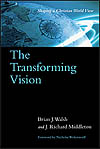
transforming vision.jpgimages.jpg31PonJQK9aL._SL110_.jpgYou might guess that I invited them to read more deeply in this aspect of discipleship.  I recommended the meaty and provocative Transforming Vision: Developing a Christian Worldview by Brian Walsh and Richard Middleton (IVP; $17.00) which will take them deeper into a radical cultural analysis rooted in a Christian worldview.  I routinely talk about the wisdom and eloquence of Os Guinness’ masterpiece The Call (Nelson; $17.99) and naturally pushed Andy Crouch’s Culture-Making: Recovering Our Creative Calling (IVP; $20.00) which is really helpful as we think about these very things.  OCBP students are already reading some excellent books for their summer project such as the concise and powerful old book by Tom Sine, Taking Discipleship Seriously which invites us to arrange our lives around “God’s intentions for the future.” Of course they are reading  The Outrageous Idea of Academic Faithfulness by Don Opitz & Derek Melleby—a must for every college student; Henri Nouwen’s profound little book on spiritual leadership, In The Name of Jesus, and Michael Goheen & Craig Barthlemew’s overview of the Bible, The True Story of the Whole World: Finding Your Place in the Biblical Drama.  Each day they41tSF0OJaFL._SL500_AA300_.jpg are reflecting on a great story from The Unexpected Adventure: Taking Everyday Risks to Talk With People About Jesus (Lee Strobel & Mark Middleburg) which reminds us to be praying and seeking opportunities to share the gospel, to be willing to tell others about the need for saving faith in Christ Jesus.  What a fun and inspiring collection—it is very highly recommended.  Maybe you will pray that these 30 students will not only think deeply about “living Jubilee” and cultural transformation, leadership, calling and such, but that they will each do verbal evangelism when appropriate, taking inspiration from the Strobel/Middelburg stories, to play their part in sowing seeds of Christ’s message.

***

29758078_f5c9c67925_m.jpgAfter this whirlwind week of passionate conversations with these campus leaders, we drove to Washington DC to set up a nice little book display about political theory and healthy citizenship for the  truly remarkable Civitas week sponsored by the Center for Public Justice. (Read Lauren Winner’s interesting report about it from a few years back, here.)  I assume readers know CPJ (we’ve linked to them before) and will perhaps spend some of this holiday weekend ruminating on just what our citizenship duties may be.  Of course we dare not sin by engaging in idolatrous nationalism—don’t get me started on the civil religion in some of our patriotic hymns—but that surely doesn’t mean that we should be disengaged from civic responsibilities.  We think CPJ gets it pretty much right.

CPJ is neither conservative nor liberal but takes their cue from (among other influences) Abraham Kuyper, the famousGods renaissance man.jpg preacher, journalist, devotional writer and Prime Minister of early 20th century Holland.  Kuyper, while a Parliament m
ember,  gave the renowned “Stone Lectures” at Princeton Seminary (prior to visiting President McKinley at the White House) in 1898 and those lectures are still in print. It is considered one of the seminal texts for the contemporary popularity of the world “worldview.”  In those lectures he invites us to stand in the grand tradition of the 16th century reformers, like Calvin, who strongly emphasized the cosmic sovereignty of Christ over all things. Jump-starting an emphasis on culture renewal sometimes now called “neo-Calvinism” Mr. Kuyper encouraged a graceful reflection on the claims of Christ the King over science, education, commerce, the arts, and, of course, politics.  Interestingly, I started my lecture series at OCBP with a quote from Kuyper that helped form the early days of the Jubilee conference three decades ago.  Kuyper famously insisted that the ascended Christ, upon looking down from heaven, does not see “one square inch” over which He does not point and declare “mine!” This “wide-as-life” view of redemption has inspired many to faithful cultural involvement and activism in our generation.

Importantly Kuyper’s beloved “every square inch” quote starts with this line, a reminder to think Christianly:  No single piece of our mental world is to be hermetically sealed off from the rest…  As a bookseller committed to helping folks think about all of life from a Biblical perspective, this call thrills me.  We must relate faith to the life of the mind and our ideas must direct us to faithful thinking and living in the world.   Kuyper was quite a man, known for mystical spirituality and public theology, for journalism and education, for interest in church renewal, science, and politics. There is only one biography in print that I know of of Kuyper, one that we import from England, Abraham Kuyper: God’s Renaissance Man by James E. McGoldrick (Evangelical Press; $18.99)  Check out this gateway to all things Kuyperian at “Friends of Kuyper” website.

For what it is worth, this rather obscure theological and political tradition is increasingly known and significant; it is surprising who all quotes Kuyper and appreciates his balanced political viewpoints.  It is fascinating that a new publishing project is reflecting upon how his ideas might apply today.  See, for instance, the recent Eerdmans release, done in cooperation with Princeton Center for Public Theology, The Kuyper Center Review Volume 1: Politics, Religion, and Sphere Sovereignty edited by Gordon Graham (Eerdmans; $24.00.)

 CPJ (for good and complex reasons rooted in thoughtful evangelical reflection) tends to think that the Christian right has failed in doing politics in a truly Christian fashion.  Similiarly, CPJ advocates a perspective that is something other than the so-called Christian left.  To seek a third way, rooted in Biblical assumptions about history, human nature, social architecture and the task of the state, and to be principled, passionate and civil about it all, is a project (it seems to us) many should support.

At Civitas, they will hear experts and public policy leaders reflecting on this “third way” thinking about uniquely Christian politics.  Much of the CPJ vision includes encouraging thoughtful dialogue to create on-going deepening of our views, rooted in the love of God and the conviction that the Bible teaches us norms about how the world is to work, including ways that government and civic life might be.  Along with our friends at Civitas this week, we invite you to consider some books about what truly “Christian politics” might be.

2796.jpgChurch, State, and Public Justice: Five Views edited by P.C. Kemeny (IVP; $19.00)  A month ago, Sojourners editor Jim Wallis wrote a piece asking if the view of government and the civic philosophy of the Tea Party movement was consistent with Biblical views.  This set off a firestorm of critique, some of which (I believe) was understandable as Jim unwisely conflated the various views of Tea Party folk and libertarianism.  Still, as I posted at the Sojo blog, this is a good, good, question, and it is one worth asking of any of us.  Is our view of the task of the State, our political philosophy, how we construe our view of citizenship, in line with a Biblical life view?  This book, I think, can help us with this question.  I can’t say enough about it as it allows some of the primary, current perspectives to be in on conversation and allows us to consider each approach. Each chapter includes not only the primary author giving his view, but also the other four replying with a critique, allowing readers to see not only the perspective, but the critics best response.   In just one  volume you get the basic view of a Roman Catholic showing the consistency of Catholic social teaching, a neo-Calvinist Kuyperian teaching about principled pluralism, a “peace & justice” Anabaptist who holds up an “evangelical for social action” view, a Baptist author teaching as a “strict separationist” and a liberal mainline Protestant.  I’ve reviewed this in greater detail previously, and think it is a fabulous resource.  Kudos to the publisher and editor for advancing the conversation among Christian about a Biblical view of the State and the nature of a Christian perspective.

2726.jpgPolitical Visions and Illusions: A Survey & Christian Critique of Contemporary Ideologies  David T. Koyzis (IVP; $22.00) Again, I’ve discussed this before and it may be the most important book of its kind.  This seriously exposes the deepest assumptions and ideas of the basic contours of the West’s approach to politics.  Certainly in the United States, “conservatives” and “liberals” are considered the two major political options and understanding how this is so, so important if we are going to be insightful citizens and make up our minds on where we stand on contemporary issues.  Koyzis is a brilliant thinker and this book (which won a number of prestigious awards) is highly recommended.  Read here a few endorsements by folks we respect.

If you have about 25 minutes, I encourage you to watch and
strauss_2010_02_17_04_43_48.jpg listen to one of our best friends, the new Director of CPJ, Dr. Gideon Strauss, as he does a chapel talk at Gordon College earlier this school year.  This talk, “Justice Is Not Optional” can be seen on YouTube.  Gideon is from South Africa, and tells about his truly remarkable journey to faith and while he isn’t talking about statecraft and political philosophy, he does give a great overview of the Biblical call to justice, somewhat inspired by his conversion story, his work with the Truth and Reconciliation Commission there, and his discovery of Isaiah 58.


CapitolFireworks2.jpgBLOG SPECIAL
any book mentioned
THIS WEEK ONLY
17.76% OFF
Fun, eh?

Order Here
this will take you to our secure order form page
or
Inquire Here
this will take you to our inquiry page where you can ask anything you’d like

Hearts & Minds 234 East Main Street  Dallastown, PA  17313     717.246.3333    

A brand new Wendell Berry collection, newly re-issued older ones, too.

A few weeks ago, I posted a quote here at BookNotes by the Kentucky farmer, novelist, poet, and essayist, Wendell Berry.  Some very good friends used the quote in a wedding, and it was lovely to share the experience (and the quote) with our readers.

One of the things Wendell Berry emphasizes is human-scale living, a sense of place, being attentive to bio-regions, the lay of the land of the neighborhood.  His slow, sweet, well-rendered and much-loved novels all explore these themes, as do his clear, thoughtful essays.  This summer, as folks think about supporting farmer’s markets, and as “localism” continues to get good press, as Christian people, even (like readers here) ponder the implications of Biblical teaching about stewardship for our daily economic practices, as we look for charming efforts at more sustainable neighborhood planning, and protest the cheapness of Wal-Mart, it is good to know we have another set of essays from our ally Mr. Berry. 

9781582436067.jpgWhat Matters? Economics for a Renewed Commonwealth is a new gathering of essays around this theme, published in paperback by the classy Counterpoint. Just as the eloquent and passionate food sociologist Michael Pollen introduced a gathering of Berry’s writing on food, and wrote a lovely forward to it (Bringing It to the Table), here, we have a bit of a collaboration with the renowned professor of economics Herman E. Daly. Daly is known for ecological economics, for a steadfast career of fighting the idol of unbridled growth (indeed, one book is called Beyond Growth) and for his work, For the Common Good.  For those of us in the Dutch neo-Calvinist tradition, it brings to mind the indispensable work of Bob Goudzewaard; younger emergent folk may think of Everything Must Change by Brian McLaren.  Jim Wallis’ recent book on economics comes to mind.  The discussion about Christian principles and economic theory is on-going and complex.  Mr. Berry is very, very important in helping us understand some very basic things.

Here, Berry wisely confronts the financial structure of our modern society, and the impact of late capitalism on American culture.  A few of these articles were published elsewhere, and a few are new.  As the back cover puts it, two of the new pieces (“Money Versus Good” and “Faustian Economics”) are “treatises of great alarm and courage.” 

Berry is sometimes considered to be aligned with the left.  He has done civil disobediencewendell1.jpg against the pollution of the coal companies, has protested mountain top removal in his beloved Appalachia,  and while he has written about why he distrusts movements, he has been increasingly available to help environmental activists, like his good friend Bill McKibben.   Recently, Mr. Berry removed a historic archive of his letters and papers, early drafts of his novels and such, from their home, housed at the University of Kentucky, because the UK has taken large money from big coal companies, even naming buildings after them.  You can read about Berry’s principled opposition to this, here.

As What Matters? Economics for a Renewed Commonwealth will show, however, Berry is less a leftist or liberal than a Jeffersonian.  He is a serious Christian, as well, and his faith and theology shape his commitments to the small and local and caring, as it does his skepticism about bigness, growth,  and ideology (especially, the ideology of progress.) He has a piece here on Liberty Hyde Bailey, the Methodist rural theologian that is very good. (We have a great biography of him, and a paperback collection of his mid-20th century work, by the way.)  He has a piece called “The Work of Local Culture” and one entitled “Two Economies” that first appeared in 1988 which I have always loved.  It is good to see these pieces together with the new ones, compiled all around the themes of true and appropriate economics, written as only a practicing farmer could.  Highly recommended.

41cRlg21HUL._SL500_AA300_.jpgWe are also happy to announce that two old Berry collections that have been out of print for several years have been re-issued, with new covers.  I do not know why they went out of print previously, and one (What Are People For?) is truly great, fairly standard Berry fare—literature, farming, land use, religion, localism, eating well, and so forth. I have been sad that it has not been available for a while because I often suggest it as a good place to start to dip into Berry’s essays.  This includes a few of his most significant essays ever, I think.  (You may know his one called “Word and Flesh” and his piece about not buying a computer, and his one about feminism, or “A Few Words for Edward Abbey”, all here.)

9781582434865.jpgThe old one happily reissued, The Hidden Wound, is truly an extraordinary book, a bit rare, even for Berry.  This is his look at the quandary of race and racism in America.   Poet Hayden Carruth wrote in The Village Voice that Berry “has produced on of the most humane,
honest, liberating works of our time.  It is a beautiful book.”  Larry McMurtry wrote that it is “A profound, passionate, crucial piece of writing…Few readers, and I think, no writers, will be able to read it without a small pulse of triumph…the statement it makes is intricate and beautiful, sad, but strong.”

Much could be said about this brief book, but, as you might guess, Berry shows that our disconnect to land, and to place, leads to all sorts of barbaric stuff (like school busing), including this old wound of race.  He wrote much of this as a young man, in 1968.  He re-visted and expanded it in 1988.  I’m glad it is back in print with this lovely new cover.

BERRY BLOG SPECIAL
20% OFF
any book mentioned

Order Here
this will take you to our secure order for
page at the website

Inquire Here
if you have any questions

Hearts
& Minds 234 East Main Street  Dallastown, PA  17313    
717.246.3333


Two truly unique books about church history. A People’s History of Christianity and The Church History ABCs

We had a great few days at a lovely Penn State conference center, hosted by the Presbyterian Church (USA) Synod of the Trinity. Thanks to those who helped us lug our heavy boxes and supplies for the bookstore.  A whole lot of effort goes into setting up these book rooms, and it is really wonderful when strong hands and backs show up.  Even though the time was short, it was well worth it, since this is our own denomination and region—our peeps, as somebody said–and we got connected and reconnected to many old friends. And sold some books. Nice. 

What a joy it was for us was to once again cross paths with Diana Butler Bass.  You may knowStrengthfortheJourney.jpg her wonderful, thoughtful memoir, Strength for the Journey: A Pilgrimage of Faith in Community (Jossey-Bass; $16.99), a faith story that tells about the various congregations of which she has been a part, as she travels through the American religious landscape.  It ranks easily with other such memoirs (think Nora Gallagher or Kathleen Norris or Phylis Tickle) however it is distinctive because she is, after all, a scholar of American religious life, with a specialty in research on mainline denominational congregational health.  She did the often-cited Lilly research on churches—published in summary form by the Alban Institute as Practicing Congregation: Imagining a New Old Church (Alban; $17.00)—so she knows how to hear and tell a congregation’s story.  And, at our Presby Synod gathering, she did just that, weaving extraordinary examples of mainline churches that have grown into maturity and ministry by exploring specific practices. From these many stories of learned and shared practices—hospitality, say, or service, or habits of deepening, mystical prayer, or learning the “spirituality of the ordinary” where faith is taken into daily life, even the marketplace and work—she drew insights about how we might proceed as mainline churches with distinctive theologies and faith-styles and inherited traditions. 

Her most famous book (making her a sought after speaker all over the world) is Christianity9780060859497.gif for the Rest of Us: How the Neighborhood Church is Transforming the Faith (HarperOne; $14.99) which is exactly about how uniquely Christian practices can deepen and renew mainline churches.  In a way, it is a more lively version of the Lily-funded research promoted at Alban, telling about the churches she visited and the people she met along the way.  As she says early on in the book, she was tired of the commonplace myth (which she learned in her own master’s work, prior to getting her PhD in this stuff) that mainline churches and their centrist theology were out of touch with the 21st century and that only evangelicals, and, evangelical mega-churches, would be sustainable and growing.  She was tired of the media only covering conservative evangelicals and televangelists, or the stories about the demise of the mainline denominations.  Christianity for the Rest of Us shows how more ordinary Protestant churches, some with quite moderate theology, some with “progressive”, liberal theology, are learning to forge a faithful kind of discipleship that is neither fundamentalist nor blandly mediocre.  Robust and serious Biblical and theological engagement by the community—discerning God’s vocation for that particular congregation—is a practice underneath and behind all other intentional practices.  Knowing who we are in Christ (a common phrase she knew from her more evangelical days) is still the key question: what is God doing in our midst, and how might we discern where the Spirit is leading, shaping who we most deeply are and what we are to be about?  Strength for the Journey narrates her story as she lived into those questions in the various churches she found herself involved in as a somewhat younger woman.  Christianity for the Rest of Us wonderfully tells (as only a religious scholar and invested, attentive journalist like her could) about the congregations she listened to, studied, and complied research about over recent decades, and the 10 or so practices she heard about from them.  This is certainly one of the great books within mainline religion in our generation, and I commend it to one and all—-agree with it or not, it is worth reading.  Of course those within mainline denominations will most resonate with it (and take great hope from it) but I find that open-minded evangelicals also benefit from it and have really enjoyed it. It is good to read about other parts of the Body of Christ, and this fine book could dispel myths about mainline Protestants (even if it brings into focus essential differences between those with more liberal theology and those with more historic, traditional theology.)  Being with her again reminded us just how much we appreciate her work.

PeoplesHistory.jpgThis emphasis on how ordinary folks practice faith allowed her to make this major contribution to this field of the sociology of American church life, but also set her up to make a major contribution to the field closer to her work as historian.  She has now given us one of the most interesting and helpful views of church history we have seen.  It has been out in hardback for a year, and now is available in a paperback, which includes a discussion guide for book groups or adult ed classes.  It is called A People’s History of Christianity: The Other Side of the Story (HarperOne; $14.95.)

Here is the simple explanation: each section tells of a reigning metaphor, a key image, that that particular era of church history tended to use.  Of course this is a huge leap of imaginative scholarship, but it rings true, and she explains herself quite nicely in an opening chapter in each of those sections.  (For instance, in the earliest days of Christian history, faith was seen as a “way.”  During the reformation, faith was shaped by the image of “Word”)  Out of this primary metaphor for faith, a certain kind of worship developed—practices of devotion, and a certain kind of life in the world—practices of ethics.  Not to make it more simple than it is, the book basically reflects on five eras of church history, showing what the main image for God and faith was, and what kind of worship and service emerged out of that.  How do we love God (worship practices) and serve God (ethical matters) if a certain view of faith was predominant?   

As you may know, most church history books look at the leaders, and, more so, the theological claims and ideas of the leaders.  And so we have this very helpful and important tradition of studying doctrine, theology, church splits, heresy and such, as the way into the study of our family past.  In this book—perhaps taking a cue from Howard Zinn’s important work showing the underside of history, the voices of the common folks and the underdogs—Butler Bass shows us how typical followers of Jesus did their thing—how and why they worshiped the way they did, and how and why they engaged the world around them, relating to their ne
ighbors, in the way they did.  In certain parts this becomes nearly revolutionary, showing how folks came to seek the radical implications of Jesus’ call even in the midst of rigid church hierarchy.  Even a bit more interesting in her historiography is her interest in telling the story of the church in ways other than through the lens of expansion, the imperial efforts, the spread of Christendom.  Seekers will enjoy this, too—there is just a bit of subversive energy here, showing how these main images really did shape new and fresh practices that brought renewal and made a difference, as followers of Jesus resisted some of the corruption of the institutions.

Diana_Butler_Bass_ap2_c.JPGHere is a short lecture where Diana tells of why we need to remember, and how knowing something about church history—viewed through lens of the “great command” of love, how grassroots folks humbly served, even when the religious institutions went wrong—is necessary and instructive for today. 

This is, obviously, a huge and significant paradigm shift in how we understand church history.  Bass obviously is a smart and knowing scholar, and this new way of construing how to do “church history” is itself a major thing (again, with an obvious nod to Zinn, RIP.)  This alternative approach—how a predominant metaphor shaped practices, both of worship and work, spirituality and service—and how it transformed real folk, is so interesting and often helpful!  Each metaphor of each era unlocks new vistas of faith and practice and while it is never bad to learn about the ideas of the past (the dogma and doctrine and church splits and innovations) it is also undeniable that this kind of study of church history can help us all live our faith more intentionally, bridging the gap between the field of church history and the daily discipleship with which we all struggle.  A People’s History of Christianity is a gift, a scholarly romp through the ages that offers new insights, insights that can help us as we practice our own habits of subversive fidelity.  I think it would make a wonderful study for nearly any educated adult group.  I didn’t get to talk about it much at Synod school, but if I had the opportunity, I’d have foisted it on everybody.  Maybe we’ll sell a few more here, now.  I hope so.  It is truly a rare and unique book, written by a top scholar who uses her academic gifts (not to mention her notable eloquence and charm) to build up God’s people.

***

In our headline, I mentioned two new approaches to the doing of church history.  Yup, believe it or not, we are pleased to announce another new resource that we can truly say “there is nothing out there like this.”  This is a brilliant idea, and I’m amazed it hasn’t been done before (or at least not done with this much elan.)  This new book I’m building up to announcing is by two Lancaster friends, prolific author from Lancaster Bible College, theologian and bluesman Stephen J. Nichols and graphic designer Ned Bustard (known in H&M circles as the head of Square Halo Books whose titles on faith and art are so widely respected.)  The unique approach? What innovation hasn’t been done before?   A splendid kids book!

51azXRKnNxL._SL500_AA300_.jpgYes, we are thrilled to announce the brand, brand new The Church History ABCs: Augustine and Twenty-five other Heroes of Faith (Crossway; $15.99.) This really is an ABC book, with full color, good rhymes, 26 characters from church history described and illustrated with remarkable insight and accuracy (and a cool guide in the back, with more details for parents or older youth.)  I will tell you more about it soon, but just had to shout about it now.  If you care at all about church history, and know any readers under the age of 10, this is a must-have gift-book.  We are among the first to have it, although I’d seen the pages a while ago.  It is truly a classy hoot—with wit and clarity and innovative art, offering children a picture of great Christian leaders of the past (Protestant, mostly, but a few Roman Catholic women and men included and a few very early folks, too, like .) 

We will be having an book release party, getting autographs, having some out loud readings, refreshments and a few other nifty activities on July 7th (a Wednesday night.)  Watch out here (and on facebook and twitter) for more info.  Just know we are selling it soon, and if you want to wait until the 7th, we can even get ’em autographed for you.  The Church History ABCs?  It is at least the children’s book of the year.  Maybe the book of the year.  C is for cheers.  B is for Buy it today!  I is for I Am Not Kidding.

Here is a great blog offer, a special deal for our on-line friends.  Let us know if we can ship you anything—it would be our great pleasure.  Thanks.

BLOG SPECIAL
20% OFF
any book mentioned

Order Here
this will take you to our secure order for page at the website
Inquire Here
if you have any questions

Hearts & Minds 234 East Main Street  Dallastown, PA  17313     717.246.3333


Q Society Room DVDs: Ideas That Create a Better World

Many of our readers know of Gabe Lyons, the fun andlyonsg.jpg deeply faithful, interesting, hipster who co-wrote (with David Kinnaman of the Barna Group) UnChristian: What a New Generation Really Thinks About Christianity and Why It Matters, and went on to create the fascinating cultural-engagement conferences, Catalyst and The Q. (The Q website, by the way, is one of our favorites!)  Both of these events are stellar, in their own way, and all sorts of folks—left, right and center within the spectrum of Christian faith, and some of those who make no claims about being Christian (like Seth Godin)—have appeared at their classy gigs.  James Davison Hunter even discusses Gabe and his fellow-travelers in his important Oxford University Press release, To Change the World.  Gabe and his events are attractive and exciting and positive and, despite Hunter’s high-brow concerns, will remain a major influence in a younger generation of informed and vibrant evangelicals over the next few years.  You may recall that Gabe spoke at our beloved Jubilee conference in Pittsburgh a few years ago. (See his presentation there at Living Jubilee.)  More recently, I linked (on Facebook and Twitter) to an amazing ABC news clip with a panel of younger evangelicals which explored the changing face of evangelical belief and practice these days.  Gabe just shines in that, as do his colleagues, some of whom I count as friends and partners-in-crime (even though I am not so young or new.)

I say all this to introduce you to Mr. Lyons’ four extraordinary DVDs, educational curriculum put out by the fabulous folks over at Zondervan.  (You may recall how I raved last fall about their excellent 6-week DVD piece on being a Good Samaritan, Start. They are doing tons of good DVDs!)  Here, Gabe and his Q cohorts have put together what they are calling “Society Room” lectures.  These are named after the famous gatherings sponsored by William Wilberforce’s Clapham group in the early 1800s, whereby folks would gather in parlors to engage good ideas that can transform the world.  Small groups of folks, talking in-depth about seriousgroup.jpg questions–in dialogue and partnership, with a view to following Jesus in meaningful ways in both personal and public life—truly can make an impact.  We believe small groups and Bible studies and book clubs have done this for years, and we rejoice that through God’s grace, folks have matured, lives are touched, and good news is spread, person to person, home to home, often within small groups. With these Q Society Room DVDs, such bands of friends can engage issues of cultural transformation, learn from some of the best folks writing and speaking today about relevant faithfulness, and struggle to put faith into more thoughtful action.  How can we tell you how excited we are—after years and years of saying this kind of stuff without great curriculum options at hand—to have just this kind of resource?  Thanks, Gabe, Q, Zondervan, and all those who make this kind of project possible. 

Now we just have to get folks–ahem, that would be you–to buy and use the stuff.

So far, there are four Society Room DVDs. All are hosted by Gabe Lyons with a roundtable discussion with several thoughtful leaders (other than the presenters.) There are some essays to read in a companion participants resource, as well, stretching the “unit” to several additional weeks.  This is some of the coolest stuff we’ve seen in ages, done by leaders we respect. Each of the main presentations are less than 20 minutes, so a typical church school class could use them.  They each sell for $29.99 but we have ’em on sale for just $20 each, now.  (See below for ordering and expiration date of the dealio.)

 0310325188.jpgThe Whole Gospel: Revisiting Our Message to the World

This includes live lectures by Chuck Colson, Tim Keel, Jamie Tworkowski, and Ron Martoia, all about re-framing the gospel in ways that are Biblically faithful, engaging folks in authentic spirituality, and learning to reach out to both culture-shaping elites and the hurting and fringes of our damaged culture.  These are excellent communicators, wise and thoughtful and we think their content deserves deep consideration.  (Jamie is the founder of To Write Love on Her Arms, and Ron Martoia wrote the excellent Transformational Architecture.) This is an excellent survey of how to express the gospel in wholistic ways and how to be salt and light of healing and hope, living out the implications of the News that is Good.  Highly recommended.

0310325218.jpgEngaging Post-Christian Culture 

What a thrill to hear and see our favorite “cultural historian” the always eloquent (and complex) Os Guinness speaking about the rise and fall of the West and how the gospel could penetrate even our most secular institutions.  Andy Crouch is here speaking beautifully about his Culture Making book, which has considerably shaped this whole Q Society Room project. The energetic Aussie Alan Hirsch describes “post Christian mission” and Jon Tyson (who was on that panel I linked to from ABC, above) talks about “renewing cities through missional tribes” and other ways to make a difference.  What good stuff this is. Maybe the most important of them all.  Please order this and help us make a difference!

0310325153.jpgThe Spirituality of Science

Well.  Passion worship leader opens this up with a marvelous bit ab out the indescribable wonder of God discovered as we consider the magnitude of the galaxies and beyond.  Famous geneticist Francis Collins appears, speaking about The Language of God (you surely know his important work as the head of the Human Genome Project and now Obama appointee to the NIH.)  Heady theologian Alister McGrath (who also has a science PhD) is here, and, my favorite, a lovely presentation by Swathmore prof, physicist Catherine Crouch.  Each of these speakers are tremendous, and the four together are beyond brilliant. Yes!  The roundtable includes heros green activist Rusty Pritchard and anti-nuke leader, Tyler Wigg-Stevenson.  This is just fabulous.

0310324491.jpgWhere You Live Matters: Developing a Vision for Your City

The drive behind the Q, and certainly the Society Room curriculum project, is to create good conversations about “ideas that make the world a better place.”  Of course, as historical, Biblical Christians, they believe that this is deeply tied to faithfulness to the Scriptures and a robust, intentional discipleship in the way of Jesus.  The ideas of all of the above three are excellent, with insights from solid and gracious folks who call us to understand our times, and engage the issues of the day—from the history of culture, to the needs of the neighbor, from the arts and into the sciences.  This fourth Q Society Room DVD, however, brings it all, quite literally, home.  Here we have Presbyterian urban church planter, New Yorker Tim Keller speaking about our place in the city, the grace and brokenness of our urban landscapes, and how God is, indeed, calling us to “seek the peace of the city.”  Joel Kotkin is a visionary social thinker, and, with Mel McGowan, an urban planner and designer, discusses the future of the suburbs, how to be involved in caring about what another author has called “the sidewalks of the Kingdom.”  The roundtable—including Andy Crouch, Jon Tyson, Sean Womack and Allie Tsavdarides, introduces this Society Room and invite you to deeper care for your own place.  Can we be challenged by this fundamental lifestyle question: where should we live, and how should we care about our neighborhoods?  I don’t know many adult Sunday School classes that tackle this stuff (although my own church had a local historian do a walking tour of our York downtown one Sunday.)  I think small groups, local forums, coffee shop meet-ups and home studies could truly enjoy exploring this provocative, generative content.

BLOG SPECIAL
$10.00 off
any Q Society Room DVDs
regularly $29.99
NOW $20.00*
*special offer expires July 31st.
ORDER HERE
this will take you to the secure order form page at our website
INQUIRE
this will take you to our inquiry page if you have any questions

Hearts & Minds 234 East Main Street  Dallastown, PA  17313     717.246.3333


A key resource for lectionary preaching and a rare hymnal: Feasting on the Word and Hymns of Glory Songs of Praise

Following my last post, I thought I’d highlight just a few other titles that mainline denominational folks, especially, might want to know about.  Of course it is our deep wish that more evangelical folks would draw on these resources, just as I hope our more mainline friends consider the recommendations we make from conservative publishers.  We try hard to get beyond those increasingly unhelpful labels, and seek truth and renewal and helpful stuff any and everywhere.  We bet that in many ways, you, too, long for this, hoping to learn from those outside of your own immediate camp.

9780664231002.jpgDo you know the much-celebrated on-going series Feasting on the Word: Preaching the Revised Common Lectionary, the lectionary commentary edited by David Bartlett and Barbara Brown Taylor? (The Christian Century called them “monumental” which, I assume, is a good thing!)  Published every three months by Westminster/John Knox, there are four large hardbacks a year, for each of the three liturgical cycles, selling for $39.95 each.  Last year (year B) started the series, and we just got Year C, Volume 4.  That is, this recent one offers preaching aids for the Season After Pentecost 2.  The lectionary geeks will know this is what is sometimes called Propers 17 through the Reign of Christ.  In other words, this picks up at the end of August and makes the journey with you up until the start of Year A, the first Sunday of Advent. [Please note, the picture on the left is not the one for Volume 4; the publisher oddly doesn’t have a picture of that one available. They all look the same, though, except for the designation of the weeks.]

Bartlett and Brown Taylor are remarkable in their own right, but in Feasting… they’ve pulled together nearly anyone who is known in mainstream Christianity, and a few others, too—some to the left, some to the right, all skilled and guided by the Spirit, writing insightfully (usually) about the texts in question.
 
For each week, the reflections are arranged in four distinct themes or modes.  Somebody does a “homilietical” reflection (that is, hints to how to preach the text); one offers an “exegetical approach” giving detailed study of the words and such; then there is the “theological” contribution; and then insights from the “pastoral” perspective. It is surprising to me that not only are there these four different angles of vision into the text and the sermon preparation, but there are, among them, different interpretive moves going on.  That is, the four writers offering insights into these four aspects of the lection don’t necessarily agree.  My own pastor noted how much he appreciates that and what seemed a bit odd to me immediately was seen as the gift that it usually. is.  This is like having a veritable army of women and men at your side, inviting you into conversation with the assigned texts every week.  Even if you are not a preacher, this is a set of books worth considering.  If you are a regular preacher, it is a very useful volume.  If you buy one, I’ll bet you’ll want others, as they are that helpful.  They are ecumenical and mainstream in orientation.  We had a big stack at the Lutheran event just last week.

Speaking of being a bit geeky, I really like reading books about homiletics.  Yeah,  I know. You can read that sentence again, and it won’t get any more sensible.  I think these books designed for preachers are amongst the most under-rated texts around.  Preachers don’t even read them.  They rarely sell in the shop, although we have hundreds.  I’ve been dipping into a few, as I do from time to time, and my ecumenical dreams are underscored by the diversity of authors in conversation in those books.  Liberals, moderates, evangelicals, all in the same books!

The Folly of Preaching: Models and Methods  edited by Michael Knowles (Eerdmans) $18.00.  This is a collection edited a few years ago by a professor of preaching at McMaster in Ontario.  Some of these are just powerful, rockin’ insightful sermons—from David Buttrick, Thomas Long, Cleophus LaRue, Haddon Robinson, John Stott.  (There ya go for some mainline and evangelical collaboration!)  A few of the pieces are more like essays. Tony Campolo, whose professional sociological work was done like preaching, anyway, has a great chapter called “Preaching to a Culture of Narcissism” and Martin Marty reflects on “Preaching Rhetorically: Thanks, Aristotle and Apostles.” Edwina Hunter weighs in on the topic “Imagination, Creativity and Preaching.”  John L. Bell is in here, Stephen Farris, Elizabeth Achtemeier and more.  What a cool collection.

Interestingly, one of the strongest and most serious homiletics books this year is from an evangelical publisher not known for releasing preaching books.  I refer to the thoughtful, profound The Glory of Preaching: Participating in God’s Transformation of the World by Darrell W. Johnson (IVP) $23.00.  Johnson is renowned for being a good communicator at that renowned evangelical institution of higher education,  Regent College, in British Columbia. You know how interestingly faithful that place is with so many solid folks, from Gene Peterson to Marva Dawn.  Highly recommended.

The Preaching of Jesus: Gospel Proclamation, Then and Now by William Brosend (WJK) $19.95. This is a new study I’m itching to read.  It has a moving forward by Marcus Borg and a great blurb on the back by Ben Witherington who I greatly trust.  It shows four different styles of rhetoric used by Jesus, and then illustrates each chapter with a sermon that captures that style.  The sermons includes some of the most respected mainline folks preaching today—Barbara Brown Taylor, Fred Craddock, Bishop Michael Curry, Tom Long, which he then analyzes. What fun!  Preacher friends, get in on this and your Sunday messages will be better.  And the rest of us?  Join this conversation and you’ll learn how to hear good sermons, learn to critique them fairly, instead of just being grumpy on the way home from church about something the pastor did or didn’t say.  Hee, heee.  Plus, you’ll impress your pastor if you casually note that your reading a book like this.

6a010536b8214c970c013480342cda970c-120wi.jpgHere is just one more recommendation of the many we have: Alyce McKenzie, a United Methodist pastor who used to minister here in the York, PA, area, has done several book on preaching.  Her new one is another of these sorts of those of us who are laypeople just might get a kick out of.  It is called Novel Preaching: Tips From Top Writers on Crafting Creative Sermons (W/JK; $16.95.)  Just as it sounds, she interviewed (or found interviews) with dozens of contemporary writers, novelists who are known for their craft, and she draws from them the habits of mind and heart, the daily practices, the tricks of the trade, of learning how to write, and write consistently.  Writing a good sentence or two is a good step towards creating a solid and mature sermon.  I know, I know–solid exegetical skills and orthodox theology are the foundation, and no clever tricks or awesome words-smithing can substitute for heart-felt proclamation of God’s Word for life.  B
ut, still, even the most Biblically-faithful thinkers and sincere pastors of the flock need some help figuring out how to write and speak well.  This book is a lot of fun for anybody who is called upon to create.  Kudos to Alyce for this cool idea. See, there is some very interesting stuff in the “homiletics” section.

HYMNS OF GLORY SONGS OF PRAISE

978-1-853-11900-2.jpgHymns of Glory Songs of Praise edited by John Bell (Canterbury Press) $56.00  Well, I never know how to sell hymnals, really, and most often just hope folks know if they want one that they can inquire with us.  This, though, deserves special mention.  You may know John Bell of Iona, the vital and progressive spiritual community in Scotland (who publisher their own creative worship resources under the name Wild Goose.)  Bell has written so very much evocative, folksy, contemporary music, and has written widely about the significance of singing in our communal church lives, that when I heard he was helping compile this new volume (for the Presbyterian Church of Scotland and distributed here by the Episcopalians) I was truly excited.  The very day it came last winter, I sat down and read the introduction and it is very helpful. An index lists songs most suitable for children, and what they call “short songs” (some of which are like Taize chants.)  It is over 700 pages yet feels right in the hand.

 Hymns of Glory Songs of Praise starts off with a section of Psalms to be sung, a blessed contribution to any hymnal.   There are ancient lyrics here, and some rich, modern hymns as well.  Still, to see the fascinating selections—a lyric from John Bunyan, a song by Bonhoeffer, a prayer turned to song from a Book of Hours (circa 1500), to Halleluya! Pelotsa Rona from South Africa to Tom Troeger and Carl Daw. There are some folky liturgical composers, of course, in the “St. Louis Jesuits” style—there is a selection or two from Michael Joncas, Marty Haugen and David Haas, and a few from Dan Schutte.  And a good number of international tunes, from China, Guatamala, various African lands.

What fun to see lyrics by John Calvin next to Shout to the Lord by Darlene Zschech; Brian 
6a00e54ef51d768834011572070e92970b-800wi.jpg Wren next to William Cowper and Horatius Bonar.  There are classics by Philip Brooks and a modern chorus by Twila Paris.  I just smiled to see an index listing Julian of Norwich and Matt Redman.  I appreciate John Bell (and his work at Wild Goose) a lot, although it must have been fascinating to be involved in the Kirk committee picking these songs.  I really smiled to see so much from the Scottish Psalter and Paraphrases (Biblical paraphrases) and songs by Ralph Vaughn Williams, right there with Gaelic folk melodies, or songs by Ruth Duck.

The hymnal is arranged in Trinitarian fashion, with songs about God, Christ and the Spirit; in the Holy Spirit portion, however, is a major section called “The Church Celebrates” and it includes songs for a variety of purposes, from Baptism or confirmation, to grief, national concerns, and music for healing and wholeness.  This is very well thought through, and will be useful, I’m sure, for music planners and worship leaders of all sorts.

Speaking of hymns, the challenge of learning new songs, we just got in a new title published by P&R, Why Johnny Can’t Sing9781596381957.jpg Hymns: How Pop Culture Rewrote the Hymnal written by T. David Gordon. In a way, it seems to be another critical lambast of popular culture like his earlier book, Why Johnny Can’t Preach which was very thoughtful, witty, even.  I, of course, have large concerns about whether this is the best way to understand culture, music and such, but it is none-the-less certainly worth reading whether you agree with him fully or not. We sold it well at the Lutheran even last week; they don’t need it as much, though, as our friends whose worship services approximate a rock concert without the pot.  Not sure what I think, but you may want to check it out—I’m sure you’ll learn about forms and styles, and why we postmoderns ought to know a bit more about the process of music.  Sure would generate some good conversations, at least, eh?

BLOG SPECIAL
10% OFF
any book mentioned

order here
takes you to the secure website order form page

Hearts & Minds  234 East Main Street  Dallastown, PA  17313          717-246-3333


Life Among the Lutherans: selling books at a Synod Assembly

From our first days nearly 28 years ago, Beth & I were eager to represent books from a diversity of publishers, religious and general market.  One aspect of that diversity is our interest in books published by mainline denominational publishers (Augsburg/Fortress, Westminster/John Knox, Pilgrim Press, Church Publishing, Chalice, Abingdon, Upper Room, and the like or British publishers like SCM or Canterbury) as well as Catholic and Orthodox presses.  Of course, our favorites are the progressive evangelicals like InterVarsity Press (IVP), Baker/Brazos or Eerdmans, and even more traditionalist evangelical houses (like Zondervan and Nelson) are putting out some of most interesting religious publishing today.  Old friends at places like Presbyterian & Reformed and Dordt College Press have released some personal favorites, and then there are the indie presses, folk that do this one book or that series, odd-ball children’s books or hard-to-find stuff.  Do you know SkyLight Paths? Wipf & Stock? Regent College Press? Jossey-Bass? Faith Alive? Religious publishing is more interesting these days, I think, than at any time in our memory.

Who knows what is going to sell when we do our big displays, custom selected for particular gatherings?  The last few days we met some old friends and a lot of new ones when we served the Lower Susquehanna Synod of the Evangelical Lutheran Church in America.  Beth was raised Lutheran and it was sweet to see a Gettsyburg College booth and to chat with an old classmate, now a Lutheran pastor, from her old church, as well as the pastor serving that parish, now.  Local church camps, social service ministries, justice advocacy groups, mission groups, all had nice displays alongside our temporary bookstore installation.  Thanks to those who said so many nice things to us at the Synod assembly. Not a few said that they appreciated our diversity, selling books geared to Lutheran congregational life, of course, but showing other interesting things as well.

Life-Among-the-Lutherans1-194x300.jpgBest sellers?  Naturally, Garrison Keillor’s Life Among the Lutherans (Augsburg; $23.99) was a big hit, perhaps our best seller there.  If you have enjoyed his Lake Woebegon novels or the Lutheran stories from the radio show, you’ll love this.  It is great writing, very, very funny, and often remarkably insightful—the gospel in through the back door of this uncommonly graced storytelling.  We hear this is coming in paperback soon, but we have some hardcovers now, at the blog special discount price.  What a fun book to take on vacation!

I mentioned unusual publishers.  We stock a few different books about pray shawl ministry, and they were appreciated.  A number of churches do this, a knitting ministry, prayerfully making shawls and other such items to be used in ministries of mercy and healing.  I’m glad we had a selection on hand, and hope they will touch lives, mediating God’s love to the sick and sad.

And, we sold some memoirs.  I love reading this genre, learning about and from the telling of410aRJ0oBOL._SL500_AA300_.jpg other’s lives.  Anne Lamott, Nora Gallagher, Sarah Miles, Barbara Brown Taylor, stories of growing up in the faith, missionary stories, memoirs of nature writing and stories of marriage and stories of grief. Paul Farmer and Edwidge Dandicat on Haiti.  Three Cups of Tea and his newer one, too. The striking, new conversion narrative (Rage Against God) by Peter Hitchens, the brother of  world-famous, outspoken atheist Christopher.

 The extraordinary writer Walter Wangerin, Jr. is well known in ELCA circles (of course we took Ragman and Miz Lil and some were surprised to see them still.) His last two are powerful; Father and Son: Finding Freedom (Zondervan; $19.99) and his recent, poignant, Letters from the Land of Cancer (Zondervan; $16.99) were appreciated. This one seemed to be handled with care, knowing the sacred power of these letters about his serious illness.

6a00e54ef51d76883401287716ec17970c-200wi.jpgI kept telling those who were browsing that Barbara Brown Taylor’s An Altar in This World: A Geography of Faith (Harper; $14.99), now out in paperback, is one of my favorite books in recent years.  Her usual elegance, her insight, her great attention to the writing craft, bring this book of memoir and reflection to us with the end result being a book of lovely, enjoyable reading, and remarkable theological insight.  God shows up everywhere–every moment can be a sacramental one, and we must practice attentive spirituality, day by day, in the ordinary stuff of life.  I love this theme, and it is surely one of the best books about the embodied nature of life in God’s good world.

bonhoeffer-by-eric-metaxas.jpgNot sure if it was a “best seller” but we did sell several of the magisterial, new biography of Dietrich Bonhoeffer, Bonhoeffer: Pastor, Martyr, Prophet, Spy, by Eric Metaxas (Nelson; $29.99.)  There is little doubt that this is the Bonhoeffer book of our time, perhaps the best yet done.  It is, like Eric’s great book on Wilberforce (Amazing Grace) both historically detailed, powerfully written, interesting and insightful.  That is, he gets the details right, presents them in a vibrant and compelling way, and, without any preachy moralism, tells the tale in a way that makes you care, that helps us see that this matters.  It is a hefty book, but it is not the kind that people buy but never finish.  It is one of the great books of 2010!  Yay for Lutherans who still care about their man and his famous ministry of resistance, bearing the full cost of discipleship.

There was a lot to look at, and little time for most shoppers—they had their complicated denominational business to attend to, of course. For fun, if anyone might find it interesting, here are a few titles we wished we could have talked about more, alerted folks about.  Call it, books I wish we would have sold, or titles that somehow didn’t get noticed.  Like orphaned children, every time we come home from these large gigs we find these small stacks of books that were missed.  Oh, if only somebody would have found a home for these wayward texts.

On Christian Liberty  Martin Luther  (Fortress) $9.99  This “Facet” edition is a small 
544652.jpg paperback, recently re-type-set with a cool cover, offering the timeless, classic Lutheran teaching about the freedom we have i
n Christ.  For the Christian, Luther insists, this freedom includes not only liberty from sin and death, but the opportunity to serve one’s neighbor.  Every follower of Jesus can benefit from dipping into the older books, and this simple, little volume, is a great way to be reminded not only of the treasures of the past, but to clarify the first things of the gospel.   His “open letter to Pope Leo X” is included in the back, and is worth reading itself.

9780802865281.jpgWe Have Seen His Glory: A Vision of Kingdom Worship  Ben Witherington III (Eerdmans) $16.00  I have promoted this elsewhere and think it is an important little book where he “teases some minds into agtive thought about what worship should look like if we really believe that God’s Kingdom is coming…It’s time for us to explore a more biblical and Kingdom-oriented vision of worship.”  Lutherans in central PA like Gordon Lathrop’s important triology (Holy Things: A Liturgical Theology , Holy People: A Liturgical Ecclesiology, and Holy Ground: A Liturgical Cosmology) and this Weslyan author brings similiar concerns to bear: if God’s reign, celebrated by some churches in “Kingdomtide” is a real fact of our history–a liturgical cosmology in Lathrop’s rich phrase—how might that effect our worship?  And how might our worship shape our lives?  This is another volume in the on-going “liturgical Studies Series” of the Calvin Institute of Christian Worship, one of the most important ministries in North America.   We stock all of the books they’ve commissioned.  Lutherans, like most mainline groups these days, care about worship.  This book could expand our conversation about renewal.

For All God’s Worth: True Worship and the Calling of the Church N.T. Wright (Eerdmans) $13.00  I’ve mentioned this before, and find it so acessible, so wise, so stimulating.  The first half of the book is about the worth of the God we worship while the second half is about caring the worship of God into the world, imaging God in all we do.  I would have thought all of N.T. Wright’s good books would have been purchased, and it was odd to be at such a large gathering where he wasn’t being discussed much.  This older paperback is a sleeper, a great little book that I wished we could have foisted on everyone.

9780835810128.jpgLike Breath and Water: Praying With Africa Ciona D. Rouse (Upper Room) $18.00  Like many mainline denominations, the Lutherans have some historic and solid connections with sister congregations and synods in Africa.  Many of us care deeply about that troubled continent, and the world is paying attention, perhaps now more than ever, about the hope and horrors there.  This full color paperback is packed full of stunning photographs–are they almost like icons?—to turn the heart and imagination to prayer.  Can we see God there?  Can we be touched by the need, and driven to prayer?  What a beautiful book!   Ciona Rouse is a Nashville-based African-American who has done some innovative work on African-influenced liturgies, books on spiritual formation, and is a photographer and poet.  Check out www.PrayWithAfrica.com.

madeforgoodness.jpgMade for Goodness and Why This Makes a Difference  Desmond Tutu and Mpho Tutu
desmond-tutu-001.jpg (HarperOne) $25.99  I don’t know why this big stack of bright, purple hardbacks didn’t fly off the shelf.  Maybe if the Desmond’s big smile were on the cover, or if the back jacket photo of his beautiful daughter–also an Episcopalian priest—were shown, readers would be drawn in to this wonderful collection of stories and reflections.  Famous father and daughter make a powerful case, less in Biblical terms, using common language and pitched to the non-churched as well as Christ-followers, that we are created to live a certain way.  Goodness matters.  This is no dry text about situation ethics and no screed about taking a stand, although, having read it, I want to be more ethical and take a clearer stand.  Anyone can choose to cultivate compassion.  We can find a path of hope.  I would supplement a book like this, naturally, with a strong study of Jesus and the authority of Scripture, to illustrate just what Christian goodness is.  But for what it is designed to do, it is a masterpiece.  A nice blurb on the back form Bono, too, where he (once again) says that Tutu is his “boss.”  Gotta love that.

0470431024.jpgConnecting Like Jesus: Practices for Healing, Teaching, and Preaching  Tony Campolo and Mary Albert Darling (Jossey-Bass) $21.95  No matter where we are displaying books, we usually take the last book the two of the did together, The God of Intimacy and Action, which is a spectacular, rich, solid survey of how the inner journey of contemplative spirituality is related to evangelism and justice work.  Here, in a brand new volume, this dynamic duo team up to offer a book about (how to say this without it sounding boring?) communication skills.  That is, how can contemplative spirituality (and other devotional practices) make us into more expert communicators, doing good work in sharing the gospel, teaching, preaching, speaking, organizing.  I am convinced that one of the reasons smaller mainline churches are often lackluster is that the leaders are simply not skilled at good communication.  One needn’t be a spiffy, blow-dried tele-evangelist or a cool Willow Creek dude in pressed casual khaki to know that image and style and communication and passion are vital to those that want to be effective in impacting others.  Dull and inept communicators turn people off, and the church has too long tolerated boring preachers and teachers.  This is a very practical (and yet really interesting) collection of tools and ideas that will help you be more effective in leadership, in public speaking, in getting the job done well.  How can we communicate more faithfully?  What is the relationship between soul care and public ministry?  How can we care for people–even the tender, inner stuff of their souls–even in ministries of teaching and preaching?  What an interesting book showing the various sides of ministry. Highly recommended, especially for those in traditional churches who are weary of the media-driven and often shallow versions of ministry but who may need to improve their ability to “connect” with listeners.  This is serious and solid, and will push you to be faithful and fruitful, spiritually-rich and effective in shari
ng the gospel.

images100318.gifYour Church Is Too Small: Why Unity in Christ’s Mission is Vital for the Future of the Church  John Armstrong (Zondervan) $19.99  I have been taking this book with a mis-leading title around to church leadership events, telling everyone I can that I think it is important (and pointing out the very clear and properly urgent sub-title.)  I’ve been working on a longer review that will appear here soon, although it is not an easy book to describe well.  The short version is this: Armstrong was once a very strict and separatist Baptist, a gifted communicator with several books, including some on publishers that do mostly Puritan theology.  Yet, his natural good-natured personality and intellectual curiosity kept him reading widely and relating to others outside his own circle.

 This new book is partly John’s own story of growing into a heart-felt ecumenicity and a Biblical and theological call to a rich, evangelical view of the Body of Christ.  With a moving and solid forward by evangelical,  Anglican J. I. Packer, John has given us a large gift, born of his own pain and struggles, friendships lost and friendship gained, as he explores the meaning of the “missional church” in these postmodern times.  Mainline denominations have had a consistent, if thin, vision of ecumenical work, so leaders and readers in mainline circles may not feel they need to read a book like this.  For reasons I’ll explain in my longer review later, I think they are sadly mistaken, and need, more than ever, to root their ecumenical views (and practices, such as they are) in a robust Biblical ecclesiolgy.  As groups like the ECLA are torn at their seams by recent controversial positions, we all need a reminder of what we are called to be as Gods people, how we can find solidarity beyond denominational boundaries, even amidst tensions; it is understandable in hard times to focus on our own issues and concerns. Still, as Your Church Is Too Small reminds us, too often, our view of the church is too small.  We must rediscover and live into an active expression of being a global and faithful Body of Christ, ambassadors for His reign of shalom, witnessing to the reconciliation He has wrought.  A book on the church, on being ecumenical, told by a recovering separatist?  With blurbs by a Roman Catholic, an Orthodox priest, and an evangelical on the back, this is a ground-breaking book! I wish I could have told my new Lutheran friends about it.  It is a book we all need.  We hope it is widely discussed.

BLOG SPECIAL
20% OFF
ANY BOOK MENTIONED

Order Here
takes you to the secure order form page at our website
Inquire Here
takes you to a page to ask questions about titles, prices, or availability

We will personally reply within a day to any order or inquiry.  We love to stay in touch.

Hearts & Minds 234 East Main Street  Dallastown, PA  17313     717.246.3333 



The Wisdom of Stability: Rooting Faith in a Mobile Culture

In my last post I mentioned that we were at a wedding in Pittsburgh where the bride and groom had read a quote from Wendell Berry.  As you may know—and if you don’t, get any collection of his essays, or the novel Jayber Crow right away—Berry is a literary star, a Kentucky farmer, and a deeply religious man of the land who has resisted “modern” ways for a lifetime.  One of his themes is that it is no crime to stay put.  (“Oh, she’ll go far” it is said, when we want to applaud a young adult with talent and ambition, as if leaving is somehow a mark of success.)  A month or so ago we celebrate his most recent, a collection of mostly literary studies, of writers with “a sense of place.”  (Imagination in Place it is provocatively entitled.)  I’ve mentioned social critics and splendid writers like Bill Kauffman (Look Homeward, America) or James Howard Kunstler (The Geography of Nowhere and Home from Nowhere) who have lamented the suburban angst of our time, and pointed us to principles of stewardship, charm, and a local scale. Is it right to stay put?  Are our Up in the Air values eroding relationships, meaning, a sense of our place in history?  I’m not so sure about any of that, but we find that some of our sharpest readers resonate with this school of thought.  At least we know that our place matters to God.  In fact,   Eugene Peterson puts it bluntly in the forward to Eric Jacobson’s book Sidewalks of the Kingdom) by asserting that “In the Bible, where one lives may be as important as what one believes.”

There is an increasing body of literature on the importance of place, the theology of place, Christian thinking about the way being embodied as creatures effects our spirituality and discipleship.  You know we’ve raved about the serious, provocative Beyond Homelessness: Christian Faith in a Culture of Displacement, by Brian Walsh & Steven Bouma-Prediger which is a must-read text for those wanting to go deep into this vital theme.

stability2.jpgWell, we are happy to tell you that there is another new book that opens up our hearts and thinking about this topic, a book that is kind and gracious, well written and gentle, even as it is bold and prophetic.  It is called The Wisdom of Stability: Rooting Faith in a Mobile Culture, written by Jonathan Wilson-Hartgrove (Paraclete Press; $14.99.)  As you may guess, it is a great blending of several styles of writing, and showing several sorts of interests by Wilson-Hartgrove who has written wisely and passionately about much in recent years. 

He is a peace-maker (went to Iraq on a peacemaking mission, and his pal Shane Claiborne wrote about his being wounded there. He then wrote about it movingly in To Baghdad and Beyond: How I Got Born Again in Babylon.)  He has written about being missional, a book with Shane about prayer,  a very important work on racial justice within the Body of Christ (Free to Be Bound: Church Beyond the Color Line) and, recently, a fine book on a Christian view of money, God’s Economy.   He was one of the conveners of the gathering (at his intentional community called Rutba House in Durham, NC) that coined the phrase “the new monasticism” and he has edited a few books on this new radical house-church/Christian community movement. (School(s) for Conversion: The Marks of the New Monasticism.)  He is a busy guy, a young leader of an ecumenical and socially active sort of evangelicalism, and he writes well.  I think this may be his best book.

And, given how busy he is, this book is leisurely.  I feel myself slowing down, even as I read it.  His stories include lovely writing about the color of the porch boards, and the taste of the sweet tea drunk in the humid South, of how he and his young daughter notice a bird making a nest near their porch, during an early morning rest on the stoop.  I like the narrative nature of these reflections, and applaud Paraclete for the aesthetic touches—each chapter starts with a several page reflection that is set apart with some wood-cut-looking page embellishments of vines.  Even the cover has a bit of a subtle embossed feel; it is nice they did this, as this is a book to be carried and read slowly, with joy, I’d say.  It is about staying put, about being rooted.  Rooted?  Artwork of vines?  Yeah, you get it.  Very nice.

Lauren Winner writes on the back cover “Stability may be the virtue of the 21-st century Christians most ignore—and the virtue we are most called to embrace.  This fine book will inspire you to look at your own life, asking ‘Where am I restless? Where might God be calling me to be rooted, to stay put?'”

Indeed, most of us have failed in this virtue; we have not cared for our neighbors (or our own neighborhoods) as we ought.  We have not been rooted in place, or really engaged with the people and plot of creation in which we are placed.  We have been too busy to participate in the simpler rhythms of life. 

Kathleen Norris knows about this.  You most likely know her book from a decade or more ago called Dakota: A Spiritual Geography, where she came to Christian faith while exploring the historic desert fathers and mothers and the rugged landscape of her native state.  Later she wrote beautifully about being in a monastery (Cloister Walk), learning the sacred time of the monks.  Can ordinary folks live like that, somehow?  She is working on that, so it is fabulous to have her write the forward to this book.  It is a wonderful foreword, and it is no small thing to have a writer of her caliber and life experience to offer such a solid introduction to the topic, and the book.

Stability.  It is a gift, Wilson-Hartgrove rightly tells us.  And it comes as we work at it, too, in a “school for prayer” (which is a section in his chapter called “Stability as a Craft.”)  He looks at some of the stuff the desert fathers and mothers have taught—serious stuff about self-reflection and boredom and temptations, all that militate against forming mature bonds of community in place.

And, so, we are glad for these kinds of books, and certainly for The Wisdom of Stability, which is so nicely done, emerging, obviously, from his own (unfinished) journey.  Or is journey—this moving away image—the wrong metaphor, here?  Well, it is a journey, a journey home, deep into place, a journey towards wisdom and care and stability.  Our mobile culture does not want this.  The media does not encourage it.  Pop culture makes icons of those who have to be “movin’ on” or who are “on the road.” Our own families may not expect it.  But, maybe, just maybe, books like this, written out of communities like this,  about experiments like this, may hold a key to renewal in our fast-paced, too-hectic, politicized culture.  This is not a call to “drop out” or ignore our global neighbors, or the fabulous opportunities that call some of us to new vistas and new places.  But it does ask the big questions, and invites conversations around the meaning of discipleship as it comes to bear on serving, jobs, relationships, community, house-holding, stewardship, and spiritual practices of attentiveness to the near-by.  I really, really enjoyed it.  In fact, I needed it.  You might, too.  We’d love you to support your own local bookseller, if you’ve got one, or this virtual community of H&M folk w
ho care about similar sorts of things.  If you’re in this tribe, and feel “at home” with us,  send us an order.  Part of our call to stability in these postmodern times—I really think this—is staying together on line, too.  May our tribe increase, even as you remain rooted in place, with a spirituality that resists a place-less mobility.  God’s peace to you.

Here is a very cool youtube video of him talking about the book.  Filmed right on the porch. 

BLOG SPECIAL
10% discount
Order Here
takes you to our secure website order form page
Inquire Here
 if  you have questions

Hearts & Minds 234 East Main Street     Dallastown, PA  17313     717.246.3333

an excerpt from Wendell Berry, read at a wondrous wedding

In 1976 Beth and I sent out wedding announcements, creatively designed by a college friend.  It rather boldly proclaimed “Remember This Day.”  It was not intended as a “save the date” announcement as much as an invitation to join us in thinking (perhaps a bit presumptuously) that God was doing something Big here, and that, like the piles of stones set up in ancient Israel to remind of God’s faithfulness, our joined lives were supposed to stand for something.  Idealistic as it may have been, we still believe that there are times in our lives (I hope it is so with you) that we should memorialize, a stake in the ground, a pile of rocks.  Christ is present and He reigns, even in such things.  Remember those days, indeed.

By phrasing it the way we did, we also were asking that our friends and loved ones help us.  We knew enough to know that friends and family are needed to make something like a meaningful marriage; the shared vocation of creating a Kingdom outpost in a family, takes help. We spoke a lot about “community” in those years, and formed an intentional household or two with a batch of other young marrieds and singles in an urban neighborhood in Pittsburgh.  The African proverb “it takes a village” had not come to our attention yet, but it sure seemed that way for us.

***

And so, we so enjoyed being at several weddings this month (literally and in spirit.) And at one, this quote from Wendell Berry was read, alongside a lovely poem by Luci Shaw, and some wonderful Scripture texts.  To hear St. Wendell read from the lectern of this impressive Anglican church was sweet, and it reminded me of our feeble effort to say something like this at our own special day, November 20, 1976. 

Thanks to the extended community of Andrew and Morgan, for helping shape them into the sort of young lovers who would think to have this excerpt from one of the best collections of his essays, Sex, Economy, Freedom & Community (Pantheon), read out loud prior to our vows to support them.

Lovers must not, like usurers, live for themselves alone.  They must finally turn their gaze at one another back toward the community.  If they had only themselves to considers, lovers would not need to marry, but they must think of others and of other things.  They say their vows to the community as much as to one another, and the community gathers around them to hear and to wish them well, on their behalf and on its own.  It gathers around them because it understands how necessary, how joyful, and how fearful this joining is.  These lovers, pledging themselves to one another “until death,” are giving themselves away, and they are joined by this as no law or contract could ever join them.  Lovers, then, “die” into their union with one another as a soul “dies” into its union with God.  And so, here, at the very heart of community life, we find not something to sell as in the public market but this momentous giving.  If the community cannot protect this giving, it can protect nothing—and our time is proving that this is so.

wendell_berry.jpg

Here at the shop we are often asked for books on marriage.  Sometimes it
is young couples about to be married.  Sometimes it is a church
marriage retreat or small group.  Sometimes folks are in trouble,
sometimes it is for a shower or wedding gift.

Here is a list with a description of a handful of our favorites, found over at the
May monthly column. Perhaps you might want to share one or two with a couple you care about.

Hearts & Minds 234 East Main Street  Dallastown, PA  17313     717.246.3333