To order any items listed at our BookNotes discount — 20% off, this time — feel free to use the link at the bottom of this column. It takes you to a certified secure order form page where you can just tell us what you want and enter your credit card digits and the obvious shipping addresses and so forth. Notice that we say that we’re happy to just send you a bill, too, if you’d rather pay by check, later. Or, we can ship to somebody else on your behalf. (We gift wrap for free, or can tuck a little note in saying the books are from you.) Just let us know how we can help. Thanks much.
We hoped you enjoyed our previous BookNotes column, sharing a few thoughts about the vocation of being a fiction writer and naming some books not only about the significance of serious reading but sharing recommendations for good resources on writing, nurturing the imagination and such. I described plenty of titles and name-dropped a bunch of others so we hope it a post worth saving for reference or sharing with any colorful, writerly friends — or anyone who cares about words. It was, again, an illustration of our bookstore’s curated inventory in many, many areas – literature and the arts just being one of those categories – where we offer books to equip those who know that the Christian mind should be informed by what we sometimes call a Christian worldview.
If you share it with anyone, do remind them, please, that they, too, can subscribe to this “news” letter. I’m often surprised that folks don’t know there is a little subscription box at the website into which you can easily put your own email address so you can get our Hearts & Minds bookstore BookNotes coming into your inbox each week.
Speaking of name dropping and quick shout outs about good writing and captivating books: I’m just dazzled by the writing, and even more, the remarkable story that is the brand new novel by Jonathan Miles. Many loved his acerbic Dear American Airlines. I reviewed a few years ago his eccentric, profound novel 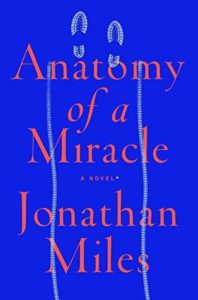 about waste and excess called Want Not. His new one is called Anatomy of a Miracle published by the significant Hogarth Press (regularly $27.00, before discount.) In the first chapter a beer-guzzling war vet, made a paraplegic in Afghanistan, is mysteriously healed on a hot morning in front of the Biz-E-Bee convenience story in Biloxi, Mississippi. The book unfolds as scientists and faith healers and reality TV producers all vie to explain what happened. (It isn’t every profane, mainstream novel, by the way, that talks about evangelical faith, both black and white Southern Christians, citing everything from C.S. Lewis on miracles to more low-brow evangelical bestsellers. And that also nicely exposes the reductionism and lack of imagination among those committed to materialistic scientism. And the dangers of, well, I digress…)
When one takes the dust jacket off of Anatomy of a Miracle, it reveals a longer subtitle, pressed on to the hardback cover itself: “The True Story of a Paralyzed Veteran, a Mississippi Convenience Store, a Vatican Investigation, and the Spectacular Perils of Grace.” No wonder Dave Eggers loves it.
Anatomy of a Miracle has gotten rave reviews from a starred review at Kirkus to a long piece in the Times. Library Journal notes, “With sincerity and wit, Miles pens a strong, sardonic rumination on the religious boundaries of the miraculous.”
Ron Rash writes of it:
Jonathan Miles has written a novel whose comic moments alone make it a wonderful read, but Anatomy of a Miracle quickly becomes so much more: an intense, and intensely profound, meditation on how an extraordinary event might test the limits of both scientific and religious belief. What a superb writer; what a superb book.
It seems I’m always in the middle of a couple of novels and a number of memoirs. I can’t wait to tell you about some well-written memoirs that I personally enjoyed.
GREAT NON FICTION: THREE EXCELLENT RECOMMENDATIONS
But our wheelhouse here is religious non-fiction and I want to revisit two very wonderful and very important books that I only announced briefly when they first came out, books that deserve a second run-through to tell you about. And I’ll add a third that is very new, offering a trio of remarkable books that I am sure will help you – no matter your age or stage of faith, no matter your season of life, whether things are going well or whether you are struggling. These are extraordinary books that seem to relate or pair well together and we recommend them to you.
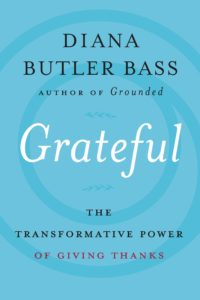
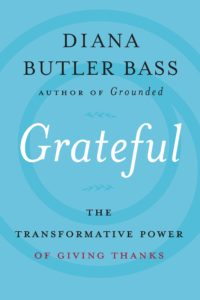 Grateful: The Transformative Power of Giving Thanks Diana Butler Bass (HarperOne) $26.99 I was enthusiastic in my description of this when the book released a month ago, and I encouraged all within ear-shot to consider it. I admitted that I wasn’t sure what I’d think about it, at first, but realized it is really good. I tried to explain it briefly, but wanted to revisit in now.
I’m a fan of the books of Diana Butler Bass, even when we might disagree or when I think she is a bit too hard on conventional theological constructs. She’s a progressive political advocate, an ecumenically-minded, liberal Episcopalian, and yet she knows much (and on a good day, can say wise and nice things about) folks who sit on various parts of the big pew that is the Body of Christ. For years and years she travelled the country documenting what sort of good ordinary, neighborhood churches were doing; she did a few academic titles of research and the wonderful Christianity for the Rest of Us: How the Neighborhood Church Is Transforming the Faith (HarperOne; $15.99) that, even though it’s been out 10 years, is still a very popular title affirming smaller churches that have embraced practices of hospitality and spiritual formation and wholistic outreach and the like. She went on to write a book about the so-called “nones” (that cite “none of the above” on religious affiliation questionnaires and what it means to find fresher expressions of faith outside the walls of the church, with the postmodern and post-Christian. (That somewhat controversial 2013 book is called Christianity After Religion: The End of Church and the Birth of a New Spiritual Awakening [HarperCollins; $15.99] and it deserves a discerning, careful read as we all grapple with how to do effective and faithful ministry in our pluralistic, “spiritual but not religious” culture.)
Bass is a scholar of religion and an activist and travels in circles with beautiful writers like Barbara Brown Taylor and thoughtful colleagues in the biz like the late great Phyllis Tickle. I still smile thinking about a picture I saw of Diana with her little string of pearls and demure business suit standing all arm in arm with the tatted up Lutheran rock star Nadia Bolz-Weber and her low-slung jeans. Diana’s last book was about an eco-friendly, “this world” sort of spirituality that not only finds God’s presence in the beauties of creation and in the ordinary stuff of quotidian life, but equips us to serve the common good in our own places; it is called Grounded: Finding God in the World – a Spiritual Revolution (Harper; $14.95.) I mention all of this so you can place her within the broader landscape of religious writing these days. She is somebody you should know and somebody I really appreciate.
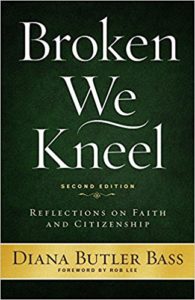 (A revised and expanded version of her must-read, short memoir called Broken We Kneel: Reflections on Faith and Citizenship is coming out late this summer from Church Publishing ($18.95 – you can pre-order it from us, of course.) It ruminates on the important church/state, faith/politics intersection but is rooted in her own anguished story of leaving a church the year following 9-11, precipitated by flags in the sanctuary. Her spiritually rich, humble phrase, “Broken We Kneel” was in direct contrast to the “United We Stand” motto and expresses her sadness at how some churches – even large main-denominational churches – are too often aligned with militarism and nationalism; it reminds us of the price some of us will have to pay to be faithful to Christ to resist what the hymn-writer called “our warring madness.” I am very eager to see revised edition…)
I explain all this not just to gently place Diana within the spectrum of religious writers these days and so you know a bit about her, but to again revisit what I said in the earlier, brief review of Grateful.
You see, I said I was surprised that Diana – a sophisticated sociologist of religion and a politically active citizen on the side of peace and justice, and a writer about deep and profound spiritual formation – would be drawn into what I had (however unfairly) considered a simplistic and overly sentimental practice – doing those little gratitude journals and sharing the results of your pious plan to “count your blessings.”
She herself apparently had some of these misgivings — the prologue of the book is called “Confession: No Thanks.” Ha. That’s my kind of starting point for a book like this.
Well, as I said in that first review, I was surprised (but shouldn’t have been) that in the hands of the capable thinker and good writer and public intellectual that Diana is, this study of gratitude becomes a subversive spiritual practice; a religious practice with considerable political implications. She critiques the gracelessness of the “quid pro quo” approach to a culture that turns everything into what we owe, as if everything works like the market, with transactions of debt. She does some historical and sociological studies of cultures that are based on assumptions of abundance and habits of gratitude; man, this simple virtue, when teased out and given some political teeth, as she does, can be downright revolutionary. (She has a section called “Pro Bono and the Golden Rule” about our political habitat that is amazing.)
As one pastor wrote of it, Grateful will soften the lens through which you look at the people in your life, and the whirling world around us.” Yes, it will soften the lens, and maybe soften your heart. But, again, this is not to avoid the hard work of social transformation, but is, in a way, the beginning of such dismantling and reformation. It does push us into that “whirling world around us.” It is, as Shauna Niequest put it, “a soul-shaping framework” but, as I explained in that earlier review, it is more than a pious or spiritual practice: it is an invitation to deconstruct and reframe the world and our political and economic idols. There were pages that made me think for a moment of Timothy Keller’s striking, succinct book on how a gospel-centered vision can undo the idols of our times Counterfeit Gods: The Empty Promises of Money, Sex, and Power, and the Only Hope That Matters (Penguin; $16.00.) There were times when it made me think of the brilliant, vital book by Brian McLaren called Everything Must Change: When the World’s Biggest Problems and Jesus’ Good News Collide (Thomas Nelson; $14.99.)
And so, I sort of justified to our sophisticated and culturally-engaged BookNotes readers, that this book was a double-dipping or triple-dipping sort of read; that is, it invites us to a personal virtue and habit of thankfulness even as it nurtures us into a deeper spirituality, even as it reminds us of the social and civic implications of taking on attitudes and practices of authentic gratitude.
It’s a self-help book!
It’s a spirituality book!
It’s a cultural study!
It’s all three at once!
Now that I have finished Grateful: The Transforming Power of Giving Thanks I’d very much like to share just a few quick observations that might inspire you to order it from us. I’m unashamed in promoting books I think will be helpful, and this is one of them. It would make a great book for a study group – in your church or among your neighbors, churched or not. It is classy and interesting and nicely written.
First, I pitched this in that last review, as I sort of did, again, above, as a civic minded book analyzing the idols of our culture, the dysfunctions of our body politic, some of which emerge from a stinginess that might be subverted by the practices of a reframed worldview based on gratitude. This is a fair pitch, telling you that Butler Bass wrote this a during the early days of the Trump administration and was, in a way, discovering from her own deep reflection, ways to be glad about life despite the dreadful and chaotic times around us. I didn’t want anyone to think this was cheesy or a Pollyanna move, a turn inward and inspirational and away from the heavy, critical stuff Butler Bass has called us to before.
Fair enough: there’s a “common good” and cultural aspect that makes Grateful nearly subversive. She cites the astute, scholarly work of Peter Liethart Gratitude: An Intellectual History (Baylor University Press; $39.99) and was obviously informed by liberation theologian Mary Jo Leddy who has a book simply called Radical Gratitude (Orbis Books; $18.00.) She gets the public virtue stuff, and is always interested – like Walter Brueggemann, whose Scriptural work she always relies upon – on the social implications of Biblical faith.
But realize this, too: I was won over reading Grateful as a book of sciency/social-sciency self-help guidance advice. Yes, she draws on the best and most recent data on brain studies and such, showing how and why keeping a gratitude journal or fostering an attitude of gratitude is good for you. (Literally it’s good for your health!) And yes, she links that to a good and generous spirituality, a deeper sort of prayer and worship. But at the end of the day, as informed as this book is by good research and her wide reading, it impacted me for its common sense advise, spoken to me in a voice I was able to hear.
Maybe other “inspirational” writers have said it more simply, but I needed Bass’s wholistic and socially responsible framework to get to this good, good stuff. She is countering a narrative of negativity – which is very strong in my own life, by the way – and offering this ancient practice to offer a better way to life. It’s a simple as that – this book really explores how helpful and good and fruitful a thankful outlook can be.
Secondly – and it wouldn’t ring true as practical and good if it didn’t go here: she is very honest about how this practice of being thankful is not a justification for stuffing down our feelings of sadness, not a justification for failing to lament or grief, and not a way around the hard theological questions of theodicy and the like. It is not a call to apathy or complicity in great evil. We can be people who both celebrate and weep; we can be people who are festive with gratitude and who lament and protest.
In fact, this is where the book deeply touched me – I even had to wipe tears away a time or two, which I hadn’t anticipated. More than her other books – even her very interesting quite personal memoir, now out in an expanded and revised second edition, Strength for the Journey: A Pilgrimage of Faith in Community (Church Publishing; $22.95) – she tells of some of her own personal struggles. She is explicit (although not graphic) about saying she was abused as a youth. She talks about her years of having no generous thoughts whatsoever about this bad uncle, now deceased. She tells of some other hard things in her own life that any caring reader will be captivated by, and that many will surely nod in agreement with, perhaps through tears. You too, Diana? Me too, indeed.
Practicing habits of thankfulness – even the much recommended “gratitude journal” – is no panacea for discontent and doesn’t offer promises of easy healing for deep hurts. But she shows from research, from stories, and from her own life, vulnerably revealed in these pages, that it can help us move in the direction towards renewed hearts and refreshed, even joyful, lives. I have to admit I don’t read many self-help books, but this was a really, really good and life-giving resource for me and I am going to revisit it throughout the summer.
Another thing I liked about Grateful is how it is layered with a complex and multi-dimensional approach but is so clear and nicely arranged. There are four distinct parts to Grateful, each with just two chapters.
Part One and Part Two are about what she calls “Me.” The chapters in Part Two and Three explore what she calls “We.” Me and We; easy, huh? And in each of those respective parts, she looks at what she calls the emotions of gratitude and the ethics of gratitude, first for us as individuals, and then for us together, in community and in public life.
(In a way this pattern brings to mind her fascinating book called A People’s History of Christianity (HarperOne; $15.99) where she documents, through different phrases of church history, how ordinary people saw their faith and how they lived their faith. That is, it explains the chief organizing images and the practices that emerged from them, the beliefs and behaviors, if you will. This swing from emotion to ethics, individually and together, in Grateful makes a similar sort of infrastructure for the book and it’s very, very useful.)
Once again; Part One is called “Me: Emotions” and Part Two is “Me: Ethics.” Part Three is “We: Emotions” and Part Four is “We: Ethics.” It makes a lot of sense, yes?
Yep, there’s some hard and raw stuff in here, personal stuff that Diana shares about her own pains and struggles and wounded relationships and there are things in here that are utterly delightful. She is honest about the complexities of all this (our own woundedness and hardness of heart and our culture’s structures and dispositions to resist grace and gratitude.) But there’s really fun stuff, too – including a remarkable bit about play and creativity, even a bit about baseball. I was moved – again, almost to tears — in a chapter about the emotion of gratitude (in the “we” section) that showed how, when shared, can become the foundation for cultures of festivity. Joy and celebration are part of the ethos of some work cultures, some churches, some institutions, and, as she tells, even of certain neighborhoods and parts of cities. What fun!
Yes, what fun to read and how good it is to reflect on how this seemingly simple reframing of heart matters become – through intentional practice, of course – a way to be grateful together, to increase communal celebration, which spills out into circles of gratitude (as she calls one of her chapters) and festivity and into, as another chapter simply puts it, “the grateful society.”
Like King’s famous “beloved community” we aren’t there yet. Which is why we need sustained study and encouragement and wisdom from guides who can help us ponder and embrace giving thanks and being generous, realizing their communal nature and public consequences.
This is “a call to the grateful way” and it is good rich, stuff. She reminds us how it works individually – both in our emotional lives (gratitude is, after all, as she carefully explains, an emotion) – and in our broader communities and cultures. As “Science Mike” McHargue says, “Bass is a calming voice in raging cultural seas. Grateful is challenging and refreshing and speaks to the core of so much modern misery.”
Can a book pushing back against modern misery be fun to read? Can a self help book be deeply spiritual? Can a book inviting an optimistic sort of good cheer, learned by nurturing gratitude be profound in a hurting, chaotic culture? Yes, yes, and, again, yes. This intelligent, nicely written book is all that and more. Grateful: The Transforming Power of Giving Thanks is worth buying, worth studying, and, at the end, worth being grateful for.
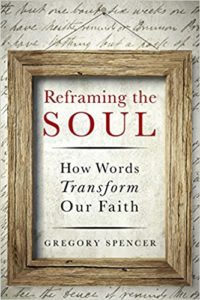
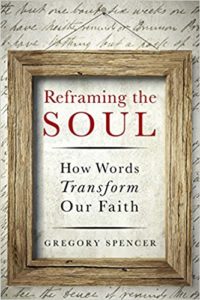 Reframing the Soul: How Words Transform Our Faith Gregory Spencer (Leafwood) $15.99 Oh my, what a handsome, nice paperback, a perfect book to read alongside Grateful by Diana Butler Bass. In fact, Spencer has a very, very good chapter on gratitude in Reframing the Soul and it helped me as I was reading Butler Bass. I’m not stretching it to say these two really could be read in tandem.
For what it may be worth, I’ve known of Gregory Spencer for years. Although it has been out of print for more than a decade, we used to push his A Heart for Truth to any college student who would listen. (Now that honor goes to the Brazos Press book Learning for the Love of God by Opitz & Melleby, of course.) In more recent years, Spencer wrote a lovely book called Awakening the Quieter Virtues (IVP; $16.00) which looks at character attributes such as innocence and reverence, discernment and gratitude, modesty and authenticity. He wants us to grapple with thoughtful stuff, but is the sort of spiritual guide who walks readers into very, very real-world, stuff. It is a book about spiritual formation but very practical.
I wasn’t sure, I’ll admit, what Reframing the Soul would be like, but I knew I liked and trusted Spencer as a solid, helpful thinker and a good, clear writer. When we first heard of it we liked the subtitle “how words transform our faith.” I was maybe thinking it might be about books or literature.
When it arrived I scanned it quickly, and was struck by its layout and design and the very good poem that concludes every chapter. I looked through the discussion questions and realized it really was a self-help kind of book, about coming to terms with how we think about our life, based on the words and stories we tell ourselves.
Ah, yes…. now that I’ve read it I can say that it is, indeed, a book about basic spiritual growth with this nearly psychological foundation. Spencer sounds like a counselor but actually taught communications studies at Westmont (yes, the irony is thick, here, as Diana Butler Bass used to teach there and she writes about it in her book.) As a communications guy, Spencer is a great writer – he makes his points, tells stories, draws on great quotes from both old classics and contemporary writers, Christian and otherwise. He’s a born storyteller and some of his illustrations are just captivating.
But besides communications – and this book is rooted in pretty serious study and awareness of how linguistics and story works – I gather that Mr. Spencer is a fine counselor, a mentor, a caring guide, maybe even a pastoral voice for many of his students and associates. He’s no saint – he makes that pretty clear, too, in his honest stories about his own foibles and mishaps – but he has this knack for pushing people to ask deeper questions about what is really going on under the surface of one’s life, fostering great self-awareness. (Remember, he wrote that book about the “quieter virtues” which includes discernment and authentic, rejecting hubris, being aware; he has this kind and gracious way – according to the stories he tells to illustrate his points – of probing and inviting and helping folks see things afresh.) This is a great gift and I don’t know of any book quite like this.
Seeing things afresh is what this book is about. He is convinced that we basically tell ourselves the same story, the same way, over and over, and it becomes true for us, impacting how we see not only the incident or persons involved, but how it shapes and forms our own behaviors. This is commonly known – think of the TV shows or movies where a person is told over and over she is dumb or ugly or lazy or won’t amount to anything and the hero or heroine has to overcome great obstacles just to prove to their parents or nemesis that they are somebody, they do have talents or capacities. That we are wounded, often for life, by lies people say about us, or lies we believe about ourselves, is nearly self evident.
Alas, Reframing the Soul goes a bit deeper, even though the prose is simple and the stories are often hilarious or poignant. Spencer has written a book that I nearly want to call – for those few for whom this would be an asset – a worldview book. He shows how our lives are construed by the deepest ideas we hold and the social imaginaries that developl how we see and lean into life. He’s read and cites James K.A. Smith’s You Are What You Love so there’s no reductionism about mere, abstract intellectual ideas being the only things that shapes us; he is fluent in conversation about our deepest desires and the storied nature of our lives.
So, yep, Spencer does all this is a really fine and thoughtful way, studying and exploring (and did I say, telling lots of stories!) the way words matter in our lives, the way the plot of our lives unfolds, the way our attitudes and practices – I’d say our very worldview – are dynamic and changing in part shaped by the words spoken to, about, or over us, Spencer gives us handles for re-thinking, re-construing, re-framing our lives.
His framework (excuse the pun) of frameworks and re-framing, is, actually, a very, very helpful way to get at this who phenomenon. In our last BookNotes post I swiped a phrase from Jamie Smith about how we are often “conscripted into a story” or some trajectory towards what we’ve come to imagine as the good life. We are conscripted by stories and imaginative frameworks, worldviews and songs, Smith and Spencer both know this. But Spencer, especially – he’s a communications specialist, after all – realizes that much of this comes from the words we use to tell the particular stories of our lives.
Why do we use this word to tell the story that way? What baggage, about shame or guilt or blame or failure or debt does that phrase bring with it? What if we told a story using other words? What if we reframed an incident with other language? That is what Reframing the Soul: How Word’s Transform Our Faith does for us.
And, again, (and not just because of the good chapter on gratitude) this is a very useful tool to read along with Diana Butler Bass; Spencer shows how practices and new habits (as she commends) happen best when they are first construed in new language. (She knows this, of course; it is in a way the chief premise of her book, shifting from debt to grace, complaining to thankfulness, and so forth.)
On the back cover of Reframing the Soul we get a glimpse of what Spencer is up to here, when he tells of “four essentials of the soul.”
- Remembering the past with gratitude
- Anticipating the future with hope
- Dwelling within ourselves in peace
- Engaging with others in love
There are the four main units of this book. After several opening chapters he gets to these four chief tasks (remembering, anticipating, dwelling, engaging) but the opening four chapters are worth the price of the book. And they are memorable – “Every Word a Window,” “There Is No Immaculate Perception,” “Order, Order, Everywhere,” and “When You Frame Your Life, What’s in the Picture?”
Then Spencer opens up the discussions about how new words can reframe and set us free from less than life-giving, less-than-adequate perceptions. Please note, this is not some technique like “neuro-linguistic programming” nor some name-it-and-claim it nonsense about positive confession. It is wise and nuanced council about reframing our stories based on how we choose to tell those stories, inspired, as we can be, by Biblical truths and spiritual discernment.
Three features at the end are brilliant. One is about “finished and unfinished frames.” This chapter starts with a long and sordid tale from his own broken family. A final appendix is called “Reframing with the Saints” and draws on a variety of older saints to help us as we re-orient our own worldviews and life narratives. The final part is a long and excellent study guide and discussion resource that would make this an ideal study for a group.
Listen to this lovely little quip by the always worth hearing John Ortberg:
Reality, a friend of mine once said, is what you run into when you’re wrong. Reframing the Soul is a wonderful guide to navigating reality with grace and truth. It is honest, hopeful, literate, and faith-filled. His framework for daily life is brilliant!
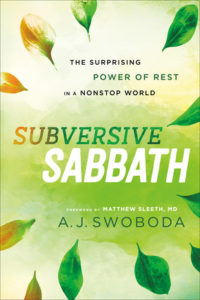
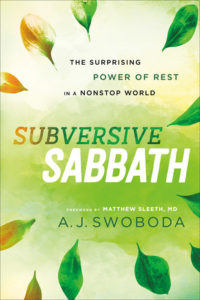 Subversive Sabbath: The Surprising Power of Rest in a Nonstop World A. J. Swoboda (Brazos Press) $19.99 This is another book that I wrote about in some detail – but not enough – when it first came out. We raved about it, assured you that it seemed to be one of the very best books done on this topic. We celebrated Swoboda as a great writer – we so loved his last few books such as A Glorious Dark: Finding Hope in the Tension Between Belief (Baker Books; $15.00) and Experience or The Dusty Ones: Why Wandering Deepens Your Faith (Baker Books; $16.00) not to mention an academic text he edited on Pentecostals involved in peace-making, social justice, and creation care entitled Blood Cries Out: Pentecostals Ecology, and the Groan of Creation (Pickwick Publications; $31.00.)
And so, we love A.J. We appreciate his great writing, how he draws on so many great sources – in this book, from Eugene Peterson to Flannery O’Connor, from Marva Dawn to Kenneth Bailey, from Nancy Sleeth to Barbara Brown Taylor, from Charles Dickens to Wendell Berry, from poets to prophets, scientists, and more.
There are so many good books on the Sabbath and Sabbath keeping that we stock and love. (I do think Marva Dawn’s Keeping the Sabbath Wholly remains a must-read and most everyone who reads in this topic knows that the dense old Rabbi Abraham Heschel’s Sabbath is a true classic. I’m very fond of the upbeat and readable The Rest of God: Restoring Your Soul by Restoring Sabbath by Mark Buchannan and Swoboda himself draws on his mentors Matthew and Nancy Sleeth and Matthew’s 24/6: A Prescription for a Healthier, Happier Life (with a nice foreword by Eugene Peterson) not to mention the amazingly broad and visionary Living the Sabbath: Discovering the Rhythms of Rest and Delight by Norman Wirzba. Swoboda has that same sort of vision of “rest and delight” and writes with joy and vigor.) As you can see, there are a lot of good books on this, all worth spending time with – perhaps as a Sabbath practice. But why one more?
I cannot say that I’ve enjoyed one as much as I have this one, nor have I learned as much. I’ve read seven or eight books on this topic, at least, and Subversive Sabbath: The Surprising Power of Rest… is among the best. It’s a big, thoughtful, wonderful book and I really, really, want to commend it to you.
In fact, listen to this:
If I were permitted to recommend only one book on Sabbath-keeping, Subversive Sabbath would be it. No one can read this book and ever again associate Sabbath-keeping with ‘blue laws’ or legalism or boredom. Subversive Sabbath dares one to do life as God intended from the beginning.
— Shirley A. Mullen, president, Houghton College
And, while we’re at it, consider these robust recommendations:
“Do you ever just want to pull the plug on your schedule? Subversive Sabbath shows you why you should and how you can; it will fundamentally change your life. It is a total reconstruction of America’s frenzied, frenetic lifestyle, offering the ultimate regenerative alternative.”
— Joel Salatin, Polyface Farm; editor of The Stockman Grass Farmer
” Subversive Sabbath is incredibly well written, accessible, and deeply encouraging. A. J. Swoboda avoids oversimplification and presents a deep, rich, and energetic argument on what it means to be fully human through an obedient pursuit of rest and well-being.”
— Ken Wytsma, founder, The Justice Conference; pastor, Antioch Church, Bend, Oregon; author of The Myth of Equality
“Our smartwatch-driven age can measure every heartbeat, every step, even the quality of our sleep, but it cannot measure the health of our souls. Our limitless freedom has paradoxically imprisoned us in an achievement culture of constant measurement. Escape from the exhaustion of endless opportunity, embrace the singular God behind the singular Sabbath day of rest. Stop, breathe, read this profoundly helpful book, and be remade.”
— Mark Sayers, senior pastor, Red Church, Melbourne, Australia; author of Disappearing Church and Strange Days
“Few things are as subversive to the hurry addiction of the modern world than the practice of Sabbath. And few things are as life-or-death important. A. J. has written his best book yet. His keen mind, quick wit, and deep soulfulness come through beautifully, page by captivating page. But more than anything, this is a book that is lived. My new go-to book on the Sabbath.”
— John Mark Comer, pastor of teaching and vision, Bridgetown Church; author of God Has a Name
Well, what can I say after those stellar endorsements? These are all from people I really like, folks I trust as thinkers and as writers, so wanted to share them with you.
I, too, would add my rave review to this as I’ve so appreciated Swoboda’s style and grace, his many stories and illustrations. He reminds us that Sabbath is a rest for the mind. He talks about the “psychic numbing” that we do.He talks about our workaholism, of course. He talks about making pancakes with his kids – always pancakes on Sabbath! – and got me choked up with a Rabbinic saying that accompanied the story. One chapter starts with a line about the beauty of cows. His stories about church life and doing ministry and how Sabbath keeping habits can shape congregational cultures are very helpful. His Biblical study draws Sabbath principles from all over the Hebrew and Christian Scriptures and anyone who cares about the formative influence of the Bible will appreciate his handling of the Word. He has a chapter called “Sabbath and Critters” which you don’t see in every Sabbath book…
Subversive Sabbath: The Surprising Power of Rest in a Nonstop World, in a way, is also a very good book to read with or after Diana Butler Bass’s Grateful: The Transforming Power of Giving Thanks. I hope you can see that these explore somewhat similar territory, even if Swoboda is a Bible teacher and pastor while Diana is sociologist and researcher; her topic is more directly psychological and could be read by nearly anyone – the emotions and ethics of gratitude are pretty universal – while his seems more directly written for those who are on the way of Jesus and seeking a faithful sort of discipleship. That is, one of the aspects of a Sabbath-keeping life and of the grateful life is a core trust in the abundance, grace, and trustworthiness of God and the sturdiness of God’s creation. That both Butler Bass and Swoboda draw upon the generative insights from Walter Brueggemann is no surprise. That they both invite us to a grounded, sense-of-place with interior lives that bear fruit for the common good is, again, no surprise. These things over-lap and relate nicely.
Swoboda’s book is arranged in four parts: Sabbath for Us, Sabbath for Others, Sabbath for Creation and Sabbath for Worship. There are three good (and well footnoted) chapters under each section, making this a 12-chapter work.
I could go on and on about passages I enjoyed and insights I gleaned and stuff I pondered (and a number of things that pushed me to maybe repent of some of my own drivenness and disobedience to these things) but I think I will just mention a few final notes. It will give you a good overview of how much is covered and why this is an important book for you even if you’ve already studied another good book on this topic.
In the “Sabbath for Us” section he has a long section about time; in these 24/7 (or, now is it 25/8 as we try to extend the very limits of creation?) this is crucial stuff. I got hooked thinking about all this from the luminous, stunning pages of the gentle Receiving the Day: Christian Practices for Opening the Gift of Time by Dorothy C. Bass (Jossey Bass; $14.95) and of course Swoboda cites it.
There is a good chapter on work – it is especially good for those of us who don’t work with our hands, much, or are stuck in offices and what some call “knowledge work.” There is a very important chapter on health.
In the “Sabbath for Others” unit he talks about relationships (wow!) and has middle chapter called “Sabbath, Economy, and Technology.” There is an important (and helpful contribution to the current literature on Sabbath called “Sabbath and the Marginalized.”
We should all take in the “Sabbath for Creation” section since, well, we all live on land, and eat, and are involved, in on way or another, with animals. This is not just for environmental activists (although, given the cut-backs in environmental regulations and the current administrations compromised role in this field, we all need to step up our stewardship game these days!) There’s a chapter on the creation, one on the land, and one, as I mentioned, on critters.
The final three chapters are under the rubric of worship – although that is fairly loosely used. These are rich and potent chapter on “Sabbath and Witness” “Sabbath and Worship” and “Sabbath and Discipleship.” Oh my, this is transformational stuff, really, really good.
We can rejoice and thank Brazos for doing this book and for having great reflection questions at the end of each chapter. It’s a gloriously written and very, very informative title, and may be just a bit much for some small groups. (It’s over 200 pages.) But the 12-chapter format isn’t toooo long, I don’t think, and it is stimulating and will lead to spirited conversations, for sure.
So, there you go, friends: a book on gratitude, a book on reframing our stories by using better words, and a book about the many aspects of a Sabbath way of life. All three are delightful subversive, each in their own ways. Buy some books, but hold on to your hats.
BookNotes

SPECIAL
DISCOUNT
ANY ITEM MENTIONED
20% Off
order here
this takes you to the secure Hearts & Minds order form page
just tell us what you want
inquire here
if you have questions or need more information
just ask us what you want to know
Hearts & Minds 234 East Main Street Dallastown PA 17313
read@heartsandmindsbooks.com
717-246-3333
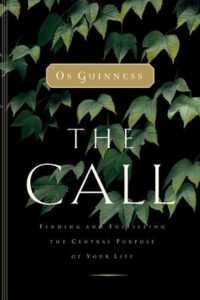 When in doubt, I often start with a passionate summary of the doctrine of vocation, talk about Os Guinness’s stellar and exquisite work The Call: Finding and Fulfilling Your Life’s Greatest Purpose (Word; $17.99) and remind folks that their work or avocations are as important to the Kingdom of God as is the work of ministers or missionaries. Explaining how the early church was wrong to so easily buy into Plato’s lie that life is made up of what some call “sacred and secular” spheres is a good way to start almost any talk on any topic. God cares, the world matters, we are called to reflect on the principles and practices that cohere with the actual way God’s good world really works, illumined by the light of Biblical truth. Citing that explosive verse about “taking every theory captive” (2 Corinthians 10:5) it’s helpful, I think, to remind folks to think well about what they do.
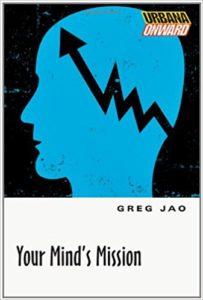 If this task or way of thinking about the intellectual implications of passages like 2 Corinthians 11:5 or Romans 12:1-2, I highly recommend at least reading up a bit on the Christian mind. My favorite brief book on this is by the wonderful Greg Jao and is called Your Mind’s Mission (IVP; $7.00.) I very briefly describe in an older BookNotes ten others in a list that’s a little dated but may proof helpful. We still stock these, and more, so
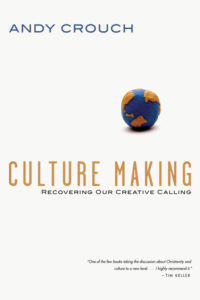 Culture Making: Recovering Our Creative Calling Andy Crouch (IVP) $22.00 Time and again I insist this is not a book for artists but for all of us, for any who long to be more meaningful engaged in the human task of culture-making, of stewarding the gifts God has given us for the common good. We are all called to make something out of what we are given and this image-of-God work of cultivating God’s garden is intrinsically human. So, yes, it is for butchers, bakers, and candlestick makers, for parents and politicians and practitioners of all sorts. But, let’s face it: who needs to have language to express this stuff, this good, creative calling, this longing to leave a legacy of something real, than those called to be artists, writers, poets, novelists? I very, very highly recommend this one-of-a-kind book.
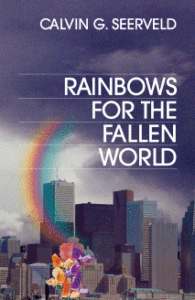 Rainbows for the Fallen World Calvin Seerveld (Toronto Tuppence Press) $30.00 In my presentation I explained a bit about this important book, on of my own personal all time favorites, especially the early chapters about how Seerveld reminds us, helps disclose for us, the aesthetic dimension to all of life. Here he does his most famous and often-discussed good work on “allusion” and a serious chapter or two on the philosophy of aesthetics. I’d read anything Cal writes – and what an energetic writer he is! For those who want a deep dive into his work, see any of these in
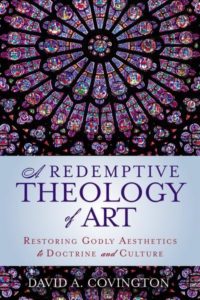 A Redemptive Theology of Art: Restoring Godly Aesthetics to Doctrine and Culture David A. Covington (Zondervan) $24.99 This is very new and I applaud Zondervan for releasing a book that, sadly, may not seem important to those who read theology. I’m part way through it want to commend the author for doing this kind of good work. It looks at how aesthetics can influence our understanding of doctrine as well as our engagement with the culture and the creative process. Good, good stuff. He quotes Seerveld, too.
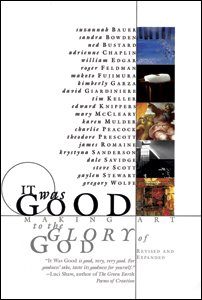
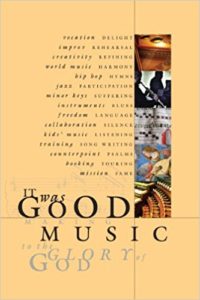
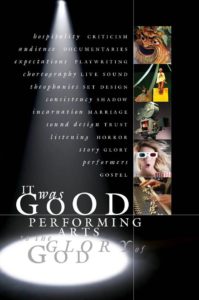 It Was Good: Making Art to the Glory of God edited by Ned Bustard (Square Halo Books) $24.99
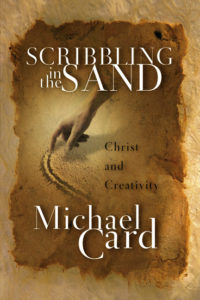 Scribbling in the Sand: Christ and Creativity Michael Card (IVP) $17.00 There are heavier books out there, but I really, really like Mike’s mature reflections and balanced call to embrace some degree of creativity in our daily lives. This is helpful for artists and writers, but also good for anyone. We recommend it often.
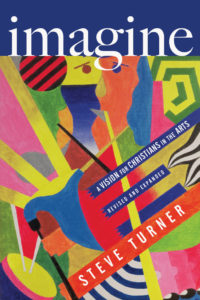 Imagine: A Vision for Christians in the Arts Steve Turner (IVP) $16.00 This is another standard go-to book for us that is basic, interesting, engaging for anyone whether filmmaker, musician, storyteller, or writer – or anyone who just enjoys the popular arts. I so appreciate this classic book, which was nicely expanded a few years back and often recommend it (to artists and others; maybe especially others.) Steve Turner is a respected rock critic (and has written widely on, among other musical icons, The Beatles.) This is a very good book, highly recommended.
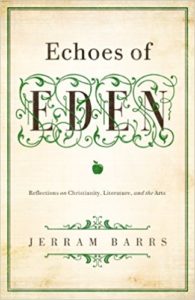 Echoes of Eden: Reflections on Christianity, Literature, and the Arts Jerram Barrs (Crossway) $18.99 When my friend Denis Haack says something good about a book, when jazzman and seminary prof William Edgar has a blurb (saying it is “enriching both professional artists and anyone else sensitive to the power of art for all of life”) and when Nicholas Perrin (once a teaching assistant to NT Wright) says that Barr “clears away the clutter of much-touted arguments and sets forth a clear framework for any Christian thinking Biblically about the arts” you know you’ve got my attention.
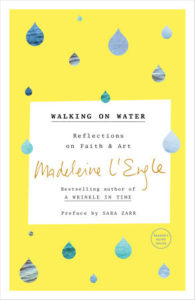 Walking on Water: Reflections on Faith and Art Madeline L’Engle (Convergence) $15.00 This is a must-read for any serious writer. Her take on the creative process and the spirituality of the arts is wise and a tad unusual – she draws on desert fathers and medieval artists and more. It is not simplistic. Of course, her main art work is as an author, so it’s very good for writers. There is, in this recently re-issued paperback, a lovely preface by the YA novelist Sara Zarr.
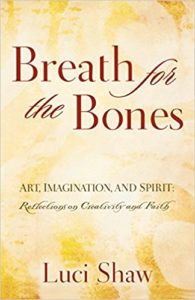 Breath for the Bones: Art, Imagination, and Spirit: Reflections on Creativity and Faith Luci Shaw (Thomas Nelson) $15.99 Luci Shaw (or was good friends and prayer partner with Madeline L’Engle, by the way) is a very esteemed Christian literary figure, a poet and nonfiction essayist, spiritual leader and storyteller. (She has a new book of poetry coming from Paraclete Press this fall!!) This is a book that should be on every aspiring writers shelves, maybe on your nightstand. She knows good writing – from Emily Dickinson to Annie Dillard – she reflects on the meaning of symbolism and metaphor and shows how good art (mostly good writing since that is her particular specialty) can help humans flourish and even experience God. Very nicely done and very inspiring.
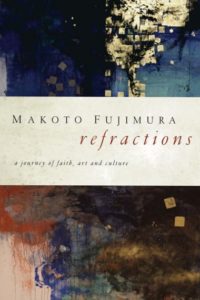 Refractions: A Journey of Faith, Art and Culture Makoto Fujimura (NavPress) $24.99 We stock and highly recommend all of Mako’s extraordinary books; there is a reason he is so well respected in so many quarters. As an abstract painter living near Ground Zero during 9-11 his ruminations on the arts have a poignant, socially responsible tone. These are beautiful essays, cries from the heart of a lively, thoughtful, Christian artist. I hope you know his many other books, from the broad and thoughtful Culture Care: Reconnecting with Beauty for our Common Life to Silence and Beauty: Hidden Faith Born of Suffering the specific, award-winning study of the classic Japanese novel, Silence, which raises huge questions about how art can be helpful as we live in a hurting world. We talked about this matter somewhat in the writers group – that good books can help heal the world. Silence and Beauty shows us how it’s done. But I think his Refractions is a must-have book.
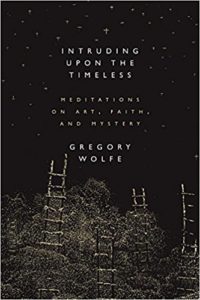 Intruding Upon the Timeless: Meditations on Art, Faith and Mystery Gregory Wolfe (Square Halo Books) $22.99 I think any literary person should know the exquisite and thoughtful prose of this well-informed Catholic leader in the movement – the space, as we say these days – relating faith and the arts. You should know the journal he founded, Image, his collection of essays entitled The Operation of Grace: Further Essays on Art, Faith, and Mystery, and a major work entitled Beauty Will Save the World: Recovering the Human in an Ideological Age. (You should know his wife, Suzanne’s, two excellent novels, too, The Confessions of X, about Augustine’s early lover and Unveiling, a revised, newly reissued novel about an art restoration project. But I digress.) This recent Square Halo edition of Intruding Upon the Timeless a collection of short, luminous, essays by Wolfe from Image was expanded last year and reissued with new artwork within, including some by woodcut artist Barry Moser. Very, very nicely done, and good reading for anyone in the arts, and certainly faith-based writers.
 Imagination Redeemed: Glorifying God with a Neglected Part of Your Mind Gene Veith & Matthew Ristuccia (Crossway) $16.99 It is surprising that there are few books that are directly exploring the role of imagination in faith. There are a few that are a bit eccentric or obtuse, but this is clear and insightful. It is a good starting point towards a coherently Christian approach and has endorsements on the back by David Kim (of the Redeemer Presbyterian Center for Faith and Work), Jeremy Begbie (who, after Seerveld, may be one of the most important aesthetic theorists writing today) and the esteemed emeritus Wheaton literature prof Leland Ryken.
 The Christian Imagination: The Practice of Faith in Literature and Writing Leland Ryken (Shaw Books) $24.99 Some say that this is an ideal book to use in a class on writing or literature, an anthology that brings together some of the very best stuff written on the integration of faith and literature. It is a bit dated and tends towards the classical, but for what it does it is an unparalleled anthology. In it you’ll find excerpts from C.S. Lewis, Flannery O’Conner, Dorothy Sayers, Frederick Buechner, and more… a good exercise for any writer is to dip into good writing and it is always worthwhile for anyone trying to develop their own opinions about creativity and aesthetics and the writing process to hear what great minds have said about this daunting topic. What a joy to have this thick paperback of 480 pages!
 Title Pending: What I Think About When I Make Stuff Justin McRoberts (CreateSpace) $10.99 I told the San Fran Bay Area ACFW group that they should know Justin, a singer-songwriter, workshop leader, podcast genius, author and all-around cultural creative who lives out there. Title Pending is a little known self-published work by a guy I really, really respect which is full of advice and ideas about being creative. Congrats to Justin and his friend Scott “The Painter” Erickson who just signed a deal with Waterbrook. Yah. What do you think about when you make stuff? Maybe Justin’s insights can help you answer that, or give a better answer. Cool.
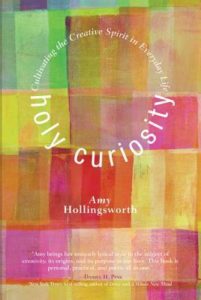 Holy Curiosity: Cultivating the Creative Spirit in Everyday Life Amy Hollingsworth (Cascade) $18.00 Perhaps you know Hollingsworth for her excellent book The Simple Faith of Mister Rogers or the riveting memoir she co-wrote with her son, Runaway Radical. She’s a fine writer and her craft is on full display here as she weaves her own story about discovering something essential about the creative process. As one writer said in a back cover review “Amy draws thread from spools ancient and modern, mythic and scientific, experiential and theoretical and weaves a seamless story…”
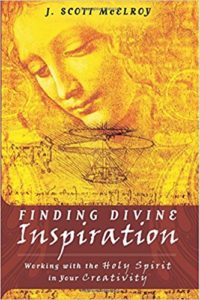 Finding Divine Inspiration: Working with the Holy Spirit in Your Creativity Scott McElroy (Destiny Image) $15.99 Scott has made a unique contribution in this field of “creativity studies” by asking, very responsibly, I might add, what active role the Holy Spirit has in our creative efforts. I like Scott a lot and many will appreciate this simple guide to discerning God’s guidance in our own efforts at the creative process. By the way, McElroy has since gone on to write a very useful book for those involved in arts ministries in the local church called Creative Church Handbook: Releasing the Power of the Arts in Your Congregation (IVP; $20.00.)
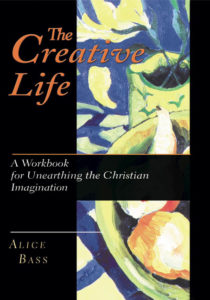 The Creative Life: A Workbook for Unearthing the Christian Imagination Alice Bass (InterVarsity Press) $19.00 You know we are fond of IVP and respect and trust their instincts about books. This was a workbook full of thoughtful exercises and things to generate greater creativity for anyone hope to unearth their own gift and capacities. I suspect this could be described as an evangelical version of something like The Artist’s Way.
 The Creative Call: An Artist’s Response to the Way of the Spirit Janice Elsheimer (Shaw/Waterbrook) $16.99 This is a book loaded with ideas, experiments, exercises and more. Designed for anyone wanting to enhance creativity, even if it is backyard gardening, a hobby of photography or digging out an old instrument from your youth. It does seems perhaps very suited for writers; for a while, this publisher (founded by Harold and Luci Shaw) had a few books in a series they called “The Writer’s Palette.) Nice, huh?
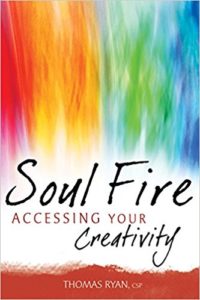
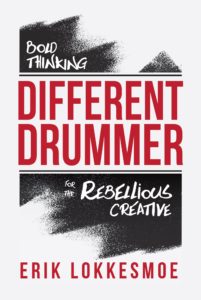 Different Drummer: Bold Thinking for the Rebellious Creative Erik Lokkesmoe (Elevant) $13.99 This small book is expertly designed with short and pithy chapters, super-graphics, cool design with touches of red ink and black graphics, with no-holds-barred bold reminders to be a “difference maker.” Lokkesmoe – who left a job in the policy world of Washington DC to be a culturally creative organizer — shows how to be encouraged, how to let go of fear and move forward into your essential role in God’s missional plan. This is very, very practical but yet expressing a youthful sort of idealistic energy. First it’ll rock your world and then you’ll really dig it.
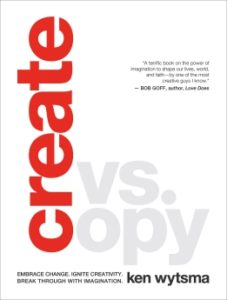 Create vs Copy: Embrace Change, Ignite Creativity, Break Through with Imagination Ken Wytsma (Moody Press) $14.99 I hope you recall that we’ve touted Wytsma before – we highly recommend his book that came out of his spectacular work founding the annual “Justice Conference” called Pursuing Justice as well as his excellent book on racism and white privilege, The Myth of Equality. But this hand-sized hardback is not only pretty cool to see but is laden with great insight about how to cultivate a creative mindset in life and leadership, using greater imagination, learning how to unleash some of our in-born creativity. The blurb on the front by Bob Goff is pretty nifty, too.
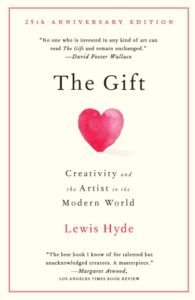 The Gift: Creativity and the Artist in the Modern World Lewis Hyde (Vintage) $16.95 This is less a workshop on being creative or an inspirational guide to finding your flow but a very impressive, almost scholarly history of how creators make a difference. Margaret Atwood says it is “the best book I know of for talented but unacknowledged creators. A masterpiece.” Jonathan Lethem said it is an “epiphany, in sculpted prose.” It is a manifesto of sorts, a call for a culture not to be so governed by money and commodity but to be reformed by the audacious generosity of artists who share their work as gift. Canadian folk-rocker Bruce Cockburn did a neat song on his 1988 Big Circumstance album inspired by this book called “The Gift.”
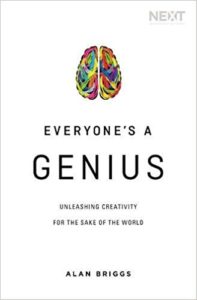 Everyone’s a Genius: Unleashing Creativity for the Sake of the World Alan Briggs (Thomas Nelson) $16.99 Briggs has a great book about staying put and caring about your own neighborhood called Staying is the New Going and the introduction (by Michael Frost) about how literature can evoke a sense of place is worth the price of the book. Many have heard me rave about this author. This is a fairly new one, absolutely fascinating, about team-building and brain studies and leadership and art and culture and, well making stuff. Very nice; a fabulous way to think about creativity and, curiously, missional church leadership, too. Give it a try – you’ll be captivated.
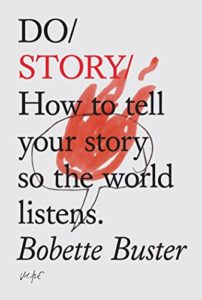 Do Story: How to Tell Your Story So the World Listens Bobette Buster (Chronicle Books) $16.95 Buster is an extraordinary woman who teaches storytelling at Northeastern University and has done presentations with all the great film studios (Pixar, Sony, Disney.) While this book seems to be more about engaging an audience with live storytelling – if you want to do a TED talk, you’ve got to get this – it is rich for anyone doing any sort of storytelling, writing, marketing, even. It’s a very hip little volume by an amazingly important person of faith. Enjoy.
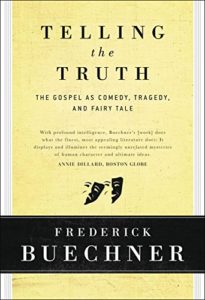 Academic; $24.99) which is very good, even for seasoned Bible readers. Since I was talking to writers,
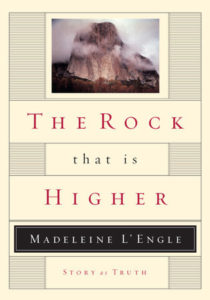 though, I slipped into an advertisement for Frederick Buechner’s fascinating Telling the Truth: The Gospel as Tragedy, Comedy and Fairy Tale (HarperOne; $17.99.) There is much more that should be said about God as Word and the Bible as Story. It’s important for all of us but should be great encouragement to those honing their writing chops, inventing fantastical worlds, spinning years and writing mysteries. Stories are close to the heart of God. And they work for us, helping us long for the right stuff, to learn to belong, to realize the story we are a part of, as Madeline L’Engle explores in her lovely The Rock That Is Higher: Story as Truth (Waterbrook; $16.99.)
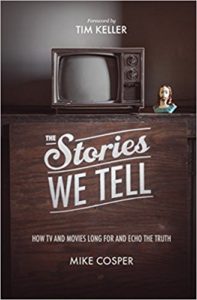 Time didn’t allow, but in a more extensive workshop teaching about this, I’d look at least at the splendid table of contents of The Stories We Tell: How TV and Movies Long for and Echo the Truth by Mike Cosper (Crossway; $15.99) which gives us new ways to appreciate the stories we watch (or read!) Although written for viewers themselves, I think writers would be helped by The Stories We Tell, just being reminded how all this works.
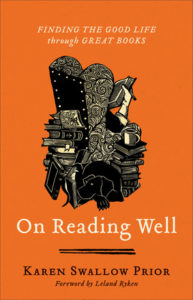 so beautifully explored in the forthcoming On Reading Well: Finding the Good Life Through Great Books by Karen Swallow Prior (Brazos Press; $19.99.) I love Smith’s line about how our imaginations can be “conscripted into a story” of a certain vision of the good life. That’s what good stories do; they grab our hearts, shape our imagination, and thereby form our desires (for better or for worse, of course. They sneak right past those “watchful dragons” you know.) They help us want what we want and love what we love. For those who take Christian beliefs seriously, and want to be part of God’s redemptive story, the problem is, as Smith warns, we might not love what we think we do.
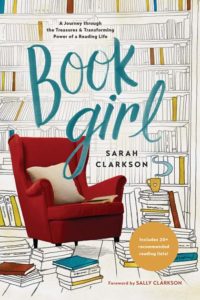 Book Girl: A Journey Through the Treasures & Transforming Power of a Reading Life Sarah Clarkson (Tyndale) $15.99 Oh how I wish I had known about this when we did our BookNotes a week or so ago about books you should pre-order. Book Girl by Sarah Clarkson comes out in September and you certainly should pre-order it right away. As I hope you saw, I highly recommended in that BookNotes On Reading Well by Karen Swallow Prior (who will be doing a presentation at our store on September 14th 2018) and invited you to pre-order that book about reading. But this beautiful book by Sally Clarkson should also have been on that list as well. It comes out in September and the first few chapters are about as sweet as anything I’ve ever read about the power of books, the virtues of the reading life, and joy of discovering books. How interesting that there are two books about the reading life coming out from two Christian publishers this fall.
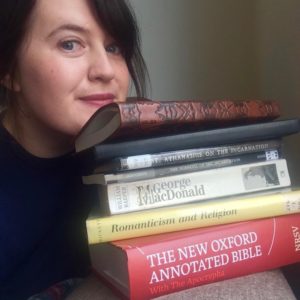 The big second half of Book Girl is comprised of Sarah Clarkson’s remarkably interesting lists of books around varying themes and genres (fiction and non-fiction.) As I skimmed these chapters on real-life topics and marveled at the many books she deftly annotated I kept shaking my head in agreement and kept smiling in recognition…
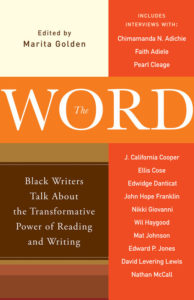 The Word: Black Writers Talk about the Transformative Power of Reading and Writing edited by Marita Golden (Broadway) $14.99 I nearly have the first pages of this remarkable book memorized as I’ve read them out loud to so many groups… these opening vignettes of novelist and memoirist Marita Golden’s encounter with books have very significantly moved me and never fails to remind me of the impact of books and why we do what we do as booksellers. I love these kinds of anthologies about folks talking about the power of books, reading them and even writing them. That it is black writers makes it that much more vital.
 Reading for Preaching: The Preacher in Conversation with Storytellers, Biographers, Poets, and Journalists Cornelius Plantinga, Jr. (Eerdmans) $14.00 Those who are fairly new to BookNotes might want to
 Reading for the Common Good: How Books Help Our Churches and Neighborhoods Flourish C. Christopher Smith (IVP) $16.00 I said in my little writer’s workshop that this was a book I wished I had written and that I so, so value it. I cannot but want to press a copy into the hands of anyone who cares about books, about thinking well and studying and talking about books and being committed to the reading life; Chris really understands the holy significance of books in Kingdom ministry and knows that slow reading and careful conversations are key practices to reform our social imaginaries. This book has such a unique and valuable take on things that I need to say that I even think that without a wider embrace of the ideas shared in this provocative, thoughtful book, the role of Christian bookstores may be doomed. Reading matters, and this gives as robust (and enjoyable) vision for that as any book I know. Buy a few, please, and share them. Give one to a book-lovin’ friend and one who ought to be. Yes!
 The Pleasures of Reading in an Age of Distraction Alan Jacobs (Oxford University Press) $19.95 Jacobs is an exquisite, world-class scholar, a serious essayist – think First Things or Image or the old Books & Culture – and this wonderful 2011 book was a contribution to the discussions around the topic of how on-line reading effects our capacity to pay attention, to read well, to retain what we’ve read. Important books like Nicholas Carr’s The Shallows (a very good, if alarming, read) were pessimistic, exposing how too much time on Facebook and social media erodes our capacities to read seriously. The Shallows was understandably dire, an Amusing Ourselves to Death for the digital age. Well, in all of these conversations and broadsides against tech and laments about the erosion of our reading habits, few noted that what was at stake was not just retaining great learning, but, well, enjoyment. We are supposed to be having fun, reading books we like. So this wonderful book – still a rather serious work of lit-and-culture-criticism from Oxford University Press – is about pleasure. Many of our best customers have truly enjoyed it.
 Caring for Words in a Culture of Lies Marilyn McEntyre (Eerdmans) $19.00 What if words were like natural resources, gift from God who wants to steward them well? These are brilliant “stewardship strategies” for anyone who uses words in these awful times. Highly recommended, especially for writers. Why don’t you just get it now, if you haven’t yet, because I’m going to keep recommending it over and over. It’s that good and that important.
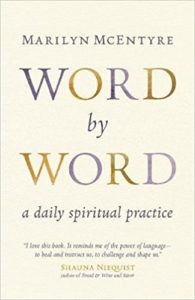 Word By Word: A Daily Spiritual Practice Marilyn McEntyre (Eerdmans) $17.99 This is like an ordinary Christian daily devotional, but instead of the standard Bible verse and reflection on it, this offers a word on ponder. One reflects on it in a variety of ways, a different angle each day, for a week. It is a beautifully (and deeply spiritual) tutorial on plumbing the meaning of the words and phrases we use, entering into them in wise and fruitful ways.
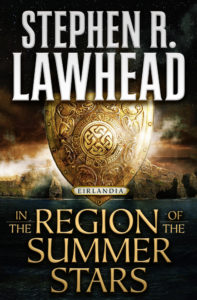 Stephen Lawhead:
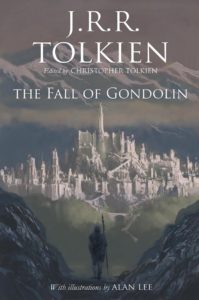 And, if you will allow me this stream-of-consciousness mention, speaking of fantasy: it is great news for Tolkien lovers that Christopher Tolkien has been working on yet another (and most likely the last) unpublished story of Middle-earth fiction from his famous father. Look for The Fall of Gondolin by J.R.R. Tolkien coming from Houghton Mifflin ($30.00) on the street date of August 30, 2918. Naturally, you can pre-order it by following the link to our secure order form page, below.
 On Writing: A Memoir of the Craft Stephen King (Scribner) $17.00 I don’t know anyone who has read this book who hasn’t exclaimed about how surprised they were by it, and how enjoyable and inspiring it was; even, for some, how very helpful it was. It is by almost all accounts a tremendous read, wise and thoughtful and full of basic, solid advice, even if it is mostly written as a memoir. A hint: he’s interested in the mechanics of language usage more than you may wish but not big on plot outlines.
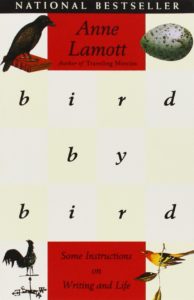 Bird by Bird: Some Instructions on Writing and Life Anne Lamott (Anchor) $16.00 Are there any serious writers who don’t know this book? It was called “a warm, generous and hilarious guide through the writer’s world and its treacherous swamps.” It is pretty clear that she came to Christian faith as she was writing this – Traveling Mercies colorfully tells that story, of course. An enduring book, it came out in 1994 (preceding the novel, a few years later, Crooked Little Hearts.) As the Seattle Times wrote of it, Bird by Bird is “A gift to all of us mortals who write or ever wanted to write… sidesplittingly funny, patiently wise and alternately cranky and kind – a reveille to get off our duffs and start writing now, while we still can.” Yup.
 Letters & Life: On Being a Writer, On Being a Christian Bret Lott (Crossway) $22.99 Kudos to Crossway, so many years ago influenced by Francis Schaeffer, for their conviction that, even for their very conservative theological views, they know that good art matters. They published novelist Larry Woiwode when the New Yorker crowd dropped him; they publish Lott, a New York Times bestselling author (whose book Jewel was even an Oprah Book Club selection) who has served on the National Council on the Arts. Yes, Lott is a straight-laced Baptist Sunday school teacher and he talks a lot in this collection of essays about his classic, evangelical faith, but he also offers deep and erudite ruminations on the craft of writing, on what we mean by “literary fiction” (he doesn’t know either, btw) and all manner of important stuff for serious literary types. Highly recommended.
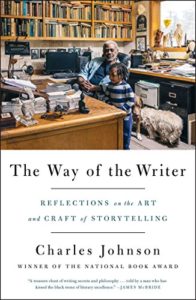 The Way of the Writer: Reflections on the Art and Craft of Storytelling Charles Johnson (Scribner) $16.00 I have a few friends who swear by this meaty book by an fiction writer who has won the prestigious National Book Award. And who has a degree in philosophy and has been a MacArthur Fellow. In 2002 Johnson received the Arts and Letters Award in Literature from the American Academy of Arts and Letters. James McBride – please tell me you know McBride — says about The Way of the Writer “A treasure chest of writing secrets and philosophy… told by a man who has kissed the black stone of literary excellence.”
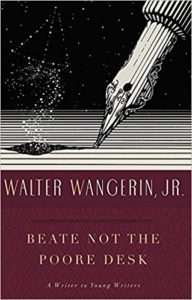 Beate Not the Poore Desk: A Writer to Young Writers Walter Wangerin, Jr. (The Rabbit Room) $14.95 Walt Wangerin is one of the great writers of our time, a Lutheran pastor, fantasy writer, children’s author, memoirist, devotional writer, Bible scholar, poet, and novelist. My, my, my. You should read anything he writes. Kudos to The Rabbit Room for offering this book where this National Book Award-winner “turns his keen eye upon the craft of writing.”
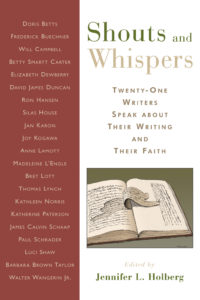 Shouts and Whispers: Twenty-One Writers Speak About Their Writing and Their Faith edited by Jennifer L. Holberg (Eerdmans) $18.99 This is the second marvelous book that more or less came out of the legendary, bi-annual Calvin Festival of Faith and Writing. Here you get remarkable, sometimes stunning, essays by excellent wordsmiths and storytellers such as Doris Betts, Frederick Buechner, Betty Smartt Carter, David James Duncan, Jan Karon, Joy Kogawa, Anne Lamott, Madeleine L’Engle, Brett Lott, Thomas Lynch, Katherine Paterson, Barbara Brown Taylor and more. Wow. Just wow. You need this.
 Writers to Read: Nine Names That Belong On Your Bookshelf Douglas Wilson (Crossway) $16.99 Wilson is a bit curmudgeonly and an incredible wordsmith (he himself wrote Wordsmithy: Hot Tips for the Writing Life.) This asks, in a way, why certain writers are legendary, classic, enduring. And what it means to choose wise ones to emulate. Of course it is a truism, a classic adage, that to be a better writer one must read good writers. Did I say that in the ACFW Zoom presentation? I intended to, but it almost sounds too self-serving, bookseller that I am. But I’ll say it here, now. To be a good thinker, a good writer, a good reader – read!
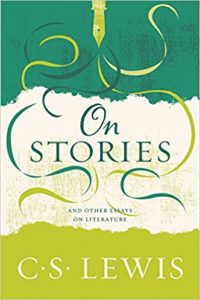 On Stories And Other Essays on Literature C.S. Lewis (HarperOne) $13.99 This wasn’t supposed to be a list of books about literature, about reading and criticism, but about creativity and writing. Nonetheless, we simply must list at least this one by the great master. There are some lovely and some haunting and some very important chapters in this handsome, small paperback. The lead essay, “On Stories,” is truly classic, as is his “On Three Ways of Writing for Children.” And I wonder what we should think about “The Death of Words”? While you’ve got your large cup of tea and are in a Lewisy mood, don’t forget his Of Other Worlds: Essays and Stories (HarperOne; $13.99.)
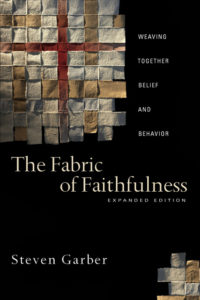
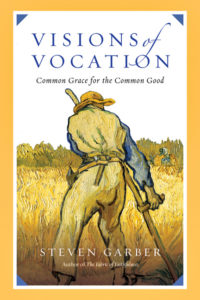 As I often do in presentations, I quote other authors (well there’s an understatement; I can almost hear my friends chuckling.) Quite regularly I quote or at least allude to Steve Garber. His Fabric of Faithfulness: Moving From Belief to Behavior (IVP; $19.00) is challenging but profound and such a great work; his Visions of Vocation: Common Grace for the Common Good (IVP; $17.00) remains one of my favorite books. In both exquisitely-written books he cites writers and novelists and artists. In Visions of Vocation Garber tells of an encounter with novelist Tom Wolfe (who was such a zesty non-fiction writer that he is credited with helping launch what is often called “the new journalism.”) When Wolfe died a week or two ago, Steve shared a tender piece on Facebook (that was somewhat similar to his telling in VoV.) It was too timely not to share.
 these I knew I had to tell you firstly about how well written they are, how much delight the wordplay and storytelling will bring, and then how they will help you learn and grow and see the world anew. With that in mind I jettisoned a few that were important but not utterly lovely and a few that I liked but didn’t love. There are plenty of excellent, important books. These ten are great because they are beautiful, so very nicely done, each in their own way, all well crafted and pleasing to read, even if the content includes some very hard stuff.
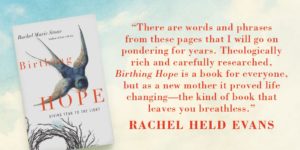
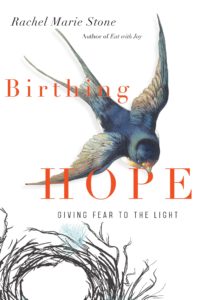 Birthing Hope: Giving Fear to the Light Rachel Marie Stone (IVP) $16.00 I think I am more grateful for this book then nearly anything I’ve read this season and Stone’s well-crafted prose is certainly among the very best writing I’ve encountered in a Christian book in ages. I have promoted this before I spent much time with it by stating the obvious: she is a doula and she works the birthing metaphor beautifully. What a great move, talking about bringing something new to the world by being vulnerable and taking up risk, like parents do. There’s some vivid childbirth stories and plenty of bodily talk about womanly stuff. (I do not buy any assumptions of squeamishness about this attributed to guys; women and men alike may be squeamish and women and men alike will take it all in with wide-eyed wonder. This powerful bit of prose is not a “woman’s book” although surely many will love it.)
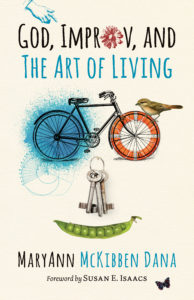 God, Improv, and the Art of Living MaryAnn McKibben Dana (Eerdmans) $21.99 Oh man, this is a fabulous book, well-written, creative, and very interesting. It is a brand new release that I can honestly say – I love saying this! – that there is nothing like it in print! Ms. McKibben Dana is a good storyteller and a fine, fine essayist – her first book was the lively year-long memoir called Sabbath in the Suburbs: One Family’s Experiment with Holy Time – and here she offers a blend of creative reflection on her experiences, some artful self-helpy sort of practical guidance, a bit of allusive theology (she is a Presbyterian USA pastor, a bit progressive and open.) It’s well written, entertaining, and in many ways wise.
 At the heart of this wild book are two big claims that are common sense enough, to my weird ears, anyway, and from which the author extrapolates. First, God wants us to say Yes. And, secondly, that yes, really must be a Yes, And.
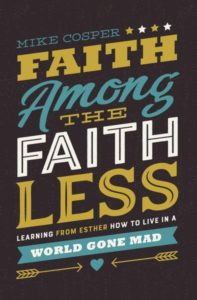 Faith Among the Faithless: Learning From Esther How to Live in a World Gone Mad Mike Cosper (Nelson) $16.99 I have recommended all of Cosper’s books in recent years, from his wonderful book on worship (Rhythms of Grace and the great study of pop culture called The Stories We Tell and the remarkably thoughtful, rich study Recapturing the Wonder.) I list this brand new one now because he is a very fine writer and a very fine thinker and to show that even a Bible commentary can be playful, creative, culturally engaged and full of inspired insight about living well in the very real world.
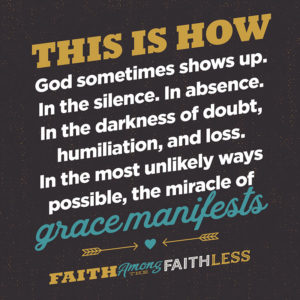 In a fascinating move Cosper says that for those of us looking for faithful presence in the world and uniquely Christian cultural engagement and calls to fidelity amidst our post-Christendom culture, we might find much more sturdy help from the backslidden and compromised Esther and Mordecai rather than the steadfast Daniel. Both are stories set in exile, but Daniel – the hero of so many sermons about cultural transformation — was raised in a firm faith tradition and he knew well the stories of Israel. Alas, it seems (and this is evident in the close reading Cosper gives) our heroes of Esther were far from fidelity, deeply compromised, clearly accommodated to the pagan ethos of the empire of Xerxes et al.
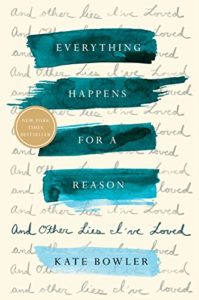 Everything Happens for a Reason And Other Lies I’ve Loved Kate Bowler (Random House) $26.00 I hesitated to list this as I’m sure most BookNotes readers would know of it already; it has garnered so much buzz and been reviewed so well, it is nearly a publishing phenomenon, riding the best-seller list for a while, now. Perhaps in league with the stunning When Breath Becomes Air or Being Mortal it is a book about ultimate things that is exceptionally insightful, beautifully written, raw and wise (and irreverent and funny, too, believe it or not.) With advanced rave reviews from Publishers Weekly and Kirkus, Bowler’s reflection on dying has become a touchstone for many conversations these days.
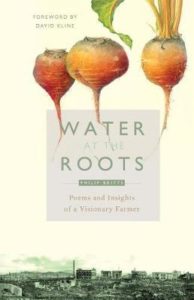 Water at the Roots: Poems and Insights of a Visionary Farmer Philip Britts (Plough Publishing) $16.00 Talk about a handsome book – just the cover and artful design throughout won us over before we even read a page. Happily, the aesthetic quality (most of the book is poetry) is front and center, even though it is a book about agrarianism. That is, very much like Wendell Berry, Philip Britts (1917- 1949) was a poet and a farmer and social activist and a person of faith. He was also a pastor and a bit of a mystic. We are thrilled that our friends at Plough Publishing – the publishing arm of the Bruderhof faith communities – has released these long out-of-print essays, narratives, and poems. And, oh, the poems…
 The graphic design of Water At the Roots is striking. There are some grainy black and white photos that are just perfect. The chapter’s that bring together his few essays, reflections and poems, are Wilderness, Ploughing, Planting, Cultivating, and Harvesting. There is a very good – no, wonderful — forward by David Kline, the famous author who has written important, intelligent books about Amish farming methods and his own organic farm in Ohio. He gets Britts’s worldview, his writing, his early anticipation of the problems of agribusiness, his faith, his stewardship of the mysteries. With Kline setting the stage, you will even more deeply realize that Water at the Roots is an important little book. But first, it is truly lovely, artful book.
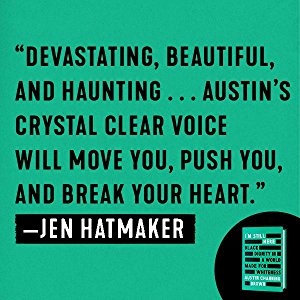
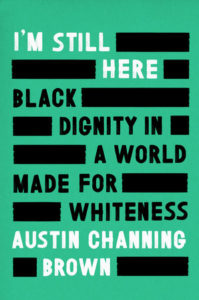 I’m Still Here: Black Dignity in a World Made for Whiteness Austin Channing Brown (Convergent) $25.00 Eloquent, moving, compelling writing about race and racism – like eloquent, moving writing about grief, say – is not uncommon. Something about the worst in life brings out good words, inspired words of rage, lament, insight, grace. That this new book is a smallish hardcover of a certain trim shape immediately brings to mind Ta-Nehisi Coates and Michael Eric Dyson, the decade’s most well-known writing by African American scholars who have worn their broken hearts right on their sleeves and have been catapulted to fame for their eloquence and profundity and wordsmithing. (The trim sized hard-covers that were so very well written and culturally significant to which I refer are, of course, Coates’s Between the World and Me and Dyson’s Tears We Cannot Stop.) It is too early to determine if I’m Still Here will become known as a similarly fervent, well-told story of one black woman’s journey through white America, but it very well might. Christena Cleveland calls it “a stunning debut.”
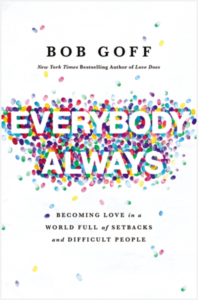 Everybody Always: Becoming Love in a World Full of Setbacks and Difficult People Bob Goff (Nelson) $16.99 We’ve already announced this one; we were very, very happy to describe it here the week it arrived. We knew then that it would be an energetic, upbeat read and we have certainly not been disappointed. There’s a reason it has zoomed to the top of the best-sellers list.
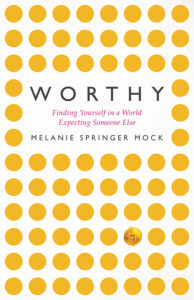 Worthy: Finding Yourself in a World Expecting Someone Else Melanie Springer Mock (Herald Press) $16.99 I was intrigued by the curious cover – see that one little circle that’s different? — and was intrigued by the first line of the excellent foreword by Carolyn Custis James who says “Every once in a while, a book lands on my desk that I wish I had read when I was in college. Worthy is one of those books.”
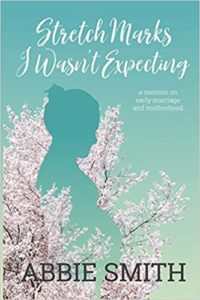 Stretch Marks I Wasn’t Expecting: A Memoir on Early Marriage and Motherhood Abbie Smith (Kalos Press) $15.95 Kalos Press is an small, indie publisher we like a lot; that they do artful, well-written and spiritually sound books like this is the main reason why. We were thrilled to announce this when it came out nearly a half a year ago but we’ve not had the opportunity to tell you about it again… although I’ve been itching to. Stretch Marks… is sort of a memoir, well told and delightfully interesting, but which includes spiritual reflections and Bible explorations. It is about the early years of the author’s marriage and her becoming and being a new mom. And it is so much more; a lot, actually.
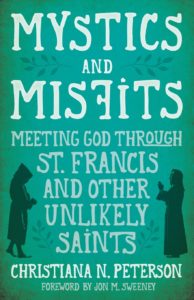 Mystics and Misfits: Meeting God Through St. Francis and Other Unlikely Saints Christiana N. Peterson (Herald Press) $16.99 This is a beautiful book, surprisingly so, even. There are many informative and nicely written books on historic saints and there are plenty on Francis so it is understandable not to jump immediately on yet another. But trust me. This is remarkable.
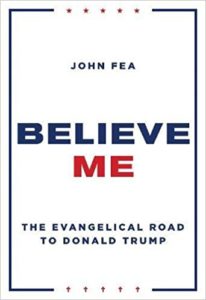 Believe Me: The Evangelical Road to Donald Trump John Fea (Eerdmans) $24.99 // sale price $19.99
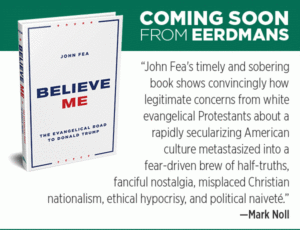 And so, you should pre-order this fine work that is due out in early June 2018. I’ve read the whole thing (and most of it twice.) I will say that his early chapter (“The Evangelical Politics of Fear”) is very helpful. His chapter “The Playbook” shows how the current evangelical worldview was decisively shaped by the rise of the Moral Majority in the 1980s and they continue to work politically out of that same vision. It is a very important overview. His study of why many evangelicals found the Obama years so very troubling is good to understand. One simply cannot fully appreciate what has been happening in some quarters of our land without this understanding of “evangelical fear.”
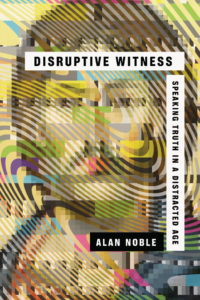 Disruptive Witness: Speaking Truth in a Distracted Age Alan Noble (IVP Books) $16.00 // sale price $12.80
 Alan is feisty and fun and upbeat and, as you can tell from his work at the Christ and Pop Culture site, is very interested in the world of TV and video games and movies and sports and such. He also founded, with Michael Ware, an organization called “Public Faith” and has a lot to say about what Michael Gerson once called “heroic conservativism” and he offers a balanced political witness for the common good. He cares about cultural flourishing and he cares about civic life. In Disruptive Witness he casts a new vision for the evangelical imagination, helping us playfully poke the idols of the age, subverting the ideologies of the time, creating space for fresh conversations. (Do you recall how we raved about Os Guinness’s brilliant Fools Talk: Recovering the Art of Christian Persuasion? If you admired that, you will like this, I’m sure, even though it is a very different book.)
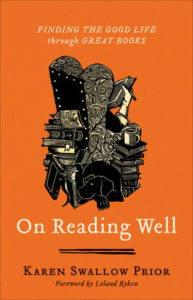 On Reading Well: Finding the Good Life Through Great Books Karen Swallow Prior (Brazos Press) $19.99 // sale price $15.99
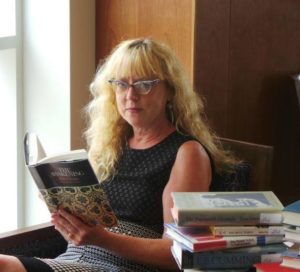 Ms Prior has written for The Washington Post and First Things and the Atlantic. She is a member of something called the Faith Advisory Council of the Humane Society of the United State (like her beloved Wilberforce and Hannah More, she is an advocate for just treatment of animals.) Like John Fea and Alan Noble, above, she is our kind of scholar – thoughtful, deeply Christian, open to fresh ideas about the culture and our times, and able to hold her own in professional and secular venues. We admire her very much.
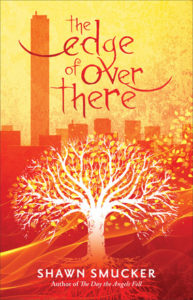 The Edge Of Over There Shawn Smucker (Revell) $17.99 // sale price $14.39
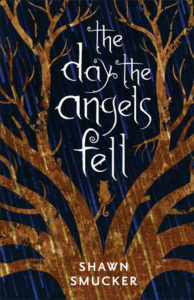 Happily, The Day the Angels Fell won a Christianity Today Best Book of 2017 award in the fiction genre. It has gotten quite a buzz, with some local (trusted) friends telling us that this guy is the real deal. To be honest we were a little late to the game, but we’re glad to have been made aware of how good he is. We’ve not met, so I’m not just puffing a friend here; I am sincere that this is a novel published by a Christian publishing house that deserves to be widely known. It is an adult novel but could be easily read by sophisticated teens. Tons of folks raved about the first one and many have been awaiting this sequel, The Edge of Over There where Abra Miller is summoned (in her search for a Tree of Life) to a portal in New Orleans, and has to contend with others that also want to follow into this gateway to Over There. We’ll have it here at the shop in early July so if you are one of those who have been eagerly anticipating it, on the edge of your seats, even, we can send on out as soon as we get ‘em in stock.
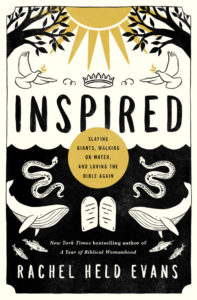 Inspired: Slaying Giants, Walking on Water, and Loving the Bible Again Rachel Held Evans (Thomas Nelson) $16.99 // sale price $13.59
 I wish the publisher had made an advance copy of Inspired: Slaying Giants, Walking on Water, and Loving the Bible Again available, as I can’t imagine what all she covers, how she tells it, or how much actual argument is in the book for a new kind of hermeneutic. I saw a Chaim Potok quote in this twitter shot, which made me happy. I suspect it is mostly storytelling and memoir and will fit well with her other books.She’s a very smart cookie, has studied theology, and done the work of research and scholarship, but also is an entertaining storyteller. She is, I think, an important voice among others who are helping us all navigate faith in a wise and fruitful way here in “secular age” and in the land of Trump.
 over a dozen books about Christianity and art, and several beautiful art books, they have released a few others not directly about the arts – Deeper Magic: The Theology Behind the Writings of C.S. Lewis by Donald T. Williams, for instance, my own Serious Dreams: Big Ideas for the Rest of Your Life and a pair of books on Genesis and on Revelation (The Beginning and The End.) Revealed: A Storybook Bible for Grownups is remarkable. Another recent one from Square Halo that isn’t exactly on the arts (and that we really, really like) is by Tom Becker, called Good Posture: Engaging Current Culture with Ancient Faith. In many ways it is nearly a gentle, fun, manifesto for their publishing program. We highly recommend it and, like all their other books, are happy to stock it here at the shop.
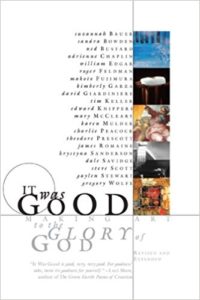 I might suggest, though, that their most important books have been a wonderful pair called It Was Good: Making Art to the Glory of God and It Was Good: Making Music to the Glory of God. Both bring together theorists and practitioners to reflect on some important aspect about the art and practice of doing faith-inspired art. In both, they’ve had contributions from well-known writers (Timothy Keller, Sandra McCracken, Gregory Wolfe, Makoto Fujimura) and many who are not known outside of their particular field of expertise but are excellent in what they do. To curate such edited volumes has been both a challenge and a joy for Ned as it is no small matter finding artists and musicians who are theologically mature, good at their craft, who have been intentional about thinking about how they integrate faith and art, and who can actually describe and write about their own particular
 experiences in the arts. Some painters or musicians do their work very, very well, but are not particularly adept at talking about it, let alone writing a chapter inviting others to learn or take inspiration from them. And, sadly, as with the books integrating Christian thinking about other professions, there just isn’t the demand for these kinds of books that there should be. As you can imagine, It Was Good volume one and volume two were both labors of love, and both are, thankfully, absolutely must-have resources for anyone remotely interested in the creative arts. Alongside a handful of others, they are modern-day classics in the genre of theologically informed aesthetic vision that can inform our own appreciation of the arts.
 The brand new It Was Good: Performing Arts to the Glory of God is unlike any other book on the market so it would be a great gift for anyone you know who is in, or aspires to be in, the world of the performing arts.

 Square Halo Books is to be commended putting out these good books. Kudos to Mr. Bustard for the behind-the-scenes work of nurturing relationships with so many artists in so many fields from so many venues which has borne fruit in this series of three It Was Good books. The bibliography in the back of this new one is thorough, but not exhausting, listing only the very best faithful scholars (of the likes of Jeremy Begbie, Calvin Seerveld, Madeline L’Engle, Cameron Anderson, Steve Turner, Sandra Bowden, William Edgar, Dorothy Sayers, and the like.) making it an ideal reference tool.
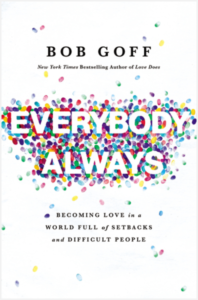 Everybody Always: Becoming Love in a World Setbacks and Difficulty People Bob Goff (Nelson) $16.99 I can’t wait to read this brand new release by one of my favorite people and one of heckuva fun writer. Goff is a great storyteller and, man, does he have a lot to talk about – his work fighting international slavery, reforming laws in Uganda or his well known efforts forming schools (even in war zones in Somalia and Iraq) make for great testimony. So this is going to be great. He is a lawyer, motivational guy, and great dad and husband and friend to people all over the world. Did I mention the Somalia and Iraq thing? He’s full of good humor and seems to be fearless. The book is going to be great.
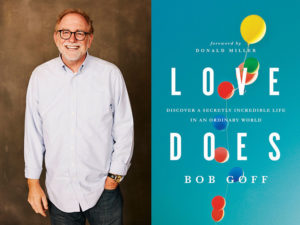 If you haven’t read his first collection of wild pieces, or the very good book by his wife and partner Sweet Maria, by the way, called Love Lives Here: Finding What You Need in a World Telling You What You Want (B+H; $17.99) you certainly should and I’m confident that you’ll enjoy them and will be pressing them into the hands of anybody you know who likes to read. The word of mouth buzz on Love Does has been one of the coolest things we’ve seen in our years of bookselling; everywhere we go people know this book. (And, happily, Love Does and Love Lives Here are the sort of books that can hook even though who don’t typically read much.) I also recommend his Love Does DVD curriculum ($29.99) which is a fun five-week course with Bob doing his Bob thing, leaking Jesus over everybody and somehow both reassuring and challenging and equipping us.
 The Character of Virtue: Letters to a Godson Stanley Hauerwas (Eerdmans) $21.00 There are many who know that Dr. Hauerwas, Professor Emeritus of Divinity and Law at Duke University, is one of the most important living theologians today, a deep philosopher, a colorful speaker, and a vibrant and robust proponent of character formation by submitting to Christian practices within the church. That is, the church shapes and forms us to be God’s people in the world that, if we are following Jesus, at least, is going to be controversial and counter-cultural. He has written bunches of books, some quite scholarly, and is known all over the globe.
 The Path Between Us: An Enneagram Journey to Healthy Relationships Suzanne Stabile (IVP) $24.00 and The Path Between Us Study Guide (IVP; $9.00)There are a lot of diagnostic tools to help us understand ourselves and others, from Meyers-Briggs to Love Languages and more. Learning about the nine Enneagram types has been incredibly popular this last year or two with several good books recently released. Customer keep telling us how much these books mean to them and how they’ve enjoyed these insights. Among our favs of recent titles include The Sacred Enneagram: Finding Your Unique Path to Spiritual Growth by Christopher Heuertz (Zondervan; $18.99) and Mirror for the Soul: A Christian Guide to the Enneagram by Alice Fryling (IVP; $16.00.) But Suzanne Stabile’s first major book, co-authored by the always great and so interesting Episcopal priest Ian Cron, The Road Back to You: An Enneagram Journey to Self-Discovery (IVP; $24.00) has been by far the biggest seller and most discussed Enneagram book in years. This is, in part, I think, because it is so lively and fun and also because Stabile and Cron have had tremendously popular podcasts. It’s a great book.
 Selfies: Searching for the Image of God in a Digital Age Craig Detweiler (Brazos Press) $19.99 I love the writing and work of Craig Detweiler who has been one of the leading voices offering a thoughtful evangelical voice in the studies of popular culture, the modern zeitgeist, and faithful ways to navigate the world of entertainment, digital culture, video games, movies, and such. We take his book iGods: How Technology Shapes Our Spiritual and Social Lives almost everywhere we go, hoping that it will inspire folks to attend more deeply about the very water we swim in, to discern a bit about the times, being better equipped to follow Jesus’ command to be “in but not of” the world. Detweiler does his good work, linking theology and Christian perspectives with social and cultural and historical analysis, so I trust him a lot. I was delighted to learn that he just recently took a new position as the president of The Seattle School of Theology & Psychology, a graduate school founded by our friend Dan Allender. What a good gift he will be to them.
 One Blood: Parting Words to the Church on Race John M. Perkins (Moody Press) $15.99 This is a handsome linen hardback, sans dust jacket, with nice red endpapers and it seems to have some gravitas to it. It is said that this is Dr. Perkins’s last book. I don’t know about that but I am sure that any time this African American leader writes something, many people should buy it, pass it around, share his work widely, and make your friends and churches know how important it is. If this is aid to be his “parting words” you should pay attention. There is a lot packed in here and he speaks plainly. In fact, he asks for our willingness to listen since he is an elder and doesn’t have time to mince words.
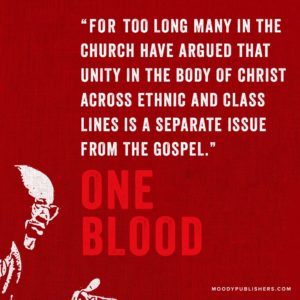
 Jon Foreman of the band Switchfoot wrote a great afterword for One Blood and it offers a great reminder of the need too keep fighting the good fight, in the power of love. Throughout the book there are some other pastors who have chimed in, offering glimpses into how some churches have embodied and lived out this message Perkin’s brings. There are some prayers, some verses to look up, some thought-provoking questions, so it’s ideal, especially to give to rising leaders or younger folks.
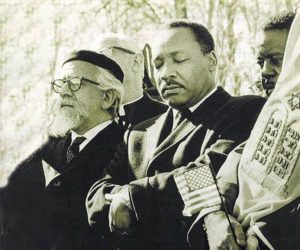 Granted, King himself had his own besetting sins and foibles. (The scene in the must-see film Selma when King calls gospel singer Mahalia Jackson late at night to sing to him his favorite hymn because he was so scared is based on a true incident.) He and his associates, like all of us, had feet of clay. Yet, America hasn’t in years seen the likes of public theologians such as those that marched with King – just think of the Jewish leader Abraham Heschel, black Baptist preacher and King’s Lieutenant Ralph Abernathy, or the Presbyterian William Sloane Coffin, converted to public justice issues after a stint in the CIA. These were leaders that were well read, deeply conversant in the best American political theory, and profoundly committed to thoughtful engagement with Scripture.
 I want to cry out when I hear ministers (of any race) and public officials (of any party) quoting King as if they know something about him or care about his social agenda when it is evident they do not. (Mike Huckabee scolded Black Lives Matters activists saying King wouldn’t have approved when that was not self-evident. How dare he suggest he cares what King thought when in so many ways he obviously does not?) I sometimes wonder how many people who cite him have read even a single of his many books?
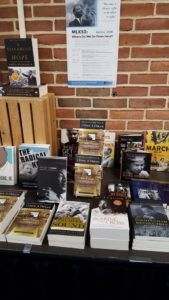 A good place to determine if we want to align ourselves with Dr. King’s vision is to read books by and about him.
 The King Years: Historic Moments in the Civil Rights Movement Taylor Branch (Simon & Schuster) $16.00 Taylor Branch is widely respected for his massive, magisterial three-volume history of “American in the King Years.” This one is a smaller, vivid, accessible summary of the bigger set and offers helpful background and texture to King’s work. The best way to learn the most important episodes of the civil rights movement; highly recommended even though they are not all about Dr. King.
 March Book One, March Book Two, March Book Three John Lewis, Andrew Aydin and Mate Powell (Top Shelf Productions) $14.95, $19.95, $19.95 I hope you know these excellently done, slightly oversized graphic novels that tell the biography of this grand civil rights leader who worked closely with King. Congressman Lewis, as you may know, is the only living main stage speaker from the famous March on Washington and, of course, was a leader at Selma and beyond. While not only about King, it is a great way into these stories and that era, especially for those who appreciate comic books and graphic novels.
 Martin Luther King Jr. for Armchair Theologians Rufus Burrow (Westminster John Knox) $18.00 I hope you know these “Armchair Theologians” books — they really are very interesting, complete with a few helpful cartoons. They aren’t really whimsical, but they are designed to study serious stuff about various theologians and their intellectual influences. There are bunches of them (on Luther, Bonhoeffer, Augustine, Calvin, Wesley, Aquinas, and more.) This one is solid, interesting, helpful, fun. You will learn a lot, I’m sure.
 Martin Luther King: The Inconvenient Hero Vincent Harding (Orbis) $16.00 I have long admired the colorful Harding, a storyteller of the first order, a passionate and decent leader of the movement. (His There Is a River is another classic in the literature of the black struggle for freedom in America.) He knows the stories, he knows why we must keep telling them, and he offers here a hard reminder of what King stood for.
 Gospel of Freedom: Martin Luther King Jr.’s Letter from a Birmingham Jail and the Struggle That Changed a Nation Jonathan Rieder (Bloomsbury) $16.00 King’s short letter written from a jail cell to moderate, sympathetic clergy, remains one of the classics of American literature; the rhetoric and eloquence of it is nothing short of brilliant. Professor Rieder explores the setting and the implications of this period of King’s life. It is widely considered a major contribution and was highly reviewed when it came out a few years ago.
 I Have A Dream: Sermons and Writings That Changed the World Martin Luther King, Jr. (Harper) $15.99 There are bigger anthologies (such as the large A Testament of Hope) but this is the best, most economical one-volume collection of his most important writings.
 The Radical King edited by Cornel West (Beacon Press) $16.00 The contemporary philosopher, activist, and public intellectual selects and introduces various letters, speeches, and essays of King’s that best illustrate his radical social vision. I hope you know West and his several books (including a recently re-issued Race Matters.) He has done us a great service to offer this particularly curated selection and a few explanatory notes about each reading. We have good studies of “the domestication” of King; this one allows you to read his words for yourself.
 The Heavens Might Crack: The Death and Legacy of Martin Luther King, Jr. Jason Sokol (Basic Books) $32.00 This new hardback is great social history, reminding us well what King was up to his last year, what happened in the immediate aftermath of his murder (where would the funeral be held, how would they move the body, who would attend, why didn’t President Johnson show?) and how the subsequent riots effected the nation. This is a riveting read, highly recommended.
 Reflections by Rosa Parks: The Quiet Strength and Faith of a Woman Who Changed a Nation Rosa Parks (Zondervan) $ This fabulous book used to be out as Quiet Strength and it is great to see it again with this excellent cover and nice, hand-sized, square, gift-book format. This is inspiring, of course, and is a fine way to learn a bit about the early days of the Montgomery Bus Boycott and also to hear about the classic faith of many of Kings friends and influences. Love it!
 A White Preacher’s Message on Race and Reconciliation Based on His Experiences Beginning with the Montgomery Bus Boycott Rev. Robert Graetz (NewSouth Books) $26.95 Graetz was in 1955 when the Montgomery Bus Boycott began, a young white Lutheran pastor of a mostly black church. He has learned quite a lot over the years and some of our friends in the CCO have gone on civil rights tours with him. This is a rare and very special contribution, nicely done. There is a forward by John Lewis.
 Called to the Fire: A Witness for God in Mississippi: The Story of Dr. Charles Johnson Chet Bush (Abingdon Press) $21.99 There are so many books like this, quiet, moving, informative stories that you may have never heard, lesser-known saints who served God despite all. This moving tale tells of Dr. Charles Johnson who was the key African American witness to take the stand in the trial famously dubbed the “Mississippi Burning” case by the FBI. Dr. Johnson was a young preacher fresh out of Bible College and became a voice for justice and equality in the segregated south. As the publisher says:
 I’m glad we sang in our church “Christ Is Alive,” #246 in Glory to God, the PC(USA) Hymnal, which was written for Easter Sunday, 1968, by United Reformed Church minister and hymn-writer Brian Wren. It was penned for that hard late-60s Easter a few days following the assassination of Rev. Dr. Martin Luther King. It sings of the historical reality of the resurrection of Christ and, perhaps like Wesley’s famous “Christ the Lord is Risen Today” speaks of Christ alive now, alive in the present tense.
 I haven’t followed much of a serious Lenten practice this year and I regret not being more disciplined or focused. But what I did do was listen almost exclusively to the latest album by Bill Mallonee,
 The Day the Revolution Began: Reconsidering the Meaning of Jesus’ Crucifixion N.T. Wright (HarperOne) $18.99 This is the one I raved about
 Surprised by Hope: Rethinking Heaven, the Resurrection, and the Mission of the Church N.T. Wright (HarperOne) $15.99 Many have said that this book is their favorite of Wright’s and its orthodox commitments and its innovative argument for creation regained is eye-opening and life-changing. We are so glad this is now out in paperback and hope it is widely used in study groups and book clubs. I assume most BookNotes readers know of its importance, especially in showing the grand vision of the restoration of the cosmos prefigured in the bodily resurrection. The implications are vast and he points us in the right direction, in much detail, with much vigor.. Now it is available for the first time in a more affordable paperback. Thanks to God.
 First, there is the short, lovely, wise, and useful little book called Living in the Resurrection: The Risen Christ in Everyday Life by Eugene Peterson (NavPress; $17.99.) This is my favorite book on what we call the “post-resurrection appearances” of Jesus, which includes a chapter called “Resurrection Wonder”, another called “Resurrection Meals” and a third called “Resurrection Friends.” Each is a reflection of Biblical text and he naturally draws out a particular spiritual practice from each. He shows how every day can be a Resurrection Day as we encounter the risen Christ and a formed in His ways by his presence among us.
 Grateful: The Transformative Power of Giving Thanks Diana Butler Bass (HarperOne) $26.99 I have written often about Diana Butler Bass, a fine scholar of religion, a student of and reporter about healthy congregational life, and a memoirist whose book about being formed by various Episcopal churches (Strength for the Journey: A Pilgrimage of Faith in Community) has recently been updated and re-issued.

 So, Diana Butler Bass has done a deep dive, as they say, into the nature of and value of gratitude. I am as eager as any to read this and admit that I need it more than most. I am glad she is a serious social critic and cares about not only individual happiness and personal meaning and resilience and such, but radical social reform and cultural renewal. In fact – surprise! – this is one of the great fruits of being people of gratitude; it is, she says, “what we most need now.” In Butler’s hands, I am sure, this virtue is not recommended as a sentimental or cheap pick-me-up by looking on the bright side. It is a profound spiritual practice that can be transforming and renewing and will help — if practiced — alter the politics of our time. In this regard, it is subversive.
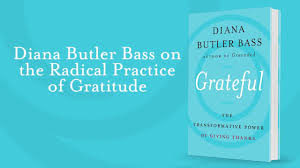
 Growing in God’s Love: A Story Bible Elizabeth F. Caldwell and Carol A. Wertheim (Westminster John Knox) $25.00 I have been wanting to describe this marvelous new children’s Bible for a while now and it never seemed to fit our Book Notes schedule and I now realize I want to shout about it here – it is very thoughtfully done, a rare and intentionally created storybook Bible done by very highly-respected Presbyterian educators. But a longer more serious review will have to wait as I’ve got so much to say about it.
 Prayers for Young Children Martina Steinkuehler, illustrated by Barbara Nascimbeni (Eerdmans) $16.50 We have really liked Steinhuhler’s illustrations in the excellent Images of God for Your Children so was glad to see her slightly modern, just a little choppy artwork to bring interest and color to these marvelous re-telling of Biblical prayers. The prayers are not sentimental or dumbed-down; there is an index showing the Biblical allusions in each of the nearly 80 pages.
 God’s Very Good Idea: A True Story About God’s Delightfully Different Family Trillia Newbell, illustrated by Catalina Echeverri (The Good Book Company) $14.99 We announced this here last fall and thought I’d just copy my review here, again: I think I will name this as our top children’s book of the year, or very near the top. It’s just stunning in how interesting it is, how it relates the simple gospel to remarkable implications, and how it gets the full-orbed vision of the Kingdom of God being that redemptive force which rescues and renews the very creation. We sometimes talk about creation-fall-redemption and this book gets it! God’s very good idea was a good and safe and colorful creation and God is not giving up on God’s good idea. Jesus will come –as the big story of the whole Bible shows in it’s unfolding drama – to save the lost and redeem the creation, which includes a restoration of the (get this!) ethnic and personality and gender diversity of the original creation.
 The Garden The Curtain and the Cross: The True Story of Why Jesus Died and Rose Again Carl Laferton illustrated by Catalina Echeverri (The Good Book Company) $14.99 The playfully excellent Cataline Echeverri did the artwork on this one, too, and fits nicely to offer this overview of the big Biblical story – a good garden, a sinful mess, a savior who comes as a serving King, and that great episode of the curtain in the temple torn. God’s redemptive vision of reconciliation and restoration in Christ’s death and resurrection is shown here in a way that is better than almost any children’s book I know – so well done, so creatively offered, so insightfully wise about capturing Christ’s work in the context of the bigger Scriptural framework of promise and deliverance. Do you want kids to be a part of this grand story to be invited in? This is a very useful resource and very cool at that.
 Not Especially Special Katie Savage illustrated by Emily Henebrey (Katie Savage) $16.99 This is brand new and I bet you haven’t heard of it yet. But you just might because this book is so good it is only a matter of time until it gets known and widely loved. We so appreciated Katie Savage’s previous book, a wonderfully realized set of thoughtful reflections, sort of a memoir about her finding God in ordinary life called Grace in the Maybe: Instructions on Not Knowing Everything about God (Howard Books; $15.99) that when we heard she was doing a children’s book we just had to see what it would be like. It is, as we expected, very impressive, a fun and winsome story well told, with a lovely message of God’s love for everyone, for the specialness we all have, despite our various callings and gifts.
 When God Made Light Matthew Paul Turner illustrated by David Catrow (Waterbrook) $11.99 Turner became know a decade ago as a sassy and funny voice for an emerging generation of open-minded, post-evangelical leaders. I think he wrote for the likes of Relevant and wrote some fun books poking at the silly, insular stylings of in-house evangelicalism. One had to like his boldness and his wit. I’m a fan.
 Herodotus the Hedgehog Jen-Luc Buquet (Eerdmans) $17.00 Eerdmans Books for Young Readers brings to North America a lot of books from overseas and they are often exceptionally creative, curious, eccentric even. They do solid Biblical and theological stories and then they do stories with good moral messages about kindness or justice or creativity and such. And then do remarkable books like Herodotus the Hedgehog.
 The NIV Action Study Bible (David C. Cook) $12.99 This uses some of the art of the graphic novel/comic book stylings of the Action Bible and puts it with the full text of the NIV. If I had this Bible as a boy, I’m telling ya, man… well. Who knows? I do think this will appeal to many, from little ones who like comics to even older ones who like graphic novels and action-adventure stories. There are nice sidebars and introductions to each book and some info graphics but the heart of this Bible are the many Action Bible illustrations. Three cheers!
 Reformation ABCs: The People, Places, and Things of the Reformation – from A to Z Stephen Nichols, illustrated by Ned Bustard (Crossway) $16.99 This came out just one year ago and since we are now in the middle of the extraordinary 500th anniversary of the start of the Protestant reformation (how often does a culture commemorate a 500th anniversary of anything!?) I figured we should run this again, from last year’s Easter Basket Suggestions post.
 Nichols and Bustard teamed up before in a truly wonderful The Church History ABCs (Crossway Books; $16.99) which came out a few years ago as a slightly oversized hardback, counting down all kinds of good stuff from church history as an ABC book. Like some ABC books, it works on two levels — yes, for young ones learning to play with letters and learn various words across the alphabet. But these sorts of books can be deceiving — there is a lot of content, and will be sure to inform and even delight anyone with a bit of interest in history. I bet you will learn something!
 All the Tales from the Ark Avril Towlands (Lion Press) $9.99 In the mid- 1990s there were a set of three books that were very popular, first in England, and then in the US; these tales about Mr. and Mrs. Noah managing a menagerie were fabulously entertaining, curious stories that told the imagined stories of what different animals experienced on the ark. This new edition offers over 400 pages of these great stories in one hand-sized paperback. And what stories they are – what fun! This isn’t a picture book and although you could read it out loud as a family even for little children, the reading level itself is probably about a third grade level.
 The Day God Made Church: A Child’s First Book About Pentecost Rebekah McLeod Hutto, illustrated by Stephanie Hig (Paraclete) $15.99 Again, I’ve recommended this here before and we display it at churchy events and folks love it. There is very little on the Pentecost story and this is one which – in really colorful design and creative text — captures the mystery and importance of this day which many consider “the birthday of the church.” This very colorful paperback uses powerful storytelling and healthy Biblical education and a stimulating, creative picture book helping us learn to celebrate a day in the church calendar that is sometimes overlooked. Pentecost is 50 days after Easter so this is great to give now. It is stunning.

 Why Should the Devil Have All the God Music? Larry Norman and the Perils of Christian Rock is a fabulously interesting book and, like the best rock and roll biographies – among my personal favorites include Testimony by Robbie Robertson of The Band and the splendid Fire and Rain: The Beatles, Simon & Garfunkel, James Taylor, CSNY, and the Lost Story of 1970 and the must-read Beatle’s study by Larry Norman’s friend, Steve Turner, called Beatles ’66: The Revolutionary Year – it includes lots of stuff about music and song lyrics and production of albums and rock tour stories, but also fair amount of fun celebrity gossip and, thank goodness, some social and cultural and religious commentary. How can one reflect on an artist who hung out with The Jefferson Airplane and opened for Jimi Hendrix and chatted with Paul McCartney and sang about racism and poverty and against the rootlessness of a materialistic generation not explain a bit about the ethos of the 1960s? Norman came of age, and gave voice to Christian faith amidst the California counter-culture; his art was a loud and often-controversial critique of bad religion and boring church and it stood (at least in the early days) as part of the broader zeitgeist which critiqued the bankrupt values of the American dream and the sins of the American empire.
 who feared the riots and the KKK and the guns of the Panthers and the Symbionese Liberation Army, those of us who participated in early Earth Day activities, who marched against the war, who wept at the napalm used in Viet Nam, who grew cynical from Watergate and wondered why our churches seemed less interested in these hugely ethical and spiritual matters in our culture than they should have been, found in Larry’s music a Christian who seemed to understand us. Yes, those of us who listened to Dylan and Simon and Garfunkle and yelled out the chorus of “Four Dead in Ohio” as a lament, we needed the Jesus-drenched lines of Norman, too, and I wished the deep, deep pathos of that longing for relevant Jesus rock came through more in this book. In those days, Larry was the closest thing we had and thinking about it still conjures for me dread and joy and passion and frustration and hope.
 Less grandiose and perhaps more fun, if you’ve ever enjoyed cool Christian rock – think Mark Heard or Keaggy or Charlie Peacock or the 77s or Sam Phillips or the best work of Amy Grant or VOL or POD or Gungor or Lecrae or Switchfoot or Sara Groves or Jennifer Knapp or Crowder – you know that you owe it to yourself to learn a bit more about the grand-daddy of all this.
 It is a true biography and less a study of the movement that Larry Norman was a part of, but it explores and reflects on much that is important, that was generative and influential; I believe it would have been an even stronger book if Thornbury had cited seminal works about the way in which rock music had within it the tensions of art and commercialism. If he had explored and reflected more on the meaning and social implications of the details he shares – fascinating ones like how Pat Boone funded early Norman records and how Norman protégé Randy Stonehill had legal battles with producers in England and why agents and DJs and critics – not to mention fans – loved Norman but his record sales were marginal and why we ended up with Christian bookstores that carried gospel music in a way Tower Records didn’t, and so forth. And why-oh-why Christian followers, especially, were confused (and some, outraged) by his less overtly religious recordings (see the great chapter on So Long Ago in the Garden, for instance.) The promo for the book notes that this previously untold story is set “at the dawn of the culture wars” and that is a helpful reminder of the big picture this is about.
 Fortunately, geeky Greg Thornbury (now serving at the New York Academy of Art) is very aware of these aesthetic and cultural concerns and has spent years ruminating and writing on them – what does it mean to be “in the world but not of it”? How do Christians serve as “salt and light” within the arts and popular culture? What is the role of God’s people to shape and influence cultural trends? How should we think about these things well? Although I may have wished for a bit more direct comment about all this, it is there between the lines, and in some of the footnotes, making Thornbury a very, very appropriate and helpful teller of this big tale. And what a tale it is.
 And he was, indeed, important, as Thornbury helps us appreciate. Billboard called Norman “the most important songwriter since Paul Simon.” The Huffington Post published an article dubbing him “The Most Amazing Artist You’ve Never Heard Of.” The Library of Congress’ National Recording Registry has honored his album Only Visiting This Planet as a “cultural, artistic, and/or historical treasure.”
 band People! played at the first big Be-In in Haight Asbury with Janis Joplin and the Dead and the beat poet Alan Ginsberg) and nicely notes some of the stars he hung out with and perhaps influenced – some say that The Who’s Tommy was somewhat inspired by Norman’s own work in developing rock operas, even as he crossed paths with the guy who played Jesus in Jesus Christ Superstar. He chatted with Neil Young and Stephen Stills in their Buffalo Springfield days; years later he played on the White House lawn for Jimmy Carter.
 and the fans that did or didn’t like him. I think much of the tone and texture of casual, non-fundamentalist, but still fiery evangelical outreach among youth in the 70s helped shape the nature of evangelicalism today. Of course some of his songs were in the influential Young Life songbooks that so many used at church camps and youth ministry events and the rise of para-church ministries (even like the CCO) took shape with long-hair and bell bottoms and Good News Bibles and Bible studies while sitting in circles on the lawn like hippies. That there is a sizable non-fundamentalist, culturally-savvy, socially relevant, and yet deeply orthodox Christian movement among baby boomers and their offspring comes in some ways from this legacy of the Jesus Movement days.
 It’s a long story but we have copies of two important, rowdy Mark Heard albums from the early 1980s, Stop the Dominoes and Victims of the Age. Tell us which one you want, absolutely free. You can listen to it while reading Why Should the Devil Have All the God Music? Larry Norman and the Perils of Christian Rock by Gregory Alan Thornbury.