Here we go again: 13 Great Books ON SALE at 30% off — for THREE DAYS ONLY

Okay, that was fun.

The BookNotes 30% off post-Jubilee clearance sale, that is. Some good folks send us the most moving notes thanking us for the sermon about “all of life redeemed” and living into the big story of God’s people being used to bring restoration and healing to all of life. And our exuberant description of the CCO’s Jubilee conference, the need for serious reading so we can learn to walk in the new Kingdom way of the Lord in our time; we have some thinking to do and books matter. We’re glad you encouraged us to keep inviting folks to be readers.

The sale brought us some extra business this week and we are glad; that’s the cash-flow businessy thing that we sometimes don’t pay enough attention to. We love authors and books, but try not to worry about “the books” and, alas, end up needing to drum up some extra customer attention sometimes.

We’re glad for those who are loyal to us and who allow us to offer a story about books and reading and to regularly suggest a selection of stimulating authors; we so appreciate those who seem to think we help them in their journey. They read BookNotes and send us orders as they get a hankering. They get their churches or organizations or moms and dads to order from us, and we are grateful.

We are equally glad for those that are only able to send us nice notes – it truly helps – or those that are waiting for those larger discounts and bigger savings from time to time. We are glad for those occasional customers, too, and understand that we all need some extra savings sometimes. Thank you for your orders this last week, especially.

Since it was fun keeping our mail-out specialist extra busy – Diana packs your books with immense care and good cheer — let’s just do it again.

Without too much bluster or detail, let me commend these vital books, all, for a very limited time, at 30% off.

BUY ANY TWO, GET 30% OFF

Here’s the deal: to get the 30% off, you have to order more than one from the list. Buy two or more of the books shown and get 30% off. Otherwise it’s a complimentary 10% off.

So here’s round two: OUR NEW THREE-DAY SALE while supplies last. This offer expires midnight Sunday March 11, 2018. You’ve got Friday, Saturday, and Sunday for the deep discount deal and then it’s back to 10% off for any of these.

Use the secure order form link below, which will take you to our secure order form page. Just tell us what you want and we’ll confirm via email, doing the discount, sending by USPS. We usually send the cheapest manner, but you can instruct us otherwise — whatever you prefer, just tell us. 

Jesus, Bread, and Chocolate: Crafting a Hand-Made Faith in a Mass Market World John J. Thompson (Zondervan) $15.99  Maybe you recall my vary lively review of this when I described it here at BookNotes in great detail, saying how much fun it was and how very right he is about so much. It is a book about Christian discipleship and whole-life faith formation, but, more obviously, it is a well- written book with chapters about bread baking, beer making, good quality chocolate, and “the best coffee I ever had.” Yep, it is about artisanal culture, from indie music to the DIY “maker” scene. A bunch of the Jubilee students love it, and pass it out to their peers.

There are chapters with titles like “Time Began in a Garden” and “Seeking God’s Table.” He admonishes us not only to enjoy life, to make something of the stuff around us – shades of Andy Crouch’s Culture Making, there – but to also “help someone less fortunate craft their own story.” There’s a few big-picture pieces about “Civilization, Reformation, Discernment and Beer” and some really interesting stories about his own journey in the thoughtfully, underground corners of contemporary Christian music. It covers a lot of ground and tells some lovely stories.

All of this lush description about real, analog life, this call to “hand-crafted” faith, is a colorful, aesthetically-rich invitation to resist the mass marketed nature of modern living and, interestingly, the overly mass-marketed approach to Christian living, spirituality and discipleship, as well. There’s something here for everyone and it’s a blast to read. And, without being heavy handed, it offers up some very important stuff about incarnation, individuality, good taste, and embodied spirituality.  Cheers!

Reconstructing The Gospel: Finding Freedom from Slaveholder Religion Jonathan Wilson-Hartgrove (IVP) $20.00v I have read all the other books that Jonathan Wilson-Hartgrove has written and he is a thoughtful theologian, serious activist, great storyteller, and a very good author. You may know that, somewhat like his friend Shane Claiborne, he grew up fundamentalist, went to Eastern University and with the help of thoughtful evangelicals there grew into a faith that is Biblically orthodox, prayerful, and deeply committed to a rule of life that includes community living, nurturing a sense of place, serving others, standing with the marginalized and oppressed, and worshiping humbly amongst a diverse family of believers. He has told much of his own story in several other books, all which I recommend heartily.

This new one just arrived and although I had the chance to dip in to an advanced copy, I can’t say I’ve studied it carefully. It deserves our full attention and I promise I will be reading it carefully. It has a coveted starred review from Publisher’s Weekly and there is an important forward by The Reverend Dr. William J. Barber II.

Jonathan, who was raised in the Bible Belt, says, “I’m a man torn in two. And the gospel I inherited is divided.”

He links his own reconstruction to the era of Reconstruction after the Civil War, and wonders about the sort of racial blindness that held sway – and still does – particularly in the American southland.

Drew Hart, author of the powerful The Trouble I’ve Seen says:

Reconstructing the Gospel is an honest reckoning with the mangled, slaveholding religion that continues to pass for the gospel in the United States. It is not self-righteous or accusatory. Instead, Jonathan vulnerably grapples with his own ongoing repentance of white supremacy’s powerful grip. Ultimately, this book is an invitation into the river that has been flowing for centuries in this land, providing a past and present counterwitness to the vandalization of Jesus’ name.

Raising White Kids: Bringing Up Children in a Racially Unjust America Jennifer Harvey (Abingdon Press) $22.99  This is a book many of us have been waiting for. Let me be brief and to the point: few books of which we are familiar are at once this theologically astute, radical in their approach to racial justice, and yet practical as a handbook for parents who need help raising their children. Professor Harvey has been writing about racial justice for decades (and most recently did the heavy, prophetic, Dear White Christians published by Eerdmans.) She is an ordained minister in the American Baptist Church.

Jennifer Harvey’s book has been called “brilliant” and “astonishing” and “required reading.” As Saira Rao, co-founder of In This Together Media says, “If you’re white and have a kid (or have ever been a kid), please read this book.”

Listen to Diana Butler Bass:

Jennifer Harvey’s brilliant work and passion for racial justice come alive on every page. Raising White Kids is a theory-rich, practical guide with wonderfully helpful examples that will equip parents to navigate today’s racial challenges with confidence and grace. For the millions of mothers and fathers who are deeply invested in creating a better tomorrow in an increasingly multi-cultural America, Harvey’s book couldn’t be more helpful or more needed right now.

There is a great endorsement on the back from Debby Irving, author of the very, very impressive Waking Up White, and Finding Myself in the Story of Race and she writes:

Raising White Kids is both an antidote to the racial ignorance and fear most white families unknowingly pass along to their young and a powerful way to call white adults into the process of racial awakening in the name of creating more just and functional communities for all. Buy this book for yourself, for your children’s teachers, and for all parents and grandparents of white children you know.

Kudos to Abingdon Press for doing some good books on race relations in the last year or two. This one is going to be discussed and used for a long time.

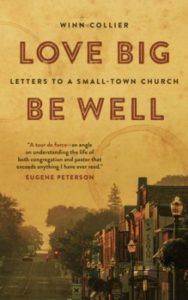
Love Big Be Well: Letters to a Small Town Church Winn Collier (Eerdmans) $16.99  We named this as one of the very best books of 2017 and celebrated it as my favorite novel of that year, too. It is a novel, a series of letters from a quiet but eloquent, down-to-Earth but very smart pastor of a cranky, lovely, fascinating, small-town, small church. I love the way pastor Eugene Peterson calls it “a tour de force” and continues:

…an angle on understanding the life of both congregation and pastor that exceeds anything I have ever read.

This is literate, enjoyable, funny, thought provoking, a story that will entertain and inspire any body who loves the church. Or those who don’t. This is a great little book, highly recommended.

Shalom Sistas: Living Wholeheartedly in a Brokenhearted World Osheta Moore, with a foreword by Sarah Bessey (Herald Press) $16.99  Osheta Moore is a great writer, an upbeat, passionate, contemporary black woman with a voice that is unforgettable. Her bio says that her work has been featured at Sojourners and SheLoves Magazine, A Deeper Story, The Art of Simple, ReKnew, and Rachel Held Evans’ blog. Men and women both have endorsed this upbeat book – Dennis Edwards says it is “Practical, engaged, theologically informed, poignant, and witty.” Christina Cleveland says that Moore has “a gift for blazing a path toward liberation, hope, and purpose.”  Maybe you saw her piece this fall in The Christian Century.

I was first struck that this Mennonite publisher was doing a book that got a starred review in Publisher’s Weekly which said, in part, “Fans of Anne Lamott and Nadia Bolz-Weber will be delighted with this new, exciting voice.”

We want to get her book out there so we’re adding it to this list of deeply discounted titles – it is fun and creative and just really good writing. Much is about justice and peace, race and inclusion, but there is stuff that is not only funny but also about humor and laughter. She loves Doctor Who. She quotes the elegant Barbara Brown Taylor and the powerful Ta-Nehisi Coates and the Biblically-solid N.T. Wright. It isn’t too many books – by black authors, no less – that start off with a major epigram from Sally Lloyd’s Jones’s The Jesus Storybook Bible and then cites Walt Brueggemans’s old UCC book on peace, Living Towards a Vision. This is strong, powerful stuff on peace and goodness and – although she lost me here – there’s a few pages of Sista Recipes. I’d have rather had a playlist, but there ya have it. Shalom Sistas. Gives new meaning to wholehearted!

New Worshipping Communities: A Theological Exploration Vera White & Charles Wiley (WJK) $20.00 This slim book deserves a bigger review later, but I have to list it here for a few quick reasons. It is a book that documents the theology of and the stories about the recent effort within the PC(USA) (that’s the mainline Presbyterians) to plant 1001 new congregations. That they call them “new worshipping communities” may bring to mind the Fresh Expressions movement and certainly indicates a missional vision, not just conventional church planting. Friends at Pittsburgh Theological Seminary have been a part of this and some of this book came out of a convocation that met there to draft documents and continue the conversation about this audacious move. Since this is our own denomination, we are thrilled to suggest that it seems like this new book is stellar, a fresh and helpful contribution to the growing literature on church start ups, planting, missional communities, fresh expressions, etcetera.

I am thrilled about this, too, because Vera White is a bit of a friend and one of my our dearest friends and a church he helped start up in Pittsburgh is one of the ones cited. Congrats to B.J. Woodworth and “The Open Door” community in the ‘burgh. We are delighted to see some of your story in this good little book. Whether one is a leader or member of a conventional mainline church or an evangelical church planter or a theological type pondering the meaning of these new expressions of worship springing up all over, New Worshipping Communities is a quick but potent read. Of course if you are a Presbyterian, it’s a no-brainer. You have to know these stories and this book is a great way into the latest move of God in our circles.

Good Faith: Being a Christian When Society Thinks You’re Irrelevant and Extreme David Kinnaman & Gabe Lyons (Baker) $15.99 That this book is co-produced by the Barna Organization and Q  is an indication that it is both research-based and creatively applied, both Biblical and deeply relevant. Kinnaman is the genius and dear man behind Barna and Gabe is the guy who puts together the Q Ideas events, high-class, TED-like gatherings for thoughtful Christians desiring to witness well in our contemporary culture. Both have a passion for equipping churches of all kinds (although they are both evangelical) for navigating the issues of the day, understanding facts and data, and moving towards a vision for cultural flourishing and the common good. I respect them both immensely and hope you’ve read them.

Alas, what to do when we are seeing a generation of younger adults “engage the culture” in new ways and take up vocations of being “salt and light” in the world with renewed vigor, but you’ve come to realize, perhaps more than they, that it is going to be harder than is sounds. Today’s younger adults, even conservative evangelicals ones, are not the cultural warriors of their neo-fundamentalist parents. They want to reach out with great passion for a Christ-like witness in the world, including being open-minded and gracious and hospitable, especially on issues such as racial justice, climate change, religious pluralism, even approaching newer approaches that are less strident about same-sex attraction and the like.

But, despite this sincere effort to be good, and to live out a faith that is for the good, the facts are clear; Barna has helpful reminded us that many outside the church are skeptical of any truth claims, skeptical of religion (no matter how gracious it may in fact be) skeptical and bothered by religiosity which they assume to be at best irrelevant and, often, at worse, extremism gone amuck.

This easy to read book offers some data and helpful reflections about and guidelines for how to live out a good, redemptive faith in a good and helpful manner, given the facts that our neighbors and co-workers most likely think our faith isn’t good, but is harmful. Good Faith: Being a Christian When… is not the full picture and isn’t the final word. But it is very, very helpful and we recommend it to any one new to this sort of desire to witness well in a pluralizing, secularizing world that is laden with anti-Christian assumptions.

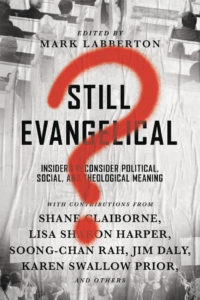
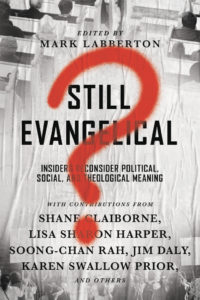
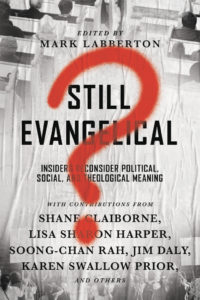
Still Evangelical? Insiders Reconsider Political, Social, and Theological Meaning edited by Mark Labberton (IVP) $17.00 This book is one of the most important books for me these past months and I poured my heart into a review that tried to explain to our BookNotes readers who evangelicals are (that is, they are not the same as fundamentalists) and why many are so very disturbed by the way the media has insisted that most evangelicals are pro-Trump. Many have gotten the idea that all evangelicals are nearly white supremacists, very anti-immigration, resistant to the facts about climate change, and are willing to look the other way about sexual violence — from President Trump or the allegations about Judge Roy Moore, say — as long as right wing politicians are elected.

Whether this caricature is even true is a burden I have, but this book is more practical. It is asking it’s contributors – from Focus on the Family’s Jim Daly to Sojourner’s Lisa Sharon Harper, from Liberty University’s Karen Swallow Prior to urban activist Shane Claiborne, and more – to weigh in on the question that if the public perception of evangelicalism is so tarnished, and if some of the blame does, in fact, come from conservative theological voices who have been complicit in this bad witness before the world, what, then, should we do. Do we hang on to this historic name for ourselves, trying to reclaim, renew, and revive it? Should we give it up? How can we adjudicate the confusions this name now brings with it, and, if it has become so greasy from being mishandled, how can we proclaim the gospel of a saving Christ and the advent of a good and wholesome Kingdom of God? These contributors are sharp, some more heartbroken than others; all are deeply concerned about the reputation of our churches and the testimony before a watching world about the goodness of the gospel. This is a very important book for anyone who cares about the religious landscape in our society. Please order some today!

Kingdom Collaborators: Eight Signature Practices of Leaders Who Turn the World Upside Down Reggie McNeal (IVP) $16.00 This is another fantastic book from The IVP Praxis line, a creatively serious line of useful resources to equip leaders for contemporary ministry. Those who know Reggie McNeal know him as a long-standing voice for what we now call the missional church; he was talking about being outward focuses and Kingdom oriented for decades and his vibrant speaking schedule has made him a well-known and well-trust voice among church consultants and leadership coaching. He works for something called GoodCities and is a senior fellow for the Leadership Network. This book is brand new.

I love McNeal’s last book Kingdom Come and this starts there – with an allusion to Acts 17:6 and the reputation the early church had for, as Nancy Ortberg says in her vivid endorsement on the back, “deconstructing what religion had become by painting a compelling picture of the realty of God’s Kingdom.” Then, Kingdom Collaborators lists nine features of effective missional leaders. As I skimmed the table of contents today I am glad we ordered quiet a few. I’m going to pushing it this Spring and figured we should start off with a bigger than usual discount now, right out of the gate. This looks tremendous, thoughtful, but very practical, too.

The Monk’s Record Player: Thomas Merton, Bob Dylan, and the Perilous Summer of 1966 Robert Hudson (Eerdmans) $23.99 I know, I know, we announced this earlier in the week and I raved a bit. I’m so excited, and the foreword itself is just fantastic. What a very cool idea, written by a very reliable author who is obviously bonkers over Dylan and Merton, too. Ya gotta love a book that says that “Cables to the Aces is when Merton went electric.”  If you get that, you’ve gotta get this book!

Here is some of what I wrote last week – I don’t have time to re-write a longer review now, mostly because I want to go read this now! So here ya go, read it again, and know it’s on sale for the next three days at 30% off.

Oh, if time permitted, I’d love to tell you more about this….this splendid, much-anticipated book is one of these works of genius that isn’t what you’d typical expect from Eerdmans, but it seems just right coming from them. Kudos, kudos! It will surely be much discussed and the cover alone is almost worth the price of the book. The Monk’s Record Player is a true telling of an episode that isn’t well known among those who follow – and there are a lot who follow and a lot written about – Bob Dylan or the mystic, activist monk, Thomas Merton. The author, Robert Hudson, is himself a huge Dylan fan, a mystic poet (like Merton, you know) and a man of contemplative prayer (he’s the one who got Four Birds of Noah’s Ark back in print again, a prayer book from the time of Shakespeare that we touted as one of the best books of its kind in 2017.) It has a foreword by David Dalton, a New York Times bestselling author and – please note: a founding editor of Rolling Stone Magazine. What a fabulous, rich, multi-dimensional, creative work this is.

And what a heckuva story.

Everybody knows how eccentric and cryptic Bob Zimmy could be. And most who know of Merton know he took a vow of Cistercian silence but couldn’t shut up. And he had a great sense of calling into the literary world, and he had a great sense of humor. I have met people who knew him, and everybody agrees he was, usually, the life of the party.

You maybe know (if I can be allowed a Dylan-esque stream of consciousness moment) that Dietrich Bonhoeffer’s bravery to resist Hitler was nurtured less by his academic study of liberal theology at Union in the 1940s but from his experience of the African American worship at Abyssinian Baptist and, especially their black gospel choir. He took gospel records back with him to Germany and the rest, as they say, is history.

Perhaps somewhat similarly, Merton, as Hudson shows, took some Bob Dylan albums with him as he strode away from and back into the modern world. This book tells the story (which involves Joan Baez, I might add) and it is a story no one else has noticed. As Publishers Weekly puts it, after noting how many books there are on Merton and Dylan already, “shelf room just must be made for this one.”

Listen to Steve Rabey:

Robert Hudson’s revealing ‘parallel biography’ shows how two of the most prolific and influential figures of the 1960s, both perpetually restless spiritual pilgrims, shared a passion for prophetic poetry, an opposition to the war in Viet Nam, and a boundless inquisitiveness. In this enjoyable and insightful book Hudson connects the dots that other Merton scholars have overlooked

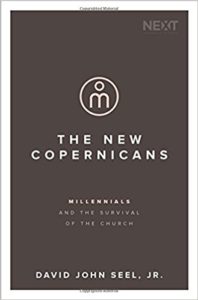
The New Copernicans: Millennials and the Survival of the Church David John Seel, Jr. (Thomas Nelson) $16.99 This is another we did a very long review of in BookNotes a month ago and now want to move more, so hope the extra discount will encourage you to read it, maybe with a group. This includes some sweeping overviews of Western history and the shifts in culture that some call postmodern. It summarizes a lot of the research on Gen X and millennials and Gen Z and such. It isn’t sloppy and it isn’t simplistic, but it does offer a fresh and powerful summary of what’s going on, how it is that churches can build new relationships of honor and trust among their emerging adults, and what we all can do to, like Copernicus of old, navigate a new world that is appearing with new ways of understanding the cosmos and our culture and ourselves. This is a great read and more important than you may know. Highly recommended.

Four Views on the Church’s Mission edited by Jason Sexton (Zondervan) $16.99 I hope you liked my long review of the Jubilee conference in the last BookNotes, and noted that this is a particular way of telling the gospel story, a way that sees the Kingdom of God as the central theme of Jesus’s ministry and work. His community, His people, the Body of Christ, the Church, is core to that story, of course, but, in this reformationally worldviewish telling, God is redeeming all of life and, therefore, thinking Christianly about economics, say, is as important as theology, and the work of the plumber or journalist or midwife is as important as the minister, priest, or nun.

Is that so? What sort of view of the church, then, emerges from that kind of Kingdom vision? And, conversely, what kind of view of the mission of the church emerges from other views of the church? How do we more precisely name the tasks appropriate for the institutional church and what is the more general mission of the people of God, but not the work of the church, per se? These are questions that have captured by attention for decades and this book is another major piece of the puzzle. It offers a good debate and clarifying viewpoints of four classic views, four angles of vision on what the church is and what it should be about. These “Counterpoint” books are very informative and we like many of them. This one is very important.

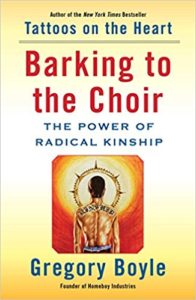
Barking to the Choir: The Power of Radical Kinship Gregory Boyle (Simon & Schuster) $26.00 I trust I don’t have to say much about this – we raved about it when we first announced it a few months ago, and many heard Father Boyle on NPR’s Fresh Air, I think. Lots of folks were buzzing about how moving this story of “Homeboy Industries” (the job-training program and community Boyle founded in inner city LA, Compton, to be exact.) The first book that was a huge New York Times bestseller was Tattoos on the Heart and this carries the story of Boyle and his homeboys forward. Boyle has been called brave and humane and brilliant. His writing has been called “astonishing” and “jaw-dropping.” Tattoos of the Heart is remarkable and this is no less so. We have a big stack and we are hoping you’ll appreciate the good discount and pick it up now. What a story!


BookNotes

Hearts & Minds logo

SPECIAL
DISCOUNT
ANY TWO OR MORE ITEMS MENTIONED

30% Off

three days only

sale expires Sunday night

March 11, 2018 at midnight

order here

takes you to the secure Hearts & Minds order form page
just tell us what you want

inquire here

if you have questions or need more information
just ask us what you want to know

Hearts & Minds 234 East Main Street  Dallastown, PA  17313
read@heartsandmindsbooks.com
717-246-3333


30% OFF SALE ON SELECTED TITLES: BUT FIRST, MY EPIC POST-JUBILEE REFLECTION. AND, A FREE BOOK OFFER AT THE END.

30% OFF CLEARANCE SALE

BUT FIRST, MY EPIC POST-JUBILEE REFLECTION AND THEN SOME BOOKS ON SALE FOR 30% OFF – AND A FREE BOOK OFFER, TOO.

FOUR DAYS ONLY.

In our last post where we highlighted some brand new books (and some long-standing hardbacks that have been finally released in paperback) we noted that we had just gotten back from the big Jubilee conference in Pittsburgh. If you are new to BookNotes or the Hearts & Minds bookstore you may not know that this great event for 4000 college student run by the campus ministry organization CCO (with whom Beth and I are involved) is one of the most important things we’ve ever had the privilege of being involved with. We were involved as a member of the early committee for the event over 40 years ago to being an occasional speaker (yep, Beth and I both) and, in the last few decades, as book provider. I suppose, counting up my time on stage promoting books at the event I may have been up front as often as nearly anyone – and they keep allowing us to come back! It is an honor to invite students to “read for the Kingdom” and it is a hard but true joy to choose and lug and curate and set up (and lay out the cash for) a big pop-up bookstore each February in Pittsburgh.

Here’s a little impromptu Facebook video I made on a whim when we were starting to load the rented truck a week or so ago; I could make a less energetic one now that we are trying to get the hundreds of boxes unpacked and in some order in our basement warehouse. If you’ve got any time in your prayer schedule, add us on your list.

https://www.facebook.com/byron.borger1/videos/10155134081636990/

The work after events is harder and more stressful than many know and our bodies and minds are aching as we look to the next complicated weeks, in our personal lives and in the store, post-Jubilee. Which includes – oh yes it does! – A FOUR-DAY ONLY AFTER JUBILEE CLEARANCE SALE. While supplies last, the titles shown way below in the list are 30% OFF. This sale is over at the end of the day –11:59 pm EST – the night of March 8th 2018.

To gain admission to these deep discounts, you just have to read through my breathy rumination, so you know what’s behind all this jubilation. Or not – just skip to the bottom to see the clearance sale items. And the free book offer if you buy any three books mentioned.

To be clear, in this first part, my bibliographic essay about Jubilee, I cite a bunch of books. They are on sale for 20% off, if mentioned in passing in this essay portion. The ones shown in the list further below, however, are all 30% off. Buy any combo of any three mentioned or shown and we’ll throw in a freebie by Michael Frost, also shown below. Just use our order form page – click on the ORDER HERE link and it will take you to our secure site. Then, just type in what you want and give us your info and share your digits. Easy. We’ll confirm everything, old school, with a personal email. Unless you state otherwise we’ll send things the least expensive way we can, which usually means media mail.  Okay?

+++

We don’t have reason to believe that the ancient Hebrews ever actually celebrated the Year of Jubilee as commanded in Leviticus 25. We’ve got a line about it on our Liberty Bell commemorating US political freedom from King George and some Tea Party types emblazon it on caps and tees shirts to complain about high taxes and a media they don’t like. But the Biblical teaching of an every-50-year Jubilee as detailed in Leviticus – dreamed about by the prophet Isaiah (Isaiah 61) so many years later which then became the first lectionary text Jesus used in his first sermon (Luke 4) – was to be so much more than these cheap misappropriations. I’m sure you know that it included land redistribution, forgiveness of economic debts (it’s why we say “forgive us our debts” in the Lord’s Prayer) and other restorative social and economic policies. Years were shaved off of indentured servant’s obligations, prisoners got out of jail, animals got to rest, the land was to lay fallow, in a move ripe with environmental stewardship and an extraordinary experience of trusting the provisions of an abundance creation overseen by a gracious God. All of this good social policy stuff about second chances and renewed social infrastructure and the revival of stewardly economies, conjuring up the teeming blessing of shalom in Genesis 1 and 2, all was to begin on the day of atonement.

When we are made right with God through the sacrificial grace of a merciful Redeemer – you can see how this points us to the cross – our family hurts and social injustices and broken institutions and our relationship with the land itself changes and we can arrange our economies and our relations with the poor and our criminal justice policies and relationships with animals and our own personal budgets all in fresh, new ways. This is the full-orbed, creation-restored, abundant life envisioned by the Sabbath and Jubilee teachings within the Hebrew Scriptures, and it was the basis for Jesus’ inaugural sermon. He bluntly says the Jubilee is a reality, begun in Him. In so many words he says, after reading Isaiah, You’re looking at it.

Jubilee people realize God’s creation is wondrously covenantal and abundant and that God is trustworthy. We move from fear to freedom and – yes – we can rest. Jubilee, it could be said, is the every-50-year Rest of all Rests, the Sabbath of all Sabbaths; although just social policies were part of it, at its root was a trust in God and God’s promises that allowed a year of rest; it is where we get the idea of a sabbatical, after all. When we embrace this kind of abundance we can be like the Galilean youngster who shared a loaf and a few fish and ended up with holy leftovers to be re-shared. How many baskets were left over, by the way? A Jubilee-ish number to be sure, offering one more clue that Jesus’ proclamation in Luke 4 that he was inaugurating this “favorable year of the Lord” is oh so true.

I’ve mentioned in other Jubilee-related reflections that some Bible scholars (particularly of a few key texts in Chronicles) deduce that the Jewish exile into Babylon in the early 500s BC, and the number of years they were kept away from their homeland, were, in fact, the number of years they would have done the big Jubilee year of rest had they been obedient. That is, God was so faithful to God’s plan that even if the people had to be exiled for a generation or more, the land would get its rest and at least part of the Jubilee would occur. God apparently takes land and rest and what we now call sustainability seriously.

The land merely laying fallow while the people were in exile wasn’t the robust, joyful plan of social restoration that was intended and centuries later we learn how the prophet Isaiah longed for it; indeed he alluded to Jubilee (see Isaiah 61) and prophesied that it would someday happen. Jesus, so many years later, still, preaching his own very first sermon on that very Isaiah text, says, that, in Himself, that time has arrived. 

You know Jesus as the Christ, as Savior, Redeemer, Bread of Life, Lord, King, friend. I suggest you add “Jubilee Bringer” to the names of Jesus you use in your holy imagination and in your prayers and liturgy. Of course, “Kingdom-bringer” is another way to say the same thing: the Kingdom is at hand; the commonwealth of God, the reign of restoration has begun; the future age of new creation has broken into the now of real life! It is simple: we “seek first the Kingdom” (Matthew 6:33) and everything else falls into place. We preach the gospel “to all creation” (Mark 16:15) and long for “all things” to be reconciled (Ephesians 1:10.) We give all we have for that treasure in that field, we enter the Kingdom and, alas, “all things are made new, we are new creations!” Through Christ’s cross the dysfunctions of the idols and powers of this world are undone (Colossians 2:15) and “all things” are reconciled (Colossians 1:20.) All things?

All things?

God wants to heal and re-direct and receive glory from reconciled sports and architecture, nursing and filmmaking, science and business, cooking and international diplomacy? Christ-followers and Kingdom agents are helping renew schooling, philosophy, factories, farming, childbirth, politics, media, home-life, and higher education?

It’s no wonder that a group of people in Pittsburgh in the 1970s studying Dutch Reformed theologian and statesman Abraham (“Every Square Inch”) Kuyper and a Mennonite book called The Politics of Jesus concluded that Jubilee would be a good title for a conference about this big redemptive story of God based on forgiveness and trust, leading to social renewal and public justice, the grand hope of the restoration of all things.

JUBILEE CONFERENCE 2018

As happens every year, I got teary and occasionally wept as I watched my younger colleagues at the CCO leading their college age students into this broad vision of God’s redemptive work in the world at the annual Jubilee Conference in Pittsburgh. Time and again in powerful main sessions and engaging workshops and vivid, loud worship, nearly 4000 students and lots of others were invited into a view of life that gives account for the goodness of creation and it’s God give orderliness and potential, the brokenness we know that comes from autonomy, sin, idolatries, stupidity, and cruelty, and, further, a vision of God’s grace that leads to redemption in Christ and true hope for the renewal of life as God intends.

It’s the best presentation of the gospel we ever year and the care and creativity obvious in the event is nearly overwhelming to me.

As you may know, the CCO arranges the Jubilee conference in those four major parts, with main stage gatherings moving from presentations on the goodness of creation to the awful fall into sin and the subsequent disruption of the world God made, on to the redemption Jesus brings and ending with a message of hope for the restored creation (what some might call “realized eschatology.”) By Sunday morning the worship and music and speakers inspire students to live into the tension of the “already but not yet” of Christ’s promises of healing the cosmos. “All things (re)new(ed)” promises Revelation 21 and 22 — our lives can be decisively shaped by this hope. Through union with the resurrected, ascended, and returning Christ, we can be the change we want to see. We are pregnant, as it were, with the promise of future hope. We are the light of the world, Jesus said, and we point people (through our good works, He also said) towards the good promises of Kingdom come, which is creation renewed.

The big artful images which served as backdrop for the stage this year were so powerful — I can’t seem to get images copies here, now, but look around for them on line if you like doing that. They were very, very cool.

There is, as N.T Wright wonderful ponders in Surprised By Hope and as Richard Middleton studies in every more detail in A New Heavens and New Earth: Reclaiming Biblical Eschatology (which ends in a great study of Luke 4, by the way), continuity between this world and the next.

It is, I believe, a continuity that provides meaning and structure and direction and purpose for life – for every aspect of life and every sphere of culture, including work and our callings into citizenship, the arts, entertainment, and more – that few churches proclaim with much clarity or gusto. Over and over at Jubilee we hear, even from adults: I’ve never heard this before!

Why is that?

I may be unfairly generalizing and there are grand exceptions, but it seems that more liberal/progressive churches, despite good stands on justice issues and a vision of radical inclusion (see the end of Luke 4 for good Biblical justification of outsiders getting in, so to speak) such churches don’t talk much about future hope or a second coming of Christ or frame ordinary day to day light in such eschatological terms; there isn’t much talk about glory or hope, it seems to me. On the other hand, more conservative evangelical churches still, despite some movement on this, think of “going to heaven” as the real point of all of life. They may be strong in helping individual believers grow in vibrant, personal faith and knowledge of God’s gift of salvation, but they are still weak in relating saving grace to all of life, and equipping folks to live into a hopeful vision of the reign of God that is a-coming, on Earth as it is in Heaven.

Further still, we are glad that both mainline denominational folks and evangelicals are learning from Catholic monastics and contemplatives about spiritual disciplines, but, again, some of the centers for spirituality and formation these days talk more about mystical union with God and intimate friendship with Jesus than being shaped by the virtues of Christ to become vessels for all-of-life, love-of-neighbor, “seek the peace of the city” sort of restorative work. It is why we were so glad to tell people about Kyle Bennett’s Practices of Love: Spiritual Disciplines for the Life of the World (Brazos Press; $17.99) that show how spiritual practices help us reconfigure and live in new ways in the real world. It makes perfect sense that James K.A. Smith wrote the forward to Kyle’s book and that they both have spoken at Jubilee. This Jubilee vision is, if nothing, integral.

So, in this still-too-rare Biblical perspective, all of life is being redeemed because God, in Christ, is redeeming this very world. For God so loved the world (the Greek word is cosmos, which means, literally, the stuff of Earth) you know. This was the sign of the first Jubilee – life renewed in a God-centered vision of the common good for all from the land on to reconfigured finances and jails and jobs – and it was at the heart of Jesus’ first sermon.

WHICH MEANS

Which means, it all matters. Every square inch. Or, as the tag line of Jubilee 2018 put it, “This changes everything.”

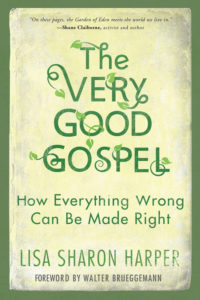
Using the creation/fall/redemption framework (or the similar rubric of shalom/alienation/reconciliation offered by Lisa Sharon Harper in her wonderful book The Very Good Gospel: How Everything Wrong Can Be Made Right (Waterbrook; $15.99) is so helpful and generative. Seen through the lens of this story we can see what’s right, what’s wrong, and what is to be done and hoped for. It is helpful beyond words for these students knowing that their hurts and their yearnings (from body issues to racial justice, and more) matter to God and that they can understand them through this framework. We have Lisa’s book listed below on sale for 30% off, so be sure to order if if you’d like.

We sell small books at Jubilee that make a big impact in explaining this; I hope you have some on hand to pass out to those with whom you talk about the full gospel of the Jubilee.

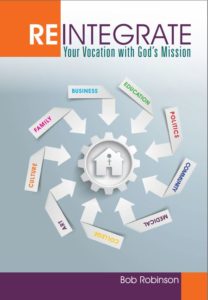
For instance, we love books such as All Things New: Rediscovering the Four Chapter Gospel Why It Matters by Hugh Whelchel (IFWE; $6.99 — although that is one we have under the clearance sale section at 30% off for the next four days) and A Christian Worldview: A Students Guide by Philip Ryken (Crossway; $11.99) which explain the significance of these four “acts” of the Biblical drama. One of our favorite small groups guides for this is the rare and wonderful Reintegrate Your Career with God’s Purposes by Bob Robinson (Good Place Publishing; $14.00) I hardly know any other simple resources that invite conversations about this coherent Biblical story that shapes how we think about all of life being redeemed. Do you? I wish we’d sell these routinely – they are so useful and so rare. They will create some fresh conversations in your circles, I’m sure!

We hope you know Richard Mouw’s thought-provoking book about the continuity between culture and redemption and new creation in his little book When the Kings Come Marching In: Isaiah and the New Jerusalem (Eerdmans; $15.00.) Again, I promise you’ll both enjoy its crisp writing and learn something new from it – some have found it confounding and others have found it clarifying. Will there be Beatles recordings in the New Earth? It is a serious question and he’s got a proof-text based on the ships of Tarshish!

Of course we always promote more serious explorations of this approach such as Creation Regained: The Biblical Basis for a Reformational Worldview by Al Wolters (Eerdmans; $15.00.) Even if you think you get the full implications of the c-f-r stuff, his chapter on “structure and direction” is worth the price of the book and priceless for helping us discern wisely about how to relate to the world and institutions and artifacts and stuff around us.

For those that want to dig into the eschatology of this “cosmic reordering of all things” we highly recommend the aforementioned Richard Middleton’s stunning A New Heavens and a New Earth: Reclaiming Biblical Eschatology (Baker Academic; $27.99) which he summarized in his Jubilee talk shown above. And, of course, again, N.T. Wright’s well-known and very important, Surprised by Hope: Rethinking Heaven, the Resurrection, and the Mission of the Church (HarperOne; $15.99.)

You can pick up the hardback (usually $24.99) at our 30% off sale price now ($17.50) while supplies last, or get the brand new paperback at the 20% discount announced in the previous BookNotes offer. We only have a couple hardbacks so let us know asap if you want one at 30% off.

Yep, the Jubilee conference, informed as it has been by these kinds of books, help participants see the Bible as a shaping narrative, a story that coheres, which has a plot and trajectory, and matters as it points us to original blessing and order and goodness, helps us understand the brokenness and idols of the age, and enables us to trust in God’s promises and faithfulness, the person and work of Christ, and the pressing pull of the Kingdom coming “on Earth as it is in Heaven.” It re-orients the perspective of participants, re-directing their self-understanding and helping them see themselves as part of the big Biblical drama. It’s a light before our path, which is to say it illuminates what we know about the world so we can walk wisely in the ways of the Lord in every zone of life.  Many of the “how to read the Bible” books we promote there have that as a feature, such as Michael Goheen & Craig Bartholomew’s The True Story of the Whole World: Finding Your Place in the Biblical Drama (Faith Alive; $15.99) or Sean Gladding’s The Story of God, the Story of Us: Getting Lost and Found in the Bible (IVP; $17.00 or The Big Story: How the Bible Makes Sense Out of Life by the fun writer Justin Buzzard (Moody Press; $13.99.)

I wish our regular Hearts & Minds customers and BookNotes readers who are not in college could have a similar enthusiastic reminder that our jobs, neighborhoods, citizenship, leisure experiences, home lives, sexuality, technologies, urban spaces and built environment, eating habits, views of the natural world, and the like are all made good by God, but are not now as they are meant to be, and that every aspect and sphere of natural, cultural, social, and personal life is, although distorted as we experience them, claimed by Christ, part of His Jubilee. How beautiful to see our churches and ourselves as missional agents joining God in the transformation of the world and how very wise to frame it not just in terms of people knowing God’s love or even “changing the world” but to see God’s work of redemption as a restoration of creation order and beauty and intent. To be deployed to that vision of the rescue of creation and attentiveness to creational ordinances and norms and potential, as prelude to the restoration of all things is nothing short of life changing.

I’m sorry to be so wordy preaching all this for you. Thank you for reading along, bearing with me.

I hope you know I’m not just happily recalling the reformational, missional theology behind the CCOs Pittsburgh Jubilee event but I’m telling you why our store is the way it is, the animating vision the has shaped Beth and me, and why our bookstore carries books on work and art and politics and sex and spirituality, cookbooks and novels and books on engineering.

We hope it is your story, too, that God is stirring up in your own desires and yearnings, an increasing passion to learn and grow wise in the ways of the world and the ways of God’s Kingdom. Oh how these newly inspired young people need wise elders and church leaders that can learn from them and also help lead them. See my review of John Seel’s excellent The New Copernicans: Millennials and the Survival of the Church (Thomas Nelson; $16.99) for a reminder of that.

If any of this talk about wholistic faith, a worldview where all of life is being redeemed, where vibrant faith can transcend older debates between liberals and conservatives, but can tell this better story, if this touches a nerve, rekindles a desire, inspires a renewed hope for a full-orbed, incarnational way of being a friend of God in all of life, working for Jubilee justice, learning about faith in the marketplace and public spaces, then maybe our bookstore can help. We want to serve all kinds of readers, but we have you in mind, particularly. We have the tools you need.

BOOKS MATTER. BOOKSTORES, TOO.

Books matter. Books are important tools for thinking about the implications of this worldviewish perspective and good authors can be wise guides to help us think deeply about God’s intentions for creation. To be faithful agents of God’s redemptive purposes in our time we need more than the Bible, more than good church services, more than passion for the relevance of the gospel. We have to think it through, un-learn and re-learn some stuff, and work it out. Why did God in all of God’s wisdom, create humans with capacities to mirror God’s own care for the world God so loves? How does our sexuality or our thinking or are propensity to play or our ability to be creative or our deep need to work or the joy of learning or the call to rest or our spending of money or our capacity to make stuff or our kinship in families, not to mention our ethnicity and gender – all human things — fit into our Christian lives, our discipleship, our walking in the way of the Lord through this hard but wonderful world?

We need all the help we can get to learn what it means to be faithful in the modern world as redeemed people.

I’d say we even have to learn to ask the right questions, and good books can stimulate our minds and enlarge our hearts and guide us into this sort of curious, probing wisdom, with a view to working out a Kingdom viewpoint in all of life.

Books are the tools we need, since even the best pastors among us most likely can’t help you much as an mathematician, school teacher, engineer, business person, artist, barista, elected official, radiologist, or social worker.

We take about 160 categories of books to the Jubilee conference so that participants can see what a well-stocked Christian bookstore looks like and the tools for Christian living we can provide.

There are good books on everything, almost, and not enough people have access to these riches. And, more importantly, germane for this “all of life redeemed” missional Jubilee vision, we take so many books to the conference in order to help conferees discover resources about their own passions and pursuits, the offices to which they are called and their various tasks and duties, as students, friends, relatives, church members, citizens and so forth. The conference is for college students and the life of the mind as they think about their studies, of course, but it also means that we show off books on sexuality and dating, learning to step into what is playfully called “adulting,” and stuff like being a better friend or son or daughter. We sell a lot of “self-help” titles about shame and pain and how God’s grace equips us to forgive and move beyond hurts and setbacks and the insecurities many have. (Does your church help hurting people see the gospel as the balm they need to heal their anguish, to cope with their anxiety? I hope so.) And, naturally, for those still trying to figure out the truthfulness of this Christian story (can such good news really be true?) we sell popular-level introductions to the gospel, books for those with questions and doubts and books that make a good case for the credibility of this story we find ourselves in.

I was glad, by the way, to sell the paperback edition of David Dark’s allusive book Life’s Too Short To Pretend Your Not Religious (IVP; $17.00) and David Skeel’s not-quite-postmodern True Paradox: How Christianity Makes Sense of Our Complex World (IVP; $16.00) alongside the more popular Case for Christ and Case for Faith and other books of evidences and apologetics for those wanting to persuade their friends of the goodness of the gospel way. Hooray for good tools, too, like Os Guinness’s Fools Talk: Recovering the Art of Christian Persuasion (IVP; $22.00) and Richard Mouw’s Uncommon Decency: Christian Civility in an Uncivil World (IVP; $16.00) and Winsome Persuasion: Christian Influence in a Post-Christian World by Tim Muehlhoff and Richard Langer (IVP; $22.00.)

Naturally, we promote resources on the big picture Jubilee worldview and try to encourage students to move a bit beyond the most popular Christian growth books into deeper spirituality (if they are ready for that, but for many, even Lewis’s Mere Christianity or Wright’s Simply Christian is a huge first step and a bit demanding) and, also, to buy books about their majors and future careers. Many of their CCO workers have raised some extra money to help those with limited funds to invest in a personal library, and it is beautiful to see. We have a huge selection of books about vocation and calling and we have a large section of books about work; not all Christian bookstores carry this kind of thing, so it’s precious to offer these tools of faithful Christian living to those who care. (Ahhh, if only older, more established Christian adults had half the passion and zeal and openness to learn that these 20-something have!)

Besides the arts and sciences, books about a Christian view of literature or computer science or nursing or film or business or special education – we think they should read a few books just about what we call “the Christian mind.” For this crowd I like John Piper’s passionate Think: The Life of the Mind and the Love of God (Crossway; $15.99) although I really, really like one by Philip E. Dow called Virtuous Minds: Intellectual Character Development (IVP; $17.99.) It is lovely, nicely written and stimulating new ground; it is one faculty and anyone who prides themselves in thinking well should read too. I like to show off the brief Called to the Life of the Mind: Some Advice for Evangelical Scholars by Richard Mouw (Eerdmans; $10.00) mostly because it is so brief. Students don’t know John Stott, these days, but his very classic book (that we passed out at our grand opening 35 years ago!) called Your Mind Matters (IVP; $9.00) is one that pushes back at the sensationalism and anti-intellectualism in some evangelical circles. This stuff if foundational, I’d say.

I think the late, great James Sire (who has spoken at Jubilee more than once and whose recent death was discussed at the book tables more than once) would have been proud to see books about worldview and the Christian mind, including his own Naming the Elephant: Worldview as a Concept (IVP; $22.00) and Habits of the Mind: Intellectual Life as a Christian Calling IVP; $20.00.) I know Sire loved The Transforming Vision: Shaping a Christian Worldview by Brian Walsh and Richard Middleton (IVP; $22.00) and we had all of Walsh and Middleton’s other books too. Man, I wish folks would order Subversive Christianity: Imaging God in a Dangerous Time by Walsh (Wipf & Stock; $17.00) – it’s incredibly potent, thoughtful, deep, urgent, and one of the chapters was one of the meatier lectures ever given at Jubilee, years and years ago!

These are books that rocked our worlds over the years and I pray that showing them off to the rising generation of CCO staff and their young students will ripple down through the next decades, putting them on a trajectory of life-long, profound discipleship. Steve Garber’s research on how all that works – moving from worldview to way of life with the help of mentors and friends as described in his very significant Fabric of Faithfulness: Moving From Belief to Behavior (IVP; $18.00) – was displayed right there, too, alongside Sire and Walsh and Middleton and Al Wolters and Mark Noll and the like. Steve used to direct the conference decades ago, so it is always special to show Fabric of Faithfulness and Visions of Vocation: Common Grace for the Common Good (IVP; $17.00), too. Both are eloquent, beautiful, stimulating, enduring books of Jubilee vision and whole-life discipleship. 

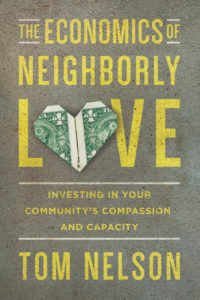
Increasingly, there are a large number of adults that attend Jubilee; in fact there is a tremendous, pre-Jubilee event for pastors and professionals, entrepreneurs and artists, businesspeople and other leaders who want to work out the Jubilee vision in their own grown-up worlds, called Jubilee Professional. I was again invited to speak briefly to this great group – right after a stunning DVD about coffee recently created by the Acton Institute, and speakers such as Andy Crouch and Tish Warren and Dan Allender. Jubilee Professional is sponsored by the Pittsburgh Leadership Foundation and this year both Acton Institute and the wonderful Made to Flourish (founded by Tom Nelson) helped out. Do you know Tom Nelson’s Work Matters: Moving From Sunday Worship to Monday Work? Tom’s vision of seeing churches and pastors motivated and equipped to encourage their congregants in their work lives is lovely; his new book is on why we should know a bit about how the structures of economics unfold and how church folk can take up their lives not unaware of economic forces is called, beautifully, The Economics of Neighborly Love: Investing in Your Community’s Compassion and Capacity (IVP; $16.00.) If you can, you should sign up for next year’s JubileePro. – it’s a great afternoon event, and then you get in to Jubilee for the big Friday night opening.

It is fabulous to have so many thoughtful, somewhat older adults visit our bookstore at Jubilee, too. Pittsburgh friends come by just to chat and shop; those leading booths (many seminaries, interestingly, but also ministry organizations, camps recruiting college-age summer staff, service opportunities and the like) swing by, to see for themselves what the fuss is about, as do many of the speakers and Jubilee Pro participants. Guests are amazed that we lugged so darn much there, and seem impressed that we have curated this particular mix of books about culture, society, faith development, spiritual formation and books about nearly every sphere of life. I almost cried when John Mark Comer said that “this is what it looks like when a true book lover curates a conference bookstore.” Dan Allender’s literal blessings meant the world to us and will keep us going at least another year. This is hard, hard work, and not particularly lucrative, but having mature Christians who know the book world – authors themselves, especially, and even editors like Bob Hoesak of Baker Academic and Brazos Press – say how much they respect our efforts is such a blessing. We are feeling such gratitude right now. It is an honor to get to work with the CCO and their Jubilee team and you who read our columns and send orders our way are a part of this. You really are as your routine business keeps us going to these sorts of missional events. It is part of what your support of our business enables and we are grateful.

AND SO I WANT TO SAY: YOU SHOULD PLAN NOW TO GO NEXT YEAR

We so wish that you, friend, could experience Jubilee for yourself. We’ve been involved in one way or another in almost every one of the 44 conferences and every year I think that “if only…” others could see what we see, experiencing this grand, bustling, energetic tribe of students struggling with the implications of the gospel for all areas of life, their own faith would be deepened and their own hope for the immediately future would be enhanced.

These kids are rocking their campuses – leading friends to faith in Christ, calling churches into better ministry, getting involved in university life, serving the community and heading off to service projects by the thousands. My, my, any Christian pastor or church leader or youth minister would come away from this event with a boat-load of fresh enthusiasm and good ideas. I have told some clergy to skip their routine professional conferences, the Festival of Homiletics, SBL, the State Pastors Conference, or whatever thing they usually attend and go to this for educational development. There is no event like it on the planet! And, by all accounts, it has the best book display of any gig anywhere.

So why not get next year’s Jubilee dates on your calendar and plan now to make the pilgrimage with us to Pittsburgh in February 22 – 24 in 2019.

I rarely use our BookNotes to promote specific organizations or ministries, but I sure do hope that if anyone has any interest in wholistic, evangelical campus ministry that works so well with this rising generation, that they’d consider donating to the Coalition for Chrisitan Outreach, known popularly as the CCO. The impact they make is fantastic. Or, who knows, maybe you might want to work with them; if you see yourself as wanting to partner with evangelically-minded churches near campuses to reach students (or you attend an evangelically-minded church near a college campus who wishes to reach students) you should contact them.

Here is one particularly vivid example of the impact Jubilee can have on a student – these kinds of stories could be multiplied over and over as young adults find this conference and the CCO’s ministry on their various campuses to be so very life-giving.

Check out this incredible video about our young friend MollyKate, who, after experiencing great hardship and depression (her father committed suicide) sensed God’s love anew through the ministry of the CCO at her campus. Interestingly, she was so taken with the creation-fall-redemption-restoration framework for the meaning of life and the aspects of the gospel story that she did a fashion design project at her school (she is a fashion design major in Ohio) creating dresses that represented these different aspects of the human condition. Her design teachers were so impressed with her couture fashion project – made from salvaged and reused fabrics, by the way – that she was selected to display her dresses with real models during New York Fashion Week. (You’ll see them in the video!) She has even made a little full-color book about her designs to tell the story of how Jubilee gave her a way to think about her calling as a dress designer which we stocked at Jubilee. On the back cover she mentions that those interested in the aesthetics of clothing might read a chapter in Steve Turner’s Pop-Cultured or dig deeper by looking at Calvin Seerveld’s Rainbows for the Fallen World. What a joy to have these conversations with a rising leader in her field. How cool is that — a fashion line inspired by Jubilee and the meta-narrative of Scripture sewn by a woman who has experienced her own, as she puts it, “journey of restoration.”

https://www.facebook.com/ccoministry/videos/10156298726938866/

+++

A FUN OBSERVATION AND A CRANKY CONCERN

Books matter. We hear young people and older friends – from students who are not yet followers of Christ to main-stage speakers – tell stories of how books have impacted them. I know it is cheesy to say, but readers become leaders. These pages of print have long been a primary conduit for knowledge and inspiration, joy and healing. I was with a student who broke down in tears as she told me how a book helped her with her relationship with her mother. Another student cried as I found a book that named her particular area of hurt. Speakers told us of a life-changing book; students mentioned citing a book in a paper they were writing or how they had passed a resource on to a friend in the dorm. Books are gifts and we should rejoice in good authors, pray for publishers and bookstores, and remind ourselves just how God has used books down through the ages to deepen faith and resource disciples to live out their faith in more credible and beautiful ways.

But the corollary is, I suppose, that in our age of blogs and the 24-hour news cycle and YouTube comics and digital overload, we can grow both jaded and dumb. Amusing Ourselves to Death by Neil Postman and The Shallows by Nicholas Carr continue to remind us that we are not as well read as we ought to be and our capacity to think well is being eroded daily. We were glad to sell Alan Jacob’s How to Think: A Survival Guide for a World at Odds (Currency; $23.00) and Christopher Smith’s Reading for the Common Good: How Books Help Our Churches and Neighborhoods (IVP; $16.00) two books we love. As much as I rejoice in telling you about how our book display was appreciated at Jubilee and how books have made a difference in so many lives, it is also true that indie bookstores (especially of the religious and theological sort) are increasingly becoming a thing of the past.

Those that know us well know that we are holding on by a thread, that our good sales at Jubilee and a handful of clergy conferences and other fun events we do all year are not enough to keep us afloat. We need a miracle of a renewed love of reading among our circles; we need more people who understand the need for reading widely, buying books, studying and learning and growing. Every year we come away from Jubilee with some bittersweet emotions – it is the very best thing we do all year and we are astonished at how good it is. We are also deeply aware that students do not read like they used to, that campus ministry professionals do not read like they used to, and that pastors and Christian leaders, with some stellar exceptions, don’t promote books like they used to. Bookstores are going extinct for a reason, and we are implicated in this shift away from what Richard Foster calls in Celebration of Discipline the “superficiality of our time” which can be countered by “the discipline of study.”

You say you want a revolution? Read for the Kingdom!

I will write about this more, later, I suppose, but I must note briefly that part of the reason for the demise of healthy bookstores in our culture (especially health religious bookstores) is not just because of this shift away from thoughtful reading, the loss of a love of the disciplines of real learning, and the dumbing down of content in our pulpits and faith communities and para-church ministries. It is also because so many people prefer the convenience and cheapness of shopping at Amazon.

We get the appeal of digital books, especially for those that travel, so we have no large beef there. We are glad that on-line vendors can sell used books at great prices. We are fond of libraries and used bookstores, so we appreciate that. Also, my hat is off to the geniuses at Amazon for their digital technologies and seemingly endless databases. It is scary when advertisers talk about pitching to the algorithms and how they can funnel and limit our knowledge of only certain books, but, manipulative as it is, it is technically impressive. Granted.

But the practice of buying from faceless sources who are mostly motivated by efficiency and speed and greed surely erodes the values that support serious learning and deep maturity. Like the way cheap and glitzy on line “education” fueled by greed and ideology should not be confused with a humane and transformative liberal arts education, so saving a quick buck at Amazon should not be confused with having a relationship with a real bookseller who cares about you and your formation. This is a reminder offered for the sake of your own intellectual health, a strategic plea on behalf of the sustainability of Kingdom living (what tools will we use to “think Christianly” when our best stores close down and all we have left are the algorithms at Amazon telling you what’s “liked” by others?) And I suppose it is a personal reminder that if you want us continuing to curate good book selections at conferences and doing good reviews of resources here on line, you should considering buying your books from us, or somebody like us. Buying good books is a spiritual discipline and sourcing them, as we say nowadays, from places of integrity that can help you well, is also a truly Christian practice. We are grateful for our friends and customers and we think we can provide you with a good service, so we want to remind you of that.

I write about this now in part because of comments occasionally made at conferences like Jubilee – sometimes even speakers stand in our bookstore and tell their followers to get their books at Amazon, stealing our livelihood in our very presence.

But I bring this up now also because, again, Jubilee is one of the best places anywhere to be inspired to live well in all areas of life, to make a difference with all we’ve got, to relate faith and culture, discipleship and our daily habits, to integrate our own lives with God’s story, day by day by day. To “think Christianly” and honor God in everything thing we do is just in the air, there. We learn from the conference to work out what it means to make our daily choices in ways that serve the common good that make sense from a Christian perspective, as we say. Jubilee invites us to live in ways that point to an alternative way of life that what is offered from late consumer capitalism, one that is based on, well, Jubilee principles of shalom and justice and restoration and stewardship, whole-life integrity. Jesus applauded those who were faithful in little things and promised that when we discern what faithfulness looks like in our small choices we will be able to move into deeper areas of impact, maybe even being agents of reformation and cultural renewal and history-making. I am so proud of CCO staff who walk alongside students in their critical years helping them discern a faithful sort of living.

You say you want a revolution? Start small; here’s one idea: buy from trusted sources that care. And, then, read for the Kingdom.

FOUR DAYS ONLY

POST-JUBILEE BOOK SALE

30% OFF THESE TITLES while supplies last

Buy any combo of any three and get the free Frost book shown below

This sale expires end of day, March 8th 2018.

These are all books we routinely stock and you can order them later at 10% off, or at a better discount if ordering in quantity. Give us a call if we can help further. For the next four days, though, while supplies last, we offer these shown below at 30% OFF.

We’ll call it rather inelegantly a clearance sale.

Garden City Work, Rest, and What It Means to Be Human John Mark Comer (Zondervan) $16.99 This is one of the best, refreshing, upbeat, fun books to read about all this good stuff. The design suggests a Rob Bell book. We really appreciated John Mark’s encouragement to us at Jubilee; he’s a good guy and did a great job Sunday morning. Buy a bunch of these and pass them out!


God Has A Name John Mark Comer (Zondervan) $16.99 . This is John Mark’s most recent book and it is oddly breezy yet profound, inviting us to know the name of God, to be in relationship with this God who cares. Interestingly, Comer suggests that the passage where God reveals God’s own name (in Exodus 34) may be the most quoted verse of the Bible in the rest of the Bible. Very nicely done.


The Call: Finding and Fulfilling the Central Purpose of Your Life Os Guinness (Thomas Nelson) $17.99 Over and over I remind people that this is a beautiful, potent, elegant, thoughtful must-read. I think it is a very important work, one of my own personal favorites, and we highly recommend it. Get it now while on sale and you will want to read it more than once.


Culture Making Discovering Our Creative Callings Andy Crouch (IVP) $22.00 Again, this is one of those books that is nearly a must-read, essential to understand the Jubilee conference and Jubilee Pro as these ideas have been so significant in our community. This is a book that explores the “cultural mandate” of imaging God well in the world by using our creativity and abilities to learn to enhance the world God has given us and make a contribution. Andy did a splendid job at Jubilee –if you saw his video from an older Jubilee (where he plays as Bach piece as he did this year) it will be clear how very thoughtful and articulate he is.


Playing God: Redeeming the Gift of Power Andy Couch (IVP) $25.00 I can’t tell you how powerful and important this is. Most readers of BookNotes have some sort of cultural power and most of us need to be a bit more intentional about considering Christianly the goodness, troubles of, and redemptive practices that might help heal our weird relationship with institutions of power. Highly recommended.


Strong and Weak: Embracing a Life of Love, Risk and True Flourishing Andy Crouch (IVP) $20.00 This small hardback is still being discussed in places who have read it together and it is more than clever, it is a stroke of genius to have this formulation of how to do more than “balance” power and strength on one hand and risk and vulnerability on the other. Can we embody both? What are the implications? How we can learn to be fully human, exercising our gifts in cruciform service? One of the most generative books we’ve read in years…


A Woman’s Place: A Christian Vision for Your Calling in the Office, the Home, and the World Katelyn Beaty (Howard Books) $14.99 With a forward by the energetic, globally-followed justice activist Christian Caine, this may seem like quite the upbeat manifesto. But, although it is very well written – Beatty was a print journalist and eventually editor of CT, after all – but it is sober and wise and thoughtful and down to Earth. As you may know, we love books on calling and vocation and it is no surprise that Beaty has been to both Jubilee and Jubilee Professional… she’s thoughtful and highly respected, offering here the only good book in this field, linking calling and vocation to women’s experiences in the workplace and the world at large. It’s well worth having, a good book to share.

Learning for the Love of God: A Student’s Guide to Academic Faithfulness Derek Melleby & Donald Opitz (Brazos Press) $15.00 Okay, you are reading all of this and you realize you know young adults who are in college who never heard of Jubilee, or are too far away to come (although we had folks there from California and Tennessee and Florida and Michigan and Indiana) or who wouldn’t be inclined to come, even if they could. I get that. Not every young adult is comfortable thinking about God and church and Christ’s Kingdom and they sure don’t get that it connects to their experiences in college. I want to invite you to consider giving this book to them. (I’m not just saying that – I really hope you seriously give it your consideration. Whom do you know who needs this?) It explores how most American’s view college life (either it’s a blast a la Animal House or it’s super studious as a ticket to academic success and a future career with a good paycheck) and how God might be offering a different view of the young adult years. What if we could actually see God in the classroom? What if we study to know God’s world and ourselves better? What if we took up a liturgy of learning that helped us connect religion and life? I suppose you’ve heard that I adore these two authors – they are among my best friends – and that this book is dedicate to me. It is an honor I don’t take lightly, and it is a book I wish I could sell more widely. Please consider it. Now is a time to get it on sale. Your young student friend will be glad you cared.

The Very Good Gospel: How Everything Good Can Be Made Right Lisa Sharon Harper (Waterbrook) $15.99 You may recall that this is one of the books we’ve touted the most lately, and we like the way Lisa does the c-f-r approach, but using fresh and Biblical language.  She shows the blessed shalom of the good creation, the harsh alienation due to sin, and the cosmic reconciliation brought by Christ. In Him, the Prince of Peace, the alienation can be healed — indeed, in the second half of the book she explores how reconciliation can occur in so many areas where there are hostilities and pain, from our own body images to class differences, ethnic tensions to our relationship with the earth itself. This is very good news, indeed.

Go: Returning Discipleship to the Front Lines of Faith Preston Sprinkle (NavPress) $14.99 I am a big fan of this book and I’ll tell you why: discipleship — as in the Cost of Discipleship by Bonhoeffer, say — is something folks are confused about. Are we all called to be disciples? What does that even mean; what does it look like? Does it mean one must also be a disciple-maker, as in a mentor or leader or something? Well, this book tries to clear up some confusion, and uses some nationally-gathered research, too, which is always interesting, to know what church folks across denominational lines think they this this elusive word means. Sprinkle thinks it is a good and useful word, and explores how our minds matter in how we think about life and times, so we should read and learn. (Sound familiar? Right on!) He talks about work and callings, aware that for many of us, the workplace is the main venue in which our faith is lived out. His refusal to have a large gap between Sunday and Monday, or between, say, evangelism and social action, shows he’s a new generation leader, offering a balanced and passionate, relevant and faithful, thoughtful and engaging sort of way to follow Jesus.  Thanks to the Barna Group for working on this project and thanks to Sprinkle for helping us think just a bit deeply (if colorfully) about what sort of renewal we should be seeking in these days.

Breaking the Idols of Your Heart Dan Allender & Tremper Longman (IVP) $16.00 Dan is a good friend of the CCO and his words of kindness and blessing to us meant more than he may realize. What an honest, raw, important storyteller he is, a seasoned therapist, thoughtful Christian psychologist, whose work about shame and hard stuff is informed by a wise, narrative view of the unfolding drama of God’s work in our lives and in the world. I think it is fair to say he was influenced as a young man by the Jubilee vision of the CCO — the creation/fall/redemption worldview stuff talked about in, say, Al Wolters’ Creation Regained or Walsh & Middleton’s Transforming Vision is in his bones. This is a creatively written approach study of Ecclesiastes, actually, colorfully co-written by a respected Old Testament scholar, highlighting the search for life’s ultimate meaning. Really good.

God Loves Sex: An Honest Conversation about Sexual Desire and Holiness Dan Allender & Tremper Longman (Baker Books) $16.99 This is another brilliant collaboration with Hebrew Bible scholar Tremper Longman and, like Breaking the Idols, they use a fictionalized story as a device as they watch a group of women and men walk through the Song of Solomon and struggle with the goodness, hurtfulness, and glories of redeemed sexuality. What a great resource!


To Be Told: God Invites Your to Co-Author Your Future Dan Allender (Waterbrook) $15.99 This was maybe the most popular book at Jubilee this year, and for good reason. It invites us to name our life’s story, to be self-aware about our pains and trauma, and to allow God to re-write a new story. This is really thoughtful material and we very highly recommend it.  A number of CCO staff used this before Jubilee and the conversations, we’re told, here rich and important.


Bold Love Dan Allender & Tremper Longman (NavPress) $17.99 Readers polls have continue to report that this is one of the best books people have read and it is surely one that is necessary and profoundly helpful. It isn’t easy, though, as it pushes us towards a deep and Christ-like love. Can we learn to love even a fool? What about those who have hurt or abused us? Can we love parents that have failed us? What do we make of the desire for revenge? Can we seek justice even as we are gracious? What’s with “turning the other cheek?” How can we avoid contempt and violence—can love be creative and even cunning? Jesus calls us to love and this bold book helps us get there. Brennan Manning called it “dazzling” and Dr. John Miller said it was “the best modern book on love I’ve ever read.” Wow.

Leading with a Limp Dan Allender (Waterbrook) $15.99 The tag line on this, if not exactly a sub-title, says it clearly: “Take Full Advantage of Your Most Powerful Weakness.” Really? Yep, Allender breaks convention and suggests we need not always lead from our strengths; in fact, perhaps our very brokenness is the sore spot that God might use to make us into great leaders. (Shades of the Enneagram, perhaps? He doesn’t mention that.) I think this is counter-intuitive and brilliant, offering a refreshing exploration of weakness and pain, hope and leadership, how to cope with betrayal and loneliness and more. What a good read it is, too – especially with chapters like “No More Jackasses” and stories drawn from the failure of a construction company. And great debates he has, in the endnotes, with his editor. (He admits, when his editor asked him some tough questions, he wrote back, “Ron: Leave me alone.”) What are your flaws? How can you “take advantage” of them? Flawed, but healthy, leaders, Allender says, “are successful because they’re not preoccupied with protecting their image. They are undaunted by chaos and complexity. And they are ready to risk failure in moving an organization from what it is to what it should be.” Hmm. Maybe a “limping leader” is the kind of person God uses to accomplish amazing things.

The Good Life Trip Lee (Moody Press) $11.99 AND/OR Rise: Get Up and Live in God’s Great Story Trip Lee (Thomas Nelson) $16.99 Let’s face it, it’s fun having a bone fide rock star – in this case an expert rapper, star in the hip-hop world along with his friends Lacrae and Sho Baraka and Propaganda (who were at Jubilee last year.) These are Trip’s two books, both really useful, clear, encouraging. The first, The Good Life is compact sized and makes a great gift for one who is seeking faith, who wonders what it means to life a good life, and how faith can help. Is the meaning of it all a nicer car and bigger house, getting what you think you want? Or is there more? Nicely done, for sure! The second, Rise Up, is his dramatic book about taking faith and discipleship seriously, about allowing God to touch you so you are a useful vessel, and being a part of the uprising of God’s Kingdom. Passionate, solid, inspiring, this is a great intro to relevant faith for anyone who might appreciate a book from the world of pop culture. Blurbs on the back are from NBA and NFL stars and the cover is way cool.

Welcome to the Revolution: A Field Guide for New Believers (Thomas Nelson) $12.99 AND/OR Free Book Brian Tome (Thomas Nelson) $14.99 We’ve promoted Tome’s introduction to Christian faith –Welcome to the Revolution on the opening night of Jubilee for years. I like it’s feisty invitation to be a part of some big God movement, but how it reminds newcomers to faith that they must learn the Bible, experience prayer, be involved in community, worship well, and serve. Welcome… is a fine introduction for young Christians who need these basics; I could see it even being used in confirmation classes if the kids are somewhat mature or creative. Free Book, though, is a step deeper, laden with fun and funny stories, really zealous and creatively written and it is about, well, freedom. Christ calls us to follow Him on this revolutionary adventure and that means we have to get away from religiosity and legalism and being tied up. Christ sets us free. Brian says, “I am a fanatic about freedom.” The gospel is about grace. We can be free to live abundantly and take risks for the Kingdom once we get this under our belts. It’s a great book, dissing the world’s systems (even the religious world) that wants people to buckle under, duped into fear and anxiety about being good enough. By the way, as it says on the cover “not that kind of free.” Ha, I wish. But we do have it at 30% off, which ain’t bad.

The Language of Faith and Science: Straight Answers to Genuine Questions Frances Collins & Karl Giberson (IVP) $22.00 Everybody needs a good handle on how to think about science these days. There is no doubt that many of us, even young adults, are curious about faith and science and we sold a lot of various sorts of books on this kind of thing at Jubilee. We have a brand new book in fact, just released by IVP, making the case that a healthy view of faith and science will help the church in its engagement with young adults. (Written by researcher Greg Cootsona it is called Mere Science and Christian Faith: Bridging the Divide with Emerging Adults. Drop me a note if you want more info on it.) I think this popular, sturdy volume by Francis Collins & Karl Giberson is a very good, very accessible work that would be useful for most of us to have on our shelves. 

Mariner: A Theological Voyage with Samuel Taylor Coleridge Malcolm Guite (IVP) $35.00 Okay, I’ll admit this wasn’t a huge feature at Jubilee, but I share it because I wanted you to see some of the specialty sorts of stuff we take for, in this case, mostly, lit majors, I suppose. (Or those who are huge fans of Malcolm Guite and his liturgical poetry, which should be everyone reading this.) We take a lot on the arts, aesthetics, pop culture, music, poetry, writing and such. This very new book is a serious contribution not only to the faith and literature genre, but it the latest in the significant “Studies in Theology and the Arts” series that we so esteem. We have each of the others (which all pertained to contemporary visual arts and aesthetics, so this, on literature, was a surprise.)

Here’s the fairly obvious description from the press, but know it doesn’t do this major book justice, written as it is, by a leading Anglican poet and theologian. What a book!

Poet and theologian Malcolm Guite leads readers on a journey with Samuel Taylor Coleridge, whose own life paralleled the experience in his famous poem “The Rime of the Ancient Mariner.” On this theological voyage, Guite draws out the continuing relevance of this work and the ability of poetry to communicate the truths of humanity’s fallenness, our need for grace, and the possibility of redemption.

Glimpses of Another Land: Political Hopes, Spiritual Longing Eric Miller (Cascade Books) $22.00 I raved about this a few years ago when it first came out; Eric is a friend (and a former school teacher from here in the York area) who has been a well-loved history professor at Geneva College in Western PA. He is a very thoughtful guy and he writes for places like the Front Porch Republic blog; that is, he makes it a real point to seek a “third way” between the left and the right. He’s a localist, if you will, a story-telling, oral history buff inspired by the likes of Wendell Berry and Bill Kauffman and, more significantly, Christopher Lasch. He helped co-write a major, scholarly book on a Christian philosophy of history and has a lovely blurb on the back of friend John Fea’s substantial, readable, Why Study History. But this – well, it’s a glorious collection of delightful, interesting, dare I say at times prophetic essays, ruminating on Pennsylvania, baseball, football, education, a sense of place, being post-partisan, true patriotism, seeking hope in fallen times, always hope. What does that mean, and, literally, what does it look like?

Mark Galli says “Eric Miller is one of the most thoughtful and graceful writers today – a combination of intelligence, humility, and faithful insight. I try to read everything he writes. What a gift to have so many of his essays collected in one place.” We love telling folks about this, and figured the extra discount might help. If you love good writing and thoughtful, wise, rumination on the state of the world, this is a treasure.

All Things New: Rediscovering the Four Chapter Gospel  Hugh Whelchel (Institute on Faith, Work, and Economics) $6.99 I mentioned this one above, linking it to the structure of the Jubilee conference itself, noting that it is one of the only small, inductive Bib le studies – look up the verses and talk about them – that shows the whole inter-related creation-fall-redemption-restoration story of the gospel. A fifth week shows why salvation cannot be truncated to merely the middle two chapters of the story (we are sinners and God forgives us, the assumption most make about the definition of the gospel) and a sixth session explores why it matters. We are one of the few bookstores carrying this and we’re eager to let you know even selling them at such a low profit margin, here, just because we really, really want to get ‘em out there. Order one, see what you think, and then order more for your small group, leadership team, Bible study, mentoring relationship, work-world fellowship group, or Sunday school class. Hang on — this is good, solid Bible teaching.

Jesus in the Courtroom How Believers Can Engage the Legal System for the Good of the World John W. Mauck (Moody Press) $13.99 AND/OR

Redeeming Law: Christian Calling and the Legal Profession Michael Schutt (IVP) $27.00  It was so exciting to have a workshop, as we often do at Jubilee, for young pre-law or law students. The amazing woman doing it this year was very sharp (and, happily, promoted Bryan Stephenson’s mighty book Just Mercy: A Story of Justice and Redemption.) We always encourage law students or attorneys to master the must-read classic in the field –every discipline and career should have such an astute classic book – my our friend Michael Schutt, Redeeming Law but we’ll admit it’s a bit heavy for some, what with the study of jurisprudence and it’s citing philosophers from Dooyeweerd to Aquinas. Dear John Mauck’s book, however, is short and sweet, clear as can be and inspiration for nearly anyone. Mauck is a very well known and widely respected attorney in Chicago and those in his firm are happy to know that John is outspoken about his faith, his own discipleship, and how it motivates him to do good work in his practice. Jesus in the Courtroom is a great little book, reminding us that Christ is King of all and that even something as sticky as legal work can point folks to true justice. Both books are on sale for this limited time, while supplies last. That’s a just ruling, eh?

A Beautiful Mess: How God Recreates Our Lives Danielle Strickland (Monarch) $12.99 Danielle Strickland did an amazing job at Jubilee, upbeat, perky, fun, crazy-funny, and yet serious, thoughtful, well-informed, and deeply passionate about God’s call to serve the poor and be agents of justice. She has been a strong leader and preacher within the Canadian Salvation Army for years and is now involved in a major initiative to stop the pipeline of kids from foster care ending up on the streets, trafficked and abused. You will be hearing more about that, I’m sure. We really recommend this powerful book. Shane Claiborne, after noting that it may feel like a punch at times, says it is “a beautiful book.” Amen.


The Ultimate Exodus: Finding Freedom from What Enslaves You Danielle Strickland (NavPress) $14.99 This book was first published in the UK and here is a fabulous, recent edition published here. I do not know of any book that accomplishes this project so well, exploring the Exodus narrative as a metaphor for our own journey to freedom. She sounds like some upbeat blend of Max Lucado and Walter Brueggemann, drawing on liberation theologians and social change advocates and personally alive conventional evangelicals, offering up a great, great book to read, or to use in a small group.

Brilliant thinker, activist, and cultural creative Ken Wytsma says:

It is common to find a book that would be good for someone you know. It’s rare to fine a book that would be good for everyone you know. Simple, beautiful, and comprehensive. The Ultimate Exodus holds treasures of Danielle’s life experiences and the depth of her spiritual reflections is poetic and life changing… This book is a gem.

Michael Frost, who we respect greatly as a writer, says:

This is a book about getting free and becoming a real and an honest-to-goodness follower of God — disciplined, focused, evangelizing, praying, serving, sabbathing, giving, and believing. And because I know Danielle Strickland, I can say that it’s written by one. You simply must read it.

Other great speakers and writers who live out what they write about endorse it with great gusto – Bob Goff, Jo Saxton, Peter Grieg, Alan Hirsch. Yeah. Order some today!

The Liberating Truth: How Jesus Empowers Women Danielle Strickland (Monarch Books) $12.99   Yes, the rumor is true: I promoted from up front at Jubilee the little book by Nigerian novelist called Chimamanda Ngozi Adichie We Should All Be Feminists. It’s based on her lovely TED talk and we think that in this ages of #metoo, it was important to say, although we’ve said it endlessly for decades. Thoughtful evangelical feminists have spoken at Jubilee in years gone by, from Mary Stewart Van Leeuwen to Elaine Storkey to Mimi Haddid to Lisa Sharon Harper. Anyway, if one wants an inspiringly upbeat, fabulously inspiring, Biblical basis for why I felt compelled to highlight Adichie’s little book, I’d happily recommend Strickland’s The Liberation Truth. 

I mentioned The Liberation Truth and her other ones from the main stage as we introduced her to Jubilee, but, to be honest, there was a lot going on after her talk, and students didn’t make their way to the book display. She was a really dynamic speaker and we are committed to selling her books; they aren’t as known as they should be, and we’re happy to offer them at a deep discount now.

The Songs of Jesus: A Year of Daily Devotions in the Psalms Timothy & Kathy Keller (Penguin) $17.00 AND God’s Wisdom for Navigating Life: A Year of Devotions in the Book of Proverbs Timothy & Kathy Keller (Penguin) $20.00  The famous New York Presbyterian scholar and pastor, Tim Keller (who is one of the most well-known contemporary writers in this crowd) was not a Jubilee (although we are sort of proud to note that Kathy was at the precursor to Jubilee, sponsored by the network that became the CCO in the early 70s.) These two very classy hardback devotionals (and all of his books, actually) were there. They are so nicely done and so solid, we featured them prominently at the conference. We’ve got some left over and figured we’d bless you with a good deal, while supplies last. Very highly recommended.

Awaiting the King: Reforming Public Theology James K.A. Smith (Baker Academic) $22.99  We had a big stack of these at Jubilee and I announced from the main stage that I still think Smith’s You Are What You Love: The Spiritual Power of Habit is one of the most important books of the decade. But I have to admit, the three big ones that were summarized in You Are What You Love — that would be Desiring the Kingdom, Imagining the Kingdom and the most recent, Awaiting the King — were for the most part too academic for most undergrads who aren’t quite aware of this level of sophisticated Christian public theology. That this new one grapples with questions of public ethics (inspired by the often dense Oliver O’Donovan) and with urgent matters of how we construe race and racism (in engagement with Willie James Jennings’s brilliant and provocative Yale University Press volume, The Christian Imagination: Theology and the Origins of Race) indicates, I suppose, that these aren’t for everyone. Jamie is coming to York and Lancaster April 6th, so you might want to start working on this one now, though. We’ll offer it at the 30% off sale price for these four days.

Strange Days: Life in the Spirit in a Time of Upheaval Mark Sayers (Moody Press) $13.99   I have said often that I am a huge, huge fan of Mark Sayers, the brilliant Aussie cultural critic and missional church pastor. His lively but insightful Vertical Self is amazing and I still think his playful critique of hyper consumers (The Trouble with Paris) is potent. His study of Kerouac (The Road Trip That Changed the World) is pretty great (it’s really the only Christian approach I’ve ever read.) He has a book on leadership called Facing Leviathan on how to lead and create while in this cultural storm. Sayers has just started a new podcast done with John Mark Comer, so it was fun to give a shout-out about that at Jubilee – Comer wrote to me saying that Sayers is just such a darn fun writer. Well, I figured I could convince young adults to get Strange Days if they were touch a bit with their anxiety about this crazy season we’re living in, what with Trump bragging about the size of our nukes and our tensions with Russian and nearly weekly terrorist attacks and the refugee crisis still looming all over the world. Things are changing fast, with fairly benign changes like transgendered bathrooms and deeply scary things like school shootings. What in the world is going on out there? How do we find the power and comfort of the Holy Spirit in these strange days? I don’t know if the Gen Z gang didn’t get the allusion to the album by The Doors or didn’t get the brilliant move of early 1900s neon on the cover, speaking of strange days. Anyway, we have a big stack of these and I’m a fan. Buy this easy to read book to get a quick handle on the troubles of our times and try to develop discernment about these strange days.

Beyond the Modern Age: An Archaeology of Contemporary Culture by Craig Bartholowme & Bob Goudzwaard (IVP Academic) $30.00 After that, then, as I’ve said often in these pages, you should consider the recent book Beyond the Modern Age by philosopher and Bible scholar Craig Bartholomew and globally recognized economist and social critic Bob Goudzwaard. I named this as one of the most important books of 2017 and still commend it; it really is one of the most insightful studies of the roots of modern culture and the spirits of the age that I have read in a decade. Goudzwaard, by the way, is an amazing man and he spoke about modern idolatry at Jubilee many moons ago. We don’t have many in stock, but we’ll give you 30% off on that, too, if you want a deeper dive into the spirit of the age.


A Book for Hearts & Minds: What You Should Read and Why (A Festschrift in Honor of the Work of Hearts & Minds Bookstore) edited by Ned Bustard (Square Halo Books) $18.99  I suppose you know the story of this, how the owners of Square Halo Books surprised us with it on our store’s 35th anniversary in late November. It has in it all sorts of lovely quotes about Beth and me and our bookstore, but it is mostly a collection of pieces by folks doing book reviews, lists of good stuff that serious readers would want to know about. We hoped we’d move a bunch of these at Jubilee, but it just didn’t happen.Young people starting to develop their libraries need books about books, wise guides and well-written annotated bibliographies, so this book done in our honor (apart from being a delightfully cool memento of our store’s work and anniversary) might have been useful, but we didn’t have time to really get it into the hands of those who are learning to read widely. I suppose knowing that you need books about books like this and wanting to read these engaging ruminations by important folks is itself an acquired taste.  We know some of our regular customers have really, really liked it and even ordered more to give away to their own fellow book-lovers.

A Book for Hearts & Minds is a well-designed book lover’s treasure and a reader’s guide to all kinds of good stuff, as recommended by a whole bunch of remarkable people. Here we have some very informed folks – including Steve Garber and N.T. Wright and Andi Ashworth and Calvin Seerveld and Karen Prior Swallow and Gregory Wolfe and many others telling what books to read and why. More than one chapter mentions Jubilee, in fact – we so love Denis Haack’s description of meeting us amidst our stacks of books on film at a long-ago conference. Square Halo was kind enough to create this book as a surprise for us, but we believe it has much wider usefulness than just among those who want to pay homage to my wordy BookNotes reviews. Here, now, you can get it at 30% off. Don’t miss this chance – do you know book lovers who might appreciate it? I’m not embarrassed (well, not toooo) to say you should buy a few.

FREE BOOK OFFER WITH A QUALIFYING PURCHASE OF THREE OTHERS

THIS ONE IS FREE IF YOU BUY ANY THREE OF THE ABOVE

Surprise the World! The Five Habits of Highly Missional People by Michael Frost (NavPress) $6.99

If you take us up on any three books at this 30% offer (or even any of the ones I mentioned in the first half, in passing, at 20% off) we will give you, absolutely free, a copy of the small but potent little paperback Surprise the World! The Five Habits of Highly Missional People by Michael Frost (NavPress; $6.99.) We are sure it will help you focus and clarify some of your own habits and help you become more of a conduit for creating signposts pointing the way of God’s Kingdom. It’s very nicely done and we’re happy to share for free.


BookNotes

Hearts & Minds logo

SPECIAL
SALE PRICES

four days only

sale ends March 8, 2018

20% off

those “mentioned” above in passing

30% off

those listed as”clearance sale”


order here

takes you to the secure Hearts & Minds order form page
just tell us what you want

inquire here

if you have questions or need more information
just ask us what you want to know

Hearts & Minds 234 East Main Street  Dallastown, PA  17313
read@heartsandmindsbooks.com
717-246-3333

12 Great New Books We Wished Had Come a Few Days Earlier So We Could Have Promoted Them at Jubilee But Now You Can the Extra Discount – 20% OFF at Hearts & Minds (And read below for a limited time 40% off for a few hardback editions while supplies remain.)

I wanted to write an epic overview of the great Jubilee conference and although we are swimming in the post-conference mess – hundreds of boxes everywhere, paperwork stacked up, odds and ends of stuff I think I promised to do but now can’t quite remember, payments and bills and paperwork galore – I set to sharing why I think this annual CCO event is so very, very wonderful.

Alas, I haven’t had time to trim my sprawling saga, let alone highlight the great 3-day after-Jubilee clearance sale.

So look for that soon. A great story and some notable savings on very good books.

But for now, well, wow.

We get back from last weekend’s big Jubilee with the ginormous rented truck and start loading the boxes from the large said vehicle into our shop, already jam-packed with books.

And I gasp. And not just because of my dangerously sore back. There sitting right in front of me were over ten brand new titles, books that I sure wished I could have gotten in time to take to Jubilee. Mostly early March releases, here a few days early, but a few days late for the big Jubilee display. So it’s good news/bad news – great books now here, but not in time to show off to over 4000 Jubilee participants.

So, we are thrilled to tell you – yes, you! – that these books are just out, brand new, right here, right now. These are not all the new books that we’ve received into the shop this week, but these are spectacular, each and ever one, I’m sure.

I will refrain from exclaiming much; some I’ve read in manuscript form, some I had early chapters, and some are fabulous-looking new paperbacks of important old hardbacks. (Yeah – finally!) All are noteworthy and we’re delighted to tell you about them now. We’ve got them on sale, too.

12 Books I Wished Had Come a Few Days Earlier So I Could Have Promoted Them at Jubilee But Now You Can the Extra Discount

20% OFF

ALL BOOKS MENTIONED

order by clicking on our secure order form link below 

The Monk’s Record Player: Thomas Merton, Bob Dylan, and the Perilous Summer of 1966 Robert Hudson (Eerdmans) $23.99 Oh, if time permitted, I’d love to tell you more about this. Eerdmans, of course, is known for super scholarly Bible commentary, thoughtful contemporary theology, books about a Reformed worldview, and, sometimes, sometimes, just spectacular creative nonfiction. Last year saw Holy Spokes on finding God in the midst of urban biking by Rev. Laura Everett and an amazingly creative and deeply interesting study of “the audacity of ambition” in the Bible study/travelogue The Great Wall of China and the Great Salton Sea by Russell Rathbun. Recently there has been the eloquent book Make a List: How a Simple Practice Can Change Our Lives and Open Our Hearts by the must-read Marilyn McEntyre.

Well, this splendid, much-anticipated book is one of these works of genius that isn’t what you’d typical expect from Eerdmans, but it seems just right coming from them. Kudos, kudos! It will surely be much discussed and the cover alone is almost worth the price of the book. The Monk’s Record Player is a true telling of an episode that isn’t well known among those who follow – and there are a lot who follow and a lot written about – Bob Dylan or the mystic, activist monk, Thomas Merton. The author, Robert Hudson, is himself a huge Dylan fan, a mystic poet (like Merton, you know) and a man of contemplative prayer (he’s the one who got Four Birds of Noah’s Ark back in print again, a prayer book from the time of Shakespeare that we touted as one of the best books of its kind in 2017.) It has a foreword by David Dalton, a New York Times bestselling author and – please note: a founding editor of Rolling Stone Magazine. What a fabulous, rich, multi-dimensional, creative work this is.

And what a heckuva story.

Everybody knows how eccentric and cryptic Bob Zimmy could be. And most who know of Merton know he took a vow of Cistercian silence but couldn’t shut up. And he had a great sense of calling into the literary world, and he had a great sense of humor. I have met people who knew him, and everybody agrees he was, usually, the life of the party.

You maybe know (if I can be allowed a Dylan-esque stream of consciousness moment) that Dietrich Bonhoeffer’s bravery to resist Hitler was nurtured less by his academic study of liberal theology at Union in the 1940s but from his experience of the African American worship at Abyssinian Baptist and, especially their black gospel choir. He took gospel records back with him to Germany and the rest, as they say, is history.

Perhaps somewhat similarly, Merton, as Hudson shows, took some Bob Dylan albums with him as he strode away from and back into the modern world. This book tells the story (which involves Joan Baez, I might add) and it is a story no one else has noticed. As Publishers Weekly puts it, after noting how many books there are on Merton and Dylan already, “shelf room just must be made for this one.”

Listen to Steve Rabey:

Robert Hudson’s revealing ‘parallel biography’ shows how two of the most prolific and influential figures of the 1960s, both perpetually restless spiritual pilgrims, shared a passion for prophetic poetry, an opposition to the war in Viet Nam, and a boundless inquisitiveness. In this enjoyable and insightful book Hudson connects the dots that other Merton scholars have overlooked.

Paul: A Biography N.T. Wright (HarperOne) $29.99 I have been working my way through an early version of this and recalling other great books I’ve loved on Paul, including some of Tom’s own. But this really is nothing like anything I’ve read. There are some other fine bios of the great apostle, but none that are so informed by such a fine scholarly awareness of context and culture.

It is, as the great Rabbi Jonathan Sacks says of it:

An enthralling journey into the mind of Paul by one of the great theologians of our time, a work full of insight, depth, and generosity of understanding.

Naturally, we love all sorts of books on all sorts of topics. But anything that can help us understand the Bible better is a great gift and anything that can root us so very deeply in the grand Biblical story, and the great, looming character of the last quarter of the story, is certainly to be received with gratitude and taken seriously. I so hope you consider this big book. It’s a combo beach book/historical novel and a magisterial biography.

You know the great biographical work of the likes of Ron Chernow or Walter Isaacson or Barbara Tuchman or Doris Kearns Goodwin. Who knew preacher, pastor, scholar, historian, and great public speaker Tom Wright could use his writing and historical talents to craft a very lively, witty biography? There are blurbs on the back from everybody from Science Mike (McHargue) to Ben Witherington. Tom Holland says, “It is a dream come true.” Very highly recommended.

What Are We Doing Here? Essays Marilynne Robinson (Farrar Strauss Giroux) $27.00  I loaned out my advanced copy of this to somebody who had need of it a few months ago, so, alas, I have only read a few of these heady, erudite pieces. We are so glad it is now here, and hope some of our fine thinkers and good friends will order it pronto. It is a well made book; it just feels hefty and nice, released by own of the great old publishing houses, FSG. Allow me to aver that this is one of the most important books of the year as it collects together the theological lectures offered by this literary figure, lectures she mostly gave at very prestigious locations.There are pieces from the University of Virginia, from renowned universities in Sweden and England, lectures from Princeton, Veritas Forum presentations, talks given at Stanford and Harvard and the like. There’s a fine lecture on the “theological virtues” given at Regent College in British Columbia and a few pieces that were later published in swanky, literary outlets like Harpers and The Nation. She is, I’d say, one of a handful of renowned public intellectuals in our time, and in these chapters she “trains her incisive mind on our modern political climate and the mysteries of faith”

Robinson has released several other collections of astute and serious prose, including essays on beauty, science, children’s literature, often exploring the limits of the modern ethos, but this may be the very best, at least for those of us who appreciate that she is at once a world-class novelist and theologically aware; she is, in fact, a bone fide Calvin scholar.

Perhaps like Wendell Berry – a very urbane, Reformed Wendell Berry – Robinson is admired and read for her tightly argued essays about public life and beloved for her award-winning novels (Gilead won the Pulitzer, to be followed by the lovely Home and haunting Lila, which allowed for the re-issue of her first book, a gripping, eccentric tale called Homecoming which I hope you’ve read.) What Are We Doing Here? was premiered last week, it is interesting to note, at New York’s Redeemer Presbyterian in Manhattan, at an event sponsored by their important Center for Faith and Work.

Connected in the minds of some to the likes of great thinkers writing about America such as Emerson or Tocqueville, she writes about our American political and cultural life, “deeply impressed by obligation as a great theater of heroic generosity, which, despite, all, is sometimes palpable still.”

Life Without Lack: Living in the Fullness of Psalm 23 Dallas Willard (Thomas Nelson) $22.99  Just a few weeks ago I was lamenting the lack of an adequate amount of high quality books on the beloved 23rd Psalm. There are a few lovely ones, yes, a few standards, a couple of edgy cool ones, but nothing that is meaty enough to be profound, and none that are truly essential. Interestingly, just two weeks ago I was revisiting some Dallas Willard books, watching him on video, reading John Ortberg’s great books about him. Beth and I met Dallas once, years ago, and in a brand new edition of Richard Foster’s seminal Celebration of Discipline we are reminded in a foreword that it was Dallas who first encouraged Richard to write that important, important book. His sense of how inner transformation works, what Christ’s grace means, practically, is extraordinary.

So, with Willard’s great philosophical mind (he taught philosophy at USC) and his remarkable awareness of the history of spirituality, the great, great writers of the early church, the Middle Ages, the Monastics and the Reformers and the modern thinkers, too, we should know that his voice was extraordinary, his enduring insight well worth taking in. Books like Renovation of the Heart and Hearing God and The Spirit of the Disciplines are not too heavy, not academic, but are rich resources showing us just how God transforms us from the inside out, making us more like Christ, day by day by day.

His death a few short years ago has been felt across the thoughtful, religious publishing world and it is beautifully to see the tributes and the anthologies. But this is a new book, drawn from a series of talks he gave in his later years. I have not read this yet, but I am sure it will be precious, and more. Life Without Lack will certainly be challenging and helpful, deep and rich and thoughtful.

John Ortberg says,

If you want to know how to live in abundant satisfaction, or how to actually love somebody, or how to spend a day with Jesus, or what work consists of, or how to die to your self so your self might come alive — I can think of no better gift than this glorious unpacking of these grand old words.

A Gospel of Hope Walter Brueggemann (WJK) $20.00 Old Testament scholar and UCC preacher Walter Brueggemann is endlessly generative – words I’ve heard him say about the Bible itself – and it seems in recent years there has been a good effort to dip into his massive amount of source material and make it available in less daunting and more readily usable ways. There have been some new devotionals and day books, Bible studies and of course collections of sermons. This approach of this slim hardback is a great idea and I hope it is bought widely and shared.

A Gospel of Hope is essentially a collection of paragraphs and sometimes just one or two line quotes from many of his sermons, lectures, Bible studies and scholarly treatises. It is sort of a quotable Brueggemann, picking amazing lines and good quotes and helpful paragraphs, grouped together around 11 different themes.; in his opening introduction he writes about audaciousness and it is both a new piece but vintage Brueggy. Anyway, grouping his ideas by topic and giving us little pieces and quotables is fabulous. From “Abundance and Generosity” to “Alternative Worlds” to “God’s Fidelity and Ours” and on to quotes/sentences about Jesus, Justice, Relinquishment, “Newness and Hope” and more. There is stuff here on public witness and social responsibility and on loving our neighbor. He writes about his own sense of “Evangelical Identity” and invites us to “Faithful Practices.” What a lovely and I think useful little volume.

The Prayer Wheel: A Daily Guide to Renewing Your Faith with a Rediscovered Spiritual Practice Patton Dodd, Jana Riess & David Van Biema (Convergent Books) $23.00  Okay, I’ll admit it. I don’t have any idea if this is all it’s cracked up to be, but I’m intrigued. Or at least I’m intrigued with seeing who out there is intrigued. I’m still learning the basics – still crazy after all these years, ya know – and maybe I need some extra ancient-future trick to deepen my rather ordinary prayer life. Maybe maybe not. For what it is worth, I respect these writers a lot and I think they are doing something brave and very interesting. There is a nice foreword by Fr. James Martin, the writer of all things Jesuit, and I trust him considerably.

As they suggest on the back cover, apparently, from the early Church through the Middle Ages, Christian devoted themselves to prayer with this particular practice that somehow was lost to history. These authors are hoping to re-introduce us to this older practice, inspired by a “stunning medieval artifact that resurfaced in 2015 in a small gallery near New York’s Metropolitan Museum of Art.”

The seven paths of the twelfth century Liesborn Wheel, arranged in a circle around the word Deus (God), lead believers – now as in past times – to encounter and apply transforming truths of the Christian faith.

They explain that this book tells the story of the wheel, guides us through its teachings, and then provides beautiful prayers for personal or group use.

“As you pray,” they suggest, “you will discover new ways to speak to God about your everyday concerns and deepest longings, and find your faith powerfully refreshed.”

Blurbs on the back include lovely notes from Ann Spangler, whose Zondervan books include Praying the Names of God and the respected United Methodist pastor and evangelist Adam Hamilton. In his preface, James Martin says it is “absolutely fascinating reading for the devout and doubtful alike.”

Fundamentalist U: Keeping Faith in American Higher Education Adam Laats (Oxford University Press) $29.99 Despite the cheesy halo on the cover, and the frustrating conflating of evangelical and fundamentalist – – a move the author acknowledges is problematic – this book would have been ideal to show off at Jubilee, if only it had come in time. It’s a great study! I’d even call it vital for campus ministers, faculty, and serious academics or others who care about higher education, especially Christian higher education. (It is my contention that books about Christian higher education – such as the extraordinary Diversity Matters: Race, Ethnicity, and the Future of Christian Higher Education edited by Karen Longman (which we awarded as a Best Book of 2017) – are important for anyone interested in the integrity and health of college and university life. Even campus workers or staff at secular private colleges or church-related liberal arts schools or major state universities should study up on this parallel story within the history of American higher ed. It is why I loved George Marsden’s classic Soul of the American University so very much, and why I think this kind of book is good to make available to anyone working in colleges or universities.

Fundamentalist U is by Adam Laats, Professor of Education and History at Binghamton University and author of The Other School Reformers: Conservative Activism in American Education, which won the History of Education Society’s Outstanding Book Award in 2016. In it, Laats does what we call these days a “deep dive” into the history and current cultures of a dozen well known Christian colleges and universities, institutions such as Wheaton, Moody, Gordon, Liberty, Biola, and others. (See – there are huge differences between fundamentalist hotspots like Bob Jones and Liberty and more clearly moderate evangelical strongholds like Gordon or Wheaton.) By doing bunches of oral histories, tons of archival studies, Laats looks at the issues that shaped the development of these institutions, including their efforts to band together in the CCCU (Consortium of Christian Colleges and Universities.)

Dipping in I was intrigued as we learn about how issues related to science and evolution were handled decades ago in significant debates on several campuses, how modern art was seen and how art departments did or didn’t develop, and how, just for instance, the anti-war student movement was treated in the late 1960s, how the colleges have navigated changes in culture (such as the rise of outspoken LGBTQ students and staff and the ever elusive desire for racial diversity.) Fascinating and important stuff – especially if you have followed any of my own recent reflections here at BookNotes around the book Still Evangelical? which is asking how the shift from fundamentalism to evangelicalism happened in the 20th century and where they may be leading these days. With Billy Graham’s death a week or so ago, this book and the era of the rapid development and growth of Christian higher education is fully germane and we’re happy to recommend it widely.

Here are some of the back cover endorsements:

“Fundamentalist and conservative evangelical colleges face unique tensions. They represent volatile movements plagued by internal struggles and ever-shifting boundaries. They pursue higher learning on behalf of a movement that accused America’s universities of betraying God’s truth and righteousness. And they function as halfway houses for evangelical students who are called to be in the world, but not of it. Adam Laats went deep into the archives of Bob Jones University, Wheaton College, Moody Bible Institute, Biola University, Liberty University and Gordon College, and he tells their stories with great integrity. The result is a major contribution to the history of Christian higher education and to the understanding of fundamentalism and evangelicalism in America.” — Joel Carpenter, Director of the Nagel Institute for the Study of World Christianity, Calvin College

“Adam Laats’s nuanced, detailed, and exceptionally well researched history of twentieth-century conservative Protestant higher education offers a plethora of fascinating information and perceptive insights. It is essential reading even for those well versed in American evangelical history, because it offers a fresh analysis of the complex ways in which fundamentalist colleges reflected (and shaped) their religious movement’s tenuous balance between the demands of the world and the tenets of faith.” — Daniel K. Williams, author of God’s Own Party: The Making of the Christian Right

Barefoot Revolution: Biblical Spirituality for Finding God  Paul Marshall (Paraclete Press) $16.99 We carry all the lovely books of Paraclete Press and when they did this – the author is a spiritual director in Sydney, Australia, a graduate of Fuller Theological Seminary, and the leader of a charity serving the poor and oppressed called Mustard Seed Global — I knew this one looked special. It is for those looking for God, but also, I gather, for anyone wanting a deeper faith, a more disciplined commitment, a relationship with God that is palpable but also responsible. It is very much about one’s interior life, one’s experience of the love of God but yet it is also about the bigger, adventurous response to that. I think of significant books like Kyle Bennett’s Practices of Love: Spiritual Disciplines for the Life of the World (Brazos Press; $17.99) or other books that offer a balanced sort of inner/outer kind of spirituality, that is both about spiritual formation and the cost of a life of service and robust discipleship.

I love what Robert Gallagher (a professor of Intercultural Studies at Wheaton) says of Barefoot Revolution:

This is not for the faint-hearted. If you are sincere, however, about embracing God’s revolutionary love, then take off your shoes and read.

Sex, Jesus, and the Conversations the Church Forgot Mo Isom (Baker) $14.99 I hope you know Mo Isom. Her autobiographical testimony, Wreck My Life was a fun read and popular among young women and men and many sports fans. She is the former All-American goalkeeper for the LSU soccer team that has been featured in all the great sports outlets, from ESPN to Sports Illustrated and has even been featured on SportsCenter Top-10 Plays. She is a widely followed blogger, outspoken Christian who has offered wise and winsome invitations to allow the gospel to shape one’s identity and calling and life.

Here, she worries that the church is relatively quiet on such a huge, huge topic – human sexuality. I am sure it is lively, faithful, creative, if customarily so. “Sex is God’s idea,” they write on the back cover. “It’s time we invited Him back into the bedroom.”

I am not so sure this offers much that is really new since, ad copy and Ms Isom’s insinuation aside, there are hundreds of books saying just this. Yet, it is said to be written with a “raw vulnerability and a bold spirit.” She shares in this book her own sexual testimony and covers all sorts of stuff from misguided rule-following to temptation, porn, promiscuity, false sexpectations, sex in marriage and more.

She resists shame and she places our human sexuality within the broader story of God’s redemptive plan. That it is written by a young woman (she is married with two young children) is a helpful contribution, too. It would have been great to have this at Jubilee, believe me! Maybe you know a young adult who would appreciate it.

Rave, rave reviews appear on the back from beloved pop Christian leaders such as Lisa Bevere, Jefferson Bethke, and Annie Downs who says that, “Mo is a powerful voice rising in our generation.” We thought you should know about it.

THE GRAND FINALE: THREE NEW PAPERBACK EDITIONS

And, now, the grand finale — a trio of books just converted from hardcover to less expensive paperbacks. We love, love, love these books and a few we have been wishing for paperback editions for a very long time. We are truly delighted to recommend them to you now, at our 20% off sale price.  If you want a hardback at an deep discount of 40% off, contact us right away as we may be able to do that for you for the next few days. We’ll see what we can do for you.

We may have hardbacks of these three still in stock so if you want hardbacks at 40% off, while supplies last, just this week, let us know.   

The Divine Conspiracy: Rediscovering Our Hidden Life in God Dallas Willard (HarperOne) $14.99  Yes, finally, in a brightly-colored, lovely cover (which they have called a 20th Anniversary Edition.) This surely has been one of the great books of the last twenty years and, even though it is a study of the reign of God and the Sermon on the Mount, it is more about spiritual formation, about character formation, about living well within this ecology of a God-given life. Many a reader has found it to be among the best books they’ve ever read. Others find it an introduction to Dallas Willard and some of his other books are among their all time favorites. There is little doubt it is esteemed, wonderful, important.

This is the book about which Richard Foster has said:

I consider The Divine Conspiracy to be the most important book in the field of Christian spirituality written in my lifetime.

Surprised by Hope: Rethinking Heaven, The Resurrection, and the Mission of the Church N.T. Wright (HarperOne) $15.99 Since the Jubilee conference goes out of its way to frame Kingdom living as joining God’s mission in the world, hoping for the full restoration of the good but fallen creation, it is a shame this book didn’t arrive until the day after the conference. In many ways, those authors who have most influenced the CCO in these matters – I’m thinking Al Wolter’s and his Creation Regained and Brian Walsh & Richard Middleton’s Transforming Vision – have themselves influenced N.T. Wright, it seems that this is truly one of the most significant books of recent decades for my own Jubilee tribe, saying afresh and with great detail what we said when we started the conference with some Kuyperians more than 40 years ago. Surprised by Hope is more heady and detailed than most undergrads may want to tackle, but it is simply a must-read. (I have used the DVD curriculum for it more than once.)

United Methodist writer and former Bishop Will Willimon says:

This is simply the best book we have on the substance of Christian hope.

Rob Bell writes,

This book is N.T. Wright at his finest: dismantling the tired old theologies of escapism and evacuation to help a whole generation of us more clearly grasp a Jesus revolution for her, now, today.

My, my, this is important stuff. It is an essential study of what heaven is and isn’t, what we mean by the Kingdom of God, what happens when we die, and why in the world the creedal affirmation of the resurrection of the body is essential, and more significant than you ever realized. We are so glad this is more affordable and in a sleek new paperback edition. Get it today.

The new cover design, by the way, sits on the shelf very nicely next to the paperbacks of Case for Psalms, How God Became King, Simply Good News and the brand new paperback of Simply Jesus.  Nice.

The Day the Revolution Began: Reconsidering the Meaning of Jesus’s Crucifixion N.T. Wright (HarperOne) $18.99  Well, this could be a perfect book to dive into these very next weeks as we move towards Holy Week and a more intentional time of reflection on the meaning of the cross. Indeed, the popular Adam Hamilton has said that “One of the most important books on the cross ever written.”

I agree. And here’s why: if NT Wright has helped us understand more fully the that true gospel is that the Kingdom of God has been inaugurated, and that God’s redemptive, covenantal, rescue plan has begun (and been decisively vindicated in the cross and resurrection) then we must ask, beyond the resurrection proving that God wins over Death and evil, why did Jesus die? Why the cross? That is, what do we mean by the atonement?

In this stunning, well-documented (440 paperback pages), study, Wright looks at every key New Testament passage about the cross and interprets the meaning of the text in light of the “new creation” paradigm that he proposes. His scholarly books work it out, but his popular level ones like Surprised by Hope and How God Became King all show that God is restoring his good but fallen creation into a renewed Earth, a fresh start for His good world. The reality of “new creation” — which means a (re)new(ed) one, actually, this fallen/disrupted world healed and restored, returned to fully reconciled, God-glorifying beauty – has been our own motivation for selling books for these 35 years; God cares about this world and we need to be attentive to God’s redemptive work within it, both in creation and the promise of new creation.

So, here, Wright explores the cross in light of the big promissory vision of restore creation that he insists upon. If he is right that we aren’t heaven bound, but that God intends to restore his good world, then how does the blood shed, the cross, the Good Friday and Easter story point us there. That is the project of The Day the Revolution Began and I think it is brilliant. We are delighted to offer it to you now at our special sale price.

BookNotes

Hearts & Minds logo

SPECIAL
DISCOUNT
ANY ITEM MENTIONED

20% Off

order here

takes you to the secure Hearts & Minds order form page
just tell us what you want

inquire here

if you have questions or need more information
just ask us what you want to know

Hearts & Minds 234 East Main Street  Dallastown, PA  17313
read@heartsandmindsbooks.com
717-246-3333

NEW BOOKS FOR LENT (mostly) and a few other great resources (including “Subversive Sabbath” by AJ Swoboda) ALL ON SALE

Here are some recent books that I wanted to tell you about as we move towards this Lenten season. Some of them are very, very good and we’re happy to share these good selections with you.  We’ve got others here in the shop, of course, and can order nearly anything, so do give us a call if we can be more helpful. You can order anything by using the secure link at the bottom of this newsletter, or the email address there, or the phone number. We’re at your service.

For another good list of 2017 Lenten devotionals that I posted last year, see HERE. For an older one, with more than a dozen from 2016, see HERE.

Or, I hope you saw the post we did about our friend and neighbor Chris Rodkey, who did an exceptionally interesting coloring book for adults that follows the lectionary, called Coloring Lent: And Adult Coloring Book for the Journey to Resurrection. See our review, HERE. 

A lot of folks like the list I did last year of books that perhaps suggested themselves as good to read during the season of Lent, but that were not devotionals or specifically Lenten. That was my list for those who didn’t want the daily devo format but were at least open to some intentional, reflective reading during this season. Check it out HERE. There’s some really fine writing recommended there.

This new 2018 list includes some that are specifically written to be used during Lent and some that, inspired by that loose list for those that don’t want such an obvious approach, are new titles that seem right to recommend here, now.

All are on sale and can be ordered by using the link below. As a small, family business with tight cash flow, we truly appreciate your support.  We hope you enjoy this curated list and my ruminations on these titles.

The Good of Giving Up: Discovering the Freedom of Lent Aaron Damiani (Moody) $12.99 This is one of the books I highlighted last year, but simply have to describe it briefly again in this list. It is not a daily devotional, but a fine, reflective book –handsomely designed with some purple ink to start off each chapter – offering a fairly conservative, Protestant rumination on why this practice (typically considered more Roman Catholic than evangelical) is healthy and useful. Granted, “giving up something for Lent” can be construed in odd ways, and any ritual can become wooden or routine, but, as Damiani happily explains, his doubts about Lent have been overcome and he now sees it, when done with proper motivation, as a sort of “springtime for the soul.” This is a very helpful resource for those who aren’t familiar with Lenten practices or who want just want to be more intentional about the season, “clearing to make room for new growth.” I know this was really appreciated by a few customers last year, and I wanted to commend it again, now.

The Art of Lent: A Painting a Day from Ash Wednesday to Easter Sister Wendy Beckett (SPCK/IVP) $15.00 This is a small, square-sized paperback made nicely with glossy paper and excellent art reproductions gracing every other page. On the facing pages the esteemed Carmelite sister and art historian, Sister Wendy, offers remarkable insight that is at once a blend of interesting art facts and art historical exploration and inspiring faith-shaping wisdom. There are over forty paintings, some quite famous and others lesser known, each explaining succinctly and with a natural, winsome invitation to use them prayerfully. This is so nice I’d recommend getting a few – it’s a wonderful book to share with the unsuspecting, one who might not ordinarily read a Christian book or who might not take up a more conventional Bible study. The book is wonderfully designed, too, with full color pages and good graphic lay out. Highly recommended.

Hanging By a Thread: The Questions of the Cross Samuel Wells (Church Publishing) $9.95 This is a thin book but the writing is no only eloquent but often profound. Wells was the articulate predecessor to Will Willimon when he left his position as Dean of the Chapel at Duke University. Wells has since returned to England where he is not Vicar of St. Martin in the Fields in London. (I named his Incarnational Ministry: Being With the Church one of the Best Books of 2017; the sequel, Incarnational Mission: Being with the World just arrived.) Hanging by a Thread is also new and includes short provocative pieces circling around this remarkable statement: “There was a time when the cross was an answer: today, the cross is a question.” Each piece “revisits the harrowing story at the very heart of Christianity.” As it says on the back:

With unswerving courage, elegant simplicity, and captivating example, it scrutinizes the assumption that the crucifixion was about fixing human problems, and instead, suggests it was the culmination of God’s disarming purposes to be with us, no matter what. This transformation from “for” to “with” discloses a profound, moving, and inspiring vision of what the central event of the Christian faith was truly all about.

Chapter titles are allusive and full of wonder: story, trust, life, purpose, power, love, story, but here is what he’s getting at: the reliability of history, the fragility of trust, the fact of mortality, the search for meaning, the nature of power, and the character of love. This really could be read, pondered, prayed through, a week at a time. Nicely done.

Holy Solitude: Lenten Reflections with Saints, Hermits, Prophets, and Rebels Heidi Haverkamp (Abingdon) $14.00  Haverkamp is a writer, retreat leader and an ordained Episcopal priest. She is also a Benedictine oblate at the extraordinary, ecumenical, Holy Wisdom Monastery in Wisconsin (and author of the lovely Advent devotional, Advent in Narnia: Reflections for the Season.) In this Lenten guide there are six weeks of reflections, with each week offering meditations on a certain theme, related to the practices of solitude and silence.

For instance, there are five days of “Solitude and Struggle” and “Solitude and Journey” and “Solitude and Hospitality” and “Solitude and Resistance.” The last days for Holy Week are under the rubric of “Solitude and Confinement” and moves from Jesus’ imprisonment to Daniel in the Lion’s Den to John of Patmos and more. I have to admit I’ve jumped ahead to the Holy Saturday reading and the Easter Sunday one, “Mary Magdalene at the Tomb.” There’s an appendix called “Ten Ways to Be Silent.” I’m sure I’m not the only one who needs it. The soft, beautiful cover just makes it just perfect.

The Glory of the Cross: Reflections for Lent from the Gospel of John Tim Chester (The Good Book Company) $12.99 We really like Tim Chester, who has written books from his native UK on this publishing house and on Crossway here in the States. He’s gospel-centered, grace-based, Reformed and missional. I like him a lot, and his energy and clarity about Biblical teaching is helpful. Here he walks readers through the gospel of John with a bit of Lenten tone, although it isn’t deep or mystical, nor heady and visionary. It’s just solid, standard, stuff, a bit of meat amidst the milk, but accessible and interesting and edifying. These meditations really do push us towards the foot of the cross where we “gaze at Christ in all his glory.” And if that doesn’t get you — that God’s glory is most revealed in this horrid, suffering, then maybe you should benefit from this warming and solid work. 47 short readings.

A Way Other Than Our Own: Devotions for Lent Walter Brueggemann (WJK) $13.00 Again, I mentioned this last year, but I’m afraid some won’t click the link offered above to see that list, so I felt like I wanted to be sure it wasn’t missed. It says on the back, “We begin our Lenten journey addressed by the remarkable assurance that the God who summons us is the God who goes along with us.” If I am attending well to this, I can get choked up just reading that line. Of course, this feisty, poetic, scholarly, passionate Old Testament scholar is good on stuff pertaining to times of wilderness and wandering “from newly freed Hebrew slaves in exile to Jesus’s temptation in the desert.” God has always called people out of their save, walled cities into uncomfortable places, revealing paths they would never have chosen.

As it says on the back, “Despite our culture of self-indulgence, we too are called to walk an alternative path – one of humility, justice, and peace.” I think these short readings might be prophetic for you as they are for many. Hold on, this isn’t sentimentality or mere inner piety. This will lead to a life-changing, challenging, beautiful life that comes “with walking in the way of grace.”

Interrupting Silence: God’s Command to Speak Out: A Bible Study for Adults Walter Brueggemann (WJK) $14.00 This is one of those books that is not created as a Lenten study but just cried out to be listed now. It is, in fact, a Bible study, full of Bible notes and discussion questions and stuff to look up and process. Okay, maybe the format isn’t that creative, but a set of short Bible lectures by Brueggemann and then conversation questions, is a remarkable resource. There is nothing quite like it among the dozens of Brueggemann books.

The theme, too, is urgent. There is nothing in print that I know of that gets at this so bluntly. “Silence,” he says, “is a complex matter. It can refer to awe before unutterable holiness, but it can also refer to the coercion where some voices are silences in the interest of control by the dominant voices.” It is the later silence that Walt, not surprisingly, explores here, urging us to speak up in situations of injustice.

Here is a bit how the publisher describes it:

Interrupting Silence illustrates that the Bible is filled with stories where marginalized people break repressive silence and speak against it. Examining how maintaining silence allows the powerful to keep control, Brueggemann motivates readers to consider situations in their lives where they need to either interrupt silence or be part of the problem, convincing us that God is active and wanting us to act for justice.

If you are involved in any social justice work, desire to be an agent of reform, maybe feel called to be some kind of whistle-blower, or just desire to be more wise and vocal and faithful in taking your stand, you will find this to be emboldening. If you are not there, not sure if we should stand up and speak out, or are afraid of the price such outspokenness might cost, I doubly recommend this set of short Bible reflections. Do it alone if you have to, or, speak up, and invite others to join you in this courageous study.

The Journey to Jerusalem: A Story of Jesus’s Last Days John Pritchard (WJK) $14.00 There has been so much written – scholarly and popular – about Jesus’ last week. Last year, for instance, we commended the excellent academic study by Andreas Kostenberger & Justin Taylor called The Final Days of Jesus: The Most Important Week and the Most Important Person Who Ever Lived. This year has seen a fabulously, short resource that is an imaginative retelling of the Gospel of Luke, from Luke 9:51 where Jesus “sets his face to go to Jerusalem.” This is good for anyone who wants to learn a bit, “get in the mood” (which is a crass way of putting it) or needs to get reacquainted with the story if a fresh way. It is great for small groups, too, and includes weekday readings for Lent, from Ash Wednesday to Good Friday. There is a poem for each Saturday, too, so, with the format and the reflection and discussion apparatus, it is more than just a historical novella. This is a fine small group option, written by the last Bishop of Oxford and Archdean of Canterbury. Pretty darn nifty, eh?

Messy Easter: Three Complete Sessions and a Treasure Trove of Ideas for Lent, Holy Week, and Easter Jane Leadbetter (IVP) $14.00 I hope you know about the innovative, intergenerational creative arts programs for churches to us — or anyone, for that matter — as a way to express worship and invite newcomers into an experience of one’s faith community. These “Messy Church” services started in the UK and we carried their creative guides as imports several years ago. (Thanks to Fresh Expressions, by the way for introducing us to the British MC volumes.) Now they are increasingly popular here and IVP has released a US-version of the “Messy Church” volumes, an Advent/Christmas one (which we told you about before) and this all new one for Lent, Holy Week, and Easter. Not a bad thing to have on hand, even if you don’t intend to do it as a full-on program.  Nice stuff, for sure.

Make a List: How a Simple Practice Can Change our Lives and Open Our Hearts Marilyn McEntyre (Eerdmans) $21.99 I know it might be a bit of a stretch to suggest this as a Lenten reading, but, well, maybe not. Let’s make a list:

  1. It is a daily reading book, so although it isn’t a Bible reflection, it does have that format and vibe.
  2. It is, in a back-door, tell-it-slant kind of way, a book about spirituality. That’s obviously Lenten.
  3. It is about writing, pausing, organizing our lives; inner peace and character formation is ideal for Lent.
  4. Why not give up your crazy-making schedule and disorganized panic for Lent? Marilyn can help.

I make my point: this is a book about inner transformation evoked by new habits, and seeing the “spirituality of the ordinary” when one takes up intentional practices, or frames the common place as liturgies. If you like nice writing, you’ll be delighted. If your interested in discovering deeper meaning in a common practice, you’ll be impressed. But if you’ve read Jamie Smith or Tish Harrison Warren, you’ll really appreciate this. If you haven’t read them, order this, for sure, but get Smith’s You Are What You Love and Tish Warren’s Liturgy of the Ordinary now, too. I’m not kidding. Make a list about which ones to read when.

I hope you know how we routinely rave about this fine writer, literature prof, and poet. We always take her Caring for Words in a Culture of Lies everywhere we go to sell books, and usually her recent Word by Word: A Daily Spiritual Practice. We like her Bible ruminations found in What’s in a Phrase: Pausing Where Scripture Gives You Pause, which itself could be a fruitful Lenten resource.

I love the quotes on the back of the cover that offer praise for the author – Shauna Niequist and Michael Card, Richard Rohr and Samuel Wells. Listen to what Lauren Winner says:

Reframes one of my existing daily habits as spiritual practice… Life giving and edifying.

Blessed are the Unsatisfied: Finding Spiritual Freedom in an Imperfect World Amy Simpson (IVP) $16.00 We were delighted to meet Amy Simpson at a Parish Nursing conference here in Central PA a few years ago, and were blown away by her honest, insightful, riveting telling of her family’s story about her mother’s schizophrenia. Her book Troubled Minds: Mental Illness and the Church’s Mission tells that tale, and offers accessible, wise insight. Her own foibles are shared candidly in Anxious. I greatly suspect that this new one, Blessed are the Unsatisfied, is deeply informed by her own narrative and her deep awareness of mental health issues, but it is a more general book than that, designed for any readers who are pondering how to find meaning amidst life’s disappointments.

As Drew Dyck (himself an author you should know) says on the back, simply, “How freeing it is that being unsatisfied doesn’t mean I’m a defective Christian!” He continues, “Simpson gave me permission to stay hungry for ultimate satisfaction while providing strategies for pursuing the abundant life of which Jesus spoke.”

Of course it seems that Amy – now working as a life and leadership coach –invites us to use our lack of satisfaction in ways that it leads to greater intimacy with God. Obviously. But I trust that she isn’t glib about that, as, here, East of Eden, even that can be fraught with brokenness. I do not know if she exposes the wrong-headed teaches of the likes of Olsteen or the overly pious John Piper on this topic, but I am sure she is balanced, realistic, honest, and sober. And, points us, indeed, to true spiritual heath that surely starts in humility and, yes, un-satisfaction. It seems a perfect read for the season of Lent.

Disruptive Discipleship: The Power of Breaking Routine to Kickstart Your Faith Sam Van Eman (IVP) $16.00  This is one of those books that is perfect for the “I want to read something about spiritual growth that challenges me to a deeper walk with God and a better manifestation of faith, hope, and love but not by reading a Lenten devo” kind of book. I often summarize Sam’s wonderful insight about needing to break our routines and get “outside our comfort zone” to disrupt our spiritual status quo so we might experience some kind of true maturity and growth, by noting that he says that that is why we give something up for Lent. We just do some 40 day experience and see how God shows up, hoping that the little exercise of self-sacrifice might afford some new occasion for growth. (Or maybe, truth be told, we just do it because we heard we should and don’t reflect or maximize or even debrief the experience to see if it bore fruit. Maybe we don’t even think it is supposed to bear any particular fruit.)

Although Mr. Van Eman is very well schooled in outdoor education, experiential learning theory, and has years of experience and expertise in leading wilderness excursions and missions trips, his insight isn’t that unusual – of course we have to do something special to kick-start our faith sometimes; all the great spiritual masters have said as much. Disruptive Discipleship invites us to think about ways that happens for us, tells stories of all kinds of scenarios and experiential learning models he’s played with, and suggests that we might want to form some pilgrim band of fellow seekers who want to be accountable to a process or learning curve or spiritual growth opportunity. It’s not rocket science, but to be honest, I don’t think I know a book like it, that is so intentional about getting at this playful way of true learning.

So, I love this book (and awarded it one of the Best Books of 2017 in case you missed those big lists from early in January and I reviewed it at great length HERE when it first came out.) We are bringing Sam to York on Saturday morning, March 17th (feel welcome if you are in the area) to First Presbyterian Church to guide us through some interesting Lenten type exercises and experiential learning opportunities. I’m not an “experiential education” type learner – give me a good old lecture any day – and am the kind of person on the Enneagram that doesn’t like to do the Enneagram. But I’ll work with Sam, any day. I think maybe you could benefit from this moving book during this season of transformation. It wasn’t written for the Lenten journey, and it is maybe more fun than you might think this season allows. But it really could work for you, and I highly recommend it.

Sam is also doing a break out workshop at the Jubilee Conference in Pittsburgh July 23-25.

Made for a Miracle: From Your Ordinary to God’s Extraordinary Mike Slaughter (Abingdon) $18.99 If this were by another author, I’d leave it off this Lenten list. It seems a bit upbeat for this time of year, and given the great insight in books on spiritual longing and dissatisfaction by Amy Simpson’s and the nuance of Hanging by a Thread by Wells, it might even seem out of synch. But I like Slaughter, an admittedly upbeat United Methodist mega-church guy, who has been surprisingly outspoken against commercialization of Christian holidays and who has written good pastoral stuff on suffering and several books about simple living and faith economics in a needy world. He starts this book about miracles with a rumination on the holocaust-produced masterpiece Mans Search for Meaning by Viktor Frankl. It has endorsements from Will Willimon (who calls it a “empowering, hope-filled book) and Rachel Billups (who wrote Down to Earth and Sent) who talks about its “grit.”

Okay, so this is a fine, Biblical study about health and wholeness and mission and justice and faith and works and service and the Kingdom breaking into our lives, both personally and in society. It is about the amazing stuff God just might be willing to do and how we can cooperate with that.  In fact, as Slaughter makes clear over and over, miracles are not “for” us, but God working through us, “for others.” As Rev. Slaughter examines two aspects of the miracle stories in Scripture and shows how there are always two components – divine action and human responsibility.

For a real miracle to take place, we must act with God, using the abilities we have, and directing them toward God’s work in the world.

And MfaM is colorful and inspirational, too. And well written – I particularly got a kick out of how he quotes right-wing Eric Metaxas on Bonhoeffer and progressive Lutheran Nadia Bolz-Weber on the wildness of Easter and Latino charismatic Juan Carlos Ortiz on radical discipleship and Richard Rohr and Oswald Chambers and Cardinal John Henry Newman. What fun.

Here is the basic flow: after talking about how we “made for miracles” and that “miracles come with a cost” he has a chapter called “The Miracle of Love.”  Subsequent chapters explore faith and prayer and health and healing.  And, then, it ends with a chapter on Resurrection!

There is also a video curriculum, a leaders guide for the videos, and even youth versions of Made for a Miracle. Let us know if you want more information about any.

Subversive Sabbath: The Surprising Power of Rest in a Nonstop World A.J. Swoboda (Brazos Press) $19.99 Wow, what a gift, a hard, challenging, lovely, grace-filled gift of very good writing, contemporary cultural analysis, spirituality and radical discipleship with the trajectory towards a good, good life. A good life lived in resistance to the ethos of the age, the idols of the times. I am so eager to read this brand new (but long-awaited and much-publicized) major new work by one of my favorite contemporary writers and while I hope it doesn’t supplant more traditional Lenten devotionals, it surely could be the most important book you read this season. Perhaps the most important book you’ll read all year.

Perhaps you will recall my remarks in last year’s Lenten list about Swoboda’s stunning book about the Triduum, A Glorious Dark: Finding Hope in the Tensions Between Belief and Experience. If you didn’t read that last year during the weekend of Good Friday and Holy Saturday, you really should.

And now he has this new one, that isn’t Lenten, per se, but is ideal for a good read this time of late Winter into early Spring. This is, as I will explain in greater detail after I’ve spent more time with it – oh how I wished I had had an advanced copy so I could be on top of telling you all about it now – this is one of the best books on Sabbath I think I have ever seen. Just judging from the table of contents, the many, many footnotes, the authors with whom Swoboda is in conversation, Subversive Sabbath is simply a must-read for anyone serious about this classic spiritual practice. The title (as he notes in the first pages) is an echo of Brueggemann’s much more slim, but equally potent study, Sabbath as Resistance: Saying No to the Culture of Now. Man, do we need that now.

As John Mark Comer (author of the great Garden City: Work, Rest, and the Art of Being Human, who will be at the Jubilee Conference in Pittsburgh in two weeks, by the way) writes on the back of Subversive Sabbath: 

“Few things are as subversive to the hurry addiction in our modern world than the practice of Sabbath. And few things are as life-or-death important.”

Swoboda’s book carries a lovely foreword by Dr. Matthew Sleeth, who, as a Bible-believing medical doctor came to sense a call to resign his medical practice and work on more preventive medicine, namely environmental studies. His several books on creation-care and his wife’s wonderful Almost Amish: One Woman’s Quest for a Slower, Simpler, More Sustainable Life on a more normative, sane, stewardly lifestyle, are all wonderful, and his good words here point us towards the insight that Swoboda isn’t interested in a merely legalistic response to not working on Sunday, just resting up a little. No, this is closer to the remarkable Living the Sabbath: Discovering the Rhythms of Rest and Delight by environmental theologian Norman Wirzba. That book is a serious stunner, too, for how Wirzba (a friend of Wendell Berry’s I might note) shows the counter-cultural lifestyle implications of God’s principles of Jubilee justice, shalom, rest, and stewardship. But  A.J. Swoboda is a poetic writer, too, making his challenging prose sing in a way that isn’t always as present in the books of his mentors in this topic — Marva Dawn, Wirzba, Tilden Edwards, Abraham Heschel, of course. They are wondrous authors in their own right, but John Mark Comer is right in saying AJ is “soulful” and Ken Wytsma is right in called Swoboda’s book “rich and energetic.” A longer review will have to discuss his extraordinarily wide research and the brilliant sources upon which he draws – from the lovely evangelical wordsmith Mark Buchanan (his book The Rest of God is a delight) to patristics and Puritans, to generative thinkers such as Miroslov Volf, Richard Mouw, Celtic mystic John Donoghue to Jewish journalist Judith Shulevitz and back to Wendell Berry and Marva Dawn. To see Moltmann and Barth quoted with Dorothy Bass and Barbara Brown Taylor next to Eugene Peterson is just a delight.

Despite the serious learning and detail to attention, it seems that Subversive Sabbath is not designed as a scholarly treatise or academic project. This hefty book is written for you and me, ordinary Christian people wanted to get beyond platitudes and simple practices to a robust and sustainable sort of discipleship that is faithful, relevant, and a blessing to the world God so loves. It quotes Batman and Tolkien and funny, organic farmer Joel Salatin, not to mention Calvin and Hobbes. I am confident this is going to be on any reliable Best Books of 2018 list.

Shirley Mullen (President of Houghton College) says, “If I were permitted to recommend only one book on Sabbath-keeping, Subversive Sabbath would be it.

The always cool and quite wise Mark Sayers (whose books are all well worth reading — his most recent is called Strange Days) says:

Our smartwatch-driven age can measure every heartbeat, every step, even the quality of our sleep, but it cannot measure the health of our souls. Our limitless freedom has paradoxically imprisoned us in an achievement culture of constant measurement. Escape from the exhaustion of endless opportunity and embrace the singular God behind the singular Sabbath day of rest. Stop, breath, read this profoundly helpful book and be remade.

BookNotes

Hearts & Minds logo

SPECIAL
DISCOUNT
ANY ITEM MENTIONED

20% Off

order here

takes you to the secure Hearts & Minds order form page
just tell us what you want

inquire here

if you have questions or need more information
just ask us what you want to know

Hearts & Minds 234 East Main Street  Dallastown, PA  17313
read@heartsandmindsbooks.com
717-246-3333

“The New Copernicans: Millennials and the Survival of the Church” by David John Seel ON SALE 20% OFF = $13.60

The New Copernicans: Millennials and the Survival of the Church David John Seel (Thomas Nelson) $16.99 ON SALE 20% OFF = $13.60

This is one of the brand new books I’ve been waiting for and am so glad it has released. It will be discussed much this year, I predict, and I am eager to tell you about it. The author is a cogent thinker and an excellent writer, drawing on excellent, important sources, making this a very fine book.

As always, you can order it at our sale price by clicking on our secure order form link at the end of this column.

I happen to know that Dr. Seel has worked long and hard to make this the best manuscript he could and it shows. This is not a simple overstatement of clichés about young adults and our postmodern world, but is a rather astute study of cultural trends and the rising generation of young adults, informed by the work of the likes of Charles Taylor. It is grounded in sharp sociological study and deep awareness of history and theology and what he calls a “frame shift.” Most deeply, I’d say, though, it is the cry from the heart of a dad who wants to see his own young adult kids and their friends remain or find their way into the church of Jesus Christ, living well for God’s Kingdom, amidst a culture that is shifting faster than most of us may realize. Will the church be there for them? Will their voices be honored and considered?

John is a church consultant, now, too, and obviously cares very much about the faithfulness and fruitfulness – indeed, the very survival – of the church.

Seel is clear – “Our millennial children, as well as nonchurchgoing millennials, are both the church’s greatest challenge and its most exciting new opportunity.” It can be a good opportunity, if, that is, we pay attention, if we find communication on-ramps such as those he outlines, and seek “genuine human connection.” Otherwise, we are in serious trouble as older church folks die off and only a meager portion of Christian youth endure to take up leadership role in the churches of tomorrow.

Indeed, this book is serious sociology, offered out of deep considerations for the church, and is informed by real conversations, facilitated by his own commitments to humility and listening.

In fact, it is this blend of scholarship and storytelling, this well-studied cultural discernment supplemented (and informed by) fascinating interviews and engaging episodes on the street, which makes The New Copernicans such an effective and enjoyable read. And such an important one, especially if you care about young people and younger adults.

BUT FIRST…

Please forgive me, or skip ahead, if this is annoying, but I want to circle back to the last BookNotes post about how many, including many younger people, are struggling with the identity and character of evangelicalism these days. In a way The New Copernicans is a must-read companion volume to Still Evangelical?

EVANGELICAL IS NOT THE SAME AS FUNDAMENTALIST

In the last BookNotes I explained a bit about the US faith tradition called “evangelical” in order to commend a new book called Still Evangelical?  Connected to the word evangelism, and evangelists, it is a tradition that values sharing the good news and helping others come to a transforming encounter with Christ and His grace. It has spawned great evangelists – just think of Billy Graham, one of the handful who popularized the term and created this thoughtful, energetic movement out of a strict and anti-intellectual fundamentalism in the middle of the 20th century — but is also a broader, more complex conservative brand of Protestantism that should not be conflated with fundamentalism, let alone fundamentalist or Pentecostal televangelists. If you watch TV, it’s more Andy Stanley, Ravi Zacharias, or Beth Moore, than Jerry Falwell Jr., Pat Robertson, or the heretical prosperity preachers like Creflo Dollar or Paula White. Evangelical leaders are more serious and more thoughtful and more moderate than most media pundits realize. Evangelicalism in the middle of the 20th century was called neo-fundamentalism, and soon was called neo-evangelicalism because it grew out of and away from fundamentalism. Cru and Compassion International and CCO and IVCF and The C.S. Lewis Institute and CT and Relevant and the Council of Christian Colleges and Universities with their books and funds into working on racial justice and climate change and a renewal of the arts and sciences and the Gospel Coalition and Tim Keller’s City-to-City renewal efforts are a far cry from the God Hates Fags guy or the hard-ball, right wing political operatives that seem evangelical in name only.

CO-OPTED?

The mostly-moderate, formerly almost a-political evangelical movement was co-opted by the far Christian right in the later part of the 20th century; due to the initially well-intended desire for cultural reform, groups like the Moral Majority and others rallied churches to get involved in public affairs. It seems evident that the leadership of this movement became increasingly less interested in the gospel and gospel implications for Biblical politics and just adopted the principles of the far right wing of the Republican Party. (Republican evangelicals as diverse as Wheaton College grad and George W. Bush speechwriter Michael Gerson, who wrote Heroic Conservatives: Why Republicans Need to Embrace America’s Ideals (and Why They Deserve to Fail If They Don’t) and Southern Baptist leader Russell Moore, who has written Onward: Engaging the Culture without Losing the Gospel, have lamented this too often unconsidered blending of far-right politics and evangelical faith and how for some on the religious right, their partisan political passions trumped their religiosity.)

It has been well researched and well-documented how shrewd party operatives, including some hard-ball, vulgar, even atheistic ones, targeted the perhaps naïve evangelicals as important allies for a Republican renaissance. (Although they were slower to reach out to more liberal religious voters, the Democrats did the same thing, a decade later or so later, tailoring their partisan effort to the “faith community.”)

WE NEED THE CHRISTIAN MIND, ALSO ON POLITICAL THINKING

I have written widely in other BookNotes columns (here, here, or here) about what is wrong with this picture – in short, the Bible calls us to have a distinctive and theologically-informed Christian mind, which should yield a theologically-informed social theory; faithful followers of Jesus must nurture the Christian mind out of which can come intentionally non-ideological perspectives on public policy, shaped by the Biblical principles of justice and more. We sometimes call this “third way” thinking, the fruit of “integrating faith and scholarship,” but it is Biblically obvious that we are to “take every idea captive” and be “non-conformed to the ways of this world by the renewal of our minds.” This makes an intentionally Christian political option one that may lead us to be out of step with both major political parties; a prudent and Biblically-shaped sort of citizenship will most likely be less than enthusiastic with most candidates and policy formulations. As African American evangelical preacher Tony Evans puts it, when Jesus comes back He won’t be riding an elephant or a donkey. So our loyalty to any party on any side of the isles is provisional, submitted to our first loyalty to the Lordship of Christ and some consistent Christian political vision.

NO CHRISTIAN POLITICAL PRINCIPLES AT ALL

I say all this to bring up the obvious: the near take-over and partisan co-option of evangelicals in the Reagan years as the Moral Majority attempted to build a moral and somewhat Christian case for right wing politics is kid’s stuff compared to the ways in which the loudest religious Trump supporters now offer no coherent Biblical basis for their support. There is no theological or Christian political reflection offered by his inner circle of weirdo fundamentalist and Pentecostal advisers. I have argued with the late Jerry Falwell, Sr. about the Bible and public life (as did more astute leaders, from Jim Wallis to Ronald Sider) and while his lack of consistent Christian thinking was exasperating, one could at least have a debate. (Ditto with the former Southern Baptist political leader, the conservative Richard Land, just for instance.) However, the “religious” right of our times cannot even be argued with; as far as I can tell, most have no Christian principles for the public square, no Biblically coherent platform, they cite no Christian political thinkers, they are disconnected to the broad tradition of Christian social thinkers, from Augustine to Luther, Calvin to Wesley, Kuyper to Bonhoeffer.

With a few noble exceptions, there’s just nothing of substance there. President Trump’s council of what evangelical historian John Fea calls “court prophets” (in Believe Me: The Evangelical Road to Donald Trump, a book coming out this summer from Eerdmans which you can pre-order now from us) are mostly not evangelicals in the historic sense (in my view) even though they use the word. The old line from the swordsman Inigo Montoya in The Princess Bride couldn’t be more apropos: “You keep using that word, but I do not think it means what you think it means.” Whether they are Evangelicals or Pentecostals or Fundamentalists, it seems to me that they are far from being studious, wisely Christian political thinkers who deserve to be informing a President. Christian citizens should not be swayed or deceived by them.

GOOD PEOPLE CAN DISAGREE, OF COURSE, BUT WE HAVE TO HAVE SOMETHING TO DEBATE ABOUT

This is not to say that there were not thoughtful Christian citizens who voted for Mr. Trump while holding their noses, thinking him the lesser of several evils; they put many eggs in the basket of Supreme Court nominees mostly to stop abortion and affirm religious liberty, and I can respect that. I am not now commenting on the wisdom of voting for Trump one way or the other, for those that have considered things seriously. Good people can disagree about the prudence and wisdom of voting for any particular candidate, but no one can say with a straight face that Mr. Trump is a Godly man or has any sort of theologically-shaped Christian political program or that most of his faith advisors are informed by evangelical thought about public life. I believe that those who speak as if Trump is a brother in Christ with righteous plans and Godly purposes have no coherent logic or theology or spirituality informing them and are disastrously wrong in failing to develop a Christian perspective on politics – what it is and what it isn’t. Again, fine and dedicated Christians can disagree about the content and shape and policies of a Christian political perspective, but we dare not offer enthusiastic, public support for any candidate without some reason, discerned with the Christian heart and mind, shaped by key Bible texts about government and political life, and coherently put together in light of what the broader church has generally said for centuries.

Ron Sider has wonderfully offered a fairly complex strategy for going through this process in his book Just Politics: A Guide for Christian Engagement (Brazos Press; $22.00) and it seems the least one could do is expect Christian leaders who speak about government to be fluent in this template, or something like it. Also, as I’ve described in BookNotes, CPJ founder James Skillen has offered an exceptional overview of the ways in which varying Christians down through church history have understood the Bible’s teaching on the task and role of the State in his The Good of Politics: A Biblical, Historical, and Contemporary Introduction (Baker Academic; $24.00.) Again, if one is advising a President of the United States – or hosting conferences and speaking out or blogging or writing about politics as a faith leader – and remains unfamiliar with this sort of content (at least) I submit you are disqualified from being taken seriously as a leader in this field.

THE CURRENT FAITH CRISIS: STILL EVANGELICAL?

Which brings me to my quick reminder of the last BookNotes post and our promotion of the wonderful and very important book Still Christian: Insiders Reconsider Political, Social, and Theological Meaning edited by Mark Labberton (IVP; $17.00.) As we announced last week, we have this at 20% OFF (making it $13.60) and you can order it easily at our webpage’s order form page by following the link below.

Still Evangelical?, as I explained, offers a set of essays and testimonies by various evangelicals about whether or not the recent public perception of evangelicalism as connected to the alt-right and the Trump platform, is fatal. Can we still in good conscience identify with a religious movement that has sold its soul for some right-wing secular pottage? Can those who know that the Bible teaches us to have solidarity with the poor, the prisoner, the refugee, the sick, continue to use the very word, evangelical, that has come to be seen as harsh to the poor, the prisoner, the refugee, the sick? Can those who want to emphasize salvation by grace alone continue to use that descriptor, evangelical, when so many so-called evangelicals have been reported to support obviously ungracious attitudes and policies? When some so-called evangelicals happily and loudly support a candidate that seemed proud of his sexual exploits, who has mocked the disabled, and spouted racist nonsense, it seems that the word and the movement it represents has lost its meaning. When the far religious right seems to offer comfort and support to a dangerous movement that may even be aligned with the neo-Nazis and the like, and when that fundamentalist movement is mislabeled as evangelical, what are real evangelicals to do?

One could, it seems to me, learn something about this mess by reading the fine big biography of Dietrich Bonheoffer, Bonhoeffer: Pastor, Martyr, Prophet, Spy: A Righteous Gentile vs. the Third Reich by Eric Metaxas (Nelson; $19.99) or other reflections on the German Christians who had to navigate a church largely accommodated to political ideology. (My own denomination, by the way, the PC(USA), has as part of its own Constitution, in its Book of Confessions, the famous anti-Hitler document, “The Barman Declaration” that insisted that if Jesus Christ was Lord, the fuehrer was not. This Bonhoeffer-related statement, while written in more awful times than our own, is relevant to any evangelical worried about accommodating faith to any partisan regime.)

As I tried to say in the last BookNotes review, Still Evangelical? is timely, urgent, and offers no simple answers, but it is a must for these very times; the authors are variously loyal or not so loyal to the name and the movement that converted and shaped them. If you haven’t, I hope you read my review, explaining why many folks should read these inspiring pieces.

They write out of the crisis of the last year or so, but the problem has been debated well for decades.

WE WERE WARNED ABOUT DEEPER MATTERS

In the early 1990s, in what seems a lifetime ago, a somewhat stuffy, conservative evangelical seminary professor named David Wells began a series of books (published by Eerdmans) offering a blistering critique of evangelicalism. In No Place for Truth: Or, Whatever Happened to Evangelical Theology and God in the Wasteland: The Reality of Truth in a World of Fading Dreams and Above All Earthly Pow’rs Wells eloquently warned about the way a drive to grow and succeed, fascinated with relevance and perception and power, influenced by the pressures of modernity such as markets and advertising and new technologies and, especially, postmodern assumptions about truth eroded evangelical fidelity. The revised second edition that came out last year of The Courage to Be Protestant: Reformation Faith in Today’s World (Eerdmans; $22.00) might be a good one to start with to understand Dr. Well’s sociologically informed but deeply theological approach. Or, at least, see a small staple bound booklet published by The Banner of Truth (now out of print) called The Bleeding of the Evangelical Church of which we have a left.

CHRISTLESS CHRISTIANITY

Nearly a decade ago a conservative, Reformed author, Michael Horton, published a blunt book called Christless Christianity: The Alternative Gospel of the American Church (Baker; $17.00) which lamented the shallow theology and self-affirming psychology of contemporary evangelicalism, warning that it will not end well. It remains a vital read for moderate mainline congregations and evangelicals that want to hold on to the first things of their gospel-centered orientation and he roundly pushed all of us to consider what we truly believe and why, and how it does or doesn’t stand firm on Christ the solid rock.

THE FUTURE OF OUR FAITH: AN INTEGENERATIONAL CONVERSATION

A book I really, really recommend (and that I highlighted here when it came out) offered a conversation back and forth between a wise and socially engaged older evangelical, Dr. Ronald J. Sider, and a younger, equally wise and socially engaged, younger evangelical, Ben Lowe. The Future of Our Faith: An Intergenerational Conversation on Critical Issues Facing the Church (Brazos Press; $18.99) is a great book on how the changes in our world in these new times (culturally and theologically) may or may not alter the very face of evangelicalism. That book was very interesting, and should have been read more widely than it was. It was a rare work that honored the fact that a younger generation of leaders are rising to take the place of older evangelical leaders and that there needs to be candid conversations about the different angles of vision. I respect both Ron and Ben and they agree on much, but it is their generational differences that make this a conversation so very well worth listening to. Written well before the Trump-era controversies, The Future of Our Faith: An Intergenerational Conversation explores questions of the future viability of evangelicalism itself, written by two fine insiders.

YOUNGER EVANGELICALS ARE MOSTLY NOT PART OF THE CHRISTIAN RIGHT

I find it interesting, by the way, and notable, that from the more liberal end of the spectrum of rising evangelical authors (think, for instance, of Rachel Held Evans or Jonathan Merritt or Shane Claiborne) to the more conservative young evangelical authors (think, maybe of Jefferson Bethke or Francis Chan or Priscilla Shirer) none of these vibrant leaders are part of the religious right. They just aren’t.

CHECK OUT JUBILEE

Just look at the beautiful range of speakers – many young – at the excellent Jubilee Conference for another glance at the shape of evangelicalism these days.

(You know we are very involved in this event organized by our colleagues in the evangelically-rooted CCO – you should come to Pittsburgh for this fabulous event! in it’s 43rd year telling a better story of what the gospel is as it relates to God’s redemptive work in all areas of life and culture.)

The younger voices of evangelicalism are not interested in the culture wars and frankly are holding out a more authentic vision of gospel ministry than many of their elders in the fundamentalist camp.

WHICH BRINGS ME TO THIS:THE STORY OF JOHN SEEL AND THE NEW COPERNICANS

Which brings me to this, a book that I wish I could describe in greater detail, that I read in manuscript form months ago, and in which I have a strong endorsement in the inside, alongside all kinds of thoughtful writers, leaders, pundits, and cultural creatives. It’s called The New Copernicans: Understanding the Millennial Contributions to the Church by David John Seel (Nelson; $16.99) and it’s great. Really great.

The book is wonderfully written and an excellent story of a middle-aged evangelical leader who learned perhaps the hard way of why we who are older must lean in and move towards the younger generation. We must take seriously the cultural concerns they bring and seriously engage the world they are creating and inheriting.

It starts with an ominous warning with a vivid telling of the disaster of the Titanic (and how it was warned, in fact, but the radio warnings never got to the bridge!) Oh my, I thought, as I finished this impressive overview, what if even half of this stuff is right? And what if our churches ignore the signals?

John Seel, the fascinating author of The New Copernicans: Understanding the Millennial Contributions to the Church is an old acquaintance who I have long admired.

He wrote a small book years ago on why evangelicals should not capitulate to the culture, insisting that what we lose in accommodating to the culture too much is too high a price to pay to seem relevant. If perhaps the decline and sidelining of the mainline church at the end of the 20th century can be traced to their own capitulation to the intellectual and cultural trends of the previous century, Seel warned that, in like manner, the new evangelicals and their seeker-oriented mega-churches seeking to be relevant and influential, could end up similarly faddish and thin and compromised. I appreciated that a lot, by the way, although feared it seemed a bit smug, a bit too traditionalist, maybe even alarmist. But it was mostly right and full of insights from the likes of Peter Berger; I was the sort of reader who needed that reminder and rebuke.

Dr. Seel co-edited a book on similar themes with a hero of mine, the eminent Os Guinness, which illustrated how sharp and learned John is. (To see what Os has been thinking and saying in recent years on these matters, still holding out a concern that we not be too placid in confronting the idols of the age, see his must-read The Impossible People: Christian Courage and the Struggle for the Soul of Civilization (IVP; $20.00) which is, as you would expect, a bracing, well-written, and very important read.)

After his work with Guinness, for many years Seel was the Headmaster of an exceptionally thoughtful classical Christian school, so, as you can see, his culturally conservative bone fides are exceptional.

He would not have written this book twenty years ago.

But, alas, life happens.

John’s kids grew up (he had nurtured them well, it seems, and his book about raising teens remains one of my favorites, Parenting Without Perfection: Being a Kingdom Influence in a Toxic World) and got involved in social justice ministries, standing with immigrants and hanging out with a Black Lives Matters group. They challenged him to get to know some of their friends, to hear well their concerns about the drift of our society and the way the evangelical church, especially, seemed complicit in the status quo that created a culture too often blind to injustices, harmful to the Earth, and disinterested in beauty and wonder and imagination. The kids woke him up, to say the least.

At the same time, as John explains in the preface of this remarkable book, he started to read and get to know some exceptional scholars and leaders who were influential in his own grappling with fresh ideas. These included the brilliant Sir John Templeton and historian Iain McGilchrist, the philosopher Charles Taylor, the missiologist Leslie Newbigin, and (I was delighted to hear) Christian teacher and philosopher of culture, James K.A. Smith.

Did I mention that Seel is one smart cookie?

GENERATIONS…

Also, it seems John had to take seriously the debates about “generational” thinking – I suspect he previously looked askance at the popular scholarship that makes confident generalizations about this or that generation. Of course we ought not overstate themes or attitudes that are common to a certain era or generation – believe it or not, not all young people in the late 60s were hippies and not all 90s youth were despondent slackers. Given how ubiquitous smart phones are and how many hours a day most kids spend in front of screens, it may be that there are unusually significant commonalities among this current iGen. See Jean Twenge’s much-discussed, sobering iGen: Why Today’s Super-Connected Kids Are Growing Up Less Rebellious, More Tolerant, Less Happy–And Completely Unprepared for Adulthood (Atria Books; $27.00) for one serious study of those born after 1995. If ever generalizations might be made, it might make most sense now. Since many evangelical kids were raised in churches organized around “contemporary worship” there are themes and tendencies and instincts that have been formed in significant ways by that, too.

So, it seems evident that John Seel is right: there are certainly some ways we can generalize and document trends and shifts and commonalities among cohorts. One hardly needs semiotics gurus like, say, the observant and always keen Leonard Sweet to point out that we aren’t in Kansas anymore, Toto. (To know the texture and background and implications of the sea-change, Len Sweet is, by the way, still very important, and I commend his many books. His prophetic warnings made in remarkable books like Soul Tsunami or Aqua Church or Soul Salsa in the last century have all come true, from the rise of interactive TV shows to postmodern double entendres shaping our attitudes to the ubiquity of social media and the leading role of images alongside words. And, yes, the need to pay attention to the digital natives, those that were “born here” as he so colorfully put it.)

So, sure, there are certain tendencies and themes that might characterize certain generational cohorts.

THE NEXT CHRISTIANS

I recall a few years back when my friend Gabe Lyon wrote The Next Christians: Seven Ways You Can Live the Gospel and Restore the World (Multnomah Books; $15.99), a book I really, really like and still highly recommend. I quipped that I hoped he was right, that younger Christians had in fact shifted away from and to the stuff he describes in that book. I’m not so sure most young adults necessarily find themselves championing those shifts and seven new ways of understanding discipleship that Gabe lists, and I know a number of us elders have been calling for these exact changes for decades. But the point is well taken – younger church kids transitioning into adulthood, especially evangelical ones that are robust about their piety and in heavy conversations about the nature and demands of faith these days, really do seem to resonate with a new kind of evangelicalism.

Again, just look at the upcoming Jubilee Conference to get a glimpse of a robust, full-bodied faith that isn’t primarily conservative or liberal, but about transforming al of life through the gospel of Christ and by sharing the goodness of God’s redemptive story.

And so, Seel has shed some of his rather doctrinaire conservatism, some of his high-class traditionalism, and some of his resistance to generational thinking.

INFORMED BY EXCELLENT SCHOLARSHIP AND ENERGETIC MINDS AND MENTORS

Inspired by these good scholars like Sir John Templeton and in conversation with important consultants (like Mike Metzger and Peter Enns and Sarah Withrow King – each very different, but bringing new insight and passion to his journey) Seel set out to see what in the heck is really going on out there.

I so admire his willingness to re-think some stuff in mid-life and his candor about that struck me as deeply admirable. Agree or not with all of his conclusions we should all applaud an author who changes his mind if his study and discernment and the bread trail of evidences lead a certain way.

DEEP PASTORAL LISTENING

He is not the first, by far, to do a deep dive into the cultural and philosophical and emotional shifts in contemporary young adult culture, but he is, I think, the best I’ve yet read. His take is both philosophically astute and experiential; he has listened to old scholars and younger kids; he has spent time in the library and on the streets, literally. His report from all of this listening and learning is wonderfully written, and surprisingly fresh – even if you’ve been down this road before, reading other stuff on Generation X or Generation Z or the Nones or whatever. The New Copernicans tells a great story and it is a great read.

If you care at all about the church, if you care at all about the culture, I am convinced, with Seel, that this is a topic you must study a bit. The New Copernicans: Millennials and the Survival of the Church is one good and pleasant and interesting way into the topic and the many voices in the conversation about it. Happily, it includes the voices of the generation being studied.

As Craig Detweiler, formerly of Pepperdine University, and now the new President of The Seattle School of Theology & Psychology, puts it, Seel has done “deep pastoral listening…” Read this remarkable quote (and not the only one with such robust enthusiasm):

Yes, yes, a thousand times yes. That is how many exclamation points, check marks, and underlines accompany my reading of John Seel’s The New Copernicans. He has clearly engaged in deep, pastoral listening in an effort to understand, affirm, and champion the next generation. This is theological sociology of the highest order. Utterly essential.

OKAY: HERE’S THE SCIENCEY BIT

Of course, The New Copernicans works with a metaphor from Nicolaus Copernicus, the faith-based scientist in who influenced Galileo in the early 1600s. (Come on, cue the Indigo Girls song Galileo right about now.)

That is, Seel nicely frames the conversation about and with young adults by a bigger story of social change in the modern era. It’s a big, big story very nicely told – he’s in some similar territory as Pete Enns in his The Sin of Certainty: Why God Desires Our Trust More Than Our ‘Correct’ Beliefs (HarperOne; $25.00) that documents in a lively combo memoir and theological reflection the faithfulness of a post-realist epistemology, exposing the dangers of a faith built on the search for certitude. Seel also draws heavily on the exceptionally potent, sprawling book by the fascinating Iain McGilchrist, The Master and his Emissary: The Divided Brain and the Making of the Western World (Yale University Press; $25.00) which offers a study of left-brained vs. right-brained thinking as a conceptual key to understand the ping-ponging in Western culture between rationalism and romanticism, between the rigid dominant culture and the passionate counter-culture. For those paying close attention, this is not too dissimilar, but a lot more interesting, than the Dutch Kuyperian neo-Calvinist philosopher Herman Dooyeweerd’s schema as explained in books like The Roots of Western Culture.

So Seel is telling this bigger story of culture and how the younger generation finds itself within these paradigms and shifts within our age. And he works this Copernicus thing to great effect.

In a wonderful foreword by Eric Swanson, the metaphor is introduced and explained by telling a bit about the famous book Galileo published in 1632 that took the form of a dialogue (between one character who represents the Copernican heliocentric view and the other, who represents the Ptolemaic/Aristotelian geocentric viewpoint. “The book was not without its controversies,” he wryly notes. Well, yeah. Galileo, as most know, was condemned of heresy for rejecting Aristotelian views and placed under house arrest for the rest of his life. His book was put on the infamous Index of Forbidden Books where it remained until 1835!

(Read that last sentence again.  Aren’t you glad you tune in to BookNotes to learn this stuff?)

As Swanson continues,

Galileo was a man caught between shadow and substance, in that liminal space where the world was changing. The established church held to the Ptolemaic view of the universe and they had the verses to prove it, “He set the earth on its foundations/it can never be moved…

…Galileo was a Copernican caught in an Aristotle age. Everything about his experience told him reality was different that what the established order was telling him. He was seeing the world through different lenses with different implications. He carefully brought facts and evidence to the bench, but old entrenched ideas, theories, and believes have a stickiness that is hard to displace. He couldn’t find a place at the table….

Today a new generation of Copernicans is emerging – those John Seel identifies as the New Copernicans – who are experiencing and navigating life in a way that is different than their spiritual ancestors. This shift in frame is just as profound as going from a geocentric to a heliocentric view of the solar system. And like Copernicus, they are generally not taken seriously. The New Copernicans are modern explorers. Many are millennial, but other generations are part of this journey as well.

Swanson’s few pages are themselves wonderful reminders of what is at stake. After a helpful summary of much that characterizes today’s younger generations, he notes:

John Seel helps us understand the why behind the whats and hows. This book serves as a primer to introduce how an increasing number of people are thinking and experiencing life….

Today the New Copernicans are here. They bring with them new ideas, new approaches, and new perspective we have not considered or perhaps even heard before. As Apple Computer said about such pioneers in their advertising, “You can quote them, disagree with them, glorify or vilify them. About the only thing you can’t do is ignore them.” We cannot dismiss them. We’ll need to embrace a fresh humility that breaths, “for we know in part…” (I Cor. 13:9) and ask for help from others on our common journey. I hope John Seel will be part of that journey for all of us.

Which is why this book is so important. My fear is that those who need it most — which is most church leaders, as far as I can tell — won’t care enough to read it. If you order it from us, I will be grateful, but, more, you congregation will be glad. It’s important; urgent, even. The subtitle about “the survival of the church” isn’t hyperbole.

OVERVIEW OF SIX PARTS

Here is an overview of the book’s excellent structure. My descriptions don’t do the lively prose justice. The chapters are short and the whole book is very lively with much to ponder and, hopefully, discuss with others.

At the end of each chapter there are, in fact, “take-away” bullet points so you can recall the most salient matters, and excellent discussion questions. This makes TNC a great small group study.

There are six major parts to TNC.

Part One has five short chapters exploring “An Ignored Warning.” This is hard stuff, reminding us that young adults are leaving the church, that evangelical congregations, too, are declining, and that if we project the loss of younger folks into the future, we will be facing a perhaps unprecedented disaster. He introduces some “left braining thinking” to explore the legacy of the rationalism of the Enlightenment. Whew, this is important stuff.

Part Two has several chapters under the rubric of “Sizing Up the Impending Frame Shift” and looks at the visible shift in culture and what characterizes the spirituality of the newer generation. “All Who Wander Are Not Lost” he reminds us and explores the role of experience (“before thinking”) as we come to appreciate the way many folks these days take in their life and times. He does this without judgment or critical assessment, as his project is to help us understand and appreciate the way in which the rising generations do life – like it or not. (And, there are good reasons to like the approach of the new Copernicans, which is another strength of the book; perhaps we older ones don’t only have to hear and understand these new ways, but perhaps these new ways are more right than we first thought!) In this regard, this is a lovely and good way to enter this arena, less as a critic and more as an explorer and learner.

Part Three offers assessment of several classic responses to the warnings. There is self-righteous blindness, there are the religiously tone-deaf, he explores the “haunted doubters” and calls us to “humility in theology.” Seel may be hard on some of us in these sections, but it is important stuff. I hope you take it in, study the take-aways, and have folks around you to talk through the reflection exercises.

Part Four offers a handful of heavy chapters – not too heavy, though, as he tells stories and gives examples – of how to better understand the shift in frame. This draws on Charles Taylor a bit, and on Jamie Smith’s insights found in How Not To Be Secular: Reading Charles Taylor. This applies those insights with wonderful skill, and you are sure to learn something fresh from these colorful chapters. His emphasis, again, on experiential learning, on “boutique hospitality” and on the differences between “verbs and nouns” as we realize the different way people view relationships are all very stimulating. I could tell more about his take on “court jesters” and what it means to be in this “haunted” era (to use Taylor’s image for the not-fully-secular age.

Part Five offers four “survival strategies” and I commend these to anyone wanting to have a lasting, healthy relationship with younger adults these days. Certainly church leaders must grapple with these concerns, wondering together how to embody justice and beauty and love and spirituality

Part Six offers inspiring if challenging reflections on “What Crisis Leadership Demands.” These are short chapters, but moved me deeply as he explores, anew, what it may mean to be faithful as evangelicals, within the current habitus. One chapter ponders the way in which older, white evangelicals supported the Trump movement, and, naturally, raises important questions about where we go next. This is very important stuff, and I cannot underestimate how useful and insightful and good these pages are.

Here are just a few of the remarkable writers and leaders who have endorsed this new book. Interestingly, folks from across the theological spectrum, too, have offered encouragement to read The New Copernicans. From liberal mystic Richard Rohr to neo-Calvinist James K.A. Smith, from conservative Catholic Christopher West to the post-modernish podcaster Science Mike, from Reformed artist and cultural steward Mako Fujimura to President of the campus ministry CCO Vince Burens, from prestigious UVa scholar James Davison Hunter to Karen Covell of the Hollywood Prayer Network. Not to mention one by a small town bookseller Byron Borger, right across from one by an RUF campus minister, Chase Daws, who says he is “beyond grateful for this work.”

Yup. In fact, I wrote several blurbs, and they are all shown at John’s New Copernican website. Man, I seem like such a fanboy.

I loved these very fine blurbs, some from people I really trust; I hope you find them compelling:

“John Seel begins The New Copernicans innocently enough, with two unassailable sociological facts about the millennial generation. They are leaving the evangelical church and they embody a significant shift about how reality and truth are apprehended and lived. Old news, you say. But Seel wants us to reconsider what’s really occurring. Young adults are abandoning the church, he says, because the church is needlessly alienating them. And although the church is aware of the cultural shift in thinking and living, just about everything the church believes about it is wrong. “This new way of processing reality,” he argues, “is not only different—but better. If evangelical leaders will take it seriously, it will make the church more like Jesus.” You owe it to yourself to let Seel make his case even if you don’t agree at every point. That goes double if you are a leader in the church. And if you are a parent or grandparent, The New Copernicans will help you better listen to and love the young adults in your life.”

—Denis Haack, director, Ransom Fellowship and editor, Critique

Do not miss reading this book. Full of wisdom, research and passion, John Seel helps us to view this tectonic shift toward millennials’s influence in culture as a generative opportunity. As an artist, I have seen this shift already taken place in the art world for some time now. The ‘iceberg’ is right in front of us! It’s now the churches responsibility to respond to principles that John carefully traces in this fine work.”

—Mako Fujimura, artist, vision director of Brehm Center, Fuller Theological Seminary

“John Seel’s The New Copernicans, is a godsend. He makes the compelling case that the millennials can help us understand our cultural moment as well as our own faith. This insightful cultural analysis of the millennial generation and the modern evangelical church comes with a warning label: disregard at your own peril.”

—Frank A. James III, president, professor of historical theology, Biblical Theological Seminary

“I’m a millennial as well as a college professor and a cultural critic, and I find John Seel’s way of thinking about my generation compelling and grounded in a generosity that’s extremely rare. I wish I could put a copy of this book into the hands of every person tasked with leading the church.”

—Alissa Wilkinson, English professor at The King’s College and film reviewer at Vox

“We are, I believe, in the midst of a shift in the plate tectonics of American religious culture. A work like Taylor’s A Secular Age has resonated because it has so accurately uncovered the genealogy that leads to this moment. What has been missing, however, is the kind of careful listening to and nuanced observation of those who are the vanguard generation of this shift. The New Copernicans fills this gap, providing important insights into this massive generational shift.”

—James Davison Hunter, author, To Change the World

“Life is full of landmarks to be discovered. Great explorers find them, note them, and keep going forward learning by what they see and experience. They then tell others so they can see also. In The New Copernicans John Seel is a great explorer pointing out the landmarks of a new reality that is dawning and will touch every aspect of the church and life in general. John’s insights paint the picture of a way forward in these turbulent times that are bursting with exploration and opportunity for those who have ears to hear.”

—Dwight Gibson, Chief Explorer, The Exploration Group, DVD For the Life of the World


BookNotes

Hearts & Minds logo

SPECIAL
DISCOUNT
ANY ITEM MENTIONED

20% Off

order here

takes you to the secure Hearts & Minds order form page
just tell us what you want

inquire here

if you have questions or need more information
just ask us what you want to know

Hearts & Minds 234 East Main Street  Dallastown, PA  17313
read@heartsandmindsbooks.com
717-246-3333


FIVE DIFFERENT AUDIENCES FOR A VERY IMPORTANT NEW BOOK: “Still Evangelical? Insiders Reconsider Political, Social, and Theological Meaning” edited by Mark Labberton 20% OFF

We here at the bookstore are very excited about this book and I have been eager to tell you about it.

As always you can click on our button below to link to our secure order form page where you can order this on sale, or any other title you may want. Just tell us what your looking for and we’ll get back to you and confirm everything. Anything mentioned here is 20% off, too.

It is called Still Evangelical? Insiders Reconsider Political, Social, and Theological Meaning and is edited by Mark Labberton (IVP) regularly $17.00; our sale price = $13.60.)

It seems to me that here are five audiences for this important book, five kinds of readers for whom I want to recommend it.

After an opening admittedly wordy rumination that I hope is helpful, I’ll quickly list the five kinds of readers who I think should order this book. And I am asking you to order it from us right away.

I’ll admit it is difficult to widely promote a book called Still Evangelical? I’m afraid half our readers won’t give it a chance so I’m asking you to hang in there with me. Some of you won’t like the question mark and others don’t like the word “evangelical.”

It’s tricky, too, because many don’t even know what the word means (including many in the religious media, and in many churches, too.) Many young adults raised in independent, non-denominational, evangelical churches don’t know that they themselves are “evangelicals” and don’t know that other churches are theologically and liturgically different. It’s weird, but I’m amazed at how mainline folks don’t know much about evangelical congregations and that evangelical folk have rarely experienced worship in a mainline church. So a book on this particular sub-culture is hard to explain (even though it is by far the largest sub-section within the Protestant church and doubtlessly the most important faith community within the North American religious landscape.) So I’ll try to explain a few things at the outset.

Maybe you are a theological progressive or fairly standard mainline church member – Lutheran, Episcopalian, UCC, United Methodist, PCUSA, RCA, and the like – and don’t think this book matters to you. I will suggest you are wrong, this book is urgent for you, too, and I’m sure you find it helpful.

Whether you are unfamiliar with the phrase or disinterested in it, I want to make the case that everyone should read this book. Roman Catholics, too, for that matter.

If you are a North American evangelical, whether you were born again at a non-denominational evangelistic rally or were led to Christ through Young Life, Youth for Christ, Cru, or CCO, or have had your heart strangely warmed at a United Methodist church camp or have come to affirm the classic, historic doctrines of theologically conservative denominations like the PCA or E Free or Southern Baptists, or maybe you attend one of the ubiquitous non-denominational community congregations or multi-site simulcast seeker churches, you most likely know who you are.

You most likely appreciate Max Lucado and Beth Moore and maybe R.C. Sproul or Ravi Zacheras; before he got too controversial, you liked Tony Campolo – man, could that guy preach. You have been involved in a small group Bible study you know about MOPS and maybe AWANA and your church uses the NIV or the ESV. Maybe you worry about the orthodoxy of outliers like Rachel Held Evans and Brian McLaren; you maybe know you are supposed to like C.S. Lewis but maybe haven’t read much of him; you like your daily devotional reading to be practical and lively and your terms of endearment with your Savior roll off your tongue easily. Your church is comfortable with talking about how God is real to you (and you might even call it “testimony.”) You desire to talk to your neighbor about Jesus and you know that His free, saving grace is the core of faith and gratitude for that can lead to passionate worship, whether in old hymns or contemporary praise and worship. You want to cling to the cross and you don’t mind saying so. You like it when sports stars give the credit to God and when movie stars give a shout out to their family values and to God’s blessings. You know people who send their kids to Christian day schools and you know people who go to Christian colleges. I’ll bet you’ve had a Compassion child, and you support any number of self-supporting missionaries; it’s what we do. You can’t imagine why anybody would mind the evangelism of Billy Graham or mind some of the good shows on Christian radio and you believe that walking with God day by day is the key to finding joy; again, you are eager to share your own story of awakening to that truth. Maybe you don’t talk about getting “saved by the blood” but that’s really how you see it, just like in that song “The Wondrous Cross.” Once you were blind, but now you see.

Of course, more seriously, there are a lot of different sorts of evangelicalism and just like within other movements or denominations or ideologies, there are vigorous discussions and debates about what counts as true evangelicalism. One good debate back and forth is in the “Counterpoint” series and is called Four Views on The Spectrum of Evangelicalism edited by Andrew David Naselli and Collin Hansen (Zondervan; $16.99.)

For a look at a formerly evangelical theologian, ethicists and leader who has come to a Biblically-based social vision that is not conservative, and who has slowly left his own identity and self-identification as an evangelical, see the very moving memoir by my friend David Gushee. It’s called Still Christian: Following Jesus Out of Evangelicalism (Westminster/John Knox; $16.00) and is a very good read if you want a tender, moving religious memoir of a faith journey, and particularly if you want a glimpse of these sorts of issues and what one person came to believe about leaving his former affiliation (including his relationships with well known Southern Baptist conservatives) and taking up a new sense as a small church pastor and a professor at Mercer University.

EVANGELICALISM IS NOT THE SAME AS FUNDAMENTALISM

Evangelicalism in America is not the same as fundamentalism, though, and this is important, very important.

The God Hates Fags guy is not an evangelical, and neither are the name-it-and-claim-it Pentecostal prosperity preachers nor the “Jesus Only” heretics.

Many evangelicals are not tied to a literal six-day creation story and would rather talk about faith at Disney World than the oddball Creation Science museum in Kentucky. Evangelicalism was, in its earliest days, called neo-fundamentalism because they took the historic fundamentals seriously, but was a new thing, rejecting the sectarianism, literalism, anti-intellectualism, and right-wing nuttiness (“Kill a commie for Christ” Carl McIntyre used to say, and no hand-holding on campus, let alone inter-racial dating, Bob Jones used to say) that plagued those who proudly called themselves the “Fightin’ Fundies.”

Especially in the US South, I understand, the lines sort of blur between fundamentalists and evangelicals, but it is important that, by definition, evangelicalism is a movement and subculture that broke away from the anti-intellectualism and bigotry of fundamentalists.

Billy Graham helped pioneer that movement in the middle of the 20th century and it is helpful to recall that he was routinely protested by fundamentalists (they thought he was theologically too liberal and too willing to work with mainline churches and, yes, he stood quietly for racial integration. King himself appreciated Billy’s concerns and encouraged him to keep doing what he was doing, preaching the gospel to all, holding his inter-racial rallies.)

Yes it’s true: fundamentalists didn’t like Billy Graham because he was too liberal.

Billy was one of the founders of the flagship magazine of evangelicalism, Christianity Today, still what I’d say is the most important religious magazine in America.

Although CT has become much more politically and culturally progressive than it once was – they editorialized against Trump more profoundly that the mainline organ, The Christian Century, by the way – they remain mostly true to their theologically conservative and conventional founding vision. They encouraged social networks of likeminded missional types and started para-church ministries and publishing houses and Bible study programs and radio ministries and global relief organizations and rescue missions and church planting efforts and developed uniquely Christian scholarship at Christian colleges, energized by zeal learned from old-school preachers.

While in the middle and last half of the 20th century mainline church seminaries used books by authors like Rudolf Bultmann (who denied every key tenant of historic faith) and Paul Tillich (who called God the “ground of Being” and an “ultimate concern”) and Harvey Cox (who called us to embrace “the secular city”) and often faddish scholars who so critiqued the authority of the Bible that Biblical illiteracy and skepticism became a given in even the most successful Protestant churches, evangelicals were busy teaching Calvin and Luther and Wesley and heady scholars like Jonathan Edwards and Charles Hodge, alongside popular writers like C.S. Lewis and John Stott and Francis Schaeffer, preparing to figure out how to speak truth and grace into the rumblings of a postmodern culture coming apart at the seams. It is much more complicated than this, of course (as writers like Diana Butler Bass have documented) but it is generally true that mainline churches declined precipitously and evangelical churches took off almost everywhere.

From evangelicalism’s post-World War founders like Billy Graham and the socially engaged, moderate, Carl F.H. Henry, and the Presbyterian Harold Ockenga we ended up in 1976 with what Time magazine called “The Year of the Evangelical.” We had thoughtful, evangelical stars from Southern Baptist Sunday school teacher Jimmy Carter to the redeemed Chuck Colson working for prison reform to the racial-reconciliation leader John Perkins (himself with a third grade education, tortured by white cops, converted at an evangelical’s churches children’s ministry program, becoming a more evangelically-vivid civil rights leader) and a young quadriplegic best seller simply named Joni, who has gone on to be an inspiration, advocate for the disabled, and a thoughtful theological popularizer in her own right. Soon, we had intellectually respected scholars becoming better known, from world-renowned philosopher Alvin Plantinga to world-class geneticist Frances Collins to award-winning historian Mark Noll. From the (sadly now-defunct) Books & Culture to the brilliant Mars Hill Audio by former NPR correspondent Ken Meyers, we can see that evangelicalism is a faith tradition much more serious and thoughtful than the impression some have. With mostly men up front, and mostly white spokespeople, still, evangelicalism at its best has nonetheless been a thoughtful, middle ground between fundamentalists on the right who seemed disinterested in contextualizing the gospel in any way to the contemporary culture and modernist, liberal theology on the left that was largely accommodated to the increasingly secularized vales of the West.

ASIDE: (This is another story, but there are those that don’t fit the narrative of theologically conventional evangelicals who preached personal salvation and the inerrancy of the Bible vs mainline liberals who drifted from talk of personal salvation and fudged their view of the Bible. For instance, Mennonites and others in the Anabaptist tradition take the Bible and personal piety very, very seriously, but not in a way that was exactly evangelical. Latino and black gospel churches, Pentecostalism within established denominations like the Assembly of God, not to mention charismatic renewal happening within liturgical churches, and the Dutch neo-Calvinists in the reformational Kuyper tradition are all examples of those who were not theologically liberal, but were never quite at home in the Billy-Graham-Christian Today-National Religious Broadcasters/Christian Booksellers Association epicenter that shifted from the Wheaton College mid-West area to Colorado Springs.)

Evangelicalism gave rise to some of the most thoughtful, creative, and energetic para-church ministries we’ve seen in our lifetime, from the likes of the large and extraordinary World Vision International and Compassion International and the micro-financers Hope International to a network of fantastic liberal arts colleges like Calvin, Westmont, Eastern, Messiah, Seattle Pacific, Taylor, Gordon, Geneva, Asbury, Azusa Pacific and the like. Progressive theological pundits and secular media folks are just wrong to put, oh, say, Hope College or Kings in New York or Eastern University or Pepperdine University in the same category as fundamentalist Bible colleges. Again, evangelicalism is diverse and less odd and generally much more interesting than many know.

Evangelicals are behind profession-specific ministries like the intellectually fascinating Christian Legal Society and the aesthetically creative CIVA (Christians in the Visual Arts) and a host of think-tanks and work-world ministries like New York’s Center for Faith and Work or the Pittsburgh Leadership Foundation and remarkable scientific groups like BioLogos or The Colossians Forum. This energetic evangelical movement has given rise to the world’s leading voice against sexual trafficking (International Justice Mission) and a little conference in Pittsburgh that has in some ways connected with many of the above organizations called Jubilee.

Evangelicals use of mass media in the 20th century was second to none and their missionary impulse was historic, to put it mildly. Their great passion for sharing the gospel and reaching the nations compelled them to excel in communications, Bible translations, missionary endeavors, literature distribution, educational outreaches, including camps and camp meetings, and more disciple-making programs than you can count. It is no surprise that there was a huge rise in Christian publishing and mostly conservative evangelical bookstores in the last decades of the 20th century. Our ecumenicism was confusing to many in our early years because evangelical faith so clearly dominated the religious publishing world; it confuses folks today, still, as liturgical and mainline Protestant stores have one by one by one closed their doors.

When one thinks of evangelicalism we can think of altar calls and Focus on the Family and Amy Grant being criticized for “crossing over” to mainstream music. We know about bad inspirational art and cheap inspirational romances novels with happy conversion stories always included and cheesy rapture bumper stickers. And — the context for Still Evangelical? Insiders Reconsider, of course — eventually evangelical faith in some quarters got mixed up with right wing politics and, now, with alt-right politics and Trumpism. That story has been told elsewhere, but now, one year after the Trump inauguration, this is a huge factor in the perception of the credibility of evangelicalism as a movement and the gospel itself.

But despite the right wing take-over (or the perception of such a take-over, which I think is over-stated) we should also think of the important history of how 19th century evangelists signed people up for the abolitionist cause, how evangelical colleges were among the first to enroll women, about the lively evangelical faith that caused many to give their lives to the poor and the destitute, including revivalists like D.L. Moody. We can think of Young Life volunteers leading lost kids – from suburban high schools and inner city ghettos – to know Jesus in their zany meetings and fabulously fun camps.

We should think of a number of important women like Dr. Shirley Mullen and Dr. Kim Phipps, to name just two, who are Presidents of evangelical colleges who are mentoring a new generation of women leaders who are firm in historic faith and stepping into roles of Christian leadership all over the land. Some evangelicals have been advancing Biblical feminism for years.

And we should consider Christian converts like Mako Fujimura, who is now one of the esteemed abstract artists of our time and young author Michael Ware who was one of the youngest staffers to have worked in the White House (and who wrote the fascinating Reclaiming Hope: Lessons Learned in the Obama White House About the Future of Faith in America.) We can think of modern sociologist Os Guinness talking about civility when he worked at The Brookings Institution and how one of the best known contemporary evangelicals, PCA pastor Timothy Keller, is hosting Pulitzer Prize novelist and public intellectual Marilyn Robinson in Manhattan next month.  As I said here a few weeks ago, it is the decidedly evangelical InterVarsity Press that has published the most faith-based books on racism in the last 40 years, and the evangelical Christian Community Development Association (CCDA) is by far the most energetic and wide-spread faith-based community development organization working today, who have been for decades nurturing a generation of savvy urban activists that can organize like ACORN and preach like the most fiery of old-school evangelists.

The very best theological discourse in some urban centers is led by people of color who identify as evangelical. The “Fellows” program is nurturing sophisticated next-generation leadership for the common good in most major cities in the US, reading together curriculum as diverse as Wendell Berry and John Stott, Tim Keller and Steve Garber along with poetry by Luci Shaw and the hip hop poetry by Grammy-award winning rapper Lecrae and the brilliant spoken word artist Propaganda. Neighborhood Bible studies and work-world prayer meetings and one-on-one mentoring to make disciples have influenced literally millions of folks who can talk with clarity about their own personal faith in God, the relevance of the Bible for their own daily discipleship, and how their church (or para-church ministry) has helped them learn how to live a vibrant Christian life. Even though this is sometimes seen as a bit simplistic or clichéd, there is no doubt that evangelical ministries have had a wonderfully life-giving and transformative influence that has born beautiful fruit in a way that no other church movement has in our time.

RAPPROCHMENT

In our generation we have seen an interesting rapprochement between evangelicals who have become more open and engaged in mainline institutions and churches and (on the other hand) mainline folks who have become more appreciative of evangelical piety. (It used to be that in many denominations if one graduated from an evangelical seminary – such as Gordon Conwell, that by nearly all accounts is more rigorous than their nearby consortium members Harvard Divinity School, say –  it was very hard to get a ministerial call, as mainliners distrusted evangelicals as pastors,  but that is changing.)

Young evangelicals are now teaching at mainline seminaries; until his death of cancer, former IVCF leader Dr. Stephen Hayner was the President of PCUSA Columbia Theological Seminary in Decatur, Georgia and places like Gordon Conwell and Fuller Theological Seminary routinely read UCC scholar Walter Brueggemann; one of his recent books, Journey to the Common Good, were lectures delivered at Regent College in British Columbia, a place where Puritan scholar J. I. Packer taught.

Some evangelicals for thoughtful reasons are classic conservatives and identify with the religious right and some, like, say, Ron Sider, and, I suspect, Tim Keller, are Democrats or Independents. Most evangelicals cheer for the balanced leadership on social issues offered by the clearly gospel-centered and non-partisan Russell Moore within the Southern Baptists (illustrated in his book Onward: Engaging the Culture without Losing the Gospel) and many mainline denominational leaders draw on the evangelically-influenced spiritual direction training of Richard Foster’s Renovare or the well-loved Transforming Center run by former Willow Creek spiritual director Ruth Haley Barton.

It was evangelical Richard Foster, after all, who introduced many Protestants to the medieval mystics and the monastic practices of meditation and lectio devina. I swear there are more evangelicals doing Ignatian spiritual examen these days then Jesuits! Mainline liberals, especially, love the contemplative Richard Rohr who, as most know, found his own faith deeply impacted in the 1970s by the evangelically-influenced charismatic renewal. All of this is to suggest that the old days of liberals and evangelicals disavowing each other are waning.

DON’T BUY IT

So, I say: when the media talks about how many white evangelicals are far-right Trump nuts, don’t buy it. Maybe a lot of fundamentalists and unusual Pentecostals supported him, but few in the mainstream evangelical world resonate with his message or style. Evangelicalism – centered around evangelistic ministries like Youth for Christ or The Salvation Army or Christian Colleges like Wheaton or magazines like CT or World and church renewal networks like The Gospel Coalition or Alpha and prayer ministries and disciple-making agencies and the huge Urbana Missions Conference or Passion conferences or Q Ideas gatherings – do not see themselves working to Make America Great Again.

Evangelicals, by definition, are people who grew up singing “To God Be The Glory” and “Shine Jesus Shine” and asking “What Would Jesus Do?” Sure many have watched the horrid “Left Behind” movies, but many roll their eyes, and are drawn to the likes of Amazing Grace the powerfully evangelical film about William Wilberforce and his campaign to stop slavery in England. There is a renewed interested in recent years in Dietrich Bonhoeffer, even, because of Eric Metaxas’s telling of Bonheoffer’s deeply religious transformation as he was inspired by the gospel preaching and singing at a black church during his time in New York.

As Jim Daly – who became the theological and culturally conservative head of Focus on the Family after Dr. Dobson left – shares in Still Evangelical? he felt compelled to reach out to one of the leading LGTBQ activists, despite their disagreements about sexual ethics and public policy, and was delighted that this understandably wary gay leader responded in what became a friendship based on a search for common ground. Granted, Daly lost some supporters and friends over this outreach, but it’s a new day within evangelicalism when that kind of conversation happens and those kinds of friendships form.

Q Ideas leader Gabe Lyon, author of The Next Christians and, more recently, co-author of Good Faith (who hosted the two gentleman in one of his Q Ideas conferences, by the way) sees this stuff all the time, fresh and creative projects initiated by evangelicals building partnerships with others in ways that wouldn’t have happen a few decades ago.

Still, despite all this, and my own insistence that evangelicalism does not equal fundamentalism, the media has widely, widely reported that the disastrous rise of the alt-right and the Trump administration has been significantly supported by the majority of evangelicals.

Which has caused a flurry of introspection and bunches of folks saying they are done with evangelical Christianity. Some have said they can no longer stomach the Christian faith at all. The gospel message as undoubtedly been confused and comprised these past few years and evangelicalism has, at best, a PR problem.

So.

All of that to say that if you think you have evangelicals pegged as right-wing fundamentalists like Falwell or heretics like Pat Robertson or the duped ladies campaigning for Roy Moore with their garish God Bless America outfits, you need to read this book.

Still Evangelical? Insiders Reconsider Political, Social, and Theological Meaning shows the theological, ethnic, and wide cultural variety of evangelical thought leaders – from pacifist urban activist and Red Letter Christian Shane Claiborne to Focus on the Family’s Jim Daly, from evangelical seminary profs like Mark Young of Denver Seminary to CT editor and ordained PCUSA pastor Mark Galli, from evangelical Christian college profs like Allen Yeh from Biola University to literary figure, writer and professor Karen Swallow Prior, who teaches at Falwell’s Liberty University.

Karen’s wonderful chapter is quintessentially evangelical – it is very thoughtful, very well written, and a lovely blend of personal narrative (giving testimony is in the DNA of any true evangelical) and social analysis. It is strong on theological essentials and attentive to the nuances and diversity of how others see things. Fundamentalists of various sorts – of the right or the left, I might add – are dogmatic and often stern. Karen’s story and contribution to Still Evangelical? is upbeat about the gospel, clear about her own story, and eager to ruminate helpfully about the strengths and weakness of her own inherited faith tradition. Can we save evangelicalism? Should we? How does she navigate her own evangelical commitments in a place like Liberty? Her chapter “Why I Am An Evangelical” is simply must reading for those that want a delightful glimpse into the best of evangelical writers these days.

Another quintessential narrative that I really, really enjoyed is the piece by Lisa Sharon Harper, in her chapter called “Will Evangelicalism Surrender?” This chapter is very strong and in some ways it is the most clear about the experience of growing up within evangelicalism. Lisa tells of her heart-felt and tear-stained walk down a sawdust trail at a camp meeting where she received Christ as her Savior and found herself, as a black girl, involved in the mostly white evangelical sub-culture in rural South Jersey. Those that know Sharon know of her journey as a woman leader within the evangelical campus ministry IVCF and her fight for an evangelical vision for racial justice and social righteousness. (She contributed the “left” part of the helpful back-and-forth book Left, Right, and Christ: Evangelical Faith in Politics co-written with Orthodox Presbyterian pastor and thinker D.C. Innes.)

It made sense that Ms Harper ended up at the ecumenical Sojourners that, although appreciated by mainline liberal activists and social-justice-minded nuns is still animated by an evangelical zeal from their earliest days when they were kicked out of Trinity Evangelical Divinity School for organizing campus anti-Viet Nam protests. Jim Wallis, their founder, was part of the Plymouth Brethren denomination, a classic evangelical denomination with a strict, holiness ethos and serious Bible teaching and he still preaches in the style of an evangelical.

I cannot imagine how Sharon emotionally holds up as a self-professed evangelical, since she is also a vivacious, radical activist – she’s been arrested in anti-poverty sit-ins, travelled in the third world with African liberationists, preached on the streets at anti-war marches, and fasted in front of the Capitol for immigrants, and counseled young Black Lives Matters activists; she captures and embodies the early vibe and lifestyles of mid-70s Jim Wallis and Sojourners more than anybody I’ve seen in decades. Like Shane Claiborne, Lisa Sharon Harper is a new century version of the folks described in the University of Pennsylvania Press volume, Moral Minority The Evangelical Left in an Age of Conservatism by David Swartz combining heart-felt evangelical piety and Bible teaching with this radical social vision. She loves telling her story of what Jesus means to her, she loves talking about his amazing grace and the power of the Bible to point us to the Kingdom of God where we can know forgiveness and meaning and be restored and reconciled to God, self, others, and the land itself. Her book The Very Good Gospel: How Everything Wrong Can Be Made Right (published by evangelical publisher Waterbook Press) explores this stuff well, giving the phrase “gospel centered” a very socially-relevant meaning and embodied expression. Again, her chapter here in Still Evangelical? is well worth pondering. It is hard hitting but tells her story nicely. Kudos!

So, if one wants to know a bit about evangelicalism, these sorts of testimonials are a good place to start.

Other chapters in this book do a very good job in telling the historical/sociological story that I only quickly rushed through above. (Admittedly, too, I told it a certain way, to accentuate my concern that we don’t conflate all religious conservatives together into one big bunch.) Several of the other chapters in this nice volume are wonderful overviews of the missional distinctives of evangelicalism and how that has or hasn’t (re)shaped evangelicals engagement in the world. I loved these brief, historical/sociological essays and appreciated their insight in connecting stuff of the past with stuff going on today. I think it’s a great window into understanding not only our work here at Hearts & Minds but much of what has gone on in the broader religious communities in recent decades.

FIVE SORT OF READERS

I will be brief in naming five sorts of readers who should study this.

First, again, it is for anyone who wants to know what we mean by evangelicalism. There are other more scholarly explorations of what this often-mentioned religious movement in the US is, and what the word means, but these chapters get at it wonderfully, and it’s a great intro to the largest Protestant movement in the country. I really, really hope that Episcopalians and Lutherans and UCC and Catholic and Methodist friends buy this book and study it together in their parishes. It’s that good.

Secondly, this is a must-read for evangelicals themselves, especially anyone in leadership or who is older. It is essential to own and study Still Evangelical? if one is on the more conservative end of the spectrum; reading and pondering this mix of authors asking how to navigate the changing world and how to hold true to our deepest convictions – keeping the first things first, as we sometimes put it – is vital. If you wonder what the fuss is about, if you don’t quite understand why younger folks, especially, are leaving evangelical churches, or why many aren’t so sure they want to use this phrase about themselves any more, then you have to get this book right away. If you have any desire to keep conservative theological views alive and well and keep our beloved evangelical tradition healthy, we have to grapple with this stuff within our own circles. Just for instance, Soong-Chan Rah’s piece on “Evangelical Futures” is a lively, short summary of his major work and it might inspire you to read his other vital books. It’s important for all of us, but especially conventional evangelicals who are fretting about the changes spinning around them.

Thirdly, if you are a social activist of any sort, you know that many of the people on the streets are motivated by faith, even if they feel a bit exiled from their old churches. Those resisting Trump’s draconian immigration attitudes or racist tweets or his cavalier attitude about sexual abuse or his dishonesty on economics or his despicable policies rolling back stewardly care for creation or his frightening nonsense about the size of his nuclear button, are often former evangelicals or somehow motivated by values learned in Sunday school. Some say they are “spiritual but not religious” and some say they are “recovering evangelicals” and some aren’t Christ-followers but they can quote Martin Luther King and Desmond Tutu and other Christians. I think this book might be a life-line to those who have drifted away from church, or are tempted to jettison clear-headed, Biblically-solid, theologically-sound, spiritually-faithful sorts of faith.

There are other books that link evangelical faith and progressive social action, and there are books that tend to abandon evangelicalism for more progressive but still robust sorts of faith, so there are no shortage of resources to build bridges with activists who need reminded of God’s call and the significance of church life, but this up-front conversation about what we can reasonably expect of evangelicalism might be just interesting enough to reach some, to help engage them in good conversations. (See, I’m an evangelical myself so I think in terms of “reaching” people groups, like, in this case, left-wing, anti-Trump activists who have soured on church because they think that evangelicalism is bigoted and retrograde, not worthy of deep consideration.) These good, balanced, chapters in Still Evangelical? while not firstly apologetics, could be helpful witnesses to a faith tradition that they have mostly not given up on. I’d love to see it shared with some of those we learned about in the Barna research that became the book by Barna guy David Kinnaman, You Lost Me: Why Young Christians Are Leaving Church . . . and Rethinking Faith. Or for those who are so vividly portrayed in the book Rescuing Jesus: How People of Color, Women, and Queer Christians Are Reclaiming Evangelicalism reported vividly by former evangelical Deborah Jian Lee. I firmly believe that some who are most critical of evangelicalism need to listen in to this self-aware and candid conversation among evangelical insiders; it isn’t as self-critical or radical as it might be as these authors really are mostly very invested in the evangelical sub-culture and have a palpable love for Christ and his good news. It just might restore their faith or at least remove some of the cynicism and bitterness if they give it a chance. Maybe you know somebody you could give it to.

Fourthly, I think this is a great book for anyone who likes to keep an open mind by pondering what different people think, holding together reasonable insights that sometimes might be in tension. You could obviously pick other books on other topics to learn about this process of good learning, of dialogue and conversation, but this one is as hot as any in religious circles, even among non-Christians, as we consider the way in which religion has played a role in our national politics.

Still Evangelical? Ten Insiders Reconsider… would be even more useful if there was some push-back and responses from each of the authors back and forth rather than just being a collection of random essays, but, still, the fact that this includes authors representing “right, left, and center” within broad evangelicalism is itself just a great example of a somewhat diverse conversation. There are fairly young evangelicals and older ones and a good number of people of color, women and men, those who are more on the fringe of classic evangelicalism and those who – like Jim Daly, of Focus on the Family — are at the very center of it. That the President of the large InterVarsity Christian Fellowship college ministry (Tom Lin) is here talking about the next generation of Christ followers (and his hope that they remain firmly evangelical) is notable.

It is great that the book was envisioned and edited by Mark Labberton, the President of the world’s most multi-ethnic and multi-national seminary (Fuller Theological Seminary) who is both a PCUSA clergyman and a respected evangelical who has written about worship and evangelism and justice and discipleship. I would have wished for Reformed thinker Richard Mouw’s wise and civil voice in here – his wonderful memoir published a year ago is called Adventures in Evangelical Civility: A Lifelong Quest for Common Ground and it is utterly germane. I’d have also wished for a non-evangelical like a liberal Lutheran or progressive United Methodist or standard Episcopalian reply to all of this. Still, it’s got a lot of different views and some varying answers to this question.

Should we retain the name, or re-brand ourselves? Can we remain faithful to Jesus and the gospel and be affiliated with this odd movement which seems to have been co-opted by a unethical religiosity in support of a terrible man with disturbing political plans? These evangelical leaders and “insiders” have varying levels of concern and different sorts of answers to this provocative question and it is urgent to answer this question, as I’ve suggested, but it is also just good to see how good people can disagree somewhat. I don’t think anyone can disagree that the religious right’s support of the playboy Trump is odd at best. What we should do about the PR crisis this has created and the faith-crisis that is growing in our evangelical ranks is a live question, so it’s good to see a bunch of different folks weighing in.

This isn’t a book about conflict resolution or civility, but it’s good to have such reasonable, thoughtful voices in the same book. Why not read it, gentle readers, just to be reminded of the practice of listening well and keeping an open mind. In our deeply polarized age, this is a breath of fresh air.

Fifth. This is simple, and I am sincere in saying this. Regardless of your theological and denominational affiliations, it is refreshing (and, more — vital) to be reminded just what we should be about. I guess I think that at our very best, we all agree on this stuff – we are all trying to respond well to God’s love that is seen in the person of Jesus. We all want to recall the grace and goodness of the gospel, right? We all want to build churches and ministries and communities that embody God’s goodness, as best we can, don’t we? We want to live a better story. Most of the writers in this book – even though they differ considerably – agree that no matter what we call ourselves or in what ways social, religious, and media forces confuse theological terms and meanings before the watching world, we are to focus on the truest truths about what matters most.

As Mark Young puts it in his good chapter “Recapturing Evangelical Identity and Mission”,

To the degree that evangelicalism continues to define itself by anything other than the gospel, answering my friends question [about why I am an evangelical] will remain problematic for those of us who care about how the broader culture hears the gospel. If we are not radically and persistently intentional about defining evangelicalism in terms of the gospel, I see no reason to continue to use a label that now misrepresents our true identity and it counterproductive to our calling…

Or, as Mark Labberton himself puts it in his lengthy introduction, after surveying everything from the recent waning of denominational loyalties to the crisis of rural and Rust Belt congregations to the plight of those in the LGBTQ communities, and more, when he clarifies what’s finally at stake:

Evangelical has value only if it names our commitment to seek and to demonstrate the heart and mind of God in Jesus Christ, who is the evangel. To be evangelical is to respond to God’s call to deeper faith and greater humility…. the only evangelicalism worthy of its name must be one that both faithfully points to and mirrors Jesus Christ.

Labberton quips that maybe the question isn’t “still evangelical?” but “yet evangelical?”

This is the question for all of us, isn’t it? This book will remind us of this large looming question. I highly recommend it.


BookNotes

Hearts & Minds logo

SPECIAL
DISCOUNT
ANY ITEM MENTIONED

20% Off

order here

this takes you to the secure Hearts & Minds order form page
just tell us what you want

inquire here

if you have questions or need more information
just ask us what you want to know

Hearts & Minds 234 East Main Street  Dallastown  PA  17313
read@heartsandmindsbooks.com
717-246-3333

ON SALE (20% OFF) — “Christian Hospitality and Muslim Immigration in an Age of Fear” by Matthew Kaemingk

Christian Hospitality and Muslim Immigration in an Age of Fear Matthew Kaemingk (Eerdmans) regularly $28.00; our 20% off sale price, $22.40.

TO ORDER, JUST USE OUR ORDER LINK BELOW WHICH WILL TAKE YOU TO OUR BOOKSTORE’S WEBSITE AND OUR SECURE ORDER FORM PAGE.

Christian Hospitality and Muslim Immigration in an Age of Fear by Matthew Kaemingkis is an exceptional new book offering careful scholarship, theology, political science, history and storytelling in a combination that will reward any serious reader and will especially delight those wanting to deepen their understanding of uniquely Christian contributions to public policy. It is so well done, so thoughtful and well-written, and it covers so much ground and offers such a thrilling, hopeful thesis, that I can confidently announce that it is already, I am sure, one of the Best Books of 2018.

With the government shut-down looming as I write we know that debates about immigration are on the front burner. Good people hold different general attitudes about immigrants (and also about those of other religions) and even those Christians trying to take seriously the Biblical texts about welcoming strangers and doing justice will disagree about policy details. But anyone who cares about our world should be paying attention. There is no doubt that in our globalized world our societies are becoming more multi-ethnic; there is not only more ethnic diversity but there is cultural diversity while even conflicting religions and ideologies bump up against one another, understandably increasing our anxiety. That Kaemingk names this an “age of fear” is not mere rhetoric.

That we fear others, especially Muslims (with the stereotypes of terrorists and anti-democratic zealots) is a huge piece in the contemporary landscape. To help us figure out a truly Christian proposal for how to navigate the complexity of secular-Christian-Muslim relationships in the changing West is a gift, and Kaemingk’s detailed study — based on the fascinating history, the glorious ups and horrific downs of immigration in Holland — is a gift that could truly break new ground.

Break new ground?

A theologically-informed case study of Christian-Muslim relations in Holland, first studied at an evangelical seminary (Kaemingk wrote his PhD thesis under Richard Mouw at Fuller Theological Seminary) breaking new ground? How can that be? Aren’t the viewpoints and positions pretty much set in stone at this point? Isn’t that partially why our government is about to shut down –there are progressives and conservatives, those who seem idealistic and even romantic about “we’re all one” pro-immigration generosity and those who are wary and often xenophobic, if not out-right nativist, insisting we be realistic about walls and borders and laws of exclusion? Of course there are some (perhaps many) who are somewhere in the middle-ish on this continuum, willing to compromise between the liberal left and the conservative right, but almost everyone – everyone! – seems to be caught on the horns of this binary polarity, assuming this ping-pong argument back and forth between those that favor greater inclusion and social justice and those that favor greater prudence and law & order. Invite ‘em in! Keep ‘em out! We’re all one! We’re in a clash of civilizations!

Can’t there be a better way?

Professor Kaemingk, by digging deep into the social thought of an influential Dutch theologian who became the Prime minister of Holland in the early 1900s, Abraham Kuyper, discovers a whole new social theory that provides an alternative to the classic left versus right continuum, a model of approaching the meaning of public justice – and in this case questions about immigration, especially Muslim immigration – that can break the impasse of our limited political imagination and offer a model that some call principled pluralism.

Christian Hospitality and Muslim Immigration in an Age of Fear is the most careful study of immigration policy I have ever read and more importantly, it is the most forward-thinking in coming up with fresh ideas for our current debate.

Dr. Kaemingk’s fresh ideas, though, are based on this uniquely Christian, theologically-informed, non-theocratic, view of Christian politics developed by Kuyper’s political party more than a hundred years ago that made room for varying ideologies and worldviews in the public square and in a society understood as diverse.

It is a social theory called principled pluralism and it created in early 1900s Holland structures and policies of publicly-funded schools and media outlets and civic associations for Jews, liberal secularists, socialists, Catholics, and Protestants, based on this notion that God desires all to be able to live out their deepest convictions in all areas of life peaceably with others; the God-given task of the state, according to pastor-theologian-statesman Kuyper, is to assure cultural flourishing for all, balancing various communities claims and needs in a social architecture of public justice for all. It was proportional – not “winner takes all” – and tried to elevate minority communities to equitable status so the majority (formerly Protestant, and then secularized liberal) wouldn’t run roughshod over those with other deeply held worldviews, ways of life, and cultural practices. Newcomers were not made to “assimilate” to some dominant cultural value system but were encouraged to find “common grace for the common good.” Obviously a pluralistic approach to society and the role of the state is something different from progressive liberalism where eventually everyone has to adopt to the idealistic views of the secular left and it is likewise different from traditionalist views of conservativism which often tends towards exclusion and tribalism. This Christian view of pluralism offers visions of and structures for “liberty and justice for all.”

Well, that sounds fine, you may say, but what if one faith community wants to do harm to another? Do pluralists think it’s fine to have a neo-Nazi political party? Should we affirm those who want to teach their children that girls ought not be educated? How much room for flourishing do we give to varying faith communities? Are all ideologies to be welcomed? Can we open up and give room to everyone to live out their convictions without leading to cultural mayhem?

That is the question that Holland faced as it transitioned from a predominantly Reformed Protestant hegemony to a pluralism innovated and facilitated by the Christian political party and “common grace” worldview promoted by Kuyperians in the early 1900s. This pluralism where all were welcome and not expected to assimilate to some allegedly neutral and value-free civil religion was something new on the world stage – not a hegemony nor a “melting pot” but a patchwork quilt – and Kaemingk tells us much about the creation and sustainability of that framework.

This arrangement was sometimes called “pillarization” because each worldview or ideological community developed in their own ways, along “pillars” that, because they were strengthened and affirmed, lived peaceably beside one another. Many have offered critique of “pillarization” (both theologically and politically) but, in any event, it came crumbling down in a tidal wave of modernism and progressive liberalism in the 1960s. Holland quickly, almost inexplicably, shifted from a respected, pluralistic, healthy culture to one of the world’s most freewheeling and painfully liberal, with Kuyper’s beloved Amsterdam becoming one of the world’s most licentious cities in all of Europe.

What can we learn about Muslim-Christian relationships from this flamboyant era of this dramatic story? What can we learn about public theology and Christian political theory by looking at Dutch pluralism (and how it was overtaken by a secularized hegemony that started out eagerly welcoming of others but has now turned very hostile to Muslims?) Might the Kuyperian model offer us something today – in Europe and in the US – as we try to find ways to get beyond our current impasse and Band-Aid proposals about the immigration crisis?

There is more to this story of the formation of pluralism and its breakdown, though, which makes it even more dramatic and urgent. Kaemingk has spent much time with the Dutch and he offers a well-told exploration of immigration and inter-faith relations in Holland – from welcoming and carefully pluralistic, to recklessly romantic, to, now – get this – being one of the most virulent anti-immigration nations in the West.

As with the rise in anti-Muslim sentiment and awful persecution of Muslim citizens (and their mosques and markets) in the US after 9-11, Holland’s attitudes took a decisive and dangerously dark shift after the brutal murder of the descendent of their beloved Vincent Van Gogh in 2004. Theo Van Gogh was a vulgar and provocative anti-Muslim spokesperson, working with the harshly anti-Muslim convert to secularism, Ayaan Kirsi Ali (whose books Infidel and Nomad are international best sellers) and the brazenly hostile anti-Muslim showman, Geert Wilders.) A militant, Islamic extremist viciously stabbed and decapitated Van Gogh. Another anti-Muslim, militantly secular populist organizing a nativist political party, Pim Fortuyn, had been murdered by Muslim terrorists less than two years previous.

As Kaemingk writes,

Between 2001 and 2006, a perfect storm of terrorist attacks abroad, a horrific assassination at home, a drama-thirsty media, and a charismatic cadre of populist politicians came together to transform Dutch political culture. This potent combination of characters, events, and cultural forces combined to completely burst the dam of political correctness and benevolent paternalism that had been built in the Netherlands during the late twentieth century. In the space of a few short years all of the pent-up fears, prejudices, and frustrations of the Dutch people were released in a series of cathartic outbursts against Muslim immigrants. The public debate quickly became Islamicized, focusing specifically on the religion of immigrants as the root of the problem. By 2006 67% of Dutch citizens were convinced that there was a clash between Dutch culture and Islam. [Citing a book called When Ways of Life Collide: Multiculturalism and Its Discontents] he notes, ‘More than half believed Islam was a threat to Dutch national identity. Within “every political party there was a faction especially ready to respond negatively to minorities’.

Matt Kaemingk’s study of this sudden rise of animosity in Holland is striking, and the chapter “Marginalizing Islam” explores two kinds of popular sentiment and response to the conflicts between liberal culture and Islamic fundamentalism – both the ugly sort of “muscular liberalism” represented by Fortuyn, Wilder, Ali, and Van Gogh, and the “softer assimilation movement” that held sway over Dutch liberalism. In this, we begin to see the bi-polar continuum — liberalism versus conservatism – that developed in Holland even as it was developing all over Europe, and, soon enough, in the US as well.

First we saw the political debates about women wearing hijab in public and outspoken condemnation of the building of mosques and then disturbing trends like the hostile rhetoric during the Brexit vote and the rise of neo-Nazi parties in Europe. These are not unrelated to the controversies of our ugly political situation here, with President Trump’s seemingly anti-Muslim immigration ban and his disturbing choice to allow Steve Bannon and his alt-right racism into the inter sanctum of the White House. Kaemingk’s reporting about anti-Muslim sentiment and policy that started to emerge in Europe nearly a decade ago is important for us here, now.

But we also see liberal push back to the hostility of the far right. The response to the alt-right has often been led by faith-leaders; mainline denominational folks and Roman Catholics and, increasingly, evangelicals, have been outspoken about the Biblical call to justice and the theological imperatives of hospitality. (I have made known my own sympathies for those advocating for immigrants, have been involved myself in years of work on asylum reform and political protest, and know many over the years who have done charitable work in refugee resettlement and the like.)

As glad as I am for the good voices from the so-called Christian left and the progressive evangelicals who are being (in my view) Biblically faithful and Christ-like on this issue, it nonetheless seems notable that many of our best advocates frame the issues in terms of the old, classic liberal versus conservative paradigm. We say we are non-partisan, but most faith-based voices sound pretty much like their secular counterparts, either Democrats or Republicans (and usually show disdain for those with whom we disagree as well, just like the pols do these days.)

Kaemingk’s astute study of how those in The Netherlands navigated this shift from open-minded, if naïve, progressive views to fearful and often nasty nativism has huge insights for us in the US.

His exploration of how the evangelical and Reformed Kuyperian political vision of principled and structural pluralism shaped, for more than half a century, a generous and wise and prudent sort of civic culture that resisted the excesses and missteps of other models is instructive, to say the least. It is, I’d say, a proposal that cries out to be understood, discussed, adjusted, and worked out. That our friends at the Center for Public Justice in Washington DC are hosting the “book launch” on Capitol Hill this week makes me happy and sends a signal that truly Christian thinking that does more than parrot the conventional options really could offer new ways to frame and new ways to consider what justice requires of us in this conflicted topic. May just such “third ways” be considered, and may this book help stimulate good thinking and new perspectives.

Okay, so that’s my pitch for why Christian Hospitality and Muslim Immigration is so important. Drawing on a broad case study on the ups and downs of Holland’s approaches – including the era shaped by Kuyper’s Christian political party and its principled pluralism — Matthew Kaemingk gives us a great example of uniquely Christian thinking about political theology.

Perhaps it should be the next book to read after the Hearts & Minds “Best Book of 2017” by James K.A. Smith, Awaiting the King: Reforming Public Theology.

It is no surprise that James K.A. Smith himself offers a fabulously interesting and well-written foreword.

Smith, too, is struck by Kaemingk’s “third way” approach:

Kaemingk challenges the failure of the theological imagination to really grapple with difference. Dominant schools of thought are locked in a binary imagination that either underwrites hegemony or blithely diminishes difference in the name of a vague sense of inclusion. The failure of Christian theology to articulate a complex, nuanced, affirmation of plurality and difference too often translates into heretical nationalisms or naïve, progressivist assimilationism. Both have failed, Kaemingk shows. Thus he points us to a neglected stream of Christian thought that has pluralism encoded in its very DNA.

Yep, that’s what I’ve been trying to say.

Kaemingk’s book is neither left nor right, nor a boringly moderate-middle approach. Christian Hospitality and Muslim Immigration in an Age of Fear proposes fresh frameworks, leading to new ground, based on this old theory from a century ago, built up among Dutch neo-Calvinists in the early 1900s. And, wow, what an amazing proposal, bravely offered in this remarkable, detailed and very informative book.

Jamie Smith likes the book for other reasons, too, beyond how it helps us get beyond the typical debate between conservatives and liberals. Listen again to this, from Smith’s foreword:

So this singular book does two things at once: it shows the real-world relevance of Reformed public theology while also making a constructive contribution to a pressing question that continues to dominate the headlines. This isn’t just more prolegomena and throat-clearing: this is a Christian ethicist tackling a real, difficult, practical question with the resources of theology. Kaemingk doesn’t pretend to be a policy expert, nor does he take his academic credentials to be a license to freelance as an activist. The (limited but constructive) role of the ethicist and theologian here is diaconal: offered in service of those involved in legislation, policy, NGOs, activism, and the quiet, quotidian works of mercy that constitute the church’s hospitality.

Smith alludes to something else that is strong in the book. Some Christians, understandably, are concerned about Kuyperian talk about a “Christian” view of politics, as if what is meant is some Christian takeover, some theocracy, some harsh triumphalism and power-mongering in the name of God. (As Kaemingk notes, saying that Christ is ruling the world doesn’t mean that Christians are running things, let alone running things for their own privilege.) Kuyper’s early 20th century views of political toleration, religious liberties for all, and structural pluralism, gives us a clue that his understanding of a Christian view of the state is one that is generous, welcoming, gracious. In that great Christmas carol “Joy to the World” we sing about Christ ruling the nations, even proving to them “the glories of his righteousness.” But what does that look like? This: “The wonders of his love. The wonders of his love.”

Another way to remind us of this is seen in what Kaemingk does beautifully – he draws on other heavyweight Dutch theologians who influenced Kuyper such as Klaas Schilder and Herman Bavinck who insisted that our social ethics and public theology be Christ-like. Which is to say we must not just promote the Kingship of Christ, but embrace the very character of His Kingship which was one of foot-washing, servanthood, humility. Schilder’s reflection on the Naked Christ – which must have been heart-piercing to his conservative, pietistic, Dutch Reformed congregations in those years – shows us that true Christian cultural engagement is always cruciform, humble, kind, even vulnerable. “Have this mind in you…” Philippians 2 tells us, as it explains Christ laying aside the privileges of his glory and embracing human servanthood. What a King this Jesus is, whose coronation happened while stripped, splayed  naked on a cross and whose royal crown was one of thorns!

This section – “Following the Naked Slave-King between Mecca and Amsterdam” — is rich and thoughtful and significant. He then follows up these older theological and pastoral voices with the contemporary theologian Hans Boersma whose remarkable book Violence, Hospitality, and the Cross envisions a way to think about the horrors of the cross as a sign of gracious hospitality. This way of “cruciform hospitality” (as he calls it) offers a “complex discipleship” that moves us deep into the fray of interfaith conflict and service to the marginalized. Anyone who thinks that the teachings of older, orthodox Calvinist theologians are necessarily conservative, socially, or unhelpful as we try to be faithful in our modern times should read this stuff. Kaemingk is careful, here, and finally points us to Christ Himself as the only Redeemer – we do not have to save the world and while the contemporary issues may feel overwhelming, it is not the Christian who must ultimately rescue Mecca or the West.

A final word about the book’s structure, to clarify my heart-felt ruminations about it.

Part 1 offers the case study, entitled “Mecca and Amsterdam.” There follows two very strong chapters, “The Myth of Multiculturalism” and “Marginalizing Islam.” He wonders, in a good interlude, what it might look like to offer “A Christian Defense of Islam.”

Part 2 is called “Christian Pluralism: A History.” The chapters here start with one on the emergence of Christian views of pluralism, and then two fascinating studies of Kuyper, explaining his “Deconstruction of Uniformity” and his “Construction of Plurality.” He goes “Beyond Kuyper” in a good interlude which points us in new ways beyond what was developed 100 years ago.

Part 3 looks at the possible future of Christian views of pluralism. Here he calls us to look at Christ and then he offers an amazing – almost surprising, unless you’ve read James K.A. Smith – chapter on the role of worship to help us long for genuine justice and desire honest pluralism. Yes, there is a chapter in here on worshipping well as a resource for nurturing a civic mindedness that is generous, just, and that could inspire us to desire the best for our neighbors. Then there is the chapter which is a call to action. He tells stories of women who reached out to Muslim immigrants forming sewing groups; he tells of a Muslim person in Holland who was receive by a right-wing preacher who, despite his conservative politics, knew the Bible told him to show kindness to the stranger, even the enemy. The book is not all political theology and theories of pluralism and stuff about the clashes of ideologies. There is this good stuff about ordinary folks thinking outside the box as they live in ways that today we might call missional.

Part 4 is very helpful, where Kaemingk explores “Islam and Christian Pluralism in America.” He gives a fine overview of Islam and Christianity in the States, and then offers a chapter called “Muslim Spaces in America.” The closing chapter is called “American Evangelicalism and Islam: The Pluralist Option.” Oh my, this is good, good stuff. It is missional, inviting us to bear witness to Christ’s grace in our neighborhoods and in our attitudes and even in our voting. It combines a robust public theology, a solid evangelical piety, with some great stories of ordinary folks being good neighbors, hospitable, welcoming, servants.

The Epilogue took me by surprise, and it is so rich that readers will be delighted that it was included. It is an extended spiritual reflection on “The Politics of Holy Week.” Very, nicely done, Matt.

One does not have to look too carefully at the recently-taken photograph on the cover of Christian Hospitality and Muslim Immigration to be reminded of the human drama and tragic nature of those fleeing for their lives, to a safe place, perhaps a new home. As Mr. Rogers used to say, there are always those who help, and, this picture reveals, there are always the innocent involved (do you see the children?) Are some on that boat dangerous, criminals, maybe? Terrorists, even? Of course that is possible. This is real-world stuff, complex, ethically-demanding, full of risk and ache and the possibility of hurt and the possibility of hope.

But, of course, life is more complex than even this vivid picture. There are cultural attitudes, social institutions, civic organizations, churches, governments, laws and policies. As citizens and neighbors, we have to think about more than the personal and how to be charitable although, as Kaemingk beautifully reminds us, that is a great place to start, and that to which some of us may be mostly called. But we also have to think more about attitudes and culture and institutions and social policy and politics, even. In this “age of fear” and certainly in this particular consequential political season, this kind of a sophisticated, demanding book could be very, very important for us. It is highly recommended as a serious tool for serious citizens in these serious times.

(For the record, I might as well ask out loud a quick question. I wonder why Paul Marshall & Nina Shea do not appear in the otherwise commendably comprehensive footnotes? Marshall is a widely respected Christian political scholar, himself influenced by Dutch neo-Calvinism and a robust advocate for principled pluralism. His book God and the Constitution: Christianity and American Politics (Rowman & Littlefield; $27.95) is excellent in offering a framework for thinking well about politics, and perhaps not as complex as James Skillen’s also rather Kuyperian classic The Good of Politics: A Biblical, Historical, and Contemporary Introduction (Baker Academic; $24.00) which I have discussed often at BookNotes. But Marshall is also one of the world’s leading scholars on some of the civil liberties violations and human rights abuses offered by radicalized Islamists. His 2011 Oxford University Press tome, Silenced: How Apostasy and Blasphemy Codes Are Choking Freedom Worldwide ($35.00) is the definitive book on the subject.(See my review, here.) The “Charlie Hebdo” murders did not happen in Holland, of course, but they paralleled the Van Gogh assassination and illustrate a serious challenge to any ministries of hospitality and reconciliation and the politics of pluralism. I would be eager to hear what the sober Marshall says about the upbeat and hopeful tone of Kaemingk’s good book.) 

AND THIS, JUST OUT THIS WEEK:

On Islam Abraham Kuyper; edited by James Bratt (Lexham Press) $49.99  As I hope you know we carry all of these recent, quite handsome, large, well-edited and nicely produced, annotated editions of the public theology of Abraham Kuyper. I believe this brand new volume, years in translation, is the first time this matieral has been available in English, and it shows Kuyper’s prescient worldview. He understood the rise of Islam as significant, and he offered what the translators have said were remarkable insights, even if expressed in ways common to European scholars of the early twentieth century. This is not your basic “introduction to Islam” for modern day folks wanting to understand the basic beliefs and practices of your Islamic neighbors or co-workers. It is, however, a remarkable further illustration of the profundity of much of Kuyper’s thought and his interest in global matters, seen through the eyes of a theologian, pastor, and statesman.

Here is what the publishers write about it — fascinating, eh?

At the beginning of the twentieth century, famed theologian Abraham Kuyper toured the Mediterranean world and encountered Islam for the first time.

Part travelogue, part cultural critique, On Islam presents a European imperialist seeing firsthand the damage colonialism had caused and the value of a religion he had never truly understood. Here, Kuyper’s doctrine of common grace shines as he displays a nuanced and respectful understanding of the Muslim world. Though an ardent Calvinist, Kuyper still knew that God’s grace is expressed to unbelievers. Kuyper saw Islam as a culture and religion with much to offer the West, but also as a threat to the gospel of Jesus Christ. Here he expresses a balanced view of early twentieth-century Islam that demands attention from the majority world today as well. Essays by prominent scholars bookend the volume, showing the relevance of these teachings in our time.

Joyful Witness in the Muslim World: Sharing the Gospel in Everyday Encounters  Evelyn A. Reisacher (Baker Academic) $22.99  We stock dozens of books about Christian-Muslim relationships from various theological views and different levels of scholarship from the most serious to the most practical.  Since this particular BookNotes post is highlighting a book that is a bit academic, I wanted to list at least one excellent resource for those wanting a good overview of evangelical outreach within the Muslim communities around the world, based on respect and care. This fine author worries about the dehumanization of Muslims in the Western mind, even the demonization of Muslims in some harsh discourse. So she is a caring, reliable voice, and knows very, very much about this topic. This is a great, thoughtful book, serious, but not too scholarly. It was the inaugural title in a series edited by Fuller Theological Seminary’s Scott Sundquest, formerly of Pittsburgh Theological Seminary.

BookNotes

Hearts & Minds logo

SPECIAL
DISCOUNT
ANY ITEM MENTIONED

20% Off

order here

this takes you to the secure Hearts & Minds order form page
just tell us what you want

inquire here

if you have questions or need more information
just ask us what you want to know

Hearts & Minds 234 East Main Street  Dallastown  PA  17313
read@heartsandmindsbooks.com
717-246-3333


Hearts & Minds Bookstore BEST BOOKS OF 2017 — PART THREE (now on sale)

We hope you enjoyed PART ONE and PART TWO of our Best Books of 2017 list. As I explained at the outset, I am aware that this list is neither adequate nor complete. In the time I’ve got, with the energy I’ve got, after much consternation and conversation, I settled on a handful of my favorite reads, books we think deserve some accolades. There are others I loved and other that many have agreed are excellent, but I curated our particular list the best I could. We appreciate your interest and your support of our bookstore.

I wanted to offer a final page or two of good books and thoughtful authors that deserve special accolades. But this list is special, limited to one key topic.  Let me explain.

You may know that one of my own “life verses” is 1 Chronicles 12:32 that remembers the Biblical sons of Issachar for being the kind of people who “understood the times and knew what God’s people should do.” Women and men who have this reputation are those who have read the world and read the Word; they are, in fact, readers. And they read with discernment, seeing life in light of God’s Word. In a way, our bookstore exists to equip folks to become sons and daughters of Issachar, those who know a bit about the world in which we live and understand what a wise and faithful response might be to the issues of the day.

I don’t know if the quote is fully accurate but Martin Luther is said to have said that “if we proclaim the gospel, as well we should, but fail to relate it to the burning issues of the day, we haven’t preached the gospel at all.”

That is, of course, because the gospel must always be incarnated. It is not an abstract set of doctrines that float in the air to which we are asked to give mere intellectual assent. Rather, the gospel is found in the person of Christ and that always means that faith is down-to-Earth, real-world, contextualized. The gospel of the Kingdom that Jesus announced and inaugurated is timeless, but always timely.

And so, in the spirit of relevant, missional, incarnate, contextualized, Kingdom living, in light of the call to be sons and daughter of Issachar, we want to name one (among many) burning issues of the day, and highlight a handful of excellent books that have come out this year to help us understand our world and this issue. Agree or not with all of them, they are surely significant, important, notable. The topic is as timely as it gets and we would be irresponsible as booksellers not to promote these kinds of books. No book list of the Best Books of 2017 would be adequate without honorably mentioning these kinds of books.

I’m speaking of books about race, racism, multi-ethnic ministry, cross-cultural concerns, racial justice and the like. Our assumption is that public justice and social righteousness and racial reconciliation are core values of the Kingdom of God and any truly gospel-centered worldview will have these concerns at the heart of things.

And, we also assume that, in fact, things are bad out there. Churches and Christian folks – even Issacharians – are struggling to know what to think, what to say, what to do as we enter these conversations, respond to egregious acts of prejudice, live in a culture steeped in what Jim Wallis has potently called “America’s Original Sin.”

And these books can help.

We award these books as significant resources in the journey towards greater Christian fidelity, and honor the publishers and authors who have released them this year. We hope you order some from us today. 

We show the regular retail price but if you click on the link at the bottom, it will take you to our secure order form page. Just tell us what you want and we will deduct the discount and ship them out (usually) via USPS.  Let us know how we can help.

White Awake: An Honest Look at What It Means to Be White Daniel Hill (IVP) $16.00  I wrote quite a lot about this amazing book when it was released late last summer (see that BookNotes column, here) and we believe it to be one of the best books of the year, one of the most engaging books I have read all year, and one of the most useful resource for anyone wanting to understand white privilege, serious and costly efforts towards racial justice, and the vision of equality and mutuality among different races.

This book is curious, beautiful, even, in that I don’t think it comes on too strong, although it is hard-hitting. It is informed and sophisticated, but yet easy to read. Hill is candid about his own failings and yet has come to be an authentic white ally in the struggle for multi-ethnic justice. I think this is a very good book, a bit more than a true beginners volume, but not so complex that it is too daunting for most. That is, it’s almost perfect for most of us. Congratulations to Daniel Hill and IVP for offering this truly great book.

The Myth of Equality: Uncovering the Roots of Injustice and Privilege Ken Wytsma (IVP) $18.00  I reviewed this amazing book this Spring and said then, after listing a few introductory books on racism, that: “I want to tell you about one of the most important books I’ve come across in this area, a book that I’ve highlighted already, but feel as if I should tell you about it again. It is not scholarly or difficult and while we are  fans of the ones listed above, this new one should be bumped up to the top of your stack. You should consider it sooner rather than later.“

Now, months later, I still maintain that The Myth of Equality is one of the best books I’ve read all year.

Ken Wytsma is one of those amazing authors that you should commit to reading whatever he writes – he has a great, great book on justice, a theology book that philosophy Nic Wolterstorff says is among the best he’s ever read, and he has a surprisingly great little book about being creative. This, his most recent, is simply stunning in its insight, it’s power, it’s significance. Although I am very, very fond of Daniel Hill’s lovely book (see above) I think I want to say that this is the most significant Christian book on racism published this year. Or, in many a year. It’s that good.

Please see my review of it, and several other books on racism, in this BookNotes post from this Spring; I trust you will appreciate seeing these various books noted and The Myth of Equality described. Send an order to us today and see if you don’t agree that it is truly one of the vital books necessary for “sons and daughters of Issachar.”  Congrats to Ken for doing this very good work.

One: Unity in a Divided World Deidra Riggs (Baker Books) $14.99 I am very interested in racial justice and I know that many readers of BookNotes have appreciated our reviews of books such as Just Mercy by Bryan Stevenson and Dear White Christian by Jennifer Harvey and our regular enthusiasm for black authors like Brenda Salter McNeil and Lisa Sharon Harper. We have touted heavy books like Forgive Us: Confessions of a Compromised Faith edited by Elise Mae Cannon and others (Zondervan; $22.99) and Prophetic Lament: A Call for Justice in Troubled Times by Soong-Chan Rah (IVP; $17.00) and have provided books to Presbyterian (USA) churches (especially) who are reading, as a whole denomination, Waking Up White, and Finding Myself in the Story of Race, a memoir by Debby Irving. We know it’s hard stuff, but we regularly display The Cross and the Lynching Tree by James Cone and Stand Your Ground by Kelly Brown Douglas, a powerful, scholarly, woman writing about “black bodies and the justice of God.”

Having said all that, I believe there are many who aren’t going to want to wade through the heavy study of Lamentations by Rah and aren’t quite up for the liberation theology of Cone, who would be turned off by a study that seems partisan or strident. That Jennifer Harvey is pretty academically dense and that Debby Irving doesn’t have a strong religious component makes them both less useful in some faith communities, I’m sure.

Which is why Deidra Riggs new book is so, so useful. It is wonderfully written, upbeat, even, without being overly cheery about a painful subject. In a way, although she is a black woman, this book is less about race or racism as such, and more foundational, more basic. It is a call to our essential human oneness, and the oneness that we should know within the church of Jesus Christ. and how that can spill over into being agents of reconciliation in other areas of division or conflict. This book about unity is exciting and inspirational and will help us – get this! — resist polarization. Wow.

Missional woman par excellence, Jo Saxton, says, simply,

If you’re searching for tools to help you rebuild unity in today’s divided world, learn from Deidra. She’s a wise, humble, and hope-filled guide.

That’s one reason we want to honor One as one of the really good books of 2017. It is hopeful in a time when many of us are desperate for signs of hope, who hunger for even a little common ground. The author is wise and humble; again, this isn’t always obvious in all such books, and Riggs’s attitude seems so Christ-like. Her approach is rooted in, she says, “God’s inexhaustible love.” When we truly know that God loves us lavishly, we can share that love with others – it sounds simple, but this gracious approach is nothing short of revolutionary. It is not surprising that the great John Perkins has a hefty and energetic endorsement.

One is a really nice book, with a fine voice of an energetic, honest, authentic young woman. She invites us to love those we find it hard to love – who is it for you? She is aware of the political, social, and cultural forces that polarize us, she is personally aware of the pain of racism, and yet she is full of the kind of hope that comes from knowing the belovedness that comes from being one with God. Want unity? Want oneness? Want to find some sense of wholeness? Want a life of adventure and passion for making the world a better place? This book – and its excellent study guide –is quietly remarkable. We recommend it especially for those who may not want a heavy anti-racism training resource or who might be scared away by too strident a tone. Thank you, Deidra, for pouring your heart out in such a helpful, beautiful way.

Dream With Me: Race, Love, and the Struggle We Must Win John M. Perkins (Baker Books) $19.99 Any time there is a new book by elder Christian leader John Perkins it is time for celebration and honoring. His many, many books, his tireless speaking, his brave action, his organizational leadership in starting and sustaining various ministries (most notably Voice of Calvary in Mendenhall Mississippi) combine to make him, doubtlessly, one of the most esteemed and consequential evangelical leaders of the last 100 years. I think Billy Graham and other internationally known evangelical spokespeople would concur: John is a great man, and a leader who has left his impact with exceptional fruitfulness and lasting influence. From his first biography (still in print) Let Justice Roll Down to his 2017 Dream With Me he has consistently honored Christ, proclaimed the gospel, taught the Bible, and pushed people of all sorts to be more radical in their pursuit of justice and peace and racial reconciliation.

When I announced this a year ago, early in 2017, I wanted readers to know how much this new book matters to us. I wrote:

There is hardly anyone I esteem more within the broader evangelical Christian community that John Perkins. When I was doing my own little book, a collection of inspirational speeches turned into essays for young adults, I said quite simply that I had to have a chapter by John Perkins. I had a number of pretty famous contributors but John’s role was a deal-breaker for me. Graciously he and his staff gave us a tape to transcribe and we happily put it in Serious Dreams: Bold Ideas for the Rest of Your Life. I say this to assure you that I’m not blowing smoke here: you should read Dr. Perkins’s books and this brand new one looks tremendous. It came two days ago so is brand, brand new.

I’m not alone in insisting that John is an important voice.  The very thoughtful author Randy Alcorn (his big book Heaven is very good and I loved his massive work from last year, a profound study simply called Happiness) says in the foreword,  “There aren’t many people other than Jesus and my wife – who I can say changed my life. John Perkins is one of them.”

The esteemed Philip Yancey (whose last book was Vanquishing Grace) says:

At a time when the racial divide in the United States is widening into a chasm, I cannot think of a more needed message than this book.

Exactly.

Read the rest of that review, along with other books on this topic, here.

Three big hollas to Dr. Perkins for his faithfulness over the last generation and for this wonderful overview of his life and work. More, thanks be to God for the chance to read about Dr. Perkin’s hope in what God is doing in this rising generation and the way Dream With Me points us to the transforming power of the gospel as we live in love, “the struggle we must win.”

Beyond Color Blind: Redeeming Our Ethnic Journey Sarah Shin (IVP) $16.00  Just released in December, this is one of the last books of 2017 and surely one of the very best. We are so glad for Sarah Shin’s beautifully-written work, and how she explains ethnicity, diversity, cultural backgrounds, and more. As an Asian American with IVCF, she serves as an evangelist, although is known for doing workshops on justice, ethnicity, the arts, and more. She has a master’s degree in theology from Gordon-Conwell and another master’s in city planning and development from MIT. She now lives in Cambridge. Not too shabby, eh?

Everyone that knows Shin, I am told, thinks the world of her. Like a number of books on this “best of” list, she is both astute and clear; she is able to reach open-minded beginners and yet hold the interest of more sophisticated students of this topic. It is a very special book and I will be touting it as a “must read” anytime I get the chance.

Beyond Color Blind is arranged in two main parts. The first half is called “Redeeming Our Ethnic Stories” and she explores how ethnicities are made by God for our good. There are “cracks” in our ethnicity, and she outlines several damaged and hurtful ways to approach our ethnic selves. She has a chapter called “Ethnicities Restored for Better” and another called “Redeemed Ethnic Identities Sent Out to Heal.” For those paying close attention, this follows a grid of “creation/fall/redemption/restoration and it is exceptionally helpful.

The second half of this helpful, exciting book is called “Stewarding Our Ethnic Identities.” She talks about trust-building with ethnic strangers, outlines some cross-cultural skills needed to form community, explains how to respond to cross-cultural conflict, and ends with two chapters which I’ve not yet read – but am positive will be nothing short of stellar. One chapter is called “Prophetic Ethnic Justice” and the next is evocatively called “Cultural Re-creators.”

I hope you sense that this is a fresh and helpful, theologically sound, even pleasant, call to this important work. Justice and “re-creation” is more than just resisting black vs. white racism, nor only about urban police brutality and the like. We are all uniquely ethnic and we are call called by God to steward the giftedness we are. Wow, this is exciting, important stuff. Very highly recommended.

The Power of Proximity: Moving Beyond Awareness to Action Michelle Ferrigno Warren (IVP) $16.00  Anyone who follows the good work of the Christian Community Development Association (CCDA) probably knows this woman and her legendary work in organizing marginalized communities. As a white-skinned woman she has lived for decades as a minority in urban neighborhoods predominantly made up of people of color. This long awaited book that came out this year is a must-read, just a very moving story of her commitments to relationships, to living “proximate to the pain of the poor.” It’s a good story, instructive, maybe a bit challenging, but a good reminder of very important things.

Much of this interesting book is about Michelle Warren’s advocacy for the poor, and how she and her family have lived in transitional neighborhoods, sharing life with those who are often hurting. She is one who has pursed justice inspired by a missional Kingdom vision, and “leans in” to the suffering of the world. The many enthursiastic endorsements on this book are just stunning, with all sorts of folks from varying social locations, all saying how much they appreciate it, and how The Power of Proximity (in the words of M. Daniel Carroll R.) “beckons us to join the pilgrimage to walk alongside the vulnerable.”

There is certainly a sub-text about racial justice in much of this, even if the book is more about her journey of learning to leverage her own privilege as an organizer for the poor. The few chapters on race are brilliant, and the chapter “Race Matters” is breath-taking in its honesty, the stories she tells, and the vulnerability with which she shares her own efforts to have solidarity with friends in the #BlackLivesMatters movements. This chapter is worth the price of the book. Kudos to CCDA and to Ms Warren for this very useful testimony and for a book that could have been guilt-producing and intimidating, but is winsome, candid, inviting. Good job.

Tears We Cannot Stop: A Sermon To White America Michael Eric Dyson (St. Martin’s Press) $24.99   How can I explain again why this book is so very important, why this provocative piece is deserving of being included in the Best of 2017 list?

Here is what I wrote in a previous BookNotes review:

Well, if conventional, evangelical sermonizing taught by the likes of seminary prof Will Willimon (in his new book Who Lynched Willie Earle?) isn’t your literary cup of tea, then perhaps this master of passionate, bold, literary prose who is a sociology professor (at Georgetown University) will grab your heart and imagination.  Dyson, an old Philly guy, is known for writing fun and informative stuff on a wide variety of topics.  He’s written about race and power and religion but often gets at that by way of pop culture, sports and music and more. I loved his old book on Tupac (Holler If You Hear Me) and we used to carry his one on Marvin Gaye. Between God and Gangster Rap was a pivotal resource.  He’s written bunches of other work – hardly any other black public intellectual has been so prolific – including well received books about Malcolm X and about King and, in 2016, an important work on Obama called The Black Presidency: Barak Obama and the Politics of Race in America. The former President, himself (who reads widely as we know) has said, “Anyone who speaks after Michael Eric Dyson pales in comparison.”

This brand new one is fierce and passionate and raw and personal.  Because I do not know all of his many previous works I cannot say for sure, but some are saying it is his most elegant and yet his most fierce.  I do not mean to distract at all from Dyson’s own intellectual and literary gifts or contribution, but the excerpt I read reminded me of one of the most discussed books on this topic in recent years, Ta-Nehisi Coates’ Between the World and Me. Not unlike Coates, some reviewers are making comparisons to the seminal work of James Baldwin. The Fire This Time, maybe?  If you are interested in this topic, you must read Dyson, who demands we hear his pain, honor his people and their journey, and take up a hopeful vision with words asking “How can we make it through the long night of despair to the bright day of hope?”

The great literary figure Toni Morrison writes that it is:

Elegantly written, Tears We Cannot Stop is powerful in several areas, moving personal recollections; profound cultural analysis; and guidance for moral redemption. A work to relish.

And, speaking of amazingly powerful, award winning authors, read this from Stephen King:

Here’s a sermon that’s as fierce as it is lucid. It shook me up, but in a good way. This is how it works if you re black in America, this is what happens, and this is how it feels. If you’re black, you’ll feel a spark of recognition in every paragraph. If you’re white, Dyson tells you what you need to know — what this white man needed to know, at least. This is a major achievement. I read it and said amen.

And you know what? While Dyson may be fairly broad in calling this gut-wrenching cry from the heart a “sermon” it is, in fact, written by one who is not only a cultural critic, scholar,  and writer, but a real preacher. Eric Michael Dyson – the Reverend Eric Michael Dyson — has been an ordained minister for thirty-five years. And he can preach. Perhaps these are hard truths for some of us to hear, but I hope you will try.

Race and Place: How Urban Geography Shapes the Journey to Reconciliation David P. Leong (IVP) $16.00  This book deserves any number of awards for its keen insights, its interdisciplinary approach, and its significant contribution to what might seem obvious, but has not been adequately plumbed in recent years. This book is extraordinary, and when I reviewed it last winter, I said how good it was. In my review I said how great it was going to be, all future tense, as it had just come out. A year on, I’m even more confident that it is exceedingly important and very well deserving of acclaim. I wish I’d have promoted it even more this past year as it is truly one of the great books of 2017. We are happy to give Race and Place one of our Hearts & Minds bookstore Awards.

Please re-read what I wrote in BookNotes when it first came out:

IVP can always be counted on to offer some of the most astute, insightful, and useful books on racial justice, multi-ethnic ministry, and authentic visions of reconciliation.  They keep offering new ones, with new angles, fresh authors, important aspects of this big call to embody diversity and be effective in evangelical ministry in a culturally a racially diverse culture.  So I trust them.  A lot.

And this brilliant new book makes that case nicely, that they are on the cutting edge of doing useful work – not arcane philosophical studies but serious scholarship to be used by those doing real-world ministry. Race and Place reminds us of an important aspect of our work on this topic, namely, that “geography matters.”  If we “long for diverse, thriving neighborhoods and churches” we have to deal with “geographic structures and systems that create barriers to reconciliation and prevent the flourishing of our communities.”

Folks who are doing important work living and writing about missional outreach (like Tim Soerens, author of The New Parish) understand how important all this is.  Soerens notes,

For way too long, conversations about race haven’t included place, and vice versa. With the insight of a scholar and wisdom that only comes from putting ideas into practice, Dr. Leong offers an invitation to the belonging, solidarity, and hope we so desperately need today.

I am so excited to read this, not only because I think he has much new to teach us, but because I am particularly interested in “a sense of place” and write and preach about ministry contextualized to place – from small towns to rust belt cities to rural places – and about social justice and racial equality.  To see these two themes brought together – Wendell Berry and Martin Luther King, if you will – is a great, great joy and I’m sure I will love reading this book.  I bet you will too!

David Leong had previously written a short but even more academic study of place and urban geography/culture a few years back, a book we stock called Street Signs: Towards a Missional Theology of Urban Cultural Engagement (Wipf & Stock; $32.00.) This new one, though, Race and Place, about our racialized cities – and how we are impacted now by decisions made generations ago about streets and school districts and neighborhoods and shopping centers and more – is going to be so helpful for anyone wanting to embody a sense of care for the places God has sent us.  Unpacking the systemic challenges of patterns of race relations – what some might call the social architecture or what others might suggest are “principalities and powers” is vital. Race and Place: How Urban Geography Shapes the Journey to Reconciliation is going to be a very valuable contribution to our ongoing work as Kingdom people. Order it today.

How to Become a Multicultural Church Douglas J. Brouwer (Eerdmans) $20.00  I have long appreciated the wise and careful voice of Doug Brouwer; he is a very good, clear writer and has other reasonable, thoughtful books about faith formation, marriage, asking questions about vocation, and more. He has been the pastor of the wildly diverse International Protestant Church in Zurich, Switzerland (one of Europe’s largest cities), which gives him a rather unique, multi-ethnic and multi-national vantage point. He’s learned a lot about social and cultural diversity, and here he tells both the difficulties and the beauties of crafting an embodiment of the Kingdom that allows us to bear witness to God’s reconciling ways. Just when I thought we had enough books on creating a more multi-ethnic church (write to me if you want other suggestions) this one comes along and delightfully surprises me. What a good book!

My friend Wes Granberg-Michaelson wrote the foreword, and I trust his recommendation. He writes:

…this book is not some ‘how to’ manual for tinkering with congregational life, but, rather, a survival guide for congregational witness in today’s world.

After helpfully, even urgently, describing trends in Western modernity and how we are, indeed, becoming increasingly multi-cultural, everywhere, and how there has been a sometime violent counter-reaction to this, Wes says that:

One may wonder what Brouwer’s winsome, honest, and inspiring account of the International Protestant Church in Zurich has to do with any of this. The answer is a lot. In my view, the witness of the gospel in the world, and the focal point for God’s mission, always has its roots in the local congregation.

He cites Leslie Newbigin’s famous line about the only hermeneutic of the gospel is a congregation of men and women who believe it and live by it, and then reminds us that “if the witness and power of Christian faith is to be understood in the public square, it must be seen in the life of the congregations shaped by its truth, just as it was first incarnated in a person.”

I have to admit, as much as I like Brouwer, and admire this work he’s done in this remarkably multi-ethnic, conflicted, curious, church, it was Granberg-Michaelson’s fine endorsement that drew me into it. It really does show how thoughtful and important How to Become a Multicultural Church is; why it is a great book about ethnicity, about diversity, about racial and cultural reconciliation. And it is a book about this particular missional congregation, that views itself as a Kingdom outpost, and has had to work at being what it is becoming.

There are some standard things about diversity, conflict, being hospitable and such, all very good and wise counsel, explored by way of really interesting examples. But there’s some things that don’t appear in other books about congregational diversity and this makes it that much more useful.  I suppose it should not surprise us that at the heart of this vision and among the chief convictions and attitudes and practices, are hospitality and community – even around the Lord’s Table.  Wow.

How to Become… tells the story of one congregation, admittedly one that is most likely different then yours. But this wise, experienced Reformed pastor has learned much and nicely tells us how churches everywhere can “adjust their attitudes and practices to embrace different kinds of diversity and worship together as God’s people.” Highly recommended.

Removing the Stain of Racism from the Southern Baptist Convention: Diverse African American and White Perspectives edited by Jarvis Williams and Kevin Jones (B+H Publishing) $24.99  I am not Southern Baptist so did not read this, although we stocked it, even though we seem not to have many Southern Baptist customers. However, we want to honor this publisher and this denomination and the authors who contributed to this collection for its brave, Biblical stance and it’s willingness to confess, repent, and struggle with issues within their own faith tradition.  This is exceptionally notable and I respect them for their candid conversations, much needed, apparently.

Here is what is also interesting about this. Not only is it important for the nation’s largest Protestant denomination, but other astute observers have said that we all have much to learn from their own process of coping with their legacy of sinfulness on this topic. Thanks be to God that we all can learn from them; many of us should celebrate these faithful steps with them. Our naming this book to our list from our little corner of the world is one way of affirming their good work and offering honor to this obviously historic book from within the theologically conservative SBC.

Listen to these accolades:

“A true gift to the church — whether Southern Baptist or any other branch of the Christian faith — this is a must read for those serious about removing the deep stain of racism.”  (Michael Emerson, author of the often-used Oxford University Press study Divided By Faith: Evangelical Religion and the Problem of Race in America) 

“It is heartening to see a volume like this one, which is brimming with judicious reflections and compelling exhortations on how we can break down the ‘dividing walls of hostility’ that still separate Baptists.”   (Thomas Kidd, historian, Baylor University)

“This powerful book is written for Southern Baptists, but should be read by all American believers. . . . Its great strength is to root the hope of racial reconciliation in the promise of the gospel.”   (Mark Noll, University of Notre Dame)

Diversity Matters: Race, Ethnicity, and the Future of Christian Higher Education edited by Karen Longman (ACU Press) $29.99  We have already announced an award for this book in our previous year’s end listings, under the category of “Best Book” about higher education. In a list of significant books released this year about racial justice, this one must be listed again as it is so very good. In case you missed it, here is what I wrote last week about it in BookNotes naming it as award winning:

The minute I heard about this big volume from the CCCU (the Council for Christian College and Universities, I was overjoyed as it is so very urgently needed. And in the moments I first saw it I knew I’d want to award it one of our Best Books awards. I can assure you there is nothing in print like it; nothing even close. It is excellent.

I know several people who work hard in the context of uniquely Christian colleges and university at making their campuses safe and welcoming for all sorts of folks. Most have African American, Latino/Latina, Asian-American, and Native American students and — for reasons that might be obvious when we think of the vastness of the global church – they also have students from all over the world. Cultural, ethnic, and racial inclusion at Christ-honoring colleges is a big deal, complex, and leaders of these schools know it. Most want to be Christ-like and gracious and the best are working to do what they think they should to advance the cause of diversity and inclusion.

This amazing book offers five key sections. There are campus case studies showing how institutions can be transformed with a commitment to diversity; another section offers lessons of resiliency and leadership from long-term CCCU diversity professionals, and a section called “voices from our friends” is where minority students and staff speak for themselves. There is a section that offers curricular and co-curricular initiatives that might enhance diversity awareness and action within Christian higher education and a section on auto-ethnographies where emerging leaders and others are invited to tell about career stages. There are discussion questions at the end of each section, mostly, it seems, for faculty, administrators, and staff.

There is much more that should be said about this thick book about the diversity initiative within the CCCU. We are honored to stock it, eager to promote it, and are utterly sincere in offering it a place on our list of the Best Books of 2017. Hats off to Longman and her team, Allison N. Ashe & Alexander Jun, Kathy-Ann Hernandez, Rebecca Hernandez, Michelle Loyd-Paige and Pete Menjares. You’re the best!

The Color of Law: A Forgotten History of How Our Government Segregated America Richard Rothstein (W.W. Norton) $27.95  This fairly academic work explores in scholarly detail how legal biases, institutional forces and even legal codes created segregation. It makes a powerful, detailed case that the Supreme Court failed (as one reviewer put it), “to understand the extent to which residential racial segregation in our nation is not the result of private decisions by private individuals, but is the direct product of unconstitutional government action.”

Other reviewers have called it “meticulous”, “masterful”, “wonderful, important” “a must-read” and more. It is a page-turner, for sure, and one of those rare books that offers detail analysis and yet is passionate and compelling.

The eminent scholar William Julius Wilson says that, “Rothstein has presented what I consider to be the most forceful argument ever published on how federal, state, and local governments gave rise to and reinforced neighborhood segregation.”

He also says that The Color of Law “will be discussed and debated for many decades.”

And that, my friends, is why we stock it, and why we honor it now. It is one of the most important books in this field.

We Were Eight Years In Power: An American Tragedy Ta-Nehisi Coates (One World) $28.00  If just two or three years ago we had the horror of what seemed like monthly killings of usually unarmed black males by police, the uprisings at Ferguson, MO, and the formation of Black Lives Matters and other such activist movements, the last two years also saw the rise to massive fame of the now best-selling author Ta-Nehisi Coates. We have long commended his wonderfully written and riveting coming-of-age in Baltimore memoir, The Beautiful Struggle, and his eloquent, passionate Between the World and Me won the prestigious American Book Award in 2015. He is a well-respected writer for The Atlantic and an esteemed public intellectual.

Toni Morrison has famously said:

I’ve been wondering who might fill the intellectual void that plagued me after James Baldwin died. Clearly it is Ta-Nehisi Coates.

Of course, not all have agreed. Many whites and a few blacks have thought his relentlessly searing work overstates the power of racism in our culture, and, for other reasons, Cornell West has recently lead a serious critique of his authority within the black intellectual tradition. Coates’ atheism hasn’t enabled him to construct any sort of hope, it seems, and lyrical as his prose is, there is, for many, something amiss.

Which, I’d say, is another reason he is a must-read, essential author for anyone wanting to be a son or daughter of Issachar. He is one of those public figures with powerful writing abilities and significant intellectual powers that his made his work crucial. And he is being discussed widely. His work is very, very significant.

We Were Eight Years in Power is a potent collection of eight major pieces he had previously written, and each has been published previously in The Atlantic. They are cleverly arranged as notes from eight years – you will have to study for yourself to know all that that is about. For what it is worth, the design of the cover evokes the autobiography of Frederick Douglas and there is, as always, good history here.

At the very least, know that Coates, who claims there was joy in doing this work, says this:

Each of the essays in the book takes up some aspect of an ongoing argument, mostly in my own head, about the utility and place of Good Negro Government. They are me in motion, thinking matters through, a process that continues even as I write this introduction. I do not doubt, for instance, that, say, wearing a suit and tie affects how some sectors of people react to one another. I’m just not sure that lack of a suit and tie is the real problem. (In terms of Good Negro Government, Barack Obama was the best of us. And when he left office, a majority of the opposition party did not believe he was a citizen.)

He tells in the introduction a bit about the structure of the book.

Before each of these essays there is a kind of extended blog post, one that attempts to capture why I was writing and where I was in my life at the time. Taken together they form a loose memoir, one that I hope enhances the main pieces. At the end of the book, there is an epilogue that attempts to assess the post-Obama age in which we now find ourselves.

Agree or not with his arguments, appreciate or not his often vivid prose, this is a book that is nearly magisterial and surely deserves to be on any serious Best of 2017 list.

By the way, just for fun, here is a link to Time magazine’s review, describing the endpapers and design of this book. There are more extensive/critical reviews, but I found this part interesting; here’s an excerpt:

The symbolism in Ta-Nehisi Coates’ new book, We Were Eight Years in Power, runs cover to cover, starting with the binding materials. The book’s endpapers, that wallpaper glued to the inside cover, are both adhesive and cohesive, serving as a visual table of contents and tone-setting allegory.

The design is toile, the whitest of white-bread decor, a textile steeped in colonialism and cotton. Coates chose illustrator Dan Funderburgh’s subversion of the traditional form to complement other historical allusions (including the cover design, which Coates wanted to reference the autobiography of Frederick Douglas.) Then there’s the word itself — toile. An e away from “work.”

Thinking Theologically About Mass Incarceration: Biblical Foundations and Justice Imperatives edited by Antonios Kireopoulos, Mitzi J. Budde, and Matthew D. Lundberg (Paulist Press) $39.95  Those who have been involved in prison and criminal justice reform have for years been using the term “mass incarceration” largely because of the must-read, seminal work, The New Jim Crow by Michelle Alexander. (For those seriously interested in that, by the way, see the recently published major critique called Locked In: The True Causes of mass Incarceration and How to Achieve Real Reform by John F. Pfaff (Basic Books; $27.99 which has gotten very significant reviews for being a rigorous, “game-changer” for understanding this issue.)

For several years the NCC participated in a multi-lateral dialogue on the questions of mass incarceration, exploring the line from old Jim Crow, the war on drugs, to massive amounts of racially-tainted incarcerations. Drawing on three themes – Biblical Foundations, How Theology Informs Justice, and How Justice Informs Theology – their study and reflection and activism lead to this book. As with other NCC efforts, this book is edited by a happy diverse team – Kireopoulos is Orthodox, Budde is ELCA (Lutheran) and Lundberg is CRC (Christian Reformed Church.) That the publisher is Roman Catholic is also a nice feature.

These essays are academic and radical. They invite the churches to more seriously grapple with this incarceration epidemic and to resist racism boldly. It can take its place next to the 2014 volume Redeeming a Prison Society: A Liturgical & Sacramental Response to Mass Incarceration by Amy Levad (Fortress; $39.00) and the forthcoming Rethinking Incarceration: Advocating Justice That Restores by Dominique DuBois Gilliard (IVP; $17.00 – due in February 2018.) Thinking Theologically About Mass Incarceration is a significant ecumenical document and we are very glad to honor it.

A Colony in a Nation Chris Hayes (Norton) $26.95 I heard Chris Hayes first on NPR and was riveted by his analysis, his knowledge, his eloquence, his obvious grasp of large, large issues in our culture, society, and, particularly, in our policing. The publisher says this to explain the thesis of this important work:

America likes to tell itself that it inhabits a postracial world, yet nearly every empirical measure ― wealth, unemployment, incarceration, school segregation ― reveals that racial inequality has barely improved since 1968, when Richard Nixon became our first “law and order” president. With the clarity and originality that distinguished his prescient bestseller, Twilight of the Elites, Chris Hayes upends our national conversation on policing and democracy in a book of wide-ranging historical, social, and political analysis.

Hayes contends our country has fractured in two: the Colony and the Nation. In the Nation, we venerate the law. In the Colony, we obsess over order, fear trumps civil rights, and aggressive policing resembles occupation. A Colony in a Nation explains how a country founded on justice now looks like something uncomfortably close to a police state. How and why did Americans build a system where conditions in Ferguson and West Baltimore mirror those that sparked the American Revolution?

A Colony in a Nation examines the surge in crime that began in the 1960s and peaked in the 1990s, and the unprecedented decline that followed. Drawing on close-hand reporting at flashpoints of racial conflict, as well as deeply personal experiences with policing, Hayes explores cultural touchstones, from the influential “broken windows” theory to the “squeegee men” of late-1980s Manhattan, to show how fear causes us to make dangerous and unfortunate choices, both in our society and at the personal level. With great empathy, he seeks to understand the challenges of policing communities haunted by the omnipresent threat of guns. Most important, he shows that a more democratic and sympathetic justice system already exists ― in a place we least suspect.

A Colony in a Nation is an essential book ― searing and insightful ― that will reframe our thinking about law and order in the years to come.

Many have noted that this is forceful and important, a major book, even “vital for our survival as a nation” one reviewer said.

Here is what Ta-Nehisi Coates says of it:

A Colony in a Nation is a highly original analysis of America’s arbitrary and erratic criminal justice system. Indeed, by Hayes’s lights, the system is not erratic at all ― it treats one group of Americans as citizens, and another as the colonized. This is an essential and groundbreaking text in the effort to understand how American criminal justice went so badly awry.

Another Day in the Death of America: A Chronicle of Ten Short Lives Barry Younge (Nation Books) $25.99 I have pondered whether I should award this a “Best Book of 2017” award, and there is no doubt in my mind that I should. For sheer excellence in powerful, creative, non-fiction reportage of ten (youthful) gun deaths on one day, it should surely be known as simply extraordinary coverage. Like other respected books of passionate, sociological, investigative journalism such as Evicted: Poverty and Profit in the American City by Matthew Desmond (which we awarded as one of the best books of 2016) or Dan Barry’s unforgettable The Boys in the Bunkhouse: Servitude and Salvation in the Heartland (again, one of the very best of 2016) Barry Younge’s painstaking detail and excellent storytelling put into place a document so powerful one can hardly stand to read it.

You may know his name from other good nonfiction books, especially The Speech: The Story Behind Dr. Martin Luther King Jr.’s Dream which was a very interesting and helpful story.

Another Day in the Death of America: A Chronicle… is not a study of race or poverty: gun deaths can kill anyone (as the story of my own family tree reveals.) However, in America, with its exceedingly high rate of gun murders – unusually, weirdly, grossly, high among the nations! — poverty and race are often somehow involved, at least related. (As we learn from other powerful non-fiction studies, such as Ghettoside: The True Story of Murder in America by Jill Leovy, sometimes there is institutional racism coloring which crimes are investigated and which urban murders are solved even if the crime itself was not racially motivated.)

Still, even though Another Day in the Death of America is not about racism, or police violence (a la Michael Brown or Trayvon Martin and the like) it seemed right to list it here as it becomes a glimpse into the lives of several families of color. It is harrowing, searing, heartbreaking. As Naomi Klein says, it is “brilliantly reported, quietly indignant, and utterly gripping. A book to be read through tears.”

It explores the seemingly inescapably cycle of violence in America and shows us what violence looks like in our land and gives us the up-close story of who the victims and their families were, and how they coped with the tragedy that unfolded around them and engulfed them.

The author, for what it is worth, was born and now lives again in the UK. He is of Barbados linage so is black. There is a certain unique angle of vision he has – in the UK, gun violence, of course, is much, much less common, and yet, he is not your typical Brit that looks like somebody from Downtown Abby. He is a caring writer, a passionate advocate, a decent person who is outraged by the ubiquitous gun violence and our timid response to it. The book, though, is not about policy or politics but about families, often poor families of color, disproportionately so. It is just another day in our land, and his writing exposes the horror of it, story by story by story.

As Younge tells us in a powerful, powerful, introduction, he has chosen, at random, one day in the life of America and reports, the best he could, about the gun violence murders – all were kids or young people – that occurred on that day. It could have been any day, he reminds us, as these are the averages in American, of a ten or so kids killed each and every day. As The Guardian review said, it is “a sharp portrait of America, written in blood.”

TWO IMPORTANT BOOKS NOW OUT IN REVISED EDTIONS

It is always good when classic books are revisited, maybe even revised and re-issued.  Late this year two older best-selling titles that had been unavailable for a while were re-released.  These deserve to be applauded, so we celebrate by adding them to our list of important books of 2017.

Why Are All The Black Kids Sitting Together In The Cafeteria — And Other Conversations About Race (Revised and Updated) Beverly Daniel Tatum (Basic Books) $18.99 This first came out, believe it or not, 20 years ago and was considered a landmark publication; those with keen knowledge about schooling and race, such as Jonathan Kozol, raved, calling it “an unusually sensitive work…”  Earl Lewis of the Andrew W. Mellon Foundation says “Twenty years later, this updated edition is a fresh, poignant, and timely as ever.”  This is a helpful study, highly recommended for those thinking about racial identity and more.


Race Matters: 25th Anniversary Edition Cornel West (Beacon Press) $15.00  Wow, this must-read classic was first released in 1993 on the even of the one-year anniversary of the Los Angeles riots.  It became a national best-seller and one of the most talked about books of its kind.  West, an exceptionally erudite, radically Christian philosopher, adds a serious new introduction to this new edition where he (not surprisingly) argues that “we are in the midst of a spiritual blackout characterized by imperial decline racial animosity, and unchecked brutality and terror, as seen in Baltimore, Ferguson, and Charlottesville.” In powerful, prophetic ways, he calls for a moral and spiritual awakening linked to the Movement for Black Lives, Standing Rock, and the Black freedom tradition. This is important.

A SPECIAL MENTION AND THANK YOU TO PUBLISHER  INTERVARSITY PRESS

If you read our BookNotes newsletter, or even have viewed these three parts of Best Books of 2017, you can notice that we here at Hearts & Minds read widely, promote a number of different sorts of books by a wide variety of publishers, and don’t mind honoring books that are theologically unlike one another. We appreciate various views but, mostly, we appreciate books that are serious, but not too scholarly, thoughtful and not merely spouting a party line, but yet Biblically and theologically reliable, sensible, orthodox. And, we are grateful for publishers who can stand within that great, broad, historically orthodox tradition and speak with relevance and power about God’s transforming vision for seeking all of life touched by Christ’s Kingdom, and do it with good, graceful writing that is pleasant to read.

InterVarsity Press (IVP) does that as consistently as any, but in this area of racial reconciliation and multi-cultural ministry, they have been as pro-active as any, publishing more books on race than any other religious publisher I know. I know (because we researched it) that there were some years when they were the only evangelical publishing books on this topic. We have noticed and admired their consistent commitment to this within our industry and want to add our voices to those who are grateful.

I suspect they don’t make a lot of money on these books that tend not to sell much (believe me, I know.) But I know they, like most good publishers, are in this work as a labor of love. They are called to serve God’s people, and they know this topic is central to the gospel and urgent for our times. That their particular publishing program is related to their work in campus ministry – where on most campuses, their fellowships emphasize racial diversity and ethnic leadership development – may be somewhat why they do so much on this topic. But I know for a fact that it is also because they are deeply committed to this topic as a matter of Biblical fidelity.

Besides reading the work of Martin Luther King, Jr in my formative years, IVP books were among the first faith-based books I ever saw on this topic. In the 70s there was Your God Is Too White (and others) and in the 80s there was More Than Equals by Spencer Perkins & Chris Rice. Over the decades they introduced Brenda Salter McNeil and by the new century they published Soong-Chan Rah and Nikki Toyama-Szeto and Helen Lee and George Yancey and Orlando Crespo and Christina Cleveland and Leroy Barber and Emmanuel Katongole and Ken Wytsma and now, Sarah Shin. They have published more people of color than most evangelical publishers and they continue to invite us all into deeper conversations about whole-life discipleship and thoughtful evangelical engagement in the world God so loves.

And so, we offer this heartfelt public thanks to our friends at InterVarsity Press for leading the way in Christian publishing by doing such good work on the topics of multi-ethnic ministry and racial justice and reconciliation. I pray that their books on this topic find many readers and that, together, we can be used by God to make a difference.

                                                                                     Martin Luther King, Jr. Day, 2018


BookNotes

Hearts & Minds logo

SPECIAL
DISCOUNT
ANY ITEM MENTIONED

10% Off

order here

this takes you to the secure Hearts & Minds order form page
just tell us what you want

inquire here

if you have questions or need more information
just ask us what you want to know

Hearts & Minds 234 East Main Street  Dallastown  PA  17313
read@heartsandmindsbooks.com
717-246-3333

Hearts & Minds BEST BOOKS OF 2017 — PART TWO

Hearts & Minds Bookstore

BEST BOOKS OF 2017 – PART TWO

We hope you saw our first part of this epic list of some of the best books released in 2017. As I explained, I’m somewhat reluctant – apparently not reluctant enough, some might say – to weigh in on this, as there are so many books that are worthy in their own way. Not every great book is for every person, and, generally, people should read what makes most sense and offers help and delight to them – although it’s always good to stretch oneself a bit and dig deeply. Our Creator wants us to know the good world in which we live, and if we care about it, we will want to know not only how full of wonder it is, but the contours of its brokenness, the ways in which the wages of sin have furrowed into our lives and society. Of course, we firmly believe Jesus the resurrected Lord is bringing hope and healing “far as the curse is found” as we sang a few weeks ago, so there is theological warrant to read about everything, in hope.

Here are some of the books that gave me pleasure, hope, inspiration and hope this year of our Lord 2017. Some I have worked with considerably, others less so. I’m excited by each and every one. Kudos and cheers to authors who write and thanks to publishers and editors, sales reps and cover designers, shippers and accountants, delivery guys and folks at the USPS who keep this whole magical thing running.

You can order these easily at the website order form page. Just click on the link at the bottom and type in what you want. We’ll do the discount and confirm everything with an email back.


Or call us. We’re at your service. Thanks very much.

And, hold on, because there is a PART THREE coming where I’m going to talk about just one topic and offer a heart-felt award to one particular publisher who has offered outstanding resources in the struggle for racial justice. That final part of our BEST BOOKS OF 2017 will post before next week, I hope.

We hope you enjoy this second list of some of the titles we think deserve gold medals and big statues and bright ribbons for their work last year.

BEST BOOKS TO FUTHER THE FAITH AT WORK CONVERSATION AND MARKETPLACE MISSION

Every Job a Parable: What Walmart Greeters, Nurses, and Astronauts Tell Us about God John Van Sloten (NavPress) $14.99 As I explained in my review of this last June when it first came out, I was utterly smitten with this book even though, early on, I wondered what more needs to be said about a Christian view of work, a Biblical view of vocation, helping people see their daily jobs as holy callings. We have written widely about that, speak about it at conferences and events, and have an intentionally curated bookstore full of Christian perspectives on business, art, education, health care, engineering, psychology, science, and more. And, happily, Van Sloten offers new insights about finding God on the job, about serving well in every possible workplace, and, how, actually, our work can teach us things about God and God’s care. As I explained, this book looks at many, may jobs and there is an index in the back showing the various insights gathering from these varying occupations. There are sermons on line, too, that John did in his church inspired by different workers in his congregation. There really is nothing quite like this and even if you’ve read a lot in their field, this is truly deserving of your time. We proclaim it one of the very best books of the year. Apparently being a work-oriented preacher is a job that can really show us God’s transforming grace, too. Well done, John Van Sloten. Thanks for doing this.

Reintegrate Your Vocation with God’s Mission Bob Robinson (Good Place Publishing) $14.00 Again, this is a book I’ve highlighted often and we helped launch its first edition in February of last year (at the big Jubilee conference in Pittsburgh.) Mid-year, a second edition came out with a fully re-worked last chapter making it even stronger. I award my good friend Bob Robinson for doing this fantastic Bible study book and honor him for his years of work inviting others into this good conversation about what whole-life discipleship looks like, particularly when one sees one’s work-world as the primary field of missional living. Three big Kingdom cheers for Reintegration Your Vocation with God’s Mission.

Sometimes, at the Golden Globes or Academy Awards, the same movie wins several awards. I won’t list this one again, but it surely wins another important award – best new small group resource. There are dozens upon dozens of wonderful small group studies for Bible studies and other home groups or adult classes. Reintegrate has a bit more content than many, but isn’t a full-on book. It’s a discussion guide, full of inductive questions, provocative questions to ponder, and discussion stuff. Use it on your own in your own daily devotional time or, better, invite a few folks together to work through it in community. You will be surprised how lively it is and how much you will learn.

The Economics of Neighborly Love: Investing in Your Community’s Compassion and Capacity Tom Nelson (IVP) $16.00 This is another book that deserves multiple awards in several categories and one I certainly recommend heartily to any BookNotes readers who cares about the world around them. This is wonderful, wise, useful, important. A blue ribbon award winner, for sure!

We firstly list this under the category of books about the world-world, in part because it is in the work-world where many of us most acutely think about economics. Further, it may be that Reverend Nelson – a good, good pastor from Kansas City – grew most deeply to care about this himself as he interacted with folks in the work-a-day world. You may know that he wrote a game-changing book about pastoral work that attends to the vocations and callings of the workers in his church. (That wonderful book is called Work Matters: Connecting Sunday Worship and Monday Work and is highly recommended as a great primer on this whole faith/work interface.)

Yet it is not exactly about work and business. It is about congregational life that involves itself in community concerns; it is about entrepreneurship, economic development, and anti-poverty work. It is about job training and fair trade and being good neighbors, even a bit about buying local and thinking about sustainability marketplace practices. It has rave, rave reviews from the likes of Amy Sherman and John Perkins and others who have made it their life’s work to help church folk care about helping their local economies flourish.

Here is how the publisher describes this books ambitious project:

What does the good news of Jesus mean for economics? Too often, Christian teaching and ministry have focused only on the gospel’s spiritual significance and ignored its physical, real-world ramifications. But loving our neighbor well has direct economic implications, and in our diverse and stratified society we need to grapple with them now more than ever. In The Economics of Neighborly Love pastor Tom Nelson sets out to address this problem. Marrying biblical study, economic theory, and practical advice, he presents a vision for church ministry that works toward the flourishing of the local community, beginning with its poorest and most marginalized members. Nelson resists oversimplification and pushes us toward more complex and nuanced understandings of wealth and poverty. If we confess the gospel of Jesus, he insists, we must contend anew with its implications for the well-being of our local communities. Together we can grow in both compassion and capacity.

Here is how our friend Steve Garber – author most recently of Visions of Vocation: Common Grace for the Common Good –writes about Tom Nelson and this recent book:

For several years I have watched this book being born, growing out of Tom Nelson’s remarkable work as a pastor in Kansas City, and increasingly as a teacher to the wider world. The Economics of Neighborly Love makes this simple argument: the everyday world is an economic world, and there are implications for who we are and how we live. Drawing on years of pastoral experience with people at work in the world, social analysis from across the political spectrum, relationships with good people doing good work in cities all over America, and most profoundly a commitment to biblical and theological reflection, this is a book for everyone who cares about the moral meaning of the marketplace.

Agree or not with all of Nelson’s proposals, we simply must agree with Tim Keller who says, simply, it is “a great contribution.” Award winning, I’d say.

Completing Capitalism: Heal Business to Heal the World Bruno Roche and Jay Jakub (Berrett Koehler) $19.95  I hope you read carefully that quote by Steve Garber, above, celebrating Tom Nelson’s book, The Economics of Neighborly Love. Garber is a person I trust more than almost anyone and it is interesting that he so appreciates that overtly evangelical and Biblical book by Nelson. Because he was also involved in a several hear study team that produced this book. It was also created by people of profound Biblical faith but the book is pitched into the mainstream world of corporations and big businesses and therefore has a more complex tone and offers more specialized proposals. I was thrilled to tell you about it earlier this year and I continue to rejoice that such good work was funded (in part by the Mars Corporation – yep, the M&M folks.) I think it is extraordinary and we are glad to honor it as one of the best business/economics books of many a year.

Here is some of what I wrote last May in BookNotes:

Completing Capitalism just released and we couldn’t be more eager to have you know about it.  Maybe the best way to introduce BookNotes readers to it is to remind you of some of the stories my friend Steve Garber tells in his extraordinary book Visions of Vocation about his work as a fellow on a team working with the Mars Corporation – yes, the family-owned candy company – helping them think through the world of work in that company, the character of modern day agriculture, the nature of business ethics, the vision that might underpin a new way of thinking about profit and corporate sustainability, the integral aspect of social responsibility of the corporation. These two authors – who are respected in high level economic circles, especially in Europe – have forged a manifesto of sorts that takes issue with a singular view of profit-making, insisting that the task and calling of a business, and the rubrics that measure its success, simply has to be about more than money-making. They are not the first or only economists calling for a more multi-dimensional definition of business success but this book is nonetheless very significant, fleshing out, as it does, what this might look like, even in a corporation like Mars, Inc.

You probably know the unchristian insight of free market guru Milton Friedman who wrote about how greed should, indeed, be our guide in business and how any notion whatsoever of social responsibility for a business (other than making money) is anathema. (That some Christian colleges and think-tanks teach this unbiblical nonsense is beyond me.) You may know the famous line written by the more liberal John Maynard Keynes about how “avarice must be our god a little longer still” as he advised us to continue our admittedly sinful economic ways. Keynes perhaps didn’t think this sort of arrangement was best, but he felt like we needed to continue to serve those false gods. This obsessive focus on a reductionistic view of the role of profit was a major cause of the abuses that nearly sunk the global economy in 2008, was it not?

Completing Capitalism attempts to re-frame the conversation about what a business is, what meaningful work is, what profit is, what the marketplace is, and how to measure the outcomes of a faithful, sustainable, truly successful business. This line of thought is a true gift.

Here’s what the always eloquent and wise Steve Garber says about it:

As human beings we long for the way the world is supposed to be, even as we make choices against that hope. For years Bruno Roche and Jay Jakub have been hard at work thinking and rethinking the way that business should be and ought to be–if we are to flourish as selves and societies, choosing a future that understands the grain of the universe. With a rare willingness to ask the most critical questions about the nature of business, their ‘economics of mutuality’ is a vision for doing good and doing well in the context of one of the most iconic brands in the modern world. Neither charity nor corporate social responsibility, but rather a way for sustained profitability, Completing Capitalism argues for making money in a way that remembers the meaning of the marketplace.

This is the sort of book we love to promote – thoughtfully faithful, informed by deep theological wisdom, but written in a way that the “real world” outside the church can grapple with it. Written with hope that somehow it is not to late to re-think and re-form the structures of our society and imagine anew ways to live in a moral marketplace. Thanks be to God for Bruno Roche and Jay Jakub and others doing the hard work of translating a morally coherent worldview into the broader public. Do you know a business leader you can share it with? Tell ‘em it’s a Hearts & Minds award-winner!

BEST BOOKS ABOUT THE ARTS

Culture Care: Reconnecting with Beauty for Our Common Life Makoto Fujimura (IVP) $17.00 We carried – and duly raved about – an early version of this that Mako had published himself through his International Arts Ministry. We were honored to carry that but were glad to hear a more mainstream publisher had picked it up and re-issued it in an expanded and very handsome trade paperback edition. This is quintessential Mako, arguably one of the best spokespersons for Christian perspectives in the art world today. This is a fabulous little book, well-written, stimulating, full of surprising lines and vivid stories.

I like the observations about it offered by Cherie Harder, President of The Trinity Forum:

In his generous and inspiring work Culture Care, artist Mako Fujimura suggests that our common culture is not a territory to be captured, but a garden to be cultivated, needing the nourishment of creativity, community, connection, and the generation of beauty. It is a grace-filled call to beat swords into plowshares and take up the work of tilling our common garden.

Intruding Upon the Timeless: Meditations on Art, Faith, and Mystery (revised, expanded) Gregory Wolfe (Square Halo Books) $22.99 Just a week or so ago I described this wonderful new expanded edition of an older favorite and said that “If I were to pick one book I was most thrilled to see this year in this whole arena of faith and the arts it is this wonderfully revised, second edition of Intruding Upon the Timeless: Meditations on Art, Faith, and Mystery by Image Journal editor Gregory Wolfe. I loved the first version and the second is, if one can imagine it, a great improvement.”

I invite you to browse back and read that full review, explaining as I did a bit about Wolfe’s great prose, his deep and wise insights about culture, his great knowledge about writers and artists. If you know Image you know what I’m talking about – he is highly regarded, with endorsing blurbs from the likes of Pulitzer Prize winner Annie Dillard.

I explained that this new edition has considerably more essays and each chapter has marvelous black and white woodcuts or art prints, now, making it a much more illustrated and artful volume. Some of the art from world-renowned printmaker Barry Moser that was in the first edition remain, but it is supplemented with more, including some by artists who did original work for this book.

Truly, the revised, expanded edition of Intruding Upon the Timeless: Meditations on Art, Faith, and Mystery deserves to be considered one of the very best books of 2017. Thanks to Mr. Wolfe, and to Square Halo Books for designing such a very handsome, aesthetically pleasing edition.

Contemporary Art and the Church: A Conversation Between Two Worlds edited by David W. Taylor (IVP Academic) $30.00 This is yet another volume in the exceptional “Studies in Theology and the Arts” series, and it is without doubt deserving of a Best Book award for 2017. (I have reviewed the others in this series as well, and they are all remarkable; start with Cam Anderson’s serious 2016 release The Faithful Artist: A Vision for Evangelicalism and the Arts if you want to work through one of them.) This 2017 one is particularly about very contemporary art (that is to say, mixed media, postmodern, installation and other deconstructing and transgressive stuff by the likes of Jeff Koons or Ai Weiwei, not the older “modern” art like Van Gogh or Picasso who worked in the 1800s and into the mid-1900s.)

The essays collected here are thoughtful, rich, engaging, positive, and unlike any collection you have seen on any religious publisher. Contemporary Art and the Church is a rare, deep voice, but not utterly alone and it takes its place alongside a handful of other scholarly work works that seriously engage the ethos of the contemporary art seen out of a positive Christian vision. This is simply extraordinary. Read our BookNotes review of it from last June if you want, or just buy it now because, well, it’s one of the Best Books of 2017

Experiences of Art Hilda Werschkul (ORO Editions) $29.95 I have to admit, per usual, that I am no scholar, and in this field, am nearly winging it. Yes, I’ve read Calvin Seerveld’s essays Art History Revisited and have struggled to understand Normative Aesthetics. But, in awarding this interesting book a 2017 honorable mention I want to be clear that I am not sure if she is right about any of her evaluations, interpretations, and art historical critique that she brings to her descriptions of great masterpieces of Western art history. I just know this is a rare book, fascinating, a volume that will reward readers with hours of learning, inspiration, perhaps even insight and joy.

Werschkul has lots of credentials (including a doctorate in art history from Columbia University) but one of the most germane is that she has taught introductory art history courses for years. In this book she walks us through the “gallery” of many great paintings from any great eras and tells about them. Can’t afford to travel to a world-class museum and hire your own docent? This book will be a good alternative. And not only does she bring good insights and curious stuff about each work, she often draws on conversations with students that she has had over the years. That is, she knows what those of us not trained in art history may want to know, questions we may have, and even, sometimes, responses to debates that ensued with her students. This really does invite us to experience art, and to engage in experiences of art by taking in these multi-disciplinary conversations.

Here is how the publisher describes the uniqueness of this interesting book:

Experiences of Art: Reflections on Masterpieces is a critique of art history that takes historical inquiry beyond the level of recited facts to new insights drawn from a thematic approach to selected periods in the history of art.

Here is a bit of the way they describe a few of the later chapters:

The fourth chapter provides a thorough investigation of a paradoxical situation running throughout the “Age of Reason” of the 18th century, showing that beginning from the time of Louis XIV to the Romantic period, there were actually conflicting tendencies between rationalism and anti-rationalism. The chapter investigates art through the fabric of history, philosophy, and literature. The final chapter on modern art begins with van Gogh, the first artist who pursued art as a means of self-fulfillment and self-expression and thereafter unravels the history of modernism’s dialectic between artists’ creative selves and their relationship to the world around them. The chapter resumes the theme of the crisis of the Enlightenment from the previous chapter, leaving the reader with an impression of how a crisis of subjectivity has manifested itself in art since the beginnings of modernity to contemporary day times.

Funny, reading through some of this I ran over to our bookstore to pull off the shelf Nancy Pearcey’s Saving Leonardo which explores the shift in worldviews and values as shown in older art into modern pop culture. She is an astute cultural critic with a big picture view. That Hilda Werschkul’s Experiences of Art made me behold and ponder, helped me learn something, and brought me delight makes me think it’s worth an award.

The Theater of God’s Glory: Calvin, Creation, and the Liturgical Arts W. David O. Taylor (Eerdmans) $30.00 I perhaps should have listed this in our last post when I was awarding the Best Books of Theology as this certainly is deserving in that world. But yet, this extraordinary book is multi-disciplinary and, like many of my favorite books, crosses boundaries and can serve well a diversity of interested readers. It is, as you can tell, a study of John Calvin, and for that alone, it is worth the price and deserving of accolades. That we can root our interests in the arts and cultural renewal in the goodness of creation – the theater of God as Calvin famously called it – is essential to ponder and Taylor takes this theme in rich and generative directions. He shows what Jeremy Begbie says in a vivid endorsement, “treasures easily overlooked.”

Further, Taylor moves from Calvin studies and a robust creational theology to how this might fund our work in the arts, particularly within the church. Taylor would certain say that the arts are for the whole culture and for art to be faithfully Christian it need not be worshipful to enhance our liturgies. But, heaven knows, we need more rich liturgical art, and this book shows how we can get beyond some of the unhelpful limitations Calvin offered and move forward in faithful, creative ways. Thank God for the Calvin Institute of Christian Worship who apparently helped fund this, and for this very exciting series of books on liturgical studies. It will us think about worship that is beautiful and joyful. Taylor is an artist, critic, professor and director of Brehm Texas, an initiative of Fuller Seminary integrating worship, theology and the arts.

In the Beauty of Holiness: Art and the Bible in Western Culture David Lyle Jeffrey (Eerdmans) $49.00 This splendid, recent book is surely one of the most significant works published this year and even more certainly one of the most significant books on art, faith, and aesthetics in many a year. It nearly goes without saying that it deserves awards and we add our small voice here to the chorus of those who have honored it.

Here is what I wrote about it in a previous BookNotes not long ago: It is hefty, although not quite a coffee table book. There are gorgeously reproduced full color art pieces on glossy paper but there is very, very extensive text. David Lyle Jeffrey, you should know, is one of our most brilliant literary critics – he teaches at Baylor and has written for top-notch journals such as First Things, Books & Culture, and Image. This is not only a lavishly illustrated book on faith and art but it is a major work by a major scholar.

One of the unique features made by this learned study is that it isn’t just another study of faith and the arts (although if Jeffrey did a generic book like that it would be essential reading) but it makes a contribution about “the beauty of holiness.” In a sense this is not just a book about architecture and art and such but it is about the place of beauty in our desire for holiness. That is, it is about spiritual formation and it is about philosophy and theology. It is over 420 pages and is simply spectacular. Clearly one of the Best Books of 2017.

Inspired by the Word: The Bible Through the Eyes of the Great Masters Dr. J. Sage Elwell (Museum of the Bible Books/Worthy) $24.99 I want to honor this one, too, even if it isn’t as scholarly or lavish as the serious one celebrated above. It was produced by the new Museum of the Bible in Washington DC and it is very, very nice.

Read how I described it in that same BookNotes and see if you don’t think it deserve a very honorable mention.

If one doesn’t want a book quite as learned and quite as lavish as the expensive and glorious David Lyle Jeffrey one shown above, this is also a great choice – less costly, less academic, and a bit less weighty. The artwork here is not reproduced on heavy, glossy paper, but it is nonetheless a beauty to behold with lots and lots of color. It is only a slightly oversized hardback and makes a nice gift without being too intense or deep.

The great contribution of Inspired by the Word is that it truly does show how Biblical texts have influenced great painters and other artists and it shows paintings and art pieces that are directly influenced by Bible stories. This is not only fascinating and inspiring but it is useful for Sunday school educators and Bible teachers, too, if they need to supplement their classes with Biblical-inspired art.

Throughout history, the back cover reminds us:

…the great stories and heroes of the Bible have been depicted in art – drawn on walls, carved in stones, stitched into tapestries, or painted on canvases that decorated homes or churches. No other book has inspired and influenced such creativity and beauty.

This book shows a lot of artwork, from a beautifully carved forth century sarcophagus to a twentieth century painting by Salvador Dali. Great masters such as Rubens, Bernini, Botticelli, and Rembrandt are all here. This is a very nice volume at a very reasonable price making it a great value. Which, in my view, means it is well worth honoring, even celebrating. Kudos.

Everyone’s a Genius: Unleashing Creativity for the Sake of the World Alan Briggs (Nelson) $16.99 I truly want to shout about this book, honor it as one of the great books this year, but I’m not sure where to put it. I don’t know where to shelve it in the store, and not sure what clever award to bestow upon it. Frankly, it is not about the arts as such. And it isn’t about enhancing your creativity to become artistic, except in a general sense. Perhaps it is a book about leadership, or about congregational life. Briggs is a great missional thinker — I just adore his Staying Is The New Going and appreciated his wise book about missional church planting principles called Guardrails.) But this – wow – it is a bit about finding one’s sweet spot of calling and flow, it is about creating zones or spaces that can be incubators of creativity, it is about realizing that we are all great at something.

I’m not sure I agree with that, and I generally am not drawn to those books about discovering your inner artist and discerning your Big Deal. But I trust Alan – remember, he wrote the book about staying put in non-sensational small towns and told us it’s okay to be ordinary. So this study of how genius is developed, what it means that we can unlock our aesthetic genius and serve well in the culture. As one reviewer put it, Everyone’s a Genius will “coax the genius out of you.” If this helps us understand the creative process – perhaps like my friend Justin McRobert’s Title Pending: Things I Think about When I Make Stuff, then this surely deserves some acclaim. The footnotes themselves are worth the price of the book. He does good work. Three cheers for helping us cut loose.

Beate Not the Poor Desk: A Writer to Young Writers Walter Wangerin, Jr. (Rabbit Room Press) $14.95 Leave it to the indie book shop and publishing house in Nashville with the intriguing Inkling-esque name to come up with a Walt Wangerin manuscript on writing. And leave it to Walter Wangerin to offer another fantastic memoir-istic, storytelling guide to life; in this case, the writing life. This is a quick and lovely read, full of advice and insight, including hard-won stuff from his own failures and mis-steps. As it says on the back,

For the first time, National Book Award-winner Walter Wangerin, Jr., turns his keen eye upon the craft of writing. By adding a lifetime of experience to the wisdom and examples of other writers (Shakespeare, Goethe, Berry, Chaucer, and many more), he builds for us an intricate picture of the craft and its subtlties. But in revealing his personal missteps, his own processes, and his own story, Wangerin provides lampposts for young writers as they embark on the long road toward mastery. Through practical advice, ethical considerations, and a master’s definition of art itself, Wangerin draws us all closer to what it means to write–and to write well.

I loved this book, and if you are interested in the creative process or good writing or the stories from this respected author, you will agree that this deserves a great shout out here at the end of 2017. Raise a pint!

BEST BOOKS ABOUT CHURCH LIFE

Love Big, Be Well: Letters to a Small-Town Church Winn Collier (Eerdmans) $16.99 Those who read BookNotes or attend events where Hearts & Minds has displayed books this fall will know that I adored this book, talked it up everywhere we went (even in some unlikely venues) and tried hard to tell people why it is one of my favorite books of the year. It is a novel, yes, and should properly be filed under fiction, but we also keep it under congregational life.

Collier, a pastor and writer I deeply respect, has given us here a novel that unfolds as a series of letters from a down-to-Earth pastor who writes about real life and gives glimpse of real hope to his small town, and sometimes a bit cranky congregation. You learn about some real folks, find some ways they come to love better and trust God more. The letters are beautiful, and the weave together to form a very compelling, if a bit quiet, story. That Jonas McAnn, the pastor in the novel, reads good books (including, let’s just say it, Wendell Berry), make him a guy you’ll want to meet.

As they say in the publisher promo info, “Readers will discover what it means for a pastor and a church to do the slow work of ministry in community–anchored by a common place and buoyed by a life of faith that is meaningful, rooted, and true.”

So, this is really, really good, fun and calming and beautiful and interesting. It’s surely one of my favorite books of the year, maybe one of my favorite books in many a year. I hope you consider it.

I’m not alone, either, in naming this as an award-winning, extraordinary book. Here’s the big quote that says it all, from none other than Pastor and serious literary lover, Eugene Peterson:

A tour de force – an angle on understanding the life of both congregation and pastor that exceeds anything I have ever read.

Hey, if I were doing (as I have some years) an award for “best blurb on a book cover” this would be blue ribbon for sure. Wow.

But try this, too, a lovely, honest endorsement by Deirda Riggs, herself a fine, fine writer:

Love Big, Be Well is a welcome mat, a handwritten invitation, a gigantic wrap-around porch, a warm night filled with fireflies. There may not be a surefire formula for living a wide-open, hope-filled life, but this collection of earnest words comes very close.

Evangelical, Sacramental & Pentecostal: Why the Church Should Be All Three Gordon T. Smith (IVP) $17.00 I respect this author immensely and hope you know his many books. They are well argued, lucid, deep without being arcane. He’s a good writer, a good teacher, and a deeply thoughtful spiritual man. Now working in higher education as president of Ambrose University in Calgary, Alberta, he continues to reflect on how our best, deepest faith traditions can nourish our lives today. His work is always helping us live well in the modern world, drinking from the deepest wells. In this regard he is a bit like Dallas Willard, perhaps like their mutual friend Richard Foster. I promise you he is not weird or sloppy or grandstanding. This is mature, solid stuff; I swear I wouldn’t honor it by including it on our Best Books of Year list if it wasn’t.

I don’t have to explain much about this book as the title says it all. I would like to think that evangelicals, liturgically oriented folks with a sacramental worldview and those involved in charismatic renewal would all find this book both enjoyable and a bit challenging. Most of us aren’t equally enamored with Word, liturgy and Spirit, so some chapters will warm your heart and others will blow your mind. If you aren’t strongly walking in any these traditions, consider it that much more important and maybe that much more challenging. But, I am sure, you will be not only challenged and stretched, you will be enthralled and blessed. Evangelical, Sacramental & Pentecostal is a great book making a vital case for a wholistic sort of mature faith that breaks boundaries. “Balanced” sounds rather moderate and boring, but in Smith’s good hands, it is a Godsend. I am sure this is one of the best books of the year, and maybe one that can help us in ways few other books can. Highly recommend.

God’s Country: Faith, Hope and the Future of the Rural Church Brad Roth (Herald Press) $16.99   At a small church conference we attend each year called Wee Kirk I introduced this book and exclaimed that I’ve waited our whole career for it. In our 35 years of bookselling we’ve wanted a really, really good book on rural life, and this is it. It is readable (although it is a tad academic) and very thoughtful. Roth’s sophisticated analysis is based on up-to-date research and data (and he insists that rural life is on the upswing, with folks moving to the country in notable patterns, and with a new generation of young adults taklng up the farming life.) I love his sense of place, his theology of geography, his understanding of the unique challenges and strengths of rural life, and how he sees this as an opportunity for good missional thinking. Len Sweet wrote a feisty forward and the whole package is just fantastic. We are very, very glad to announce this as one of the Best Books of the Year. Yeah!

To Alter Your World: Partnering with God to Rebirth our Communities Michael Frost & Christiana Rice (IVP) $17.00 IVP released this in cooperation with the Forge American movement and is in their important, very useful, Praxis Line. That is, this is missional, activisitic, energetic, but attempting to be practical for living out faith commitments in the real world. Michael Frost and Christiana Rice are expert at casting vision, holding up new metaphors, and doing serious social analysis to help us think about what cultural and social transformation might really look like. Their awareness about what it takes to exegete one’s neighborhood and be serious agents of God’s renewal of all things is remarkable. You should listen to them.

I particularly applaud – as I said in a previous BookNotes review – the way To Alter Your World offers and plays with the theme of midwifery. Birthing a new world. Bringing to term the stuff God is wanting to see “born in us today” as the old carol puts it. I found this not only imaginative and inspiring, but actually quite wise and provocative. I’ve used that language myself a bit, and these authors fleshed it out beautifully. Michael Frost has said that Christiana Rice gets all the credit for that. Indeed, the mother’s touch is here, and it is poignant and powerful, brave and creative.

Can we imagine our congregations and fellowships and faith communities as midwives to the new world God is birthing among us? Read this book and you will be ready. Don’t wait. This is the most potent/pregnant “missional” book I’ve read in years and one I will celebrate whenever we can. Thanks to Michael and especially Christiana for adding this breath-taking volume to the missional literature.

Four Views On The Church’s Mission edited by Jason Sexton (Zondervan) $16.99 I just love these point-counterpoint books and this one is as good as it gets. As I’ve described in a longer BookNotes review, this offers four different perspectives on the mission of the church, and after each main chapter, the other three bring their rebuttal and response. By hearing these voices side by side, you can determine what you think is most faithful and helpful (or not) in each of these classic perspectives.

There are four main views; sorry if they seem a bit obscure. The book unfolds them well, and the debate is upbeat and helpful.

  • Soteriological Mission by Jonathan Leeman
  • Participatory Mission by Christopher Wright
  • Contextual Mission by John Franke
  • Ecumenical Political Mission by Peter Leithart

If this conversation weren’t so important maybe I wouldn’t feel compelled to celebrate this work – there are lots of good books that generate good theological discussion. But this, this is urgent stuff. Well done. I’m naming it side by side with the one below.

The Mission of the Church: Five Views in Conversation edited by Craig Ott (Baker Academic) $22.99 Okay, this is almost like the above one, but with five views, and five different sorts of views. Let’s call it a tie, since both are marvelous tools, helpful and necessary. I am very impressed with this one, and find that the voices representing a range of Christian traditions engage in a very enlightening conversation  — an award winning one, I’d say.

The Mission of the Church: Five Views is arranged just a bit differently than the one above; it offers five views, without rebuttal, and then in the second half each of the view authors give all of their responses to the others in one substantial critique.

I appreciate how they situate themselves and the traditions/strategies they represent. Here’s what they call them, and who wrote each one:

  • A Prophetic Dialogue Approach, Stephen B. Bevans
    A Multicultural and Translational Approach, Darrell L. Guder
    An Integral Transformation Approach, Ruth Padilla DeBorst
    A Sacramental Vision Approach, Edward Rommen
    An Evangelical Kingdom Community Approach, Ed Stetzer

Saving Images: The Presence of the Bible in Christian Liturgy Gordon W. Lathrop (Fortress Press) $34.99 We stock a lot of what we might want to call liturgical theology books, not to mention resources for worship planning, books of lectionary-based prayers, collects and such. I wanted to honor at least one stand out book in this field and it seemed to me that Lathrop is nearly a rock star in this arena. It may be funny to think of him as such, but this author is respected and widely appreciated. He is an ELCA Lutheran who ha taught at Wartburg Seminary, the Lutheran Seminary in Philadelphia, the Virginia Theological Seminary, and at Yale Divinity School.

This book, as I suggested in our earlier BookNotes review, is a life-long passion of Lathrop’s and he is deep and scholarly in his explorations. How is the Bible to be read? What is the role of the Bible in our faith and in our worship? And how might a liturgical use of the Bible differ from our personal devotions or adult ed forums and Sunday school classes? There are no easy answers, but Lothrop is convinced that we underestimate the abiding power of the Word. This book shows how and why we should maximize the presence of the Scriptures in our worship.

Interestingly, many may think they use the Bible a lot in their worship, but he pushes back at that a bit, wondering if the cadence, language, and text of the canon really does form us in worship. This is an amazingly stimulating book. There are raves from heavy theologians like Robin Jensen of Notre Dame and Bible scholars like Walter Brueggemann (who calls it as “wise and remarkable book from which I have learned a great deal.”) This is scholarship that matters, and we are happy to honor it on our “Best of” list this year.

BEST BOOKS OF CULTURAL CRITICISM

Okay, we are in that time of the program when we realize we’re running out of time and there are a lot of awards to give out. I think the Director tells those setting up the awards to keep it quick and they start playing music even over Tom Hanks when he thanks his mama.

So, here we go. I could go on and on about these books, particularly, as they mean a lot to me. You’ll have to trust me on this. These are stellar.

Our Secular Age: Ten Years of Reading and Applying Charles Taylor edited by Collin Hansen (The Gospel Coalition) $16.99 I suppose you’ve heard of the nearly impenetrable Catholic philosopher, Charles Taylor and his fat Harvard University Press book A Secular Age. (We have Taylor’s new one, by the way, on linguistics.) Taylor’s heavy insights about our “God haunted” ethos, not quite secular in the way most think, was translated well for many of us in James K.A. Smith’s very important (and helpful) How (Not) To Be Secular: Reading Charles Taylor that came out from Eerdmans in 2014.

Well, this new anthology oddly doesn’t have Jamie Smith included, nor Tim Keller, who cites Taylor often, but it nonetheless is a collection of some of the best evangelical engagement with Taylor any of us have ever seen. How did faith go, they ask on the back cover, “from assumed to assaulted?” Nothing is easy about faith in this era, so this good gathering of writers, thinkers, and pastors weigh in on what is going on in these secularized days, and how Taylor might help.

Join Carol Trueman, Michael Horton, Jen Pollock Michel, Brett McCracken, Bruce Ashford, Greg Forster, Alan Noble, Mike Cosper, and others in this award winning collection of cultural studies. Alan Jacobs –whose book How To Think we mentioned in the last award’s list –says it is “a landmark book.”

I like Kevin Vanhoozer’s endorsement:

The essays in this helpful volume do more than borrow from Taylor: they engage, question, develop, and occasionally criticize his influential account of our complex cultural moment in which we all are trying to live, move, and have our being as disciples of Jesus Christ. Reading and applying the insights of those who have read and applied Taylor is a salutary exercise in understanding oneself and others in an age that is not only secular, but fragile, frustrated, and confused.

Strange Days: Life in the Spirit in a Time of Upheaval Mark Sayers (Moody Press) $13.99 I read anything by Mark Sayers, a sassy Aussie who has his finger on the pulse of US culture, and, now, the global scene as well. He is upbeat and clever, and his discernment about idols and ideologies, about habits of heart and the signs of life in pop culture are all truly remarkable.

I should say more about this (and I have, in a previous shout out at BookNotes) but now I want to honorable mention this as a great, great book, helpfully offering a way to navigate these strange days of fear, terrorism, globalization, culture wars, harsh politics and more. It can be overwhelming. Are you are frightened or confused about the state of the wider world, the rapid change, the digital stuff? This easy-to-read book is one that I’m sure will help you.

“Does the world make you dizzy?” he colorfully asks? Do you get that these are strange days? Don’t miss this, it’s a great little book by an author you should know.

Beyond the Modern Age: An Archaeology of Contemporary Culture Bob Goudzwaard & Craig G. Bartholomew (IVP Academic) $30.00  This is one of the most stunning, informed, educational, sweeping, and prophetically wise books I’ve read in quite a while and these is no doubt I want to award it one of the very Best Books of 2017 awards. It is unlike most books I’ve read this year as it is so broad and big in it’s ambitious vision and yet so conscientious and finally, practical about hearing how ordinary people respond to this stuff. Goudzwaard, as you may know, is a hero of mine, a former Member of Parliament in Holland (in the Christian Democratic party that stands in the line of Abraham Kuyper’s AR Party) and he is a world-class economist.

I wrote at very great length about this complex book (see here) and would simply refer you to that to see why I am so convinced this is a book worthy of your attention and worthy of a Hearts & Minds award.

I agree with scholar and professor Michael Goheen who says that:

Goudzwaard and Bartholomew are two of the very best at interpreting Western culture. They dig deep to the religious foundations of our culture, which is so important for the church’s mission today. This is a very important book!

And listen to David Dockery who insists:

Beyond the Modern Age is essential reading for all seeking to navigate their way through the complex cultural and worldview issues associated with the modernization of our world.

The Vanishing American Adult: Our Coming of Age Crisis and How to Rebuild a Culture of Self Reliance Ben Sasse (St, Martin’s Press) $27.99   What a lot of buzz this book got when it released this summer, and what a lot of good conversation we had talking about it. I am not sure I like all of it, and I certainly protest some of the voting pattern of this otherwise sensible and seemingly virtuous Senator. But, like it or not, this is a heckuva book, feisty, fearless, candid. It’s a book we need to pay attention to.

His thesis is fairly simple: today’s young adults are not growing up and taking their place in the world and it is somewhat because of how we have coddled them. I am very aware that this is a vast, and perhaps even hurtful, generalization, and there are exceptions. (Some young adults do not take their place in the world for reasons other than a silly lack of self-reliance, learned easily because they never had summer jobs.) Still, there is, I think, much truth to Sasse’s evaluation and his stories are striking.

One of his answers, by the way – and you can see why this should make us glad – is that young adults should be encouraged to read, to buy good books, to start a personal library. We have to learn to learn, to become more serious about our lives, and resist the tendency to shallowness. We are stuck in a digital culture that erodes much meaning. We are facing crumbling institutions that once formed strong communities. Who wouldn’t agree?

I like that one the back of this book there are all sorts of interesting blurbs offering vibrant endorsements. Mike Rowe, creator of the “Dirty Jobs” TV show says some chapters should be “required reading for every parent, every child, and every elected official.”

Larry the Cable Guy weighs in jokingly saying “as an adolescent myself, this book sheds some light on my situation.”

Listen to US Senator Cory Booker;

I know Ben Sasse as one of the most important emerging voices in our national dialogue ― plain-spoken, brilliant, and unafraid to speak his mind. Whether we agree or disagree, when he speaks ― I’m listening. And when he writes, I’m definitely reading.


Winsome Persuasion: Christian Influence in a Post-Christian World Tim Muehlhoff and Richard Langer (IVP Academic) $22.00

This book is very good and time doesn’t allow me to explain it all here. First, know this – the authors are advocates for civility and persuasion (think of Richard Mouw’s lovely Uncommon Decency and Os Guinness’s brilliant book Fools Talk.) This call for engaging the broader culture with a civil posture that shows love and respect is itself worthy of any number of awards this hard year. So we celebrate an evangelical book that invites us to be both persuasive and civil, shrewd and gracious, to make out points but to listen well. It is, as Jonathan Merritt says, “a book whose time has come.”

But this is more than a much-needed reminder to be gracious. It is even more than a call to persuade, to know how to convince others of our views (rather than just proclaiming or insisting or fighting or taking over.) It is, in fact, a deep study of communication theory, or rhetoric, of conflict and of what it means to be, as they put it, a “counterpublic.”

Even if you don’t agree with all their positions which they use as case studies on how to be compelling and persuasive and kindly as we make a case, the points will be clear and helpful.

My goodness, we need this. We honor its intention and offer thanksgiving for publishers like IVP who are themselves winsome and persuasive. This is a good book and we are happy to mention it here.

(Public Affairs) $25.99 What a very well written, lovely, interesting, and inspiring book this is. You may recall my previous description of it in an earlier BookNotes, but it is, essentially, a creative non-fiction study of this author’s journey to things that matter, real things. That is, he explores the rise of record stores. He visits coffee houses that specialize in offering board games. He tells about the return of stationary stores. Of course, he is all about the local bookstore. The chapter about real film is amazing.

Who knew that all these “analog” things are coming back with a vengeance?

And who knew the cultural significance of these trends?

I love this kind of a book, reportage, memoir, storytelling, and social analysis. Sax is a really good writer, and a fine analysis. His celebration of physical stuff is stunningly good and his insights resonate with this claim by Kevin Kelly (founder of Wired and author of The Inevitable) who says, “The better digital gets the more important analog becomes.” A bit surprisingly, he says, “Sax’s reporting is eye-opening and mind-changing.”

And that deserves an award. It’s easy to convince old school guys like me. To change the brilliant mind of a Kevin Kelly, well, that’s the mark of a very good book. Three big real life cheers!

The Way of the Dragon or the Way of the Lamb: Searching for Jesus’s Path of Power in a Church That has Abandoned It Jamin Goggin & Kyle Strobel (Nelson Books) $16.99 I described this at BookNotes when it came out early in 2017 and I’ve been waiting almost a year to say it – this is one of the great books I’ve read this year. I highly recommend it as it is both vibrant and faith building, Biblical and theologically solid, but also provocative and stretching as it explores how we can follow Jesus well, embracing even his upside-down view of power. What is the role of weakness in Christ and in our own faith journey? What does it mean to let go of ambition and power? What, really, does it look like to follow Jesus?

You may know that I think Andy Crouch’s important book Playing God: Redeeming the Gift of Power is the benchmark for any book on this topic. His follow up, Strong and Weak about love and risk is a must-read follow up. Those are among the best books of the decade, exactly on this topic! But right after those two, take up The Way of the Dragon or the Way of the Lamb.

I was delighted by how Goggin and Stobel engaged so many thoughtful cultural critics and faith leaders, from Marva Dawn to Dallas Willard, from John Perkins to Jean Vanier to Dietrich Bonhoeffer. And yes, they refer to Andy Crouch’s work a bit. That is, they’ve done their homework and they’ve engaged this stuff thoughtfully and faithfully and very well. I was exceptionally impressed and I hope you will be to. It’s a great book.

Thanks to Goggin and Strobel for pushing us towards the way of the Lamb. My hats off to them for that, and this book surely gets on our big list of the Best Books of the Year.

BEST BOOK COMMEMORATING THE 500th ANNIVERSARY OF THE PROTESTANT REFORMATION

Martin Luther: The Man Who Rediscovered God and Changed the World Eric Metaxas (Viking) $30.00 I have perused dozens of books on this topic this season, taught a short class at my own church, and created two pretty hefty bibliographies of just some of the many books we stock on this topic. (See that pair of annotated lists, here: 

Still, if I had to hone it down to just one (and the only reason I have to is because I’m running out of time and stamina) I have to say that this riveting, easy-to-read but well researched biography is my favorite book on Luther published this year. Sure there are older classics, and we are fond of all sorts of recent stuff, from Brand Luther: How an Unheralded Monk Turned His Small Town Into a Center of Publishing, Made Himself the Most Famous Man in Europe to an amazingly dark graphic novel expertly done by Plough Publishing called Renegade. I loved Steven Nichols small The Reformation: How a Monk and a Mallet Changed the World and we’ve been featuring his Reformation ABCs children’s book (with fantastic, colorful illustrations by Ned Bustard.) And the subtitle of this is kinda odd. Luther “rediscovered God”?

But, again, ladies and gentleman, all things considered, in a field packed with excellent work and lots of great books, Mr. Metaxas, as was seen in his great books on Bonhoeffer and Wilberforce, has a notable gift of telling a great story, bringing in lots of history and amazing detail and mostly solid information, with writerly force and grand verve. I think this is the best book on Luther I’ve ever read and we happily put it on the list of Best Books of 2017.

TWO GREAT, NEW BOOKS ABOUT CHRISTIAN HIGHER EDUCATION

Reforming the Liberal Arts Ryan C. Mcilhenny (Falls City Press) $14.95  You may know not this but there is quite a cottage industry of books about college and university life – some that end up as best-sellers and culturally significant, actually. Christians have written wisely into that world, and this brand new little book is a perfect example of how people of faith can offer a unique perspective on the meaning of learning and the significance of a liberal arts education.

For some reason, we stock a number of books like this, even though I suppose not many college professors shop here. Maybe it is quixotic, but I love these books and would like to think celebrating the very best might encourage someone.

This is a nearly brand new book so it just gets in to the Best Books of 2017 list.

Here is what I wrote about it a few weeks ago. I hope this shows why we honor it.

Not only is this a good book for any teacher, dean, administrator, or resident hall director, I think any church near a college and certainly anyone working in campus ministry needs to be able to be familiar with this wise and compelling argument for what Bob Sweetman (of the Institute for Christian Studies) says on his front-cover blurb is “a venerable Christian educational project.”

Our friend the philosophy Esther Lightcap Meek says Reforming the Liberal Arts sounds all the major tones a book like this should but also:

…augments it with zesty new notes: current research in brain studies, in the impact of technology, and in best educational practices. It is a chord anchored at the base in years of seasoned practice teaching and inspiring students.

McIllhenny has a PhD from the University of California, Irvine and now teaches at an overseas campus project of Geneva College in Shanghai, China. What a great author and what a great little book. We think it deserves a special place on this list.

Diversity Matters: Race, Ethnicity & The Future of Christian Higher Education edited by Karen Longman (Abilene Christian University Press) $29.99 The minute I heard about this big volume from the CCCU (the Council for Christian College and Universities, I was overjoyed as it is so very urgently needed. And in the moments I first saw it I knew I’d want to award it one of our Best Books awards. I can assure you there is nothing in print like it; nothing even close. It is excellent.

I know several people who work hard in the context of uniquely Christian colleges and university at making their campuses safe and welcoming for all sorts of folks. Most have African American, Latino/Latina,  Asian-American, and Native American students and — for reasons that might be obvious when we think of the vastness of the global church – they also have students from all over the world. Cultural, ethnic, and racial inclusion at Christ-honoring colleges is a big deal, complex, and leaders of these schools know it. Most want to be Christ-like and gracious and the best are working to do what they think they should to advance the cause of diversity and inclusion.

This amazing book offers five key sections. There are campus case studies showing how institutions can be transformed with a commitment to diversity; another section offers lessons of resiliency and leadership from long-term CCCU diversity professionals, and a section called “voices from our friends” is where minority students and staff speak for themselves. There is a section that offers curricular and co-curricular initiatives that might enhance diversity awareness and action within Christian higher education and a section on autoethnographies where emerging leaders and others are invited to tell about career stages. There are discussion questions at the end of each section, mostly, it seems, for faculty, administrators, and staff.

There is much more that should be said about this thick book about the diversity initiative within the CCCU. We are honored to stock it, eager to promote it, and are utterly sincere in offering it a place on our list of the Best Books of 2017. Hats off to Longman and her team, Allison N. Ashe & Alexander Jun, Kathy-Ann Hernandez, Rebecca Hernandez, Michelle Loyd-Paige and Pete Menjares. You’re the best!

BEST BOOK ABOUT GLOBAL JUSTICE

We have a huge section of books on global concern, peacemaking, immigration, global climate change and more. I could list many that are excellent, many more that just look really, really good. For our big Best of 2017 I want to just list one.

Engaging Globalization: The Poor, Christian Mission, and Our Hyperconnected World Bryant L. Myers (Baker Academic) $26.99 Byers is a professor of transformational development in the School of Intercultural Studies at Fuller Theological Seminary, one of the most cutting edge research centers on these things on the planet. We stock many of the books that come out of their school. We are especially fond of the series (again, from Fuller) of which this book is a part, called “Mission in Global Community” which is edited by Scott Sunquist and Amos Young. Bryant Myers has gotten many awards for his important mission writings over the years and it is humbling for us to try to honor him here, for this. Engaging Globalization is a remarkable, important, and stimulating work, and it deserves any accolades it receives.

Greg Okesson of the E. Stanley Jones School of World Missions at Asbury says the book is “as astute as it is compelling.”  Soong-Chan Rah of North Park calls it “an essential text.” Jehu Hanciles of Candler says it is “engaging… both timely and instructive.”

Krisanne Vaillancourt Murphy (who co-wrote the excellent Advocating for Justice) says:

Myers shares a compelling vision for how ordinary laity, church leaders, and people of goodwill are called to partake in God’s work of restoration and redemption. A must read for anyone who desires to be transformed and to change the world.

We award it because it brings together so much, so thoughtfully, and because it is so very important. His passion for the poor is legendary, his insights abut what really transforms cultures and economic systems for greater justice is astute. Maybe this quote from Roland Hoksbergen at Calvin College says it best:

Engaging Globalization calls Christians everywhere to the redemptive task of appreciating the good of secular theories and practices of globalization, while at the same time revising and reforming these theories and practices with our deep awareness of God, our image-bearing humanity, and the purpose God has given us. For a world that is both in thrall to and threatened by the secularizing forces of globalization, this is a message we desperately need.

Indeed. Kudos one and all. We humbly offer this big book about the wide world a place on the Best of 2017 list from our small town Hearts & Minds.

FOUR BOOKS AWARDED FOR TELLING THEIR STORY ABOUT A SPECIFIC FIELD – MEMOIR MEETS A MOVEMENT

Confessions of a Funeral Director: How the Business of Death Saved My Life Caleb Wilde (HarperOne) $25.99 I did not know when I started this that Caleb Wilde was an internet rock star in the movement for “death positive” messages and reform of the funeral industry. (I also didn’t know that one of my very best friends knows him, and that Caleb’s mom helped lead my friend to Christ, in the early 1970s when they dated in high-school – that’s worth an award right there!)

But I did know that one of my all time favorite writers, Thomas Lynch, who wrote some of my all time favorite books such as The Undertaking, had a nice endorsement on the back. Earlier this year I finally read the amazing, edgy book about reforming the cremation industry (called, yep, Smoke Gets In Your Eyes) so I was eager to read more about the deeper meaning of this moving trade and apparently important voice within that industry. Wilde is a fourth generation funeral parlor guy –before 1954 his grandparents drained the blood from the bodies they embalmed in their kitchen sink! And he lives not that far from us in South Central Pennsylvania, a bit East of Philadelphia.

Confessions of a Funeral Director… is just that. It isn’t a diatribe or full-on proposal for reform, although there are plenty of insights about how to make the undertaking business more humane and our own views of death and dying more sensible. One story about taking a body out of a Lutheran nursing home in Lititz, PA was so beautiful it made me cry.

I like books that tell stories, that show an author making sense of their life, but it is even better if they come to some sense of purpose and work to reform whatever area they are writing about. This is a perfect example of that, and we applaud the book, and Mr. Wilde’s humane efforts.

There are numerous great reviewing blurbs about this very enjoyable memoir. Here are a few:

“Caleb Wilde shows us how his faith was transformed and deepened as he allowed death to ‘quiet’ his faith rather than trying to manage death through his religious anxiety. I never thought of a funeral home as sacred space, but I do now. And I’m glad for it.”– Peter Enns, author of The Bible Tells Me So and The Sin of Certainty

“Wilde not only helps us rethink our fears and misgivings about death and dying, he empowers us to embrace the end of life fully alive. Confessions of a Funeral Director will make you laugh, cry, cringe, and it might just change everything you believe to be true about death.”– Matthew Paul Turner, author of Churched and When God Made You

“To a culture long estranged from its dead, Caleb Wilde provides good guidance towards some rapprochement. By getting the dead where they need to go, a good funeral gets the living where they need to be. Here is good orderly direction towards those ends.”– Thomas Lynch, author of The Undertaking

“With wit and warmth, Wilde breaks open the mysteries of funeral directing, allowing a glimpse into that unseen world of chemicals and coffins. Wilde teaches how to cherish the beauty in mourning and honor the deaths. His words guide us past the denials, and lead us to embrace life.”– Carol Howard Merritt, author of Healing Spiritual Wounds

Barking to the Choir: The Power of Radical Kinship Gregory Boyle (Simon & Schuster) $26.00 I am absolutely convinced that this will go down as one of the truly beloved books of our time, certainly one of the great reads of 2007. It just released in December and I have not had time to read it yet, but I can without doubt celebrate it here, now. I hope you know Father Boyle – he has been in magazines like Sojourners and on NPR and “On Meaning” with Krista Tippet.

Boyle’s first wildly and widely acclaimed book was Tattoos of the Heart: The Power of Boundless Compassion which told of his work starting Homeboy Industries (a grace-based, job training ministry among gang members in South Central LA) and it is a book that many say is one of the most moving books they’ve ever read. It is a modern classic of urban studies and gang ministry. Boyle is a Jesuit Catholic priest with a big heart and a surprising amount of street savvy. Barking to the Choir is a sequel to Tattoos and continues the powerful story of his friendship with the kids and young adults in the ‘hood. and tells stories of how love has transformed them.

His writing has been called “incandescent” “jaw-dropping” and “astonishing” and Tattoos of the Heart has been called “a spiritual masterpiece” – “hope-filled and often hilarious.”  Anne Lamott says “It is lovely and tough and tender beyond my ability to describe and left me in tears of both sorrow and laughter.”

Barking to the Choir is, quite simply, a book about compassion. It is about unconditional love and kindness. And it tells stories of how it all works, even among some of the hardest gangs in one of our largest urban centers. Surely, it is one of the most notable books this year.

The Bees of Rainbow Falls: Finding Faith, Imagination, and Delight in Your Neighbourhood Preston Pouteaux (Urban Loft Publishers) $17.99 Well, here, too, is another great little book that I want to shout about. The intriguing, beautifully complex cover is itself award-worthy, and the story itself is, well, unlike anything I’ve seen. I don’t know about you, but sometimes we just want to celebrate a book just because it is so fresh, so new, because there is nothing like it; it’s a breath of fresh air, unexpected.

Urban Loft is a boutique, niche publisher in the Pacific Northwest that has done some very nice books about rather hip topics (urban biking) and church planting, and a marvelous book called No Home Like Place. This fits with their localist missional vision, and Paul Sparks (co-author of The New Parish) wrote a great foreword. I like very much that this book is about having a missional sense of wanting to be a blessing to one’s neighborhood.

And ya gotta love that he does it by bee keeping. Yep, missional bee keeping.

This book has been called “enchanting” and “captivating” and “charming” and “delightful” and “elegant.” But even as he tells his story, it does call us to imagine “living in our neighbourhoods in a way that transforms our whole outlook on faith, hope, and love.” Pourteaux writes about this unlikely journey and how it changed how he saw his neighbors.

As it says on the back cover, “The Bees of Rainbow Falls reminds us that we matter to our community, that goodness is found all around us, and that new life emerges out of the small and sublime.”

Wild Things: The Joy of Reading Children’s Literature as an Adult Bruce Handy (Simon & Schuster) $26.00 We want to mention this as a lovely, thoughtful book that deserves an award this year, too. And what a book to celebrate! It is serious, thoughtful, what might even be called literary criticism, even as it playfully explores the deeper meaning – for adults – of books as common as those by Dr. Suess and Maurice Sendak and Beatrix Potter and titles as beloved as Charlotte’s Web and Narnia. Can it be that Ramona Quimby can be as true an American icon as Tom Sawyer or jay Gatsby?

Each chapter of this good book – it’s just over 300 pages! – explores a particular author or kid’s book. It is “spirited, perceptive, and just outright funny.” It has gotten all manner of “Best of” awards, listings and starred reviews. Ann Packer calls it “wonderfully-entertaining” and Lev Grossman says it is “brilliant, revelatory, and endlessly entertaining.” What a joy to know that a book like this has found it’s following. I hope BookNotes readers and friends of Hearts & Minds will help spread the news.

This really does read like a memoir as Mr. Handy (who lives in Manhattan and has two kids and a wife who herself is a novelist) tells of his encounters taking up these classic books in his mid-adult years. He has done the research and knows a lot about the authors and the books – and anyone who loves books will be impressed to learn so much. But it is also his own story, his poignant engagement with the masterpieces he is re-reading. This is one of the great reads of 2017. Cheers!

THREE BIG WENDELL BERRY AWARDS

Wendell Berry and the Given Life Ragan Sutterfield (Franciscan Media) $22.99 I was so glad when this came out – I’ve read two other books by Sutterfield, including his book about land called Cultivating Reality. He is now an Episcopal priest in Texas and continues, obviously, to care about the very nature of a life well lived in peaceable sync with land and place. This is certainly one of the very best books I’ve read about Berry and for those who need an introduction – or for those who are fans and want to learn more – Wendell Berry and the Given Life is a splendid volume. Ragan covers a lot of ground in this sophisticated work and he doesn’t hold back his critique of much that is wrong with our industrialized and violent culture. He distills Berry’s prose, poems, and stories, into a dozen key points, core convictions, if you will, and it is marvelously realized.

The foreword is wonderfully done by the eloquent and sensible Bill McKibben. Not since the 2008 Brazos Press book Wendell Berry and the Cultivation of Life: A Reader’s Guide has there been so perceptive a book about Berry; this new one, though, shows how to live it all out, in whatever place we find ourselves. Yes! This is very highly recommended, as one of the very Best Books of the year. 

The Place of Imagination: Wendell Berry and the Poetics of Community, Affection, and Identity Joseph Wiebe (Baylor University Press) $49.95 I know this is pricey and a bit academic (okay, a lot academic.) But, still, this is a very solid book to hold, a beautiful book to read, a fine, fine resource for anyone who loves Berry. Of course many of us are drawn to Berry because of his reminder that we are to be present to our places. Whether it’s the farm in Jayber Crow or Berry’s eloquence in affirming “local” poets, or his agrarian essays talking about the literal lay of the land, his sense of place is central to his work.

This fine scholar calls it “the poetics of community” and relates it to affection and identity. Let that sink in. Yep, this deserves an award, for sure. Surely one of the most important (of several) books about Berry and one of the most important books of this year, inviting us to take seriously how our own affections for our own places shapes who we are. How does imagination get formed, if not, somewhat at least, by our sense of place and our deepest loves.

And then, Wiebe (a professor of religious studies at the University of Alberta) shows how this shapes our own moral imagination. That is, we have more moral capacity to understand and care well for others when we are clear about our own place. This is rich thoughtful stuff. One might think Wiebe has been reading Jamie Smith, in fact. But, really, he’s reading Wendell Berry novels. As the publisher says:

By joining these ambassadors of Berry’s moral imagination in their fictive journeys, readers, too, can allow imagination to transform their affection, thereby restoring place as a facilitator of identity as well as hope for healed and whole communities. Loving place translates into loving people, which in turn transforms broken human narratives into restored lives rooted and ordered by their places.

The Art of Loading Brush: New Agrarian Writings Wendell Berry (Counterpoint) $26.00 Wendell continues to work on a novel, we are told, and there are a, curiously, a teaser chapter or two here that indicate something of this forthcoming fiction. But most of this book is comprised of what he is known for, agrarian writing. That is, this really is stuff about the farming life, about land use, about animals and their care, about place and rural concerns. He speaks out against “local wastefulness and distant idealism.” He is a farmer with a big view, but always down to earth.

Some have said this is the best example of this kind of stuff, compiled in one volume, since his 1970s-era manifesto The Unsettling of America. Of course to do that, he engages contemporary literature, as well – he is a farmer and a poet and literary critic, after all. Booklist says of this, “About everything he loves and everything he regrets he has never written better.”

And that, my friends, surely makes this obvious as one of the very best books of the year.

AGAIN, AS WE SAID ABOVE, PLEASE STAY TUNED.  THERE IS A PART THREE COMING.  MORE OF THE VERY BEST… SOON, I HOPE.

BookNotes

Hearts & Minds logo

SPECIAL
DISCOUNT
ANY ITEM MENTIONED

10% Off

order here

this takes you to the secure Hearts & Minds order form page
just tell us what you want

inquire here

if you have questions or need more information
just ask us what you want to know

Hearts & Minds 234 East Main Street  Dallastown  PA  17313
read@heartsandmindsbooks.com
717-246-3333

Hearts & Minds BEST BOOKS OF 2017 — PART ONE (on sale)

HEARTS & MINDS BEST BOOKS OF 2017 – PART ONE

I know we usually enter this game a bit late — we are retail bookstore owners, after all, not professional reviewers or full-time bloggers, so we’re just a bit busy in the holiday seasons of December. Thanks for your patience while we pondered this remarkable year of very good books and tried to slim down my massive list.

 I didn’t slim it down much, so stay tuned for PART TWO to be posted soon.

Thank you for humoring us as we present this faux awards show schtick. (Some soul on facebook last year complained, I think seriously, that her friend, an author I much ballyhooed, didn’t get a cash prize.  Sorry. For those who have vision of grandeur about our small town operation here, there’s no medal or statue either.)

Every year I wonder if I should even do this thing: who am I to say what is “best” in a field of  so many fabulous books?  Best in whose eyes, for what purpose, for what kind of reader? Books aren’t “one size fits all” so we recommend week by week all kinds of titles for all sorts of purposes from all sorts of perspectives.

But some do stand out, titles I wish nearly everyone would know. Books I wish we sold more of. Books that are excellent, if only in a certain, specialized field. Books I truly want to honorably mention, shouting out to authors and publishers who have given us such good gifts. 
Here are some that captured my attention this year, books that we think were beautiful, good, important or fun. Some are grand, akin to the “Best Picture” or “Best Actress in a Leading Role” honors; others are maybe more like those technical award banquets they don’t even broadcast during the Academy Awards show, or the award for the “Best Short Feature in a Foreign Language” which may be really, really good but you may not care much.  I hope you don’t skip any of these year end reviews, though.

So, here are some of my favorite recommendations and best choices that deserve acclaim from 2017. 

Prices shown are the regular retail prices. We will deduct 10% off any you order.

Just click on the “order” tab below which will take you to our secure order form page where you type in what you want. We’ll promptly reply and confirm everything, old-school.

THE BEST BOOK of 2017
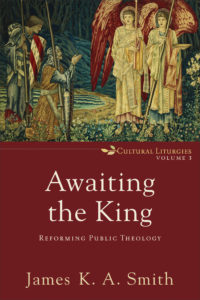
Awaiting the King: Reforming Public Theology James K.A. Smith (Baker Academic) $22.99  I have written at great length about why this third volume in the acclaimed “Cultural Liturgies Project” is worth wading through, why it is so very important, why it deserves to be considered one of the very best books of the year. It is by turns serious, a bit dense, but then playful and powerful. As with the others in the trilogy, Smith draws on the Kuyperian neo-Calvinism that has been so influential in our lives here and moves our conversation about worldview and cultural transformation towards liturgy and loves and embody faithfulness in but not of the world God so loves. In this hard season of political strife, it is particularly important to double down and study public theology well, and Smith is the perfect public intellectual, caring for the common good, aware of the ideologies around us, and eager to help GOd’s people be both faithful and fruitful in our public witness.
I particularly like that Smith is so very clear about his own theological heritage and the tradition in which he stands but he is generously and insightfully astute about others, Catholics, the Radical Orthodox movement, black liberation theology, and more. This is the mark of an excellent book, I think, and I applaud his considerable gift in being able to do this.  Agree or not with all of it, this is a very important book, and a fine one, and I urge you to consider it.

Of course, we’ve named the more accessible one-volume summary of the whole trilogy, You Are What You Love: The Spiritual Power of Habit, one of the books of the decade, so if the three big ones are too daunting, start there. In any event, Awaiting the King is a masterpiece of writing that wonderfully teeters on the edges of being scholarly and popular, prophetic and pastoral, academic and relevant. Kudos to Smith and his publishers at Baker.
For what it is worth, there’s a handsome paper slipcase we have for the trilogy and one can by all three in that nice boxed set.  It includes Desiring the Kingdom: Worship, Worldview, and Cultural Formation and Imagining the Kingdom: How Worship Works and Awaiting the King: Reforming Public Theology. $66.99


BEST MEMOIRS and CREATIVE NON-FICTION
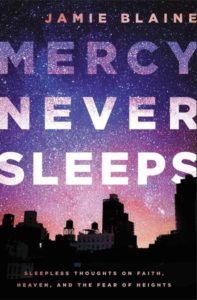
Mercy Never Sleeps: Sleepless Thoughts on Faith, Heaven, and the Fear of Heights Jamie Blaine (Nelson) $16.99. I hope you know Blaine’s amazing book about being a late night psychiatric counselor (and roller-rink manager) that we’ve promoted heartily the last two years.  This is his newer one, reflections on his small-town, Southern lifestyle with his ponytail and heavy metal tee shirts, his fascination with pinball and helping hurting people.  Maybe God still moves in mysterious ways, he says, when he (again) realizes his life isn’t unfolding as planned. As it says on the back “a twist of fate places the late-night psychiatric crisis guy on 24/7 call, his insomnia ramps up to desperate stages as he veers closer to becoming the very kind of person he’s trying to save.

This is a story of self discovery, a memoir of faith, both hilarious and heartbreaking. It’s one heck of a wild story for anyone who has felt like they were losing it, “lost and stumbling” and a “field guid to making peace with your own rambling path home.” If you liked Midnight Jesus you’ll love Mercy Never Sleeps. It’s one of the best of the year.

I love the cover, too, those deep stars. Nice job.
Grace for Amateurs: Field Notes on a Journey Back to Faith Lily Burana (Word) $22.99. This is one of the most memorably books I’ve read all year, certainly a personal favorite, and a title that I am eager to share with those who have an open mind and want to listen in on the faith journey of a feisty, progressive, hurting, hilarious woman who is vivid in following Jesus in some unusual ways.  Lily starts the book telling of her depression — the meds aren’t working as they used to — and her desperation as she seeks for a sign from God. Her sister is a PC(USA) pastor and she has some Catholic relatives so not unfamiliar with faith.  After what seems to be a bona fide miracle and her subsequent conversion she searches for a church (meeting with folks at Tim Keller’s NYC church, but not joining because they aren’t fully inclusive of LGTBQ folks) and continues one describing her ups and downs on this new faith journey.

Lily Burana is an excellent, colorful writer — she reminds me a bit of her friend Nadia Bolz-Weber — who has penned three previous books, one about her previous life as a stripper, another about her good marriage to an Army soldier, and a novel entitled Dagger. So, yeah. She’s, uh, interesting, to say the least. Grace for Amateurs has been described as “a collection of linked essays that chronicle her spiritual recovery.” Her world may seem a bit eccentric for some, but it’s a beautifully done story with lots of passion and pathos.  I truly loved it.
Pray for Me: Finding Faith in a Crisis Rick Hamlin (FaithWords) $20.00. You may know Hamlin’s name from his long-standing work at the ever-popular Guideposts or his amazingly written, well-reviewed 1997 book Finding God on the A Train. Yes, this book is a narrative about needing intercession and there is much to learn about the spiritual disciplines of listening prayer. The foreword alone is a brilliantly written, insightful rumination on how distracted we are when we attempt our daily quiet times.  But is is more, much more, than a story of needing prayer.

Pray for Me is the well told tale of a mysterious illness, of the confusion of the unknown, of our health care system, of family and friends and love and grace in times of trouble.  As Sue Monk Kidd writes,

Here is a compelling story about a man suddenly leveled by a mysterious illness who grapples with fundamental questions of faith and prayer. Pray for Me is an utterly relatable book full of honesty and hope.

Really smart folks have appreciated this lovely book — there is a great blurb on the back by historian Thomas Cahill —and those who like good writing will adore it. Rick Hamlin, one observer says, “is the largest-hearted of men.” This makes for a powerful read when he struggles with doubt and re-discovered the deeper insights about prayer. This is a restorative, healing book. 
Reclaiming Hope: Lessons Learned in the Obama White House About the Future of Faith in America Michael Wear (Nelson) $25.99 Although we often stock this book in our politics section, for obvious reasons, I want to here award it a very honorable mention in this category of memoirs. Michael is a friend — he was good enough in his busy schedule to do a book talk and signing for a small group here at the shop — and he has much insight about a balanced, Biblical, non-partisan view of Christian political life. His experiences in, and his hard decision to leave, the Obama White House, is reported well here as he tells his story of coming to faith, learning about racial issues, growing to care about civic life, eventually working in the Obama campaign, and then taking up his role as one of the youngest ever White House staffers. He gives blow by blow coverage of many things that happened that first term with the first black President. Michael weighs in, wisely, I think, about what it means to be an evangelical Democrat, and how to navigate differences of theology and public policy on hot button issues from same sex marriage to abortion to religious liberty cases.

Wear talks about the integration of faith and politics well — he has done his homework and knows the best thinkers and activists and organizations that think about Christians and government —  but the heart of this book is his own story, his brave story, of being a young man who wants to enter public service and, as a fairly young Christian, joins in this historic episode in American public life.

Michael experienced first hand many of the things we have read about in the news magazines and his telling has a clear view, his writing has a nice voice, as they say.  This is a memoir of political service, a faith journey, a story of finding and losing one’s vocation. No matter what your own political views, I think you’ll be captivated by this honest story of living with faith in hard political years and how he discovered renewed hope. Highly recommended.
Hunger: A Memoir of (My) Body Roxane Gay (Harper) $25.99 Most of the memoirs I write about here are those of people of faith, Christians who perhaps come to deeper insight about their lives as they journey along the life of faith, curious and unpredictable as it may be. If there is value, and great reading pleasure, in listening in as others narrate their lives and makes sense of their days, what about those who narrate their lives with reference to God or Biblical truth about redemption?  Obviously — I hope BookNotes readers think it is obvious —all people made in the image of God have a story to tell and there is often great worth in reading about how others unfold their stories, for better or worse.  And, interestingly, many of my very favorite books are these kinds — not mere factual biography or autobiography of famous people, but accounts of more ordinary folk telling the tale of how they make sense of their lives, often in light of hard times, struggle, pain, loss.

Roxane Gay is a brilliant literary star these days, with a best-selling collection of brilliant essays (Bad Feminist), a collection of short stories (Difficult Women) that, although often vividly sexual in nature, are luminous in their excellent writing, and also a highly regarded 2014 debut novel.  Hunger is her memoir, telling of being gang-raped by classmates as a 12 year-old, how that effected her life, especially regarding her now seriously overweight body.  Although this gripping story is hard to read — obviously the decades long aftermath of the sexual violence, about which she had not spoken previously, is heart-wrenching, but her descriptions of her own struggles with obesity and body image and food and eating is painfully, exceptionally moving. Her describing the difficulties of being a large woman on the road (as a public speaker, doing author readings and book panels and appearing at forums on race and feminism) is eye-opening and compelling. Her range as a storyteller — from well-crafted, beautiful lines to often very straight-forward, prosaic reporting — is exceptional and her abilities as a writer are remarkable. There is a reason she has become famous within the literary world, although now her artful wordsmithing seems to have taken somewhat of a back seat to her advocacy as a voice for those who are fat, her voice on issues of feminism and rape culture, and, of course, about her own journey as a dark-skinned Haitian-American.

Hunger is about her life, her body, her desires (and yes, her family and her work and her lovers and friends.) It is certainly one of the most memorable books I’ve ever read. God bless Roxane Gay.
Struck: One Christian’s Reflections on Encountering Death Russ Ramsey (IVP) $16.00. I must say that most days I am not at all interested in books about after-life experiences, close encounters of any kind, the dramatic stuff about going to heaven and such. This book is not one of those, but I thought it might be. I knew this impeccably responsible publisher with high literary standards wouldn’t do anything dumb, let alone anything shallow, and the great cover drew me in, so I took a look. And, man, what a book!

I now see why this book is short-listed for the upcoming Gold Medallion Awards; it is a very well written and theologically astute story about a Presbyterian pastor who needs emergency open heart surgery (from a bacterial infection that destroyed his mitral valve.) It is a “profoundly eloquent journey” that starts with this telling observation: “When my doctor told me I was dying, I came alive.”

However, this being alive is only part of the story — he admits to anger (including at people who disappeared during this needy time in his life) and he explores how hard it was that the dangerous surgery happened on his 18th wedding anniversary. The post-surgery depression and the spiritual questions about near-death stuff are raw and real.

I very highly recommend Struck.  I’m not alone, either — the blurbs on the back are curiously diverse (which is always a good sign, I think) with raves from Leif Eager (the remarkable author of the novel Peace Like a River) and Barnabas Piper (who has a great book on curiosity, by the way) and singer-songwriter Sandra McCracken. Ramsey wrote a book about Jesus that I really liked, by the way, called Behold the King of Glory. This is a raw story of fear, depression, loss, grace, and hope and a very fine memoir.  

Danger, Man Working: Writing from the Heart, the Gut, and the Poison Ivy Patch Michael Perry (Wisconsin Historical Society) $18.95. I’ll admit this isn’t exactly memoir, although Perry is a born storyteller, he has a remarkably vivid sense of place, and is self-aware enough to ruminate (sometimes tenderly, sometimes with brutal honesty, sometimes with hilarious goofiness) on his own inner life and personal attitudes.  So these are short pieces in the vein of one of my very favorite books from last year, Roughneck Grace: Farmer Yoga, Creeping Codgerism, Apple Golf, and Other Brief Essays from on and Off the Back Forty (also a collection of rural life pieces from the Wisconsin Historian Society magazine.) Beth thinks she liked Roughneck better, but we both adore his writing and his stories.

 Danger, Man Working revisits common themes for Perry — cleaning the chicken coop (that would be the building about which he wrote in his full-on memoir, which we loved, Coop) and messing around with his vehicles (like in the bigger book Truck: A Love Story.) He does share a New York elevator with a group of supermodels, and I don’t think he’s ever written about that before. So, it’s not exactly a memoir, but these short pieces are so well written and so telling about his life as a part time farmer and local fire department guy, and so much about his daily shenanigans that I think it qualifies to be listed in this field known for very creative nonfiction.
By the way, I think I want to celebrate and maybe even award his brand new one, that came out in November, with some kind of an award — best funny book about Farmer Philosophy and the Meaning of (Rural) Life? —  but I have to admit we haven’t read it yet. Can I give a tentative award to Montaigne in Barn Boots: An Amateur Ambles Through Philosophy (Harper; $25.99.) If it’s awful, I’ll take it back, but either way, I’m sure I’ll write about it again. Stay tuned.  


BEST BOOKS OF BASIC DISCIPLESHIP AND CHRISTIAN FAITH FORMATION
Disruptive Discipleship: The Power of Breaking Routine in to Kickstart Your Faith Sam Van Eman (IVP) $16.00. We’ve thought long and hard about this as it is a genre of books of which there are thousands; dozens are very, very good and we are hard pressed to name just a few that can be life changing, helpful, well-done and inspiring. So this is a hard call, as there are just so many worthy books that can help us in our daily discipleship and ordinary Christian living.

Further, I don’t want you to not take this seriously because I’ve already said, in more than one review at BookNotes, that Sam is a dear friend and a local guy who works for CCO. I admire him very much and respect his work as a leader of experiential education, wilderness trips, mission experiences and more.  But, whether it looks like I’m cozying up to him because he’s a pal or not, I am convinced this is one of the best books of this sort I’ve read in years.  It is interesting, Biblical, well-written, and pushes us to allow God to transform us in ways that are both a bit outside the box and yet utterly sensible.

I hardly know of another book that reminds us of what fancier books might call learning theory or pedagogy, and makes a thoughtful case for experiential design; that is, being intentional about what really transforms us.  We know from Jamie Smith — You Are What You Love and Imagining  the Kingdom — that just learning new content and absorbing into our brains new ideas isn’t adequately transforming. New life don’t come from new ideas alone. Sam helps us understand why and, better, pushes us towards arranging fresh projects to kickstart our Christian growth.  He shows that breaking routine, disrupting things a bit where we have to rely on God or think about our faith or practice new habits, really are the learning contexts where real Christian formation happens.  He tells great stories of adventure education and ordinary family situations and common experiences in small groups or among friends, where lasting growth happened and folks emerged more mature in Christ.  Do you want more faith, hope, love? Do you desire to get out of the doldrums and actually go somewhere in your faith this year? Do you want to get that extra bit of jolt to drive you to deeper faithfulness? Disrupt things a bit. Sam has your back. This book can be your field guide.

As Mark Scandrette (of Practicing the Way of Jesus and  Belonging and Becoming: Creating a Thriving Family Culture) puts it:

Disruptive Discipleship explores how to get unstuck and say yes to the good reality we were created for. We don’t learn or grow by getting new information. We have to risk experimenting with new practices, experiences, and challenges. Sam Van Eman is an enthusiastic, honest, and seasoned guide to this adventure. 
Adopted: The Sacrament of Belonging in a Fractured World Kelly Nikondeha (Eerdmans) $16.99. This creative boundary-crossing, multi-disciplinary book deserves any number of awards as it is so, so good, and covers so many topics and categories. It is, officially, I suppose, theology. But it really isn’t academic and not that sort of rigorous scholarly exploration, so it feels more like “basic Christian growth.” It is about adoption, so it’s a family book. The author — as I explained in a previous BookNotes column — is an adoptive mother in Africa so it is also about international justice, bi-racial stuff, practical theology of the global sort. Her reflections on being adopted —both literally into her family as a child and adopted by God, as a metaphor for salvation — are thoughtful, generative, important. That she offers this theological voice as a mom, in Africa, makes it simply remarkable and not a little bit thrilling.

I want to tell many about this book and it would be a shame if it falls between the cracks, too serious for basic Christian living readers, seemingly not textbooky enough for serious theology students, not practical enough for self-help parenting selections but a bit too much about home and family for serious social justice folk. It could fall through the cracks, but let’s hope it works the other way around — each of the sorts of readers should consider it, and it really will be a great read for those interested in social justice, in theology, in spiritual formation, in daily discipleship, in family studies, in global concerns.  It is about belonging, and that is a phrase pregnant with meaning, ripe with all kinds of fruit.

Brian McLaren is right to say that “Kelley Nikondeha writes with the heart of a poet and a theologian.” She writes as an orphan and adopted child and as a young adoptive parent. “Who could have guessed,” Brian writes, “that her story could give such rich insight into theology, family, society, racism, fear, and belonging?”

Listen to what Christian Cleveland says:

Part memoir, part theological exposition, Adopted: The Sacrament of Belonging in a Fractured World expands our understanding of what it means to be the family of God. As both an adopted person and an interracial adoptive parent, Kelley Nikondeha writes with transparency, tenderness, and racial awareness. This wonderful book will illuminate a path for all people to experience sacred relationships.
Recapturing the Wonder: Transcendent Faith in a Disenchanted World Mike Cosper IVP) $17.00   I don’t know Mike Cosper but I feel like I should — I’ve awarded as a “best Hearts & Minds book of the year” his last three books. I truly loved his 2013 book on worship Rhythms of Grace: How the Church’s Worship Tells the Story of the Gospel and his 2014 book The Stories We Tell: How TV and Movies Long for and Echo the Truth (both published by Crossway; $15.99 each.) And now this, his magnificent Recapturing the Wonder. He’s a very fine writer, a solid young thinker. He obviously cares about solid theology that can help us understand how to faithfully indwell the unfolding Biblical story in a way that helps us make sense of and work for the renewal of secular culture. That is, he’s my kind of guy.

This new book reminds us that, in fact, there isn’t exactly anything called “secular culture.” “This is Our Father’s World” the old hymn says, and Cosper understands this. But something is fishy these days, our modernist story has somehow disenchanted the world; we don’t need Charles Taylor to tell us that (although he helps, and Cosper has read him.) Recapturing the Wonder puts it squarely on the table: what does it mean to live in a world that is ablaze with God, that is created and good and should bring us great joy? How does our faith in the supernatural —transcendence! — help us see and live life in a way that opens us to awe and wonder and joy and God? I love this book and you should too.

There are some mature reviews on the back cover, from Russell Moore and Karen Swallow Prior to Matt Chandler (who says it is “deeply spiritual, easily accessible, and creatively written”) but I like the simple promise of Kyle Idleman:

Pulls you in from the first story of a tomcat catching a raccoon and keeps you reading until the final challenge to live the good life, You will love it.
Spiritual and Religious: The Gospel in an Age of Paganism N.T. Wright (SPCK) $15.00. How glad are we that N.T Wright’s first book — released under his common name “Tom” in the 1990s in the US as Bringing the Church to the World and long out of print — is now available in a revised and updated edition. The Brits at SPCK have happily seen to it that that previous book, with its trenchant critique of new age thinking and alt-paganism so popular in that era, finds a home again, now, when “spiritual but not religious” is the religion of choice of so many. That expression is well worth pondering and there have been many who have critiqued it harshly and many others who think the church can merely accommodate itself to relate well to those spiritual longings and find easy fellowship with that sort of vision.  Wright, here, wisely, I am certain, does a bit of both, offering hard-hitting critique of the notions of spirituality that are essentially pagan, and yet offering pastoral care for those stuck in worldviews and lifestyles that are, finally, not life-giving or coherent. 

Can we “bring the church to the world” by understanding the ethos of the times. Can we deal well with the zeitgeist without being overly harsh or needlessly cavalier? Can we speak the truth in love?  Wright says yes, we can and we must and shows us how, here, by offering this analysis of the spirit of the times and this call to not “water down the distinctives of Christian faith.” It is what some have called “an urgent book for the times” and one that is “passionate, brilliant, filled with hope.” It shows us how to really be “the church for the world.”

We tried to say that back in the early ‘90s when this unknown author had this rather bland looking book from a publisher house that at the time wasn’t particularly known for exceptional theological books. It came and went and we felt badly that we never really sold it much.

Years later, we want to give a louder voice to our intuitions then: this is a very important book by a very important author, one that will help us reach out well, understand our faith as it stands in contrast to other views of faith and spirituality, and will allow us to understand the Triune God. Can we worship God well, form Christian community that are about Christ’s Kingdom, and that can both renounce idolatry and offer good news of real hope to a confused culture? Spiritual and Religious: The Gospel in an Age of Paganism can help.
The Remarkable Ordinary: How to Stop, Look, and Listen to Life Frederick Buechner (Zondervan) $16.99  One need only read a few pages in to this book to hear that classic voice of Buechner, the Presbyterian minister who was called mostly to be a writer, and who was short-listed for both the Pulitzer and the prestigious American Book Award. He has that cadence and that oddly plain sort of phrases; he is telling how some people are clear about their jobs and how he sometimes envies, them, those who can reply. You know, people like “sausage stuffers.” I have to admit I didn’t see that coming and it made me smile.

He is a fine writer, and honest storyteller, and it is a publishing occasion of great, great note that editors somewhere found these previously unpublished lectures.  These chapters — all but one never published before — were drawn from his famed “Laity Lodge” lectures and presentations given in the 1987 Norton lectures. He was at the height of his fame, perhaps, and are the top of his game. And now, we have what is essential a new book from those years, a publishing event, indeed.

The theme of this is classic Buechner — we are all living ordinary lives but it all really is quite extraordinary. We have to “listen to our lives” and pay attention, noting the beauty and grace all around us, even despite the great woundedness we know and the sorry we carry. Buechner has told some of his own sorries in his many memoirs and he has addressed the hurts of the world often. (See the new compilation of stuff he’s written about that noted above, A Crazy, Holy Grace.) But here, in this Remarkable Ordinary book, he really does invite us to see what God is doing in our lives, to uncover the plot of our life’s story, to see “the sacred opportunity to connect with the divine each moment.”

Some of this is memoir and storytelling, as you would expect from a writer like this. Some of it is theological rumination that is profound, but not scholarly. Some of it nears contemplative spirituality, but it isn’t exactly about mindfulness or prayer, at least not mostly.  Some of it is actually about his own calling as a writer and how he connects with artists.

We honor this good book not only for its own wonder and insight but for the project itself, for the folks like John Sloan and Caleb Seeling and folks at Zondervan who saw the value in introducing this notable writer of considerable talent to a new generation. For that, this surely deserves a huge shout out from all who love the printed page, who appreciate intelligent religious writing, and who are glad for books like this gracing the marketplace. Kudos one and all.
As Kingfishers Catch Fire: A Conversation on the Ways of God Formed by the Words of God Eugene H. Peterson (Tyndale) $24.99 There are many people who name some of Peterson’s many books (for instance, A Long Obedience in the Same Direction or Working the Angels, or his book on David, or the one on the Psalms as a way to pray, or Reversed Thunder, a marvelous book on Revelation. His five volume set of “spiritual theology” are mature and extraordinary, weighty books anyone serious about Christian faith should work thorough. I am not alone, certainly not alone, in saying that he is one of the more substantive, popular writers of our day.  His autobiographical memoir is called Pastor and that is how he mostly wants to be remembered.

As Kingfishers Catch Fire is a lovely hardback collection of  nearly 50 sermons and lectures Peterson gave in the early days of his church planting days at Christ Our King Presbyterian Church in Bel Air, MD.  This is where is all started, where he wrote his first books and cooked up the idea for The Message, there among, as he puts in, Kittel and coffee cups. Although preached nearly sixty years ago, these sermons (some of which reference the race riots of the last 60s and the Viet Nam war) would stand up in any pulpit today.  Reading them now will edify any pastor, Bible scholar, or church member who needs an eloquent diet of solid, interesting, mature spiritual theology.

We want to award this a special honorary mention because it may be the last book we have from Pastor Pete. At least that is what we’ve heard.  If so, it is a beautiful and sizable contribution, a very good way to bookend his prodigious publishing ministry.

Here are the sections, with seven sermons under each, accumulating almost 500 pages of good bread for that long obedience in the same direction:

  • He Spoke and It Came to Be: Preaching in the Company of Moses
  • All My Springs Are You: Preaching in the Company of David
  • Prepare the Way of the Lord: Preaching in the Company of Isaiah
  • On Earth As It Is In Heaven: Preaching in the Company of Solomon
  • Yes and Amen in Jesus: Preaching in the Company of Peter
  • Christ in You the Hope of Glory: Preaching in the Company of Paul
  • In the Beginning was the Word: Preaching in the Company of John of Patmos

I like the endorsement of Glenn Packiam (of New Life Church in Colorado Springs) who says this:

There is no one who has done more to shape my ‘pastoral imagination’ than Eugene Peterson. Now, through this extraordinary collection, we see how words become pastoral work. An exegete and a poet, Peterson opens up to us not only the text but its world, welcoming us to walk with Moses, David, Isaiah, Solomon, Peter, Paul, and John. And as we do, we find ourselves keeping company with Jesus. Read it devotionally; read it as a study in sacred storytelling; read it to come alive along the Jesus Way.

Congratulations to Eugene Peterson.  And kudos to the good folk at Bel Air Presbyterian who, as he says, “listened with appreciation to my sermons for twenty-nine years, and their prayers were a substantial factor in what was preached.”
Vintage Saints and Sinners: 25 Christians Who Transformed My Faith Karen Wright Marsh (IVP) $20.00 There is so much to love about this book I hardly know where to begin. I think I will just reprint some of what I wrote when I discussed it in a previous BookNotes.  My enthusiasm hasn’t waned — this is a great book to dip in to, to learn from, to live with as you realize these older Christian folks can speak into our own lives.  This is great stuff, award winning, in our view.  Here is some of what I said before:

It is handsomely designed, from the cover to the matching inside flyleaves. It is well written.  It teaches about saints we’ve heard of and some we haven’t.

Another thing to love — there is a stellar, wonderfully-written foreword by Lauren Winner. I’ve read the whole introduction twice and just have to share this paragraph, that heads off at the pass a concern some of us may have about a book of hagiography:

In part because saints live in weird relation to the world, inviting saints into your life can be tricky. Indeed, reading about a saint can occasionally induce despair. I read about the heroism of Sophie Scholl, and the demons who accompany me on my daily rounds perk up and say, “If the standard is staring down Hitler and being guillotined on treason charges, why not admit that you’re not really trying to live like Jesus at all? You can even consistently remember to bring canned goods to church on the first Sunday of the month.” And then the demons are off to the races, explaining that I’m a pathetic excuse for a Christian and suggesting that instead of praying Evening Prayer, I rewatch the second season of House of Cards.

And then Winner says, in a move that surprised and helped me:

Here’s the thing to say to those demons (I manage to say it about one-third of the time.): I don’t read the saints in order to imitate them. I read about the saints because they show me something about myself.

Winner advises that we read Marsh’s Vintage Saints and Sinners while noticing what saints hold your attention. Some will intrigue you, some might repel you. Winner suggests that the Holy Spirit is involved in adjudicating this process. She says, “I suspect that over our lives, each of us is given two or three or four saints with whom to live in particular intimacy. Your three or four will be different from mine because you’re gifted in ways I’m not, and because you’re damaged in ways I’m not. Which saints is God offering you, to help illumine and burnish your particular gifts, and to help illumine and heal your particular damages?”

Well, Karen Wright Marsh is a perfect guide for helping you learn about and find some saints to accompany you. She is an excellent writer and a fine historian and has been working on this book, it seems, for a long time, learning and growing into these varying visions of a life well lived for God. Marsh herself has a philosophy degree from Wheaton College and a in linguistics from the University of Virginia. She is the cofounder and director of Theological Horizons, a university ministry that has promoted theological scholarship at the intersection of faith, thought, and life since 1991. Her husband is Charles Marsh, himself a Bonhoeffer scholar and a vibrant historian of the civil rights movement. They are both involved in the UVA “lived theology” projects.

This is a wonderful resource, years in the making, I gather, and one of the Best Books of 2017. Cheers!

BEST YEAR-LONG DEVOTIONALS
Gift and Task: A Year of Daily Readings and Reflections Walter Brueggemann (WJK) $20.00. I have longed thought this would be an amazing resource — a page a day collection of short pieces by Walt, based on the lectionary readings. Of course whether you are a lectionary-fan or not, this is a page-a-day set of short pieces by the one who is arguably the most important Biblical scholar of our day. His evocative and controversial works have riveted us for a generation, now, and to finally have a short way into his fertile, Biblical mind is a true gift. This book has been long awaited and wished for.  Three big cheers!

Not too surprisingly, Walt says this in a very moving forward, as he describes to things that distinguish this set of reflections:

First, I have written reflections that are intended for serious church members who are willing to consider in critical ways the cost and joy of discipleship. This means that I have resisted any temptation toward a more generic “devotional.” Because most materials offered in that genre are, in my judgement, quite romantic. Second, while I have not imposed much critical scholarship on the texts, I intend that may exposition should be citric all responsible and not excessively accommodated to popular itches.
God’s Wisdom for Navigating Life: A Year of Daily Devotions in the Book of Proverbs Timothy & Kathy Keller (Viking) $20.00 It is hard not to want to recognize, celebrate and award every new book by this prodigious author and former pastor of a church plant in Manhattan that has attracted thousands of sophisticated, often unchurched, New Yorkers. Keller has a worldview that allows him to see God’s hand in all things, that recognizes the Lordship of Christ in all areas of life, and that desires Biblical fidelity and cultural relevance in ways that bear fruit for the glory of God and Kingdom of Christ. He’s thoughtful, eloquent, sophisticated without putting on urbane airs. I like him immensely and respect his writing.  This daily devotional, handsomely designed with gold edge pages and ribbon marker, like last year’s wonderful Songs of Jesus on the Psalms, has he and his wife, Kathy, ruminating a bit on each section of Proverbs. It is wisely not just a simple meditation on each and every Psalm in order, but it groups them thematically. This is solid from a textual view (Calvin Seerveld taught us years ago that our notion of reading each individual Proverb like some Ben Franklin-esque aphorism isn’t literarily right) and makes it more useful, too, plumbing a wise theme about this or that topic of life.  This is not simplistic or cheesy or romantic “inspiration” of the sort Brueggemann mocks above. It offers solid, beautifully done, helpful, if brief, readings for each day of the year. Highly recommended.

BEST THEOLOGY BOOKS
Rethinking Faith, Works, and the Gospel of Jesus the King  Matthew W. Bates (Baker Academic) $24.99  Agree fully or not (geesh, even understand it fully or not) this is a extraordinary contribution, a great book, what New Testament scholar Michael Gorman calls a “bold, provocative… a much-needed corrective.”  As you may guess (and if you read in this field, you’ve surely heard about this as it has been widely discussed) that it struggles with the question of “cheap grace” and what it really means to be saved by faith alone, if that faith is, in fact the Biblical sort that demands fidelity, works, embodiment, service. Scot McKnight — who calls it “an outstanding book” wrote the good foreword, saying:

The superficiality of American evangelicalism’s gospel-obsessions with security and assurance has led me at times to wonder if the should not teach justification by discipleship. Or justification by faithfulness. But Matthew Bates has landed on a beautiful and biblically sound term: allegiance.

Obviously, faith is, Biblically speaking, more than mere intellectual assent, but trust. Not what we sometimes call “easy believism.”  And Bates’s rethinking of whole-life discipleship loyal to King Jesus is written, as Gorman reminds us, with scholarship offered out of “zeal for the Kingdom and concern for the church.”  Right on!

The erudite professor Michael Bird of Ridely College in Australia, and a very active and significant evangelical theologian, says:

Bates forces us to rethink the meaning of faith, the gospel, and works, with a view to demonstrating their significance for true Christian discipleship. This will be a controversial book, but perhaps it is the controversy we need.

Joshua Jipp of Trinity Evangelical Divinity School shows that this isn’t shallow grandstanding or over-the-top speculation, and illustrates why we want to honor it as one of the most important books in this category this year:

Bates makes a powerful argument that the New Testament writings find their climax in their portrait of Christ as the enthroned king. The right response to this king is not simply trust or intellectual assent but rather wholehearted allegiance. Bates’s reframing of faith, works, and the gospel is a necessary correction to prevalent distortions of Jesus’s gospel. This is an important argument written by a creative, careful, and trustworthy biblical interpreter.
Engaging the Doctrine of Creation: Cosmos, Creatures, and the Wise and Good Creator Matthew Levering (Baker Academic) $44.99   Levering, who holds his PhD from Boston College, is a well-respected Roman Catholic theologian and Biblical scholar. He is respected across the theological spectrum as is indicated by the rave, rave reviews on this serious work from voices such as Bruce Marshal (of Perkins School of Theology at Southern Methodist) and Kevin Vanhoozer (of Trinity Evangelical Divinity School) and the orthodox scholar David Bentley Hart (who writes for First Things) and Lewis Ayres of Durham University and the Neo-anabaptist Scot McKnight (who says it is “the best of Catholic Theology by the best of Catholic theologians.”  Of course many fellow Catholics have raved about this as well.

For instance, listen to John Cavadini, the McGrath Institute for Church Life professor at the University of Notre Dame:

This book is breathtaking in its scope and astonishing in its erudition and creativity. The doctrine of creation suffered gradual attenuation in the theology of the twentieth century, and this book–engaged with modern science and philosophy but not limited to that engagement–is a welcome and refreshing accomplishment in retrieval and reinvigoration. It will prove useful in undergraduate and graduate education alike as well as for any interested educated reader

Who wouldn’t want to honor a book that is considered “breathtaking” and “astonishing”?

Although readers of BookNotes will know why I’m drawn to this — the goodness of creation as the “theatre of God” (as Calvin put it) that is ordered by God and upheld by Christ is a chief truth about reality and everything we do — I like that it resonates also with other concerns we have about how to understand our life and times and how the Bible story can give shape to our own lives.

Listen to this rave review by Reinhard Hutter of The Catholic University of America and how he notes themes that are so very important to us:

Engaging the Doctrine of Creation is an illuminating ecumenical symphony of a vast array of splendid theological and philosophical voices from the Christian past and present, which have been gathered and prompted by Matthew Levering with his unique gift as a theological conductor. Levering unfolds once more the sublime and unfathomable depth, height, and breadth of the Christian doctrines of creation, fall, and redemption. In light of widespread contemporary doubts about the creation of the universe, the intelligibility of original sin, and the possibility of redemption, this book is of immediate relevance for every serious student and teacher of Christian theology, whether Protestant, Orthodox, or Catholic.
Contours of the Kuyperian Tradition: A Systematic Introduction Craig G. Bartholomew (IVP Academic) $40.00. I will admit that I haven’t even read all of this but I know it is a resource I will cherish for the rest of my life. This offers, in broad, but serious, theological tones, a sweeping overview of the contours of the worldview we have embraced, the vision of life which has informed us deeply. I have written elsewhere, most HERE, how learning about this Biblical vision of whole-life restoration brought on by Christ’s Kingdom — described often as “creation re-galned” and “all of life redeemed” — helped shape our own sense of calling and why we have the bookstore as we do.  From Christian engagement with the arts to Biblical thinking about social justice to our ecumenical theology to our interest in philosophy and cultural criticism, to our many resources about vocation, calling, work and serving God in one’s careers, all of this has, in one way or another, be influenced by those who have been influenced by the neo-Calvinism of Abraham Kuyper. This is doubtlessly the best overview of Kuyperian thought and the best theological foundation for moving more deeply into that rich tradition.

As the author of the magisterial, definitive biography of Abraham Kuyper, James Pratt (who wrote Abraham Kuyper, Modern Calvinist, Christian Democrat) put it,

Craig Bartholomew has given us this clear, thorough overview of Kuyper’s original insights, their further development, and their relevance in the postmodern world.   

I wish I could think of very clever name for the award we want to give to this outstanding and important book. I am sure that those who don’t know much about the famous Dutch statesman and activist and pious devotional writer will find this book an engaging, important introduction. I hope it is read by those curious about all this. Those who see themselves as Kuyperian or reformational will know it is simply a must-have volume — come on, order it soon!  Contours of the Kuyperian Tradition is indispensable, significant, deserving of great accolades. Maybe our little, small-town (“de kleine luyden”) Best Book Award will help.  Kudos!

BEST BOOK ON ECUMENISM
Costly Love: The Way to True Unity for All the Followers of Jesus John H. Armstrong (New City Press) $15.95   This is a beautiful, good, important book and I’m not sure quite where to place it. It isn’t simplistic Christian living, although it is not an academic, scholarly theology text for the guild, either.  It is somewhat about church life, and the vision John has is clearly the ecumenical relationships among the whole Body of Christ — I hope your congregation or parish cares about such things. Armstrong wrote what I still take to be the best book on ecumenical concerns a few years ago, somewhat inspired by a piece by J.I. Packer, called Your Church Is Too Small: Why Unity in Christ’s Mission is Vital to the Future of the Church.  It might be said that this is a sequel; or, maybe a prequel. How do we get to a bigger vision of the church, an inter-denominational sense of unity, unless we learn to love across our differences? From the famous call to love one another most poignantly given in John 13:34, Armstrong not only tells us how we are to be one with one another, living in love, but how this is, in fact, a central concept of who God is, God’s own identity.  He roots our work for unity in the character of God.

What Christian of any age doesn’t know this, that God is love? Who doesn’t know the great, central love command, to love God and others?  But yet, important as it is, when have you last read a somewhat sustained, serious study of this topic?  For many, we never have!

The unity we have as members of the church of Christ is a gift and a obligation; we are to steward the reality of the oneness that is a given in Christ, but to do that we have to, as we say these days, “live into it.” Costly Love will show you how.

We tip our hat to John and his Act 3 Network and their latest project The Initiative. We honor his faith, his work, and, now, his recent book,  Costly Love, one of the most important of 2017. Order it today.

BEST BOOKS OF PERSONAL SELF-IMPROVEMENT
Ordering Your Private World: Revised and Updated Gordon MacDonald (Nelson) $16.99. I have said everywhere I’ve gone this past half a year that this new edition of a classic from the 1970s, is truly one of the most important books I’ve read. MacDonald’s clear-headed prose and illuminating storytelling and wise instruction about priorities and boundaries and the health of our interior lives made a difference for me decades ago, and re-reading some of it again reminded me of how very, very glad we are that MacDonald is still writing. We stock all of his books and it is hard to pick a favorite; this one has sold over a million copies and, now with contemporary revisions and a new study guide, Ordering Your Private World should reach a new generation of readers, or refresh those who need a straight-forward reminder of the value of rest, prayer, study, using our time well and what it means to live “from the inside out.” There is no doubt that our public effectiveness is deeply linked to our inner resources. This book deserves great credit and you would be wise to spend some time with it. 
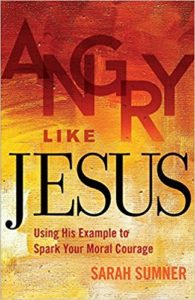
Angry Like Jesus: Using His Example to Spark Your Moral Courage Sarah Sumner (Fortress) $16.99 I want to honor this book for any number of reasons, one of which is I don’t know too many books on the mostly theologically liberal ECLA Fortress Press that have endorsing blurbs from J.I. Packer and former managing editor of Christianity Today Katelyn Beaty.  I am glad to see a mainline denominational house publishing a woman mentored by Carl Henry and Dallas Willard. So that’s worthy of celebration.

More importantly, this is a great book, very thoughtful, balanced, wise, helpful. It’s not a simplistic self-improvement book informed mostly by popular ideas but is deeply shaped by engagement with the Biblical text. Listen to what John Burke (author of No Perfect People Allowed: Creating a Come as You Are Culture at Church) says of it:

As I have found with all of Sarah Sumner’s writing, this book makes you grapple with deep theological thoughts in hard-hitting, practical ways that will change your life for the better. Sumner brilliantly unmasks the false idea that anger and love can’t go together, and, in the process, helps the reader become more living precisely by showing us how to be angry in healing ways.

I bet you know somebody who needs this; maybe it would make a good study for a group, opening us up more generally to being more healthy about how we express our emotions. This is a very fine resource, highly recommended.  Three cheers.
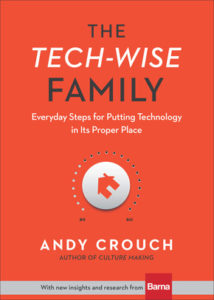
The Tech Wise Family: Everyday Steps for Putting Technology in It’s Proper Place Andy Crouch (Baker Books) $13.99 We have a handful of other fine books on this topic that have released this year and we are glad. Parents we know — heck, oldsters like ourselves! — are trying to figure out how to handle wisely the whole world of devices, digital culture, the role of screens and computers.  Most of the best such books realize that there is a deep question about lifestyle, embodiment in the world, postures of cultural engagement, and a host of other background stuff rather than merely the question of, say, on-line porn or texting while driving. But I am confident that there is no book on the market that paints the bigger picture as helpfully and succinctly as this wise little book by my friend Andy Crouch.  It is nothing short of marvelous, a truly wonderful book and one I cannot say enough about to anyone, everywhere.

Yes, it is mostly about parenting, and yes, it looks at key principles and practices that can be embraced in the tech-wise home.  But, again, whether you are in a family with children or not, “reclaiming real life” in a virtual world is a task for all of us these days.

If you follow BookNotes you will not be surprised to know that we want to award this as one of the very best little books of 2017. It follows Andy’s other important works ( all three of which are among my all time favorite books —Culture Making, Playing God, and Strong and Weak) as titles that are eloquent and thoughtful and enjoyable.

Listen to what Shauna Niequist says:

A vision for family life and faith and character so compelling and inspiring that it made me weep, made me reconsider many aspects of our home, made me profoundly thankful for this beautiful and important book.
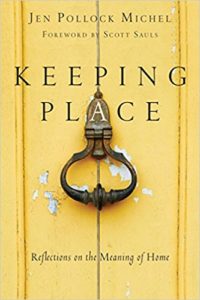
Keeping Place: Reflections on the Meaning of Home Michel Jen Pollock (IVP) $16.00 Nearly written as a memoir, this beautiful paperback is an evocative call to a sense of place, to remember our homes, to be home-makers that are hospitable and caring.

As one reviewer put it:

Home is our most fundamental human longing. And for many of us homesickness is a nagging place of grief. This book connects that desire and disappointment with the story of the Bible, helping us to see that there is a homing God with wide arms of welcome — and a church commissioned with this same work.

We loved Pollock’s last wonderfully-written book, Teach Us to Want: Longing, Ambition & the Life of Faith which we awarded as a Best Book of 2014. Congratulations, Jen, and thank you, for inviting us into your own ruminations on homemaking and place-keeping, in this wonderful, wonderful read. Keeping Place is surely one of the Best Books of 2017.
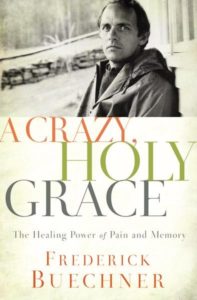
A Crazy, Holy Grace: The Healing Power of Pain and Memory Frederick Buechner (Zondervan) $16.99. Okay, I’m just going to say it: how can we not award a new Frederick Buechner book with a “best of” award? Granted, much of this has been previously published (there is one fully new chapter that had never been released) but it is compiled and pulled together expertly by editor par excellence, Caleb Seeling, gleaning from Buechner’s larger body of work and give us this one, fine, themed volume. That is, in Crazy, Holy Grace, we have a collection of Buechner pieces from his various books on why God is silent in the midst of pain, how he himself sorted out the hauntedness of memory, the relationship of grief and grace.

You may know that in a set of on-going memoirs Buechner told secrets from his family, including the story of his father having committed suicide when Buechner was a young boy. He writes about what it means to “steward our pint” and how the “magic of memory” can heal old wounds.  Loss comes to all of us, he reminds us, but we are not alone. This new collection of various pieces from nearly a dozen different books where Buechner has addressed these mysteries, compiled together, make it seem like a very coherent, fresh new work. We should be grateful.  One of the great publishing gifts of the year!
Walking Through Twilight: A Wife’s Illness – A Philosopher’s Lament Douglas Groothuis (IVP) $17.00  Every year there are exceptionally moving memoirs of illness and loss, grief and recovery. I could list five others that are deserving of awards for their honest portrayal of these hard, hard matters. Some very good writers use their abilities to convey what it is like to go through unspeakable hardship and we are the better for it. Although these sorts of books are often tender and vulnerable, the best offer no simple answers as we struggle with the meaning of it all.

And yet, there are those, like this one, that are written not only by devout Christ followers but also by professional scholars, theologians, philosophers, and they bring to the writing a certain passion for answers and a certain eloquence and attentiveness to what matters most.  I think this amazing book, which I have not yet finished, by a professor of philosophy at Denver Seminary, is one of the best of this sort I’ve read this year.

Groothius has written widely about philosophy, about apologetics, about ethic issues that arise in our postmodern culture. He knows his away around the world and is well equipped to write about heavy stuff. (Don’t you love a book that maturely but accessibly introduces the value of studying theology with a title like Philosophy in Seven Sentences?)  But, of course, as we can easily imagine, it is a somewhat different matter when the pain hits close to home.

Groothius’s once-brilliant wife Becky has been hit with the ravages of early on-set dementia. As Doug opens his heart and life and journey to us we come to realize deeply the losses experience by both Doug and Becky and how they descended into this deep darkness.  There is excellent writing here, but also incisive thinking.

Listen to what some other thoughtful reviewers have said, to see why we want to honor this book as one of the best books published late in 2017. Fellow apologist and evangelical thinker J.P. Moreland writes:

To be honest, I’ve never read a book like this. It overflows with deep reflection on the suffering of life and the apparent absence of God at the very times we need him most. But the specialness of this book lies in Groothuis’s raw, unfiltered, and bewildering expression of emotion pain, agony, confusion regarding the journey of his dear wife, Becky, and its impact on Doug’s own pilgrimage. There are no cheap Christian slogans, no slapping of a Bible verse as a Band-Aid on a near-mortal wound, no simplistic happily-ever-after. But there is hope. Hope built on deep reflection about Christianity, suffering, and the meaning of life. To me, this is the best book my dear friend has ever written. Its healing powers will penetrate your soul as you slowly read through its pages

Or consider what the esteemed Os Guinness writes:

Would I write as Doug Groothuis does here? Could I even begin to? I was profoundly humbled by this memoir. Philosophers are all about clear thinking, but the classroom is beggared by the anguish described here with such searing honesty, such poetic insight, such intense clarity, and such unconquerable hope.

In the brilliant preface, world-class philosopher Nicholas Wolterstorff explains the value of the book, framing it by the notion of lament.  Nic knows this well, as he wrote his own small journal called Lament for a Son which his young adult son died unexpectedly in a climbing accident. That small journal remains a godsend for many, and it is notable that Nic added his voice to those supporting Grootihuis’s poignant book.

We wish this family well and commend this book to you.

BOOKS FOR SPIRITUAL FORMATION
Four Birds of Noah’s Ark: A Prayer Book from the Time of Shakespeare Thomas Dekker, edited by Robert Hudson (Eerdmans) $17.99 Again, this is one of those books that I have talked about often this year, and that is deserving of a huge award (or more than one award.) From the beautifully crafted design, the cover and fonts, to the back-story of how this little-known literary classic came back in to print, Four Birds is a book-seller’s dream. I think it is a book-lover’s dream, too, and many of our customers have agreed. What a joy to have and to hold. Congratulations to Eerdmans (and poet and Bible scholar Robert Hudson) for daring to bring this nearly-lost volume back to print.

As I’ve written before, Four Birds of Noah’s Ark was written amidst the black death in the very early 1600’s in London. Each set of prayers—beautifully crafted, Biblically-rich, theologically-mature — comes from one of the four birds, each around a constellation of concerns.  It’s a curious metaphor and structure, but what is most interesting is that this prayer-book full of these four different sorts of prayers, was in print for centuries, finally going out of print in the early 20th century (1924 to be exact.) Hudson rediscovered it, edited and adapted it withjust a bit with some helpful annotations; his own preface is itself glorious, by the way, and repays repeated readings. Eerdmans Publishing Co. created a handsome volume (with two color ink and lovely engravings), bringing it wonderfully back into print after this hiatus of nearly a century. It is absolutely one of the most notable books of 2017. 

As I noted in my earlier BookNotes review, on the back cover, Karen Swallow Prior writes:

In an age of extemporaneous prayers, it is instructive and delightful to read prayers created within the word-rich age of the English Reformation and wrought with such care. Beautifully crafted, filled with human goodness and biblical truth, these are more than prayers: they are meditations, devotions, and little lessons on what it means to be human and utterly dependent upon God. This is a volume I will return to again and again.

Here is a marvelous little piece written by the editor, imagining that C.S. Lewis introduces Dekker’s prayer book (which he surely was familiar with) to his fellow Inklings at the famous Eager and the Child pub. You’ll love this imaginative essay — just ignore the dumb instructions from EerdWord at the end that fails to suggest buying the book from your favorite indie store. You know better.
Glory Happening: Finding the Divine in Everyday Places Kaitlin B. Curtice (Paraclete Press) $16.99  I have written before about our interest in what we might call “the spirituality of the ordinary.” Mundane stuff of Earth can reveal much about God and we can “practice the presence” moment-by-moments as we walk corum deo. This is one of the reasons we raved so about our favorite book of last year, Liturgy of the Ordinary by Tish Harrison Warren. This recent book, Glory Happening, seems to be akin to many of these, but yet is is extraordinary; stellar. It is wonderfully written, creative, raw, and colorful.  Kaitline Curtice is a Native American Christian author (and worship leader) and sometimes writes for Sojourners. She is a storyteller and lay theologian, a woman yo invites us to “accept the invitation — invest in the glory that surrounds you!” She helps us through these stories and prayers, to open our eyes.

The arrangement of this book that makes it so interesting is that each reflection starts with a reading, often from a curious or fascinating source. How many daily meditations start with an excerpt of Leif Enger’s novel, Peace Like a River, or Geraldine Brooks, or J.R.R. Tolkien or Louisa May Alcott or Henry David Thoreau? These good mediations at least start with a reminder of God’s glory revealed all around us from literary figures, but she also includes more classic mystics, too (Brother David Steindl-Rast or Richard Foster or Celtic theologian J. Philip Newell, for instance.) The page long prayers that follow the reflections are vivid and poetic and the books graphic design helps show them off. 

I must admit, I’m not fond of the cover — the font doesn’t grab me and the bright red flower is way too cheery. But with Rachel Held Evans saying how she was stunned by this (“every sentence is a feast for the senses”) and how Ms. Curtice writes with “the insights of a prophet and the attention of a poet” I hope you can imagine how thoughtful this is.

As Brian McLaren explains, in Glory Happening “the author walks with us into the heart of glory, asking what is means to find sacred spaces in everything.”  Hooray!
Spiritual Disciplines for the Life of the World  Kyle David Bennett (Brazos Press) $17.99 This book attempts to bring a new and needed voice to much of the conversation and teaching about spiritual formation, and it accomplishes so much, it certainly needs to be mentioned in any list of the Best Books of 2017. Starting with a wide-as-life redemption rooted in the orthodox Reformed vision of Abraham Kuyper and others who envision a reformational “common grace for the common good” sort of worldview, Bennett asks, provocatively, what do the classic spiritual practices like prayer, fasting, silence, and the like have to do with our obligation to love our neighbor? He is exploring — among other things, but not least, this — what the connection is between what some might call the “journey inward and the journey outward” and in this regard he is not the first. Richard Foster’s classic Celebration of Discipline, just for instance, certainly has plenty to say about that, as do formation standards by authors like Thomas Merton and Henri Nouwen.  Of course this is a huge part of the appeal of Richard Rohr these days.  Heck, the old Puritans had a high and holy view of God and God’s nearness and allow that to give them a robustly spiritual view of all manner of stuff (including service to others and holy sex and feasting!) So this isn’t utterly novel, but, yet, there is something going on in this provocative book that invites us to think afresh about relevant and meaningful spiritual disciplines that yield true fruit of love for neighbor.

The blurbs on the back of this book illustrate how many are taking Bennett seriously. Dennis Okholm (who has written two very good books on how evangelicals and others can learn from Catholic monastic regimens and insights) notes how this book can help us avoid “sanctified narcissism.” He continues:

Bennett’s book is a welcome corrective. He turns the disciplines sideways, and in doing so life gets oriented outward. If you take him seriously your life and your neighborhood will be changed.

Others I respect give rave reviews here — from Vincent Bacote (Director of the Center for Applied Christian Ethics at Wheaton and other of several books about Kuyper and public life) to Gideon Strauss, now a teacher at Toronto’s Institute for Christian Studies, to Rebecca Konyndyk DeYoung, philosophy prof at Calvin College and author of Glittering Vices (a truly brilliant book on the deadly sins) and the former editor of Books & Culture, John Wilson.  These lively endorsements mean a lot to me and assured me that I am not alone in thinking there is something very important going on here. Granted, I expressed a few concerns in my own review at BookNotes but that doesn’t mean I don’t want to recognize it as one of the very important releases of 2017. Cheers.
Spirituality for the Sent: Casting a Vision for the Missional Church edited by Nathan A. Finn & Keith S. Whitfield (IVP Academic) $30.00  I admire to being a bit reluctant to honor such an academic and expensive book — with a rather dark cover, no less — in a field of books designed to nurture reader’s souls, form us in intimate friendship with Jesus, and allow us to more deeply walk with God.  But, complex as this book is, it is essential reading for anyone serious about spirituality. Spirituality for the Sent carries out this theme of the “journey outward” as it is nourished by deep piety, individually and corporately in faith communities.

If this seems like a crossing of genres, here, so be it; I am sure you understand that, typically, spiritual formation focuses on the inner life of the Christian and the missional church discussions have focused on an evaluation of culture and what it means to be aligned with God’s redemptive purposes in all of life.  But it isn’t as simple as individuals leaning to pray and discern God’s Spirit and then getting busy going out, scattered in service. The two must be integrated, deeply connected. We need a spirituality of and for the sent ones.

This excellent resource brings together evangelical scholars “to address the relationships between spiritual formation and a mission vision of theology and practice.” With authors such as Craig Bartholomew, Mae Elise Cannon, Michael Goheen, George Hunsberger, Soong-Chan Rah, and Gordon Smith, we have between two covers, some of the best thinkers and writers working these days on this topic. This book deserves a number of awards in a number of categories. We’re glad to honor it here and hope many church leaders take it up and study it prayerfully

BEST BOOKS OF BIBLICAL STUDIES

May I just say that there are so, so many books that have come out in recent years that we admire by authors we respect, in so many fields within Biblical studies, and on so many aspects of the Bible. There are commentaries galore and it doesn’t seem right to compare, say, an academic commentary on Romans with a popular level reflection on the Psalms to a moderate-level guide to James.   

And, there are so many good, new Bibles on the market, study editions, fresh translations, even “Readers Editions” (without verse numbers.) Heck, I even have an reflection in a Bible — the Faith and Work Study Bible published by Zondervan in cooperation with leaders at the Center for Faith and Work at Redeemer Presbyterian.  Funny, I didn’t even know that my essay was in there, even though I thought we were familiar with this helpful study edition. A friend at a conference pointed it out to me after I denied having anything actually in the Bible.  Ha.  So there’s that.

Here are just a few stand out resources that I want to give a special shout out about for our year’s end awards for 2017.
Scripture and Its Interpretation: A Global, Ecumenical Introduction to the Bible edited by Michael J. Gorman (Baker Academic) $ 34.99. This volume is extraordinary, simple an amazing resource, jam-packed with helpful essays by a remarkable array of Bible scholars from all over the world. Edited by the esteemed New Testament scholar from Saint Mary’s Ecumenical Institute in Baltimore, Mike Gorman (author of books on Paul such as the introduction Reading Paul, and heavier works such as Cruciformity, Apostle of the Crucified Lord, Inhabiting the Cruciform God, Becoming the Gospel) this big hardback serves as a overview of varying viewpoints on how to interpret Scripture. This is such a vital topic and it is wise in any such study to hear the most responsible voices from varying places, and this volume helps us.

There are three major parts to Scripture and Its Interpretation with a handful of chapters under each. 

Part 1 is simply called “The Bible.” In this unit you get here seven major pieces about how the Bible canon was formed, what the setting of the Bible is — ancient Israel and early church — and a fascinating chapter called “From There To Here: The Transmission and Translation of the Bible.”

Part 2 is the heart of the book with over a dozen chapters from all over the world on the “Interpretation of the Bible in Various Traditions and Cultures.” Some of these authors you many not know but many are well known. For instance, we have Stephen Fowl, Joel Green and Edith Humphrey and Craig Keener and M. Daniel Carrol, not to mention a good piece by Gorman himself. There are chapters here about Roman Catholic interpretation, pentecostal hermeneutics, Orthodoxy and the Bible, and perspectives on African, African-American, Latino/Latina, and Asian as well as Asian-American interpretation. 

Part 3 is nearly worth the price of the book with these four chapters:

  • The Bible and Spirituality by Michael Gorman
  • Scripture and Ethics by St Mary’s Dean, Brent Laytham
  • The Bible and Politics by Christopher Rowland
  • Scripture and Christian Community by Jonathan Wilson-Hartgrove
  • The Bible and Christian Mission by N.T. Wright

This is a fine book, a good resource which you can dip into often for the rest of your life. Certain chapters might be quite pressing; others will be interesting and edifying if you are open to reading widely.  Some may be important to have handy so when you need them you can easily draw upon them.  We are big on this book, and happy to name it as one of the Best Biblical Studies books of 2017.
Exile: A Conversation with N. T. Wright edited by James M. Scott (IVP Academic) $40.00. Some of this remarkable book is over my head and I’ll admit that at first glance it may seem a bit arcane. But I am convinced that Biblical themes of exile are very, very important and vital authors such as Walter Brueggemann and Daniel Smith-Christopher (and, in practical ways, Will Willimon & Stanley Hauerwas) and older scholars such as Ralph Klein and Peter Ackroyd have alerted us to this. Small, delightfully practical books have come out on this such as the splendid Beacon Hill study, Embracing Exile: Living Faithfully as God’s Unique People in the World by Scott T. Daniels which in it’s own little way deserves an award for bringing such weighty Biblical themes to modern-day use for ordinary churches.

So, arcane as it may sound, this is very important stuff and Tom Wright is surely one of the most vocal and impressive scholars these days pushing a certain theory of his about Israel, the second Temple, first century Judaism, Jesus’s own self-understanding, and the ways in which exilic themes come to play in understanding Christ’s Kingdom and the church’s mission. This book, therefore, is vital, important, and, for Bible geeks, at least, certainly one of the most thrilling books of the year.

Here is some of what I wrote about it in a previous BookNotes column:

N.T. Wright has an influential and somewhat contested theory about the First Century Jews believing they were still in exile. He thinks this is very important for how to view the Jewish understanding of the work of the Messiah and therefore how we, too, should interpret Jesus’s words and work. There is a good chapter by Scott about this that sets the stage for the debate in this book and then a very good piece by Tom Wright himself summarizing his generative thesis. Those two chapters are nearly worth the price of the book.

The rest of the book has Old Testament scholars, historians of the first century Judaism culture, New Testament scholars, and theologians weighing in on this. There are about a dozen major chapters.  At the end, N.T. Wright has another great chapter responding to his conversation partners.  Scholars include well known names such as Walt Brueggemann, Scot McKnight, Hans Boersma, Ephraim Radner, and some men and women who are best known within their own speciality field.

I’m sure Exile: A Conversation with N. T. Wright deserves to be named as one of the Best Books of 2017.
Michael Williams (David C. Cook) $16.99  Thanks be to God for this very fine new study, one that finally fills a remarkable need, I think. For years we have searched for just the right sort of study for small groups and Adult Ed classes or college Bible studies that covered well the Old Testament prophets. Some are, to put it simply, too academic, while a few are too simplistic. A few are several volumes, some don’t handle all the right prophets. Some are so doctrinaire, pushing a certain theological vision while others only focus on the social justice parts.  It’s been surprisingly difficult to find works on the so-called minor prophets that are clear about their historical setting, helpful about their basic message, and that helpfully link their visionary messages to the coming of the gospel of Christ.

Hidden Prophets by Michael Williams does this wonderfully. He is an Old Testament professor at Calvin Theological Seminary in Grand Rapids (and wrote a book called How to Read the Bible Through the Jesus Lens which I think is helpful and the excellent Far As The Curse Is Found: The Covenant Story of Redemption.) What surprised me a bit about this volume is how very interesting it is, how upbeat a writer he can be, and how, at times, down to earth and funny it is.  That is, it really is user-friendly without dumbing down significant content. Williams is a profesional PhD but he’s obviously got a heart for communicating well to God’s people. I think this book deserves a very big award for being a very helpful addition to our Biblical literacy.
And It Was Good: Reflections on Beginnings  Madeleine L’Engle (Convergent) $15.00

A Stone for a Pillow: Journeys with Jacobs    Madeleine L’Engle (Convergent) $15.00

Sold Into Egypt: Journeys Into Human Being  Madeleine L’Engle (Convergent) $15.00

These three marvelously written, provocative and insightful ruminations on these primal stories from Genesis have been out of print as single volumes for years. (We have a fat paperback that has all three in one.) It is fabulous that they have been made available again, with wonderful new covers and an interesting foreword by Rachel Held Evans. Madeleine L’Engle, as you surely know, was a world-renowned author (most famously of Wrinkle in Time, soon to be released as a major motion picture), an exquisite thinker, a fine reader and writer, a poet, a children’s author, adult fiction author, essayist, memoirist, Bible teacher and librarian. She was a kind and interesting person, as those who knew her attest. She attended a small, evangelically-minded Episcopal church in Manhattan, and nearly all of her books are worth owning. These, especially in these handsome paperbacks, are certainly well-worth reading; they are nearly memoir as she relates the Bible stories to her own life.   She draws on the creation story both vividly and wisely as she takes up her own vocation as maker, pondering how the Creator God inspires us to create. And, oh how she loves joining Jacob watching the angles reaching from earth to heaven;, and how her delight gives way to vexing questions, questions about not only the meaning of angels but of the nature of blessing, forgiveness, sexual identity, and more. She wrote Sold Into Egypt during the season of deep bereavement on the loss of her husband, so “joins Joseph on this spiritual expedition as she herself moves through grief.”  They have a reader’s guide in the back, now, making them ideal for book clubs or study groups.

I think it is nearly a publishing event that they’ve been re-released and while they are not exactly academic Biblical commentaries, she brings her writer’s eye to her reading of the stories, and shows how her own life is blessed as she sees her own story within the sacred stories.  We are grateful for the chance to once again tell people about Madeleine’s Genesis Trilogy and we believe they are worth honoring this year of our Lord, 2017.
The Jesus Journey: Shattering the Stained Glass Superhero and Discovering the Humanity of God: A 40-Day Encounter Trent Sheppard (Nelson) $16.99  I am so glad we discovered this wonderfully written book.  I had recommended for a Sunday school I was teaching this fall for class participants to accompany them as they took up the gospel readings. And I can’t stop thinking about it, and a few folks told me how very much it meant to them.

Here is some of what I wrote at BookNotes last fall.

The Jesus Journey is wonderfully written, clever, curious, interesting, up-beat, honest, a great read on many level. The author is a theologian that draws on the likes of the big scholarly books of N.T. Wright and a boots-on-the-ground pastor who cares about how people learn to live. He starts off telling about how jolly old Saint Nicholas punched a guy during the Council of Chalcedon (talk about “the Santa I never knew” he quips, alluding to the Phil Yancey book.) He is utterly orthodox and believes we should care – if not throw punches – about the divinity and humanity of Christ. This book is reflection on the life and times of Jesus with a view to his humanity. There are many good books on this these days – don’t miss The Jesus We Missed by Patrick Reardon, just for instance — but this is arranged in 40 short readings. From “Jesus Had an Aunt” to “But Was He Funny?” through to the exquisite telling of Jesus’ last days and a reminder of the dance of the Trinity in the final piece called “In the Beginning” Sheppard will draw you it, give you insight, and create space for real transformation.

At the end of each reading Sheppard invites us into a three-layered process of “Ponder, Pray, Practice.” These are not just mundane or simple summaries, but wise and poignant and useful for your journey. It will help you learn more about the Jesus story and it will help you care. I am sure your relationship with God will be enhanced by this very interesting book.

Sheppard helps to pastor an urban house church called Ekklesia and oversees Alpha’s work with college students in New England. He has read very widely, draws on the best stuff, and is a great storyteller. Most important, he offers these eye-opening reflections by helping us – as the back cover puts it — “”encounter Jesus as if for the first time by experiencing his breathing, heart-beating, body-and-blood, crying-and-laughing humanity.”

I think that deserves some kind of special award. Helping us understand Jesus? Three big cheers for that. It’s one of the best books of its kind that I read this year.

OKAY FRIENDS: STAY TUNED FOR PART TWO, COMING SOON.

PLEASE USE OUR SECURE ORDER FORM (see link below) TO TELL US WHAT YOU WANT (OR CLICK THE INQUIRE LINK TO CONTACT US AND ASK QUESTIONS.) WE APPRECIATE YOUR SUPPORT.

WE HOPE THIS LIST OF WELL-DESERVING HEARTS & MINDS AWARD-WINNING TITLES HELP YOU CELEBRATE SOME OF THE GOOD BOOKS OF THE YEAR AND HELP YOU CONTINUE THE HABIT OF READING WIDELY. THANKS FOR TUNING IN.

LOOK FOR MORE OF OUR 2017 HONORABLE MENTIONS AND BEST BOOK AWARDS IN THE NEXT BOOKNOTES.  

BookNotes

Hearts & Minds logo

SPECIAL
DISCOUNT
ANY ITEM MENTIONED

10% Off

order here

this takes you to the secure Hearts & Minds order form page
just tell us what you want

inquire here

if you have questions or need more information
just ask us what you want to know


Hearts & Minds 234 East Main Street  Dallastown  PA  17313
read@heartsandmindsbooks.com
717-246-3333