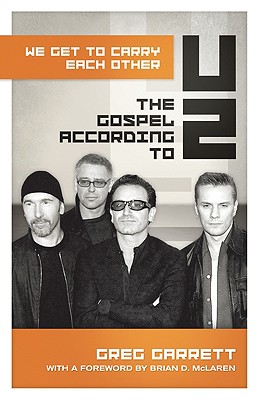
We Get To Carry Each Other: The Gospel According to U2 by Greg Garrett

When we opened our store 27 years ago, we had a media studies and pop culture section, but William D. Romanowski’s seminal Pop Culture Wars (IVP; $22) wasn’t even out yet.  We were years before the explosion of interest in religious cultural engagement, thinking Christianly about film and rock music, and while there were good titles here and there, it was rare that theologically oriented bookstores like ours featured that kind of cultural criticism.  Now we’ve got stuff like the wonderful Culturally Savvy Christian by Dick Staub (Jossey Bass; $14.95) and the extraordinary series of “Engaging Culture” released by Baker with titles like Performing the Sacred: Theology and Theater in Dialogue by Todd Johnson and Dale Savidge or Jeremy Begbie’s spectacular Re-Sounding Truth: Christian Wisdom in the World of Music.  We have shelves and shelves of this kind of good work, including books on TV and film and advertising.

 Cool and insightful writers who are very, very talented like Cathleen Falsani cite pop stars and current events in moving memoirs like her Sin Boldly: A Field Guide for Grace, published by mainstream evangelical publishing houses like Zondervan, who wouldn’t have touched a book like this two decades ago.  (And, get this–Ms Falsani and the aforementioned publisher has a study of the grace-haunted, if troubling, films of the eccentric Coen brothers coming out soon, entitled, with reference to The Big Lebowski, The Dude Abides: The Gospel According to the Coen Brothers.  I kid you not.)  But we are ahead of our story.  In the early 80s there was not an evangelical consensus to be thinking faithfully about the popular or entertainment arts, and mainline Protestant and Catholic writers had little to offer, either. “Christ transforming culture” may have been a category in Neihbur’s book that the mainline pastors knew, but nobody was doing much in this regard. Westminster/John Knox had a great little book by a Presbyterian guy named Robert Short called The Gospel According to Peanuts, though, which is still in print. I think it has sold over ten million copies.  I think they were on to something.
October.jpg

We did have an interesting record section, though, and it was always interesting to tell people about Bruce Cockburn,  ponder the mysticism of Van Morrison, slap on the latest album of Mark Heard (God rest his soul) or, eventually, edgy and thoughtful bands like the 77s or The Choir.  I will never forget, though, a thoroughly secularized friend, a guy I knew from the nuclear freeze campaign, who just couldn’t believe we stocked U2 (not to mention other Irish rockers like The Pogues or The Waterboys, but that’s another story.) October and Boy were essentials, then War and the swirling, significant Unforgettable Fire, one of the truly great recordings in rock history.   We stocked the shocking book of artwork from Hiroshima from which the album drew its name and it seemed anointed, extraordinary for speaking into the times. When a loved one went on a prayerful peace witness into the war zones of El Salvador and Nicaragua and Bono spit out the lyrics to “Bullet the Blue Sky”, it was deeply, deeply moving for me;  I did a lot of praying and plotting protests to the soundtrack of these angry young men.  Evangelical rock critics like Steve Turner, Mark Joseph, Bill Romanowski and eventually Charlie Peacock and John Fischer, all who wrote for CCM magazine, were inviting evangelicals out of the contemporary Christian music sub-culture, and a few folks understood, early on, that U2 were, in many ways, doing what we yearned for: culturally and politically relevant, faith-infused, artistically-satisfying,  big, commercial alternative rock.  And what a spectacle it has been. We Get To Carry Each Other.jpgWe’ve carried and celebrated all their stuff, even reading a section from Screwtape Letters once, out loud, to a customer who was confused by the satire of the MacPhisto devil horns in the Zooropa Tour era.  Soon enough, nearly everybody realized that these boys from Ireland with a past in a charismatic house church, were, in their own way, followers of the Christ, and were making significant contributions to global artistic and political culture, despite (perhaps because of) their tendencies towards the profane and sensational.  Who else could hang out with hawkish Republican Senators and Desmond Tutu; address British political parties, and get Bruce Springsteen involved in the Amnesty International humans rights work?  Who else could cite Bruce Cockburn and C.S. Lewis and get gigs with Muddy Waters and Frank Sinatra?  And who would call up Eugene Peterson to thank him for The Message, which he read at his father’s deathbed, which he told tens of thousands of fans night by night by night.   And who eventually would end up speaking at the MTV awards and the National Prayer Breakfast, which has been published as a small gift book (kudos to Nelson for releasing it as On the Move; $12.99) then gracing the cover of Christianity Today?
Steve Stockman, a fabulous and fun Irish theological activist, was the first to explore their faith in a major book, and did a wonderful job in Walk On: The Spiritual Journey of U2 (Relevant; $13.99) which was eventually expanded and re-issued.  Stockman knows his stuff and it is a fine little study, full of great stories and insights.  There is a great collection of sermons inspired by U2 lyrics, Get Up Off Your Knees: Preaching the U2 Catalog, edited by Raewynne Whiteley & Beth Baynard (Cowley; $14.95) that we really, really, like.  I’ve written before that many of these real sermons are great, but that four of the sermons themselves, alongside other good ones, are so incredibly rich that they make the book worth owning.  Two by Brian Walsh, and two by Steve Garber are so well done and Biblically-astute that I’ve read and re-read them.

Brian Walsh also supervised an academic thesis done at Wycliffe College in Canada on U2religious nuts.jpg which was eventually turned into a brief but very powerful book: Religious Nuts and Political Fanatics: U2 in Theological Perspective by Robert Vagacs (Wipf & Stock; $15.)  It may be the most mature stuff written One Step Closer.jpgabout the songs (and, through a friend who knows Bono, I got to give a copy that I hope got to him.)  The story of how their music helped a group cope with the grief of a dying child is stunning in its power and faithfulness, and the book unfolds from there. Excellent.
  Not t
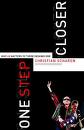
oo long ago, Yale Divinity School theologian Christian Scharen published a very solid study entitled One Step Closer: Why U2 Matters to Those Seeking God  (Brazos; $14.99.) It has gotten great reviews from the likes of Charlie Peacock and Tony Jones and Miroslav Volf and David Dark.

Do you know the British pocket paperbacks called 331/3 published by Continuum ($10.95)?  They are small books on specific albums (from Court & Spark to Let It Be, from There’s a Riot Goin’ On to OK Computer, and so many more.)  The one on Achtung Baby (the only U2 record to be done in this series) is written by a devout Catholic scholar–he quotes George Weigel, Frank Sheed, Peter Kreeft, and such—Stephen Catanzarite.

Just recently we’ve gotten one in the famous, on-going “and philosophy” series (u2 and philosophy.jpgalongside
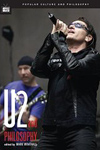
u2 and philosophy.jpg books about The Simpsons, Lost, Football, and so forth.) U2 and Philosophy: How To Decipher an Atomic Bomb is edited by  Mark Wrathall (Open Court Press; $17.95) and includes seriously philosophical works, studying U2 lyrics alongside Derrida, Heidegger, Nietzsche or Levinas.  One chapter, for instance, is called “Aristotle, U2 and the Abolition of Man: “A Feeling Is So Much Stronger Than a Thought”” and another (“Staring at the Sun” looks at a U2ian experience of Kierkegaardian despair.  Yet another studies the sense of place in The Joshua Tree.) Some pieces get pretty deep, although the one’s I’ve read are interesting, if you like that sort of thing.

Now, though, we have the best of them all, We Get to Carry Each Other: The Gospel According to U2 by Greg Garrett (WJK; $16.95. )  Garrett is no stranger to the theologically-informed study of pop culture (indeed, has co-authored with Chris Seay a book on The Matrix, one on comic books and graphic novels called Holy Superhereos! and did a recent study of religious themes in Hollywood movies which is very good.  He just released a very new and helpful one on grief called Stories From the Edge. (Is there an allusion to Mr. Evans? )  Greg Garrett is a novelist who is also an Episcopalian lay preacher, and a teacher at Baylor U.  He is more than competent as a writer and is a delight to read.  And, most importantly for this book, he loves the music of U2, has followed them for years, but has not always understood their spiritual vision.  Although he makes a case that we simply must attend to this obvious aspect of their work (even chiding a well-known rock critic for missing the obvious religious prayer of “Magnificent” off the recent No Line on the Horizon disc) he is aware that for many, this is, oddly, pretty new territory.  It is a perfect book for seekers or those who don’t usually read religious literature.  They will be surprised, it seems, to learn that there is deep theology and much Biblically-literate art, beyond the obvious in “40” or “Yahweh.”

The joy here, though, is how Garrett turns us towards the important themes of Bono and the boys, time and again, showing and ruminating on, their lyrics and shows.  With lots of lyrics cited, a few moving U2 stories (the death threat story from an Arizona show nearly took my breath away) and some first hand accounts of concerts and interviews, Garrett walks us through the career and activism of the band, helping us see the theological impulse behind their work.  Like the Christian Scharen book, he works on a particular theme in each chapter of We Get To Carry Each Other, exploring topics such as belief, communion, and social justice.  (A concluding “Ten Spiritual Lessons from U2” was a bit of a let-down, a nice little conclusion, but not as gritty, Biblical, or as richly offered as it might have been.  I wonder what you might do, though, to conclude such a book?  

bono.jpg

That Bono holds to something like an African ubuntu theology, a mix of liberationist and social gospel, pitched with evangelical fervor, should come as no surprise. He’s read the prophets, after all.  That a young theologian fluent in this stuff is able to help draw out these themes is very helpful.  There is fine theological engagement with the songs, with citations from Brian McLaren and Rowan Williams, Jurgen Moltmann and N.T. Wright, Martin Luther King and Oscar Romero, alongside the usual lyrical quotes from all the albums.  And, just as Garrett cites some unusual theologians (the desert fathers or John Bunyan or Jeremy Begbie) he cites some unexpected lyrics from some unexpected songs, too.  All in all, this is a great intro to the broadest vision of the band, and a gold-mine of inspiration for those of us who know their music well.

Is this the best and final book on this high profile and boisterous band?  No.  Is it worth reading, sharing with friends, giving to fans who might not read any other theologically inclined book?  Absolutely.  Greg has done a good job bringing together a ton of stories, interviews, speeches and press clippings, all alongside an obvious love for the music.  His own interest is contagious (and the playlists he offers for each chapter are a good touch.)  We are happy to recommend this, glad for the music, glad for this guide to the music.  Besides reminding us of this great band and their evocative lyrics and significant social activism, it reminds us that good theology is a work of the people, bringing thinking about God and life together into the issues and contexts of the day.  This is street level theology, as it should be.

Here is a great interview with Greg at the Read the Spirit website.  Check it out, and come back here to order the book (please.)  Thanks.

Greg ends his final page with a lifting from the gorgeous song Yahweh, stealing Bono’s prayer that his life be a blessing, and offers this prayer for you, the reader of his book:

Take this soul
Stranded in some skin and bones.
Take this soul
And make it sing.

Hearts & Minds 234 East Main Street Dallastown, PA 17313     717.246.3333
Back to College package with special price

back to campus.jpgYou most likely know somebody heading back to college this week, or heading there for the first time.
belushi.jpgOver the weekend, the stores were abustle with kids and moms buying dorm supplies, fresh-looking and eager for that big transition day.  I wanted to stop them and ask which college they were heading to and if they had intentions of living life for some grand story, bigger than the two noted by Melleby & Optiz in The Outrageous Idea of Academic Faithfulness.  You know we tout that as a must-read for every college student, and their fun summary of the two main narratives that make sense of college for most, has proven to be very, very helpful for not a few students.  Heck, if they just read that section, they will be well on their way to being discerning and thoughtful about the point of their college years.

Grades & Accolades may sound more promising than Beer & Circus, and I suppose it is.  But is success in the American dream really all there is?  What about that often-used quote of Frederick Buechner about our vocation being “that place where the world’s deep need and your deep gladness meet”?  Is there not some deeper, bigger reason for being in college other than just getting a job or making money?  Or having a heckuva an expensive good learning experience?  Beer & Circus, sadly, is the operative vision for most (just look at the drinking statistics, even at the most excellent schools or so-called church-related colleges!)  Few would admit that, though–who wants to be known as a hedonist?–so they buy into the story of making a difference with their gifts, the idealistic stuff of high school commencement addresses, and fool themselves into thinking they’ve got some grand hopes, even as they drink themselves silly on the week-ends.  Or, they immerse themselves in some kind of religious fellowship group, only to find it rarely connects with the real stuff of campus life.  At the end of the day (and you know this is true if you talk with collegiates) they are living into and out of a worldview that is somehow disconnected to their religious faith.  Students live for (and teachers often teach for) the less than grand dream of upward mobility, middle-class success, and getting a job that affords a certain lifestyle.  Grades & Accolades, with a bit of Beer and Circus on the side, all in service of the false idol that happiness resides in our preperations to take up our place in the economic system.  All the popular Mad Man episodes exposing the sickness of this suburban dream notwithstanding, college students don’t have a natural ability to think outside the box on this. Most of the high school guidance experiences and the zeitgist in the air (from TV ads about college, or popular movies) presume one of these two visions of the reason for college and have shaped them for it.

And so, The Outrageous Idea.  Who knew?  God cares about college? Our creator calls students to learn in order to take up vocations serving the common good for God’s sake, pointing to the coming of Christ’s Kingdom, coming on Earth, in every possible profession, job or career.  Studies, classroom work, majors and careers are intimately related to spiritual formation, and learning to see one’s college experience from the framework of an integrated Christian perspective is a key for success in the college transition.  And therefore are more meaningful than ever imagined!  Yes, the stakes are high, but God’s promises pertain, even in Soc 101 or lab sciences or Accounting or Psych or Art History level 2.  He is with us!   As I travel doing workshops on this, it is amazing how excited students get (and how some faculty are surprised) when they are invited to connect the dots between Sunday and Monday, faith and learning, college and calling. 

outragous idea of academic.jpgThe Outrageous Idea of Academic Faithfuless: A Guide for Students by Derek Melleby & Don Opitz (Brazos) $13.99 This is the best book on this stuff, and, as I’ve often said, it is interesting, well-written, fun, and although meaty, not intimidating.  Perfect for students, helpful even for faculty or others who work in higher ed.  I wasn’t kidding when I said it was one of the most important books of the year (when it came out just a few years ago) as there simply is nothing like it.  Tuck it along with your student, or send a care-package, quick.  It is wonderful and important.
There is an on-line study guide for it, now, too, along with a facebook place.  How cool is that?  (Check it out at http://academicfaithfulness.blogspot.com/)

Perhaps a bit more elegant, a slight step up, is a marvelous book called Engaging God’sengaging God's world.jpg World: A Christian Vision of Faith, Learning, and Living by the always-interesting Cornelius Plantinga, Jr.  (Eerdmans; $16.00)   I was teaching from this book this summer, and found myself underlining long passages to read out loud as it vividly and beautifully reminded us of the complexities of learning and thinking in a world such as ours;  that is, a world created good by God, distorted and damaged by sin, and being reclaimed and redeemed by Christ’s the saving Lord.  How we allow our own deepest yearnings to lead us to places of integrated learning and vocational visions in the college years is never easy, but it is rarely described so helpfully as in this inspiring work. 

I heard someone just this summer say that they wished they had read this book when they were in college.  Lovely, thoughtful, and wise, it is the sort of stuff that can truly make a difference in providing for students a framework for taking their college years joyfully and seriously.

Why College: Faithful Learning and Christian Higher Education by Rick Ostrander (Abilene Christian University Press; $12.99) is the best entry-level study of higher education from a Christian perspective I’ve yet seen.  Taking cues from his PhD mentor George Marsden (whose historic, award-winning Soul of the American University breaths throughout this smaller book) Ostrander makes an excellent case for why uniquely Christian colleges exist, and what they ought to be about.  I suppose most faculty or students or campus workers at secular schools wouldn’t naturally pick up a book likes this, but it was hard for me to put down.  Clear, concise, it is another voice calling for a worldview that is able to help students relate faith and learning, integrating Kingdom perspectives with the issues of higher education, and we commend it to all.  Rick had visited our store years ago, and is friends with some of our own best friends, so we  are thrilled to see this nice book finally released.   As Michael Hamilton of Seattle Pacific writes,
it is “Perhaps the best available introduction for students of the aims and purposes of a Christian college education.” 

Following Jesus into College and Beyond 
Jeff Baxter (Zondervan) $12.99    I know you know that we commend these sorts of books listed above for any and all college students and faculty you know.  Still, there are those who are young in their reading, immature in the faith, perhaps, just not likely to even pick up a book about academics or learning.  They would be wrong to suppose that Melleby & Optiz are hard or dry, but there ya go: the anti-intellectualism of some of our young adults, and their dualistic faith, precludes them from even thinking about reading a book, fun as it may be, about relating faith and college.  Unless it comes packaged as a self-help resource, a little book to help navigate temptations and confusions, offering practical guidance on how to get along with room mates, how to avoid bad relationships, how to suruvive and thrive.  Baxter’s book is excellent for this, in fact, although it looks like a typical book you’d give to a high school youth group member, it is a bit more thoughtful than you might think. Who am I and where am I headed? may be the cry of the young adult, and this offers insights from those who have walked down that road before.  Jeff (who lives in Colorado) calls his ministry the sacred outfitter and his cool appeal will make this a very useful book for a somewhat anxious young person. 

reason for god.jpgReason For God: Belief in an Age of Skepticism  Tim Keller (Penguin) $16.00  This may be the best of the popular books that offer a foundational approach for the skeptics and seekers, and although it is perfect for those who are unsure of their faith commitments, it is also very, very valuable for young students who just need to know that their faith is credible, that there is an intellectual tradition that affirms historic, orthodox Christianity, and that we can have good conversations about our doubts and concerns.  Now out in paperback, this would be a great gift for any young adult, but especially y those heading to the academic world where, not surprisingly, many anti-Christian diatribes are heard each and every day.  This could be a lifeline, and we suggest it urgently.

Fabric of Faithfulness: Weaving Together Belief and Behavior 
Steve Garber (IVP) $17.00  You may tire of us recommending this, and we certainly are proud I am featured in a small part of it, but we really do name this as one of the move provocative, thoughtful, important books we’ve ever read.  Steve is a writer who is both tough and tender, serious and interesting, wide-ranging and yet, finally, clear about his project: helping students learn in ways that make a difference in the long haul of their lives.  Even though Stan Hauerwas said that he thinks you should buy this for every student going off to college, it seems to me that it is best used by upper classmen, thoughtful seekers or students who are deeply aware of the call to relate faith and life in coherent and lasting ways.  If you have any professor or student life friends, this is the book to offer them, so they might see the significance of their important work in higher education.  Does the way we know make a difference? Can we sustain the stuff of our college experiences over the longer course of a life well lived?  Do the pressures of the contemporary culture, modern and post-modern, broken and sad, bear down upon us in ways that keep us from hopeful enthusiasm in relating robust faith and real life?

Desiring the Kingdom: Worship, Worldview, and Cultural Formation James K. A. Smith (Baker Acadmic) $21.99  I mentioned this in our last post, highlighting it as one of the truly significant books of the year.  As a philosophy prof at Calvin College, Jamie is all about this matter of nurturing a way of life that is intregal, that sees the habits of embodied life as a service to the God we love.  Alas, our daily habits shape our character and lives in ways that are often incongruous to vital and robust Christian faith and in this deeply philosophical study, he invites us to ask how to relate worship, life, and a radically Christian way of life. What I didn’t say in the last post was that this book emerged, in part, from his workshops with Christian faculty who have longed for a more nuanced account of their work as teachers, who have longed to be integrated not just in how they think about their field, but how they shape students into being people who love the right things, God’s things.  As Paul Griffiths from Duke Divinity School writes, “Jamie Smith shows in clear, simple and passionate prose what worship has to do with formation and what both have to do with education.  He argues that the God-directed, embodied love that worship gives is central to all three areas…”  Well, I’m not sure sure I’d say the prose is simple, but it does nicely relate this Augustian vision of well-ordered loves to the stuff of learning, and specifically to the questions raised by the basic world-and-life viewpoint encouraged by the books listed above.  Of course Jamie, postmodernist that he is, rejects a rationalistic view of learning (we are more than brains capturing factoids) and he talks quite a bit about being what Charles Taylor calls imaginaries.  Can universities help us become Godly dreamers?  A huge, huge question, and this is a book worth working on for a long school year.  Highly recommended.

BLOG SPECIAL
back to college
PACKAGE DEAL
buy
Outrageous Idea of Academic Faithfulness
AND
any other book mentioned
25% off
Order Here
Hearts & Minds 234 East Main Street  Dallastown, PA  17313  717.246.3333 
A rich week of new books: Bobby Gross, James K. A. Smith, Walt Brueggeman, Timothy Keller DVD

It has been an unusually rich week for new titles here at Hearts & Minds
and I have large regrets about not being able to keep up telling you about them all.
We cherish our many on-line friends and the supportive, book-lovin’ community
we’ve become. There are so many I’d like to tell you about in greater detail.
For now, though, some quick announcements about some meaty ones, and a great blog special discount
deal.


Living the Christian Year: Time to Inhabit the Story of God Bobby
Gross (IVP) $17.00  

living the christian year.jpg

My friend Bobby Gross called a few years ago and said he
wanted to write a book about the church calendar and the liturgical year. He was
worshiping in a small Episcopal Church in New York, active in leadership with
InterVarsity Christian Fellowship’s mature ministry with college faculty and
grad students, and I was tickled to make some suggestions of titles for his study. Alas, he has finally
come out with said book, and it is a wonderful, yearlong devotional guide, nearly unlike
any you’ve ever seen. Lush, thoughtful, wise, informative, and, yes, an
opportunity to inhabit the story. A really lovely introduction by Lauren Winner
is fabulous and there is a great bibliography (ahem) making this a truly useful
resource. Emilie Griffin calls it “a jewel of a book…” and Phyllis Tickles notes
that it is “beautiful in its gentleness and humility, this book is a gift to
Christians of all communions and denominations…” Whether you are well
experienced in living the feasts and seasons or if this is new terrain for you,
this is an essential guidebook that is very highly
recommended.

desiring the kingdom.jpg

Desiring the Kingdom: Worship, Worldview, and Cultural
Formation
James K.A. Smith (Baker Academic) $21.99

This is the first
volume in what is expected to be a grand three volume set on “cultural
liturgies.” By dipping back to his beloved Augustine, through Calvin, Kuyper, John Paul II, 
and modern poets and authors (from Cormac McCarthy, Graham Greene,Tom Wolfe and more)
he shares a lively study of how contemporary rituals, practices, and habits form
character in ways that are not consistent with the things of God. For a Kingdom
vision and way of being in the world, we must have a robust eccesiology, and
give deep attention to the rituals of worship. It is not every neo-Calvinian
philosopher of culture who has been so deeply influenced by the Pentecostal
tradition, and who attend to meaningful liturgy, and few that engage so ecumenically, with conversation partners from
Alexander Schmemann to Stanley Hauerwas and the Ekklesia Project, Richard Mouw
to Anne Sexton. He names musicians like The Indigo Girls, Patty Griffin and the
recording of Bach’s St Matthew’s Passion as a soundtrack. This is
amazingly good, extraordinary stuff, a major contribution to cultural studies
(his interaction with Charles Taylor is very helpful), clarifying what we mean
by worldviews, and how a Christian way of life can be sustained by our
worshiping communities. A must-read for serious thinkers in our day. You will
be hearing more, I am sure.


In The Beginning God.JPG

In The Beginning, God: Creation, Culture, and the Spiritual Life
Marva J. Dawn (IVP) $15.00

I have regularly said that we stock all of
Marva’s good books and will read anything she writes. This brief book was a days
respite for me and it could be breezed through in almost one sitting. I have
since come back and reflecting a bit more carefully, and it is mature and
provocative stuff, as always. These meditations on Genesis 1, 2, and 3 may miss
a few things I’d wish to emphasize but she sees things no one else as noted,
makes connections with other Biblical texts, and always, always calls us to
caring, engaged, thoughtful and faithful service of the Triune God in the church
and the world. Mark Labberton writes, “Marva Dawn’s writing turns like a
kaleidoscope of truth and grace, and this book is no exception.” Amen to that.
Join this good author in the celebration of praise at the difference God makes
in all things.


Unsettling God: The Heart of the Hebrew Bible Walter Brueggemann
(Fortress) $22.00

An Unsettling God.JPG

Where you daunted by the big and fact magnum opus of professor
Brueggemann, The Theology of the Old Testament? You were not alone: many
of us have gotten cold feet, or worse, at the thought of wading through that
thing. While this more than a serious abridgement, it is a great way into that
work. Here, they’ve expertly drawn the stuff about the character of God found in
that magisterial work, and offers a summary of his take on Israel’s testimony to
a surprising God. One reviewer says it is “a luminous and honest reading..a
masterful exposition of the fragility and resilience of covenant…” As Terrence
Fretheim summarizes, “He gathers the very important chapters on this theme from
his TOT and brings fresh testimony to an unsettling God who partners with
Israel, the individual, the nations, and the larger creation.” Highly
recommended.


Covenant Economics: A Biblical Vision for Justice for All  Richard A.
Horsley (WJK) $24.95

Horsley is known for his “anti-Empire” Biblical scholarship
(a recent one on Romans, for instance) and the faithful resistance of the early
church communities to the violence of the Roman Empire’s dominion. Although he
is not an economist, he deftly opens up what some of the Bible says about
economic justice. I still go to that central portion of Ron Sider’s classic Rich
Christians in an Age of Hunger
for a re-telling of the immense material in
the Bible on this topic. Here, from a somewhat different angle, Horsley walks us
through the Scriptures anew, with plenty attention given to first century realities, social conditions in Biblical times, with tons of scholarly footnotes. Have a Bible handy, he says, and dig in. Very,
very timely.


Prospects and Ambiguities of Globalization: Critical Assessment at a Time of
Growing Turmoil
edited by James W. Skillen (Lexington Books) $26.95

This
is a great price for a serious collection of dense essays about globalization,
gathered by one of the wisest political thinkers around today. Skillen has long
been a friend and mentor, and his balanced, non-partisan, views have been
instructive to many. He is a scholar and popularizer, a thinker and an active
citizen, a radical Christian (in the neo-Calvinist tradition, generally; 
progressively evangelical and Reformed) who desires to offer a thoughtful and
deeply integrated scholarship to his faithful work. This gathering includes chapters by
Alice-Catherine Carls, Charles Glenn, Dennis Hoover, Rodney Ludema, Steven
Meyer, and Max Stackhouse, and, of course, a very important piece by Skillen.
Covering topics as diverse as education, the military, economics and
cultural shifts, this multi-disciplinary volume is a helpful contribution to an
on-going conversation about the discernment of our times, and a faithful
direction for Christian discipleship in public life.


Secret Faith in the Public Square: An Argument for the Concealment of
Christian Identity
James Malesic (Brazos) $27.99

Leave it to Brazos Press to
once again make us think, long and hard, about faithful discipleship in these
trying times. This is bound to be misunderstood and controversial, and
I’ve not gotten through enough to say what I think, except to say: “get a load
of this!” Malesic (PhD, University of Virginia) and a prof at the Kings College
in Pennsylvania, makes the case that we have nearly ruined the watching world’s
perception of the gospel, in deed, nearly ruined the gospel itself, by allowing
it to be too tainted by political ideologies of the left and right. He suggests
that there is hardly any way to live out Christian faith wearing one’s faith on
one’s sleeve, without running the large risk of being “absorbed and prostituted
in our voracious secular culture” (as Rusty Reno put in on the back.) This may
be a “form of therapy” as we disassociate our public witness from worldly
accommodation, and allow us to live out public life in fresh and surprising
ways. Obviously, the real truth of Christianity cannot be reduced to a political
pin on a politician’s lapel (or a protester’s sign.) Granted. Is his call for
concealment the answer? This really is worth considering and talking about.


Prodical God DVD.jpg

The Prodigal God: Finding Your Place at the Table DVD Timothy Keller (Zondervan) $24.99

We cannot tell
you how we esteem this thoughtful and energetic and very smart pastor working in
the hip corridors of Wall Street and Soho. From his faithful efforts doing
Biblical teaching and mature worship in lower Manhattan (and on-line where he
has such a huge following) he has earned the right to be taken very seriously.
His small book of last year of the same name was quite nice and truly helpful as
we uncover the healing power of the gospel; Jesus’ call, especially, to
the “older brother” who seems to not appreciate grace, has unlocked this famous
story for many readers. Happily, we now have Keller teaching in a six-part DVD
curriculum. You can buy the DVD, and a participant’s discussion guide ($9.99), even a whole kit ($54.99) with the book, all of the above and an
extra spiffy audio CD and rom, a leaders guide, a video trailer to promote it, and such.
Good stuff, but at least check out the DVD. Highly, highly recommended. Praise
be to God for such solid work. His excellent New York Times best-selling
Reason for God is now out in a trimmer sized paperback ($16.00.)
We still have some of the nice hardback that we are selling for the paperback
price, while supplies last. Great deal on an exceptional study of faith in an
age of skepticism.

BLOG

SPECIAL

25%

off any two items mentioned

10%

off any one item mentioned

ORDER HERE

or call

717.246.3333

Hearts & Minds 234 East Main Street Dallastown, PA  17313

Books about learning to care, service, missions & justice

Our July monthly column is up at the “Reviews” section of the website.  It is an interesting and important list of books on learning to care, servanthood, missions, social justice and such.  We describe a real variety of books, and in a brief introductory note, invite you to spread the list around if you know anybody that might find it interesting.  The toothbush thing was no joke, either.  Heaven help us.

Here are a couple of the titles I described.  I’ll betcha there are some you haven’t seen before, and some that might inspire you.  Please see the whole list, offered at a discounted price.  Thanks.

hearing the call across traditions.jpg
selfless way.jpgtouch.jpgwhen helping hurts.jpg

deep justice journeys.jpg
compassion.jpg
justice project.JPGcommitment and connection.jpg

Patrick Keefe’s speaking engagement a great success; see The Snakehead video clip and some evangelical books on immigration

The book signing today went famously with maybe 150 in attendance!  Author Patrick Radden Keefe is a sweet guy, a class act, and a very, very smart fella.  As Pulitzer Prize winning journalist Seymour Hersh wrote about his earlier book, Chatter: Uncovering the Echelon Surveillance Network and the Secret World of Global Eavesdropping:
 

“It is absolutely thrilling to see someone as young, as competent, and as gifted as Patrick Radden Keefe…we need more of this kind of work.”

If Hersh wanted more beautifully crafted, socially significant, globally oriented, investigative journalism—that captures insightfully the complex nexus of human drama, public policy, and social justice–The Snakehead  is it.  It continues to garner great reviews.  Patrick was reviewed nicely in the book section of today’s Washington Post and his time here in York was stellar.  We had some great speakers respond to his reading, and a good group of the Golden Venture passengers came in for the event.  That workers in church-based and other nonprofit refugee groups, legal humans rights advocates and immigration reform leaders showed up for our gig in York was thrilling.  That so many local friends came, to hear again of our advocacy, as told through the voice of Mr. Keefe’s fine writing, was even more thrilling.

Thanks for those who bought the book, for the supportive emails, for your interest in this book which offers the largest backstory ever, for a project that consumed years of our lives here in York.  It really means a lot, and we are blessed to have a writer like Patrick telling our story. Did you know I was cited talking about this Golden Venture detention in Their Blood Cries Out, Paul Marshall’s watershed book on religious freedom issues in the early 90s? (We don’t stock used books, but this work is so seminal and urgent, it is one of the very few titles we keep a stock of used ones here,since it is now out of print and hard to find.)  We talked with Gary Haugen of world-famous International Justice Mission (IJM) about this in the early 90s as he was starting his extraordinary work against trafficking.  Further, I’m interviewed in Steve Garber’s well-received book, The Fabric of Faithfulness: Weaving Together Belief and Behavior (yep) speaking about our work with these Chinese detainees seeking political asylum. It has been on our hearts and minds for years, now, so thought our BookNotes friends should know. 

You can browse back and read what I wrote yesterday about The Snakehead and why it is important to us, and for anyone interested in the deepest questions the American experience (and a special thanks to those FaceBook friends who prayed that it get in our local paper.  It did.)  Do check that out if you haven’t.

If you want a short visual version, though, this movie clip is Patrick speaking about the book, the drama of the underworld of organized Chinese crime, the wreck of the Golden Venture, and the twists and plots that lead him from Chinatown to China, Burma, Thailand, Kenya, South America, to York, PA.  It is a great little video.   I can happily call Patrick and his wife our friends, and hope you take a few moments to watch the video.  If you want to order the book, please see the special price from last week’s blog special.

By the way, since many of our readers have an intentional theological bent, and may want aChristians at the Border.jpg more integrated Christian perspective, may I recommend the two best books on gracious and faithful immigration views we’ve seen in recent years.  The first is written by another friend, M. Daniel Carroll, R., and is called Christians at the Border: Immigration, the Church and the Bible (Baker; $16.99).  It came just last year, as immigration issues were growing more contentious, the first book on the subject by an evangelically-oriented publisher. Danny spoke at the Pittsburgh Jubilee conference in February where he spent considerable time with us at the book table.  A dear, dear man, a solid Biblical scholar (he teaches Old Testament at Denver Seminary) and a passionate writer, I trust his heart, and his knowledge.  This is the book to start with if one wants a compelling, informative, faith-based introduction to this complex issue.  I think it is very fair treatment;  it admits to complexity, yet moves towards generosity, rich with theological integrity.  Even if you don’t agree, it is important.  Kudos to Baker for doing it!

Welcoming the Stranger.jpgWelcoming the Stranger: Justice, Compassion & Truth in the Immigration Debate by Matthew Soerens & Jenny Hwang (IVP; $15.00) is the best work yet done from an evangelical perspective.  Matthew Soerens is an immigration and citizenship counselor at World Relief Dupage in Wheaton, IL and Jenny Hwang is director of advocacy and policy in the Refugee and Immigration Program of World Relief in Baltimore, MD.  Endorsements on the back include those from Amy Black (an impeccably thoughtful and balanced political science prof at Wheaton College), Reverend Luis Cortes, Joel Hunter, and Ronald Sider, who says it is “Biblical, urgent, readable.  An excellent introduction to this complex moral issue.  All thinking evangelicals should read it.”  There is a good discussion guide, too.  Excellent.

Thanks again for reading last week’s post on The Snakehead—it means a lot to us.  After today’s fabulous book signing, hosting Patrick, and seeing so many folks who care about our Chinese asylum-seekers, we are energized anew to continue to try to sell books that can help us understand our world, piecing together the good and the bad, helping us be discerning and compassionate, and, having read well, been changed for the better.  Good books can do that.  

The Snakehead: An Epic Tale of the Chinatown Underworld and the American Dream

This is a long review that I wrote which hopefully will appear, at least in part, in our local newspaper.  It wasn’t written for a religious audience, although I think most BookNotes readers won’t mind that lack of Biblical references.

Author Patrick Radden. Keefe hopefully will be on NPRs Fresh Air later this week, and he will be doing a book launch of The Snakehead here in York on Sunday, August 2nd, since some of the story is set here.  I’ll try to get our poster about the event up on Facebook, perhaps.  Do call us if you need more information.  The store is mentioned in passing, by the way, in this prestigious new work, a book which explores Chinese immigration, human smuggling, and the treatment of those seeking asylum.  Pretty amazing stuff, in a very handsome, thick hardback.  There is an extraordinary website that Patrick has done for the book, so after reading my review, please check it out here: www.thesnakehead.com.


The Snakehead.jpgThe Snakehead: An Epic Tale of the Chinatown Underworld and the American Dream  Patrick Radden Keefe  (Doubleday; 2009) $27.50  414 pp

I can remember the conversation like it was yesterday. I recall planning the subsequent protest/prayer vigil at York County Prison, the guns aimed at us there on Concord Road, the impromptu press conference. I recall the natural leadership of my dear friend and local United Methodist pastor, Joan Maruskin as she stepped — pushed by the Holy Spirit, she might say — into the local and national limelight. I will never forget the gladness in the moment we met the savvy and passionate — ticked off with righteous indignation, he might say — small town Republican lawyer, Craig Trebilcock. It was obvious that he was willing and able to speak to prison officials and TV reporters and the array of religious human rights advocates gathered at the prison. It was early August 1993. It was one of the most important days in my life as it started an involvement with the local support group, People of the Golden Vision, gathered to demand fair asylum hearings for dozens and dozens of Chinese immigrants detained by the INS, sent oddly to our central Pennsylvania  prison.

When The Snakehead author Patrick Radden Keefe writes of that day, halfway through his sprawling epic of organized crime in Chinatown, climaxing in the study of human smuggling, including the Golden Venture detainees, my hands shook. To see an esteemed academic writer with publishing acclaim — his work gets on NPR and is reviewed at the major papers –was truly thrilling.  Our inter-faith project to provide emotional, spiritual, and pro-bono legal aid for this large group of Chinese refugees seeking political asylum as they were detained in York has been told in bits and pieces; local papers did an admirable job covering the plight of the men and women being detained and the labyrinth of government repression (in Tiananmen-era China and Clinton-era USA), not to mention the local efforts to assist them to freedom.  Our populist by-the-seat-of-our-pants uprising on behalf of fair trials and just renderings of perplexing asylum law has been written in magazine articles, a documentary film, and in the novel written by Rod Merrill, the schoolteacher turned song leader for the weekly vigils. But this prominent work — Keefe has degrees from Cambridge and Yale, and writes for the likes of The New Yorker, is, if I may say so, the big time. Local folks are rightfully very proud and eager to hear what this observer has written.

When the Golden Venture immigrants left the Fujian Province on their several month journey, one could possibly get legal, political asylum in the United States, seeking freedom from forced sterilizations and abortions as the draconian Chinese health cadres enforced the one-child only policy there. President Clinton reversed the Reagan/Bush polices, so even as the horrific stories were told, and often verified, like the heart-rending story of Pin Lin, Craig Trebilcock’s client, (well-told in The Snakehead) the INS [now ICE] refused asylum and began deportation proceedings. We had reason to believe, as did the immigrants, that such deportation would most likely lead to their severe persecution or death back in China. Our new Chinese friends, seeking the American dream and freedom from communist repression, were in very serious danger.

Our campaign did get national attention as we corresponded anyone who might help, from Amnesty International to embassies and dignitaries. We spoke with reps from Oprah, Pope John Paul II, and, through a personal friend, Tony Campolo, President Clinton himself. Hillary went to Beijing, immigration issues were becoming more contentious, yet our local story was impressive. We ended up sharing cover space in Life magazine with the U.S. Olympic Team.

Still, we struggled to tell our story, lobby, write, vigil and pray.  Rod Merrill released his CD of “Freedom Songs” and anti-Communist conservatives (literally) joined hands with ACLU liberals. Republican and Democrat congressional staffers attended our vigils by the prison (although usually stood to the side.)  We had agnostics and Buddhists and fiery evangelicals, praying, singing, working, in any way they could. I preached most weeks, my Bible still stained from rain and sleet.  Dissident Chinese leaders and journalists for the Asian presses visited.  Our guys remained in jail, the women moved to a hellhole in New Orleans, and some of us road-tripped there to visit. Year after year after year the wheels of injustice turned, slowly, as we resisted, case by case by case.

The Snakehead: An Epic Tale of the Chinatown Underworld and the American Dream is a riveting true crime expose, an exposé that took the author into the Byzantine web of the Chinese underground, an organized crime network as complex, nuanced, storied, and violent as the Sicilian Mafia.  Much of this book reads like Mario Puzo, except deals and murders happen over Chinese take-out on East Broadway in the shadow of the Brooklyn Bridge, not over wine in Little Italy. Imagine The Sopranos without the pasta.

Patrick Keefe is not only well educated, he is a smart fortune cookie, quick on the up-take,Patrick Keefe.jpg  piecing stuff together, connecting dots, able to follow his nose (as he did, all around the globe, quite literally.)  Besides his journalistic career, working with a Guggenheim Fellowship, he’s got a gig at a respected think-tank, Washington’s The Century Foundation.  In his research for the new book, he tramped the rural roads of Fujian and posh high-rises of Hong Kong. He interviewed leaders of gangs with names like the Fukienese Flying Dragons and hung out with top FBI and INS officials, some who had gone dangerously undercover learning about the Asian heroine trade. He crossed paths with those who knew the repression in Burma, came to understand the reasons for human smuggling, and, yes, grew to care for the unfortunate men and women who paid the “snakehead” smugglers huge amounts to be carried out of China and into the land of the Lady of the harbor. As their American Dream turned nightmarish and the anguished frustrations drove some prisoners to suicide, we in York redoubled our efforts at obtaining appeals, pardons, or stays of deportation. We filed injunctions and demanded public hearings.

In these years, we here in York wondered about the bigger backstory of how these immigrants ended up in the shipwrecked freighter. We had heard of the money owed to the “snakehead” organized crime leaders like Sister Ping who bought the old freighters and bribed the international harbor officials from Kenya to Belize, Thailand to Panama. The prisoners told us about the horrible conditions on the vessel, those who had died, the mutiny at sea when the plan when weird. Odd stories circulated although we had little time to explore these larger international dramas. New information, twists and fascinating surprises emerged as Keefe sleuthed around the world, digging into places no one has so thoroughly gone. The Snakehead offers this narrative, the biggest possible picture and it is at times breathtaking.

Mr. Keefe was drawn to this story, he told us during one of his research visits to York, when he covered for The New Yorker the trial of Cheng Chui Ping, aka Sister Ping, who, by the late 1990s had become the FBIs most wanted Asian criminal. To understand why the Chinese-American community (especially the prominent Fujian community) so loved her — seen even as a Robin Hood figure — Keefe followed the story into the subculture of Asian immigration, which lead him to China, Burma, Africa, and Central America. And, finally, to York, Pennsylvania.

Our local support group, People of the Golden Vision, is well described in The Snakehead and that is reason enough for shelling out for this large study. To hear about the intricately constructed “freedom birds” made by hand in the prison, to hear the stories of the men some of us knew so well, to learn about home-grown, bi-partisan activism, the way local churches were involved, and the work of members of the York Bar Association, is wonderful. I feel deeply blessed and grateful, perhaps somehow validated, to have a prominent journalist tell this story in a solid public affairs venue like Doubleday. Our group gave years of our lives to this local cause; marriages and work and churches and careers were effected. I cannot imagine how the refugees themselves, or the INS judges or other principles, will feel, seeing their names in print. It is instructive and good to read about it, whether one lives near here or not, and the author deserves our appreciation..

Keefe is not a partisan as he tells the tale. He is a good writer, a good reporter, a  well-informed scholar making him a very keen observer, and he knows enough to know that every story has many sides, history unfolds within a mix of people, places, principles, passions, policies… Was there evil-doing behind the forces that brought the Golden Vision men to York?  Yes, yes, more than we ever knew! Was there injustice shown to decent freedom-loving immigrants? Yes, yes, and Keefe tells that, too. I might have wished for more, since the local lawyers and advocates saw such abuse of raw power against the vulnerable. But he allows for various views, telling different sides and interviewing different key players in this epic story.

In Keefe’s hands, the subtitle of The Snakehead — An Epic Tale of the Chinatown Underworld and the American Dream — is shown as a story which spans continents and centuries; people are treated well, or not, as large social forces shape international affairs, immigration policy, prison conditions, public sentiments and stuff as arcane as asylum procedures and small efforts to achieve detention reforms. Topics as large and detailed as abortion, racism, human rights, crime, religion, personal vendettas, and ethnic tensions float in and around this big story. Why did some of these young men and women choose the dangers and risks of illegally leaving their homeland? Did they know they were being used by seriously organized criminal elements? Why did Mr. Clinton ignore their pleas for so long? (Why, in fact, was not the ship stopped before it ran aground, since it was being watched by intelligence?) What international issues shaped individual policy positions, and what ramifications did this have on folks in the Chinese Mafia, or our heroes being held in the York County jail?  Is there a lingering connection between anti-Asian biases in 19th century immigration law and the practices of today?

Much is learned here that is important for our times and it would serve us well to think deeply about these matters of ethnic assimilation, immigration policies, the meaning of citizenship, and how our deepest worldviews shape our perceptions of race, justice, rights, law, and hope. Much is contested in our times, and as our global realities flatten and the world shrinks, where this all will lead is anyone’s guess. We need to be thoughtful and well equipped for helpful responses.

I cried when I closed this book; obviously those named in the book, and those who were deeply involved in the PGV are invested, as they say.  Still, it is a moving story for any reader, this tale of hard and painful risk, this life-or-death voyage for freedom, this vision of the American Dream, soured by corrupt Chinese crooks and confusing U.S. public policy.  And, somewhat redeemed by local folks acting in good faith, offering hospitality and the plea for justice.

As Mr. Keefe reminds us,

Every shipwreck tells a story.  And if this particular story is in some ways an unhappy one, it is also a story about the awesome power of optimism and bravery and hope, about the many twisting paths that bring strangers to this country, and about what it means to be–and to become—American.

BLOG SPECIAL
The Snake Head
Patrick Radden Keefe
(Doubleday)
usually $27.50
only $22

we can have it autographed for you if you allow us to ship it next week

order
here

or call
717.246.3333
Hearts & Minds  Dallastown, PA


Drops Likes Stars new book by Rob Bell

I want to briefly tell you about a stunningly original book, an example of an unusual and rare commitment ondrops like stars.jpg the part of an evangelical publisher, the new coffee-table sized gift book by Rob Bell, Drops Likes Stars (Zondervan; $34.95;  see blog special price, below.)  I have to tell you that I’m not going to tell you what that title means, but you will know by the end of the 150 + page book.

The book is arranged much like some of his other boyant and interesting titles, but, well, more so.  That is, there is just one sentence on some pages, super-graphics, or tiny print, a second color or typeface, or even a scrawl or two (when he mentions that, after spraining his writing hand, he tried to write with the other for a while but it didn’t work out so well.)  There are full color photos, some rather lovely, a few of stunning art works (including one of the most vivid full shots of The David you’ll see outside of a Michelangelo art book.)  The graphics are half the joy of this moving work, this large-sized bookish equilivalent to a quirky Nooma video, with a lot of white space, which helps the eye really see…

The subtitle is important: A Few Thoughts on Creativity and Suffering.  I can hardly explain more without spoiling the experience, but this art book is a designed presentation of what seems like a Rob Bell sermon.  It is actually the companion book to a small tour he did, taking this show on the road, exploring this endlessly complex relationship between art and generativity.  It includes some Bible, some stories, some rock song lyrics, a poetry shard, an analogy or two, a quote from a contemporary artist and a funny movie quote.  A story about Johnny Cash. One about Pope John Paul.  A tender story about a child full of wonder.  All presented with very  21st century artistic visual aesthetic.

Is it therefore postmodern? Pu-leese.  It is just a very cool gift book, a coffee table resource, a book with pictures.  An allusive book with hipster design.  A wonderful story, asking about how our suffering can be redeemed, if we can be bored of life, if we can find new passion to live meaningfully, even artfully, amidst the dross and strang fo these times.

If we can see drops like stars. 

Is there a relationship between creativity and suffering?  Is our sad human condition somehow met by the God of the Bible?  Can we embrace prophetic imagination and wonder and joy, even as we lament and experience ache and brokenness?

We want to share this brand new book now, as it will be a blessing to many.  My hunch is because it is a bit unusual–the provocative design and higher price-point—-it will not be on the best-seller list of most Christian bookstores.  We want to sell it considerably reduced price, hoping you will enjoy it, ponder it, perhaps give it.

Here is an article that was in the Christian Century that explains Bell’s appeal  Here is an interesting interview from Christianity Today. His entry at Wikipedia is a good introduction, with a long list of links, including some that are critical.  Check ’em out.  

drop like stars banner.jpg 
BLOG SPECIAL
Drops Like Stars
regularly $34.99
NOW
$19.99
saving $15.00

ask for the blog special
AND: while ordering this, get any other Rob Bell book or DVD at 30% off. 
Just ask.

order
here

or call
717.246.3333
Hearts & Minds 234 East Main Street Dallastown, PA  17313

Soul and the City, To Live in Peace, A Heart for Community and other books on urban life & ministry

On Sunday I will be visiting an exciting church plant in Baltimore, helping lead some conversations on being a church in the city.  I’ve been doing some reading on this (for decades, actually.) I’m helping plan an adult education series at my own downtown Presbyterian (USA) church that we will offer this fall.  There is such great literature on this, from mainline denominations and evangelical urban ministries, from historic black and Latino churches to new stuff reflecting on the broader questions of culture, cityscapes and a theology of place.  Call us if you want to talk further… 

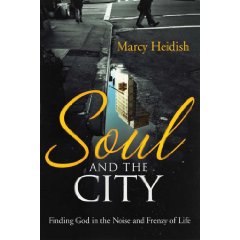
soul and the city.jpgOf the many I could write about, I have to tell you about one that I have finally gotten around to reading—oh, how I wished I had studied it when we received it earlier this year as I would have been promoting it with more vigor.  Soul and the City: Finding God in the Noise and Frenzy of Life by Marcy Heidish (Waterbrook; $13.99) is a small-ish paperback, wonderfully written, beautifully done, and is truly a book of spiritual formation.  Heidish is a great writer, cites fascinating sources to very good effect, weaving quotes and passages and illustrations seamlessly.  What is so delightful and helpful (praise be to God) is that she is so utterly ecumenical;  she will be citing Eastern Orthodox or Catholic classics like Anthony Bloom or Julian of Norwich and then tell us about A. W. Tozer;  she cites reformational scholar Richard Mouw and draws on Tilden Edwards and Evelyn Underhill.  She uses Richard Foster and Dallas Willard and Eugene Peterson, but, as a novelist herself, she knows how to use a great literary passages. I loved a passage she cited of Frederick Buechner that I had forgotten.  Her use of Spoon River Anthology when talking about the last days of her atheist father was poignant and powerful.  I want to watch Grand Canyon again, after her making note of one scene about the longing for community.

This sweet book celebrates the God of the mundane, the spirituality of the ordinary, the way incity street 2.jpg which classic spiritual disciplines can help us engage life, embrace culture, dig into our places and make a difference, especially in compassionate service to others.  Although some of her stories comes from her extensive work with homeless women, serving in shelters and community groups, much of this is just how to walk more faithfully with God when we are really, really busy, pressed and stressed.

Urban dwellers, she reminds us, have a constant sense of being pushed and shoved, of hurrying, of multi-tasking, of living in a swirl of noise and smells and possibilities, good and ill.  Her writing rings true as she talks about praying while waiting for a table at a crowded cafe, while being jammed into a too-full elevator, while breathing the fumes of diesel buses, while seeing the juxtaposition of the very well heeled and the poor. She uses screaming sirens as cues to silent intercession and she has allowed God to help her make contact with others, even on busy sidewalks. (Yes, she cites the most famous passage of mystic Thomas Merton, his epiphany of being one with everyone in that busy Louisville crosswalk.) 

downtown church.jpgShe describes her small prayerful escapes into the sanctuary of downtown churches, and she is (again) delightfully ecumenical.  I suppose she is Episcopalian or Catholic as she is so familiar with their liturgical architecture and sacred seasons.  Yet, she readily describes involvement in store-front missions and evangelical community churches;  she reads Jewish prayers and attends charismatic praise services.  Heidish gets around, has tons of urban and urbane experiences and tells her story with a light touch—there is no pride or over-wrought, larger-than-life stories.  Anyone who feels the fast pace of our high-tech world, who works in offices or commutes in exurbs, or who wonders how to be more sane within our secularized culture of power and politics, concrete and ether, noise and speed, will love her invitation to spiritual growth and inner peace, set precisely in the urban heart of our crazy times.  It isn’t about urban ministry, as such, but about contemplative practice while on the run, in the real world.

Happily, Heidish celebrates the city, too.  It is not all corruption, tension, and waste, grim and crime.  She savors the delights of the availability of various foods—she is attentive to the goodness of ethnic diversity—and art and expanding cultural horizons and diverse religious communities.  Yes, she writes tenderly about volunteering at a hospice or homeless shelter, but she also has friends in the financial industry, writes about wonderful penthouse vistas, and works, herself, as successful writer, in journalism, film and media.  (She won awards for doing the novel from which the Cicely Tyson movie A Woman Called Moses, was adapted.)  Her way with words is a blessing, making this book not only a blessed bit of wisdom, but a joy to read.

***
When I speak in Baltimore, I will surely have to highlight a few others.  Here are some.

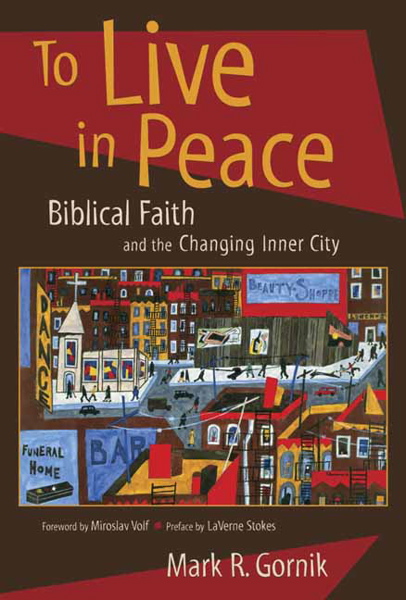
to live in peace.jpgTo Live in Peace: Biblical Faith and the Changing Inner City  Mark Gornick  (Eerdmans) $22.00  This is the best book on the subject, bar none.  Gornik tells of his years of work in Sandtown, the West Baltimore neighborhood where he moved, and the church that emerged.  This has the most profound theological orientation, the best and most energizing Bible study, and the best sociological insights of any urban ministry book on the market. Thoughtful and a bit demanding, it is the best.  Forward by Miroslav Volf.  Simply a must.

A Heart for the Community: New Models for Urban and Suburban Ministry  edited by John Fuder & Noel Castellanos (Moody Press) $34.99  The brand new collection of essays is an official publication of the esteemed CCDA (Christian Community Development Association) and it includes nearly 30 authors.  As Bob Lupton of Atlanta writes, “With cities gentrifying and poverty suburbanizing, the definitions and practices of urban ministry are changing.  A Heart for the Community is right on time.”  This includes some of the best evangelical practitioners in the nation, sharing fresh insights—very up to date!  There are other excellent anthologies of this sort;  we really recommend the one edited by the late Harvie Conn & Manuel Ortiz called Urban Ministry: The Kingdom, The City, and the People of God (IVP; $35.00.)  It is most likely the best one volume collection.  Highly recommended.

The Urban Christian: Effective Ministry in Today’s Urban World  Ray Bakke (IVP) $16.00   For a solid read, this book written in the 80s by a rural boy gone city,
is a fabulous little classic, a great place to start  I cannot tell you how I respect this guy and the reverberations of his decades in urban work.

Theirs is the Kingdom: Celebrating the Gospel in Urban America  Robert Lupton (Harper) $13.95  Tony Campolo writes, “The story of Lupton’s ministry is one of the most inspiring in America. Those of us who are trying to accomplish something of value in urban settings look to him and his co-workers as models.”  Passionate and stimulating, this is a great little classic, another that is excellent to start with;  the chapters are short, there are tons of stories, it is powerfully written. 

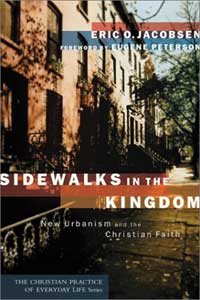
Sidewalks in the Kingdom: New Urbanism and the Christian Faith  Eric O. Jacobsen 
Sidewalks in the Kingdom.jpg (Brazos) $20.00  You may know of my love for James Howard Kunstler, the fiesty and brilliant writer who has popularized “new urbanism” in books like Home From Nowhere; his scathing critiques of the ugliness of our man-man landscapes are legendary.  Here, Jacobsen offers a very helpful, beginners contribution to how church folks can care about their towns–large or small–and how thinking about stuff as mundane as zoning and sidewalks, really matter in God’s good world.  My, my, if only folks paid attention to half of this, we’d have a more charming and sustainable and just built culture.  One need not be a city planner or architect to read this. Highly recommended.

Churches That Make a Difference: Reacing Your Community With Good News and Good Works  Ronald J. Sider, Philip N. Olson, Heidi Rolland Unruh (Baker) $21.99   Remarkable research was done among churches (in the Philadelphia area) that were doing truly wholisitic, faith-based, multi-dimensional urban ministry.  Some are historic minority churches, some are mainline denominational parishes, some are independent evangelical works.  From these truly effective congregations and their wholistic outreach, they drew principles and came up with best practices.  This really is a fabulous handbook for how to get more deeply involved, making a difference.

Linking Arms, Linking Lives: How Urban-Suburban Partnerships Can Transform Communities  Ronald Sider, John Perkins, Wayne Gordon, Albert Tizon  (Baker) $14.99  I’ve raved about this before and want to commend it again. Especially for those who are not in urban church settings, this is a missional vision that is inspiring, with lots of great stories and concrete examples of great partnerships and mutual sharing.   Biblical insight, practical wisdom, a field guide like none other, this is how to move closer to what surely God intends.  You won’t regret spending some time in these stories, being inspired to dream up new initiatives.

 New Neighbor: An Invitation to Join Beloved Community  Leroy Barber  (Mission Year)new neighbor.jpg $14.99. We have mentioned this before—it seems we are one of the few stores that are promoting this lovely collection of short pieces illustrated by stunning, full-color photography of Brian T.Murphy.  A graphically well-designed, pocket-sized paperback, these are stories–almost call and response, highlighting urban need and injustice, and neighborly care and advocacy–that hold up ordinary folks building the beloved community. This is a project of Mission Year and tells their stories, although any of us could be new neighbors.  This will show you why and how. Beautiful, in so many ways.

beyond homelessness.jpgBeyond Homelessness: Christian Faith in a Culture of Displacement  Brian Walsh & Steven Bouma-Prediger  (Eerdmans) $24.00  I have raved about this before, and I am convinced it is one of the most insightful and innovative books of my lifetime.  (Ha—my comments were even cited in a footnote in an article about the book in The Christian Scholars Review.)  Not for beginners in Christian studies, I suppose, Beyond Homelessness is nonetheless an unparalleled, Biblical-rooted view of what it means to be at place, why we are or are not at home in this world, how the ecological crisis might provide a lens for healing and transforming faith, and how a vision of God’s redemptive homecoming/restoration could allow us to better engage not only inner city homelessness, but the more general postmodern agnst of our assaulted, beloved world.  There are great Biblical interludes, remarkable stories of urban networks among the displaced and homeless, good environmental theology and a worldview that dares to believe God wants to us to care so deeply that we truly find shalom—home—here, now, granted as gift from our Divine Homemaker.

BLOG SPECIAL
15% off any title mentioned
request the blog special

order here
or call
717.246.3333
Hearts & Minds 234 East Main Street  Dallastown, PA  17313 

Books on Multi-cultural reconciliation, Racial Justice, and Multi-Ethnic Ministry

multicultural.jpg

A good friend was doing some workshops on the topic of racial reconciliation and although she has a lot of good resources, she wondered what was new and important.  I think one of the groups that she was working with was reading through the evangelical classic More Than Equals by Chris Rice and Spencer Perkins;  they knew the ground-breaking work of John Perkins, and maybe had some good stuff by Manuel Ortiz and had studied the classic multi-ethnic history of America, A DIfferent Mirror by Ron Takaki.  Many know the near classic Oxford University Press study Divided By Faith by Christian Smith and Michael Emerson.  They may or may not have seen Eyes on the Prize on DVD but I hope so…I was eager to describe some of our own favorites, a small portion of the large inventory we have on this topic.  I hope you enjoy the list, and hope you are inspired to study this topic a bit.  Read through to the end and you’ll be rewarded with a special blog discount on any of these titles. 

All God’s Children: A Biblical Critique of Racism  Steven McKenzie (Abingdon) $14.95  A powerful study, mostly Biblical, showing how the Bible dealt with race and nationalistic pride and how Christ’s church began as a racially inclusive community.  Very helpful for building  Biblical foundations.

Peppermint-filled Piñatas: Breaking Through Tolerance and Embracing Love  Eric Michael Bryant (Zondervan) $12.99  These short chapters with poignant stories illustrate various ways we can get beyond our stereotypes, and even beyond “toleration” towards authentic relationships and true Christian care.  A bridge-building message about grace, love, inclusive care, and  Godly outreach written by a young evangelical youth pastor.  Very fun, engaging and inviting.

Living in Color: Embracing God’s Passion for Diversity  Randy Woodley (IVP) $16.00  I have often said this is the best book to celebrate ethnic and racial diversity, inviting us to a multi-cultural concern, beyond issues of “black and white.” An excellent primer on the subject, a must-have resource.  Written by a passionate Native Christian, this is a very readable and solid approach.  Highly recommended.

crazy enough to care.jpgCrazy Enough to Care: Changing Your World Through Compassion, Justice & Racial Reconciliation  Alvin C. Bibbs (IVP) $16.00  This Willow Creek leader for multicultural relations has given us a remarkable collection of studies, discussion guides and lesson plans, perfect for preparing programs or for any small group to work through.  This is an expert resource, guiding us through practical issues, rooted in solid perspectives.  I cannot say enough about this fabulous and very useful guidebook.

Cultural Intelligence: Improving Your CQ to Engage Our Multicultural World  David A. Livermore (Baker) $17.99  Although this is  designed for serious youth workers, helping youth and family ministries grapple with important issues, it is helpful for anyone…I can hardly think of a more up to date and urgent book that helps us understand various world cultures, the ethnic and racial diversity common these days, and the need to have some insight about how to be more effective in relating to others. Comprehensive and accessible, proactive and helpful.  I wish I could read you the fascinating chapter titles—you’d really see how thorough it is…great!

Learning From the Stranger: Christian Faith and Cultural Diversity  David Smith
learning from the stranger.jpg (Eerdmans) $20.00  Smith wrote the important book about teaching foreign languages rooted in a Christian worldview (The Gift of the Stranger) and here he offers a broader more foundational approach to what “culture” is, discussing how cultural differences affects our perceptions and behaviors, and why Christians need a robust theology of hospitality.  He shows how Christ’s call to love our neighbor involved learning from others, including “cultural strangers.”  This is a remarkably thoughtful bit of Biblical and theological study, peppered with David’s own stories, insights, and experiences.  It is a beautiful book, a great example of extraordinary, deeply integrated thinking, a wonderful example of distinctively Christian scholarship.  Smith teaches German at Calvin College and is renowned for his perspectives on uniquely Christian theories and habits of education.  Highly recommended for the biggest picture.

Understanding and Dismantling Racism: The Challenge of 21st Century White America  Joseph Brandt (Augsburg-Fortress) $17.00  Recently expanded and re-issued, this is a demanding and serious call to rethink racial assumptions, white privilege and work towards diversity and justice.  Very impressive, highly regarded among trainers and activists.  The author has served as a pastor in an urban Lutheran church although some evangelicals might suggest the book isn’t terribly overt about spirituality or gospel proclamation.  This is not a criticism, I do not think, but a realization that he presumes much that is discussed in other books about reconciliation and justice.  This is the manual for serious work, self-evaluation, and a re-orientation of values and systems, exposing and undoing racism and its structural injustices.  Very important.  Glad for this new, updated edition, too.

The Church Enslaved: A Spirituality of Racial Reconciliation  Tony Campolo & Michael Battle (Fortress) $17.00  Tony–the passionate and humorous Baptist preacher and sociologist–combines here with an African-American Episcopalian scholar and churchman, to offer a fabulous, introductory, but very wise study.  This is hard-hitting, prophetic, and yet kind and pastoral, lifting up contemplative practices and (un)common friendship as a key to new ways of faithful discipleship.  Has a chapter on the vision and work of Desmond Tutu that is very nice.  Includes a very, very good study guide, making it excellent as a study book for congregations.

Beyond Rhetoric: Reconciliation as a Way of Life Samuel George Hines & Curtis Paul DeYoung  (Judson) $14.00  Two exceptionally important African American leaders offer us here a warm, friendly, yet hard-hitting study of not just racism, but of brokenness and alienation, inviting us to the gospel of reconciliation as a key to faithful living.  My, my, this is vital and robust stuff, solid and insightful, insisting on action, not just talk.  Very impressive.

Gracism: The Art of Inclusion  David A. Anderson  (IVP) $17.00  This is a lovely book based on grace (the play on words in the title is crucial!)  Anderson has started as vibrant multi-cultural congregation and here shows the positive way to show God’s favor to others, reaching ou
t in care and grace.  The author is rather young, quite energetic, has a Ph.D. from Oxford, and is leading his exciting Bridgeway congregation as an agent of hope.  Sweet!

heart of racial justice.jpgThe Heart of Racial Justice: How Soul Change Leads to Social Change Brenda Salter McNeil & Rick Richardson  (expanded edition) $15.00  Just a few months ago this new edition, with expanded content and a new cover, was released and many have noted how great it.  With a forward by John Perkins, this is an excellent resource not to be missed. (It has a very useful study guide in the back, too.)  It exposes important material about the racial divides that plague us, yet it firmly places these struggles within the context of spiritual warfare and spiritual transformation.  Can we allow Christ to remake us?  Can we do evangelism in a way that is truly about reconciliation?  Can we resist social and structural evil with the power of the gospel?  Can social change emerge from serious soul change?  Is there a relationship between, say, healing prayer, and working against racial injustice?

Free to Be Bound: Church Beyond the Color Line
  Jonathan Wilson-Hartgrove (NavPress) $12.99  Jon has become known as a co-author and partner-in-crime with Shane Claiborne and the other radically Christian servants in the “new monastics” movement.  He here tells his story of moving to a largely black, rural, Southern church and taking up his place among his brothers and sisters there.  Chris Rice says that this is “one of the most fresh and most important new voices in the American church.”  Shane writes that it “sings truth like old spirituals and lets you sip justice like sweet tea.”  Gotta love a book like that.  Good discussion questions, too.

Race Matters
  Cornel West  (Vintage) $12.95  Although brother West is a follower of Christ and an active churchman, this book isn’t overtly religious, published by a mainstream general market publishing house.  Yet, it resonates with the things of God, has profoundly spiritual insights about the nature of the Western culture, and is, as the Washington Post review said, “as moving as any of the sermons of Martin Luther King, as profound as W.E.B. Du Bois…as exhilarating in their offering of liberation as James Baldwin’s early essays.”  I think it would be hard to be articulate about the conversations about race in our time without knowing this significant work.  A must.

Hope on a Tightrope: Words & Wisdom  Cornel West (Smiley Books) $19.95  I note this for a number of reasons, not the least of which is the way it shows–I pithy and short excerpts with cool graphics–how West is so fluent in not only historic black literature, but in soul music, funk, raggae, hip-hop; his brilliant faith-based insights about culture and oppression is liberally enhanced by drawing on pop culture, especially the sounds of soul.  And, there is a spectacular CD of West speaking, reading, prophesying, proclaiming…pretty hip for an academic from Harvard and Princeton!  (The Smiley imprint, by the way, is the publishing efforts of PBS talk show guy Tavis Smiley.)

Reconciliation Blues: A Black Evangelical’s Inside View of White Christianity  Edward Gilbreath (IVP) $20.00 This author is an esteemed scholar, a traditional evangelical who is Black; this is a journalistic report on his experiences, beautifully written and truly illuminating.  It is bold, it is needed, and it is really interesting as he shares his story, offers his vantage point, and leads us–especially evangelicals, but it is good for anyone–towards practices of new hope.  Significant for para-church groups, or any church or organization which is mostly white who wants to be more inclusive, but wonders why it is so often hard.

consuming image.jpgConsuming Jesus: Beyond Race & Class Divisions in a Consumer Church Paul Louis Metzgar  (Eerdmans) $16.00  This is a heavy book, serious and a bit demanding, laden with mature theology and serious social criticism.  It is important the way the author places racial concerns in the broader context of class differences, and the radical call of the gospel to resist consumerism and embrace grace-even grace found in meals shared together, as we become one at Christ’s table.  Forwards by Donald Miller and John Perkins.

I Have a Dream: Writings and Speeches That Changed the World  Martin Luther King, Jr.  edited by James Washington (Harper) $14.95  This may be the best introduction to various works of King.  These passionate words can still inspire and leave us more aware, and more stimulated, to act in bold ways.  King’s name is so ubiquitous, it is a shame we don’t study his work more carefully.  Highly recommended.  Do you know his Strength to Love?  Wonderful!

Enter the River: Healing Steps from White Privilege Towards Racial Reconciliation  Jody Miller Shearer (Herald) $14.99  Jody was a young man from Lancaster (who had worked in urban New Orleans)  when he wrote this a decade ago, and it has only become more authentic, powerful, and needed.  This is a personal call to be more faithful, and an amazingly insightful essay on ways to proceed.  Very challenging and powerful.

Subverting the Power of Prejudice: Resources for Individual and Social Change
  Sandra Barnes (IVP) $16.00  Barnes is an outspoken African American scholar (professor of sociology at Purdue) who has made the scholarly work on prejudice accessible and useful for ordinary Christian folks wanting to work on this issue.  Looking at gender, status, age, race, wealth, and such, she shows how we damage others and ourselves when we presume and live out inappropriate biases.  This is an essential, intelligent and helpful contribution in the journey to being set free in Christ, agents of social change, learning to understand and disarm our prejudices and bigotry.  If you think the problem is simple, or if you think you’re well on your way, this could be a wake-up call to renewed commitment and work.

Beyond Racial Gridlock: Embracing Mutual Responsibility  George Yancey  (IVP) $15.00  Yancey has written other good books on nurturing multi-cultural congregations (which would be good to read even if one isn’t particularly passionate about starting more intentionally diverse churches or fellowships since they are so interesting and visionary.)  This one, though, is an essential read for anyone serious about solving American racial problems without simplistic answers or one-sided blame.  He shows that various racial groups have born unique pains, and have most likely lived out sinful responses in their own unique ways.  Without crass generalizations, he offers a blueprint for mutual responsibility, in ways that are at once sensible and revolutionary.  Firmly Christian, yet widely applicable, this is a brilliant and innovative contribution that is balanced and respectful.  Yancey is a young, black scholar (University of North Texas) who has earned the right to be taken very seriously.  A long-overdue, constructive proposal, fresh and provocative.

White Guilt: How Blacks and Wh
ites Together Destroyed the Promise of the Civil Rights Era
  Shelby Steele (Harper) $13.95  Steele was catapulted to fame with is elegant and controversial The Content of Our Character where, as a black man, he insists on not talking so much about race.  He makes a plea to the black community to stop what he termed “race holding” which he describes with great care.  Many felt it was wrong-headed (and it may be that it is what stirred West to insist that “race matters.”)  This newer one is classic conservative thinking, calling for an end to blaming others, insisting on self-reliance, and yet predicts that this is impossible in our time, because so many whites want to assuage their perceived guilt, by being eager to appear against racism.  He has been on the talk-show circuit describing Obama’s win in these exact terms: whites voted for him not so much because they agreed with his ill-defined policies, but simply because he was black.  Whether there is truth or insight here remains to be seen, but it is a very, very important part of the conversation.  Steele is very highly regarded among conservative pundits and his arguments make provocative, interesting, and troubling reading.

Hope & History: Why We Have to Keep Telling the Story of the Movement  Vincent Harding (Orbis) $17.00  This is perhaps my favorite one-volume study of the civil rights movement, by an esteemed activist, historian, theologian and storyteller who helps us recall why this is all so very important.  Amazingly moving!  His There Is A River: The Black Struggle for Freedom in America is a classic, too, and should be known among us.  His book on King (King: The Inconvenient Hero is brief and excellent.)

The Next Evangelicalism: Freeing the Church From Western Cultural Captivity  Soong-Chan Rah (IVP) $15.00  This brand new book is getting a lot of buzz as folks are exclaiming how important it is.  Soong-Chan is a popular professor at North Park Theological, and shows that as the global face of Christianity is shifting away from the West (as Philip Jenkins and others have shown) American Christianity must be transformed as well.  Perhaps this is ahead of its time, as we struggle for integration and reconciliation among the most obvious racial groupings of our culture, and remain confused by “America’s original sin” of slavery and mistreatment of native peoples.  Yet, his insight is true: the future is now!  Harvey Cox of Harvard says, “This book is the best and most balanced treatment of the subject now available.”  John Perkins says it is “powerful, prophetic…Rah’s message is one we need to hear and to share with others.”

This Side of Heaven: Race, Ethnicity and Christian Faith  edited by Robert J. Priest & Alvaro L. Nieves (Oxford University Press) $55.00  I mention this only for those who feel seriously drawn to important Christian scholarship; this collection of essays is fabulous, diverse, significant.  The editors are from Trinity Evangelical Divinity School and Wheaton College and they’ve included noted scholars such as Vincent Bacote, Janell Williams Paris, Peter Chao, Paul Heibert…there are many from many nationalities, offering insights from the Bible, from anthropology, from social policy, etc.  This is a major contribution for libraries (at least) and those serious about studying this professionally. 

Here are just a few that are about and for specific races, from overtly Christian perspectives.  Very nicely done.  Of course there are history books opening our awareness of how these ethnic groups came to America.  Do you know Yellow?  Or Harvest of Empire?
Or Bury My Heart At Wounded Knee?

More Than Serving Tea: Asian American Women on Expectations, Relationships, Leadership and Faith  edited by Nikki Toyama and Tracey Gee  (IVP) $15.00  This is a passionate anthology, lovely, interesting, and quite obviously helpful for Asian women of various ethnic and national backgrounds.  Eye-opening for anyone who wants to respectfully listen in…wow.

Being Latino in Christ: Finding Wholeness in Your Ethnic Identity  Orlando Crespo (IVP) $12.00  Perhaps like the one listed above, this is a must for Latino/a Christians—the only book of its kind, really–and is also a good guide to anyone who wants to be a respectful ally and friend.  Exceptional.

One Church, Many Tribes: Following Christ Just the Way God Made You  Richard Twiss (Regal) $14.99  There are perhaps more academic books, some with a more militant First People’s perspective (for instance, the work of James Treat or George Tinker), but this is the best to start with, a charismatic and engaging Native leader, reminding Indians of Christ’s call to unity and grace, following the Waymaker.   Brother Twiss is a dear man, of the Rosebud Lakota/Sioux.

Being White: Finding Our Place in a Multi-ethnic World  Paula Harris & Doug Schaupp  (IVP) $15.00  I am not sure why some white folks are reluctant to buy this, but it is a hard book to sell.  Yet, with all the talk about race, about the need to reflect meaningful on others, on reconciliation and hospitality and such, this is an invitation for white folks to do that well.  A very admirable little book, highly recommended.  I wonder if those of other ethnic groups might value its candor and insight?  Could create some good discussions!  Evangelist George Verwer says it is “a book after God’s own heart.”  Ron Sider and John Perkins similarly endorse it. 

Check All That Apply: Finding Wholeness as a Multiracial Person Sundee Tucker Frazier (IVP) $13.00  Oddly, this is a natural concern for many, but there is nothing else in print from a Christian perspective about being a multi-racial person and the unique opportunities and struggles such folk have.  Could be very useful for some, and a beautiful example of innovative Christian thinking about culture, race, ethnicity and such.

Some of My Best Friends: Writings on Interracial Friendships  Emily Bernard (Harper)  I reviewed this extensively about five years ago, when it blew me away as I read, in well-crafted, robust, stimulating narratives, the joys, struggles, pains, and perplexities of inter-racial friends.  This is not a Christian book; it includes some peculiar takes (esp the vulgar first chapter, about thugs in Chinatown, playing “the race card” during a failed hold-up.)  I found this to be exceptionally touching, honest, painful, funny, and tender.  There is something very rewarding and enriching that happens between most inter-racial friends; it is often, though, harder than imagined, and sometimes, one friend is less than candid than the other.  What a collection!  This  is now out of print, but we have just a few left…
reaching the world in our own backyard.jpg
Reaching The World in Our Own Backyard: A Guide to Building Relationships With People of Other Faiths
& Cultures  Rajendra Pillai (Waterbrook) $14.99  Okay, this isn’t precisely on racial justice or multi-cultural reconciliation, but about building inter-faith relationships, and doing meaningful evangelism with those of other ethnic and cultural backgrounds.  Still, it is a lovely resource, helpful, and insightful…It notes cultural idiosyncrasies, gestures, and sayings and such,
which will help reminds us to be caring and a bit informed.

BLOG
SPECIAL

BUY ANY ONE LISTED
GET ANOTHER FOR HALF PRICE
(less expensive selection is half price.)

please request the blog special when you order

Order here
or call
717.246.3333
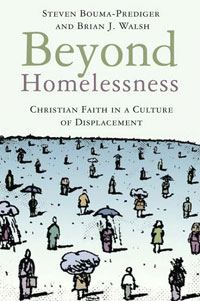
Hearts & Minds 234 East Main Street Dallastown, PA  17313

IAM does an interview with Byron about Hearts & Minds…and a recent reading list published in Comment

IAM conversations.jpgYes, the lively and friendly interviewer Christy Tennant, who works in New York for the International Arts Movement (IAM), did a set of free-ranging interviews with me on the vision behind our store, why we carry so many books on culture-making (and other stuff that typical Christian bookstores may not stock), our take on our bookselling calling and more.  There are two parts, done last April, posted alongside other really great podcast interviews**, at the IAM Conversations part of their fabulous website.  I thought some BookNote readers might like to actually hear me talk a bit…

**I’m not kidding: scroll back and check these out;  Christy chats with former U.S. Poet Laurate Billy Collins, philosopher Nic Woltersdorff, Steve Garber (author of Fabric of Faithfulness, recorded live at the CCOs Jubilee conference), jazz muscians such as Helen Sung and Deanna Witkowski,contemporary artist and IAM founder Mako Fujimura, critic and scholar Don Siedell (God in the Gallery), Andy Crouch (Culture-Making), Susan Isaacs (Angry Conversations with God)…wow!  What a resource!  I’m so honored to be interviewed alongside these stellar folks. 

This may be presumptuous but if anybody is doing any promo work for us, trying to convince their church or college or bookgroup or agency to use our services, why not cast this pod over their way?  It’s just me rambling on, sharing our love for books and explaining our work, but, well, it’s what I do. Help us if you can by spreading the word to others who love indie stores. 

Speaking of finding Hearts & Minds other places than our own blog, I just had some book
stack of books.jpg reviews published at one of our favorite on-line journals, Comment (published by the profound Canadian think-tank cardus.)

One column is actually a reprint of a clever article they published about a year ago, inviting readers to a feast of books, using the food metaphor as I list various sorts of titles–appetizers, main course, dessert, etc.  I’m glad they reprinted it.  Bon Appetit!

Here is a brand new article where I describe some recently released gems, very thoughtful books, from the extraordinary Shopcraft as Soulcraft to the newest Alain de Botton (on work)  to N.D. Wilson’s spectacularly weird and demanding Notes from a Tilt-A-Whirl.  Do check it out.

Thanks to Comment for allowing me the privilege of writing for them. They publish serious Christian reflections on issues of public concern, and usually include odd little suggestions on music, food, or ” small comforts.”  Love it!  You should subscribe, getting their good stuff weekly.