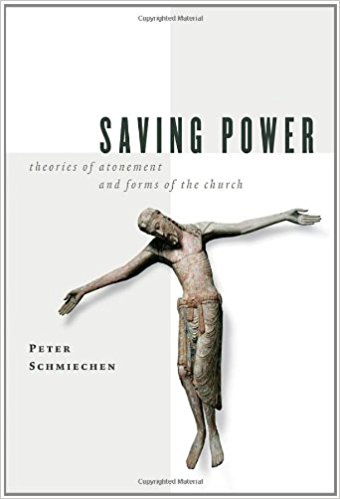
Saving Power: Theories of Atonement and Forms of the Church by Peter Schmiechen

saving power.jpgPete Schmiechen is the President Emeritus of Lancaster Theological Seminary and in the preface to this major work he notes how his work as a UCC pastor, an academic, and then a seminary President shaped his on-going passion for this important topic. It shows;  this is a serious and wide-ranging book and yet is certainly not written for the theological guild, or even for exclusive use as a seminary text, but for working pastors, church leaders and interested learners of all sorts.  The sub-title is important since Dr. Schmiechen is interested not only in learning how to explain and formulate the reconciling work of the Cross, but how that might shape pastoral practice and typologies and styles of congregational formation and church life.

The last few posts here at BookNotes have, I hope, reminded readers of our (rare, I’m told) tendency to read widely, to stock books which represent the best of various schools of thought, and to invite customers into generous conversations that might transcend some typical polarities within the Body of Christ.  In plain words, that means we sell books that are theologically liberal and theologically conservative, stuff that is classic and stuff that is innovative, books that are reassuring and books that provoke.  (I keep saying this to readers and customers, otherwise our selection may just look confused, which I suspect some fear we are.)  Further, we hope to invite customers, readers, reviewers, friends, into deeper dialogue with authors, denominations and traditions perhaps other than their own.  This question about the substitutionary atonement, Christ paying the penalty we deserve, justification through grace at the expense of the blood of the Christ who came to pay a ransom— these are important matters.  The Bible calls us to proclaim God’s good news, and we are overjoyed to announce that, for those in Christ, there is now no condemnation.  But that surely implies a backstory, a context, a situation where there was some condemnation, judgment from which we are—because of Christ—now free.  How the cross and death of Christ fits into that story—and the broader gospel Story of the coming of the Kingdom of God—is an endlessly beguiling matter.  So one more book here, again—see our special pricing offer, below.

Saving Power: Theories of Atonement and Forms of the Church (Eerdmans; $35.00) offers a thoughtful, thorough, and interesting study of ten different schools of thought regarding the way the saving power of God’s grace gets said.  These ten are grouped in four categories.  With each atonement theory, he offers a case study, and explains the critical issues that have been raised (and that he himself may have) with that approach.  For instance,  the notion of Sacrifice has as its main proponent the book of Hebrews;  Justification by Grace explores, of course, Martin Luther.  The case study for Penal Substitution is the work of old Princeton scholar Charles Hodge, about which S says, 

(he is) one of the strongest defenders of the theory, based on appeals to Scripture, tradition, and reason.  Hodge has no interest in innovation but claims only to be consistent with these sources.  It is not surprising that, for so many followers, such a formidable defense should provide legitimacy for this theory. Conversely, those who would reject this theory will have to deal with the biblical and theological sources used by Hodge.

In the mid-19th century, Hodge taught (for 50 years) at Princeton and as a leading defender of historic orthodoxy “shaped the general theological character of the Presbyterian church.”
Of course few Presbyterian Church (USA) seminaries teach him now, although he is esteemed in PCA circles. Regardless, it was an excellent choice for Schmiechen since his intellectual shadow has been cast upon most evangelicals, whether they realize it or not.

Well, on he goes, walking us carefully through Athanasius and Anselm, who emphasize the renewal and restoration of creation, respectively.  He has a chapter on the cross as reconciliation (he had an earlier book on this drawn largely from I Corinthians 1 and 2) and one comparing Irenaeus and 20th century liberation theologians.  Under the theme of “The Wondrous Love of God” he looks at Peter Abelard, John Wesley, and Jurgen Moltmann.

My more strict and evangelical friends may find reading a UCC leader a bit of a stretch, but I truly recommend this nearly majesterial work.  As Hans Boersma (of Regent College) puts it

Convinced that many of the church’s problems may be traced back to a lack of clarity in atonement theology, Peter Schmiechen presents a comprehensive range of atonement theologies with integrity, theological acumen, and, at times, surprising analyses.  Refusing to reduce the meaning of Christ’s work to one model or theory, Schmiechen boldly presents to less than ten theories, describing their strengths and weaknesses.  Those who wish to immerse themselves in the broad spectrum of Christian reflection on the saving power of God in Jesus Christ will be impressed with the lucidity, depth, and congeniality with which he approaches each of the theories he discusses.  Even where he feels the need to express his strong reservations, Schmiechen treads carefully, respectfully, and yet frankly.

Or as the ever-thoughtful and winsome Walter Brueggemann blurbs: “Schmiechen’s sturdy scholarship is an important resource for the church seeking to find its way back to the saving truth that is larger than all our pet projects.”

Here are all the lyrics of a marvelously rich song, “Come Ye Sinners” a Joseph Hart hymn from 1759 that is poetic (“weak and wounded/sick and sore”), theological mature in deep awareness of God’s grace, and, in Indelible Grace’s folk-rock rendition, (sorry, this is just a portion of their recording) is one of my all-time favorites.  It is from the first of their five CDs, simply called Indelible Grace.   Give us a holler if you want to order any..
ID picture.jpg
.

BLOG SPECIAL
Saving Power: Theories of Atonement and Forms of the Church
$10 off
regularly $35
now $25
ORDER HERE
or
 717.246.3333

The meaning of the gospel: Surprised by Hope (and an announcement about the forthcoming N.T. Wright release, “Justification: God’s Plan and Paul’s Vision”)

A good, thoughtful friend posted a fair question at the end of my bibliography the other day (acrucifix.jpg bibliography which described just a handful of books that illustrate the range of views and writing on the subject of the cross.) She basically asked that if some thinkers suspect that “penal substitution” and “paying a price” for our sin and averting God’s wrath isn’t the most basic reason Jesus came to Earth, and isn’t the point of the cross, what else could it possible be?

Oh my, what a good question.  Of course, my bias tends to be fairly traditional on this question, so I wouldn’t recommend just any hare-brained books that come along. I am not proposing that Jesus’ cross accomplishes anything less than the reconciliation of all things back to Himself (Ephesians 1:10; Colossians 1.)  As a few of the books which I mentioned show (like the one by Piper) the Biblical witness names a number of different things accomplished by the death of Christ. New ideas of just how that happens, which verses are more literal, and which wax metaphorical, which we understand clearly and which take some historical/cultural background to understand, and how best to say it all, are worth knowing about, especially if they suggest that the more typical formulations (especially in evangelical piety) are themselves somehow not inherent in the Biblical text. 

crucifix icon.jpgI certainly cannot answer the question simply, which is why I recommended books that might. I don’t mean to be cheap, but the answer is, partially:  well, if you really want to know, read some of these books, or read about them, at least. It is a bit complicated, isn’t it?  That’s why these books are there and it why we commend reading widely.  For starters, you could check out wikipedia on atonement, penal substitution, or justification, for instance, which describes in fairly objective fashion, some various figures in church history that have had different theories about how the effecicy of the cross works. 

And, please recall my suggestion that we be open-minded and gracious as we read and learn and discern and discuss;  the website that was linked in the comment has some pretty firm comments, verging on smug nastiness, I’m afraid. Another website had ugly, self-rightous comments, such as one about a writer which said he (or his views) were “garbage. And that is an insult to garbage.”  This from a person defending a high view of the Bible and mature doctrine.  So sad.  I recently re-read C.J. Mahany’s little book on humility called Humility: True Greatness (Multnomah; $12.99) and it was wonderful hearing from a staunch Calvinist that we must seek truth and charity, clarity and graciousness.  It is a deeply theological work, yet sweetly practical and sensible.

It seems to me that we can say this much quickly when we are asked “why the cross?”: the bigger question is what was Jesus all about, what was His mission, and how can the specific statements such as “The son of man came to give his life as a ransom for many” or “I came to seek and save the lost” or “I came to bring a sword”) be harmonized and related properly, but in some overall sense of meaning?  What is the largest context to make sense of the life and teachings, death and resurrection of the Christ?  Jesus came, it seems to me, to fulfill the promises to Israel and establish a Kingdom “on Earth as it is in heaven.”  His inaugural sermon in Luke 4 in which he plainly says why He was anointed with the Spirit and what he purpose was, cites Isaiah 62 which everyone knows is an allusion to Leviticus 25, the Year of Jubilee, the every 50th sabbath year—announced on the day of atonement—when through grace,  justice would be done, economics would change, land would be healed, and everybody in the community got a second chance, poor and disabled and imprisoned alike. Jesus famously then said that in their hearing, this Jubilee had come to pass!  When he implied that this gracious regime change might include outsiders, they wanted to kill him.  Garbage, I guess.

In the synoptic gospels, whenever the “good news” is mentioned—the same good news that the complex apostle Paul proclaims and explains—the phrase “the Kingdom” is what is being discussed. (“Preach the Kingdom to all creation” it says in Mark.) The details of justification through God’s grace, how election and the atonement happens, the necessary imputation of righteousness, and all the rest, are, it seems to me, how details of how one enters the Kingdom.  That is, the cross is not the gospel, God is not the gospel (as John Piper puts it in one lovely if misguided book by that name) but the Kingdom come is the gospel.  Of course the mainline liberals of the 20th century were wrong: the Kingdom is not just “deeds without creeds” or mere social humanism or even liberation from injustice.  One need not be a social gospel theologian to take Matthew Mark and Luke, most obviously, at face value when they say that the gospel is “the gospel of the Kingdom.”  Therefore, the role of the cross is to defeat Death and allow us to enter the community of the King.  It is not the point of the gospel, it is the entrance to the gospel.

So, while we indeed need to get our doctrine(s) of justification and atonement right, we who understand it will revel in the meaning and glory and mystery of the cross, we dare not leave it at that.  We are to proclaim the foolishness of the cross, which stands for so much more than the fine news of being forgiven (however we best describe that holy transaction.)  We are converted to be fit for the Dominion of the King, which is the great good news.

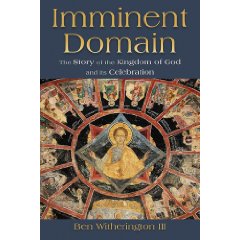
Imminent Domain.jpgThose that follow these things will know that I’ve long believed this Kingdom definition of the gospel, owing much to everyone from Abraham Kuyper, Hermann Ridderbos and Al Wolters to Ronald Sider, Howard Snyder and Jacque Ellul. A simple little book that says it wonderfully is called Kingdom Come: How Jesus Wants to Change the World by Alan Wakabayashi (IVP; $13.00) which we highly recommend.  A brand new one delightfully called Imminent Domain: The Story of the Kingdom of God and Its Celebration (Eerdmans; $12.00) just came out by Ben Witherington III, a fine Bible scholar from Asbury Seminary in Kentucky.  Just fabulous!  Of course the Kingdom themes animates some of the best work being done about “the missional church” (Gruder et al.)  This isn’t new stuff.

 
But the clearest, most important, and most prolific author nowadays about this is N.T. Wright.  His amazing, 2008 book
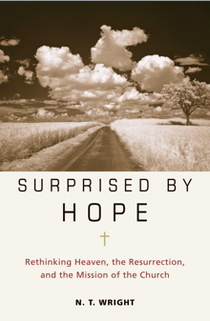
surprised by hope.jpgSurprised by Hope: Rethinking Heaven, The Resurrection, and the Mission of the Church (HarperOne; $24.95) is a perfect follow-up to Easter, ideal to be read this Spring!  I’ve raved about this book here before, and just today on a Pittsburgh talk sho
w I blurted out that it was one of my all-time favorite books.  I don’t think I was grandstanding, either.  I really think it is brilliant stuff, very important and very helpful, bringing together a missional vision, based on an understanding of the inaugurated Kingdom, secured by the Victory of the resurrection, prefigured in the bodily resurrection of Christ.  No, no, no—readers of BookNotes surely know—Jesus didn’t die just to get us Fire Insurance, so we don’t go to hell and can live in heaven forever as angels.  Ugh. The Bible insists that we can have abundant life now (John 10:10),  that he rose in the flesh, and we say, with the Apostle’s Creed, that we believe in resurrection of the body.  That, of course, means, our bodies.  In a (re)new(ed) Earth—paradise regained, creation restored, heaven come down to Earth.  It’s the spring coming to all of Narnia, the curse working backwards, after the long Winter under the witch’s power. The death of Aslan isn’t the point, of course, it the return of the rightful King as He restores the place he so loves.

The fine-tuned theological scholarship that I commended in the last posts about the cross are prelude to this, bigger, more urgent matter: what is the atonement for?  I liked Mark Driscoll’s pastoral letters about the theology of atonement, applying these great truths to hurting people, yet I think it occasionally missed this proper Kingdom vision.  (Some truly Reformed guys are so fixated in explicating precise doctrine that they don’t always get to the missional heart of God and the implications of the Kingdom for whole-life discipleship in the world.)  I’d want to say that the point of the cross is so we might fulfill Matthew 6:33 and seek only the reign of God, Christ’s Kingdom. I believe for Paul, “the cross” is shorthand for “the gospel” and that is always understood as the reign of the victorious and ascended Lord.  God promises that all will be well for those who have such hunger and thirst for His righteousness, which cannot be divorced from the call to serve God in the world.  This can be seen as nearly begging the question of what the cross, qua cross, means.  I hope you don’t think that of me today, since my last two posts commended serious reading on this specific topic.  I now just want to put it in broader context.  John Stott’s wonderful book on the cross which I touted, by the way, seems to do a bit of this, and I am glad.  As always, he is a reliable and balanced source.

N.T. Wright, though, does a very great service in helping us with this Kingdom vision of a hopeful future, but, for what it is worth (and it is worth quite a lot in my book) he also is a careful, creative, Biblical theologian on the finer tuned systematic stuff as well.  For instance,  here is a long article by Bishop Wright that discusses a few books/authors/positions on the atonement, even offering some very serious critique to a book which I wanted to highlight in my bibliography (Pierced for My Transgressions: Rediscovering the Glory of Penal Substitution by Steve Jeffery, Mike Ovey & Andrew Sach)  It was getting a bit long, and it is a serious work, so I deleted my annotation. Wright is perplexed why good evangelicals think the book is so Biblically-rooted when he thinks that it is demonstronably not. In one hefty must-read article, Wright exposes the inadequacies of the right and left, liberals and conservatives, and offers this Kingdom vision that tries to take quite seriously the nature of the unfolding Biblical narrative, the Jewishness of Jesus and the covenantal echoes in the epistles, rather than merely cite strung together prooftexts, read through a lens of medieval or modern hue.  I think it is very well worth reading, especially to anyone who nodded when Becky posted her fine query. 

For those who were intrigued by the books about the non-violent atonement, I might suggest this overview, from the justice & spirituality journal, Clarion, which is a good introduction to this project and why it is valuable.  It is excerpted from Brad Jersek’s chapter in Stricken By God?

By the way, speaking of non-violence, Ron Sider’s wonderful little book Christ and Violence
(Wipf & Stock; $15.00) is one of the key books on the evangelical pacifist’s bookshelf.  I so appreciate that he does not root the demand for love of enemies merely on a sentiment about loving everyone or the mandate to “turn the other cheek.”  He more profoundly places it in within historic Protestant soteriology from Romans: “while we were yet sinners, Christ died for us.” (Romans 5:8)  Ron figures if that is the way the cosmic King of Kings deals with his enemies, we can do no less.  Now that is a part of the discussion about the atonement that we need from the camp that is insisting on the literal penal perspective.  Do they love their enemies very much? Do they invite us to live out the way of the cross even in our public lives, our politics?  Hmmm.  Here is a quote from a more recent book of his, The Scandal of the Evangelical Conscience (Baker; $12.99) which reminds me of the need to be always asking what response we give and live to the doctrines we profess:

When Christians today reduce the gospel to forgiveness of sins, they
are offering a one-sided, heretical message that is flatly unfaithful
to the Jesus they worship as Lord and God. Only if we recover Jesus’
gospel of the kingdom and allow its power to so transform our sinful
selves that our Christian congregations (always imperfect to be sure)
become visible holy signs of the dawning kingdom will we be faithful to
Jesus. Only then will our evangelical words recover integrity and
power.  

 
Justifcation Wright.jpgAND, lastly—a drum roll, please: we can now take pre-orders for a marvelous new book that is coming out in May on this exact topic, a thoughtful book by N.T. Wright in response to the good critique written of his views of justification written last year by John Piper.  As you can see, it will be called Justification: God’s Plan and Paul’s Vision (IVP; $25.00.)  It is important, not least because there are so many folks wondering exactly where he stands.

You may recall that I did a fairly favorable mini-review of Piper’s fair, fascinating (and very informative) critique of Wright (which was called The Future of Justification: A Response to N.T. Wright.)  I have to admit I’ve got a glimpse of some of this—Wright’s response to Piper and others— and it is very, very rich stuff.  We’ll be offering a big blog special when it arrives—25% off–so you can order it now if you’d like.  We still have copies of Piper’s book, too so you could order that, too.  It usually sells for $17.99.  While supplies last, we have some selling for $10.00.  Just let us know if you want the Piper one now, or if we should send them together, when Wright releases in a couple of weeks or so.

The Cross of Christ: An annotated bibliography

Walking out of church last night in the dark, and into the dark, the silence was comforting;  I believe it was Barbara Brown Taylor who I first heard say that many folk prefer the solemn grief of Good Friday more than the triumphant joy of Easter.  There is something about Christ’s solidarity with our grief, with our being betrayed, with our sorrows and sadnesses, and something about facing our sin and regrets, that is strangely good. 

Yet, the spoken word, music and sermonettes led me to ponder, again, what I wrote yesterday about the need for a robust and open-minded discussion about the meaning of the cross.  Tethered as I am to historic Christian orthodoxy, I do not want to re-invent doctrines for newfangled purposes.  Yet, it is mysterious, isn’t it?  Why does a forgiving God need blood shed?  Which position in church history—the ransom theory, the penal substitution doctrine, the Christus Victor teaching—says it best?  Although it is a strong, Calvinist approach, I hope you read my comments in the last post on Mark Driscoll’s pastoral letters called Death By Love which is one good example of how historic doctrine can be shared to
great effect for those who are in deep pain, longing for healing and
hope, and in need of the redemptive power of the Lamb who was slain.

Here are a few more books we recommend if you, too, want to be clearer about the teachings on the cross, and if you want to join the on-going conversation about new and old formulations about this core aspect to Christian faith and discipleship.  I hope every so many years you take up a book or two like this, studying and knowing the deepest things about the deepest truth.
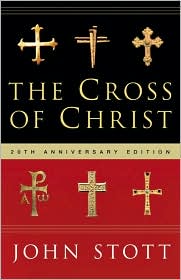
cross of christ.JPGThe Cross of Christ  John Stott (IVP) $26.00  I am always tickled to tell the story of how some liberal mainline pastors saw, in The New York Times, while staying at a hotel where I was selling books at their gathering complimentary story written by David Brooks on moderate, evangelical Anglican writer John Stott.  They came to me asking if I had heard of this “Stoot” guy that Brooks was raving about.  Of course I had a selection of his stuff on the book display; we take something of his nearly every book table we do.  It is a sad statement about our churches that folks do not know this thoughtful, gentle, balanced, faithful writer of dozens of helpful books. (His Basic Christianity is now in a 50th anniversary edition and has sold millions.)  Many pastors and thoughtful laypeople have said that this book on the cross is the best they’ve read on the subject, and is considered among thoughtful evangelicals to be a classic, and certainly the highpoint of Stott’s prodigious output.

Ajith Fernando, a Sri Lanka Christian leader, says of it, “I have no hesitation in saying that this is the most enriching theological book I have ever read.” 

Fifty Reasons Why Jesus Came to Die
  John Piper (Crossway)  I love this little book of one or two page Bible meditations, each on a different thing that the texts tells us are why Jesus died.  Piper is a very conservative Reformed Baptist, so you can be sure he takes the standard texts about our justification by God’s grace at face value.  He is also an honest Bible guy, so he happily notes diverse motivations and outcomes—-we become reconciled, we can break down walls of hostility, we can give our wealth away, we can become peacemakers, agents of reconciliation, and the like, all things specifically named in the Scriptures when they talk about the results of the work of the cross.  Yes, this is a standard devotional of classic texts and I cannot imagine anyone who loves the Bible or the life of Jesus not being “strangely warmed” by these wondrous texts.  Here is a great deal:  we have these reflections also on audio, a lovely unabridged book-on-CD by ChristianAudio on sale for $5.98.  What a great resource, even to give away or loan out.  It is about 3 1/2 hours, read by Robertson Dean.

Proclaiming the Scandal of the Cross: Contemporary Images of Atonement  edited by Mark Baker (Baker Academic) $16.99  What a wonderful collection, with scholars, pastors, writers, church leaders, storytellers and preachers,  even poets and novelists, all weighing in on aspects of the cross.  Included in these short reflections are Richard Hays, C.S. Lewis, Frederica Mathewes-Green, Brian McLaren, Luci Shaw, Rowan Williams, Debbie Blue, Curtis Chang.  There is a highly favorable endorsement on the back by Marva Dawn, which may remind you that it will be Biblically faithful, historically solid, socially engaged and well-written. She writes, “This collection is an outstanding contribution to widen our comprehensions and deepen our adoration.”

The Atonement Debate  edited by Derek Tidball and others  (Zondervan) $18.99  A few years many evangelicals spilled much ink sometimes even mis-quoting Steve Chalke when he said that typical views of penal substitution could be seen by some as “cosmic child abuse” and that we have to be careful how we talk about this essential matter.  Of course, he is fully right, it could be, and has been, seen as that.  That begs the question of what Chalke thinks, and what the Bible and our best theologians say;  he is surely correct, though, that we must be careful how we communicate the good news and the scandal—“foolishness” as Corinthians puts it–of the cross. This good book is a collection of papers that were convened around Chalke’s views, organized by the Evangelical Alliance and the London School of Theology. Contributions are included by Chalke, Chris Wright, I. Howard Marshall, Joel Green and many others.  It is a superb compilation of various sub-topics, with sections about history, exegesis of key passages, engaging contemporary thinkers, and pastoral suggestions. Very strong.

Stricken By God? Nonviolent Identification and the Victory of Christ  Edited by Brad Jersak and Michael Hardin  (Eerdmans) $32.00  I have not waded through all of this yet, but it is the best collection of serious essays representing this new view.  Endorsements include Stanley Hauerwas, Greg Boyd, and Rene Girard (obviously a very important figure in the movement rejecting scapegoat theories and “redemptive violence.”)  Here is a phrase or two that captures the question: Did God really pour out his wrath against sins on his Son to satisfy his own need for justice? Or did God-in-Christ forgive the world even as it unleashed its wrath against him?  Was Christ’s sacrifice the ultimate fulfillment of God’s demand for redemptive bloodshed? Or was the cross God’s great “no” to that whole system?  This distinctively panoramic volume offers fresh perspectives on these and other difficult questions emerging throughout church history.    Authors include James Alison, Marcus Borg, C.F. D Moule, Richard Rohr, Miroslav Volf, J. Denny Weaver, Rowan Williams, N.T. Wright, Kharalambos Anstall, Sharon Baker and more.

Violence, Hospitality and the Cross: Reappropriating the Atonement Tradition
  Hans Boersma (Baker Academic) $28.00  Although it is a mammoth work, this may be my highest recommendation for those within the scholarly discourse.  Boersma is open-minded and eager to interact with the newest thinkers, especially those who are concerned about the socio-political implications of anything other than a nonviolent understanding of the cross.  He takes these thinkers seriously, interacts with their important concerns, and, finally, ends up with a somewhat chastened but still standard position on the legitimacy of the Reformed emphasis on penal substitution.  A neo-Calvinist from Canada, Boersma seems to represent the best of evangelical scholarship, Reformed thinking, philosophical depth, and exceptionally ecumenical openness.  Highly recommended for those reading scholarly work…
community called atonement.jpgCommunity Called Atonement  Scot McKnight (Abingdon) $17.00  I mentioned this yesterday as a key and fabulous volume which introduces the various views and discussions, in a gracious and inclusive manner.  Tony Jones of the emergent village, has helped create a new series of books called “Living Theology” and this was the first in that series (a new one is on questions of faith and science.)  McKnight, here, is balanced, clear, reasonable, and deeply ecumenical. As evangelical brainiac Kevin Vanhoozer says, it
“remixes biblical metaphors, integrates doctrine and praxis, and deconstructs one-sided theories of the saving significance of the cross.”  It is wise to place atonement theology within the context of God’s redemptive work in the world.  Hint for those who may care: McKnight’s wholistic approach seems to have much in common with the patristic model of recapitulation.

Saved From Sacrifice: A Theology of the Cross Mark Heim (Eerdmans) $26.00  Oh my, what a great example of mature thinking, careful new ideas, a deep care for Christian truths and a contemporary sensibility that doctrine must be alive for postmodern people.  Rooted in the very best scholarship about nonviolent theorist Rene Girard (and his scapegoating theories), this is as warm and caring as an academic book can be.  Highly recommended for those wanting new formulations that are interesting, beautifully conceived, and well-argued.

Recovering the Scandal of the Cross: Atonement in New Testament and Contemporary Contexts  Joel Greene & Mark Baker (IVP) $17.00  A major contribution, this is written by a world-renowned Methodist evangelical scholar and a highly regarded Mennonite.  Although they may not be as interested in Girard as many in the nonviolent atonement movement, they are eager to explore non-Western ways of understanding the cross, and help us see news ways of talking about God’s redemptive work.  Very provocative, yet reliably solid

Triune Atonement: Christ’s Healing for Sinners, Victims, and the Whole of Creation  Andrew Sung Park (WJK) $19.95  Well, this book deserves a long and serious review from someone more knowledgeble than I.  I have appreciated Dr. Park’s previous works where he takes the Asian concept of han and uses it to help us gain a more multi-faceted (and, he thinks, truly Biblical) understanding of sin.  Han includes sin and sinned-againstness.  It includes moral complicity and broken fallenness.  Here, he appropriates this multi-faceted view of sin and shows that Christ’s atoning work is for, well, everything!  In good teacherly fashion he explains most of the standard views throughout church history, and then offers his own peculiar mix, drawing on and holding up the work of the Holy Spirit, especially.  (I am not sure of this, but I recall that this was a theme of a major World Council of Churches event a few years back—the Spirit’s work in the redemption of creation–and is a historic emphasis of the Orthdox.) Dr. Park is very aware of not only the early, medieval, Reformation church views, but is in dialogue with the wildest new thinkers, too, making this a useful guide to the topic.

This question of how the very Trinity is involved in redemptive work is a fascinating one, and I applaud this book for raising such matters.  Sadly, it is poorly written, with some sentences being terribly perplexing; when a tone of grace was called for it was wooden. (Perhaps this is owing to a language barrier if English is not Park’s native language.)  I suspect he wants it to be used as a textbook, so he makes academic allusions to scholars and books that typical readers may not appreciate. (How many readers know what a “womanist” theologian is? How many will follow his brief argument that they could be two Holy Spirits, the Spirit of Jesus and the Paraclete, who are actually one?  Can it be taken for granted that folk know James Cone or Chad Meyers whose names he drops in passing?) Dr. Park offers what is helpful about each approach, and some fair critique of each of the major views written about throughout church history, but the criticisms are too often terse and unqualified. (“This is wrong…” he simply says, as if it is a foregone conclusion that it is as wrong as he says in one short sentence.  I wanted to shout “come on, brother, that isn’t fair!”  Why a prominent denominational publisher would let this important work get published without adequate editing is beyond me.

Another beef: the great last chapter on God’s redemptive work over all creation feels tacked on; consistent, but disconnected. (He says in the forward that it is an intregal part of the book, but it doesn’t appear until the end.) His case makes sense, but he doesn’t tie it into the flow of the book. While he shows that God’s healing hope for animals and Earth is taught in the Biblical text, he doesn’t do what he should have in a book on this topic: ask how the Triune atonement works to reconcile creation.  Did Jesus’ shed blood have any effecicy for animals?  Why or why not?  It is a great, great question, and a good chapter (as far as it goes) but it wasn’t adequate in a book about the meaning of the cross.  

So, the new Triune Atonement is fascinating, saying some good stuff, bringing together various schools of thought, and extending them from our Triune God into all of creation.  I just wish it were more careful, more clear, more willing to use a tentative tone when asserting grand ideas.  Yet, at the end of the day, I appreciated his efforts and commend the book for those wanting an interesting example of new formulations by this Korean-American scholar.
in his place.JPGIn My Place Condemned He Stood: Celebrating the Glory of the Atonement  J.I. Packer & Mark Dever (Crossway) $16.99  Many Packer fans have read and re-read his introduction to Puritan John Owen’s The Death of Death in the Death of Christ and it is considered one his best pieces.  It is in here, as are several other important articles, essays and unpublished work of Packer.  Dever (of Capitol Hill Baptist Church) offers a few good chapters, too, offering a younger voice of old school Calvinism.  David Wells says, “This book contains some of the finest essays that have ever been written on the death of Christ.”  Tom Schreiner says, “Every student and pastor should own this volume, for the contents are so precious that they deserve more than one reading.”  Tim Keller says–get this!—“The essays in this volume are some of the most important things I have ever read.”  Keller continues, “If you want to preach in such a way that results in real conversions and changed lives, you should master the approach to the cross laid out in this book.”  Sinclair Ferguson says “The magisterial but too-little-known essay “What Did the Cross Achieve?” is itself worth the price of the whole book.”

The Great Exchange: My Sin for His Righteousness  Jerry Bridges & Bob Bevington (Crossway) $15.99  Do you want gospel transformation?  Do you want to know how all this theology of the atonement and understanding justification by grace impacts our lives?  Are you yawning with a “so what” about this post about theology books?  This is an excellent study of how the apostles taught about the atonement as the basis for faith living and makes the historic views of penal substitution very understandable.   There is a classic Scottish work from 1870 called The Apostles’ Doctrine of the Atonement by George Smeaton.  Most of us won’t pick that up, but this book is clearly patterned after it.  Make time to read this and learn how the cross is not just for obtaining forgiveness, but is the power for Christian living, day-by-day.

Jesus on Death Row: The Trial of Jesus and American Capital Punishment 
Mark Osler (Abingdon) $16.00  This is a unique study comparing the most infamous criminal proceeding in history—the trial and execution of Jesus—and capitol punishment in the US today.  The autho
r is a Christian law professor and former federal prosecutor (and expert on sentencing guidelines whose work has been cited in the Supreme Court.) In each chapter he explains details about the trial of Jesus and uses that as a springboard into stories of injustice and legal corruption and the horrors of death row.  Not a study of the atonement, but a close reading of the trial and passion narratives as a guide into discussion about the ethics of modern crime and punishment.  Troubling, informative, and a new way to read the Bible in contemporary context.

Perhaps a poet and hymn-writer should get the last word: Listen to the moving, gentle song
How Deep the Father’s Love for Us as done by Ferdnando Ortega.  

 

Death By Love: Letters from the Cross ( some remarks on open-mindedness, and an array of titles on the atonement.)

Recently, a few sharp customers on varying places on the spectrum of views about the theology of the atonement have asked me to “weigh in” on new ideas, old ideas, classic doctrines and emerging newer perspectives about the theology of the cross. (I recommend Scot McKnight’s A Community Called Atonement [Abingdon; $17] for a great introduction to various schools of thought and views on the meaning and implications of Christ’s redeeming work if you are unaware of the blazing debates about this these days.) Many know that we carry all kinds of books and encourage reading widely, discussing, being open, showing considerate consideration to brothers and sisters with new insights or troubling concerns. (Remember that David Dark book I highlighted a few weeks back, The Sacredness of Questioning Everything [Zondervan; $15.99.])  I think we have to be open to hearing many voices, hosting hard questions, eager for new, faithful formulations, and we carry a real diverse selection here at the shop.

Of course this doesn’t mean we can just throw out any old thing in preference to the new.  I’m turned off when newer theologians cheaply insist that the classic view of Christ on the cross pays for our sins is just so much bloody nonsense, leading to wars and child abuse. And I’m irked when those who disagree with more nuanced and thoughtful articulations of those concerns pass it off as a mere desire for faddishness or being offended by the blood.  (Could it be that those who struggle with this are well-intended and perhaps onto perhaps a partial truth?)  For instance,  in a blurb on the back of a book I’m about to describe, a reviewer says that this book “defends (against) reprehensible attacks” against traditional understandings of the cross.  When new theologians quest for new ways to get stuff said, it isn’t necessary or helpful, in my view, to call them names or to say they are reprehensible.  I sometimes don’t know who is worse, the edgy new guys or the stuffy old ones. As we recall Christ’s great love shown in His passion acts (and mandates–the Maundy Thursday call to wash each others feet!) we can create good spaces for healthy conversation and charitable dialogue.  That is why I liked the title of McKnight’s book–we are a catholic community piecing together the best ways to describe the deepest mysteries;  what Lewis calls in Narnia the “deeper magic.” 

And, of course, the cross is described as a great mystery.  Who can fathom it all? Even those of us who hold traditional theology surely ponder sometimes, don’t we?  Why o why? The great hymns ask the question.  Sure, we can answer it wrongly, we can un faithfully dismiss the witness of the Scripture, but to ponder, to study, to float ideas and suggest better ways to speak about the dearest things of God’s gospel, is not reprehensible.  Shame on Crossway for publishing such a blurb.

Yet, the historic creeds and doctrines of the church are being re-considered, sometimes with the best of Spirit-driven motivation, perhaps sometimes not.  Sometimes out of a legitimate need to open up answers to hard questions, unsettled ponderings, and sometimes with less than commendable answers. That has been a huge erosion of traditional knowledge in our churches.  There are many books on the cross and the atonement, from various perspectives and denominational traditions,  many from which I’ve learned.  I’m open and eager to study this many-faceted jewel from any side I can (and will list a few suggestions later if you share this open-minded eagerness.)  Can liberals learn from conservatives?  Can those with traditional convictions read with charity the newer views? We hope so…

I hope this week-end, as you ponder the cross, the darkness of Good Friday, the ponderous depth of Holy Saturday, and the glory of the Resurrection emerging from the horrible death penalty and State execution of the cross, that you may find yourself wanting to know more about the reasons Christ died, how to properly understand that extraordinary transaction, knowing well the ancient ways of formulating it, learning to say it in the midst of a post-Christian, postmodern culture.  May you stand again at the foot of the Cross, struck as most of us are this time of year, by the centrality of it all.

***

Another quick story:  just the other day a regular customer, an African American church leader, was looking for books on the blood of Christ (interestingly, the blood is mentioned in the New Testament more than the cross.)  I showed her a book that mentioned “penal substitution” and she asked what that meant.  As I explain the typical view that Christ somehow took the punishment we deserved, paid a penalty, averted God’s wrath that was due us, she nodded in obvious awareness.  “Some Christians don’t believe that?” she asked incredulously.  “No,” I noted, “there are those who think that that way of saying it, that metaphor of wrath and punishment and courtroom images, isn’t fully Biblical and isn’t the most helpful way to describe God’s love and Christ’s willingness to give Himself.”  “Lawd-have- mercy” she replied.  Indeed.  For centuries common Christian folk have read their Bibles and heard verses read out loud and sung hymns and it was perfectly clear that the “he died for my sins” view was not just cooked up by Ansalm, but is deeply rooted in the whole Biblical narrative.  To explore new ways to get it said is one thing;  to deny the obvious Biblical data…well..  Lord have mercy.

Or, as the Book of Common Prayer puts it:

 Almighty God, who has given your only Son to be unto us both a sacrifice for sin, and also an example of a godly life: Give us grace to receive thankfully the fruits of his redeeming work…

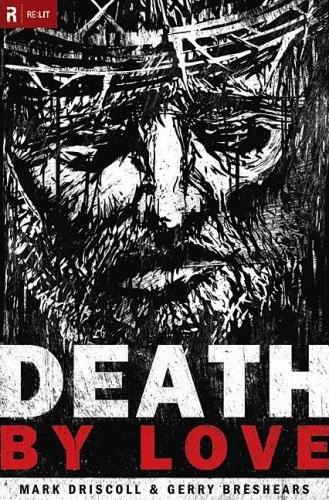
Death By Love: Letters from the Cross by Mark Driscoll and Gerry Breshears (Crossway;death by love.jpg $19.99) is an extraordinary book which upholds in blunt and non-negotiable language, the historic Reformation perspective on the cross.  I am not a Mark Driscoll fan, I’ve not loved his other books, I think he is wrong-headed about some things, and his youtube sermons betray an arrogance and pride that he himself has sometimes admitted to.  Yet, yet, this is a book that brought me to tears, struck me as very, very insightful, and despite the occasional harsh note, is a book rooted in a very deep sense of pastoral care.  The format is extraordinary, and serves several good ends.  Let me tell you about it.

Each chapter begins with a riveting description of a friend of his, a person in his congregation.  Several have faced abuse.  One was a child molester.  One was a sex addict.  Another self-righteous and controlling, joyless and rigid with his upright family.  One has a wife with a brain tumor while another holds deep hatred for a relative. One was raped, another fears hell.  One just wants to know God.  Oh my, how I wish every pastor knew his or her flock this well, able to know so intimately and write with such care, about the horrors of life as experienced by folks in this broken world.  Driscoll and his co-author describe these hard situations without extra sensationalism, but he doesn’t water down the problems or his proposals.  Their language is terse and realistic and candid.  Driscoll doesn’t beat around the bush.

Then, there is the heart of each chapter, a pastoral letter he wrote to this person showing how a particular doctrine, aspect, or formulation of the cross can be the very truth that f
rees this parishioner from his or her torment.  And this is where it gets very interesting: Driscoll has absolutely no interest in psychology or in counseling or in strategic empathy as a supportive helper in self-discovery.  He is a preacher, a neo-Puritan pastor, a working theologian.  That is, he is convinced that appropriating the doctrines of justification, atonement, propetiation, imputation of righteousness, Christus Victor, ransom, Christus Exemplar, reconciliation, and such are the keys to healing, hope, and renewal.  In some cases he is exceedingly blunt with little interest in sugarcoating the hard truth; I suspect that not all of these letters were well-received.  He regularly says that he loves the one he is writing to, says dear and tender things, and occasionally reminds us that this letter isn’t (of course) the first thing that he has said. (Those schooled in traditional pastoral counseling will be aghast, as I was, at times, but, again, we can know that these are offered in the context of broader pastoral relationships and true friendship.)  These letters aren’t the start but the height of his pastoral counsel, after much hand-holding, meetings, confessions, tears and prayer.  Yet, it is no-nonsense, straight-up, Biblical teaching, confident that an appropriation of historic, orthodox theology will make all the difference.

death by love drawings.jpgTo make this book all the more moving, there are very strong black and white sketches of the person to whom the letter is written, each with a hint or smear of red.   The chapter headings are in red ink as well, giving this a classy feel, despite the intense drawings and heavy topics.

Wow.  I have a hunch that typical fundamentalists would not write these letters;  in my experience many older-school fundamentalist Protestants would be afraid to name the sins (especially those of a sexual nature) and would be moralistic and glib in proof-texting verses about proper behavior, as if that alone would shame the person into faithfulness or bring sentimental comfort.  More evangelical pastors and many liberal Protestants and Catholics may believe much of this (although some clearly will not) but it is my sense that many church leaders are much more accommodated to the neo-Freudian worldview and would use more pop psychology than Biblical theology if they had these conversations.  (Some, I would guess, would merely recommend a therapist, although Catholics might utilize the sacrament of confession/reconciliation.)  Although these doctrines are commonplace for those who know classic historic theology, I know of pastors who have never taken a single class on these doctrines.  It is bracing to see a pastor use this stuff in this way.

I am not sure I would commend writing letters like each of these although a few are brilliant and I devoured them, thinking and praying and reflecting on them a lot.  I might want to qualify things a bit, maybe soften the insistence a bit, although that is not Driscoll’s style, and I am hopeful that he knew the folks well enough to be confident he was writing what needed to be said, in a manner that didn’t offend needlessly.  I am not sure if Driscoll even really wrote all these, or if they are beefed up for the book, with a bit of understandable creative liscense.

Still, I stand in great appreciation for at least three things about Death By Love: Driscoll’s Seattle church clearly has attracted people with deep, deep wounds, and as a pastor he knows these folk as friends.  Thank goodness for that.   He believes that theology is life-changing and that teaching these central truths is not tangential but central to the calling of being a pastor.  Right on.   And he shows that there is not just one aspect to the glorious cross, but many ways that the Bible speaks of and our best theologians have learned to say what is so good about Good Friday.  This bombastic punk pastor knows this, that there are many facets to the jewel of the cross, and that we can draw on various doctrines and explanations, with many ways to explain and appropriate the core truth of God’s redeeming grace.  If we teach them well, he shows, they become not arcane insights for the weirdos who may be theologically-minded, but become avenues of healing, wholeness, growth and sanctification.   Driscoll the popularizer of heavy theology is also Driscoll the serious pastor.  I commend him for this important effort, and recommend his book to anyone who wants a solid introduction to historic, conservative doctrine, applied afresh amidst the very, very broken world of those who are sinners and those who have been sinned against.  Which is, of course, each and every one of us.

In the next post, I will list a few more books on the cross that I’ve been taken with lately, a few classics, a few controversial ones, and one or two suggestions for those starting this journey of understanding the apex of our Lenten journey. 

Calvin College, Cornel West and Finding the Groove: Finding a Jazz-Shaped Faith

The Calvin College Festival of Faith and Music was a tremendously  interesting, fun and striking event; my 16-year old Marissa and I enjoyed the 11 hour trip to Grand Rapids, anticipating the lectures (Mako Fujimura, Andy Crouch, Cornel West), workshops, and concerts—from the large and loud Lupe Fiasco hip hop show, the provocative and joyous indi-rockers Hold Steady, to the quiet and acoustic stuff in intimate venues.  Over the Rhine was large but not too loud (ahh, what a band they have with them this time out, and what a voice Karin still has!) Nashville singer songwriter Julie Lee blessed us with lyrics from Emily Dickinson and a stellar band (including Stephen Mason from Jars of Clay on a brooding lap steel.)  I couldn’t help but think her voice was like one of my favorite Southern singers, Nanci Griffith.  The worship musicians were serious, solid, acoustic–the BiFrost Worship Arts Hymns Project, with personal from the Sufjan Stephens’ produced Welcome Wagon album (which I hope to review one of these days), was wonderful to behold.  We now have the BiFrost hymns album in stock, which I will review shortly.  Somewhat in the spirit of the Indelible Grace albums, BiFrost offers classic old words re-done by edgy alt acoustic artists like Seattle’s Rosie Thomas, David Bazan (Pedro the Lion), Damien Jarado, Denison Witmer, Leigh Nash, and others we really appreciate, done with gusto and hipster earnestness in great low-fi.  (Check out their myspace here.  Here is an article from the Episcopal Diocese of Washington about them.)  We’re told some label may be picking this up for national distribution, but we have ’em now, and the great price of $10.00.

As much as I liked the Festival music, and being around performing artists, writers and serious cultural creatives–thanks to the Davids Bazan and Dark for their friendship and stories, and Justin McRoberts for his good mind,heart and talent—the highlight was, for many of us, seeing the tidal wave of astonishing energy from one of America’s most high profile public intellectuals, Princeton University’s Dr. Cornel West.  We’ve stocked West’s books since our earliest days; the Presbyterian Publishing House (Westminster/John Knox) did Prophesy Deliverance! in the early 80s, and it is happily back in print ($24.95), and his Prophetic Fragments, has recently been re-issued by Eerdmans; ($29.00.)  As a major African-American social critic and philosopher, he has been on NPR and Tavis Smiley and popular papers often these days.  There is now great anthology of West’s  serious work, The Cornel West Reader (Basic Civitas; $22.00.)  To see a young black scholar publicly thank Dr. West for that book—holding a dog-eared copy up of the 600+ page volume for all to see—brought tears to my eyes, reminding me of the power of books, popping up even at a music/arts festival.

Here is how the Calvin Festival website begins their bio of Dr. West:

One of America’s most provocative public intellectuals, Cornel West has been a champion for racial justice since childhood. His writing, speaking, and teaching weave together the traditions of the black Baptist Church, progressive politics and jazz. The New York Times has praised his “ferocious moral vision.”  Currently the Class of 1943 Professor at Princeton University, West burst onto the national scene in 1993 with his best-selling book, Race Matters, a searing analysis of racism in American democracy…

Searing, it is, and an essential book in our view: Race Matters (Vintage; $12.95.)  In person, his powerful and prophetic talk is laden with sweeping gestures and sly wordplays, and good references to Curtis Mayfield and Marvin Gaye and Funkadelic (who else would link Parliament/Funkadelic with Plato’s famous dictum that good education is preparation for dying well, and make the case very well?)  Cornel has a long-standing interest in black popular culture, and is known for his work not only citing Shakespeare and Marx, the Bible and postmodern philosphers, but for his enthusiastic engagement with black music (Coltrane, and Mile Davis, of course, the socially-conscious likes of Gil Scott Heron and Stevie Wonder,  through contemporary rappers like Kayne West.)  This was, legend has it, much of the reason for his removal from his prestigious post at Harvard.

That the Calvin College music Festival team conjured up an interview with Lupe Fiasco done by Cornel West was genius;  they both esteem each other, even cite each other, but had never met.  That it went so well made many say it was worth coming to the event just for that historic moment.  Lupe is a smart, influential and spiritually aware African American performing artist, and to see the feisty, energetic elder West probe him, push him, encourage him, even pastor him, was nothing short of glorious.  I might have wished for more discussion of Lupe’s urban vocabulary, the role of satire in his street narratives, the apparent project of using rap to deconstruct the stereotypical excesses of hedonistic rap culture.  What we got, though, was a helpful and inspiring framing of the heart and mind of this popular artist who may not yet even be at the top of his game.  And, that was followed by one of the best lectures/speeches (sermons?) I’ve heard by Dr. West that evening.  It was great to hear him affirm Calvin and its Reformed vision as that place where this important stuff was going on.

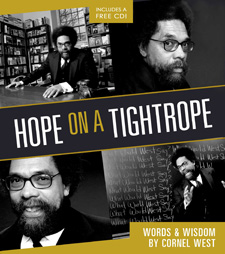
hope on a tightrope.jpgI was so inspired by Dr. West that I wanted to offer our BookNotes readers an incentive to join the conversation. We’ll offer the recently published collection of Cornel West, a  recently published handsome hardback (with an exciting CD included) Hope on a Tightrope: The Wit and Wisdom (Hay House; $19.95) for the blog special price of $14.95.

BLOG SPECIAL
  $5 OFF
Hope on a Tightrope: Words & Wisdom
ORDER HERE.

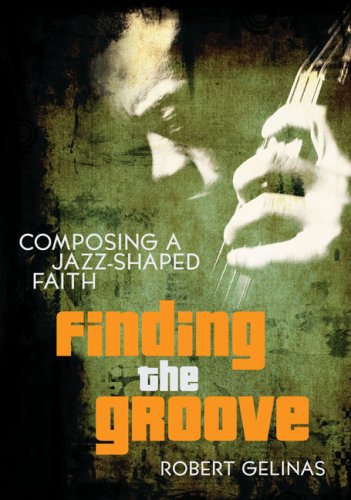
A brand new title that I read in almost one sitting is one I am very, very eager to promote,finding the groove.jpg especially now.  How does one get a little sleeper of a book known, purchased, respected?  Can you help us get this book discussed?    We need to support this book, so here is my first effort, not a full review, but an improvised shout out: Finding the Groove: Composing a Jazz-Shaped Faith by Robert Gelinas (Zondervan;
$14.99) A major tip o the hat to Z for releasing this very, very cool book, a book that is honest, creative, Biblically-faithful and very inspiring.  The author has been steeped in jazz music and although this is not a book for musicians, or even about music, really, it picks up the jazz tradition, uses jazz as a metaphor for the life of faith.  It has been said before, but never with such heart-rending passion: jazz themes such as improvisation, collaboration, working the minor keys, balancing freedom within boundaries, the interplay of the individual and the group, and the like, are great ways into a conversation about how to live as faithful followers of Christ.  What might a “jazz-shaped faith” look like, this book asks—and how could it help us fulfill the message of the gospel in a way no method, no movement, or structured program or ministry plan could?  How might the jazz practices of “casual apprentices” and  “jam sessions” and “time in the woodshed” help us find our syncopated groove in Christ?  This book is fabulous, fun, and very insightful.

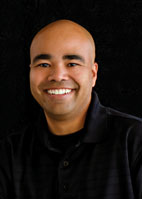
Rober gelinas.jpgRev. Gelinas is a pastor of Colorado Community Church, a multi-cultural and multi-denominational mission.  He dedicates much of the book to a friend of ours, the fascinating, fabulous, solid-as-a-rock brother Dr. Carl Ellis (author of Free at Last? The Gospel in the African-American Experience [IVP; $18.00].) Gelinas, like his mentor Dr. Ellis, is obviously fluent in the jazz idiom, but it never bogs down in historical details; he has the requisite quotes from Louis Armstrong and Wynton Marsalis and Ken Burns, but keeps it moving, always showing how learning this stuff could be helpful for God’s church.  Do I hear an A-men? 

One of the great parts of Finding the Groove is his introductory and delightful overview of several important jazz musicians such as the troubled and seeking John Coltrane, (whose famous liner notes from A Love Supreme are transcribed here) and the seminal Mile Davis.  Gelinas situates these artists in their proper setting, a racially charged and complex transitional era in our nation’s history.  He grooves on what might be called jazz novelists, especially Ralph Ellison’s Invisible Man, a novel that clearly emerges from the racial themes of the jazz age and the Harlem Renaissance.  His riff on the European Renaissance that gave us one Martin Luther and the Harlem one, which gave us another Martin Luther (King), is worth the price of the book!  His naming our sins of racism and the complexities of our culture are vital, but not overwhelming.  He, like Cornel West at Calvin last week, drops wonderfully playful allusions to important works—-being a “Blues People” (Amiri Baraka) and “Mo Better Blues” (Spike Lee) and the famous question about “why the caged bird sings” (Maya Angelou) making this a culturally-savvy education and a delight to read.  He offers great sidebar quotes—did you know Martin King spoke at the famous Berlin Jazz Festival in 1964, talking about God’s gift of creativity? 

Finding the Groove:Composing a Jazz Shaped Faith
is easy to read, brief, a bit unsettling (jazzeneutics is his invitation to improvise with the Scriptures) and a moving reading experience.  You can check out some of it at www.jazztheologian.com.  Buy the book from us, get your groove on.  Yeah.

                                        BLOG SPECIAL                          

Finding the Groove
regularly $14.99
$5.00 off
$10
Order Here


Hearts & Minds 234 East Main Street  Dallastown, PA 17313   717.246.3333


Slice O Life: Bruce Cockburn Live Solo

My best friend Ken Heffner heads the team of the amazing folks that put together the bi-annual Calvin College Festival of Faith & Music.  (It starts Thursday, but isn’t too late to show up if you’re able to get there!)  As the Director of Student Activities at this historic Christian college which emphasizes the tradition of common grace which sees God’s handiworks in all created things, and yet which understands that serving under the Kingship of Christ means that we must live out certain Biblically-informed distinctives, Ken helps students with “cultural discernment”, nurturing within students a sense that rock bands and movies and songwriters and hip-hop artists are not just escapism and mindless entertainment, but are cultural artifacts offered by people made in the image of God.  The popular arts can inform, inspire, critique, and give voice to our very human cares and fears.  As Ken puts it in his theologically-insightful interview in relevant magazine, “We are looking for artists that wake people up.”

This year the FFM will include Professor and philosopher Cornel West (Race Matters) lecturing before the show of hip hop artist Lupe Fiasco;  Mako Fujimura (Refractions) will speak of the creative life, and there will be presentations on everything from culture making (Andy Crouch, of course, whose book Culture-Making we again commend to you) to spiritual themes in the blues (Central PA’s own Stephen J. Nicholes, author of the Brazos book we’ve promoted Getting the Blues) to workshops on what rock journalism and art criticism ought to be about.  From the guys of Paste to splendid writers like Cathleen Falsani (Sin Boldly: A Field Guide to Grace and the forthcoming The Dude Abides), David Dark (Everyday Apocalypse, The Gospel According to America, and the new, provacative Sacred Art of Questioning Everything), Terry Mattingly (Pop Goes Religion), Charlie Peacock (At the Crossroads) and more.  Heffner and Co. bring in some of the best folks in faith-based engagement with contemporary music.  That over the years Calvin has  hosted musicians as diverse as Sigur Ros and David Bazen, Niko Case, The Psalters, Sufjan Stevens, Emmy Lou Harris, Over the Rhine, T-Bone Burnett, The Blind Boys of Alabama, Bill Mallonee, Rosie Thomas, and Ben Harper shows the diversity of talent and the artists that may not typically play in such an evangelical setting.  Wake us up, indeed.  Thank God for Calvin’s witness in this area, for Ken’s colleagues like the folk who publish the great ezine catapult, (the new issue is called “Crying Out in Stereo” and is a must-read for music fans) or pop-culture scholar, William Romonowski (author of Eyes Wide Open: Finding God in Popular Culture.)  I can’t tell you how that whole gang up there, and all they stand for, has inspired and supported us in our over the years. 

BruceCockburn1.jpgWell. One of the artists who for many of us pioneered this sort of important pop music integration of exceptional musical excellence, remarkable lyrical craft, thoughtful religious faith, and who, through lyrics, interviews, activism, and sheer longevity as a vital public performer, has made his nuanced faith-based art known and respected, even among the most secular of critics, is Canadian singer-song writer Bruce Cockburn.  Although Mr. Cockburn is not appearing at the Calvin FFM this year, his new live album releases today, and it’s brilliance—as a new project capturing him solo, and as a bit of a career retrospective—-will surely be on the lips of some of the fans of the FFM project. 

Cockburn, as you may know, was a rising star in the folk circuit in the late 60s and hadCockburn.jpg achieved extraordinary respect by the 70s as a singer-songwriter and one of the best guitar players around.  Other musicians envied his dexterity, his chops, his odd tunings and overall musical genius.  When, through some mystical experiences and a thoughtful study of the novels of Charles Williams and C.S. Lewis and the like, he became a Christian, a whole new audience began to follow him.  As he learned to tour with a band, gained exposure on the world scene, came to incorporate world beat, jazz and other urban rhythms and unusual musical forms, he (like Dylan going electric) lost a few folkie purists, but picked up an even larger global audience.  Here is one reviewer’s excellent overview of his journey and large body of work.  The Cockburn Project is an excellent internet site keeping track of his work.

bruce2.jpgBy the 80s, his telling of the tales of his world travels, romances, philosophical musings, and growing awareness of social injustice showed an extraordinary sensitivity to global poverty, economic injustice, and his impressionistic songs about sights and sounds of third world revolutions–the Sandinista’s rebellion against the horrors of the Somozo dictatorship in Nicaragua, for instance—made him a Christian singer that was, frankly, unlike anybody else on the planet. He has traveled with relief and development NGOs, narrated (and written soundtracks) for documentaries on sand erosion in Africa, done First Nations activism, and contributed songs to anti-land-mind projects; yet, he rarely became preachy or singularly political.  As he read Thomas Merton and Latino poets and quoted Brennan Manning or Tony Campolo, he became, for many of us, a near icon.  Not only was he a wondrous guitar player, and good poet, and a funny, good guy, he was a serious reader, articulate and passionate about living faithfully in the weird and wondrous world of such beauty and horror.  He has penned some of the most touching love songs and some of the most raging political pieces in the history of rock music.  This is so important to those of us–like Heffner at Calvin, or us here at Hearts & Minds—-who want to share our enthusism for writers, artists, thinkers and activists who care deeply about faith, but who don’t always wear it on their sleeve, who care about the world, but who have the creative capacity for telling stories and using imagination and sharing their vision of what life is and, perhaps, could be.  My friend Brian Walsh (who may or may not be writing a book on Cockburn) has given us a very, very helpful overview not only of Bruce’s journey as a socially engaged Christian artist, but uses him as an example and case study of how attentiveness to the brokenness of the world has generated an aesthetic in Cockburn which makes him an example of a more authentic and faithful Christian art (than what we usually see, for instance, in typical CCM fare.)  Read Theology at the Rim of The Broken Wheel: Bruce Cockburn and Christian Faith in a Postmodern World.  As Brian was working on his
co-authored 2008 Eerdmans book Beyond Homelessness: Chrisitian Faith in a Culture of Displacement, he drew inspiration from these urgent themes in Cockburn’s work; see Walsh’s wonderful essay At home in the Darkness, but Hungry for Dawn: Homecoming in Canadian Songwriter Bruce Cockburn  We highl, highly recommend them both.

 We have carried Cockburn’s albums from the beginning—the first I bought was in the mid-70s, In The Falling Dark, and I still have the LP with Ken Heffner’s notes scribbled on it, from when he borrowed it.  We agree with Walsh that BCs work is a rare example of exceptionally insightful contemporary music, and we celebrate the release of the new one today.

slice o life.jpgSlice O Life is a double disc, recorded live from his recent solo tour.  Cockburn has a few other great live albums yet they feature blazing electric guitar, groovy band vibes, Afro-rock/world beat Reggae stuff, alongside his more typical soft-rock tunes, accompanied, always, with top-shelf fellow musicians.  Those that follow Bruce, though, have long hoped for a solo, all-acoustic record of his live shows that shows off what he can do with these big songs when it is just him, unplugged and on stage, dazzling, by himself.  Slice O is a slice of his own touring life, with a few interesting stories between the songs, some new arrangements of Cockburn classics, a couple of sing-alongs (yes, he does Wondering Where the Lions Are) and some few great photos in the package. The second disc features fascinating recordings of jamming around during the sound-check, including some extended blues stuff…) You can see the song titles and read an excellent overview of the project (and may still be able to hear it for free) at the True North website here. 

We could be delighted if you bought it from us.  It is, as I’ve said, a great illustration of much of what we are about here: waking people up, using the arts to make us think, attending to how faith fuels imagination, and how the popular arts can take us places, teach us things, inspire us to see and act in new ways, and, of course, entertain us. Wide awake.

Or, as a reviewer in Acoustic Music puts it, (The solo CD) “is a long immersion in what an individual and his art are capable of…the entire affairs goes a long way to resuscitate the essentiality of a single human being pouring himself out to others, standing as an esposition of what’s possible if we have the heart and discipline to follow our calling.”

BLOG SPECIAL
BRUCE COCKBURN
Slice O Life: Live Solo
regularly $19.98
special price
$15.98

ORDER
HERE

Hearts & Minds 234 East Main Street  Dallastown, PA 17313     717.246.3333


Bookstore March Madness: On the Road edition

Customers sometimes tell me that they like hearing what events we’ve served, authors we’ve met, knowing about our travels.  And, of course, we end up with a few extra books from some of our gigs, so we can offer some good discounts, too, if you want to be a part of our process.

For instance, last weekend, with the help of some dear friends at Gordon College, we set up a display in Boston for those seriously interested in the relationship of faith and film studies, being “salt and light” amidst the “electronic campfire” for modern storytelling that is contemporary cinema. Speakers were as wide ranging as the very smart drummer from rock band Mae, to media executive and fantasylucifer's flood.jpg novelist Linda Rios Brook (check out her Lucifer’s Flood [published by Realms; $13.95], part intriguing theological exploration and part swashbuckling adventuresome story of prehistoric heaven and earth) this prestigious gathering was exactly the kind of group we feel especially called to serve.   Others who are savvy about ways to be engaged in “common good” kind of work within the entertainment industry spoke and debated and imagined greater influence for truly important things within this very strategic arena.

beyind the screen.jpgBarbara Nicolosi was perhaps the most significant speaker, teaching from her important, co-edited book Behind the Screen: Hollywood Insiders on Faith, Film and Culture  (Baker; $18.00.)    What fun to have a speaker telling stories about the director of the X-Men movies, or the backstory of the provocative, short-lived TV show Joan of Arcadia.  Interviewed here are the cultural creatives of Hollywood, but, more, there is theologically-informed wisdom for any of us living in this entertainment world.  Whether you are film buff, a Christian movie critic, a parent trying to discern what to permit your teens to watch;  whether you are a college student who is taking a film course, or are working in the industry, there are chapters here for you.  I continue to ponder some of this, and agree with the blurb on the back by David McFadzean, himself a producer of Home Improvement, What Women Want and Where the Heart Is when he says, “Do yourself a favor—turn off the TV, skip the movie opening this weekend, sit down, make yourself a tub of popcorn and read this book.”  Here and here are good reviews of it and it’s multi-layered, serious perspective.

***

A few days later we were part of a book launch in Philadelphia, celebrating the brand new release of a splendid pocket sized hardback prayer book, created by the Twenty-Fifth Presiding Bishop of the Episcopal Church, The Right Rev. Frank T. Griswold.  As a former chair of the Episcopal Church’s Standing Liturgical Commission, and a co-chair of the Anglican-Roman Catholic International Commission, he is deeply shaped by the devotional practices of high liturgy, and the personal practices of praying the hours, the Divine Offices, and such. Rev. Griswold—most just called him Frank—walked us through the various sectionspraying our day.jpg of his fabulous Praying Our Days: A Guide and Companion (Morehouse; $20.00) from the opening essay to the section of full-color icons in the back.  What a treat to have him tell of his own boy-hood faith, reading prayers from an array of prayer books, and how the Vatican II renewal efforts lead to the revision of the Book of Common Prayer, a project in which he was involved.  (God must have a sense of humor, by the way.  Just a day before I had an email conversation with non-Episcopalian (PCA, actually) customer asking about the debate between those who favor the 1928 BCP edition and the more commonly-used 19’79 BCP.  Little did I know that Frank, who I was about to meet, could hold forth on that very topic, if asked!)

Griswold was methodical and clear, calling upon us to experience the Triune God, without sentiment or excessive enthusiasm, but in ways that truly form us to be Christ-like disciples, carrying faith into the dailiness of this broken world.  Praying Our Days includes short essays and a few poems (like the wonderful “Word” by Madeleine L’Engle, an Episcopalian whose art and writing and soul was shaped by her own love of the catechism and prayers of these sorts.)  There are Psalms, litanies, prayers, prayers of the Bishop’s own composition, and prayers both ancient and recent.  Being with this gathering of older Episcopalians, laity and priests, hearing this leader tell of his own prayer life, and signing, then, this brand new book, was a thrill.  Thanks to those at the Philadelphia Theological Institute  for allowing us to participate.

The drive home was great, spending time in silence and prayer, and then listening to Bono’s ironic rock refrain from the new album, No Line on the Horizon, “let me in the sound, let me in the sound.”  And switching to the new live Van Morrison, the celtic cowboy, who scat sings up and down the scale, over and over, growling out his incantation: listen to the silence.  Praying Our Days: A Guide and Companion will help us to “the sound” and “the silence.”  We have more of these in the shop, of course, so do order one if you’d like.

***

Late last night I returned from a drive a few hours West, where I met up with ever faithful Scott, who is transporting books for us to the annual Byron Bitar philosophy lectures at Geneva College, in Beaver Falls, PA.  These annual lectures in philosophy are growing in renown, and jamie teaching.jpgtonight they will feature Dr. James K.A. Smith (who teaches in the esteemed philosophy department of Calvin College) who will engage in conversation with his respondant, Eastern College prof R.J. Snell.  Snell is quite the ecumenical Christian scholar himself, author of Through a Glass Darkly: Bernard Lonergan
& Richard Rorty on Knowing Without a God’s-eye View
(Marquette University Press; $27.00.)  Jamie Smith is just about my favorite philosopher, if one can have a favorite philosopher, and his having studied the epic Dutch neo-Calvinist thinker Herman Dooyeweerd, as well as his remarkable work interpreting the “radical orthodoxy” movement and his thoughtful engagement with the postmodern emergent conversation, makes him a very important figure.  That Snell will bring a Lonergraian bit of insight will make this a remarkable scholarly event.  Kudos to Geneva prof Esther Lightcap Meek, herself author of the truly helpful, Polanyi-inspired lay-person’s guide to epistemology (Longing to Know: The Philosophy of Knowledge for Ordinary People; Brazos Press; $22.00) and others at Geneva College who pull of these wonderful, open-to-the-public events.

Just to note how significant this young scholar is, you should know that there is
now a book
logic.jpg out that is a discussion of his work.  Entitled The Logic of Incarnation: James K.A. Smith’s Critique of Postmodern Religion edited by Neal DeRoo and Brian Lightbody (Pickwick; $28.00), it is a pretty high-octane theo-philosophical collection, with various colleagues and associates offering appreciative critique, response and evaluation.  Jamie does a good reply as a last chapter, taking up some of the contributions and challenges, inviting us all to thinking more faithfully about the nature of the world in which God is incarnated, and how the implications of that doctrine can shape our engagement with post-modernity and the postmodern deconstructive project.

Jamie, by the way, has a new collection of more popular-level essays being released next month, and we are taking pre-orders for it.  I am so thrilled partly because this isn’t aimed at the scholarly guild, even as it brings a serious, thoughtful approach in chapters that are none-the-less aimed at a fairly ordinary reader.  We are thrilled that it will be released in April.  Dedicated to Fuller President Richard Mouw—perfect—it is called The Devil Reads devil reads derrida.jpgDerrida–and other Essays on the University, The Church. Politics, and the Arts (Eerdmans; $17.00.)  It includes previously published essays, articles, popular columns, speeches and sermons.  Yes, may favorite “Teaching Calvinists to Dance” from CT is in there, his brilliant telling of how the embodied nature of his Pentecostal dancing days has shaped his more abstract scholarly work within the Kuyperian/Calvinist tradition. It is the perfect introduction to this guys robust and creative work in social action, cultural studies, theological reflection, and his admixture of his Pentecostal background, his complex Reformed worldview, and his contemporary concerns about how liturgy shapes life.

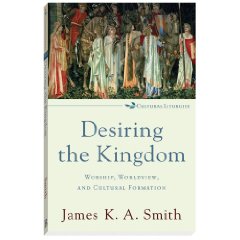
In fact, his next major work will be released later this summer, and will be called Desiring thedesiring the kingdom.jpg Kingdom: Worship, Worldview and Cultural Formation (Baker Academic; $21.99.)  It will surely be one of the most important books of the year, perhaps of the decade!   I suspect the Bitar lectures will be mostly drawn from this forthcoming volume.  Here is the promo blurb about it:   Malls, stadiums, and universities are actually liturgical structures
that influence and shape our thoughts and affections. Humans–as
Augustine noted–are “desiring agents,” full of longings and passions;
in brief, we are what we love. James K. A. Smith focuses on the themes
of liturgy and desire in Desiring the Kingdom, the first book in what
will be a three-volume set on the theology of culture. He redirects our
yearnings to focus on the greatest good: God. Ultimately, Smith seeks
to re-vision education through the process and practice of worship.
Students of philosophy, theology, worldview, and culture will welcome
Desiring the Kingdom, as will those involved in ministry and other
interested readers
. It is certainly a “Hearts & Minds” kind of book, and we are taking pre-orders for this one, too.  If you’d like to chat about it, call 717.246.3333.


MARCH MADNESS
BLOG SPECIAL
25% off

any book mentioned
**this month only**
(Pre-orders of James K.A. Smith forthcoming books included, to be shipped when released.)

Hearts & Minds 234 East Main Street  Dallastown, PA  17313     717.246.3333

Bookstore version of March Madness rolls on: great deals on new titles

I love tellin’ ya about new titles.  The last few days we’ve highlighted some random titles. I didn’t write a big ol’ essay about why they are important for God’s Kingdom or or how they will enhance Christ’s glory as we become more thoughtful readers or how rare some of these titles might be in other stores.  No, no.  I just listed some.  Here’s more, all offered at  25% off.

  Im tellin’ ya: it’s like March madness.   Spread the word.  Give us a call or send an email to inquiry or order.

A People’s History of Christianity: The Other Side of the Story
  Diana Butler BassPeople's History.jpg (HarperOne) $25.99  I hope you know Diana as an eloquent writer, a person who speaks, often beautifully, of new ways of seeing God’s work in God’s churches, and how old ways and historic, if distinctive, spiritual practices are renewing mainline parishes.  I’d read anything of hers, and have said so, often.  Here is her brand new one, a bit different than her memoir-ish telling of stories of congregational life, even if she has not lost her charm as a writer, the personal insight, the intimate detail.  This is, in fact, a church history, but it is kinda like Howard Zinn mashup with Justo Gonzalez. Or Philip Jenkins writing with Dorothy Day looking over his shoulder.

D.B. Bass’ A People’s History… walks us well through several different epochs of church history and rather than defining those periods by their doctrine, ecclesiastical disputes or debates about dogma, she shows—powerfully—how folks practiced their piety. And their ethics.  This formula for each section of describing common people, key leaders, and the spiritual tone of their journeys inward and outward—their prayer and their politics—is really useful.  And very enlightening.

Some big-wig church historians have raved about Bass’ work (“raises new kinds of questions, illumines neglected themes, prompts reassessments of familiar topics and draws the reader into fresh forms of engagement with the history” says E. Brooks Holifield of Emory.)  Less academic folk who are great writers, with their feet on the ground, in service ministries among the poor—Sarah Miles, say, or Shane Claiborne—have also raved noting that it is “intelligent and sassy” and helps us live more faithfully in light of these past ways of being God’s people.  That is, while I think any church history could be helpful to deepen our discipleship in faithful ways, this one really is very useful!  Pultizer Prize winning author of What Hath God Wrought even writes, “The curious but hesitant reader who wonders whether Christianity just might have something in it for them will that the answer is YES.”  Amen to that.  What a great, rare, book.  Highly recommended.

3 Simple Rules (larger).jpgThree Simple Rules That Will Change the World  Reuben P. Job (Abingdon) $8.95  You may know Jobs from his wonderful work doing A Guide to Prayer for All God’s People, and two other liturgically-themed daily devotionals.  As a former editor of the Upper Room publishing ministry, he is well aware of the deepest hungers for spiritual formation, and has help offer wonderfully-written volumes.  Here, he offers a simple, nearly pocket sized handsome hardback, a more ecumenical version of a small book the United Methodists used last year.  Three Simple Rules are from John Wesley, and offer us a practice of “a way of living that is in harmony with the life of Jesus” allows us to survive in and thrive in a world like ours.  (The three rules are “Do No Harm”, “Do Good” and “Stay in Love With God.”  What a great little book.

 Abingdon has also released a DVD with Reuben Jobs and adult six-session study book for small groups ($7.00.)  They’ve also done a teen version Three Simple Rules 24/7 ($7.00 and a Leaders Guide for $7.00) and even a kids edition (Three Simple Rules for Following Jesus: A Six Week Study for Children ($15.95).  This is very cool stuff, thoughtful but practical.  The whole church could do it together.  Give us a call or email if you want info on any of them.

insights.jpgInsights: Karl Barth’s Reflections on the Life of Faith  Karl Barth (WJK) $14.95.  There may be other such daily devotionals, but I don’t know of any.  Here, you can dip in to Barth’s lucid thoughts, in cogently gathered short readings, each based on a Biblical text.   These are taken from across his wide body of work, making it a perfect introduction.  One reviewed suggested these are great to stimulate prayer.  Another called them “winsome.”  One-page, vibrant selections of the most important theologian of the last several hundred years**.  Should be in every church library, at least!

**anybody want to challenge that?  Dare ya to post a comment!  This “Theological World Cup Playoffs” has him red-carded, though…

deepest difference.JPG
Deepest Differences: A Christian Atheist Dialogue 
James Sire & Carl Peraino (IVP) $15.00  I don’t know about you but I am growing a wee bit tired of the oodles of books by thoughtful Christians responding to the nasty “new atheism” intellectuals (like Dawkins, Hitchens, et al.)  Okay, I even know some of the authors that have written them, and most are quite good.  Here, though, is a book I’ve been waiting a year for, since Jim Sire told me about this friendly, honest, deep conversation he was having over email with a nearby atheist neighbor.  Only Sire could be this thoughtful, and whimsical, this overt in defending the historic gospel, all the while being this impish, dear, good man.  Surely professor Peraino knew he was grappling with a famous worldview scholar, apologist and author?  Maybe not at first.  The letters unfold and we are all are in their debt. Thanks to the two of them, and to the publisher, for allowing us to listen in to this friendly, deep dialogue without clear-cut answers to difficult questions.


heart of catholic.jpgThe Heart of Catholic Social Teaching: It’s Origins and Contemporary Significance  David Matzko McCarthy  (Brazos) $24.99  Brazos is this fascinating imprint that attempts to dig deep into our best traditions as a church, relating them to the postmodern times of our contempora
ry culture. We stock all of their releases, and this just came.  They’ve done marvelous books, academic stuff and less scholarly work, too, almost all of impeccable scholarship and taste, interesting and important.  There are more basic introductions to the coherence of the Catholic social ethic, but I doubt if you’ll find a more interesting, thoughtful, and important collection.  This weaves defty between Augustine and Aquinas, Scripture and Eucharist, peace, abortion, human rights, civic life and the deep spirituality of this venerable tradition.

A Great and Terrible Love: A Spiritual Journey Into the Attributes of God
  Mark Galli
great and terrible love.jpg (Baker) $17.99  It may be that J.I Packer wrote one of the best books on the characteristics of God (Knowing God) but, except for chapter three of that famous work, I was always under-impressed.  (Gasp.  I know Packer is beloved by many!) Here, Packer himself notes that this is “sharp-sighted, deep-diving, wide-ranging, contemplative, whose wisdom is flavored by a mellow astringency that is all his own.”  Too bad J.I. didn’t used to write like that!  Fortunately, Galli does, and this is a lovely, rich, and interesting book designed to add to what John Ortberg says (in the forward) is “part of the longest and most important conversation held by the human race: What is God like?”  Listen in and join the conversation.
 

divine commodity.jpgThe Divine Commodity: Discovering a Faith Beyond Consumer Christianity  Skye Jethani (Zondervan) $18.99  One of the reasons this hardback is just a tad pricey is because it includes full color art reproductions.  Vincent Van Gogh, to be exact; fabulously shown.  I know Nouwen has mined this a bit, but Jethani goes deeper, with other Van Gogh works (he obviously knows Van Gogh’s life and letters and uses them wonderfully.)  By meandering through this, he begins discovering our own problems of soul, offering historic spiritual disciplines to match the yearnings of serious people in these fragmented times.  Yet–and this is important—by drawing on spiritual and artistic masters of the past, this book offers insights into a faith perspective and inner work that cannot be co-opted by late capitalism’s consumerist ethos.  As Walter Brueggemann writes of Divine Commodity, “This is as good a book on the pervasive power of consumerism as I have read.”  And that, coming from Walt, who is known as one of our leading prophets against this brutalizing way of life, is saying quite a lot.  This books offers a rare kind of blend of social criticism and Bible study and spirituality and Blue Like Jazz memoir, written by an evangelical aligned with the Christian Missionary Alliance.  This is a book unlike most you’ve read, and highly, highly recommended
.

BLOG SPECIAL
25% off
any book mentioned
ORDER HERE

Hearts & Minds 234 East Main Street  Dallastown, PA  17313     717.246.3333 

New Richard Foster arrives early! New books on science! New book on race & rock!

Sometimes I spend time here at BookNotes explaining what we are about, why we like some books so, celebrating the kind of stuff Tom Sine talks about when he writes of “Creating the Future One Mustard Seed at a Time.”  (I reviewed his New Conspirators, a while back, here.)  Sometimes, though, we just tell of some random books, hoping the great titles speak for themselves. Yesterday brought a batch, and we listed a few in the last post.  More today!  Here ya go.  Extra-nice special price down below, too.  What a day!

longing for god 2.JPGLonging for God: Seven Paths of Christian Devotion  Richard J. Foster & Gayle D. Beebe  (IVP) $25.00  Many know our fondness for Foster’s extraordinary body of work.  He earlier wrote in Streams of Living Water of several faith streams within the river of the Body of Christ.  Here, he re-visits these key streams, focusing rather on key individuals, others who have gone before, showing their insights and tendencies as paths to deepen our awareness of God’s love.  There will be much to tell of this (Beebe, now President of Westmont College, was a student of Foster’s when he first gave class notes of what was to become Celebration of Discipline.)  This may be the highpoint of the IVP formatio line, and we are thrilled that it arrived early, happy to be among the first to celebrate it.  Now to read, pray, ponder, and experience God’s goodness with the help of the many guides they tell about in this marvelous, useful, resource.  Here is a very nice video clip with the authors describing their “tapping into a history and pattern that comes down from us through the ages.”   Please, please, take a moment and hear them out.

fine tuned universe.jpgA Fine Tuned Universe: The Quest for God in Science and Theology  Alister E. McGrath (WJK) $39.95   Endorsements on the back are from stellar scientists such as Philip Clayton, Francis Collins and. John Polkinghorne.  McGrath is a splendid Reformed scholar, an Anglican theologian, who also holds a PhD in science and theology and is well suited to help us continue this conversation.  Just last night I groused at the false faith/science dilemma portrayed during House.  (One sympathetic character says faith and prayer is good for the waiting room, but not the operating room.  Now there’s a dualism to unpack, eh?)  And today I got an email from an ID center describing a particular secular scientist who has affirmed the legitimacy of teaching about ID in science classes (debunking the misunderstandings of the Kitzmiller v Dover fiasco.  We really need these kinds of thoughtful scholars like McGrath to help us think all this through, and he is top-notch, serious, devout, important.

science and religion primer.jpgA Science and Religion Primer  edited by Heidi A. Campbell & Heather Looy (Baker Academic) $19.99  Book for book, Baker Academic is the most important and interesting Christian academic press going.  And this, my goodness, what a resource!  With dozens of authors, and a stellar advisory board, this compendium of articles makes this a go-to dictionary for anything faith/science.   Ms Campbell has a PhD from University of Edinburgh and Ms Looy’s is from McMaster University.  Four substantive introductory essays set the book’s background, and the rest (over 100 entries) offer an A-Z listing.  Remarkable.  Here is a bit more on the book (from the publisher’s webpage;  for even more, click on their “media” kit link.)

Questions of Truth: Fifty-One Responses to Questions about God, Science, and Belief  John Polkinghorne & Nicholas Beale  (WJK) $16.95  When a forward is written by a Nobel prizewinner in Physics, and a major endorsement comes from another Nobel prizewinning scientist, and it gets a rave review from Alister McGrath, and the British “book launch” was held at the Royal Academy, you know this really must be quite thoughtful.  Polkinghorne, noted above, is a major figure in today’s discussions about faith & science (he’s written at least 26 books!)  An ordained minister in the Church of England, he has been knighted and won the prestigious Templeton Prize in 2002.  This, though, looks like a fairly entry level guide to thoughtful faith in an age of science.  Here is their website.  Come back and order from us if it strikes you as useful, or if you are a fan of Polky. 

A Story of Rhythm and Grace: What the Church Can Learn from Rock & Roll aboutstory of rhythm 2.JPG  Healing the Racial Divide  Jimi Calhoun (Brazos) $15.99  Calhoun has played alongside of and worked with some of the most renowned of pop performers, from Jimi Hendrix to Etta James, The Four Tops to Mick Jagger,  Elton John to Parliament-Funkadelic.  You’ve got to read more to learn about this amazing guy.  (How many Pentecostal preachers publish on Brazos and get a blurb on the back from none other than the New Orleans hero, Dr. John?  What a night, indeed! Or thank Sly Stone in the acknowledgments!)  Charlie Peacock writes that Calhoun “has accomplished that all too rare achievement—he wrote an absolutely unique book that fills a true need.”  Musicians have often been in the forefront of racial reconciliation, so we must listen to this storyteller, preacher, rock and roll storyteller.

jimi calhoun.jpgI’ll be writing about this cat more, for sure, but for now, check this out, from the back cover: In A Story of Rhythm and Grace, Calhoun weaves together engrossing stories about racial differences and reconciliation from his life in the music world and his life in the church.  Reflecting on how he has often found more racial harmony on the stage and in the recording studio than in the pews, Jimi shows what religion might learn from rock and roll.

BLOG SPECIAL
25% off
 any book mentioned
ORDER HERE
or call
717-246-3333

Hearts & Minds 234 East Main Street  Dallastown, PA  17313

Some new and recent titles

I will dispense with the overview and sermon, telling you why these are the sorts of books we sell, what’s important about them, how they mesh with our vision, why you should have reading groups, blah, blah, blah and get right to it.  They deserve so much more, but I at least want to alert you that they are here.   And offer some special blog pricing.

sacredness of questioning.jpgThe Sacredness of Questioning Everything  David Dark (Zondervan) $15.99  I say this sort of thing a lot these days, but that Zondervan would publish a book that quotes Dan Berrigan and Homer Simpson and James Joyce and Rowan Williams and Allen Ginsberg and Walter Brueggemann shows that the apocalypse might be niegh.  Thanks be to God that such good writers, who read widely, and make such a fabulously interesting cases for important matters, are being published by evangelical houses.  In this case, the case is that we should think long and hard—indeed, that God wants us to—and that we should in some ways deconstruct the standard fare, coming at us from church, schoool, media, government. What an invitation to a discerning, liberated lifestyle!  David remains commited to standing on the solid rock of historic orthodox faith and his Buechner-esque Presbyterianism, with Southern shades of Flannery O’Conner, shines through each good section.   Eugene Peterson observes that Dark “brings a deep sense of reverence to every book he reads, every song he hears, every movie he sees, but it is a discerning reverence—attentive to truth and Jesus wherever he comes on them.  He is also a reliable lie detector.  And not a dull sentence in the book.”  I love this guy.  If you’d like a quick example of his good writing, read this great review of Rod Dreher’s Crunchy Cons that appeared a few years back in The Christian Century.  Or this ramble on Bob Dylan from Paste.

furious longings.jpgThe Furious Longing of God  Brennan Manning (Cook) $16.99  This brief, almost hand-sized hardback is lovely to behold.  It is Manning doing his thing again, telling us, once again, that we are loved.  It is, indeed, a love story for the broken-hearted, an intense and consuming love story.  For those who feel they can never measure up, this poignant telling of the serious love of God may be surprising: yes, God loves us, he call us His beloved.  We’re all ragamuffins, and Manning loves to tell stories that reminds us that Christ is with us in our mess.  Good news, eh?  Very tender questions for reflection, too.  To be honest, I wish there was more Biblical groundedness here, and a few more pages.  But it isn’t that kind of book…use it carefully for meditation or reflection or as a reminder.  I believe it was C.S Lewis, after all, who said we don’t always need to be instructed, but reminded.  Yep.

The Daily Reader for Contemplative Living: Excerpts from the Works of Father Thomas Keating  compiled by S. Stephanie Iachetta (Continuum) $16.95  This is a dense paperback of meaty thoughts for each day, nearly 400 pages, drawn from the esteemed Cistercian monk of Snowmass CO, founder of the “centering prayer” movement.  This work brings together for each day of the year three short prayer practices: first, “active prayer”; second, “spiritual reading”; and third, “Lectio Divina.”  There is some serious theology, lots of Bible, a bit of mystical stuff, excerpts from Fr Keating’s several books and audios.  A good and useful collection for daily quiet time. 

sitting at the feet.jpgSitting at the Feet of Rabbi Jesus: How the Jewishness of Jesus Can Transform Your Faith  Ann Spangler & Lois Tverberg (Zondervan) $21.99  Many have been thinking about this topic since Rob Bell has popularized the notion, Tom Wright has insisted we think faithfully as Jesus would have in the first century, and great, great scholars like Kenneth Bailey have shown how Middle Eastern peasant culture shapes our proper understanding of the gospels. Ken Bailey lived most of his life in the Middle East and knows that Arab culture and languages as well as most Westerners.  His newest, Jesus Through Middle Eastern Eyes (IVPseeing jesus through middle eastern eyes.jpg; $23.00) is another example of his extraordinary work, perhaps some of the best New Testament scholarship around, offering close readings of the parables and other teachings of Jesus.  His body of work on the gospels is wonderfully reviewed and well-described by Gary Burge, in Books & Culture this month!  Please check it out, here.)

  In this brand new book by Ann Spangler and Lois Tverberg we have a popularized and inspiration devotional study of what it would be like to study in 30 AD with the great Rabbi.It really is wonderful (and draws on Baily, in fact.)  Marvin Wilson, who we surely trust on these themes, says that these authors “vibrantly introduce the reader to valuable aspects of the Jewish back- ground, lifestyle, and teaching of the Rabbi from Galilee.” .

christian worship.jpgChristian Worship: 100,000 Sundays of Symbols and Rituals  Gail Ramshaw (Fortress) $30.00  You may know Ramshaw as a thoughtful Lutheran feminist theologian and liturgist.  Her husband is the Lutheran scholar of liturgical theology, Gordon Lathrop, whose own work is considerable.  Here, in this new hardback, illustrated with photos, icons and artwork, she offers a very creative ecumenical textbook on worship.  It is being said that there is nothing like this on the market, an exciting and engaging text—“marked by ample wit” one reviewer says—and written for serious, introductory study.  There are some very, very interesting questions at the end of each section, her own reflections and proposals, which help readers live out the meaning of true worship.  She spends some time looking at mythic power and the role of ritual, and makes an important case for knowing the past, the symbols, the liturgy.  Fascinating.

seven.jpgSeven: The Deadly Sins and the
Beatitudes
  Jeff Cook (Zondervan) $12.99  This isn’t brand new, but I’ve waited until Lent to start it.  Wow, what an amazing writer!  What a great way to tell the story, what an authentic voice–penned by a evangelical church-planter in a boozy college town in Colorado.  I’m really, really impressed and with all the many books on the seven deadlies, this is surely the most interesting and, if I may say so, fun to read.   It is an important trope, too, to match up the seven deadly sins and the beatitudes;  it isn’t original with him, but he may be the one who plumbs it best without being overly wooden or didactic.

Listen to this, by the ever thoughtful philosopher Peter Kreeft:

Of the many, many books about the Gospels, or about Jesus, or about Christian morality, only one in a thousand gives us a real breakthrough, a new “big picture,”  Most are just nice little candles on the cake.  Seven is a bonfire.  It’s not just good; it’s striking.  It doesn’t just say all the things you’ve heard a thousand times before.  And yet it’s totally in sync with both the saints and the scholars

gardening eden.jpgGardening Eden: How Creation Care Will Change Your Faith, Your Life, and Our World  Michael Abbate  (Waterbrook) $13.99  Before the snake, the fruit, the fall, the Commandments, God created a garden.  And Abbate is in fact, a gardener.  We all are, he says, as God has given us the immense obligation to work the garden well, to cultivate and care for the planet.  Interestingly, Mr. Abbate is a nationally recognized expert in green development strategies, is certified LEED and ASLA, and runs GreenWorks which is an award-winning landscape architecture design firm.  It is fabulous to have an evangelical publisher feature the work of an urban design leader, who writes also for trade journals and national magazines.  Randy Alcorn wrote the forward.  Is this the first evangelical book that quotes Michael Pollen (in a section on eating locally?)  Thank goodness for his wide reading—from Francis Schaeffer to Wendell Berry to the West Virginia Council of Churches (see their statement on mountaintop removal.) Very, very readable, with tons of practical up to date tips for faithful creation care.

BLOG SPECIAL
25% OFF
any book listed
ORDER
HERE

or call
717.246.3333

Hearts & Minds 234 East Main Street Dallastown, PA 17313      

Â