
Last week had us picking and boxing, listing and lugging, loading and driving, all the way to New England, north of Boston. We were honored to be chosen as bookseller for a heavy conference for Christian schoolteachers, mostly high school instructors, on making the notion of worldview come alive across the curriculum. The conference, sponsored by the very wonderful and altogether exceptional Lexington Christian Academy, invited their participants to think how to cultivate inquiry, setting a tone to get students to think deeply and ask good questions, cherishing God’s world in such a way as to learn in wonder. We sold plenty of books and got tons of good feedback, meeting teachers from across the nation. Thanks to LCA for having us play a part, and thanks to Kim W. for allowing me to stretch my book minutes a bit beyond—all right, a lot beyond—the one minute allotted. It is fun, I must say, to get applause for doing my animated info-merical schtick. I do hope everyone knew it was utterly sincere.
A few highlights:
David Naugle, worldview guru, and author of the spectacular tour de force Worldviews: The History of an Idea cited in his keynote address our friend Sam Van EmanÕs little book, On Earth as It Is In Advertising: From Commercial Hype to Gospel Hope and worked with his simulated gospel (Ôsim-gospelÓ) lingo to reflect on what might be considered sim- education. Naugle is a brilliant thinker, a very kind man, and a good teacher himself. (And we heard what book he is working on next!) Of course, he bought some books to lug back to Texas! I even got to tell people that Jim SireÕs 2005 book Naming the Elephant is nearly dedicated to Naugle and that in the forward Sire thanks David for inspiring him to revisit the question of what a worldview is, how worldviews actually work, and why worldview studies are so very important to pursue. His talk, by the way, is on his website, which you should visit regularly.
Nancy Pearcey gave a very helpful plenary speech, pretty much a summary of her main thesis, written in a compelling manner in the Gold Medallion book, Total Truth. She summarizes SchaefferÕs upper-story/lower-story dichotomy and uses Dooyeweerdian methodology, nearly, to offer a full-orbed view of truth. It was a good experience hearing her again, and we thank her for her important words. I announced that she was Fran & Edith Schaeffer for the 21st century, and I donÕt think I exaggerate. Check out info about the book here. I suppose it was self-indulgent, but I had a chance to again thank her and celebrate her naming us in her first book, The Soul of Science, an act of encouragement that we still recall gladly.
David Smith, gentle British scholar, now at Calvin College, is working on a number of projects, including some stuff to show how learning international languages can be an act of justice and peace; it isnÕt everyday that one meets a careful scholar with such great passions for make the world right; to have solid theology and Godly piety and be at the top of his craft, thinking and teaching in such remarkable ways is a joy to behold. David co-authored the only book we know about teaching foreign language in a principled and healing way, The Gift of the Stranger and he also wrote an argument for teaching Christianly in a book we are imported from across the big pond: The Bible and The Task of Teaching. It, too, is an extraordinary and thoughtful work, rooted in his deeply wholistic, Christian approach. Both of these books are hard to find and we have them here.
DavidÕs story of coming to faith years ago even while sensing that the evangelical subculture didnÕt seem to offer much in the way of scholarly resources or visions was incredibly rewarding for me to hear. He shared that he picked up some books—he called the book display guy from England who sold him the right stuff at some conference somewhere my counterpart—and the lights came on for him: he had no idea that a tradition existed of serious academic renewal developed in light of Biblical perspectives and Christian conviction. But that one purchase years ago from an ad hoc bookseller, made the difference! Yeah—a bookseller at an off-site book table sold this young believer a book so many years ago and it set him on a direction where he is now himself a leader in the reformation of scholarship.
This is why we do what we do, driving all day and setting up all night, I said to my traveling assistant, Rainman Gus. Indeed. I hope you who read this now feel somehow a part of this story, too, this movement, this book-informed move to live out radical faithfulness…
Other authors and friends were there: Jim Skillen and Andy Crouch are older and newer friends and their work is respected. Check out their respective websites for thrilling insight and wonderful writing. And some brand new friends, too: what a joy to meet the author of a memoir I had packed, The House Where Hardest Things Happened: A Memoir About Belonging by Kate Young CaleyÉ I had no idea she worked at LCA and it was a thrill to meet her and chat about her writing and good care for indie bookstores. Thanks, Kate. Lots of good conversations, talking about books, answering questions, inviting shoppers to email us later. And, for the record, I suppose I verged on embarrassing myself by arguing with a Harvard physics prof. Not a smart move, some might say.
We saw snow in Massachusetts, visited great bookstores in Cambridge, ate sweet potato fries in some place Gus said was famous, and—get this!—stopped in a church basement on the way home and caught a remarkable show of guitar genius and Hearts & Minds friend, Brooks Williams.
We did a blurb on BrooksÕ new CD, Blues & Ballads, on the bookstore website last month, and seeing him play live not only reminded me how much we love this performer, but how glad we are to stock his albums. He played with Paul Asbell, himself a Middlebury College musicologist and legendary blues producer (yeah—he’s worked with or produced everybody from Muddy Waters to LightninÕ Hopkins, and played with guys like B.B. King, Curtis Mayfield and, and, Brooks Williams!) They told tons of stories about the music they played, taught us a bit about the blues and early jazz, and showed an glorious joy in playing so well for the delighted crowd. This was an awesome night of up-close live and loose music, called a Ã’guitar summitÓ on the coffeehouse poster. Gus got brown rice Japanese tea and I got fair trade coffee, we hugged Brooks, who weÕve hosted here, but never seen on his home turf, and started home at midnight, which seemed like a bluesy thing to do, but was probably just stupid, arriving bleary-eyed in time to participate in our church service Sunday morning. And then collapsed into bed.
The LCA conference and bookselling road trip couldnÕt have happened without Scott Ã’GusÓ Calgaro and I thank him here for his able assistance and storytelling and overall good direction, except when walking near Harvard Yard. And thanks again to the authors and book-lovers who support our work. Perhaps like in the story David Smith told, or the others that could also be told, these packages of print and paper will find their way into someone’s heart, and change their world. Exhausted and sore as I am, late as it is, I thank God. Man, I love this job.
I hope you know we value your support, helping us keep this retail thing viable. Thanks.
Category Archives: BookNotes
12 Marks of the New Monasticism

Last week, I was raving about this collection of essays, called together by the good folks at Rutba House, an intentional community living among the poor and serving together in incarnational, radical discipleship. They noticed that different kinds of folks are talking about community these days, and wanted to bring together various voices to ponder some common insights and principles. They invited some folks from the Emergent conversation, the Catholic Worker movement, Richard Foster’s Renovare ministry, which offered insights about the broad contemplative traditions that so many are reclaiming. The Christian Community Development Association (CCDA) founded by John Perkins reminded the gathered folk of their longstanding committment to the “3 R’s” (Relocation, Redistribution, Reconciliation.) My goodness, what a wonderful set of different traditions all insisting on community, work with the marginalized, prayerful attention to being church for the world. Here are the marks they came up with, which are explored wonderfully in School(s) for Conversion: 12 Marks of a New Monasticism.
Relocation to the abandoned places of Empire.
Sharing economic resources with fellow community members and the needy among us.
Hospitality to the stranger.
Lament for racial divisions within the church and our communities combined with the active pursuit of a just reconciliation.
Humble submission to Christ’s body, the church.
Intentional formation in the way of Christ and the rule of the community along the lines of the old novitiate.
Nurturing common life among members of intentional community.
Support for celibate singles alongside monogameous married couples and their children.
Geographical proximity to commuity members who share a common rule of life.
Care for the plot of God’s earth given to us along with support of our local economies.
Peacemaking in the midst of violence and conflict resolution within communities along the lines of Matthew 18.
The School(s) for Conversion chapters explore each of these, with different authors, of course, writing each one. There is a good degree of diversity, here, but they strive to offer this vision for those longing for a better form of living out fidelity in our times. I’ve noted some concerns I have, in my initial review of Shane’s book last week (he is one of the authors here) and also in my posting the other day about this book. Anyone else have any initial thoughts? I might suggest, though, that after weighing in, that many of us give this book a chance to perculate in our lives, that we prayerfully discern if we might be drawn to such steps towards similiar experiments. Is there someone (anyone?) you can talk to about these yearnings? Are you in some kind of small group, book club, fellowship or Sunday school class? I think this book–even if it miss certain features or asserts biases that some might not find essential—is one of the most important books of recent years. It is rare I say this, but, truly, there is nothing like it on the market! Thanks be to God that a book like this was put out, and let us hope it stirs up many to deeper consideration of the nature of our church life and the meaning of discipleship and spirituality and community and service.
For more info, visit www.newmonasticism.org. Then come back to Hearts & Minds and support our efforts to promote books that you most likely won’t find at your typical bookstore. Thanks.
School(s) for Conversion: 12 Marks for a New Monasticism Edited by The Rutba House (Cascade Books) $22.00
C.S. Lewis on the poor
I had the wonderful privelege of preaching yesterday at New Life PCA church here in South York, and was warmly welcomed and well hosted. A cool and welcoming place, this is a congregation that has had good and forthright conversations about holding together those with differing political and cultural views; they are eager to reach out in creative ways into the broader community. Good stuff. When their pastor–who is in a singing combo called Plan B (for those who have ears to hear)–explained that he is preaching in Luke, and asked me to speak on the Year of Jubilee (cancel the debt on the day of atonement!) which shows up in Isaiah 61, the text Jesus uses for his first sermon (Luke 4), well, I almost wet myself. I love showing those connections between Older & Newer portions of Scripture and called my message “Jesus’ Inaugural Address: Echoes of Jubilee.” In Him it has happened, the year of the Lord, the annointed Kingdom, has come. Good news for the poor, and anybody poor in spirit enough to know they need release. We are now to be people of Jubilee, living into God’s Kingdom of peaceful, restorative, social policy and annoucing Christ-given grace.
For those drawn to reflection before the service, this C.S. Lewis quote from Mere Christianity was in the bulletin:
Charity—giving to the poor—is an essential part of Christian morality: in the frightening parable of the sheep and the goats it seems to be the point on which everything turns. Some people nowadays say that charity ought to be unnecessary and that instead of giving to the poor we ought to be producing a society in which there were no poor to give to. They may be quite right in saying that we ought to produce this kind of society. But if anyone thinks that, as a consequence, you can stop giving in the meantime, then he has parted company with all Christian morality. I do not believe one can settle how much we ought to give. I am afraid the only safe rule is to give more than we can spare.
School(s) for Conversion

Okay, folks. I’ve blogged (and linked you to a big ‘ol rambling review I did) about Shane Claiborne’s Irresistible Revolution where he invites us to, in response to the grace of Jesus, care more for the poor, nurture the prophetic imagination, and engage in subversive stunts to expose the dead-end bankruptcy of the secular American Empire. Then I wrote about a wonderful memoir of a friend of Shane’s, Jonathan Wilson-Hartgrove, a very decent fellow who was, as he puts it, Born Again in Babylon. In that moving reflection, he tells of being a Capitol Hill page, on his way to the Naval Academy and his eventual embrace of radical faith, his journey with the Christian Peacemaker Teams (CPT) to be a peacemaking witness in Iraq, and how he and his wife helped form an urban, intentional community–a Baptist Catholic Worker–in North Carolina.
I don’t desire my book review blog here to be a site for fisty-cuffs, yet I am a bit surprised that nobody commented on these extraordinary books which make such expansive claims that we should all live like Jesus. Although I suggested, from my Reformed worldview, that the personalism and anti-institutional tone of much of this tradition is inadequate for serious and sustainable social change, I nonetheless celebrated this faithful younger generation who is trying to embody meaningful discipleship in community, standing against the idols and ideologies of our culture. When I write, as I sometimes do, about being “neither left nor right” I am mostly thinking of “third way” alternative political parties—Kuyper in Holland and his formation of distinctively Christian social institutions has been one of my influences, you know–but Shane or Jonathan would more likely take this phrase to mean standing up to protest the war-making of both the Democrats and the Republicans and rejecting power by sharing life with the powerless. With Dorothy Day, St. Francis or Mother Theresa, they might be less inclined to use the “leaven in the loaf” metaphor from Jesus as justifcation for radical witness within middle class structures, jobs, organizations and institutions, but might more likely call us to be a “city on a hill” showing the way out of exile.
So it should come as no surprise that the community which Jonathan & his wife helped start (Rutba House–learn about the reference in my previous post) gathered a gang of somewhat like minded folk to create discussion and then put out a book on what community looks like and how such communities can be agents of the counter-cultural values of God’s movement.
The very title, School(s) for Conversion speaks much—our gathering to live in community to be and do “church” is a school which trains us to be Christian. (Certainly, it can be said, that any good worshiping body does this, as we enact rituals and pay attention to liturgical practice. Where else in our culture do we hear about being peacemakers and then rehearse it—“passing the peace” most churches call it—so that we might be trained in such nonviolence? Where else do we eat a meal together—communion!—and learn of the relationship between for and grace?)
The subtitle is of course a thorny one, for me–my monthly reviews occasionally lament the ways in which churches of various stripes have disempowered lay people and kept back the vision of vocation and calling, nearly implying that the reign of God is not about the Kingdom (“creation restored”) but the institutional church. I think the Bible rejects any such dualisms and I am quick to fret about such things. So anything that seems to retreat from culture, or stand apart from it, or that suggests that praying is more important than working (as most of us rightfully or wrongfully imagine when the word “monk” is used) smacks to me of a piety that is not faithful. I don’t like the desert fathers, no matter how trendy dear Henri Nouwan made them. (They left their children for God’s sake! They deserted their homes, their businesses, their congregations! So they could find God! Talk about gnosticism! Ugh!)
Still, this gang of writers convened by Rutba House represents various kinds of experiments at relevant alternative communities and since we’ve engaged in some of this “living together in a world falling apart” ourselves, I want to take it seriously. And you know what? This is a wonderful, wonderful collection of essays, delightful, visionary, prophetic, practical and helpful. I’ll explain why in my next post.
School(s) for Conversion: 12 Marks of a New Monasticism edited by The Rutba House (Cascade Books) $22.00
Born Again in Baghdad

I hope that readers took me up on the invitation to read my long reflection on the wonderful and important new book by Shane Claiborne and his pals at The Simple Way community in Philly. You will not want to miss Shane’s punchy and powerful reflections, The Irresistable Revolution and I hope my mild critique didn’t dissuade anybody from taking him seriously. His book, I believe, deserves to be discussed and debated.
I would like to suggest another book, a parallel book, in which, interestingly, Shane makes an appearance. (His broken arm episode from the wreck while doing peace work in Iraq is quite a story, and I was glad to read more about it in this new book.) It is calledTo Baghdad and Beyond: How I Got Born Again in Babylon, written by another formner student from Eastern U., a thoughtful young man involved in their best classes: Jonathan Wilson-Hartgrove. Not unlike Shane, young Jonathan came to college with a conservative, evangelical faith intact, a sharp mind and a desire to take his discipleship seriously. He ended up embracing a pretty radical tradition, seeking to embody faith by following ancient practices, and thinking through social issues in light of the primacy of loyality to Jesus.
The title alludes to the heart of the narrative—a peacemaking expedition with CPT (Christian Peacemaker Teams) to be a Godly presence and international nonviolent witness to the possibilities of peacebuilding ways of solving international problems. You may know about CPT due to the recent news reports of a recent delegant (a Candadian Quaker named Tom Fox) who was murdered after being kidnapped there. There has been much right-wing sputtering about the military-led rescue of the remaining captured peacemakers and this book is a wonderful window into some of what goes on in these trips. It is by turns frightening, funny, theological and a great travelogue, all in the genre of spiritual memoir. It allows us a glimpse into the soul of one who would put his life on the line for peace and helps us understand the Christain basis for peace activism in the manner of Voices in the Wilderness or the Christian Peacemaker Teams. Our family has been aware of the history of the CPT movement (my sister-in-law went on an early, dangerous, version of this, Witness for Peace, into the war zones of Nicargua during the Contra war there.) Jonathan’s book means very much to us for any number of such reasons.
Upon returning home—especially with a tender recollection of being rescued by a Muslim doctor in the town of Rutba, where their hospital had just been bombed by coaltion forces—Jonathan and his wife helped start an intentional community, living among the poor and trying to flesh out a more overtly and prophetically Christian way of life, here, amidst the underbelly of the American empire. The Rutba House community is in Durham NC. (Learn more about their work at www.newmonasticism.org.)
As contemporary American Christians read the book of Revelation within the dominant societal system in which we live, we must ask ourselves whether or not our own nation-state has become the modern equivalent of the Roman Empire. We must ask “Has America become Babylon?” That is the question that Jonathan Wilson-Hartgrave endeavors to answer.
Tony Campolo from the Preface
For those who may want a more detailed study of the Christain Peacemaker Teams and their work, see the new collection Getting in the Way: Stories form the Christain Peacemaker Teams 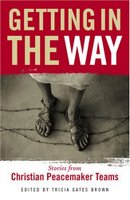 edited by Trician Gates Brown (Herald Press) $17.99 From Hebron to Haiti, Iraq to Columbia, these brave folks are doing what we all know needs to be done if the faith-based peace witness is to have integrity: sacrifice for peace as much as others sacrifice for war. Highly recommended.
To Baghdad and Beyond Jonathan Wilson-Hartgrove (Cascade Books) $16.00
I missed that memo.
A funny saying making the rounds these days—I missed that memo–suggests that sometimes we feel out of the loop, missing something, unaware.
Well, this time, it isn’t your fault. Our automatic notification “subscription” went a bit hay-wire and somehow the thing got, to use the proper term, xed out. Or maybe disabled is what they call it now.
It has been re-enabled and you now can see that I’ve posted a couple of really important book annoucements in the past week. Please scroll down and check them out, since I’ve got a few more up my sleeve, coming down the pike.
Sorry about the inconvenience. It is gratifying to know that some of you missed these reports (well, just a few) although it is weird to think that you thought I’d have any idea how to fix it.
As always, kudos to Scott the Ubiquitous Cyber-Man who can fix these things and to fellow blogger Denise Frame Harlan, who told us how. You should subscribe to her blog of lovely and powerful prose because she is going to be a famous author someday. Enjoy.
The Irresistible Revolution

Here is how I start the long review–mostly positive, with a few qualifications–that I did for the monthly column over at the website. I hope you read it all and catch our enthusism for this book.
I have been eager to tell you about a wonderful, fun, challenging, interesting and provocative book written by a young Christian who is getting some publicity these days; it is a guy weÕve come to know a bit, that weÕve heard of for several years, and are very encouraged to know of the release of his new book. Shane Claiborne is a hoot of a guy—radical in his commitment to evangelical social action, delightful in his lack of guile, inspiring in his show of guts and goofiness. I have a few reservations about the book, a pages-long backstory about my own journey (which I will try to tell only briefly) and more enthusiasm about selling this new book than anything that has come along in ages. It is called, if you donÕt know, The Irresistible Revolution: Living as an Ordinary Radical and is published by Zondervan ($12.99.) This in itself is a story that is curious since most evangelical publishers wouldnÕt risk telling the tale of a young man who lives with the poor, protesting the role of the military and who has been regularly arrested for nonviolent civil disobedience. Martin Luther KingÕs famous words to the more cautious status quo Reverends in his “Letter From a Birmingham Jail” are still pretty needed today, since most mainstream folks tell our idealistic social activists to cool down and go more slowly. I am overjoyed that Zondervan took a risk on this guy, and trust that the integrity and wholeness of ShaneÕs life, and the Biblical basis for his human rights activism, will become plain. For now, though, the release of this book is a huge thing. This is Zondervan, not Orbis Press! Shane came out of an evangelical Christian college, for crying out loud, not Oberlin or Koinonia Farms! He has spoken at Willow Creek! How did he even hear of the Berrigan BrotherÕs at his college? That is itself quite a story. I thought we were the only bookstore in the world that carries Max Lucado and Ammon Hennacy; Chuck Colson and Howard Zinn; Rick Warren and Dorothy Day. But IÕm ahead of myself…read more
excerpt from N.T. Wright’s Simply Christian
In Simply Christian, N.T. Wright’s brillant, new introduction to the Christian faith, an apologetic work somewhat like Lewis’s classic Mere Christianity, he starts with our longing for making the world right, our desire for justice, wonders what to make of these echoes we hear of a better world. In the next substantial section, he walks readers through an overview of the Bible story, with the unique take that his scholarly work has developed. With pleasant illustrations and thoughtful argument, he writes about God, Israel, exile & homecoming, and Jesus. From the final pages of the chapter “Israel”:
Simply Christian: Why Christianity Makes Sense N.T. Wright (Harper SanFransico) $22.95…we can see at last the multiplicity of ways in which the Israel of Jesus’s own day was able to think and speak about the coming together of heaven and earth. We noticed in the previous chapter how the Temple functioned this way. The Glorious Presence of YHWH, dwelling in the tent, and then in the Temple itself, was referred to as “the tabernacling”—that is, the Shekinah; it was a way of the God of heaven being present on earth with and for his people. By Jesus’s day similar ideas were being developed in relation to the Torah, God’s gift to his redeemed people; if you kept the Torah, it was as though you were in the Temple itself–that is, at the place where heaven and earth met. We saw a moment ago another strand that points in the same direction: God’s “word,” the word by which all things are made, will go out once more to make all things new. Similar things could be said about God’s “wisdom,” an idea which begins, it seems, with the notion that when God made the world he did so wisely, and develops until “Wisdom” becomes a figure in her own right …Finally going back once more to Genesis, God’s powerful wind, his breath, his Spirit (all three are ways of translating the same original word) is let loose in the world to bring new life.
Presence, Torah, Word, Wisdom, and Spirit: five ways of saying the same thing. The God of Israel is the creator and redeemer of Israel and the world. In faithfulness to his ancient promises, he will act within Israel and the world to bring to its climax the great story of exile and restoration, of the divine rescue operation, of the king who brings justice, of the Temple that joins heaven and earth, of the Torah that binds people together, and of creation healed and restored. It is not only heaven and earth that are to come together. It is God’s future and God’s present.
It’s a wonderful dream. Rich, multi-layered, full of pathos and power. But why should anyone suppose that it—or anything else that might be built upon it—is anything more than a dream? Why should we imagine it’s true?
The whole New Testament is written to answer that question. And the answers all focus, of course, on Jesus of Nazareth.
N.T. Wright’s Simply Christian
Most serious contemporary readers and certainly those familiar with religious writings of the last 50 years know the acclaim of C.S. Lewis’s Mere Christianity. Originally spoken on the BBC, and then published as smaller booklets—The Broadcast Talks—this book is one of the wiser, deep yet popular cases for the Christian faith in our lifetime. It is widely read and widely cited. Happily, a new book was recently released which documents Lewis’s turbulent rise to broadcast fame during the war years. Pretty interesting.
Most serious readers of Christian books today know that certainly one of the most brilliant, popular and influential writers of this generation is N.T. (Tom) Wright. Beloved known by some as “The Bish” he is an evangelically-minded, progressive, erudite and prolific writer. He has done major, major work in Jesus scholarship, published popular-level Bible commentaries, a few collections of sermons and essays, a daily devotional and has written scholarly work on the authority of the Bible, the writings of Paul, the echoes of Hebrew scriptures in the New Testament. He is interested in these postmodern times and yet is resolutely committed to being an Anglican church leader and a Biblical theologian.
Simply Christian: Why Christianity Makes Sense is his sterling call to do popular level, thoughtful and compelling apologetics. It is, in a phrase, his version of Mere Christianity. With rave reviews from diverse authors—the fiction writer Anne Rice, the Reformed theologian J.I. Packer, Walt Brueggemann…It is a remarkable book that has this many important leaders commending it.
I have started this wonderful introduction to Christian faith and it is characteristically Wright.
He starts off with the big question of where our desire for justice comes from. These first chapter invite us to realize that we have dreams, here “echoes” of a voice. The second part is called “Staring Into the Sun” which looks at an overview of the Bible, the culmination of the story of Israel found in Jesus, and how Christ’s inaugurates the kingdom. The final third of the book illustrates ways that church folk can be agents of this new Kingdom, this realization of our echo, our desires for the world made right.
I’ve jumped ahead–I’m so bad–to see how he handles the big ending of living in beauty, as a step entering the new creation brought by the resurrection. It is a wonderful, wonderful ending.
Simply Christian: Why Christianity Makes Sense N.T. Wright (Harper SanFransico) $22.95
Athanasius, Owen, Machen
For my Sabbath reading I had a wonderfully blessed experience reading the new fourth volume in John Piper’s collections of character studies in short biographies called (from a line about Augustine) “The Swans Are Not Silent.” In each volume he looks at three heroes of Christian faith, illustrating how they taught and lived out a particular truth. For instance, the first, called The Legacy of Soverign Joy looks at the understanding of saving grace in three church greats; the next one, The Hidden Smile of God, looks at the role suffering played in three church leaders; it is not surprising that it is very moving. The third is on keeping up your ministry despite all opposition and struggle, called The Roots of Endurance (the chapter on anti-slavery activist William Wilberforce is splendid, and important, but all three are exceptional.) All three of these books are informative, moving, brief and make significant contributions to our pracitical piety today. Although they come out of a conference designed for pastors, and would make an excellent gift for pastors you know, I think they are great for anyone, since most of us know little about the lives of these previous theologians or Christian leaders. I’ve been waiting for a fourth one for a while.
Contending for Our All: Defending Truth and Treasuring Christ in the lives of Athanasius, John Owen and J. Gresham Machen is a great book on why we must sometimes take a vital stand to defend orthodox theology. I will admit that I sometimes worry that the ever passionate Piper sometimes verges on being to self-assured of his positions, too bombastic, too strong. But, as I have often said as I commend his many books, it is rare to find such generous care, pastoral desire, clear joy and a strong call to sacrifical service. If he errs on the side of being too sure of his views, my hunch is that it doesn’t matter too much—most of us will only apply a portion of his teachings, anyway. So even if he overstates a bit, I love and respect and have been helped by his solid guidance and Christ-centered passion.
Readers of my blog or monthly column know that I enjoyed and had sympathies with McLaren’s Generous Orthodoxy so you might understand that I worried whether Piper would be promoting harshness or needlessly strict dogma. I was happy that he addressed this on the very first page. Here, he starts off his study of the fight for orthodoxy by insisting that we ought not be prideful, but humble. It is a paragraph worth reading slowly:
Some controversy is crucial for the sake of life-giving truth. Running from it is a sign of cowardice. But enjoying it is usually a sign of pride. Some necessary tasks are sad, and even victory is not without tears—unless there is pride. The reason enjoying controversy is a sign of pride is that humility loves truth-based unity more than truth-based victory. Humility loves Christ-exalting exultation more than Christ-defending confrontation—even more than Christ-defending vindication. Humility delights to worship Christ in spirit and truth. If it must fight for worship-sustaining truth, it will, but that is not because the fight is pleasant. It’s not even because victory is pleasant. It’s because knowing and loving and proclaiming Christ for who he really is and what he really did is pleasant.
I learned quite a bit about all three of the characters in each of the three chapters. I had no idea that the Council of Nicea (325) created such ugly battles in the generation following its formulation of Christ’s divinity. Although an Egpyptian Bishop and Middle Eastern theologian, Athanasius was most beloved as a pastor; I had no idea how he suffered exile and how his flock cared for him. (The famous desert fathers and mothers cared for him, too, a fascinating sub-plot of its own.)
John Owen, too, the 17th century British Puritan, was a serious scholar who took a firm stance for a high view of Christ and his saving work, and his writings propelled him into international politics. (Local Pennsylvania tidbit: William Penn studied under Owen and learned of religious toleration from him) He is the giant of Puritan theology, a dense and deep writer, yet all the while sweetly communing with the Christ that he theologized about.
And Machen. What a character, ceaseless in his reasonable defense of historic faith amongst those that denied the classic forumaltions and truths (you know, little stuff like the bodily resurrection.) Piper’s take on him–including some concerns and questions–was very moving for a Presbyterian like me. Machen was kicked out of the church and left his position at Princeton, yet turned down opportunities to teach at more fundamentalist institutions. How he helped evangelicalism grapple with the forces of modernity—between the extremes of liberalism and fundamentalism–is as relevant now as in the middle days of the 20th century.
All of the Swans books are worth having. This one struck me as very relevant, illustrating Piper’s passion for truth, his conservative bias in standing for traditional theological forumulations (it is no surprise he takes a shot at the emergent folks) and yet his truly kindly writing and desire for grace and peace is evident. He ends, I’m glad to report, with a reflection on a small book that had a huge, huge impact on me years ago: Francis Schaeffer’s The Mark of a Christian. There, you should know, Schaeffer, at the height of his work on cultural apologetics, his defense of historic faith admist nihistic existentialism and worse in the 60’s, insisted that the final apologetic, the last defense, the truest compelling arguement, was love in the life of the believer. To start a book like this with a mediation on humility and end it on love is as it should be. As is usually the case, Piper gets it right.
Contending for Our All: Defending Truth and Treasuring Christ in the Lives of Athanasius, John Owen, and J. Gresham Machen John Piper (Crossway) $17.99