4 Poets (Part 2) L.S. Klatt

Yesterday I wrote a brief invitation to consider poetry—not just the idea of it, but to actually invest in and read some poems.  I quickly gave the old shout out to a few of our favs, and then described the first of four friends  (ahhh, how ’bout that alliteration?) who have each recently published poetry volumes.  I wanted to tell you about these because they are friends and we would love it if you supported them—sort of like going to the verbal deli and asserting, right out loud in front of everyone, “I’ll take a pound of poetry, please.”   These are most likely writers you don’t know about, so we’re doing our cool thing of letting you know.

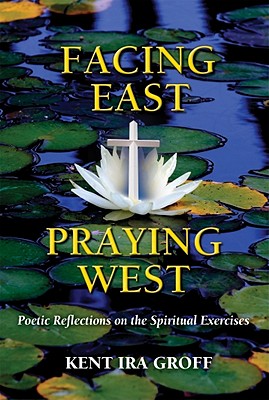
Also in yesterday’s post I shared a few poems from the first of the four,  Kent Ira Groft, from his lovely devotional book rooted in the Ignatian spiritualilty method, poems he happened to write while on a retreat and sabbatical in India, Facing East, Praying West (Paulist; $12.95.)

Now, I want to tell you about two very different writers, both who used to work for the Pittsburgh-based CCO (Coalition for Christian Outreach) doing innovative and thoughtful evangelism and disciple-making in the context of higher education.  You probably know that I worked for the CCO decades ago and Beth and I continue to serve them as book-sellers, speaker, trainer, cheerleader.  CCO is doing great work linking local churches to near-by campuses and it is in this capacity of lay ministry with young adults that Lew Klatt and Michele Barnes McClendon became friends of mine.  To say that I admired their ways with students, their fidelity to the gospel, and their good work with CCO is an understatement.  I can vouch for their integrity, their passion, their ministry, and their well-read, bookish disposition.  It doesn’t surprise me that both have been writing for a while; they have been poets in word and deed for years.  It doesn’t surprise me that both are now published poets.  And, while CCO didn’t intentionally shape their literary stylings, it did shape their worldview.  I would say that, happily, these are both integrally Christian, but not usually overtly so.  To swipe the old gal’s line, they “tell it slant.”

First, Dr. L. S. Klatt, known to friends as Lew.                                  

Interloper: Poems by L.S. Klatt (University of Massacusetts Press; $14.95)
klatt.jpg
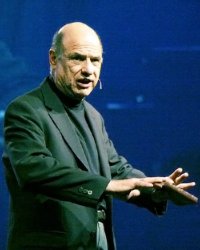
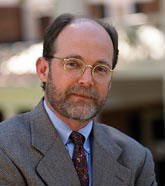
Lew now teaches in the English Department at Calvin College (Michigan) and has been having his work published in prestigious journals for some time now.  He is doing a workshop at the famed Calvin Festival of Faith and Writing this very weekend, and perhaps some of those talks will be recorded or shared. He is dear, dear guy, incredibly smart, and may more than the other three friends I’m celebrating in this column seem like the caricature of a bohemian poet (as long as folks don’t know that he went to seminary, too.)  That shaved head and long goatee; the cool delivery, the English prof job.  Yep, he’s got the coffee-house cred.  And his work is informed and demanding.

One critic and fellow writer, Dara Wier says,

There are cows of higher mathematics in Interloper’s pages.  Invention, imagination, thinking invited to test what is new, what hasn’t been imagined—-these are given pride of place in Klatt’s poems…The book is a field guide for any mind exercising to learn unknown transfers and connecting combinations.

klatt_228.jpgThe image of poet as interloper (who traffics where perhaps they don’t belong) is important, here. (The word is from a Whitman line in the epigraph.)  He is here sticking his curious nose into everything—from Native American landscapes to modern car crashes, from contemporary commerce to homage to Walt Whitman.  One poem is called Chicago (with a nice nod to Sandburg) while another is Nebuchadnezzar and the Paparazzi and yet one is The Leek as Bazooka  I liked one curiously called The Beet as a Bloody Tenet.  I don’t think I’ve ever read a poem with “quinces from Persia” before.  And I know I’ve never hear a poem called ekphrastic.

Crazy stuff, this free verse, odd sounds (beyond Hopkins), meditative discourses, a line from Jonathan Edwards, another a riff on a painting I’ve not heard of, and a few inspired by a journal entry from Emerson.  Mostly, though, he is being creative; doing art.  Here is a line from the back that I love as much as any in the book: (for Klatt) “words are musical and versatile, more about play than utility, and he therefore seeks to dislocate language to freelance and maneuver, to alter common sense on the way to new sense.”   

Careful reading pays off, though, eventually, with some new visions, indeed:

pears become guitars, racks of ribs are presented as steamboats, and helicopters transmute into diesel seraphs….in symbols that scat and ricochet, the interloper scores a new song, one that composes—and decomposes—on the page.

Interloper won the prestigious Juniper Prize for Poetry and it is a thrill to announce that this important Amherst publisher saw Klatt’s work worthy of serious publication.  One may not understand all these lines. (Ha!  One will not!)  I wish I could reproduce some here, but there are squiggles and 8-balls and pi signs and Chi-rhos and games of hangman and the darndest stuff one ever saw in verse.  I don’t think it is merely frivelous, although it is allusivity gone gonzo.  He plays with words, with sounds, with lines, with images, so many images– I am left speechless and wondering.  Man, this is a piece of work, deeply moral, somehow, God-drenched and weird.

Some, I really don’t get. Some were so cryptic that I had to laugh, and yet wanted to
“do it again” like a kid dizzy from spinning.

 And then was the awful line, the one I knew to be about the death of my father in a horrible car wreck, and my pain; even here, it isn’t exact or representational, and I know Lew and his loved ones have also experienced excruciating grief.  The tears that well up even as I write are for you, too, my friend.

                The husk of his car
crumpled like a Coca-Cola
can. You stick your head in
the front (passenger) door
& pick through Ovid
& Aristotle covered with
pulverized glass
like sapphires
like sugar
The library is open
& how you remember
your father at a time like this
is excruciating fire
& smite.  The world
is aluminum & how you know
is because
                you are the car
& no one (no one else is)
driving

Hearts & Minds 234 East Main Street  Dallastown, PA  17313  717.246.3333

4 Poets (Part 1) Kent Ira Groff

Books about books are favorites of mine, and books about words are a real book geek’s delight.  I am even excited about the academic study In the Beginning Was the Word, a God-centered philosophy of linguistics, by Reformed mathematician cum theologian, Vern Poythrus (Crossway; $25.00.)   I’ve raved before in these pages about the truly beautiful Caring for Words in a Culture of Lies by Marilyn Chandler McEntyre (Eerdmans; $18.00.)  She reminds us of the power of words, about truth, but also about beauty and charm.   Of course Eugene Peterson, especially in his collection of essays and interviews, Subversive Spirituality (Eerdmans; $26.00) has a few great chapters on the power of fiction, and the joys of poetry.  He believes that those who love the Bible ought to also love words, and that our poets and fiction writers are among our best allies as we learn to read, and to care about language.  He is blunt in his frustration that most pastors say they are too busy (or too theological or too spiritual) to read novels.  Calvin Seerveld in Rainbows for the Fallen World (Toronto Tuppence Press; $25.00) has a chapter on how deepening our allusive imagination could help us (among other things) read the Bible better.  And many of the wonderful chapters in a book we named as one of the books of the year last year, Bearing the Mystery: Twenty Years of Image Journal, edited by Gregory Wolfe (Eerdmans; $30.00), make, in serious and thoughtful prose, paintings, poems, and interviews, this exact point.  

I am not very schooled at poetry—I had an e e cummings paperback as a kid and my dad used to read Tennyson out loud, but that’s about it— and much of it frankly doesn’t interest me.  Some of that is my fault, I confess—one needn’t work so hard reading luminous prose from a good memoirist, and there is more immediate feedback if you follow the narrative—and I suppose most of us could admit to not spending enough quiet time ruminating on the word play and joy of our poets.  (Of course some of it is not our fault—there are a lot of bad poets, who are either overly sentimental and schmaltzy or overly cryptic and off-putting.  But take heart: there are good ones, that are playful and allusive and meaningful and fun.)

I just started Poetry in Person: Twenty-five Years of Conversation with America’s Poets edited by Alexander Neubauer (Knopf; $27.95.)  It includes sparkling exchanges about their work, about why we should care, about the state of our artistic culture, and (as in most interviews) a happy blend of the curious and the profound.   There are details about drafts and there is advice about craft.  Mostly, though, you get to eavesdrop with poets who are considered some of the best of our age.  I am sorry to admit I didn’t know most of them. 

Better, though. here in National Poetry Month, is to read some poets.  I could tell you about many we’ve got in the store, many obscure or lesser known (Ron Jellema has a recent one, and he is known in some Christian circles, at least; we occasionally get some orders for Scott Cairnes who has recently done some good writing that isn’t poetry.) And there are some ways “into” poetry  by some who are rightly famous.  For instance, we have a great daily devotional called 40 Days With Gerard Manley Hopkins for those who like his stunning wordy style.  It is just wonderful!  There are the excellent anthologies compiled by Billy Collins (or any of his own accessible work; Ballistics just came out in paperback) or Garrison Keillor’s chosen favorites, Good Poems, which is a great one-volume introduction to meaningful poems that can buoy the spirit.  We are glad for the new paperback version of Mary Oliver’s latest The Truro Bear…, and we always recommend the always-popular selected collections of Wendell Berry.  (Oh, how we celebrated a year ago when his Mad Farmer Poems were finally re-issued handsomely by CounterPoint, in a large sized, gift edition, lavishly illustrated with engravings by Abigail Rorer.)  I hope you know the good work of Luci Shaw, one of our favorites and best sellers.

The 2008 Pulitzer Prize in poetry went to Philip Schultze and he just released a new collection of old and new poems (The God of Loneliness) and I’ve been browsing through a West Virginia poet named Maurice Manning that has been liked to Mr. Berry, whose book is called  The Common Man.

A great, great way to learn about poetry and the ways it can enrich us is to learn from those who have been touched by certain poets or their work.  I often recommend  Teaching With Fire: Poetry That Sustains the Courage to Teach edited by Sam Intrator & Megan Scribner (with an introduction by Parker Palmer) published by Jossey-Bass ($16.95) or Leading From Within: Poetry That Sustains the Courage to Lead, also edited by Sam Intrator & Megan Scribner (Jossey-Bass; $19.95.)

These two may be just what you need: the editors asked teachers, and then, more generally, leaders, to name a poem that has helped them endure their hard word, poems that have inspired them, poems that they found helpful as they from time to time revisit why they do what they do.  Great clippings poured in, teachers and leaders shared remarkable poems, and remarkable stories as to why these verses helped them.  Their little testimonials are offered, and then the poem itself.  I have found the stories about the work to be as interesting to me in some cases as the poems themselves, although the explanations really helped open up the riches of the words.  Nice!

Allow me to introduce you to four volumes of poetry that I have been reading and re-reading recently.

 I will do this in four parts, sharing about each one in the next few posts.

These four are each quite different, and (I admit happily) that all four are friends.  I guess that was why I was firstly drawn to them, as I know the faces and voices of each.  The first is written by a seasoned spiritual director, whose books on spirituality are often enhanced by his fine exegesis of poems or his own simple verse, who has now written a poetical guide to spiritual discernment. One is the work of a professor of English and poetry, and his book is published by a prestigious poetry house; the third poet is a housewife who has recently self-published (and should, I’d say, get herself an agent and become big and famous in the small pond of poets, cause she is that good.)  The last I will tell you about is the first published volume by an established memoirist, a spectacular writer, whose book was published by IAM [International Arts Ministry.]  It is their first effort publishing a book, and we are thrilled to promote it.

Come on folks, follow along.  This is going to be fun.  First: Kent Ira Groff.

Facing East Praying West: Poetic Reflections on the Spiritual Exercises  Kent Ira Groff (Paulist Press) $12.95  Almost anyone in central Pennsylvania who has followed the rise of ministries of spiritual direction knows about Oasis, and Kent’s leading work in this deep field.  He’s written before, books about the inner journey, a book about congregational life that is imbued with a deeper spirituality, a wonderfully evocative book for men and a very interesting book about the spirituality of writing.  Here, he gives us poems he wrote while in India, alongside guidance from the famed Exercises of Ignatius, and a Bible passage on which to meditate. 
9780809146284.jpg

Does this stand alone as a poetry book, worthy to be celebrated in National Poetry Month?  Yes, I think it does.  However, for better or worse (for better, in my book) these lovely works are linked to his passion to help others in spiritual formation.  Yes, he was hanging around Anthony De Mello, yes he was in India, and yes these are arranged as a guide through four weeks of the Jesuit discernment stuff.  But mostly, these are prayer guides, lovely words created to help us ponder the riches of life and faith and give voice to ponderings one might have in conversation with the Biblical text.  Use it as a devotional, or read them as poems in their own right.  I cannot commend this enough because I think for many of us, we will warm to the power of poetry when we see it connected to our deepest spiritual concerns.  And, also for many of us, our prayer lives could use some imagination, some zest, some playfulness and some way to connect spirit and life.  Kent Groff is experienced as an aid and fellow traveler on this journey.  Let his avocation of artistic word-play help you appreciate poetry and prayer.

Here is his reflection from Week Two which is themed “Incarnation.” It is called Luke’s Good News.  He writes out Luke 12:22 and then this:

Try this for Christology:
Lord Jesus as you show
us to life life from below
    cradle manger,
     pulpit  boat,
     temple mountain,
eating bread at others’ tables,
befriending Prodigal and Samaritan,
not a place to lay your head,
     gambled robe,
     Roman cross,
     borrowed tomb,
still rising from the dead,
revealing friend in stranger,
known in breaking bread,
giving life forgiving love:

Now I raise doxology:

Let me treasure how I borrow
life today to love tomorrow.

Kent offers a similar incarnational reflection a few pages later, one called Love and Pain, inspired by Luke 7:47.

My young Chinese artist
host plays music on his car radio.
I like it and ask, “What are the words?”
He pauses—
                     “Love and pain.”

How is it life’s one cosmic soup
of love and pain?
Someone with pain of rejection
loves forgiveness’s restoration.
Jesus parties
with folks with little—yet wastes
it all for love—and ends
with not a thing.

Love and pain–
then love—
life’s song.  Again…
    
Many BookNote readers, I’d guess, have often pondered Mary’s Song from Luke 1.

Here is Kent’s poem Revolutionary Magnificat

This Magnificat is revolutionary:

When a Nazi army encircled an Austrian village one Holy Saturday
(but did not consider what day
the next would be)
and church bells rang
Easter hymns at dawn,
the enemy army (thinking many troops had gathered
overnight) fled with
Alleluias at their heels.

Our praise will be the thing
wherein we’ll catch
the consciousness of the king,
bring peace instead of warring ways.

I was very touched by one called Healing Wounds  which is part of the Week Four portion on “resurrection.”  The devotional text is John 20:26, after which the poem appears.
Groff-2.jpg
I tried for years
to heal with scars,
but love’s wounds run
deep.  Then One appeared
who knows such pain
as will remain
forever open
yet life giving,
all forgiving

“Peace be with you,”
came Love’s refrain.

I will gladly
keep these wounds
if you will only use
my vulnerable Self as strength
for giving others
faith and hope and love at length.

Kent Ira Groff is a good guy, a friend of Hearts & Minds, and I think a thoughtful, yet accessible wordsmith.  His vocation is helping others become more aware of God’s presence and how to live transformed lives for the reign of God.  He trains other spiritual directors and is respected among those who work in that field.  Yet, from the very first time I met him, selling his Alban Institute book in Red Lion, PA, I knew he had a poet’s heart.  He resonates with St. John of the Cross and other mystical poets.  He often adds his own verse in his books.  Here, at last, is Kent doing this—his gift, as gift.  We think you might find it both enjoyable and useful. 

Next up:  a college prof who is an old CCO friend, whose new work is, uh, complicated. For reasons I’ll explain, one of them made me bawl. And another former CCO campus minister who stands clearly and powerfully in a grand tradition of black women poets.

Hearts & Minds  234 East Main Street  Dallastown, PA  17313     717.246.3333

Globalization, student development, and Somewhere Down the Road with Amy Grant

Thanks to friends at Geneva College (Beaver Falls, PA) who allowed me to speak briefly at their sociology department forum on globalization last night.  I had the great opportunity to supplement the interesting and insightful lectures, video pieces, and small group conversation with some hearty suggestions on books that help us live in this shrinking/stretching world, the hot-wired world Friedman called flat.  I described basic stuff on global justice issues like Rod Sider’s Rich Christians in an Age of Hunger, to the insightful study of how the ideology of idolatry works to drive the inter-connectedness of the most urgent problems of our age, Hope For Troubled Times, by Bob Goudzwaard, Mark Vander Vennen & David Van Heemst, and Subverting Global Myths, the seriously profound and highly recommended critique by Sri Lankan evangelical Vinoth Ramachandra. We displayed more than a dozen different books on various aspects of the globalization phenom, and it was great to expose younger Christian students to semi-scholarly Christian books or activist guides to help them as they think through the implications of transforming faith in the 21st century. 

And further thanks to the student development office who allowed me to preach to their professional staff—resident life people, career guidance staff, outdoor education leaders, health care providers and counselors, multi-ethnic specialists and the campus ministry team who all conspire to help students “weave together belief and behavior” in Steve Garber’s memorable phrase (which is the subtitle of Fabric of Faithfulness.)  I talked about defining moments in my life, key Biblical texts and theological “aha” moments that have pushed me to be a cheerleader for the integration of faith and the Christian mind, thinking about vocation and calling, reading as an act of Kingdom fidelity, and the transforming/worldviewish “life is religion” perspective that animates us here at the bookstore.  I asked if they–mature Christians at an evangelical institution of higher learning–have had formative times and helpful places where they’ve been guided into how their faith impacts their understanding of the institutions and settings in which they work.  (What would you say?  Has anyone asked you how you’ve come to think about your own calling and career? What does it mean to “image God” in your own work?  Have you ever read a Christian book about your particular passion or vocation?)

And, yep, somebody was counting how many books or authors I cited or alluded to the hour lecture—from Jamie Smith to Andy Crouch to Derek Melleby & Don Opitz, Calvin, Luther, Kuyper, King.  Nearly 20, not the least of which was the amazing new book Souls in Transition: The Religious & Spiritual Lives of Emerging Adults by researcher Christian
Smith (Oxford University Press; $24.95.)

In the last meeting I participated in, I spent some time with a few valiant leaders who are helping foster conversations on campus about community involvement, service learning, social transformation, and justice advocacy as part of spiritual formation and theological witness, which is one of the tasks of their Center for Faith and Practice.  My own less-than-stunning forays into public action became the jumping off point into talking about how best to sustain wholistic ministry that cares about word and deed (Good News and Good Works as Ron Sider’s book puts it.)  There are quite a number of resources that can be used–DVDs and Bible study booklets and brief books that are designed for reading clubs or discussion groups and we are glad some of their folks may be using some of them. 

I suppose it shouldn’t surprise anyone that one of the things that comes up–in talking with youth, young adults, or any other cohort or generation—is the deep question of how to sustain healthy practices of serving, even standing up for social change, being prophetic, subverting the idols, rocking the boat, without growing overwhelmed, cynical or jaded.  The Bible says not to grow tired of doing good. Isaiah 58 promises that those serving the oppressed will have intimacy with God as God shows up for us.  Yet our world is full of brokenness, our lives are touched by sadness, and often our views of faith development and our experiences in church don’t particularly honor this human side of life East of Eden.  What do we do with all this pain? 

I drove the 5 hours home excited about book-selling, glad to have shared ideas and resources for integrated Christian lives, lives that make sense and are coherent, informed by the Biblical story.  But I was haunted by my own weariness, the sadness of disease and injury and disappointments, even close to home. (Please, please pray for my neighbor Marc who is in critical care after a motorcycle accident.)

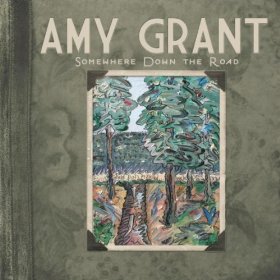
Somewhere 2.jpgI put on the new Amy Grant album, Somewhere Down the Road.  Think what you will about Amy as a symbol of CCM, but she is a smart, smart almost middle aged woman, a fine pop singer, and a substantial thinker.  There have been tons of cheesy evangelical pop and not a few vapid, inarticulate evangelical stars, but, with a few exceptions, Amy has avoided the schmultz and has produced a serious body of entertaining and artful pop music.

Her new album is a thematic one, about life as journey, about “road” as metaphor, and about the ups and downs of life under the sun.  It is not quite Eccelsiastes, but she has named her own pain and broken-ness before, and this record includes some of those older songs (one in a bare acoustic version) that are in what Francis Schaeffer called “the minor key” of Christian art.  For many of us, the hard stuff is not so minor, but a fairly major aspect of our lives.  Not enough of the most popular Christian music admits that.

The first song made me cry.  I had to pull over.  Simply put, it says that our cries and laments and miseries are, to God’s ears, “better than a hallelujah.” 

Perhaps that is a good part of what I was saying at Geneva.  In a globalized world of complexity (both delightful and dangerous) and injustice, our human-ness matters.  God cares for the suffering.  As student affairs staff come alongside young adults in their journey of faith, they come across significant pains and losses and griefs, and God can be found in these hard times; we are, as Nouwen memorably put it, “wounded healers.”  And, yes, as we mentor folks to do the hard work of wholistic ministry, being missionally-minded Good Samaritans,  we must encourage them to cry out, to know that–like in the Bible–God hears the cry of the suffering.  Lament and fear and tears may be, “better than a hallelujah sometimes.”

Here is a lovely youtube video somebody made to this brand new Amy Grant single, “Better Than a Hallelujah.”  It is a very sweet song, a wise set of lyrics, and a touching slideshow.  It is worth watching (and we would love to see your comments—post ’em as a “comment” at the Booknotes blog if you care to.)

Here is a youtube video of Amy talking for few minutes about the concept of her new album.  You may enjoy hearing her describing her interest in roads and life as journey. [I have to admit that I rolled my eyes a little when I realized there was a song about hopping a train–the beautifully coiffed Amy, for crying out loud—but the darn thing works, the tongue-in-cheek “What’s the Chance of That?” cracks open the song along with the killer harmonica.]  The album has a few great songs (and includes a pretty hip track sung with her daughter, Sarah and one cleverly co-written with Mindy Smith about not being critical of others .)

You can read her description of the record here.

We have the CD, of course.  It sells for just $13.99.  You can order it from us here.

Thanks for your support, buying books and music from us, which allows us not only to sell good stuff, but to go out on the road sometimes, bringing encouragement and resources and energy to folk doing the hard work of serious ministry. It is a privilege to partner with them, and it is a privilege to sell books to those–perhaps like you–who are on the journey “somewhere down the road”, and who know that God hears you in the ups and downs, just like Ms Grant sings—“into the arms of love.”

Hearts & Minds 234 East Main Street  Dallastown, PA 17313     717.246.3333

Choose Love Not Power: How to Right the World’s Wrongs from a Place of Weakness

I forget exactly what it was, but as I was sitting in the Good Friday service
the other night and

church candles.jpg

a phrase of Jesus just popped out at me, a word from the gospels
that hadn’t quite struck me before. You know now that works.

For me–for better or worse, I suppose–this naturally leads me to books and,
well, book-ling. I don’t think it is “God telling me” to try to sell a certain
title, exactly, but I am not going to blush about this. I do think of books that
others might read, or I feel a compulsion to name resources for others, often
right in the middle of prayers or Scripture or hymns. I think of these as my Spirit-led
ad campaigns.

Perhaps I’m just projecting my own needs, connecting the dots of the Biblical
text and my own sorry life. Maybe I’ve got an over-active imagination and ought
to leave work at work sometimes. Or maybe God is telling me to tell
ya about something.

Well, just in case it is some holy summons, I’m not going to delay.

I kept thinking during that Good Friday service that I should tell people
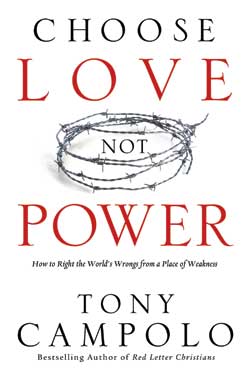
about the new Tony Campolo book, Choose Love Not Power: How to Right the
World’s Wrongs from a Place of Weakness
(Regal; $14.99.)

Yes, I know, for some of us, Tony has been around a long time, he has re-told
more stories and shared so many of his favorite anecdotes and Scriptures at
conferences and revivals and conventions and camps that some of us can nearly
repeat his talks along with him. Lately, I have noticed a few people roll their
eyes when I mention him—not so much because they disagree with his vibrant
faith or differ with his call to progressive evangelical politics. It’s just,
well… maybe we could call it Tony Overload. And it makes me sad.

It frustrates me because I don’t think that is fair. Campolo is still a
master communicator, still has a commendable desire to offer more-or-less
traditional Baptist faith with more-or-less socially relevant gospel
application. From his books on apologetics (like Partly Right where he
gives a generous explanation of the big questions of critics of the faith like
Freud and Darwin and Marx, but exposes their errors) to Things We Wished We Had Said, his book on fathering,
sweetly and honestly co-written with his adult son, Bart, Tony has written very
interesting books that make people think and invite a serious, yet joyful, way
of living. Carpe Diem is one of his most popular, you know, and
one of my favorites.

Campolo wants people to know the gift of salvation through God’s grace, he
teaches people how to pray and “get into the Word” and reminds folks of the joys
of evangelism. Despite a reputation for hanging with the hurting, and being
involved in political stuff, he rails against unrighteousness and names our
temptations—from sexual sins to materialism to gluttony. He doesn’t come
across like a hair shirt, but those who say he is soft on sin must be talking
about somebody else.  He preaches about the cross.  And he makes people laugh, and when their guard is down
from all the zany storytelling, he invites folks to sign up for prayer meetings,
or an experience of urban ministry, or even to give a year to serving the poor;
he asks people to at least make a donation to his educational work in Haiti or
to adopt a Compassion child or to give service to whatever group is hosting him.
He has helped us out here in York more than once, most recently helping us raise
money for Bridges of Hope, a mentoring ministry for homeless moms. You got a
problem with that?

A brand new book is coming soon, Connecting With Jesus,
co-authored with Mary Albert

connecting with jesus.jpg

Darling of Spring Arbor College (Jossey Bass;
$21.95.) I can’t wait to see it. They co-authored a really great book a few
years ago called The God of Intimacy and Action: Reconnecting Ancient
Spiritual Practices, Evangelism, and Justice
which is a wonderful combo
of stories, Scripture, social engagement and burning passion for not only a
deeper, more contemplative faith, but a more robust social witness, in both
words and deeds.

Still, the one that came to my mind, pondering Christ’s
non-violent resistance as Peter lopped off that poor guy’s ear and then Christ’s
quiet witness at the sham trial, as we did a few days ago, was one of Dr.
Campolo’s very early books. In the 80s it was called The Power Delusion
or something like that. It was ahead of its time, with Tony the sociologist
analyzing ways we view success and how we relate to power and authority, and
Tony the preacher calling us to a radical Christian alternative to the American
Dream and the way we exercise control over others. This is a foundational book,
yet with such practical implications. It is about how to serve God in ordinary
ways on ordinary days, from parenting and home life to thinking about global
concerns and our public life. As you might guess, Tony draws on sociologists and
cultural critics and theologians to offer a critique of power, our addictions to
be in control, our gender relations and how we think about work, and invites us
to humility and compassion. It was never a big hit (wonder why?) and went out of
print years ago.

choose love.jpg

Well, a month ago the evangelical publisher Gospel Light/Regal–God bless ’em
for re-issuing John Perkins, too!—somehow got this old book of vintage Campolo
back into print. It is expanded and edited and updated for the new century and
is, as I said, now called Choose Love Not Power.

It has a crown of thorns on the cover, so maybe I should have listed it a
week or so ago. Still, it took my carefully listening sitting in the darkened
sanctuary of our Tennebrae service to recall it. Yes, this is a fabulous book to
explore after Easter. Christ has shown that His way is true. In fact, he has
shown it to be ultimately not just faithful, but effective. It was through this
cosmic method—overcoming evil with good–that His claims to Lordship have been
vindicated.

In Ron Sider’s late 70’s classic, Christ and
Violence
(Wipf & Stock; $15.00) he roots Biblical peace-making not
just in a sentimental reading of “love your enemies” or a quaint reminder that
we are to “turn the other cheek.” More deeply, perhaps, than simple obedience to
these bold commands, Sider roots Biblical pacifism in the very nature and ways
of God. While we were yet His enemies, Romans 5:10 reminds us, Christ
gave His life over for us. That is, nonviolent love of enemies seems to be at
the very heart of God, who may have woven it into the fabric of the universe.
And old Peter never forgot that lesson as he wrote, at the end of his life, that
Christ’s episode in the garden is an example for us to follow.

And so, I want to suggest that a great post-resurrection, after-Easter study
might be to ask how this Christ-like manner, this forgiveness of enemies, this
ironic silence at the trial, this utter humility, might shape our lives, our
views of success, our views of power. And Campolo explores this question very
well. We highly recommend it and trust that it will make you think for yourself
(which is what he asks in a moving afterward, where he admits to the complexity
of the matter, and his own ambiguities at times.)

tony c.jpg

Yes, Choose Love
Not Power
is full of Campolo-esque bluster, cool testimonials, and
colorful storytelling. I am sure most people will think it is a fun read, a
great book to have and to share. And, it is not too difficult, nothing obscure
or obtuse, even as he does some serious study, helpfully citing heavy scholars
like Christopher Lasch and Philip Rieff. (He also cites his beloved Martin
Buber, and tells that wonderful story from Franny & Zooey.) He
examines how power works in various settings and wonders how Jesus might want us
to act. In a way, it is all too clear: Tony insists that there is a simple
choice to be made, and one cannot truly live out a commitment to both ways. We
must choose: love or power. I love Mark 10 and Matthew 20, Zechariah 4:6, and 1
Corinthians 1:26-29. I agree mostly with Tony’s concerns and appreciate his
vivid warning against religious coercion and flexing our political muscles.
(Recall that last week here I highly recommended the recent scholarly work from James Davison
Hunter, To Change the World where he takes Campolo to task; I’m
not sure Hunter has read this portion of Campolo’s corpus.)

Regardless, I think
I’d tweak Choose Love.. a bit, wondering why he seems to presume
that power is illicit, and how we might formulate a more appropriately Christian
understanding of power. Does he, like Jacque Ellul, say, have a better doctrine
of the fall and idolatry than he does of creation and “natural” norms? (That is,
is power an inherently good thing, created by God, which is now most often
distorted and misused, or is it itself a manifestation of our fallen order?)
Must it be love vs power, either/or? Can not love redeem power?

I think
Campy might agree. He seems to suggest as much in some parts of the new edition.
He tells the story of his work to bring some moderate land reform and social
responsibility to Gulf & Western, the sugar cane corporation that was
accused of abusing their role in the economy of the Dominican Republic. It is an
admirable story, a great example of limited but effective use of power. I wonder
what you think?

Here’s to resurrection victory, a display of God’s power.
He’s to newness of life breaking out, newness that certainly effects our views
about things, from the bedroom to the board room. Here’s to another year of
figuring out what it means to be truly faithful to Jesus and His reign, how to
be servants of all, even in the ways we use power. Here’s to tears of laughter
and tears of repentance and tears shed from tender stories told by one of finest
evangelical communicators, Dr. Tony Campolo.

Invite somebody into your life to read this together. No eye rolling will be
allowed. And no ugly power plays to see who reads it first or finds the most
poignant critique. Only playful and mutual discussion and healthy learning
allowed.  Of course, as he himself says, you won’t agree with it all.  It should be obvious, but there are few books that we sell that we agree with every line; few authors where I fully love all of their work. So?  I think this is a very useful book on a very important topic, by a fine writer and important voice.  Join the conversation!

BLOG

SPECIAL


Choose Love Not Power:

How to Right the World’s Wrongs from a
Place of Weakness

regularly $14.99

now just $10.99


ORDER HERE

(takes you to our secure order page)

Hearts & Minds 234 East Main Street Dallastown, PA 17313
717.246.3333

Living the Resurrection by Eugene Peterson — On Sale for $5.00 OR FREE*

Please note that this special offer was a time-limited deal from April of 2010.  We no longer have this book at this bargain price.  It is still a wonderful read, though, and very highly recommended.  Thanks.

I often get a bit jittery during this season, nervous that it isn’t meaningful enough, or that I am not taking adequate time to be intentional about spiritual practices and self-reflection.  I know, I know, I’m too busy (and, I know, I know, that God’s grace is bigger than our own little habits, wise and faithful or not.)  Still, I want to witness to the world, and to myself and my family, that this week is called Holy for a reason.  This stuff matters.  Here is a link to a poetic reflection by my friend Brian Walsh, a Pastoral Letter to his “Wine Before Breakfast” college fellowship in Toronto, which was posted at the Empire Remixed community blog.  Maybe it will help you prepare for the Tridiuum, this trio of holy days that is upon us.

If you care to, you might scroll back to the BookNotes blog posts from a year ago where I highlight several different sorts of books about the atonement, the meaning of the cross, and justification.  Important stuff, and I think we offered a fairly healthy and diverse selection.  A few said it was inspiring just to read about them, even thought they didn’t buy the books.  Hope it helps.

Still, the big question that looms before me is so what?  That is, how does Easter really make a difference?  Of course, I cannot presume to answer that—there have been 2000 years of sermons and examples of people doing just that, for better or sometimes worse.  But we do offer books and resources to befriend you on the journey, authors who have written well to help us think, to prod us on, the remind us of the deepest truths and to teach us some new ones.  As a business person who is at heart an educator, I can’t not share some resources with you now, this weekend, at this critical junction.  What comes next?  We are nearly holding our breath.  Well, here are a couple of fine resources to order now, and read soon, while this passion drama is still fresh in our minds.

living the resurrection.jpgLiving the Resurrection  Eugene Peterson (NavPress) $16.99
ON SALE FOR JUST $5.00 (While supplies last.)

 This is a very thoughtful, well-written, gutsy, fairly brief hardback that I have read more than once.  It makes a great several week reflection, or a Sunday school class or book group, as it is so, well, orderly.  It examines the post-resurrection narratives, and the comments on them by Paul,  and draws from them insights about how to live out of this glorious Resurrection truth. How do we encounter, witness to, and serve the Risen Christ in everyday life?   As he describes it, there is resurrection wonder, resurrection friends, and resurrection meals. 

One person once took me to task for saying that Eugene’s writing is “earthy.”  I suppose she thought I meant “earthly” which is to say, in her mind, “worldly.”  No, not at all. Peterson is a Kingdom of God man, a Bible-loving pastor who wants to slowly and carefully nurture in us a God-drenched imagination, a Kingdom way, truly a way shaped by Jesus and His victory over death, but, yet, always, “down to Earth”, creaturely, human and humane, real.  Yes, he is earthy, just like these post-resurrection stories of fish and friends. 

If you like Peterson’s magnum opus five volume spiritual theology set, you will love this, as it is quite similar, yet is brief and easy to read.  It’s a great way to introduce a friend to this important contemporary writer. It is a great way to see how Bible texts can teach us, and how we can enact them in church ritual and how those practices can shape our living—Easter all year long!  We read well, listen to the stories, do church in appropriate ways shaped by these texts and these stories, and God shows up, changing us, and we walk out into a new world, to live differently.

We really, really love this slim volume, and I was thrilled when a sales rep offered me a deal—a deal that allows us to sell it for just $5.00.  Wow, you can’t even get a cheap mass market paperback for that!  Depending on how you roll, your bill at the coffee shop will be more than the book.  Folks, this is the bargain of the year.  While supplies last.

Practice Resurrection: A Conversation on Growing Up In Christ  Eugene Peterson
practicing resurrection Peterson.jpg (Eerdmans) $24.00  I have to tell you that I have not started this yet.  The fifth and final volume in his “conversations” of spiritual theology, is a cranky study of Ephesians, claiming that we must attend to maturity, character formation, and discipleship.  I am working very, very slowly through this series; all are remarkable. This one looks great.

 As you may guess, I skim a lot of books, highlighting them for customers, knowing enough to describe them.  These I am reading for my own nurture, books that I believe I will spend perhaps the rest of my life with.  I am impressed, and I like Eugene, count him as a bit of a mentor and friend.  So, sorry, I haven’t touched this yet.  I’m just not ready for it. Maybe you understand, and have your own books that you must read first.  Or maybe you are ready and eager.  This could be the best book on living out the victories of the resurrection.  Certainly the allusion to the famous Wendell Berry poem makes it quite special.  Consider it recommended.

The Challenge of Easter
  N.T. Wright (IVP) $6.00  Again, this is one I’ve discussed before,challenge of easter.jpg and think it would make a lovely bit of (serious) devotional reading next week.  This is a brilliant excerpt from The Challenge of Jesus and is Wright at his semi-scholarly best.  Why do we celebrate Easter?  So what, you ask?  Here, Wright looks at Easter in its earliest context, where a band of followers discovered the fulfillment of all the promises God had made to their people over the centuries.  Could this announcement of and vindication of the announcement of a new genesis, and a new Kingdom come, based on the Risen, suffering Christ, really re-shape all of human history? Are we now living into this newness, this life-over-death newness?  This little book really packs a wallop, perfect for a one-on-one discipleship conversation, a post-Easter gift for anyone wondering what it all means. 

surprised DVD.jpgSurprised by Hope DVD  N.T. Wright (Zondervan) $24.99  I’ve blogged before about this spectacular book, which explores the resurrection, the promise of new creation, and, consequently, how to rethink the nature of death, heaven, the afterlife, and the missional vision of the church today.  Here, N.T. Wright walks us through this book and more, in a zesty and appealing new DVD curriculum that would be a fabulous project for this season of Easter-tide. I’m showing it in the church I attend, and invite you to consider it, too.  Christ rose.  We will too, and the Scriptures say we reign with Him. The whole creation groans, awaiting liberation.  What does that mean?  This is an amazingly rich and well made DVD curriculum for personal home use or for a class or group.
 

Divine conspiracy DVD.jpgThe Divine Conspiracy DVD  Dallas Willard (Zondervan) $24.99  Years ago, when the book first came out Beth & I had the great privilege of spending a bit of informal time with Dallas Willard, an incredible thinker, a solid spiritual guide, and a heck of a nice fellow.  He told us a story about how this title came to him when the publisher insisted on something other than his first, more prosaic proposal—God seemed to give him this title as a way to allusively name the Kingdom of God without off-putting rhetoric.  And, also, how awkward it was when Richard Foster in the forward named it as one of the most important books in all of church history, to go down with the spiritual classics of all time. And coming from Foster, that is something, indeed.

 Well, here we have the studious Dr. Willard being delightfully interviewed by the great communicator and all around media-friendly dude, John Ortberg.  Ortberg’s jokingly calls his own wonderful book The Life You Always Wanted “Dallas for Dummies” and he now gets to work with him, bringing deep Kingdom principles of formation and Christ-likeness to us in wise and useful ways.  If Christ indeed rose from the dead, and He now lives in us, what in the world does that turn us into? How are we changed by his indwelling, by His resurrection power in our lives?  Transformation, here we come!  Six weeks of Dallas for dummies, indeed.  Absolutely excellent.

raised with christ.jpgRaised with Christ: How the Resurrection Changes Everything  Adrian Warnock (Crossway) $17.99  This is a truly remarkable book, a major contribution, by a British blogger who is exceptionally solid in his Biblically orthodox rigor, but is not contented with merely getting the doctrine correct, but wonders–as I put it, “So what?”  If all of this is true, what ways must we live?  What does newness of life mean for ordinary Christians who are confident that their redeemer lives? How does this doctrine–surprisingly under-valued, he argues—give us new vision for daily life?  Warnock is quite a rigorous and conservative scholar, but has a pastoral heart for faithful living, working out the implications of the “everything” that this changes. (Does he cover it all?  Of course not.  How could he?)  There are so many rave endorsements of this, such as one from Joni Eareckson Tada who writes that readers “are in for a delightful surprise as they grasp anew all the benefits that flow from Jesus’ resurrection—what a difference it can make in our lives, our churches and our communities!”

the feast.jpgThe Feast: How to Serve Jesus in a Famished World Joshua Graves (Leafwood Publications) $14.99  A seasoned pastor, friend and great customer told us this was one of his favorite books of the year, and as I’ve read through it, I keep thinking how it ought to be better known.  This is radical stuff, meeting us in our places of deep hunger, and yet calling us to invite others to the table.  With quotes from authors as diverse as Dorothy Day, Hans Kung, Lewis Smedes,  Annie Dillard, Rowan William, Barbara Brown Taylor to Lee Camp, you can see this guy has an eye for good writing and mature, evangelical faith, with a bent towards radical discipleship in the nitty gritty of social ministry.  Wonderfully written, challenging words, about taking Jesus seriously, and offering His bread of life to a needy world.  Thank goodness for this lovely publisher, out of Abilene Texas.

BLOG SPECIAL

Living the Resurrection

regularly $16.99
NOW JUST $5.00
OR
FREE
*with purchase of any of the other above listed titles
ORDER HERE

Hearts & Minds 234 East Main Street Dallastown, PA 17313     717.246.3333


James Davison Hunter To Change the World

I’m sorry this blog post is a bit long.  I hope you read it carefully. Thanks.

I received a number of compliments on the last BookNotes blog that criticized Glen Beck for his remark saying people should leave their churches if the church speaks about social justice.  I also criticized Mr. Beck for his rude–scary, even–comments about how he intended to hammer and hammer and hammer Sojourners editor, Jim Wallis.  His campaign to discredit Wallis and all his “cute” “little” friends I suppose includes me (and maybe you) and I can assure you that Mr. Beck is speaking about stuff he is just wrong about.  He is wrong about the Bible and he is wrong about Wallis. There should be no argument about that.

However, this does not mean it is right to be ugly towards him or uncivil in our refutations.  Apparently, a few readers thought I may been too dismissive, thinking that I was mocking those who may disagree with Wallis or Sojourners or those that appreciate some of Beck’s perspective.  I hope careful readers of the post, and those who read my lengthy replies in the comment section, understand that we here at Hearts & Minds are very eager to promote robust conversation, reading widely, and thinking things through together in light of a Biblical perspective—which means not siding up easily with any simply ideology of the left or right.  To be “distinctively Christian” in our approach may be misunderstood, as we may need to offer kind critique to those who are too simplistic or ideological on both sides of the political spectrum.  We joke about how we sometimes “offend everyone” but that is hurtful and hard, and we don’t mean to be glib.  My remarks were not meant as a critique of serious conservativism (as I said, we recommend the Acton Institutes new DVD curriculum on stewardship in various sides of life.) Still,  I think Beck is a good example of a bad example: he is not true to the Bible on this matter of justice (he is a Mormon, but, geesh, he ought to know at least a couple of the thousands of verses about public and social justice) and he is beyond rude in his discourse. 

Wallis is different, I think.  He has displayed a certain civility in respond to these egregious attacks, and he has offered to come on Glen Beck’s show and talk it out.  And, beyond being relatively well-mannered, his book, as I suggested, is not a lefty mirror-image of the right-wing Beck.  In fact, with his discussions about values, wholesome entertainment, raising children, being involved in Little League and such, Jim seems like he’s quite willing to focus on the family and sound fairly, well, conservative.  As we should, though, he also cares about other people’s families, and wants that to be part of our daily lifestyles, and our politics. He’s quick to renounce greed and the faults of an ideology that makes an idol out of freedom or the market.  He is not a Marxist but he isn’t solely a free market guy, either.  In that way, he is close to the classic social ethics of the Catholic tradition, similar to the statements of social concern published by the National Association of Evangelicals, and not that dissimilar to those in the Kuyperian “third way” movement such as the Center for Public Justice that seeks a Christian alternative to the secular left and right.  His views are enough, but in my view, they aren’t anything as bad as his critics suggest.  I have hosted Jim here in the store, and I have read every one of his books and columns for more than 30 years.

Well. Why would I hint that Wallis’ politics are inadequate?  As I said, I really liked Rediscovering Values, which is about the cultural and religious shifts we will need if we are going to truly learn from the recent financial disasters.  Read my brief comments from the other day and see if it might be a book you might enjoy.  I found it very thoughtful, insightful, helpful and we are happy to recommend it, on sale, too.  With economics and the economy on everyone’s mind, this is a great time to do some faithful thinking about it all.

Mr.Beck is way off base in his understand about and his accusations of Wallis, but there are those that I trust and respect who have made critiques of Wallis’ earlier books.  Of course, not everyone who has concerns about Jim’s work, or the general “religious left” he represents, is nasty and dishonest like Beck has been.  Some are civil and, I think, on to something.

 For instance, here is a review of Jim Wallis’ God’s Politics offered by Paul Marshal, whose important book God and the Constitution I often recommend (see our “Books By Vocation” pages, and go to the section on politics to read my brief description of it, or put the title into the BookNotes search feature to find other places I’ve reviewed it). This review is a firm rebuke from the characteristically jovial Mr. Marshal, and I think it is an important contribution to what just politics might demand of us, and whether the rhetoric of Wallis, the Call for Renewal, the Red Letter Christians, et al, is adequate.  Marshall thinks not, and for some surprising reasons. (It is common to say that the “Christian left” is just beholden to the Democrats as the “Christian right” is to the Republicans, but Paul’s critique is deeper and more profound than that.) I hope you read it, not only to hear a critique of Sojo but to see an example of how to be critical yet fair, naming virtues and faults in an even-handed manner.  
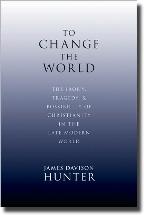
to change the world.jpgMore powerful, however, is a blazing bit of passionate scholarship, several years in the making, by one of the premier sociologists working today, University of Virginia’s esteemed professor and author, Dr. James Davison Hunter. The brand new and magnificent To Change the World: The Irony, Tragedy, and Possibility of Christianity in the Late Modern World (Oxford University Press; $27.95) will surely be regarded as one of the most important serious books about faith and culture published in many a year.

  We have heard bits and pieces of this—Hunter has published in Comment and has done some public forums over the years—and we are thrilled to commend it. People who read, as I always do, the thoughtful “Doggie Head Tilt” essays of Mike Metzger at the Clapham Institute blog, or the beautiful work of Steve Garber’s Washington Institute on Faith, Culture and Vocation may resonate with this; it is deeply political and yet not partisan, interested in helping folks relate “Christ and culture” in ways that have integrity, and are transforming, without being ideological. It seems to me that this book will appeal to many of our most valued friends and customers.

 I am not prepared to say much about it as I’ve only studied the footnotes (wow!) and the table of contents and the first section.  Well, okay, I’ve dipped in and read whole pages here and there, including some of the last pages (gasp.)  It is, as I’ve expected, serious, thoughtful, lucid, even beautiful at times. It seems even-handed as he critiques the simple ways in which the religious right and religious left interact with the cultural givens, and their general model for how they approach social change.  He offers serious criticism of each approach, and also to the views of a third tradition or model, one found in the anti-Constantinian views associated with Stanley Hauerwas, John Milbank, and
others in the “radical orthodoxy”  and “new monastic” movements.  His critique of their increasingly significant movement is insightful and important, or so it seems. 

I was chided the other day in the BookNotes comment section for saying a certain view was “silly” and I hope you read that comment and my reply.  It is important stuff.  Hunter more elegantly describes a concern that is close to what I was suggesting.  He is like a caring doctor who is good at diagnosing our deepest illnesses. He writes about those (like myself, perhaps) who emphasize a “Christian worldview” and have a certain degree of idealism. We can change the world for Christ–not like the simplistic and moralistic right and left, but by truly understanding and thinking faithfully about every zone of life.  We reject dualism and Gnosticism and want to get involved in the real world!   Yet, this very idealism seems sometimes to fail to deal with policies on the ground, with historic social forces, with givens–that is, with reality.  (In my response to one who thought I was being critical of conservatives I explained that I was rather dismissing those who think that just giving money to private charities is all one must do to be faithful to the call of justice, as if in our globalized and complex world, real policies and politics can be avoided, as if we spiritual people are somehow above it all.)  Well, Hunter notes that there is an irony in those of us who hold out such idealistic hopes.

…the idealism expressed in the worldview approach is, in fact, one manifestation of the very dualism its proponents are trying to challenge.  Idealism reinforces that dualism by ignoring the institutional nature of culture and disregarding the way culture is embedded in structures of power.

I am not sure exactly who he means, here, and I don’t think it is me, exactly. I agree with him: no, we dare not ignore institutions, nor disregard culture or “structures of power.”  Hunter is correct here. Both the right and the left—Beck and Wallis, if you will–are guilty of confusions that Hunter goes to great, great lengths to document, discuss and explore.  He isn’t unkind, but he is firm, and there is just enough documentation here to keep the research interesting and focused.  I keep skimming it looking for signs of it being too dry or too heavy, and I am happy that on every page I glance at, I am convinced I need to read this carefully, and soon.
hunter.jpgIn three major sections, Dr. Hunter offers penetrating appraisals of these most popular approaches of how we “change the world” and what they each mean by that.  The book explores not only the usual suspects—Falwell, Wallis, Dobson, Campolo, Robertson, McLaren—but he studies those who are about “culture making” (Andy Crouch) or working to “engage” and be relevant to culture, such as the exciting Catalyst conferences and the Fermi Project (Gabe Lyons.)  There is little doubt that Hunter is a premier sociologist who has done his field work within the recent renaissance of evangelical social, cultural, and public work.

Hunter invites us to witness to God’s redemptive work in the world in a way that is theologically rooted and culturally realistic, with a manner and framework that is both faithful and fruitful.  He is interested in the work of the “grass roots” yet I am sure he pays attention to “cultural elites” and those who can most effectively shape culture in humanizing and Godly ways. (“Does change come from the bottom up or the top down” may be a simplistic question, but it approaches some of his topic, shows at least some of what the book is about.)  A few respected friends of ours have been in discussion with him, and they have summarized their view by calling for a “faithful presence.” (For those who might care, I don’t think they mean this in the way Thomas Merton, Dorothy Day, Jim Douglas or Dan Berrigan talked about it, by the way.) This critique of popular modes of faith-based action and a call to think in new ways about the very nature of our involvement in the world is vital, urgent, and I suspect will have very much wisdom to it, even if some will find fault.  People smarter than I will be weighing in on it.  We think it is going to be much-discussed.  We are very glad to be able to announce it here and offer it now on sale, inviting you to think seriously, hoping it generates articles, papers, conversations, initiatives and faithful work, big and small, in your town and mine.

One easy way to get into this conversation is to listen to him talk about the book with the always incisive interviewer (whose perspective will be quite congenial to Hunter’s, by the way) former NPR journalist Ken Myers.  His spectacular Mars Hill Audio Journal recently interviewed Mr. Hunter (and, on that bi-monthly issue, also interviews James K.A. Smith, Tom Long on funerals, a philosopher of Christian education, and some other fine thinkers.)  You can download it electronically or subscribe to get the CD each month at Mars Hill Audio, here.

If you want to read a quick bit about him, the great folks at Trinity Forum have a bio, here.  More helpfully, here is a speech he delivered to some gathered by the Forum, and you can read it–not exactly the book, but close.  Do come back and order it from us if you like.

Jim Wallis is right that the Bible calls for justice.  Glen Beck is wrong to rail against him with such religious ignorance and talk-show animus.  We should read Sojourners (the only magazine we continue to stock in the store) and buy his books, like The Call to Conversion or Rediscovering Values that I highlighted in our last post.  Even if they aren’t all they could possibly be (how few books are) they are good.  They take us part way towards renewal and faithful living, and they are interesting and helpful.

To Change the World: The Irony, Tragedy, and Possibility of Christianity in the Late Modern World may not come next for readers new to this stuff,  as it is a fully different sort of scholarly work. It is remarkable and important, but it is going to be slow going for some.

Paul Marshall’s excellent and thoughtful book about faith and politics, which I cited above, is important as a “next step” of public theology and balanced social thinking after Wallis.  Ron Sider’s Scandal of Evangelical Politics comes to mind, and is impeccable—a H&M favorite. More generally,  I do continue to love Andy Crouch’s fun Culture Making and recommend it strenuously, hoping it continues to be bought and discussed. The tremendous new re-issue of the Os Guinness’ mystery novel about the church allowing itself to be undermined by our involvement in culture, The Last Christian On Earth, (scroll back a few entries to see our announcement of it) gets us ready for this large, deep conversation, too, and I can’t recommend that enough to thoughtful readers. Guinness fans will know the connection to Hunter.  D.A. Carson released a book two years ago on Eerdmans called Christ and Culture that is a bit dry, and a bit academic, but, again, is important for those building a library and vocabulary of working towards Dr. Hunter’s topic.  It is important work.  

Yet, for those already thinking about this mind-boggling conversation, activists and scholars and anyone wanting to
be well-informed and well-read on faith-based reflections on authentic social change at the start of our new century, “late modernity” as it is, To Change the World is simply a must. Rave, rave endorsements on the back are from Nicholas Wolterstorff, Charles Taylor, Robert Bellah, and Timothy Keller.  It will be years, I’d guess, until it comes out in paperback, and it will not be matched anytime soon, I’m sure. You ought to get it.  Join the conversation.  Thanks for caring–for God and God’s world.

BLOG SPECIAL
To Change the World
James Davison Hunter
more than 20% off
regularly $27.95
NOW $21.95
Order Here
(takes you to the secure order form page at Hearts & Minds)

Hearts & Minds 234 East Main Street Dallastown, PA 17313     717.246.3333

Rediscovering Values: On Wall Street, Main Street and Your Street and The Call To Conversion

READ JIM WALLIS FOR YOURSELF

I was on the Beck bandwagon, off the bandwagon, but now back on the bandwagon.  I think I was among the first to sign a Facebook petition with Bread for the World, a bi-partisan Christian citizens group that works on legislation against hunger and poverty, against the dumb comments by Glen Beck (who, now famously, had said that if your church talks about social justice you should quit that church ASAP, since social justice is not part of the gospel.) I twittered and Facebooked that BFW call to reject Beck’s foolishness.  Bread for the World is a fine organization, and a good illustration of our conviction that God’s reign—Christ as Lord!—must be professed and lived out in every zone of life.  Even in politics, we are called to be good citizens and pray and work for the cry of Psalm 72: “Give the king thy justice, O Lord” for we know (Isaiah 1:10) that the Lord hates unjust legislation. And, amongst other things, good laws help ensure each gets their due, including the poorest among us.  (See The Rising of Bread for the World: An Outcry of Citizens Against Hunger by Art Simon (Paulist; $16.95) for a wonderful study showing how BFW does that.) Jesus’ first sermon is an allusion to the Year of Jubilee, which surely had public, economic, even political implications.  Being social creatures (that is how the Holy Trinitarian God made us) who live in the world of society, culture, governments, policies, international banking and business, it is just silly (it is beyond silly) to suggest that we should only help people privately, through charity.  Yes, public justice is part of what God intends for his world. Glen Beck is just wrong.

(As are some who have listed our bookstore as a dangerous place, for this same reason.  They have gone on record saying that if verbal evangelism isn’t done first and foremost, even relief efforts like saving children from the rubble in Haiti is wrong, and anyone who supports such efforts is approaching heresy.  They believe in burning books, too, so you can imagine how spooked we were by their toxic religion and false accusations against us.  I would imagine they like Glen Beck.)

Still, I determined not to write about the Beck fiasco, not to re-tweet any of the many twitter comments I’ve seen, not even watch the spoofs on youtube.  I thought it would run its course and that would be that.

Then Sojourners got involved, my old friend Jim Wallis asked to appear on Glen Beck’s show, and Beck got scary-weird talking about how the “hammer was going to pound over and over” on Wallis and his “cute little organization.”  If you don’t know (and God bless you if you don’t) about this, it was truly bizarre, as Beck made these ridiculous quasi-accusations and threats to Jim and the Sojo gang.  I am embarrassed for my friends who like Mr. Beck; this was so ugly and over-the-top odd.  Is he often like that?

Still, the showdown was a bit too sensational for me, and while I’ve got every back issue of Sojourners since the earliest Post American days, I don’t think they are always correct, and not always the most insightful or Biblically faithful. Mostly, I was bored by the prospect of a Jim vs Glen smack-down, which seemed just too predictable.

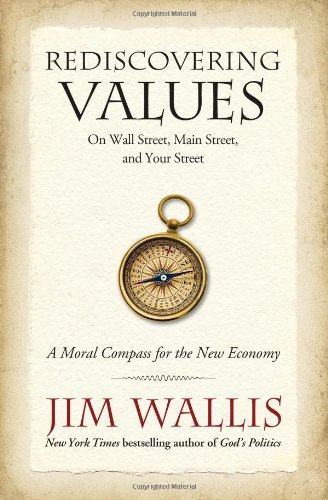
rediscovering values.jpgAnd then I recalled how much I truly like most of Jim’s books, including the new one Rediscovering Values: On Wall Street, Main Street, and Your Street—A Moral Compass for the New Economy (Howard Books; $24.00.)  It is so hopeful and insightful, so reasonable that even a popular conservative speechwriter and pundit (Mike Gerson, who I respect immensely) writes of it:

“One does not need to agree with Jim Wallis on everything to find Rediscovering Values insightful and timely.  In our current economic struggles, Wallis sees an opportunity, not just for recovery, but for a renewal of important, neglected ideals.  This is a needed voice.” 

Or, hear this from Leith Anderson, now the President of the conservative National Association of Evangelicals, who says:

“Agree or disagree—Jim Wallis touches your heart, stretches your mind, and challenges your values.  He thunders like an Old Testament prophet, yet he is gentle and gracious. With a heart for people and a dream for a better tomorrow, Jim Wallis looks tough times in the eye and talks of hope.”

Wallis very convincingly makes the case that our financial crisis is not a matter of numbers, of misunderstood economic theory, not even of a few bad eggs and their gratuitous greed.  It illustrates a moral crisis of our culture, and, as such, it demands spiritual answers.  We are living into and out of the wrong story, and it must be replaced with a new, better Story.  As Wallis makes clear, our deepest and most ecumenical faith traditions call us to care about the common good (social justice, included) and that from our personal lives to our work lives, our banking and shopping to our voting and politics, our family habits and our recreation, we have to live differently, based on gospel values.  To do that, we must have our deepest commitments change.  To use the language Jim used to use more passionately as a younger, radical evangelical, we need converted.

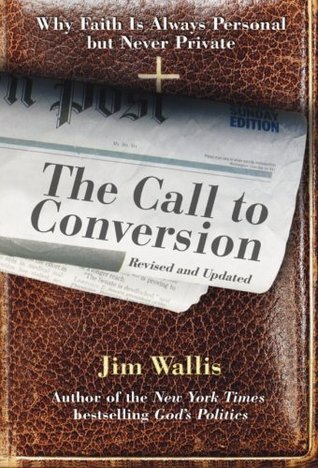
I still think Jim’s most substantial and helpful book is his classic Call to Conversion: Whycall to conversion.jpg Faith is Always Personal But Never Private (HarperOne; $13.95).  With the exceptional popularity of his God’s Politics book and group guide Living God’s Politics a few years ago, HarperOne quietly re-issued his late-70s classic, edited, expanded and up-dated for the new century.  I am happy to say it is one my all time favorite books.  I’ve read out loud from his section on Christ as Lord countless times, and greatly appreciate his chapter on community.The chapter on peacemaking is important and clear, and the one chapter on poverty nearly says it all. Check out the “Bible and the newspaper” cover design, alluding to the famous Barth quip. I really do recommend it.

We will offer it at a special sale price, too (see below.)

The new one Rediscovering Values is wonderful, too, in part because it is so sensible, so clear, so interesting. (I dare you to read his part about playing baseball with his boys and not be touched. I have been challenged each time I’ve read his piece about our calendars and schedules being “moral documents.”)  He has a good, if brief, chapter on the meaning of work, and it is evident that his view of culture transcends the simple polarities of liberal or conservative.  I think this “moral compass” will speak to anyone who has pondered not only how we got in our economic mess, but how we might get out of it.  That is, not just “get out of it” and back to “normal” but how to re-imagine what “normal” is.  Do you know the old Bruce Cockburn song–about these very themes of economics and injustice, standards of living, corporations and state violence–called “The Trouble With Normal”? (Listen here (studio) or here (live). Of c
ourse, the famous line answers—“it always gets worse!”

We must not desire to go back to normal, the economics and worldview and way of life that gave rise to the crisis of recent years.  This time can be a time of reappraisal, and Rediscovering Values is a guide to the conversations we simply must have if our culture is not going to “always get worse.” We can use this window of time, and this book, as an opportunity to ask some hard questions of ourselves.

From the biggest forces on Wall Street to the very lifestyles in our homes and neighborhoods, we must repent.  And live in, as the Lutheran liturgy nicely words it, “in newness of life.”

* * *
I also got fired up to post on this (after previously determining not to) when I read this important report and rebuttal that Jim wrote.  Beck accuses Jim of being a Marxist, and he seems to imply Dorothy Day was a commie, too. (He does this by playing fast and loose with some audio tapes, like Jerry Falwell used to do with Alan Boesak and Desmond Tutu in the anti-apartheid struggle.)  If you click on that link, you will hear a live audio of a conversation between Dorothy and Jim. Have you read her autobiography, The Long Loneliness?  It is a classic, you know.

When I think of how Sojourners introduced me to Dorothy Day, to Oscar Romero, to John Perkins, to Phil Berrigan, to John Howard Yoder, all solid Christians who suffered much for their faith, and how my life and faith has been edified by the long-standing call to conversion and justice by Sojourners, I wanted to again go public with my frustrations with Beck’s immoral and dishonest accusations and applaud Jim’s reply.  I hope my conservative friends who esteem Beck will hold him accountable.  He is just out of line, dead wrong about the Bible, and wrong about Wallis. And wrong about the way he’s doing it all.

Best, though, is skip him, and read Wallis for yourself.  Since he is dedicating so much time this week to spreading misinformation about Wallis, I know you know people who have heard this, and who may wonder.  It is important that some of us have these books under our belts, ready to be loaned out.  Why not form a study group–maybe Beck fans and Sojo fans,even– and discern for yourself.  Is Rediscovering Values consistent with a Christian perspective?  Can it be a “moral compass for the new economy”?  How about The Call to Conversion?  Have you heard that call lately?

BLOG SPECIAL
Call to Conversion: Why Faith is Always Personal But Never Private
regularly priced $13.95
sale price $10.00

Rediscovering Values
regularly priced $24.00
sale price $17.00

ORDER HERE
(takes you to the secure Hearts & Minds order form page)

Hearts & Minds 234 East Main Street Dallastown, PA 17313     717.246.3333

brand new Tim Keller DVD curriculum Gospel in Life

building.jpgTHE GOSPEL IN LIFE: GRACE CHANGES EVERYTHING

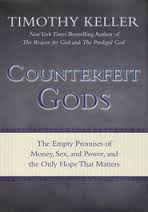
I can’t begin to tell you how excited I am about this. I am obviously not alone in my huge appreciation for Rev. Tim Keller, author of four books that we have happily promoted here.  From his earliest book Ministries of Mercies to his nearly classic Reason for God, to his small, astute hardcovers (Prodigal God and Counterfeit Gods) Keller has been an author of elegance and class and serious content. If you don’t know his books, I suggest them.

That he is culturally engaged and socially relevant–and yet theologically conservative/orthodox—makes him a very interesting character, indeed. (One New York Times article about him captures this, with an allusion to the ultra-hip Village Voice: “Preaching the Word and Quoting the Voice.”)   His growing and fruitful Redeemer church plants in New York city are renown for attracting sophisticated young seekers, offering them relevant, robust faith construed in energetic, but historically orthodox ways.

gospel in life.jpgIn many ways, Keller is a symbol, these days, a man and a movement that is attempting to “seek the peace of the city” and encourage culture-making, urban restoration, and a significant integration of faith and the work-world, all of this by plumbing the depths of standard Reformed theology, the call to live vocationally and missionally soli deo gloria.  I am only trying to conjure up a bit of an image, but it seems Keller is a bit of old school Puritan (think Edwards on the beauty of God or Baxter on spirituality) with a healthy appreciation for the “all of life redeemed” worldview of Abraham Kuyper and Francis Schaeffer, with a passion for compassionate social involvement and a disinterest in faddish “contemporary” worship. (Granted, Redeemer is fortunate to have members of the Metropolitan Opera and Broadway stars in their choir or worship team so they can offer traditional services with great excellence and power.)  He takes the callings and marketplace context of his parishioners seriously.  He even wrote a chapter about this–being a pastor to artists–in the Square Halo anthology It Was Good: Making Art to the Glory of God.

It has been our experience that more mainline pastors seem to appreciate that Keller deeply theological, rooted in classic stuff, is morally serious and engaged and not trendy or programmatic the way some wanna-be-hip independent churches may be these days. (He reads Eugene Peterson, of course.)  Evangelicals like his solid doctrine and his constant emphasis on the first things of the gospel.  Urban activists and the urban sophisticates like his thoughtful style, his passion for the city, the way Redeemer and its outgrowth ministries are so obviously multi-ethnic. Seekers appreciate his candor and clarity.

And, so, we’ve been encouraging people to read his stuff.  We’ve recommended the Prodigal prodigal god.jpgGod book and rejoiced when a DVD curriculum was released in 2009.  (Just a few days ago a United Methodist pastor friend told me recently how much his congregation has appreciated using this DVD as a Lenten study.) The book and teaching DVD present the “older brother” in the parable as the key figure: it is about those who think they can earn or deserve the blessings of God since they played by the rule and not “blown it” like the younger, rebellious brother.  God is the extravagant one, prodigal to the younger son, but the story (told, as it was, to the Pharisees) is finally an offer of grace to those who have kept their noses clean, those who have done the right things, the middle-class church-goers who may not even know they need such grace.  Great and urgent stuff for our congregations, a great way to recall the essence of the gospel. Read my brief review here.                                                               
counterfeit gods.jpg 
I’ve raved about his more recent Counterfeit Gods which is about money sex and power and is the best study of its kind.  If you’d like, you can read my brief description here. Scroll part way down–it was in the “best books” list for 2009.  As it gains popularity, we are hearing more stories of how it has impacted people’s lives, how profoundly it is being taken, how important it is.  Thank goodness!

THE GOSPEL IN LIFE: GRACES CHANGES EVERYTHING

gospel in life.jpgNow, this: oh, wow, am I excited.  This is the grand overview, the foundational worldview that sees that Christ’s gospel is not just about being forgiven, or going to heaven but is the force for real transformation, of people and structures and cultures.  This is the power of God’s saving grace to impact persons, churches, and neighborhoods.  This is Keller at his most classic, offering well- produced, content-rich, Bible and theological teaching for ordinary churches.  I suspect that this is going to bear fruit for decades to come.  As he puts it in the subtitle–a real theme of true Christianity of any sort, but an emphasis of his own Presbyterian and Reformed heritage—“grace changes everything.”  Christ’s death on the cross is not just a simple atoning matter that gets us to heaven, but is gracious power for daily living.  It is the Kingdom come, Christ’s victory over all manner of evil, even as we suffering in a fallen world.  It is new energy for service, and increasingly being given the gift of inner transformation.

Here are the allusive titles and the subtitle for each serious lesson:

1.  City  The World That Is
2.  Heart  Three Ways to Live
3.  Idolatry  The Sin Beneath the Sin
4.  Community  The Context for Change
5.  Witness  An Alternative City
6.  Work   Cultivating the Garden
7.  Justice  A People for Other
s
8.  Eternity  The World That Is To Come

The lectures are not much more than 10 minutes each.  They are designed to be discussed, using the workbook.  Both the book and DVD are published by Zondervan.

The workbook is hefty (233 pages) a much, much better-than-average study book, that includes readings to do before the viewing of the DVD, and a substantial amount of leaders notes, too.  It is the “discipleship course” many of us have been waiting for.  You can see part of a sample lesson, here.

The  study book  usually costs $10.99.     Our price is  $8.25
The  8-week DVD usually costs $24.99.    Our price is  $18.75
You can buy a package of the two together (saving $4.00) for $31.99. Our price is $24.00

Watch a trailer to the DVD here, watching Keller explain what it’s all about. 

keller.jpg

.ORDER HERE
ask for the special blog discount
or call
717.246.3333

Hearts & Minds 234 East Main Street  Dallastown, PA  17313     717.246.3333

.
 

Love: The Ultimate Apologetic and Manifold Witness: The Plurality of Truth

After reading a Newsweek article about religion (or the lack thereof) at Harvard I wrote a long-winded post for our March monthly column.  I cited books like The Myth of Religious Neutrality (Roy Clouser) and a few resources on faith, science, postmodernism, reason and such.  I hope you visit that column as we are passionate about offering resources for those who need to engage this conversation about truth and pluralism and secularization and witnessing with credibility amidst the new atheism and culture wars. 

Two things came to mind, though, as soon as I hit the send button.

FIRST

In any debate about worldviews, Christians know that Jesus says that love wins.  That we are to always “speak the truth in love” and that, supremely, all will know who Jesus is “if you love one another.”  As Francis Schaeffer, a cultural critic and pastor to the counter culture of the 60s, himself quite a terse speaking defender of the truth claims of the gospel, put it, love is the “final apologetic.”  His book The Mark of a Christian (Inter-Varsity Press; $6.00) is still quite a little gem.  Do you know it?  It is one of Schaeffer’s most enduring small essays.

love the ultimate apologetic.jpgThe book I most wanted to add to that list, though, is a thoroughly contemporary update of that sweet thesis, and is called Love: The Ultimate Apologetic: The Heart of Christian Witness by Art Lindsley (IVP; $15.00.)   It is a truly great book.

Art, a staff teacher in the Washington, DC-area C.S. Lewis Institute, has done extraordinary work on apologetics.  A chapter from his True Truth: Defending Absolute Truth in a Relativistic World–a book where he shows the difference between absolutes and absolutism-—is excerpted in the prestigious new collection Belief: Readings on the Reason for Faith by Francis Collins (HarperOne; $19.99.) Art’s fabulous book called C.S. Lewis’ Case for Christ explores the journey of thought that the famous Oxford atheist undertook to finally conclude and commit to the truth of Christianity.  The subtitle shows Art’s good insight into the multi-dimensional avenues Mr. Lewis explored and commends to us all: “insights from Reason, Imagination and Faith.”  Lewis was a rigorous thinker, but no rationalist.  Those struck by the harsh rationalism cited in the Harvard Newsweek story, like those by the popular and pleasant–but reductionistic— Steven Pinker, might want to consider Lindsley on Lewis.

Still, always and everywhere, love is the answer.  Which is why after years of a career teaching and writing and doing apologetics, promoting “true truth” alongside our great communicators such as Ravi Zacharias, Lindsley knew he also had to write about love.  There isn’t much on this topic, and few books are devoted to the apologetic impact of a generous and kind spirit.  Few books tell you how to be more loving amidst intellectual sparring.

As I was suggesting titles about reason and faith and truth and science and pluralism and worldviews I was remiss not to add this.  Love: The Ultimate Apologetic is very highly recommended.

SECONDLY

There is another big mystery, another significant, large claim about this business of what constitute truth.  It is a claim that some are showing, a radical but serious idea: that truth is known in community. This is the stunning and audacious (and, some are saying, particularly Reformed) insight of John F. Franke in his Manifold Witness: The Plurality of Truth (Abingdon; $18.00.)

manifold witness.jpgYou may know that the emergent village has a series that is edited by Tony Jones, called the “living theology” series.  This is a recent one (the brand new one is by Andrew Root.  More on that later.)  Brian McLaren has a lovely forward, showing four reasons why this book is so enjoyable and interesting and well worth your investment.

Brian notes that, firstly, it is beautifully written.  Although a complex study of epistemology, it isn’t laden with technical jargon.  Secondly, it is wonderful to see a white male theologian so sensitive to the concerns of non-white, minority voices.  Thirdly, Brian (as has Scot McKnight) notes just how darn Reformed this idea is.  Not that it restates dogma as frozen in the past, but in that it exemplifies the Reformation ideal of the church always reforming. Yes, we always need to be growing, exploring, re-stating and re-formulating.  Finally, there is the actual claim of the book: truth is plural.

I can’t explain it all here, but I agree with Brian that this is a wondrous work, a lovely book, well written, nicely designed, and clearly argued.  It illustrates, as Lamin Sanneh puts it, that “faith is embodied, that theology is rooted in practice and experience, and that the gospel shapes and is shaped by culture.”  It is a work that will be of interest of those who have been reading Desiring the Kingdom by James K.A. Smith, which also studies the interface of  theology and practice, worldview and way of life, convictions and interpretation.

Manifold voices are a good thing.  That’s a good thing, too, because, like it or not, that is how the Bible is written, and that is the nature of our world, especially as we in the West admit to the global nature of the Christian community.  I ended my long review the other day with a reminder of Os Guinness’ Case for Civility, suggesting that it is urgent that we make space for ideological diversity (something the fundamentalists on the right and left don’t seem to desire) or we will be torn asunder as a culture.  Maybe alongside Os’ passionate call for social structures informed by the first amendment, we should remind ourselves of the deeply communal nature of the Christian tradition, the multi-dimensional ways of knowing.  Kudos to Franke and to the “living theology” series for this intriguing, graceful, provocative meditation, Manifold Witness: The Plurality of Truth.  I hope many consider it, read it and talk about it.  We’re offering it on sale, below.  

BLOG SPECIAL
Love: The Ultimate Apologetic
and/or
Manifold Witness: The Plurality of Truth
Buy one 10% off
Buy two 20% off

Order Here

Hearts & Minds 234 East Main Street  Dallastown, PA  17313     717.246.3333

Longer review article just posted at the March monthly review column

Hey, BookNotes friends—just did a longer review article over at the monthly review column (March 2010.)  I ruminated a bit on the religion vs faith debate–a dumb way to frame it if you ask me—inspired by an interesting article in Newsweek about the controversy at Harvard University about the study of religion (or lack thereof) in their liberal arts curriculum.

The article got me thinking about how religion is considered some separate side of life that can be studied, instead of the deepest worldview from which the study is happening.  This is hugely complex, but we’ve got some books that can help–I’m sure of it.  So I rambled and I listed a handful of titles, some new, and a few older ones that came to mind as helpful for anyone navigating this complex conversation, in our schools, towns, churches.   

Here is the link over to the monthly review column (or you can just click on the top bar of the website, on “reviews.”  There, I have a link to the Newsweek piece about Harvard, and offer a whole bunch of books, all on sale at 20% off. 

Here are just a few of the ones I describe:

belief 3.JPG
Myth of religious Neutrality.jpg

reason for god.png

how postmodernism.jpg
science and its limits.jpg

abolition of man.jpg

case for civility.jpgbetween relativism.jpg

Hearts & Minds 234 East Main Street  Dallastown, PA  17313     717-246-3333